Guiding Questions
● Whatcauses biodiversity loss, and how are ecological and societal
systems impacted?
3.
3.2.1 Introduction
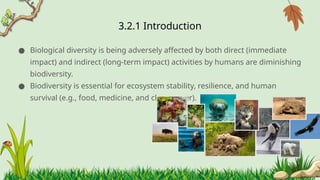
● Biologicaldiversity is being adversely affected by both direct (immediate
impact) and indirect (long-term impact) activities by humans are diminishing
biodiversity.
● Biodiversity is essential for ecosystem stability, resilience, and human
survival (e.g., food, medicine, and clean water).
4.
3.2.1
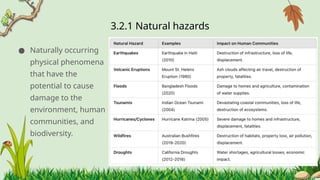
Natural hazards
●Naturally occurring
physical phenomena
that have the
potential to cause
damage to the
environment, human
communities, and
biodiversity.
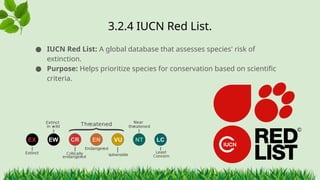
5.
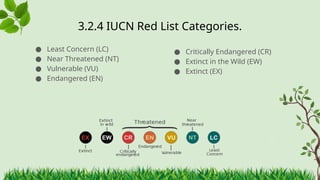
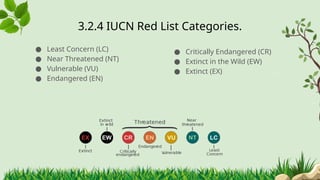
3.2.1
Direct Threats
●Overharvesting: Unsustainable extraction of resources (e.g.,
overfishing, logging).
○ Example: Overfishing of Atlantic cod has led to the collapse of
populations, destabilizing marine ecosystems.
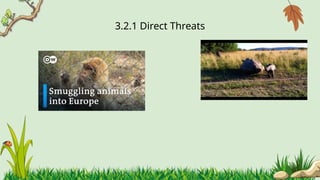
● Poaching: Illegal hunting of wildlife for commercial purposes.
○ Example: Poaching of African elephants for ivory has drastically
reduced their population due to market demand for ivory or
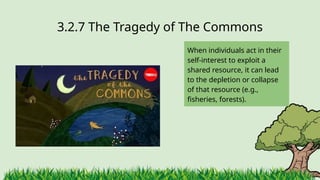
medicinal purposes.
● Illegal Pet Trade: Capture and sale of wild species as pets.
○ Example: Parrot species are captured for trade, leading to
population declines.
3.2.1
Indirect Threats
●Climate Change: Alters ecosystems, shifts species’ habitats, and
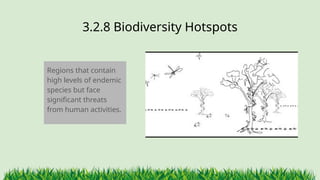
increases stress on wildlife.
○ Example: Polar bears are losing habitat due to melting Arctic ice,
affecting their survival.
● Pollution: Contaminants damage ecosyst)ems, affecting species'
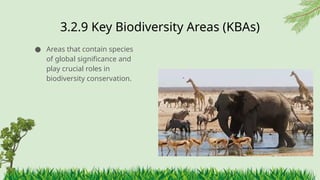
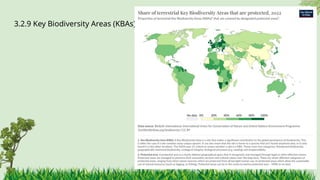
survival and health.
○ Example: Plastic waste in oceans harms marine life, entangles
animals, and degrades food chains. Nitrogen from agriculture
causes dead zones in aquatic ecosystems.
8.
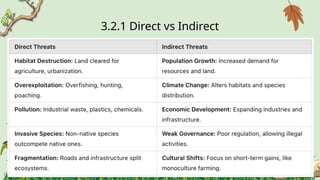
3.2.1 Direct vsIndirect
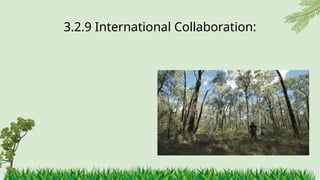
● Climate Change: Alters ecosystems, shifts species’ habitats, and
increases stress on wildlife.
○ Example: Polar bears are losing habitat due to melting Arctic ice,
affecting their survival.
● Pollution: Contaminants damage ecosyst)ems, affecting species'
survival and health.
○ Example: Plastic waste in oceans harms marine life, entangles
animals, and degrades food chains. Nitrogen from agriculture
causes dead zones in aquatic ecosystems.
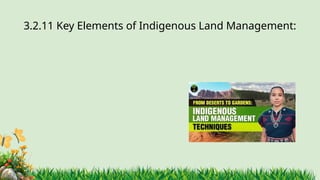
9.
3.2.1
Direct &Indirect Threats
● Activity: Research a specific ecosystem and identify direct and indirect
threats to biodiversity in that ecosystem.
10.
3.2.2
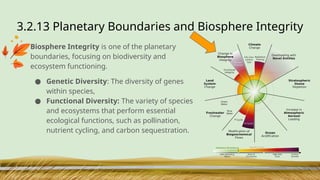
Multiple HumanImpacts.
● Ecosystems face combined pressures from human activity, which
increases vulnerability.
○ Examples of impacts:
■ Deforestation for agriculture (habitat loss).
■ Climate change due to greenhouse gas emissions.
■ Pollution from industry and agriculture, leading to
contamination of land and water.
■
Habitat Loss and Fragmentation
■ Invasive Alien Species
11.
3.2.2
Compounding Effects
●Synergy of threats: One human activity often exacerbates another,
creating more severe impacts.
○ Example: Climate change worsens habitat loss by altering the
climate, reducing species' adaptability.
■ Coral reefs are weakened by rising sea temperatures (climate
change), making them more susceptible to pollution and
invasive species (e.g., crown-of-thorns starfish)
12.
3.2.2
Multiple HumanImpacts.
Application of skills: Investigate the impact of human activity on biodiversity
in an ecosystem by studying change in species diversity along a transect laid
perpendicular to a site of human interference or by randomly sampling
within transects before and after the human activity. (Field study)
3.2.3
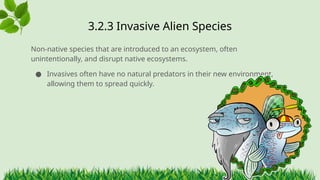
Invasive AlienSpecies
Non-native species that are introduced to an ecosystem, often
unintentionally, and disrupt native ecosystems.
● Invasives often have no natural predators in their new environment,
allowing them to spread quickly.
15.
3.2.3
Impacts InvasiveAlien Species
● Competition for Resources: Invasive species often outcompete native
species for resources (e.g., food, space).
○ Example: The grey squirrel in the UK competes with the native red
squirrel for food, leading to the decline of red squirrels.
● Predation: Invasive species can prey on native species that have no
defense mechanisms against them.
○ Example: The brown tree snake in Guam has led to the extinction of
several bird species.
● Introduction of Disease: Invasive species can bring diseases or
parasites to native species.
○ Example: American crayfish introduced fungal diseases to
European crayfish populations, decimating their numbers.
16.
3.2.3
Pathways ofIntroduction
● Trade and Transport: organisms may be transported in ballast water, on
ships' hulls, or as stowaways in cargo.
○ Example: The zebra mussel, native to Eastern Europe, was
introduced to North America in the ballast water of ships.
● Agriculture: introduced intentionally for agricultural, horticultural, or
landscaping purposes, but later escape into the wild.
○ Example: The cane toad introduced to Australia to control pests in
sugarcane fields but became a highly destructive
● Pet and Wildlife Trade: exotic pets released into the wild
○ Example: The Burmese python in Florida, released into the wild has
established a breeding population in the Everglades,
● Tourism and Recreation: the unintentional transport of seeds, spores,
or small organisms on equipment, vehicles, or clothing.
17.
3.2.3
Economic andEnvironmental Consequences
● Economic Impact: Invasive species can damage agriculture, forestry,
fisheries, and water systems, leading to costly losses.
○ Example: Zebra mussels clog water intake pipes, costing industries
millions in maintenance and control efforts.
● Environmental Impact: Invasive species destabilize ecosystems by
displacing native species, altering food webs, and disrupting ecological
processes, reducing essential ecosystem services like water purification
and pollination.
● Human Health Impact: Some invasive species introduced diseases or
allergens that directly affect human health.
○ Example: Invasive mosquitoes, such as Aedes aegypti and Aedes
albopictus, spread diseases like dengue fever and Zika virus.
18.
3.2.3
Invasive Species- Activity
● Activity: Consider local examples of alien species that have become
invasive and the management strategy that has been used to reduce
their impact
19.
3.2.4
IUCN
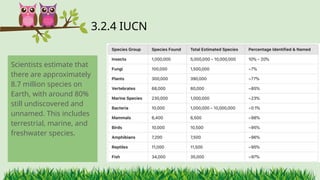
Scientists estimatethat
there are approximately
8.7 million species on
Earth, with around 80%
still undiscovered and
unnamed. This includes
terrestrial, marine, and
freshwater species.
3.2.4
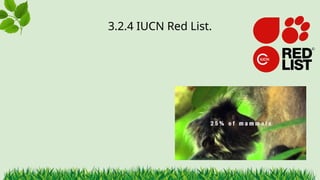
IUCN RedList.
● IUCN Red List: A global database that assesses species' risk of
extinction.
● Purpose: Helps prioritize species for conservation based on scientific
criteria.
22.
3.2.4
IUCN RedList Categories.
● Least Concern (LC)
● Near Threatened (NT)
● Vulnerable (VU)
● Endangered (EN)
● Critically Endangered (CR)
● Extinct in the Wild (EW)
● Extinct (EX)
3.2.4
Criteria forIUCN Red List
● Population Size: Small populations are at higher risk of extinction due to
reduced genetic diversity.
○ Example: The Amur leopard, with fewer than 100 individuals left in
the wild.
● Rate of Population Decline: Rapid decline in population size is an
indicator of high risk.
○ Example: The vaquita porpoise is critically endangered due to
entanglement in fishing nets.
● Geographic Range: Species with a restricted range are more vulnerable
to threats like habitat destruction.
○ Example: The golden poison frog, found only in Colombia’s
rainforests.
25.
3.2.4
IUCN RedList Categories.
● Least Concern (LC)
● Near Threatened (NT)
● Vulnerable (VU)
● Endangered (EN)
● Critically Endangered (CR)
● Extinct in the Wild (EW)
● Extinct (EX)
26.
3.2.5
Raising Awareness
●Assigning conservation status through the IUCN Red List raises
awareness of species at risk.
○ Example: The critically endangered northern white rhinoceros has
garnered global attention, leading to substantial funding for anti-
poaching efforts.
27.
3.2.5
Prioritizing ConservationEfforts
● Governments, NGOs, and individuals use the IUCN Red List to direct
resources toward species in critical danger.
○ Example: The Amur leopard is a priority for conservation
organizations, leading to habitat protection and anti-poaching laws.
● Guiding Resource Allocation: Funds and efforts are more effectively
distributed when species most at risk are identified.
28.
3.2.5
Perspectives onConservation Prioritization
● Government Perspectives: Governments often prioritize species that
impact national interests, ecosystem services, or economic development.
● NGO Perspectives: NGOs often focus on global or regional priorities,
targeting critically endangered or flagship species to raise awareness.
● Individual Perspectives: Individuals contribute to conservation through
advocacy, donations, and personal choices.
29.
3.2.5
Raising Awareness
●Activity: Investigate a species (e.g., Amur leopard) whose conservation
status has improved due to targeted conservation efforts.
30.
3.2.6
Species RedList Status - Activity
● Activity: Investigate three different named species: a species that has
become extinct due to human activity; a species that is critically
endangered; and a species whose conservation status has been
improved by intervention
31.
3.2.7
The Tragedyof The Commons
When individuals act in their
self-interest to exploit a
shared resource, it can lead
to the depletion or collapse
of that resource (e.g.,
fisheries, forests).
32.
3.2.7
The Tragedyof The Commons
● Activity: Research two examples where a resource is overharvested (for
example, fish stocks on the Grand Banks) or where an environment is
contaminated (for example plastic pollution in ocean gyres).
3.2.8
Importance ofEndemic Species
Endemic Species:
● Species that are found only in one specific geographical location, such as
an island, region, or habitat.
● Example: The lemurs of Madagascar or the Galápagos tortoises.
Significance of Endemic Species:
● Often play a crucial role in maintaining the balance of their native
ecosystems.
● These species contribute to the overall biodiversity of the planet, holding
unique evolutionary traits.
36.
3.2.8
Vulnerability toExtinction:
● Habitat Loss: Because endemic species are restricted to a particular
area, they are highly susceptible to habitat destruction (e.g.,
deforestation, land conversion).
● Climate Change: Endemic species are often adapted to very specific
environmental conditions, making them less resilient to rapid climate
changes or extreme weather.
● Invasive Species: The introduction of non-native species can disrupt
ecosystems and outcompete or prey on endemic species.
● Limited Range: Small geographic range means these species have
fewer opportunities to relocate or adapt to changing conditions.
37.
3.2.8
Hotspots Classification
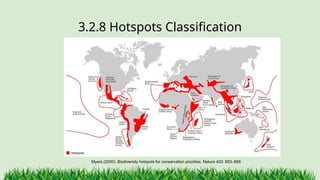
●High Species Endemism: The area must contain at least 1,500 species of
vascular plants that are endemic, meaning these species are found
nowhere else on Earth.
● Significant Habitat Loss: The region must have lost at least 70% of its
original habitat due to human activities.
3.2.8
Threats toHotspots
● Deforestation and Agriculture: Conversion of forests to agricultural
land (e.g., palm oil plantations in Southeast Asia).
○ Example: Habitat destruction in Sundaland is pushing species like
the orangutan and Sumatran tiger toward extinction.
● Climate Change: Rising temperatures threaten ecosystems within these
hotspots (e.g., coral bleaching in the Coral Triangle).
● Habitat Fragmentation: occurs when continuous habitats are divided
by human activities such as road construction and logging
● Overexploitation of Resources: overexploited for food, medicine, or the
illegal wildlife trade
41.
3.2.8 Hotspots -Activity
Activity: Research and specific hotspot.
● Describe the geographical location of the hotspot and the types of
habitats found there (e.g., tropical rainforest, coral reefs, montane
forests, etc.).
● Identify the Threats to the Hotspot
● Explore Current Conservation Efforts:
42.
3.2.9
Key BiodiversityAreas (KBAs)
● Areas that contain species
of global significance and
play crucial roles in
biodiversity conservation.
3.2.9
Importance ofKBAs
● Ecosystem Services: Many KBAs are responsible for critical ecosystem
services (e.g., carbon sequestration, water filtration).
○ Example: The Amazon Rainforest is a vital carbon sink and habitat
for thousands of species.
46.
3.2.9
Key BiodiversityAreas (KBAs)
● Support for Endangered Species: KBAs are home to species listed as
Vulnerable, Endangered, or Critically Endangered on the IUCN Red List.
● Unique Ecosystems: KBAs often harbor ecosystems that are globally
unique or irreplaceable.
● Global Ecological Contributions: Many KBAs play an essential role in
regulating the climate, sequestering carbon, purifying water, and
maintaining soil health.
47.
3.2.9
Examples BiodiversityAreas (KBAs)
● Amazon Rainforest: Home to an estimated 10% of the world's known
species, the Amazon plays a critical role in regulating global climate.
● Western Ghats (India): This biodiversity hotspot is home to many
endemic species and supports a variety of ecosystems.
48.
3.2.9
International Collaboration:
●BirdLife International: focus is on bird species and their
habitats, identifies Key Biodiversity Areas (KBAs), promotes
sustainable land-use practices, and advocates for policy changes
to protect biodiversity.
● Conservation International: works globally to safeguard
critical ecosystems, engages local communities in conservation
efforts., influences global policy and secure funding for
conservation projects.
3.2.10
Conflicts inKBAs
● Natural resources in KBAs are often targeted for economic activities (e.g.,
mining, logging), leading to conflict between economic interests and
conservation goals.
51.
3.2.10
Types ofConflict in KBAs
● Economic Exploitation: Logging, mining, and agriculture generate income
but cause habitat destruction and biodiversity loss.
● Sustainable Development: Efforts like eco-friendly agriculture,
sustainable forestry, and ecotourism aim to balance economic needs with
conservation, though this balance is often difficult to achieve.
● Conservation: Focuses on protecting species and ecosystems through
protected areas, resource regulation, and community engagement.
● Resistance: Conservation efforts can face resistance from local
communities relying on resource extraction for their livelihoods
52.
3.2.10
Challenges inManaging Conflict in KBAs
● Sustainable Resource Management: Implement eco-friendly agriculture,
responsible mining, and sustainable forestry to minimize environmental
damage while supporting local livelihoods.
● Community Engagement: Involve local communities in KBA management
to ensure resource use aligns with conservation goals and local needs.
● Stronger Environmental Regulations: Strengthen and enforce laws to
combat illegal activities like poaching, logging, and mining in KBAs.
● Eco-Friendly Alternatives: Promote ecotourism and sustainable farming
to provide economic benefits while preserving ecosystems and reducing
harmful activities.
53.
3.2.10
Examples ofConflicts
● Palm Oil in Indonesia: Large-scale deforestation for palm oil plantations
threatens biodiversity in key areas like Sundaland.
● Mining in the Western Ghats: Mining for resources such as iron ore has
degraded habitats, affecting freshwater ecosystems and endemic species.
54.
3.2.10
Key BiodiversityAreas (KBAs)
● Activity: Identify and research Key Biodiversity Areas (KBAs) conflict.
Identify the conflict, economic exploitation and conservation
55.
3.2.11
Environmental Justice
●Ensuring the fair distribution of environmental benefits and burdens
across all populations, especially marginalized communities.
56.
3.2.11
Vulnerability ofMarginalized Communities
● Impact on Indigenous and Low-Income Communities: Often the first to
experience the adverse effects of biodiversity loss, such as reduced access
to natural resources.
○ Example: The Maasai people of the Serengeti were displaced for the
creation of a national park, losing access to grazing lands.
3.2.11
Key Elementsof Indigenous Land Management:
● Place-Based Practices: Indigenous land management is closely tied to
specific local environments, making it unique and not easily transferable to
other regions.
● Sustainability: Indigenous communities manage resources sustainably,
maintaining ecological balance and operating within planetary boundaries.
● Traditional Knowledge Systems: Indigenous peoples hold valuable
ecological knowledge, passed down through generations, essential for
sustainable biodiversity conservation.
59.
3.2.11
Free, Prior,and Informed Consent (FPIC) in Conservation
A principle that ensures indigenous peoples can approve or reject projects
affecting their lands.
Key Elements:
● Free: No coercion or pressure.
● Prior: Consent is sought well in advance.
● Informed: Communities are fully informed.
● Consent: Power to say "yes" or "no."
60.
3.2.11
Free, Prior,and Informed Consent (FPIC) in Conservation
● Empowers Indigenous Communities: Ensures their voices are central to
conservation decisions.
● Protects Rights: Safeguards cultural and economic ties to the land.
● Supports Sustainable Conservation: Projects aligned with indigenous
practices are more successful.
Example:
● In Ecuador, FPIC helped indigenous communities protect the Amazon from
harmful industrial projects.
61.
3.2.11
Threats toIndigenous Sustainable Land Management
● Population Growth & Economic Development: Traditional practices, such
as rotational farming, are now practiced at larger scales, causing
environmental degradation.
● Climate Change: Climate shifts reduce ecosystem resilience, shorten
fallow periods, and decrease soil fertility in indigenous farming practices.
● Lack of Governmental Support: Governments often prioritize large-scale
projects over indigenous practices, causing land degradation.
● Adoption of Global Development Models: Some communities replace
traditional practices with short-term economic models like monoculture
plantations, harming biodiversity.
62.
3.2.11
Ethical Issuesin Conservation and Indigenous Practices
● Displacement and Land Use Conflicts: Indigenous peoples are displaced
to create protected areas, undermining their land rights and sustainable
management practices.
● Undermining Traditional Knowledge: Excluding indigenous knowledge
from conservation efforts risks ineffective outcomes and can cause
conflicts between local communities and conservationists.
63.
3.2.11 Vulnerability ofMarginalized Communities
● Activity: Research the threats to a named sustainable traditional
indigenous land management practice.. Discuss how indigenous rights and
biodiversity conservation can be balanced.
64.
3.2.13 Planetary Boundariesand Biosphere Integrity
Biosphere Integrity is one of the planetary
boundaries, focusing on biodiversity and
ecosystem functioning.
● Genetic Diversity: The diversity of genes
within species,
● Functional Diversity: The variety of species
and ecosystems that perform essential
ecological functions, such as pollination,
nutrient cycling, and carbon sequestration.
3.2.13 Impact ofSpecies Extinctions
● Crossing the Threshold: Species extinction rates are now estimated to be
100-1,000 times higher than natural background rates.
○ The loss of keystone species like the sea otter can lead to the
collapse of entire ecosystems.
○ The decline of fish stocks due to overfishing and habitat degradation
is threatening the livelihoods of millions of people who depend on the
ocean for food and income.
68.
3.2.13 Global Consequences
●Ecosystem Collapse: Species loss diminishes ecosystem resilience, leading
to tipping points beyond which ecosystems may not recover
● Disruption of Carbon and Water Cycles:
● Reduced Resilience to Environmental Change:
How might crossing the
biodiversity threshold
impact global food
security?
69.
3.2.13 Evidence forthe Tipping Point Hypothesis
● Sixth Mass Extinction: Human activities are driving a rapid
mass extinction, much faster than past natural events.
● Ecosystem Degradation: Major ecosystems (rainforests, coral
reefs, wetlands) are degrading quickly, risking large-scale
disruptions to life support systems.
● Planetary Boundary: The loss of biosphere integrity has
crossed a critical threshold, threatening a shift to a less
hospitable Earth.
70.
3.2.13 Strategies toPrevent Crossing the Tipping Point
● Protecting Hotspots: Focus on conserving regions with high
endemism and threat levels to protect species at high risk of
extinction.
● Restoring Ecosystems: Reforestation and wetland rehabilitation can
rebuild biodiversity and improve ecosystem resilience.
● Land Use: Sustainable agricultural, forestry, and fisheries practices
reduce biodiversity loss while supporting economic growth.
● Global Conservation Agreements: International agreements like the
CBD and Kunming-Montreal COP15 set global conservation targets,
such as protecting 30% of land and sea by 2030.
71.
3.2.13 Planetary Boundariesand Biosphere Integrity
Activity Research a tipping point scenario where biodiversity loss could
have global consequences (e.g., coral reef collapse due to ocean
acidification, loss of tropical forests).
● What are the ecological and social impacts?