The film starts without
diegetic/non-diegetic
sounds.
Already it sets the
scene, creating a very
quiet, lonely
atmosphere. The use of
blue also connotes
similar feelings.
Establishing shots and
slow panning shots of a
room are shown, as
slowly introducing us to
the character who is yet
to be revealed.
The first minute goes
through a series of
jump-cuts between
panning/establishing
shots of the room and
opening credits. The
second cut involves
ambience sound
(beach), thus setting as
well as giving life to the
scene.
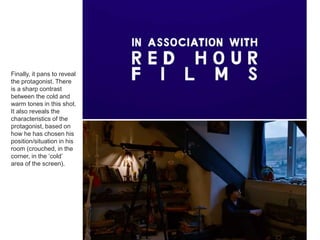
Finally, it pans to reveal
the protagonist. There
is a sharp contrast
between the cold and
warm tones in this shot.
It also reveals the
characteristics of the
protagonist, based on
how he has chosen his
position/situation in his
room (crouched, in the
corner, in the ‘cold’
area of the screen).
At this point, he starts to
narrate/introduce
himself. He is not
physically talking straight
to the camera, but rather
seems like he is very
distant to the audience
and closed off, because
of his posture and
averted gaze.
Alternatively, it can
depict how he is
speaking internally, and
we therefore have
access to his inner
voice/monologues,
meaning we can identify
with him easier.
[clock ticking, zooms in
to the tick]
This shot involves an
image alluding to the
title. Also it brings down
his character, as if he is
depicted being
underwater with the
submarine, which again
alludes to his feelings
and emotions (feeling of
sinking, going to the
unknown, being alone,
etc).
The zoom-in was used
as if to allow us to get
closer to his character
and identify with him.
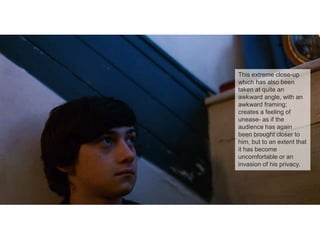
This extreme close-up
which has also been
taken at quite an
awkward angle, with an
awkward framing;
creates a feeling of
unease- as if the
audience has again
been brought closer to
him, but to an extent that
it has become
uncomfortable or an
invasion of his privacy.
Finally, he becomes
aware of the ‘presence’
of the audience. He
regards the viewers,
thus involving them in
the film- in his story.
[Stuck on a Puzzle by
Alex Turner]
A series of establishing
shots of the outside
world follow.
One notable
characteristic of all the
shots that were used
was the absence of
people. Like the
protagonist’s room, it is
isolated, still and quiet.
Submarine FOS

Submarine FOS

  • 2.
    The film startswithout diegetic/non-diegetic sounds. Already it sets the scene, creating a very quiet, lonely atmosphere. The use of blue also connotes similar feelings. Establishing shots and slow panning shots of a room are shown, as slowly introducing us to the character who is yet to be revealed.
  • 3.
    The first minutegoes through a series of jump-cuts between panning/establishing shots of the room and opening credits. The second cut involves ambience sound (beach), thus setting as well as giving life to the scene.
  • 4.
    Finally, it pansto reveal the protagonist. There is a sharp contrast between the cold and warm tones in this shot. It also reveals the characteristics of the protagonist, based on how he has chosen his position/situation in his room (crouched, in the corner, in the ‘cold’ area of the screen).
  • 5.
    At this point,he starts to narrate/introduce himself. He is not physically talking straight to the camera, but rather seems like he is very distant to the audience and closed off, because of his posture and averted gaze. Alternatively, it can depict how he is speaking internally, and we therefore have access to his inner voice/monologues, meaning we can identify with him easier.
  • 6.
    [clock ticking, zoomsin to the tick] This shot involves an image alluding to the title. Also it brings down his character, as if he is depicted being underwater with the submarine, which again alludes to his feelings and emotions (feeling of sinking, going to the unknown, being alone, etc). The zoom-in was used as if to allow us to get closer to his character and identify with him.
  • 7.
    This extreme close-up whichhas also been taken at quite an awkward angle, with an awkward framing; creates a feeling of unease- as if the audience has again been brought closer to him, but to an extent that it has become uncomfortable or an invasion of his privacy.
  • 8.
    Finally, he becomes awareof the ‘presence’ of the audience. He regards the viewers, thus involving them in the film- in his story.
  • 9.
    [Stuck on aPuzzle by Alex Turner] A series of establishing shots of the outside world follow. One notable characteristic of all the shots that were used was the absence of people. Like the protagonist’s room, it is isolated, still and quiet.