Name: ________________________Date: ________________
Section:_______________________Score:________________
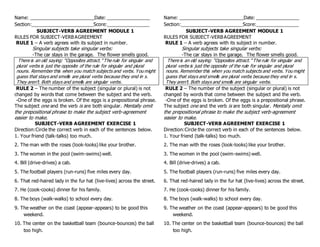
SUBJECT-VERB AGREEMENT MODULE 1
RULES FOR SUBJECT-VERB AGREEMENT
RULE 1 – A verb agrees with its subject in number.
Singular subjects take singular verbs:
-The car stays in the garage. The flower smells good.
There is an old saying: “Opposites attract.” The rule for singular and
plural verbs is just the opposite of the rule for singular and plural
nouns. Remember this when you match subjects and verbs. You might
guess that stays and smells are plural verbs because they end in s.
They aren’t. Both stays and smells are singular verbs.
RULE 2 – The number of the subject (singular or plural) is not
changed by words that come between the subject and the verb.
-One of the eggs is broken. Of the eggs is a prepositional phrase.
The subject one and the verb is are both singular. Mentally omit
the prepositional phrase to make the subject verb-agreement
easier to make.
SUBJECT-VERB AGREEMENT EXERCISE 1
Direction:Circle the correct verb in each of the sentences below.
1. Your friend (talk-talks) too much.
2. The man with the roses (look-looks) like your brother.
3. The women in the pool (swim-swims) well.
4. Bill (drive-drives) a cab.
5. The football players (run-runs) five miles every day.
6. That red-haired lady in the fur hat (live-lives) across the street.
7. He (cook-cooks) dinner for his family.
8. The boys (walk-walks) to school every day.
9. The weather on the coast (appear-appears) to be good this
weekend.
10. The center on the basketball team (bounce-bounces) the ball
too high.
Name: ________________________Date: ________________
Section:_______________________Score:________________
SUBJECT-VERB AGREEMENT MODULE 1
RULES FOR SUBJECT-VERB AGREEMENT
RULE 1 – A verb agrees with its subject in number.
Singular subjects take singular verbs:
-The car stays in the garage. The flower smells good.
There is an old saying: “Opposites attract.” The rule for singular and
plural verbs is just the opposite of the rule for singular and plural
nouns. Remember this when you match subjects and verbs. You might
guess that stays and smells are plural verbs because they end in s.
They aren’t. Both stays and smells are singular verbs.
RULE 2 – The number of the subject (singular or plural) is not
changed by words that come between the subject and the verb.
-One of the eggs is broken. Of the eggs is a prepositional phrase.
The subject one and the verb is are both singular. Mentally omit
the prepositional phrase to make the subject verb-agreement
easier to make.
SUBJECT-VERB AGREEMENT EXERCISE 1
Direction:Circle the correct verb in each of the sentences below.
1. Your friend (talk-talks) too much.
2. The man with the roses (look-looks) like your brother.
3. The women in the pool (swim-swims) well.
4. Bill (drive-drives) a cab.
5. The football players (run-runs) five miles every day.
6. That red-haired lady in the fur hat (live-lives) across the street.
7. He (cook-cooks) dinner for his family.
8. The boys (walk-walks) to school every day.
9. The weather on the coast (appear-appears) to be good this
weekend.
10. The center on the basketball team (bounce-bounces) the ball
too high.

Subject and verb module 1

  • 1.
    Name: ________________________Date: ________________ Section:_______________________Score:________________ SUBJECT-VERBAGREEMENT MODULE 1 RULES FOR SUBJECT-VERB AGREEMENT RULE 1 – A verb agrees with its subject in number. Singular subjects take singular verbs: -The car stays in the garage. The flower smells good. There is an old saying: “Opposites attract.” The rule for singular and plural verbs is just the opposite of the rule for singular and plural nouns. Remember this when you match subjects and verbs. You might guess that stays and smells are plural verbs because they end in s. They aren’t. Both stays and smells are singular verbs. RULE 2 – The number of the subject (singular or plural) is not changed by words that come between the subject and the verb. -One of the eggs is broken. Of the eggs is a prepositional phrase. The subject one and the verb is are both singular. Mentally omit the prepositional phrase to make the subject verb-agreement easier to make. SUBJECT-VERB AGREEMENT EXERCISE 1 Direction:Circle the correct verb in each of the sentences below. 1. Your friend (talk-talks) too much. 2. The man with the roses (look-looks) like your brother. 3. The women in the pool (swim-swims) well. 4. Bill (drive-drives) a cab. 5. The football players (run-runs) five miles every day. 6. That red-haired lady in the fur hat (live-lives) across the street. 7. He (cook-cooks) dinner for his family. 8. The boys (walk-walks) to school every day. 9. The weather on the coast (appear-appears) to be good this weekend. 10. The center on the basketball team (bounce-bounces) the ball too high. Name: ________________________Date: ________________ Section:_______________________Score:________________ SUBJECT-VERB AGREEMENT MODULE 1 RULES FOR SUBJECT-VERB AGREEMENT RULE 1 – A verb agrees with its subject in number. Singular subjects take singular verbs: -The car stays in the garage. The flower smells good. There is an old saying: “Opposites attract.” The rule for singular and plural verbs is just the opposite of the rule for singular and plural nouns. Remember this when you match subjects and verbs. You might guess that stays and smells are plural verbs because they end in s. They aren’t. Both stays and smells are singular verbs. RULE 2 – The number of the subject (singular or plural) is not changed by words that come between the subject and the verb. -One of the eggs is broken. Of the eggs is a prepositional phrase. The subject one and the verb is are both singular. Mentally omit the prepositional phrase to make the subject verb-agreement easier to make. SUBJECT-VERB AGREEMENT EXERCISE 1 Direction:Circle the correct verb in each of the sentences below. 1. Your friend (talk-talks) too much. 2. The man with the roses (look-looks) like your brother. 3. The women in the pool (swim-swims) well. 4. Bill (drive-drives) a cab. 5. The football players (run-runs) five miles every day. 6. That red-haired lady in the fur hat (live-lives) across the street. 7. He (cook-cooks) dinner for his family. 8. The boys (walk-walks) to school every day. 9. The weather on the coast (appear-appears) to be good this weekend. 10. The center on the basketball team (bounce-bounces) the ball too high.