Contents


    Ba
         ck
           gr                In
             ou                tro
               nd                      du
                    &                        ct


2
                        M                        io
                         et                        n
                           ho
                                  do
                                        lo
                                            gy


                                       Fi
                                         nd
                                              in
                                                   gs
                             Co
                                n      clu
                                             sio
                        Re                        ns
                             po
                                  rt
                                       Au
                                             th
                                                  or
                                                      s
                             Co
                                       nt
                                            ac
                                              t U
                                                  s
Introduction


  As the title of this report suggests, understanding green apparel
  consumer demand, and the associated market opportunity, was
  the focus of the Ryan Partnership® Chicago/Mambo Sprouts®
  Marketing Styling Sustainability consumer apparel survey,
                                                                                Would�more�consumers
  Winter 2012. Our hypothesis for the poll was simple–more                      purchase�eco/sustainable
  consumers would purchase eco/sustainable apparel if it were                    apparel�if�it�were�easy�
  easy to find. But how many more–and would that indicate
                                                                                        to�find?
  significant growth potential for apparel retailers and
  manufacturers? Is there greater opportunity in certain apparel
  segments over others? What is the best way to motivate shoppers
  to purchase eco/sustainable apparel? And, what are the roles of
  manufacturers and retailers in meeting these shoppers’ needs and
  growing the market?


  The general findings in Styling Sustainability reinforce a key
  conclusion forwarded in our 2011 research white paper–One Green
  Score for One Earth (http://onegreenscore.com). Consumers want a
  clear and objective means of understanding the sustainability impact
  of their purchases (including their apparel purchases), and will vote
  with their wallets for those brands and retail outlets that are capable
  of credibly communicating on this topic.


                                                                            3
Background & Methodology


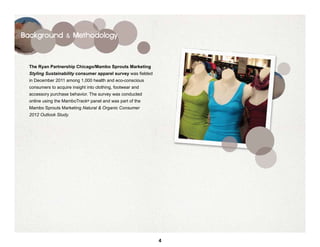
  The Ryan Partnership Chicago/Mambo Sprouts Marketing
  Styling Sustainability consumer apparel survey was fielded
  in December 2011 among 1,000 health and eco-conscious
  consumers to acquire insight into clothing, footwear and
  accessory purchase behavior. The survey was conducted
  online using the MamboTrack® panel and was part of the
  Mambo Sprouts Marketing Natural & Organic Consumer
  2012 Outlook Study.


                                                               4
Only four in 10 shoppers (38%) believe it is important to buy eco/sustainable apparel, whereas three
Findings                       in four or more claim buying eco/sustainable food/grocery and household cleaning supplies is essential
A Market with Strong           (84% and 75% respectively). On the face of it, buying green appears to be relatively unimportant when
Growth Potential               shopping for apparel.


                                   Importance of Buying Eco/Sustainable by Product Category

                                                                                                                                          69%
                                                                                                                      69%
                                                              84%                                                                                               66%                63%

            38%
                                                                                        75%
                                                          Food/grocery               Household                      Lawn and            Personal care       Baby/children's    Large appliances
                                                                                 cleaning supplies                 garden care        (health and beauty       products          (washer,

            Apparel                                                                                                                  care, cosmetics, etc.) (toys, diapers,
                                                                                                                                                             supplies, etc.)
                                                                                                                                                                                  dryer, etc.)


            (clothing, footwear,
                accessories)
                                                              51%                                                                                                                   39%
                                                                                        46%                           43%                  42%                  39%
                                                       Interior home décor       Exterior home                 Office/school            Linens/bedding       Electronics       Small appliances
                                                          (paint, cabinets,      (siding, paint,                 supplies                                     (computer,       (toaster, blender,
                                                      fixtures, furniture, etc.)   roof, etc.)               (paper, clips,                                 mobile phone,         iron, etc.)
                                                                                                           binders, folders, etc.)                          iPod, gaming
                                                                                                                                                             device, etc.)


                                                                         Base: Respondents that indicated they buy the category

                                    Source: Ryan Partnership Chicago/Mambo Sprouts Marketing, Styling Sustainability consumer apparel survey, Winter 2012


                                                                                         5
However, seven in ten (69%) shoppers report that they consider eco/sustainability when buying apparel,
Findings                with only three in ten claiming they rarely (23%) or don’t consider (7%) this factor when making their
A Market with Strong    apparel purchase decisions. Clearly, green is more important than most are able to express, with
Growth Potential
                        eco-features being part of the purchase criteria considered by many consumers. This apparent
                        contradiction indicates the opportunity for the apparel industry to better respond by providing shoppers
                        with additional and improved information, which will allow them to carry through on their intentions.


                                                                     Consideration of Eco/Sustainable
                                                                         When Buying Apparel


             51%                                        23%                                     15%                         7%                   3%
                 Sometimes                                     Rarely                          Regularly                   Don’t                Always
                                                                                                                          Consider
                                    Source: Ryan Partnership Chicago/Mambo Sprouts Marketing, Styling Sustainability consumer apparel survey, Winter 2012


                                                                          6
What are the strongest decision drivers when buying apparel? It should come as no surprise that
Findings                   among all shoppers, comfort/fit (94%), price (92%) and durability/quality (90%) are most important.
Sustainability Factors     But eco/sustainable features such as no animal testing (61%), ethically made/fair labor practices
as Important as “Fun”
                           (56%), sourced locally/made in the USA (56%) and earth-friendly organic materials (47%) were also
and “Fashionable”"
                           cited as important factors among one in two or more shoppers. This is similar in importance to the
                           weight shoppers give to factors such as fun to wear (58%) and fashionable (51%)–sustainability
                           factors are clearly a close second, behind the expected top-decision drivers.


                                                Important Factors in Choosing an Apparel
                                                              Brand/Item


                                                                                                                                             94%                   92%
                                     7%                                                   1%
                                                                                                                                            Comfort/fit              Price


                                4                                                       6                                                                          78%
                                                   ly


                                                                                                                                             90%
                                        co eri nd


                                                        p)


                                                                                                   g l
                                                                                                 in a
                                         at rie


                                                     m
                                              n, s


                                                                                              st im
                                                                                                                                          Durability/quality   Available where
                                                   he
                                          tto al
                                       m th-f


                                                                                                                                                                    I shop


                                                                                            te an
                                            r
                                  Ea


                                                                                               o
                                                                                             N
                                                                                                                                             58%                     51%
                                     ic
                                          an
                                        rg
                                      (o


                                                                                                                                            Fun to wear              Fashion


                                                                                                                                             45%                    43%
                                                                                                                                            100% cotton         Green production


                         5 6%                                            5 6%                                                               42%                     32%
                                                                                       ct e/
                                 SA /


                                                                                            es
                                U ally


                                                                                     ra ad
                                                                                         ic


                                                                                                                                     Brand name/reputation     Vintage/secondhand
                              in c


                                                                                   rp m
                             e lo


                                                                                 bo ly
                           ad ed


                                                                               la al


                                                                                                                                                                    20%
                                                                             ir ic
                         m urc


                                                                                                                                             31%
                                                                           fa Eth
                          So


                                                                                                                                                                 % of purchase
                                                                                                                                      Handmade/craft/artisan   donated to a cause


                               Source: Ryan Partnership Chicago/Mambo Sprouts Marketing, Styling Sustainability consumer apparel survey, Winter 2012


                                                                                        7
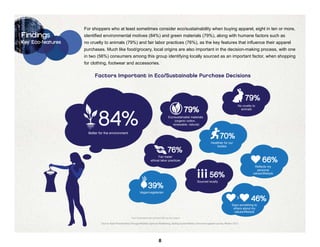
For shoppers who at least sometimes consider eco/sustainability when buying apparel, eight in ten or more,
Findings           identified environmental motives (84%) and green materials (79%), along with humane factors such as
Key Eco-features   no cruelty to animals (79%) and fair labor practices (76%), as the key features that influence their apparel
                   purchases. Much like food/grocery, local origins are also important in the decision-making process, with one
                   in two (56%) consumers among this group identifying locally sourced as an important factor, when shopping
                   for clothing, footwear and accessories.

                         Factors Important in Eco/Sustainable Purchase Decisions


                                                                                                                                                      79%
                                                                                                                                                 No cruelty to
                                                                                                                79%
                           84%
                                                                                                                                                   animals

                                                                                               Eco/sustainable materials
                                                                                                   (organic cotton,
                                                                                                  renewable, natural)

                     Better for the environment
                                                                                                                                     70%
                                                                                                                             Healthier for our
                                                                                                                                 bodies
                                                                                               76%
                                                                                  Fair trade/
                                                                            ethical labor practices                                                                66%
                                                                                                                                                             Reflects my
                                                                                                                                                               personal

                                                                                                                           56%                              values/lifestyle

                                                                                                                   Sourced locally
                                                                         39%
                                                               Vegan/vegetarian

                                                                                                                                                 >         46%
                                                                                                                                             Says something to
                                                                                                                                              others about my
                                                                                                                                               values/lifestyle
                                                       Base: Respondents that indicated they buy the category

                             Source: Ryan Partnership Chicago/Mambo Sprouts Marketing, Styling Sustainability consumer apparel survey, Winter 2012


                                                                                     8
While price will always be top-of-mind with shoppers, lack of availability appears to be a strong purchase
Findings                        barrier to eco-fashion. About one in three or more don’t buy eco/sustainable apparel because they are not
Perceived Lack of               familiar with green options (34%), eco-selections are not available where they shop (33%), or there just
Availability a Key Barrier      aren’t enough options to choose from (44%). One in four are not even sure where to purchase
                                eco/sustainable apparel (28%).

                                        Reasons for Not Regularly Considering Eco/Sustainability
                                                                                         in Purchasing Apparel


                             Not familiar with                Not enough options                                      Not available where                                         Don't know if
                             eco/sustainable                                                                           I shop for apparel                                    eco/sustainable apparel
                             apparel options
                                                                          44%                                                       33%
                                                                                                                                                                            is available where I shop


                                34%                                                                                                                                                25%
                                                                                                   Not sure where
                                                                                                                                                                                          My favorite apparel
                                                                                                     to purchase                                                                          brand doesn't offer
                                                                                                   eco/sustainable                                                                         eco/sustainable
                                                                                                       apparel                                              Not fashionable


                                      Cost/too expensive                                                   28%                                                  11%                          16%
                                            53%                                                                                                                         Don't trust
                                                                                                                                                                                                 Quality not the
                                                                                                                                                                                                   same as
                                                                                                                                                                                              conventional apparel
                                                                                                                                                                     eco/sustainability
                                                                                                                                                                     labels and claims              5%
                                                                                                                                                                         7%

                                             Base: Respondents that indicated they don’t consider, rarely or sometimes consider eco/sustainability when buying apparel

                                             Source: Ryan Partnership Chicago/Mambo Sprouts Marketing, Styling Sustainability consumer apparel survey, Winter 2012

                                                                                                              10


                                                                                                             9
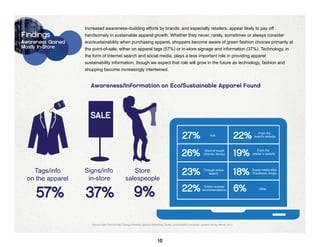
Increased awareness–building efforts by brands, and especially retailers, appear likely to pay off
Findings           handsomely in sustainable apparel growth. Whether they never, rarely, sometimes or always consider
Awareness Gained   eco/sustainability when purchasing apparel, shoppers become aware of green fashion choices primarily at
Mostly In-Store    the point-of-sale, either on apparel tags (57%) or in-store signage and information (37%). Technology, in
                   the form of Internet search and social media, plays a less important role in providing apparel
                   sustainability information, though we expect that role will grow in the future as technology, fashion and
                   shopping become increasingly intertwined.


                      Awareness/Information on Eco/Sustainable Apparel Found


             $
                      SALE

                                                                                                 27%                    Ads
                                                                                                                                              22%       From the
                                                                                                                                                     brand’s website


                                                                                                26%                Word of mouth
                                                                                                                   (friends, family)          19%       From the
                                                                                                                                                    retailer’s website


    Tags/info      Signs/info                       Store                                       23%               Through online
                                                                                                                      search                  18%   Social media sites
                                                                                                                                                    (Facebook, blogs)

  on the apparel    in-store                     salespeople

     57%           37%                                  9%                                      22%                                           6%
                                                                                                                  Online reviews/
                                                                                                                 recommendations                         Other


                                                                               10
                      Source: Ryan Partnership Chicago/Mambo Sprouts Marketing, Styling Sustainability consumer apparel survey, Winter 2012


                                                                            10
"It�would�be�a�tipping�point�

                                                                                  if�I�were�choosing�between
Findings
                                                                                 two�products�of�similar�price�
Opportunity to
Increase Awareness                                                              and�quality, or�might�persuade

                                                                                me�to�buy�the�more�expensive

                                                                                 product�between�two�similar

                                                                                            products.”
   Eco-conscious food/grocery and household cleaning products
   have managed to overcome a number of these same purchase
                                                                                                  "It�would�be�great�to�know
   barriers (i.e. cost-value, options, availability, etc.) through
                                                                                                     more�at�the�point�of
   strong in- and out-of-store sustainability communications and
                                                                                                    purchase�about�how�
   merchandising, as well as third-party certifications such as the
                                                                                                   sustainable�an�item�is,�
   USDA Organic seal. The majority (61%) of consumers would be
                                                                                                     so�I�can�vote�better
   interested in an apparel sustainability rating or index, as it would
                                                                                                  informed�with�my�dollars.”
   help their comparison shopping and provide information that could
   allow them to more easily and speedily find and select sustainable
   items. Some also thought an apparel index could assist them
   in determining what stores to shop and which brands to buy.                    "I'd�be�interested�in�knowing�that

                                                                               there�are�alternative�options�out�there�

                                                                               for�clothing�that�are�made�with�natural

                                                                                  and/or�organic�fibers,�the�brands

                                                                                  that�carry�them�and�where�they

                                                                                   can�be�purchased�at�low�cost.”


                                                                          11
Findings
Opportunity to
Increase Awareness


                     Interest in an Apparel Sustainability Rating or Index


                                                              61%
                       Source: Ryan Partnership Chicago/Mambo Sprouts Marketing, Styling Sustainability consumer apparel survey, Winter 2012


                                                                               12
Respondents overwhelmingly reported shopping for apparel at mass merchants and department stores,
Findings                   with six in ten (62%) frequenting Target and over four in ten patronizing Kohl’s (44%). Though, when asked
Outlets Shopped            via an open-ended question to name an apparel retailer they considered sustainable, fewer than one in
                           three could do so. It’s worth noting, too, that the top-named eco-fashion retailer was Whole Foods Market–
                           a natural grocer–followed by Patagonia and secondhand merchants.


                                       Retail Stores Regularly Shopped for Apparel in 2011


      62%         44%                       30%                     29% 29%                               27%                     26%              24% 24% 21%
      Target      Kohl’s                    T.J. Maxx              JCPenney          Macy’s                 Gap                   Walmart            Other     Amazon   Whole
                                                                                                                                                   retailers            Foods


                           Source: Ryan Partnership Chicago/Mambo Sprouts Marketing, Styling Sustainability consumer apparel survey, Winter 2012

                                                                                        10


                                                                                      13
Findings
Categories Purchased
                                           Eco/Sustainable Apparel
                                         Categories Purchased in 2011

Eco/sustainable food purchasing
often begins with basic items (i.e.
dairy/milk, produce, baby food).                                                                                   23%                 21%                       21%
                                                                                                                   Footwear         Women’s casual             Active/workout
Green apparel has gateway                                                                                                              apparel                      wear

segments as well (i.e. sneakers,
t-shirts, yoga clothes), and these
entry categories led consumer
purchasing in 2011, with one in
five respondents having bought
eco/sustainable footwear (23%),
women’s casual apparel (21%)                  19%                      17%                       15%                    14%                 12%                         9%
                                           Accessories (belts,    Baby/toddler clothing      Children's clothing        Sleepwear          Jeans/denim              Outerwear
and active/workout wear (21%).         scarves, handbags/wallets)

This is also most likely due to
broader awareness and/or
availability of eco-options (i.e.
organic cotton/bamboo/recycled
materials) in these categories, as
a number of manufacturers, and
some retailers, have made relatively
                                            8%                      8%                        6%                     3%                  3%                      16%
                                        Intimate apparel      Men's casual apparel        Professional/work        Evening wear       Maternity wear        Not important to buy
                                                                                               apparel                                                     eco/sustainable apparel
concerted efforts to promote their
green apparel lines that fall within
                                                Source: Ryan Partnership Chicago/Mambo Sprouts Marketing, Styling Sustainability consumer apparel survey, Winter 2012
these segments (i.e. Timberland,
Nike, REI).


                                                                                     14
Green fashion categories presenting high potential growth this year (2012 purchase intent vs. 2011
                                                         purchase) include professional/work attire (index of 398), intimate apparel (384), outerwear (370), jeans/
Findings
Category Growth
                                                         denim (343), men’s casual apparel (333), maternity wear (320) and sleepwear (284) by a factor of three or
Potential                                                more. Evening wear surprisingly represents the greatest growth opportunity of all eco-apparel categories
                                                         with an index of 518. This can most likely be attributed to consumers wishing to make a statement with a
                                                         special garment and/or the wearer’s willingness to invest in a showcase piece.


                                                                   Eco/Sustainable Apparel Category
                                                                           Growth Potential
                             143
84


                                                                                                                                  384
                                                                                                                                         398


                                                                                                                                                                         518
                                           184


                                                              206
                                                              213 Footw
                                                              221 Acces r
                                                              227 - Wome ries (bel


                                                                                           284


                                                                                                          320
                                                                                                          333 Matern
                                                                                                          343 Men’s wear
                                                                                                                        370
 -N


                               -B


                                                                                                                                    - In

                                                                                                                                           -P


                                                                                                                                                                          -E
                                                -C


                                                                  -
                                                                  -


                                                                              -A


                                                                                                 -S


                                                                                                              -
                                                                                                              -
                                                                                                                      - Je

                                                                                                                             -O
  ot i


                                   aby


                                                                                                                                               rof


                                                                                                                                                                           ven
                                                                                ctiv


                                                                                                    lee
                                                  hild


                                                                                                                                     tim
                                                                                                                              ute
   mp


                                                                                                                       ans


                                                                                                                                               ess
                                                                                                     pw
                                    /tod


                                                                                                                                         ate
                                                                                     e/w


                                                                                                                                   rwe


                                                                                                                                                                               ing
                                                   ren
      ort


                                                                                                                            /de
                                                                        ea
                                                                        so

                                                                              n’s


                                                                                                                      cas
                                                                                                                     ity
                                                                                                      ear


                                                                                                                                                 ion
      ant


                                     dle


                                                     ’s c


                                                                                       ork


                                                                                                                                           app
                                                                                                                                    ar


                                                                                                                                                                                we
                                                                                                                             nim
                                                                               cas


                                                                                                                       ual


                                                                                                                                                     al/w
                                         r cl


                                                                                         out


                                                                                                                                                                                 ar
                                                         loth
         to b


                                                                                                                                            are
                                                                                    ual


                                                                                                                        app
                                           oth


                                                                                                                                                      ork
                                                                                           we
                                                             ing


                                                                                                                                               l
            uy


                                                                              ts,

                                                                                       app
                                            ing


                                                                                                                            are
                                                                               sca


                                                                                             ar


                                                                                                                                                        app
               e
             co/


                                                                                                                             l
                                                                                         are
                                                                                   r
                                                                                 ves


                                                                                                                                                            are
                sus


                                                                                           l
                                                                                     ,


                                                                                                                                                               l
                                                                                     han
                   tain


                                                                                       dba
                       abl


                                                                                         gs/
                      ea


                                                                                            wa
                                                                                             llet
                        ppa


                                                                                              s)
                             rel


                                     100                                       200                                          300                                    400                500


                               Source: Ryan Partnership Chicago/Mambo Sprouts Marketing, Styling Sustainability consumer apparel survey, Winter 2012


                                                                                                                 15
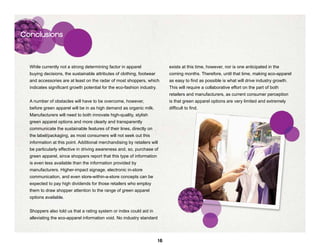
Conclusions


  While currently not a strong determining factor in apparel                  exists at this time, however, nor is one anticipated in the
  buying decisions, the sustainable attributes of clothing, footwear          coming months. Therefore, until that time, making eco-apparel
  and accessories are at least on the radar of most shoppers, which           as easy to find as possible is what will drive industry growth.
  indicates significant growth potential for the eco-fashion industry.        This will require a collaborative effort on the part of both
                                                                              retailers and manufacturers, as current consumer perception
  A number of obstacles will have to be overcome, however,                    is that green apparel options are very limited and extremely
  before green apparel will be in as high demand as organic milk.             difficult to find.
  Manufacturers will need to both innovate high-quality, stylish
  green apparel options and more clearly and transparently
  communicate the sustainable features of their lines, directly on
  the label/packaging, as most consumers will not seek out this
  information at this point. Additional merchandising by retailers will
  be particularly effective in driving awareness and, so, purchase of
  green apparel, since shoppers report that this type of information
  is even less available than the information provided by
  manufacturers. Higher-impact signage, electronic in-store
  communication, and even store-within-a-store concepts can be
  expected to pay high dividends for those retailers who employ
  them to draw shopper attention to the range of green apparel
  options available.


  Shoppers also told us that a rating system or index could aid in
  alleviating the eco-apparel information void. No industry standard


                                                                         16
Report Authors


  Ryan Partnership Chicago                                             Mambo Sprouts Marketing
  See how far ideas can take you.   ®
                                                                       Live Healthy. Live Green. Live Well.
  Ryan Partnership Chicago is a leading expert in promotion,           Mambo Sprouts Marketing, headquartered in Collingswood,
  shopper and digital marketing campaigns for emerging and             New Jersey, develops and executes online, retail and direct
  established consumer brands. The company’s creative                  mail promotions, and market research programs targeted at
  professionals combine sound, strategic research and                  health, natural and organic products consumers. In existence
  business acumen to create meaningful IDEAS that motivate             since 1996, the company was created when its founders
  purchase and loyalty among its clients’ products, services           recognized the lack of educational materials and discounts
  and customers. Ryan’s unparalleled expertise originates              available to health and natural products consumers. It has
  from its extensive, proprietary research that yields some of         since grown into a full-scale marketing agency with programs
  the industry’s deepest insights into consumers, categories,          that benefit health and eco consumers, manufacturers and
  retailers, and shopper behavior. This knowledge is leveraged         retailers. Leading the health and wellness marketplace
  to consistently drive competitive market positioning and ROI.        through its MamboTrack research data trends and insights,
                                                                       Mambo Sprouts Marketing is a respected resource throughout
  The agency is a creative powerhouse, recently tripling in            the LOHAS (Lifestyles of Health & Sustainability) industry. For
  size with its breakthrough ideas and campaigns for clients           more information, please visit www.mambosprouts.com.
  such as Wm. Wrigley Jr. Company, GlaxoSmithKline,
  Energizer Personal Care, World Vision, Chaco and Bel
  Brands USA. Ryan Partnership Chicago is a part of Ryan
  Partnership, the largest independent marketing services
  company in North America and a subsidiary of D.L. Ryan
  Companies, LLC. For a complete listing of services, please
  visit www.ryanpartnershipchicago.com.                                                                                ®


                                                                  17
Contact Us


                ®


  Ryan Partnership
  Christine Nardi Diette
  Group President
  325 N. LaSalle, Suite 775
  Chicago, IL 60654
  cdiette@ryanchicago.com


  Mambo Sprouts Marketing
  Karen Herther
  Sr. Director of Market Research & Consumer Insight
  1101 Haddon Avenue
  Collingswood, NJ 08108
  kherther@mambosprouts.com


                                                       18
Styling Sustainability

Styling Sustainability

  • 2.
    Contents Ba ck gr In ou tro nd du & ct 2 M io et n ho do lo gy Fi nd in gs Co n clu sio Re ns po rt Au th or s Co nt ac t U s
  • 3.
    Introduction Asthe title of this report suggests, understanding green apparel consumer demand, and the associated market opportunity, was the focus of the Ryan Partnership® Chicago/Mambo Sprouts® Marketing Styling Sustainability consumer apparel survey, Would�more�consumers Winter 2012. Our hypothesis for the poll was simple–more purchase�eco/sustainable consumers would purchase eco/sustainable apparel if it were apparel�if�it�were�easy� easy to find. But how many more–and would that indicate to�find? significant growth potential for apparel retailers and manufacturers? Is there greater opportunity in certain apparel segments over others? What is the best way to motivate shoppers to purchase eco/sustainable apparel? And, what are the roles of manufacturers and retailers in meeting these shoppers’ needs and growing the market? The general findings in Styling Sustainability reinforce a key conclusion forwarded in our 2011 research white paper–One Green Score for One Earth (http://onegreenscore.com). Consumers want a clear and objective means of understanding the sustainability impact of their purchases (including their apparel purchases), and will vote with their wallets for those brands and retail outlets that are capable of credibly communicating on this topic. 3
  • 4.
    Background & Methodology The Ryan Partnership Chicago/Mambo Sprouts Marketing Styling Sustainability consumer apparel survey was fielded in December 2011 among 1,000 health and eco-conscious consumers to acquire insight into clothing, footwear and accessory purchase behavior. The survey was conducted online using the MamboTrack® panel and was part of the Mambo Sprouts Marketing Natural & Organic Consumer 2012 Outlook Study. 4
  • 5.
    Only four in10 shoppers (38%) believe it is important to buy eco/sustainable apparel, whereas three Findings in four or more claim buying eco/sustainable food/grocery and household cleaning supplies is essential A Market with Strong (84% and 75% respectively). On the face of it, buying green appears to be relatively unimportant when Growth Potential shopping for apparel. Importance of Buying Eco/Sustainable by Product Category 69% 69% 84% 66% 63% 38% 75% Food/grocery Household Lawn and Personal care Baby/children's Large appliances cleaning supplies garden care (health and beauty products (washer, Apparel care, cosmetics, etc.) (toys, diapers, supplies, etc.) dryer, etc.) (clothing, footwear, accessories) 51% 39% 46% 43% 42% 39% Interior home décor Exterior home Office/school Linens/bedding Electronics Small appliances (paint, cabinets, (siding, paint, supplies (computer, (toaster, blender, fixtures, furniture, etc.) roof, etc.) (paper, clips, mobile phone, iron, etc.) binders, folders, etc.) iPod, gaming device, etc.) Base: Respondents that indicated they buy the category Source: Ryan Partnership Chicago/Mambo Sprouts Marketing, Styling Sustainability consumer apparel survey, Winter 2012 5
  • 6.
    However, seven inten (69%) shoppers report that they consider eco/sustainability when buying apparel, Findings with only three in ten claiming they rarely (23%) or don’t consider (7%) this factor when making their A Market with Strong apparel purchase decisions. Clearly, green is more important than most are able to express, with Growth Potential eco-features being part of the purchase criteria considered by many consumers. This apparent contradiction indicates the opportunity for the apparel industry to better respond by providing shoppers with additional and improved information, which will allow them to carry through on their intentions. Consideration of Eco/Sustainable When Buying Apparel 51% 23% 15% 7% 3% Sometimes Rarely Regularly Don’t Always Consider Source: Ryan Partnership Chicago/Mambo Sprouts Marketing, Styling Sustainability consumer apparel survey, Winter 2012 6
  • 7.
    What are thestrongest decision drivers when buying apparel? It should come as no surprise that Findings among all shoppers, comfort/fit (94%), price (92%) and durability/quality (90%) are most important. Sustainability Factors But eco/sustainable features such as no animal testing (61%), ethically made/fair labor practices as Important as “Fun” (56%), sourced locally/made in the USA (56%) and earth-friendly organic materials (47%) were also and “Fashionable”" cited as important factors among one in two or more shoppers. This is similar in importance to the weight shoppers give to factors such as fun to wear (58%) and fashionable (51%)–sustainability factors are clearly a close second, behind the expected top-decision drivers. Important Factors in Choosing an Apparel Brand/Item 94% 92% 7% 1% Comfort/fit Price 4 6 78% ly 90% co eri nd p) g l in a at rie m n, s st im Durability/quality Available where he tto al m th-f I shop te an r Ea o N 58% 51% ic an rg (o Fun to wear Fashion 45% 43% 100% cotton Green production 5 6% 5 6% 42% 32% ct e/ SA / es U ally ra ad ic Brand name/reputation Vintage/secondhand in c rp m e lo bo ly ad ed la al 20% ir ic m urc 31% fa Eth So % of purchase Handmade/craft/artisan donated to a cause Source: Ryan Partnership Chicago/Mambo Sprouts Marketing, Styling Sustainability consumer apparel survey, Winter 2012 7
  • 8.
    For shoppers whoat least sometimes consider eco/sustainability when buying apparel, eight in ten or more, Findings identified environmental motives (84%) and green materials (79%), along with humane factors such as Key Eco-features no cruelty to animals (79%) and fair labor practices (76%), as the key features that influence their apparel purchases. Much like food/grocery, local origins are also important in the decision-making process, with one in two (56%) consumers among this group identifying locally sourced as an important factor, when shopping for clothing, footwear and accessories. Factors Important in Eco/Sustainable Purchase Decisions 79% No cruelty to 79% 84% animals Eco/sustainable materials (organic cotton, renewable, natural) Better for the environment 70% Healthier for our bodies 76% Fair trade/ ethical labor practices 66% Reflects my personal 56% values/lifestyle Sourced locally 39% Vegan/vegetarian > 46% Says something to others about my values/lifestyle Base: Respondents that indicated they buy the category Source: Ryan Partnership Chicago/Mambo Sprouts Marketing, Styling Sustainability consumer apparel survey, Winter 2012 8
  • 9.
    While price willalways be top-of-mind with shoppers, lack of availability appears to be a strong purchase Findings barrier to eco-fashion. About one in three or more don’t buy eco/sustainable apparel because they are not Perceived Lack of familiar with green options (34%), eco-selections are not available where they shop (33%), or there just Availability a Key Barrier aren’t enough options to choose from (44%). One in four are not even sure where to purchase eco/sustainable apparel (28%). Reasons for Not Regularly Considering Eco/Sustainability in Purchasing Apparel Not familiar with Not enough options Not available where Don't know if eco/sustainable I shop for apparel eco/sustainable apparel apparel options 44% 33% is available where I shop 34% 25% Not sure where My favorite apparel to purchase brand doesn't offer eco/sustainable eco/sustainable apparel Not fashionable Cost/too expensive 28% 11% 16% 53% Don't trust Quality not the same as conventional apparel eco/sustainability labels and claims 5% 7% Base: Respondents that indicated they don’t consider, rarely or sometimes consider eco/sustainability when buying apparel Source: Ryan Partnership Chicago/Mambo Sprouts Marketing, Styling Sustainability consumer apparel survey, Winter 2012 10 9
  • 10.
    Increased awareness–building effortsby brands, and especially retailers, appear likely to pay off Findings handsomely in sustainable apparel growth. Whether they never, rarely, sometimes or always consider Awareness Gained eco/sustainability when purchasing apparel, shoppers become aware of green fashion choices primarily at Mostly In-Store the point-of-sale, either on apparel tags (57%) or in-store signage and information (37%). Technology, in the form of Internet search and social media, plays a less important role in providing apparel sustainability information, though we expect that role will grow in the future as technology, fashion and shopping become increasingly intertwined. Awareness/Information on Eco/Sustainable Apparel Found $ SALE 27% Ads 22% From the brand’s website 26% Word of mouth (friends, family) 19% From the retailer’s website Tags/info Signs/info Store 23% Through online search 18% Social media sites (Facebook, blogs) on the apparel in-store salespeople 57% 37% 9% 22% 6% Online reviews/ recommendations Other 10 Source: Ryan Partnership Chicago/Mambo Sprouts Marketing, Styling Sustainability consumer apparel survey, Winter 2012 10
  • 11.
    "It�would�be�a�tipping�point� if�I�were�choosing�between Findings two�products�of�similar�price� Opportunity to Increase Awareness and�quality, or�might�persuade me�to�buy�the�more�expensive product�between�two�similar products.” Eco-conscious food/grocery and household cleaning products have managed to overcome a number of these same purchase "It�would�be�great�to�know barriers (i.e. cost-value, options, availability, etc.) through more�at�the�point�of strong in- and out-of-store sustainability communications and purchase�about�how� merchandising, as well as third-party certifications such as the sustainable�an�item�is,� USDA Organic seal. The majority (61%) of consumers would be so�I�can�vote�better interested in an apparel sustainability rating or index, as it would informed�with�my�dollars.” help their comparison shopping and provide information that could allow them to more easily and speedily find and select sustainable items. Some also thought an apparel index could assist them in determining what stores to shop and which brands to buy. "I'd�be�interested�in�knowing�that there�are�alternative�options�out�there� for�clothing�that�are�made�with�natural and/or�organic�fibers,�the�brands that�carry�them�and�where�they can�be�purchased�at�low�cost.” 11
  • 12.
    Findings Opportunity to Increase Awareness Interest in an Apparel Sustainability Rating or Index 61% Source: Ryan Partnership Chicago/Mambo Sprouts Marketing, Styling Sustainability consumer apparel survey, Winter 2012 12
  • 13.
    Respondents overwhelmingly reportedshopping for apparel at mass merchants and department stores, Findings with six in ten (62%) frequenting Target and over four in ten patronizing Kohl’s (44%). Though, when asked Outlets Shopped via an open-ended question to name an apparel retailer they considered sustainable, fewer than one in three could do so. It’s worth noting, too, that the top-named eco-fashion retailer was Whole Foods Market– a natural grocer–followed by Patagonia and secondhand merchants. Retail Stores Regularly Shopped for Apparel in 2011 62% 44% 30% 29% 29% 27% 26% 24% 24% 21% Target Kohl’s T.J. Maxx JCPenney Macy’s Gap Walmart Other Amazon Whole retailers Foods Source: Ryan Partnership Chicago/Mambo Sprouts Marketing, Styling Sustainability consumer apparel survey, Winter 2012 10 13
  • 14.
    Findings Categories Purchased Eco/Sustainable Apparel Categories Purchased in 2011 Eco/sustainable food purchasing often begins with basic items (i.e. dairy/milk, produce, baby food). 23% 21% 21% Footwear Women’s casual Active/workout Green apparel has gateway apparel wear segments as well (i.e. sneakers, t-shirts, yoga clothes), and these entry categories led consumer purchasing in 2011, with one in five respondents having bought eco/sustainable footwear (23%), women’s casual apparel (21%) 19% 17% 15% 14% 12% 9% Accessories (belts, Baby/toddler clothing Children's clothing Sleepwear Jeans/denim Outerwear and active/workout wear (21%). scarves, handbags/wallets) This is also most likely due to broader awareness and/or availability of eco-options (i.e. organic cotton/bamboo/recycled materials) in these categories, as a number of manufacturers, and some retailers, have made relatively 8% 8% 6% 3% 3% 16% Intimate apparel Men's casual apparel Professional/work Evening wear Maternity wear Not important to buy apparel eco/sustainable apparel concerted efforts to promote their green apparel lines that fall within Source: Ryan Partnership Chicago/Mambo Sprouts Marketing, Styling Sustainability consumer apparel survey, Winter 2012 these segments (i.e. Timberland, Nike, REI). 14
  • 15.
    Green fashion categoriespresenting high potential growth this year (2012 purchase intent vs. 2011 purchase) include professional/work attire (index of 398), intimate apparel (384), outerwear (370), jeans/ Findings Category Growth denim (343), men’s casual apparel (333), maternity wear (320) and sleepwear (284) by a factor of three or Potential more. Evening wear surprisingly represents the greatest growth opportunity of all eco-apparel categories with an index of 518. This can most likely be attributed to consumers wishing to make a statement with a special garment and/or the wearer’s willingness to invest in a showcase piece. Eco/Sustainable Apparel Category Growth Potential 143 84 384 398 518 184 206 213 Footw 221 Acces r 227 - Wome ries (bel 284 320 333 Matern 343 Men’s wear 370 -N -B - In -P -E -C - - -A -S - - - Je -O ot i aby rof ven ctiv lee hild tim ute mp ans ess pw /tod ate e/w rwe ing ren ort /de ea so n’s cas ity ear ion ant dle ’s c ork app ar we nim cas ual al/w r cl out ar loth to b are ual app oth ork we ing l uy ts, app ing are sca ar app e co/ l are r ves are sus l , l han tain dba abl gs/ ea wa llet ppa s) rel 100 200 300 400 500 Source: Ryan Partnership Chicago/Mambo Sprouts Marketing, Styling Sustainability consumer apparel survey, Winter 2012 15
  • 16.
    Conclusions Whilecurrently not a strong determining factor in apparel exists at this time, however, nor is one anticipated in the buying decisions, the sustainable attributes of clothing, footwear coming months. Therefore, until that time, making eco-apparel and accessories are at least on the radar of most shoppers, which as easy to find as possible is what will drive industry growth. indicates significant growth potential for the eco-fashion industry. This will require a collaborative effort on the part of both retailers and manufacturers, as current consumer perception A number of obstacles will have to be overcome, however, is that green apparel options are very limited and extremely before green apparel will be in as high demand as organic milk. difficult to find. Manufacturers will need to both innovate high-quality, stylish green apparel options and more clearly and transparently communicate the sustainable features of their lines, directly on the label/packaging, as most consumers will not seek out this information at this point. Additional merchandising by retailers will be particularly effective in driving awareness and, so, purchase of green apparel, since shoppers report that this type of information is even less available than the information provided by manufacturers. Higher-impact signage, electronic in-store communication, and even store-within-a-store concepts can be expected to pay high dividends for those retailers who employ them to draw shopper attention to the range of green apparel options available. Shoppers also told us that a rating system or index could aid in alleviating the eco-apparel information void. No industry standard 16
  • 17.
    Report Authors Ryan Partnership Chicago Mambo Sprouts Marketing See how far ideas can take you. ® Live Healthy. Live Green. Live Well. Ryan Partnership Chicago is a leading expert in promotion, Mambo Sprouts Marketing, headquartered in Collingswood, shopper and digital marketing campaigns for emerging and New Jersey, develops and executes online, retail and direct established consumer brands. The company’s creative mail promotions, and market research programs targeted at professionals combine sound, strategic research and health, natural and organic products consumers. In existence business acumen to create meaningful IDEAS that motivate since 1996, the company was created when its founders purchase and loyalty among its clients’ products, services recognized the lack of educational materials and discounts and customers. Ryan’s unparalleled expertise originates available to health and natural products consumers. It has from its extensive, proprietary research that yields some of since grown into a full-scale marketing agency with programs the industry’s deepest insights into consumers, categories, that benefit health and eco consumers, manufacturers and retailers, and shopper behavior. This knowledge is leveraged retailers. Leading the health and wellness marketplace to consistently drive competitive market positioning and ROI. through its MamboTrack research data trends and insights, Mambo Sprouts Marketing is a respected resource throughout The agency is a creative powerhouse, recently tripling in the LOHAS (Lifestyles of Health & Sustainability) industry. For size with its breakthrough ideas and campaigns for clients more information, please visit www.mambosprouts.com. such as Wm. Wrigley Jr. Company, GlaxoSmithKline, Energizer Personal Care, World Vision, Chaco and Bel Brands USA. Ryan Partnership Chicago is a part of Ryan Partnership, the largest independent marketing services company in North America and a subsidiary of D.L. Ryan Companies, LLC. For a complete listing of services, please visit www.ryanpartnershipchicago.com. ® 17
  • 18.
    Contact Us ® Ryan Partnership Christine Nardi Diette Group President 325 N. LaSalle, Suite 775 Chicago, IL 60654 cdiette@ryanchicago.com Mambo Sprouts Marketing Karen Herther Sr. Director of Market Research & Consumer Insight 1101 Haddon Avenue Collingswood, NJ 08108 kherther@mambosprouts.com 18