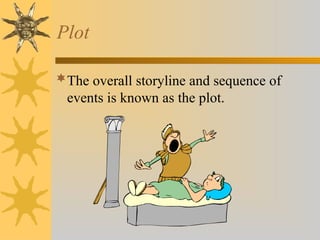
Definitions
For the mostpart, plays have no narrators.
(There are a few notable exceptions to this
rule.)
The audience must glean critical
information from the action on stage.
5.
Dealing with Details
Unlikenovels or short stories, plays have
special features.
– Plays are divided into acts and scenes.
– Scripts feature lists of characters and stage
directions which require the reader to pause
and visualize the set up.
– Readers and actors must pay close attention to
the dialogue in order to understand the
characters and action.
6.
Important Terms
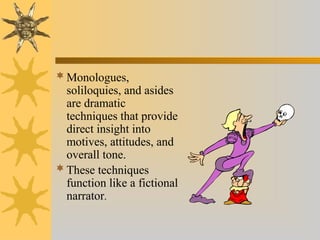
Monologue –an extended speech by one
character.
Soliloquy – an extended speech by one character,
alone on stage. Soliloquies are used to express
the private thoughts of one character.
Aside – a character’s direct address to the
audience, which is not heard by the other
characters.
7.
Monologues,
soliloquies, and asides
aredramatic
techniques that provide
direct insight into
motives, attitudes, and
overall tone.
These techniques
function like a fictional
narrator.
8.
Two Basic “Flavors”
Tragedy
Tragedies treat serious
subjects and often
focus on the tragic
hero’s character.
Tragedies usually end
with death.
Comedy
Comedies are
dramatic works which
use humor to explore
various themes and
characters. Comedies
usually end on a
happy note.
9.
More Terms
Dramatic Irony
–Playwrights use dramatic irony when they allow the
audience to know more than the characters do about a
specific situation or incident.
In Shakespeare’s Hamlet, the audience hears the
fiendish plot of Claudius and Laërtes. Both are
determined to see Hamlet dead. Moments later,
Hamlet responds to news of the King’s great wager and
his own impending duel with Laërtes by saying, “[…]
how ill all’s here about my heart” (V.ii. 186).
10.
Key Terms
Melodrama
– Thisnineteenth century view of drama appeals
to the emotions. Based on stock characters
who are either villainous or virtuous, these
sensational plays have happy endings.
– Like many contemporary television shows,
melodramas feature static characters who deal
with the world but fail to experience real
growth, development, or insight.
11.
Key Terms
Realism
– Realisticdrama deals frankly with social
issues and contemporary life. Instead of
focusing on the lives of kings or great heroes,
these dramas present a look at ordinary people
and everyday problems.
12.
Key Terms
Effects ofRealism
– Realism requires a shift away from painted
backdrops and scenery.
– The result is the “box set” which utilizes
three, more or less, solid walls. The fourth
“wall” remains open to the audience.
– Sets are decorated with real furniture.
– New methods make changing scenery faster.
13.
Key Terms
Naturalism
– Likerealism, naturalism developed in
response to the sentimental and sensational
melodramas that were popular in the
nineteenth century.
– Using realistic plots, naturalism explores the
forces that influence the human condition.
14.
Key Terms
Satire
– Theterm satire refers to social criticism that is
cloaked in comedy and used to ridicule social
institutions and figureheads.
Farce
– The term farce refers to comedy that lapses
into ludicrous, improbable plots, mockery, and
even slapstick.
Elements of Plot
Exposition– introduces the characters,
setting and basic situation.
Rising action – presents the central
conflict, complications, suspense and
crisis.
Climax – the point of greatest tension.
17.
Elements of Plot
Fallingaction – subsiding intensity.
Denouement – the resolution which ties up
loose ends and concludes the action.
18.
Reading Drama
Pay particularattention to the overall plot.
– What are the major conflicts or issues?
– When does the climax occur?
– What force or forces seem to be at work in the
play, moving the action along?
19.
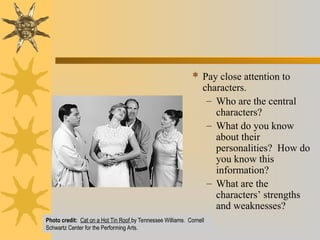
Pay closeattention to
characters.
– Who are the central
characters?
– What do you know
about their
personalities? How do
you know this
information?
– What are the
characters’ strengths
and weaknesses?
Photo credit: Cat on a Hot Tin Roof by Tennessee Williams. Cornell
Schwartz Center for the Performing Arts.
20.
Recognizing the Theme
Mostwritten works have a central theme
and several additional themes.
–Try to identify the central theme.
–Back up your interpretation with
examples from the text.
21.
If possible, watcha
production of the play
you’ve been reading.
How does the
production
correspond to your
reading? How does it
differ?

![More Terms
Dramatic Irony
– Playwrights use dramatic irony when they allow the
audience to know more than the characters do about a
specific situation or incident.
In Shakespeare’s Hamlet, the audience hears the
fiendish plot of Claudius and Laërtes. Both are
determined to see Hamlet dead. Moments later,
Hamlet responds to news of the King’s great wager and
his own impending duel with Laërtes by saying, “[…]
how ill all’s here about my heart” (V.ii. 186).](https://image.slidesharecdn.com/intro-to-drama-250215072503-ec985b61/85/introduction-to-drama-themes-elements-9-320.jpg)