OPPORTUNITIES FOR SPACE
RESOURCES UTILIZATION
FUTURE MARKETS
& VALUE CHAINS
Study Summary - December 2018
INTRODUCTION
The vision of the SpaceResources.lu initiative, launched by the Luxembourg
Government is to contribute to the peaceful exploration and sustainable utilization
of space resources for the benefit of humankind. The focus for achieving this goal
is to support and promote the development of a sustainable commercial industry
for space resources utilization.
Luxembourg’s strategy for pursuing
this exciting vision is based on
several key points:
	 Large quantities of space
resources are available in the
Solar System;
	 Incorporation of space resources
into exploration missions will
reduce costs and improve their
economic viability;
	 Space resources will play a
foundational role in future
in-space economies;
	 Space resources technology
has multi-sector, near-term
commercial value in existing
terrestrial markets.
The exploitation of volatiles – mainly
water – and other resources such
as raw regolith or metals available
on celestial bodies requires the
establishment of new supply chains
for effective utilization. Although the
time horizon for the first operational
applications are expected to be in
the next decade, preparatory steps
are being taken today in developing
the enabling technologies and
obtaining prospecting information
on future exploitable space
resources. It is in the interest of
pioneering space companies,
space agencies, and other visionary
organizations to ensure they capture
early opportunities and anticipate
future needs for the space resources
utilization value chains to emerge.
3
SPACERESOURCES.LU Opportunities for space resources utilization - Future Markets and Value Chains
Luxembourg Space Agency - December 2018
ASSESSMENT
METHODOLOGY
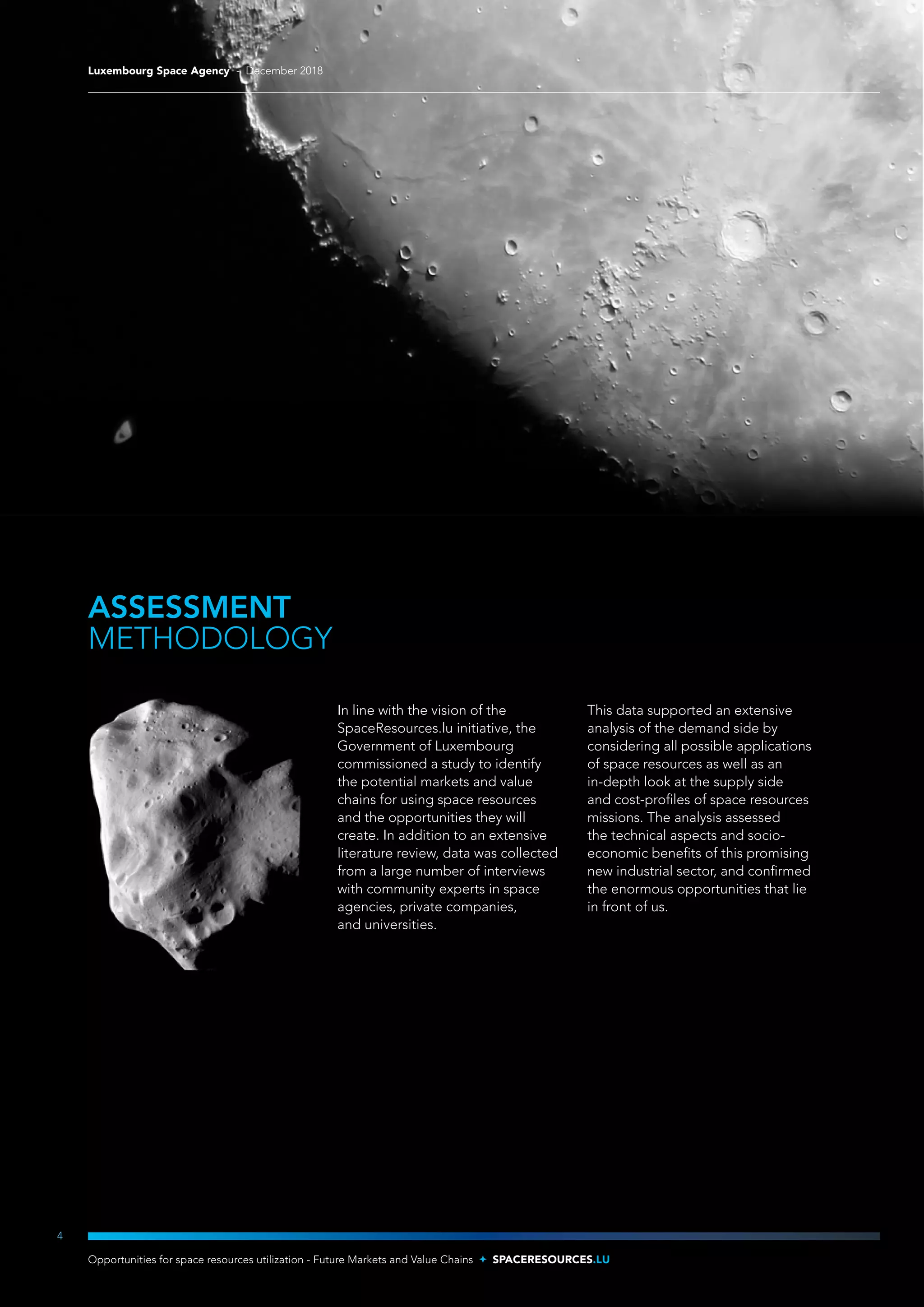
In line with the vision of the
SpaceResources.lu initiative, the
Government of Luxembourg
commissioned a study to identify
the potential markets and value
chains for using space resources
and the opportunities they will
create. In addition to an extensive
literature review, data was collected
from a large number of interviews
with community experts in space
agencies, private companies,
and universities.
This data supported an extensive
analysis of the demand side by
considering all possible applications
of space resources as well as an
in-depth look at the supply side
and cost-profiles of space resources
missions. The analysis assessed
the technical aspects and socio-
economic benefits of this promising
new industrial sector, and confirmed
the enormous opportunities that lie
in front of us.
4
Luxembourg Space Agency - December 2018
Opportunities for space resources utilization - Future Markets and Value Chains SPACERESOURCES.LU
SPACE RESOURCES
UTILIZATION VALUE CHAINS
Primary drivers for the establishment
of the space resources industrial
sector are determined by their
effect on the affordability of space
missions and their ability to provide
autonomy to the missions by
enabling them to ‘live off the land’.
Many materials are of potential
interest for space resources
utilization, and they can be
prioritized based on a combined
examination of the supply side
(which resources are available on the
celestial bodies of interests) and of
the demand side (what applications
would benefit from these resources).
Analysing the different value chains
includes characterizing the amount
of required material available
at different locations in space,
along with the type and location
of their uses, then comparing the
costs of using space resources
to the costs of using materials
provided directly from Earth. If
space resources are cheaper in the
particular case studied then this
becomes a potential opportunity for
commercialization.
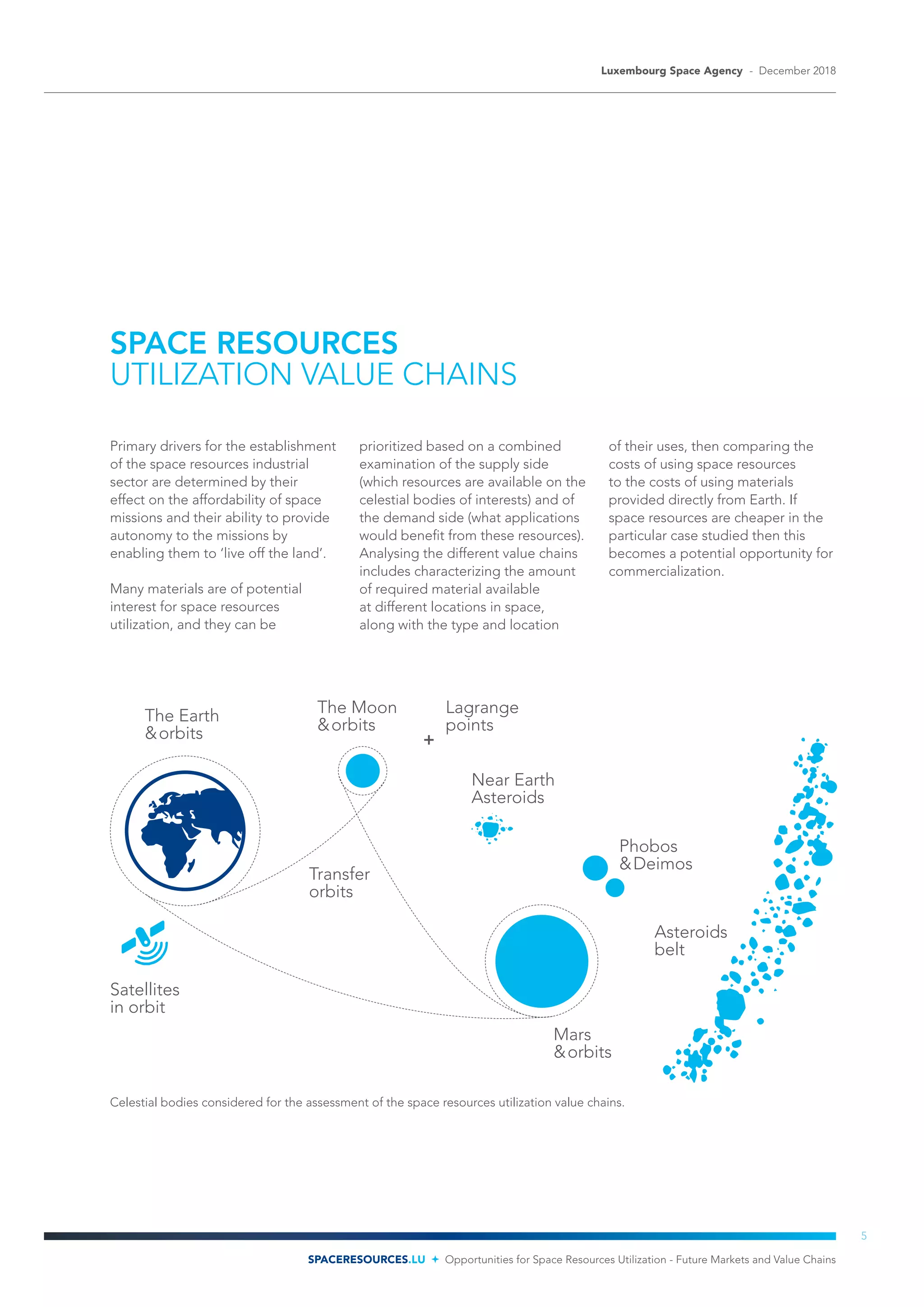
The Earth
&orbits
Mars
&orbits
Transfer
orbits
Satellites
in orbit
The Moon
&orbits
Lagrange
points
Near Earth
Asteroids
Phobos
&Deimos
Asteroids
belt
+
Celestial bodies considered for the assessment of the space resources utilization value chains.
Luxembourg Space Agency - December 2018
SPACERESOURCES.LU Opportunities for Space Resources Utilization - Future Markets and Value Chains
5
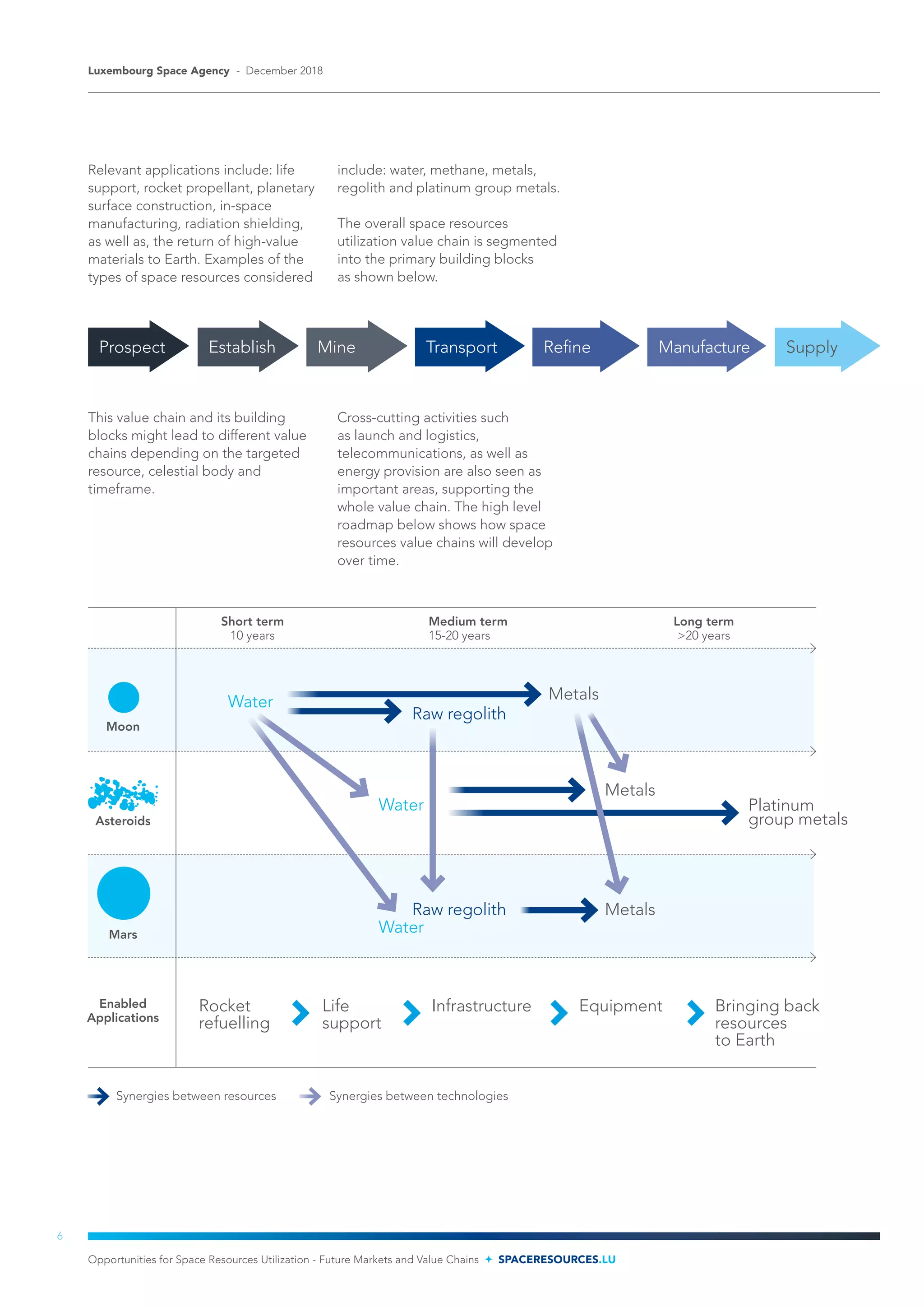
Relevant applications include: life
support, rocket propellant, planetary
surface construction, in-space
manufacturing, radiation shielding,
as well as, the return of high-value
materials to Earth. Examples of the
types of space resources considered
include: water, methane, metals,
regolith and platinum group metals.
The overall space resources
utilization value chain is segmented
into the primary building blocks
as shown below.
Short term
10 years
Moon
Water
Water
Raw regolith
Raw regolith
Metals
Metals
Metals
Platinum
group metalsAsteroids
Mars
Enabled
Applications
Rocket
refuelling
Life
support
Infrastructure Equipment Bringing back
resources
to Earth
Long term
>20 years
Medium term
15-20 years
Prospect RefineMine SupplyEstablish ManufactureTransport
Synergies between resources Synergies between technologies
Water
This value chain and its building
blocks might lead to different value
chains depending on the targeted
resource, celestial body and
timeframe.
Cross-cutting activities such
as launch and logistics,
telecommunications, as well as
energy provision are also seen as
important areas, supporting the
whole value chain. The high level
roadmap below shows how space
resources value chains will develop
over time.
Opportunities for Space Resources Utilization - Future Markets and Value Chains SPACERESOURCES.LU
Luxembourg Space Agency - December 2018
6
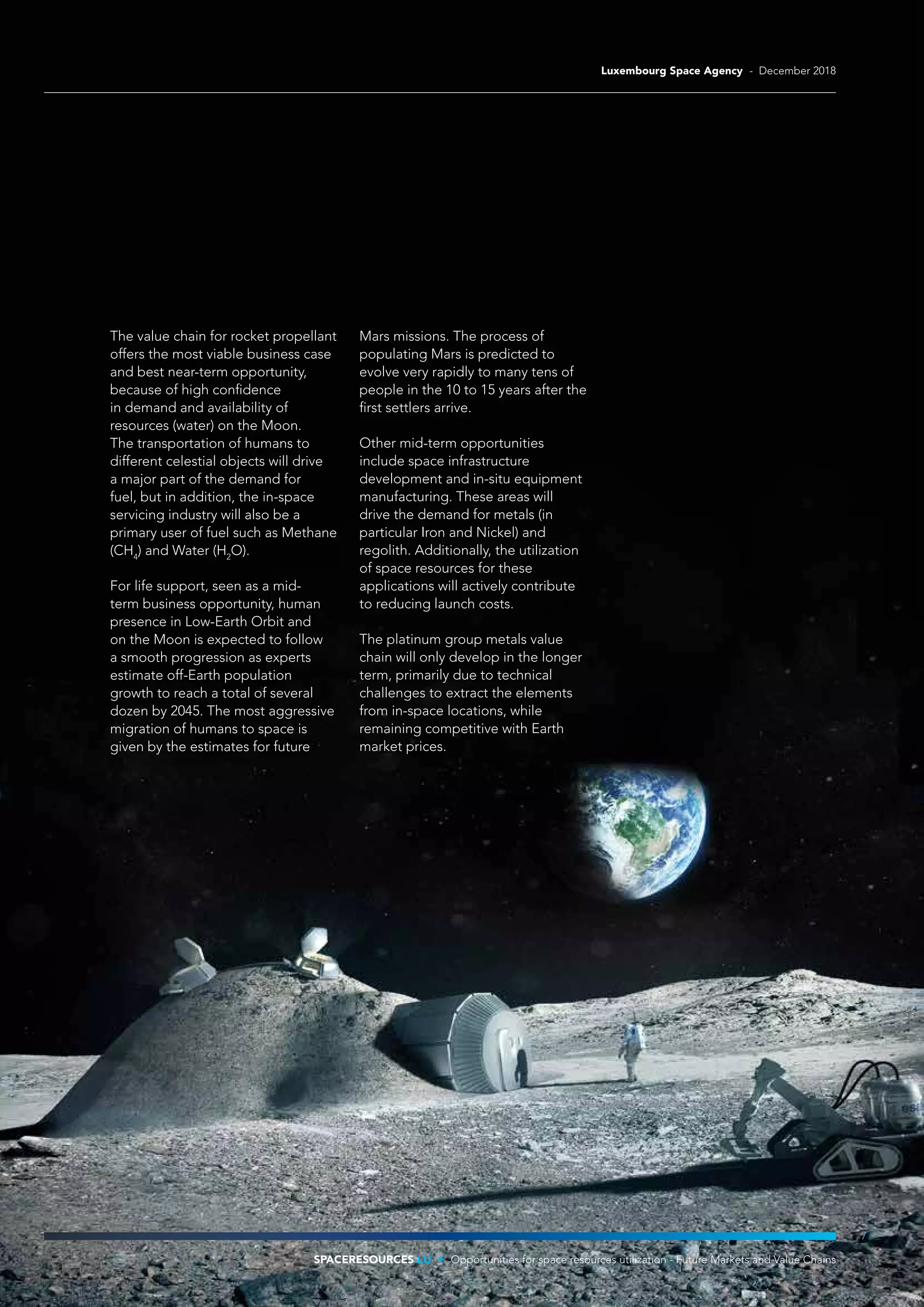
The value chain for rocket propellant
offers the most viable business case
and best near-term opportunity,
because of high confidence
in demand and availability of
resources (water) on the Moon.
The transportation of humans to
different celestial objects will drive
a major part of the demand for
fuel, but in addition, the in-space
servicing industry will also be a
primary user of fuel such as Methane
(CH4
) and Water (H2
O).
For life support, seen as a mid-
term business opportunity, human
presence in Low-Earth Orbit and
on the Moon is expected to follow
a smooth progression as experts
estimate off-Earth population
growth to reach a total of several
dozen by 2045. The most aggressive
migration of humans to space is
given by the estimates for future
Mars missions. The process of
populating Mars is predicted to
evolve very rapidly to many tens of
people in the 10 to 15 years after the
first settlers arrive.
Other mid-term opportunities
include space infrastructure
development and in-situ equipment
manufacturing. These areas will
drive the demand for metals (in
particular Iron and Nickel) and
regolith. Additionally, the utilization
of space resources for these
applications will actively contribute
to reducing launch costs.
The platinum group metals value
chain will only develop in the longer
term, primarily due to technical
challenges to extract the elements
from in-space locations, while
remaining competitive with Earth
market prices.
7
SPACERESOURCES.LU Opportunities for space resources utilization - Future Markets and Value Chains
Luxembourg Space Agency - December 2018
8
Opportunities for space resources utilization - Future Markets and Value Chains SPACERESOURCES.LU
Luxembourg Space Agency - December 2018
SOCIO-ECONOMIC
IMPACT
Using space resources is expected
to create socio-economic benefits in
three major areas:
The first area is the space resources
utilization industry itself, which is
expected to generate a market
revenue of 73 to 170 B€ (Present
Value 2018) over the 2018-2045
period, supporting a total of 845,000
to 1.8 million Full Time Employees
- Years. Efficiency gains in the form
of cost savings for the end-users
(i.e. customers of space resources)
are estimated at 54 to 135 B€
(Present Value 2018). This figure
accounts for fuels (CH4
, H2
O), water
(H2
O) for life support, and materials
for equipment and infrastructure
(regolith and metals).
The second area involves knowledge
and technology spillovers
represented by technological
developments associated with space
resources value chains which are
expected to encompass several
technical domains, such as materials
science, manufacturing, additive
manufacturing, robotics, and data
analytics. It is forecasted that these
spillover benefits will be in the order
of 2.5 B€ over 50 years (Present
Value 2018). Network spillovers,
are predicted to have very strong
effects from industrial clustering
which facilitates the interchange of
knowledge and personnel between
organizations. There will also be
strong effects from the development
of standards for the new industrial
sector.
Finally, the space resources value
chains are expected to contribute
to wider effects with a strong
contribution to social and strategic
benefits by enabling space
exploration and development,
and with some contributions to
environmental benefits by lessening
dependence on Earth’s finite
resources.
Luxembourg Space Agency - December 2018
SPACERESOURCES.LU Opportunities for Space Resources Utilization - Future Markets and Value Chains
9
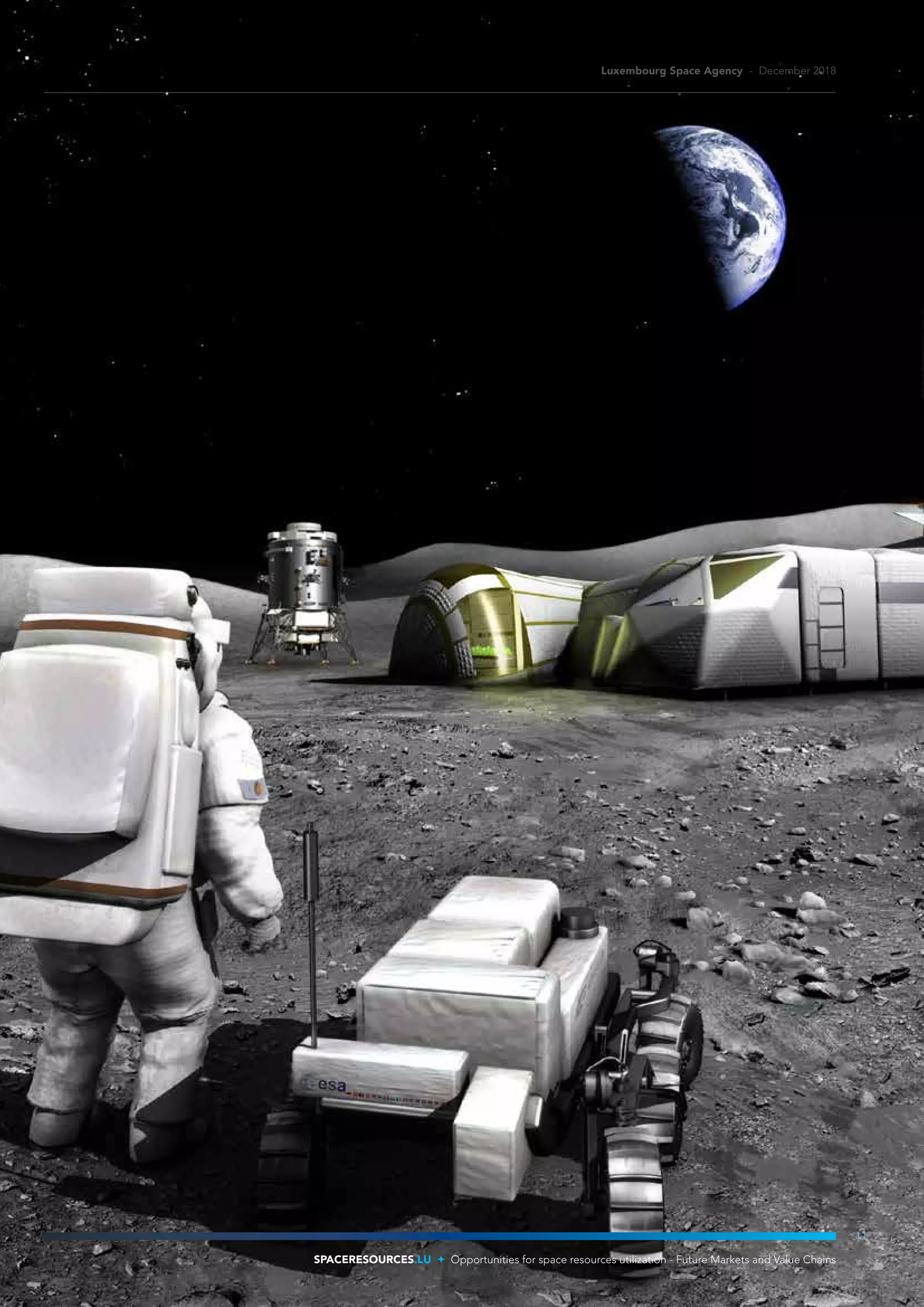
NEEDED
TECHNOLOGY
The technology for space resources
utilization processes exists at
a low to medium Technology
Readiness Levels. Major steps
need to be taken in demonstrating
the technologies at an advanced
stage on Earth and then raising
readiness levels for use in flight. In
addition, the technologies need to
be flown in space to demonstrate
to investors, agencies and other
stakeholders that the scenarios
deemed economically feasible are
also technically possible.
Different kinds of technologies are
required across the value chain. The
technologies have been classified in
the following groups:
Prospecting technologies
Technologies supporting the
prospecting and exploration of
the resource through geophysical
and mineralogical measurements,
pinpointing deposits of interest,
and obtaining data to support their
exploitation.
Mining technologies
Technologies enabling the
extraction, local transportation,
beneficiation and handling of the
bulk material.
Transport and supply technologies
Technologies enabling the
transportation of the resources
through space to the point of
storage or utilization, and/or back
to Earth.
Refinement technologies
Technologies allowing the
processing of the material in order
to obtain the final products like
structural materials in intermediate
or final shape.
Manufacturing technologies
In-situ creation of structural
elements and fabrication of
everyday tools; for example through
the use of 3D printing.
Supply (storage) technologies
Technologies to store and transfer
the resources, in particular oxidizers
and fuel.
Support technologies
Technologies applicable across the
whole value chain, and necessary to
support space resources utilization
operationally, including software,
robotics, communications and
energy technologies.
Opportunities for Space Resources Utilization - Future Markets and Value Chains SPACERESOURCES.LU
Luxembourg Space Agency - December 2018
10
Luxembourg Space Agency - December 2018
11
SPACERESOURCES.LU Opportunities for space resources utilization - Future Markets and Value Chains
CHALLENGES
Realizing the potential benefits of
space resources remains challenging
and requires global partnerships.
There are technical and commercial
challenges, but also regulatory and
financial ones. Technical capabilities
necessary for enabling the entire
value chain from prospecting to
utilizing space resources must be
developed, tested, and matured.
Identifying capabilities needed for
space mining that also have near-
term business potential is required
to ensure incremental growth as
the market today is nascent and will
need time to mature.
International and domestic legal
frameworks need to be established
to protect entrepreneurs, assure
investors, and ensure responsible
business activities. Significant
investment with long-time horizons
must be available to enable private
firms to develop and deploy critical
systems.
FINAL
THOUGHTS
Defining a near-term set of
space resources utilization
value chains made it possible
to estimate future resource
markets which in turn informed
the development of a strategy
to reach towards the visionary
goals of the SpaceResources.lu
initiative. Although space resources
utilization still has some uncertainties
requiring planners to make several
assumptions, the analysis of the
different value chains revealed a
number of promising aspects for
the future of this important
industrial sector.
There are opportunities across
all stages of the value chains
that can be leveraged to create
commercial benefits, in particular,
early prioritization of specific space
resources and uses were identified
along with areas for further
technology developments. The
collaboration between space actors
and the terrestrial mining industry is
expected to play a central role in the
successful development of space
resources by leveraging experience
and know-how of mining companies.
Importantly, space resources
utilization can generate sizeable
socio-economic benefits, including
economic impacts, employment,
market spillovers, and technology
spillovers. Cost savings assessments
have demonstrated substantial
cost reductions for space missions,
revealing viable markets for space
resources products.
Opportunities for Space Resources Utilization - Future Markets and Value Chains SPACERESOURCES.LU
Luxembourg Space Agency - December 2018
12
LUXEMBOURG SPACERESOURCES.LU
INITIATIVE
The Luxembourg Government
decided to launch the
SpaceResources.lu initiative
based on its past successes in
the space sector. The initiative
aims to contribute to the peaceful
exploration and sustainable
utilization of space resources for the
benefit of humankind.
To create the strong foundation
required to support and promote
the development of a commercial
space resources utilization industry
the Luxembourg Government is
working on a five pillar strategy:
	 Ensure national political support
and promote international
cooperation
	 Build clear legal framework and
engage internationally
	 Promote long-term public
support and workforce
engagement through education
and R&D
	 Provide dedicated support
for industrial research and
development activities
	 Develop investment instruments
focussed on commercial space
Since its launch in early 2016, the
initiative has made considerable
progress on all pillars, resulting in
the establishment of companies
addressing different areas of the
space resources utilization value
chain.
Luxembourg has signed dedicated
bilateral agreements with multiple
countries and has stepped-up its
engagement on the European and
international level. In particular,
it supports discussions on the
utilization of space resources in
forums such as the UN-COPUOS
or the Hague International Space
Resources Governance Working
Group.
In August 2017, the Luxembourg
Parliament enacted a law on
the exploration and utilization
of space resources, making it
the second country in the world
that recognizes the possibility of
resources ownership by private
companies, as well as laying down a
specific authorization procedure for
corresponding missions.
Luxembourg continues to
strengthen its public research
institutions and has developed a
space master programme that will
feature, amongst others, courses on
space resources utilization. Through
its engagement with the European
Space Agency, Luxembourg has
provided dedicated R&D support
to companies.
In the area of investment,
Luxembourg signed an agreement
with the European Investment Bank
to enhance access to finance for
innovative projects supported under
the SpaceResources.lu initiative.
In closing, Luxembourg is keen
to establish partnerships with
companies, research centres,
investors and organizations from
around the world, for regulatory,
research, innovation or finance
related areas.
Luxembourg Space Agency - December 2018
SPACERESOURCES.LU Opportunities for Space Resources Utilization - Future Markets and Value Chains
13
CONTACTS FOR
FURTHER INFORMATION
Whether you are a company, a governmental organization or an investor, if you
require any further information about the study or the SpaceResources.lu initiative,
please contact the following persons of the Luxembourg Space Agency team:
Mathias Link
Director – International Affairs & SpaceResources.lu
19-21, boulevard Royal
L-2449 Luxembourg
Tel. (+352) 288 482 - 19
Email: mathias.link@space-agency.lu
Grégory Martin
Senior Policy Officer - Economic Development
19-21, boulevard Royal
L-2449 Luxembourg
Tel. (+352) 288 482 - 15
Email: gregory.martin@space-agency.lu
Luxembourg Space Agency: www.space-agency.lu
Luxembourg Space Resources Initiative: www.spaceresources.lu
This study was executed by a consortium of companies from Luxembourg, France,
Belgium and the UK. It was funded by the Government of Luxembourg through
the Luxembourg National Space programme (LuxIMPULSE) implemented by the
European Space Agency.
The view expressed herein does not necessarily reflect the official opinion of either
the European Space Agency or the Government of Luxembourg.
Copyright images: Ministry of the Economy; ESA; ESA/Foster+Partners;
ESA 2010 MPS for OSIRIS Team MPS/UPD/LAM/IAA/RSSD/INTA/UPM/DASP/IDA;
ESA/Carlos Di Nallo; ESA - ScienceOffice.org - CC BY-SA IGO 3.0
Opportunities for Space Resources Utilization - Future Markets and Value Chains SPACERESOURCES.LU
Luxembourg Space Agency - December 2018
14
Study summary-of-the-space-resources-value-chain-study

Study summary-of-the-space-resources-value-chain-study

  • 1.
    OPPORTUNITIES FOR SPACE RESOURCESUTILIZATION FUTURE MARKETS & VALUE CHAINS Study Summary - December 2018
  • 3.
    INTRODUCTION The vision ofthe SpaceResources.lu initiative, launched by the Luxembourg Government is to contribute to the peaceful exploration and sustainable utilization of space resources for the benefit of humankind. The focus for achieving this goal is to support and promote the development of a sustainable commercial industry for space resources utilization. Luxembourg’s strategy for pursuing this exciting vision is based on several key points: Large quantities of space resources are available in the Solar System; Incorporation of space resources into exploration missions will reduce costs and improve their economic viability; Space resources will play a foundational role in future in-space economies; Space resources technology has multi-sector, near-term commercial value in existing terrestrial markets. The exploitation of volatiles – mainly water – and other resources such as raw regolith or metals available on celestial bodies requires the establishment of new supply chains for effective utilization. Although the time horizon for the first operational applications are expected to be in the next decade, preparatory steps are being taken today in developing the enabling technologies and obtaining prospecting information on future exploitable space resources. It is in the interest of pioneering space companies, space agencies, and other visionary organizations to ensure they capture early opportunities and anticipate future needs for the space resources utilization value chains to emerge. 3 SPACERESOURCES.LU Opportunities for space resources utilization - Future Markets and Value Chains Luxembourg Space Agency - December 2018
  • 4.
    ASSESSMENT METHODOLOGY In line withthe vision of the SpaceResources.lu initiative, the Government of Luxembourg commissioned a study to identify the potential markets and value chains for using space resources and the opportunities they will create. In addition to an extensive literature review, data was collected from a large number of interviews with community experts in space agencies, private companies, and universities. This data supported an extensive analysis of the demand side by considering all possible applications of space resources as well as an in-depth look at the supply side and cost-profiles of space resources missions. The analysis assessed the technical aspects and socio- economic benefits of this promising new industrial sector, and confirmed the enormous opportunities that lie in front of us. 4 Luxembourg Space Agency - December 2018 Opportunities for space resources utilization - Future Markets and Value Chains SPACERESOURCES.LU
  • 5.
    SPACE RESOURCES UTILIZATION VALUECHAINS Primary drivers for the establishment of the space resources industrial sector are determined by their effect on the affordability of space missions and their ability to provide autonomy to the missions by enabling them to ‘live off the land’. Many materials are of potential interest for space resources utilization, and they can be prioritized based on a combined examination of the supply side (which resources are available on the celestial bodies of interests) and of the demand side (what applications would benefit from these resources). Analysing the different value chains includes characterizing the amount of required material available at different locations in space, along with the type and location of their uses, then comparing the costs of using space resources to the costs of using materials provided directly from Earth. If space resources are cheaper in the particular case studied then this becomes a potential opportunity for commercialization. The Earth &orbits Mars &orbits Transfer orbits Satellites in orbit The Moon &orbits Lagrange points Near Earth Asteroids Phobos &Deimos Asteroids belt + Celestial bodies considered for the assessment of the space resources utilization value chains. Luxembourg Space Agency - December 2018 SPACERESOURCES.LU Opportunities for Space Resources Utilization - Future Markets and Value Chains 5
  • 6.
    Relevant applications include:life support, rocket propellant, planetary surface construction, in-space manufacturing, radiation shielding, as well as, the return of high-value materials to Earth. Examples of the types of space resources considered include: water, methane, metals, regolith and platinum group metals. The overall space resources utilization value chain is segmented into the primary building blocks as shown below. Short term 10 years Moon Water Water Raw regolith Raw regolith Metals Metals Metals Platinum group metalsAsteroids Mars Enabled Applications Rocket refuelling Life support Infrastructure Equipment Bringing back resources to Earth Long term >20 years Medium term 15-20 years Prospect RefineMine SupplyEstablish ManufactureTransport Synergies between resources Synergies between technologies Water This value chain and its building blocks might lead to different value chains depending on the targeted resource, celestial body and timeframe. Cross-cutting activities such as launch and logistics, telecommunications, as well as energy provision are also seen as important areas, supporting the whole value chain. The high level roadmap below shows how space resources value chains will develop over time. Opportunities for Space Resources Utilization - Future Markets and Value Chains SPACERESOURCES.LU Luxembourg Space Agency - December 2018 6
  • 7.
    The value chainfor rocket propellant offers the most viable business case and best near-term opportunity, because of high confidence in demand and availability of resources (water) on the Moon. The transportation of humans to different celestial objects will drive a major part of the demand for fuel, but in addition, the in-space servicing industry will also be a primary user of fuel such as Methane (CH4 ) and Water (H2 O). For life support, seen as a mid- term business opportunity, human presence in Low-Earth Orbit and on the Moon is expected to follow a smooth progression as experts estimate off-Earth population growth to reach a total of several dozen by 2045. The most aggressive migration of humans to space is given by the estimates for future Mars missions. The process of populating Mars is predicted to evolve very rapidly to many tens of people in the 10 to 15 years after the first settlers arrive. Other mid-term opportunities include space infrastructure development and in-situ equipment manufacturing. These areas will drive the demand for metals (in particular Iron and Nickel) and regolith. Additionally, the utilization of space resources for these applications will actively contribute to reducing launch costs. The platinum group metals value chain will only develop in the longer term, primarily due to technical challenges to extract the elements from in-space locations, while remaining competitive with Earth market prices. 7 SPACERESOURCES.LU Opportunities for space resources utilization - Future Markets and Value Chains Luxembourg Space Agency - December 2018
  • 8.
    8 Opportunities for spaceresources utilization - Future Markets and Value Chains SPACERESOURCES.LU Luxembourg Space Agency - December 2018
  • 9.
    SOCIO-ECONOMIC IMPACT Using space resourcesis expected to create socio-economic benefits in three major areas: The first area is the space resources utilization industry itself, which is expected to generate a market revenue of 73 to 170 B€ (Present Value 2018) over the 2018-2045 period, supporting a total of 845,000 to 1.8 million Full Time Employees - Years. Efficiency gains in the form of cost savings for the end-users (i.e. customers of space resources) are estimated at 54 to 135 B€ (Present Value 2018). This figure accounts for fuels (CH4 , H2 O), water (H2 O) for life support, and materials for equipment and infrastructure (regolith and metals). The second area involves knowledge and technology spillovers represented by technological developments associated with space resources value chains which are expected to encompass several technical domains, such as materials science, manufacturing, additive manufacturing, robotics, and data analytics. It is forecasted that these spillover benefits will be in the order of 2.5 B€ over 50 years (Present Value 2018). Network spillovers, are predicted to have very strong effects from industrial clustering which facilitates the interchange of knowledge and personnel between organizations. There will also be strong effects from the development of standards for the new industrial sector. Finally, the space resources value chains are expected to contribute to wider effects with a strong contribution to social and strategic benefits by enabling space exploration and development, and with some contributions to environmental benefits by lessening dependence on Earth’s finite resources. Luxembourg Space Agency - December 2018 SPACERESOURCES.LU Opportunities for Space Resources Utilization - Future Markets and Value Chains 9
  • 10.
    NEEDED TECHNOLOGY The technology forspace resources utilization processes exists at a low to medium Technology Readiness Levels. Major steps need to be taken in demonstrating the technologies at an advanced stage on Earth and then raising readiness levels for use in flight. In addition, the technologies need to be flown in space to demonstrate to investors, agencies and other stakeholders that the scenarios deemed economically feasible are also technically possible. Different kinds of technologies are required across the value chain. The technologies have been classified in the following groups: Prospecting technologies Technologies supporting the prospecting and exploration of the resource through geophysical and mineralogical measurements, pinpointing deposits of interest, and obtaining data to support their exploitation. Mining technologies Technologies enabling the extraction, local transportation, beneficiation and handling of the bulk material. Transport and supply technologies Technologies enabling the transportation of the resources through space to the point of storage or utilization, and/or back to Earth. Refinement technologies Technologies allowing the processing of the material in order to obtain the final products like structural materials in intermediate or final shape. Manufacturing technologies In-situ creation of structural elements and fabrication of everyday tools; for example through the use of 3D printing. Supply (storage) technologies Technologies to store and transfer the resources, in particular oxidizers and fuel. Support technologies Technologies applicable across the whole value chain, and necessary to support space resources utilization operationally, including software, robotics, communications and energy technologies. Opportunities for Space Resources Utilization - Future Markets and Value Chains SPACERESOURCES.LU Luxembourg Space Agency - December 2018 10
  • 11.
    Luxembourg Space Agency- December 2018 11 SPACERESOURCES.LU Opportunities for space resources utilization - Future Markets and Value Chains
  • 12.
    CHALLENGES Realizing the potentialbenefits of space resources remains challenging and requires global partnerships. There are technical and commercial challenges, but also regulatory and financial ones. Technical capabilities necessary for enabling the entire value chain from prospecting to utilizing space resources must be developed, tested, and matured. Identifying capabilities needed for space mining that also have near- term business potential is required to ensure incremental growth as the market today is nascent and will need time to mature. International and domestic legal frameworks need to be established to protect entrepreneurs, assure investors, and ensure responsible business activities. Significant investment with long-time horizons must be available to enable private firms to develop and deploy critical systems. FINAL THOUGHTS Defining a near-term set of space resources utilization value chains made it possible to estimate future resource markets which in turn informed the development of a strategy to reach towards the visionary goals of the SpaceResources.lu initiative. Although space resources utilization still has some uncertainties requiring planners to make several assumptions, the analysis of the different value chains revealed a number of promising aspects for the future of this important industrial sector. There are opportunities across all stages of the value chains that can be leveraged to create commercial benefits, in particular, early prioritization of specific space resources and uses were identified along with areas for further technology developments. The collaboration between space actors and the terrestrial mining industry is expected to play a central role in the successful development of space resources by leveraging experience and know-how of mining companies. Importantly, space resources utilization can generate sizeable socio-economic benefits, including economic impacts, employment, market spillovers, and technology spillovers. Cost savings assessments have demonstrated substantial cost reductions for space missions, revealing viable markets for space resources products. Opportunities for Space Resources Utilization - Future Markets and Value Chains SPACERESOURCES.LU Luxembourg Space Agency - December 2018 12
  • 13.
    LUXEMBOURG SPACERESOURCES.LU INITIATIVE The LuxembourgGovernment decided to launch the SpaceResources.lu initiative based on its past successes in the space sector. The initiative aims to contribute to the peaceful exploration and sustainable utilization of space resources for the benefit of humankind. To create the strong foundation required to support and promote the development of a commercial space resources utilization industry the Luxembourg Government is working on a five pillar strategy: Ensure national political support and promote international cooperation Build clear legal framework and engage internationally Promote long-term public support and workforce engagement through education and R&D Provide dedicated support for industrial research and development activities Develop investment instruments focussed on commercial space Since its launch in early 2016, the initiative has made considerable progress on all pillars, resulting in the establishment of companies addressing different areas of the space resources utilization value chain. Luxembourg has signed dedicated bilateral agreements with multiple countries and has stepped-up its engagement on the European and international level. In particular, it supports discussions on the utilization of space resources in forums such as the UN-COPUOS or the Hague International Space Resources Governance Working Group. In August 2017, the Luxembourg Parliament enacted a law on the exploration and utilization of space resources, making it the second country in the world that recognizes the possibility of resources ownership by private companies, as well as laying down a specific authorization procedure for corresponding missions. Luxembourg continues to strengthen its public research institutions and has developed a space master programme that will feature, amongst others, courses on space resources utilization. Through its engagement with the European Space Agency, Luxembourg has provided dedicated R&D support to companies. In the area of investment, Luxembourg signed an agreement with the European Investment Bank to enhance access to finance for innovative projects supported under the SpaceResources.lu initiative. In closing, Luxembourg is keen to establish partnerships with companies, research centres, investors and organizations from around the world, for regulatory, research, innovation or finance related areas. Luxembourg Space Agency - December 2018 SPACERESOURCES.LU Opportunities for Space Resources Utilization - Future Markets and Value Chains 13
  • 14.
    CONTACTS FOR FURTHER INFORMATION Whetheryou are a company, a governmental organization or an investor, if you require any further information about the study or the SpaceResources.lu initiative, please contact the following persons of the Luxembourg Space Agency team: Mathias Link Director – International Affairs & SpaceResources.lu 19-21, boulevard Royal L-2449 Luxembourg Tel. (+352) 288 482 - 19 Email: mathias.link@space-agency.lu Grégory Martin Senior Policy Officer - Economic Development 19-21, boulevard Royal L-2449 Luxembourg Tel. (+352) 288 482 - 15 Email: gregory.martin@space-agency.lu Luxembourg Space Agency: www.space-agency.lu Luxembourg Space Resources Initiative: www.spaceresources.lu This study was executed by a consortium of companies from Luxembourg, France, Belgium and the UK. It was funded by the Government of Luxembourg through the Luxembourg National Space programme (LuxIMPULSE) implemented by the European Space Agency. The view expressed herein does not necessarily reflect the official opinion of either the European Space Agency or the Government of Luxembourg. Copyright images: Ministry of the Economy; ESA; ESA/Foster+Partners; ESA 2010 MPS for OSIRIS Team MPS/UPD/LAM/IAA/RSSD/INTA/UPM/DASP/IDA; ESA/Carlos Di Nallo; ESA - ScienceOffice.org - CC BY-SA IGO 3.0 Opportunities for Space Resources Utilization - Future Markets and Value Chains SPACERESOURCES.LU Luxembourg Space Agency - December 2018 14