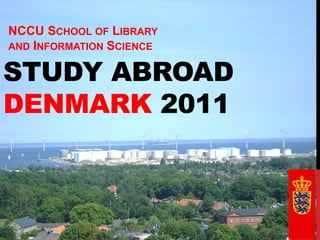
NCCU School of Library and Information ScienceStudy abroadDenmark 2011
Presented by Megan Lawson, Danielle’ McGhee, Kafi-Ayanna Allah, and Jason Howard
Getting to know Denmark and Exploring Danish CultureDenmark is an impressive country, and Copenhagen is full of old-world charm, even though it is one of the largest cities in northern Europe.  Having spent two weeks in Copenhagen, we had the opportunity to get to know the country and the people, their lifestyle, politics, and culture helping us to form a context by which to understand their libraries.
Blending the Old with the New One of the things that stood out the most for us was the blending of the old with the new in the city. This is accomplished through:ArchitectureRenovation of old buildings rather than tearing them down is common.  The exterior is left in tact, while the interior is modernized. Yet Denmark is also home to many modern architectural masterpieces.PoliticsThere is a reverence for the Danish Royal Family, but Danes are also very conscious about what is happening in their parliament, voting, and asserting their rights.LifestyleDenmark is very much in the Information Age, and aspects of the country are very modern, high tech, and fact paced.  At the same time, Danes also value the past, nature, and taking time out to enjoy life.Blending the Old with the New: architectureThe Exterior and Interior of Magasin Department Store:Preservation is important in Copenhagen, so architects use the shells of original buildings but recreate the interiors.Interior Photo Credit: en.unionpay.com
Blending the Old with the New: architectureThe interior of AmagerbroKultur’sSunby Library and cultural center reflects typical modern Danish design, focusing on light wood and natural lighting.
Blending the Old with the New: architectureDevelopers of Amager neighborhoods began incorporating modern design into the original exteriors as part of revitalization projects that began in the 2000’s.
Blending the Old with the New: Unique NeighborhoodsThe practices of creating modern buildings in empty spaces, preserving historic architecture, and modernizing some of the older buildings have made the neighborhoods and districts of city very distinct and unique.  We could often tell what district we were in by the buildings around us.The Bella Sky Hotel in Ørestad District Photo Credit: housevariety.blogspot.com
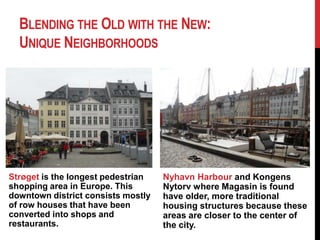
Blending the Old with the New: Unique NeighborhoodsNyhavnHarbourand KongensNytorv where Magasin is found have older, more traditional housing structures because these areas are closer to the center of the city.Strøgetis the longest pedestrian shopping area in Europe. This downtown district consists mostly of row houses that have been converted into shops and restaurants.
Blending the Old with the New: Unique NeighborhoodsParts of Copenhagen University are also in the Islands Bryyge area. This modern dorm on the University’s newest campus is an architectural masterpiece.The Islands Bryggedistrict has newer, more modern construction mixed with older structures because it is placed further outside the city.
Blending the Old with the New: GovernmentDanish political system is an example of blending old with new as their government is a constitutional monarchy.Though she has little formal power, there is still much respect and pride for the monarch, Queen Margarethe. Citizens are also proud of their right to vote. We learned that around 80% of the Danish population votes, and they are allowed to elect a new government if they are not satisfied with the current one.This process is occurring right now, making it a very exciting time to visit the country.Queen Magarethe IIPhoto Credit: clausdjensen.com
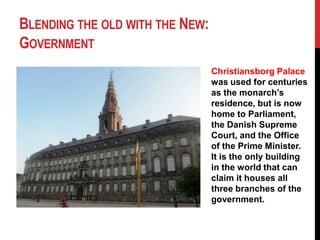
Blending the old with the New: GovernmentChristiansborg Palace was used for centuries as the monarch’s  residence, but is now home to Parliament, the Danish Supreme Court, and the Office of the Prime Minister.  It is the only building in the world that can claim it houses all three branches of the government.
Taxes and Danish ServicesCitizens have to pay very high taxes, about 50-70% of their income, but they see the benefits in everyday life through:free public health care and educationwonderful maternity benefits and retirement planswelfare for unemployed citizens for up to 2 yearsfree access to libraries, cultural centers, museums, etc.The Danes are proud of the taxes they pay because they know they have quality services and that their government takes care of its people.
University of CopenhagenPost-secondary education in Denmark is free.
AmagerbroKulturDanish citizens have free access to public libraries and cultural centers like Amagerbro Cultural Center that incorporates artistic spaces and athletic centers.
Blending the Old with the New:DanskeHyggeDanskehyggemeans “Danish relaxation” or “Danish well-being.” Although Copenhagen is a metropolis and one of the largest cities in Scandinavia, the Danes there have a simple way of living.Because of the harsh winters and months of darkness they must live in, hygge is taken seriously as a necessity for well being.  This equates to:mandatory summer vacations from worka lack of summer schoollittle crime in the citya very trusting nature; mothers leave babies in strollers outside on nice days for fresh airDanskehyggereally means that Danes are able to find relaxation and enjoyment in every part of life.  We were told that Danes only need 3 things to be happy: good weather, a cup of coffee, and a pastry. By Danish standards, we were very happy the whole trip!
Danish Summer WeatherIn summer, Danes can be seen everywhere enjoying the wonderful weather, as they are here in the King’s Gardens.
Danish PastriesIf it only takes good weather, coffee, and a pastry to make a Dane happy, we were very happy travelers by Danish standards!
An introduction to Danish Library Systems and EducationExperiencing Copenhagen helped us to better grasp Danish society, and we were able to understand Danish libraries through that lens.  After two days of touring the city,  we began our course of study.  Our education about the country’s libraries began with an introduction to library science education at the Royal School of Library and Information Science.
The Royal School of Library and Information Science (RSLIS)The Royal School of Library and Information Science (RSLIS), DetInformationsvidenskabeligeAkademi(IVA) in Danish
Survey and DiscussWe were given a tour of the facility by Ragnhild Riis, Research Officer at RSLIS,as well as a chance to sit and discuss with her the institution, its programs, and some of the challenges and concerns RSLIS and Danish libraries are facing.Photo Credit: identitydesigned.com/iva/
Basic Background and StatisticsFounded in 1956, RSLIS replaced the Danish State Library School that had been established in 1918.The School has ~1,000 students and a branch campus in Aalborg.Accredited Bachelor’s, Master’s, and PhD programs are available.RSLIS also offers an English language Master’s Program for non-Danes and seeks partnerships with foreign universities.  We were able to meet international Master’s students, however there are currently no international PhD students.
Challenges to RSLIS: EnrollmentBecause education is free in Denmark, institutions are funded based upon enrollment.  To keep enrollment up, RSLIS:recruits young people as they graduate high school.advertises the School’s programs in newspapers and in short films.creates connections with library and information science (LIS) schools at universities abroad, such as the recent partnership created with Wuhan University in China.However, the lack of interest in librarianship still resulted in low enrollment.  RSLIS’s solution was to rebrand itself by employing a fresh look to its advertisements and, more notably, by changing the Danish version of its name from DanmarksBiblioteksskole (Danish Library School) toDetInformationsvidenskabeligeAkademi(The Information Science Academy). Enrollment has increased.
Award WinnersPhoto Credit: http://www.make.dk/news/all/all/makestuffAs a matter of fact, for its work on its visual identity, RSLIS received the Distinction Award this year in the international brand transformation showcase competition hosted by Rebrand.http://www.rebrand.com/distinction-iva
What’s in a Name?‘University’ vs. ‘Academy’Most Danish universities are governed by the Ministry of Science, Technology, and Innovation. RSLIS is governed by the Danish Ministry of Cultural Affairs, thus ‘university’ cannot be used. Ms. Riis raised the point that there can be many connotations of the term “academy,” many of them less than comparable to the esteem and legitimacy associated with “university.” As such, RSLIS is not thought of as a proper university, though it produces the same type of degrees and research.  The View of the Library versus The View of LibrarianshipLibraries in Denmark are governed by the Ministry of Culture because they are cornerstones of the community.
In many places in the world Librarians are not seen as real professionals.  Concerns about LIS Schools: i-Schools and Library SchoolsThe debate between i-Schools and Library Schoolsis really a debate about the nature and future of libraries. Rather than being viewed as aspects of the same discipline, information science is viewed as progressive while library science is viewed as static. Ms. Riis was not in favor of the notion of     i-Schools which seemingly place information science outside of library science as a separate field. Library and Information Science schools may be able to reduce this separation.Fracturing within the programs: At RSLIS, library science and information science disciplines are housed in two completely separate buildings of the School.
RSLIS regards this situation as less than ideal and seek more cooperation and interactions between the two disciplines. Other Concerns:Fundingand DigitalizationBudget cuts have lead to fewer resources in Danish libraries and some closures.Riis noted that financial constraints have been less harsh on school libraries, but they have been affected.  Some academic libraries have been forced to merge their personnel with university staff to save money, giving the libraries less autonomy.The notion of digitalization raised such questions as: What are the expectations of digital libraries?In the wake of digitizing materials, will one have access to less due to storage issues and the costs associated with purchasing digital media licenses?Will budget cuts to the digital library inevitably lead to outsourcing entire collections?It seems that librarians everywhere, even in a society as high tech as Denmark’s is, are struggling with questions about the future of the library and the role of new technology.
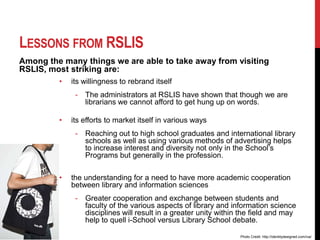
Lessons from RSLISAmong the many things we are able to take away from visiting RSLIS, most striking are:its willingness to rebrand itselfThe administrators at RSLIS have shown that though we are librarians we cannot afford to get hung up on words. its efforts to market itself in various waysReaching out to high school graduates and international library schools as well as using various methods of advertising helps to increase interest and diversity not only in the School’s Programs but generally in the profession. the understanding for a need to have more academic cooperation between library and information sciences Greater cooperation and exchange between students and faculty of the various aspects of library and information science disciplines will result in a greater unity within the field and may help to quell i-School versus Library School debate.Photo Credit: http://identitydesigned.com/iva/
discovering Scandinavian Library Culture and Style Through LecturesOur initial discussion at RSLIS provided us with a better framework for understanding the Danish library world.  The lectures we received at RSLIS in our first week of study oriented Danish library culture within context of broader Scandinavian library culture and established it as both unique and part of the regional whole.
LIS Education in Scandinavia:by Ole HarboIntroduction to the geographical structure of Scandinavian countries Scandinavian countries consist of Norway, Sweden, and  Denmark also Iceland, Finland, and the Faroe IslandsLibrary SystemsHeavily influenced by Germany and the public library system was strongly influenced by the United Stated of America. Establishment of library education programs in ScandinaviaMost libraries have their own library program, and if not programs and additional resources are shared amongst the universities.
Denmark’s HistoryHistorically Denmark controlled parts of Sweden.Nordic countries tried to create their own federation to share resources with one another.This only worked culturally for library organizations in the Nordic area.EducationAfter a peasant uprising, an opportunity was created to send all children to school for equality purposes. This education includes not only scholarly lessons, but also lessons on trust, culture, and social responsibilities. An Introduction to Denmark:by Ismail Abdullahi
Political Library in the Age of Web 2.0 and Social Network Media  by Leif KajbergUnderstanding new technology Being a responsible thinker by using critical awareness.
Social media should be used as a tool. For example: Market an issue via Facebook.Outlook on libraries and librariansLibrarians must teach students to learn how to educate themselves, so that they in turn may educate others.
We must teach the community the mission of the library to make the public understand the library’s goal of availability. Scandinavia’s Political System, Culture, and societies with an outlook on Librariesby Leif KajbergCultural Challenges and StrengthsAmericanization is a challengeConfidence in social capital
The Nordic Library Model and Trends in Scandinavian Library Architectural Design  by Nan DahlkildSuccessful Knowledge Environments require openness, lighting, sustainability, comfort and “fixability” as components that make a learning environment successful.Architecture and practices of Nordic librarieschurch (3 levels) “pharmacy-like” order open access modernized structuresExamples of libraries that embody the elements of a successful knowledge environment:Chicago Public LibraryNashville Main LibraryThe Royal Library (Black Diamond) in Copenhagen
Scenario Planning Scenario planning is a risk taking plan that leads one to think about how to execute a plan/ Based on the “what if” question.Creates an enlightened way of thinkingExecute a plan with the realistic mind.Entrepreneurship in the Library Professionby Michael Kristiansson
The Exploration of Various     types of Danish LibrariesIn the second week of our study with our anticipation at its peak, we were able to tour and explore different kinds of libraries in Denmark, each with a different purpose and/or target population.
Danish LibrariesWe had the opportunity to visit a wide variety of libraries in Copenhagen and elsewhere in Denmark.AmagerbroKultur’sSundbyBibliotek – A library created as part of a revitalization project for a lower income neighborhood providing state of the art programs for youth and a number of social services for its patronsCopenhagen Main Library – The head library of Copenhagen located in the center of the city’s downtown area FrederiksburgKommunesBiblioteker – A regular-sized community branch library HelsingørKommunesBiblioteker – A remodeled library in a somewhat rural yet historic coastal area that serves the public and takes on the responsibilities of a tourism office  KUBIS-Hum at Copenhagen University – Humanities library serving students and faculty at Copenhagen UniversityThe Royal Danish Library – A research library containing a wealth of primary sources from the middle ages through to the present
Danish Libraries:Common CharacteristicsThough each library we visited was quite different from the last, we found several common characteristics in them, such as:a caféan active community strong children’s facilities in the public librariesa focus on service
Danish Libraries:AmagerbroKultur’sSundbyBibliotek
Danish Libraries:AmagerbroKultur’sSundbyBibliotekSundby library was created as part of AmagerbroKultur, a neighborhood cultural organization offering concerts, theater, exercise, play time, lectures, and workshops for citizens in that area. AmagerbroKultur as a Faciltator:AmagerbroKultur supports the local democracy.Meeting Rooms for local organizations
Electronic Bulletin Board
Online Program ManagementCollaboratorsWorks with other libraries in the city
Education
Child DevelopmentDanish Libraries:Copenhagen Main Library
Danish Libraries:Copenhagen Main LibraryIn the heart of Copenhagen, this library has multiple levels:Ground - Cafe & Reception 2nd Floor - Children & Youth, Art & Literature3rd Floor - Humanities and Social Studies4th Floor - Sociology, Government, Cooking, others
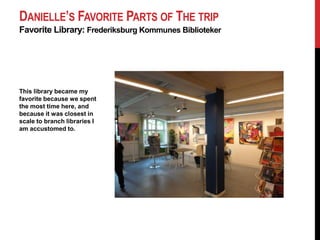
Danish Libraries:Frederiksberg KommunesBibliotekerSet in blah blahblah, this friendly branch library was just across the street from our hotel and our only real source of internet access.  It quickly became a favorite for that reason alone.Two floors with adult materials located on the ground floorSome AV materials are loaned as well as video gamesA modest amount of computers in the adult and children’s areas
Danish Libraries:HelsingørKommunesBiblioteker
Danish Libraries:HelsingørKommunesBibliotekerLocated in the town of Helsingør, HelsingørKommunesBiblioteker, aka Helsbib., is roughly thirty miles away from Copenhagen.  This state of the art library is set up in three levels:1st Floor – Children’s2nd Floor - Fiction3rd Floor – Facts (Nonfiction)This library is also fully equipped with a concert hall, exercise room, and an play area for adults.
Danish Libraries:KUBIS-Hum at Copenhagen University
Danish Libraries:KUBIS-Hum at Copenhagen UniversityKUBIS is an acronym (Københavns UniversitetsBibliotekogInformationsService) translating to Copenhagen University Library and Information Service (CULIS) in English. KUBIS-Hum is the Faculty Library of Humanities at KUBIS.  This library’s collections hold information for departments related to the arts, linguistic studies, and cultural studies at Copenhagen University.  The library also regularly hosts events and exhibits.
Danish Libraries:The Royal Danish Library
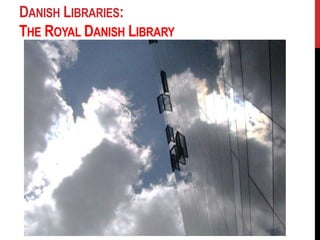
Danish Libraries:The Royal Danish LibraryThe Royal Danish  Library is made up of the newer black prism known as the Black Diamond, seen here, as well as the older brick building next to it.
Danish Libraries:The Royal Danish LibraryThe Royal Library is another wonderful example of the old merging with the new in Denmark.The library was originally founded in 1648 by King Frederik III.
It was opened to the public in 1793.
The old building was built in its current location in 1906.
It merged with Copenhagen University Library in 1989.
The Black Diamond was opened in 1999.Amenities of the Black Diamond:The Queen’s HallAuditorium
The National Museum of Cartoon Art
The National Museum of PhotographyDanish Libraries:The Royal Danish LibraryBoth The interior and exterior of the Black Diamond are modern and beautifully made, however features and fixtures inside the library maintain design aspects that are similar to those in the old building so that a sense of continuity is achieved.
Helsbib’s modern interior and experimental design stood out from other libraries we toured. We had the opportunity to view many features at this library that I have never seen anywhere else.Megan’s Favorite Parts of The tripFavorite Library: Helsbib
Megan’s Favorite Parts of The tripFavorite Place: Nyhavn HarborNyhavn Harbor was my favorite place in Copenhagen. This harbor is off the main canal near the city center, and featured some of the most beautiful, unique houses in the city. These buildings used to be bars and brothels, but now feature restaurants and tourist shops. Hans Christian Anderson’s house is near the end of the harbor.
Megan’s Favorite Parts of The TripFavorite Moment: Reaching the top of the Church of Our SaviorMy favorite moment was the last day of our trip, when we climbed the spire of the Church of Our Savior. Although this experience was terrifying, at over 200 feet in the air with the last steps of the tower on the outside of the spire, we had a great view of the city we had been living in for two weeks.  This was an excellent way to say good-bye to the city.
Kafi’s Favorite Parts of The TripFavorite Library: HelsbibMy favorite library was also Helsbib, set in a remodeled shipyard within view of both Kronborg “Hamlet’s” Castle and the Swedish shoreline.
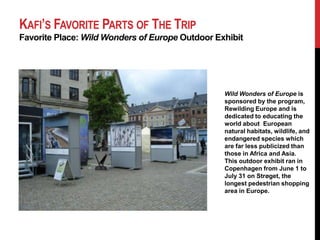
Kafi’s Favorite Parts of The TripFavorite Place: Wild Wonders of Europe Outdoor Exhibit Wild Wonders of Europe is sponsored by the program, Rewilding Europe and is dedicated to educating the world about  European natural habitats, wildlife, and endangered species which are far less publicized than those in Africa and Asia.  This outdoor exhibit ran in Copenhagen from June 1 to July 31 on Strøget, the longest pedestrian shopping area in Europe.

Study abroad2

  • 1.
    NCCU School ofLibrary and Information ScienceStudy abroadDenmark 2011
  • 2.
    Presented by MeganLawson, Danielle’ McGhee, Kafi-Ayanna Allah, and Jason Howard
  • 3.
    Getting to knowDenmark and Exploring Danish CultureDenmark is an impressive country, and Copenhagen is full of old-world charm, even though it is one of the largest cities in northern Europe. Having spent two weeks in Copenhagen, we had the opportunity to get to know the country and the people, their lifestyle, politics, and culture helping us to form a context by which to understand their libraries.
  • 4.
    Blending the Oldwith the New One of the things that stood out the most for us was the blending of the old with the new in the city. This is accomplished through:ArchitectureRenovation of old buildings rather than tearing them down is common. The exterior is left in tact, while the interior is modernized. Yet Denmark is also home to many modern architectural masterpieces.PoliticsThere is a reverence for the Danish Royal Family, but Danes are also very conscious about what is happening in their parliament, voting, and asserting their rights.LifestyleDenmark is very much in the Information Age, and aspects of the country are very modern, high tech, and fact paced. At the same time, Danes also value the past, nature, and taking time out to enjoy life.Blending the Old with the New: architectureThe Exterior and Interior of Magasin Department Store:Preservation is important in Copenhagen, so architects use the shells of original buildings but recreate the interiors.Interior Photo Credit: en.unionpay.com
  • 5.
    Blending the Oldwith the New: architectureThe interior of AmagerbroKultur’sSunby Library and cultural center reflects typical modern Danish design, focusing on light wood and natural lighting.
  • 6.
    Blending the Oldwith the New: architectureDevelopers of Amager neighborhoods began incorporating modern design into the original exteriors as part of revitalization projects that began in the 2000’s.
  • 7.
    Blending the Oldwith the New: Unique NeighborhoodsThe practices of creating modern buildings in empty spaces, preserving historic architecture, and modernizing some of the older buildings have made the neighborhoods and districts of city very distinct and unique. We could often tell what district we were in by the buildings around us.The Bella Sky Hotel in Ørestad District Photo Credit: housevariety.blogspot.com
  • 8.
    Blending the Oldwith the New: Unique NeighborhoodsNyhavnHarbourand KongensNytorv where Magasin is found have older, more traditional housing structures because these areas are closer to the center of the city.Strøgetis the longest pedestrian shopping area in Europe. This downtown district consists mostly of row houses that have been converted into shops and restaurants.
  • 9.
    Blending the Oldwith the New: Unique NeighborhoodsParts of Copenhagen University are also in the Islands Bryyge area. This modern dorm on the University’s newest campus is an architectural masterpiece.The Islands Bryggedistrict has newer, more modern construction mixed with older structures because it is placed further outside the city.
  • 10.
    Blending the Oldwith the New: GovernmentDanish political system is an example of blending old with new as their government is a constitutional monarchy.Though she has little formal power, there is still much respect and pride for the monarch, Queen Margarethe. Citizens are also proud of their right to vote. We learned that around 80% of the Danish population votes, and they are allowed to elect a new government if they are not satisfied with the current one.This process is occurring right now, making it a very exciting time to visit the country.Queen Magarethe IIPhoto Credit: clausdjensen.com
  • 11.
    Blending the oldwith the New: GovernmentChristiansborg Palace was used for centuries as the monarch’s residence, but is now home to Parliament, the Danish Supreme Court, and the Office of the Prime Minister. It is the only building in the world that can claim it houses all three branches of the government.
  • 12.
    Taxes and DanishServicesCitizens have to pay very high taxes, about 50-70% of their income, but they see the benefits in everyday life through:free public health care and educationwonderful maternity benefits and retirement planswelfare for unemployed citizens for up to 2 yearsfree access to libraries, cultural centers, museums, etc.The Danes are proud of the taxes they pay because they know they have quality services and that their government takes care of its people.
  • 13.
    University of CopenhagenPost-secondaryeducation in Denmark is free.
  • 14.
    AmagerbroKulturDanish citizens havefree access to public libraries and cultural centers like Amagerbro Cultural Center that incorporates artistic spaces and athletic centers.
  • 15.
    Blending the Oldwith the New:DanskeHyggeDanskehyggemeans “Danish relaxation” or “Danish well-being.” Although Copenhagen is a metropolis and one of the largest cities in Scandinavia, the Danes there have a simple way of living.Because of the harsh winters and months of darkness they must live in, hygge is taken seriously as a necessity for well being. This equates to:mandatory summer vacations from worka lack of summer schoollittle crime in the citya very trusting nature; mothers leave babies in strollers outside on nice days for fresh airDanskehyggereally means that Danes are able to find relaxation and enjoyment in every part of life. We were told that Danes only need 3 things to be happy: good weather, a cup of coffee, and a pastry. By Danish standards, we were very happy the whole trip!
  • 16.
    Danish Summer WeatherInsummer, Danes can be seen everywhere enjoying the wonderful weather, as they are here in the King’s Gardens.
  • 17.
    Danish PastriesIf itonly takes good weather, coffee, and a pastry to make a Dane happy, we were very happy travelers by Danish standards!
  • 18.
    An introduction toDanish Library Systems and EducationExperiencing Copenhagen helped us to better grasp Danish society, and we were able to understand Danish libraries through that lens. After two days of touring the city, we began our course of study. Our education about the country’s libraries began with an introduction to library science education at the Royal School of Library and Information Science.
  • 19.
    The Royal Schoolof Library and Information Science (RSLIS)The Royal School of Library and Information Science (RSLIS), DetInformationsvidenskabeligeAkademi(IVA) in Danish
  • 20.
    Survey and DiscussWewere given a tour of the facility by Ragnhild Riis, Research Officer at RSLIS,as well as a chance to sit and discuss with her the institution, its programs, and some of the challenges and concerns RSLIS and Danish libraries are facing.Photo Credit: identitydesigned.com/iva/
  • 21.
    Basic Background andStatisticsFounded in 1956, RSLIS replaced the Danish State Library School that had been established in 1918.The School has ~1,000 students and a branch campus in Aalborg.Accredited Bachelor’s, Master’s, and PhD programs are available.RSLIS also offers an English language Master’s Program for non-Danes and seeks partnerships with foreign universities. We were able to meet international Master’s students, however there are currently no international PhD students.
  • 22.
    Challenges to RSLIS:EnrollmentBecause education is free in Denmark, institutions are funded based upon enrollment. To keep enrollment up, RSLIS:recruits young people as they graduate high school.advertises the School’s programs in newspapers and in short films.creates connections with library and information science (LIS) schools at universities abroad, such as the recent partnership created with Wuhan University in China.However, the lack of interest in librarianship still resulted in low enrollment. RSLIS’s solution was to rebrand itself by employing a fresh look to its advertisements and, more notably, by changing the Danish version of its name from DanmarksBiblioteksskole (Danish Library School) toDetInformationsvidenskabeligeAkademi(The Information Science Academy). Enrollment has increased.
  • 23.
    Award WinnersPhoto Credit:http://www.make.dk/news/all/all/makestuffAs a matter of fact, for its work on its visual identity, RSLIS received the Distinction Award this year in the international brand transformation showcase competition hosted by Rebrand.http://www.rebrand.com/distinction-iva
  • 24.
    What’s in aName?‘University’ vs. ‘Academy’Most Danish universities are governed by the Ministry of Science, Technology, and Innovation. RSLIS is governed by the Danish Ministry of Cultural Affairs, thus ‘university’ cannot be used. Ms. Riis raised the point that there can be many connotations of the term “academy,” many of them less than comparable to the esteem and legitimacy associated with “university.” As such, RSLIS is not thought of as a proper university, though it produces the same type of degrees and research. The View of the Library versus The View of LibrarianshipLibraries in Denmark are governed by the Ministry of Culture because they are cornerstones of the community.
  • 25.
    In many placesin the world Librarians are not seen as real professionals.  Concerns about LIS Schools: i-Schools and Library SchoolsThe debate between i-Schools and Library Schoolsis really a debate about the nature and future of libraries. Rather than being viewed as aspects of the same discipline, information science is viewed as progressive while library science is viewed as static. Ms. Riis was not in favor of the notion of i-Schools which seemingly place information science outside of library science as a separate field. Library and Information Science schools may be able to reduce this separation.Fracturing within the programs: At RSLIS, library science and information science disciplines are housed in two completely separate buildings of the School.
  • 26.
    RSLIS regards thissituation as less than ideal and seek more cooperation and interactions between the two disciplines. Other Concerns:Fundingand DigitalizationBudget cuts have lead to fewer resources in Danish libraries and some closures.Riis noted that financial constraints have been less harsh on school libraries, but they have been affected. Some academic libraries have been forced to merge their personnel with university staff to save money, giving the libraries less autonomy.The notion of digitalization raised such questions as: What are the expectations of digital libraries?In the wake of digitizing materials, will one have access to less due to storage issues and the costs associated with purchasing digital media licenses?Will budget cuts to the digital library inevitably lead to outsourcing entire collections?It seems that librarians everywhere, even in a society as high tech as Denmark’s is, are struggling with questions about the future of the library and the role of new technology.
  • 27.
    Lessons from RSLISAmongthe many things we are able to take away from visiting RSLIS, most striking are:its willingness to rebrand itselfThe administrators at RSLIS have shown that though we are librarians we cannot afford to get hung up on words. its efforts to market itself in various waysReaching out to high school graduates and international library schools as well as using various methods of advertising helps to increase interest and diversity not only in the School’s Programs but generally in the profession. the understanding for a need to have more academic cooperation between library and information sciences Greater cooperation and exchange between students and faculty of the various aspects of library and information science disciplines will result in a greater unity within the field and may help to quell i-School versus Library School debate.Photo Credit: http://identitydesigned.com/iva/
  • 28.
    discovering Scandinavian LibraryCulture and Style Through LecturesOur initial discussion at RSLIS provided us with a better framework for understanding the Danish library world. The lectures we received at RSLIS in our first week of study oriented Danish library culture within context of broader Scandinavian library culture and established it as both unique and part of the regional whole.
  • 29.
    LIS Education inScandinavia:by Ole HarboIntroduction to the geographical structure of Scandinavian countries Scandinavian countries consist of Norway, Sweden, and Denmark also Iceland, Finland, and the Faroe IslandsLibrary SystemsHeavily influenced by Germany and the public library system was strongly influenced by the United Stated of America. Establishment of library education programs in ScandinaviaMost libraries have their own library program, and if not programs and additional resources are shared amongst the universities.
  • 30.
    Denmark’s HistoryHistorically Denmarkcontrolled parts of Sweden.Nordic countries tried to create their own federation to share resources with one another.This only worked culturally for library organizations in the Nordic area.EducationAfter a peasant uprising, an opportunity was created to send all children to school for equality purposes. This education includes not only scholarly lessons, but also lessons on trust, culture, and social responsibilities. An Introduction to Denmark:by Ismail Abdullahi
  • 31.
    Political Library inthe Age of Web 2.0 and Social Network Media by Leif KajbergUnderstanding new technology Being a responsible thinker by using critical awareness.
  • 32.
    Social media shouldbe used as a tool. For example: Market an issue via Facebook.Outlook on libraries and librariansLibrarians must teach students to learn how to educate themselves, so that they in turn may educate others.
  • 33.
    We must teachthe community the mission of the library to make the public understand the library’s goal of availability. Scandinavia’s Political System, Culture, and societies with an outlook on Librariesby Leif KajbergCultural Challenges and StrengthsAmericanization is a challengeConfidence in social capital
  • 34.
    The Nordic LibraryModel and Trends in Scandinavian Library Architectural Design by Nan DahlkildSuccessful Knowledge Environments require openness, lighting, sustainability, comfort and “fixability” as components that make a learning environment successful.Architecture and practices of Nordic librarieschurch (3 levels) “pharmacy-like” order open access modernized structuresExamples of libraries that embody the elements of a successful knowledge environment:Chicago Public LibraryNashville Main LibraryThe Royal Library (Black Diamond) in Copenhagen
  • 35.
    Scenario Planning Scenarioplanning is a risk taking plan that leads one to think about how to execute a plan/ Based on the “what if” question.Creates an enlightened way of thinkingExecute a plan with the realistic mind.Entrepreneurship in the Library Professionby Michael Kristiansson
  • 36.
    The Exploration ofVarious types of Danish LibrariesIn the second week of our study with our anticipation at its peak, we were able to tour and explore different kinds of libraries in Denmark, each with a different purpose and/or target population.
  • 37.
    Danish LibrariesWe hadthe opportunity to visit a wide variety of libraries in Copenhagen and elsewhere in Denmark.AmagerbroKultur’sSundbyBibliotek – A library created as part of a revitalization project for a lower income neighborhood providing state of the art programs for youth and a number of social services for its patronsCopenhagen Main Library – The head library of Copenhagen located in the center of the city’s downtown area FrederiksburgKommunesBiblioteker – A regular-sized community branch library HelsingørKommunesBiblioteker – A remodeled library in a somewhat rural yet historic coastal area that serves the public and takes on the responsibilities of a tourism office KUBIS-Hum at Copenhagen University – Humanities library serving students and faculty at Copenhagen UniversityThe Royal Danish Library – A research library containing a wealth of primary sources from the middle ages through to the present
  • 38.
    Danish Libraries:Common CharacteristicsThougheach library we visited was quite different from the last, we found several common characteristics in them, such as:a caféan active community strong children’s facilities in the public librariesa focus on service
  • 39.
  • 40.
    Danish Libraries:AmagerbroKultur’sSundbyBibliotekSundby librarywas created as part of AmagerbroKultur, a neighborhood cultural organization offering concerts, theater, exercise, play time, lectures, and workshops for citizens in that area. AmagerbroKultur as a Faciltator:AmagerbroKultur supports the local democracy.Meeting Rooms for local organizations
  • 41.
  • 42.
    Online Program ManagementCollaboratorsWorkswith other libraries in the city
  • 43.
  • 44.
  • 45.
    Danish Libraries:Copenhagen MainLibraryIn the heart of Copenhagen, this library has multiple levels:Ground - Cafe & Reception 2nd Floor - Children & Youth, Art & Literature3rd Floor - Humanities and Social Studies4th Floor - Sociology, Government, Cooking, others
  • 46.
    Danish Libraries:Frederiksberg KommunesBibliotekerSetin blah blahblah, this friendly branch library was just across the street from our hotel and our only real source of internet access. It quickly became a favorite for that reason alone.Two floors with adult materials located on the ground floorSome AV materials are loaned as well as video gamesA modest amount of computers in the adult and children’s areas
  • 47.
  • 48.
    Danish Libraries:HelsingørKommunesBibliotekerLocated inthe town of Helsingør, HelsingørKommunesBiblioteker, aka Helsbib., is roughly thirty miles away from Copenhagen. This state of the art library is set up in three levels:1st Floor – Children’s2nd Floor - Fiction3rd Floor – Facts (Nonfiction)This library is also fully equipped with a concert hall, exercise room, and an play area for adults.
  • 49.
    Danish Libraries:KUBIS-Hum atCopenhagen University
  • 50.
    Danish Libraries:KUBIS-Hum atCopenhagen UniversityKUBIS is an acronym (Københavns UniversitetsBibliotekogInformationsService) translating to Copenhagen University Library and Information Service (CULIS) in English. KUBIS-Hum is the Faculty Library of Humanities at KUBIS. This library’s collections hold information for departments related to the arts, linguistic studies, and cultural studies at Copenhagen University. The library also regularly hosts events and exhibits.
  • 51.
  • 52.
    Danish Libraries:The RoyalDanish LibraryThe Royal Danish Library is made up of the newer black prism known as the Black Diamond, seen here, as well as the older brick building next to it.
  • 53.
    Danish Libraries:The RoyalDanish LibraryThe Royal Library is another wonderful example of the old merging with the new in Denmark.The library was originally founded in 1648 by King Frederik III.
  • 54.
    It was openedto the public in 1793.
  • 55.
    The old buildingwas built in its current location in 1906.
  • 56.
    It merged withCopenhagen University Library in 1989.
  • 57.
    The Black Diamondwas opened in 1999.Amenities of the Black Diamond:The Queen’s HallAuditorium
  • 58.
    The National Museumof Cartoon Art
  • 59.
    The National Museumof PhotographyDanish Libraries:The Royal Danish LibraryBoth The interior and exterior of the Black Diamond are modern and beautifully made, however features and fixtures inside the library maintain design aspects that are similar to those in the old building so that a sense of continuity is achieved.
  • 60.
    Helsbib’s modern interiorand experimental design stood out from other libraries we toured. We had the opportunity to view many features at this library that I have never seen anywhere else.Megan’s Favorite Parts of The tripFavorite Library: Helsbib
  • 61.
    Megan’s Favorite Partsof The tripFavorite Place: Nyhavn HarborNyhavn Harbor was my favorite place in Copenhagen. This harbor is off the main canal near the city center, and featured some of the most beautiful, unique houses in the city. These buildings used to be bars and brothels, but now feature restaurants and tourist shops. Hans Christian Anderson’s house is near the end of the harbor.
  • 62.
    Megan’s Favorite Partsof The TripFavorite Moment: Reaching the top of the Church of Our SaviorMy favorite moment was the last day of our trip, when we climbed the spire of the Church of Our Savior. Although this experience was terrifying, at over 200 feet in the air with the last steps of the tower on the outside of the spire, we had a great view of the city we had been living in for two weeks. This was an excellent way to say good-bye to the city.
  • 63.
    Kafi’s Favorite Partsof The TripFavorite Library: HelsbibMy favorite library was also Helsbib, set in a remodeled shipyard within view of both Kronborg “Hamlet’s” Castle and the Swedish shoreline.
  • 64.
    Kafi’s Favorite Partsof The TripFavorite Place: Wild Wonders of Europe Outdoor Exhibit Wild Wonders of Europe is sponsored by the program, Rewilding Europe and is dedicated to educating the world about European natural habitats, wildlife, and endangered species which are far less publicized than those in Africa and Asia. This outdoor exhibit ran in Copenhagen from June 1 to July 31 on Strøget, the longest pedestrian shopping area in Europe.