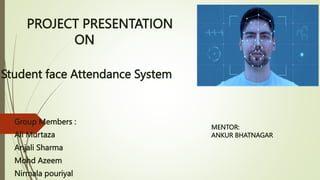
Student face Attendance System
Group Members :
Ali Murtaza
Anjali Sharma
Mohd Azeem
Nirmala pouriyal
MENTOR:
ANKUR BHATNAGAR
PROJECT PRESENTATION
ON
CONTENT:
 INTRODUCTION
 TRADITIONAL ATTENDANCE V/S FACE RECOGNITION
 HOW FACE RECOGNITION WORK?
 COMPONENT OF FACE ATTENDANCE SYSTEM
 BENEFITS
 CHALLENGES & ETHICAL CONCERNS
 FUTURE IMPLICATION
 CONCLUSION
Introduction to student face attendance
sytem
A Student Face Attendance System project aims to automate the
process of attendance tracking by utilizing facial recognition technology.
it involves the creation of a system that can:
1. Capture facial images of students.
2. Analyze and identify unique facial features to create digital templates
(faceprints).
3. Compare captured faceprints with stored data to mark attendance
accurately.
4. Provide real-time attendance tracking and data to educators and
administrators.
5. Ensure the security and privacy of students' biometric information.
This project combines hardware, software, and ethical considerations to
create a reliable and efficient method for attendance management that
minimizes errors, enhances security, and streamlines administrative
tasks within educational institutions.
Introduction to face recognition

Face recognition technology identifies people by analyzing their facial features. It
works by capturing an image, extracting unique facial characteristics, creating a
digital faceprint, comparing it to stored data, and making a decision about the
person's identity or verification. This tech is used for security, access control, and
increasingly in attendance systems. While it offers accuracy and automation,
ethical concerns about privacy and biases persist.
 The project aims to revolutionize attendance tracking by implementing a secure,
accurate, and automated system using face recognition technology.
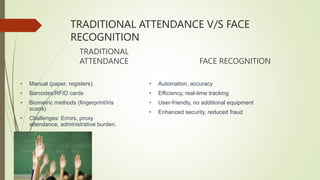
TRADITIONAL ATTENDANCE V/S FACE
RECOGNITION
TRADITIONAL
ATTENDANCE
• Manual (paper, registers)
• Barcodes/RFID cards
• Biometric methods (fingerprint/iris
scans)
• Challenges: Errors, proxy
attendance, administrative burden.
FACE RECOGNITION
• Automation, accuracy
• Efficiency, real-time tracking
• User-friendly, no additional equipment
• Enhanced security, reduced fraud
TRADITIONAL ATTENDANCE V/S FACE
RECOGNITION
 Traditional Attendance Systems:
• Manual (paper, registers)
• Barcodes/RFID cards
• Biometric methods (fingerprint/iris scans)
• Challenges: Errors, proxy attendance, administrative burden.
• Face Recognition for Attendance:
• Automation, accuracy
• Efficiency, real-time tracking
• User-friendly, no additional equipment
• Enhanced security, reduced fraud
HOW FACE RECOGNITION WORK?
1. Face Detection:
1. Begins with a camera capturing an image or video frame containing a face.
2. Algorithms locate and identify faces within the captured image.
2. Feature Extraction:
1. Analyzes the detected face to identify key distinguishing features.
2. Measures elements like the distance between eyes, nose shape, cheekbone structure, etc.
3. Creating a Faceprint:
1. Converts the extracted facial features into a unique digital template or faceprint.
2. This faceprint is a numerical representation of the unique characteristics of an individual's face.
4. Database Comparison:
1. Compares the generated faceprint with a database of stored faceprints.
2. The database can contain faceprints of known individuals for identification or a single stored faceprint for verification.
5. Matching and Decision:
1. Utilizes complex algorithms to match the captured faceprint with stored faceprints.
2. In identification, it searches the database for a match. In verification, it checks if the captured faceprint matches the stored one.
6. Outcome:
1. Based on the comparison, the system produces a decision or result.
2. For identification, it may output the matched identity or indicate no match found. For verification, it confirms or denies the match.
benefit
1. Precision: Accurate identification ensures error-free attendance records.
2. Efficiency: Automates attendance tracking, reducing administrative workload.
3. Real-time Tracking: Provides live data for immediate monitoring.
4. Enhanced Security: Strengthens campus security by preventing unauthorized access.
5. User-Friendly: Convenient for students and faculty, no additional equipment needed.
6. Data Insights: Generates valuable attendance data for analysis and decision-making.
7. Cost Savings: Reduces paper usage and associated costs.
8. Compliance: Helps adhere to data protection laws and promotes transparency.
9. Error Reduction: Minimizes human errors in attendance marking.
10.Adaptability: Can integrate with existing school systems for seamless operation.
CHALLENGES & ETHICAL CONCERNS
 Challenges:
1. Accuracy in Different Conditions: Ensuring accurate recognition under varying lighting conditions, different facial angles, or with students wearing
accessories like glasses or hats.
2. Technology Reliability: Dependence on technology functioning consistently without errors or technical glitches that might affect attendance tracking.
3. Data Security: Safeguarding biometric data stored in the system against breaches or unauthorized access.
4. Privacy Concerns: Respecting students' privacy rights and obtaining consent for collecting and storing facial data.
5. Integration and Compatibility: Ensuring seamless integration with existing school management systems or databases.
 Ethical Concerns:
1. Consent and Privacy: Obtaining informed consent from students and ensuring their awareness of how their biometric data will be used and
protected.
2. Bias and Fairness: Addressing potential biases in the facial recognition algorithms that might lead to unfair treatment or misidentification, especially
for certain demographics.
3. Data Protection: Adhering to data protection laws and regulations, such as GDPR, to protect students' sensitive biometric information.
4. Transparency and Accountability: Ensuring transparency about the system's functioning and establishing accountability in handling and securing
the data collected.
5. Potential Misuse: Preventing misuse of facial data for purposes other than attendance tracking and ensuring it's not shared or accessed
inappropriately.
FUTURE IMPLICATION
 future implications for a Student Face Attendance System:
1. Enhanced Accuracy and Efficiency:
1. Advancements in technology for more accurate and efficient attendance tracking.
2. Integration with AI and Machine Learning:
1. Integration with AI to improve recognition capabilities and adaptability.
3. Expanded Biometric Authentication:
1. Wider use beyond attendance for access control and services on campuses.
4. Strengthened Security Measures:
1. Integration with campus security systems for enhanced safety.
5. Personalized Learning Insights:
1. Using attendance data to personalize teaching methods for students.
6. Ethical Framework Development:
1. Establishment of ethical guidelines for responsible use of biometric data.
7. Global Adoption and Standardization:
1. Increasing worldwide adoption with standardized practices.
8. Collaborative Research Efforts:
1. Collaboration among stakeholders to address challenges and biases.
9. Customization and Adaptability:
1. Customizing systems for different educational setups and needs.
10. Administrative Streamlining:
1. Beyond attendance, improving other administrative processes.
conclusion
1. Efficiency and Accuracy:
1. The system optimizes attendance tracking, ensuring precision and streamlining the process for both students and educators.
2. Enhanced Security:
1. With its biometric approach, it fortifies campus security, minimizing unauthorized access and ensuring data integrity.
3. Real-time Data and Insights:
1. Instant attendance data facilitates prompt decision-making and offers valuable insights for improving educational strategies.
4. User-Friendly Approach:
1. Simplifies attendance for users by eliminating the need for additional tools, creating a seamless experience.
5. Ethical Considerations:
1. Ethical concerns emphasize the need for responsible data handling and compliance with privacy regulations for fair usage.
6. Future Implications:
1. The system's evolution promises advancements, expanded applications, and collaborative efforts to address challenges for responsible
integration.
7. Collaborative Approach:
1. Highlighting the necessity of collaboration among stakeholders to navigate challenges and ensure ethical and efficient system implementation.

Student face Attendance System.pptx

  • 1.
    Student face AttendanceSystem Group Members : Ali Murtaza Anjali Sharma Mohd Azeem Nirmala pouriyal MENTOR: ANKUR BHATNAGAR PROJECT PRESENTATION ON
  • 2.
    CONTENT:  INTRODUCTION  TRADITIONALATTENDANCE V/S FACE RECOGNITION  HOW FACE RECOGNITION WORK?  COMPONENT OF FACE ATTENDANCE SYSTEM  BENEFITS  CHALLENGES & ETHICAL CONCERNS  FUTURE IMPLICATION  CONCLUSION
  • 3.
    Introduction to studentface attendance sytem A Student Face Attendance System project aims to automate the process of attendance tracking by utilizing facial recognition technology. it involves the creation of a system that can: 1. Capture facial images of students. 2. Analyze and identify unique facial features to create digital templates (faceprints). 3. Compare captured faceprints with stored data to mark attendance accurately. 4. Provide real-time attendance tracking and data to educators and administrators. 5. Ensure the security and privacy of students' biometric information. This project combines hardware, software, and ethical considerations to create a reliable and efficient method for attendance management that minimizes errors, enhances security, and streamlines administrative tasks within educational institutions.
  • 4.
    Introduction to facerecognition  Face recognition technology identifies people by analyzing their facial features. It works by capturing an image, extracting unique facial characteristics, creating a digital faceprint, comparing it to stored data, and making a decision about the person's identity or verification. This tech is used for security, access control, and increasingly in attendance systems. While it offers accuracy and automation, ethical concerns about privacy and biases persist.  The project aims to revolutionize attendance tracking by implementing a secure, accurate, and automated system using face recognition technology.
  • 5.
    TRADITIONAL ATTENDANCE V/SFACE RECOGNITION TRADITIONAL ATTENDANCE • Manual (paper, registers) • Barcodes/RFID cards • Biometric methods (fingerprint/iris scans) • Challenges: Errors, proxy attendance, administrative burden. FACE RECOGNITION • Automation, accuracy • Efficiency, real-time tracking • User-friendly, no additional equipment • Enhanced security, reduced fraud
  • 6.
    TRADITIONAL ATTENDANCE V/SFACE RECOGNITION  Traditional Attendance Systems: • Manual (paper, registers) • Barcodes/RFID cards • Biometric methods (fingerprint/iris scans) • Challenges: Errors, proxy attendance, administrative burden. • Face Recognition for Attendance: • Automation, accuracy • Efficiency, real-time tracking • User-friendly, no additional equipment • Enhanced security, reduced fraud
  • 8.
    HOW FACE RECOGNITIONWORK? 1. Face Detection: 1. Begins with a camera capturing an image or video frame containing a face. 2. Algorithms locate and identify faces within the captured image. 2. Feature Extraction: 1. Analyzes the detected face to identify key distinguishing features. 2. Measures elements like the distance between eyes, nose shape, cheekbone structure, etc. 3. Creating a Faceprint: 1. Converts the extracted facial features into a unique digital template or faceprint. 2. This faceprint is a numerical representation of the unique characteristics of an individual's face. 4. Database Comparison: 1. Compares the generated faceprint with a database of stored faceprints. 2. The database can contain faceprints of known individuals for identification or a single stored faceprint for verification. 5. Matching and Decision: 1. Utilizes complex algorithms to match the captured faceprint with stored faceprints. 2. In identification, it searches the database for a match. In verification, it checks if the captured faceprint matches the stored one. 6. Outcome: 1. Based on the comparison, the system produces a decision or result. 2. For identification, it may output the matched identity or indicate no match found. For verification, it confirms or denies the match.
  • 9.
    benefit 1. Precision: Accurateidentification ensures error-free attendance records. 2. Efficiency: Automates attendance tracking, reducing administrative workload. 3. Real-time Tracking: Provides live data for immediate monitoring. 4. Enhanced Security: Strengthens campus security by preventing unauthorized access. 5. User-Friendly: Convenient for students and faculty, no additional equipment needed. 6. Data Insights: Generates valuable attendance data for analysis and decision-making. 7. Cost Savings: Reduces paper usage and associated costs. 8. Compliance: Helps adhere to data protection laws and promotes transparency. 9. Error Reduction: Minimizes human errors in attendance marking. 10.Adaptability: Can integrate with existing school systems for seamless operation.
  • 10.
    CHALLENGES & ETHICALCONCERNS  Challenges: 1. Accuracy in Different Conditions: Ensuring accurate recognition under varying lighting conditions, different facial angles, or with students wearing accessories like glasses or hats. 2. Technology Reliability: Dependence on technology functioning consistently without errors or technical glitches that might affect attendance tracking. 3. Data Security: Safeguarding biometric data stored in the system against breaches or unauthorized access. 4. Privacy Concerns: Respecting students' privacy rights and obtaining consent for collecting and storing facial data. 5. Integration and Compatibility: Ensuring seamless integration with existing school management systems or databases.  Ethical Concerns: 1. Consent and Privacy: Obtaining informed consent from students and ensuring their awareness of how their biometric data will be used and protected. 2. Bias and Fairness: Addressing potential biases in the facial recognition algorithms that might lead to unfair treatment or misidentification, especially for certain demographics. 3. Data Protection: Adhering to data protection laws and regulations, such as GDPR, to protect students' sensitive biometric information. 4. Transparency and Accountability: Ensuring transparency about the system's functioning and establishing accountability in handling and securing the data collected. 5. Potential Misuse: Preventing misuse of facial data for purposes other than attendance tracking and ensuring it's not shared or accessed inappropriately.
  • 11.
    FUTURE IMPLICATION  futureimplications for a Student Face Attendance System: 1. Enhanced Accuracy and Efficiency: 1. Advancements in technology for more accurate and efficient attendance tracking. 2. Integration with AI and Machine Learning: 1. Integration with AI to improve recognition capabilities and adaptability. 3. Expanded Biometric Authentication: 1. Wider use beyond attendance for access control and services on campuses. 4. Strengthened Security Measures: 1. Integration with campus security systems for enhanced safety. 5. Personalized Learning Insights: 1. Using attendance data to personalize teaching methods for students. 6. Ethical Framework Development: 1. Establishment of ethical guidelines for responsible use of biometric data. 7. Global Adoption and Standardization: 1. Increasing worldwide adoption with standardized practices. 8. Collaborative Research Efforts: 1. Collaboration among stakeholders to address challenges and biases. 9. Customization and Adaptability: 1. Customizing systems for different educational setups and needs. 10. Administrative Streamlining: 1. Beyond attendance, improving other administrative processes.
  • 12.
    conclusion 1. Efficiency andAccuracy: 1. The system optimizes attendance tracking, ensuring precision and streamlining the process for both students and educators. 2. Enhanced Security: 1. With its biometric approach, it fortifies campus security, minimizing unauthorized access and ensuring data integrity. 3. Real-time Data and Insights: 1. Instant attendance data facilitates prompt decision-making and offers valuable insights for improving educational strategies. 4. User-Friendly Approach: 1. Simplifies attendance for users by eliminating the need for additional tools, creating a seamless experience. 5. Ethical Considerations: 1. Ethical concerns emphasize the need for responsible data handling and compliance with privacy regulations for fair usage. 6. Future Implications: 1. The system's evolution promises advancements, expanded applications, and collaborative efforts to address challenges for responsible integration. 7. Collaborative Approach: 1. Highlighting the necessity of collaboration among stakeholders to navigate challenges and ensure ethical and efficient system implementation.