International Journal of Horticulture, Agriculture and Food Science (IJHAF)
ISSN: 2456-8635
[Vol-9, Issue-4, Oct-Dec, 2025]
Issue DOI: https://dx.doi.org/10.22161/ijhaf.9.4
Peer-Reviewed Journal
Article DOI: https://dx.doi.org/10.22161/ijhaf.9.4.3 (Int. j. hortic. agric. food sci.)
https://aipublications.com/ijhaf/ Page | 17
Structures and Problems for Measuring Agricultural
Productivity: An Analytical Study
Dr. Tage Ampa1
, Dr. Ram Krishna Mandal2,*
1
Assistant Professor, Department of Education, Dera Natung Govt. College, Itanagar, Arunachal Pradesh, India
2
HoD & Professor, Department of Economics, Cooch Behar Panchanan Barma University, Cooch Behar, West Bengal, India
Orcid: 0000-0001-9621-7084
*Corresponding Author
Received: 25 Sep 2025; Received in revised form: 23 Oct 2025; Accepted: 28 Oct 2025; Available online: 02 Nov 2025
©2025 The Author(s). Published by AI Publications. This is an open-access article under the CC BY license
(https://creativecommons.org/licenses/by/4.0/)
Abstract— The concept of agricultural productivity has been widely used to clarify the spatial organization and
distribution of agricultural practices, and to glean important insights into how agricultural systems operate across
varying spatial contexts. Productivity generally is assessed from two key standpoints: (a) on the productivity of land
resources that are used in agricultural practice, and (b) on the productivity of the infrastructure that exists in support
of agricultural activity, both interrelated and mutually implicated in overall agricultural success. Objectives: The
present research examines the varying contentions associated with measuring agricultural productivity. Methods and
Materials: This discussion focuses on the methods used for measuring agricultural productivity, including the
Agriculture Productivity Index, and also digs deeper into how agricultural productivity is determined. Results and
Discussions: Quality and quantity in the context of productivity are influenced by four main factors—the land, labor,
capital and the entrepreneur of the farmer. While land productivity applies primarily to crop-based agriculture, it
can also apply to livestock production. There are many measures of productivity that can be calculated but one
comprehensive measure is the ratio of the total value of all farm products to the total land area used for agriculture.
Conclusion: It is also important to note that different areas within the country exhibit different and divergent problems
in relation to agricultural production.
Keywords— Spatial organization, Resources, Index, Quality and quantity, Livestock production
I. INTRODUCTION
Agricultural productivity is an extensive topic that has been
studied and explained by many researchers with varying
definitions and perspectives. In agriculture, there are many
namesake practitioners (agriculturalists, agronomists,
economists, and geographers) that study productivity from
their particular perspective; thus, produce a variety of
definitions. In agricultural geography and economic
science, agricultural productivity is normally interpreted as
the quantity of output produced per unit of input used, or the
output produced per unit of land area, which is an indication
of efficiency. The understanding of increasing agricultural
productivity is often related to a more appropriate use of the
input factors of production, which considers physical
resources and socioeconomic institutional and
technological factors able to support agricultural
development. The agricultural improvement and
developments of a country or region depend largely on
enabling the cultivation and production of multiple crops of
the agricultural economy. Over the years, there have been
massive undertakings and initiatives made to put forth in
improving food security and economic stability through
reaching higher production and productivity rates in
agriculture. Observing agricultural productivity provides
important information by showing performance levels in
agricultural productivity by region and compared to
neighboring regions to understand efficient or inefficient
level of output.
By scrutinizing these performance indicators, agricultural
development strategies can be conceived and generated,
directed at addressing and alleviating regional
discrepancies, and inequalities within the agricultural sector
Ampa and Mandal International Journal of Horticulture, Agriculture and Food Science (IJHAF)
9(3)-2025
Article DOI: https://dx.doi.org/10.22161/ijhaf.9.4.3 (Int. j. hortic. agric. food sci.)
https://aipublications.com/ijhaf/ Page | 18
as a whole. In addition, these measurements provide an
important opportunity to examine ground realities that
contribute to agricultural stagnation, or backwardness, in
specific areas, thus leading to more tailored intentions. The
spatial examination of agricultural productivity is
significant because it highlights the structural dynamics and
issues associated with production relations, thus allowing
developers to formulate relevant and effective policy
measures that engage and direct appropriate policy options.
The concept of agricultural productivity has been widely
used to clarify the spatial organization and distribution of
agricultural practices, and to glean important insights into
how agricultural systems operate across varying spatial
contexts. Productivity generally is assessed from two key
standpoints: (a) on the productivity of land resources that
are used in agricultural practice, and (b) on the productivity
of the infrastructure that exists in support of agricultural
activity, both interrelated and mutually implicated in overall
agricultural success. The productivity of land is always tied
to and often encumbered with, the productivity of the
infrastructure engaged in agricultural production, as
Dharmasiri (2011), discusses, highlighting the
interrelatedness of these variables.
OBJECTIVES
The present research examines the varying contentions
associated with measuring agricultural productivity.
II. METHODS AND MATERIALS
This discussion focuses on the methods used for measuring
agricultural productivity, including the Agriculture
Productivity Index, and also digs deeper into how
agricultural productivity is determined. Agricultural
productivity is generally defined as the ratio of output
produced to the input used, which can be produced using
multiple formulas. For example, the simplest formula is the
output/input ratio, while the more advanced method
represents a productivity index, which would include one or
multiple measures of inputs considering land area, total
production, or any other contextual factors impacting levels
of productivity (such as price or variety of crop).
Methodology
This study employs an analytic-descriptive research design
to assess the structures, indicators, and challenges of
measuring agricultural productivity. The methodology
seeks to provide a conceptual and empirical understanding
of different ways to measure agricultural productivity while
also assessing their limitations and applicability for specific
systems of agriculture.
Design: The design for this study is based on a descriptive-
analytics study. It utilizes secondary sources, theoretical
models, and existing measurement indices for assessing
structures of productivity measurement and inherent
problems. The design allows for a comparative-critique of
the current literature, as well as providing a comparison of
quantitative tools to measure productivity.
Data Sources: The research draws primarily on secondary
data from published books, academic journals, reports from
international institutions such as the Food and Agriculture
Organization (FAO), Organisation for Economic Co-
operation and Development (OECD), and government
papers, including classified documents. A range of existing
classical works (for example, Singh and Dhillon, 2000 and
Shafi, 1984) as well as contemporary studies (for example,
Dharmasiri, 2011; Ludena, 2010) are utilised in order to
construct a holistic framework.
Analytical Tools and Techniques: A variety of techniques
for measuring agricultural productivity that are widely used
are reviewed and applied conceptually: 1. Simple Output -
Input Ratio - assessing relative productivity with an
efficiency measurement of total output over total input
(yield/input). 2. Productivity Index (PI) - measuring
regional output against national outputs to assess relative
performance. 3. Total Factor Productivity (TFP) - assessing
total efficiency which takes into account a range of inputs
(land, labour, capital, water, fertiliser, etc.) in assessing an
output measure (e.g., yield, productivity) based on total
output. 4. Yield per Unit Area - a measure of productivity
that measures yield per hectare; one of the most commonly
used productivity indicators (for a single crop report). 5.
Input-specific measures - including land productivity,
labour productivity, capital productivity, and productivity
of intermediate inputs; the measures follow a standard
formula. Additionally, consideration is given to the
Perpetual Inventory Method (PIM) and current inventory
method (CIM) of estimating capital stock; minimal returns
analysis is also introduced as a more precise measure of
productivity relative to efficiency.
Scope of Analysis
The approach involves: Structural Analysis: Measurement
of land, labour, capital and intermediate inputs as structural
factors for productivity.
Comparative Analysis: The distribution across regions
and types of farms, for the purpose of demonstrating
differences.
Problem Analysis: The analysis of other issues such as
mixed cropping, unmonitored by-products of the farming
process, horticultural outputs being underestimated and
technical efficiencies.
Ampa and Mandal International Journal of Horticulture, Agriculture and Food Science (IJHAF)
9(3)-2025
Article DOI: https://dx.doi.org/10.22161/ijhaf.9.4.3 (Int. j. hortic. agric. food sci.)
https://aipublications.com/ijhaf/ Page | 19
Policy Linkages: Linking the results of measurement to the
underlying policies in relation to resource use, technology
use and sustainability.
Limitations: The study is confined to secondary data,
which may contain inconsistencies across regions and
between time periods. The intricate nature of agricultural
systems, in developing economies, particularly mixed and
subsistence farming, brings some inevitable challenges that
cause accuracy in measurement to vary these will be noted
when considering results.
III. MATERIALS
When Singh and Dhillion (2000) first suggested that 'yield
per unit' should be closely examined and seen as a valid
indicator of agricultural productivity, it drew considerable
interest from the academic community. Not unexpectedly,
this suggestion has been widely critiqued, and it has been
claimed by a number of other authors that it is an invalid
suggestion as it ultimately focuses on land as the sole factor
of production, rather than the multitude of other important
factors that pertain to agricultural production.
As a result, there is a growing chorus of academics who
propose a broader definition of agricultural productivity
which considers each of the essential resources of
production, specifically, labour or farmer experience, the
use of fertilisers, the access to and management of water
inputs, and a variety of biological factors that underpin crop
production. Due to the aforementioned agreement that
average returns per unit of food production is insufficient, it
has also been suggested to use marginal returns per unit of
food production as a more precise measure instead. This
measure is believed to be a more accurate representation of
the efficiency of combining any inputs into the production
process, assuming 'all else is held constant'. In agriculture,
the resources used to achieve production are diverse (land,
labour, seeds, manure, irrigation land, etc) and all of these
resources are necessary in agricultural practice. In addition
to these factors, the role of managerial ability (an intangible
but necessary resource) is also an important resource to the
overall success of agricultural business success. Just as
everything has a certain amount of efficiency associated
with it, a given agricultural business will be most efficient
when the combination of production inputs is least cost for
a given amount of output. Therefore, the ratio of cash values
of outputs produced to cash values of inputs used can be
simply defined as cost efficiency measures in agriculture.
It is therefore reasonable to assume that higher levels of
output indicate an increasingly efficient allocation of
resources and, on the other hand, a more efficient allocation
of resources means more output levels (Krishnarao, 1960).
The productivity of labour is one of the main determinants
of occupational income levels for those workers involved in
agricultural activities, revealing the importance of labour
efficiency in terms of the entire economy. Broadly stated,
labour productivity can be stated in terms of man-hours or
days of work to generate a unit of agricultural production.
Shafi (1984) noted that labour productivity is measured by
total agricultural output produced per unit of labour
employed. This measurement is of primary significance in
terms of what is potentially the most critical factor of
production and thus makes it intuitively obvious and
relatively simple to measure. Agricultural productivity can
be defined as the "ratio of the index of the local agricultural
output to the index of total inputs used in farm production."
Additionally, labour productivity is an important
determinant of living standards often expressed in total
income per person, thus demonstrating its important policy
implications. However, it is important to acknowledge that
labour productivity only represents part of the actual
capabilities of workers or the intensity of worker effort in
the production process (OECD, 2001). In the field of
agricultural geography, the significance of labour
productivity has two major dimensions. To begin with, it
significantly affects the national economy and, second, it is
one of the primary determinants of the standard of living of
the agricultural population (Dharmasiri, 2011). Capital
investment - which includes a multitude of expenditures
such as land purchase; land development and reclamation;
drainage and irrigation infrastructure; livestock purchase;
feed, seeds, and farming tools; machinery; and, chemical
inputs into crop production - is now seen as a key
contributor in increasing agricultural productivity.
Significant studies by Jamison and Lau (1982) and
Alderman et al. (1996) have explored the linkages between
education and wages with agricultural productivity,
specifically focusing on how human capital informs
agricultural productivity. More recently, Fafchamps and
Quisumbing (1998) have conducted extensive research,
identifying several indicators of human capital and its
implications for agricultural productivity - an important
research endeavor that reflects the multifaceted nature of
agricultural productivity, particularly in the Pakistani
context.
Different ways of measures and formulae
1. Simple Output / Input Ratio: This is the most
straightforward measure of the productivity of a single
factor of production; we simply total the output and divide
by the total input. The input could be labor, or fertilizer, or
amount of land,
Formula: Productivity of a single factor of production =
Output / Input. Let us take the most important factor of
Ampa and Mandal International Journal of Horticulture, Agriculture and Food Science (IJHAF)
9(3)-2025
Article DOI: https://dx.doi.org/10.22161/ijhaf.9.4.3 (Int. j. hortic. agric. food sci.)
https://aipublications.com/ijhaf/ Page | 20
production in productivity, labor. Labor Productivity (or
Productivity of Labor) = Output / Labor.
2. Productivity Index (PI): This measure allows us to
compare output of one crop against output of a different
crop in relation to the amount of land used. The formula for
PI = [(Y / Yn) / (T / Tn)] where Y = Total output of the
selected crops ina specific unit area, Yn = Total output of
the same selected crop at the national level, T = Total area
cropped of the specific crop in that specific area, Tn = Total
area cropped at the national level.
3. Total Factor Productivity (TFP): Total factor productivity
(TFP) expresses productivity of all inputs used in the
production of an output at a time. TFP is a broader measure
of productivity, which combines all inputs rather than one
or two. Formula: TFP = [(Output) / (Inputs)]. For example,
if a farm is producing one output while decreasing the
overall inputs (land, labor, capital, water, fertilizers, etc.)
used, TFP would be increasing.
4. Crop Yield per Unit Area: Crop yield per unit area is
perhaps one of the most utilized measures of agricultural
productivity and is specific to crops. Formula: Yield per
hectare = Total yield / Area (in hectares).
5. Extra Measures: Land Productivity: Land productivity is
the production per unit of land, i.e., yield per of land.
Labour Productivity: Labour productivity means the
quantities of production per unit of labour (or, output per
worker hour).
Capital Productivity: Capital productivity means the
quantities of production per unit of capital investment.
Gross revenue: The gross revenue is the total income
generated from agricultural production.
6. Agricultural productivity valuation:
Cap Rate: Cap rate is the capitalization rate used in
agricultural land valuations.
Landowner's Share: The proportion of gross revenue that
the landowner receives.
Formula: [(Gross Revenue × Landowner's Share) / Cap
Rate].
Example: [(10,000 Gross Revenue per acre)×(0.8
landowner's share)/(0.05 cap rate)] would equal (10,000 ×
0.8)/0.05 = Rs. 160,000, the productivity value per acre.
7. Assessment of agricultural productivity
Cap rate: Cap rate is the capitalization rate used for the
valuation of agricultural land per acre. Landowner's
Share:The share of gross revenues that goes to the
landowner per acre.
Formula: (Gross Revenue × Landowner's Share) / Cap Rate
For example, gross revenues = Rs. 20000 per acre, the
landowner’s = 50% of the production value= Rs. 10000 for
that acre, and Cap rate = 10%
Therefore, the assessment of agricultural productivity =
[(20000 × 50%)/10%] = [(20000 × 0.5)/0.1] = Rs. 100,000
Agricultural productivity is computed using the formula,
Productivity = (Total Output ÷ Total Input), where "Total
Input" are the resources consumed in the production of the
agricultural output (land, labor, capital, water, fertilizers,
etc.; and "Total Output" refers to the volume of agricultural
output (outputs such as crops and livestock).
(https://openknowledge.fao.org/server/api/core/bitstreams/
dcd4edfc-f7d5-4872-8996-5612c8 7446d6/content).
IV. RESULTS AND DISCUSSIONS
Quality and Quantity
Quality and quantity in the context of productivity are
influenced by four main factors—the land, labor, capital and
the entrepreneur of the farmer.
Land Productivity: While land productivity applies
primarily to crop-based agriculture, it can also apply to
livestock production. There are many measures of
productivity that can be calculated but one comprehensive
measure is the ratio of the total value of all farm products
(crops and livestock) to the total land area used for
agriculture. Land productivity measures only the return of
output associated with a specific land area used for
production agriculture. While primarily applied in crop
production, land productivity measures the aggregate land
area dedicated to crop agriculture. Land productivity can
also be determined by the ratio of area of land planted to the
output of crop production, where the area of land is typically
measured in form of acres or hectares. When land
productivity is measured as a physical yield, for example,
yield of crops such as maize are measured in tonne yield,
this measure aligns with the return on productivity.
In contrast, when land productivity is expressed in monetary
terms, it is often called returns to land. The term captures
the financial benefits from agricultural practices undertaken
on the land.
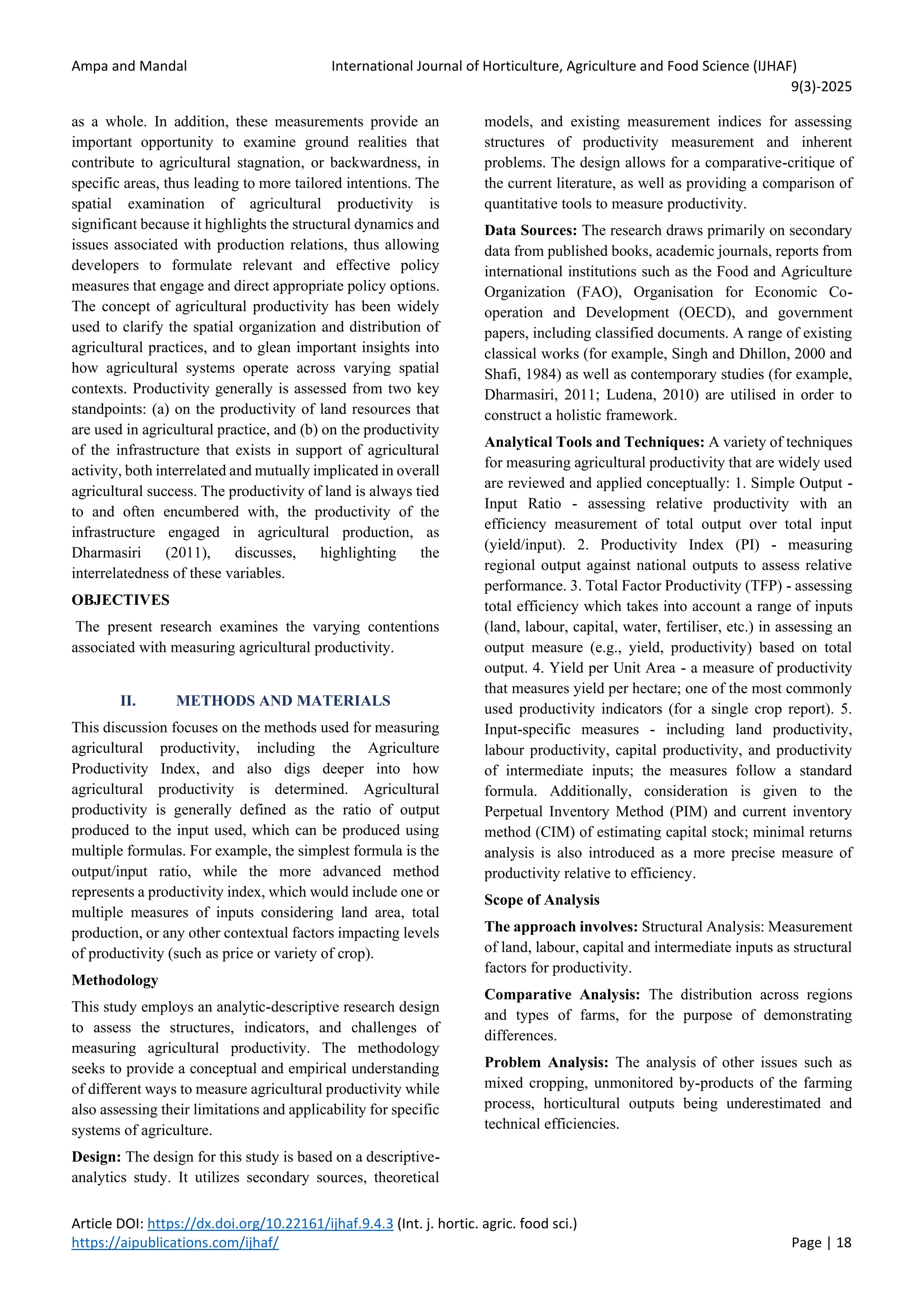
Land productivity =
Quantity of output
Area used by Crop
In regard to agricultural production, productivity
calculations must account for all crop produced on the
specified plot of land during a specified reference time,
which may mean a cropping season or year. This is
important to consider because, in practice, farmers often
grow multiple crops on the same land during the year;
Ampa and Mandal International Journal of Horticulture, Agriculture and Food Science (IJHAF)
9(3)-2025
Article DOI: https://dx.doi.org/10.22161/ijhaf.9.4.3 (Int. j. hortic. agric. food sci.)
https://aipublications.com/ijhaf/ Page | 21
farmers may grow each crop together on that parcel of land
or may have a practice of successive cropping with different
crops during different seasons. Kelly et al. (1996) described
a broader issue regarding the under-valuation of yield and
output in developing countries, and ultimately, he and co-
authors attribute this under-valuation to not fully accounting
for crops that are mixed or that people grow in succession,
and not adequately accounting for by-products that may be
sold, consumed by the household or used to produce
something else out of crops grown for food. Therefore, it is
especially important that all crops grown be included in the
greater calculation of productivity, especially in developing
countries where this type of practice is very common.
Labour Productivity: Labour productivity is an expression
used in a formula that defines the amount produced relative
to the labour inputs used within the production process.
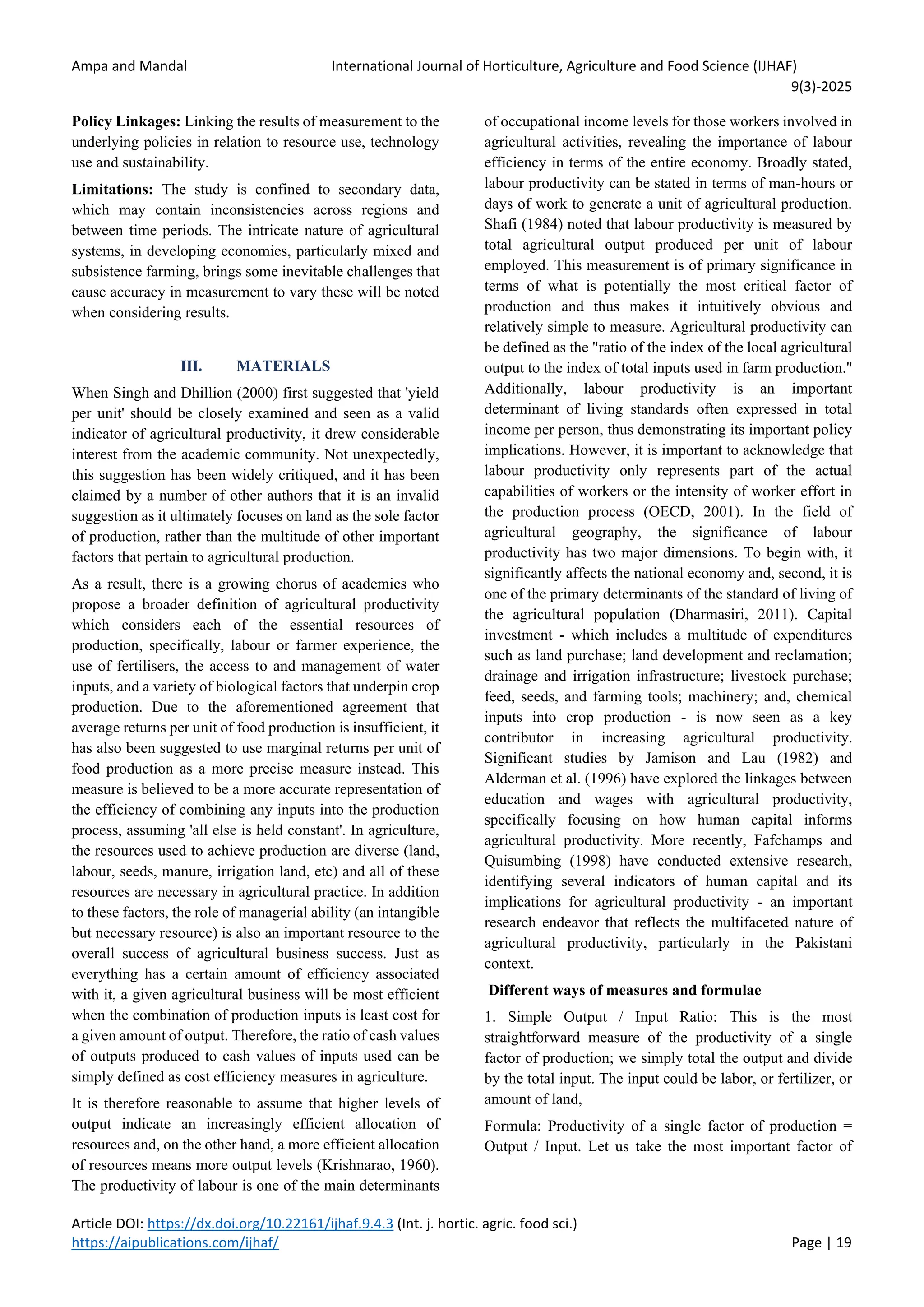
Here, the formula for labour productivity is:
Labour productivity =
Quantity of output
No. of Labour Employed
The accuracy and reliability of the labour productivity
measure depends on several factors that include but are not
limited to the actual amount of time spent doing agricultural
work (including full-time, part-time, or seasonal work, as
well as family labour and casual workers), along with the
skills and quality of the labour force. Differences in skill
and quality can impact productivity, and estimates can be
biased if a single wage rate is assigned to all types of
workers with differing skill levels and experience. The
complexity of labour productivity is not limited to labour
factors, as it is often entangled in other influential factors
such as land availability and the capital invested. For
example, Kelly et al. (1996) note that in situations of labour
scarcity and land abundance, producers are likely to
implement production systems designed to maximize
labour productivity. Capital also plays an important role, as
it is directly related to the overall productivity of labour.
Importantly, increases in agricultural yield can be primarily
linked to the use of genetically enhanced seeds that have
great yield potential and an increase in the use of chemical
fertilizers and pesticides, and in some cases, increased
irrigation. Higher labour productivity is often correlated
with the degree of mechanization in agriculture, as more
efficient mechanization reduces the labour needed to farm
more land. The differences in estimated labour productivity
levels in different countries and regions can in part be
explained by the greater degree of mechanized equipment
in developed economies than is found in developing
regions. In addition, labour costs involve the total of wages
and benefits paid to hired labour, plus the estimated wage
for any unpaid family labour and any unpaid labour
contributed by the farm owner. Estimating the imputed
wage for unpaid labour involves determining wage rates for
hired workers with similar characteristics—not a simple
exercise. Furthermore, adjusting for changes in labour
quality involves complex and nuanced calculations. To that
end, matrices have been developed, allowing work hours
and hourly wage rates to be categorized, and agrarian
workers can be classified by sex, age, education level, and
employment status (hired, self-employed, and unpaid
family labour). This allows for a comprehensive means to
measure labour inputs adjusted for quality.
Capital Productivity: Capital productivity serves as a vital
metric that assesses the contribution of capital utilised
within the production process to the overall output
generated. In agricultural contexts, capital is typically
defined as an input that is owned by the farm and is capable
of providing various services over an extended duration,
often spanning several years. When evaluating capital
productivity, it is common for many productivity measures
to concentrate predominantly on the tangible assets
associated with farming activities, including farm buildings,
machinery, and other forms of equipment that are integral
to production. The calculation of capital productivity is
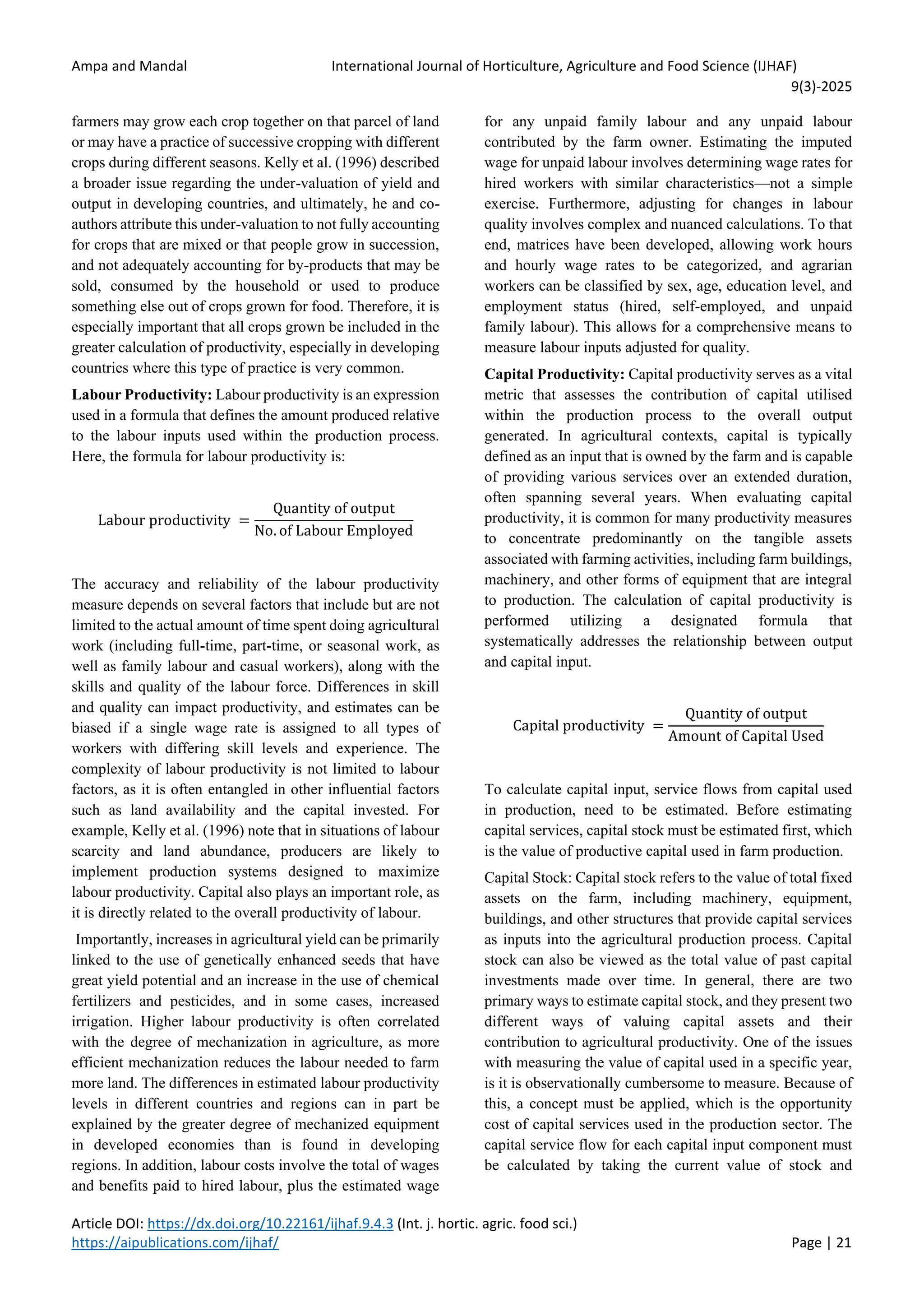
performed utilizing a designated formula that
systematically addresses the relationship between output
and capital input.
Capital productivity =
Quantity of output
Amount of Capital Used
To calculate capital input, service flows from capital used
in production, need to be estimated. Before estimating
capital services, capital stock must be estimated first, which
is the value of productive capital used in farm production.
Capital Stock: Capital stock refers to the value of total fixed
assets on the farm, including machinery, equipment,
buildings, and other structures that provide capital services
as inputs into the agricultural production process. Capital
stock can also be viewed as the total value of past capital
investments made over time. In general, there are two
primary ways to estimate capital stock, and they present two
different ways of valuing capital assets and their
contribution to agricultural productivity. One of the issues
with measuring the value of capital used in a specific year,
is it is observationally cumbersome to measure. Because of
this, a concept must be applied, which is the opportunity
cost of capital services used in the production sector. The
capital service flow for each capital input component must
be calculated by taking the current value of stock and
Ampa and Mandal International Journal of Horticulture, Agriculture and Food Science (IJHAF)
9(3)-2025
Article DOI: https://dx.doi.org/10.22161/ijhaf.9.4.3 (Int. j. hortic. agric. food sci.)
https://aipublications.com/ijhaf/ Page | 22
multiplying it by an estimated rental fee, which provides a
value for the capital service from the capital input.
In this case, the implicit rental rates for each asset type are
carefully derived by applying the expected real rate of
return which is an important indicator of the economic value
and efficiency of capital use.
The Perpetual Inventory Method (PIM): Often abbreviated
PIM, is predicated upon an increase in the capital stock from
the prior year for the purpose of estimating the current
year’s new investment, while factoring in the obsolescence
of productive capital by one year into the future, which is a
required process officially termed as capital depreciation.
Capital depreciation is usually calculated by asset type, as
an example to demonstrate the retailer’s operational
limitations, farm buildings and structures will have a much
longer depreciation time horizon than farm machinery
would, which simply reflects the real operational service
lives of the two asset types in agricultural production. The
perpetual inventory method may be clinically expressed in
the following mathematically symbolized manner:
𝐊𝐭 = 𝐈𝐭 + (𝟏− 𝛍)𝐊𝐭−𝟏
where Kt refers to the capital stock for the current year. It
represents the level of investment at this current point in
time. The μ, or replacement rate or depreciation factor,
provides a basis for determining the sustainability of capital
assets over time.
Current inventory method (CIM): The Current Inventory
Method (CIM), on the other hand, is based mainly on a
precise count and valuation of capital goods which might be
amended for the estimated average age of capital goods in
use, substantively, with regards to the accounting period or
agricultural season. The Continuous Inventory Method
(CIM) is a method for estimating capital stock that is usually
preferred for estimating capital stock with great detail, but
it requires a considerable amount of data inputs that may not
be universally available, regarding an accounting period or
agricultural season, in comparison to the more
straightforward current inventory method. The ultimate
utilization of either inventory measure - the Continuous
Inventory Method or the Current Inventory Measure -
depends upon the data that has been collected, and made
available, for an analysis of the asset and will rely
significantly on deciding upon an arbitrary service life of
the asset considered. Productivity of intermediate inputs:
Productivity of intermediate inputs is critically indicative of
the agricultural production process and represent goods and
services in the production process that will be transformed,
or that will be completely used, during a specific accounting
period or agricultural season.
In agriculture, intermediate inputs include a wide variety of
purchases made by farmers for the raw material and
supplemental inputs that are used in agricultural production,
and these inputs are essential to the efficiency and output of
any agricultural enterprise. Intermediate inputs may include
all kinds of things from energy, oil and lubricants to seeds,
fertilisers and soil amendments, pesticides and herbicides,
plus services such as repairs and maintenance, etc. Because
intermediate inputs differ in their nature, it’s useful to be
able to combine their input into a single unit of measure,
usually applied in terms of dollar value.
The value of intermediate inputs is usually defined by the
price paid by the farmer which may include some
combination of the financial elements of subsidies and taxes
along with the costs of production. With respect to inputs, it
is possible to measure and calculate the productivity of
intermediate inputs, through a somewhat specific formula,
which will express the degree of efficiency with which the
intermediate inputs are converted into agricultural products.
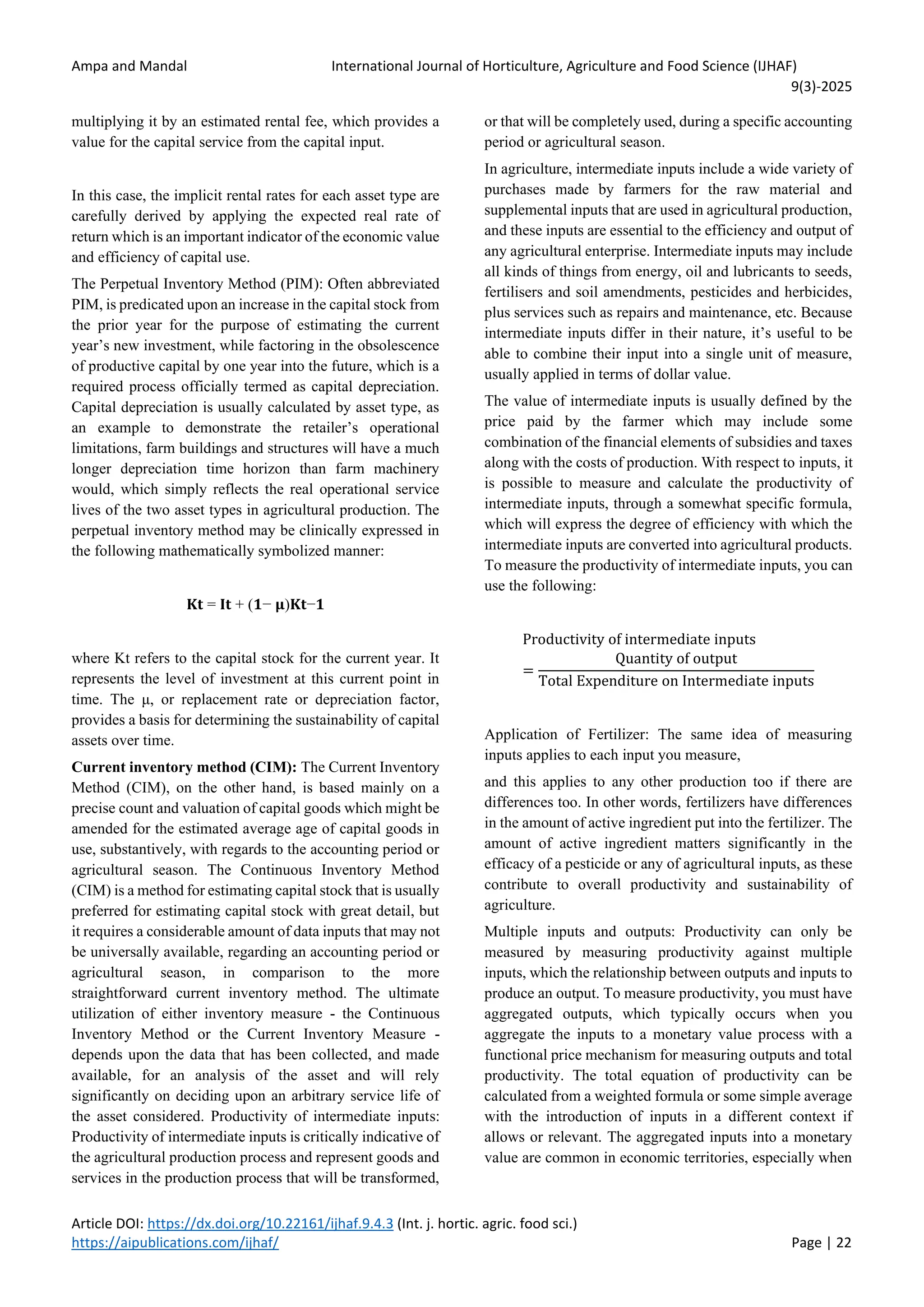
To measure the productivity of intermediate inputs, you can
use the following:
Productivity of intermediate inputs
=
Quantity of output
Total Expenditure on Intermediate inputs
Application of Fertilizer: The same idea of measuring
inputs applies to each input you measure,
and this applies to any other production too if there are
differences too. In other words, fertilizers have differences
in the amount of active ingredient put into the fertilizer. The
amount of active ingredient matters significantly in the
efficacy of a pesticide or any of agricultural inputs, as these
contribute to overall productivity and sustainability of
agriculture.
Multiple inputs and outputs: Productivity can only be
measured by measuring productivity against multiple
inputs, which the relationship between outputs and inputs to
produce an output. To measure productivity, you must have
aggregated outputs, which typically occurs when you
aggregate the inputs to a monetary value process with a
functional price mechanism for measuring outputs and total
productivity. The total equation of productivity can be
calculated from a weighted formula or some simple average
with the introduction of inputs in a different context if
allows or relevant. The aggregated inputs into a monetary
value are common in economic territories, especially when
Ampa and Mandal International Journal of Horticulture, Agriculture and Food Science (IJHAF)
9(3)-2025
Article DOI: https://dx.doi.org/10.22161/ijhaf.9.4.3 (Int. j. hortic. agric. food sci.)
https://aipublications.com/ijhaf/ Page | 23
applicable to your entire cost of production or overall cost
of inputs.
Issues Regarding Technical Efficiency
Input Type and Quality: In support of the statement that
production efficiency can only be assessed with the
assumption that the agricultural operation or firm is
operating at its technical efficient frontier, refer to the works
of Grosskopf (2002), Nishimizu& Page (1982), Fare et al.
(1989), and others. It is worth noting that agricultural
productivity is, at its essence, a function of two primary
items: the type and quality of input into the production
process and the degree to which those inputs are integrated
into the production process and ultimately utilized. The
former item reflects the production technologies utilized,
and the latter reflects technical efficiency of the production
process.
Improvements related to Productivity: Productivity
improvements are often and perhaps too simply attributed
to efficiency improvements; this attribution is almost
certainly misguided. For example, Ludena (2010) estimates
the advances associated with agricultural productivity in
Latin America and the Caribbean between the years 1961
and 2007 can be attributed largely to technological changes,
whereas the changes in efficiency during the same period
were negative. Estimates often arise from a general
ambiguity on how to define technical efficiency, how to
differentiate between efficiency and technological change,
and how the two relate to productivity.
Policies in Agriculture: Given the limited availability of
our natural resources - including land, water, and current
environmental conditions - the development and
implementation of effective agricultural policy is [...]the
productive capacity agricultural lies in... In fact, one should
expect similar or higher physical productivity and
significant financial returns from improved use of existing
technologies rather than simply transferring to newly
developed technologies. Although new technologies may
increase short-run productivity, new technologies may be at
a higher cost and impose higher costs on the environment.
Agricultural practices and policy applications can differ
widely from one country or region to another based, in part,
on the varied characteristics, quality, and accessibility of
agricultural inputs including soil, rainfall, and skill
qualifications of the labor force in agriculture.
Production Technology: Production technology is
intrinsically defined by the specific outputs and resources
available for production. For any given agricultural product,
there may be several production technologies, representing
distinct economic, environmental and agronomic conditions
in their particular context. For example, the nature of soils,
rainfall patterns, and other key inputs, all show structural
differences in regions such as Southeast Asia. A production
frontier is achieved when the inputs available are used in a
manner to achieve maximum efficiency. An agricultural
holding is achieving its production frontier, when it has
achieved the highest possible level of technical efficiency.
More formally, as described by Odhiambo & Nyangito
(2003), an agricultural holding is technically inefficient if -
based on its current use of inputs - it cannot produce the
most possible output it could. Whereas an agricultural
holding is technically inefficient if it is observed it is using
more inputs than it should considering what it is producing.
The idea of technical efficiency is important to agricultural
economics, because it gives a basis to the need for different
productivity targets to evaluate an agricultural operation
holistically.
This idea also considers multiple dimensions, the resource
and input base, which includes the technology used in
farming, and how far a given agricultural holding is from
the best idea of the most efficient producers in that industry.
It is entirely possible for a given agricultural holding to be
technically efficient; it may have been able to realize its own
potential maximum output level. It could also show low
productivity, compared to a less technically efficient farm,
simply because the less technically efficient farm has access
to better quality inputs that allow that farm productivity to
be higher. A farm can be considered technically inefficient
if it has not produced the maximum level of output that
could reasonably be expected given the type of inputs
available, as defined by the Food and Agricultural
Organization of the United Nations in 2017.
Meteorology and Geological Change: The complex
interplay of meteorological factors and geological change is
fundamental to the intricacy of the problem of agricultural
productivity but is amplified by the scale of the economic
context within which the situation lies.
The processes involved in determining relative prices, the
adjustments in production in response to changes in prices,
the complex inter-sectoral relationships in agriculture, and
the sophisticated value relations among potential factor
inputs and the final agricultural products powerfully affect
the general productivity problem; however, as Krishnarao
pointed out in 1960, a number of complex problems arise as
one tries to evaluate and compare returns to investment and
factor inputs in agricultural production.
Problems of Measurement in Agriculture
1. High Variation in Types of Agriculture: i) In
developing countries like India, there are widely diversified
agricultural systems including hybrids, cash crops and food
crops.
ii) This variation in the types of crops grown makes
measurement very difficult for reason that these crops
Ampa and Mandal International Journal of Horticulture, Agriculture and Food Science (IJHAF)
9(3)-2025
Article DOI: https://dx.doi.org/10.22161/ijhaf.9.4.3 (Int. j. hortic. agric. food sci.)
https://aipublications.com/ijhaf/ Page | 24
contribute in various degrees to total food and income
output.
2. Necessity of Total Output Returns: i) To obtain an
accurate measure of the productivity total, all output returns
of the farm must be included, namely, the output of main
crops, by-products, total returns from home produced
articles consumed and returns due to unsold stock.
ii) To omit any of these items in the calculation leads to
under-measurement of the total productivity of the farm.
3. Troublesome Mixed Cropping: i) Where mixed crops
are grown or several crops are put on the same area at the
same time, measurement is very difficult.
ii) It is very difficult to isolate the yield and/or value of each
of the crops that may be grown on an area.
iii) Thus Hopkins and Berry (1994) showed in Niger that if
the returns to labour were measured on the basis of the
returns from the major crop grown, then the productivity
costs were under-estimated by not less than 20 per cent, and
the addition of the returns of secondary crops gave a more
accurate idea of the total measure of productivity.
4. Under-Measurement of Return of Horticultural
Crops. i) Horticultural crops (fruits and vegetables, etc.) are
usually grown on smaller areas than the cereals or cash
crops.
ii) Because of their small area and new habit of production,
horticultural crops are usually omitted from the measure of
productivity.
iii) This means, therefore, that the actual income returns to
the farmer are less than on account of the horticultural
measurement, and it has the effect of concealing the
economic importance of the increasing value of
horticultural products for the diversification of high value
produce.
5. Omitting the Correlation in the Agricultural
Operations: i) outputs of one agricultural operation are, in
many cases, either directly or indirectly the feeds of another
agricultural operation. Thus, hay grown on crops can be
used as stock feed.
ii) Unless, however, these movements of stock-feeds for
which the farmer is not regarded as responsible are but
incompletely passed through the accounting system, the
productivity accounting will be but a partially truthful
measure and below the level required for a true appreciation
of productivity.
iii) The measurement of productivity comprehensively must
include all operations in the whole agricultural system.
6. Biases due to Ignorance of the Difference in Quality
and Variation:
i) The non-recognition of the differences in the quality of
land, mixtures of crops and differences in degrees of inputs
causes exceeding biases in the estimates of the productivity.
ii) According to Kelly et al. (1996), the existence of such
biases would distort the estimates of the microeconomics
profitability as well as macroeconomic performance of
agriculture.
7. Quality and efficiency of Inputs: i) The productivity is
not only a measure of the quantity of inputs, i.e. inputs
(land, labour, capital, etc.) but is also a measure of the
quality of the input and efficiency with which they are used.
ii) Thus the productivity of land, for instance, would be
measured also in terms of fertility of soil, the form of the
soil, climatic conditions, as well of course, the question of
management and the efficiency with which modern
technique has been applied to the agricultural industry
(Kelly et al, 1996).
8. Necessity for Holistic Productivity Measure: i) A
productivity measure which is meaningful must measure in
holistic totality all outputs and inputs which need not be
hitherto measured (e.g. by-products of all kinds,
horticulture (small scale) internal transfers (animal)) if a
true understanding of productivity is desired.
ii) This holistic productivity measure has investigation as to
the total productivity and accomplishes the essential idea
which is the true expression of efficiency in all degrees of
agricultural systems in developing countries, etc.
V. SUGGESTIONS
1. Placing ever-increasing pressure on farmers and
agricultural producers is the increasing demand to feed the
increasing global population more food, with the
increasingly decreasing available land and resources. It
requires a specialized and coordinated human effort to
manage the inputs required to fulfill the needs of
agricultural production while also maintaining the
ecological assets that sustain the agricultural productivity of
knowledge and sustainable practice.
2. The current forces of globalisation and the emergence of
corporate farming should not be allowed to challenge the
importance of millions of small and marginal farmers and
agricultural labourers, who together are the foundation of
the agricultural economy in India. The interests of these
marginalized groups should be robustly protected, and this
can only be achieved by enabling farmers through
appropriate empowerment, using innovative approaches
and skills that can contribute to sustainable agriculture.
Ampa and Mandal International Journal of Horticulture, Agriculture and Food Science (IJHAF)
9(3)-2025
Article DOI: https://dx.doi.org/10.22161/ijhaf.9.4.3 (Int. j. hortic. agric. food sci.)
https://aipublications.com/ijhaf/ Page | 25
3. The rise of information technology is creating a
transformational revolution in all areas of life, including
agriculture, and is an unprecedented opportunity to improve
agricultural productivity. Low-cost, simple, and well-
designed information technology solutions can help educate
farmers to provide them with important information they
can access to assist their farming activities. Information
technology can also serve as an effective market
information network and can give farmers real-time updates
on climatic, pest, and disease surveillance information that
is critical to agricultural productivity.
4. The current institutions that seek to circulate agricultural
information within the country, including institutions like
the Indian Council of Agricultural Research Institute
(ICAR), State Agricultural Universities (SAUs), and Krishi
Vigyan Kendras (KVKs) and a variety of non-
governmentand private sector actors, should consider
creating a better network instead of starting an institutional
vehicle anew. This alternative option would facilitate the
circulation of important information and knowledge,
ensuring that information is transferred freely and
efficiently to the end users (Rani, 2007).
VI. CONCLUSION
It is also important to note that different areas within the
country exhibit different and divergent problems in relation
to agricultural production. Such issues can consist of low
rainfall, poor environmental conditions, low groundwater
retention, inappropriate land, excess rainfall or flooding,
prolonged drought, and poor identification of the best
cropping options in accordance with soil conditions.
Agricultural productivity levels are most evident in the
northeastern states of the country, which seem to experience
the most challenges to sufficient levels of agricultural
productivity due to low groundwater retention, and
groundwater retention is what is needed to aid in producing
any crops or meeting the water demands of crops.
The South Eastern region of the country has a high potential
for agricultural production because of the amount of land
available for future expansion of additional cultivation. To
provide policy makers with the evidence to make future
decisions on agricultural expansion options, the existing
pattern of spatial distribution of the country’s agriculture
can guide the identification of potential agricultural
development zones. There is much research to be done on
developing nutrient-dense crops resilient to climate change.
Agricultural curricula must embed economic viability,
global competitiveness, social equity, and environmental
sustainability. Agricultural education must participate in the
global social compact to address societal demand.
REFERENCES
[1] Jamison, D. T., & Lau, L. J. (1982). Farmer education and
farm efficiency. Johns Hopkins University Press.
[2] Singh, J., & Dhillon, S. S. (2000). Agricultural geography
(2nd ed.). Tata McGraw-Hill.
[3] Shafi, M. (1984). Agricultural productivity and regional
imbalances. Concept Publishing Company.
[4] Alderman, H., Behrman, J. R., Ross, D. R., & Sabot, R.
(1996). The returns to endogenous human capital in
Pakistan’s rural wage labour market. Oxford Bulletin of
Economics and Statistics, 58(1), 29–55.
[5] Dharmasiri, L. M. (2011). Measuring agricultural
productivity using the Average Productivity Index (API). Sri
Lanka Journal of Advanced Social Studies, 1(2), 25–44.
https://doi.org/10.4038/sljass.v1i2.4855
[6] Fare, R., Grosskopf, S., Lovell, C. A. K., &Pasurka, C.
(1989). Multilateral productivity comparisons when some
outputs are undesirable: A nonparametric approach. Review
of Economics and Statistics, 71(1), 90–98.
[7] Grosskopf, S. (2002). Some remarks on productivity and its
decomposition. Journal of Productivity Analysis, 20(3), 459–
474.
[8] Hopkins, J., & Berry, S. (1994). Agricultural productivity and
the returns to labor in Africa. Journal of African Economies,
3(1), 61–96. https://doi.org/10.1093/jae/3.1.61
[9] Krishnarao, B. (1960). Efficiency in farming: An analytical
view. Indian Journal of Agricultural Economics, 15(2), 19-
26.
[10] Nishimizu, M., & Page, J. M. (1982). Total factor
productivity growth, technological progress and technical
efficiency change: Dimensions of productivity change in
Yugoslavia, 1965–78. The Economic Journal, 92(368), 920–
936.
[11] Rani, P. (2007). Agri-portal kiosk: A tool to ‘information
hungry’ farmers. Southern Economist, 46(6), 7–8.
[12] Fafchamps, M., & Quisumbing, A. R. (1998). Human capital,
productivity, and labour allocation in rural Pakistan.
https://www.economics.ox.ac.uk/members/marcel.fafchamp
s/homepage/hum.pdf
[13] Hopkins, J., & Berry, R. A. (1994). Agricultural productivity
and returns to labour: Evidence from Niger. World Bank
Working Paper.
[14] Kelly, V. A., Hopkins, J., Reardon, T., & Crawford, E. W.
(1996). Improving the measurement and analysis of African
agricultural productivity: Promoting complementarities
between micro and macro data (Technical Paper No. 27).
USAID, Office of Sustainable Development, Bureau for
Africa.
[15] Ludena, C. E. (2010). Agricultural productivity growth,
efficiency change and technical progress in Latin America
and the Caribbean (IDB Working Paper Series No. 186).
Inter-American Development Bank.
[16]Organisation for Economic Co-operation and Development
(OECD). (2001). Measuring productivity: OECD manual –
Measurement of aggregate and industry-level productivity
growth. OECD Publishing.

Structures and Problems for Measuring Agricultural Productivity: An Analytical Study

  • 1.
    International Journal ofHorticulture, Agriculture and Food Science (IJHAF) ISSN: 2456-8635 [Vol-9, Issue-4, Oct-Dec, 2025] Issue DOI: https://dx.doi.org/10.22161/ijhaf.9.4 Peer-Reviewed Journal Article DOI: https://dx.doi.org/10.22161/ijhaf.9.4.3 (Int. j. hortic. agric. food sci.) https://aipublications.com/ijhaf/ Page | 17 Structures and Problems for Measuring Agricultural Productivity: An Analytical Study Dr. Tage Ampa1 , Dr. Ram Krishna Mandal2,* 1 Assistant Professor, Department of Education, Dera Natung Govt. College, Itanagar, Arunachal Pradesh, India 2 HoD & Professor, Department of Economics, Cooch Behar Panchanan Barma University, Cooch Behar, West Bengal, India Orcid: 0000-0001-9621-7084 *Corresponding Author Received: 25 Sep 2025; Received in revised form: 23 Oct 2025; Accepted: 28 Oct 2025; Available online: 02 Nov 2025 ©2025 The Author(s). Published by AI Publications. This is an open-access article under the CC BY license (https://creativecommons.org/licenses/by/4.0/) Abstract— The concept of agricultural productivity has been widely used to clarify the spatial organization and distribution of agricultural practices, and to glean important insights into how agricultural systems operate across varying spatial contexts. Productivity generally is assessed from two key standpoints: (a) on the productivity of land resources that are used in agricultural practice, and (b) on the productivity of the infrastructure that exists in support of agricultural activity, both interrelated and mutually implicated in overall agricultural success. Objectives: The present research examines the varying contentions associated with measuring agricultural productivity. Methods and Materials: This discussion focuses on the methods used for measuring agricultural productivity, including the Agriculture Productivity Index, and also digs deeper into how agricultural productivity is determined. Results and Discussions: Quality and quantity in the context of productivity are influenced by four main factors—the land, labor, capital and the entrepreneur of the farmer. While land productivity applies primarily to crop-based agriculture, it can also apply to livestock production. There are many measures of productivity that can be calculated but one comprehensive measure is the ratio of the total value of all farm products to the total land area used for agriculture. Conclusion: It is also important to note that different areas within the country exhibit different and divergent problems in relation to agricultural production. Keywords— Spatial organization, Resources, Index, Quality and quantity, Livestock production I. INTRODUCTION Agricultural productivity is an extensive topic that has been studied and explained by many researchers with varying definitions and perspectives. In agriculture, there are many namesake practitioners (agriculturalists, agronomists, economists, and geographers) that study productivity from their particular perspective; thus, produce a variety of definitions. In agricultural geography and economic science, agricultural productivity is normally interpreted as the quantity of output produced per unit of input used, or the output produced per unit of land area, which is an indication of efficiency. The understanding of increasing agricultural productivity is often related to a more appropriate use of the input factors of production, which considers physical resources and socioeconomic institutional and technological factors able to support agricultural development. The agricultural improvement and developments of a country or region depend largely on enabling the cultivation and production of multiple crops of the agricultural economy. Over the years, there have been massive undertakings and initiatives made to put forth in improving food security and economic stability through reaching higher production and productivity rates in agriculture. Observing agricultural productivity provides important information by showing performance levels in agricultural productivity by region and compared to neighboring regions to understand efficient or inefficient level of output. By scrutinizing these performance indicators, agricultural development strategies can be conceived and generated, directed at addressing and alleviating regional discrepancies, and inequalities within the agricultural sector
  • 2.
    Ampa and MandalInternational Journal of Horticulture, Agriculture and Food Science (IJHAF) 9(3)-2025 Article DOI: https://dx.doi.org/10.22161/ijhaf.9.4.3 (Int. j. hortic. agric. food sci.) https://aipublications.com/ijhaf/ Page | 18 as a whole. In addition, these measurements provide an important opportunity to examine ground realities that contribute to agricultural stagnation, or backwardness, in specific areas, thus leading to more tailored intentions. The spatial examination of agricultural productivity is significant because it highlights the structural dynamics and issues associated with production relations, thus allowing developers to formulate relevant and effective policy measures that engage and direct appropriate policy options. The concept of agricultural productivity has been widely used to clarify the spatial organization and distribution of agricultural practices, and to glean important insights into how agricultural systems operate across varying spatial contexts. Productivity generally is assessed from two key standpoints: (a) on the productivity of land resources that are used in agricultural practice, and (b) on the productivity of the infrastructure that exists in support of agricultural activity, both interrelated and mutually implicated in overall agricultural success. The productivity of land is always tied to and often encumbered with, the productivity of the infrastructure engaged in agricultural production, as Dharmasiri (2011), discusses, highlighting the interrelatedness of these variables. OBJECTIVES The present research examines the varying contentions associated with measuring agricultural productivity. II. METHODS AND MATERIALS This discussion focuses on the methods used for measuring agricultural productivity, including the Agriculture Productivity Index, and also digs deeper into how agricultural productivity is determined. Agricultural productivity is generally defined as the ratio of output produced to the input used, which can be produced using multiple formulas. For example, the simplest formula is the output/input ratio, while the more advanced method represents a productivity index, which would include one or multiple measures of inputs considering land area, total production, or any other contextual factors impacting levels of productivity (such as price or variety of crop). Methodology This study employs an analytic-descriptive research design to assess the structures, indicators, and challenges of measuring agricultural productivity. The methodology seeks to provide a conceptual and empirical understanding of different ways to measure agricultural productivity while also assessing their limitations and applicability for specific systems of agriculture. Design: The design for this study is based on a descriptive- analytics study. It utilizes secondary sources, theoretical models, and existing measurement indices for assessing structures of productivity measurement and inherent problems. The design allows for a comparative-critique of the current literature, as well as providing a comparison of quantitative tools to measure productivity. Data Sources: The research draws primarily on secondary data from published books, academic journals, reports from international institutions such as the Food and Agriculture Organization (FAO), Organisation for Economic Co- operation and Development (OECD), and government papers, including classified documents. A range of existing classical works (for example, Singh and Dhillon, 2000 and Shafi, 1984) as well as contemporary studies (for example, Dharmasiri, 2011; Ludena, 2010) are utilised in order to construct a holistic framework. Analytical Tools and Techniques: A variety of techniques for measuring agricultural productivity that are widely used are reviewed and applied conceptually: 1. Simple Output - Input Ratio - assessing relative productivity with an efficiency measurement of total output over total input (yield/input). 2. Productivity Index (PI) - measuring regional output against national outputs to assess relative performance. 3. Total Factor Productivity (TFP) - assessing total efficiency which takes into account a range of inputs (land, labour, capital, water, fertiliser, etc.) in assessing an output measure (e.g., yield, productivity) based on total output. 4. Yield per Unit Area - a measure of productivity that measures yield per hectare; one of the most commonly used productivity indicators (for a single crop report). 5. Input-specific measures - including land productivity, labour productivity, capital productivity, and productivity of intermediate inputs; the measures follow a standard formula. Additionally, consideration is given to the Perpetual Inventory Method (PIM) and current inventory method (CIM) of estimating capital stock; minimal returns analysis is also introduced as a more precise measure of productivity relative to efficiency. Scope of Analysis The approach involves: Structural Analysis: Measurement of land, labour, capital and intermediate inputs as structural factors for productivity. Comparative Analysis: The distribution across regions and types of farms, for the purpose of demonstrating differences. Problem Analysis: The analysis of other issues such as mixed cropping, unmonitored by-products of the farming process, horticultural outputs being underestimated and technical efficiencies.
  • 3.
    Ampa and MandalInternational Journal of Horticulture, Agriculture and Food Science (IJHAF) 9(3)-2025 Article DOI: https://dx.doi.org/10.22161/ijhaf.9.4.3 (Int. j. hortic. agric. food sci.) https://aipublications.com/ijhaf/ Page | 19 Policy Linkages: Linking the results of measurement to the underlying policies in relation to resource use, technology use and sustainability. Limitations: The study is confined to secondary data, which may contain inconsistencies across regions and between time periods. The intricate nature of agricultural systems, in developing economies, particularly mixed and subsistence farming, brings some inevitable challenges that cause accuracy in measurement to vary these will be noted when considering results. III. MATERIALS When Singh and Dhillion (2000) first suggested that 'yield per unit' should be closely examined and seen as a valid indicator of agricultural productivity, it drew considerable interest from the academic community. Not unexpectedly, this suggestion has been widely critiqued, and it has been claimed by a number of other authors that it is an invalid suggestion as it ultimately focuses on land as the sole factor of production, rather than the multitude of other important factors that pertain to agricultural production. As a result, there is a growing chorus of academics who propose a broader definition of agricultural productivity which considers each of the essential resources of production, specifically, labour or farmer experience, the use of fertilisers, the access to and management of water inputs, and a variety of biological factors that underpin crop production. Due to the aforementioned agreement that average returns per unit of food production is insufficient, it has also been suggested to use marginal returns per unit of food production as a more precise measure instead. This measure is believed to be a more accurate representation of the efficiency of combining any inputs into the production process, assuming 'all else is held constant'. In agriculture, the resources used to achieve production are diverse (land, labour, seeds, manure, irrigation land, etc) and all of these resources are necessary in agricultural practice. In addition to these factors, the role of managerial ability (an intangible but necessary resource) is also an important resource to the overall success of agricultural business success. Just as everything has a certain amount of efficiency associated with it, a given agricultural business will be most efficient when the combination of production inputs is least cost for a given amount of output. Therefore, the ratio of cash values of outputs produced to cash values of inputs used can be simply defined as cost efficiency measures in agriculture. It is therefore reasonable to assume that higher levels of output indicate an increasingly efficient allocation of resources and, on the other hand, a more efficient allocation of resources means more output levels (Krishnarao, 1960). The productivity of labour is one of the main determinants of occupational income levels for those workers involved in agricultural activities, revealing the importance of labour efficiency in terms of the entire economy. Broadly stated, labour productivity can be stated in terms of man-hours or days of work to generate a unit of agricultural production. Shafi (1984) noted that labour productivity is measured by total agricultural output produced per unit of labour employed. This measurement is of primary significance in terms of what is potentially the most critical factor of production and thus makes it intuitively obvious and relatively simple to measure. Agricultural productivity can be defined as the "ratio of the index of the local agricultural output to the index of total inputs used in farm production." Additionally, labour productivity is an important determinant of living standards often expressed in total income per person, thus demonstrating its important policy implications. However, it is important to acknowledge that labour productivity only represents part of the actual capabilities of workers or the intensity of worker effort in the production process (OECD, 2001). In the field of agricultural geography, the significance of labour productivity has two major dimensions. To begin with, it significantly affects the national economy and, second, it is one of the primary determinants of the standard of living of the agricultural population (Dharmasiri, 2011). Capital investment - which includes a multitude of expenditures such as land purchase; land development and reclamation; drainage and irrigation infrastructure; livestock purchase; feed, seeds, and farming tools; machinery; and, chemical inputs into crop production - is now seen as a key contributor in increasing agricultural productivity. Significant studies by Jamison and Lau (1982) and Alderman et al. (1996) have explored the linkages between education and wages with agricultural productivity, specifically focusing on how human capital informs agricultural productivity. More recently, Fafchamps and Quisumbing (1998) have conducted extensive research, identifying several indicators of human capital and its implications for agricultural productivity - an important research endeavor that reflects the multifaceted nature of agricultural productivity, particularly in the Pakistani context. Different ways of measures and formulae 1. Simple Output / Input Ratio: This is the most straightforward measure of the productivity of a single factor of production; we simply total the output and divide by the total input. The input could be labor, or fertilizer, or amount of land, Formula: Productivity of a single factor of production = Output / Input. Let us take the most important factor of
  • 4.
    Ampa and MandalInternational Journal of Horticulture, Agriculture and Food Science (IJHAF) 9(3)-2025 Article DOI: https://dx.doi.org/10.22161/ijhaf.9.4.3 (Int. j. hortic. agric. food sci.) https://aipublications.com/ijhaf/ Page | 20 production in productivity, labor. Labor Productivity (or Productivity of Labor) = Output / Labor. 2. Productivity Index (PI): This measure allows us to compare output of one crop against output of a different crop in relation to the amount of land used. The formula for PI = [(Y / Yn) / (T / Tn)] where Y = Total output of the selected crops ina specific unit area, Yn = Total output of the same selected crop at the national level, T = Total area cropped of the specific crop in that specific area, Tn = Total area cropped at the national level. 3. Total Factor Productivity (TFP): Total factor productivity (TFP) expresses productivity of all inputs used in the production of an output at a time. TFP is a broader measure of productivity, which combines all inputs rather than one or two. Formula: TFP = [(Output) / (Inputs)]. For example, if a farm is producing one output while decreasing the overall inputs (land, labor, capital, water, fertilizers, etc.) used, TFP would be increasing. 4. Crop Yield per Unit Area: Crop yield per unit area is perhaps one of the most utilized measures of agricultural productivity and is specific to crops. Formula: Yield per hectare = Total yield / Area (in hectares). 5. Extra Measures: Land Productivity: Land productivity is the production per unit of land, i.e., yield per of land. Labour Productivity: Labour productivity means the quantities of production per unit of labour (or, output per worker hour). Capital Productivity: Capital productivity means the quantities of production per unit of capital investment. Gross revenue: The gross revenue is the total income generated from agricultural production. 6. Agricultural productivity valuation: Cap Rate: Cap rate is the capitalization rate used in agricultural land valuations. Landowner's Share: The proportion of gross revenue that the landowner receives. Formula: [(Gross Revenue × Landowner's Share) / Cap Rate]. Example: [(10,000 Gross Revenue per acre)×(0.8 landowner's share)/(0.05 cap rate)] would equal (10,000 × 0.8)/0.05 = Rs. 160,000, the productivity value per acre. 7. Assessment of agricultural productivity Cap rate: Cap rate is the capitalization rate used for the valuation of agricultural land per acre. Landowner's Share:The share of gross revenues that goes to the landowner per acre. Formula: (Gross Revenue × Landowner's Share) / Cap Rate For example, gross revenues = Rs. 20000 per acre, the landowner’s = 50% of the production value= Rs. 10000 for that acre, and Cap rate = 10% Therefore, the assessment of agricultural productivity = [(20000 × 50%)/10%] = [(20000 × 0.5)/0.1] = Rs. 100,000 Agricultural productivity is computed using the formula, Productivity = (Total Output ÷ Total Input), where "Total Input" are the resources consumed in the production of the agricultural output (land, labor, capital, water, fertilizers, etc.; and "Total Output" refers to the volume of agricultural output (outputs such as crops and livestock). (https://openknowledge.fao.org/server/api/core/bitstreams/ dcd4edfc-f7d5-4872-8996-5612c8 7446d6/content). IV. RESULTS AND DISCUSSIONS Quality and Quantity Quality and quantity in the context of productivity are influenced by four main factors—the land, labor, capital and the entrepreneur of the farmer. Land Productivity: While land productivity applies primarily to crop-based agriculture, it can also apply to livestock production. There are many measures of productivity that can be calculated but one comprehensive measure is the ratio of the total value of all farm products (crops and livestock) to the total land area used for agriculture. Land productivity measures only the return of output associated with a specific land area used for production agriculture. While primarily applied in crop production, land productivity measures the aggregate land area dedicated to crop agriculture. Land productivity can also be determined by the ratio of area of land planted to the output of crop production, where the area of land is typically measured in form of acres or hectares. When land productivity is measured as a physical yield, for example, yield of crops such as maize are measured in tonne yield, this measure aligns with the return on productivity. In contrast, when land productivity is expressed in monetary terms, it is often called returns to land. The term captures the financial benefits from agricultural practices undertaken on the land. Land productivity = Quantity of output Area used by Crop In regard to agricultural production, productivity calculations must account for all crop produced on the specified plot of land during a specified reference time, which may mean a cropping season or year. This is important to consider because, in practice, farmers often grow multiple crops on the same land during the year;
  • 5.
    Ampa and MandalInternational Journal of Horticulture, Agriculture and Food Science (IJHAF) 9(3)-2025 Article DOI: https://dx.doi.org/10.22161/ijhaf.9.4.3 (Int. j. hortic. agric. food sci.) https://aipublications.com/ijhaf/ Page | 21 farmers may grow each crop together on that parcel of land or may have a practice of successive cropping with different crops during different seasons. Kelly et al. (1996) described a broader issue regarding the under-valuation of yield and output in developing countries, and ultimately, he and co- authors attribute this under-valuation to not fully accounting for crops that are mixed or that people grow in succession, and not adequately accounting for by-products that may be sold, consumed by the household or used to produce something else out of crops grown for food. Therefore, it is especially important that all crops grown be included in the greater calculation of productivity, especially in developing countries where this type of practice is very common. Labour Productivity: Labour productivity is an expression used in a formula that defines the amount produced relative to the labour inputs used within the production process. Here, the formula for labour productivity is: Labour productivity = Quantity of output No. of Labour Employed The accuracy and reliability of the labour productivity measure depends on several factors that include but are not limited to the actual amount of time spent doing agricultural work (including full-time, part-time, or seasonal work, as well as family labour and casual workers), along with the skills and quality of the labour force. Differences in skill and quality can impact productivity, and estimates can be biased if a single wage rate is assigned to all types of workers with differing skill levels and experience. The complexity of labour productivity is not limited to labour factors, as it is often entangled in other influential factors such as land availability and the capital invested. For example, Kelly et al. (1996) note that in situations of labour scarcity and land abundance, producers are likely to implement production systems designed to maximize labour productivity. Capital also plays an important role, as it is directly related to the overall productivity of labour. Importantly, increases in agricultural yield can be primarily linked to the use of genetically enhanced seeds that have great yield potential and an increase in the use of chemical fertilizers and pesticides, and in some cases, increased irrigation. Higher labour productivity is often correlated with the degree of mechanization in agriculture, as more efficient mechanization reduces the labour needed to farm more land. The differences in estimated labour productivity levels in different countries and regions can in part be explained by the greater degree of mechanized equipment in developed economies than is found in developing regions. In addition, labour costs involve the total of wages and benefits paid to hired labour, plus the estimated wage for any unpaid family labour and any unpaid labour contributed by the farm owner. Estimating the imputed wage for unpaid labour involves determining wage rates for hired workers with similar characteristics—not a simple exercise. Furthermore, adjusting for changes in labour quality involves complex and nuanced calculations. To that end, matrices have been developed, allowing work hours and hourly wage rates to be categorized, and agrarian workers can be classified by sex, age, education level, and employment status (hired, self-employed, and unpaid family labour). This allows for a comprehensive means to measure labour inputs adjusted for quality. Capital Productivity: Capital productivity serves as a vital metric that assesses the contribution of capital utilised within the production process to the overall output generated. In agricultural contexts, capital is typically defined as an input that is owned by the farm and is capable of providing various services over an extended duration, often spanning several years. When evaluating capital productivity, it is common for many productivity measures to concentrate predominantly on the tangible assets associated with farming activities, including farm buildings, machinery, and other forms of equipment that are integral to production. The calculation of capital productivity is performed utilizing a designated formula that systematically addresses the relationship between output and capital input. Capital productivity = Quantity of output Amount of Capital Used To calculate capital input, service flows from capital used in production, need to be estimated. Before estimating capital services, capital stock must be estimated first, which is the value of productive capital used in farm production. Capital Stock: Capital stock refers to the value of total fixed assets on the farm, including machinery, equipment, buildings, and other structures that provide capital services as inputs into the agricultural production process. Capital stock can also be viewed as the total value of past capital investments made over time. In general, there are two primary ways to estimate capital stock, and they present two different ways of valuing capital assets and their contribution to agricultural productivity. One of the issues with measuring the value of capital used in a specific year, is it is observationally cumbersome to measure. Because of this, a concept must be applied, which is the opportunity cost of capital services used in the production sector. The capital service flow for each capital input component must be calculated by taking the current value of stock and
  • 6.
    Ampa and MandalInternational Journal of Horticulture, Agriculture and Food Science (IJHAF) 9(3)-2025 Article DOI: https://dx.doi.org/10.22161/ijhaf.9.4.3 (Int. j. hortic. agric. food sci.) https://aipublications.com/ijhaf/ Page | 22 multiplying it by an estimated rental fee, which provides a value for the capital service from the capital input. In this case, the implicit rental rates for each asset type are carefully derived by applying the expected real rate of return which is an important indicator of the economic value and efficiency of capital use. The Perpetual Inventory Method (PIM): Often abbreviated PIM, is predicated upon an increase in the capital stock from the prior year for the purpose of estimating the current year’s new investment, while factoring in the obsolescence of productive capital by one year into the future, which is a required process officially termed as capital depreciation. Capital depreciation is usually calculated by asset type, as an example to demonstrate the retailer’s operational limitations, farm buildings and structures will have a much longer depreciation time horizon than farm machinery would, which simply reflects the real operational service lives of the two asset types in agricultural production. The perpetual inventory method may be clinically expressed in the following mathematically symbolized manner: 𝐊𝐭 = 𝐈𝐭 + (𝟏− 𝛍)𝐊𝐭−𝟏 where Kt refers to the capital stock for the current year. It represents the level of investment at this current point in time. The μ, or replacement rate or depreciation factor, provides a basis for determining the sustainability of capital assets over time. Current inventory method (CIM): The Current Inventory Method (CIM), on the other hand, is based mainly on a precise count and valuation of capital goods which might be amended for the estimated average age of capital goods in use, substantively, with regards to the accounting period or agricultural season. The Continuous Inventory Method (CIM) is a method for estimating capital stock that is usually preferred for estimating capital stock with great detail, but it requires a considerable amount of data inputs that may not be universally available, regarding an accounting period or agricultural season, in comparison to the more straightforward current inventory method. The ultimate utilization of either inventory measure - the Continuous Inventory Method or the Current Inventory Measure - depends upon the data that has been collected, and made available, for an analysis of the asset and will rely significantly on deciding upon an arbitrary service life of the asset considered. Productivity of intermediate inputs: Productivity of intermediate inputs is critically indicative of the agricultural production process and represent goods and services in the production process that will be transformed, or that will be completely used, during a specific accounting period or agricultural season. In agriculture, intermediate inputs include a wide variety of purchases made by farmers for the raw material and supplemental inputs that are used in agricultural production, and these inputs are essential to the efficiency and output of any agricultural enterprise. Intermediate inputs may include all kinds of things from energy, oil and lubricants to seeds, fertilisers and soil amendments, pesticides and herbicides, plus services such as repairs and maintenance, etc. Because intermediate inputs differ in their nature, it’s useful to be able to combine their input into a single unit of measure, usually applied in terms of dollar value. The value of intermediate inputs is usually defined by the price paid by the farmer which may include some combination of the financial elements of subsidies and taxes along with the costs of production. With respect to inputs, it is possible to measure and calculate the productivity of intermediate inputs, through a somewhat specific formula, which will express the degree of efficiency with which the intermediate inputs are converted into agricultural products. To measure the productivity of intermediate inputs, you can use the following: Productivity of intermediate inputs = Quantity of output Total Expenditure on Intermediate inputs Application of Fertilizer: The same idea of measuring inputs applies to each input you measure, and this applies to any other production too if there are differences too. In other words, fertilizers have differences in the amount of active ingredient put into the fertilizer. The amount of active ingredient matters significantly in the efficacy of a pesticide or any of agricultural inputs, as these contribute to overall productivity and sustainability of agriculture. Multiple inputs and outputs: Productivity can only be measured by measuring productivity against multiple inputs, which the relationship between outputs and inputs to produce an output. To measure productivity, you must have aggregated outputs, which typically occurs when you aggregate the inputs to a monetary value process with a functional price mechanism for measuring outputs and total productivity. The total equation of productivity can be calculated from a weighted formula or some simple average with the introduction of inputs in a different context if allows or relevant. The aggregated inputs into a monetary value are common in economic territories, especially when
  • 7.
    Ampa and MandalInternational Journal of Horticulture, Agriculture and Food Science (IJHAF) 9(3)-2025 Article DOI: https://dx.doi.org/10.22161/ijhaf.9.4.3 (Int. j. hortic. agric. food sci.) https://aipublications.com/ijhaf/ Page | 23 applicable to your entire cost of production or overall cost of inputs. Issues Regarding Technical Efficiency Input Type and Quality: In support of the statement that production efficiency can only be assessed with the assumption that the agricultural operation or firm is operating at its technical efficient frontier, refer to the works of Grosskopf (2002), Nishimizu& Page (1982), Fare et al. (1989), and others. It is worth noting that agricultural productivity is, at its essence, a function of two primary items: the type and quality of input into the production process and the degree to which those inputs are integrated into the production process and ultimately utilized. The former item reflects the production technologies utilized, and the latter reflects technical efficiency of the production process. Improvements related to Productivity: Productivity improvements are often and perhaps too simply attributed to efficiency improvements; this attribution is almost certainly misguided. For example, Ludena (2010) estimates the advances associated with agricultural productivity in Latin America and the Caribbean between the years 1961 and 2007 can be attributed largely to technological changes, whereas the changes in efficiency during the same period were negative. Estimates often arise from a general ambiguity on how to define technical efficiency, how to differentiate between efficiency and technological change, and how the two relate to productivity. Policies in Agriculture: Given the limited availability of our natural resources - including land, water, and current environmental conditions - the development and implementation of effective agricultural policy is [...]the productive capacity agricultural lies in... In fact, one should expect similar or higher physical productivity and significant financial returns from improved use of existing technologies rather than simply transferring to newly developed technologies. Although new technologies may increase short-run productivity, new technologies may be at a higher cost and impose higher costs on the environment. Agricultural practices and policy applications can differ widely from one country or region to another based, in part, on the varied characteristics, quality, and accessibility of agricultural inputs including soil, rainfall, and skill qualifications of the labor force in agriculture. Production Technology: Production technology is intrinsically defined by the specific outputs and resources available for production. For any given agricultural product, there may be several production technologies, representing distinct economic, environmental and agronomic conditions in their particular context. For example, the nature of soils, rainfall patterns, and other key inputs, all show structural differences in regions such as Southeast Asia. A production frontier is achieved when the inputs available are used in a manner to achieve maximum efficiency. An agricultural holding is achieving its production frontier, when it has achieved the highest possible level of technical efficiency. More formally, as described by Odhiambo & Nyangito (2003), an agricultural holding is technically inefficient if - based on its current use of inputs - it cannot produce the most possible output it could. Whereas an agricultural holding is technically inefficient if it is observed it is using more inputs than it should considering what it is producing. The idea of technical efficiency is important to agricultural economics, because it gives a basis to the need for different productivity targets to evaluate an agricultural operation holistically. This idea also considers multiple dimensions, the resource and input base, which includes the technology used in farming, and how far a given agricultural holding is from the best idea of the most efficient producers in that industry. It is entirely possible for a given agricultural holding to be technically efficient; it may have been able to realize its own potential maximum output level. It could also show low productivity, compared to a less technically efficient farm, simply because the less technically efficient farm has access to better quality inputs that allow that farm productivity to be higher. A farm can be considered technically inefficient if it has not produced the maximum level of output that could reasonably be expected given the type of inputs available, as defined by the Food and Agricultural Organization of the United Nations in 2017. Meteorology and Geological Change: The complex interplay of meteorological factors and geological change is fundamental to the intricacy of the problem of agricultural productivity but is amplified by the scale of the economic context within which the situation lies. The processes involved in determining relative prices, the adjustments in production in response to changes in prices, the complex inter-sectoral relationships in agriculture, and the sophisticated value relations among potential factor inputs and the final agricultural products powerfully affect the general productivity problem; however, as Krishnarao pointed out in 1960, a number of complex problems arise as one tries to evaluate and compare returns to investment and factor inputs in agricultural production. Problems of Measurement in Agriculture 1. High Variation in Types of Agriculture: i) In developing countries like India, there are widely diversified agricultural systems including hybrids, cash crops and food crops. ii) This variation in the types of crops grown makes measurement very difficult for reason that these crops
  • 8.
    Ampa and MandalInternational Journal of Horticulture, Agriculture and Food Science (IJHAF) 9(3)-2025 Article DOI: https://dx.doi.org/10.22161/ijhaf.9.4.3 (Int. j. hortic. agric. food sci.) https://aipublications.com/ijhaf/ Page | 24 contribute in various degrees to total food and income output. 2. Necessity of Total Output Returns: i) To obtain an accurate measure of the productivity total, all output returns of the farm must be included, namely, the output of main crops, by-products, total returns from home produced articles consumed and returns due to unsold stock. ii) To omit any of these items in the calculation leads to under-measurement of the total productivity of the farm. 3. Troublesome Mixed Cropping: i) Where mixed crops are grown or several crops are put on the same area at the same time, measurement is very difficult. ii) It is very difficult to isolate the yield and/or value of each of the crops that may be grown on an area. iii) Thus Hopkins and Berry (1994) showed in Niger that if the returns to labour were measured on the basis of the returns from the major crop grown, then the productivity costs were under-estimated by not less than 20 per cent, and the addition of the returns of secondary crops gave a more accurate idea of the total measure of productivity. 4. Under-Measurement of Return of Horticultural Crops. i) Horticultural crops (fruits and vegetables, etc.) are usually grown on smaller areas than the cereals or cash crops. ii) Because of their small area and new habit of production, horticultural crops are usually omitted from the measure of productivity. iii) This means, therefore, that the actual income returns to the farmer are less than on account of the horticultural measurement, and it has the effect of concealing the economic importance of the increasing value of horticultural products for the diversification of high value produce. 5. Omitting the Correlation in the Agricultural Operations: i) outputs of one agricultural operation are, in many cases, either directly or indirectly the feeds of another agricultural operation. Thus, hay grown on crops can be used as stock feed. ii) Unless, however, these movements of stock-feeds for which the farmer is not regarded as responsible are but incompletely passed through the accounting system, the productivity accounting will be but a partially truthful measure and below the level required for a true appreciation of productivity. iii) The measurement of productivity comprehensively must include all operations in the whole agricultural system. 6. Biases due to Ignorance of the Difference in Quality and Variation: i) The non-recognition of the differences in the quality of land, mixtures of crops and differences in degrees of inputs causes exceeding biases in the estimates of the productivity. ii) According to Kelly et al. (1996), the existence of such biases would distort the estimates of the microeconomics profitability as well as macroeconomic performance of agriculture. 7. Quality and efficiency of Inputs: i) The productivity is not only a measure of the quantity of inputs, i.e. inputs (land, labour, capital, etc.) but is also a measure of the quality of the input and efficiency with which they are used. ii) Thus the productivity of land, for instance, would be measured also in terms of fertility of soil, the form of the soil, climatic conditions, as well of course, the question of management and the efficiency with which modern technique has been applied to the agricultural industry (Kelly et al, 1996). 8. Necessity for Holistic Productivity Measure: i) A productivity measure which is meaningful must measure in holistic totality all outputs and inputs which need not be hitherto measured (e.g. by-products of all kinds, horticulture (small scale) internal transfers (animal)) if a true understanding of productivity is desired. ii) This holistic productivity measure has investigation as to the total productivity and accomplishes the essential idea which is the true expression of efficiency in all degrees of agricultural systems in developing countries, etc. V. SUGGESTIONS 1. Placing ever-increasing pressure on farmers and agricultural producers is the increasing demand to feed the increasing global population more food, with the increasingly decreasing available land and resources. It requires a specialized and coordinated human effort to manage the inputs required to fulfill the needs of agricultural production while also maintaining the ecological assets that sustain the agricultural productivity of knowledge and sustainable practice. 2. The current forces of globalisation and the emergence of corporate farming should not be allowed to challenge the importance of millions of small and marginal farmers and agricultural labourers, who together are the foundation of the agricultural economy in India. The interests of these marginalized groups should be robustly protected, and this can only be achieved by enabling farmers through appropriate empowerment, using innovative approaches and skills that can contribute to sustainable agriculture.
  • 9.
    Ampa and MandalInternational Journal of Horticulture, Agriculture and Food Science (IJHAF) 9(3)-2025 Article DOI: https://dx.doi.org/10.22161/ijhaf.9.4.3 (Int. j. hortic. agric. food sci.) https://aipublications.com/ijhaf/ Page | 25 3. The rise of information technology is creating a transformational revolution in all areas of life, including agriculture, and is an unprecedented opportunity to improve agricultural productivity. Low-cost, simple, and well- designed information technology solutions can help educate farmers to provide them with important information they can access to assist their farming activities. Information technology can also serve as an effective market information network and can give farmers real-time updates on climatic, pest, and disease surveillance information that is critical to agricultural productivity. 4. The current institutions that seek to circulate agricultural information within the country, including institutions like the Indian Council of Agricultural Research Institute (ICAR), State Agricultural Universities (SAUs), and Krishi Vigyan Kendras (KVKs) and a variety of non- governmentand private sector actors, should consider creating a better network instead of starting an institutional vehicle anew. This alternative option would facilitate the circulation of important information and knowledge, ensuring that information is transferred freely and efficiently to the end users (Rani, 2007). VI. CONCLUSION It is also important to note that different areas within the country exhibit different and divergent problems in relation to agricultural production. Such issues can consist of low rainfall, poor environmental conditions, low groundwater retention, inappropriate land, excess rainfall or flooding, prolonged drought, and poor identification of the best cropping options in accordance with soil conditions. Agricultural productivity levels are most evident in the northeastern states of the country, which seem to experience the most challenges to sufficient levels of agricultural productivity due to low groundwater retention, and groundwater retention is what is needed to aid in producing any crops or meeting the water demands of crops. The South Eastern region of the country has a high potential for agricultural production because of the amount of land available for future expansion of additional cultivation. To provide policy makers with the evidence to make future decisions on agricultural expansion options, the existing pattern of spatial distribution of the country’s agriculture can guide the identification of potential agricultural development zones. There is much research to be done on developing nutrient-dense crops resilient to climate change. Agricultural curricula must embed economic viability, global competitiveness, social equity, and environmental sustainability. Agricultural education must participate in the global social compact to address societal demand. REFERENCES [1] Jamison, D. T., & Lau, L. J. (1982). Farmer education and farm efficiency. Johns Hopkins University Press. [2] Singh, J., & Dhillon, S. S. (2000). Agricultural geography (2nd ed.). Tata McGraw-Hill. [3] Shafi, M. (1984). Agricultural productivity and regional imbalances. Concept Publishing Company. [4] Alderman, H., Behrman, J. R., Ross, D. R., & Sabot, R. (1996). The returns to endogenous human capital in Pakistan’s rural wage labour market. Oxford Bulletin of Economics and Statistics, 58(1), 29–55. [5] Dharmasiri, L. M. (2011). Measuring agricultural productivity using the Average Productivity Index (API). Sri Lanka Journal of Advanced Social Studies, 1(2), 25–44. https://doi.org/10.4038/sljass.v1i2.4855 [6] Fare, R., Grosskopf, S., Lovell, C. A. K., &Pasurka, C. (1989). Multilateral productivity comparisons when some outputs are undesirable: A nonparametric approach. Review of Economics and Statistics, 71(1), 90–98. [7] Grosskopf, S. (2002). Some remarks on productivity and its decomposition. Journal of Productivity Analysis, 20(3), 459– 474. [8] Hopkins, J., & Berry, S. (1994). Agricultural productivity and the returns to labor in Africa. Journal of African Economies, 3(1), 61–96. https://doi.org/10.1093/jae/3.1.61 [9] Krishnarao, B. (1960). Efficiency in farming: An analytical view. Indian Journal of Agricultural Economics, 15(2), 19- 26. [10] Nishimizu, M., & Page, J. M. (1982). Total factor productivity growth, technological progress and technical efficiency change: Dimensions of productivity change in Yugoslavia, 1965–78. The Economic Journal, 92(368), 920– 936. [11] Rani, P. (2007). Agri-portal kiosk: A tool to ‘information hungry’ farmers. Southern Economist, 46(6), 7–8. [12] Fafchamps, M., & Quisumbing, A. R. (1998). Human capital, productivity, and labour allocation in rural Pakistan. https://www.economics.ox.ac.uk/members/marcel.fafchamp s/homepage/hum.pdf [13] Hopkins, J., & Berry, R. A. (1994). Agricultural productivity and returns to labour: Evidence from Niger. World Bank Working Paper. [14] Kelly, V. A., Hopkins, J., Reardon, T., & Crawford, E. W. (1996). Improving the measurement and analysis of African agricultural productivity: Promoting complementarities between micro and macro data (Technical Paper No. 27). USAID, Office of Sustainable Development, Bureau for Africa. [15] Ludena, C. E. (2010). Agricultural productivity growth, efficiency change and technical progress in Latin America and the Caribbean (IDB Working Paper Series No. 186). Inter-American Development Bank. [16]Organisation for Economic Co-operation and Development (OECD). (2001). Measuring productivity: OECD manual – Measurement of aggregate and industry-level productivity growth. OECD Publishing.