a International Journal of Engineering, Business and Management (IJEBM)
ISSN: 2456-7817
[Vol-9, Issue-3, Jul-Sep, 2025]
Issue DOI: https://dx.doi.org/10.22161/ijebm.9.3
Article Issue DOI: https://dx.doi.org/10.22161/ijebm.9.3.1
Int. j. eng. bus. manag.
www.aipublications.com Page | 1
A Comparative Analysis of Traditional and Digital
Marketing Strategies in Era of E-Commerce
Umamaheswararao Gobbilla1
, Dadi Sai Kiran2
1
Associate Professor, Department Of MBA, CMR Institute of Technology, Hyderabad, Telangana, India.
orcid.org/0000-0002-4467-4600
2
Student of MBA, CMR Institute of Technology, Hyderabad, Telangana, India.
Received: 15 Jun 2025; Received in revised form: 09 Jul 2025; Accepted: 13 Jul 2025; Available online: 17 Jul 2025
©2025 The Author(s). Published by AI Publications. This is an open-access article under the CC BY license
(https://creativecommons.org/licenses/by/4.0/)
Abstract— This study investigates the comparative effectiveness of traditional and digital marketing
strategies within the rapidly evolving e-commerce landscape. Employing a mixed-method approach, it
analyzes consumer perceptions, engagement, and purchase behavior through surveys, interviews, and
secondary data from diverse industries in India. Key findings reveal that digital marketing significantly
influences consumer decision-making, with higher reach, cost-efficiency, and engagement levels, while
traditional methods remain vital for brand trust and visibility. The results suggest that integrating both
approaches into hybrid, omnichannel strategies enhances overall marketing impact. These insights
underscore the importance for businesses to adopt a balanced, consumer-centric approach that leverages
the strengths of both channels to optimize brand presence and foster long-term loyalty in a competitive digital
environment. The study highlights the critical need for adaptive marketing models to sustain growth and
relevance in the e-commerce era.
Keywords— Traditional Marketing, Digital Marketing, E-Commerce, Marketing Strategies, Consumer
Behaviour, Online Advertising, Brand Engagement, Marketing Effectiveness, Customer Retention,
Marketing Channels.
I. INTRODUCTION
The landscape of marketing has undergone a dramatic
transformation in recent years, largely driven by the rapid
growth of e-commerce. As the digital world continues to
evolve, businesses are faced with the challenge of selecting
the most effective marketing strategies to engage with
consumers. Traditional marketing and digital marketing
represent two distinct approaches to this challenge.
Traditional marketing, rooted in the analog world, relies on
methods such as print media, television ads, and direct mail,
while digital marketing focuses on online platforms such as
social media, search engines, email, and websites.
The rise of e-commerce has shifted the balance towards
digital strategies, as the internet and mobile technology
have made it easier for businesses to connect with global
audiences in real time. However, despite the proliferation of
digital marketing tools, traditional marketing techniques
remain relevant in certain contexts. Understanding the
comparative strengths and weaknesses of both approaches
is critical for businesses looking to navigate the increasingly
complex marketing landscape.
This analysis delves into the key features, advantages, and
challenges of traditional and digital marketing strategies in
the context of the e-commerce era. The objective is to
provide a comprehensive understanding of how these
strategies work in tandem, how they can be integrated, and
how businesses can use them to stay competitive in an
evolving market environment.
The Evolution of Marketing in the E-commerce Era:
E-commerce, which began as a niche market in the 1990s,
has now become a dominant force in the global economy.
According to data from Statista, global retail e-commerce
sales amounted to approximately $4.9 trillion in 2021 and
are projected to continue growing in the coming years. This
rapid growth has led to a shift in how businesses market
their products and services. The digital age has introduced
Gobbilla and Kiran A Comparative Analysis of Traditional and Digital Marketing Strategies in Era of E-Commerce
Int. j. eng. bus. manag.
www.aipublications.com Page | 2
a range of new tools and platforms, offering companies the
ability to interact with their customers more efficiently and
effectively than ever before.
Marketing strategies, once confined to traditional methods,
now face the added dimension of digital engagement. As
consumers increasingly turn to online shopping, companies
must adapt to this shift by exploring new marketing
avenues. Traditional methods such as television ads,
billboards, and print media have been complemented—or in
some cases, replaced—by digital tactics like search engine
optimization (SEO), social media marketing, influencer
partnerships, and email campaigns.
While traditional marketing is often seen as outdated in the
face of rapid digitalization, it still offers unique benefits that
can’t be fully replicated online. Many businesses today are
employing hybrid strategies that combine traditional and
digital methods to maximize reach, engagement, and
conversion. This blend of approaches is particularly
important for businesses that seek to appeal to a diverse
range of demographics, each with varying preferences for
how they consume information and make purchasing
decisions.
Traditional Marketing Strategies:
Traditional marketing refers to methods that have been used
for decades to promote products and services. These
strategies are typically offline and can include TV and radio
ads, direct mail, print advertisements (newspapers,
magazines), billboards, and telemarketing. Each of these
channels has its strengths and limitations, and their
effectiveness often depends on the nature of the product or
service being marketed, as well as the target audience.
1. Television and Radio Advertising
Television and radio remain powerful tools for reaching
large, diverse audiences. For decades, these mediums have
dominated the advertising landscape, offering companies
the ability to broadcast messages to millions of people at
once. Television, in particular, offers a unique opportunity
to combine visual and auditory elements to create
compelling advertisements that can leave a lasting
impression on viewers.
However, the rise of digital media has fragmented
audiences. People now have more control over the content
they consume and when they consume it. With streaming
platforms, on-demand services, and the proliferation of ad-
blocking technology, television and radio advertising no
longer guarantee the same level of reach and impact they
once did.
2. Print Media and Direct Mail
Print media (newspapers, magazines, brochures) and direct
mail have traditionally been important marketing tools.
These methods allow businesses to target specific
geographic areas and demographics, providing a tangible,
physical connection to consumers. Direct mail, for example,
can be personalized, offering a direct line of communication
with potential customers.
However, print media is increasingly becoming less
effective, especially among younger audiences who are
more likely to engage with digital content. Direct mail,
while still valuable in certain markets, is also facing
challenges due to its higher costs and lower response rates
compared to digital campaigns.
3. Billboards and Outdoor Advertising
Billboards and outdoor advertising are still prominent in
traditional marketing strategies. Billboards are effective for
local advertising, particularly in high-traffic areas, and can
create a strong visual presence for businesses. However,
outdoor advertising’s reach is limited to specific geographic
areas, and the effectiveness of this method is difficult to
measure accurately.
Digital Marketing Strategies:
Digital marketing refers to the use of online platforms,
tools, and techniques to promote products or services.
Unlike traditional marketing, digital marketing offers a
more targeted, data-driven approach to engaging with
consumers. The ability to track and analyze user behavior
has made digital marketing an indispensable tool for
businesses in the e-commerce era.
1. Search Engine Optimization (SEO)
SEO is one of the most effective digital marketing
strategies, focusing on improving the visibility of a website
or webpage in search engine results. By optimizing content
with relevant keywords, businesses can ensure that their
websites appear at the top of search results, increasing
organic traffic and brand awareness. SEO is cost-effective
compared to traditional advertising and offers a high return
on investment (ROI) if executed properly.
However, SEO requires ongoing effort and expertise. The
algorithms used by search engines such as Google are
constantly evolving, and businesses must stay up to date
with best practices to maintain their rankings. Additionally,
SEO results can take time to materialize, requiring patience
and persistence.
2. Social Media Marketing
Social media platforms like Facebook, Instagram, Twitter,
and LinkedIn have become key components of modern
marketing strategies. These platforms offer businesses the
opportunity to engage with consumers in a more direct and
personal way. Social media marketing involves creating and
Gobbilla and Kiran A Comparative Analysis of Traditional and Digital Marketing Strategies in Era of E-Commerce
Int. j. eng. bus. manag.
www.aipublications.com Page | 3
sharing content, running ads, and fostering community
interaction.
The primary advantage of social media marketing is the
ability to reach highly targeted audiences. By leveraging
data on user behavior, interests, and demographics,
businesses can tailor their messages to specific groups.
Social media also allows for real-time interaction with
customers, enabling businesses to respond to questions,
concerns, or feedback quickly.
The challenges of social media marketing include managing
online reputation, maintaining a consistent brand voice, and
keeping up with ever-changing algorithms. Additionally,
organic reach on social platforms is declining, and
businesses must increasingly invest in paid ads to reach
their target audience.
3. Email Marketing
Email marketing involves sending promotional messages,
newsletters, or updates to a list of subscribers. It is one of
the most cost-effective and direct methods for building
customer relationships and encouraging repeat business. By
segmenting email lists and personalizing content,
businesses can create highly targeted campaigns that drive
conversions.
One of the key advantages of email marketing is its ability
to nurture leads over time, keeping a brand top of mind.
However, email marketing can be seen as intrusive if not
done correctly, and high unsubscribe rates or spam filters
can limit the effectiveness of campaigns.
4. Influencer Marketing
Influencer marketing has gained tremendous traction in the
digital age. Brands partner with social media influencers or
bloggers who have a large and engaged following to
promote their products or services. Influencers can drive
consumer behavior through product endorsements, reviews,
and sponsored content.
The advantage of influencer marketing is that it allows
businesses to tap into established trust and credibility with
an audience. Influencers often have a loyal following, and
their recommendations can carry significant weight.
However, selecting the right influencer and measuring ROI
can be challenging, and there are risks associated with brand
misalignment or influencer controversies.
Comparative Analysis: Traditional vs. Digital
Marketing:
1. Reach and Targeting
Traditional marketing methods like TV and print
advertising offer broad reach, but the targeting is often less
precise. Businesses using traditional marketing techniques
may find it difficult to tailor their messages to specific
consumer segments. Digital marketing, on the other hand,
provides highly targeted options. With tools like Google
Ads, Facebook Ads, and SEO, companies can target
consumers based on factors like location, interests,
browsing behavior, and demographics.
2. Cost-Effectiveness
In terms of cost, digital marketing is generally more
affordable than traditional marketing. While creating a TV
ad or a print campaign can be expensive, digital ads, email
campaigns, and social media promotions can be executed at
a fraction of the cost. Additionally, digital marketing allows
businesses to measure the performance of campaigns in real
time, enabling them to adjust strategies for optimal ROI.
3. Measurability and Analytics
Digital marketing shines when it comes to measurability.
With tools like Google Analytics, businesses can track
every aspect of a campaign, from click-through rates to
conversion rates. This data allows for continuous
optimization and more informed decision-making.
Traditional marketing lacks the same level of precise
measurement, making it more difficult to assess the
effectiveness of campaigns.
4. Consumer Interaction
Traditional marketing often involves a one-way
communication model, where businesses broadcast their
message to the masses. Digital marketing, however, enables
two-way interaction between brands and consumers. Social
media, customer reviews, and direct messaging offer
customers the opportunity to engage with businesses
directly, fostering relationships and enhancing customer
loyalty.
5. Adaptability and Speed
Digital marketing offers unparalleled flexibility.
Businesses can quickly adjust campaigns in response to
real-time data, market conditions, or consumer feedback.
Traditional marketing, especially in the case of print or
television ads, is less adaptable and requires significant
lead time to produce and distribute content.
II. LITERATURE REVIEW
John T. Keller (2020): This study explores the gradual
transition from traditional marketing methods—such as
print, television, and radio advertisements—to more agile
and measurable digital strategies. The author examines how
the rise of e-commerce has transformed consumer behavior,
forcing companies to rethink how they approach customer
acquisition and engagement. The research highlights the
cost-effectiveness, personalization, and real-time analytics
of digital marketing as key advantages. By comparing
Gobbilla and Kiran A Comparative Analysis of Traditional and Digital Marketing Strategies in Era of E-Commerce
Int. j. eng. bus. manag.
www.aipublications.com Page | 4
traditional and digital channels, the paper reveals how
businesses in various sectors have adapted their marketing
models to remain competitive. The study includes case
analyses from retail, FMCG, and tech industries. Key
metrics like conversion rate, ROI, and customer retention
are assessed. The author concludes that while traditional
methods still hold value for brand building, digital
marketing dominates in conversion and engagement in the
e-commerce landscape.
Priya R. Nair (2021): This paper investigates how
traditional and digital marketing strategies differ in
engaging customers in an e-commerce-driven environment.
It draws on empirical data from surveys and consumer
behavior studies conducted over five years. Digital
platforms, particularly social media and email marketing,
are shown to foster higher engagement levels through
personalization and interactivity. Meanwhile, traditional
methods like billboards and TV ads still serve as effective
tools for mass awareness. The study emphasizes the
growing importance of content marketing, SEO, and
influencer partnerships in digital spaces. Engagement is
analyzed using click-through rates, time on page, and user
feedback. The paper concludes that digital marketing offers
superior customer involvement, though hybrid approaches
are often most effective for long-term brand building.
Ahmed Youssef (2021): Ahmed Youssef evaluates how
marketing strategies impact business scalability in the
context of growing e-commerce markets. The literature
reviewed includes historical data on traditional advertising
trends and recent case studies from online businesses. The
findings indicate that digital marketing not only provides
wider reach at a lower cost but also facilitates targeted
campaigns with measurable outcomes. Traditional methods,
while less dynamic, offer credibility and trust, particularly
for established brands. The author introduces a framework
to determine optimal marketing mix based on product type,
target demographic, and brand maturity. Emphasis is placed
on performance indicators such as customer acquisition cost
(CAC) and lifetime value (LTV). The paper concludes that
integration of both methods enhances visibility and
conversion in competitive online environments.
Susan W. Lin (2022): This article discusses the
displacement and evolution of traditional media in the wake
of digital marketing's dominance. Through analysis of
advertising budgets from Fortune 500 companies, it
becomes evident that there is a massive reallocation toward
digital platforms such as Google Ads, Facebook, and
influencer marketing. The study outlines how traditional
media have responded by adapting digital extensions—e.g.,
print publications offering online content. Lin's research
also highlights consumer preferences, showing that the
majority of modern consumers engage more actively with
digital content due to its accessibility and interactivity. The
comparative analysis finds that digital strategies excel in
performance tracking and ROI optimization. Traditional
media still contribute to brand authority and trust,
suggesting their ongoing relevance in integrated campaigns.
Ravi Deshmukh (2023): This study centers on the
marketing practices of startups and small businesses
transitioning from traditional to digital frameworks. Data
were collected from 150 startups across sectors including
fashion, tech, and food delivery. The research identifies the
cost constraints that drive small enterprises toward digital
channels, including SEO, PPC, and affiliate marketing. It
contrasts this with the higher entry costs of traditional
advertising such as print and broadcast. The study measures
effectiveness based on lead generation, user engagement,
and conversion rates. The findings confirm that digital
marketing not only offers scalability but also enables real-
time campaign optimization. Traditional methods, though
less favored, are used for localized branding and physical
market penetration. The paper recommends a flexible, data-
driven digital-first strategy for startups in the e-commerce
era.
Michael A. Thompson (2023): This research explores the
shifting dynamics between traditional and digital marketing
due to the rise of e-commerce. It examines how e-commerce
platforms have created an environment where real-time data
and customer feedback are integral to marketing decisions.
The author focuses on the inefficiencies and costs
associated with traditional advertising methods, particularly
in print and TV, when compared to the precise targeting and
cost-effectiveness of digital strategies. A comparative
analysis of ad spend trends between digital and traditional
channels reveals that brands are moving away from mass
media. The study also highlights the ability of digital
marketing to achieve better customer targeting, track
engagement metrics, and optimize campaigns
instantaneously. While traditional media still maintain
strong brand recall, digital strategies are shown to deliver
superior ROI for e-commerce companies.
Liza M. Fernandez (2024): In this study, the author
investigates how companies with long-established
traditional marketing practices have adapted to the digital
revolution spurred by e-commerce. Using case studies of
large retail chains and financial institutions, Fernandez
explores how traditional advertising has been integrated
with digital tools like social media and online campaigns to
engage customers. By examining the blending of online and
offline strategies, the research identifies key challenges,
including the cultural shift within organizations and the
need for digital skill development among marketing teams.
Gobbilla and Kiran A Comparative Analysis of Traditional and Digital Marketing Strategies in Era of E-Commerce
Int. j. eng. bus. manag.
www.aipublications.com Page | 5
The paper provides actionable recommendations for
businesses looking to merge both worlds effectively,
arguing that hybrid approaches, such as combining online
reviews with TV advertising or using digital content on
traditional channels, offer the best outcomes for modern
businesses.
Sarah P. Davis (2020): This article reviews existing
literature on consumer behavior as it relates to traditional
and digital marketing, with a specific focus on e-commerce
growth. The research highlights how consumer preferences
and decision-making processes have evolved in the digital
age, influenced by online reviews, social media
engagement, and personalized ads. Davis compares the
effectiveness of traditional marketing strategies in building
brand awareness versus the immediate conversion rates
facilitated by digital marketing techniques. The paper
outlines how digital tools provide brands with more
customer insights and allow for the customization of
messages in real-time, while traditional methods still play a
role in establishing brand identity. The study concludes that
digital marketing strategies, particularly those leveraging e-
commerce platforms, are more effective in driving
consumer decisions today.
Rachel S. Wong (2022): Rachel Wong’s research examines
how digital marketing is reshaping traditional concepts of
brand loyalty in the context of e-commerce. The study
explores how e-commerce platforms and digital ads offer
greater access to products, price comparisons, and customer
feedback, leading to an erosion of brand loyalty seen with
traditional marketing. Wong analyzes how digital tools like
retargeting, personalized email campaigns, and influencer
endorsements can influence purchasing decisions. The
paper further investigates how traditional methods like
loyalty programs, print coupons, and sponsorships still play
a crucial role in customer retention for certain markets. The
study finds that while digital marketing may drive short-
term sales, traditional methods are still valuable in
maintaining long-term brand relationships.
Jonathan L. Green (2023): Green’s study takes a cross-
industry approach to compare how traditional and digital
marketing strategies have evolved in response to e-
commerce’s rise. The research examines four distinct
industries: automotive, fashion, technology, and food &
beverage, analyzing how each has adapted their marketing
strategies over time. It finds that while traditional marketing
channels such as television and outdoor advertising still
hold strong in industries like automotive, digital marketing
has become the core focus in sectors like fashion and
technology. E-commerce-driven innovations like mobile
marketing, social media promotions, and search engine
optimization are presented as indispensable tools for brand
survival. The research argues that industries must balance
traditional and digital efforts to create comprehensive
marketing strategies that capitalize on the strengths of both
worlds.
David M. Harper (2022): Harper’s study offers a deep dive
into the return on investment (ROI) comparison between
digital marketing and traditional advertising methods,
particularly in the context of e-commerce. By analyzing
advertising campaigns from several global e-commerce
giants, the study concludes that digital marketing
consistently yields a higher ROI due to its ability to target
niche audiences with precision and its capacity to be
continuously optimized for maximum effectiveness. The
author also addresses the measurement challenges inherent
in traditional media and how digital channels enable direct
tracking of key performance indicators (KPIs) like click-
through rates, conversion rates, and cost per acquisition.
Despite digital marketing’s dominance in terms of
measurable results, the paper suggests that traditional
advertising still has a place in creating long-term brand
equity and trust.
Emma T. Collins (2024): Collins’ paper looks toward the
future of marketing in the age of e-commerce and the
blending of traditional and digital strategies. The research
emphasizes the growing need for omnichannel marketing
strategies that combine the reach of traditional methods with
the data-driven precision of digital platforms. The study
highlights examples of companies successfully integrating
both approaches, such as retailers using digital ads to drive
foot traffic to brick-and-mortar stores or leveraging
television ads with digital call-to-action buttons. The author
argues that the key to future success lies in creating
seamless transitions between online and offline channels to
enhance the customer experience. The paper predicts that e-
commerce brands that adopt hybrid marketing strategies
will be best positioned to thrive in a competitive landscape.
Tim J. Roberts (2023): This research delves into the
growing role of marketing automation in the e-commerce
sector, highlighting the stark differences between traditional
and digital strategies. Roberts discusses how automation
tools—such as email marketing, chatbots, and AI-driven
recommendation systems—have revolutionized the way
brands interact with consumers. The paper explores the
efficiency and cost-effectiveness of these digital tools,
contrasting them with the manual and resource-intensive
nature of traditional marketing tactics. The study also
evaluates how automation enables highly personalized
customer journeys, increasing engagement and conversion
rates. By providing case studies from various e-commerce
platforms, the paper underscores the increasing reliance on
Gobbilla and Kiran A Comparative Analysis of Traditional and Digital Marketing Strategies in Era of E-Commerce
Int. j. eng. bus. manag.
www.aipublications.com Page | 6
digital solutions over traditional methods in today’s fast-
paced retail environment.
Kelly R. Johnson (2021): This article explores the impact
of social media on the marketing strategies of e-commerce
brands and compares it to traditional media’s role in the
marketing mix. Johnson evaluates the efficacy of platforms
like Instagram, Facebook, and TikTok in creating brand
awareness, customer engagement, and driving sales. The
study reveals how social media marketing offers more
interaction, real-time feedback, and measurable outcomes
compared to traditional media like print ads and radio. It
also looks into the challenges businesses face, such as
managing online reputation and customer reviews. The
author concludes that while traditional media still holds
sway in mass awareness campaigns, social media’s ability
to influence purchasing decisions and build customer
loyalty positions it as a dominant force in modern e-
commerce marketing.
Samuel R. Patel (2022): Patel’s study examines how e-
commerce businesses leverage both digital and traditional
advertising methods to build a strong market presence. He
highlights how digital strategies, such as influencer
marketing, pay-per-click advertising, and SEO, allow
businesses to engage with niche audiences in a highly
targeted manner. On the other hand, traditional advertising
techniques like television and radio commercials are still
effective in fostering broad brand recognition. The research
compares the costs, effectiveness, and reach of both
approaches, demonstrating that while digital marketing
offers precision, traditional methods are still critical for
brand awareness, especially in the early stages of business
development. Patel concludes that a hybrid marketing
strategy that incorporates both digital and traditional
approaches yields the best results for e-commerce
businesses.
III. RESEARCH GAP
1. Lack of Longitudinal Studies on Marketing Strategy
Effectiveness over Time:
• While several studies (e.g., Davis 2020, Fernandez
2024, Patel 2022) compare traditional and digital
marketing effectiveness, there is limited
longitudinal data tracking how these strategies
perform over multiple years.
• There is a gap in understanding long-term brand
equity and customer retention trends in purely
digital vs. hybrid vs. traditional campaigns.
2. Insufficient Industry-Specific Comparative Analyses:
• Although Green (2023) and Youssef (2021)
discuss cross-industry trends, industry-specific,
in-depth studies (e.g., fashion vs. tech vs. food)
are still lacking.
• How digital and traditional marketing perform
across different consumer behaviour models in
specific industries remains underexplored.
3. Limited Focus on Consumer Perception and Trust in
Hybrid Marketing Models:
• Existing literature highlights performance metrics
(ROI, CAC, CTR), but consumer trust,
emotional response, and brand loyalty in hybrid
models (digital + traditional) are less researched.
• Especially in emerging markets, consumer trust
in traditional media vs. digital platforms needs
deeper psychological and behavioural analysis.
4. Underrepresentation of Small Business and Rural
Perspectives:
• Deshmukh (2023) discusses startups, but there is
limited research on rural e-commerce
marketing or how micro-enterprises utilize or
perceive traditional vs. digital marketing tools.
• The urban-centric bias leaves a gap in
understanding digital accessibility, trust, and
adoption in rural and semi-urban areas.
5. Limited Empirical Validation of Omnichannel
Strategies:
• Studies like Collins (2024) promote omnichannel
approaches, but empirical, data-driven studies
validating performance and user experience
across these channels are rare.
• There's a need for experimental or quasi-
experimental studies to measure the effectiveness
of such integration in real-time consumer journeys.
6. Neglected Role of Organizational Capabilities and
Change Management:
• While Fernandez (2024) touches on cultural shifts,
most studies do not fully explore how internal
capabilities—such as digital skill levels,
resistance to change, and training programs—
impact marketing strategy effectiveness during
digital transformation.
7. Scarce Research on Ethical and Regulatory
Implications in Digital E-Commerce Marketing:
• Digital platforms introduce concerns around data
privacy, ethical ad targeting, and compliance,
but most literature focuses on technical
effectiveness.
Gobbilla and Kiran A Comparative Analysis of Traditional and Digital Marketing Strategies in Era of E-Commerce
Int. j. eng. bus. manag.
www.aipublications.com Page | 7
• There's a research gap in understanding
consumer sentiment and policy compliance,
especially in the Indian and other developing
market contexts.
8. Insufficient Exploration of New Technologies and
Their Disruption Potential:
• Roberts (2023) discusses automation, but
emerging technologies such as AI, AR/VR,
blockchain, and voice search in marketing
remain largely unexplored in traditional vs. digital
comparisons.
• Their disruptive role in the customer acquisition
and retention landscape still needs academic
attention.
9. Gaps in Measuring True ROI Across Combined
Strategies:
• Many studies (e.g., Harper 2022, Thompson 2023)
measure ROI for either digital or traditional
separately.
• There is a need for a standardized framework or
model to assess integrated ROI, especially in
campaigns that blend both channels.
10. Limited Cultural and Regional Contextualization:
• Most research takes a global or Western-centric
approach; there is limited India-specific or
culturally contextualized research that accounts
for:
o Language diversity
o Socioeconomic disparities
o Cultural preferences toward media and
technology
Statement of the Problem:
Despite the increasing integration of digital and traditional
marketing strategies, current research falls short in offering
a comprehensive and contextually grounded understanding
of their long-term effectiveness, especially within specific
industries and cultural regions. There is a critical lack of
longitudinal studies assessing the sustained impact of
marketing strategies on brand equity and customer
retention. Moreover, industry-specific comparative
analyses remain underdeveloped, limiting the applicability
of generalized findings to diverse sectors such as fashion,
technology, and food. Hybrid marketing models—
combining digital and traditional approaches—are often
evaluated on technical metrics like ROI and CAC, while
essential consumer-centric aspects such as trust, emotional
response, and loyalty are insufficiently addressed.
Additionally, the literature exhibits a strong urban and
enterprise-level bias, neglecting the perspectives of rural
consumers and small businesses, who face unique
challenges in marketing accessibility and adoption. The
empirical validation of omnichannel strategies is sparse,
particularly in measuring their impact on real-time customer
journeys. Organizational readiness, including digital
competencies and change management capabilities,
remains an underexplored factor influencing strategy
implementation.
Ethical and regulatory implications, especially concerning
consumer data privacy and compliance in developing
economies like India, are inadequately covered. Emerging
technologies—such as AI, AR/VR, and blockchain—have
the potential to significantly disrupt marketing practices, yet
their role in digital vs. traditional paradigms is under-
researched. Furthermore, there is no standardized
framework for accurately measuring the true ROI of
integrated marketing strategies, nor is there sufficient
cultural or regional contextualization in current studies,
especially within linguistically and socioeconomically
diverse markets like India.
This confluence of research gaps signals the need for a
multidimensional, empirically grounded, and culturally
sensitive investigation into the evolving dynamics of
marketing effectiveness in the digital era.
Need For the Study:
In the rapidly evolving landscape of e-commerce,
businesses are increasingly challenged to choose the most
effective marketing strategies to attract, engage, and retain
customers. While digital marketing has gained prominence
due to its cost-effectiveness, real-time analytics, and
personalization capabilities, traditional marketing methods
such as print, television, and radio continue to hold
influence, especially in certain demographics and regional
markets. Despite the widespread shift toward digital
platforms, there is no one-size-fits-all approach, and the
effectiveness of these strategies often depends on factors
such as industry type, consumer behavior, geographic
location, and marketing objectives.
This study is necessary to provide a clear, data-driven
comparison between traditional and digital marketing
strategies within the context of e-commerce, helping
businesses make informed decisions on resource allocation
and campaign design. With increasing competition and
consumer expectations in the online marketplace,
understanding the strengths, limitations, and optimal use-
cases of each strategy is essential. Additionally, the study
aims to bridge the gap in literature regarding hybrid
marketing models, emerging technologies, and their
combined impact on brand visibility, trust, and ROI.
Gobbilla and Kiran A Comparative Analysis of Traditional and Digital Marketing Strategies in Era of E-Commerce
Int. j. eng. bus. manag.
www.aipublications.com Page | 8
Furthermore, in the context of developing economies like
India, where regional diversity, digital literacy, and
infrastructure disparities play a critical role in marketing
effectiveness, there is an urgent need to assess how both
traditional and digital tools can be leveraged or integrated.
This research will also aid policymakers, marketers, and
small businesses in adopting strategies that are not only
effective but also inclusive and contextually relevant.
Objectives of the Study:
• To analyse the effectiveness of traditional and
digital marketing strategies in the context of the
growing e-commerce industry.
• To compare the reach, cost-efficiency, and ROI of
traditional versus digital marketing methods.
• To assess consumer engagement and behavior in
response to different marketing approaches.
• To provide actionable insights and
recommendations for businesses to enhance their
marketing efforts in the digital age.
Scope of the Study:
The scope of this study encompasses a comparative analysis
of traditional and digital marketing strategies within the
context of the e-commerce era. It explores various
marketing channels, their effectiveness, reach, cost-
efficiency, and adaptability to changing consumer
behaviors. The study covers different industries and
business sizes to understand how each marketing approach
performs in diverse settings. It also examines the integration
of both strategies to create hybrid models for improved
outcomes. Geographically, the study may consider global
trends with a focus on markets significantly impacted by e-
commerce growth.
Hypotheses of the Study:
H0: Digital marketing strategies have no a greater positive
impact on consumer engagement and purchase behaviour
than traditional marketing strategies in the e-commerce era.
H1: Digital marketing strategies have a greater positive
impact on consumer engagement and purchase behaviour
than traditional marketing strategies in the e-commerce era.
Limitations of the Study:
• The study has certain limitations that may affect
the generalizability of its findings.
• The sample size is limited and may not fully
represent all industries or regions. Rapid changes
in digital technology can also make some findings
time-sensitive.
• Additionally, responses from participants may
carry personal biases. Limited access to
proprietary marketing data further restricts in-
depth financial comparisons.
IV. RESEARCH METHODOLOGY
Research Design:
The study will adopt a descriptive and comparative
research design, aiming to evaluate and contrast the
effectiveness, reach, consumer perception, and return on
investment (ROI) of traditional and digital marketing
strategies within the e-commerce context. It will also
explore hybrid approaches and their relevance in diverse
market segments.
Research Approach:
A mixed-method approach will be used, combining both
quantitative and qualitative techniques to gain a
comprehensive understanding of the marketing strategies:
• Quantitative: Surveys and secondary data
analysis to measure performance metrics (e.g.,
CTR, CAC, conversion rates).
• Qualitative: Interviews and case studies to
understand consumer perception, trust, and
emotional engagement.
Sampling Method:
• Sampling Technique: Stratified random sampling
for consumer surveys and purposive sampling for
expert interviews.
• Sample Size:
o Consumers: 100 respondents from
diverse demographic backgrounds (urban
and rural, different age groups).
o Marketing Professionals/Business
Owners: 15–20 professionals from
various industries (fashion, electronics,
food, etc.).
Data Collection Methods:
• Primary Data:
o Structured questionnaires distributed
through online and offline channels to
consumers.
o In-depth interviews with marketing
professionals and business owners.
• Secondary Data:
o Company reports, campaign performance
metrics, published case studies, industry
whitepapers, and academic journals.
Data Analysis Techniques:
Gobbilla and Kiran A Comparative Analysis of Traditional and Digital Marketing Strategies in Era of E-Commerce
Int. j. eng. bus. manag.
www.aipublications.com Page | 9
• Quantitative Analysis:
o Chi-square test.
• Qualitative Analysis:
o Thematic analysis of interview responses
and case study findings to derive patterns
and insights.
Study Area and Population:
• The study will focus primarily on the Indian e-
commerce market but will include insights from
select global case studies for broader applicability
Time Duration of the Study:
• The study will be conducted over a period of 3 to
6 months.
V. DATAANALYSIS & INTERPRETATION
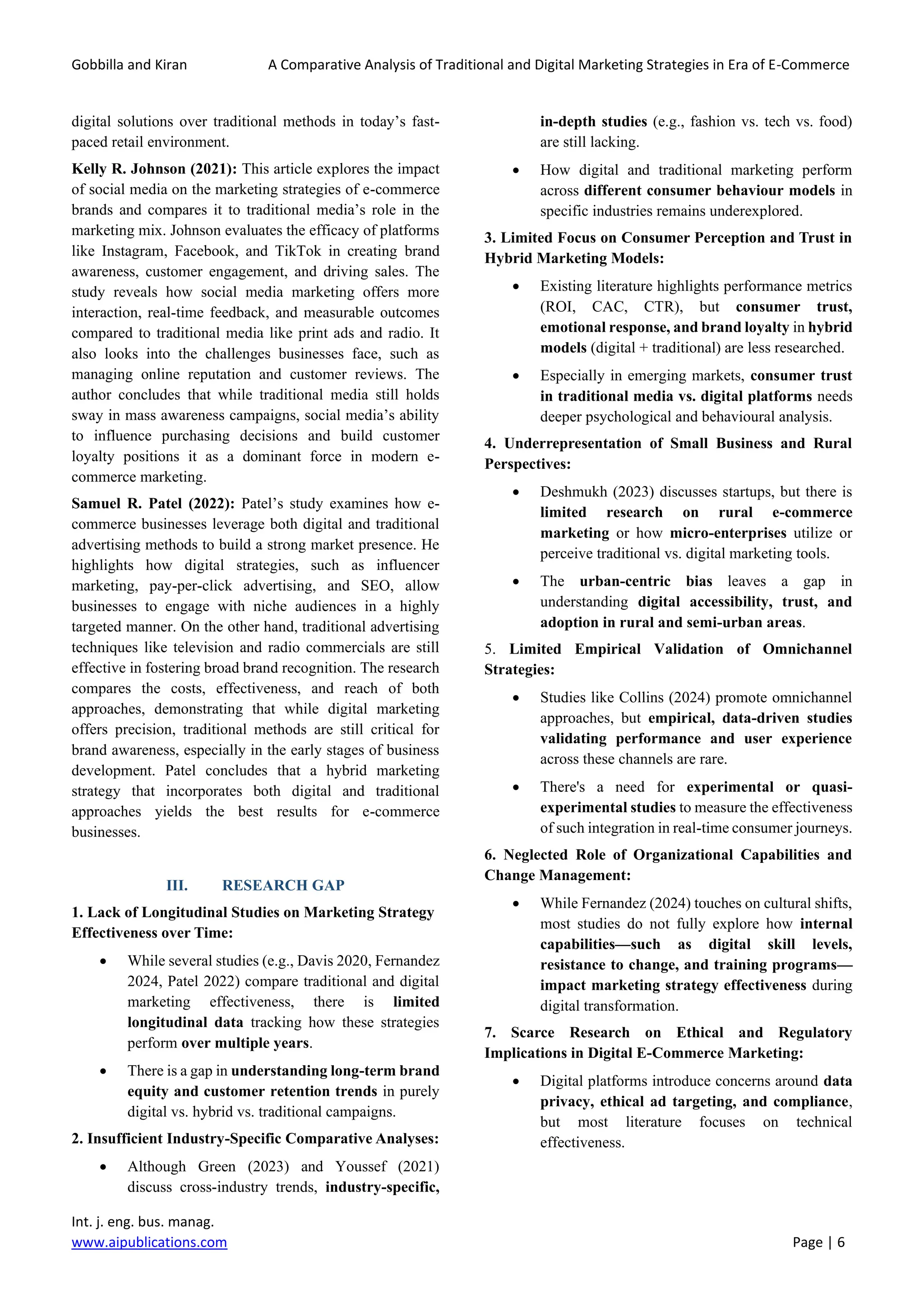
1. What is your age?
Particulars Participants Percentage
20-25 18 18.0%
25-30 17 17.0%
30-35 47 47.0%
35-40 16 16.0%
40 and above 2 2.0%
Total 100 100%
Interpretation: As we can see from the above data table
that majority of the respondents are from the age group of
20 to 25 years that of 18% of the total respondents. Next to
that 17% of the respondents are from the age group of 25
years to 35 years. Next to that we have 47% of the
respondents from the age group of 30 years to 35 years.
Next 16% of the respondents are from the age group of 35
years to 40 years. Rest 2% of the respondents are from the
age group of more than 40 years.
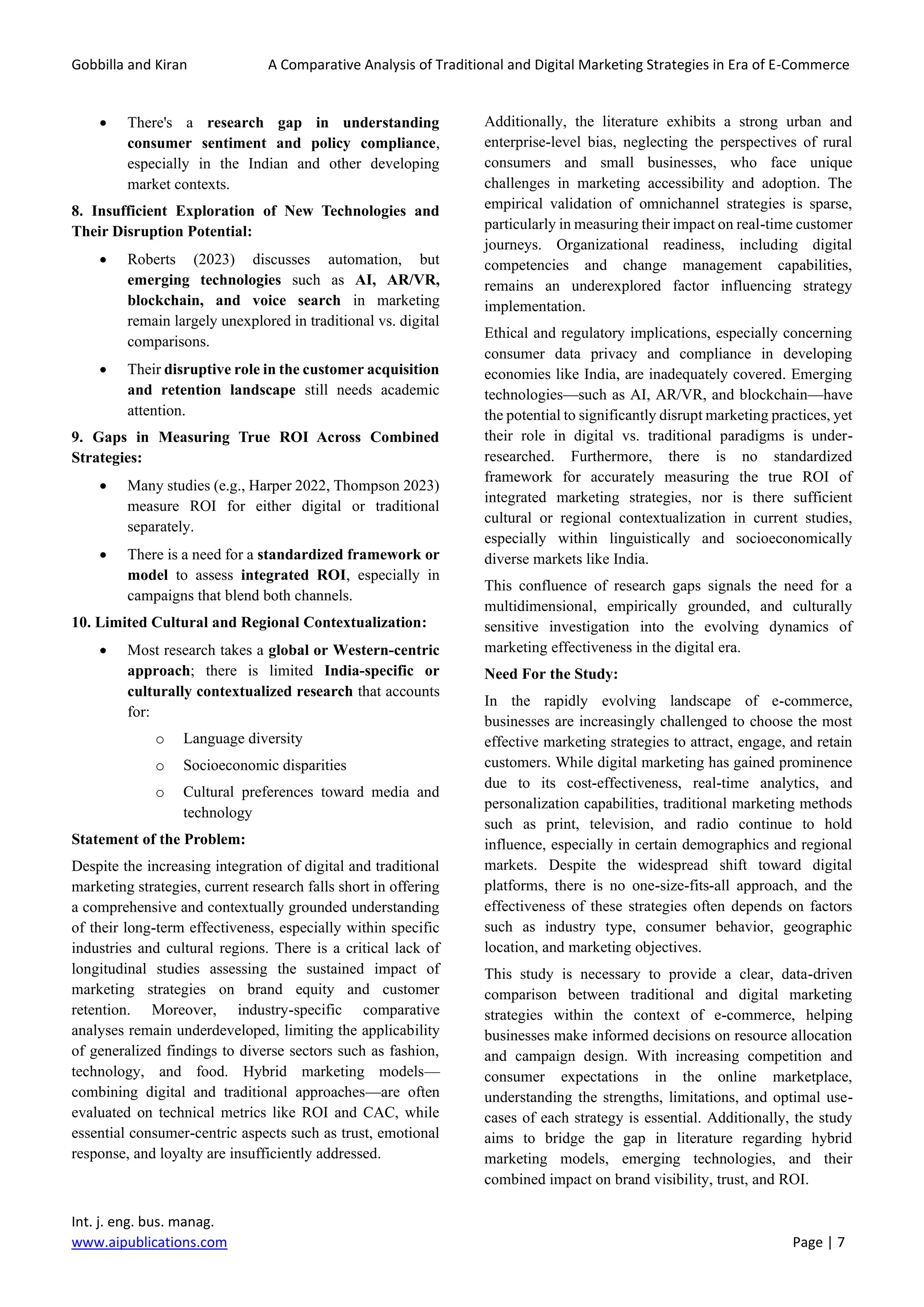
2. What is your gender?
Particulars Participants Percentage
Male 20 20%
Female 60 60%
Prefer not to say 10 10%
Total 100 100%
Interpretation: From the above data table, we can see that
majority of the respondents are from Man, that of 20% of
the total respondents. Next to that 60% of the respondents
are Woman and rest of the 10% of the respondents prefer
not to say.
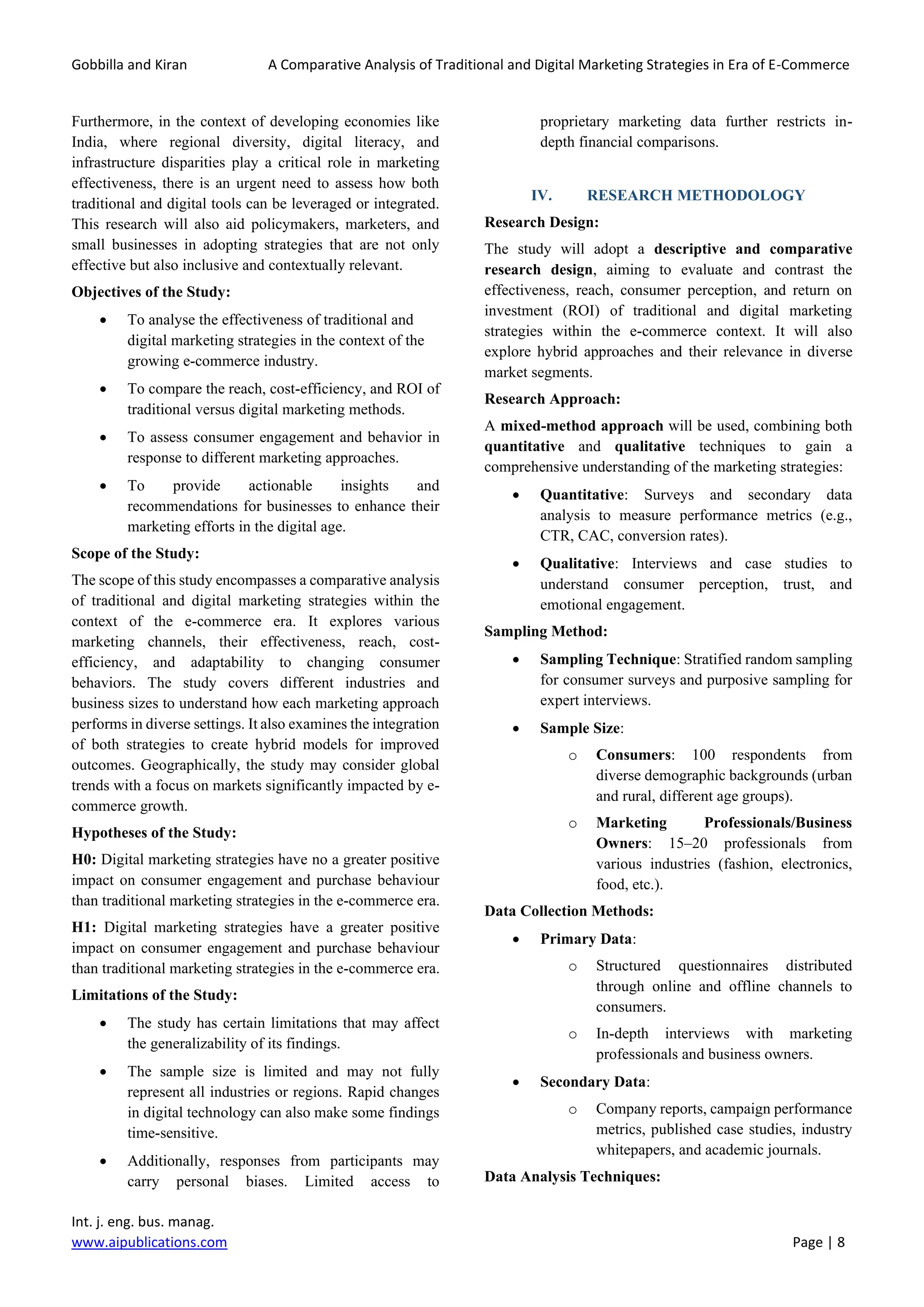
3. What is your Income?
Particulars Participants Percentage
Below 25000/- 10 10.0%
26000-35000/- 15 15.0%
36000-50000/- 42 42.0%
51000-60000/- 23 23.0%
60000 and
above
10 10%
Total 100 100
18%
17%
47%
16%
2%
20-25 25-30 30-35 35-40 40 and above
0
10
20
30
40
50
60
70
Male Female Prefer not to say
Series1 Series2
10%
15%
42%
23%
10%
Below 25000/- 26000-35000/-
36000-50000/- 51000-60000/-
60000 and above
Gobbilla and Kiran A Comparative Analysis of Traditional and Digital Marketing Strategies in Era of E-Commerce
Int. j. eng. bus. manag.
www.aipublications.com Page | 10
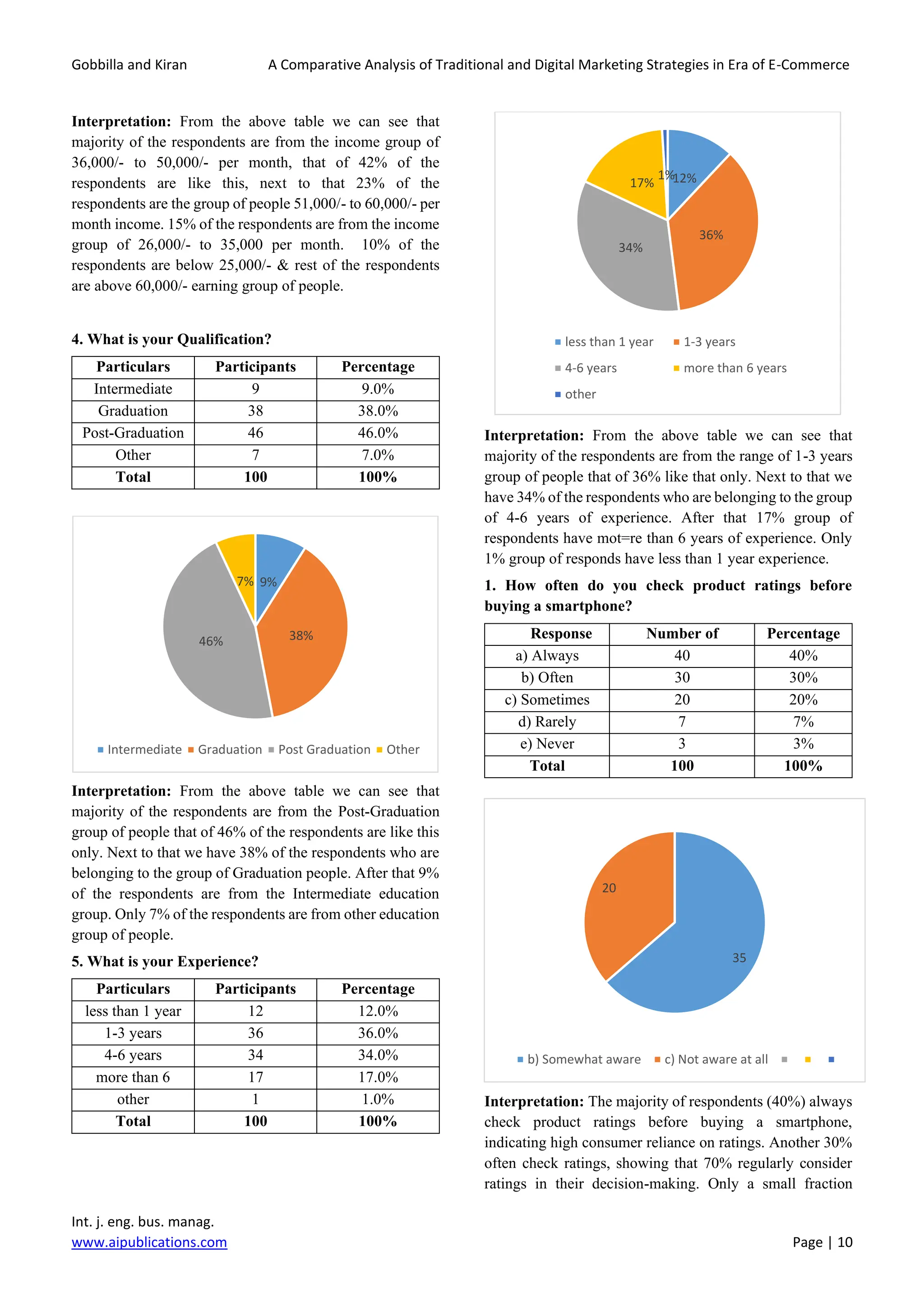
Interpretation: From the above table we can see that
majority of the respondents are from the income group of
36,000/- to 50,000/- per month, that of 42% of the
respondents are like this, next to that 23% of the
respondents are the group of people 51,000/- to 60,000/- per
month income. 15% of the respondents are from the income
group of 26,000/- to 35,000 per month. 10% of the
respondents are below 25,000/- & rest of the respondents
are above 60,000/- earning group of people.
4. What is your Qualification?
Particulars Participants Percentage
Intermediate 9 9.0%
Graduation 38 38.0%
Post-Graduation 46 46.0%
Other 7 7.0%
Total 100 100%
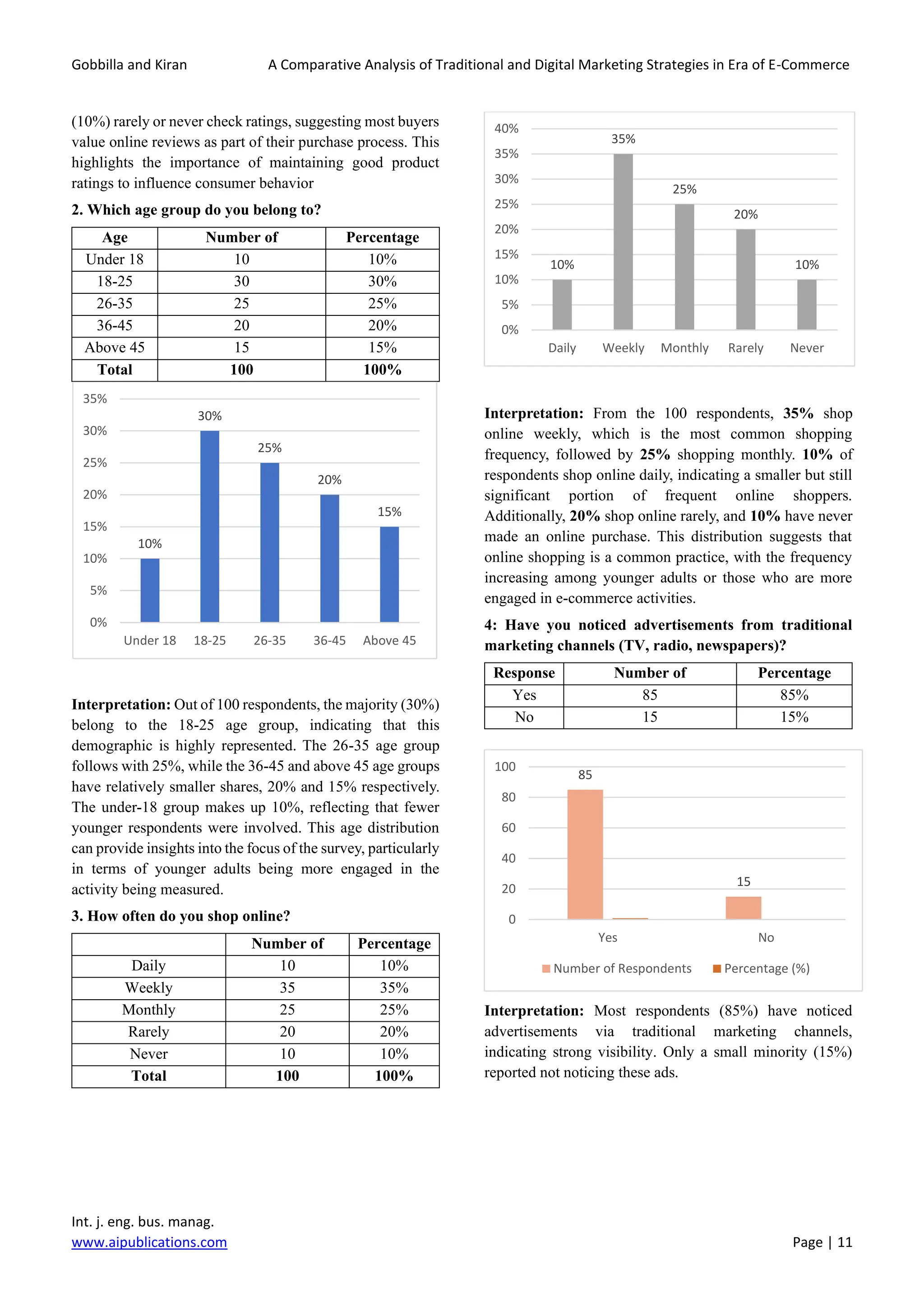
Interpretation: From the above table we can see that
majority of the respondents are from the Post-Graduation
group of people that of 46% of the respondents are like this
only. Next to that we have 38% of the respondents who are
belonging to the group of Graduation people. After that 9%
of the respondents are from the Intermediate education
group. Only 7% of the respondents are from other education
group of people.
5. What is your Experience?
Particulars Participants Percentage
less than 1 year 12 12.0%
1-3 years 36 36.0%
4-6 years 34 34.0%
more than 6
years
17 17.0%
other 1 1.0%
Total 100 100%
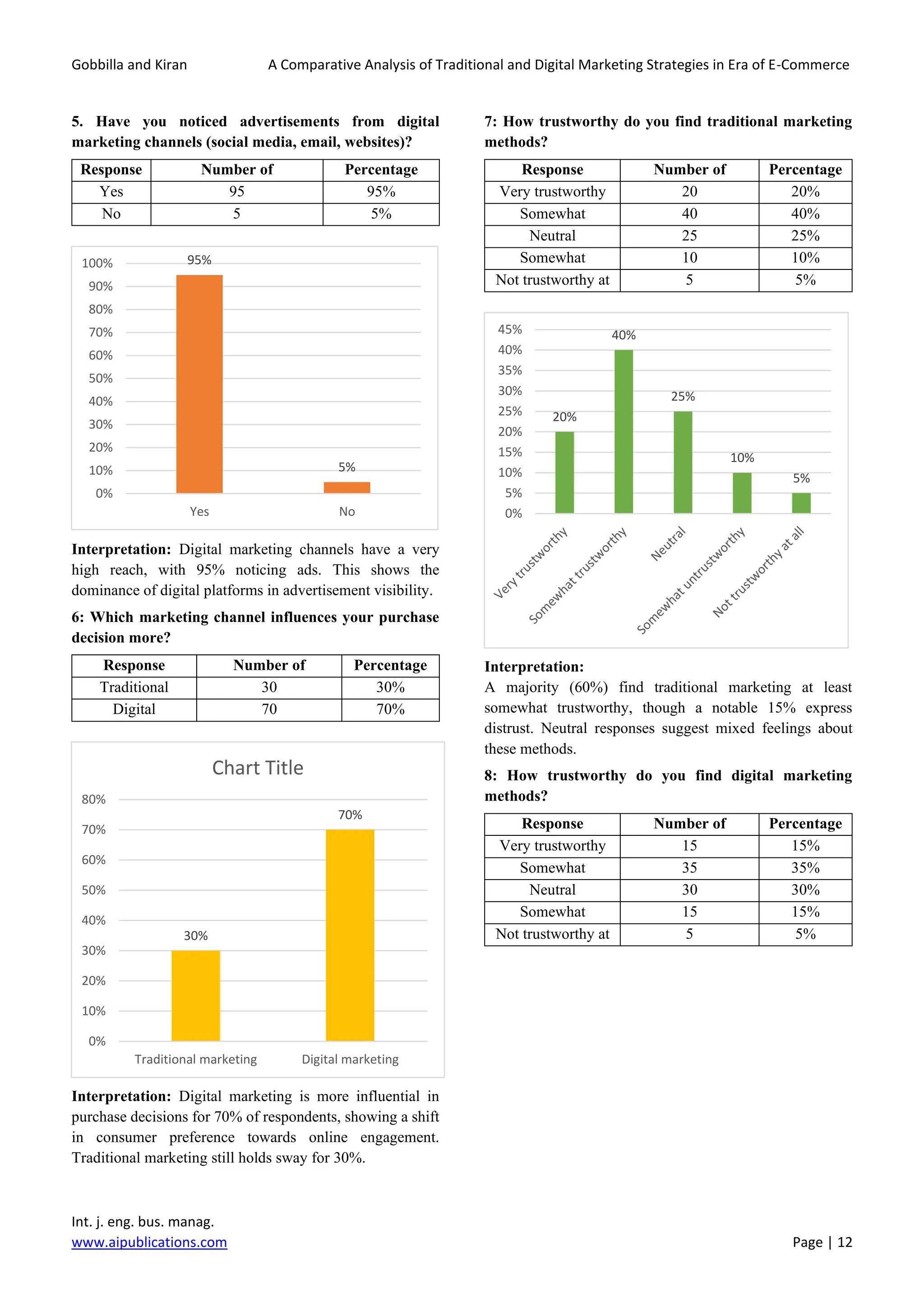
Interpretation: From the above table we can see that
majority of the respondents are from the range of 1-3 years
group of people that of 36% like that only. Next to that we
have 34% of the respondents who are belonging to the group
of 4-6 years of experience. After that 17% group of
respondents have mot=re than 6 years of experience. Only
1% group of responds have less than 1 year experience.
1. How often do you check product ratings before
buying a smartphone?
Response
Option
Number of
Respondents
Percentage
(%)
a) Always 40 40%
b) Often 30 30%
c) Sometimes 20 20%
d) Rarely 7 7%
e) Never 3 3%
Total 100 100%
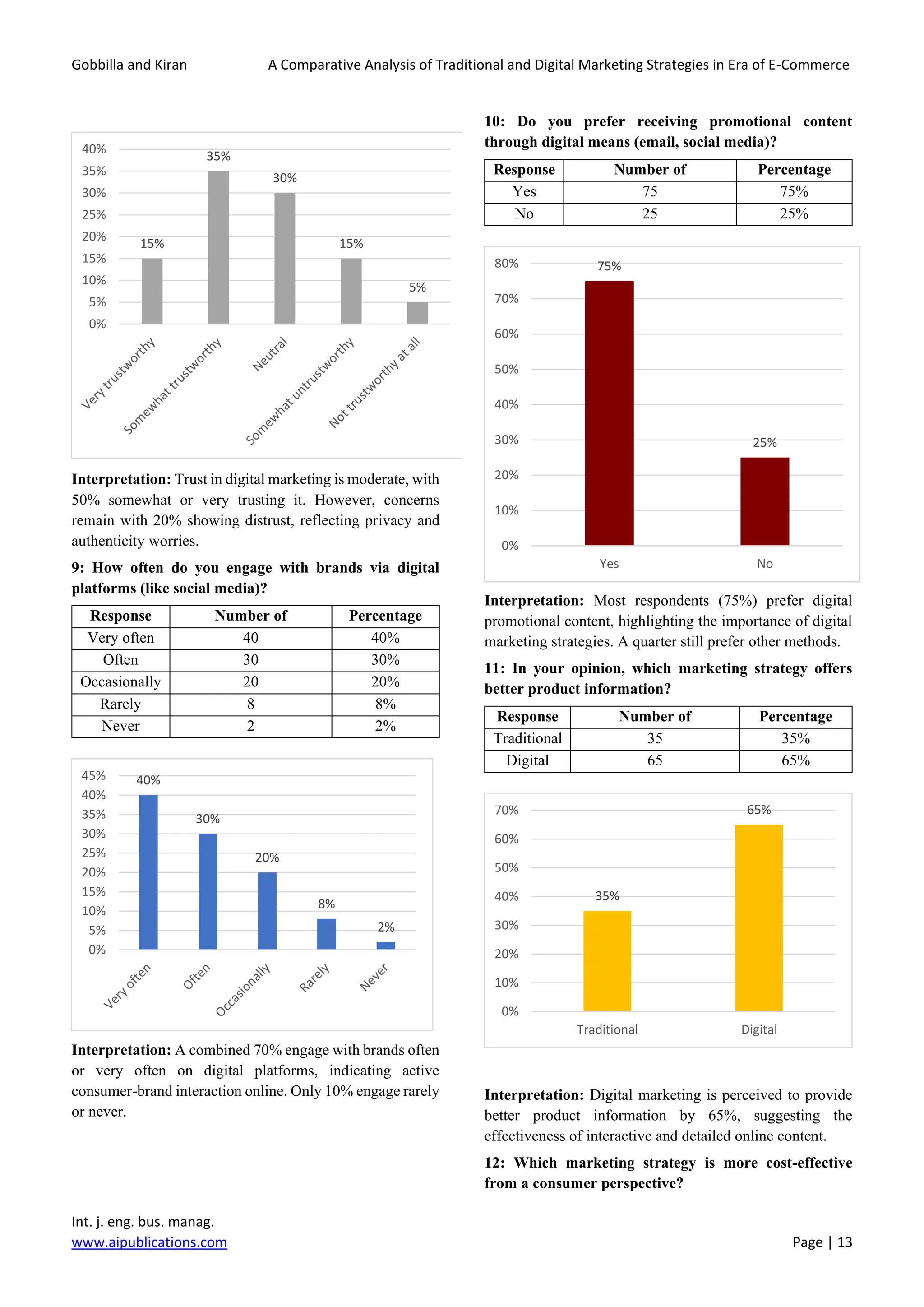
Interpretation: The majority of respondents (40%) always
check product ratings before buying a smartphone,
indicating high consumer reliance on ratings. Another 30%
often check ratings, showing that 70% regularly consider
ratings in their decision-making. Only a small fraction
9%
38%
46%
7%
Intermediate Graduation Post Graduation Other
12%
36%
34%
17%
1%
less than 1 year 1-3 years
4-6 years more than 6 years
other
35
20
b) Somewhat aware c) Not aware at all
Gobbilla and Kiran A Comparative Analysis of Traditional and Digital Marketing Strategies in Era of E-Commerce
Int. j. eng. bus. manag.
www.aipublications.com Page | 11
(10%) rarely or never check ratings, suggesting most buyers
value online reviews as part of their purchase process. This
highlights the importance of maintaining good product
ratings to influence consumer behavior
2. Which age group do you belong to?
Age
Group
Number of
Respondents
Percentage
(%)
Under 18 10 10%
18-25 30 30%
26-35 25 25%
36-45 20 20%
Above 45 15 15%
Total 100 100%
Interpretation: Out of 100 respondents, the majority (30%)
belong to the 18-25 age group, indicating that this
demographic is highly represented. The 26-35 age group
follows with 25%, while the 36-45 and above 45 age groups
have relatively smaller shares, 20% and 15% respectively.
The under-18 group makes up 10%, reflecting that fewer
younger respondents were involved. This age distribution
can provide insights into the focus of the survey, particularly
in terms of younger adults being more engaged in the
activity being measured.
3. How often do you shop online?
Frequency of Online
Shopping
Number of
Respondents
Percentage
(%)
Daily 10 10%
Weekly 35 35%
Monthly 25 25%
Rarely 20 20%
Never 10 10%
Total 100 100%
Interpretation: From the 100 respondents, 35% shop
online weekly, which is the most common shopping
frequency, followed by 25% shopping monthly. 10% of
respondents shop online daily, indicating a smaller but still
significant portion of frequent online shoppers.
Additionally, 20% shop online rarely, and 10% have never
made an online purchase. This distribution suggests that
online shopping is a common practice, with the frequency
increasing among younger adults or those who are more
engaged in e-commerce activities.
4: Have you noticed advertisements from traditional
marketing channels (TV, radio, newspapers)?
Response Number of
Respondents
Percentage
(%)
Yes 85 85%
No 15 15%
Interpretation: Most respondents (85%) have noticed
advertisements via traditional marketing channels,
indicating strong visibility. Only a small minority (15%)
reported not noticing these ads.
10%
30%
25%
20%
15%
0%
5%
10%
15%
20%
25%
30%
35%
Under 18 18-25 26-35 36-45 Above 45
10%
35%
25%
20%
10%
0%
5%
10%
15%
20%
25%
30%
35%
40%
Daily Weekly Monthly Rarely Never
85
15
0
20
40
60
80
100
Yes No
Number of Respondents Percentage (%)
Gobbilla and Kiran A Comparative Analysis of Traditional and Digital Marketing Strategies in Era of E-Commerce
Int. j. eng. bus. manag.
www.aipublications.com Page | 12
5. Have you noticed advertisements from digital
marketing channels (social media, email, websites)?
Response Number of
Respondents
Percentage
(%)
Yes 95 95%
No 5 5%
Interpretation: Digital marketing channels have a very
high reach, with 95% noticing ads. This shows the
dominance of digital platforms in advertisement visibility.
6: Which marketing channel influences your purchase
decision more?
Response Number of
Respondents
Percentage
(%)
Traditional
marketing
30 30%
Digital
marketing
70 70%
Interpretation: Digital marketing is more influential in
purchase decisions for 70% of respondents, showing a shift
in consumer preference towards online engagement.
Traditional marketing still holds sway for 30%.
7: How trustworthy do you find traditional marketing
methods?
Response Number of
Respondents
Percentage
(%)
Very trustworthy 20 20%
Somewhat
trustworthy
40 40%
Neutral 25 25%
Somewhat
untrustworthy
10 10%
Not trustworthy at
all
5 5%
Interpretation:
A majority (60%) find traditional marketing at least
somewhat trustworthy, though a notable 15% express
distrust. Neutral responses suggest mixed feelings about
these methods.
8: How trustworthy do you find digital marketing
methods?
Response Number of
Respondents
Percentage
(%)
Very trustworthy 15 15%
Somewhat
trustworthy
35 35%
Neutral 30 30%
Somewhat
untrustworthy
15 15%
Not trustworthy at
all
5 5%
95%
5%
0%
10%
20%
30%
40%
50%
60%
70%
80%
90%
100%
Yes No
30%
70%
0%
10%
20%
30%
40%
50%
60%
70%
80%
Traditional marketing Digital marketing
Chart Title
20%
40%
25%
10%
5%
0%
5%
10%
15%
20%
25%
30%
35%
40%
45%
Gobbilla and Kiran A Comparative Analysis of Traditional and Digital Marketing Strategies in Era of E-Commerce
Int. j. eng. bus. manag.
www.aipublications.com Page | 13
Interpretation: Trust in digital marketing is moderate, with
50% somewhat or very trusting it. However, concerns
remain with 20% showing distrust, reflecting privacy and
authenticity worries.
9: How often do you engage with brands via digital
platforms (like social media)?
Response Number of
Respondents
Percentage
(%)
Very often 40 40%
Often 30 30%
Occasionally 20 20%
Rarely 8 8%
Never 2 2%
Interpretation: A combined 70% engage with brands often
or very often on digital platforms, indicating active
consumer-brand interaction online. Only 10% engage rarely
or never.
10: Do you prefer receiving promotional content
through digital means (email, social media)?
Response Number of
Respondents
Percentage
(%)
Yes 75 75%
No 25 25%
Interpretation: Most respondents (75%) prefer digital
promotional content, highlighting the importance of digital
marketing strategies. A quarter still prefer other methods.
11: In your opinion, which marketing strategy offers
better product information?
Response Number of
Respondents
Percentage
(%)
Traditional 35 35%
Digital 65 65%
Interpretation: Digital marketing is perceived to provide
better product information by 65%, suggesting the
effectiveness of interactive and detailed online content.
12: Which marketing strategy is more cost-effective
from a consumer perspective?
15%
35%
30%
15%
5%
0%
5%
10%
15%
20%
25%
30%
35%
40%
40%
30%
20%
8%
2%
0%
5%
10%
15%
20%
25%
30%
35%
40%
45%
75%
25%
0%
10%
20%
30%
40%
50%
60%
70%
80%
Yes No
35%
65%
0%
10%
20%
30%
40%
50%
60%
70%
Traditional Digital
Gobbilla and Kiran A Comparative Analysis of Traditional and Digital Marketing Strategies in Era of E-Commerce
Int. j. eng. bus. manag.
www.aipublications.com Page | 14
Response Number of
Respondents
Percentage
(%)
Traditional 20 20%
Digital 80 80%
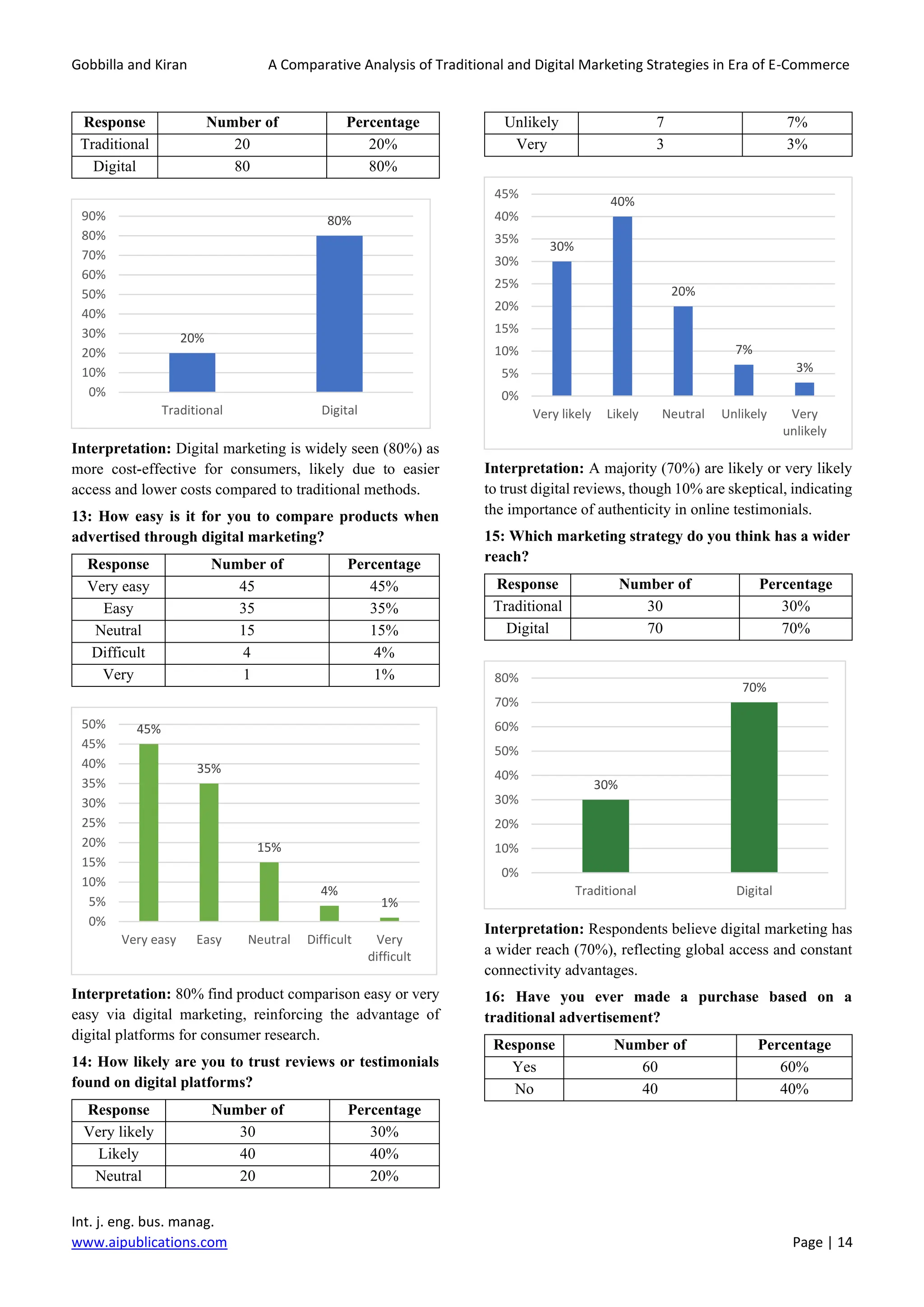
Interpretation: Digital marketing is widely seen (80%) as
more cost-effective for consumers, likely due to easier
access and lower costs compared to traditional methods.
13: How easy is it for you to compare products when
advertised through digital marketing?
Response Number of
Respondents
Percentage
(%)
Very easy 45 45%
Easy 35 35%
Neutral 15 15%
Difficult 4 4%
Very
difficult
1 1%
Interpretation: 80% find product comparison easy or very
easy via digital marketing, reinforcing the advantage of
digital platforms for consumer research.
14: How likely are you to trust reviews or testimonials
found on digital platforms?
Response Number of
Respondents
Percentage
(%)
Very likely 30 30%
Likely 40 40%
Neutral 20 20%
Unlikely 7 7%
Very
unlikely
3 3%
Interpretation: A majority (70%) are likely or very likely
to trust digital reviews, though 10% are skeptical, indicating
the importance of authenticity in online testimonials.
15: Which marketing strategy do you think has a wider
reach?
Response Number of
Respondents
Percentage
(%)
Traditional 30 30%
Digital 70 70%
Interpretation: Respondents believe digital marketing has
a wider reach (70%), reflecting global access and constant
connectivity advantages.
16: Have you ever made a purchase based on a
traditional advertisement?
Response Number of
Respondents
Percentage
(%)
Yes 60 60%
No 40 40%
20%
80%
0%
10%
20%
30%
40%
50%
60%
70%
80%
90%
Traditional Digital
45%
35%
15%
4%
1%
0%
5%
10%
15%
20%
25%
30%
35%
40%
45%
50%
Very easy Easy Neutral Difficult Very
difficult
30%
40%
20%
7%
3%
0%
5%
10%
15%
20%
25%
30%
35%
40%
45%
Very likely Likely Neutral Unlikely Very
unlikely
30%
70%
0%
10%
20%
30%
40%
50%
60%
70%
80%
Traditional Digital
Gobbilla and Kiran A Comparative Analysis of Traditional and Digital Marketing Strategies in Era of E-Commerce
Int. j. eng. bus. manag.
www.aipublications.com Page | 15
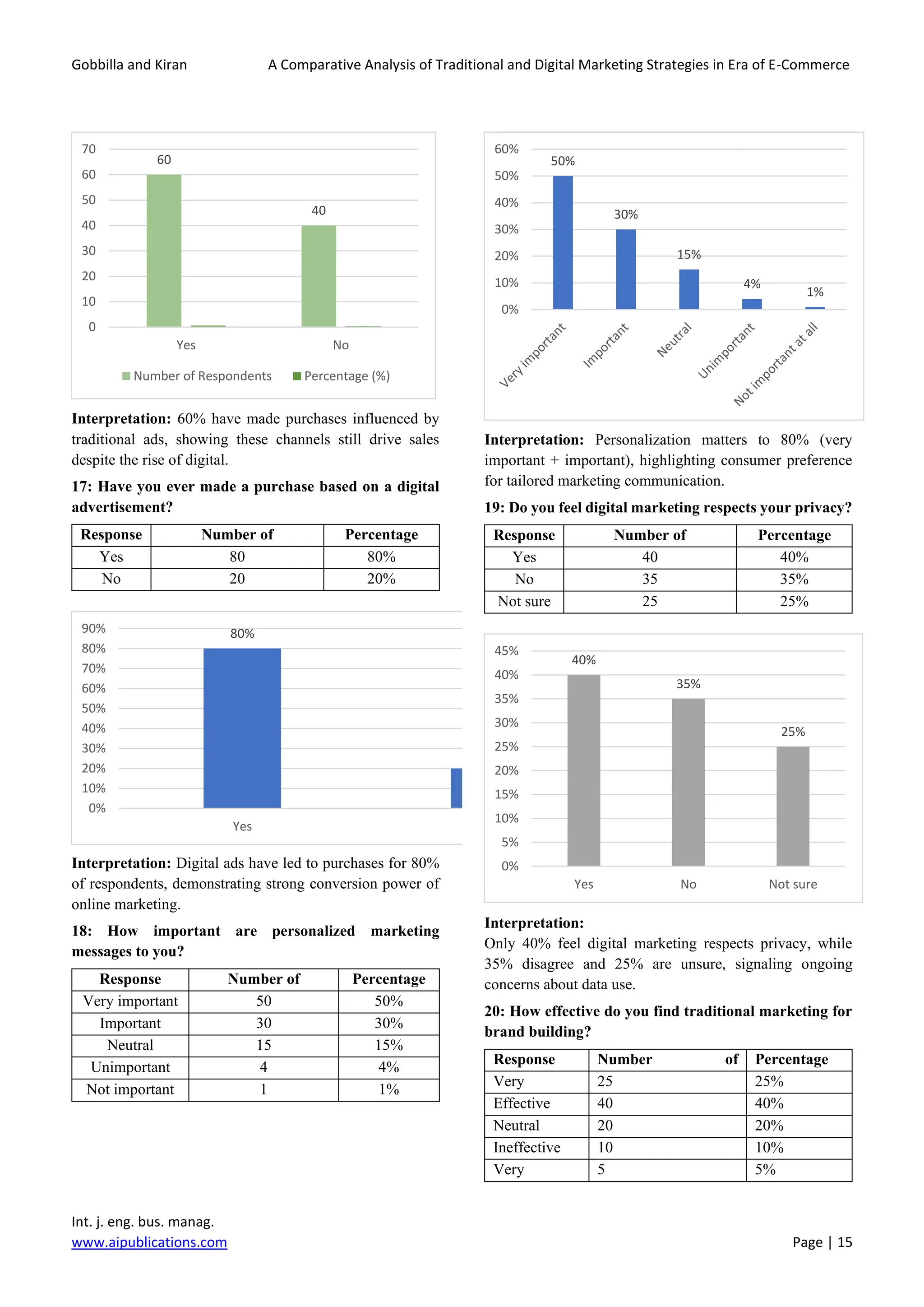
Interpretation: 60% have made purchases influenced by
traditional ads, showing these channels still drive sales
despite the rise of digital.
17: Have you ever made a purchase based on a digital
advertisement?
Response Number of
Respondents
Percentage
(%)
Yes 80 80%
No 20 20%
Interpretation: Digital ads have led to purchases for 80%
of respondents, demonstrating strong conversion power of
online marketing.
18: How important are personalized marketing
messages to you?
Response Number of
Respondents
Percentage
(%)
Very important 50 50%
Important 30 30%
Neutral 15 15%
Unimportant 4 4%
Not important
at all
1 1%
Interpretation: Personalization matters to 80% (very
important + important), highlighting consumer preference
for tailored marketing communication.
19: Do you feel digital marketing respects your privacy?
Response Number of
Respondents
Percentage
(%)
Yes 40 40%
No 35 35%
Not sure 25 25%
Interpretation:
Only 40% feel digital marketing respects privacy, while
35% disagree and 25% are unsure, signaling ongoing
concerns about data use.
20: How effective do you find traditional marketing for
brand building?
Response Number of
Respondents
Percentage
(%)
Very
effective
25 25%
Effective 40 40%
Neutral 20 20%
Ineffective 10 10%
Very
ineffective
5 5%
60
40
0
10
20
30
40
50
60
70
Yes No
Number of Respondents Percentage (%)
80%
0%
10%
20%
30%
40%
50%
60%
70%
80%
90%
Yes
50%
30%
15%
4%
1%
0%
10%
20%
30%
40%
50%
60%
40%
35%
25%
0%
5%
10%
15%
20%
25%
30%
35%
40%
45%
Yes No Not sure
Gobbilla and Kiran A Comparative Analysis of Traditional and Digital Marketing Strategies in Era of E-Commerce
Int. j. eng. bus. manag.
www.aipublications.com Page | 16
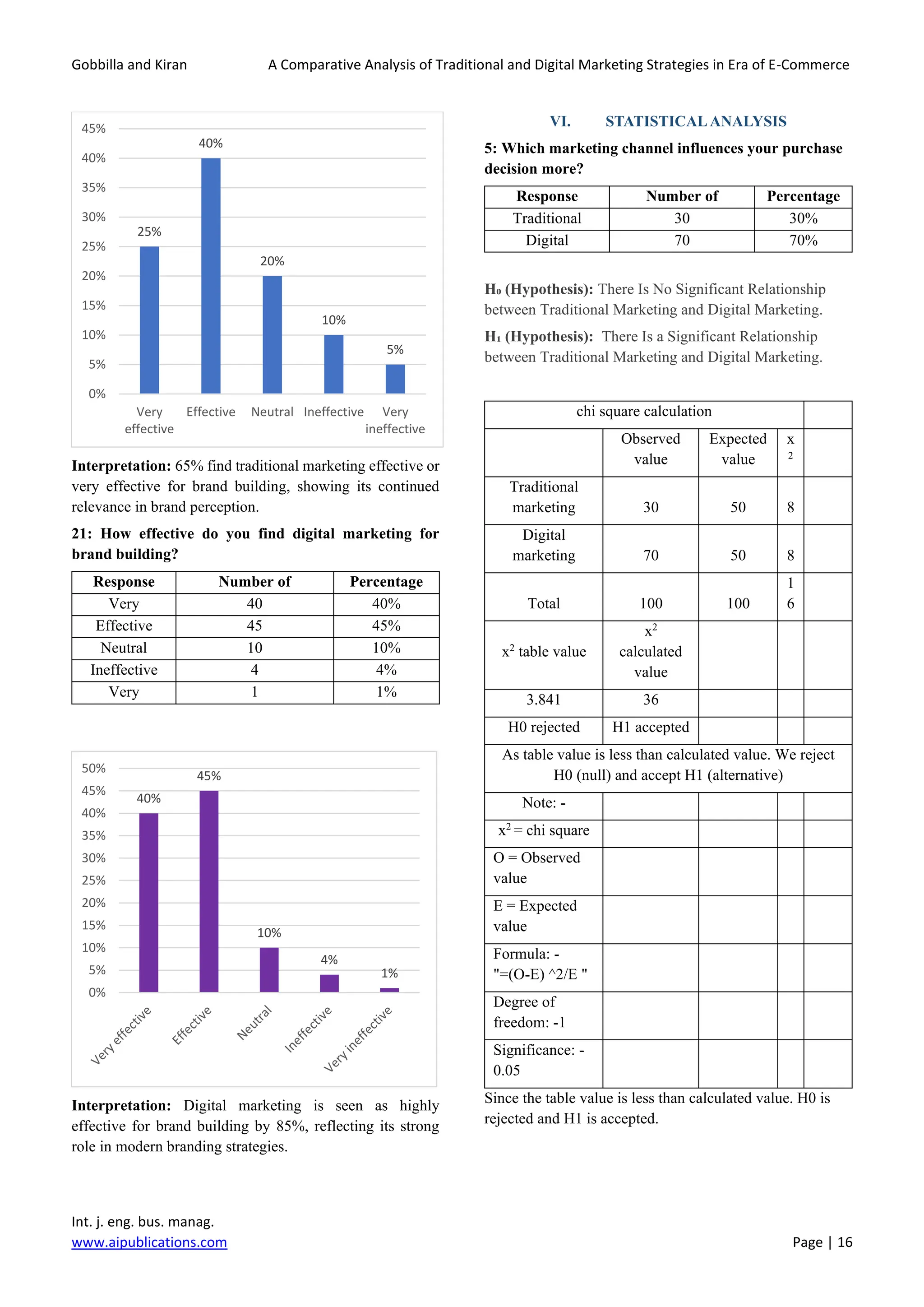
Interpretation: 65% find traditional marketing effective or
very effective for brand building, showing its continued
relevance in brand perception.
21: How effective do you find digital marketing for
brand building?
Response Number of
Respondents
Percentage
(%)
Very
effective
40 40%
Effective 45 45%
Neutral 10 10%
Ineffective 4 4%
Very
ineffective
1 1%
Interpretation: Digital marketing is seen as highly
effective for brand building by 85%, reflecting its strong
role in modern branding strategies.
VI. STATISTICALANALYSIS
5: Which marketing channel influences your purchase
decision more?
Response Number of
Respondents
Percentage
(%)
Traditional
marketing
30 30%
Digital
marketing
70 70%
H₀ (Hypothesis): There Is No Significant Relationship
between Traditional Marketing and Digital Marketing.
H₁ (Hypothesis): There Is a Significant Relationship
between Traditional Marketing and Digital Marketing.
chi square calculation
Observed
value
Expected
value
x
2
Traditional
marketing 30 50 8
Digital
marketing 70 50 8
Total 100 100
1
6
x2
table value
x2
calculated
value
3.841 36
H0 rejected H1 accepted
As table value is less than calculated value. We reject
H0 (null) and accept H1 (alternative)
Note: -
x2
= chi square
O = Observed
value
E = Expected
value
Formula: -
"=(O-E) ^2/E "
Degree of
freedom: -1
Significance: -
0.05
Since the table value is less than calculated value. H0 is
rejected and H1 is accepted.
25%
40%
20%
10%
5%
0%
5%
10%
15%
20%
25%
30%
35%
40%
45%
Very
effective
Effective Neutral Ineffective Very
ineffective
40%
45%
10%
4%
1%
0%
5%
10%
15%
20%
25%
30%
35%
40%
45%
50%
Gobbilla and Kiran A Comparative Analysis of Traditional and Digital Marketing Strategies in Era of E-Commerce
Int. j. eng. bus. manag.
www.aipublications.com Page | 17
VII. FINDINGS
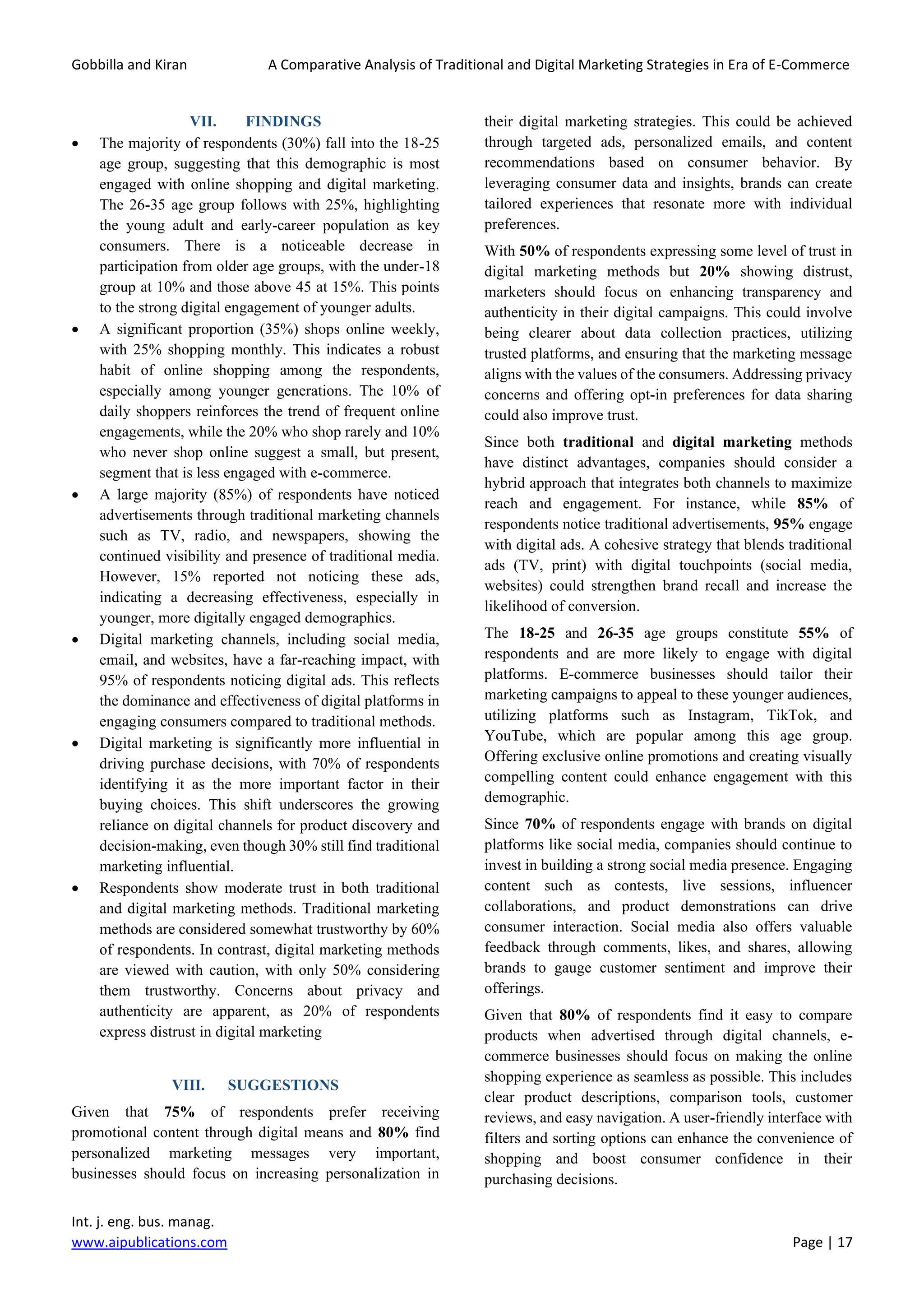
• The majority of respondents (30%) fall into the 18-25
age group, suggesting that this demographic is most
engaged with online shopping and digital marketing.
The 26-35 age group follows with 25%, highlighting
the young adult and early-career population as key
consumers. There is a noticeable decrease in
participation from older age groups, with the under-18
group at 10% and those above 45 at 15%. This points
to the strong digital engagement of younger adults.
• A significant proportion (35%) shops online weekly,
with 25% shopping monthly. This indicates a robust
habit of online shopping among the respondents,
especially among younger generations. The 10% of
daily shoppers reinforces the trend of frequent online
engagements, while the 20% who shop rarely and 10%
who never shop online suggest a small, but present,
segment that is less engaged with e-commerce.
• A large majority (85%) of respondents have noticed
advertisements through traditional marketing channels
such as TV, radio, and newspapers, showing the
continued visibility and presence of traditional media.
However, 15% reported not noticing these ads,
indicating a decreasing effectiveness, especially in
younger, more digitally engaged demographics.
• Digital marketing channels, including social media,
email, and websites, have a far-reaching impact, with
95% of respondents noticing digital ads. This reflects
the dominance and effectiveness of digital platforms in
engaging consumers compared to traditional methods.
• Digital marketing is significantly more influential in
driving purchase decisions, with 70% of respondents
identifying it as the more important factor in their
buying choices. This shift underscores the growing
reliance on digital channels for product discovery and
decision-making, even though 30% still find traditional
marketing influential.
• Respondents show moderate trust in both traditional
and digital marketing methods. Traditional marketing
methods are considered somewhat trustworthy by 60%
of respondents. In contrast, digital marketing methods
are viewed with caution, with only 50% considering
them trustworthy. Concerns about privacy and
authenticity are apparent, as 20% of respondents
express distrust in digital marketing
VIII. SUGGESTIONS
Given that 75% of respondents prefer receiving
promotional content through digital means and 80% find
personalized marketing messages very important,
businesses should focus on increasing personalization in
their digital marketing strategies. This could be achieved
through targeted ads, personalized emails, and content
recommendations based on consumer behavior. By
leveraging consumer data and insights, brands can create
tailored experiences that resonate more with individual
preferences.
With 50% of respondents expressing some level of trust in
digital marketing methods but 20% showing distrust,
marketers should focus on enhancing transparency and
authenticity in their digital campaigns. This could involve
being clearer about data collection practices, utilizing
trusted platforms, and ensuring that the marketing message
aligns with the values of the consumers. Addressing privacy
concerns and offering opt-in preferences for data sharing
could also improve trust.
Since both traditional and digital marketing methods
have distinct advantages, companies should consider a
hybrid approach that integrates both channels to maximize
reach and engagement. For instance, while 85% of
respondents notice traditional advertisements, 95% engage
with digital ads. A cohesive strategy that blends traditional
ads (TV, print) with digital touchpoints (social media,
websites) could strengthen brand recall and increase the
likelihood of conversion.
The 18-25 and 26-35 age groups constitute 55% of
respondents and are more likely to engage with digital
platforms. E-commerce businesses should tailor their
marketing campaigns to appeal to these younger audiences,
utilizing platforms such as Instagram, TikTok, and
YouTube, which are popular among this age group.
Offering exclusive online promotions and creating visually
compelling content could enhance engagement with this
demographic.
Since 70% of respondents engage with brands on digital
platforms like social media, companies should continue to
invest in building a strong social media presence. Engaging
content such as contests, live sessions, influencer
collaborations, and product demonstrations can drive
consumer interaction. Social media also offers valuable
feedback through comments, likes, and shares, allowing
brands to gauge customer sentiment and improve their
offerings.
Given that 80% of respondents find it easy to compare
products when advertised through digital channels, e-
commerce businesses should focus on making the online
shopping experience as seamless as possible. This includes
clear product descriptions, comparison tools, customer
reviews, and easy navigation. A user-friendly interface with
filters and sorting options can enhance the convenience of
shopping and boost consumer confidence in their
purchasing decisions.
Gobbilla and Kiran A Comparative Analysis of Traditional and Digital Marketing Strategies in Era of E-Commerce
Int. j. eng. bus. manag.
www.aipublications.com Page | 18
With 35% of respondents expressing concerns about
privacy, businesses should make an effort to be more
transparent about their data collection practices. Clearly
communicating how personal data is being used and
offering customers control over their privacy settings can
alleviate concerns. Providing customers with the option to
opt-in or opt-out of personalized marketing could also build
trust and encourage participation in digital campaigns.
As 80% of respondents believe digital marketing is more
cost-effective for consumers, businesses can further
emphasize the affordability of their products or services
through digital platforms. Offering discounts, time-
sensitive deals, and flash sales promoted through email and
social media can be a powerful tool in driving conversions.
Also, leveraging cost-effective digital advertising platforms
such as Google Ads, Facebook Ads, and Instagram Ads can
ensure businesses reach their target audience at a lower cost.
Considering the increasing reliance on mobile devices for
browsing, shopping, and social media interaction,
businesses should ensure that their digital marketing
campaigns and e-commerce platforms are optimized for
mobile. This includes mobile-friendly websites, fast-
loading pages, and easy-to-navigate interfaces.
Additionally, mobile-specific ads and push notifications can
further engage users and drive conversions.
Despite the dominance of digital marketing, 65% of
respondents find traditional marketing methods effective
for brand building. To strengthen the impact of traditional
marketing, companies could consider combining these
channels with digital campaigns. For example, running a
traditional TV or print campaign alongside digital ads can
create a cohesive brand experience across multiple
platforms. Additionally, offering incentives like QR codes
in traditional ads to direct customers to online stores or
social media pages can help bridge the gap between the two
methods.
IX. CONCLUSION
The comparative analysis of traditional and digital
marketing strategies in the context of e-commerce reveals
significant insights into consumer behavior, preferences,
and the effectiveness of various marketing channels. In
today’s digital era, it is clear that digital marketing holds a
dominant position in influencing consumer decisions,
driving engagement, and offering cost-effective solutions
for businesses. A substantial majority of respondents favor
digital platforms for receiving promotional content,
engaging with brands, and making purchases. The high trust
placed in digital marketing, coupled with its ease of use and
convenience for product comparison, demonstrates its
power in shaping modern consumer behaviors.
However, traditional marketing still plays a crucial role,
particularly in brand visibility and trust-building, with a
significant portion of respondents acknowledging the
effectiveness of traditional channels in these areas. The
continued relevance of traditional media, such as TV, radio,
and print, indicates that businesses should not completely
abandon these methods, but rather integrate them with
digital strategies for a more comprehensive approach.
Furthermore, consumers' growing concerns about privacy
in digital marketing highlight the need for businesses to
adopt transparent data practices and ensure respect for user
privacy. Personalization and tailored messaging also stand
out as essential components of a successful marketing
strategy, as consumers are increasingly looking for relevant
and customized experiences.
Ultimately, the most successful marketing strategies in the
era of e-commerce will be those that seamlessly combine
the strengths of both traditional and digital methods. A
hybrid, omnichannel approach will enable brands to reach a
wider audience, enhance customer trust, and foster long-
term relationships with consumers. Businesses that can
effectively navigate this dual approach—leveraging
digital’s flexibility and reach while maintaining traditional
marketing’s credibility and broad appeal—will be best
positioned to thrive in the competitive landscape of modern
e-commerce.
REFERENCES
[1] Kotler, P., & Armstrong, G. (2017). Principles of
Marketing (17th ed.). Pearson.
[2] Chaffey, D., & Ellis-Chadwick, F. (2019). Digital
Marketing: Strategy, Implementation, and Practice
(7th ed.). Pearson.
[3] Ryan, D. (2016). Understanding Digital Marketing:
Marketing Strategies for Engaging the Digital
Generation (3rd ed.). Kogan Page.
[4] Lamb, C. W., Hair, J. F., & McDaniel, C. (2018).
MKTG: Principles of Marketing (12th ed.). Cengage
Learning.
[5] Smith, P. R., & Zook, Z. (2011). "Marketing
Communications: Integrating Offline and Online with
Social Media." Journal of Marketing Communications,
17(2), 133-148.
[6] Chaffey, D. (2015). "Digital Marketing: Strategy,
Implementation, and Practice." Journal of Strategic
Marketing, 23(6), 509-526.
[7] Gartner, W. B. (2015). "The Changing Face of
Marketing." International Journal of Marketing
Studies, 7(3), 89-103.
Gobbilla and Kiran A Comparative Analysis of Traditional and Digital Marketing Strategies in Era of E-Commerce
Int. j. eng. bus. manag.
www.aipublications.com Page | 19
[8] Leeflang, P. S. H., Verhoef, P. C., Dahlström, P., &
Freundt, T. (2014). "Challenges and Solutions for
Marketing in a Digital Era." European Journal of
Marketing, 48(7/8), 1354-1376.
[9] Hutter, K., Hautz, J., & Füller, J. (2013).
"Advertising in Social Media: A Comparative Study of
Facebook, Twitter, and YouTube." Journal of
Advertising, 42(2), 180-198.

A Comparative Analysis of Traditional and Digital Marketing Strategies in Era of E-Commerce

  • 1.
    a International Journalof Engineering, Business and Management (IJEBM) ISSN: 2456-7817 [Vol-9, Issue-3, Jul-Sep, 2025] Issue DOI: https://dx.doi.org/10.22161/ijebm.9.3 Article Issue DOI: https://dx.doi.org/10.22161/ijebm.9.3.1 Int. j. eng. bus. manag. www.aipublications.com Page | 1 A Comparative Analysis of Traditional and Digital Marketing Strategies in Era of E-Commerce Umamaheswararao Gobbilla1 , Dadi Sai Kiran2 1 Associate Professor, Department Of MBA, CMR Institute of Technology, Hyderabad, Telangana, India. orcid.org/0000-0002-4467-4600 2 Student of MBA, CMR Institute of Technology, Hyderabad, Telangana, India. Received: 15 Jun 2025; Received in revised form: 09 Jul 2025; Accepted: 13 Jul 2025; Available online: 17 Jul 2025 ©2025 The Author(s). Published by AI Publications. This is an open-access article under the CC BY license (https://creativecommons.org/licenses/by/4.0/) Abstract— This study investigates the comparative effectiveness of traditional and digital marketing strategies within the rapidly evolving e-commerce landscape. Employing a mixed-method approach, it analyzes consumer perceptions, engagement, and purchase behavior through surveys, interviews, and secondary data from diverse industries in India. Key findings reveal that digital marketing significantly influences consumer decision-making, with higher reach, cost-efficiency, and engagement levels, while traditional methods remain vital for brand trust and visibility. The results suggest that integrating both approaches into hybrid, omnichannel strategies enhances overall marketing impact. These insights underscore the importance for businesses to adopt a balanced, consumer-centric approach that leverages the strengths of both channels to optimize brand presence and foster long-term loyalty in a competitive digital environment. The study highlights the critical need for adaptive marketing models to sustain growth and relevance in the e-commerce era. Keywords— Traditional Marketing, Digital Marketing, E-Commerce, Marketing Strategies, Consumer Behaviour, Online Advertising, Brand Engagement, Marketing Effectiveness, Customer Retention, Marketing Channels. I. INTRODUCTION The landscape of marketing has undergone a dramatic transformation in recent years, largely driven by the rapid growth of e-commerce. As the digital world continues to evolve, businesses are faced with the challenge of selecting the most effective marketing strategies to engage with consumers. Traditional marketing and digital marketing represent two distinct approaches to this challenge. Traditional marketing, rooted in the analog world, relies on methods such as print media, television ads, and direct mail, while digital marketing focuses on online platforms such as social media, search engines, email, and websites. The rise of e-commerce has shifted the balance towards digital strategies, as the internet and mobile technology have made it easier for businesses to connect with global audiences in real time. However, despite the proliferation of digital marketing tools, traditional marketing techniques remain relevant in certain contexts. Understanding the comparative strengths and weaknesses of both approaches is critical for businesses looking to navigate the increasingly complex marketing landscape. This analysis delves into the key features, advantages, and challenges of traditional and digital marketing strategies in the context of the e-commerce era. The objective is to provide a comprehensive understanding of how these strategies work in tandem, how they can be integrated, and how businesses can use them to stay competitive in an evolving market environment. The Evolution of Marketing in the E-commerce Era: E-commerce, which began as a niche market in the 1990s, has now become a dominant force in the global economy. According to data from Statista, global retail e-commerce sales amounted to approximately $4.9 trillion in 2021 and are projected to continue growing in the coming years. This rapid growth has led to a shift in how businesses market their products and services. The digital age has introduced
  • 2.
    Gobbilla and KiranA Comparative Analysis of Traditional and Digital Marketing Strategies in Era of E-Commerce Int. j. eng. bus. manag. www.aipublications.com Page | 2 a range of new tools and platforms, offering companies the ability to interact with their customers more efficiently and effectively than ever before. Marketing strategies, once confined to traditional methods, now face the added dimension of digital engagement. As consumers increasingly turn to online shopping, companies must adapt to this shift by exploring new marketing avenues. Traditional methods such as television ads, billboards, and print media have been complemented—or in some cases, replaced—by digital tactics like search engine optimization (SEO), social media marketing, influencer partnerships, and email campaigns. While traditional marketing is often seen as outdated in the face of rapid digitalization, it still offers unique benefits that can’t be fully replicated online. Many businesses today are employing hybrid strategies that combine traditional and digital methods to maximize reach, engagement, and conversion. This blend of approaches is particularly important for businesses that seek to appeal to a diverse range of demographics, each with varying preferences for how they consume information and make purchasing decisions. Traditional Marketing Strategies: Traditional marketing refers to methods that have been used for decades to promote products and services. These strategies are typically offline and can include TV and radio ads, direct mail, print advertisements (newspapers, magazines), billboards, and telemarketing. Each of these channels has its strengths and limitations, and their effectiveness often depends on the nature of the product or service being marketed, as well as the target audience. 1. Television and Radio Advertising Television and radio remain powerful tools for reaching large, diverse audiences. For decades, these mediums have dominated the advertising landscape, offering companies the ability to broadcast messages to millions of people at once. Television, in particular, offers a unique opportunity to combine visual and auditory elements to create compelling advertisements that can leave a lasting impression on viewers. However, the rise of digital media has fragmented audiences. People now have more control over the content they consume and when they consume it. With streaming platforms, on-demand services, and the proliferation of ad- blocking technology, television and radio advertising no longer guarantee the same level of reach and impact they once did. 2. Print Media and Direct Mail Print media (newspapers, magazines, brochures) and direct mail have traditionally been important marketing tools. These methods allow businesses to target specific geographic areas and demographics, providing a tangible, physical connection to consumers. Direct mail, for example, can be personalized, offering a direct line of communication with potential customers. However, print media is increasingly becoming less effective, especially among younger audiences who are more likely to engage with digital content. Direct mail, while still valuable in certain markets, is also facing challenges due to its higher costs and lower response rates compared to digital campaigns. 3. Billboards and Outdoor Advertising Billboards and outdoor advertising are still prominent in traditional marketing strategies. Billboards are effective for local advertising, particularly in high-traffic areas, and can create a strong visual presence for businesses. However, outdoor advertising’s reach is limited to specific geographic areas, and the effectiveness of this method is difficult to measure accurately. Digital Marketing Strategies: Digital marketing refers to the use of online platforms, tools, and techniques to promote products or services. Unlike traditional marketing, digital marketing offers a more targeted, data-driven approach to engaging with consumers. The ability to track and analyze user behavior has made digital marketing an indispensable tool for businesses in the e-commerce era. 1. Search Engine Optimization (SEO) SEO is one of the most effective digital marketing strategies, focusing on improving the visibility of a website or webpage in search engine results. By optimizing content with relevant keywords, businesses can ensure that their websites appear at the top of search results, increasing organic traffic and brand awareness. SEO is cost-effective compared to traditional advertising and offers a high return on investment (ROI) if executed properly. However, SEO requires ongoing effort and expertise. The algorithms used by search engines such as Google are constantly evolving, and businesses must stay up to date with best practices to maintain their rankings. Additionally, SEO results can take time to materialize, requiring patience and persistence. 2. Social Media Marketing Social media platforms like Facebook, Instagram, Twitter, and LinkedIn have become key components of modern marketing strategies. These platforms offer businesses the opportunity to engage with consumers in a more direct and personal way. Social media marketing involves creating and
  • 3.
    Gobbilla and KiranA Comparative Analysis of Traditional and Digital Marketing Strategies in Era of E-Commerce Int. j. eng. bus. manag. www.aipublications.com Page | 3 sharing content, running ads, and fostering community interaction. The primary advantage of social media marketing is the ability to reach highly targeted audiences. By leveraging data on user behavior, interests, and demographics, businesses can tailor their messages to specific groups. Social media also allows for real-time interaction with customers, enabling businesses to respond to questions, concerns, or feedback quickly. The challenges of social media marketing include managing online reputation, maintaining a consistent brand voice, and keeping up with ever-changing algorithms. Additionally, organic reach on social platforms is declining, and businesses must increasingly invest in paid ads to reach their target audience. 3. Email Marketing Email marketing involves sending promotional messages, newsletters, or updates to a list of subscribers. It is one of the most cost-effective and direct methods for building customer relationships and encouraging repeat business. By segmenting email lists and personalizing content, businesses can create highly targeted campaigns that drive conversions. One of the key advantages of email marketing is its ability to nurture leads over time, keeping a brand top of mind. However, email marketing can be seen as intrusive if not done correctly, and high unsubscribe rates or spam filters can limit the effectiveness of campaigns. 4. Influencer Marketing Influencer marketing has gained tremendous traction in the digital age. Brands partner with social media influencers or bloggers who have a large and engaged following to promote their products or services. Influencers can drive consumer behavior through product endorsements, reviews, and sponsored content. The advantage of influencer marketing is that it allows businesses to tap into established trust and credibility with an audience. Influencers often have a loyal following, and their recommendations can carry significant weight. However, selecting the right influencer and measuring ROI can be challenging, and there are risks associated with brand misalignment or influencer controversies. Comparative Analysis: Traditional vs. Digital Marketing: 1. Reach and Targeting Traditional marketing methods like TV and print advertising offer broad reach, but the targeting is often less precise. Businesses using traditional marketing techniques may find it difficult to tailor their messages to specific consumer segments. Digital marketing, on the other hand, provides highly targeted options. With tools like Google Ads, Facebook Ads, and SEO, companies can target consumers based on factors like location, interests, browsing behavior, and demographics. 2. Cost-Effectiveness In terms of cost, digital marketing is generally more affordable than traditional marketing. While creating a TV ad or a print campaign can be expensive, digital ads, email campaigns, and social media promotions can be executed at a fraction of the cost. Additionally, digital marketing allows businesses to measure the performance of campaigns in real time, enabling them to adjust strategies for optimal ROI. 3. Measurability and Analytics Digital marketing shines when it comes to measurability. With tools like Google Analytics, businesses can track every aspect of a campaign, from click-through rates to conversion rates. This data allows for continuous optimization and more informed decision-making. Traditional marketing lacks the same level of precise measurement, making it more difficult to assess the effectiveness of campaigns. 4. Consumer Interaction Traditional marketing often involves a one-way communication model, where businesses broadcast their message to the masses. Digital marketing, however, enables two-way interaction between brands and consumers. Social media, customer reviews, and direct messaging offer customers the opportunity to engage with businesses directly, fostering relationships and enhancing customer loyalty. 5. Adaptability and Speed Digital marketing offers unparalleled flexibility. Businesses can quickly adjust campaigns in response to real-time data, market conditions, or consumer feedback. Traditional marketing, especially in the case of print or television ads, is less adaptable and requires significant lead time to produce and distribute content. II. LITERATURE REVIEW John T. Keller (2020): This study explores the gradual transition from traditional marketing methods—such as print, television, and radio advertisements—to more agile and measurable digital strategies. The author examines how the rise of e-commerce has transformed consumer behavior, forcing companies to rethink how they approach customer acquisition and engagement. The research highlights the cost-effectiveness, personalization, and real-time analytics of digital marketing as key advantages. By comparing
  • 4.
    Gobbilla and KiranA Comparative Analysis of Traditional and Digital Marketing Strategies in Era of E-Commerce Int. j. eng. bus. manag. www.aipublications.com Page | 4 traditional and digital channels, the paper reveals how businesses in various sectors have adapted their marketing models to remain competitive. The study includes case analyses from retail, FMCG, and tech industries. Key metrics like conversion rate, ROI, and customer retention are assessed. The author concludes that while traditional methods still hold value for brand building, digital marketing dominates in conversion and engagement in the e-commerce landscape. Priya R. Nair (2021): This paper investigates how traditional and digital marketing strategies differ in engaging customers in an e-commerce-driven environment. It draws on empirical data from surveys and consumer behavior studies conducted over five years. Digital platforms, particularly social media and email marketing, are shown to foster higher engagement levels through personalization and interactivity. Meanwhile, traditional methods like billboards and TV ads still serve as effective tools for mass awareness. The study emphasizes the growing importance of content marketing, SEO, and influencer partnerships in digital spaces. Engagement is analyzed using click-through rates, time on page, and user feedback. The paper concludes that digital marketing offers superior customer involvement, though hybrid approaches are often most effective for long-term brand building. Ahmed Youssef (2021): Ahmed Youssef evaluates how marketing strategies impact business scalability in the context of growing e-commerce markets. The literature reviewed includes historical data on traditional advertising trends and recent case studies from online businesses. The findings indicate that digital marketing not only provides wider reach at a lower cost but also facilitates targeted campaigns with measurable outcomes. Traditional methods, while less dynamic, offer credibility and trust, particularly for established brands. The author introduces a framework to determine optimal marketing mix based on product type, target demographic, and brand maturity. Emphasis is placed on performance indicators such as customer acquisition cost (CAC) and lifetime value (LTV). The paper concludes that integration of both methods enhances visibility and conversion in competitive online environments. Susan W. Lin (2022): This article discusses the displacement and evolution of traditional media in the wake of digital marketing's dominance. Through analysis of advertising budgets from Fortune 500 companies, it becomes evident that there is a massive reallocation toward digital platforms such as Google Ads, Facebook, and influencer marketing. The study outlines how traditional media have responded by adapting digital extensions—e.g., print publications offering online content. Lin's research also highlights consumer preferences, showing that the majority of modern consumers engage more actively with digital content due to its accessibility and interactivity. The comparative analysis finds that digital strategies excel in performance tracking and ROI optimization. Traditional media still contribute to brand authority and trust, suggesting their ongoing relevance in integrated campaigns. Ravi Deshmukh (2023): This study centers on the marketing practices of startups and small businesses transitioning from traditional to digital frameworks. Data were collected from 150 startups across sectors including fashion, tech, and food delivery. The research identifies the cost constraints that drive small enterprises toward digital channels, including SEO, PPC, and affiliate marketing. It contrasts this with the higher entry costs of traditional advertising such as print and broadcast. The study measures effectiveness based on lead generation, user engagement, and conversion rates. The findings confirm that digital marketing not only offers scalability but also enables real- time campaign optimization. Traditional methods, though less favored, are used for localized branding and physical market penetration. The paper recommends a flexible, data- driven digital-first strategy for startups in the e-commerce era. Michael A. Thompson (2023): This research explores the shifting dynamics between traditional and digital marketing due to the rise of e-commerce. It examines how e-commerce platforms have created an environment where real-time data and customer feedback are integral to marketing decisions. The author focuses on the inefficiencies and costs associated with traditional advertising methods, particularly in print and TV, when compared to the precise targeting and cost-effectiveness of digital strategies. A comparative analysis of ad spend trends between digital and traditional channels reveals that brands are moving away from mass media. The study also highlights the ability of digital marketing to achieve better customer targeting, track engagement metrics, and optimize campaigns instantaneously. While traditional media still maintain strong brand recall, digital strategies are shown to deliver superior ROI for e-commerce companies. Liza M. Fernandez (2024): In this study, the author investigates how companies with long-established traditional marketing practices have adapted to the digital revolution spurred by e-commerce. Using case studies of large retail chains and financial institutions, Fernandez explores how traditional advertising has been integrated with digital tools like social media and online campaigns to engage customers. By examining the blending of online and offline strategies, the research identifies key challenges, including the cultural shift within organizations and the need for digital skill development among marketing teams.
  • 5.
    Gobbilla and KiranA Comparative Analysis of Traditional and Digital Marketing Strategies in Era of E-Commerce Int. j. eng. bus. manag. www.aipublications.com Page | 5 The paper provides actionable recommendations for businesses looking to merge both worlds effectively, arguing that hybrid approaches, such as combining online reviews with TV advertising or using digital content on traditional channels, offer the best outcomes for modern businesses. Sarah P. Davis (2020): This article reviews existing literature on consumer behavior as it relates to traditional and digital marketing, with a specific focus on e-commerce growth. The research highlights how consumer preferences and decision-making processes have evolved in the digital age, influenced by online reviews, social media engagement, and personalized ads. Davis compares the effectiveness of traditional marketing strategies in building brand awareness versus the immediate conversion rates facilitated by digital marketing techniques. The paper outlines how digital tools provide brands with more customer insights and allow for the customization of messages in real-time, while traditional methods still play a role in establishing brand identity. The study concludes that digital marketing strategies, particularly those leveraging e- commerce platforms, are more effective in driving consumer decisions today. Rachel S. Wong (2022): Rachel Wong’s research examines how digital marketing is reshaping traditional concepts of brand loyalty in the context of e-commerce. The study explores how e-commerce platforms and digital ads offer greater access to products, price comparisons, and customer feedback, leading to an erosion of brand loyalty seen with traditional marketing. Wong analyzes how digital tools like retargeting, personalized email campaigns, and influencer endorsements can influence purchasing decisions. The paper further investigates how traditional methods like loyalty programs, print coupons, and sponsorships still play a crucial role in customer retention for certain markets. The study finds that while digital marketing may drive short- term sales, traditional methods are still valuable in maintaining long-term brand relationships. Jonathan L. Green (2023): Green’s study takes a cross- industry approach to compare how traditional and digital marketing strategies have evolved in response to e- commerce’s rise. The research examines four distinct industries: automotive, fashion, technology, and food & beverage, analyzing how each has adapted their marketing strategies over time. It finds that while traditional marketing channels such as television and outdoor advertising still hold strong in industries like automotive, digital marketing has become the core focus in sectors like fashion and technology. E-commerce-driven innovations like mobile marketing, social media promotions, and search engine optimization are presented as indispensable tools for brand survival. The research argues that industries must balance traditional and digital efforts to create comprehensive marketing strategies that capitalize on the strengths of both worlds. David M. Harper (2022): Harper’s study offers a deep dive into the return on investment (ROI) comparison between digital marketing and traditional advertising methods, particularly in the context of e-commerce. By analyzing advertising campaigns from several global e-commerce giants, the study concludes that digital marketing consistently yields a higher ROI due to its ability to target niche audiences with precision and its capacity to be continuously optimized for maximum effectiveness. The author also addresses the measurement challenges inherent in traditional media and how digital channels enable direct tracking of key performance indicators (KPIs) like click- through rates, conversion rates, and cost per acquisition. Despite digital marketing’s dominance in terms of measurable results, the paper suggests that traditional advertising still has a place in creating long-term brand equity and trust. Emma T. Collins (2024): Collins’ paper looks toward the future of marketing in the age of e-commerce and the blending of traditional and digital strategies. The research emphasizes the growing need for omnichannel marketing strategies that combine the reach of traditional methods with the data-driven precision of digital platforms. The study highlights examples of companies successfully integrating both approaches, such as retailers using digital ads to drive foot traffic to brick-and-mortar stores or leveraging television ads with digital call-to-action buttons. The author argues that the key to future success lies in creating seamless transitions between online and offline channels to enhance the customer experience. The paper predicts that e- commerce brands that adopt hybrid marketing strategies will be best positioned to thrive in a competitive landscape. Tim J. Roberts (2023): This research delves into the growing role of marketing automation in the e-commerce sector, highlighting the stark differences between traditional and digital strategies. Roberts discusses how automation tools—such as email marketing, chatbots, and AI-driven recommendation systems—have revolutionized the way brands interact with consumers. The paper explores the efficiency and cost-effectiveness of these digital tools, contrasting them with the manual and resource-intensive nature of traditional marketing tactics. The study also evaluates how automation enables highly personalized customer journeys, increasing engagement and conversion rates. By providing case studies from various e-commerce platforms, the paper underscores the increasing reliance on
  • 6.
    Gobbilla and KiranA Comparative Analysis of Traditional and Digital Marketing Strategies in Era of E-Commerce Int. j. eng. bus. manag. www.aipublications.com Page | 6 digital solutions over traditional methods in today’s fast- paced retail environment. Kelly R. Johnson (2021): This article explores the impact of social media on the marketing strategies of e-commerce brands and compares it to traditional media’s role in the marketing mix. Johnson evaluates the efficacy of platforms like Instagram, Facebook, and TikTok in creating brand awareness, customer engagement, and driving sales. The study reveals how social media marketing offers more interaction, real-time feedback, and measurable outcomes compared to traditional media like print ads and radio. It also looks into the challenges businesses face, such as managing online reputation and customer reviews. The author concludes that while traditional media still holds sway in mass awareness campaigns, social media’s ability to influence purchasing decisions and build customer loyalty positions it as a dominant force in modern e- commerce marketing. Samuel R. Patel (2022): Patel’s study examines how e- commerce businesses leverage both digital and traditional advertising methods to build a strong market presence. He highlights how digital strategies, such as influencer marketing, pay-per-click advertising, and SEO, allow businesses to engage with niche audiences in a highly targeted manner. On the other hand, traditional advertising techniques like television and radio commercials are still effective in fostering broad brand recognition. The research compares the costs, effectiveness, and reach of both approaches, demonstrating that while digital marketing offers precision, traditional methods are still critical for brand awareness, especially in the early stages of business development. Patel concludes that a hybrid marketing strategy that incorporates both digital and traditional approaches yields the best results for e-commerce businesses. III. RESEARCH GAP 1. Lack of Longitudinal Studies on Marketing Strategy Effectiveness over Time: • While several studies (e.g., Davis 2020, Fernandez 2024, Patel 2022) compare traditional and digital marketing effectiveness, there is limited longitudinal data tracking how these strategies perform over multiple years. • There is a gap in understanding long-term brand equity and customer retention trends in purely digital vs. hybrid vs. traditional campaigns. 2. Insufficient Industry-Specific Comparative Analyses: • Although Green (2023) and Youssef (2021) discuss cross-industry trends, industry-specific, in-depth studies (e.g., fashion vs. tech vs. food) are still lacking. • How digital and traditional marketing perform across different consumer behaviour models in specific industries remains underexplored. 3. Limited Focus on Consumer Perception and Trust in Hybrid Marketing Models: • Existing literature highlights performance metrics (ROI, CAC, CTR), but consumer trust, emotional response, and brand loyalty in hybrid models (digital + traditional) are less researched. • Especially in emerging markets, consumer trust in traditional media vs. digital platforms needs deeper psychological and behavioural analysis. 4. Underrepresentation of Small Business and Rural Perspectives: • Deshmukh (2023) discusses startups, but there is limited research on rural e-commerce marketing or how micro-enterprises utilize or perceive traditional vs. digital marketing tools. • The urban-centric bias leaves a gap in understanding digital accessibility, trust, and adoption in rural and semi-urban areas. 5. Limited Empirical Validation of Omnichannel Strategies: • Studies like Collins (2024) promote omnichannel approaches, but empirical, data-driven studies validating performance and user experience across these channels are rare. • There's a need for experimental or quasi- experimental studies to measure the effectiveness of such integration in real-time consumer journeys. 6. Neglected Role of Organizational Capabilities and Change Management: • While Fernandez (2024) touches on cultural shifts, most studies do not fully explore how internal capabilities—such as digital skill levels, resistance to change, and training programs— impact marketing strategy effectiveness during digital transformation. 7. Scarce Research on Ethical and Regulatory Implications in Digital E-Commerce Marketing: • Digital platforms introduce concerns around data privacy, ethical ad targeting, and compliance, but most literature focuses on technical effectiveness.
  • 7.
    Gobbilla and KiranA Comparative Analysis of Traditional and Digital Marketing Strategies in Era of E-Commerce Int. j. eng. bus. manag. www.aipublications.com Page | 7 • There's a research gap in understanding consumer sentiment and policy compliance, especially in the Indian and other developing market contexts. 8. Insufficient Exploration of New Technologies and Their Disruption Potential: • Roberts (2023) discusses automation, but emerging technologies such as AI, AR/VR, blockchain, and voice search in marketing remain largely unexplored in traditional vs. digital comparisons. • Their disruptive role in the customer acquisition and retention landscape still needs academic attention. 9. Gaps in Measuring True ROI Across Combined Strategies: • Many studies (e.g., Harper 2022, Thompson 2023) measure ROI for either digital or traditional separately. • There is a need for a standardized framework or model to assess integrated ROI, especially in campaigns that blend both channels. 10. Limited Cultural and Regional Contextualization: • Most research takes a global or Western-centric approach; there is limited India-specific or culturally contextualized research that accounts for: o Language diversity o Socioeconomic disparities o Cultural preferences toward media and technology Statement of the Problem: Despite the increasing integration of digital and traditional marketing strategies, current research falls short in offering a comprehensive and contextually grounded understanding of their long-term effectiveness, especially within specific industries and cultural regions. There is a critical lack of longitudinal studies assessing the sustained impact of marketing strategies on brand equity and customer retention. Moreover, industry-specific comparative analyses remain underdeveloped, limiting the applicability of generalized findings to diverse sectors such as fashion, technology, and food. Hybrid marketing models— combining digital and traditional approaches—are often evaluated on technical metrics like ROI and CAC, while essential consumer-centric aspects such as trust, emotional response, and loyalty are insufficiently addressed. Additionally, the literature exhibits a strong urban and enterprise-level bias, neglecting the perspectives of rural consumers and small businesses, who face unique challenges in marketing accessibility and adoption. The empirical validation of omnichannel strategies is sparse, particularly in measuring their impact on real-time customer journeys. Organizational readiness, including digital competencies and change management capabilities, remains an underexplored factor influencing strategy implementation. Ethical and regulatory implications, especially concerning consumer data privacy and compliance in developing economies like India, are inadequately covered. Emerging technologies—such as AI, AR/VR, and blockchain—have the potential to significantly disrupt marketing practices, yet their role in digital vs. traditional paradigms is under- researched. Furthermore, there is no standardized framework for accurately measuring the true ROI of integrated marketing strategies, nor is there sufficient cultural or regional contextualization in current studies, especially within linguistically and socioeconomically diverse markets like India. This confluence of research gaps signals the need for a multidimensional, empirically grounded, and culturally sensitive investigation into the evolving dynamics of marketing effectiveness in the digital era. Need For the Study: In the rapidly evolving landscape of e-commerce, businesses are increasingly challenged to choose the most effective marketing strategies to attract, engage, and retain customers. While digital marketing has gained prominence due to its cost-effectiveness, real-time analytics, and personalization capabilities, traditional marketing methods such as print, television, and radio continue to hold influence, especially in certain demographics and regional markets. Despite the widespread shift toward digital platforms, there is no one-size-fits-all approach, and the effectiveness of these strategies often depends on factors such as industry type, consumer behavior, geographic location, and marketing objectives. This study is necessary to provide a clear, data-driven comparison between traditional and digital marketing strategies within the context of e-commerce, helping businesses make informed decisions on resource allocation and campaign design. With increasing competition and consumer expectations in the online marketplace, understanding the strengths, limitations, and optimal use- cases of each strategy is essential. Additionally, the study aims to bridge the gap in literature regarding hybrid marketing models, emerging technologies, and their combined impact on brand visibility, trust, and ROI.
  • 8.
    Gobbilla and KiranA Comparative Analysis of Traditional and Digital Marketing Strategies in Era of E-Commerce Int. j. eng. bus. manag. www.aipublications.com Page | 8 Furthermore, in the context of developing economies like India, where regional diversity, digital literacy, and infrastructure disparities play a critical role in marketing effectiveness, there is an urgent need to assess how both traditional and digital tools can be leveraged or integrated. This research will also aid policymakers, marketers, and small businesses in adopting strategies that are not only effective but also inclusive and contextually relevant. Objectives of the Study: • To analyse the effectiveness of traditional and digital marketing strategies in the context of the growing e-commerce industry. • To compare the reach, cost-efficiency, and ROI of traditional versus digital marketing methods. • To assess consumer engagement and behavior in response to different marketing approaches. • To provide actionable insights and recommendations for businesses to enhance their marketing efforts in the digital age. Scope of the Study: The scope of this study encompasses a comparative analysis of traditional and digital marketing strategies within the context of the e-commerce era. It explores various marketing channels, their effectiveness, reach, cost- efficiency, and adaptability to changing consumer behaviors. The study covers different industries and business sizes to understand how each marketing approach performs in diverse settings. It also examines the integration of both strategies to create hybrid models for improved outcomes. Geographically, the study may consider global trends with a focus on markets significantly impacted by e- commerce growth. Hypotheses of the Study: H0: Digital marketing strategies have no a greater positive impact on consumer engagement and purchase behaviour than traditional marketing strategies in the e-commerce era. H1: Digital marketing strategies have a greater positive impact on consumer engagement and purchase behaviour than traditional marketing strategies in the e-commerce era. Limitations of the Study: • The study has certain limitations that may affect the generalizability of its findings. • The sample size is limited and may not fully represent all industries or regions. Rapid changes in digital technology can also make some findings time-sensitive. • Additionally, responses from participants may carry personal biases. Limited access to proprietary marketing data further restricts in- depth financial comparisons. IV. RESEARCH METHODOLOGY Research Design: The study will adopt a descriptive and comparative research design, aiming to evaluate and contrast the effectiveness, reach, consumer perception, and return on investment (ROI) of traditional and digital marketing strategies within the e-commerce context. It will also explore hybrid approaches and their relevance in diverse market segments. Research Approach: A mixed-method approach will be used, combining both quantitative and qualitative techniques to gain a comprehensive understanding of the marketing strategies: • Quantitative: Surveys and secondary data analysis to measure performance metrics (e.g., CTR, CAC, conversion rates). • Qualitative: Interviews and case studies to understand consumer perception, trust, and emotional engagement. Sampling Method: • Sampling Technique: Stratified random sampling for consumer surveys and purposive sampling for expert interviews. • Sample Size: o Consumers: 100 respondents from diverse demographic backgrounds (urban and rural, different age groups). o Marketing Professionals/Business Owners: 15–20 professionals from various industries (fashion, electronics, food, etc.). Data Collection Methods: • Primary Data: o Structured questionnaires distributed through online and offline channels to consumers. o In-depth interviews with marketing professionals and business owners. • Secondary Data: o Company reports, campaign performance metrics, published case studies, industry whitepapers, and academic journals. Data Analysis Techniques:
  • 9.
    Gobbilla and KiranA Comparative Analysis of Traditional and Digital Marketing Strategies in Era of E-Commerce Int. j. eng. bus. manag. www.aipublications.com Page | 9 • Quantitative Analysis: o Chi-square test. • Qualitative Analysis: o Thematic analysis of interview responses and case study findings to derive patterns and insights. Study Area and Population: • The study will focus primarily on the Indian e- commerce market but will include insights from select global case studies for broader applicability Time Duration of the Study: • The study will be conducted over a period of 3 to 6 months. V. DATAANALYSIS & INTERPRETATION 1. What is your age? Particulars Participants Percentage 20-25 18 18.0% 25-30 17 17.0% 30-35 47 47.0% 35-40 16 16.0% 40 and above 2 2.0% Total 100 100% Interpretation: As we can see from the above data table that majority of the respondents are from the age group of 20 to 25 years that of 18% of the total respondents. Next to that 17% of the respondents are from the age group of 25 years to 35 years. Next to that we have 47% of the respondents from the age group of 30 years to 35 years. Next 16% of the respondents are from the age group of 35 years to 40 years. Rest 2% of the respondents are from the age group of more than 40 years. 2. What is your gender? Particulars Participants Percentage Male 20 20% Female 60 60% Prefer not to say 10 10% Total 100 100% Interpretation: From the above data table, we can see that majority of the respondents are from Man, that of 20% of the total respondents. Next to that 60% of the respondents are Woman and rest of the 10% of the respondents prefer not to say. 3. What is your Income? Particulars Participants Percentage Below 25000/- 10 10.0% 26000-35000/- 15 15.0% 36000-50000/- 42 42.0% 51000-60000/- 23 23.0% 60000 and above 10 10% Total 100 100 18% 17% 47% 16% 2% 20-25 25-30 30-35 35-40 40 and above 0 10 20 30 40 50 60 70 Male Female Prefer not to say Series1 Series2 10% 15% 42% 23% 10% Below 25000/- 26000-35000/- 36000-50000/- 51000-60000/- 60000 and above
  • 10.
    Gobbilla and KiranA Comparative Analysis of Traditional and Digital Marketing Strategies in Era of E-Commerce Int. j. eng. bus. manag. www.aipublications.com Page | 10 Interpretation: From the above table we can see that majority of the respondents are from the income group of 36,000/- to 50,000/- per month, that of 42% of the respondents are like this, next to that 23% of the respondents are the group of people 51,000/- to 60,000/- per month income. 15% of the respondents are from the income group of 26,000/- to 35,000 per month. 10% of the respondents are below 25,000/- & rest of the respondents are above 60,000/- earning group of people. 4. What is your Qualification? Particulars Participants Percentage Intermediate 9 9.0% Graduation 38 38.0% Post-Graduation 46 46.0% Other 7 7.0% Total 100 100% Interpretation: From the above table we can see that majority of the respondents are from the Post-Graduation group of people that of 46% of the respondents are like this only. Next to that we have 38% of the respondents who are belonging to the group of Graduation people. After that 9% of the respondents are from the Intermediate education group. Only 7% of the respondents are from other education group of people. 5. What is your Experience? Particulars Participants Percentage less than 1 year 12 12.0% 1-3 years 36 36.0% 4-6 years 34 34.0% more than 6 years 17 17.0% other 1 1.0% Total 100 100% Interpretation: From the above table we can see that majority of the respondents are from the range of 1-3 years group of people that of 36% like that only. Next to that we have 34% of the respondents who are belonging to the group of 4-6 years of experience. After that 17% group of respondents have mot=re than 6 years of experience. Only 1% group of responds have less than 1 year experience. 1. How often do you check product ratings before buying a smartphone? Response Option Number of Respondents Percentage (%) a) Always 40 40% b) Often 30 30% c) Sometimes 20 20% d) Rarely 7 7% e) Never 3 3% Total 100 100% Interpretation: The majority of respondents (40%) always check product ratings before buying a smartphone, indicating high consumer reliance on ratings. Another 30% often check ratings, showing that 70% regularly consider ratings in their decision-making. Only a small fraction 9% 38% 46% 7% Intermediate Graduation Post Graduation Other 12% 36% 34% 17% 1% less than 1 year 1-3 years 4-6 years more than 6 years other 35 20 b) Somewhat aware c) Not aware at all
  • 11.
    Gobbilla and KiranA Comparative Analysis of Traditional and Digital Marketing Strategies in Era of E-Commerce Int. j. eng. bus. manag. www.aipublications.com Page | 11 (10%) rarely or never check ratings, suggesting most buyers value online reviews as part of their purchase process. This highlights the importance of maintaining good product ratings to influence consumer behavior 2. Which age group do you belong to? Age Group Number of Respondents Percentage (%) Under 18 10 10% 18-25 30 30% 26-35 25 25% 36-45 20 20% Above 45 15 15% Total 100 100% Interpretation: Out of 100 respondents, the majority (30%) belong to the 18-25 age group, indicating that this demographic is highly represented. The 26-35 age group follows with 25%, while the 36-45 and above 45 age groups have relatively smaller shares, 20% and 15% respectively. The under-18 group makes up 10%, reflecting that fewer younger respondents were involved. This age distribution can provide insights into the focus of the survey, particularly in terms of younger adults being more engaged in the activity being measured. 3. How often do you shop online? Frequency of Online Shopping Number of Respondents Percentage (%) Daily 10 10% Weekly 35 35% Monthly 25 25% Rarely 20 20% Never 10 10% Total 100 100% Interpretation: From the 100 respondents, 35% shop online weekly, which is the most common shopping frequency, followed by 25% shopping monthly. 10% of respondents shop online daily, indicating a smaller but still significant portion of frequent online shoppers. Additionally, 20% shop online rarely, and 10% have never made an online purchase. This distribution suggests that online shopping is a common practice, with the frequency increasing among younger adults or those who are more engaged in e-commerce activities. 4: Have you noticed advertisements from traditional marketing channels (TV, radio, newspapers)? Response Number of Respondents Percentage (%) Yes 85 85% No 15 15% Interpretation: Most respondents (85%) have noticed advertisements via traditional marketing channels, indicating strong visibility. Only a small minority (15%) reported not noticing these ads. 10% 30% 25% 20% 15% 0% 5% 10% 15% 20% 25% 30% 35% Under 18 18-25 26-35 36-45 Above 45 10% 35% 25% 20% 10% 0% 5% 10% 15% 20% 25% 30% 35% 40% Daily Weekly Monthly Rarely Never 85 15 0 20 40 60 80 100 Yes No Number of Respondents Percentage (%)
  • 12.
    Gobbilla and KiranA Comparative Analysis of Traditional and Digital Marketing Strategies in Era of E-Commerce Int. j. eng. bus. manag. www.aipublications.com Page | 12 5. Have you noticed advertisements from digital marketing channels (social media, email, websites)? Response Number of Respondents Percentage (%) Yes 95 95% No 5 5% Interpretation: Digital marketing channels have a very high reach, with 95% noticing ads. This shows the dominance of digital platforms in advertisement visibility. 6: Which marketing channel influences your purchase decision more? Response Number of Respondents Percentage (%) Traditional marketing 30 30% Digital marketing 70 70% Interpretation: Digital marketing is more influential in purchase decisions for 70% of respondents, showing a shift in consumer preference towards online engagement. Traditional marketing still holds sway for 30%. 7: How trustworthy do you find traditional marketing methods? Response Number of Respondents Percentage (%) Very trustworthy 20 20% Somewhat trustworthy 40 40% Neutral 25 25% Somewhat untrustworthy 10 10% Not trustworthy at all 5 5% Interpretation: A majority (60%) find traditional marketing at least somewhat trustworthy, though a notable 15% express distrust. Neutral responses suggest mixed feelings about these methods. 8: How trustworthy do you find digital marketing methods? Response Number of Respondents Percentage (%) Very trustworthy 15 15% Somewhat trustworthy 35 35% Neutral 30 30% Somewhat untrustworthy 15 15% Not trustworthy at all 5 5% 95% 5% 0% 10% 20% 30% 40% 50% 60% 70% 80% 90% 100% Yes No 30% 70% 0% 10% 20% 30% 40% 50% 60% 70% 80% Traditional marketing Digital marketing Chart Title 20% 40% 25% 10% 5% 0% 5% 10% 15% 20% 25% 30% 35% 40% 45%
  • 13.
    Gobbilla and KiranA Comparative Analysis of Traditional and Digital Marketing Strategies in Era of E-Commerce Int. j. eng. bus. manag. www.aipublications.com Page | 13 Interpretation: Trust in digital marketing is moderate, with 50% somewhat or very trusting it. However, concerns remain with 20% showing distrust, reflecting privacy and authenticity worries. 9: How often do you engage with brands via digital platforms (like social media)? Response Number of Respondents Percentage (%) Very often 40 40% Often 30 30% Occasionally 20 20% Rarely 8 8% Never 2 2% Interpretation: A combined 70% engage with brands often or very often on digital platforms, indicating active consumer-brand interaction online. Only 10% engage rarely or never. 10: Do you prefer receiving promotional content through digital means (email, social media)? Response Number of Respondents Percentage (%) Yes 75 75% No 25 25% Interpretation: Most respondents (75%) prefer digital promotional content, highlighting the importance of digital marketing strategies. A quarter still prefer other methods. 11: In your opinion, which marketing strategy offers better product information? Response Number of Respondents Percentage (%) Traditional 35 35% Digital 65 65% Interpretation: Digital marketing is perceived to provide better product information by 65%, suggesting the effectiveness of interactive and detailed online content. 12: Which marketing strategy is more cost-effective from a consumer perspective? 15% 35% 30% 15% 5% 0% 5% 10% 15% 20% 25% 30% 35% 40% 40% 30% 20% 8% 2% 0% 5% 10% 15% 20% 25% 30% 35% 40% 45% 75% 25% 0% 10% 20% 30% 40% 50% 60% 70% 80% Yes No 35% 65% 0% 10% 20% 30% 40% 50% 60% 70% Traditional Digital
  • 14.
    Gobbilla and KiranA Comparative Analysis of Traditional and Digital Marketing Strategies in Era of E-Commerce Int. j. eng. bus. manag. www.aipublications.com Page | 14 Response Number of Respondents Percentage (%) Traditional 20 20% Digital 80 80% Interpretation: Digital marketing is widely seen (80%) as more cost-effective for consumers, likely due to easier access and lower costs compared to traditional methods. 13: How easy is it for you to compare products when advertised through digital marketing? Response Number of Respondents Percentage (%) Very easy 45 45% Easy 35 35% Neutral 15 15% Difficult 4 4% Very difficult 1 1% Interpretation: 80% find product comparison easy or very easy via digital marketing, reinforcing the advantage of digital platforms for consumer research. 14: How likely are you to trust reviews or testimonials found on digital platforms? Response Number of Respondents Percentage (%) Very likely 30 30% Likely 40 40% Neutral 20 20% Unlikely 7 7% Very unlikely 3 3% Interpretation: A majority (70%) are likely or very likely to trust digital reviews, though 10% are skeptical, indicating the importance of authenticity in online testimonials. 15: Which marketing strategy do you think has a wider reach? Response Number of Respondents Percentage (%) Traditional 30 30% Digital 70 70% Interpretation: Respondents believe digital marketing has a wider reach (70%), reflecting global access and constant connectivity advantages. 16: Have you ever made a purchase based on a traditional advertisement? Response Number of Respondents Percentage (%) Yes 60 60% No 40 40% 20% 80% 0% 10% 20% 30% 40% 50% 60% 70% 80% 90% Traditional Digital 45% 35% 15% 4% 1% 0% 5% 10% 15% 20% 25% 30% 35% 40% 45% 50% Very easy Easy Neutral Difficult Very difficult 30% 40% 20% 7% 3% 0% 5% 10% 15% 20% 25% 30% 35% 40% 45% Very likely Likely Neutral Unlikely Very unlikely 30% 70% 0% 10% 20% 30% 40% 50% 60% 70% 80% Traditional Digital
  • 15.
    Gobbilla and KiranA Comparative Analysis of Traditional and Digital Marketing Strategies in Era of E-Commerce Int. j. eng. bus. manag. www.aipublications.com Page | 15 Interpretation: 60% have made purchases influenced by traditional ads, showing these channels still drive sales despite the rise of digital. 17: Have you ever made a purchase based on a digital advertisement? Response Number of Respondents Percentage (%) Yes 80 80% No 20 20% Interpretation: Digital ads have led to purchases for 80% of respondents, demonstrating strong conversion power of online marketing. 18: How important are personalized marketing messages to you? Response Number of Respondents Percentage (%) Very important 50 50% Important 30 30% Neutral 15 15% Unimportant 4 4% Not important at all 1 1% Interpretation: Personalization matters to 80% (very important + important), highlighting consumer preference for tailored marketing communication. 19: Do you feel digital marketing respects your privacy? Response Number of Respondents Percentage (%) Yes 40 40% No 35 35% Not sure 25 25% Interpretation: Only 40% feel digital marketing respects privacy, while 35% disagree and 25% are unsure, signaling ongoing concerns about data use. 20: How effective do you find traditional marketing for brand building? Response Number of Respondents Percentage (%) Very effective 25 25% Effective 40 40% Neutral 20 20% Ineffective 10 10% Very ineffective 5 5% 60 40 0 10 20 30 40 50 60 70 Yes No Number of Respondents Percentage (%) 80% 0% 10% 20% 30% 40% 50% 60% 70% 80% 90% Yes 50% 30% 15% 4% 1% 0% 10% 20% 30% 40% 50% 60% 40% 35% 25% 0% 5% 10% 15% 20% 25% 30% 35% 40% 45% Yes No Not sure
  • 16.
    Gobbilla and KiranA Comparative Analysis of Traditional and Digital Marketing Strategies in Era of E-Commerce Int. j. eng. bus. manag. www.aipublications.com Page | 16 Interpretation: 65% find traditional marketing effective or very effective for brand building, showing its continued relevance in brand perception. 21: How effective do you find digital marketing for brand building? Response Number of Respondents Percentage (%) Very effective 40 40% Effective 45 45% Neutral 10 10% Ineffective 4 4% Very ineffective 1 1% Interpretation: Digital marketing is seen as highly effective for brand building by 85%, reflecting its strong role in modern branding strategies. VI. STATISTICALANALYSIS 5: Which marketing channel influences your purchase decision more? Response Number of Respondents Percentage (%) Traditional marketing 30 30% Digital marketing 70 70% H₀ (Hypothesis): There Is No Significant Relationship between Traditional Marketing and Digital Marketing. H₁ (Hypothesis): There Is a Significant Relationship between Traditional Marketing and Digital Marketing. chi square calculation Observed value Expected value x 2 Traditional marketing 30 50 8 Digital marketing 70 50 8 Total 100 100 1 6 x2 table value x2 calculated value 3.841 36 H0 rejected H1 accepted As table value is less than calculated value. We reject H0 (null) and accept H1 (alternative) Note: - x2 = chi square O = Observed value E = Expected value Formula: - "=(O-E) ^2/E " Degree of freedom: -1 Significance: - 0.05 Since the table value is less than calculated value. H0 is rejected and H1 is accepted. 25% 40% 20% 10% 5% 0% 5% 10% 15% 20% 25% 30% 35% 40% 45% Very effective Effective Neutral Ineffective Very ineffective 40% 45% 10% 4% 1% 0% 5% 10% 15% 20% 25% 30% 35% 40% 45% 50%
  • 17.
    Gobbilla and KiranA Comparative Analysis of Traditional and Digital Marketing Strategies in Era of E-Commerce Int. j. eng. bus. manag. www.aipublications.com Page | 17 VII. FINDINGS • The majority of respondents (30%) fall into the 18-25 age group, suggesting that this demographic is most engaged with online shopping and digital marketing. The 26-35 age group follows with 25%, highlighting the young adult and early-career population as key consumers. There is a noticeable decrease in participation from older age groups, with the under-18 group at 10% and those above 45 at 15%. This points to the strong digital engagement of younger adults. • A significant proportion (35%) shops online weekly, with 25% shopping monthly. This indicates a robust habit of online shopping among the respondents, especially among younger generations. The 10% of daily shoppers reinforces the trend of frequent online engagements, while the 20% who shop rarely and 10% who never shop online suggest a small, but present, segment that is less engaged with e-commerce. • A large majority (85%) of respondents have noticed advertisements through traditional marketing channels such as TV, radio, and newspapers, showing the continued visibility and presence of traditional media. However, 15% reported not noticing these ads, indicating a decreasing effectiveness, especially in younger, more digitally engaged demographics. • Digital marketing channels, including social media, email, and websites, have a far-reaching impact, with 95% of respondents noticing digital ads. This reflects the dominance and effectiveness of digital platforms in engaging consumers compared to traditional methods. • Digital marketing is significantly more influential in driving purchase decisions, with 70% of respondents identifying it as the more important factor in their buying choices. This shift underscores the growing reliance on digital channels for product discovery and decision-making, even though 30% still find traditional marketing influential. • Respondents show moderate trust in both traditional and digital marketing methods. Traditional marketing methods are considered somewhat trustworthy by 60% of respondents. In contrast, digital marketing methods are viewed with caution, with only 50% considering them trustworthy. Concerns about privacy and authenticity are apparent, as 20% of respondents express distrust in digital marketing VIII. SUGGESTIONS Given that 75% of respondents prefer receiving promotional content through digital means and 80% find personalized marketing messages very important, businesses should focus on increasing personalization in their digital marketing strategies. This could be achieved through targeted ads, personalized emails, and content recommendations based on consumer behavior. By leveraging consumer data and insights, brands can create tailored experiences that resonate more with individual preferences. With 50% of respondents expressing some level of trust in digital marketing methods but 20% showing distrust, marketers should focus on enhancing transparency and authenticity in their digital campaigns. This could involve being clearer about data collection practices, utilizing trusted platforms, and ensuring that the marketing message aligns with the values of the consumers. Addressing privacy concerns and offering opt-in preferences for data sharing could also improve trust. Since both traditional and digital marketing methods have distinct advantages, companies should consider a hybrid approach that integrates both channels to maximize reach and engagement. For instance, while 85% of respondents notice traditional advertisements, 95% engage with digital ads. A cohesive strategy that blends traditional ads (TV, print) with digital touchpoints (social media, websites) could strengthen brand recall and increase the likelihood of conversion. The 18-25 and 26-35 age groups constitute 55% of respondents and are more likely to engage with digital platforms. E-commerce businesses should tailor their marketing campaigns to appeal to these younger audiences, utilizing platforms such as Instagram, TikTok, and YouTube, which are popular among this age group. Offering exclusive online promotions and creating visually compelling content could enhance engagement with this demographic. Since 70% of respondents engage with brands on digital platforms like social media, companies should continue to invest in building a strong social media presence. Engaging content such as contests, live sessions, influencer collaborations, and product demonstrations can drive consumer interaction. Social media also offers valuable feedback through comments, likes, and shares, allowing brands to gauge customer sentiment and improve their offerings. Given that 80% of respondents find it easy to compare products when advertised through digital channels, e- commerce businesses should focus on making the online shopping experience as seamless as possible. This includes clear product descriptions, comparison tools, customer reviews, and easy navigation. A user-friendly interface with filters and sorting options can enhance the convenience of shopping and boost consumer confidence in their purchasing decisions.
  • 18.
    Gobbilla and KiranA Comparative Analysis of Traditional and Digital Marketing Strategies in Era of E-Commerce Int. j. eng. bus. manag. www.aipublications.com Page | 18 With 35% of respondents expressing concerns about privacy, businesses should make an effort to be more transparent about their data collection practices. Clearly communicating how personal data is being used and offering customers control over their privacy settings can alleviate concerns. Providing customers with the option to opt-in or opt-out of personalized marketing could also build trust and encourage participation in digital campaigns. As 80% of respondents believe digital marketing is more cost-effective for consumers, businesses can further emphasize the affordability of their products or services through digital platforms. Offering discounts, time- sensitive deals, and flash sales promoted through email and social media can be a powerful tool in driving conversions. Also, leveraging cost-effective digital advertising platforms such as Google Ads, Facebook Ads, and Instagram Ads can ensure businesses reach their target audience at a lower cost. Considering the increasing reliance on mobile devices for browsing, shopping, and social media interaction, businesses should ensure that their digital marketing campaigns and e-commerce platforms are optimized for mobile. This includes mobile-friendly websites, fast- loading pages, and easy-to-navigate interfaces. Additionally, mobile-specific ads and push notifications can further engage users and drive conversions. Despite the dominance of digital marketing, 65% of respondents find traditional marketing methods effective for brand building. To strengthen the impact of traditional marketing, companies could consider combining these channels with digital campaigns. For example, running a traditional TV or print campaign alongside digital ads can create a cohesive brand experience across multiple platforms. Additionally, offering incentives like QR codes in traditional ads to direct customers to online stores or social media pages can help bridge the gap between the two methods. IX. CONCLUSION The comparative analysis of traditional and digital marketing strategies in the context of e-commerce reveals significant insights into consumer behavior, preferences, and the effectiveness of various marketing channels. In today’s digital era, it is clear that digital marketing holds a dominant position in influencing consumer decisions, driving engagement, and offering cost-effective solutions for businesses. A substantial majority of respondents favor digital platforms for receiving promotional content, engaging with brands, and making purchases. The high trust placed in digital marketing, coupled with its ease of use and convenience for product comparison, demonstrates its power in shaping modern consumer behaviors. However, traditional marketing still plays a crucial role, particularly in brand visibility and trust-building, with a significant portion of respondents acknowledging the effectiveness of traditional channels in these areas. The continued relevance of traditional media, such as TV, radio, and print, indicates that businesses should not completely abandon these methods, but rather integrate them with digital strategies for a more comprehensive approach. Furthermore, consumers' growing concerns about privacy in digital marketing highlight the need for businesses to adopt transparent data practices and ensure respect for user privacy. Personalization and tailored messaging also stand out as essential components of a successful marketing strategy, as consumers are increasingly looking for relevant and customized experiences. Ultimately, the most successful marketing strategies in the era of e-commerce will be those that seamlessly combine the strengths of both traditional and digital methods. A hybrid, omnichannel approach will enable brands to reach a wider audience, enhance customer trust, and foster long- term relationships with consumers. Businesses that can effectively navigate this dual approach—leveraging digital’s flexibility and reach while maintaining traditional marketing’s credibility and broad appeal—will be best positioned to thrive in the competitive landscape of modern e-commerce. REFERENCES [1] Kotler, P., & Armstrong, G. (2017). Principles of Marketing (17th ed.). Pearson. [2] Chaffey, D., & Ellis-Chadwick, F. (2019). Digital Marketing: Strategy, Implementation, and Practice (7th ed.). Pearson. [3] Ryan, D. (2016). Understanding Digital Marketing: Marketing Strategies for Engaging the Digital Generation (3rd ed.). Kogan Page. [4] Lamb, C. W., Hair, J. F., & McDaniel, C. (2018). MKTG: Principles of Marketing (12th ed.). Cengage Learning. [5] Smith, P. R., & Zook, Z. (2011). "Marketing Communications: Integrating Offline and Online with Social Media." Journal of Marketing Communications, 17(2), 133-148. [6] Chaffey, D. (2015). "Digital Marketing: Strategy, Implementation, and Practice." Journal of Strategic Marketing, 23(6), 509-526. [7] Gartner, W. B. (2015). "The Changing Face of Marketing." International Journal of Marketing Studies, 7(3), 89-103.
  • 19.
    Gobbilla and KiranA Comparative Analysis of Traditional and Digital Marketing Strategies in Era of E-Commerce Int. j. eng. bus. manag. www.aipublications.com Page | 19 [8] Leeflang, P. S. H., Verhoef, P. C., Dahlström, P., & Freundt, T. (2014). "Challenges and Solutions for Marketing in a Digital Era." European Journal of Marketing, 48(7/8), 1354-1376. [9] Hutter, K., Hautz, J., & Füller, J. (2013). "Advertising in Social Media: A Comparative Study of Facebook, Twitter, and YouTube." Journal of Advertising, 42(2), 180-198.