Unit 5
Er.Nipun Thapa
Control Structure
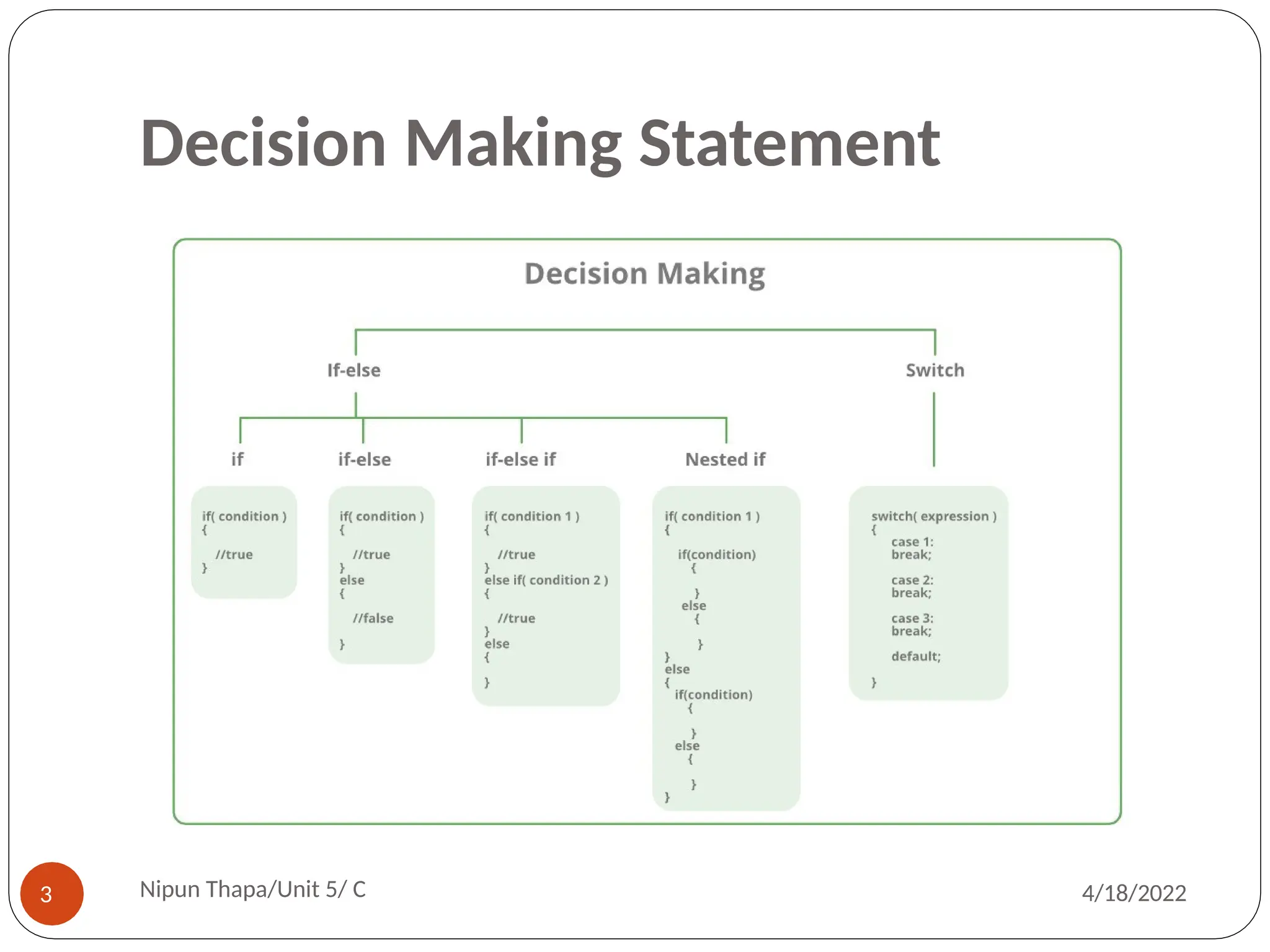
Decision Making Statement
⚫ There come situations in real life when we need to make
some decisions and based on these decisions, we decide
what should we do next.
⚫ Similar situations arise in programming also where we
need to make some decisions and based on these
decisions we will execute the next block of code.
⚫ For example, in C if x occurs then execute y else execute z.
There can also be multiple conditions like in C if x occurs
then execute p, else if condition y occurs execute q, else
execute r. This condition of C else-if is one of the many
ways of importing multiple conditions.
Nipun Thapa/Unit 5/ C
2 4/18/2022
Decision Making Statement
Nipun Thapa/Unit 5/ C
3 4/18/2022
if statement
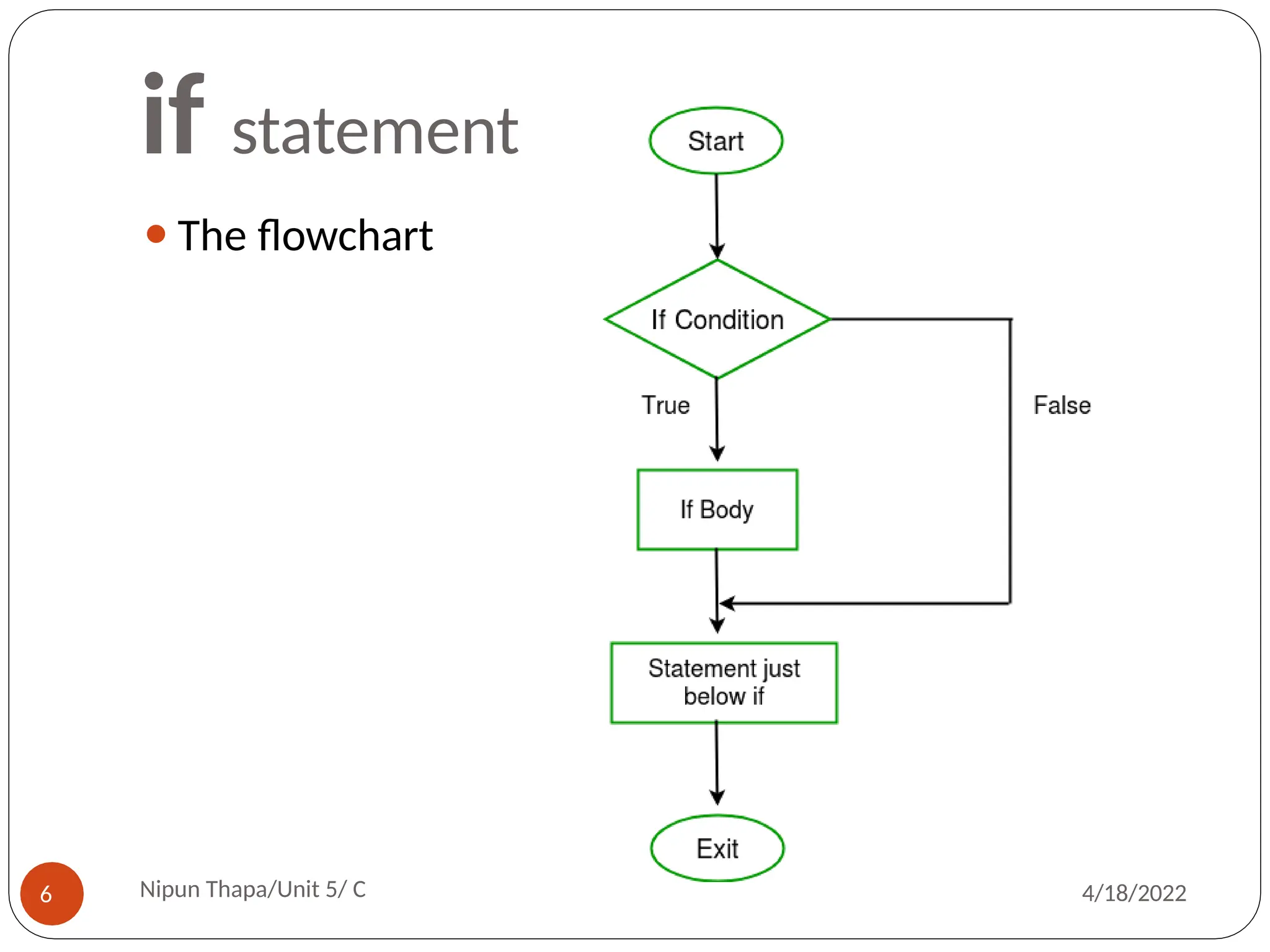
⚫The if statement is a two way decision statement
and is used together with an expression, i.e. test
condition.
⚫The if statement evaluates the test expression first
and then, if the value of the expression is true,
it execute the statement(s) within its block.
⚫Otherwise, it skips the statements within its block
and continues from the first statement outside the
if block.
Nipun Thapa/Unit 5/ C
4 4/18/2022
if statement
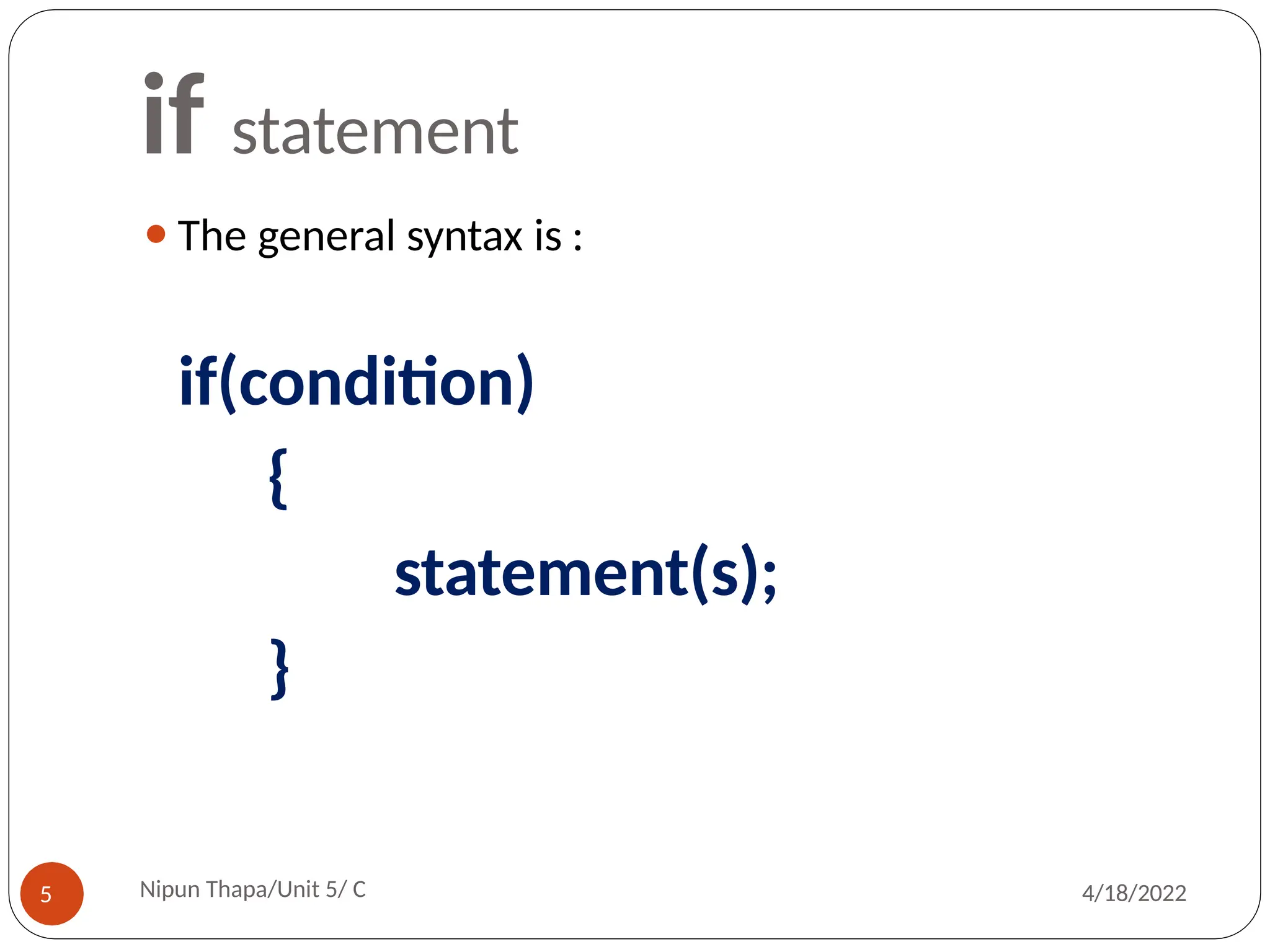
⚫The general syntax is :
Nipun Thapa/Unit 5/ C
5 4/18/2022
if(condition)
{
statement(s);
}
if statement
⚫The flowchart
Nipun Thapa/Unit 5/ C
6 4/18/2022
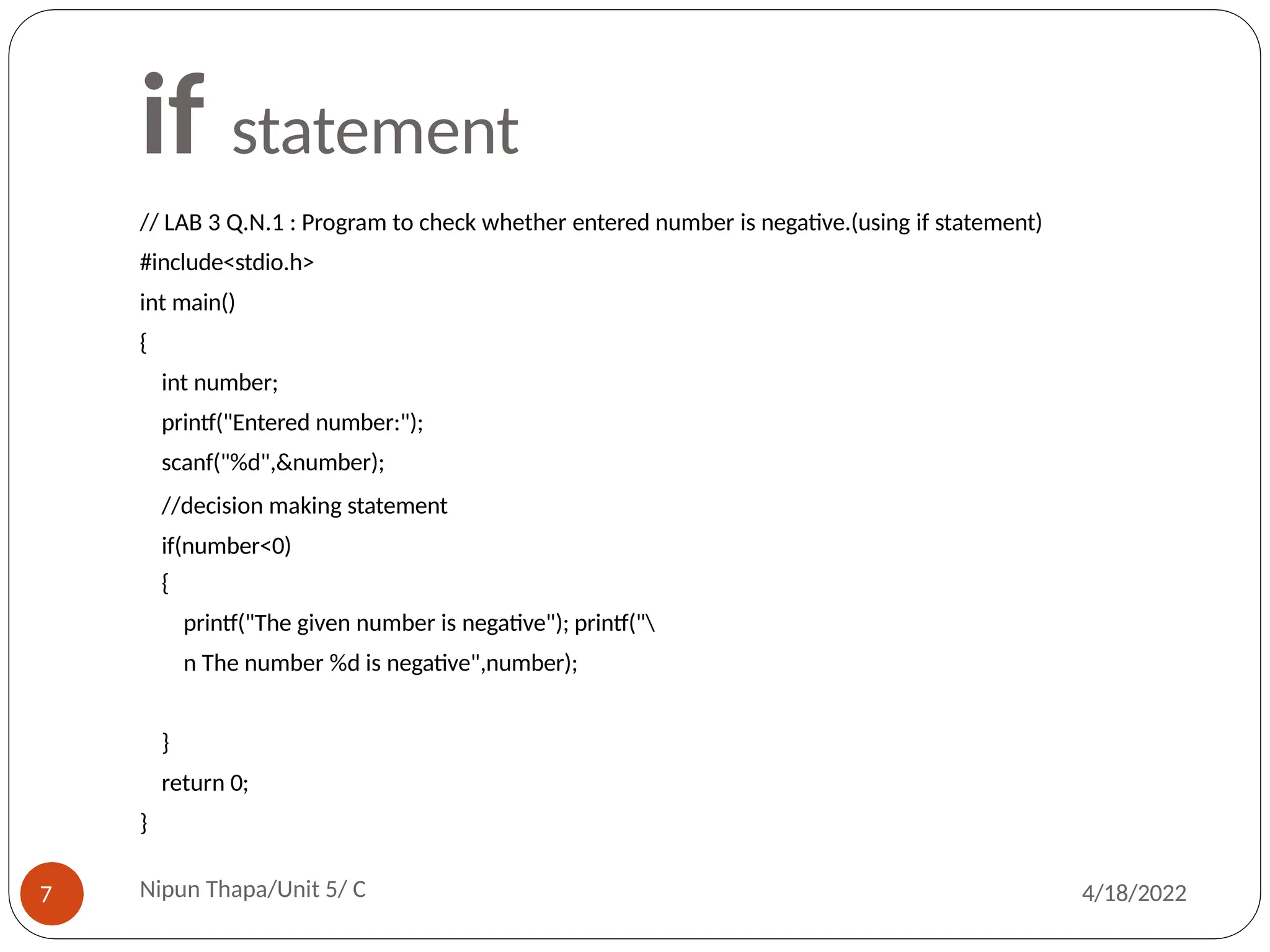
if statement
// LAB 3 Q.N.1 : Program to check whether entered number is negative.(using if statement)
#include<stdio.h>
int main()
{
int number;
printf("Entered number:");
scanf("%d",&number);
//decision making statement
if(number<0)
{
printf("The given number is negative"); printf("
n The number %d is negative",number);
}
return 0;
}
Nipun Thapa/Unit 5/ C
7 4/18/2022
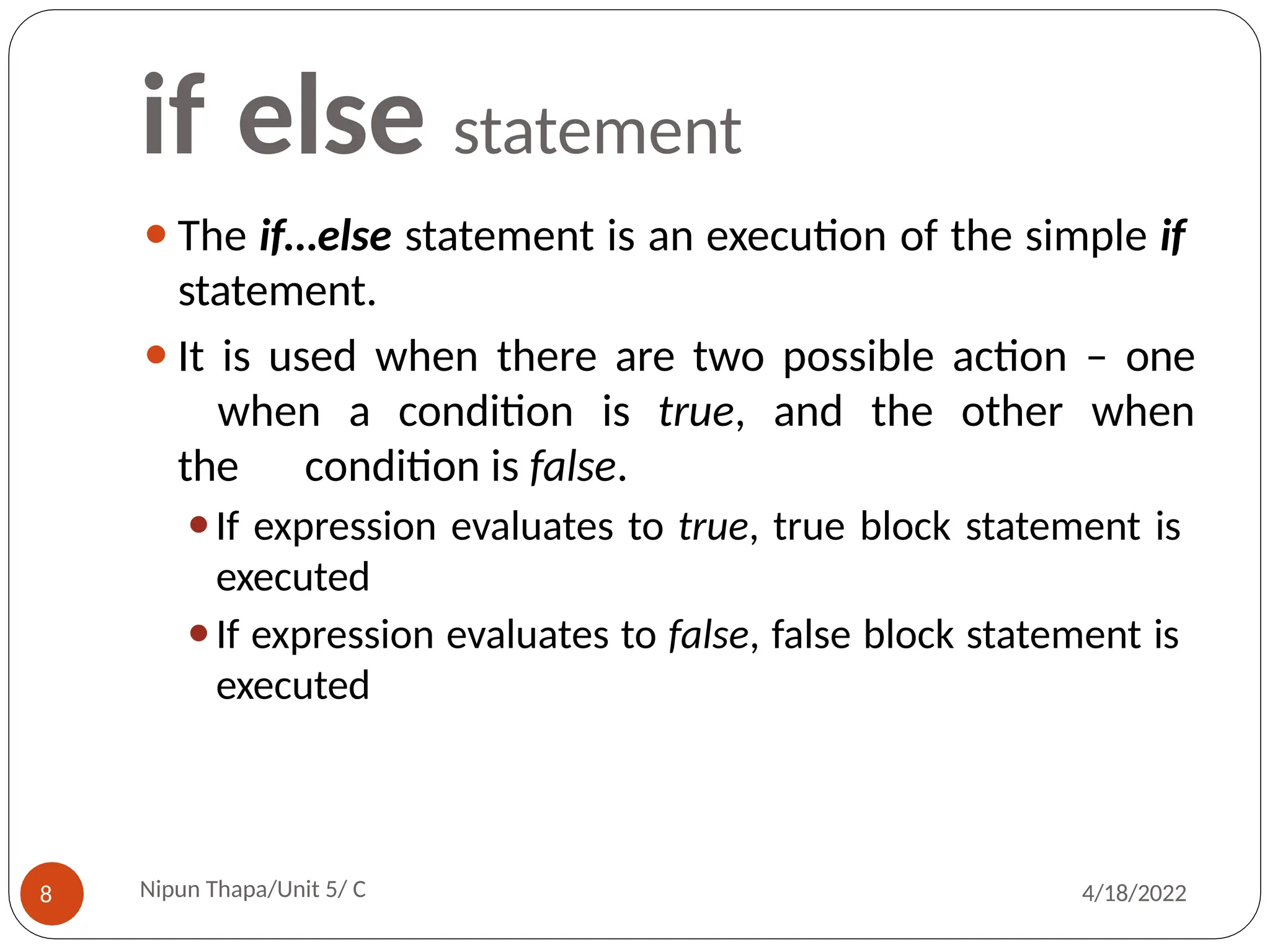
if else statement
⚫The if…else statement is an execution of the simple if
statement.
⚫It is used when there are two possible action – one
when a condition is true, and the other when
the condition is false.
⚫If expression evaluates to true, true block statement is
executed
⚫If expression evaluates to false, false block statement is
executed
Nipun Thapa/Unit 5/ C
8 4/18/2022
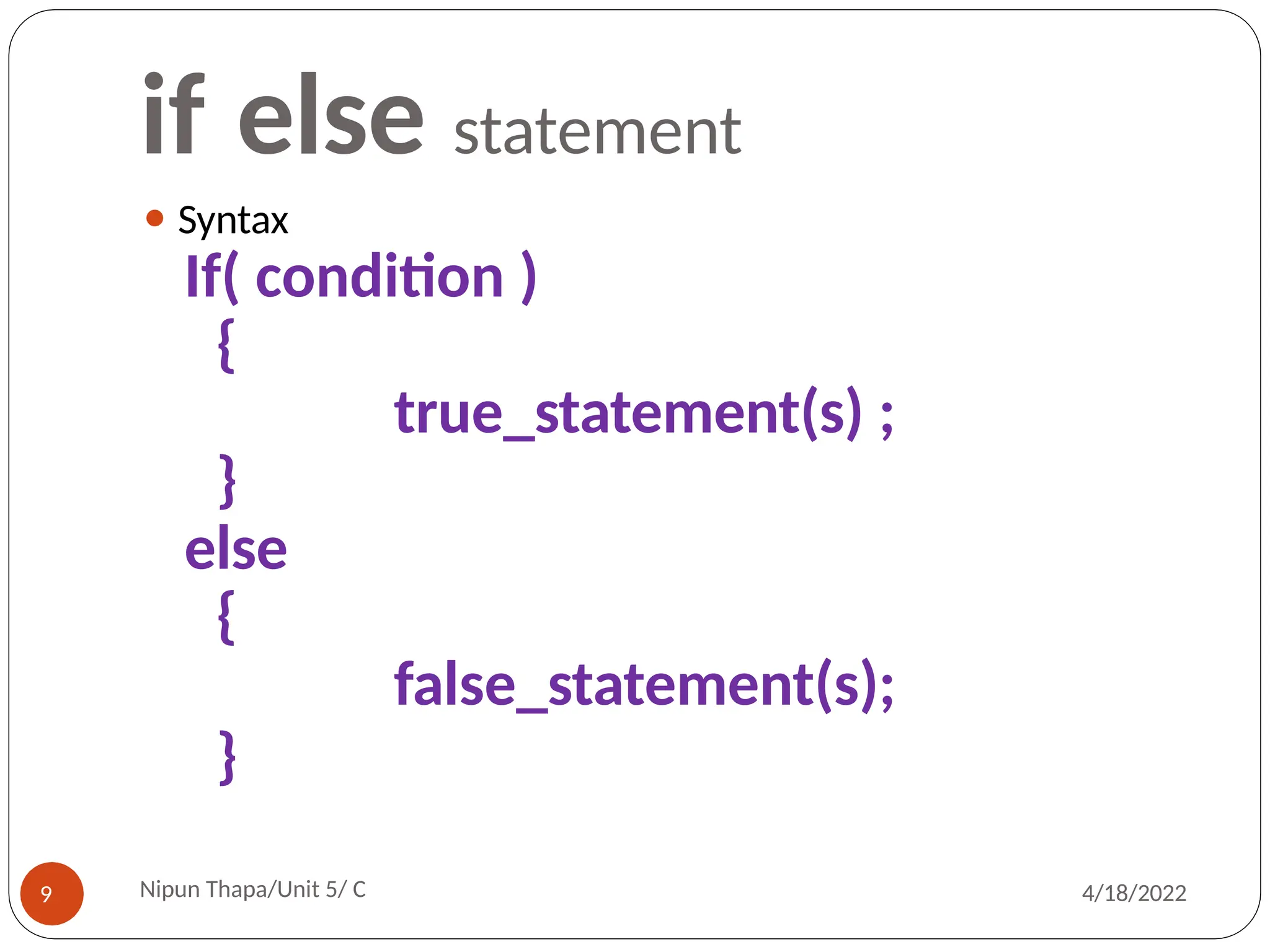
if else statement
⚫ Syntax
If( condition )
{
true_statement(s) ;
}
else
{
false_statement(s);
}
Nipun Thapa/Unit 5/ C
9 4/18/2022
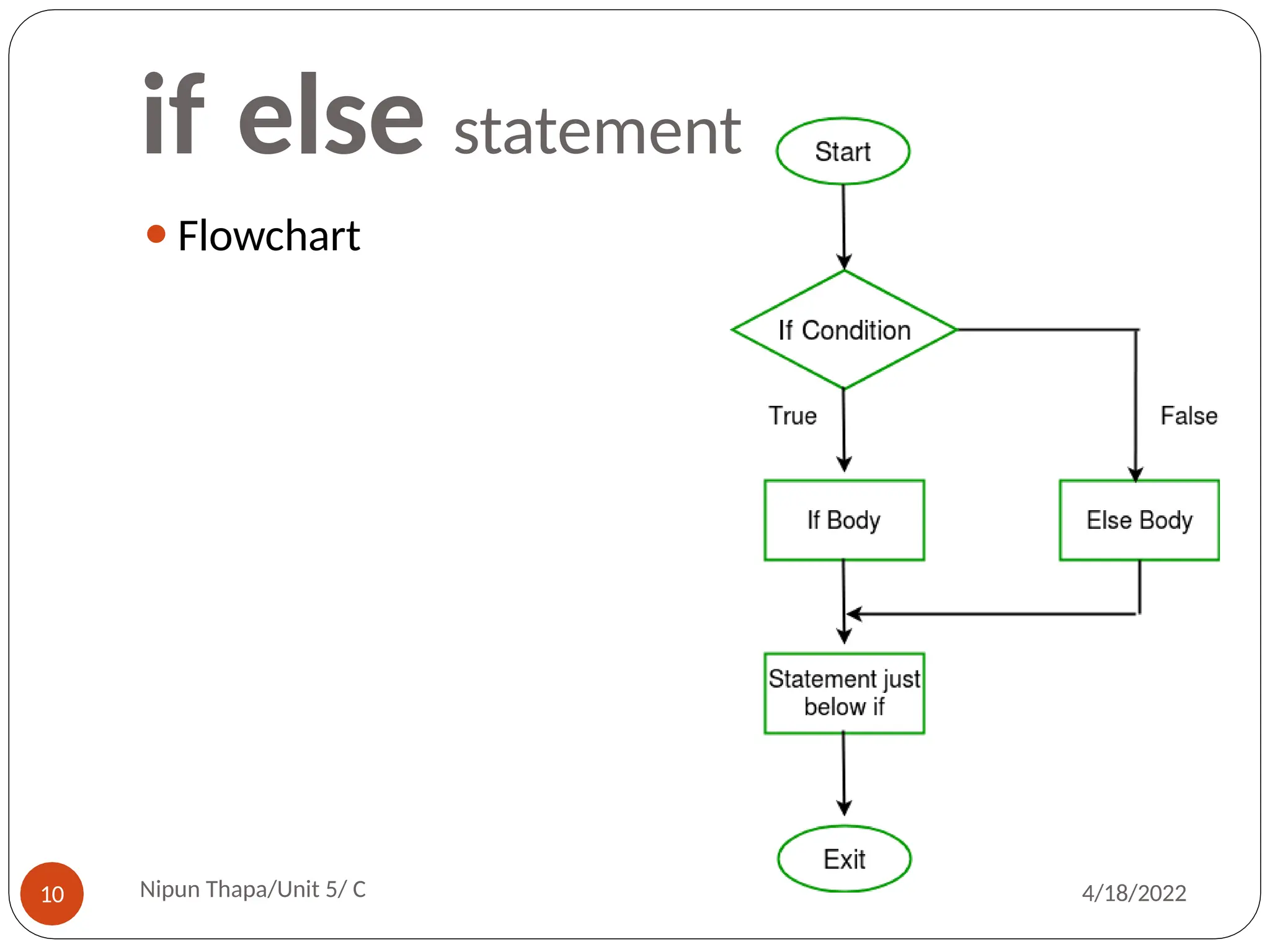
if else statement
⚫Flowchart
Nipun Thapa/Unit 5/ C
10 4/18/2022
if else statement
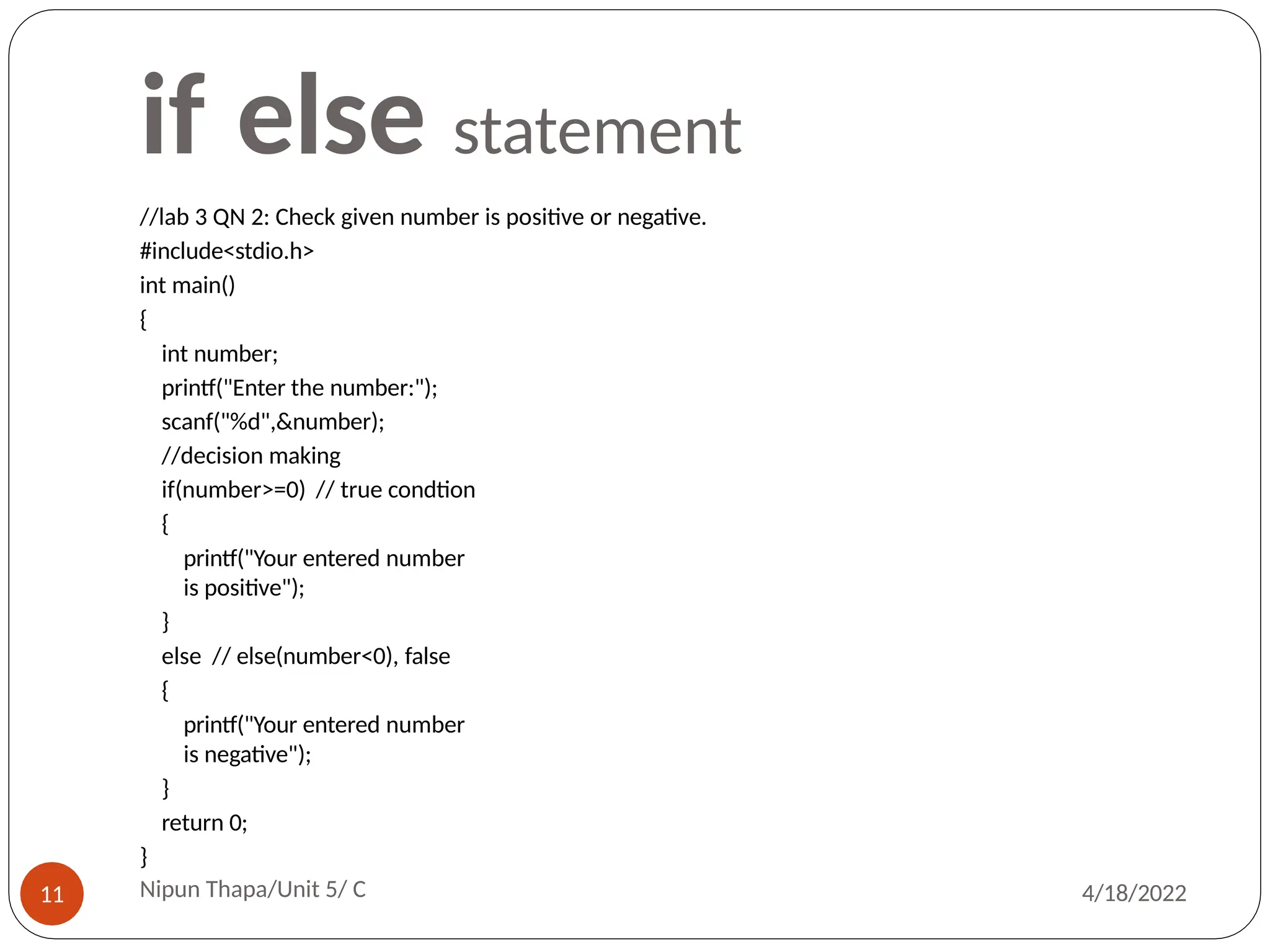
//lab 3 QN 2: Check given number is positive or negative.
#include<stdio.h>
int main()
{
int number;
printf("Enter the number:");
scanf("%d",&number);
//decision making
if(number>=0) // true condtion
{
printf("Your entered number
is positive");
}
else // else(number<0), false
{
printf("Your entered number
is negative");
}
return 0;
}
Nipun Thapa/Unit 5/ C
11 4/18/2022
if else statement
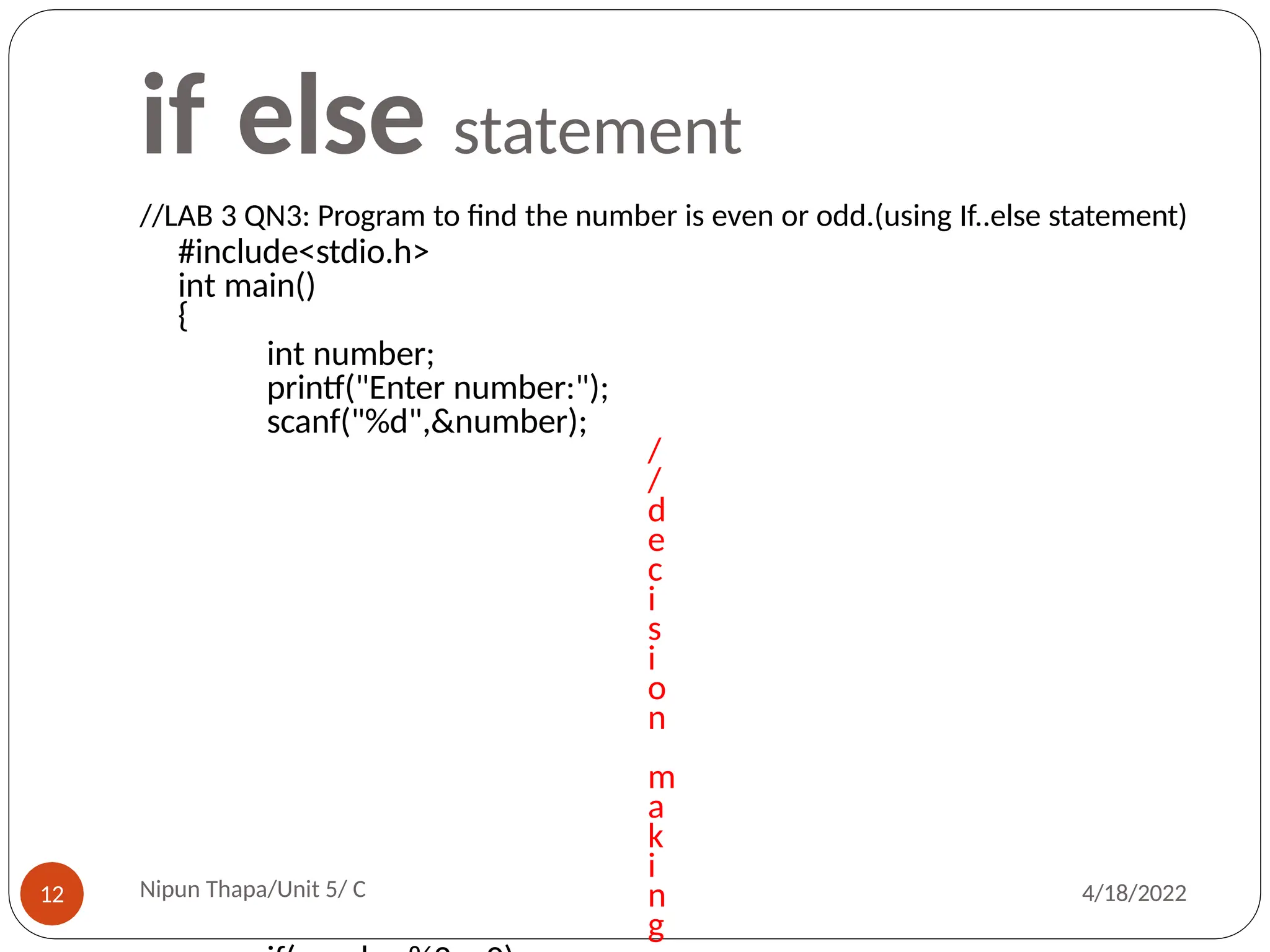
//LAB 3 QN3: Program to find the number is even or odd.(using If..else statement)
#include<stdio.h>
int main()
{
int number;
printf("Enter number:");
scanf("%d",&number);
/
/
d
e
c
i
s
i
o
n
m
a
k
i
n
g
Nipun Thapa/Unit 5/ C
12 4/18/2022
if else statement
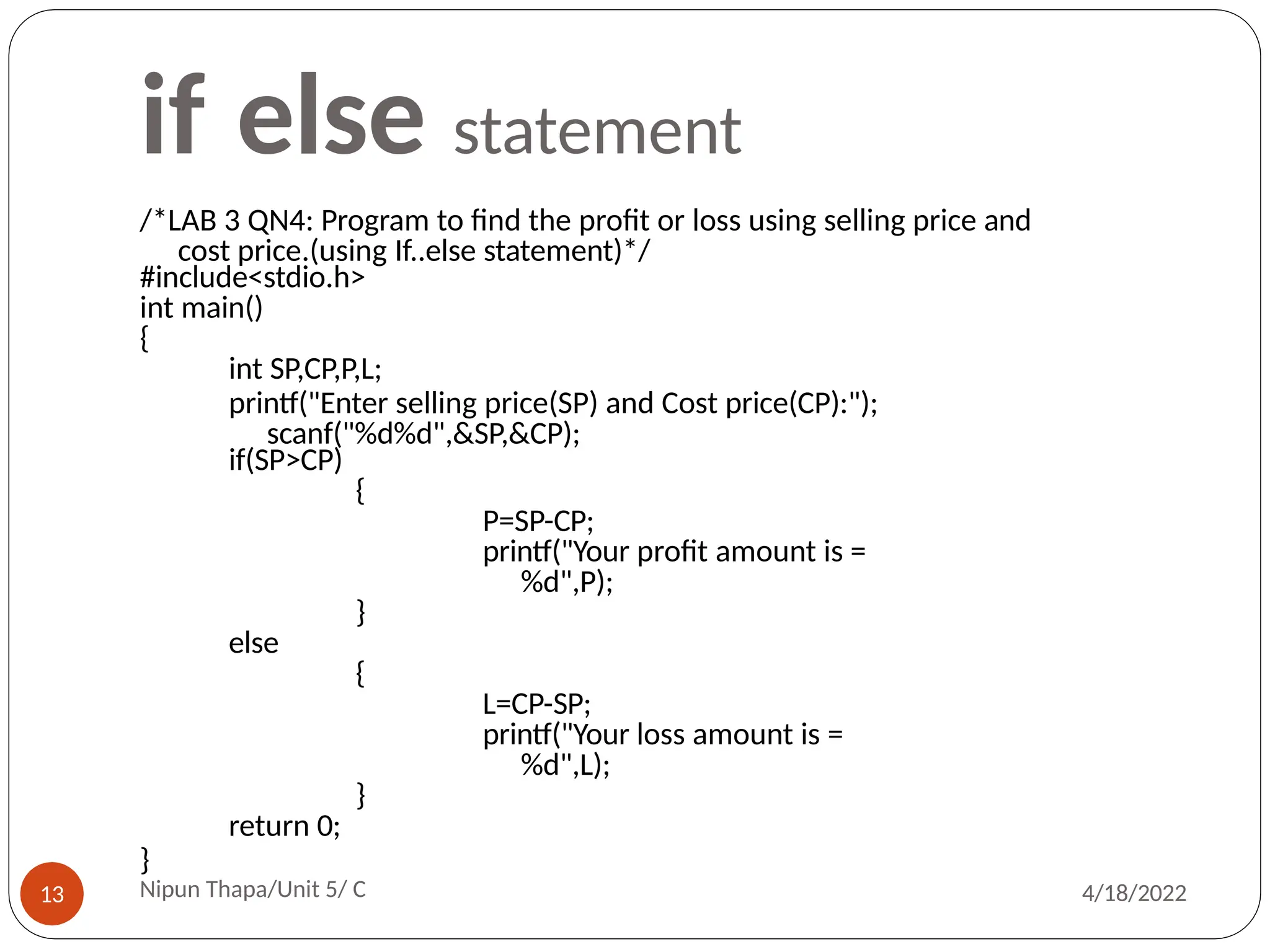
/*LAB 3 QN4: Program to find the profit or loss using selling price and
cost price.(using If..else statement)*/
#include<stdio.h>
int main()
{
int SP,CP,P,L;
printf("Enter selling price(SP) and Cost price(CP):");
scanf("%d%d",&SP,&CP);
if(SP>CP)
{
P=SP-CP;
printf("Your profit amount is =
%d",P);
}
else
{
L=CP-SP;
printf("Your loss amount is =
%d",L);
}
return 0;
}
Nipun Thapa/Unit 5/ C
13 4/18/2022
if else statement
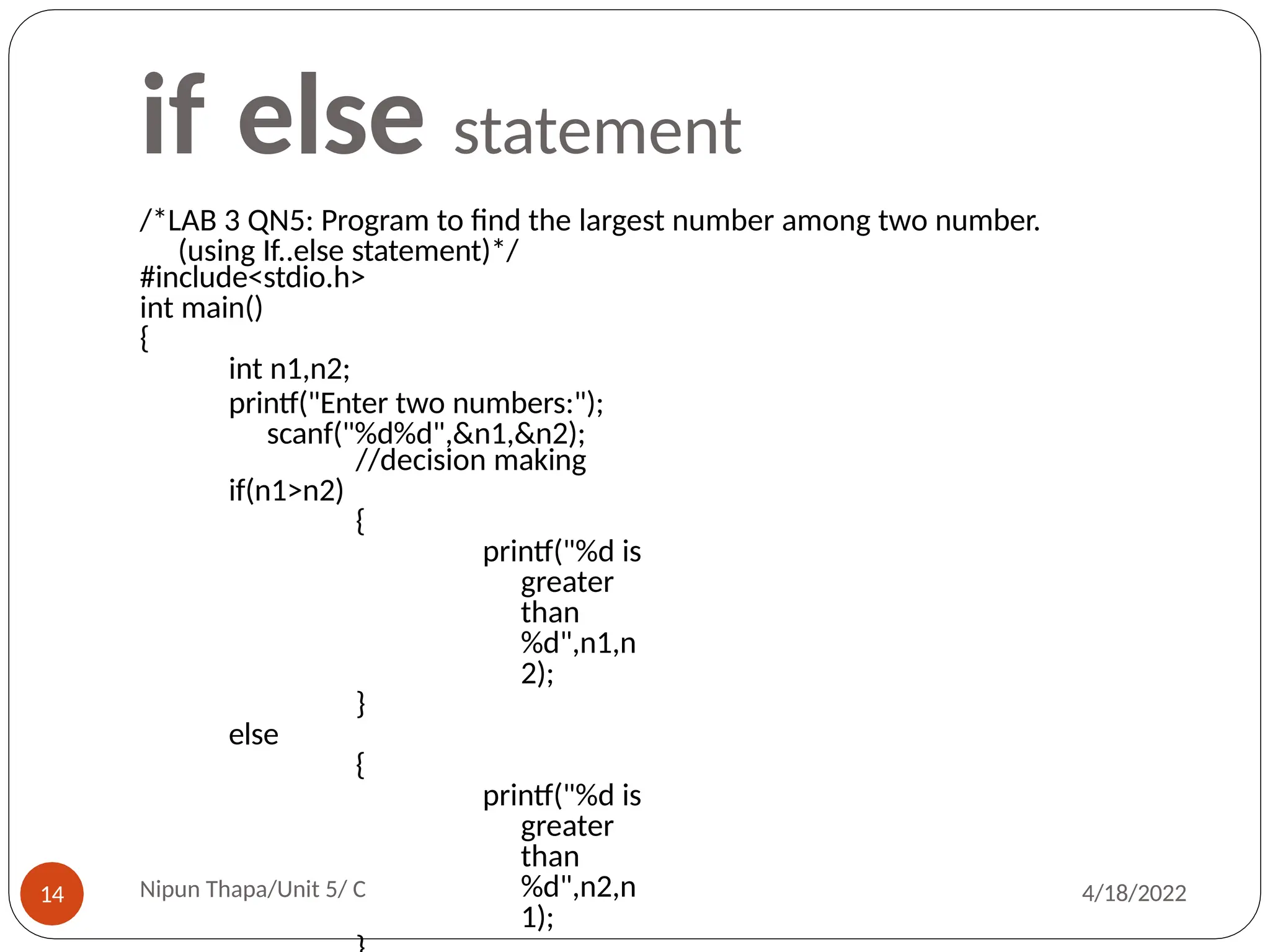
/*LAB 3 QN5: Program to find the largest number among two number.
(using If..else statement)*/
#include<stdio.h>
int main()
{
int n1,n2;
printf("Enter two numbers:");
scanf("%d%d",&n1,&n2);
//decision making
if(n1>n2)
{
printf("%d is
greater
than
%d",n1,n
2);
}
else
{
printf("%d is
greater
than
%d",n2,n
1);
Nipun Thapa/Unit 5/ C
14 4/18/2022
if else statement
/*LAB 3 QN6: Program to check the number is divisible
by 5 or not.
(using If..else statement)*/
Nipun Thapa/Unit 5/ C
15 4/18/2022
Nested If statement
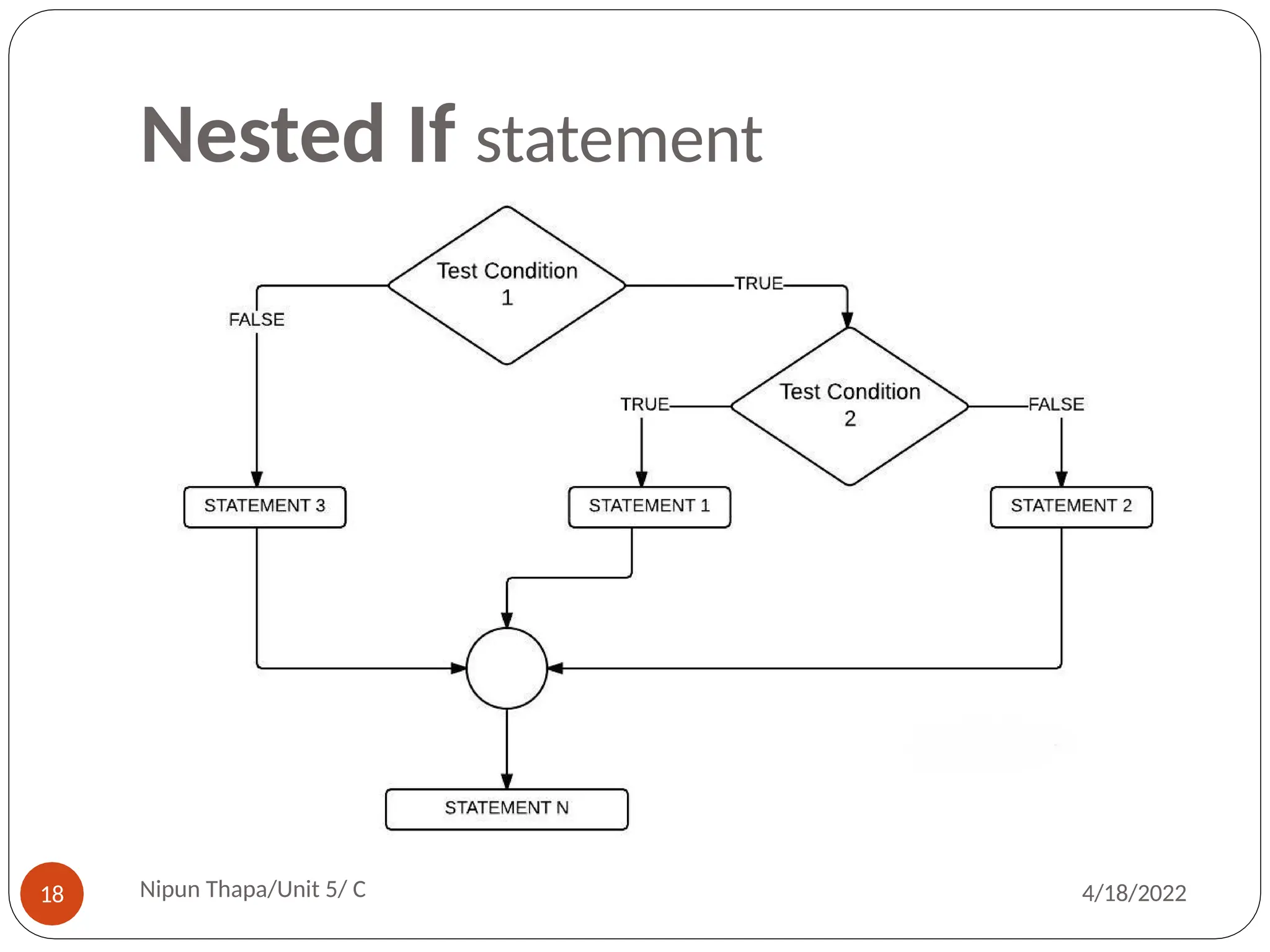
⚫When a series of decisions are involved, we may have
to use more than one if else statement in nested.
⚫A if statement contains another if else statement
is called nested if statement.
Nipun Thapa/Unit 5/ C
16 4/18/2022
⚫The condition are execute
from
checking each condition whether
top
to bottom
it meets
the
condition criteria or not
⚫ if it found the condition is true then it executes
the block associated statements of true part else it
goes to next condition to execute.
Nested If statement
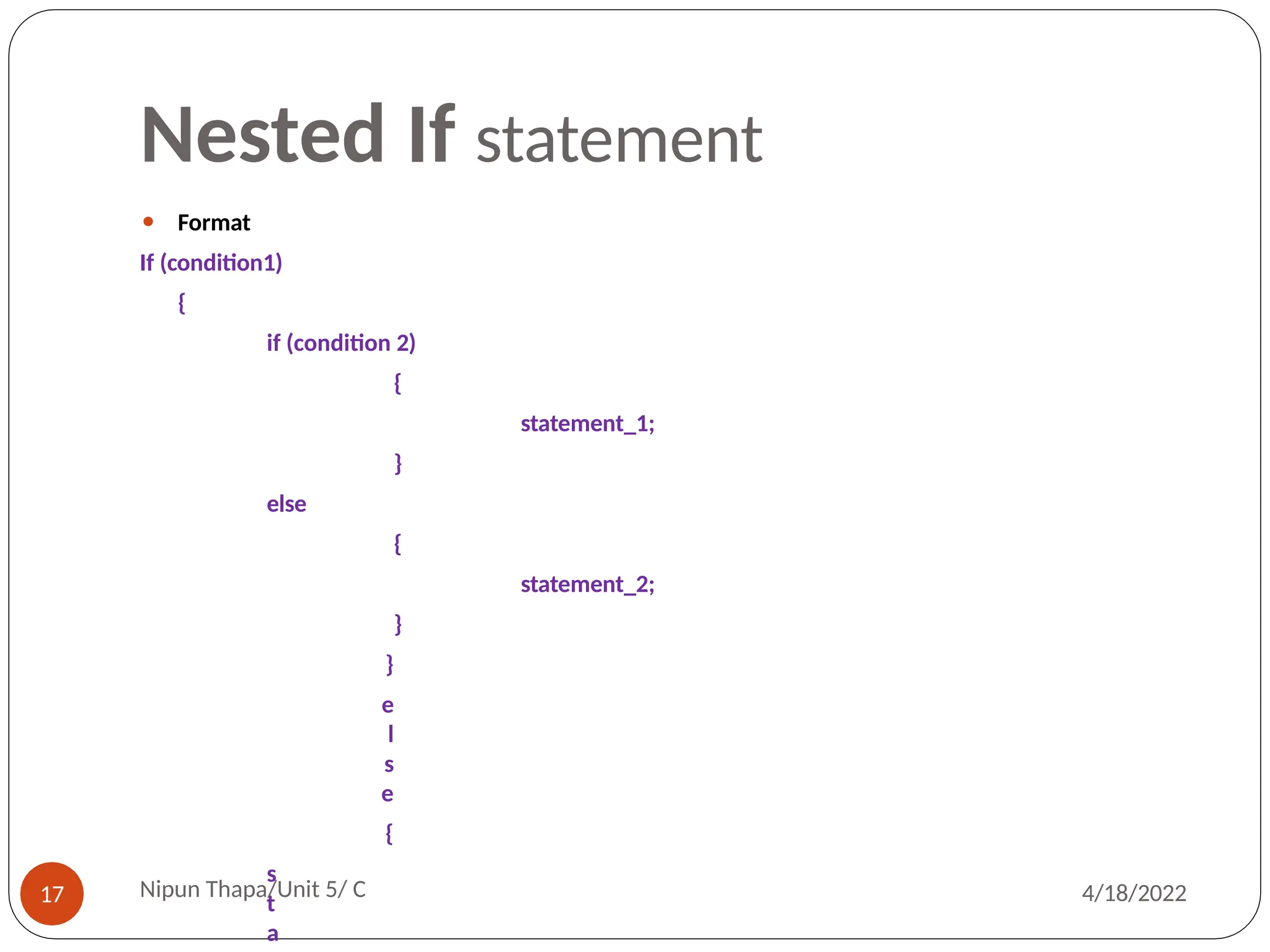
⚫ Format
If (condition1)
{
if (condition 2)
{
statement_1;
}
else
{
statement_2;
}
}
e
l
s
e
{
s
t
a
Nipun Thapa/Unit 5/ C
17 4/18/2022
Nested If statement
Nipun Thapa/Unit 5/ C
18 4/18/2022
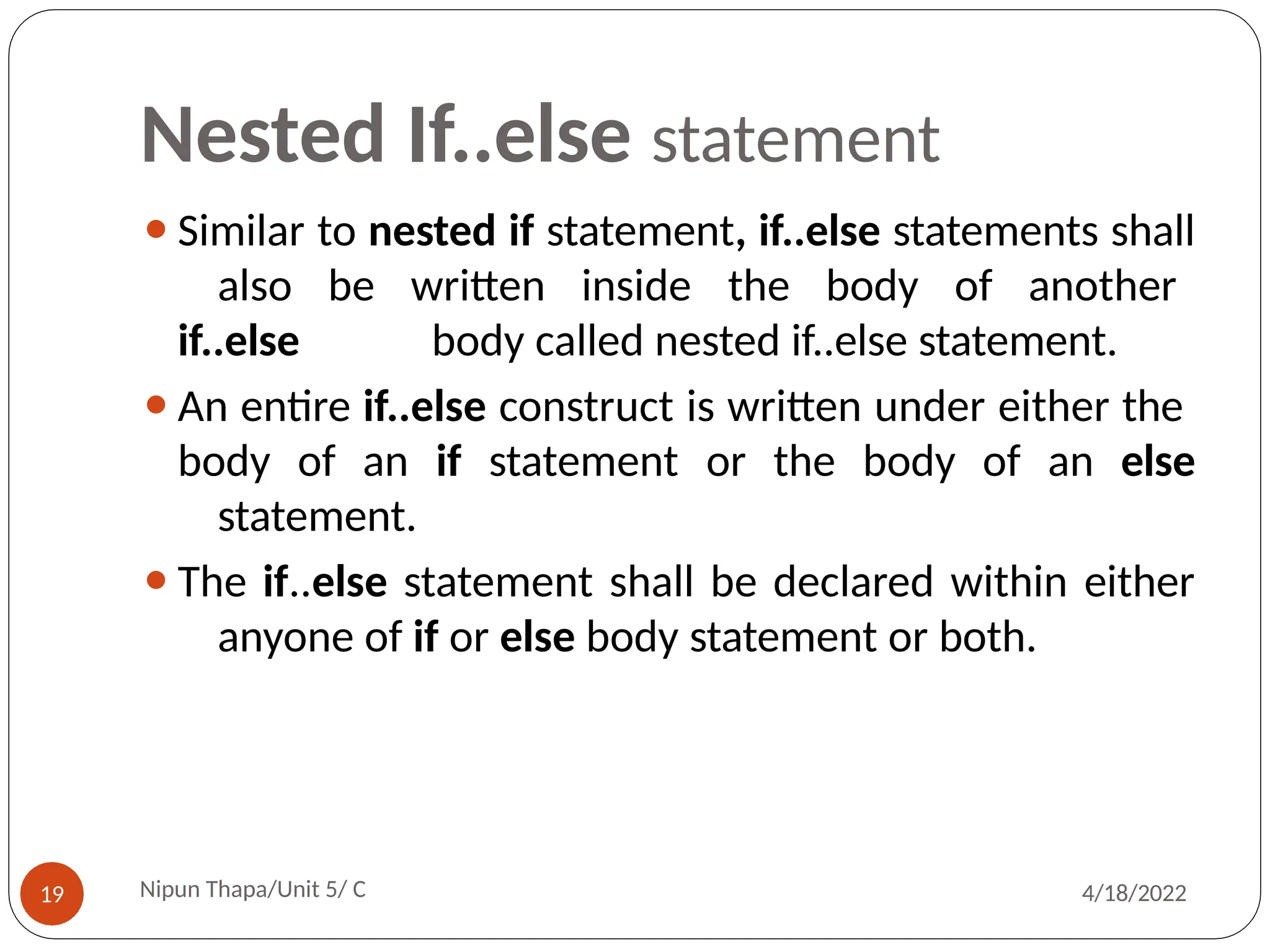
Nested If..else statement
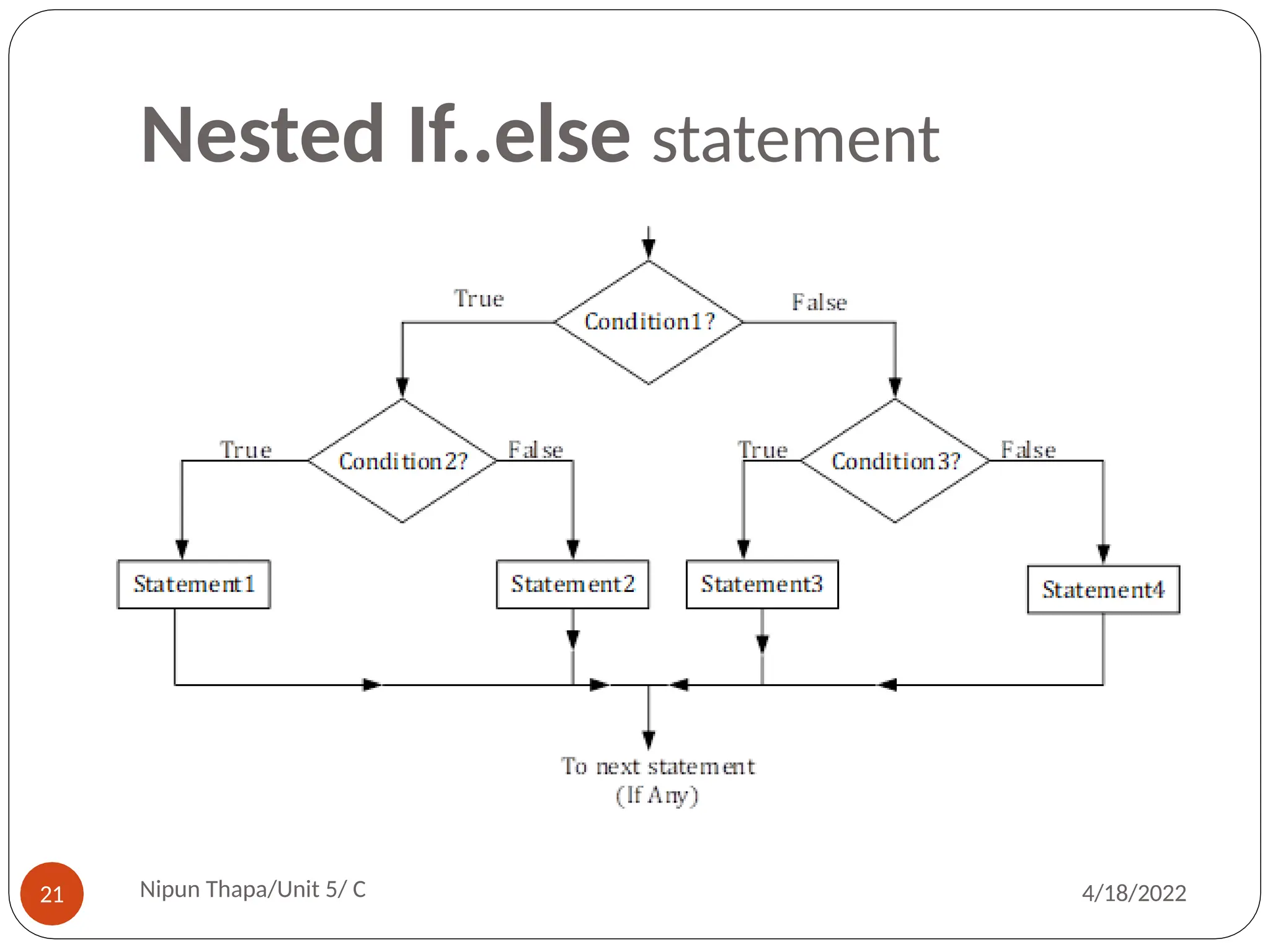
⚫Similar to nested if statement, if..else statements shall
also be written inside the body of another
if..else body called nested if..else statement.
⚫An entire if..else construct is written under either the
body of an if statement or the body of an else
statement.
⚫The if..else statement shall be declared within either
anyone of if or else body statement or both.
Nipun Thapa/Unit 5/ C
19 4/18/2022
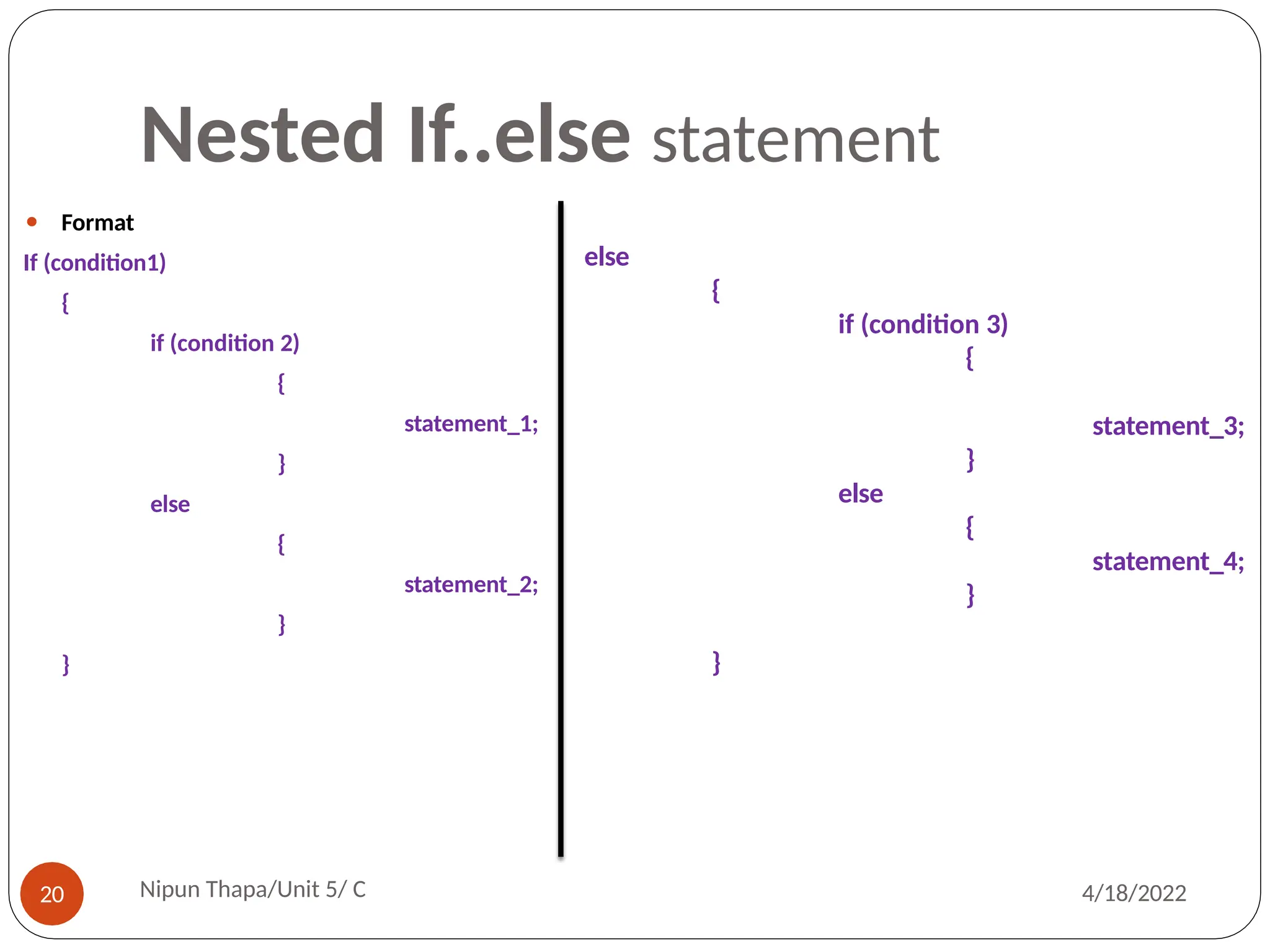
Nested If..else statement
⚫ Format
If (condition1)
{
if (condition 2)
{
statement_1;
}
else
{
statement_2;
}
}
else
{
if (condition 3)
{
statement_3;
}
else
{
statement_4;
}
}
Nipun Thapa/Unit 5/ C
20 4/18/2022
Nested If..else statement
Nipun Thapa/Unit 5/ C
21 4/18/2022
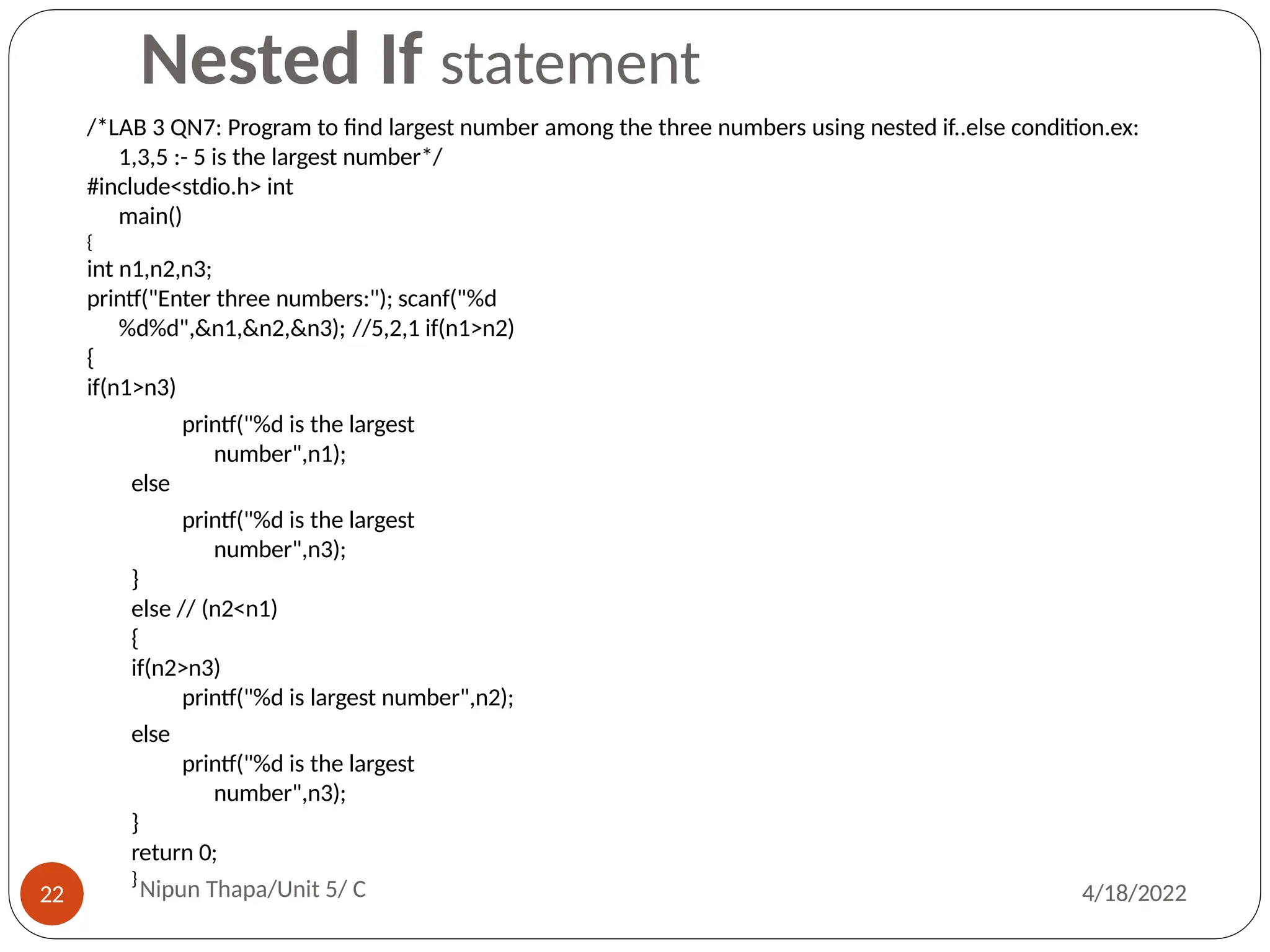
Nested If statement
/*LAB 3 QN7: Program to find largest number among the three numbers using nested if..else condition.ex:
1,3,5 :- 5 is the largest number*/
#include<stdio.h> int
main()
{
int n1,n2,n3;
printf("Enter three numbers:"); scanf("%d
%d%d",&n1,&n2,&n3); //5,2,1 if(n1>n2)
{
if(n1>n3)
printf("%d is the largest
number",n1);
else
printf("%d is the largest
number",n3);
}
else // (n2<n1)
{
if(n2>n3)
printf("%d is largest number",n2);
else
printf("%d is the largest
number",n3);
}
return 0;
}
Nipun Thapa/Unit 5/ C
22 4/18/2022
If-else-if ladder statement
⚫This is a type of nesting in which there is an if…else
statement in every part except the last else part.
⚫This type of nesting is frequently used in
programs and also known as else if ladder .
⚫This construct is if-else-if ladder because of
its appearance
Nipun Thapa/Unit 5/ C
23 4/18/2022
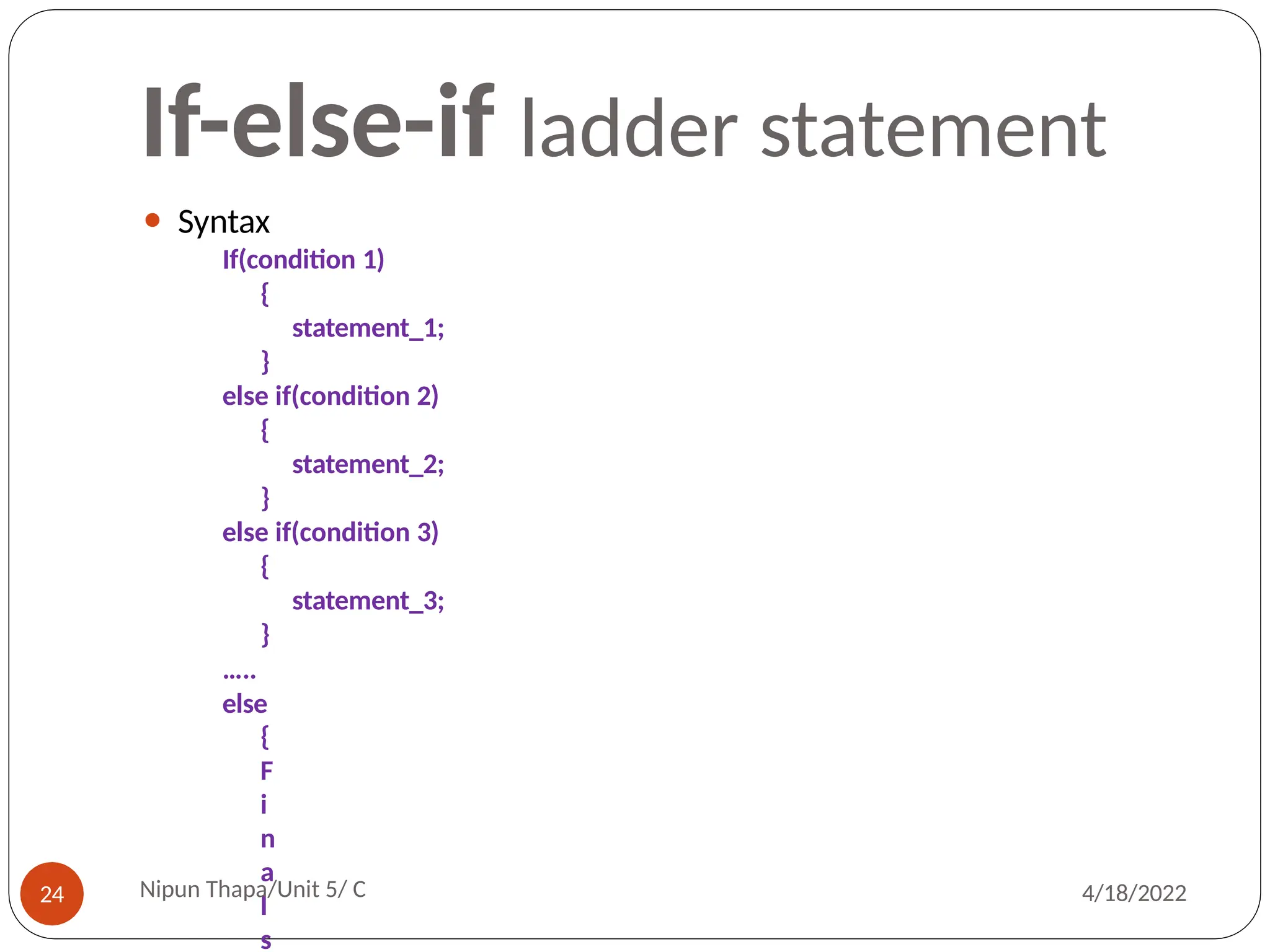
If-else-if ladder statement
⚫ Syntax
If(condition 1)
{
statement_1;
}
else if(condition 2)
{
statement_2;
}
else if(condition 3)
{
statement_3;
}
…..
else
{
F
i
n
a
l
s
Nipun Thapa/Unit 5/ C
24 4/18/2022
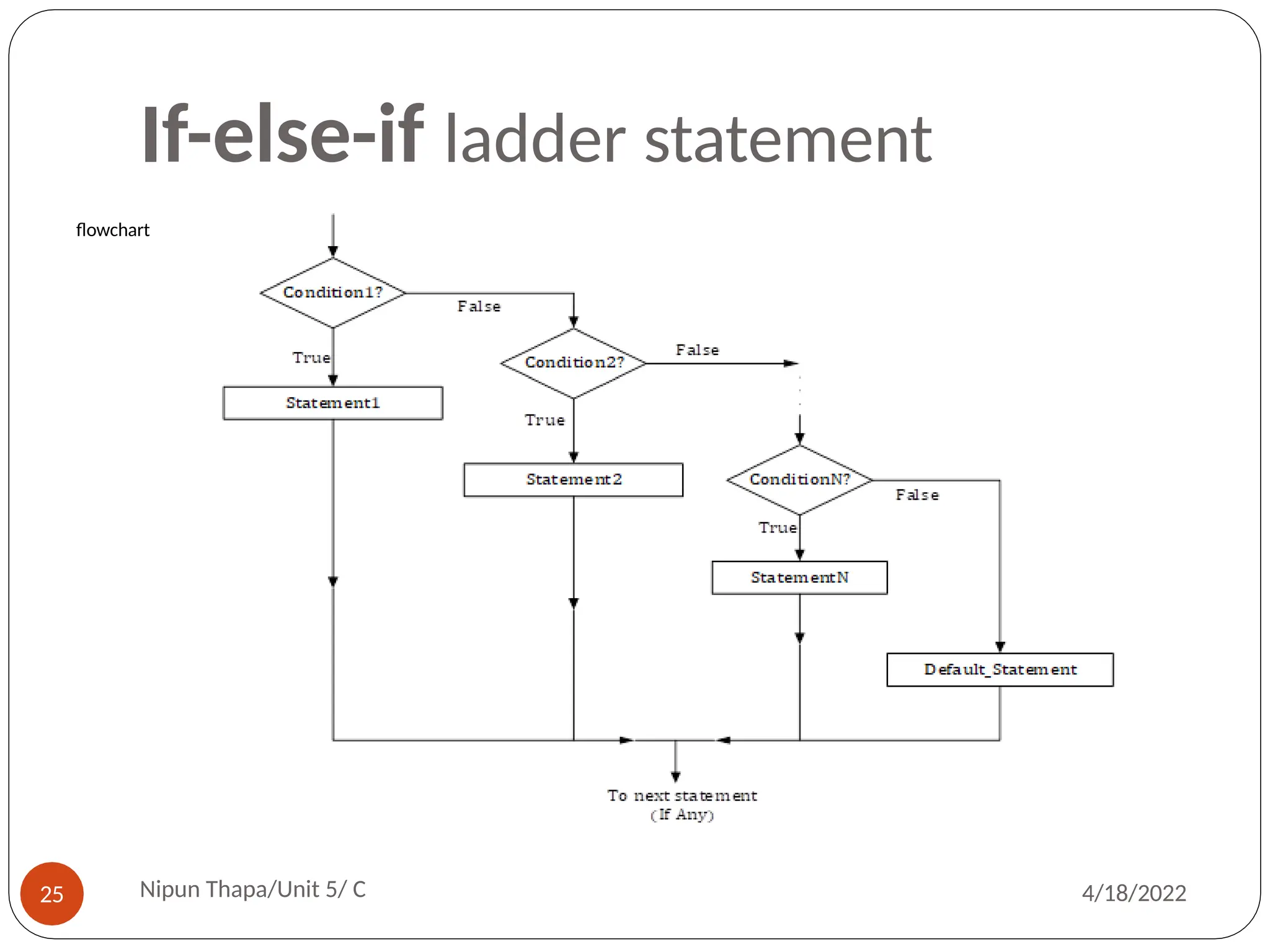
If-else-if ladder statement
flowchart
Nipun Thapa/Unit 5/ C
25 4/18/2022
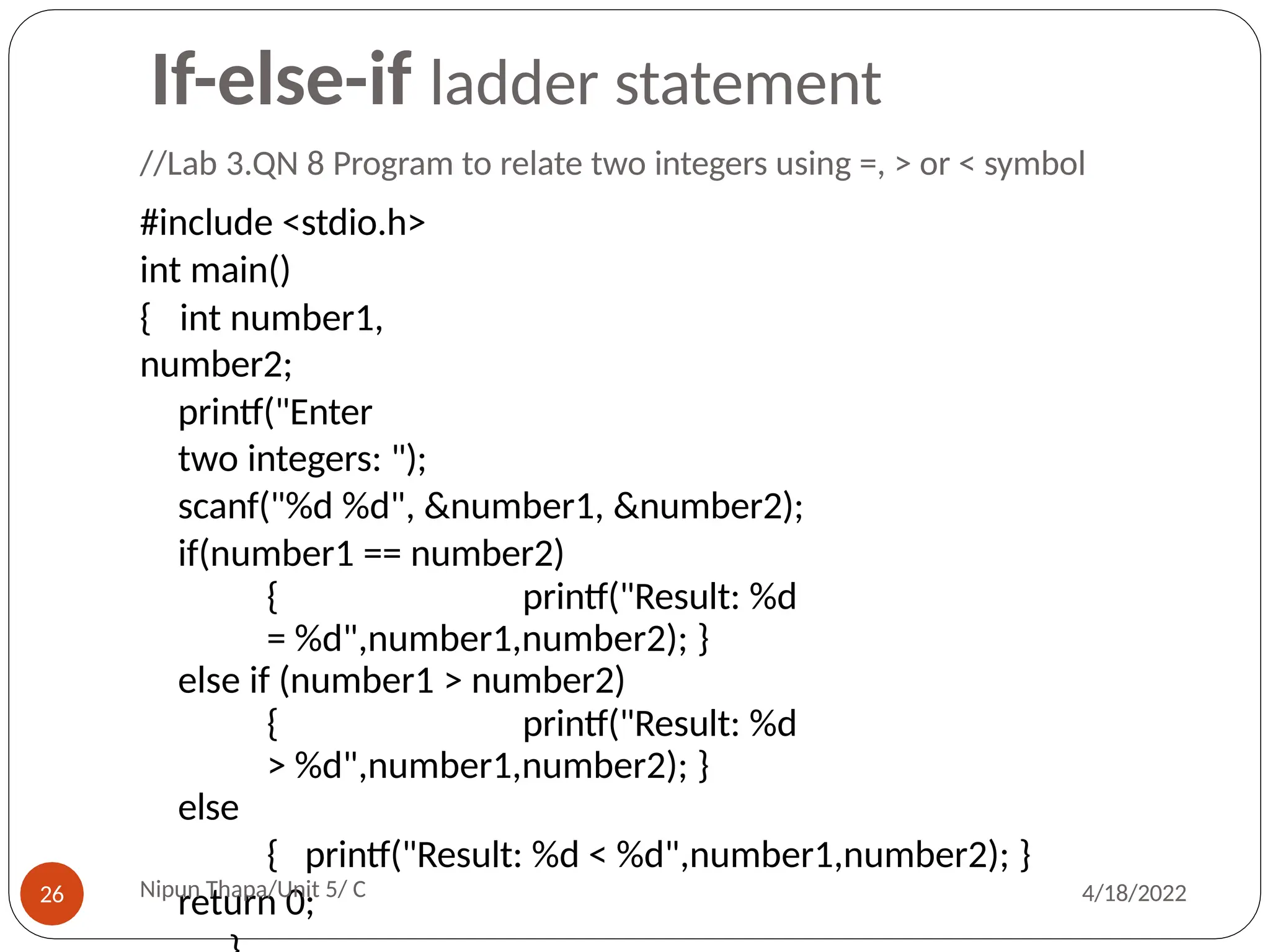
//Lab 3.QN 8 Program to relate two integers using =, > or < symbol
#include <stdio.h>
int main()
{ int number1,
number2;
printf("Enter
two integers: ");
scanf("%d %d", &number1, &number2);
if(number1 == number2)
{ printf("Result: %d
= %d",number1,number2); }
else if (number1 > number2)
{ printf("Result: %d
> %d",number1,number2); }
else
{ printf("Result: %d < %d",number1,number2); }
return 0;
Nipun Thapa/Unit 5/ C
26 4/18/2022
If-else-if ladder statement
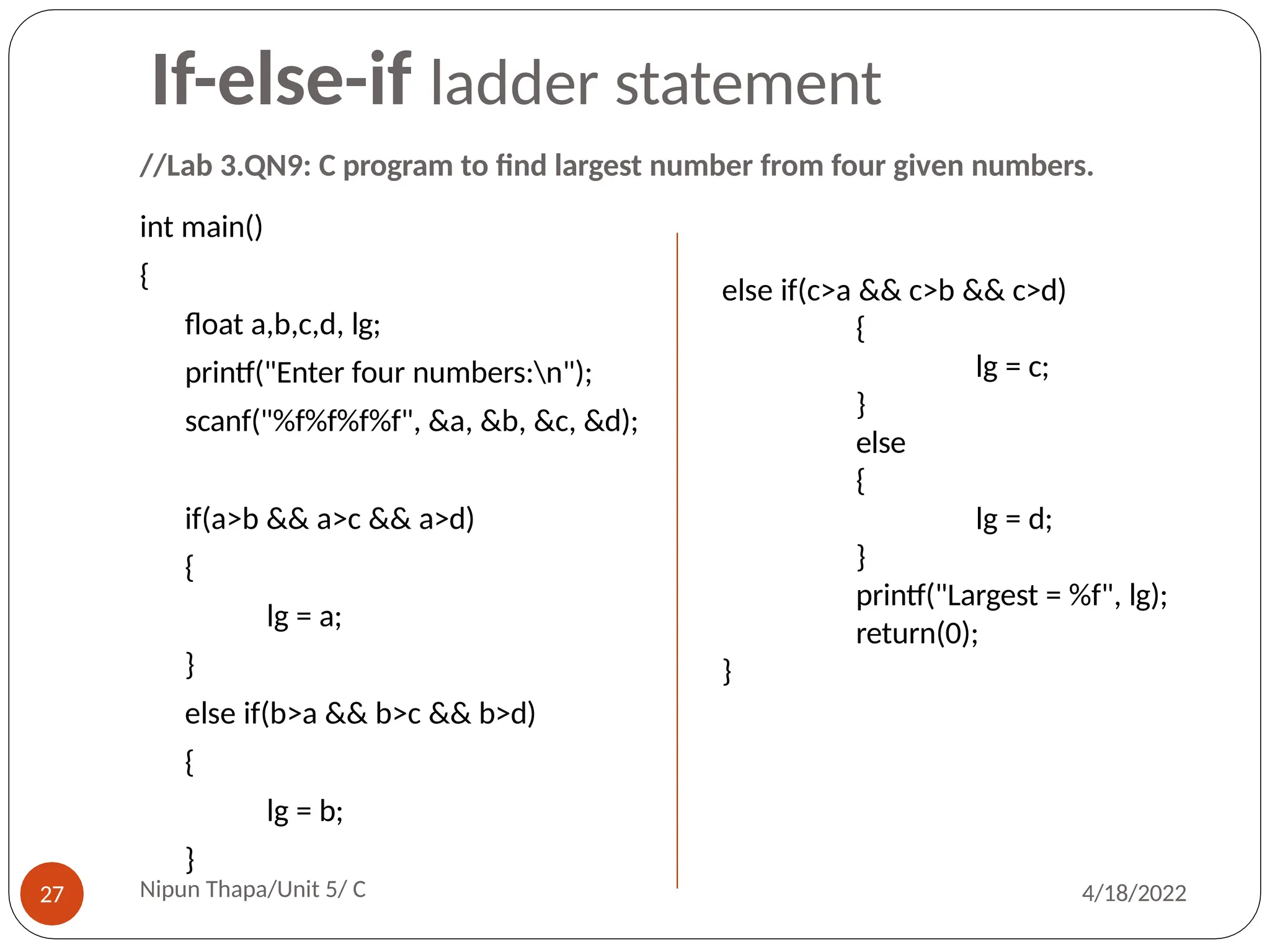
//Lab 3.QN9: C program to find largest number from four given numbers.
int main()
{
float a,b,c,d, lg;
printf("Enter four numbers:n");
scanf("%f%f%f%f", &a, &b, &c, &d);
if(a>b && a>c && a>d)
{
lg = a;
}
else if(b>a && b>c && b>d)
{
lg = b;
}
else if(c>a && c>b && c>d)
{
lg = c;
}
else
{
lg = d;
}
printf("Largest = %f", lg);
return(0);
}
If-else-if ladder statement
Nipun Thapa/Unit 5/ C
27 4/18/2022
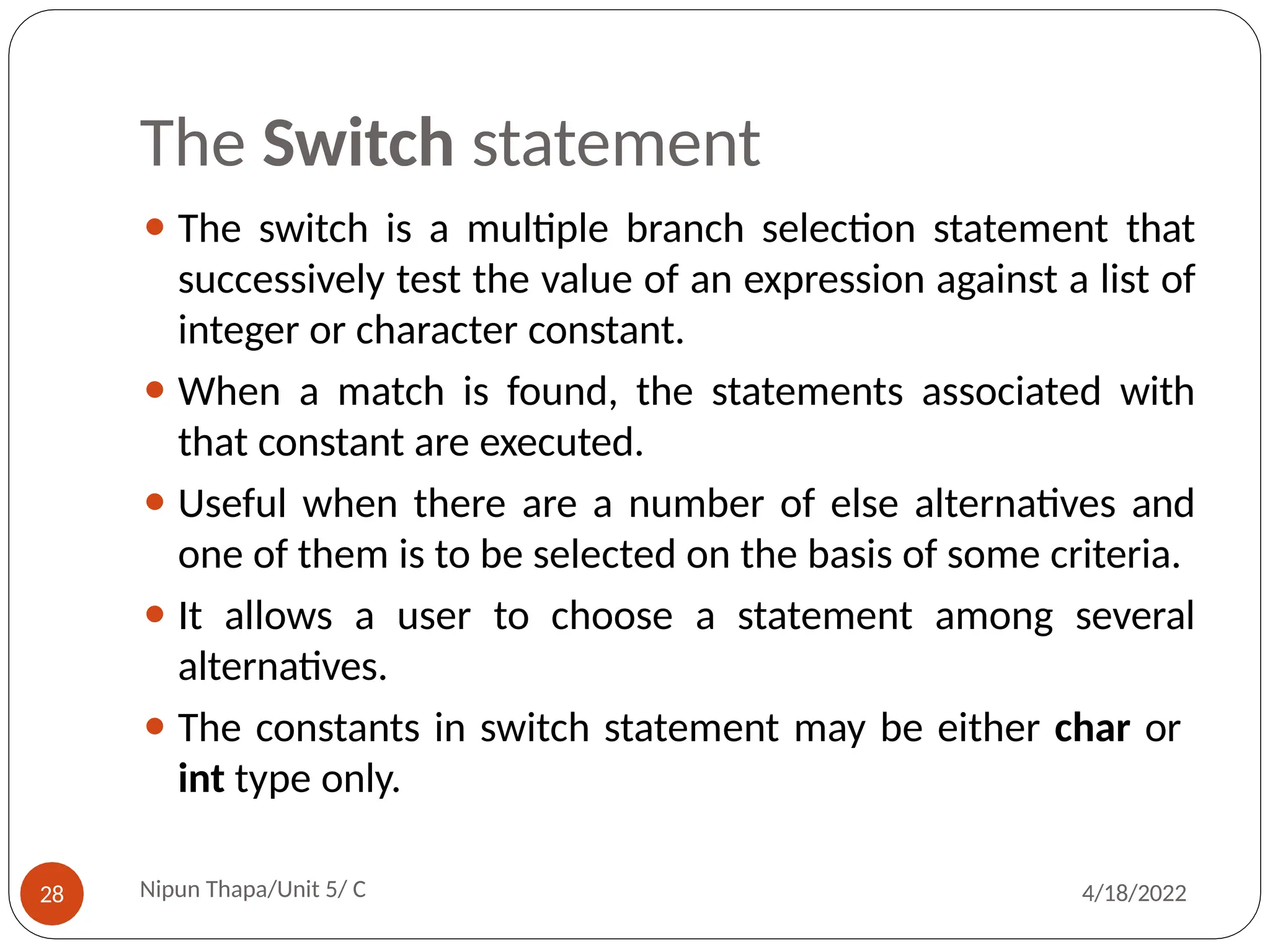
The Switch statement
⚫ The switch is a multiple branch selection statement that
successively test the value of an expression against a list of
integer or character constant.
⚫ When a match is found, the statements associated with
that constant are executed.
⚫ Useful when there are a number of else alternatives and
one of them is to be selected on the basis of some criteria.
⚫ It allows a user to choose a statement among several
alternatives.
⚫ The constants in switch statement may be either char or
int type only.
Nipun Thapa/Unit 5/ C
28 4/18/2022
The Switch statement
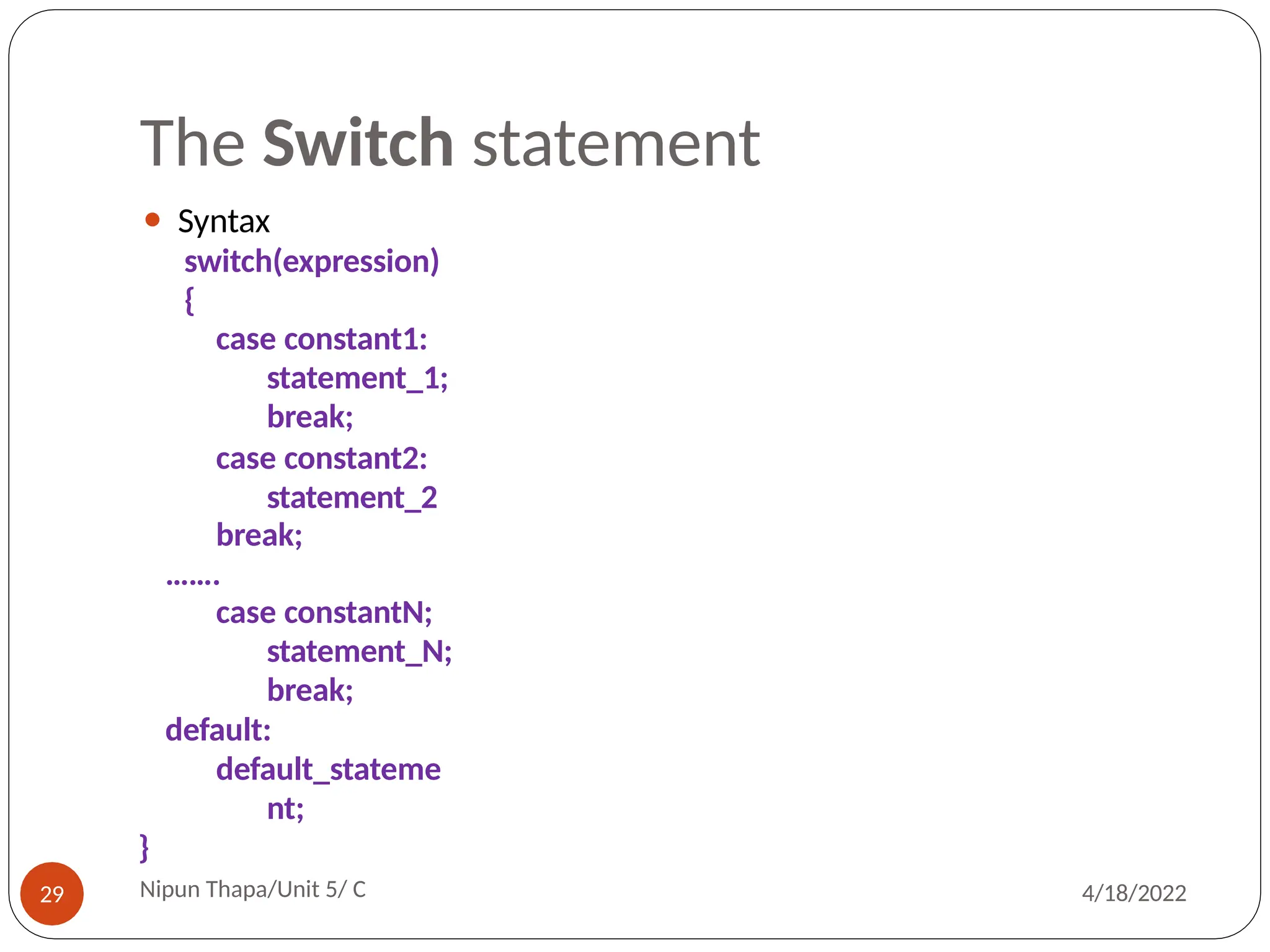
⚫ Syntax
switch(expression)
{
case constant1:
statement_1;
break;
case constant2:
statement_2
break;
…….
case constantN;
statement_N;
break;
default:
default_stateme
nt;
}
Nipun Thapa/Unit 5/ C
29 4/18/2022
The Switch statement
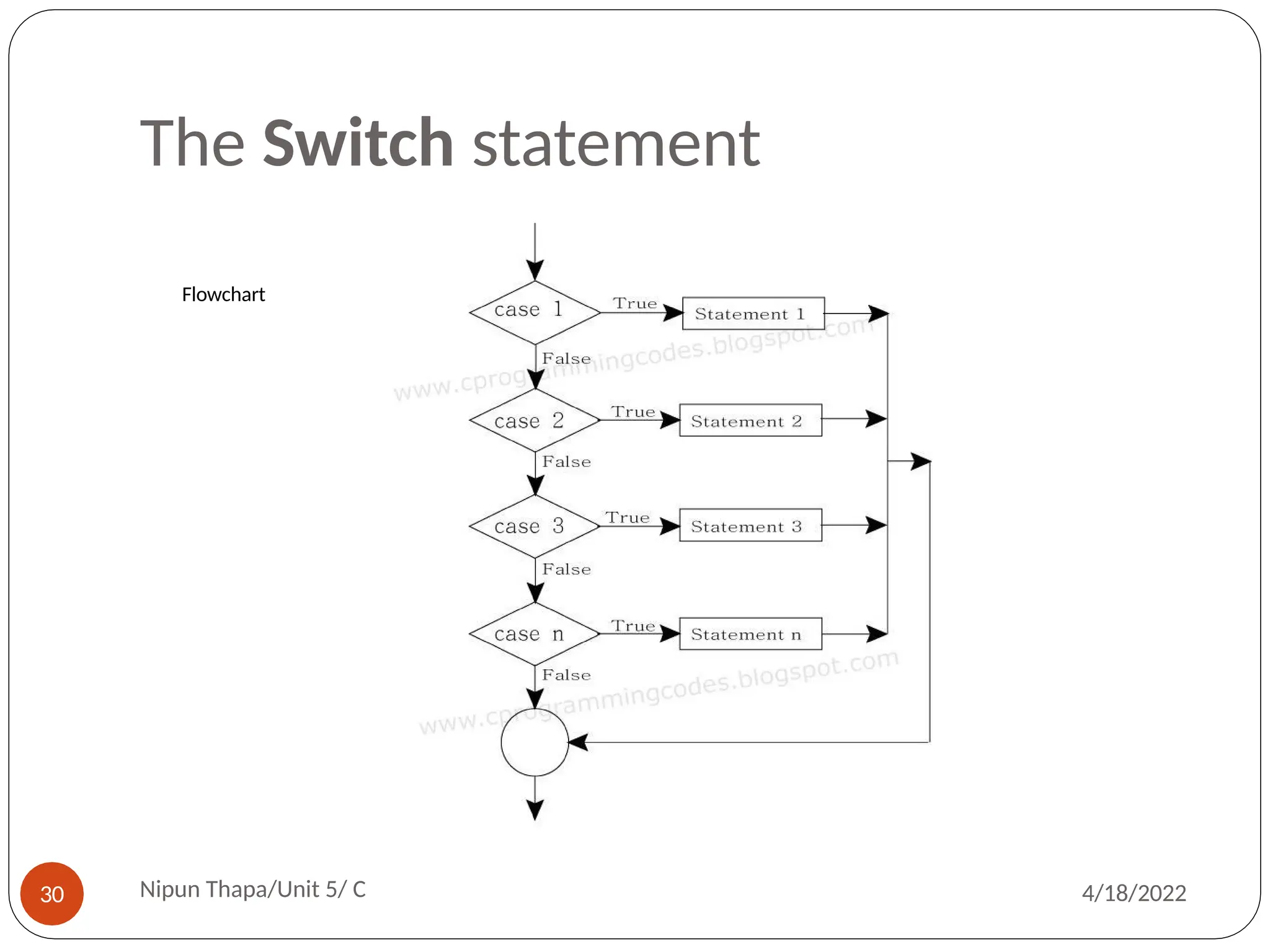
Flowchart
Nipun Thapa/Unit 5/ C
30 4/18/2022
The Switch statement
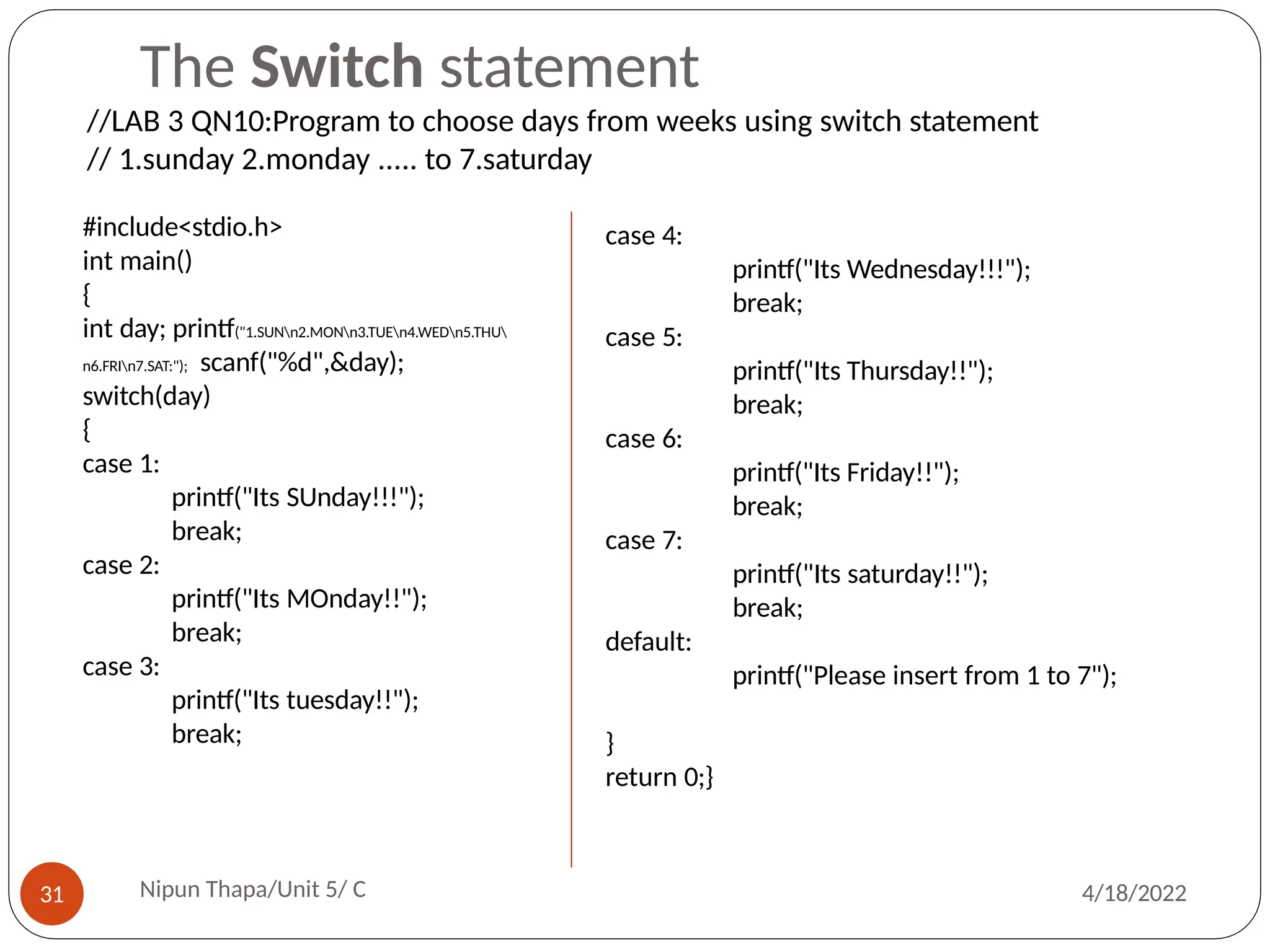
#include<stdio.h>
int main()
{
int day; printf("1.SUNn2.MONn3.TUEn4.WEDn5.THU
n6.FRIn7.SAT:"); scanf("%d",&day);
switch(day)
{
case 1:
printf("Its SUnday!!!");
break;
case 2:
printf("Its MOnday!!");
break;
case 3:
printf("Its tuesday!!");
break;
case 4:
printf("Its Wednesday!!!");
break;
case 5:
printf("Its Thursday!!");
break;
case 6:
printf("Its Friday!!");
break;
case 7:
printf("Its saturday!!");
break;
default:
printf("Please insert from 1 to 7");
}
return 0;}
//LAB 3 QN10:Program to choose days from weeks using switch statement
// 1.sunday 2.monday ..... to 7.saturday
Nipun Thapa/Unit 5/ C
31 4/18/2022
The Switch statement
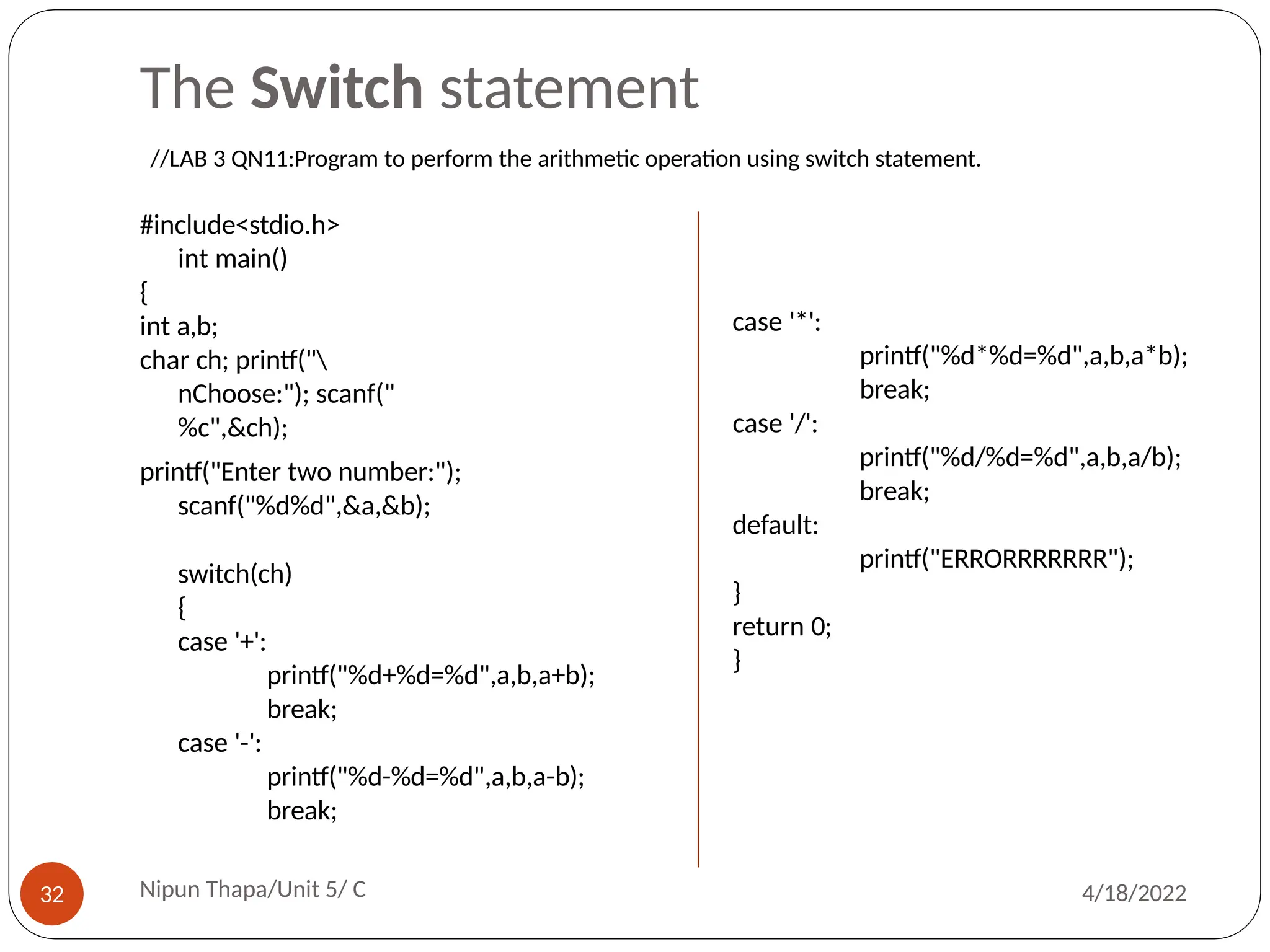
#include<stdio.h>
int main()
{
int a,b;
char ch; printf("
nChoose:"); scanf("
%c",&ch);
printf("Enter two number:");
scanf("%d%d",&a,&b);
switch(ch)
{
case '+':
printf("%d+%d=%d",a,b,a+b);
break;
case '-':
printf("%d-%d=%d",a,b,a-b);
break;
case '*':
printf("%d*%d=%d",a,b,a*b);
break;
case '/':
printf("%d/%d=%d",a,b,a/b);
break;
default:
printf("ERRORRRRRRR");
}
return 0;
}
//LAB 3 QN11:Program to perform the arithmetic operation using switch statement.
Nipun Thapa/Unit 5/ C
32 4/18/2022
Er. Nipun Thapa
Loops
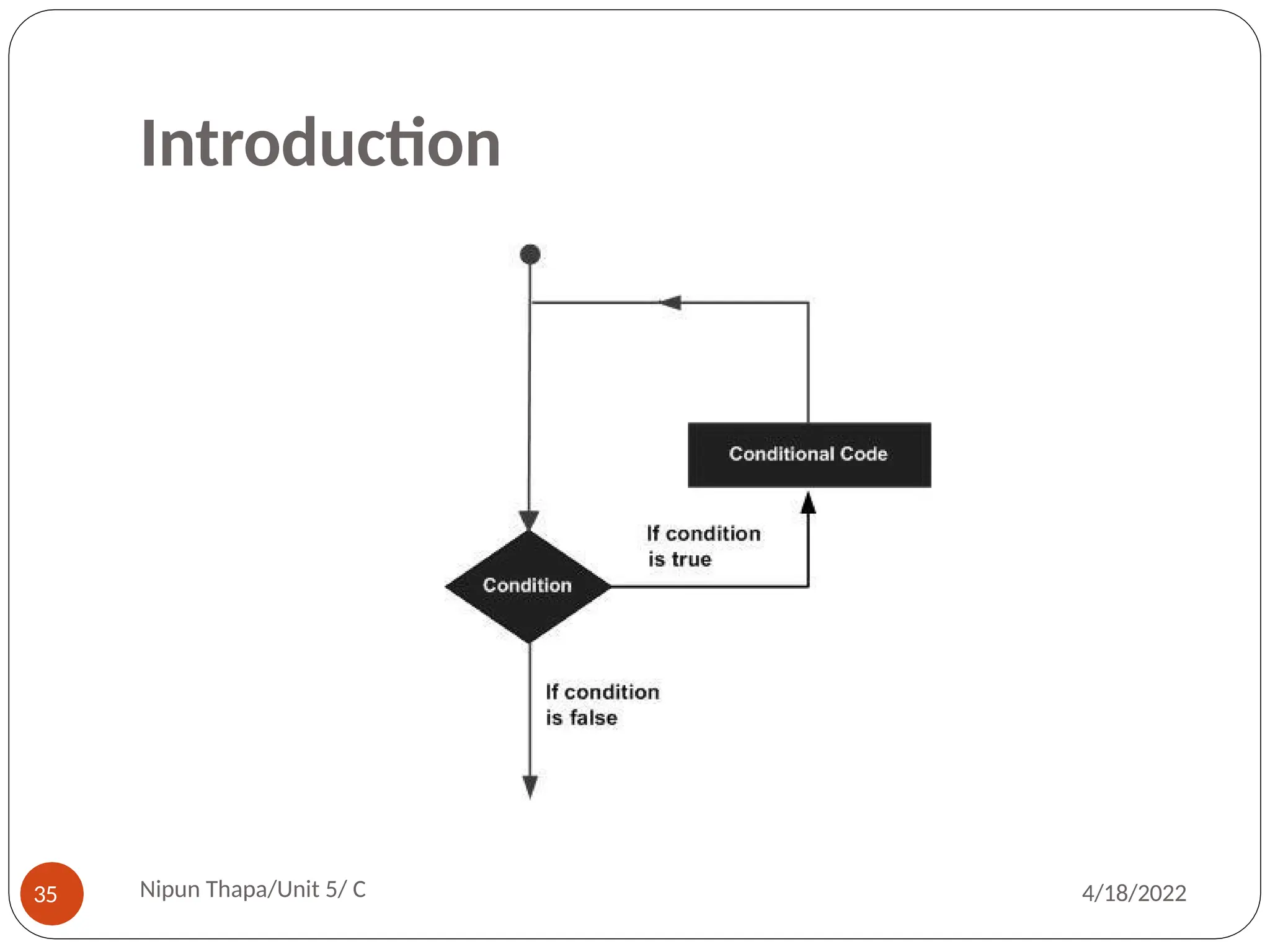
Introduction
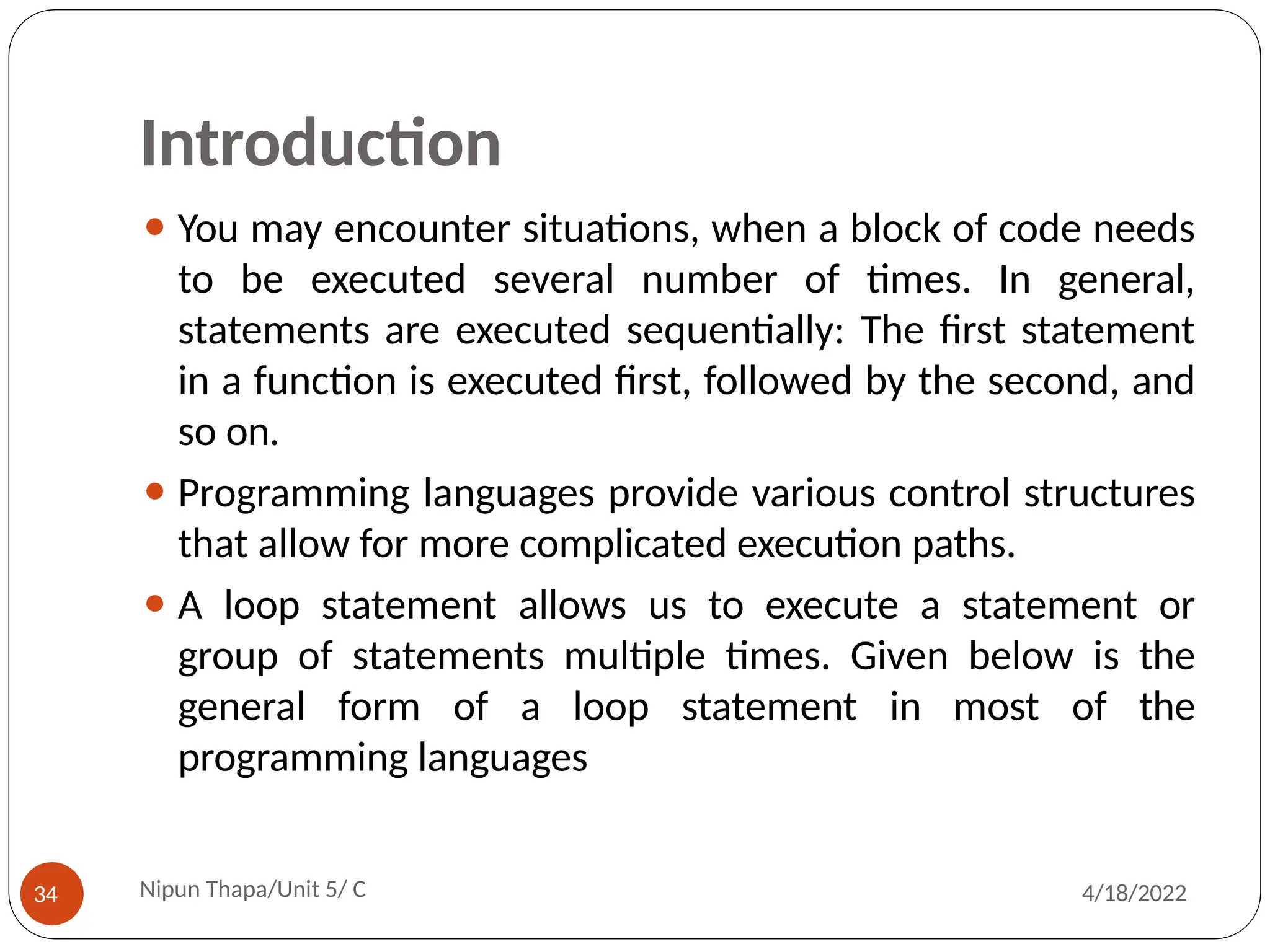
⚫ You may encounter situations, when a block of code needs
to be executed several number of times. In general,
statements are executed sequentially: The first statement
in a function is executed first, followed by the second, and
so on.
⚫ Programming languages provide various control structures
that allow for more complicated execution paths.
⚫ A loop statement allows us to execute a statement or
group of statements multiple times. Given below is the
general form of a loop statement in most of the
programming languages
Nipun Thapa/Unit 5/ C
34 4/18/2022
Introduction
Nipun Thapa/Unit 5/ C
35 4/18/2022
What are Loops?
⚫A Loop executes the sequence of statements many
times until the stated condition becomes false.
⚫A loop consists of two parts, a body of a loop and a
control statement. The control statement is
a combination of some conditions that direct the
body of the loop to execute until the specified
condition becomes false.
⚫The purpose of the loop is to repeat the same code a
number of times.
Nipun Thapa/Unit 5/ C
36 4/18/2022
Types of Loops in C
Depending upon the position of a control statement in
a program, looping in C is classified into two types:
1. Entry controlled loop
2. Exit controlled loop
⚫In an entry controlled loop, a condition is checked
before executing the body of a loop. It is also called
as a pre-checking loop.
⚫In an exit controlled loop, a condition is checked after
executing the body of a loop. It is also called as a post-
checking loop.
Nipun Thapa/Unit 5/ C
37 4/18/2022
Types of Loops in C
provides us with three
Nipun Thapa/Unit 5/ C
38 4/18/2022
⚫'C' programming
language types
of loop constructs:
1. The while loop
2. The do-while loop
3. The for loop
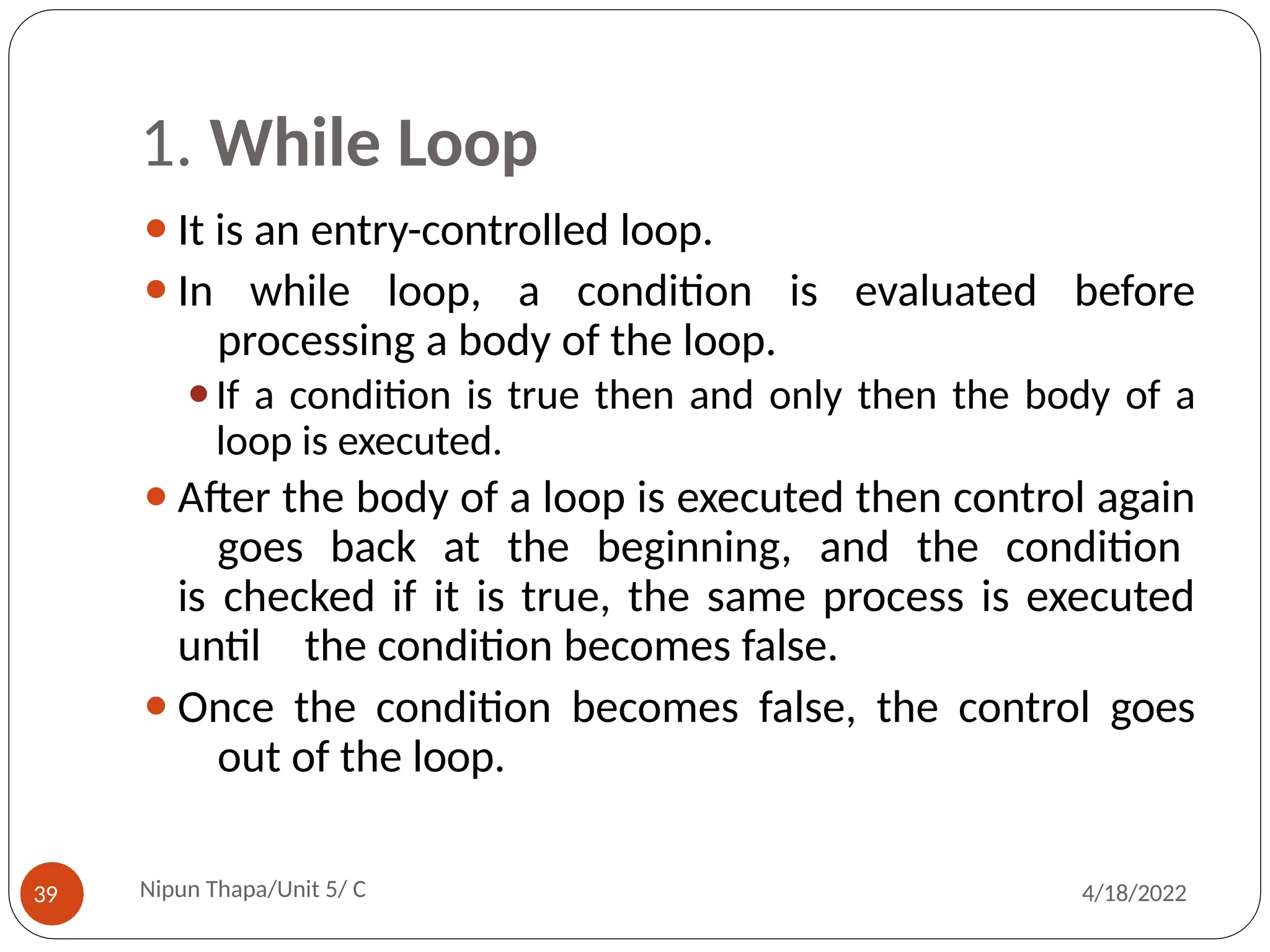
1. While Loop
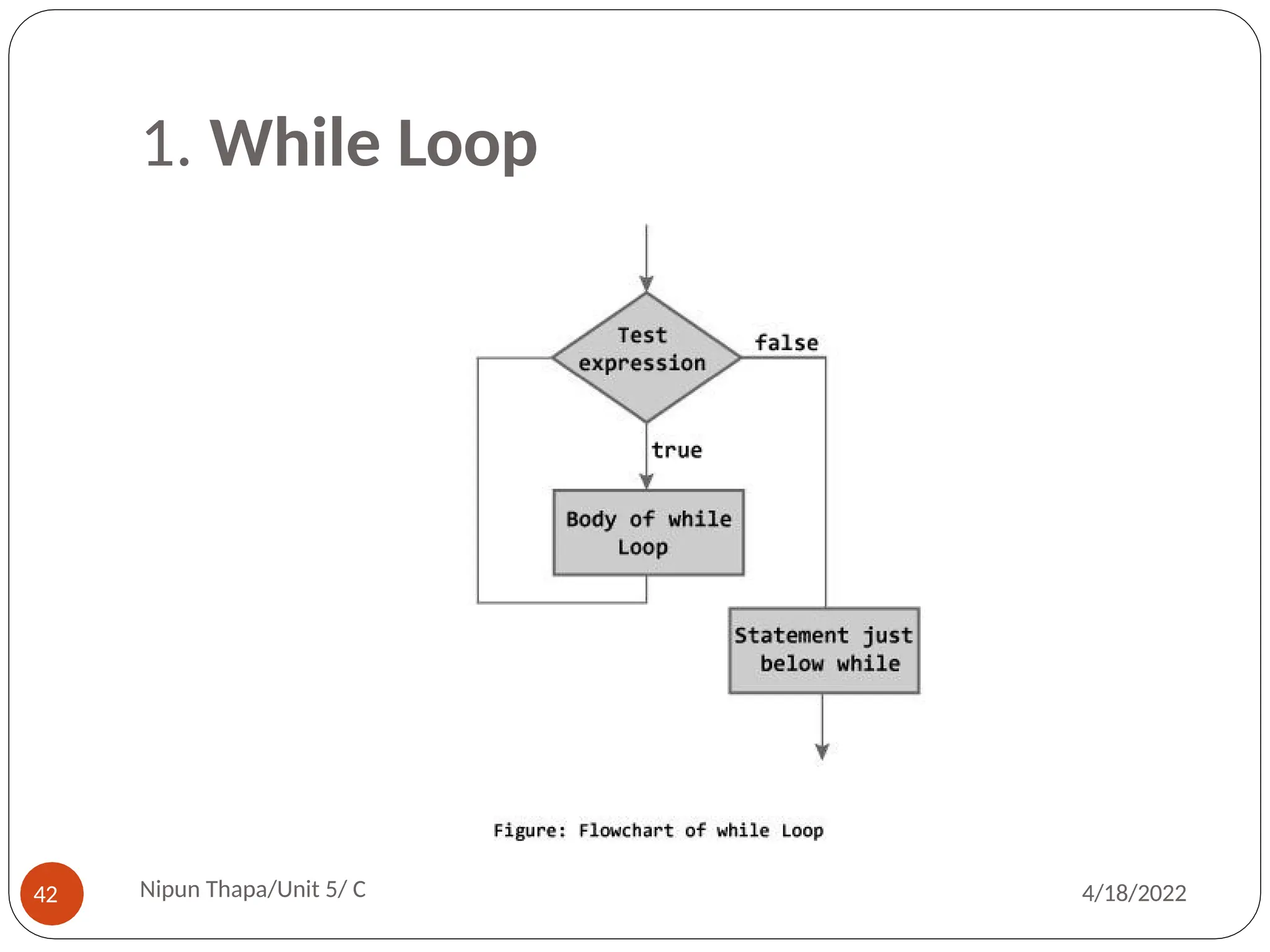
⚫It is an entry-controlled loop.
⚫In while loop, a condition is evaluated before
processing a body of the loop.
⚫If a condition is true then and only then the body of a
loop is executed.
⚫After the body of a loop is executed then control again
goes back at the beginning, and the condition
is checked if it is true, the same process is executed
until the condition becomes false.
⚫Once the condition becomes false, the control goes
out of the loop.
Nipun Thapa/Unit 5/ C
39 4/18/2022
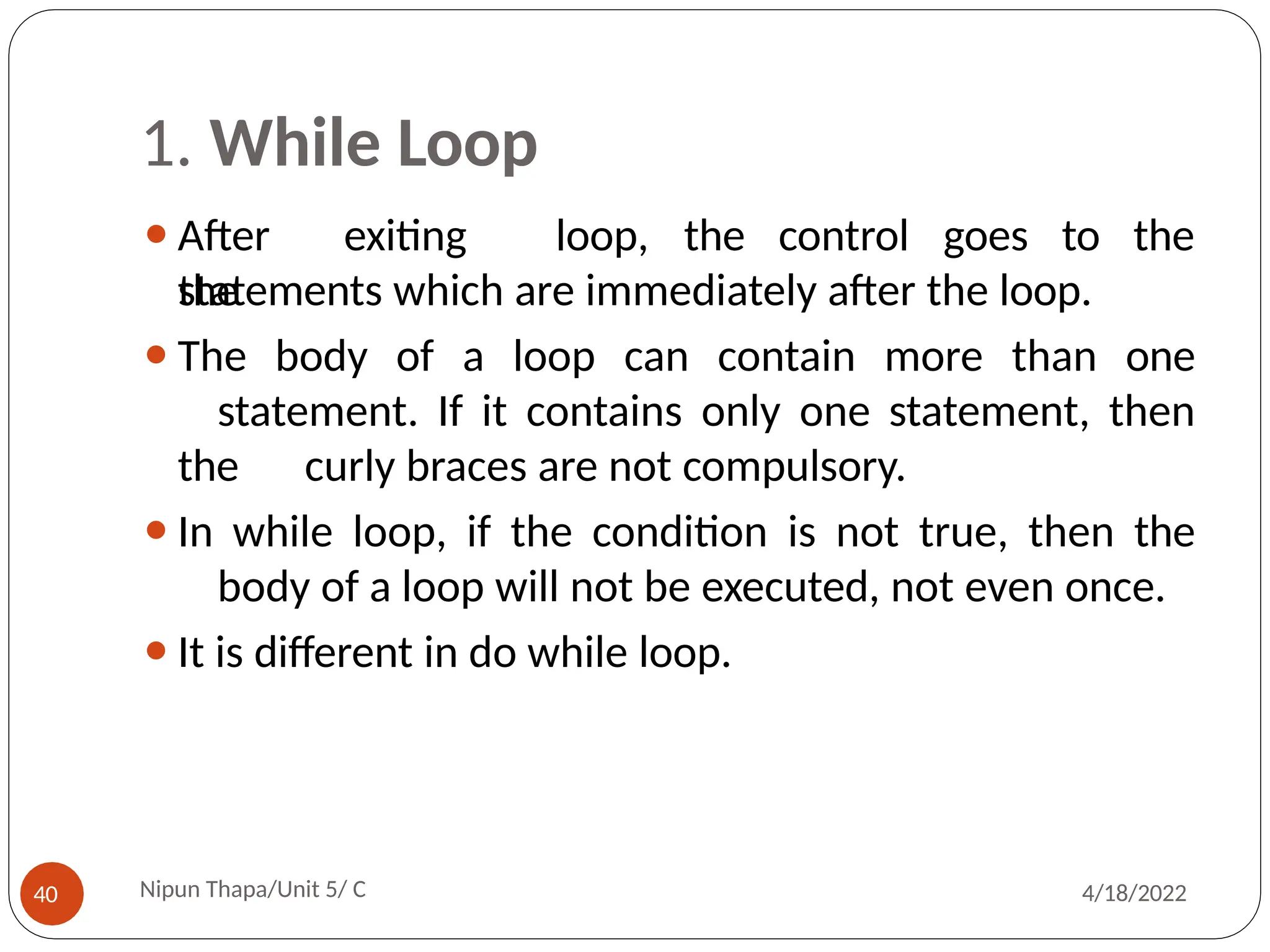
1. While Loop
⚫After exiting
the
Nipun Thapa/Unit 5/ C
40 4/18/2022
loop, the control goes to the
statements which are immediately after the loop.
⚫The body of a loop can contain more than one
statement. If it contains only one statement, then
the curly braces are not compulsory.
⚫In while loop, if the condition is not true, then the
body of a loop will not be executed, not even once.
⚫It is different in do while loop.
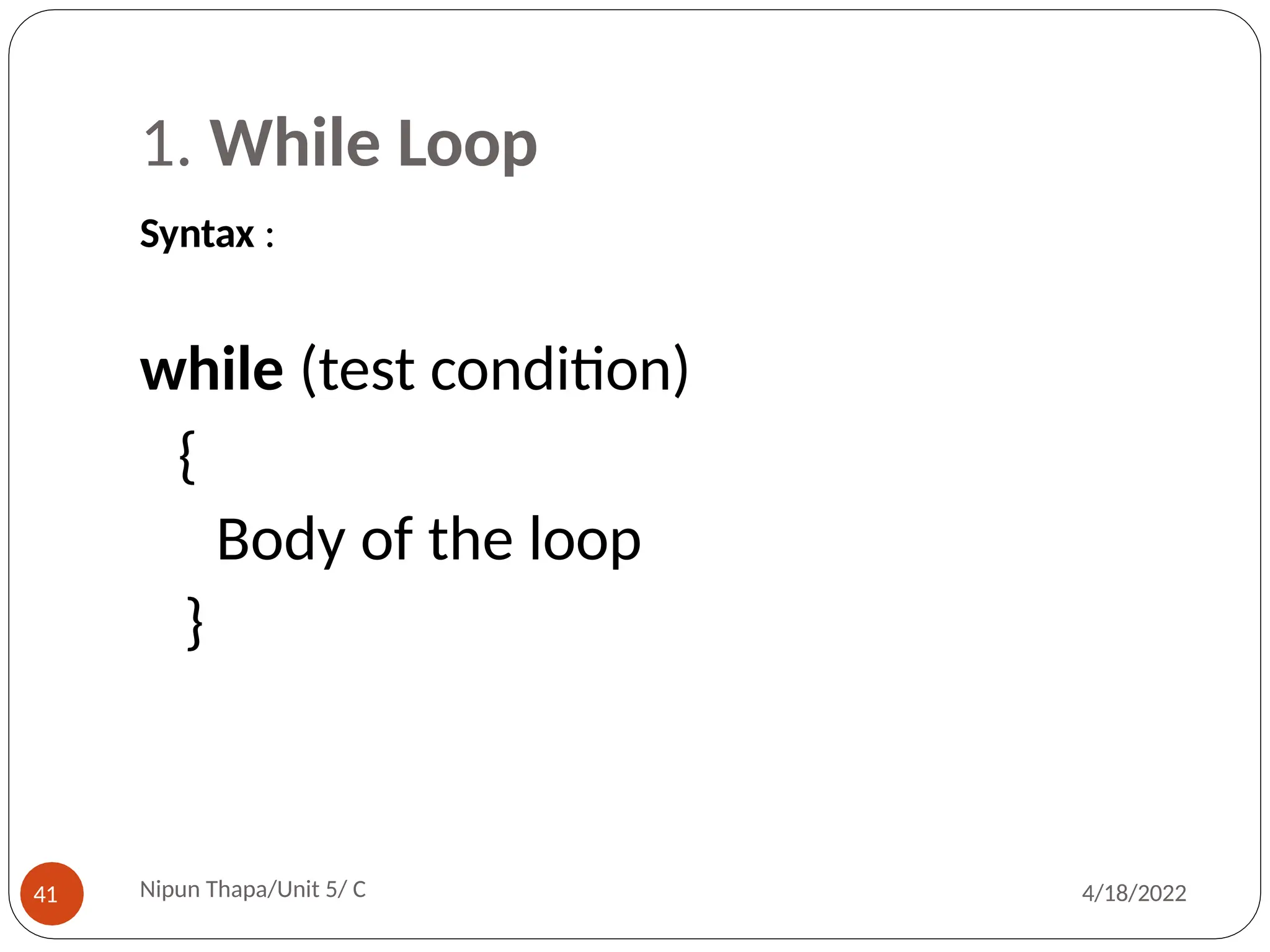
1. While Loop
Syntax :
Nipun Thapa/Unit 5/ C
41 4/18/2022
while (test condition)
{
Body of the loop
}
1. While Loop
Nipun Thapa/Unit 5/ C
42 4/18/2022
1. While Loop
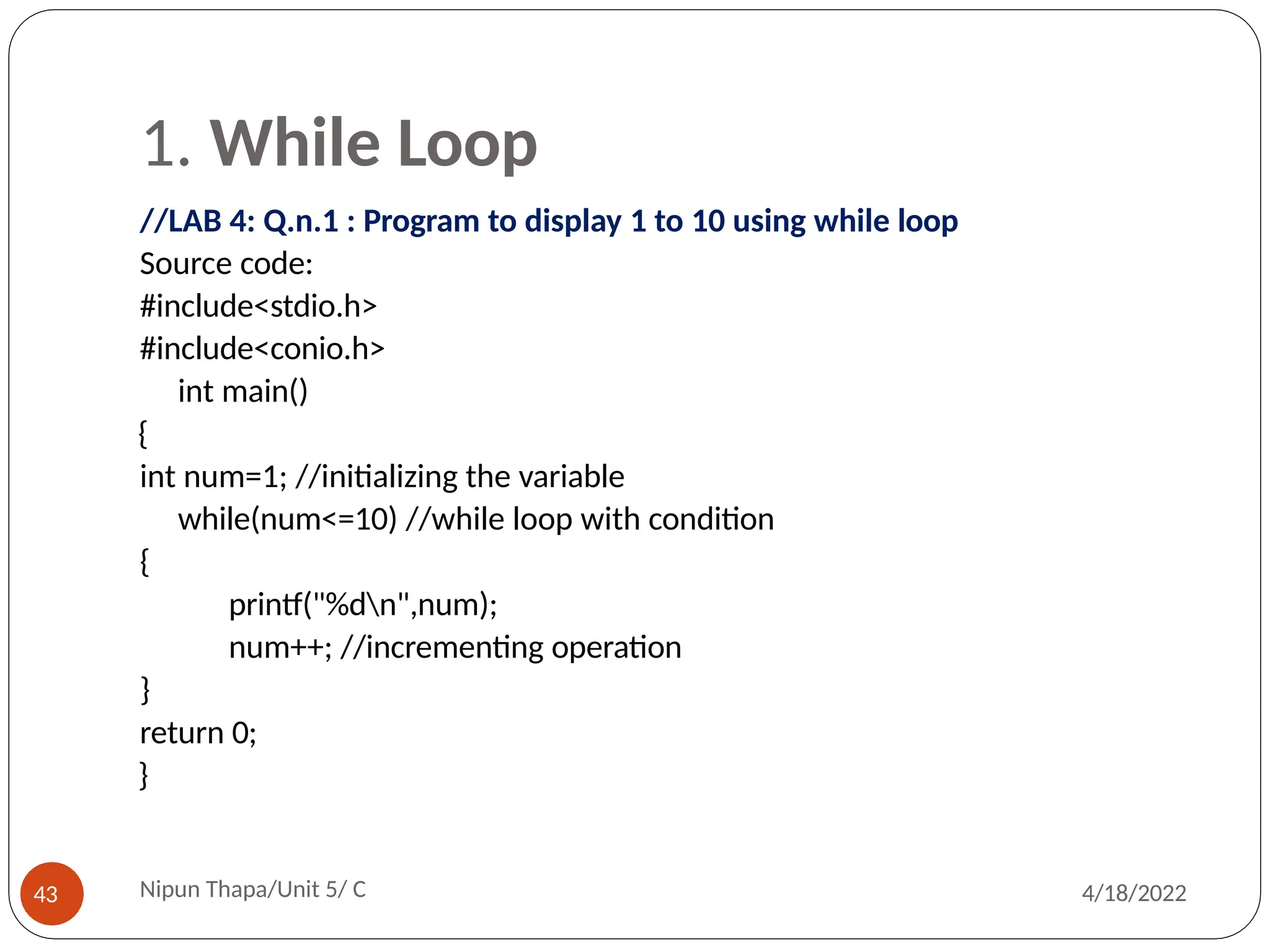
//LAB 4: Q.n.1 : Program to display 1 to 10 using while loop
Source code:
#include<stdio.h>
#include<conio.h>
int main()
{
int num=1; //initializing the variable
while(num<=10) //while loop with condition
{
printf("%dn",num);
num++; //incrementing operation
}
return 0;
}
Nipun Thapa/Unit 5/ C
43 4/18/2022
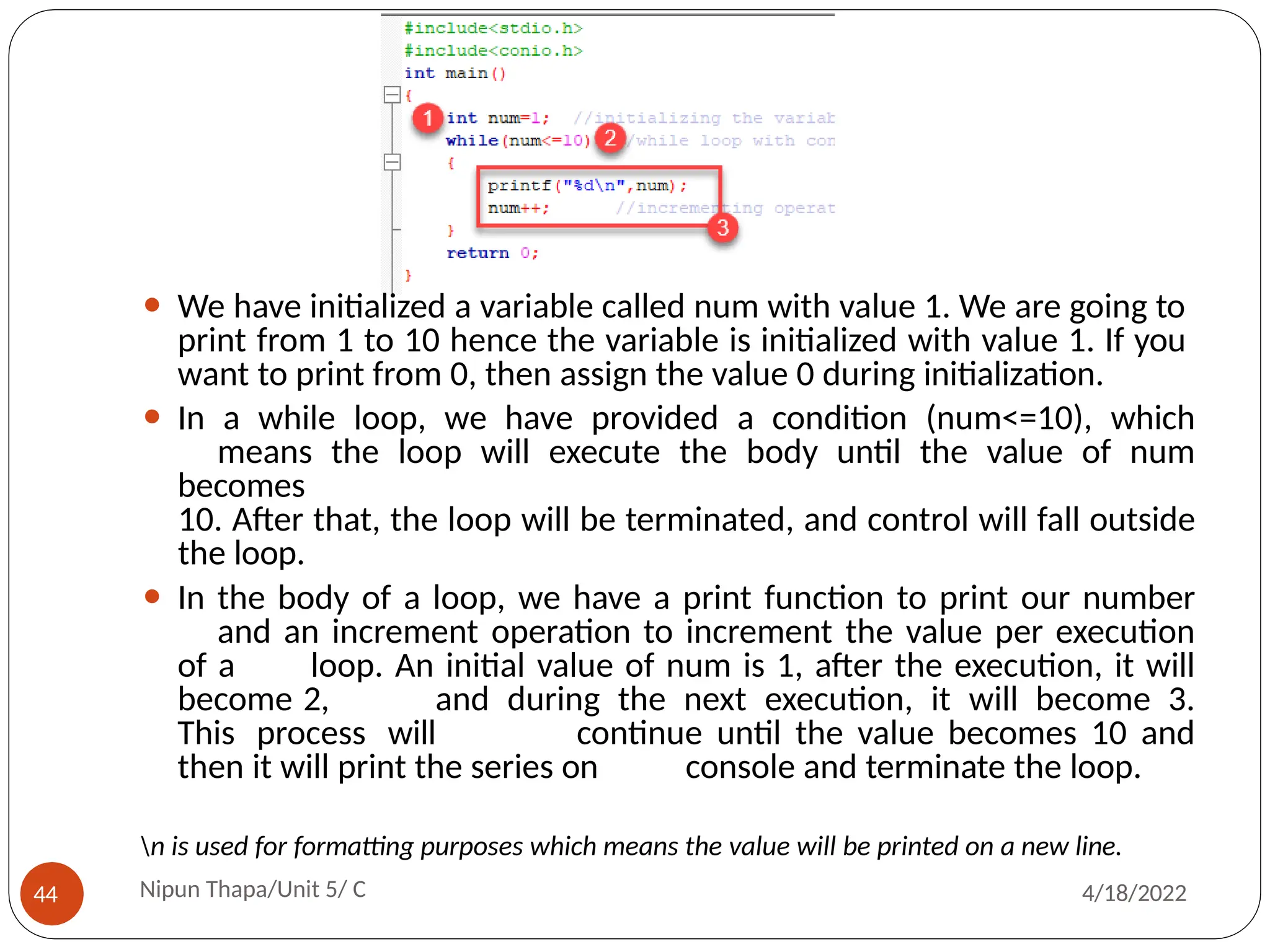
⚫ We have initialized a variable called num with value 1. We are going to
print from 1 to 10 hence the variable is initialized with value 1. If you
want to print from 0, then assign the value 0 during initialization.
⚫ In a while loop, we have provided a condition (num<=10), which
means the loop will execute the body until the value of num
becomes
10. After that, the loop will be terminated, and control will fall outside
the loop.
⚫ In the body of a loop, we have a print function to print our number
and an increment operation to increment the value per execution
of a loop. An initial value of num is 1, after the execution, it will
become 2, and during the next execution, it will become 3.
This process will continue until the value becomes 10 and
then it will print the series on console and terminate the loop.
n is used for formatting purposes which means the value will be printed on a new line.
Nipun Thapa/Unit 5/ C
44 4/18/2022
1. While Loop
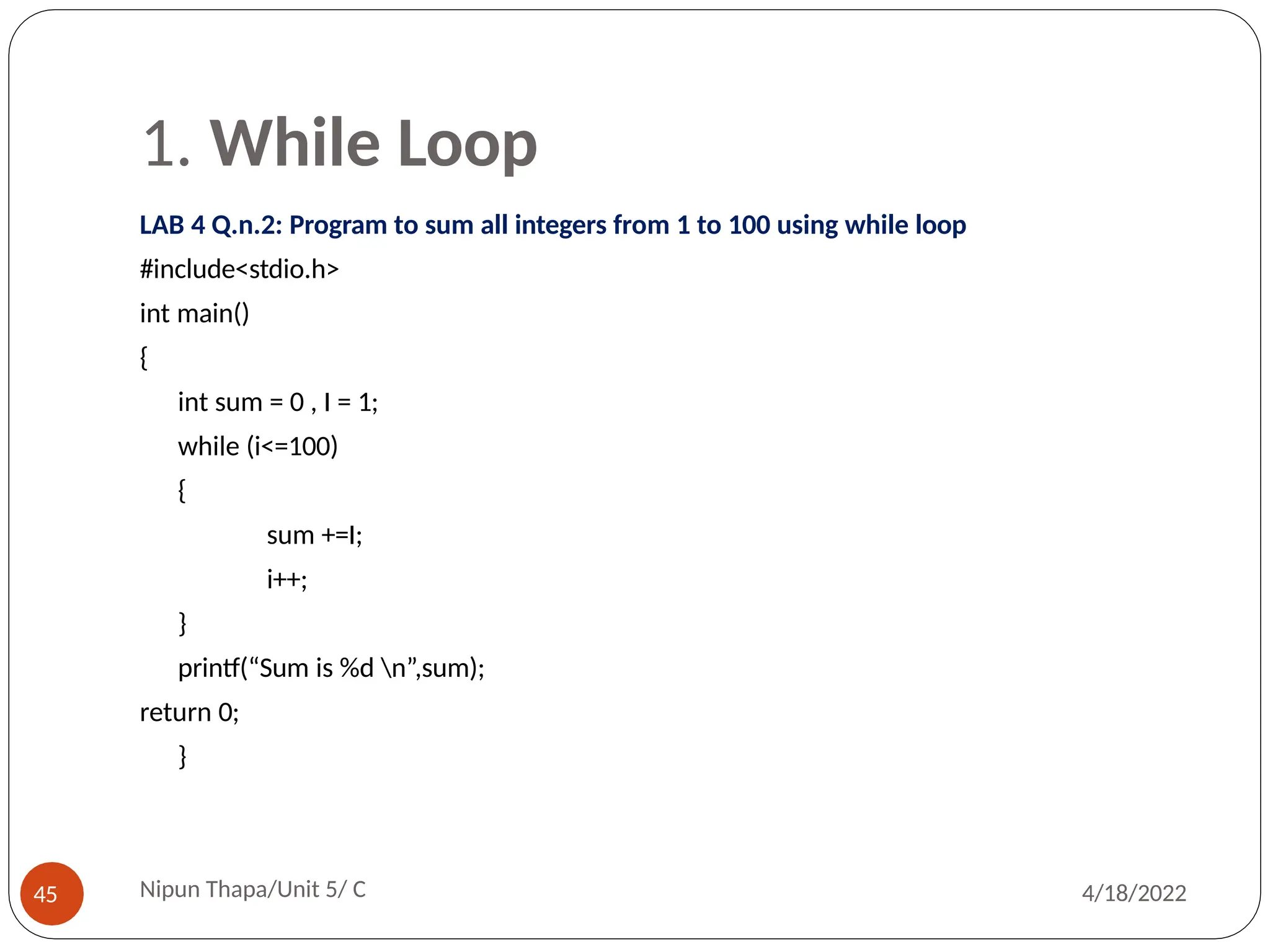
LAB 4 Q.n.2: Program to sum all integers from 1 to 100 using while loop
#include<stdio.h>
int main()
{
int sum = 0 , I = 1;
while (i<=100)
{
sum +=I;
i++;
}
printf(“Sum is %d n”,sum);
return 0;
}
Nipun Thapa/Unit 5/ C
45 4/18/2022
1. While Loop
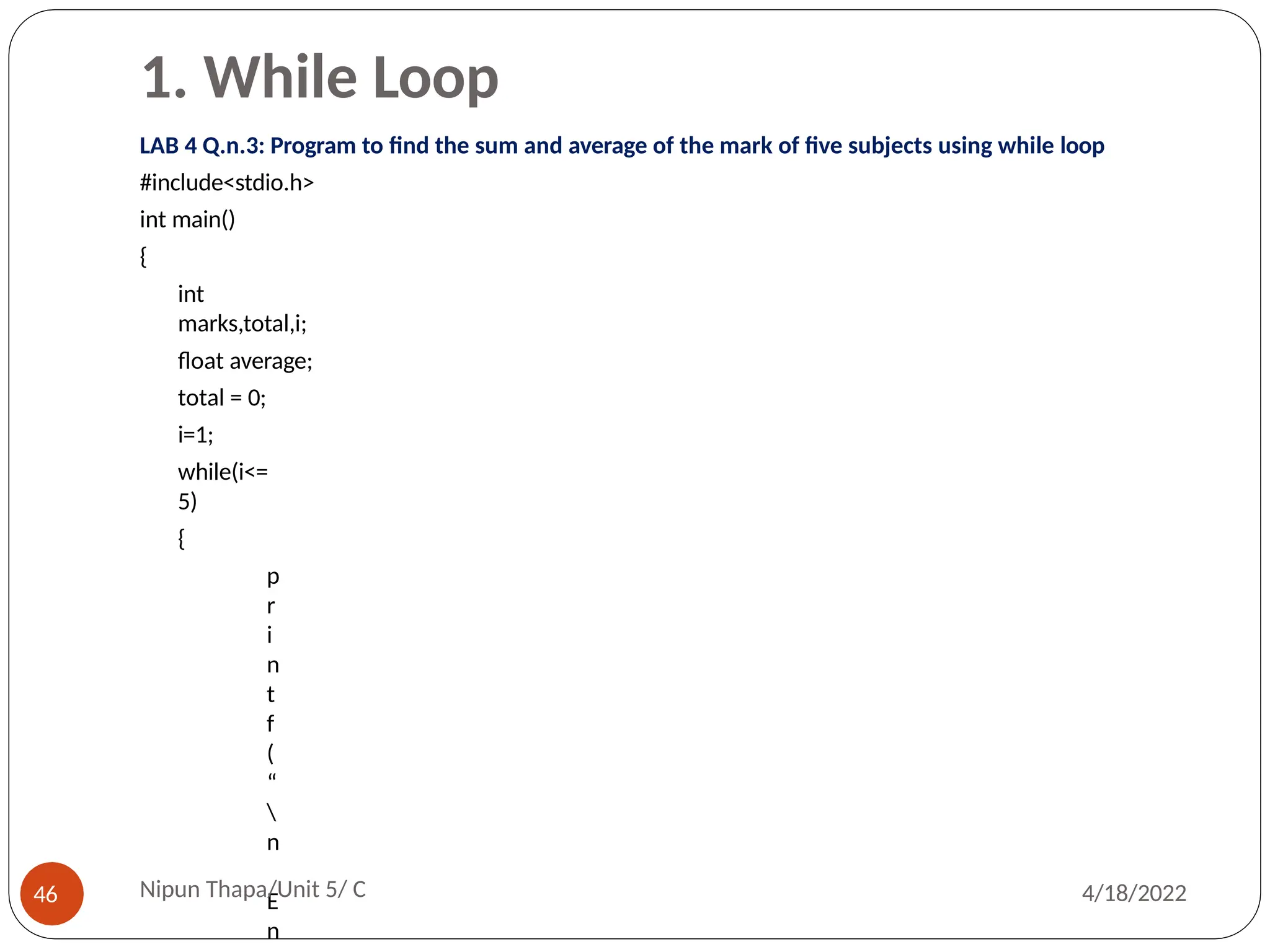
LAB 4 Q.n.3: Program to find the sum and average of the mark of five subjects using while loop
#include<stdio.h>
int main()
{
int
marks,total,i;
float average;
total = 0;
i=1;
while(i<=
5)
{
p
r
i
n
t
f
(
“

n
E
n
Nipun Thapa/Unit 5/ C
46 4/18/2022
1. While Loop
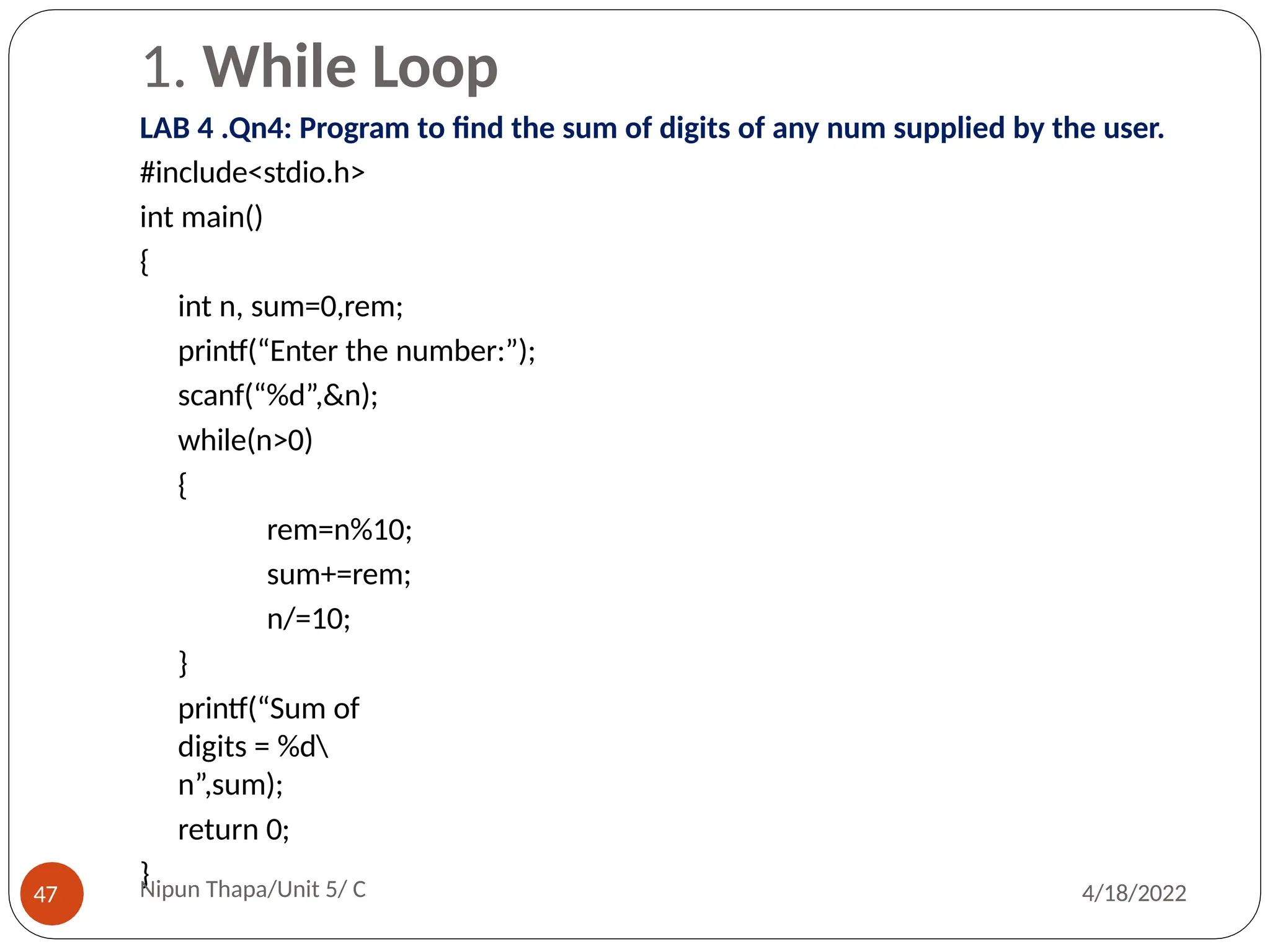
LAB 4 .Qn4: Program to find the sum of digits of any num supplied by the user.
#include<stdio.h>
int main()
{
int n, sum=0,rem;
printf(“Enter the number:”);
scanf(“%d”,&n);
while(n>0)
{
rem=n%10;
sum+=rem;
n/=10;
}
printf(“Sum of
digits = %d
n”,sum);
return 0;
}
Nipun Thapa/Unit 5/ C
47 4/18/2022
1. While Loop
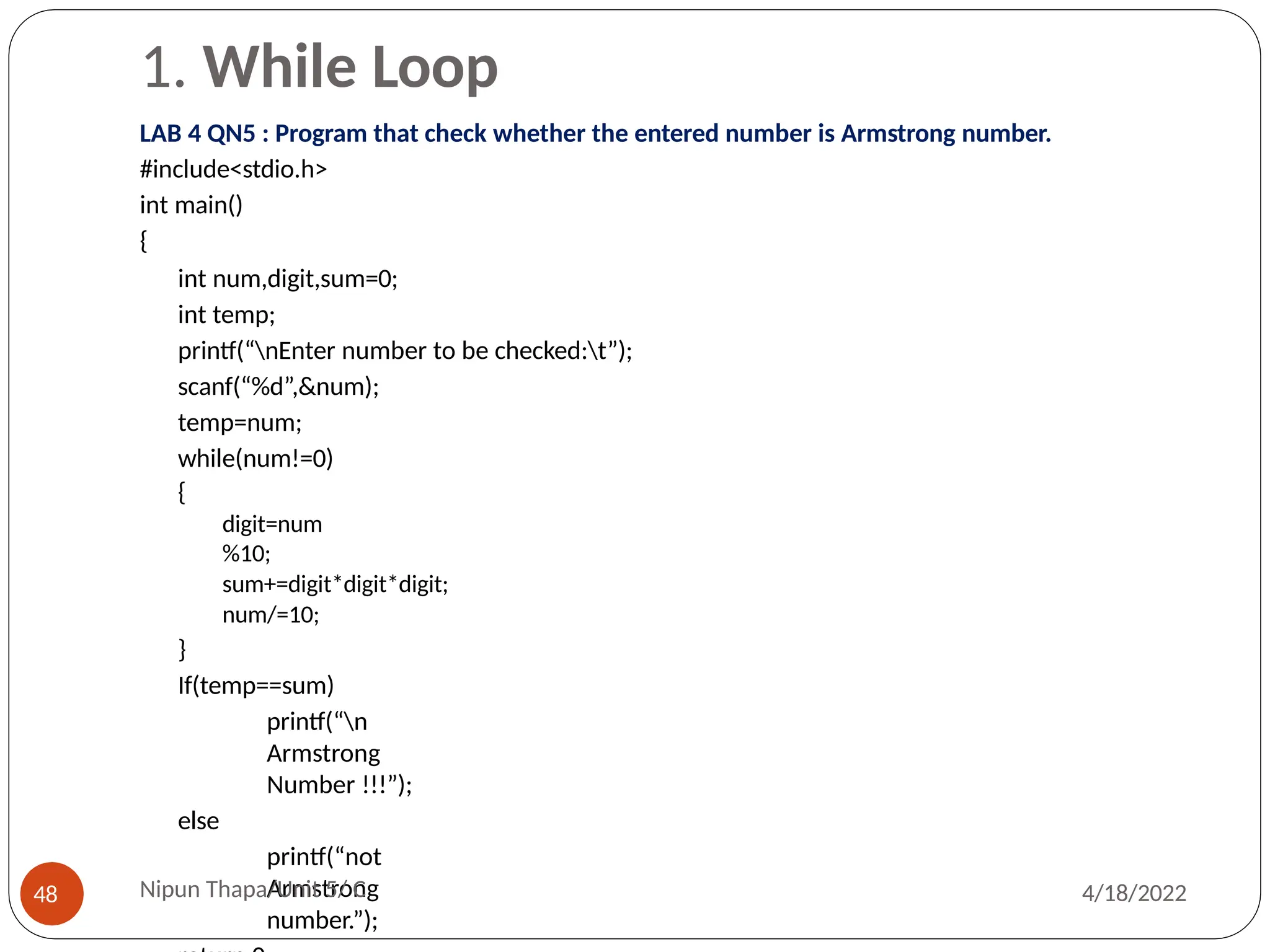
LAB 4 QN5 : Program that check whether the entered number is Armstrong number.
#include<stdio.h>
int main()
{
int num,digit,sum=0;
int temp;
printf(“nEnter number to be checked:t”);
scanf(“%d”,&num);
temp=num;
while(num!=0)
{
digit=num
%10;
sum+=digit*digit*digit;
num/=10;
}
If(temp==sum)
printf(“n
Armstrong
Number !!!”);
else
printf(“not
Armstrong
number.”);
Nipun Thapa/Unit 5/ C
48 4/18/2022
1. While Loop
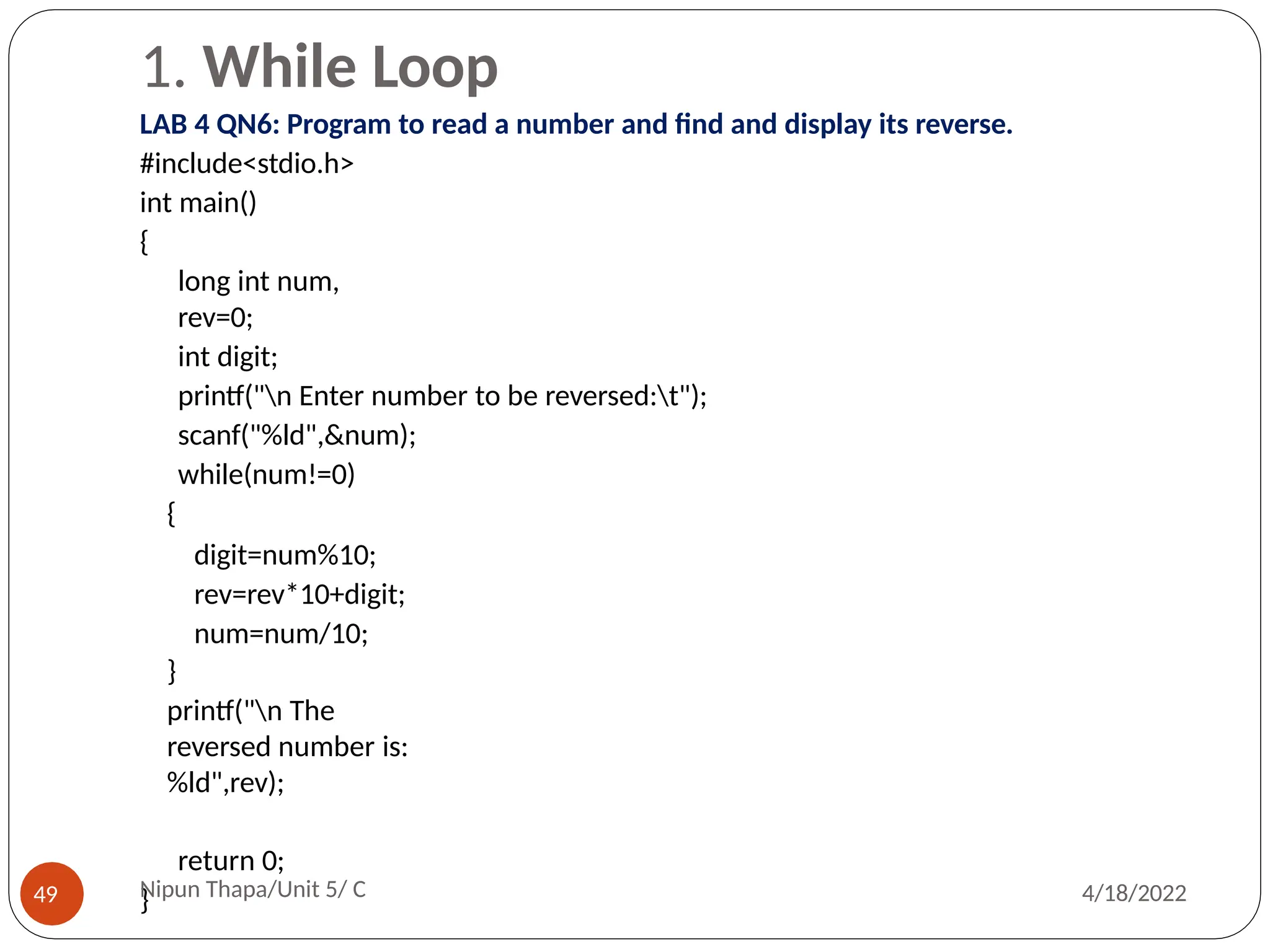
LAB 4 QN6: Program to read a number and find and display its reverse.
#include<stdio.h>
int main()
{
long int num,
rev=0;
int digit;
printf("n Enter number to be reversed:t");
scanf("%ld",&num);
while(num!=0)
{
digit=num%10;
rev=rev*10+digit;
num=num/10;
}
printf("n The
reversed number is:
%ld",rev);
return 0;
}
Nipun Thapa/Unit 5/ C
49 4/18/2022
1. While Loop
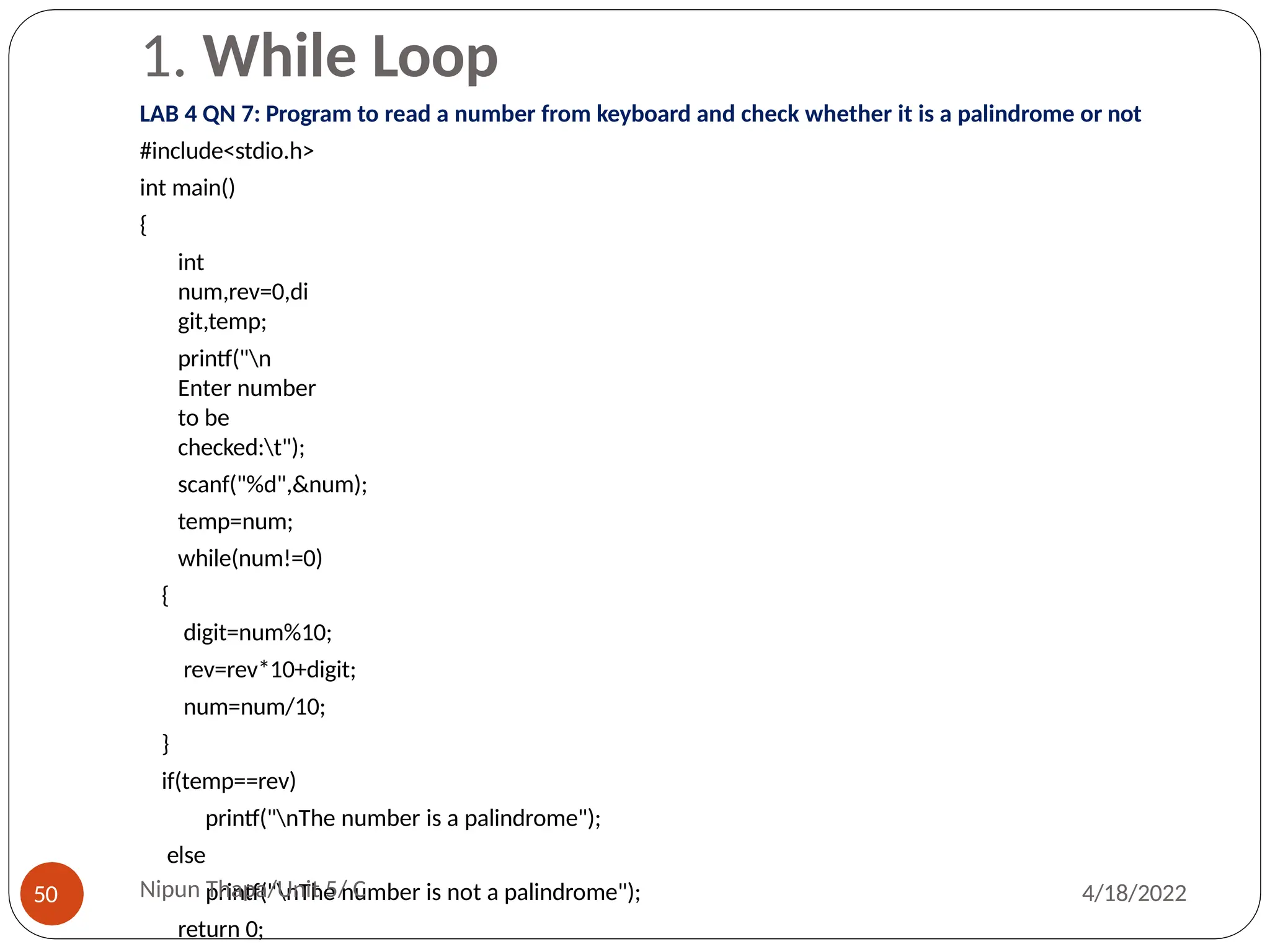
LAB 4 QN 7: Program to read a number from keyboard and check whether it is a palindrome or not
#include<stdio.h>
int main()
{
int
num,rev=0,di
git,temp;
printf("n
Enter number
to be
checked:t");
scanf("%d",&num);
temp=num;
while(num!=0)
{
digit=num%10;
rev=rev*10+digit;
num=num/10;
}
if(temp==rev)
printf("nThe number is a palindrome");
else
printf("nThe number is not a palindrome");
return 0;
Nipun Thapa/Unit 5/ C
50 4/18/2022
1. While Loop
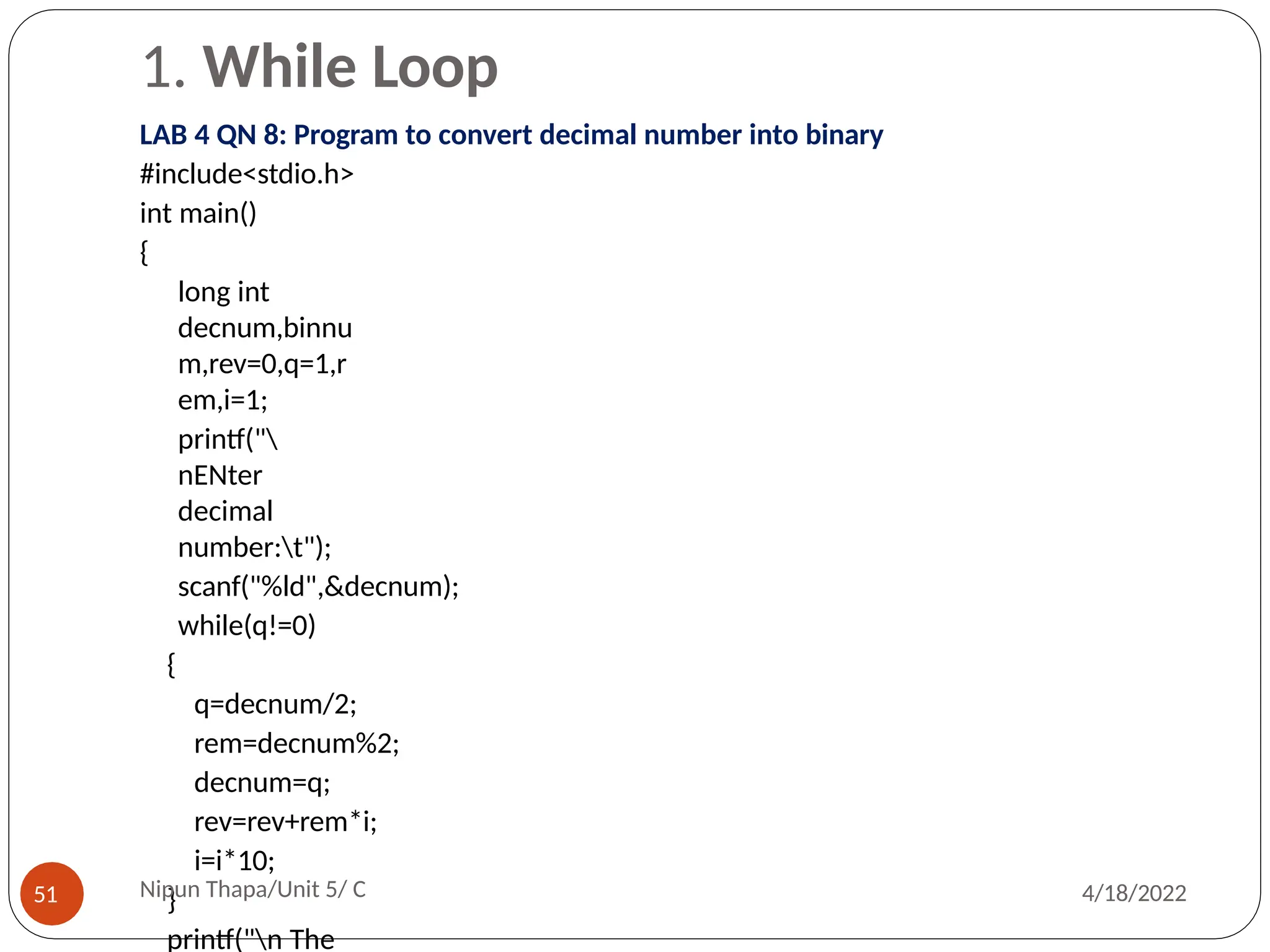
LAB 4 QN 8: Program to convert decimal number into binary
#include<stdio.h>
int main()
{
long int
decnum,binnu
m,rev=0,q=1,r
em,i=1;
printf("
nENter
decimal
number:t");
scanf("%ld",&decnum);
while(q!=0)
{
q=decnum/2;
rem=decnum%2;
decnum=q;
rev=rev+rem*i;
i=i*10;
}
printf("n The
Nipun Thapa/Unit 5/ C
51 4/18/2022
2. do-while loop
⚫A do...while loop in C is similar to the while loop
except that the condition is always executed after
the body of a loop.
⚫The test is performed at the end of the loop rather
than the beginning.
⚫It is also called an exit-controlled loop.
Nipun Thapa/Unit 5/ C
52 4/18/2022
2. do-while loop
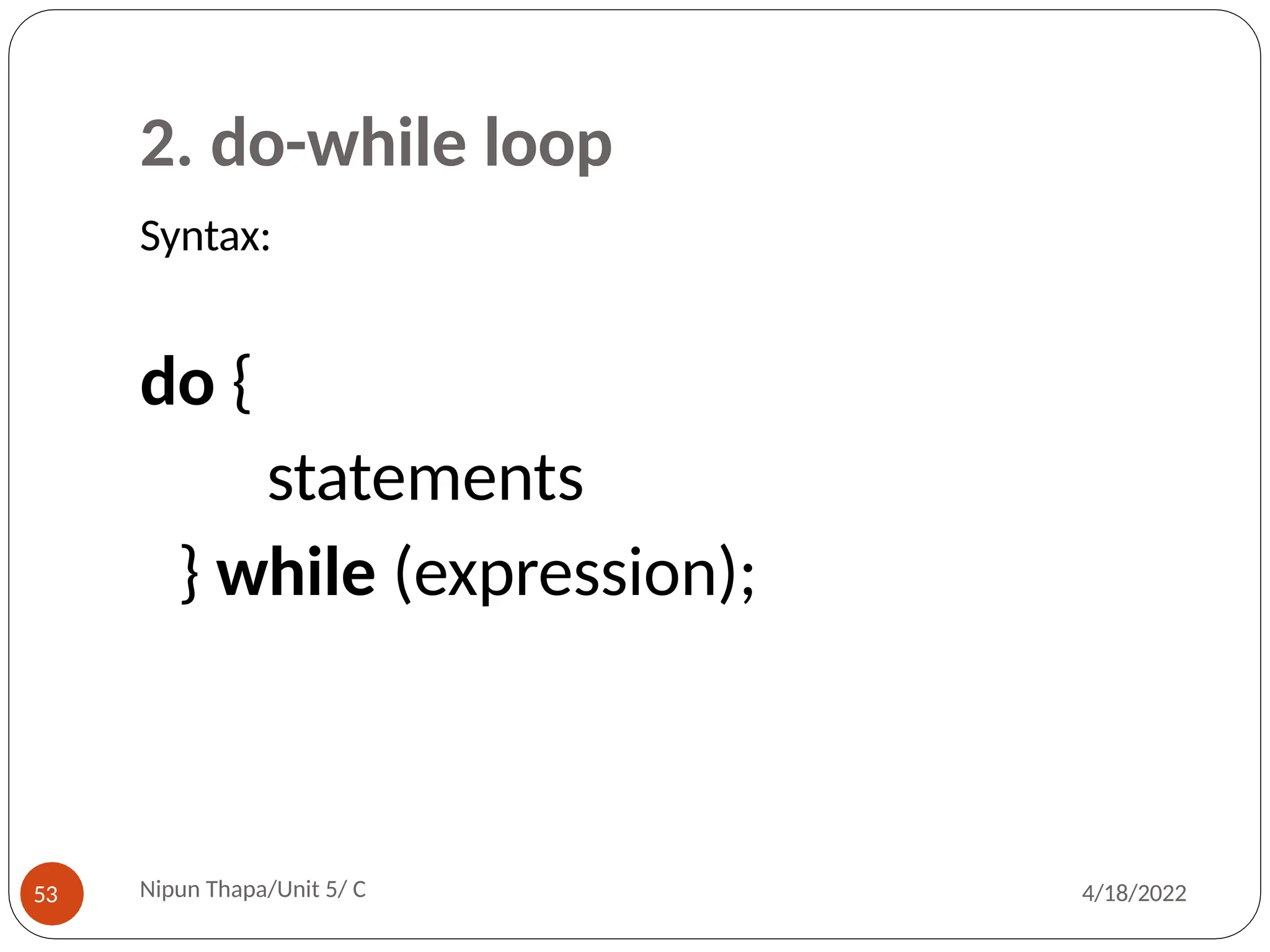
Syntax:
Nipun Thapa/Unit 5/ C
53 4/18/2022
do {
statements
} while (expression);
2. do-while loop
Nipun Thapa/Unit 5/ C
54 4/18/2022
2. do-while loop
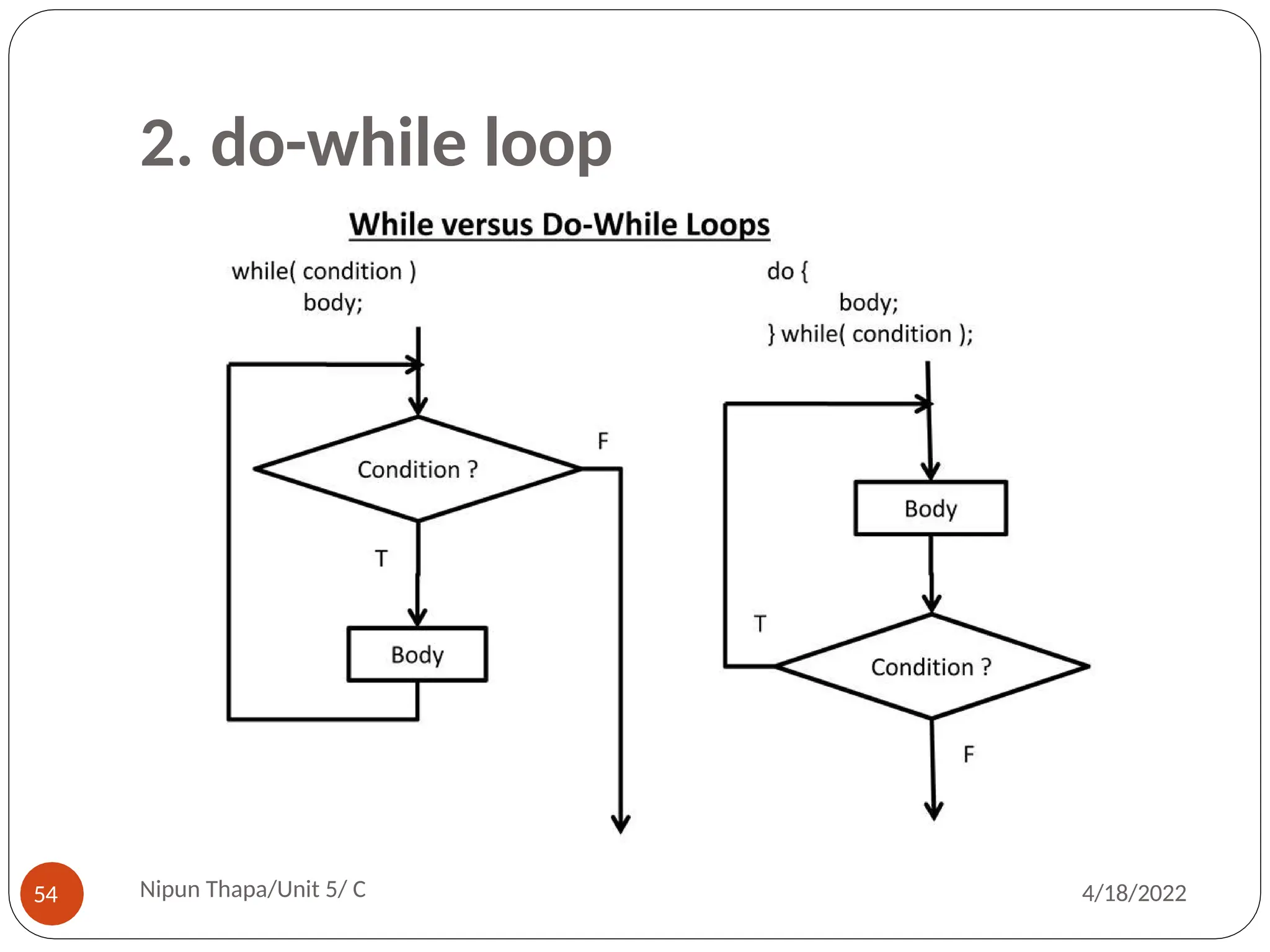
⚫ As we saw in a while loop, the body is executed if and only if the
condition is true. In some cases, we have to execute a body of
the loop at least once even if the condition is false. This type of
operation can be achieved by using a do-while loop.
⚫ In the do-while loop, the body of a loop is always executed at
least once. After the body is executed, then it checks the
condition. If the condition is true, then it will again execute the
body of a loop otherwise control is transferred out of the loop.
⚫ Similar to the while loop, once the control goes out of the loop
the statements which are immediately after the loop is
executed.
⚫ The critical difference between the while and do-while loop is
that in while loop the while is written at the beginning. In do-
while loop, the while condition is written at the end and
terminates with a semi-colon (;)
Nipun Thapa/Unit 5/ C
55 4/18/2022
2. do-while loop
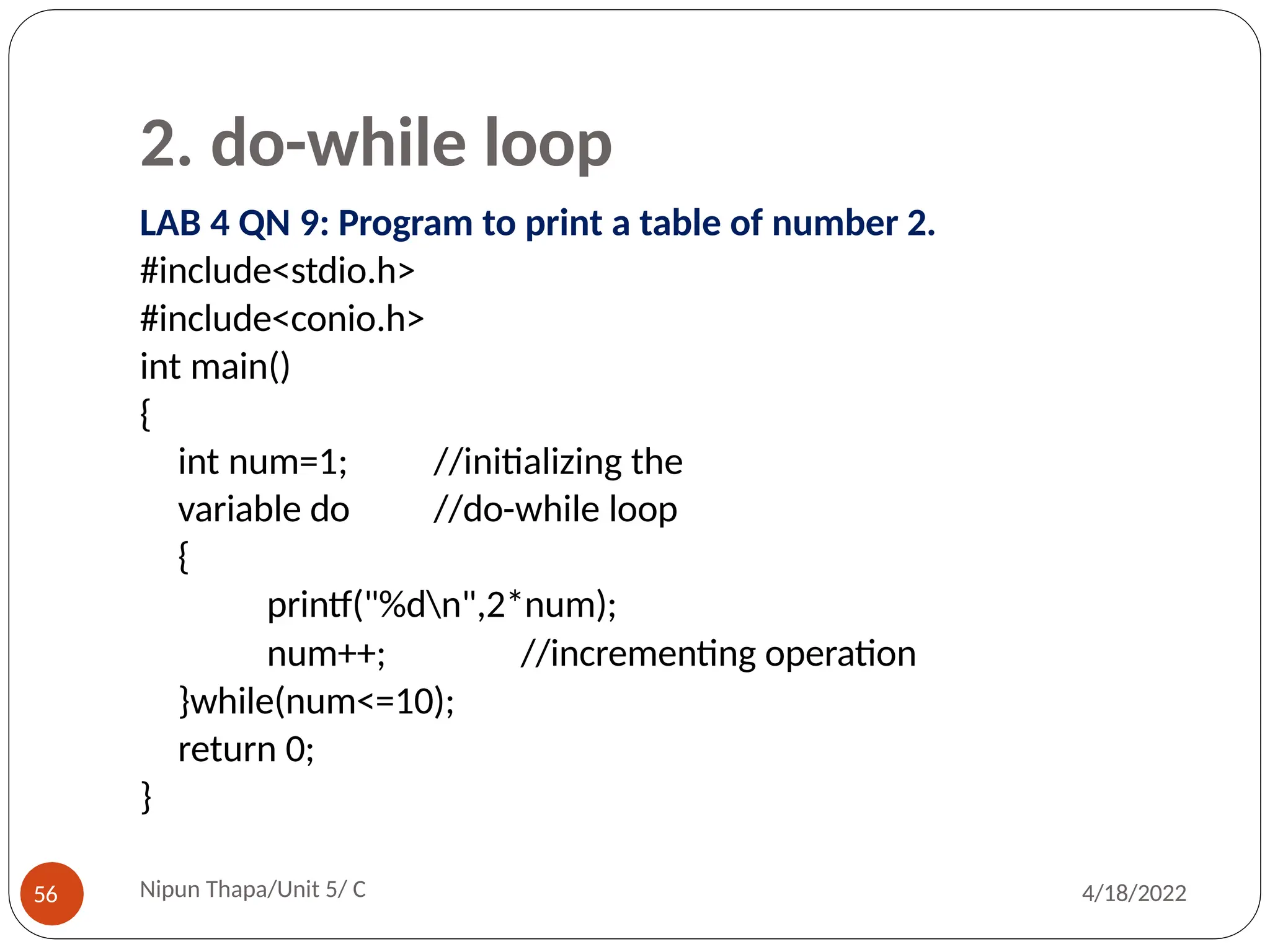
LAB 4 QN 9: Program to print a table of number 2.
#include<stdio.h>
#include<conio.h>
int main()
{
int num=1; //initializing the
variable do //do-while loop
{
printf("%dn",2*num);
Nipun Thapa/Unit 5/ C
56 4/18/2022
//incrementing operation
num++;
}while(num<=10);
return 0;
}
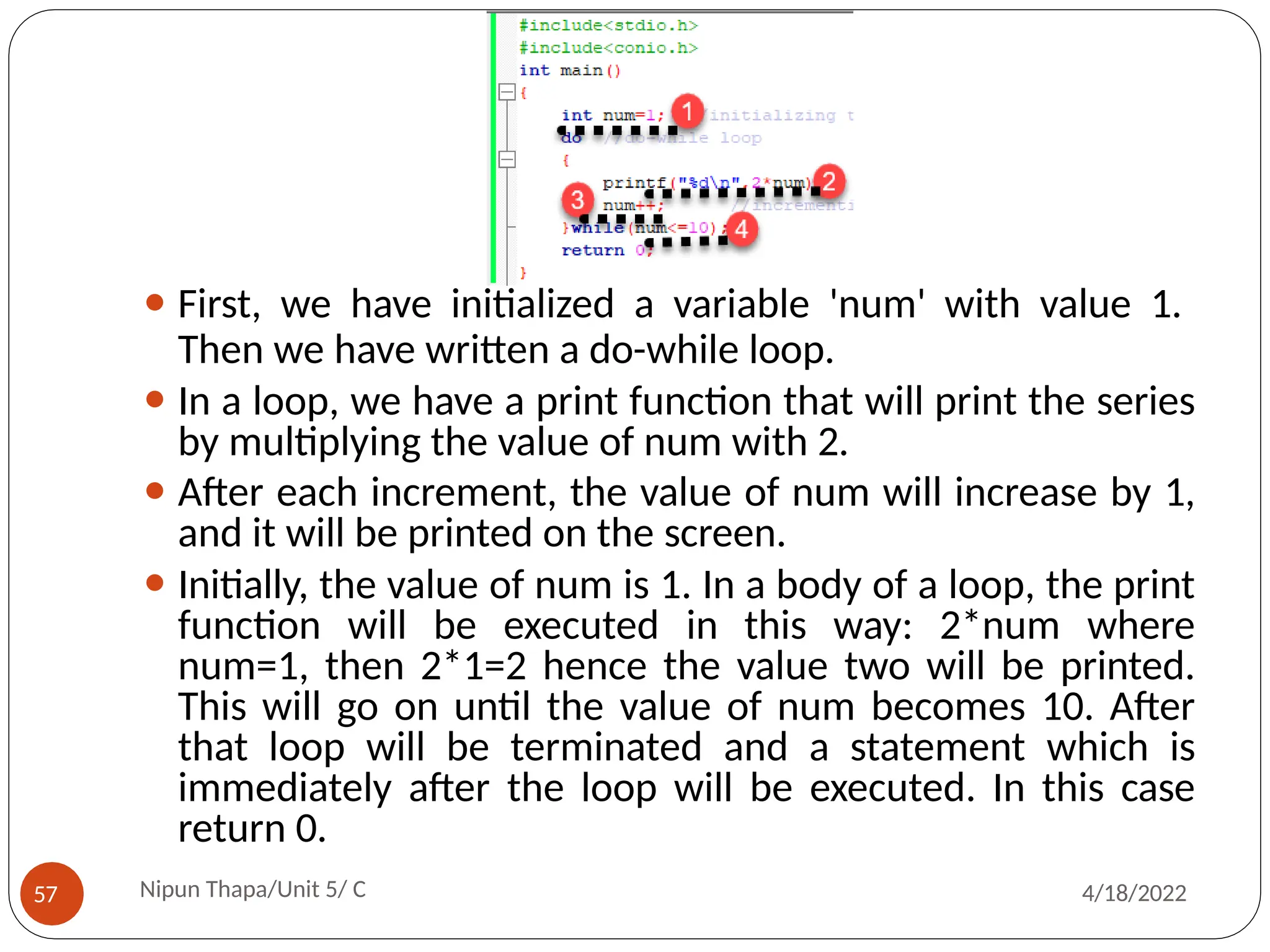
⚫ First, we have initialized a variable 'num' with value 1.
Then we have written a do-while loop.
⚫ In a loop, we have a print function that will print the series
by multiplying the value of num with 2.
⚫ After each increment, the value of num will increase by 1,
and it will be printed on the screen.
⚫ Initially, the value of num is 1. In a body of a loop, the print
function will be executed in this way: 2*num where
num=1, then 2*1=2 hence the value two will be printed.
This will go on until the value of num becomes 10. After
that loop will be terminated and a statement which is
immediately after the loop will be executed. In this case
return 0.
Nipun Thapa/Unit 5/ C
57 4/18/2022
2. do-while loop
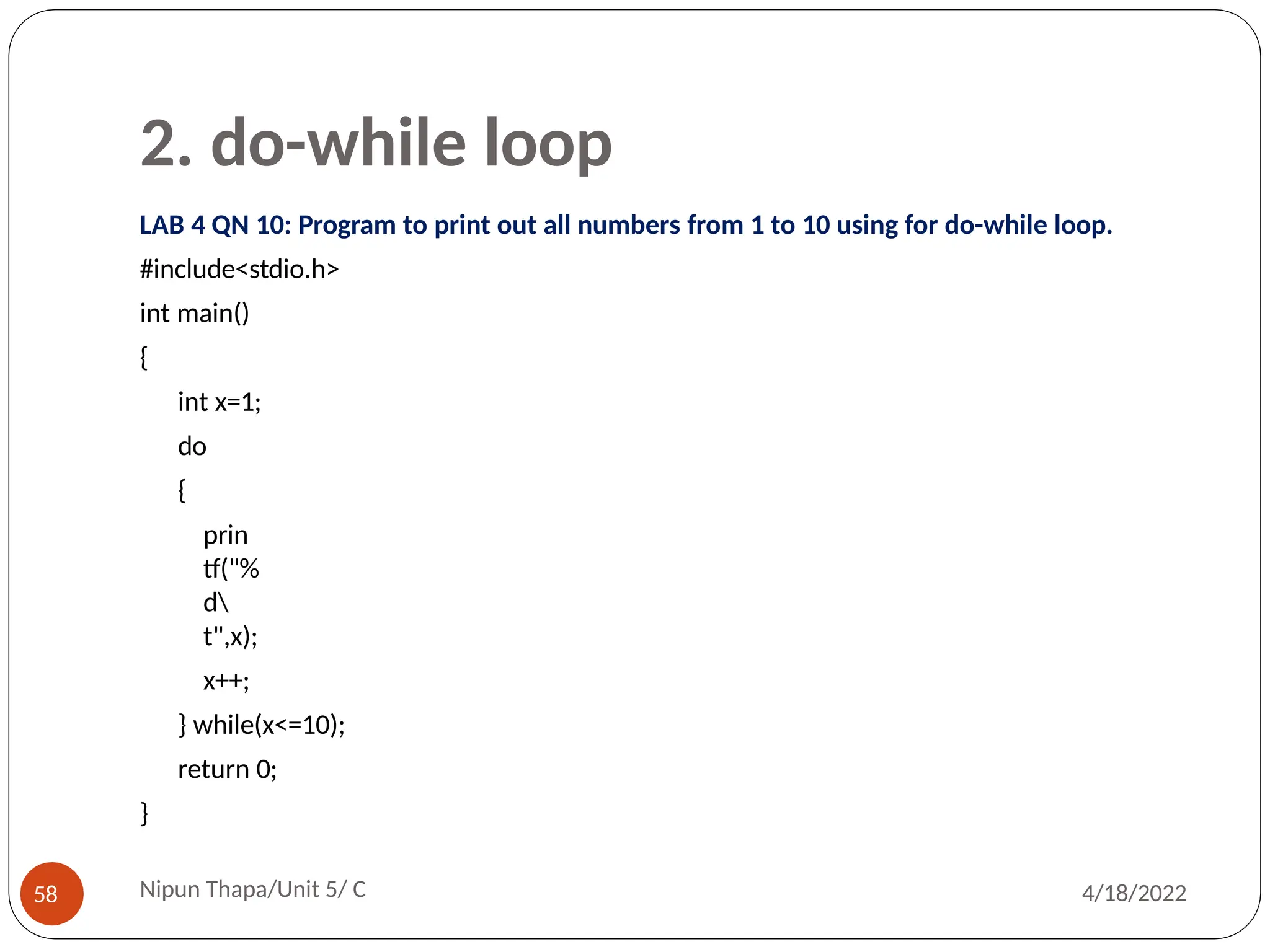
LAB 4 QN 10: Program to print out all numbers from 1 to 10 using for do-while loop.
#include<stdio.h>
int main()
{
int x=1;
do
{
prin
tf("%
d
t",x);
x++;
} while(x<=10);
return 0;
}
Nipun Thapa/Unit 5/ C
58 4/18/2022
2. do-while loop
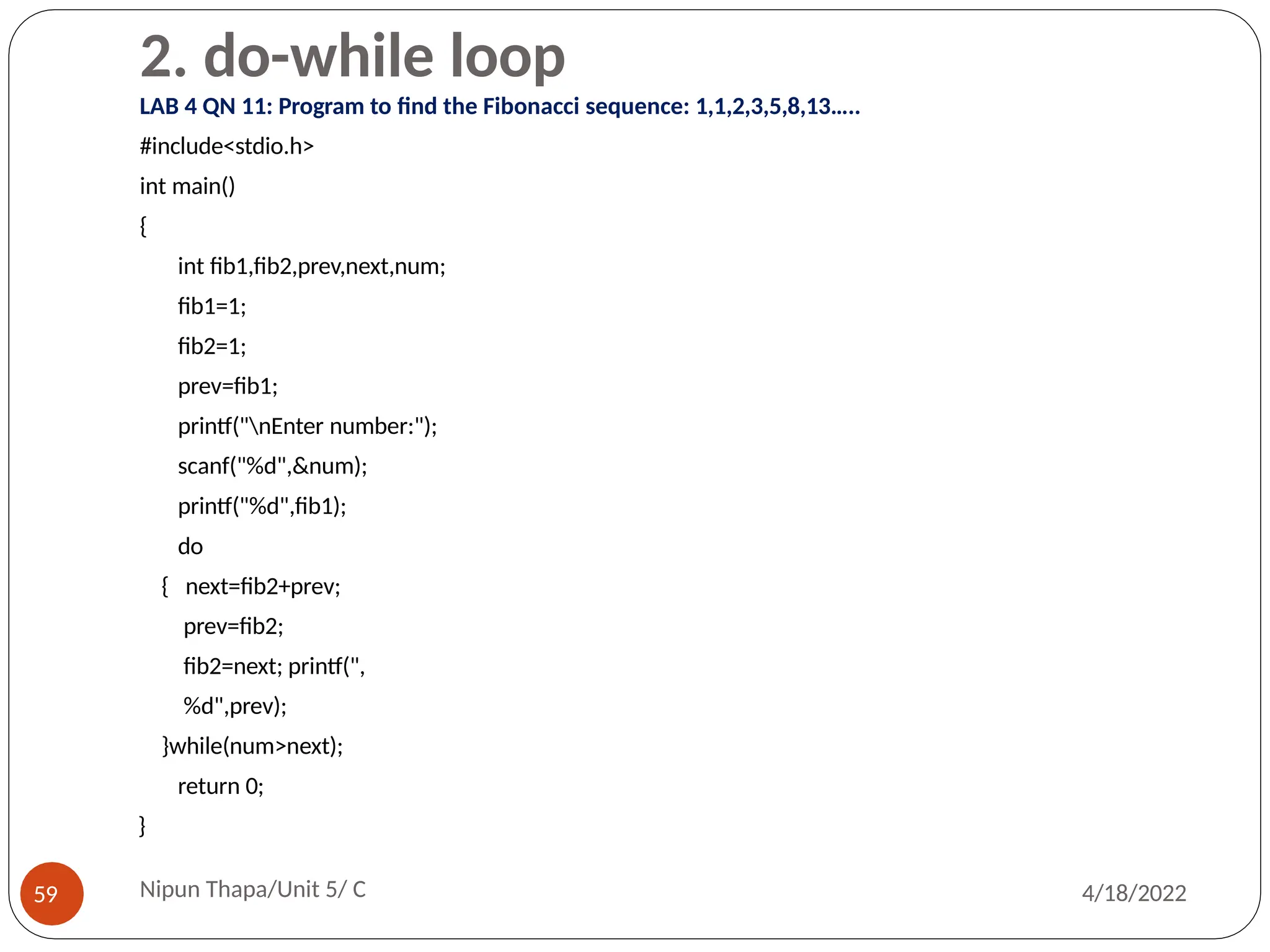
LAB 4 QN 11: Program to find the Fibonacci sequence: 1,1,2,3,5,8,13…..
#include<stdio.h>
int main()
{
int fib1,fib2,prev,next,num;
fib1=1;
fib2=1;
prev=fib1;
printf("nEnter number:");
scanf("%d",&num);
printf("%d",fib1);
do
{ next=fib2+prev;
prev=fib2;
fib2=next; printf(",
%d",prev);
}while(num>next);
return 0;
}
Nipun Thapa/Unit 5/ C
59 4/18/2022
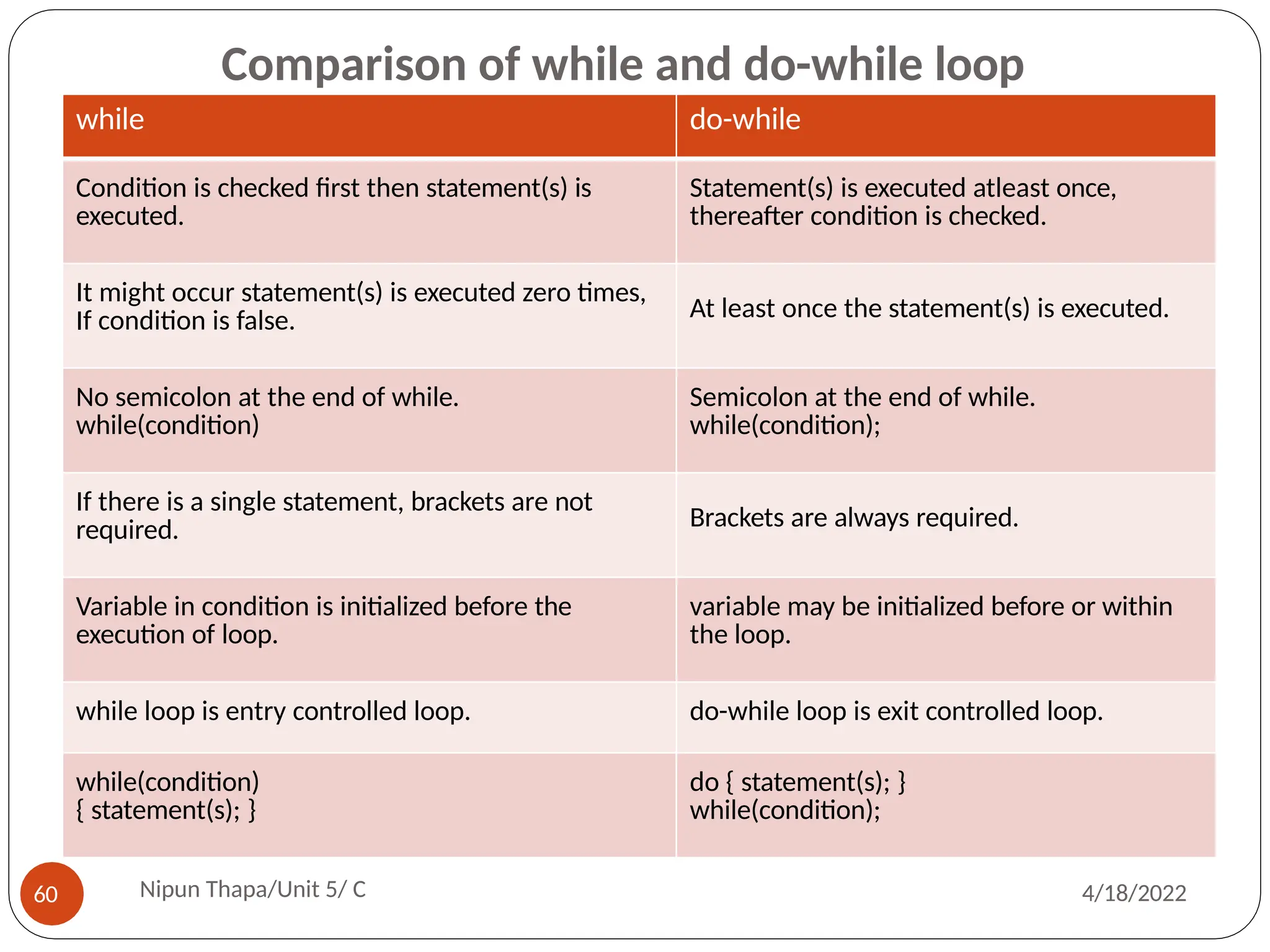
Comparison of while and do-while loop
while do-while
Condition is checked first then statement(s) is
executed.
Statement(s) is executed atleast once,
thereafter condition is checked.
It might occur statement(s) is executed zero times,
If condition is false. At least once the statement(s) is executed.
No semicolon at the end of while.
while(condition)
Semicolon at the end of while.
while(condition);
If there is a single statement, brackets are not
required. Brackets are always required.
Variable in condition is initialized before the
execution of loop.
variable may be initialized before or within
the loop.
while loop is entry controlled loop. do-while loop is exit controlled loop.
while(condition)
{ statement(s); }
do { statement(s); }
while(condition);
Nipun Thapa/Unit 5/ C
60 4/18/2022
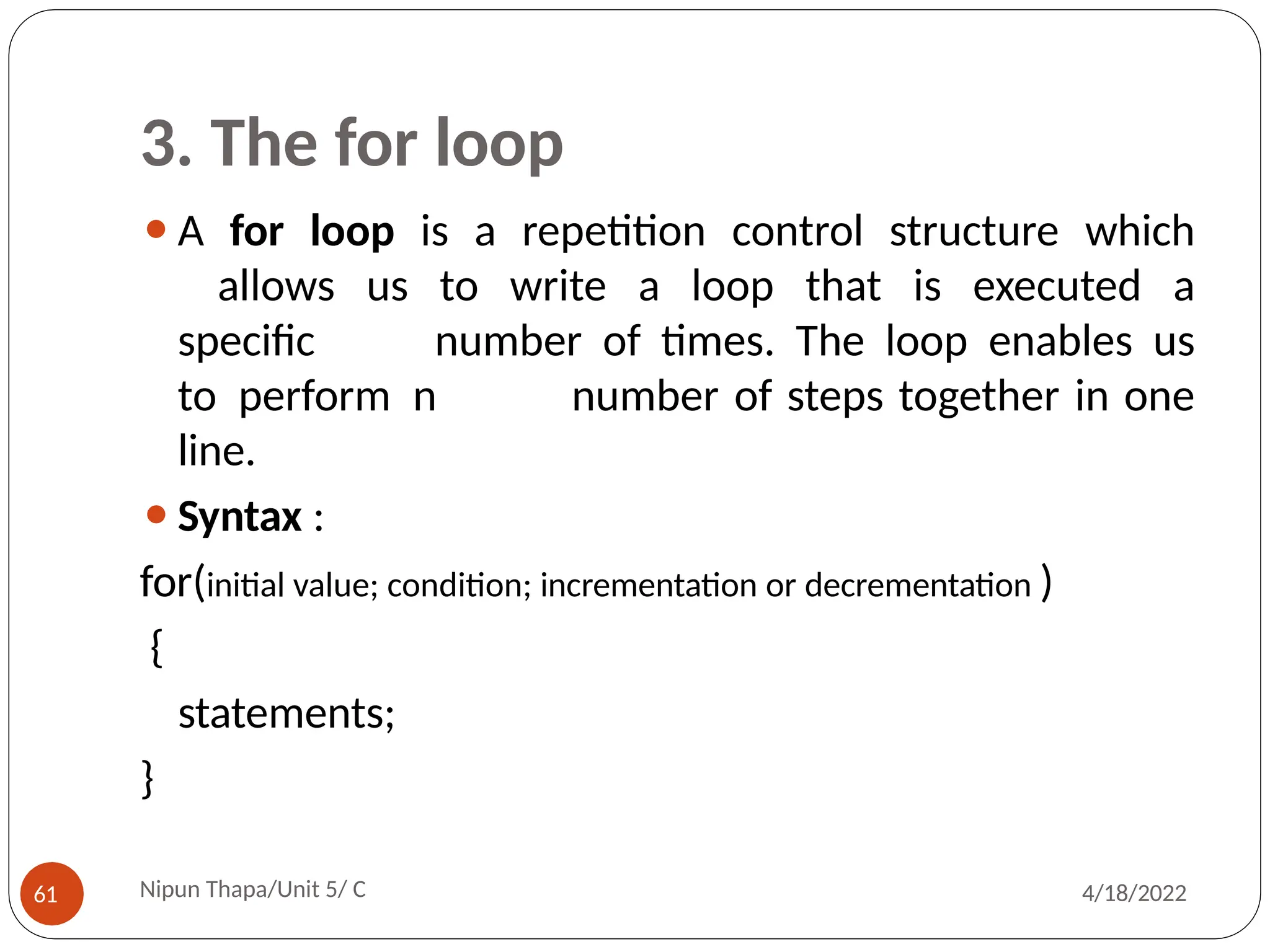
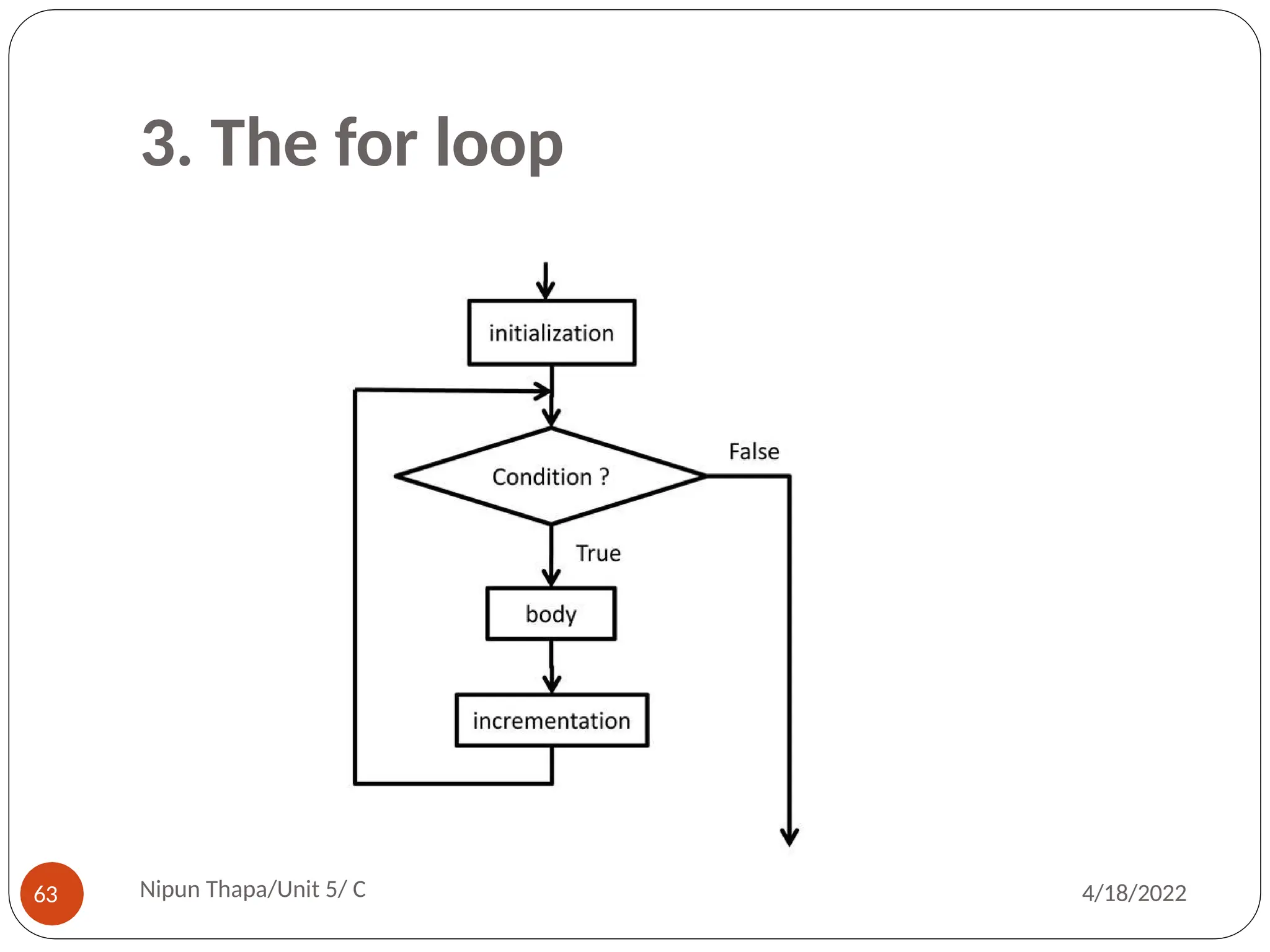
3. The for loop
⚫A for loop is a repetition control structure which
allows us to write a loop that is executed a
specific number of times. The loop enables us
to perform n number of steps together in one
line.
⚫Syntax :
for(initial value; condition; incrementation or decrementation )
{
statements;
}
Nipun Thapa/Unit 5/ C
61 4/18/2022
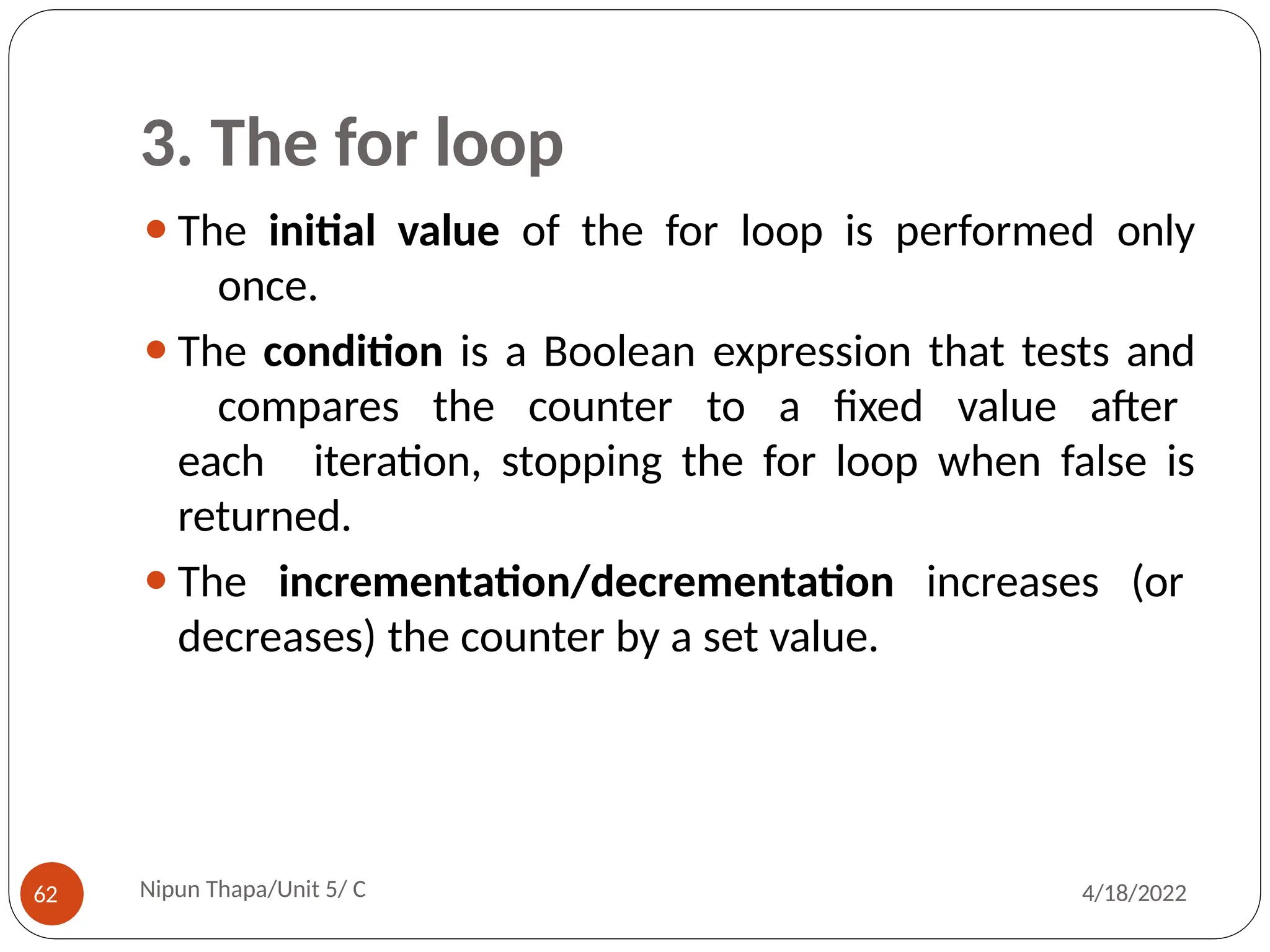
3. The for loop
⚫The initial value of the for loop is performed only
once.
⚫The condition is a Boolean expression that tests and
compares the counter to a fixed value after
each iteration, stopping the for loop when false is
returned.
⚫The incrementation/decrementation increases (or
decreases) the counter by a set value.
Nipun Thapa/Unit 5/ C
62 4/18/2022
3. The for loop
Nipun Thapa/Unit 5/ C
63 4/18/2022
3. The for loop
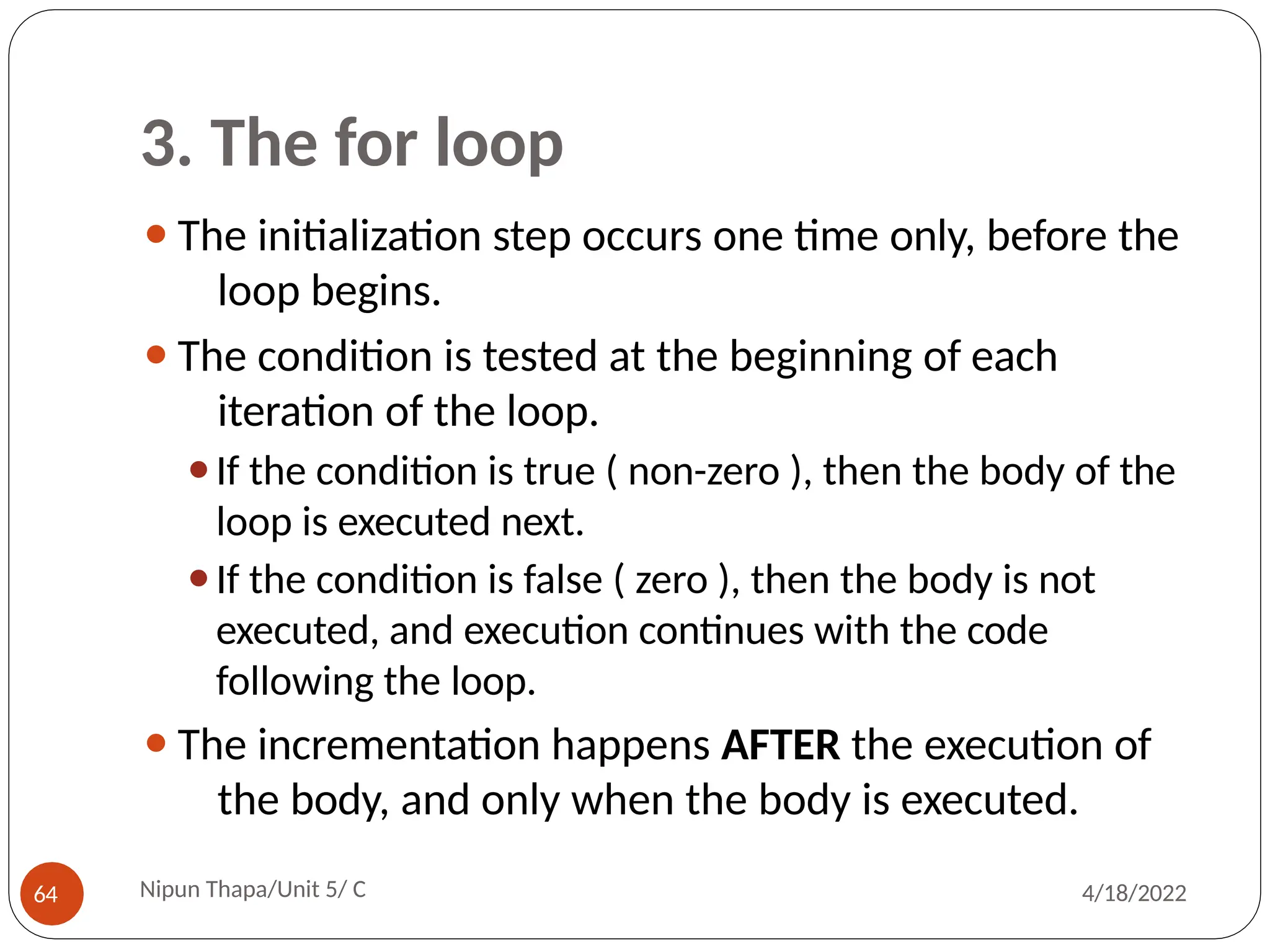
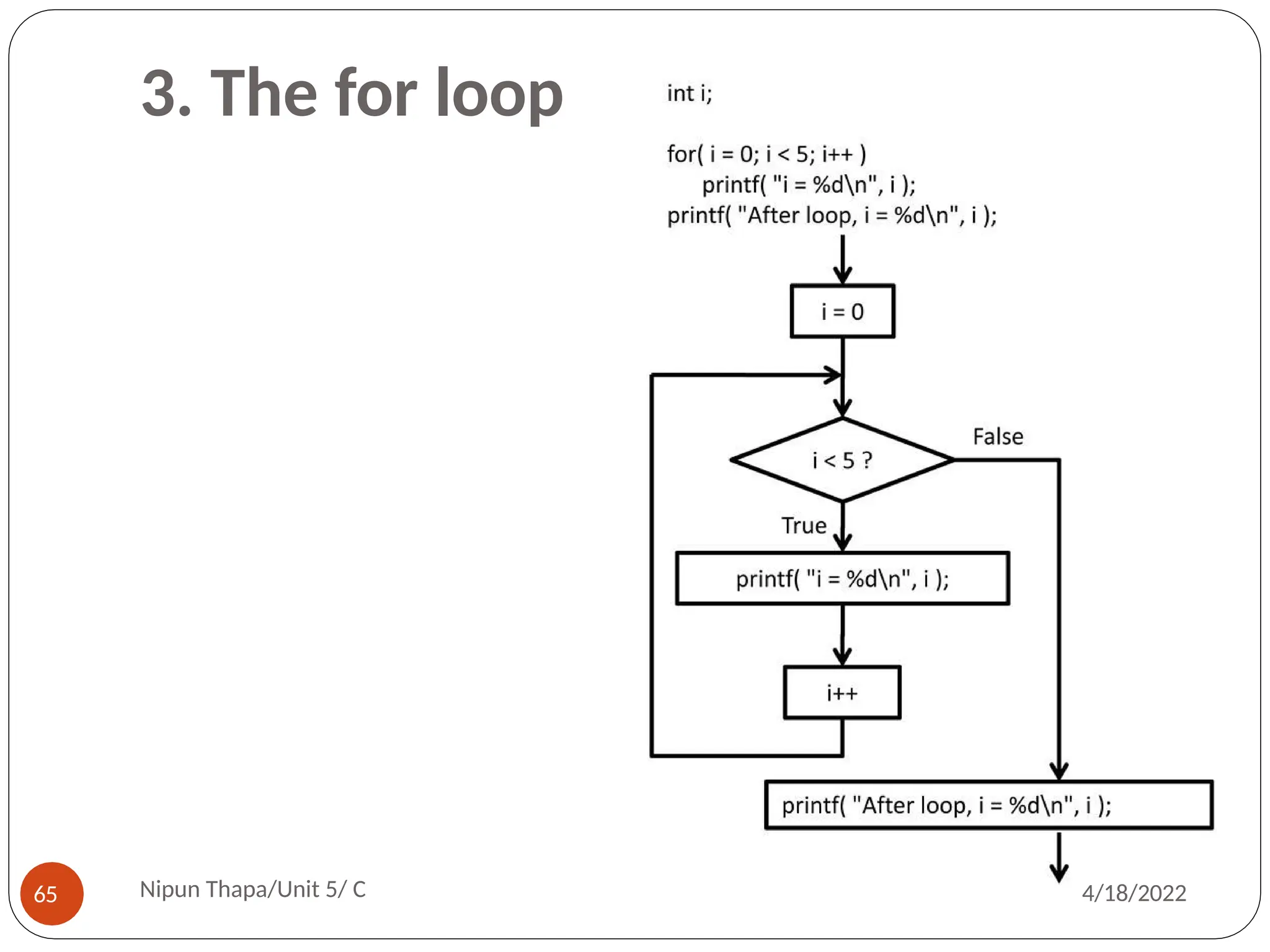
⚫The initialization step occurs one time only, before the
loop begins.
⚫The condition is tested at the beginning of each
iteration of the loop.
⚫If the condition is true ( non-zero ), then the body of the
loop is executed next.
⚫If the condition is false ( zero ), then the body is not
executed, and execution continues with the code
following the loop.
⚫The incrementation happens AFTER the execution of
the body, and only when the body is executed.
Nipun Thapa/Unit 5/ C
64 4/18/2022
3. The for loop
Nipun Thapa/Unit 5/ C
65 4/18/2022
3. The for loop
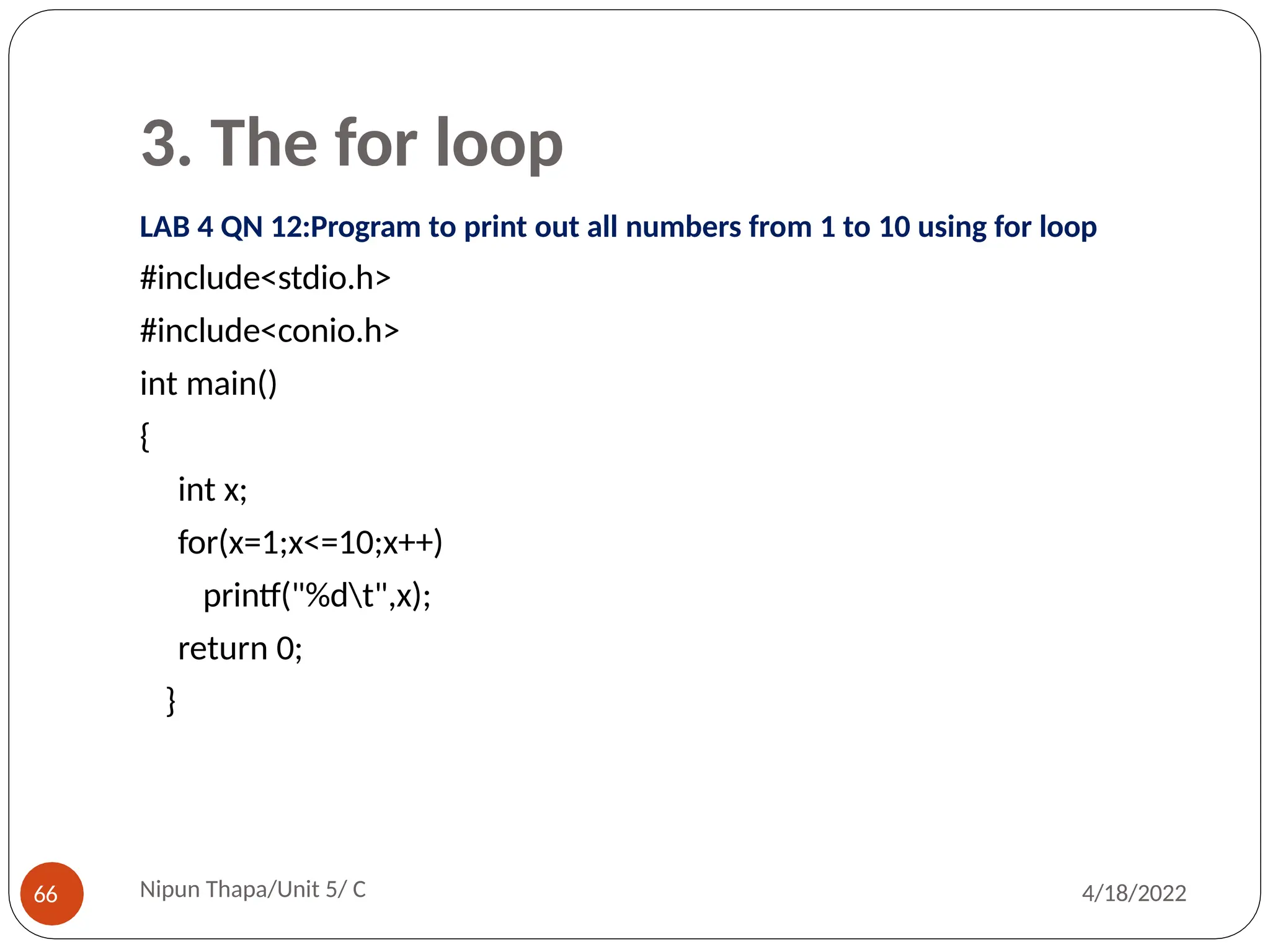
LAB 4 QN 12:Program to print out all numbers from 1 to 10 using for loop
#include<stdio.h>
#include<conio.h>
int main()
{
int x;
for(x=1;x<=10;x++)
printf("%dt",x);
return 0;
}
Nipun Thapa/Unit 5/ C
66 4/18/2022
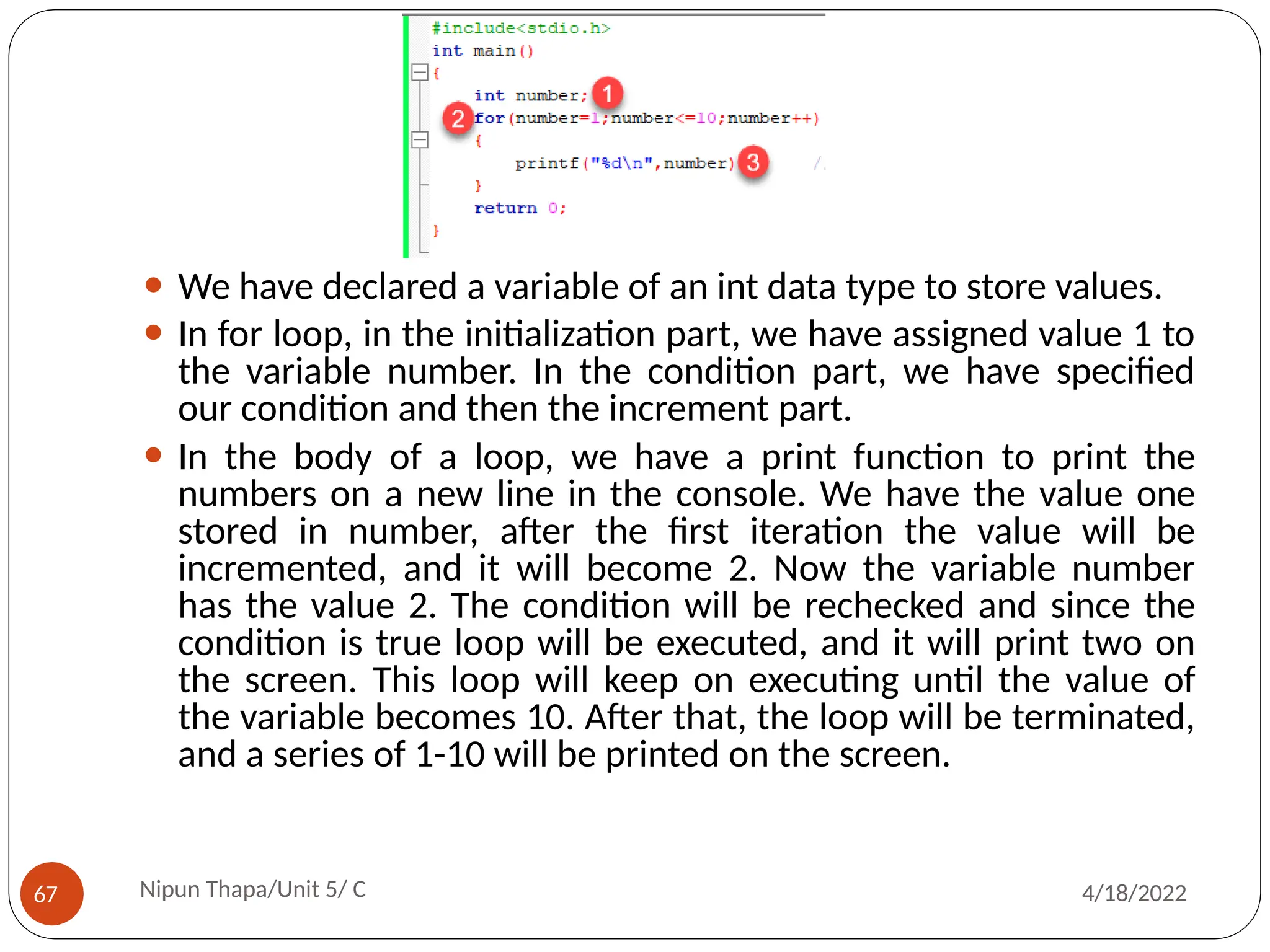
⚫ We have declared a variable of an int data type to store values.
⚫ In for loop, in the initialization part, we have assigned value 1 to
the variable number. In the condition part, we have specified
our condition and then the increment part.
⚫ In the body of a loop, we have a print function to print the
numbers on a new line in the console. We have the value one
stored in number, after the first iteration the value will be
incremented, and it will become 2. Now the variable number
has the value 2. The condition will be rechecked and since the
condition is true loop will be executed, and it will print two on
the screen. This loop will keep on executing until the value of
the variable becomes 10. After that, the loop will be terminated,
and a series of 1-10 will be printed on the screen.
Nipun Thapa/Unit 5/ C
67 4/18/2022
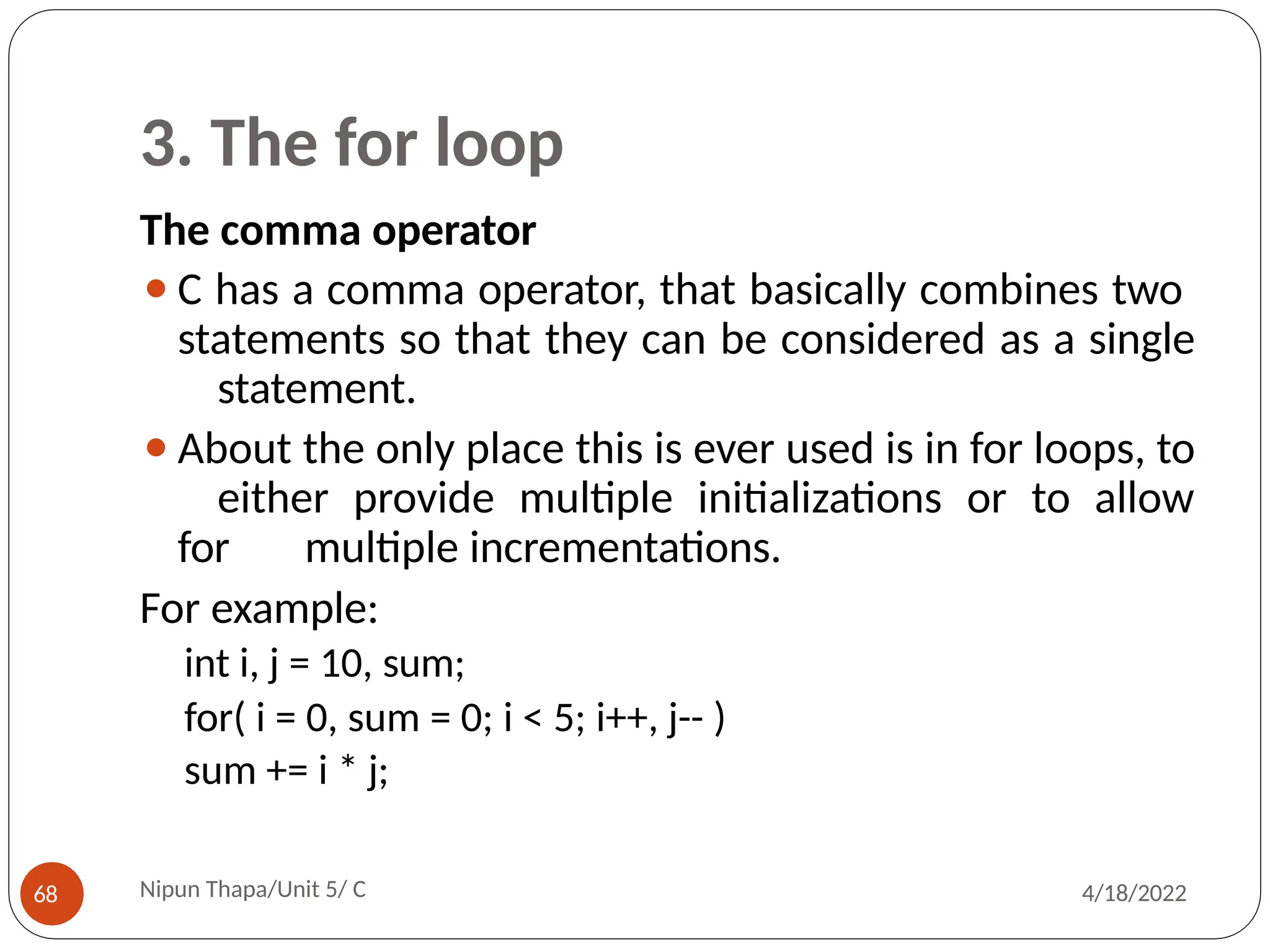
3. The for loop
The comma operator
⚫C has a comma operator, that basically combines two
statements so that they can be considered as a single
statement.
⚫About the only place this is ever used is in for loops, to
either provide multiple initializations or to allow
for multiple incrementations.
For example:
int i, j = 10, sum;
for( i = 0, sum = 0; i < 5; i++, j-- )
sum += i * j;
Nipun Thapa/Unit 5/ C
68 4/18/2022
3. The for loop
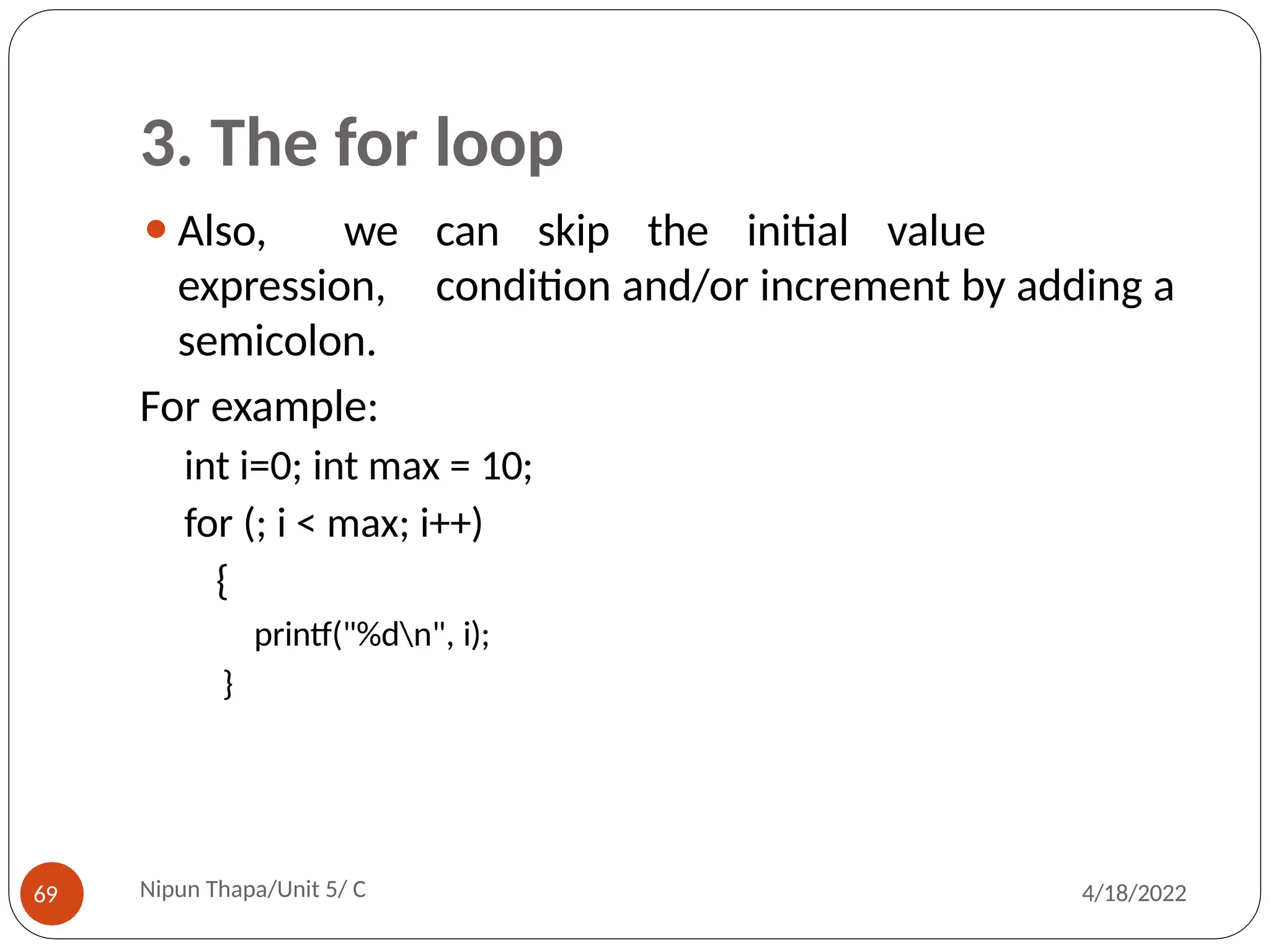
⚫Also, we can skip the initial value
expression, condition and/or increment by adding a
semicolon.
For example:
int i=0; int max = 10;
for (; i < max; i++)
{
printf("%dn", i);
}
Nipun Thapa/Unit 5/ C
69 4/18/2022
3. The for loop
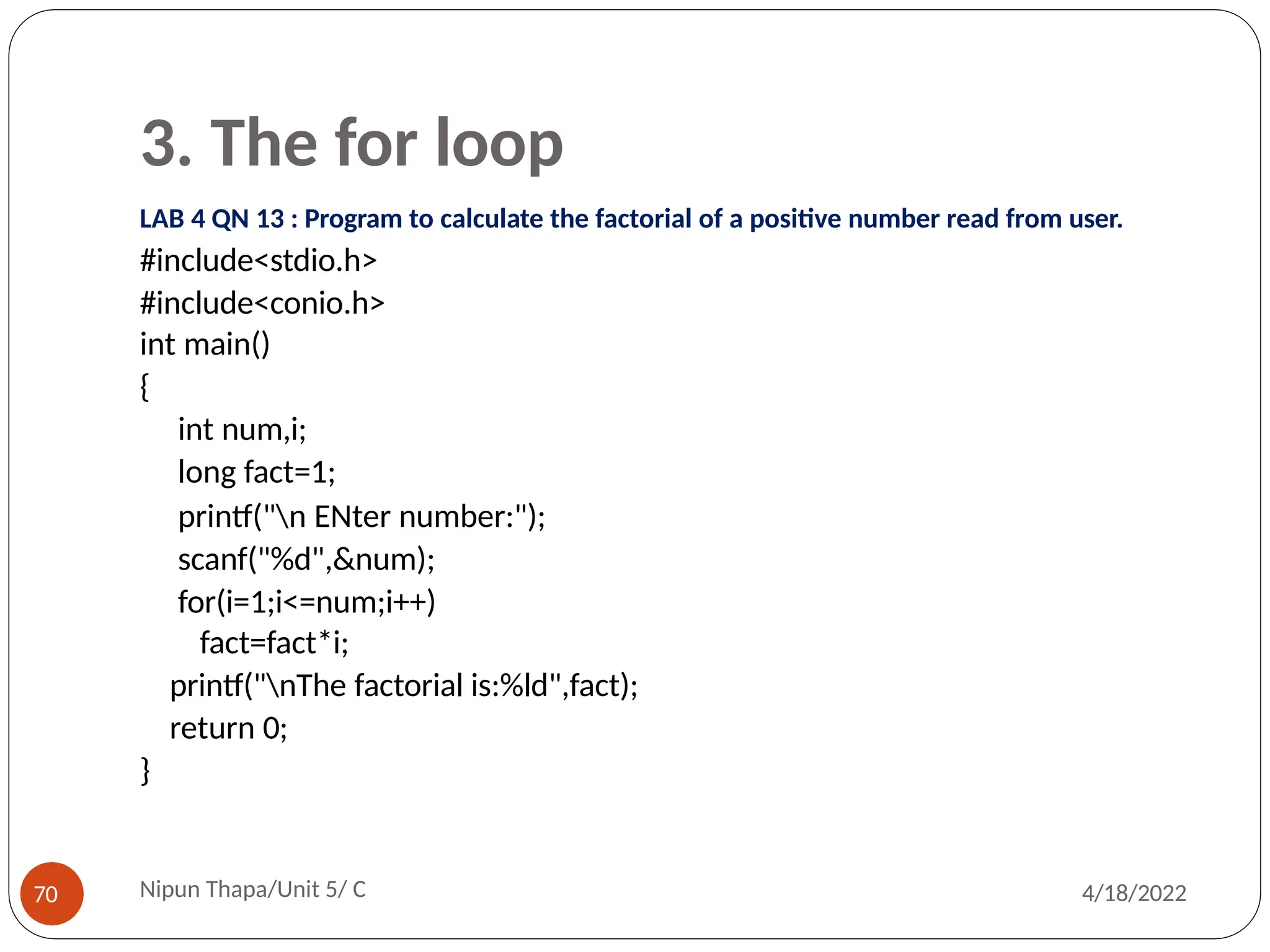
LAB 4 QN 13 : Program to calculate the factorial of a positive number read from user.
#include<stdio.h>
#include<conio.h>
int main()
{
int num,i;
long fact=1;
printf("n ENter number:");
scanf("%d",&num);
for(i=1;i<=num;i++)
fact=fact*i;
printf("nThe factorial is:%ld",fact);
return 0;
}
Nipun Thapa/Unit 5/ C
70 4/18/2022
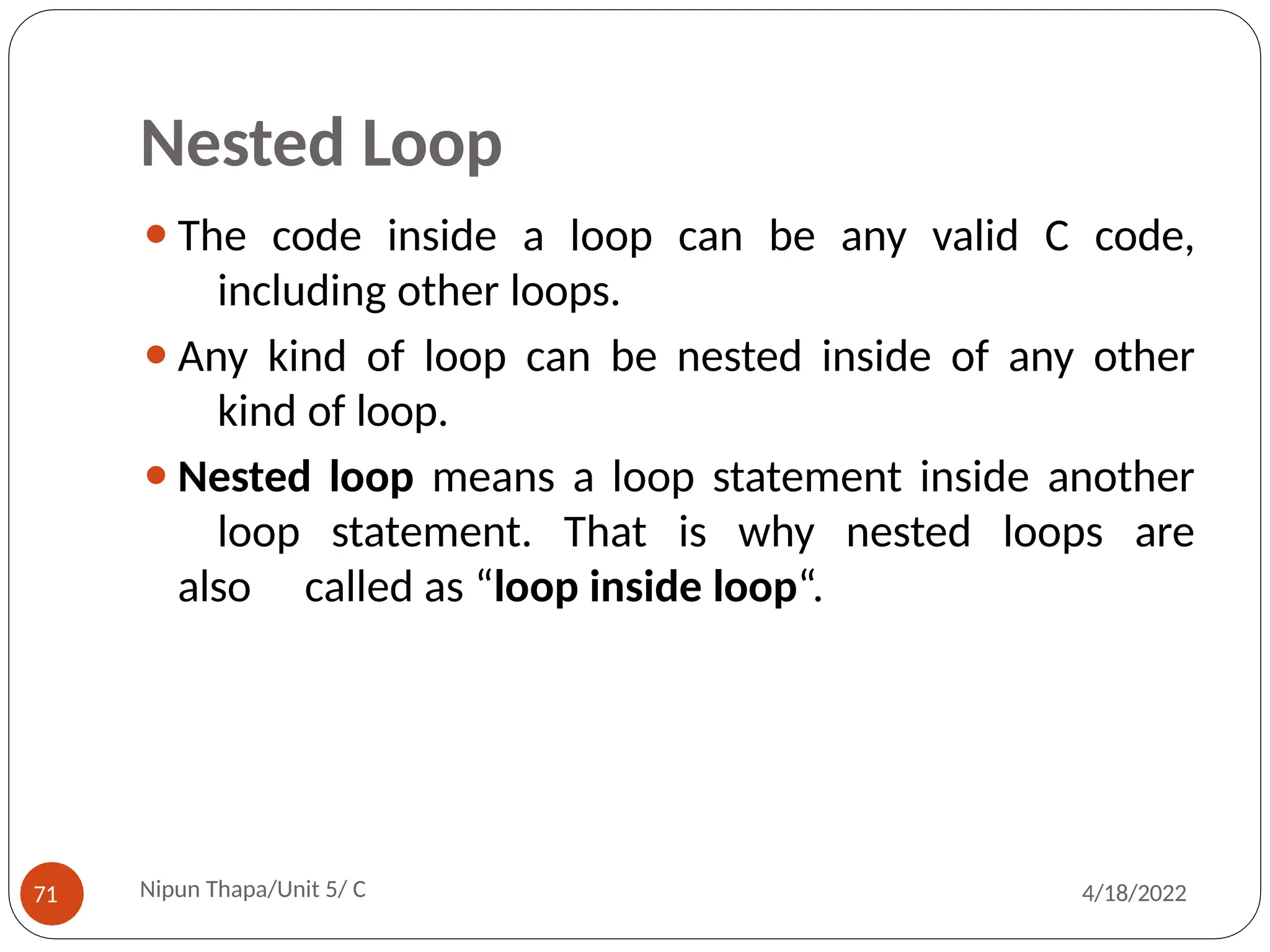
Nested Loop
⚫The code inside a loop can be any valid C code,
including other loops.
⚫Any kind of loop can be nested inside of any other
kind of loop.
⚫Nested loop means a loop statement inside another
loop statement. That is why nested loops are
also called as “loop inside loop“.
Nipun Thapa/Unit 5/ C
71 4/18/2022
Nested Loop
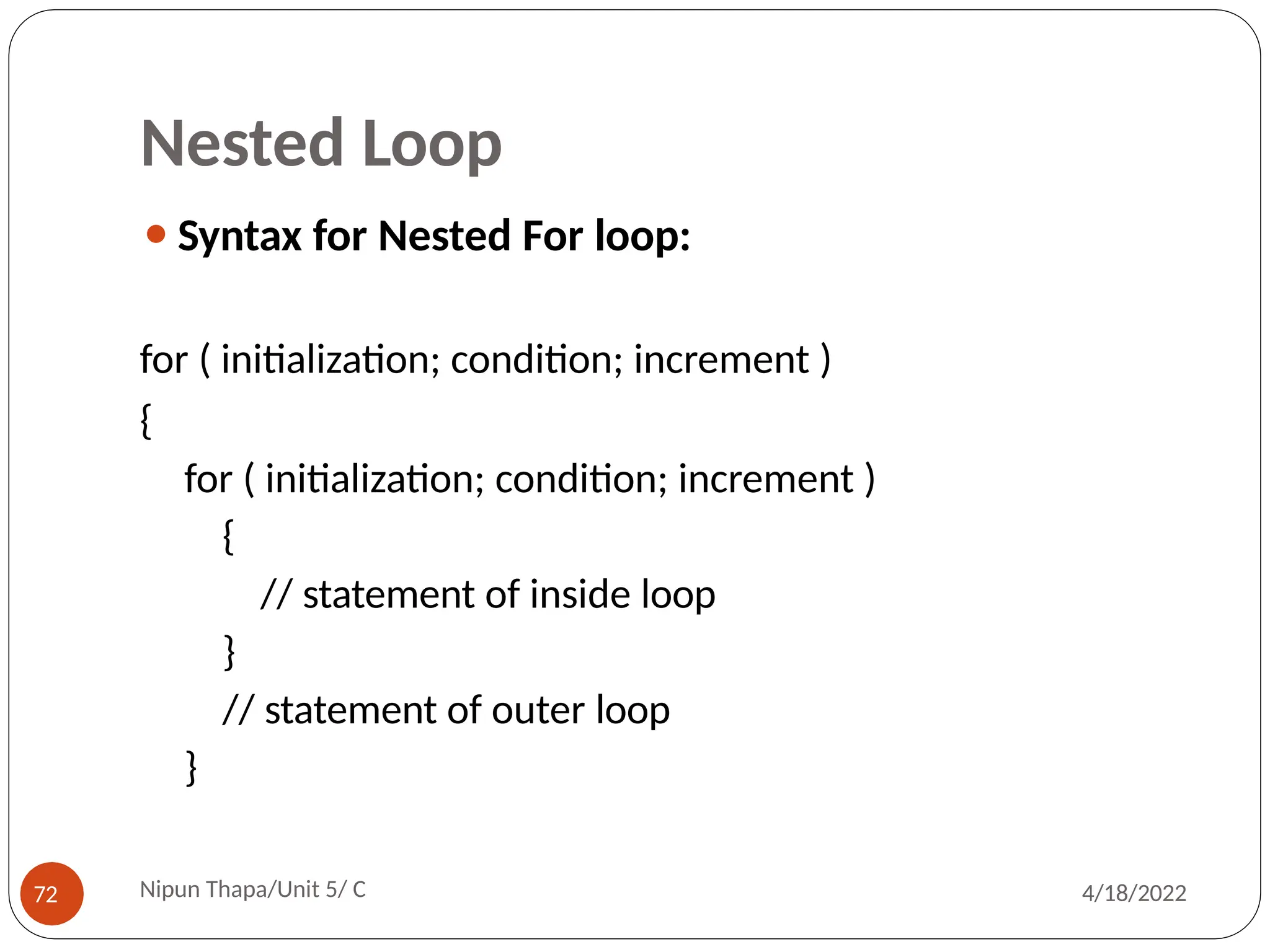
⚫Syntax for Nested For loop:
for ( initialization; condition; increment )
{
for ( initialization; condition; increment )
{
// statement of inside loop
}
// statement of outer loop
}
Nipun Thapa/Unit 5/ C
72 4/18/2022
Nested Loop
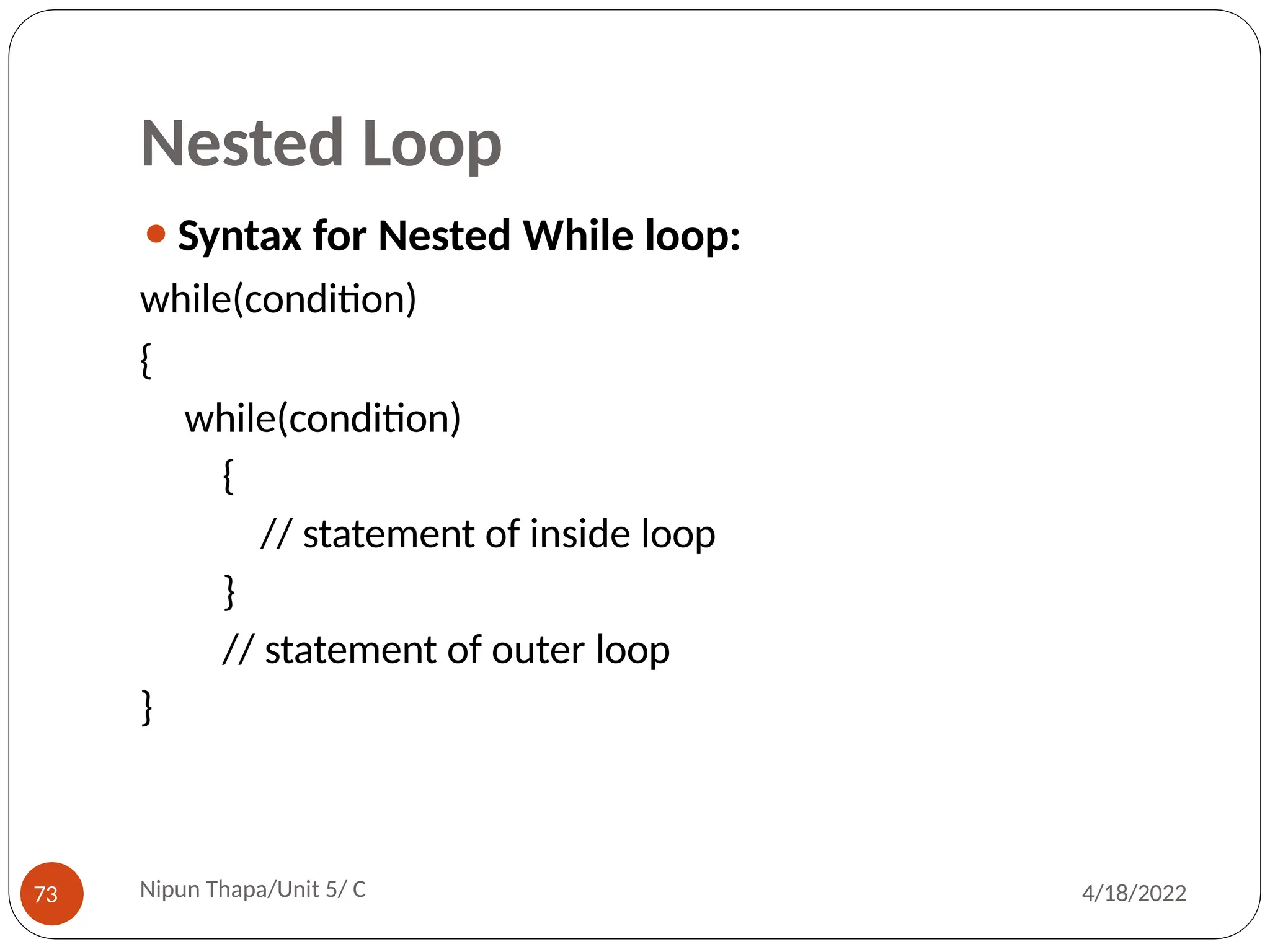
⚫Syntax for Nested While loop:
while(condition)
{
while(condition)
{
// statement of inside loop
}
// statement of outer loop
}
Nipun Thapa/Unit 5/ C
73 4/18/2022
Nested Loop
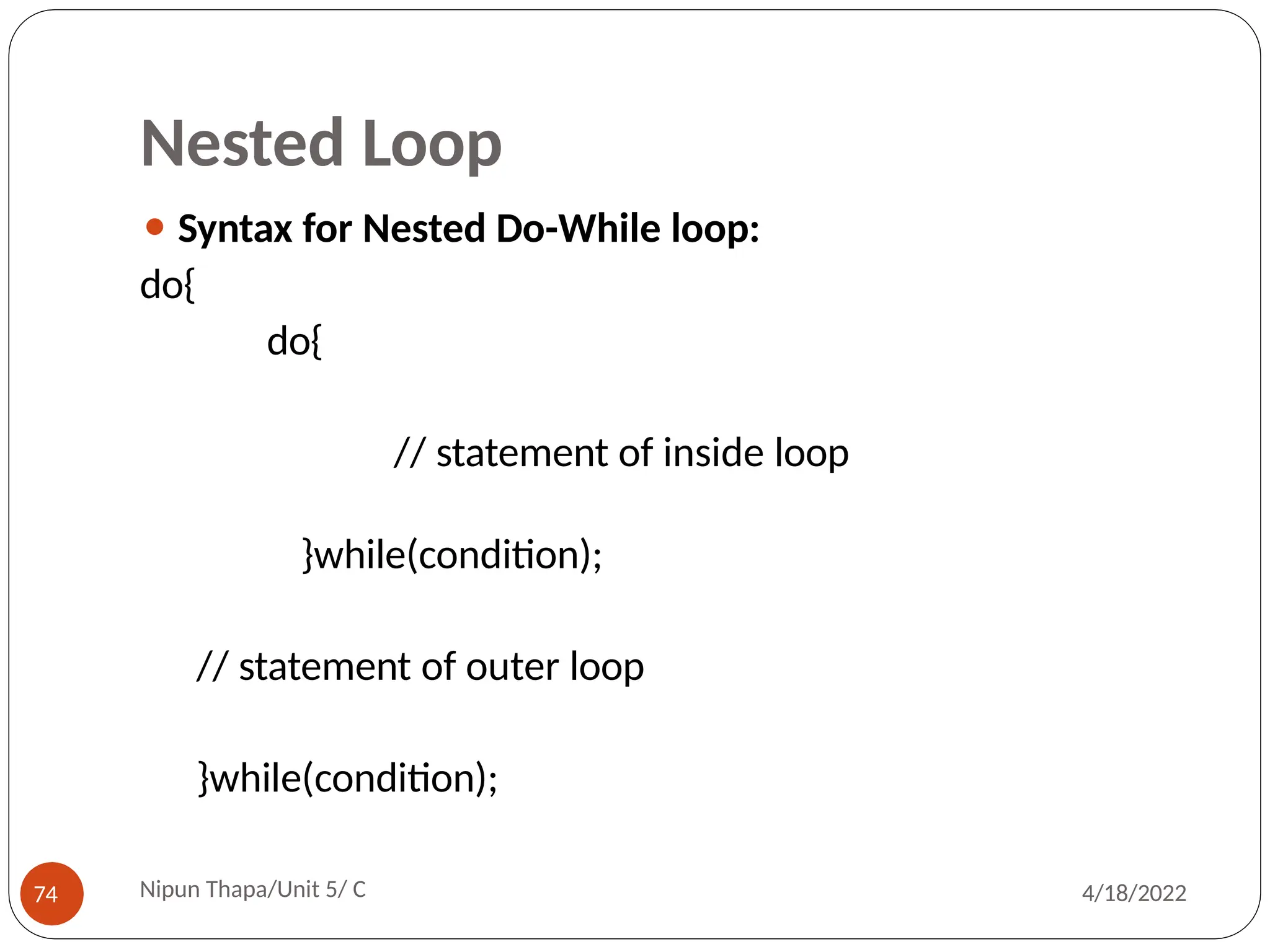
⚫ Syntax for Nested Do-While loop:
do{
do{
// statement of inside loop
}while(condition);
// statement of outer loop
}while(condition);
Nipun Thapa/Unit 5/ C
74 4/18/2022
Nested Loop
LAB 4 QN 14: Program to show multiplication table .
#include <stdio.h>
int main()
{
int i, j; int table = 2;
int max = 10;
for (i = 1; i <=
table; i++)
{
for (j =
0; j <=
max; j+
+)
{
p
r
i
n
t
f
Nipun Thapa/Unit 5/ C
75 4/18/2022
Jumping Statements
⚫The break; continue; and goto; statements are used
to alter the normal flow of a program.
Nipun Thapa/Unit 5/ C
76 4/18/2022
⚫Loops perform a set of
repetitive
expression becomes false but it
task
until text is
sometimes
desirable to skip some statement/s inside loop or
terminate the loop immediately without checking the
test expression. In such cases, break and continue
statements are used.
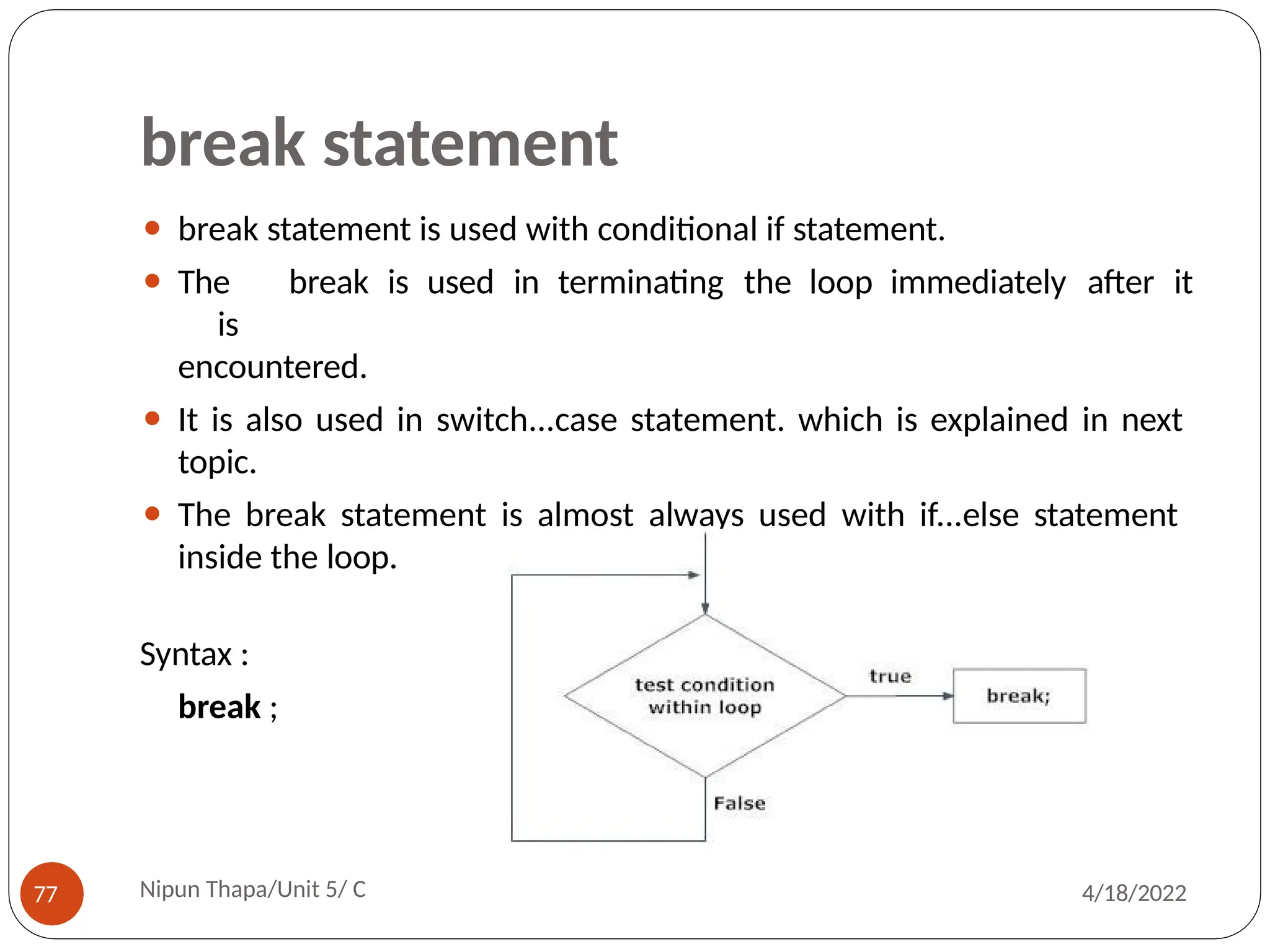
break statement
⚫ break statement is used with conditional if statement.
⚫ The break is used in terminating the loop immediately after it
is
encountered.
⚫ It is also used in switch...case statement. which is explained in next
topic.
⚫ The break statement is almost always used with if...else statement
inside the loop.
Syntax :
break ;
Nipun Thapa/Unit 5/ C
77 4/18/2022
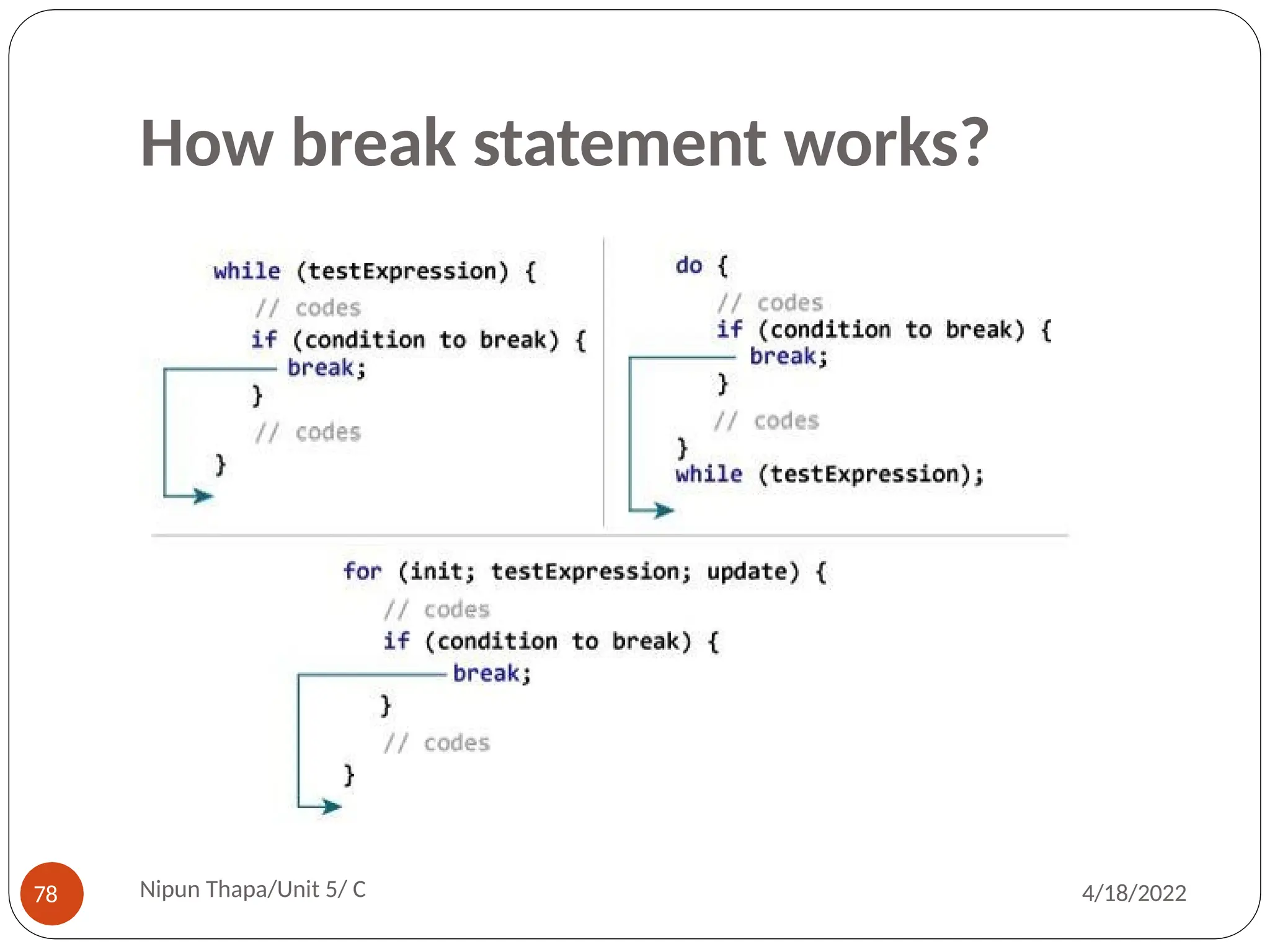
How break statement works?
Nipun Thapa/Unit 5/ C
78 4/18/2022
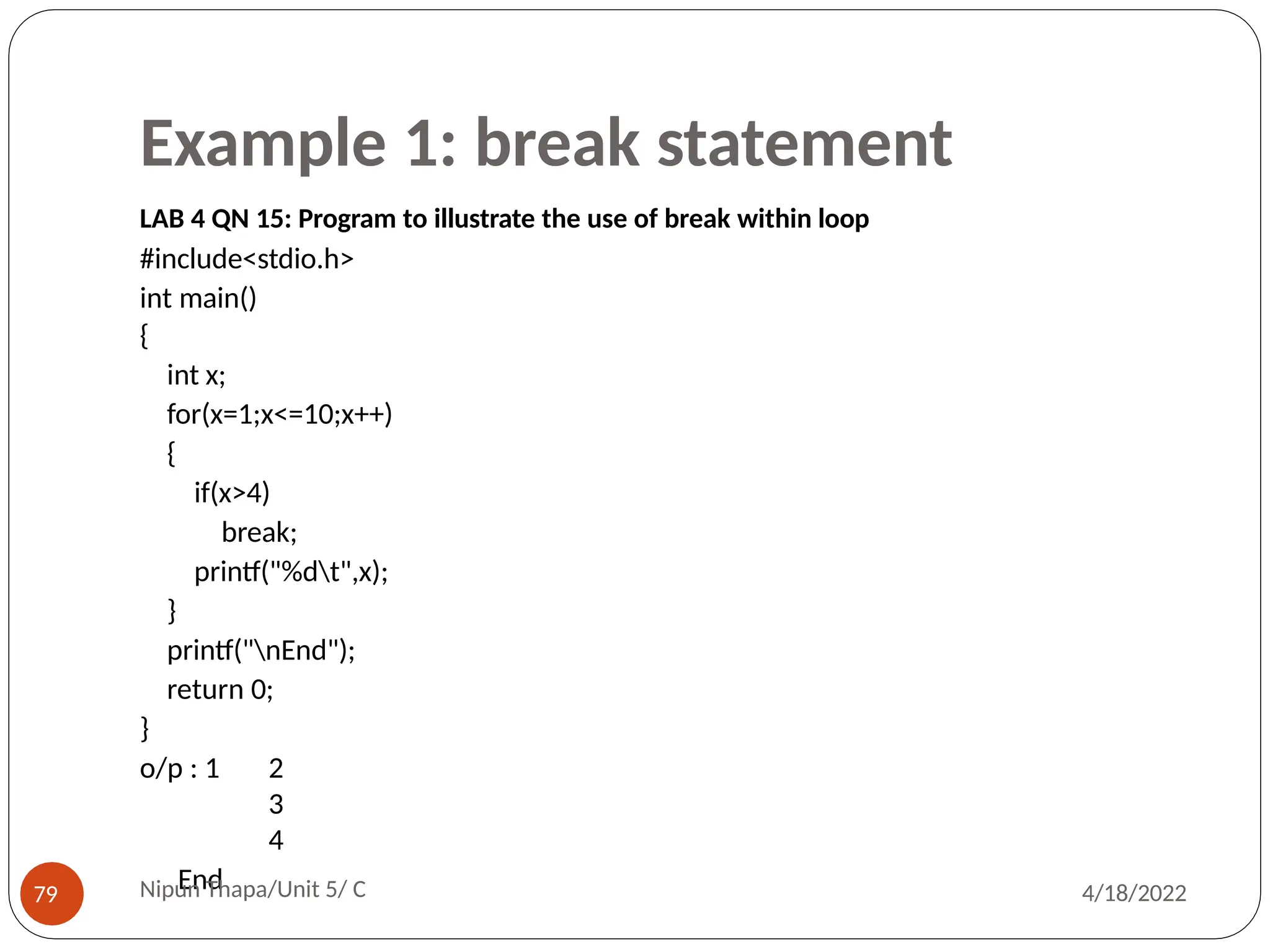
Example 1: break statement
LAB 4 QN 15: Program to illustrate the use of break within loop
#include<stdio.h>
int main()
{
int x;
for(x=1;x<=10;x++)
{
if(x>4)
break;
printf("%dt",x);
}
printf("nEnd");
return 0;
}
o/p : 1 2
3
4
End
Nipun Thapa/Unit 5/ C
79 4/18/2022
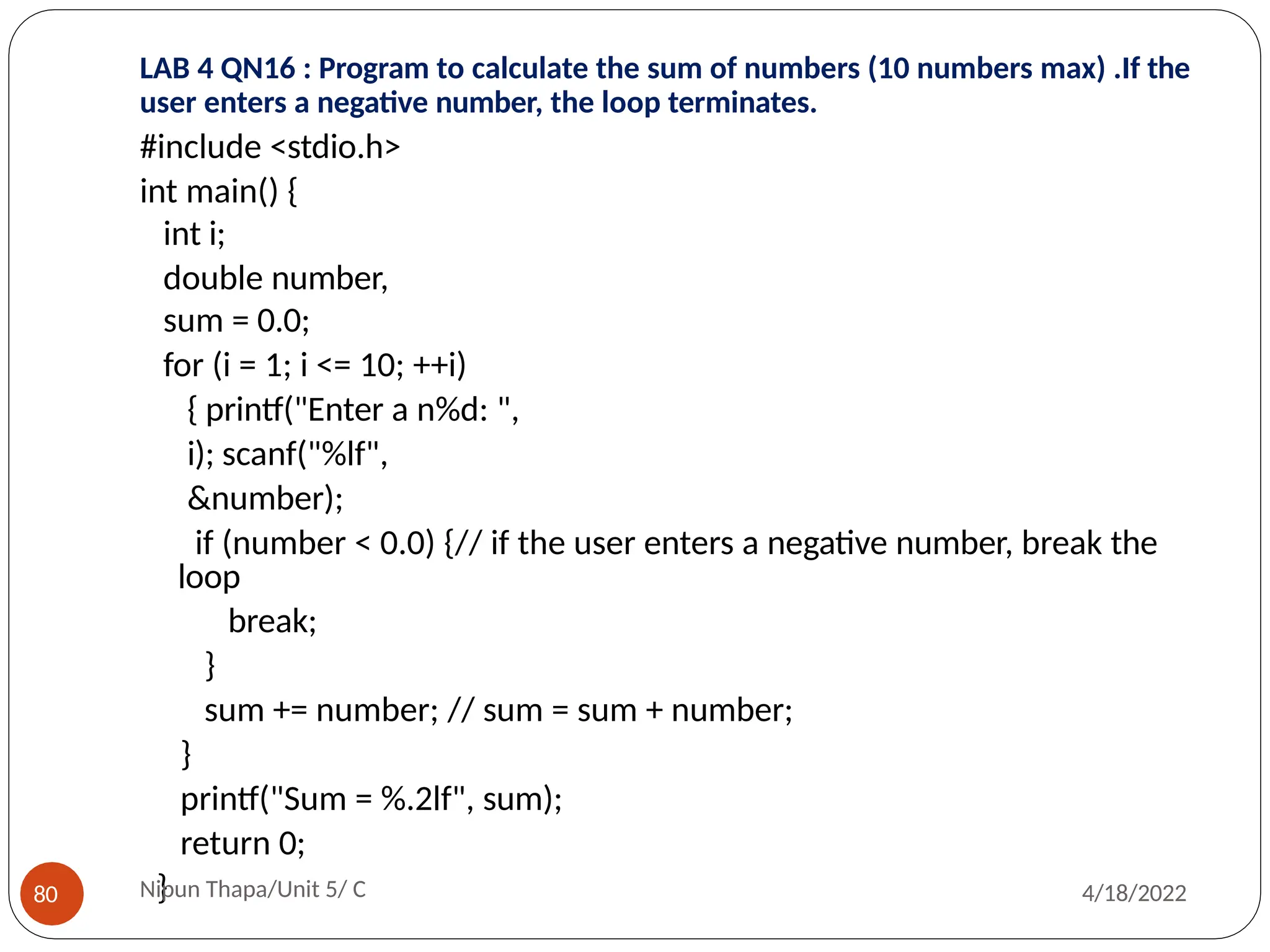
LAB 4 QN16 : Program to calculate the sum of numbers (10 numbers max) .If the
user enters a negative number, the loop terminates.
#include <stdio.h>
int main() {
int i;
double number,
sum = 0.0;
for (i = 1; i <= 10; ++i)
{ printf("Enter a n%d: ",
i); scanf("%lf",
&number);
if (number < 0.0) {// if the user enters a negative number, break the
loop
break;
}
sum += number; // sum = sum + number;
}
printf("Sum = %.2lf", sum);
return 0;
}
Nipun Thapa/Unit 5/ C
80 4/18/2022
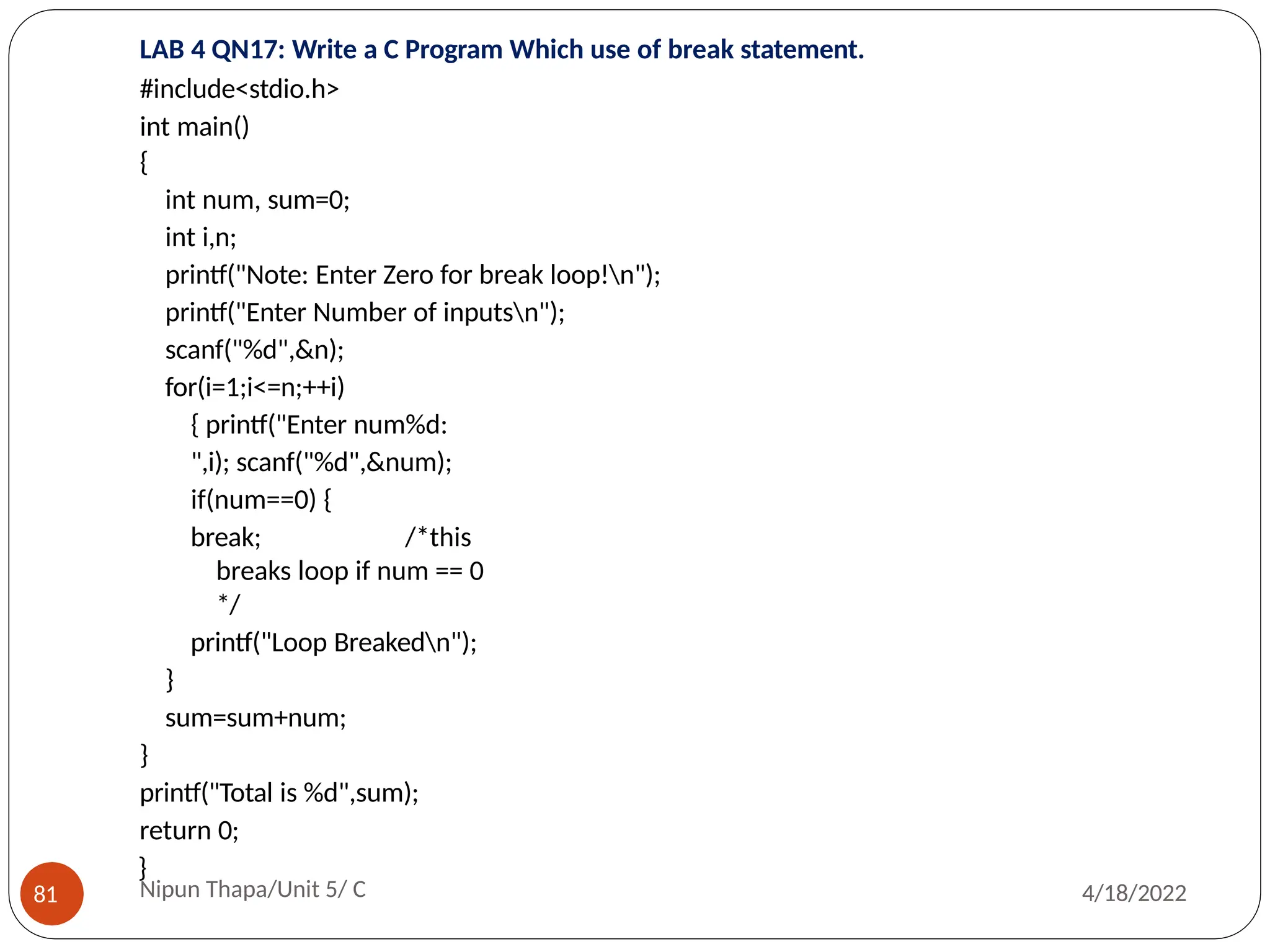
LAB 4 QN17: Write a C Program Which use of break statement.
#include<stdio.h>
int main()
{
int num, sum=0;
int i,n;
printf("Note: Enter Zero for break loop!n");
printf("Enter Number of inputsn");
scanf("%d",&n);
for(i=1;i<=n;++i)
{ printf("Enter num%d:
",i); scanf("%d",&num);
if(num==0) {
break; /*this
breaks loop if num == 0
*/
printf("Loop Breakedn");
}
sum=sum+num;
}
printf("Total is %d",sum);
return 0;
}
Nipun Thapa/Unit 5/ C
81 4/18/2022
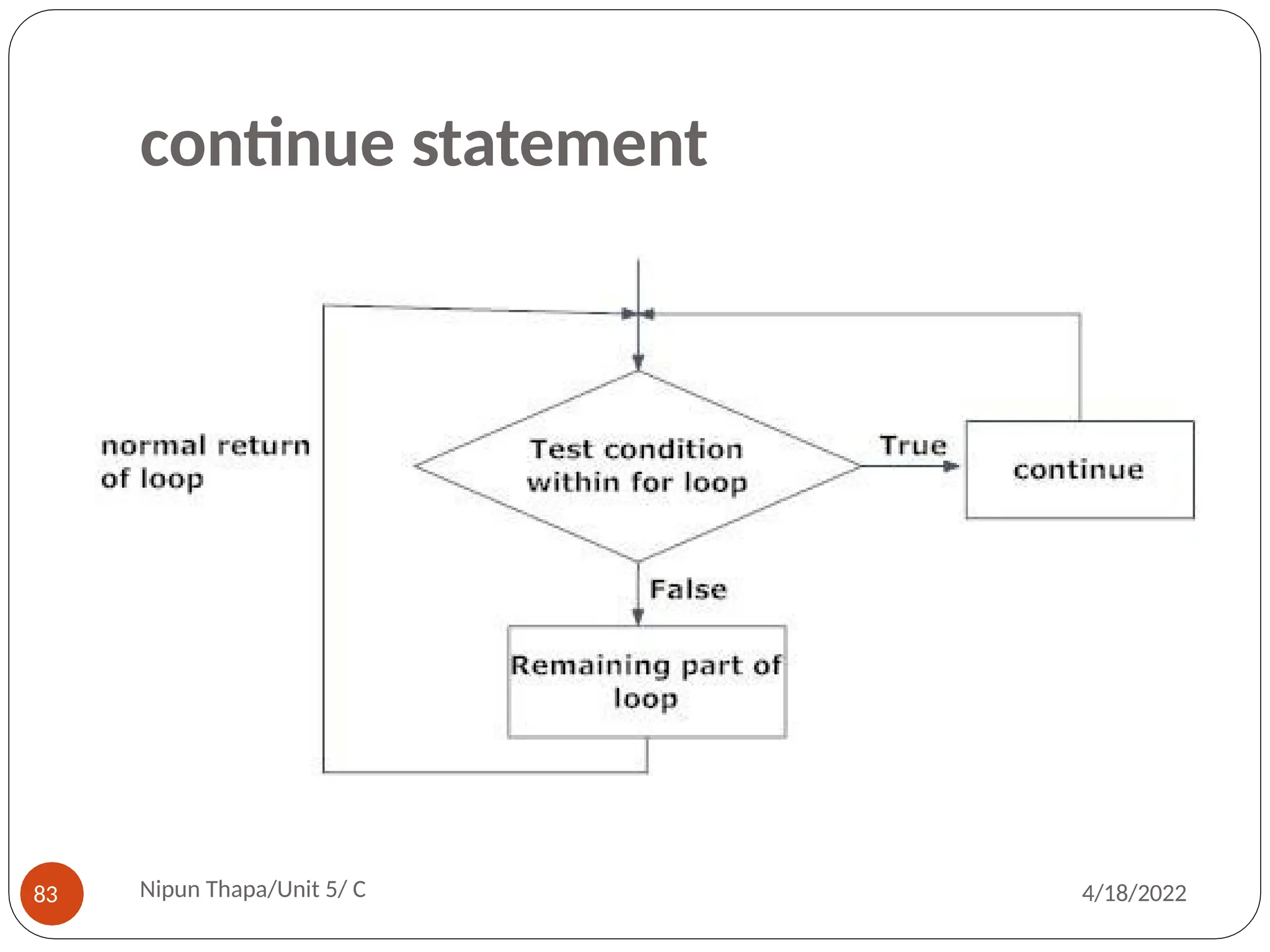
continue statement
⚫ The Continue statement like any other jump statements
interrupts or changes the flow of control during the
execution of a program.
⚫ Continue is mostly used in loops. Rather than terminating
the loop it stops the execution of the statements
underneath and takes the control to the next iteration.
⚫ Similar to a break statement, in case of nested loop,
the continue passes the control to the next iteration of the
inner loop where it is present and not to any of the outer
loops.
Syntax:
continue;
Nipun Thapa/Unit 5/ C
82 4/18/2022
continue statement
Nipun Thapa/Unit 5/ C
83 4/18/2022
continue statement
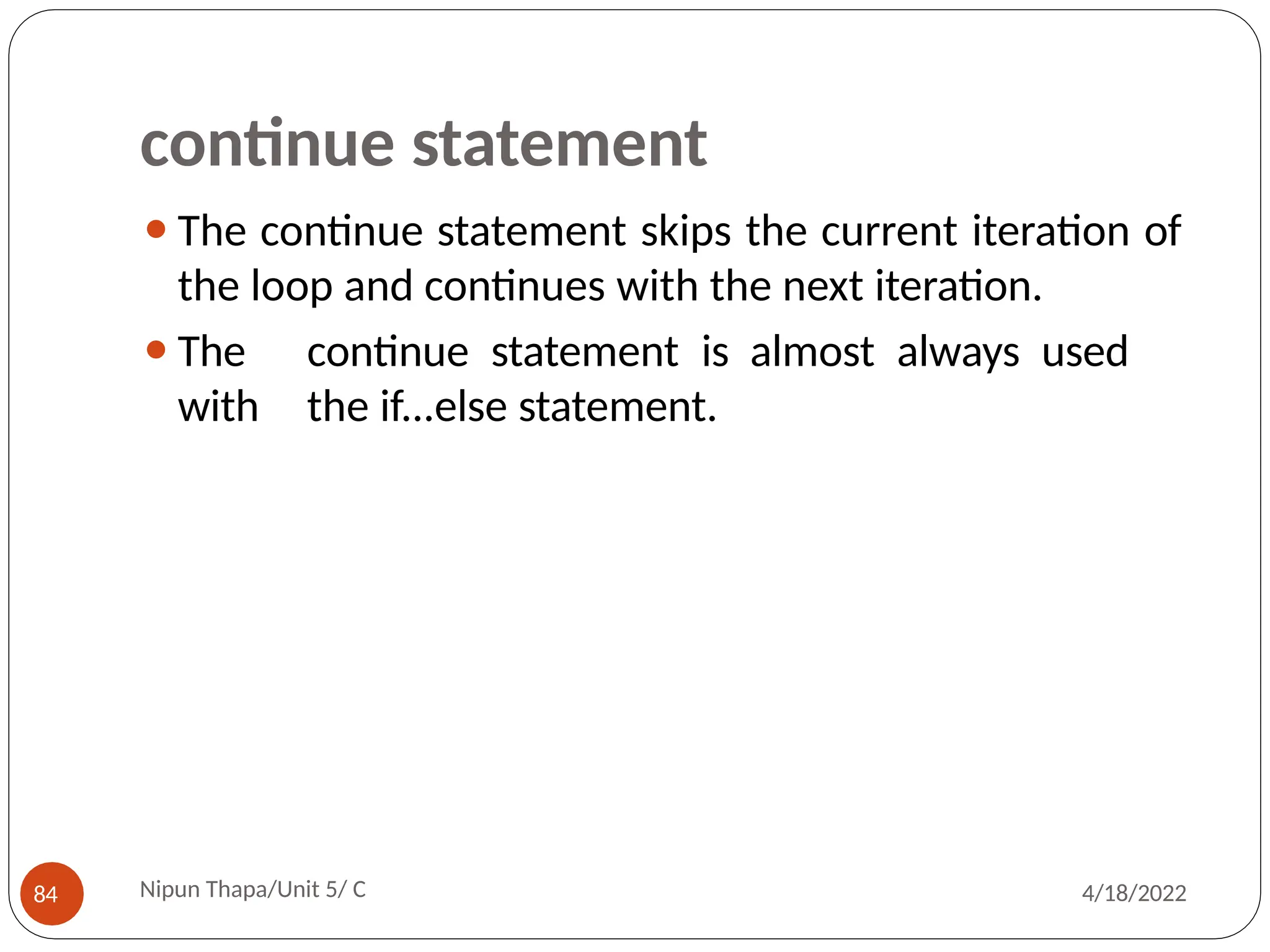
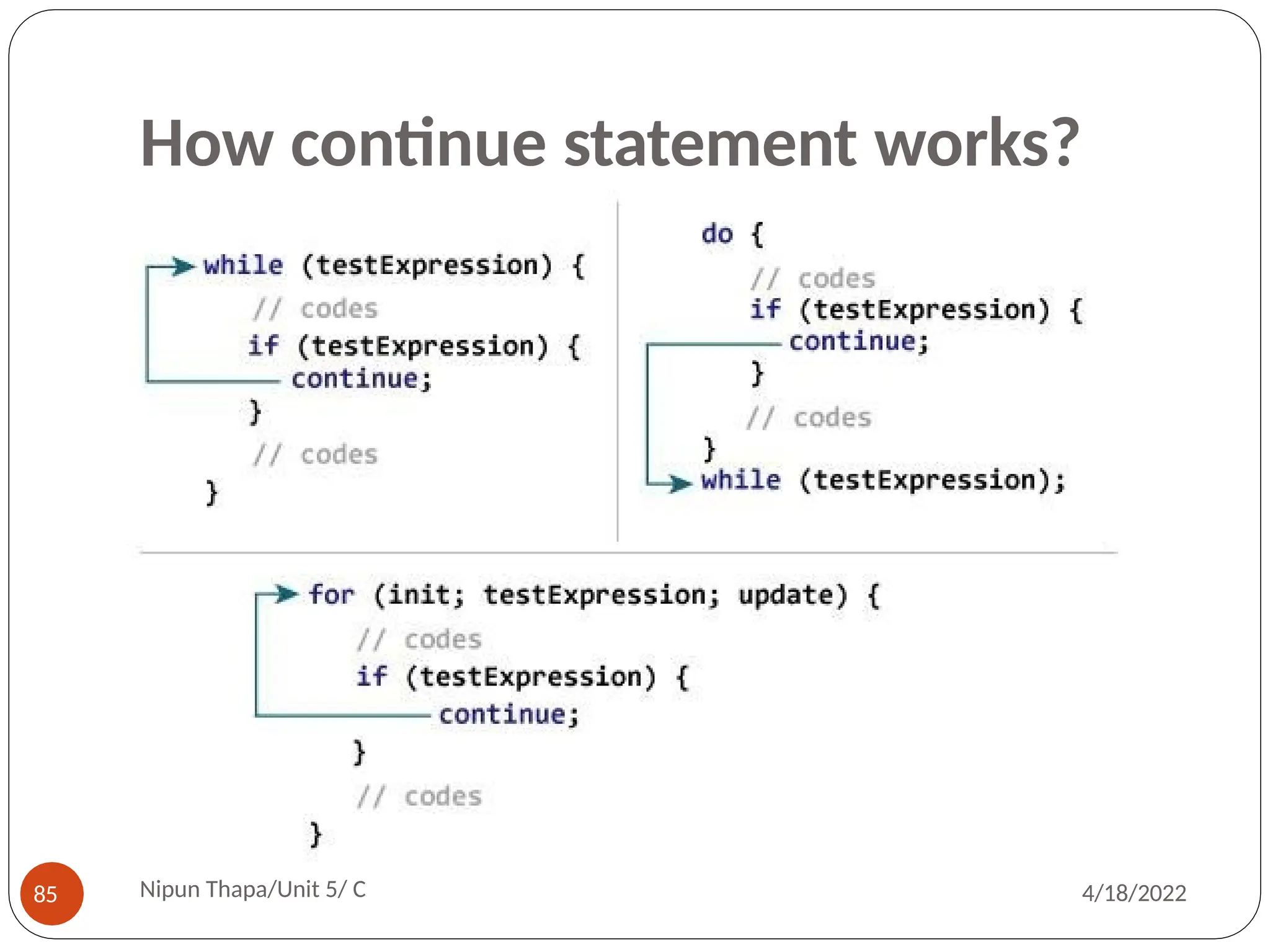
⚫The continue statement skips the current iteration of
the loop and continues with the next iteration.
⚫The continue statement is almost always used
with the if...else statement.
Nipun Thapa/Unit 5/ C
84 4/18/2022
How continue statement works?
Nipun Thapa/Unit 5/ C
85 4/18/2022
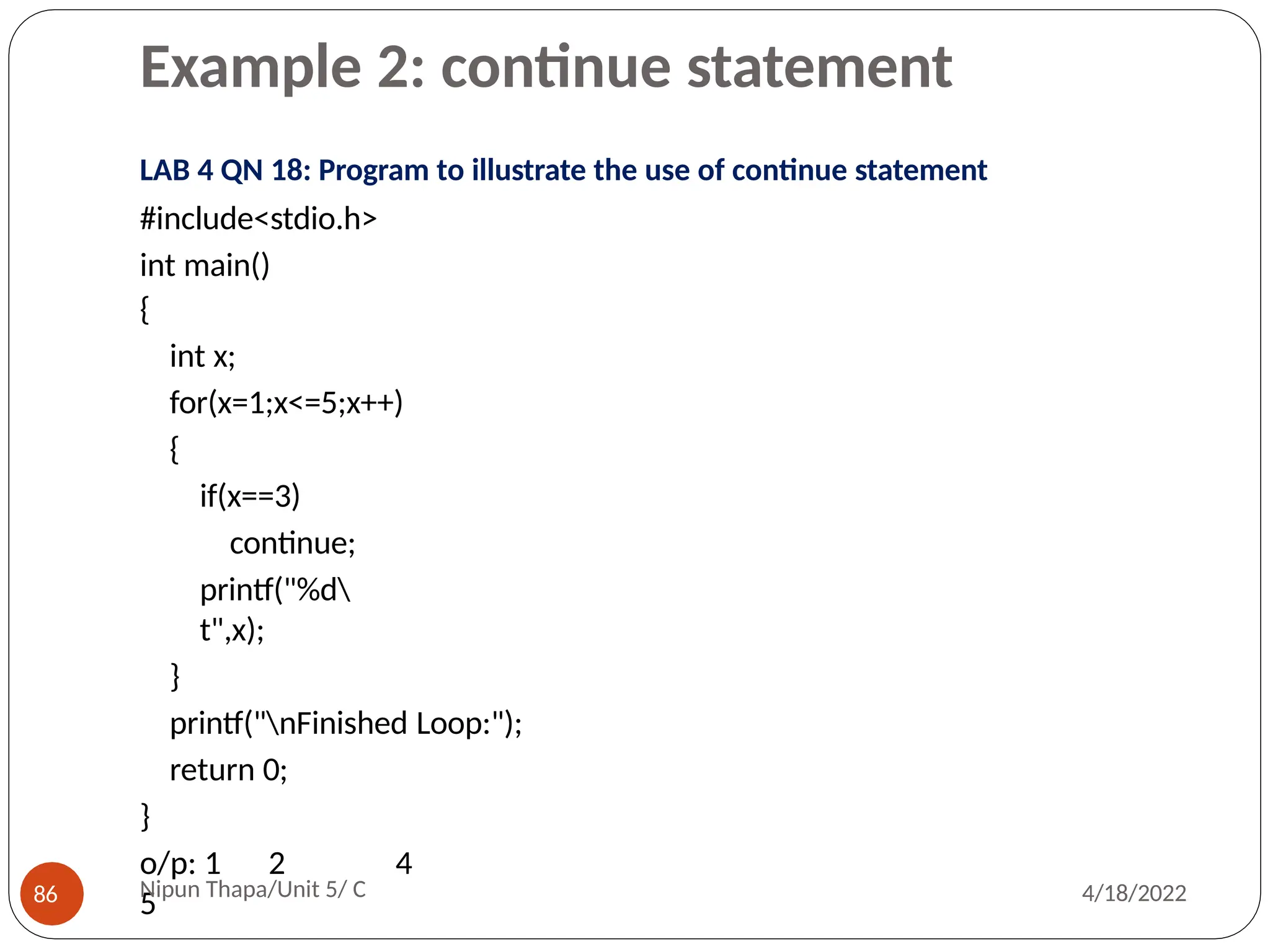
Example 2: continue statement
LAB 4 QN 18: Program to illustrate the use of continue statement
#include<stdio.h>
int main()
{
int x;
for(x=1;x<=5;x++)
{
if(x==3)
continue;
printf("%d
t",x);
}
printf("nFinished Loop:");
return 0;
}
o/p: 1 2 4
5
Nipun Thapa/Unit 5/ C
86 4/18/2022
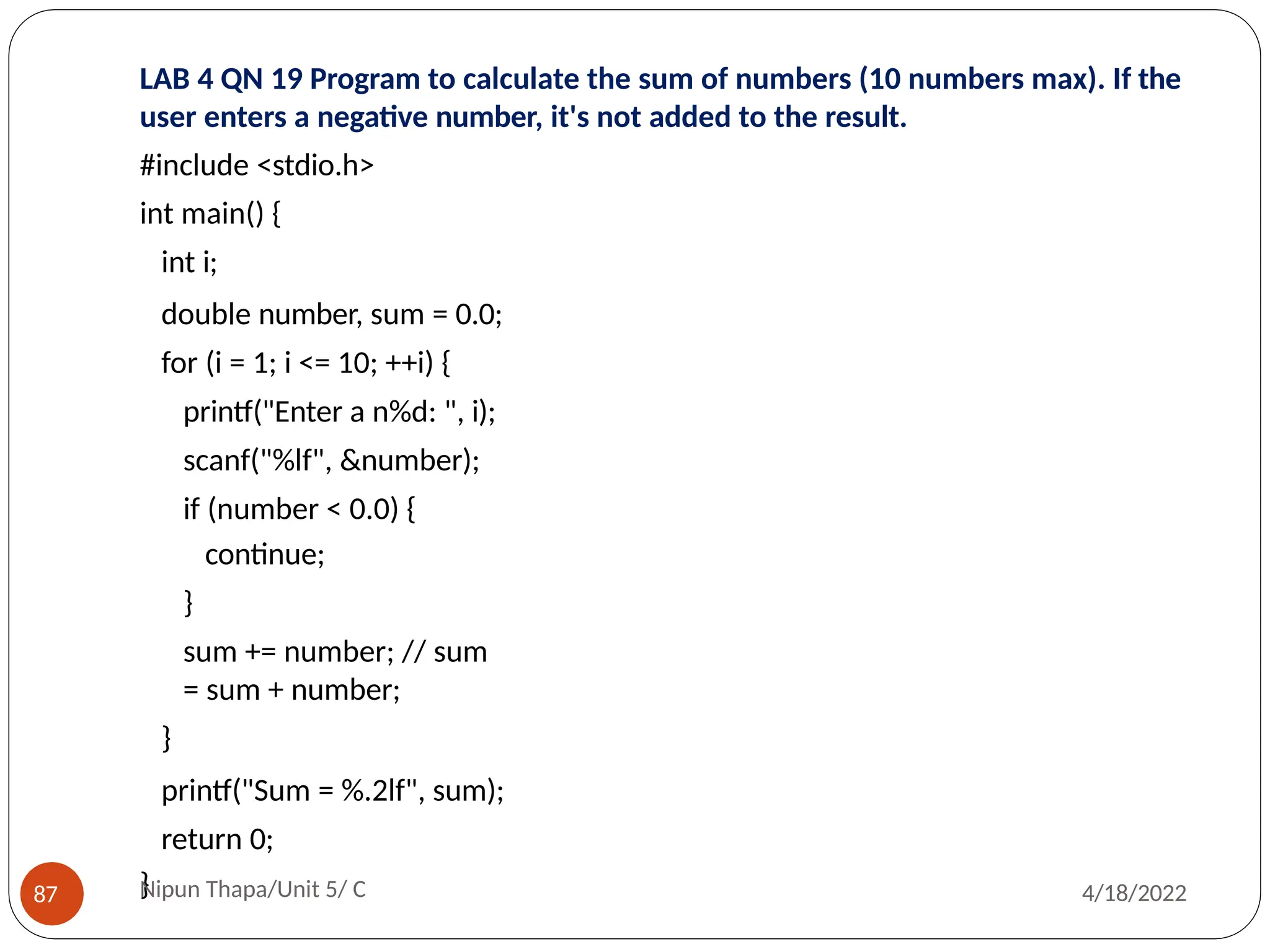
LAB 4 QN 19 Program to calculate the sum of numbers (10 numbers max). If the
user enters a negative number, it's not added to the result.
#include <stdio.h>
int main() {
int i;
double number, sum = 0.0;
for (i = 1; i <= 10; ++i) {
printf("Enter a n%d: ", i);
scanf("%lf", &number);
if (number < 0.0) {
continue;
}
sum += number; // sum
= sum + number;
}
printf("Sum = %.2lf", sum);
return 0;
}
Nipun Thapa/Unit 5/ C
87 4/18/2022
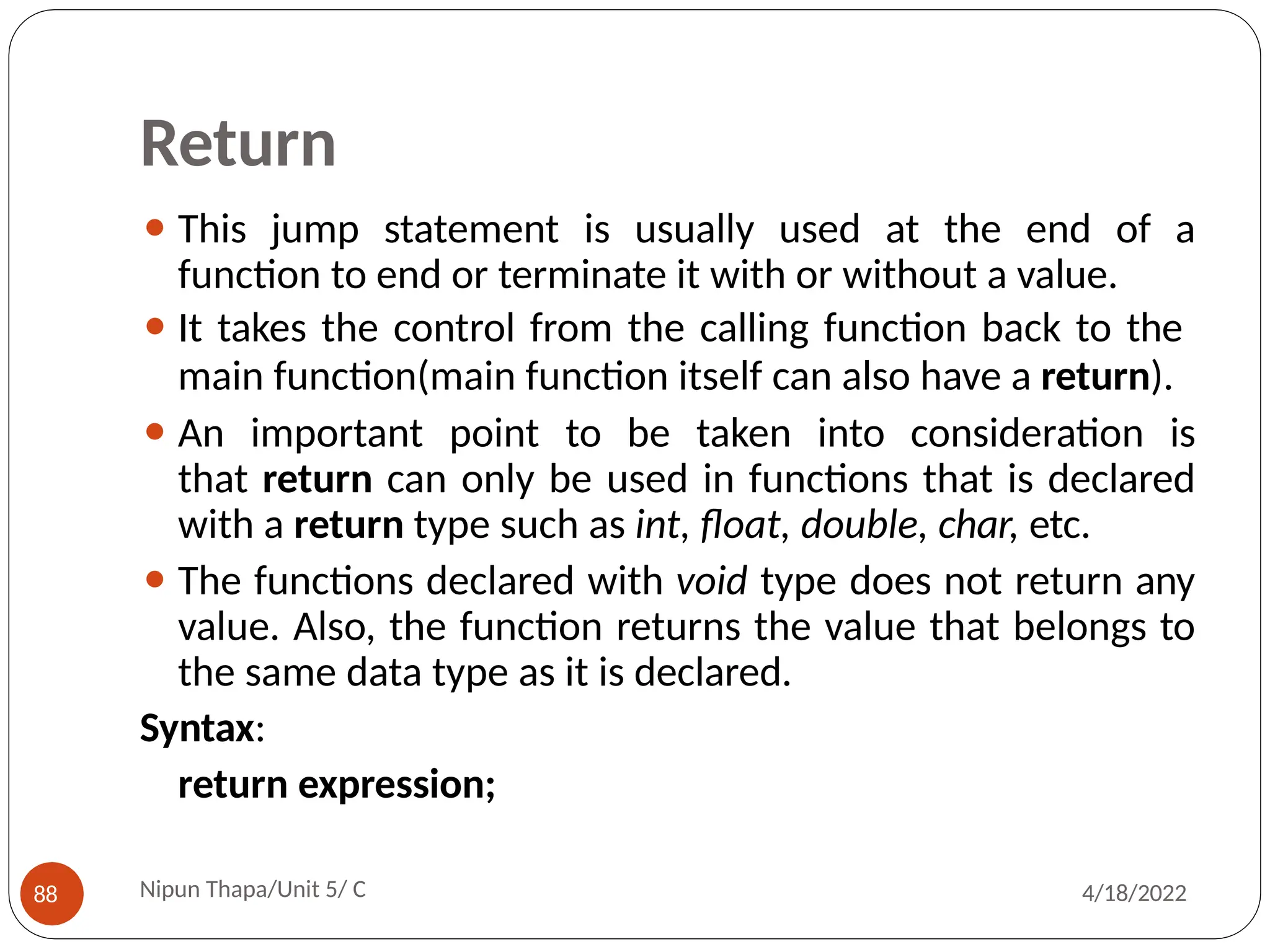
Return
⚫ This jump statement is usually used at the end of a
function to end or terminate it with or without a value.
⚫ It takes the control from the calling function back to the
main function(main function itself can also have a return).
⚫ An important point to be taken into consideration is
that return can only be used in functions that is declared
with a return type such as int, float, double, char, etc.
⚫ The functions declared with void type does not return any
value. Also, the function returns the value that belongs to
the same data type as it is declared.
Syntax:
return expression;
Nipun Thapa/Unit 5/ C
88 4/18/2022
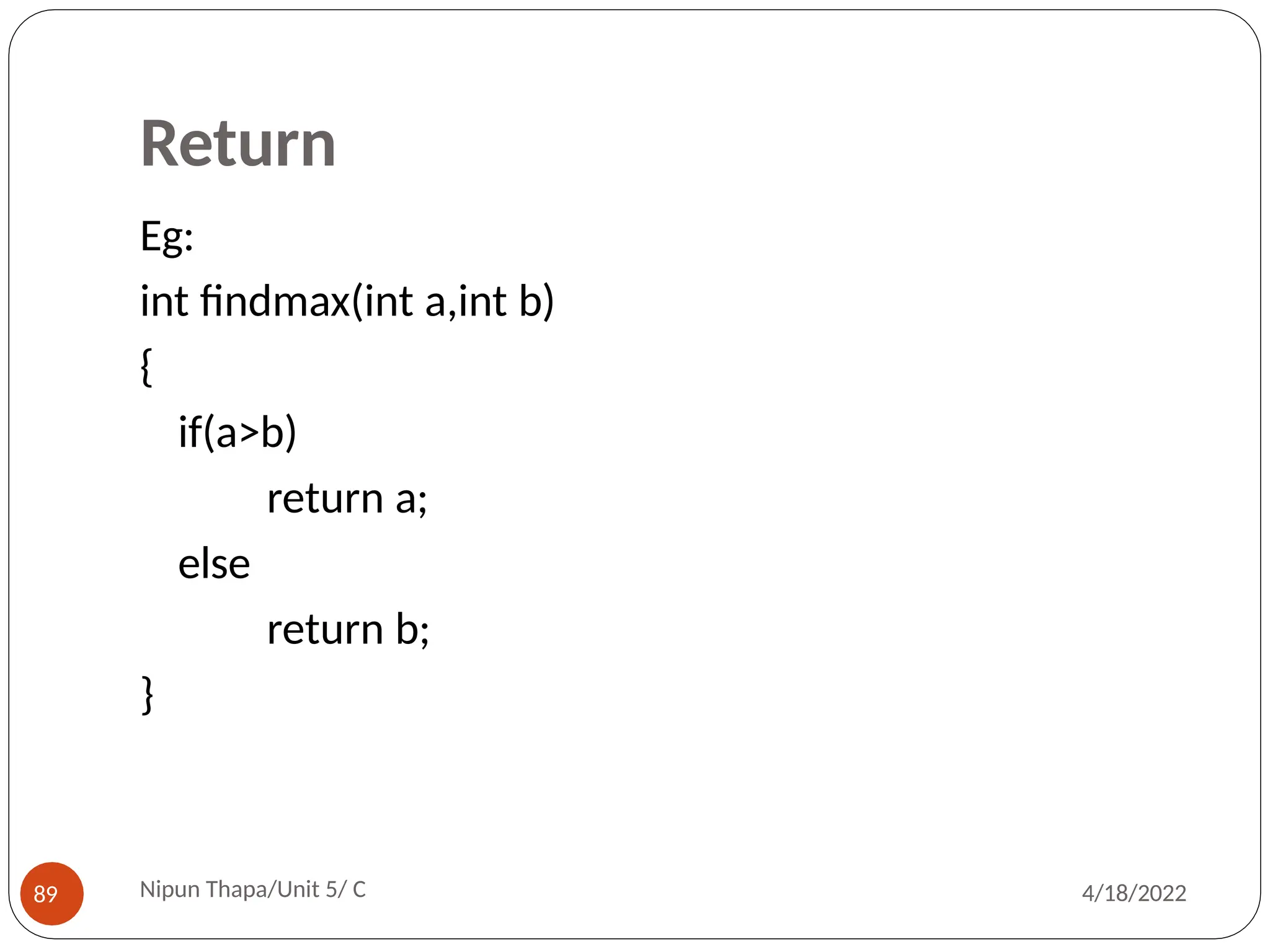
Return
Eg:
int findmax(int a,int b)
{
if(a>b)
return a;
else
return b;
}
Nipun Thapa/Unit 5/ C
89 4/18/2022
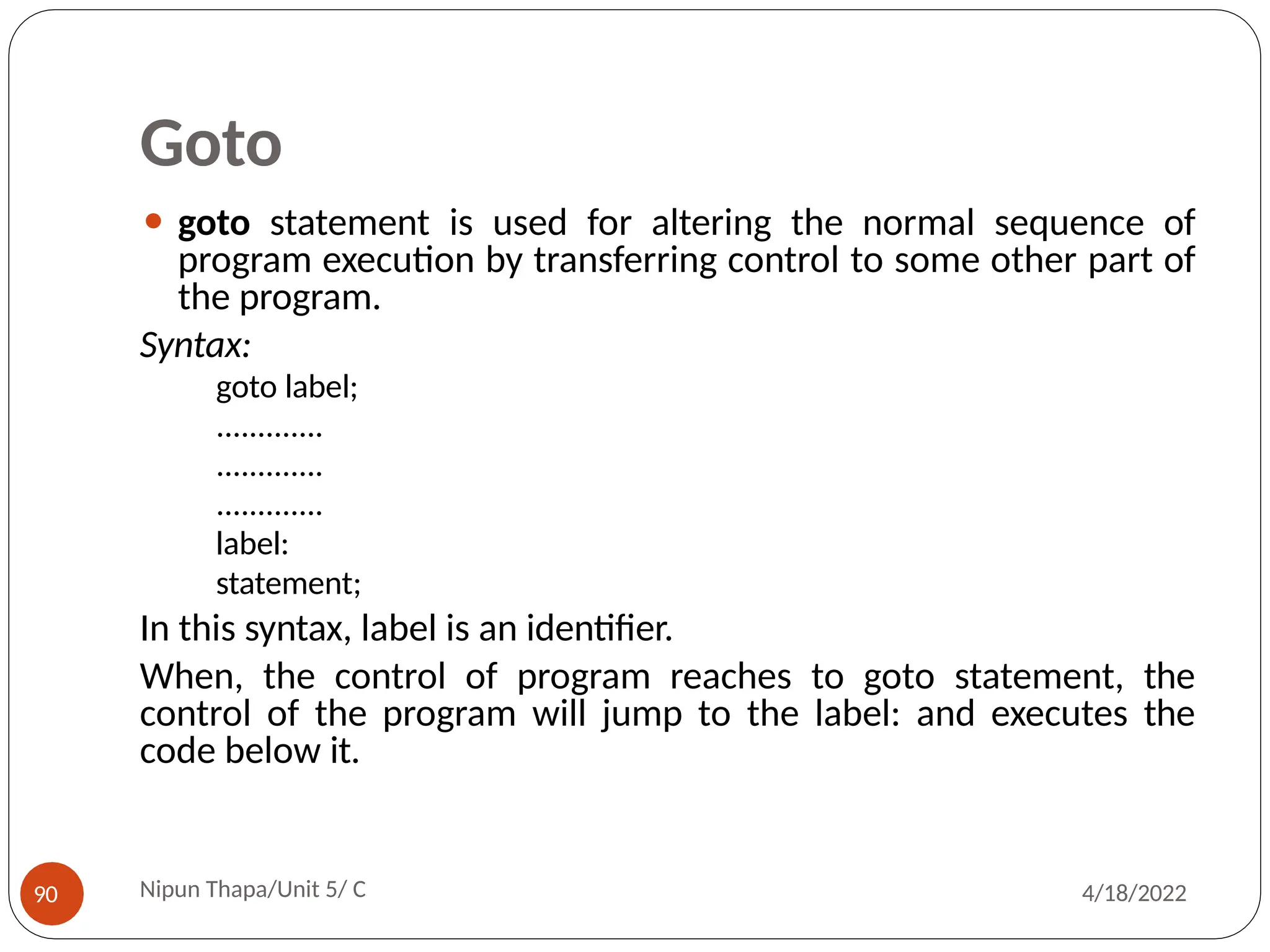
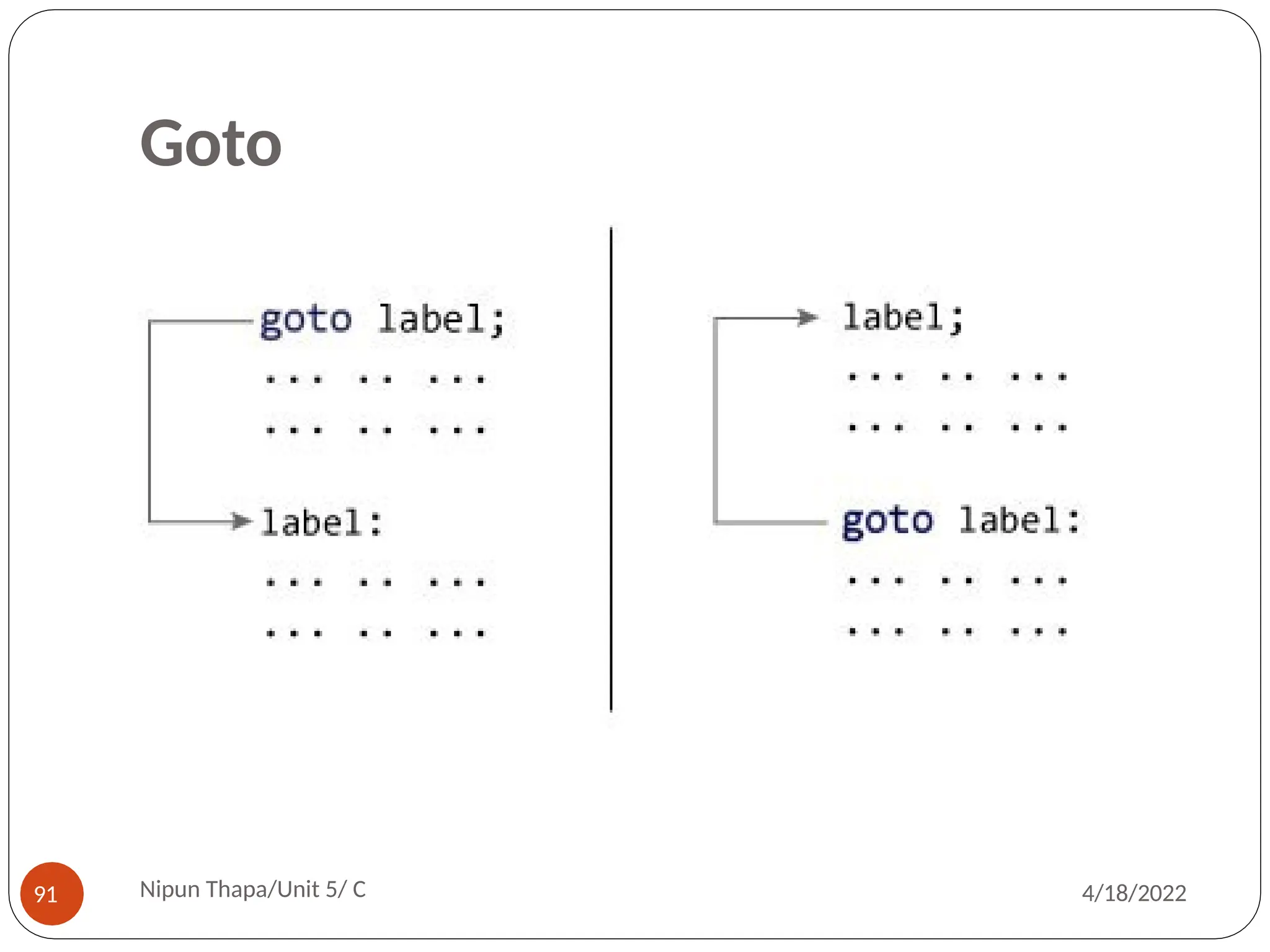
Goto
⚫ goto statement is used for altering the normal sequence of
program execution by transferring control to some other part of
the program.
Syntax:
goto label;
.............
.............
.............
label:
statement;
In this syntax, label is an identifier.
When, the control of program reaches to goto statement, the
control of the program will jump to the label: and executes the
code below it.
Nipun Thapa/Unit 5/ C
90 4/18/2022
Goto
Nipun Thapa/Unit 5/ C
91 4/18/2022
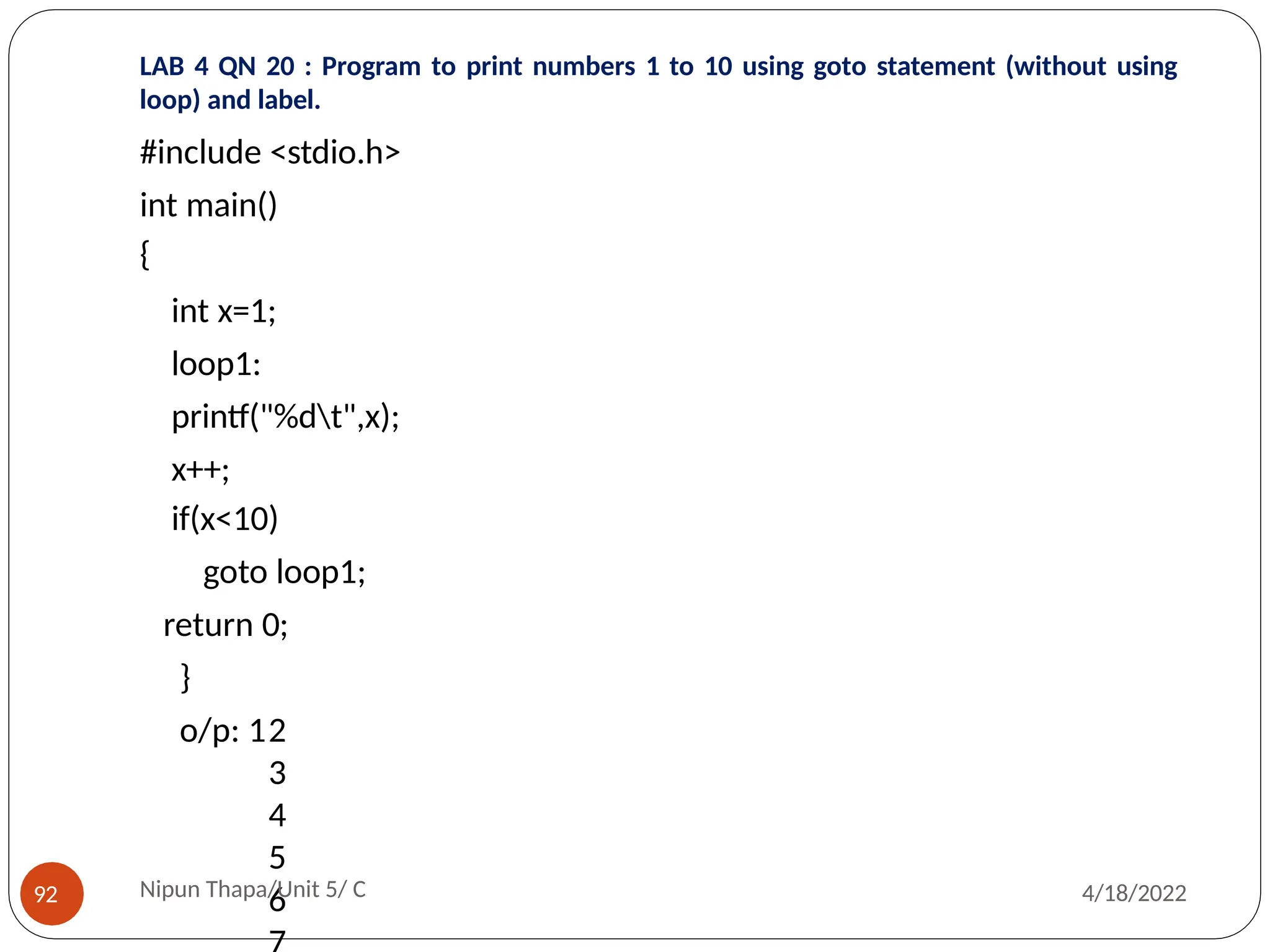
LAB 4 QN 20 : Program to print numbers 1 to 10 using goto statement (without using
loop) and label.
#include <stdio.h>
int main()
{
int x=1;
loop1:
printf("%dt",x);
x++;
if(x<10)
goto loop1;
return 0;
}
o/p: 12
3
4
5
6
Nipun Thapa/Unit 5/ C
92 4/18/2022
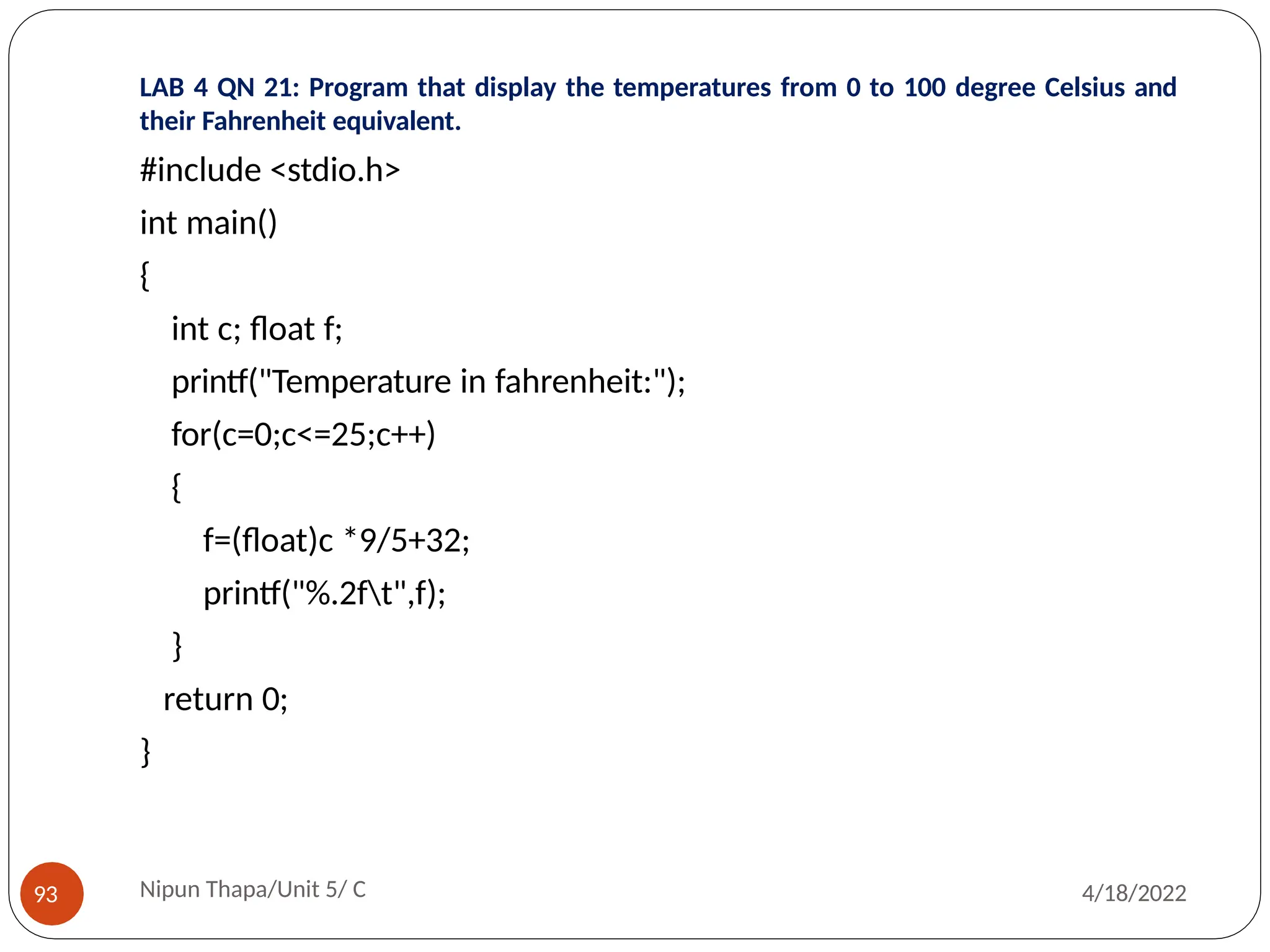
LAB 4 QN 21: Program that display the temperatures from 0 to 100 degree Celsius and
their Fahrenheit equivalent.
Nipun Thapa/Unit 5/ C
93 4/18/2022
#include <stdio.h>
int main()
{
int c; float f;
printf("Temperature in fahrenheit:");
for(c=0;c<=25;c++)
{
f=(float)c *9/5+32;
printf("%.2ft",f);
}
return 0;
}
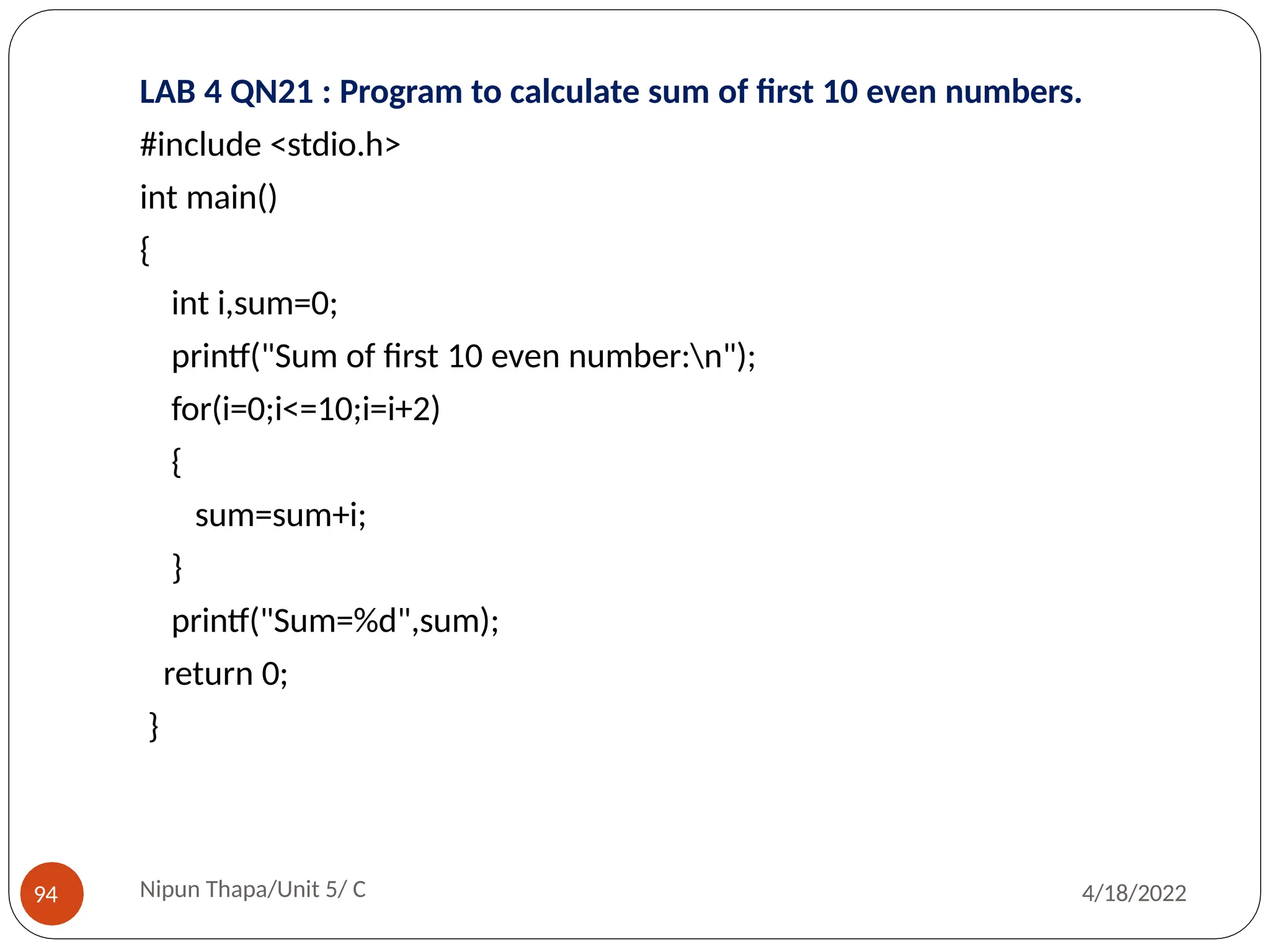
LAB 4 QN21 : Program to calculate sum of first 10 even numbers.
#include <stdio.h>
int main()
{
int i,sum=0;
printf("Sum of first 10 even number:n");
for(i=0;i<=10;i=i+2)
{
sum=sum+i;
}
printf("Sum=%d",sum);
return 0;
}
Nipun Thapa/Unit 5/ C
94 4/18/2022
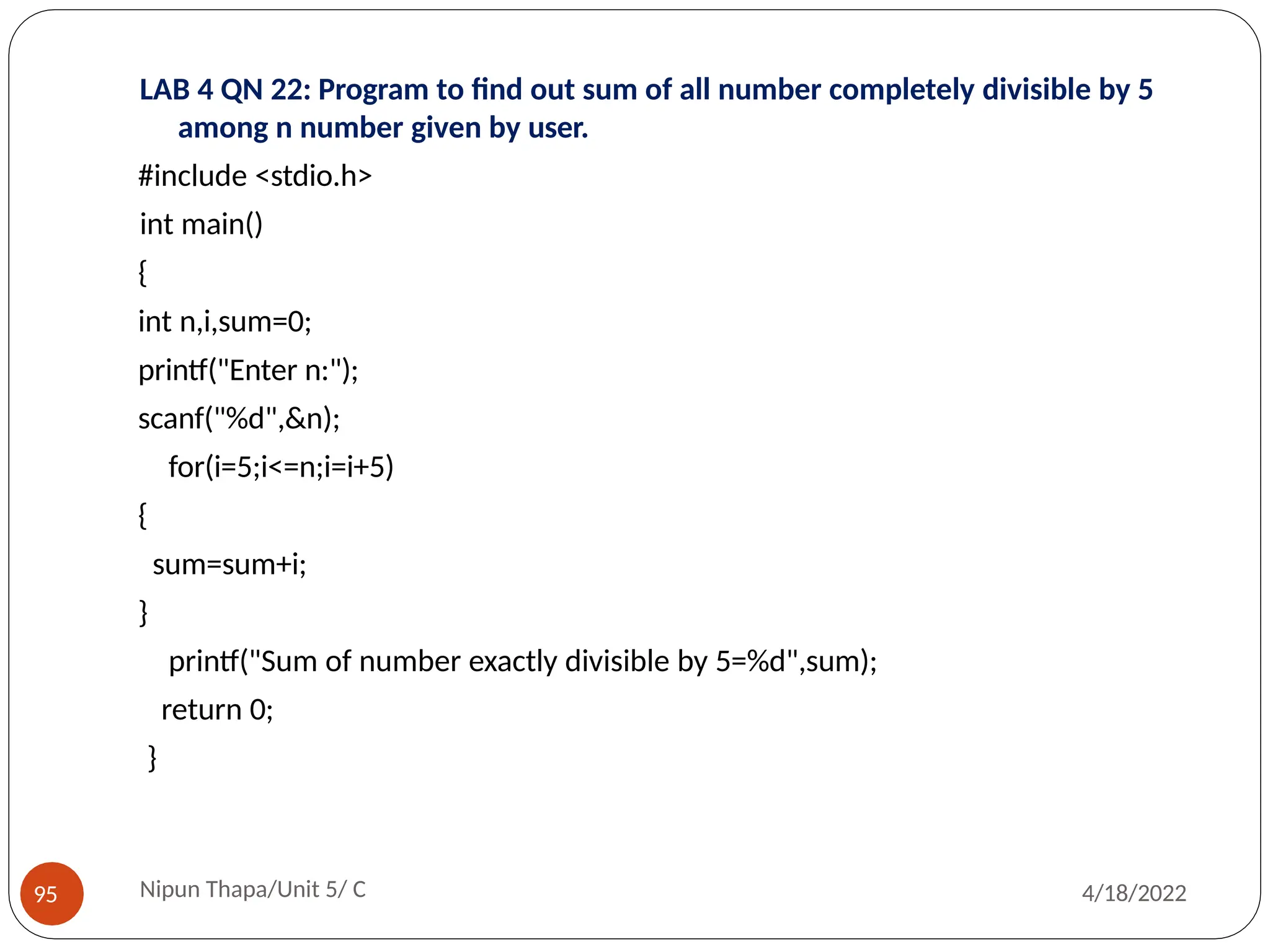
LAB 4 QN 22: Program to find out sum of all number completely divisible by 5
among n number given by user.
#include <stdio.h>
int main()
{
int n,i,sum=0;
printf("Enter n:");
scanf("%d",&n);
for(i=5;i<=n;i=i+5)
{
sum=sum+i;
}
printf("Sum of number exactly divisible by 5=%d",sum);
return 0;
}
Nipun Thapa/Unit 5/ C
95 4/18/2022
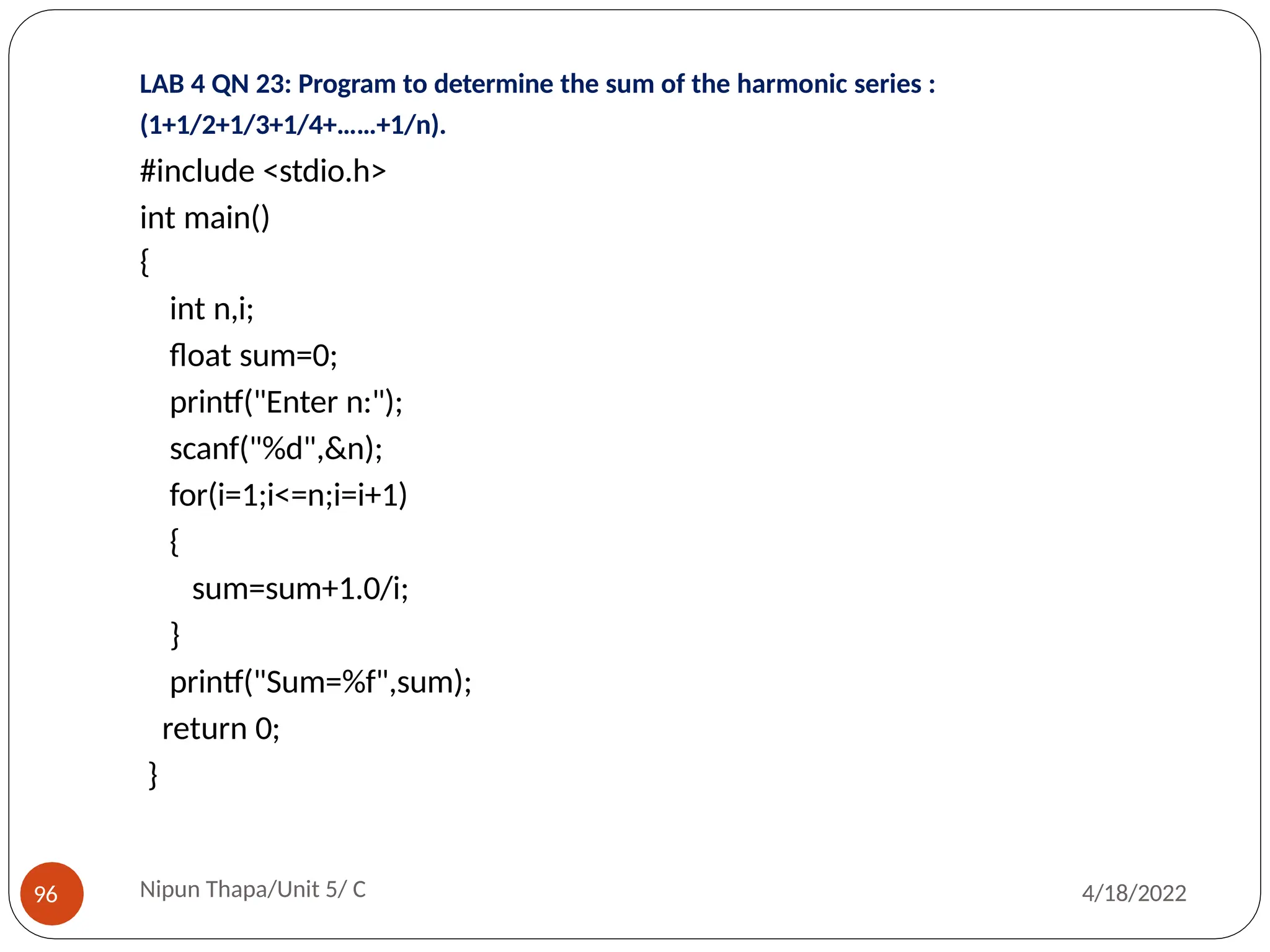
LAB 4 QN 23: Program to determine the sum of the harmonic series :
(1+1/2+1/3+1/4+……+1/n).
#include <stdio.h>
int main()
{
int n,i;
float sum=0;
printf("Enter n:");
scanf("%d",&n);
for(i=1;i<=n;i=i+1)
{
sum=sum+1.0/i;
}
printf("Sum=%f",sum);
return 0;
}
Nipun Thapa/Unit 5/ C
96 4/18/2022
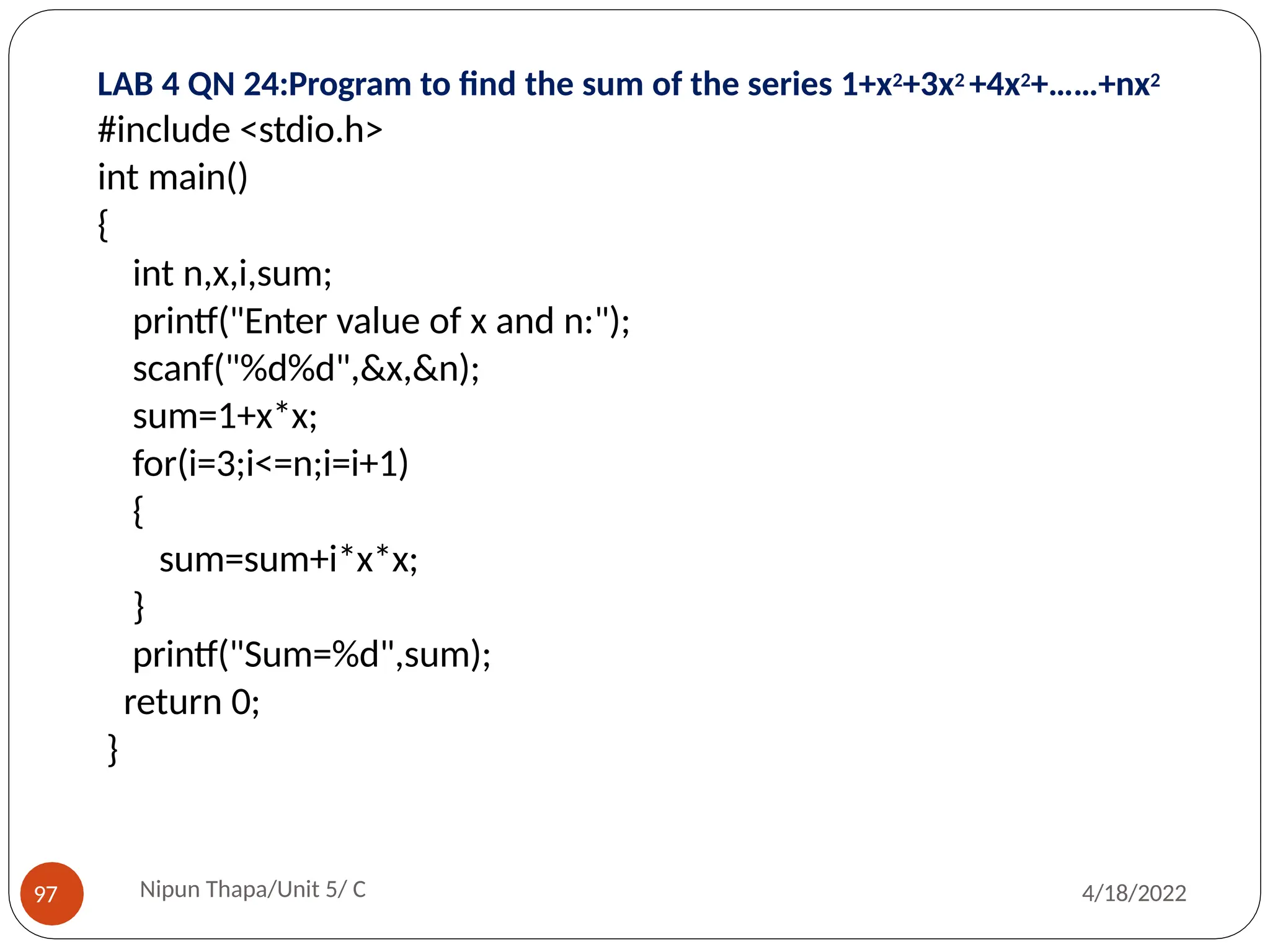
LAB 4 QN 24:Program to find the sum of the series 1+x2+3x2 +4x2+……+nx2
Nipun Thapa/Unit 5/ C
97 4/18/2022
#include <stdio.h>
int main()
{
int n,x,i,sum;
printf("Enter value of x and n:");
scanf("%d%d",&x,&n);
sum=1+x*x;
for(i=3;i<=n;i=i+1)
{
sum=sum+i*x*x;
}
printf("Sum=%d",sum);
return 0;
}
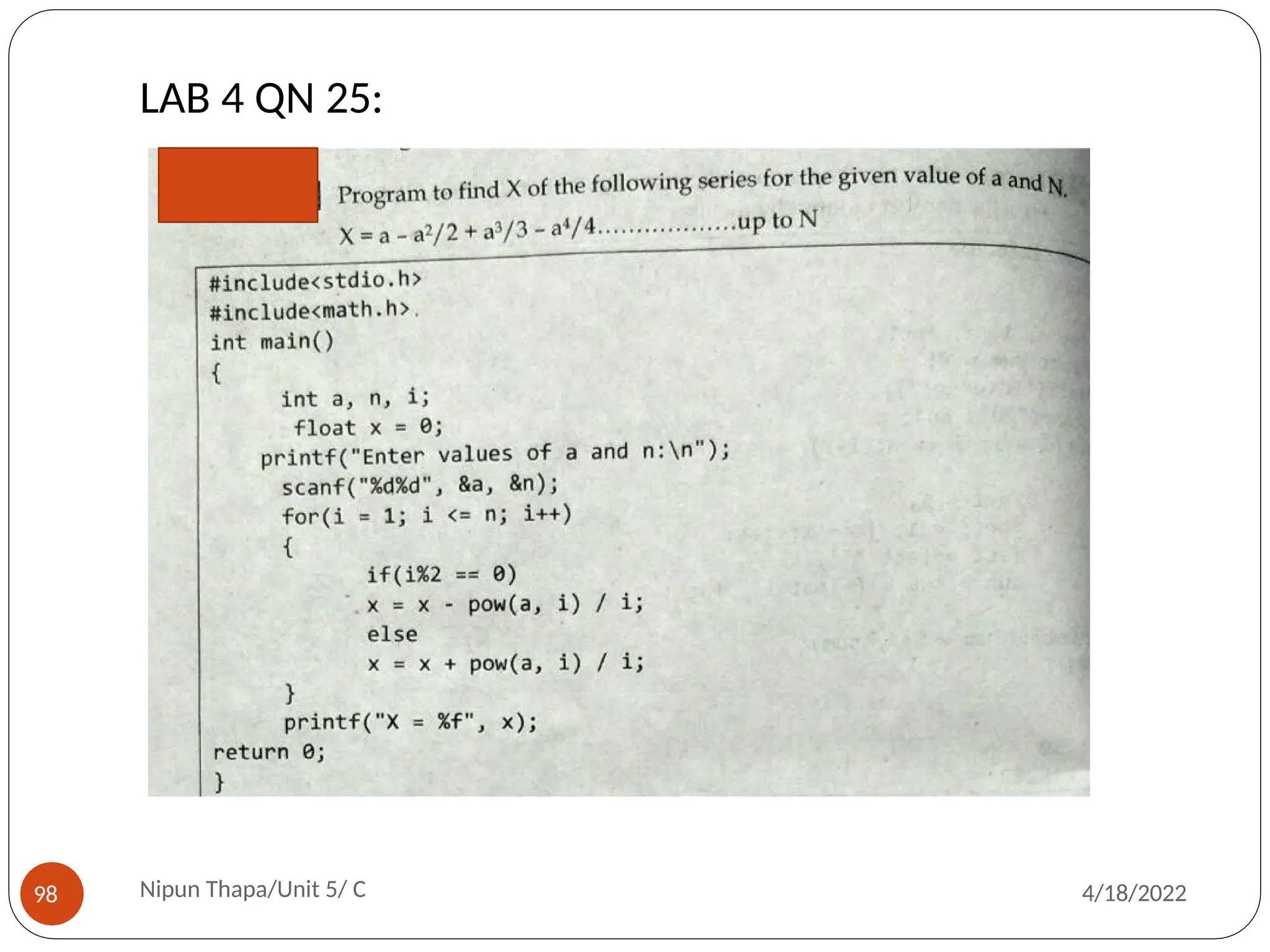
LAB 4 QN 25:
Nipun Thapa/Unit 5/ C
98 4/18/2022
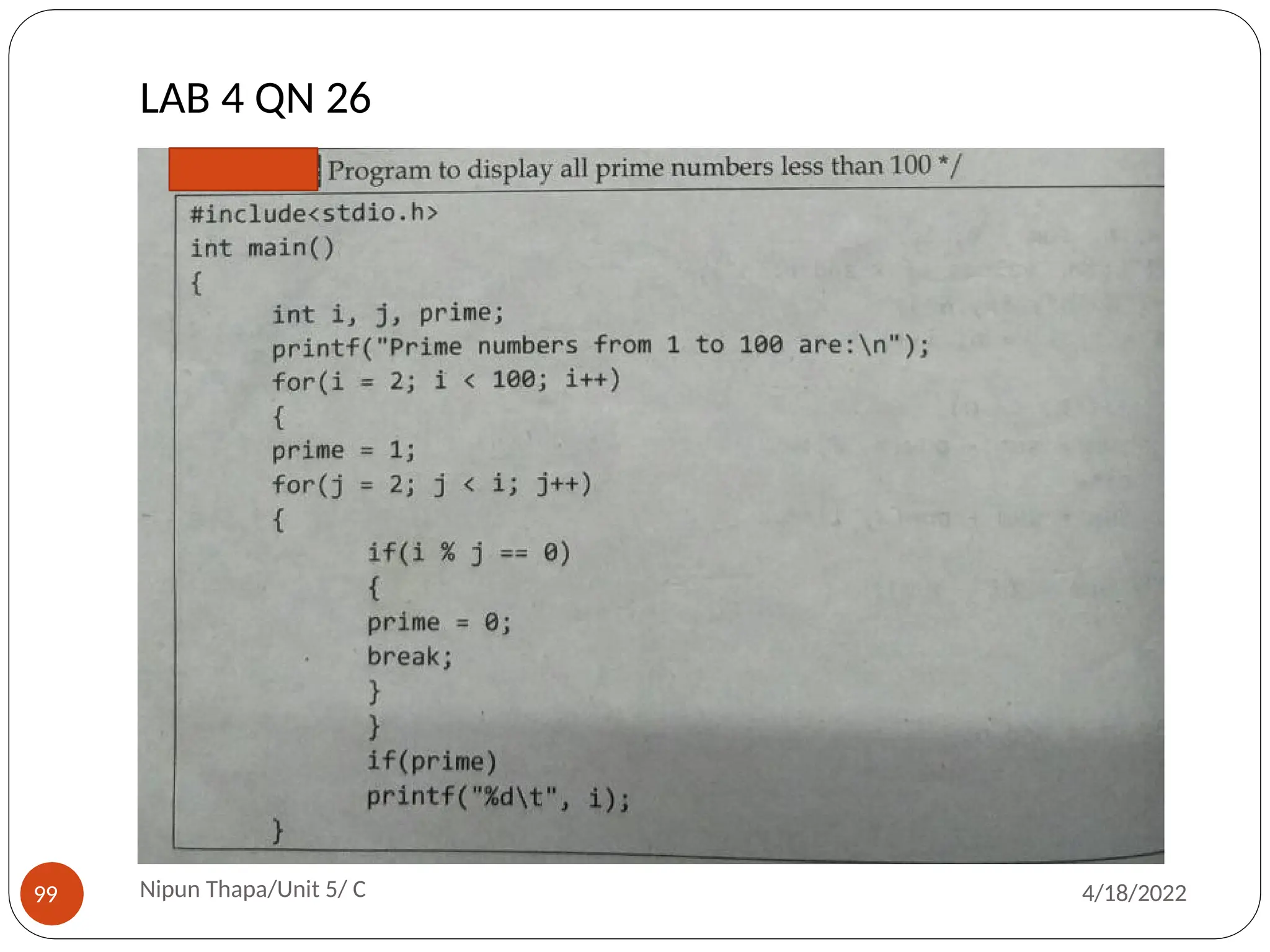
LAB 4 QN 26
Nipun Thapa/Unit 5/ C
99 4/18/2022
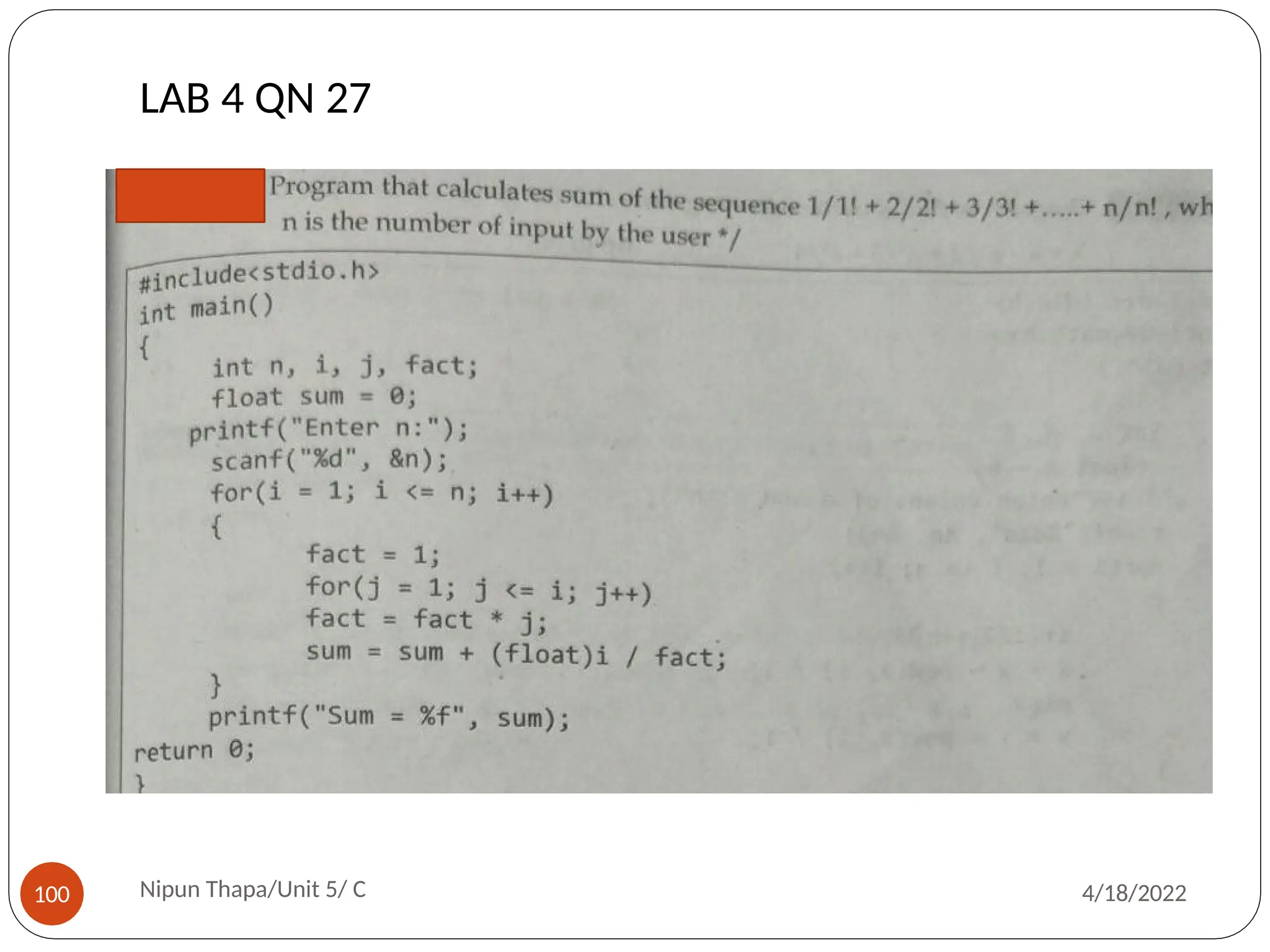
LAB 4 QN 27
Nipun Thapa/Unit 5/ C
100 4/18/2022
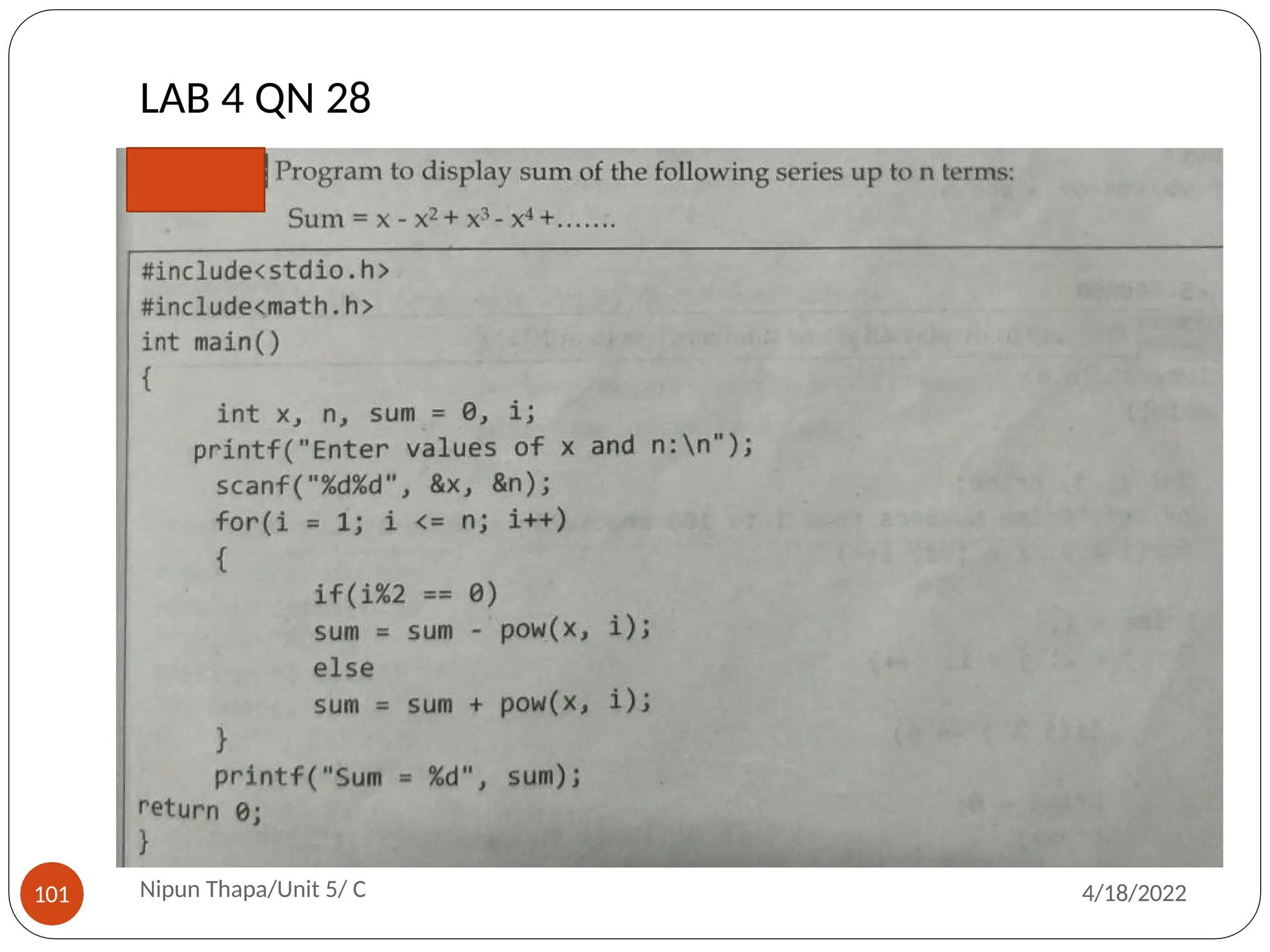
LAB 4 QN 28
Nipun Thapa/Unit 5/ C
101 4/18/2022
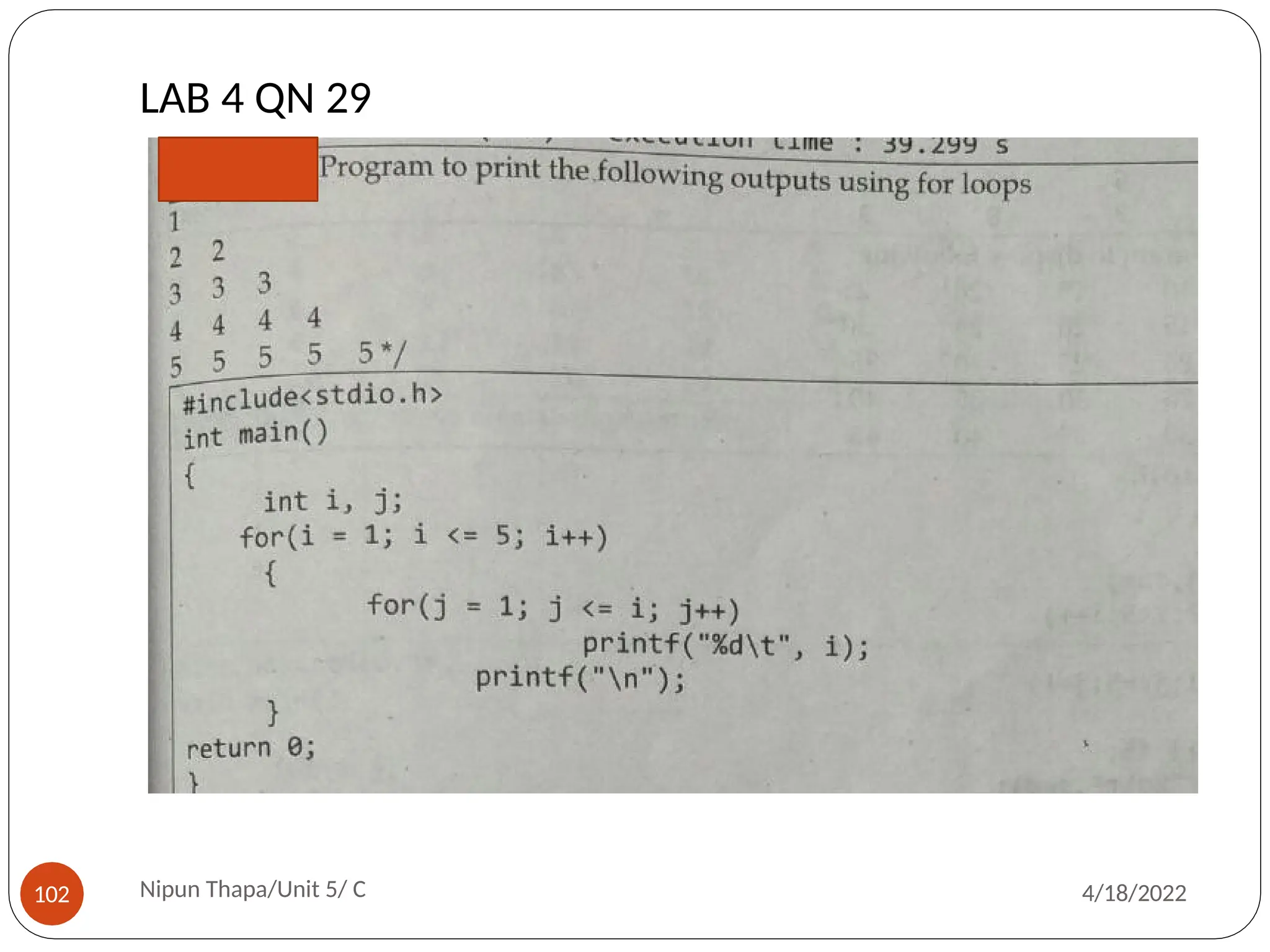
LAB 4 QN 29
Nipun Thapa/Unit 5/ C
102 4/18/2022
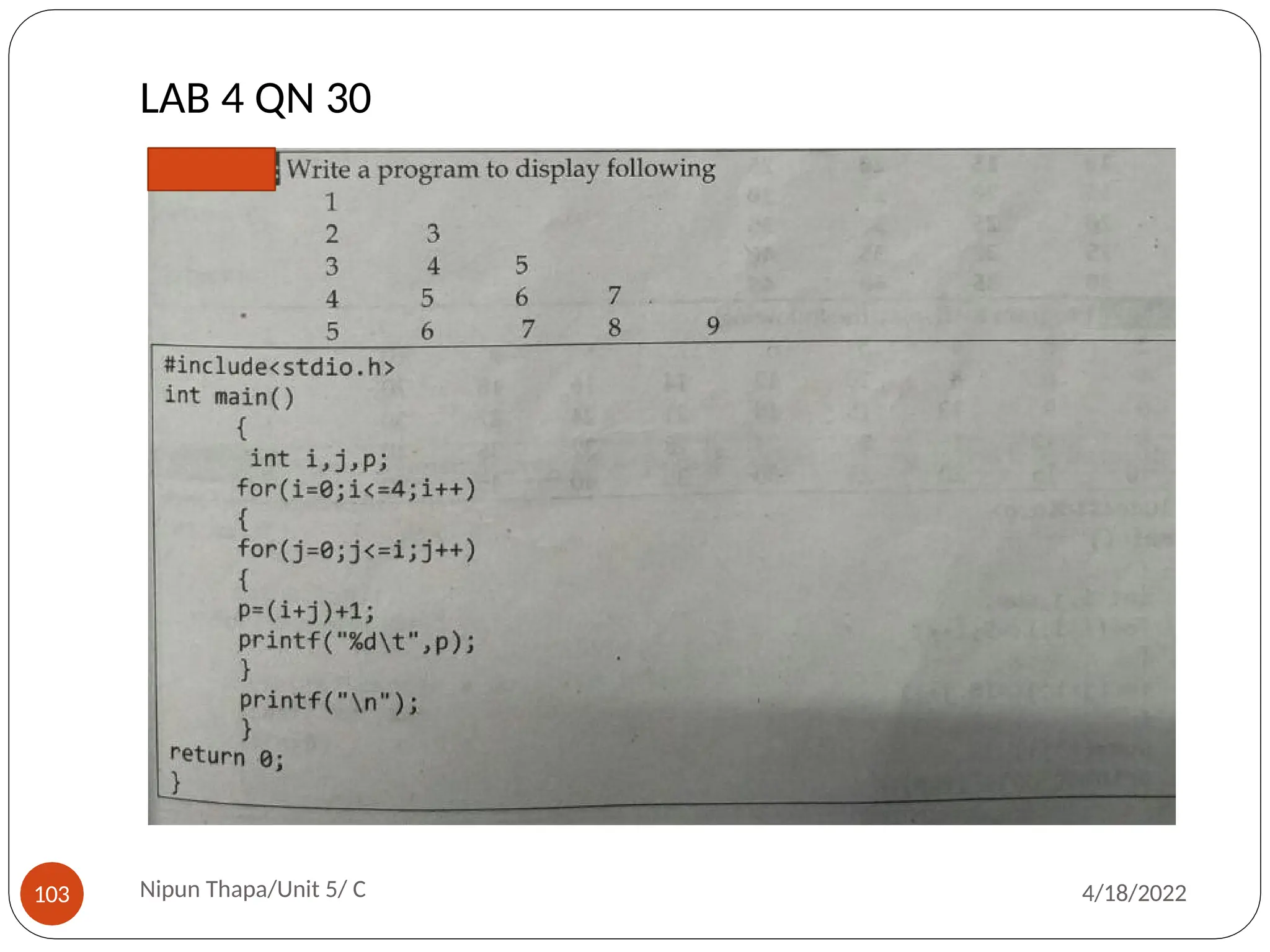
LAB 4 QN 30
Nipun Thapa/Unit 5/ C
103 4/18/2022
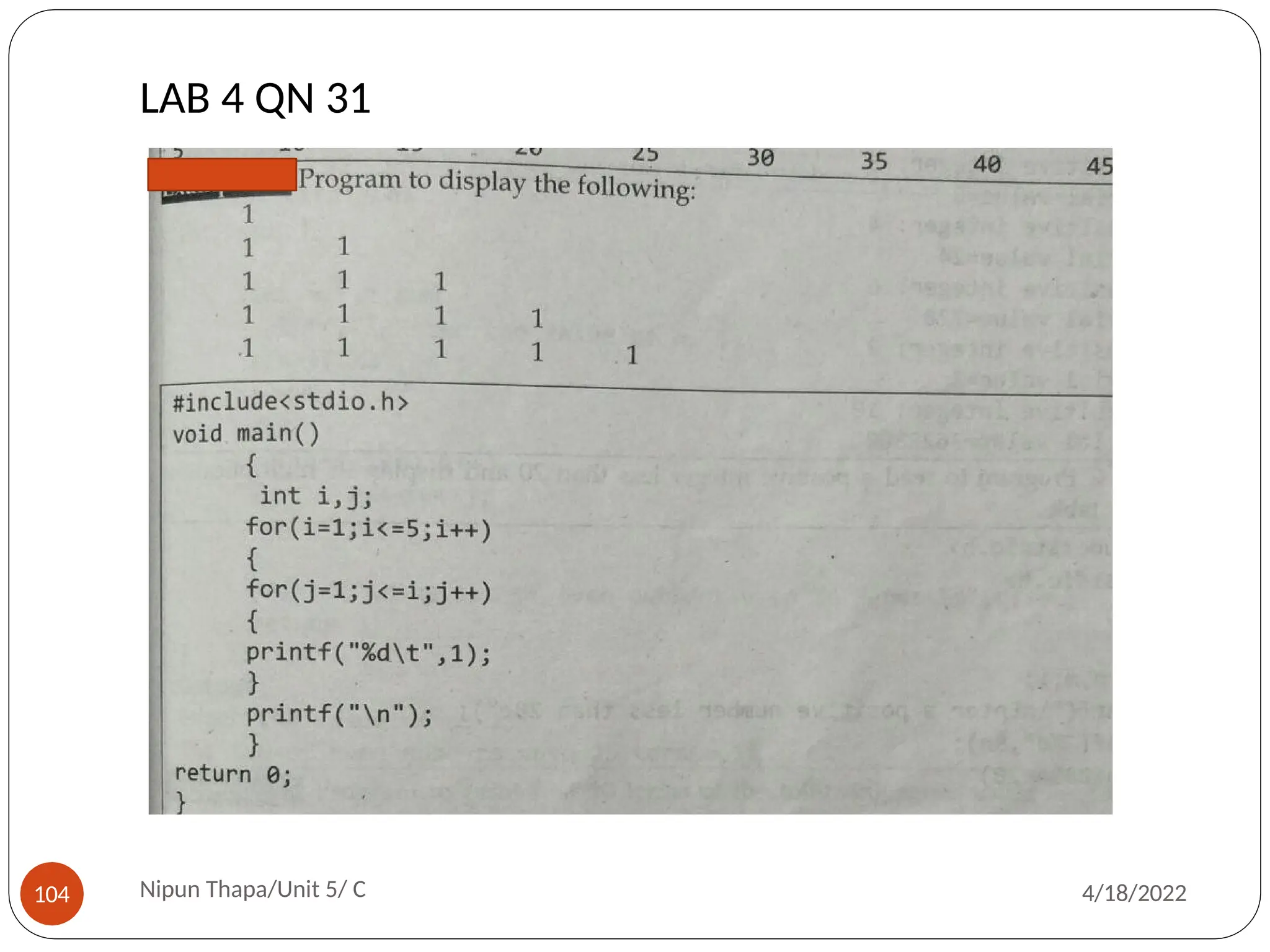
LAB 4 QN 31
Nipun Thapa/Unit 5/ C
104 4/18/2022
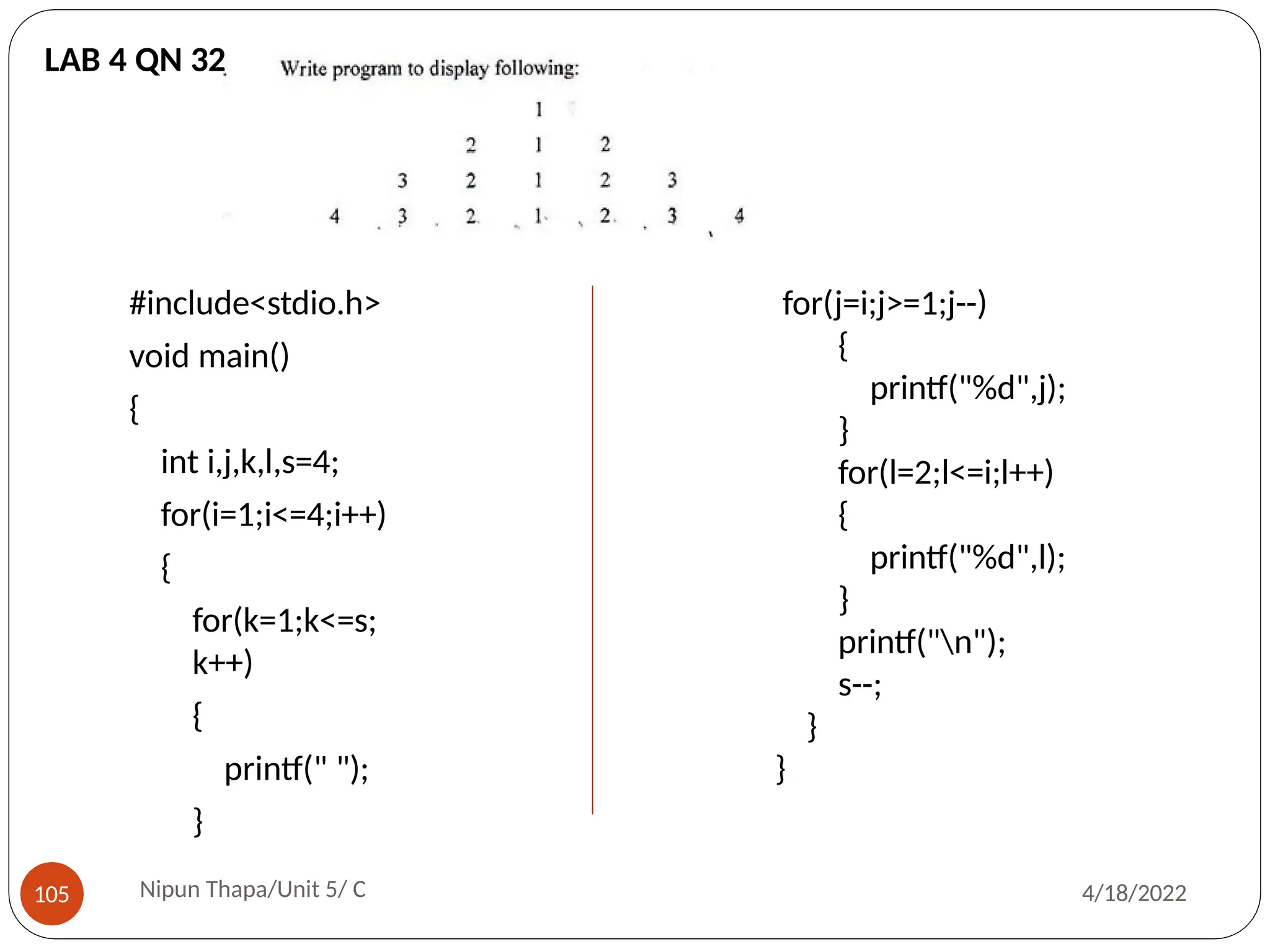
#include<stdio.h>
void main()
{
int i,j,k,l,s=4;
for(i=1;i<=4;i++)
{
for(k=1;k<=s;
k++)
{
printf(" ");
}
for(j=i;j>=1;j--)
{
printf("%d",j);
}
for(l=2;l<=i;l++)
{
printf("%d",l);
}
printf("n");
s--;
}
}
LAB 4 QN 32
Nipun Thapa/Unit 5/ C
105 4/18/2022
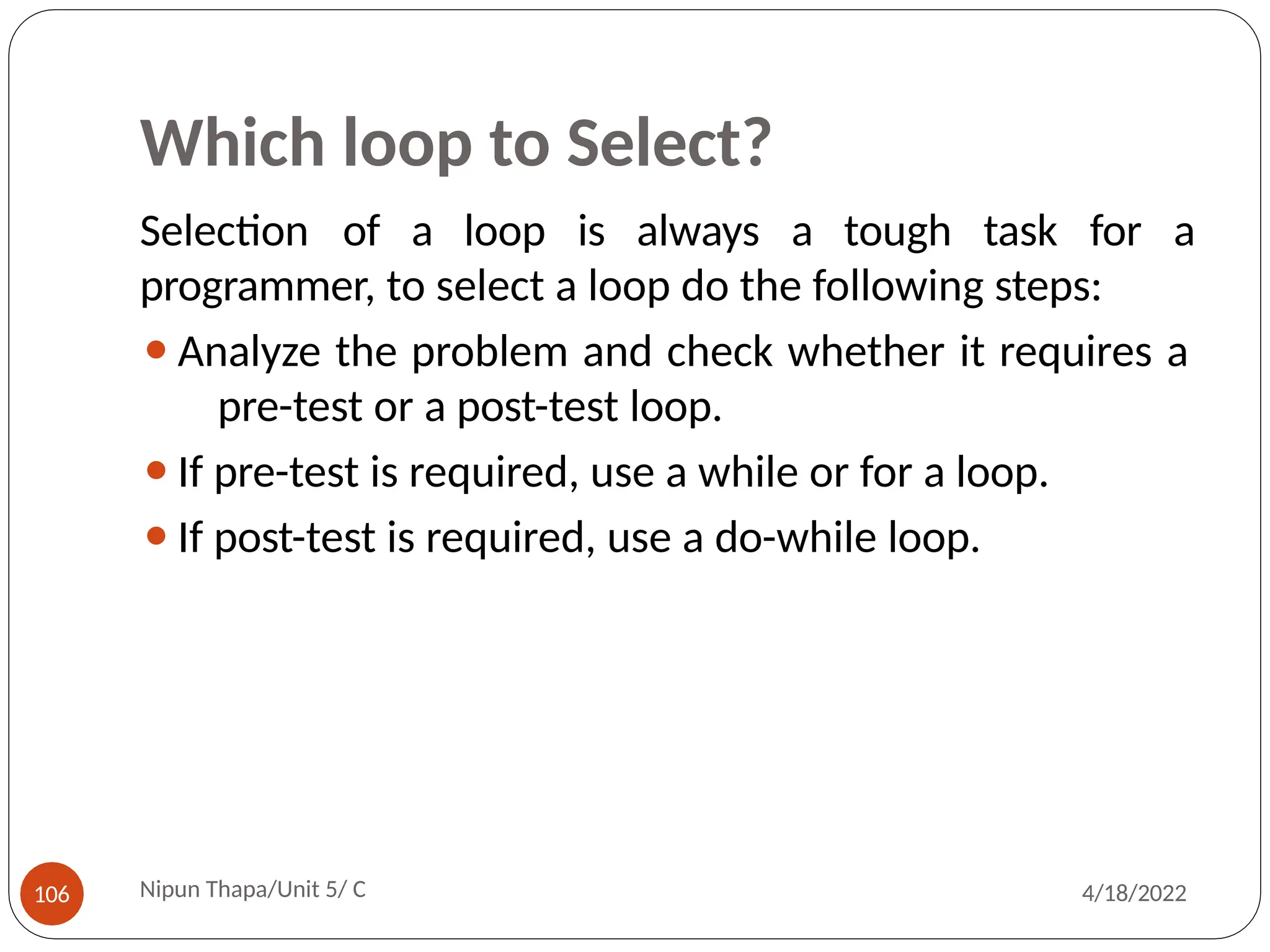
Which loop to Select?
Selection of a loop is always a tough task for a
programmer, to select a loop do the following steps:
⚫Analyze the problem and check whether it requires a
pre-test or a post-test loop.
⚫If pre-test is required, use a while or for a loop.
⚫If post-test is required, use a do-while loop.
Nipun Thapa/Unit 5/ C
106 4/18/2022
Finished
Chapter 5
Nipun Thapa/Unit 5/ C
107 4/18/2022

Structured Programming Unit-5-Control-Structure.pptx

  • 1.
  • 2.
    Decision Making Statement ⚫There come situations in real life when we need to make some decisions and based on these decisions, we decide what should we do next. ⚫ Similar situations arise in programming also where we need to make some decisions and based on these decisions we will execute the next block of code. ⚫ For example, in C if x occurs then execute y else execute z. There can also be multiple conditions like in C if x occurs then execute p, else if condition y occurs execute q, else execute r. This condition of C else-if is one of the many ways of importing multiple conditions. Nipun Thapa/Unit 5/ C 2 4/18/2022
  • 3.
    Decision Making Statement NipunThapa/Unit 5/ C 3 4/18/2022
  • 4.
    if statement ⚫The ifstatement is a two way decision statement and is used together with an expression, i.e. test condition. ⚫The if statement evaluates the test expression first and then, if the value of the expression is true, it execute the statement(s) within its block. ⚫Otherwise, it skips the statements within its block and continues from the first statement outside the if block. Nipun Thapa/Unit 5/ C 4 4/18/2022
  • 5.
    if statement ⚫The generalsyntax is : Nipun Thapa/Unit 5/ C 5 4/18/2022 if(condition) { statement(s); }
  • 6.
    if statement ⚫The flowchart NipunThapa/Unit 5/ C 6 4/18/2022
  • 7.
    if statement // LAB3 Q.N.1 : Program to check whether entered number is negative.(using if statement) #include<stdio.h> int main() { int number; printf("Entered number:"); scanf("%d",&number); //decision making statement if(number<0) { printf("The given number is negative"); printf(" n The number %d is negative",number); } return 0; } Nipun Thapa/Unit 5/ C 7 4/18/2022
  • 8.
    if else statement ⚫Theif…else statement is an execution of the simple if statement. ⚫It is used when there are two possible action – one when a condition is true, and the other when the condition is false. ⚫If expression evaluates to true, true block statement is executed ⚫If expression evaluates to false, false block statement is executed Nipun Thapa/Unit 5/ C 8 4/18/2022
  • 9.
    if else statement ⚫Syntax If( condition ) { true_statement(s) ; } else { false_statement(s); } Nipun Thapa/Unit 5/ C 9 4/18/2022
  • 10.
    if else statement ⚫Flowchart NipunThapa/Unit 5/ C 10 4/18/2022
  • 11.
    if else statement //lab3 QN 2: Check given number is positive or negative. #include<stdio.h> int main() { int number; printf("Enter the number:"); scanf("%d",&number); //decision making if(number>=0) // true condtion { printf("Your entered number is positive"); } else // else(number<0), false { printf("Your entered number is negative"); } return 0; } Nipun Thapa/Unit 5/ C 11 4/18/2022
  • 12.
    if else statement //LAB3 QN3: Program to find the number is even or odd.(using If..else statement) #include<stdio.h> int main() { int number; printf("Enter number:"); scanf("%d",&number); / / d e c i s i o n m a k i n g Nipun Thapa/Unit 5/ C 12 4/18/2022
  • 13.
    if else statement /*LAB3 QN4: Program to find the profit or loss using selling price and cost price.(using If..else statement)*/ #include<stdio.h> int main() { int SP,CP,P,L; printf("Enter selling price(SP) and Cost price(CP):"); scanf("%d%d",&SP,&CP); if(SP>CP) { P=SP-CP; printf("Your profit amount is = %d",P); } else { L=CP-SP; printf("Your loss amount is = %d",L); } return 0; } Nipun Thapa/Unit 5/ C 13 4/18/2022
  • 14.
    if else statement /*LAB3 QN5: Program to find the largest number among two number. (using If..else statement)*/ #include<stdio.h> int main() { int n1,n2; printf("Enter two numbers:"); scanf("%d%d",&n1,&n2); //decision making if(n1>n2) { printf("%d is greater than %d",n1,n 2); } else { printf("%d is greater than %d",n2,n 1); Nipun Thapa/Unit 5/ C 14 4/18/2022
  • 15.
    if else statement /*LAB3 QN6: Program to check the number is divisible by 5 or not. (using If..else statement)*/ Nipun Thapa/Unit 5/ C 15 4/18/2022
  • 16.
    Nested If statement ⚫Whena series of decisions are involved, we may have to use more than one if else statement in nested. ⚫A if statement contains another if else statement is called nested if statement. Nipun Thapa/Unit 5/ C 16 4/18/2022 ⚫The condition are execute from checking each condition whether top to bottom it meets the condition criteria or not ⚫ if it found the condition is true then it executes the block associated statements of true part else it goes to next condition to execute.
  • 17.
    Nested If statement ⚫Format If (condition1) { if (condition 2) { statement_1; } else { statement_2; } } e l s e { s t a Nipun Thapa/Unit 5/ C 17 4/18/2022
  • 18.
    Nested If statement NipunThapa/Unit 5/ C 18 4/18/2022
  • 19.
    Nested If..else statement ⚫Similarto nested if statement, if..else statements shall also be written inside the body of another if..else body called nested if..else statement. ⚫An entire if..else construct is written under either the body of an if statement or the body of an else statement. ⚫The if..else statement shall be declared within either anyone of if or else body statement or both. Nipun Thapa/Unit 5/ C 19 4/18/2022
  • 20.
    Nested If..else statement ⚫Format If (condition1) { if (condition 2) { statement_1; } else { statement_2; } } else { if (condition 3) { statement_3; } else { statement_4; } } Nipun Thapa/Unit 5/ C 20 4/18/2022
  • 21.
    Nested If..else statement NipunThapa/Unit 5/ C 21 4/18/2022
  • 22.
    Nested If statement /*LAB3 QN7: Program to find largest number among the three numbers using nested if..else condition.ex: 1,3,5 :- 5 is the largest number*/ #include<stdio.h> int main() { int n1,n2,n3; printf("Enter three numbers:"); scanf("%d %d%d",&n1,&n2,&n3); //5,2,1 if(n1>n2) { if(n1>n3) printf("%d is the largest number",n1); else printf("%d is the largest number",n3); } else // (n2<n1) { if(n2>n3) printf("%d is largest number",n2); else printf("%d is the largest number",n3); } return 0; } Nipun Thapa/Unit 5/ C 22 4/18/2022
  • 23.
    If-else-if ladder statement ⚫Thisis a type of nesting in which there is an if…else statement in every part except the last else part. ⚫This type of nesting is frequently used in programs and also known as else if ladder . ⚫This construct is if-else-if ladder because of its appearance Nipun Thapa/Unit 5/ C 23 4/18/2022
  • 24.
    If-else-if ladder statement ⚫Syntax If(condition 1) { statement_1; } else if(condition 2) { statement_2; } else if(condition 3) { statement_3; } ….. else { F i n a l s Nipun Thapa/Unit 5/ C 24 4/18/2022
  • 25.
    If-else-if ladder statement flowchart NipunThapa/Unit 5/ C 25 4/18/2022
  • 26.
    //Lab 3.QN 8Program to relate two integers using =, > or < symbol #include <stdio.h> int main() { int number1, number2; printf("Enter two integers: "); scanf("%d %d", &number1, &number2); if(number1 == number2) { printf("Result: %d = %d",number1,number2); } else if (number1 > number2) { printf("Result: %d > %d",number1,number2); } else { printf("Result: %d < %d",number1,number2); } return 0; Nipun Thapa/Unit 5/ C 26 4/18/2022 If-else-if ladder statement
  • 27.
    //Lab 3.QN9: Cprogram to find largest number from four given numbers. int main() { float a,b,c,d, lg; printf("Enter four numbers:n"); scanf("%f%f%f%f", &a, &b, &c, &d); if(a>b && a>c && a>d) { lg = a; } else if(b>a && b>c && b>d) { lg = b; } else if(c>a && c>b && c>d) { lg = c; } else { lg = d; } printf("Largest = %f", lg); return(0); } If-else-if ladder statement Nipun Thapa/Unit 5/ C 27 4/18/2022
  • 28.
    The Switch statement ⚫The switch is a multiple branch selection statement that successively test the value of an expression against a list of integer or character constant. ⚫ When a match is found, the statements associated with that constant are executed. ⚫ Useful when there are a number of else alternatives and one of them is to be selected on the basis of some criteria. ⚫ It allows a user to choose a statement among several alternatives. ⚫ The constants in switch statement may be either char or int type only. Nipun Thapa/Unit 5/ C 28 4/18/2022
  • 29.
    The Switch statement ⚫Syntax switch(expression) { case constant1: statement_1; break; case constant2: statement_2 break; ……. case constantN; statement_N; break; default: default_stateme nt; } Nipun Thapa/Unit 5/ C 29 4/18/2022
  • 30.
    The Switch statement Flowchart NipunThapa/Unit 5/ C 30 4/18/2022
  • 31.
    The Switch statement #include<stdio.h> intmain() { int day; printf("1.SUNn2.MONn3.TUEn4.WEDn5.THU n6.FRIn7.SAT:"); scanf("%d",&day); switch(day) { case 1: printf("Its SUnday!!!"); break; case 2: printf("Its MOnday!!"); break; case 3: printf("Its tuesday!!"); break; case 4: printf("Its Wednesday!!!"); break; case 5: printf("Its Thursday!!"); break; case 6: printf("Its Friday!!"); break; case 7: printf("Its saturday!!"); break; default: printf("Please insert from 1 to 7"); } return 0;} //LAB 3 QN10:Program to choose days from weeks using switch statement // 1.sunday 2.monday ..... to 7.saturday Nipun Thapa/Unit 5/ C 31 4/18/2022
  • 32.
    The Switch statement #include<stdio.h> intmain() { int a,b; char ch; printf(" nChoose:"); scanf(" %c",&ch); printf("Enter two number:"); scanf("%d%d",&a,&b); switch(ch) { case '+': printf("%d+%d=%d",a,b,a+b); break; case '-': printf("%d-%d=%d",a,b,a-b); break; case '*': printf("%d*%d=%d",a,b,a*b); break; case '/': printf("%d/%d=%d",a,b,a/b); break; default: printf("ERRORRRRRRR"); } return 0; } //LAB 3 QN11:Program to perform the arithmetic operation using switch statement. Nipun Thapa/Unit 5/ C 32 4/18/2022
  • 33.
  • 34.
    Introduction ⚫ You mayencounter situations, when a block of code needs to be executed several number of times. In general, statements are executed sequentially: The first statement in a function is executed first, followed by the second, and so on. ⚫ Programming languages provide various control structures that allow for more complicated execution paths. ⚫ A loop statement allows us to execute a statement or group of statements multiple times. Given below is the general form of a loop statement in most of the programming languages Nipun Thapa/Unit 5/ C 34 4/18/2022
  • 35.
  • 36.
    What are Loops? ⚫ALoop executes the sequence of statements many times until the stated condition becomes false. ⚫A loop consists of two parts, a body of a loop and a control statement. The control statement is a combination of some conditions that direct the body of the loop to execute until the specified condition becomes false. ⚫The purpose of the loop is to repeat the same code a number of times. Nipun Thapa/Unit 5/ C 36 4/18/2022
  • 37.
    Types of Loopsin C Depending upon the position of a control statement in a program, looping in C is classified into two types: 1. Entry controlled loop 2. Exit controlled loop ⚫In an entry controlled loop, a condition is checked before executing the body of a loop. It is also called as a pre-checking loop. ⚫In an exit controlled loop, a condition is checked after executing the body of a loop. It is also called as a post- checking loop. Nipun Thapa/Unit 5/ C 37 4/18/2022
  • 38.
    Types of Loopsin C provides us with three Nipun Thapa/Unit 5/ C 38 4/18/2022 ⚫'C' programming language types of loop constructs: 1. The while loop 2. The do-while loop 3. The for loop
  • 39.
    1. While Loop ⚫Itis an entry-controlled loop. ⚫In while loop, a condition is evaluated before processing a body of the loop. ⚫If a condition is true then and only then the body of a loop is executed. ⚫After the body of a loop is executed then control again goes back at the beginning, and the condition is checked if it is true, the same process is executed until the condition becomes false. ⚫Once the condition becomes false, the control goes out of the loop. Nipun Thapa/Unit 5/ C 39 4/18/2022
  • 40.
    1. While Loop ⚫Afterexiting the Nipun Thapa/Unit 5/ C 40 4/18/2022 loop, the control goes to the statements which are immediately after the loop. ⚫The body of a loop can contain more than one statement. If it contains only one statement, then the curly braces are not compulsory. ⚫In while loop, if the condition is not true, then the body of a loop will not be executed, not even once. ⚫It is different in do while loop.
  • 41.
    1. While Loop Syntax: Nipun Thapa/Unit 5/ C 41 4/18/2022 while (test condition) { Body of the loop }
  • 42.
    1. While Loop NipunThapa/Unit 5/ C 42 4/18/2022
  • 43.
    1. While Loop //LAB4: Q.n.1 : Program to display 1 to 10 using while loop Source code: #include<stdio.h> #include<conio.h> int main() { int num=1; //initializing the variable while(num<=10) //while loop with condition { printf("%dn",num); num++; //incrementing operation } return 0; } Nipun Thapa/Unit 5/ C 43 4/18/2022
  • 44.
    ⚫ We haveinitialized a variable called num with value 1. We are going to print from 1 to 10 hence the variable is initialized with value 1. If you want to print from 0, then assign the value 0 during initialization. ⚫ In a while loop, we have provided a condition (num<=10), which means the loop will execute the body until the value of num becomes 10. After that, the loop will be terminated, and control will fall outside the loop. ⚫ In the body of a loop, we have a print function to print our number and an increment operation to increment the value per execution of a loop. An initial value of num is 1, after the execution, it will become 2, and during the next execution, it will become 3. This process will continue until the value becomes 10 and then it will print the series on console and terminate the loop. n is used for formatting purposes which means the value will be printed on a new line. Nipun Thapa/Unit 5/ C 44 4/18/2022
  • 45.
    1. While Loop LAB4 Q.n.2: Program to sum all integers from 1 to 100 using while loop #include<stdio.h> int main() { int sum = 0 , I = 1; while (i<=100) { sum +=I; i++; } printf(“Sum is %d n”,sum); return 0; } Nipun Thapa/Unit 5/ C 45 4/18/2022
  • 46.
    1. While Loop LAB4 Q.n.3: Program to find the sum and average of the mark of five subjects using while loop #include<stdio.h> int main() { int marks,total,i; float average; total = 0; i=1; while(i<= 5) { p r i n t f ( “ n E n Nipun Thapa/Unit 5/ C 46 4/18/2022
  • 47.
    1. While Loop LAB4 .Qn4: Program to find the sum of digits of any num supplied by the user. #include<stdio.h> int main() { int n, sum=0,rem; printf(“Enter the number:”); scanf(“%d”,&n); while(n>0) { rem=n%10; sum+=rem; n/=10; } printf(“Sum of digits = %d n”,sum); return 0; } Nipun Thapa/Unit 5/ C 47 4/18/2022
  • 48.
    1. While Loop LAB4 QN5 : Program that check whether the entered number is Armstrong number. #include<stdio.h> int main() { int num,digit,sum=0; int temp; printf(“nEnter number to be checked:t”); scanf(“%d”,&num); temp=num; while(num!=0) { digit=num %10; sum+=digit*digit*digit; num/=10; } If(temp==sum) printf(“n Armstrong Number !!!”); else printf(“not Armstrong number.”); Nipun Thapa/Unit 5/ C 48 4/18/2022
  • 49.
    1. While Loop LAB4 QN6: Program to read a number and find and display its reverse. #include<stdio.h> int main() { long int num, rev=0; int digit; printf("n Enter number to be reversed:t"); scanf("%ld",&num); while(num!=0) { digit=num%10; rev=rev*10+digit; num=num/10; } printf("n The reversed number is: %ld",rev); return 0; } Nipun Thapa/Unit 5/ C 49 4/18/2022
  • 50.
    1. While Loop LAB4 QN 7: Program to read a number from keyboard and check whether it is a palindrome or not #include<stdio.h> int main() { int num,rev=0,di git,temp; printf("n Enter number to be checked:t"); scanf("%d",&num); temp=num; while(num!=0) { digit=num%10; rev=rev*10+digit; num=num/10; } if(temp==rev) printf("nThe number is a palindrome"); else printf("nThe number is not a palindrome"); return 0; Nipun Thapa/Unit 5/ C 50 4/18/2022
  • 51.
    1. While Loop LAB4 QN 8: Program to convert decimal number into binary #include<stdio.h> int main() { long int decnum,binnu m,rev=0,q=1,r em,i=1; printf(" nENter decimal number:t"); scanf("%ld",&decnum); while(q!=0) { q=decnum/2; rem=decnum%2; decnum=q; rev=rev+rem*i; i=i*10; } printf("n The Nipun Thapa/Unit 5/ C 51 4/18/2022
  • 52.
    2. do-while loop ⚫Ado...while loop in C is similar to the while loop except that the condition is always executed after the body of a loop. ⚫The test is performed at the end of the loop rather than the beginning. ⚫It is also called an exit-controlled loop. Nipun Thapa/Unit 5/ C 52 4/18/2022
  • 53.
    2. do-while loop Syntax: NipunThapa/Unit 5/ C 53 4/18/2022 do { statements } while (expression);
  • 54.
    2. do-while loop NipunThapa/Unit 5/ C 54 4/18/2022
  • 55.
    2. do-while loop ⚫As we saw in a while loop, the body is executed if and only if the condition is true. In some cases, we have to execute a body of the loop at least once even if the condition is false. This type of operation can be achieved by using a do-while loop. ⚫ In the do-while loop, the body of a loop is always executed at least once. After the body is executed, then it checks the condition. If the condition is true, then it will again execute the body of a loop otherwise control is transferred out of the loop. ⚫ Similar to the while loop, once the control goes out of the loop the statements which are immediately after the loop is executed. ⚫ The critical difference between the while and do-while loop is that in while loop the while is written at the beginning. In do- while loop, the while condition is written at the end and terminates with a semi-colon (;) Nipun Thapa/Unit 5/ C 55 4/18/2022
  • 56.
    2. do-while loop LAB4 QN 9: Program to print a table of number 2. #include<stdio.h> #include<conio.h> int main() { int num=1; //initializing the variable do //do-while loop { printf("%dn",2*num); Nipun Thapa/Unit 5/ C 56 4/18/2022 //incrementing operation num++; }while(num<=10); return 0; }
  • 57.
    ⚫ First, wehave initialized a variable 'num' with value 1. Then we have written a do-while loop. ⚫ In a loop, we have a print function that will print the series by multiplying the value of num with 2. ⚫ After each increment, the value of num will increase by 1, and it will be printed on the screen. ⚫ Initially, the value of num is 1. In a body of a loop, the print function will be executed in this way: 2*num where num=1, then 2*1=2 hence the value two will be printed. This will go on until the value of num becomes 10. After that loop will be terminated and a statement which is immediately after the loop will be executed. In this case return 0. Nipun Thapa/Unit 5/ C 57 4/18/2022
  • 58.
    2. do-while loop LAB4 QN 10: Program to print out all numbers from 1 to 10 using for do-while loop. #include<stdio.h> int main() { int x=1; do { prin tf("% d t",x); x++; } while(x<=10); return 0; } Nipun Thapa/Unit 5/ C 58 4/18/2022
  • 59.
    2. do-while loop LAB4 QN 11: Program to find the Fibonacci sequence: 1,1,2,3,5,8,13….. #include<stdio.h> int main() { int fib1,fib2,prev,next,num; fib1=1; fib2=1; prev=fib1; printf("nEnter number:"); scanf("%d",&num); printf("%d",fib1); do { next=fib2+prev; prev=fib2; fib2=next; printf(", %d",prev); }while(num>next); return 0; } Nipun Thapa/Unit 5/ C 59 4/18/2022
  • 60.
    Comparison of whileand do-while loop while do-while Condition is checked first then statement(s) is executed. Statement(s) is executed atleast once, thereafter condition is checked. It might occur statement(s) is executed zero times, If condition is false. At least once the statement(s) is executed. No semicolon at the end of while. while(condition) Semicolon at the end of while. while(condition); If there is a single statement, brackets are not required. Brackets are always required. Variable in condition is initialized before the execution of loop. variable may be initialized before or within the loop. while loop is entry controlled loop. do-while loop is exit controlled loop. while(condition) { statement(s); } do { statement(s); } while(condition); Nipun Thapa/Unit 5/ C 60 4/18/2022
  • 61.
    3. The forloop ⚫A for loop is a repetition control structure which allows us to write a loop that is executed a specific number of times. The loop enables us to perform n number of steps together in one line. ⚫Syntax : for(initial value; condition; incrementation or decrementation ) { statements; } Nipun Thapa/Unit 5/ C 61 4/18/2022
  • 62.
    3. The forloop ⚫The initial value of the for loop is performed only once. ⚫The condition is a Boolean expression that tests and compares the counter to a fixed value after each iteration, stopping the for loop when false is returned. ⚫The incrementation/decrementation increases (or decreases) the counter by a set value. Nipun Thapa/Unit 5/ C 62 4/18/2022
  • 63.
    3. The forloop Nipun Thapa/Unit 5/ C 63 4/18/2022
  • 64.
    3. The forloop ⚫The initialization step occurs one time only, before the loop begins. ⚫The condition is tested at the beginning of each iteration of the loop. ⚫If the condition is true ( non-zero ), then the body of the loop is executed next. ⚫If the condition is false ( zero ), then the body is not executed, and execution continues with the code following the loop. ⚫The incrementation happens AFTER the execution of the body, and only when the body is executed. Nipun Thapa/Unit 5/ C 64 4/18/2022
  • 65.
    3. The forloop Nipun Thapa/Unit 5/ C 65 4/18/2022
  • 66.
    3. The forloop LAB 4 QN 12:Program to print out all numbers from 1 to 10 using for loop #include<stdio.h> #include<conio.h> int main() { int x; for(x=1;x<=10;x++) printf("%dt",x); return 0; } Nipun Thapa/Unit 5/ C 66 4/18/2022
  • 67.
    ⚫ We havedeclared a variable of an int data type to store values. ⚫ In for loop, in the initialization part, we have assigned value 1 to the variable number. In the condition part, we have specified our condition and then the increment part. ⚫ In the body of a loop, we have a print function to print the numbers on a new line in the console. We have the value one stored in number, after the first iteration the value will be incremented, and it will become 2. Now the variable number has the value 2. The condition will be rechecked and since the condition is true loop will be executed, and it will print two on the screen. This loop will keep on executing until the value of the variable becomes 10. After that, the loop will be terminated, and a series of 1-10 will be printed on the screen. Nipun Thapa/Unit 5/ C 67 4/18/2022
  • 68.
    3. The forloop The comma operator ⚫C has a comma operator, that basically combines two statements so that they can be considered as a single statement. ⚫About the only place this is ever used is in for loops, to either provide multiple initializations or to allow for multiple incrementations. For example: int i, j = 10, sum; for( i = 0, sum = 0; i < 5; i++, j-- ) sum += i * j; Nipun Thapa/Unit 5/ C 68 4/18/2022
  • 69.
    3. The forloop ⚫Also, we can skip the initial value expression, condition and/or increment by adding a semicolon. For example: int i=0; int max = 10; for (; i < max; i++) { printf("%dn", i); } Nipun Thapa/Unit 5/ C 69 4/18/2022
  • 70.
    3. The forloop LAB 4 QN 13 : Program to calculate the factorial of a positive number read from user. #include<stdio.h> #include<conio.h> int main() { int num,i; long fact=1; printf("n ENter number:"); scanf("%d",&num); for(i=1;i<=num;i++) fact=fact*i; printf("nThe factorial is:%ld",fact); return 0; } Nipun Thapa/Unit 5/ C 70 4/18/2022
  • 71.
    Nested Loop ⚫The codeinside a loop can be any valid C code, including other loops. ⚫Any kind of loop can be nested inside of any other kind of loop. ⚫Nested loop means a loop statement inside another loop statement. That is why nested loops are also called as “loop inside loop“. Nipun Thapa/Unit 5/ C 71 4/18/2022
  • 72.
    Nested Loop ⚫Syntax forNested For loop: for ( initialization; condition; increment ) { for ( initialization; condition; increment ) { // statement of inside loop } // statement of outer loop } Nipun Thapa/Unit 5/ C 72 4/18/2022
  • 73.
    Nested Loop ⚫Syntax forNested While loop: while(condition) { while(condition) { // statement of inside loop } // statement of outer loop } Nipun Thapa/Unit 5/ C 73 4/18/2022
  • 74.
    Nested Loop ⚫ Syntaxfor Nested Do-While loop: do{ do{ // statement of inside loop }while(condition); // statement of outer loop }while(condition); Nipun Thapa/Unit 5/ C 74 4/18/2022
  • 75.
    Nested Loop LAB 4QN 14: Program to show multiplication table . #include <stdio.h> int main() { int i, j; int table = 2; int max = 10; for (i = 1; i <= table; i++) { for (j = 0; j <= max; j+ +) { p r i n t f Nipun Thapa/Unit 5/ C 75 4/18/2022
  • 76.
    Jumping Statements ⚫The break;continue; and goto; statements are used to alter the normal flow of a program. Nipun Thapa/Unit 5/ C 76 4/18/2022 ⚫Loops perform a set of repetitive expression becomes false but it task until text is sometimes desirable to skip some statement/s inside loop or terminate the loop immediately without checking the test expression. In such cases, break and continue statements are used.
  • 77.
    break statement ⚫ breakstatement is used with conditional if statement. ⚫ The break is used in terminating the loop immediately after it is encountered. ⚫ It is also used in switch...case statement. which is explained in next topic. ⚫ The break statement is almost always used with if...else statement inside the loop. Syntax : break ; Nipun Thapa/Unit 5/ C 77 4/18/2022
  • 78.
    How break statementworks? Nipun Thapa/Unit 5/ C 78 4/18/2022
  • 79.
    Example 1: breakstatement LAB 4 QN 15: Program to illustrate the use of break within loop #include<stdio.h> int main() { int x; for(x=1;x<=10;x++) { if(x>4) break; printf("%dt",x); } printf("nEnd"); return 0; } o/p : 1 2 3 4 End Nipun Thapa/Unit 5/ C 79 4/18/2022
  • 80.
    LAB 4 QN16: Program to calculate the sum of numbers (10 numbers max) .If the user enters a negative number, the loop terminates. #include <stdio.h> int main() { int i; double number, sum = 0.0; for (i = 1; i <= 10; ++i) { printf("Enter a n%d: ", i); scanf("%lf", &number); if (number < 0.0) {// if the user enters a negative number, break the loop break; } sum += number; // sum = sum + number; } printf("Sum = %.2lf", sum); return 0; } Nipun Thapa/Unit 5/ C 80 4/18/2022
  • 81.
    LAB 4 QN17:Write a C Program Which use of break statement. #include<stdio.h> int main() { int num, sum=0; int i,n; printf("Note: Enter Zero for break loop!n"); printf("Enter Number of inputsn"); scanf("%d",&n); for(i=1;i<=n;++i) { printf("Enter num%d: ",i); scanf("%d",&num); if(num==0) { break; /*this breaks loop if num == 0 */ printf("Loop Breakedn"); } sum=sum+num; } printf("Total is %d",sum); return 0; } Nipun Thapa/Unit 5/ C 81 4/18/2022
  • 82.
    continue statement ⚫ TheContinue statement like any other jump statements interrupts or changes the flow of control during the execution of a program. ⚫ Continue is mostly used in loops. Rather than terminating the loop it stops the execution of the statements underneath and takes the control to the next iteration. ⚫ Similar to a break statement, in case of nested loop, the continue passes the control to the next iteration of the inner loop where it is present and not to any of the outer loops. Syntax: continue; Nipun Thapa/Unit 5/ C 82 4/18/2022
  • 83.
  • 84.
    continue statement ⚫The continuestatement skips the current iteration of the loop and continues with the next iteration. ⚫The continue statement is almost always used with the if...else statement. Nipun Thapa/Unit 5/ C 84 4/18/2022
  • 85.
    How continue statementworks? Nipun Thapa/Unit 5/ C 85 4/18/2022
  • 86.
    Example 2: continuestatement LAB 4 QN 18: Program to illustrate the use of continue statement #include<stdio.h> int main() { int x; for(x=1;x<=5;x++) { if(x==3) continue; printf("%d t",x); } printf("nFinished Loop:"); return 0; } o/p: 1 2 4 5 Nipun Thapa/Unit 5/ C 86 4/18/2022
  • 87.
    LAB 4 QN19 Program to calculate the sum of numbers (10 numbers max). If the user enters a negative number, it's not added to the result. #include <stdio.h> int main() { int i; double number, sum = 0.0; for (i = 1; i <= 10; ++i) { printf("Enter a n%d: ", i); scanf("%lf", &number); if (number < 0.0) { continue; } sum += number; // sum = sum + number; } printf("Sum = %.2lf", sum); return 0; } Nipun Thapa/Unit 5/ C 87 4/18/2022
  • 88.
    Return ⚫ This jumpstatement is usually used at the end of a function to end or terminate it with or without a value. ⚫ It takes the control from the calling function back to the main function(main function itself can also have a return). ⚫ An important point to be taken into consideration is that return can only be used in functions that is declared with a return type such as int, float, double, char, etc. ⚫ The functions declared with void type does not return any value. Also, the function returns the value that belongs to the same data type as it is declared. Syntax: return expression; Nipun Thapa/Unit 5/ C 88 4/18/2022
  • 89.
    Return Eg: int findmax(int a,intb) { if(a>b) return a; else return b; } Nipun Thapa/Unit 5/ C 89 4/18/2022
  • 90.
    Goto ⚫ goto statementis used for altering the normal sequence of program execution by transferring control to some other part of the program. Syntax: goto label; ............. ............. ............. label: statement; In this syntax, label is an identifier. When, the control of program reaches to goto statement, the control of the program will jump to the label: and executes the code below it. Nipun Thapa/Unit 5/ C 90 4/18/2022
  • 91.
  • 92.
    LAB 4 QN20 : Program to print numbers 1 to 10 using goto statement (without using loop) and label. #include <stdio.h> int main() { int x=1; loop1: printf("%dt",x); x++; if(x<10) goto loop1; return 0; } o/p: 12 3 4 5 6 Nipun Thapa/Unit 5/ C 92 4/18/2022
  • 93.
    LAB 4 QN21: Program that display the temperatures from 0 to 100 degree Celsius and their Fahrenheit equivalent. Nipun Thapa/Unit 5/ C 93 4/18/2022 #include <stdio.h> int main() { int c; float f; printf("Temperature in fahrenheit:"); for(c=0;c<=25;c++) { f=(float)c *9/5+32; printf("%.2ft",f); } return 0; }
  • 94.
    LAB 4 QN21: Program to calculate sum of first 10 even numbers. #include <stdio.h> int main() { int i,sum=0; printf("Sum of first 10 even number:n"); for(i=0;i<=10;i=i+2) { sum=sum+i; } printf("Sum=%d",sum); return 0; } Nipun Thapa/Unit 5/ C 94 4/18/2022
  • 95.
    LAB 4 QN22: Program to find out sum of all number completely divisible by 5 among n number given by user. #include <stdio.h> int main() { int n,i,sum=0; printf("Enter n:"); scanf("%d",&n); for(i=5;i<=n;i=i+5) { sum=sum+i; } printf("Sum of number exactly divisible by 5=%d",sum); return 0; } Nipun Thapa/Unit 5/ C 95 4/18/2022
  • 96.
    LAB 4 QN23: Program to determine the sum of the harmonic series : (1+1/2+1/3+1/4+……+1/n). #include <stdio.h> int main() { int n,i; float sum=0; printf("Enter n:"); scanf("%d",&n); for(i=1;i<=n;i=i+1) { sum=sum+1.0/i; } printf("Sum=%f",sum); return 0; } Nipun Thapa/Unit 5/ C 96 4/18/2022
  • 97.
    LAB 4 QN24:Program to find the sum of the series 1+x2+3x2 +4x2+……+nx2 Nipun Thapa/Unit 5/ C 97 4/18/2022 #include <stdio.h> int main() { int n,x,i,sum; printf("Enter value of x and n:"); scanf("%d%d",&x,&n); sum=1+x*x; for(i=3;i<=n;i=i+1) { sum=sum+i*x*x; } printf("Sum=%d",sum); return 0; }
  • 98.
    LAB 4 QN25: Nipun Thapa/Unit 5/ C 98 4/18/2022
  • 99.
    LAB 4 QN26 Nipun Thapa/Unit 5/ C 99 4/18/2022
  • 100.
    LAB 4 QN27 Nipun Thapa/Unit 5/ C 100 4/18/2022
  • 101.
    LAB 4 QN28 Nipun Thapa/Unit 5/ C 101 4/18/2022
  • 102.
    LAB 4 QN29 Nipun Thapa/Unit 5/ C 102 4/18/2022
  • 103.
    LAB 4 QN30 Nipun Thapa/Unit 5/ C 103 4/18/2022
  • 104.
    LAB 4 QN31 Nipun Thapa/Unit 5/ C 104 4/18/2022
  • 105.
    #include<stdio.h> void main() { int i,j,k,l,s=4; for(i=1;i<=4;i++) { for(k=1;k<=s; k++) { printf(""); } for(j=i;j>=1;j--) { printf("%d",j); } for(l=2;l<=i;l++) { printf("%d",l); } printf("n"); s--; } } LAB 4 QN 32 Nipun Thapa/Unit 5/ C 105 4/18/2022
  • 106.
    Which loop toSelect? Selection of a loop is always a tough task for a programmer, to select a loop do the following steps: ⚫Analyze the problem and check whether it requires a pre-test or a post-test loop. ⚫If pre-test is required, use a while or for a loop. ⚫If post-test is required, use a do-while loop. Nipun Thapa/Unit 5/ C 106 4/18/2022
  • 107.