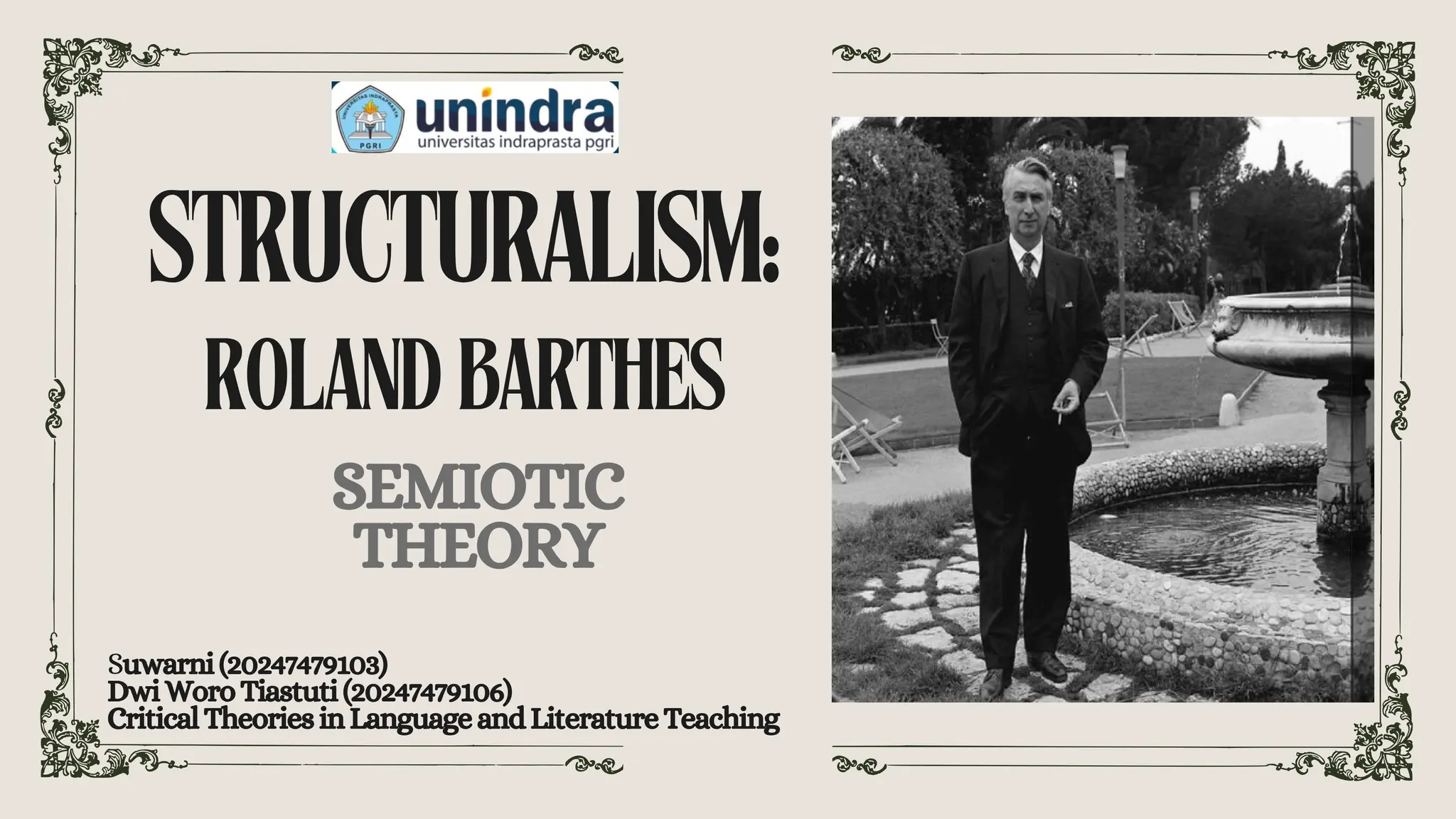
Here is a Structuralism : Roland Barthes brief explanation that matches your PowerPoint presentation on Semiotic Theory. It’s designed to be interactive, communicative, and easy to follow
PREVIEW:
STRUCTURALISM
CONCEPTS
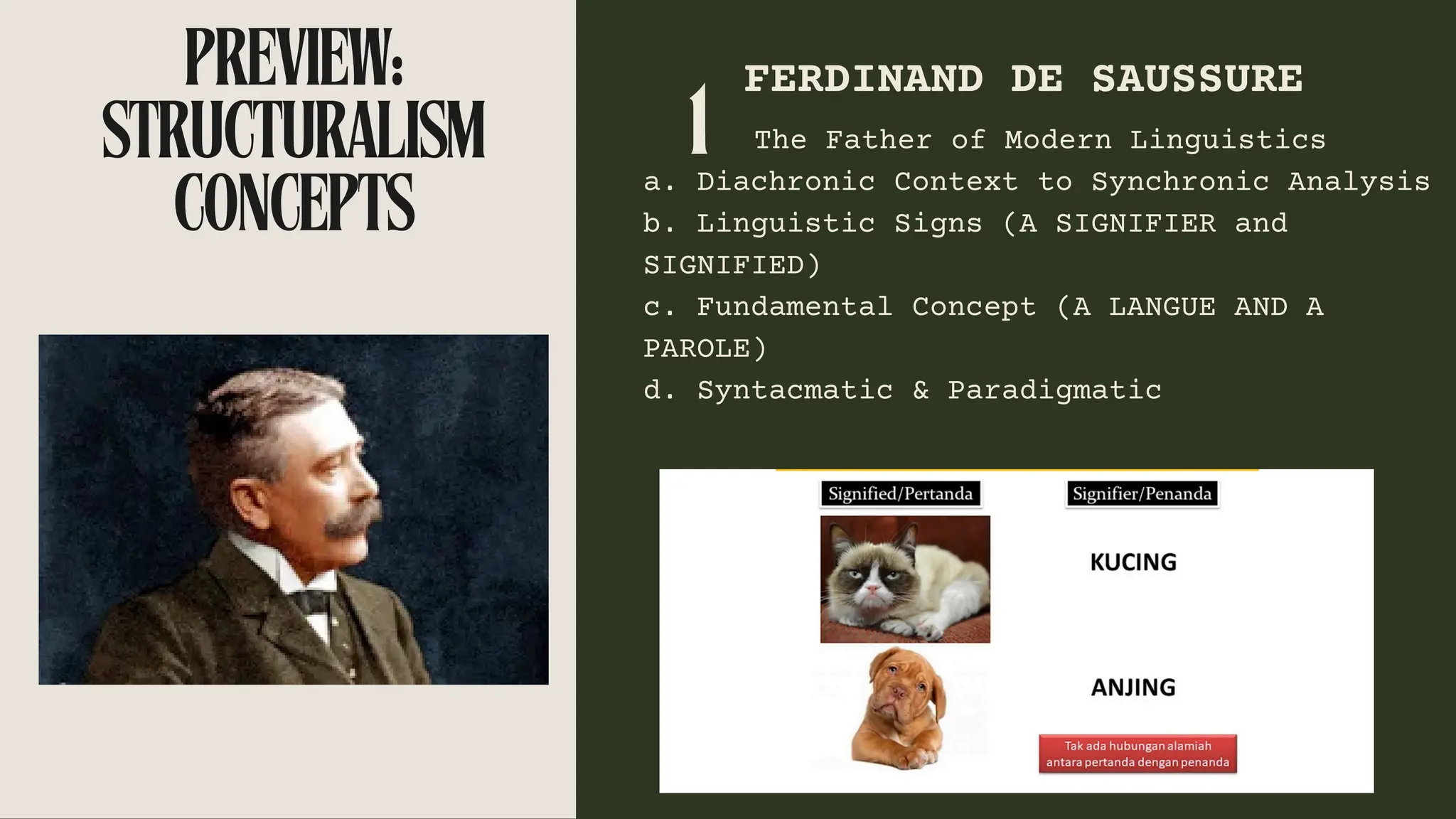
FERDINAND DE SAUSSURE
TheFather of Modern Linguistics
a. Diachronic Context to Synchronic Analysis
b. Linguistic Signs (A SIGNIFIER and
SIGNIFIED)
c. Fundamental Concept (A LANGUE AND A
PAROLE)
d. Syntacmatic & Paradigmatic
1
3.
PREVIEW:
STRUCTURALISM
CONCEPTS
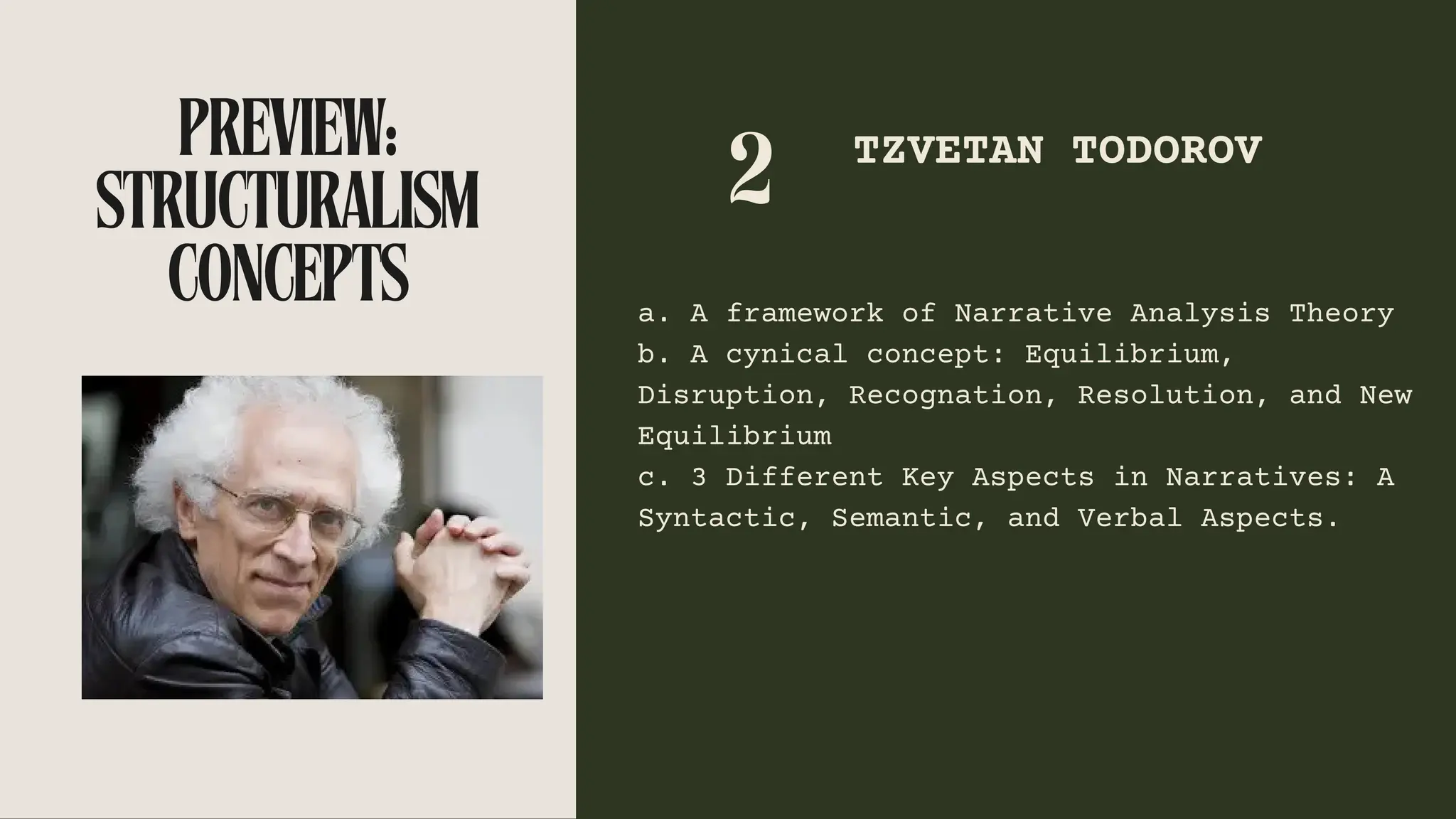
2 TZVETAN TODOROV
a.A framework of Narrative Analysis Theory
b. A cynical concept: Equilibrium,
Disruption, Recognation, Resolution, and New
Equilibrium
c. 3 Different Key Aspects in Narratives: A
Syntactic, Semantic, and Verbal Aspects.
4.
INTRODUCTION
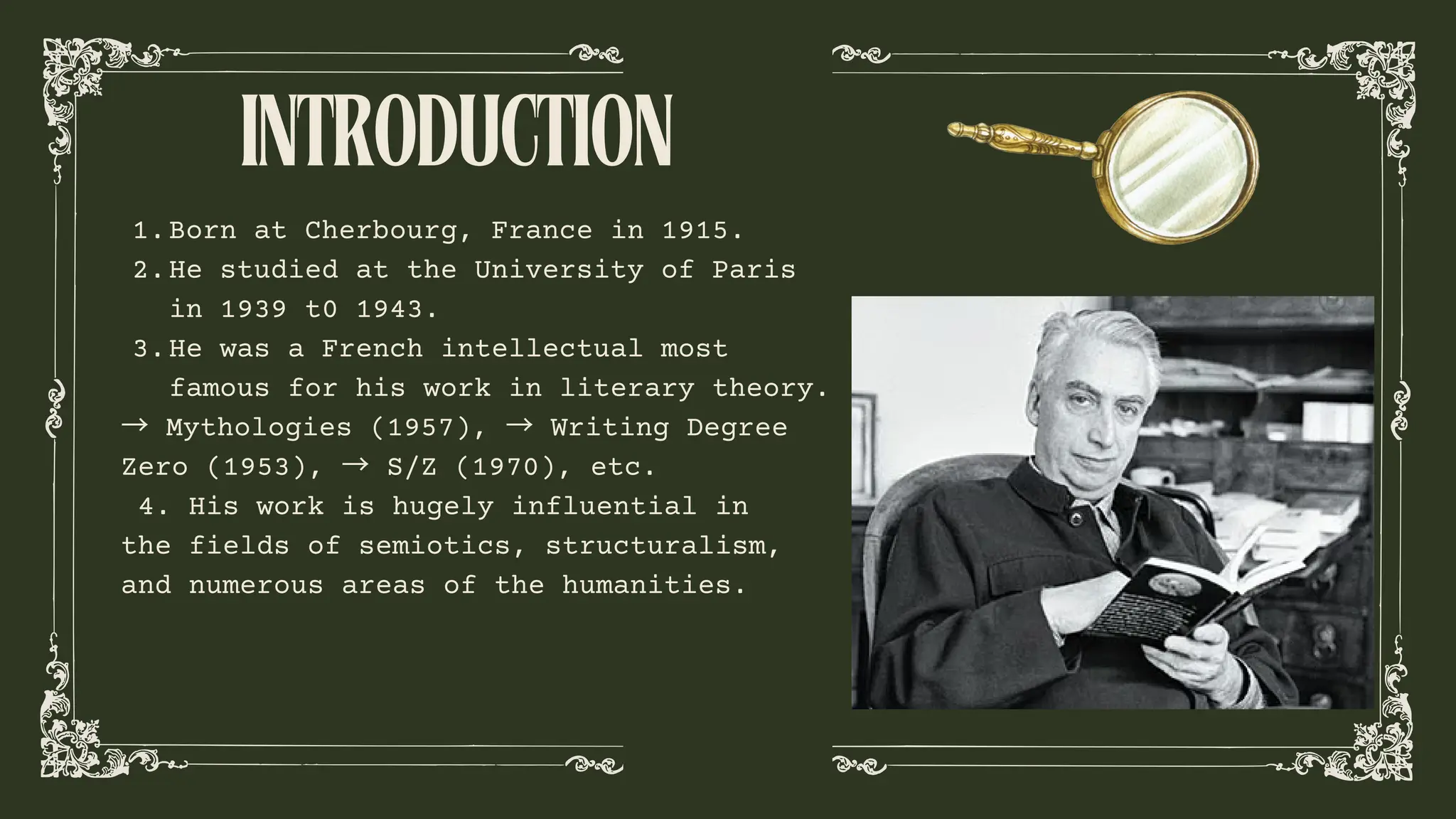
Born at Cherbourg,France in 1915.
1.
He studied at the University of Paris
in 1939 t0 1943.
2.
He was a French intellectual most
famous for his work in literary theory.
3.
→ Mythologies (1957), → Writing Degree
Zero (1953), → S/Z (1970), etc.
4. His work is hugely influential in
the fields of semiotics, structuralism,
and numerous areas of the humanities.
5.
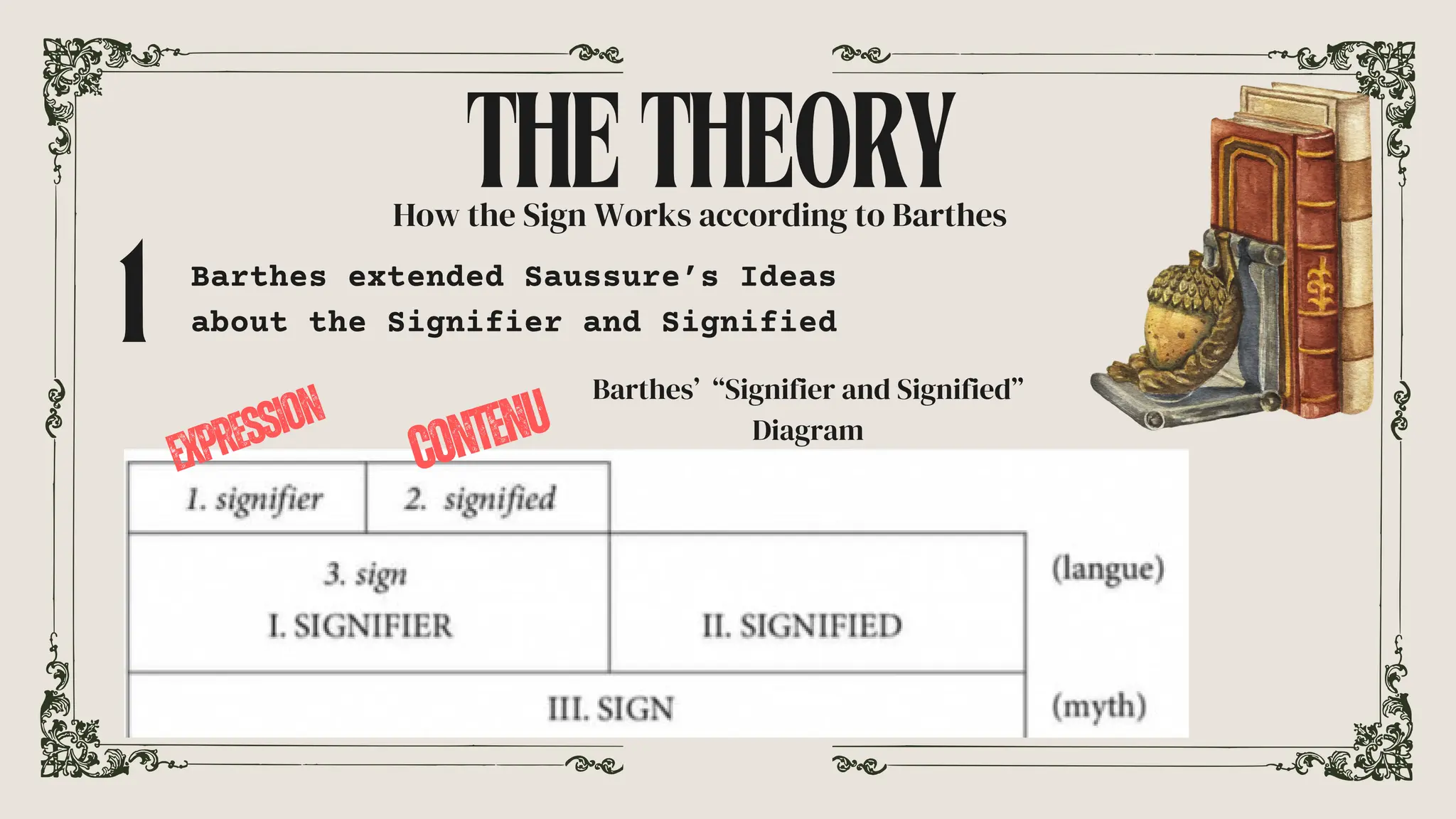
THETHEORY
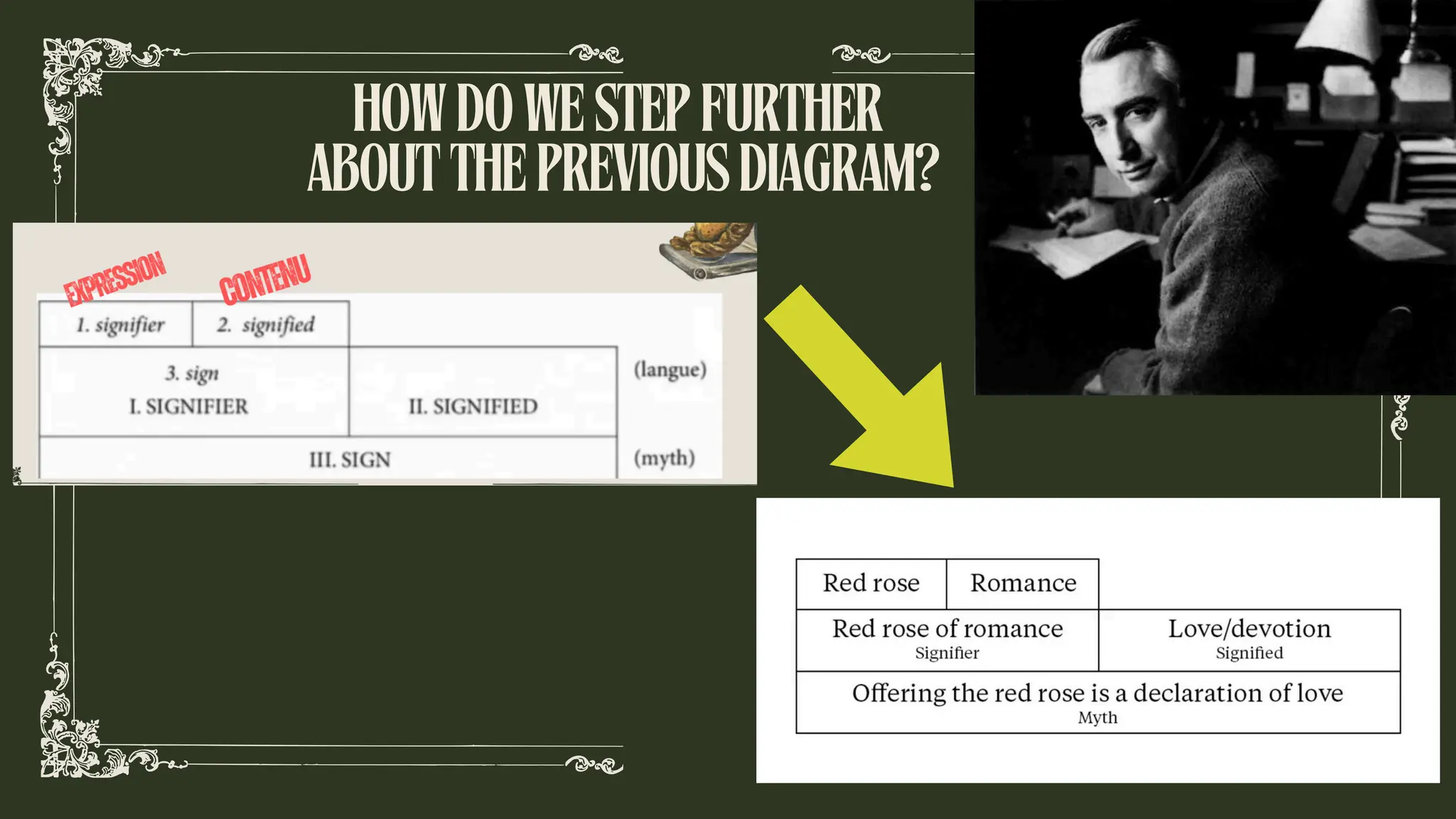
Barthes extended Saussure’sIdeas
about the Signifier and Signified
1 Barthes’ “Signifier and Signified”
Diagram
EXPRESSION
CONTENU
How the Sign Works according to Barthes
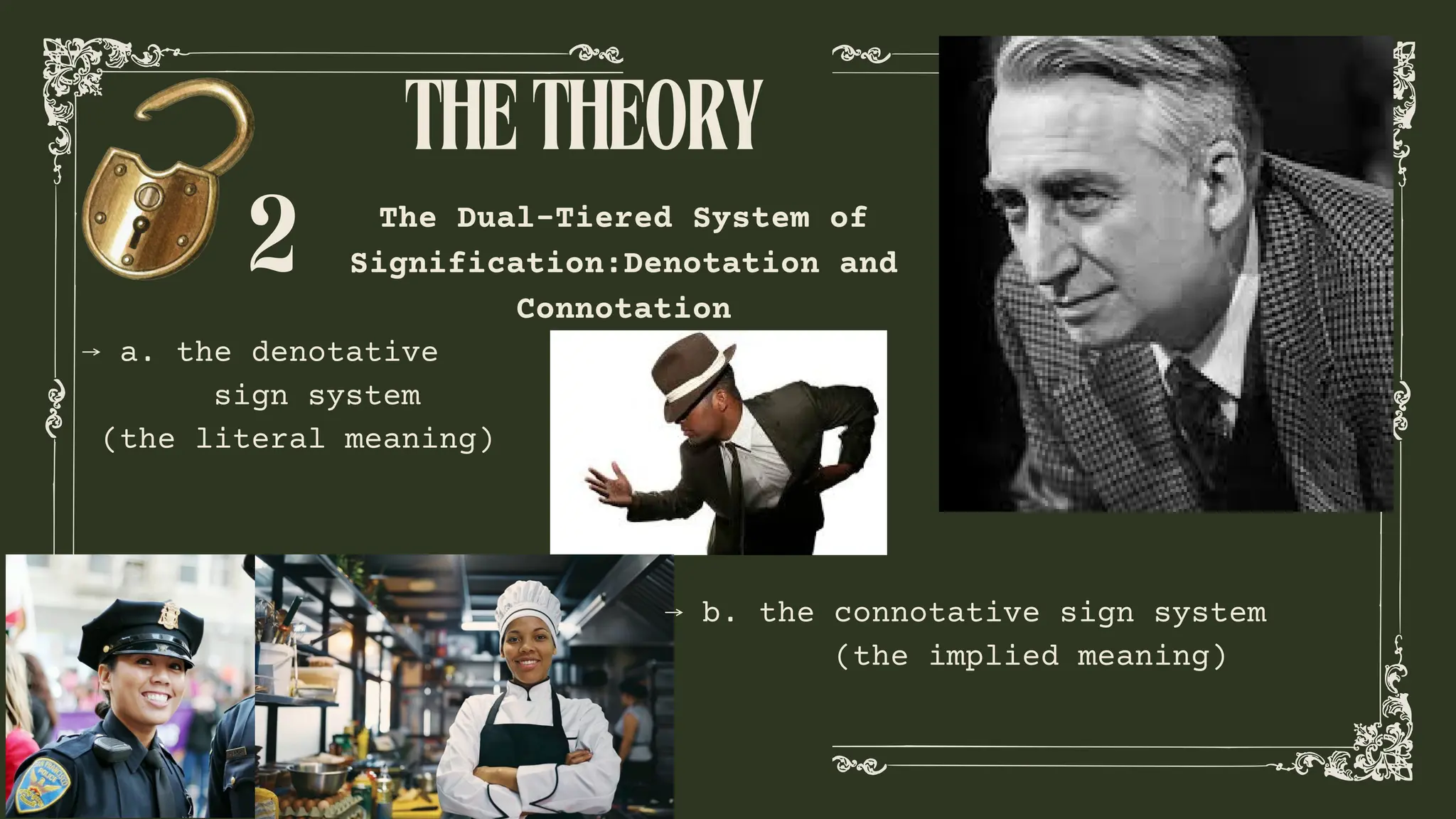
THETHEORY
2 The Dual-TieredSystem of
Signification:Denotation and
Connotation
⟶ a. the denotative
sign system
(the literal meaning)
⟶ b. the connotative sign system
(the implied meaning)
8.
THESIGN
SYSTEMS
In Roland Barthes'semiotic theory,
denotation refers direct reference to
the 'signified' (this is the thing the
sign refers to).
Meanwhile connotation refers to the
broader, associated meanings and
interpretations that go beyond the
literal.
The different values and orders
(connotations and denotations)
according to Barthes
(Barthes, 1987)
9.
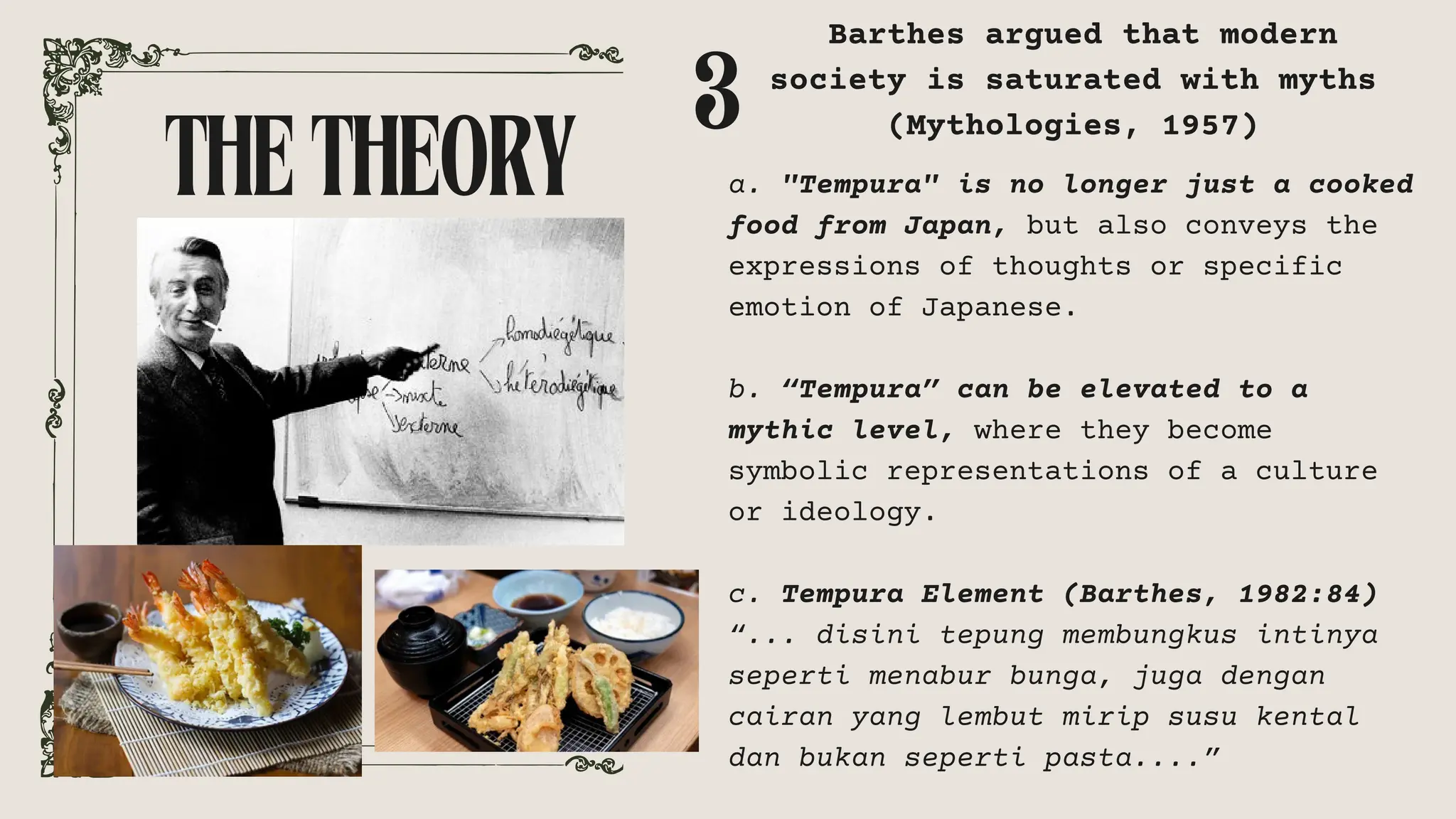
THETHEORY a. "Tempura"is no longer just a cooked
food from Japan, but also conveys the
expressions of thoughts or specific
emotion of Japanese.
b. “Tempura” can be elevated to a
mythic level, where they become
symbolic representations of a culture
or ideology.
c. Tempura Element (Barthes, 1982:84)
“... disini tepung membungkus intinya
seperti menabur bunga, juga dengan
cairan yang lembut mirip susu kental
dan bukan seperti pasta....”
3
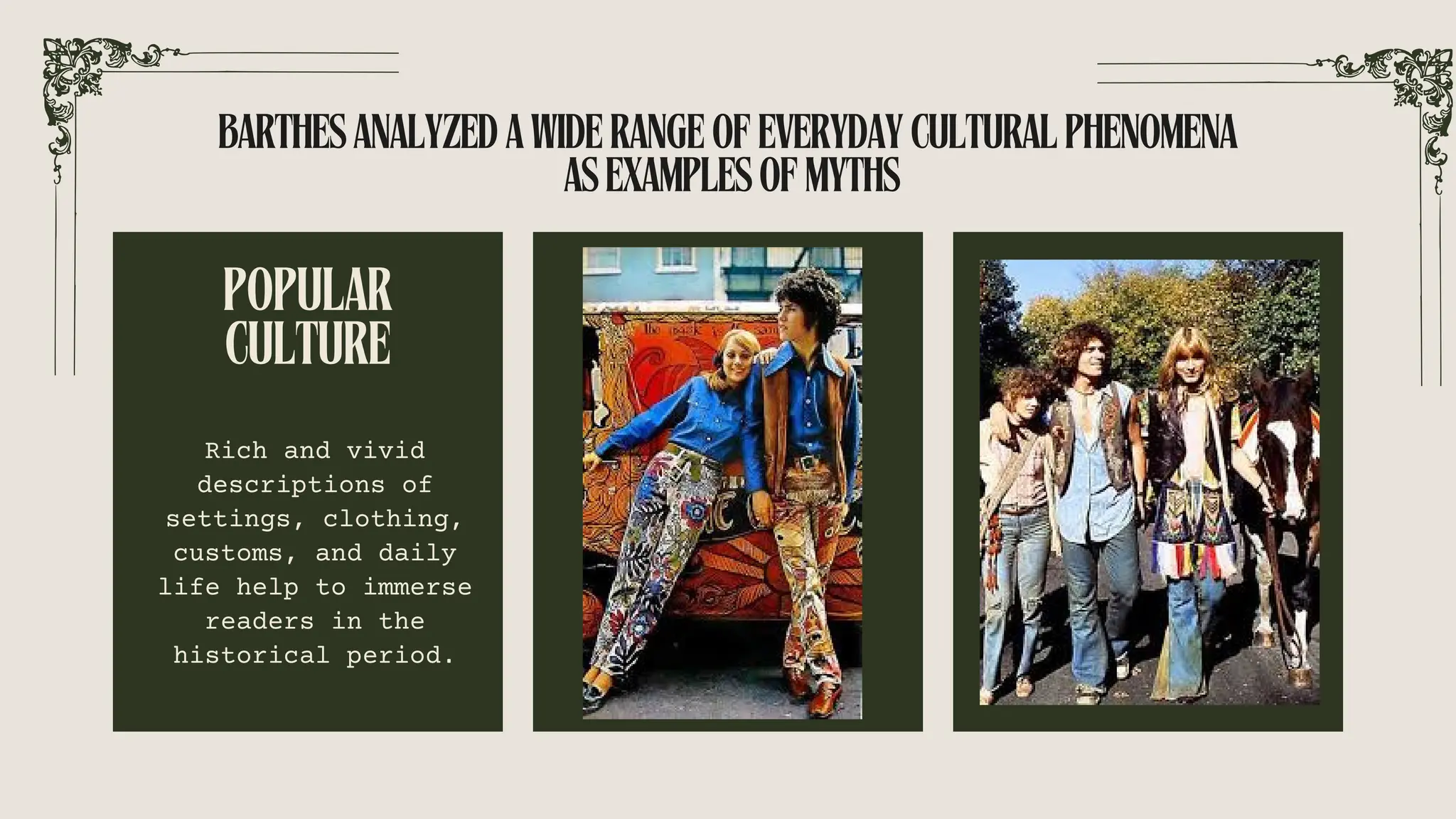
Barthes argued that modern
society is saturated with myths
(Mythologies, 1957)
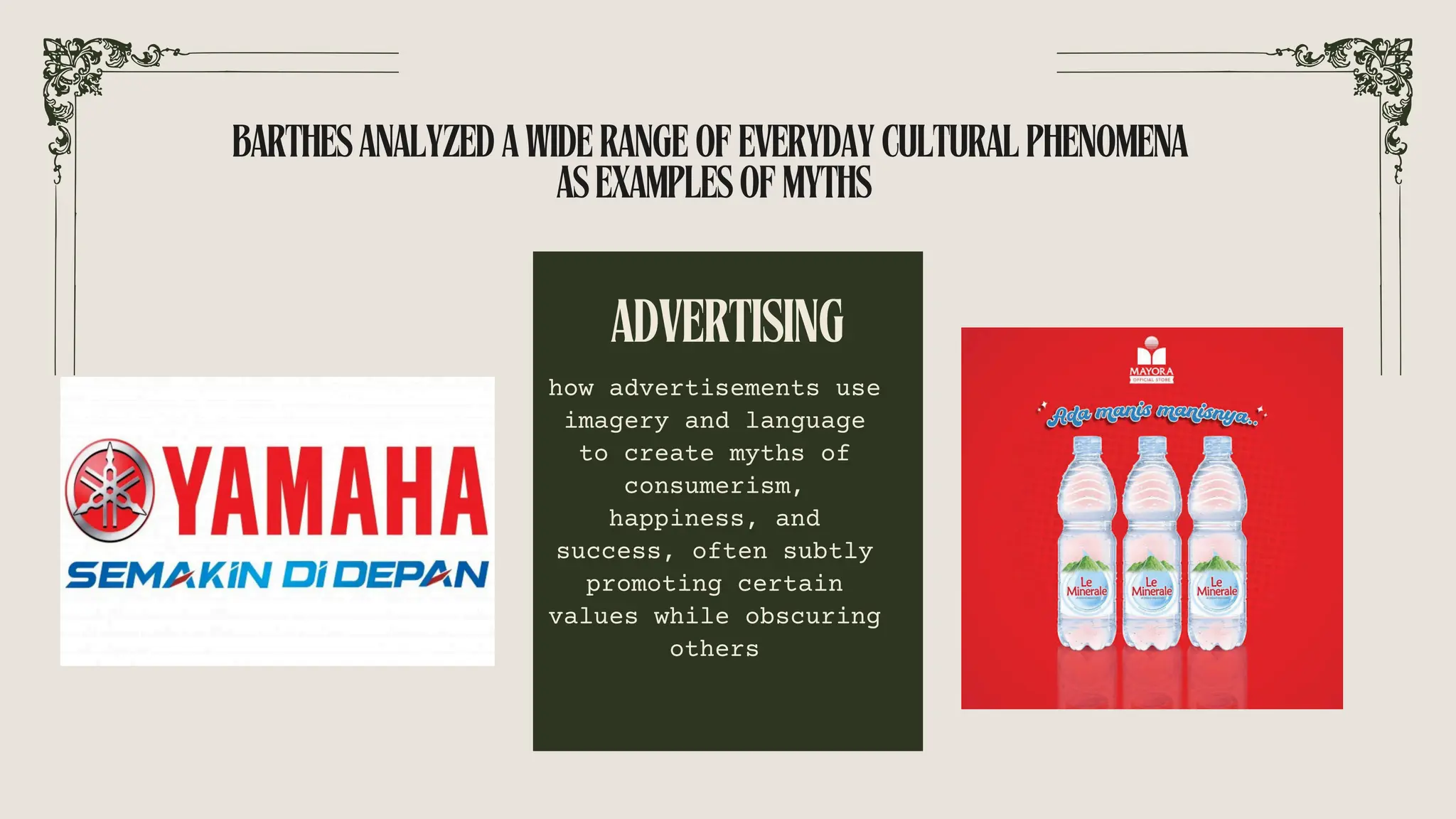
how advertisements use
imageryand language
to create myths of
consumerism,
happiness, and
success, often subtly
promoting certain
values while obscuring
others
ADVERTISING
BARTHESANALYZEDAWIDERANGEOFEVERYDAYCULTURALPHENOMENA
ASEXAMPLESOFMYTHS
12.
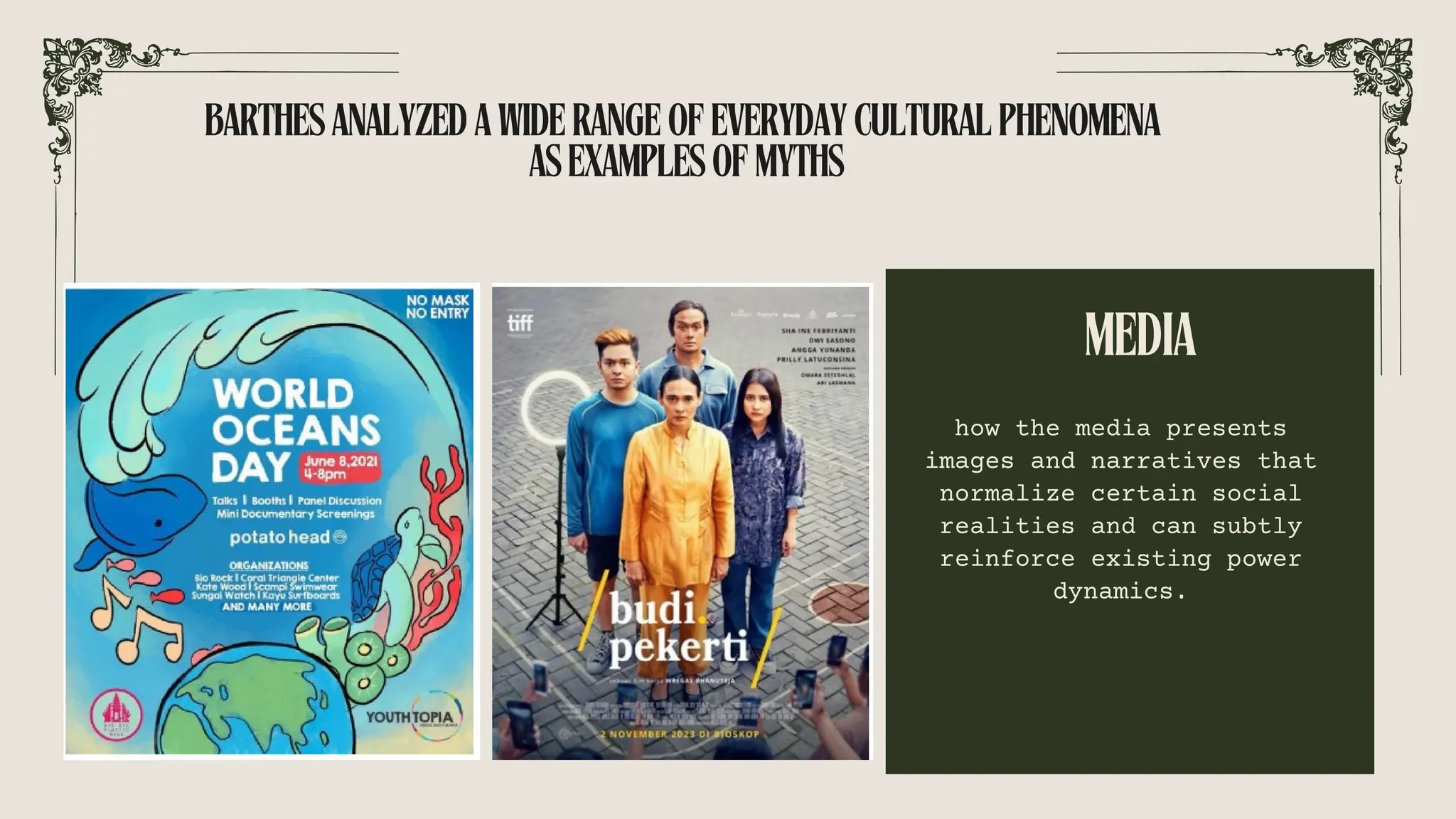
how the mediapresents
images and narratives that
normalize certain social
realities and can subtly
reinforce existing power
dynamics.
MEDIA
BARTHESANALYZEDAWIDERANGEOFEVERYDAYCULTURALPHENOMENA
ASEXAMPLESOFMYTHS
13.
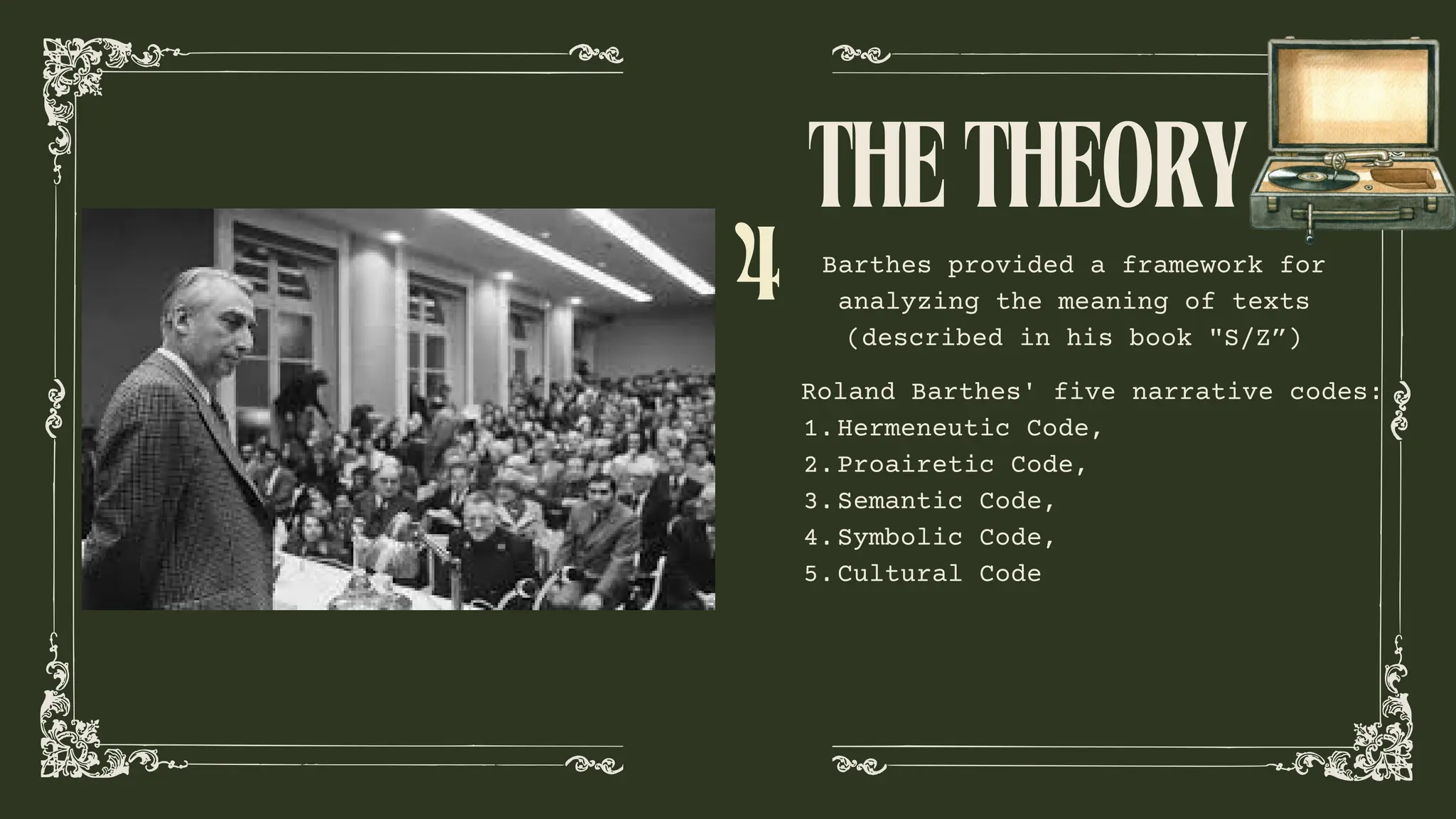
Barthes provided aframework for
analyzing the meaning of texts
(described in his book "S/Z”)
THETHEORY
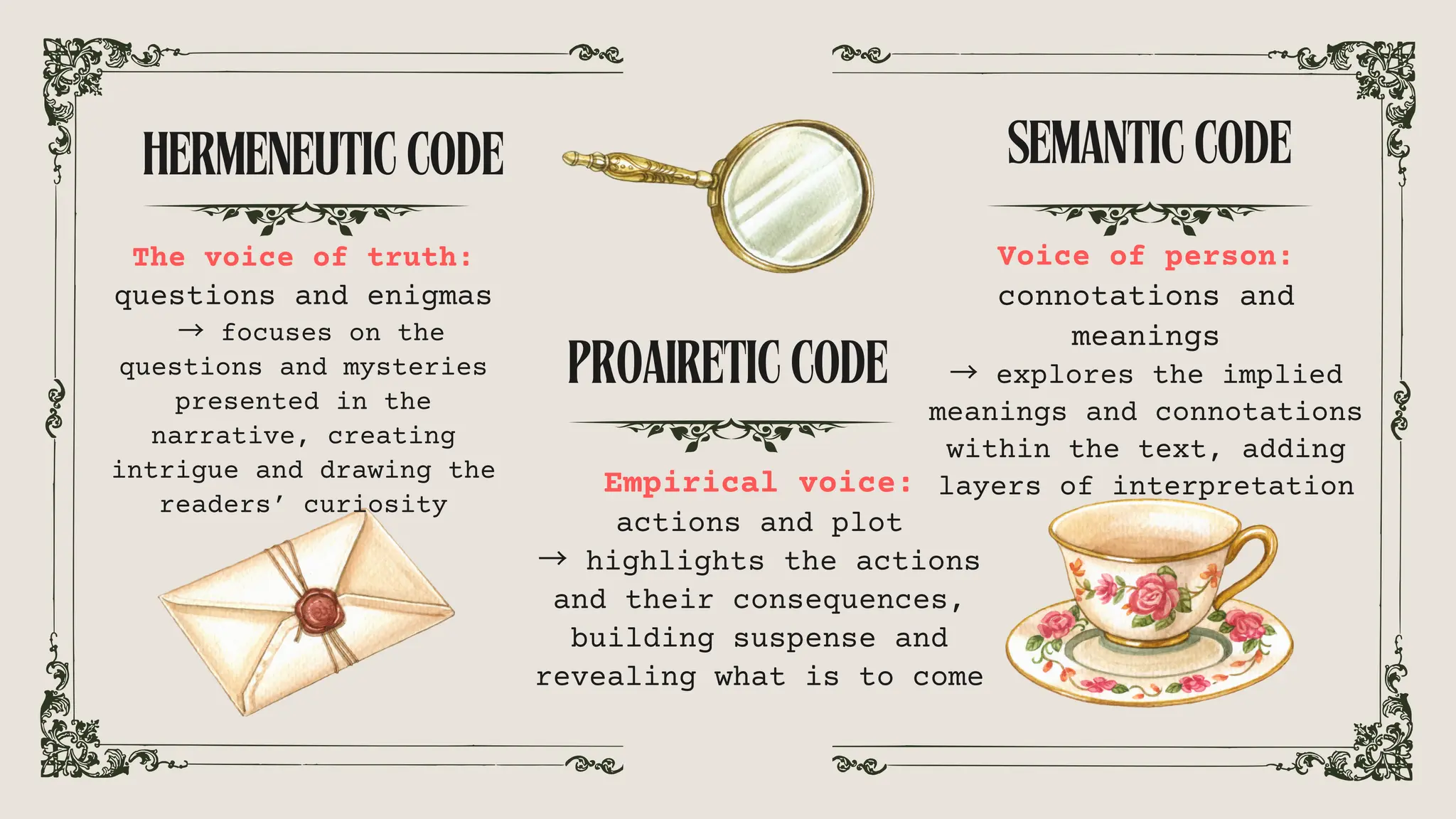
Roland Barthes' five narrative codes:
Hermeneutic Code,
1.
Proairetic Code,
2.
Semantic Code,
3.
Symbolic Code,
4.
Cultural Code
5.
4
14.
The voice oftruth:
questions and enigmas
→ focuses on the
questions and mysteries
presented in the
narrative, creating
intrigue and drawing the
readers’ curiosity
HERMENEUTICCODE
Voice of person:
connotations and
meanings
→ explores the implied
meanings and connotations
within the text, adding
layers of interpretation
SEMANTICCODE
Empirical voice:
actions and plot
→ highlights the actions
and their consequences,
building suspense and
revealing what is to come
PROAIRETICCODE
15.
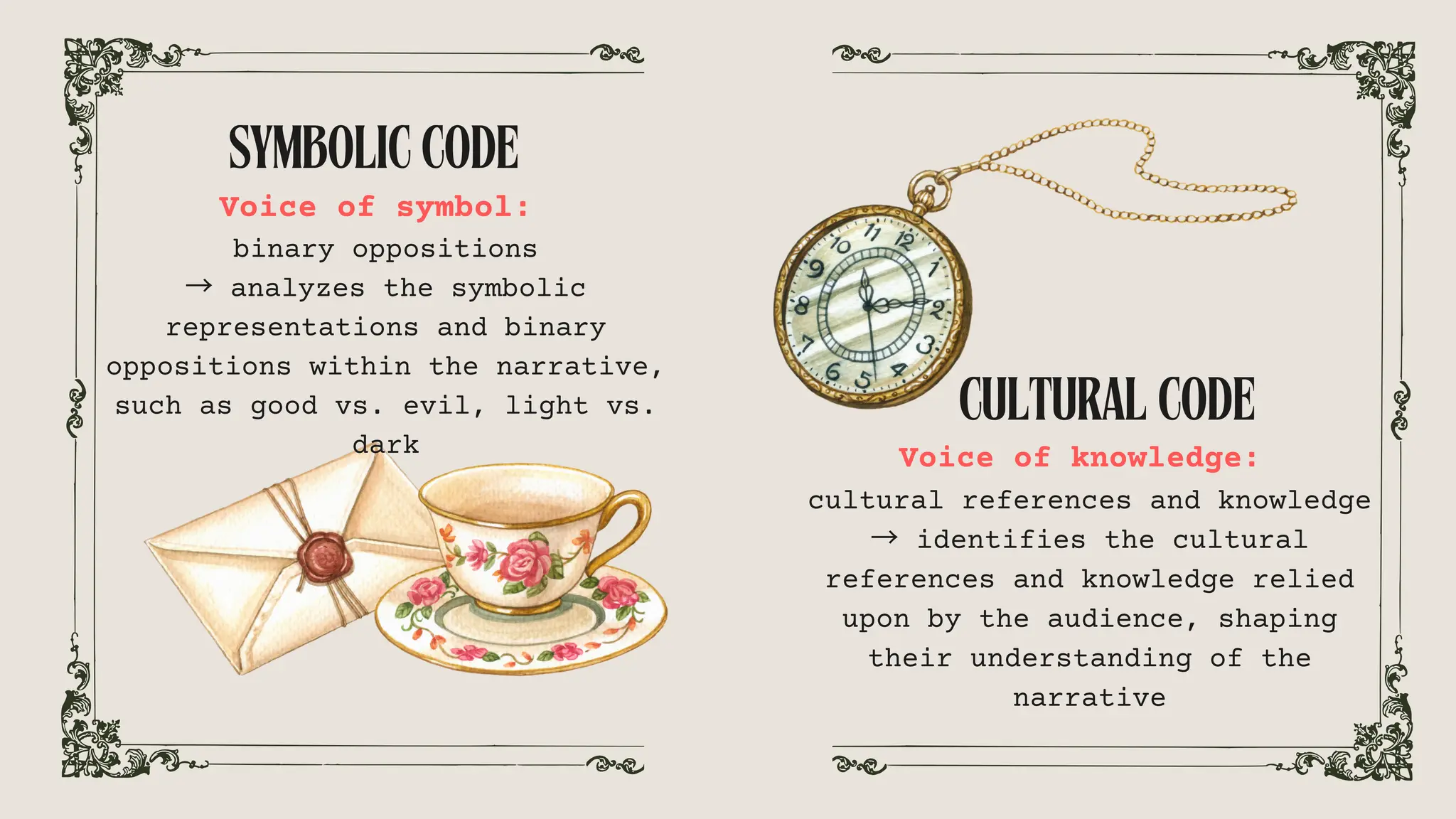
Voice of knowledge:
culturalreferences and knowledge
→ identifies the cultural
references and knowledge relied
upon by the audience, shaping
their understanding of the
narrative
Voice of symbol:
binary oppositions
→ analyzes the symbolic
representations and binary
oppositions within the narrative,
such as good vs. evil, light vs.
dark
SYMBOLICCODE
CULTURALCODE