STROKE
PREVENTION
IN AF
Thromboembolic complications, in particular, stroke, are the
most significant and potentially life-threatening sequelae of
AF.
The mainstay of stroke prevention is continuous
anticoagulation therapy, most commonly using an oral
medication.
Specific patient populations have a high risk of stroke, including
patients with hypertrophic cardiomyopathy, mitral stenosis,
and prior stroke history, and therefore, anticoagulation is
recommended, barring contraindications.
AF in patients without mitral stenosis is commonly referred to
as nonvalvular AF.
Assess the stroke risk in parents with AF.
The risk of stroke appears to be most accurately
predicted by the presence of underlying risk factors
known in increase stroke risk.
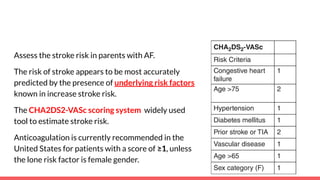
The CHA2DS2-VASc scoring system widely used
tool to estimate stroke risk.
Anticoagulation is currently recommended in the
United States for patients with a score of ≥1, unless
the lone risk factor is female gender.
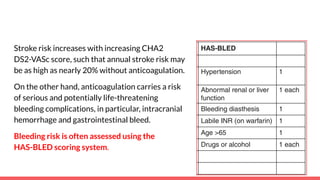
Stroke risk increases with increasing CHA2
DS2-VASc score, such that annual stroke risk may
be as high as nearly 20% without anticoagulation.
On the other hand, anticoagulation carries a risk
of serious and potentially life-threatening
bleeding complications, in particular, intracranial
hemorrhage and gastrointestinal bleed.
Bleeding risk is often assessed using the
HAS-BLED scoring system.
If bleeding risk is deemed to be outweighed by stroke risk, anticoagulation is
recommended.
It is important to note that the perceived burden of AF has not been shown to
predict stroke risk. The approach to patients with paroxysmal AF is therefore the
same as for persistent AF.
The options for anticoagulation are the
● oral factor Xa inhibitors apixaban, edoxaban, or
rivaroxaban;
● the oral antithrombin inhibitor dabigatran; and
● the vitamin K antagonist warfarin.
Antiplatelet agents alone are generally not sufficient.
The antiplatelet agents aspirin and clopidogrel are inferior to
warfarin for stroke prevention in AF and do not have less risk of
bleeding.
Clopidogrel combined with aspirin is better than aspirin alone for
stroke prevention, but this combination is inferior to warfarin and
has a greater bleeding risk than aspirin alone.
In nonvalvular AF, warfarin reduces the annual risk of stroke by 64%
compared to placebo and by 37% compared to antiplatelet therapy.
Warfarin is required for patients with rheumatic mitral stenosis or
mechanical heart valves.
The newer, direct-acting anticoagulants have not been tested in
rheumatic heart disease, and a direct thrombin inhibitor did not
prevent thromboembolism in patients with mechanical heart valves.
Warfarin can be an inconvenient agent that
● requires several days to achieve a therapeutic effect (prothrombin time
[PT]/international normalized ratio [INR] >2),
● requires monitoring of PT/INR to adjust dose, and
● has many drug and food interactions that can hinder patient compliance
and render maintaining a therapeutic effect challenging.
The direct-acting anticoagulants dabigatran, rivaroxaban, apixaban,
and edoxaban were noninferior to warfarin in individual trials of
nonvalvular AF patients, and intent-to-treat analysis of pooled data
suggests superiority to warfarin by small absolute margins of 0.4–0.7%
in reduction of mortality, stroke, major bleeding, and intracranial
hemorrhage.
The direct-acting agents are easier to use and achieve reliable anticoagulation
promptly without requiring dosage adjustment based on blood tests.
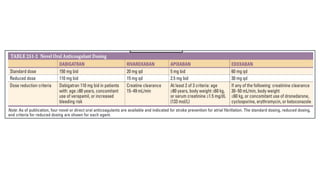
Dabigatran, rivaroxaban, and apixaban have renal excretion, cannot be used with
severe renal insufficiency (creatinine clearance <15 mL/min), and require dose
adjustment for modest renal impairment, which is of particular concern in the
elderly, who are at increased bleeding risk.
Limited experience with apixaban demonstrates safety and efficacy in patients
undergoing chronic hemodialysis for end-stage kidney disease. Excretion can also be
influenced by P-glycoprotein inducers and inhibitors
Warfarin anticoagulation can be reversed by administration of fresh frozen plasma,
prothrombin complex concentrate, and vitamin K.
Reversal agents are available for dabigatran (idarucizumab), and Xa inhibitors are
available (andexanet alfa), and both are administered intravenously. These agents
may be pro-thrombotic and administration must be judicious.
Bleeding is the major risk of anticoagulation.
Risk factors for bleeding include
● age >65–75 years,
● Heart failure,
● Renal insufficiency,
● Prior bleeding, and
● Excessive alcohol or non steroidal anti-inflammatory drug use.
Direct-acting anticoagulants appear to have a lower risk of intracranial bleeding
compared with warfarin without sacrificing protective effects against
thromboembolism.
In patients who require dual antiplatelet therapy (e.g., aspirin and clopidogrel) after
coronary or peripheral arterial stenting, there is a substantially increased bleeding
risk when standard oral anticoagulation with warfarin or a direct-acting
anticoagulant is added.
The optimal combination of agents for patients with AF who also require
antiplatelet therapy remains unclear.
Because most thrombi form in the left atrial appendage, surgical removal of
the appendage, combined with atrial maze surgery, may be considered for
patients undergoing surgery, although removal of the appendage has not
been unequivocally shown to reduce the risk of thromboembolism.
Percutaneously deployed devices that occlude or ligate the left atrial
appendage are also available, appear to be noninferior to warfarin in
reducing stroke risk, and are considered in patients who have a high risk of
thromboembolism but serious bleeding risk from chronic oral
anticoagulation
CARDIOVERSION & ANTICOAGULATION
Cardioversion within 48 h of the onset of AF is common practice in patients who
have not been anticoagulated, provided that they are not at high risk for stroke due
to a prior history of embolic events, rheumatic mitral stenosis, or hypertrophic
cardiomyopathy with marked left atrial enlargement.
These low-risk patients with occasional episodes of AF can be instructed to notify
their physician when AF occurs to arrange for cardioversion to be done within 48 h.
If the duration of AF exceeds 48 h or is unknown, there is greater concern
for thromboembolism after cardioversion, even in patients considered low
risk (CHA2 DS2-VASc of 0 or 1 ) for stroke.
There are two approaches to mitigate the risk related to cardioversion
# to anticoagulate continuously for 3 weeks before and a minimum of 4 weeks after
cardioversion.
# to start anticoagulation and perform a TEE or high-resolution cardiac CT scan to
detect the presence of thrombus in the left atrial appendage.If thrombus is absent,
cardioversion can be performed and anticoagulation continued for a minimum of 4
weeks to allow time for recovery of atrial mechanical function. In either case,
cardioversion of AF is associated with a substantial risk of recurrence, which may
not be symptomatic
REFERENCE

Stroke Prevention in Atrial Fibrillation.pdf

  • 1.
  • 2.
    Thromboembolic complications, inparticular, stroke, are the most significant and potentially life-threatening sequelae of AF. The mainstay of stroke prevention is continuous anticoagulation therapy, most commonly using an oral medication.
  • 3.
    Specific patient populationshave a high risk of stroke, including patients with hypertrophic cardiomyopathy, mitral stenosis, and prior stroke history, and therefore, anticoagulation is recommended, barring contraindications. AF in patients without mitral stenosis is commonly referred to as nonvalvular AF.
  • 4.
    Assess the strokerisk in parents with AF. The risk of stroke appears to be most accurately predicted by the presence of underlying risk factors known in increase stroke risk. The CHA2DS2-VASc scoring system widely used tool to estimate stroke risk. Anticoagulation is currently recommended in the United States for patients with a score of ≥1, unless the lone risk factor is female gender.
  • 5.
    Stroke risk increaseswith increasing CHA2 DS2-VASc score, such that annual stroke risk may be as high as nearly 20% without anticoagulation. On the other hand, anticoagulation carries a risk of serious and potentially life-threatening bleeding complications, in particular, intracranial hemorrhage and gastrointestinal bleed. Bleeding risk is often assessed using the HAS-BLED scoring system.
  • 6.
    If bleeding riskis deemed to be outweighed by stroke risk, anticoagulation is recommended. It is important to note that the perceived burden of AF has not been shown to predict stroke risk. The approach to patients with paroxysmal AF is therefore the same as for persistent AF.
  • 7.
    The options foranticoagulation are the ● oral factor Xa inhibitors apixaban, edoxaban, or rivaroxaban; ● the oral antithrombin inhibitor dabigatran; and ● the vitamin K antagonist warfarin. Antiplatelet agents alone are generally not sufficient.
  • 8.
    The antiplatelet agentsaspirin and clopidogrel are inferior to warfarin for stroke prevention in AF and do not have less risk of bleeding. Clopidogrel combined with aspirin is better than aspirin alone for stroke prevention, but this combination is inferior to warfarin and has a greater bleeding risk than aspirin alone.
  • 9.
    In nonvalvular AF,warfarin reduces the annual risk of stroke by 64% compared to placebo and by 37% compared to antiplatelet therapy. Warfarin is required for patients with rheumatic mitral stenosis or mechanical heart valves. The newer, direct-acting anticoagulants have not been tested in rheumatic heart disease, and a direct thrombin inhibitor did not prevent thromboembolism in patients with mechanical heart valves.
  • 10.
    Warfarin can bean inconvenient agent that ● requires several days to achieve a therapeutic effect (prothrombin time [PT]/international normalized ratio [INR] >2), ● requires monitoring of PT/INR to adjust dose, and ● has many drug and food interactions that can hinder patient compliance and render maintaining a therapeutic effect challenging.
  • 11.
    The direct-acting anticoagulantsdabigatran, rivaroxaban, apixaban, and edoxaban were noninferior to warfarin in individual trials of nonvalvular AF patients, and intent-to-treat analysis of pooled data suggests superiority to warfarin by small absolute margins of 0.4–0.7% in reduction of mortality, stroke, major bleeding, and intracranial hemorrhage.
  • 12.
    The direct-acting agentsare easier to use and achieve reliable anticoagulation promptly without requiring dosage adjustment based on blood tests. Dabigatran, rivaroxaban, and apixaban have renal excretion, cannot be used with severe renal insufficiency (creatinine clearance <15 mL/min), and require dose adjustment for modest renal impairment, which is of particular concern in the elderly, who are at increased bleeding risk. Limited experience with apixaban demonstrates safety and efficacy in patients undergoing chronic hemodialysis for end-stage kidney disease. Excretion can also be influenced by P-glycoprotein inducers and inhibitors
  • 14.
    Warfarin anticoagulation canbe reversed by administration of fresh frozen plasma, prothrombin complex concentrate, and vitamin K. Reversal agents are available for dabigatran (idarucizumab), and Xa inhibitors are available (andexanet alfa), and both are administered intravenously. These agents may be pro-thrombotic and administration must be judicious.
  • 15.
    Bleeding is themajor risk of anticoagulation. Risk factors for bleeding include ● age >65–75 years, ● Heart failure, ● Renal insufficiency, ● Prior bleeding, and ● Excessive alcohol or non steroidal anti-inflammatory drug use. Direct-acting anticoagulants appear to have a lower risk of intracranial bleeding compared with warfarin without sacrificing protective effects against thromboembolism.
  • 16.
    In patients whorequire dual antiplatelet therapy (e.g., aspirin and clopidogrel) after coronary or peripheral arterial stenting, there is a substantially increased bleeding risk when standard oral anticoagulation with warfarin or a direct-acting anticoagulant is added. The optimal combination of agents for patients with AF who also require antiplatelet therapy remains unclear.
  • 17.
    Because most thrombiform in the left atrial appendage, surgical removal of the appendage, combined with atrial maze surgery, may be considered for patients undergoing surgery, although removal of the appendage has not been unequivocally shown to reduce the risk of thromboembolism. Percutaneously deployed devices that occlude or ligate the left atrial appendage are also available, appear to be noninferior to warfarin in reducing stroke risk, and are considered in patients who have a high risk of thromboembolism but serious bleeding risk from chronic oral anticoagulation
  • 18.
    CARDIOVERSION & ANTICOAGULATION Cardioversionwithin 48 h of the onset of AF is common practice in patients who have not been anticoagulated, provided that they are not at high risk for stroke due to a prior history of embolic events, rheumatic mitral stenosis, or hypertrophic cardiomyopathy with marked left atrial enlargement. These low-risk patients with occasional episodes of AF can be instructed to notify their physician when AF occurs to arrange for cardioversion to be done within 48 h.
  • 19.
    If the durationof AF exceeds 48 h or is unknown, there is greater concern for thromboembolism after cardioversion, even in patients considered low risk (CHA2 DS2-VASc of 0 or 1 ) for stroke.
  • 20.
    There are twoapproaches to mitigate the risk related to cardioversion # to anticoagulate continuously for 3 weeks before and a minimum of 4 weeks after cardioversion. # to start anticoagulation and perform a TEE or high-resolution cardiac CT scan to detect the presence of thrombus in the left atrial appendage.If thrombus is absent, cardioversion can be performed and anticoagulation continued for a minimum of 4 weeks to allow time for recovery of atrial mechanical function. In either case, cardioversion of AF is associated with a substantial risk of recurrence, which may not be symptomatic
  • 21.