Vinod Kothari
Vinod Kothari & Company
www.vinodkothari.com
Kolkata
1006-1009 Krishna Building
224 AJC Bose Road
Kolkata – 700017
Phone: 033- 2281 7715/ 1276/ 3742
E: corplaw@vinodkothari.com
Mumbai
403-406,
175, Shreyas Chambers,
D.N. Road, Fort, Mumbai – 400001
Phone: 022 – 22614021 / 30447498
E: bombay@vinodkothari.com
Delhi
A/11, Hauz Khas,
New Delhi – 110016
Phone: 011- 41315340 / 65515340
E: delhi@vinodkothari.com
Striking off under Companies Act, 2013
1
Copyright
• The presentation is a property of Vinod Kothari & Company.
• No part of it can be copied, reproduced or distributed in any manner,
without explicit prior permission.
• In case of linking, please do give credit and full link
2
About Us
• Vinod Kothari & Co.,
o Based in Kolkata, Mumbai and Delhi
• We are a team of consultants, advisors &
qualified professionals having over 25 years
of practice.
Our Organization’s Credo:
Focus on capabilities; opportunities follow
3
Scope of the presentation
Since there are several partly-overlapping issues, let us be clear about the scope of the
presentation.
• The presentation deals with Companies Act provisions dealing with striking-off
• Does not deal with-
o Tax issues arising out of unauthenticated capital or sources of funding for
companies or consequential impact on properties of companies;
o Benami properties or the Benami property law
4
• The massive striking-off of companies is somehow connected with
Operation Clean Money – a drive against black money.
• The Companies Act deals with striking off of a defunct company.
• If the company is defunct, it apparently has no substance into it.Hence,
unlikely that something which is defunct can be used as a conduit
for money laundering.
A drive against black money
5
Several expressions being used in conjunction
Even though these expressions may have no mutual intersection:
 Defunct companies
 Dormant companies
 Shell companies
 Benami companies
 Vanishing companies
6
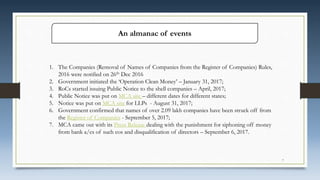
An almanac of events
1. The Companies (Removal of Names of Companies from the Register of Companies) Rules,
2016 were notified on 26th Dec 2016
2. Government initiated the ‘Operation Clean Money’ – January 31, 2017;
3. RoCs started issuing Public Notice to the shell companies – April, 2017;
4. Public Notice was put on MCA site – different dates for different states;
5. Notice was put on MCA site for LLPs - August 31, 2017;
6. Government confirmed that names of over 2.09 lakh companies have been struck off from
the Register of Companies - September 5, 2017;
7. MCA came out with its Press Release dealing with the punishment for siphoning off money
from bank a/cs of such cos and disqualification of directors – September 6, 2017.
7
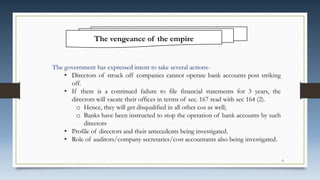
The vengeance of the empire
The government has expressed intent to take several actions-
• Directors of struck off companies cannot operate bank accounts post striking
off.
• If there is a continued failure to file financial statements for 3 years, the
directors will vacate their offices in terms of sec. 167 read with sec 164 (2).
o Hence, they will get disqualified in all other cos as well;
o Banks have been instructed to stop the operation of bank accounts by such
directors
• Profile of directors and their antecedents being investigated.
• Role of auditors/company secretaries/cost accountants also being investigated.
8
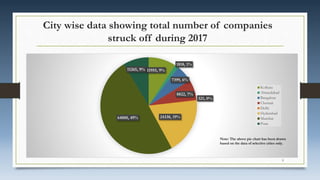
City wise data showing total number of companies
struck off during 2017
11955, 9%
1818, 1%
7399, 6%
8822, 7%
321, 0%
24338, 19%64000, 49%
11265, 9%
Kolkata
Ahmedabad
Bangalore
Chennai
Delhi
Hyderabad
Mumbai
Pune
Note: The above pie chart has been drawn
based on the data of selective cities only.
9
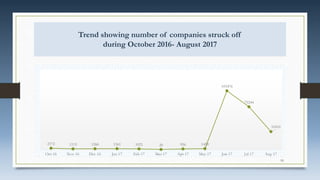
Trend showing number of companies struck off
during October 2016- August 2017
2172 1115 1260 1361 1021 20 956 1450
103476
75244
31416
Oct-16 Nov-16 Dec-16 Jan-17 Feb-17 Mar-17 Apr-17 May-17 Jun-17 Jul-17 Aug-17
10
• Sec 248 - Striking off of defunct companies by the registrar
o Compulsory strike-off: By the registrar – sec 248 (1)
o Voluntary strike-off: By the company – sec. 248 (2)
o Consequential and appellate provisions – sec 249 – 252
o The Companies (Removal of Names of Companies from the Register of Companies)
Rules, 2016
• Sec 164 (2) (a) read with sec 167 (1) (a); 167 (2) - disqualification of directors.
• Sec 271 (1) (f) – compulsory winding up
• Sec 455 –dormant companies – read with Companies (Miscellaneous) Rules
• 455 (4) – register of dormant companies
• 455 (6) - striking off of names of dormant companies from register of dormant
companies
• Several other implications of non filing of financial statements
Relevant provisions of Companies Act
11
Meaning of defunct companies
The term ‘Defunct Company’ is defined in the Guidelines issued by MCA for Fast Track Exit
mode for defunct companies under section 560 of the Companies Act, 1956 , which states –
“For Fast Track Exit mode (FTE), it is stated as under:-
(a) Any company will be called as “defunct company” for the purpose of these guidelines,
which has nil asset and liability and (i) has not commenced any business activity or
operation since incorporation; or (ii) is not carrying over any business activity or
operation for last one year before making application under FTE.”
12
The three conditions for mandatory strike-off are:-
• Company has failed to commence business within 1 year from incorporation
o This condition actually pertains to requirement of earlier law requiring cos to file certificate
of commencement of business; irrelevant now
• Subscribers to memorandum have not paid their subscription amount within 6 months of
incorporation – the same has been omitted by the Companies (Amendment) Act, 2015
• Company is not carrying business or operation for two immediately preceding financial years and
has not applied for dormant status
o Since the RoC action has been taken before October, 2017 (before the due date for annual
filings for 2016-17), it pertains to the act of non-filing of financial statements, the relevant
financial years are 2014-15, and 2015-16
Provisions of sec. 248 (1)
13
Legal position as to inoperative companies
• If a company becomes inoperative or dormant, it may apply to be categorised as a dormant company u/s 455
• There is only an annual filing in case of dormant companies
• Form MSC -3, certified by a chartered accountant; rest of the formalities are not applicable
• However, if a company, which is not an optionally dormant companies, becomes inoperative, the Registrar may use powers
to strike off the name
• The purpose of strike-off, whether voluntary or involuntary, is to clean up the register of companies which have become
substantively extinct
• If the company has assets/liabilities, it may go the process of winding up
• Thus, there are 2 options for an inoperative company
• Get categories as dormant company
• Get treated or opt to be treated as defunct company
• In case of defunct companies, do the implications on directors cease:
• Form STK-1 clearly says to the contrary 14
Meaning of the term ‘not in operation’
• The power of the RoC to strike off the name of the company not carrying business or
operation has been there in CA, 1956
• Similar provisions have existed in UK, 1948
• Also, in UK CA 2006, sections 1000-1002
• A company is in the course of being wound up and not carrying on any business, yet so long
as it remains undissolved -- it will be considered to be in operation- Re, Outlay Assurance
Society, (1887) 34 Ch D 479.
15
Presumption of non-operative company
Where a company since its incorporation in 1929 and for thirty years thereafter had—
(a) never met in a shareholders’or directors’meeting, and
(b) no returns or list of members were filed
(c) no balance sheets prepared or bank accounts were maintained by the company, and
(d) the properties of the company were dealt with, sold and transferred as if they were the personal
property of the individual members,
Registrar was justified in striking the company off the register of companies after giving sufficient
opportunities to the interested parties to show cause to the contrary. Rai Saheb U.N. Mandal’s
Estate Ltd., In re, (1960) 30 Com Cases 172 (Cal).
16
Process of striking off 1/2
• Sending of notice of proposed action by the RoC –rule 3 (2)
• To the company
• To all directors as per addresses on record
• In form STK-1
• Notice to be sent by registered post or speed post
• Notice shall state the reasons for which the name of the company to be struck off
• Opportunity to make representation within 30 days from the date of notice.
• This is not a pre-striking off notice; this seems to be a notice to presume that the company is
inoperative
• Pre-strike-off notice u/s 248 (1), rule 7, form STK-5
• To be given to company and directors
• Notice shall also be put on official gazette – sec 248 (4) : was this done??
• Publication of the notice in newspapers – English and vernacular –state-wise
• To be put on the website of the MCA
• Simultaneously, the RoC shall intimate the concerned regulatory and tax authorites – rule 7 (2)
17
• There seems a 30-day period for the second notice as well –rule 7 (2)
• For getting objections, if any, of regulatory authorities
• Notice of strike-off : On expiry of 30 days, RoC shall once again put a notice in
Official Gazette – sec. 248 (5), rule 9, form STK-7
• Official gazette and the website of the MCA
• however, no such notice seems to have been put on the Official Gazette till
now.
• In view of the language of STK-7, this seems to be notice for each company
dissolved
• Thereafter, the company stands dissolved
Process of striking off 2/2
18
RoC’s obligation [sec 248 (6)]
• Looking at the tone of the provision, the provision seems applicable only to
voluntary strike-off by the company; however, language extends to
compulsory strike-off as well.
• RoC to satisfy himself that --
o Sufficient provision has been made for realization of amount due to the
company;
o Sufficient provision made for discharge of obligations or liabilities by
the company;
19
Importance of following procedural
requirements
• Courts have held in several cases that the procedural requirements of sec.
560 of CA 1956 /248 of CA 2013 are important; action of striking off has
been reversed on that ground:
• Basanti Cotton Mills, Calcutta High court, 2010,
https://indiankanoon.org/doc/49377648/, subsequently, Gopal Navinbhai Dave and
ors. Vs. Nirendranath Kar and anr., 2012 ruling
• The power of the registrar under sec. 560 is a power; not a duty
• Sukhbir Saran Bhatnagar And Ors. vs Registrar Of Companies
https://indiankanoon.org/docfragment/1718097/
20
However, following companies cannot be struck off
• Rule 3 provides the following companies cannot be struck off, either under compulsory or voluntary
strike-off
• listed companies;
• companies that have been delisted due to non-compliance of listing regulations or listing agreement or any
other statutory laws;
• vanishing companies;
• where inspection or investigation is ordered, being carried out, or prosecutions arising out of inspection or
investigation pending
• Inspection/investigation under 1956 Act
• companies against which any prosecution for an offence is pending in any court;
• companies whose application for compounding is pending before the competent authority
• companies, which have accepted public deposits
• companies having charges which are pending for satisfaction;
• companies registered under section 25 of the Companies Act, 1956 or section 8 of the Act.
21
Can non-filing of financial statements be a ground
for treating the company as inoperative
• Sec 455 (4) provides, in case of non-filing of financial statements and annual return by
companies, the RoC shall serve a notice to the company to enter the name of the company
in the register of dormant companies
• Primafacie, unless there are other strong reasons, it seems the first action required on
account of non-filing of financial statements is dormancy, and not strike off
• Sec. 248 nowhere talks about non-filing of financial statements
• In UK practice, the presumption about company being inoperative is taken based on several
facts:
• Non-filing of documents
• Non-delivery of documents at the registered office
• Directors not being traceable [https://www.gov.uk/government/publications/company-strike-off-
dissolution-and-restoration/strike-off-dissolution-and-restoration ]
22
Directors’ liability in case of defunct companies
• Calculating and Business Machines, 1983 54 Comp Cas 100 Patna,
https://indiankanoon.org/doc/454964/
• company applied for strike off
• RoC objected on the ground of “some liability” and served prosecution notices
• Prosecution notices were struck down as there was no mens rea
• Liability of directors continues despite strike off- International Asset
Reconstruction Co vs RoC, https://indiankanoon.org/doc/163386364/
23
Effect of dissolution u/s 248
• Sec 250 – it shall cease to operate as a company
• Certificate of incorporation shall be deemed to have been canceled
o Except for the purpose of realization of money due to the company
o And for discharge of obligations of the company
That is, the company may realize assets and pay off obligations, but will have to cease to be a
going concern
• Proviso to sec. 248 (6) says assets of the company may be still available for discharge of the
obligations of the company
• Certainly enough, the realization of assets and discharge of obligations can be done only by
the-then signatories
24
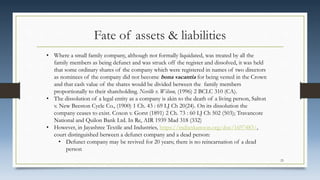
Fate of assets & liabilities
• Where a small family company, although not formally liquidated, was treated by all the
family members as being defunct and was struck off the register and dissolved, it was held
that some ordinary shares of the company which were registered in names of two directors
as nominees of the company did not become bona vacantia for being vested in the Crown
and that cash value of the shares would be divided between the family members
proportionally to their shareholding. Neville v. Wilson, (1996) 2 BCLC 310 (CA).
• The dissolution of a legal entity as a company is akin to the death of a living person, Salton
v. New Beeston Cycle Co., (1900) 1 Ch. 43 : 69 LJ Ch 20(24). On its dissolution the
company ceases to exist. Coxon v. Gorst (1891) 2 Ch. 73 : 60 LJ Ch 502 (503); Travancore
National and Quilon Bank Ltd. In Re, AIR 1939 Mad 318 (332)
• However, in Jayashree Textile and Industries, https://indiankanoon.org/doc/1697483/,
court distinguished between a defunct company and a dead person:
• Defunct company may be revived for 20 years; there is no reincarnation of a dead
person
25
Restoration of Name of Companies
26
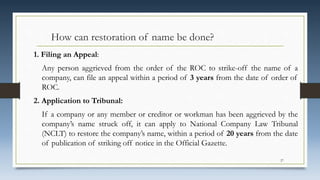
How can restoration of name be done?
1. Filing an Appeal:
Any person aggrieved from the order of the ROC to strike-off the name of a
company, can file an appeal within a period of 3 years from the date of order of
ROC.
2. Application to Tribunal:
If a company or any member or creditor or workman has been aggrieved by the
company’s name struck off, it can apply to National Company Law Tribunal
(NCLT) to restore the company’s name, within a period of 20 years from the date
of publication of striking off notice in the Official Gazette.
27
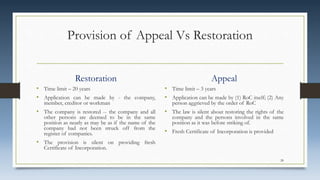
Provision of Appeal Vs Restoration
Restoration
• Time limit – 20 years
• Application can be made by - the company,
member, creditor or workman
• The company is restored -- the company and all
other persons are deemed to be in the same
position as nearly as may be as if the name of the
company had not been struck off from the
register of companies.
• The provision is silent on providing fresh
Certificate of Incorporation.
Appeal
• Time limit – 3 years
• Application can be made by (1) RoC itself; (2) Any
person aggrieved by the order of RoC
• The law is silent about restoring the rights of the
company and the persons involved in the same
position as it was before striking of.
• Fresh Certificate of Incorporation is provided
28
Section 560 of the Act, 1956
As per the erstwhile act:
• where it appears from the latest available balance-sheet of a defunct
company that it has adequate realisable assets -- steps are taken to take the
company into compulsory liquidation.
• But where the latest available balance-sheet shows that the company has no
assets or has such assets as would not be sufficient to meet the costs of
liquidation, steps are taken to strike their names off the register under
section 560.
29
Who may file application?
Aggrieved by the company having its name struck off-
• Company; or
• Any member; or
• Creditor; or
• workman
Where to file application?
NCLT
When to file application?
Before the expiry of 20 years from the publication in the Official Gazette of the notice under section 248(5).
30
Section 252 (3) of the Companies Act, 2013
corresponding to Section 560(6) of the Companies Act, 1956
Annexures to the application
1. Copy of MOA and AOA of the Company
2. List of Directors of the Company
3. CTC of the order of ROC for strike off
4. Available signed Balance Sheets of the Company
5. CTC of Board Resolution passed by the company for making petition to NCLT to make appeal against
the order of ROC
6. Affidavit verifying the petition
7. Copy of bank draft evidencing payment of fee of Rs. 2,500/-
8. Memorandum of appearance with copy of the Board Resolution or the vakalatnama, as the case may be
31
Steps for Restoration of Name
First Step- Preparation of Petition: Rule 87A (1)
The petition shall be filed in Form No. NCLT-9.
Second Step- Submission of Petition with ROC: Rule 87A(2)
A copy of the application shall be served on ROC and on such other persons as NCLT may direct, not
less than 14 days before the date fixed for hearing of the application.
Third Step- Hearing by NCLT: Rule 87A(3)
NCLT shall hear all the parties and take note of the objections received.
Then, if it is satisfied of the following, it can order the restoration of name of the company:
• At the time of its name being struck off, Company was carrying on business or was in operation; or
• If otherwise it is just that the name of the company be restored.
32
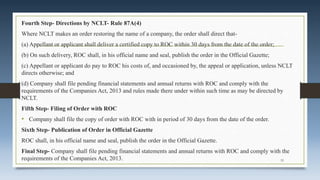
Fourth Step- Directions by NCLT- Rule 87A(4)
Where NCLT makes an order restoring the name of a company, the order shall direct that-
(a) Appellant or applicant shall deliver a certified copy to ROC within 30 days from the date of the order;
(b) On such delivery, ROC shall, in his official name and seal, publish the order in the Official Gazette;
(c) Appellant or applicant do pay to ROC his costs of, and occasioned by, the appeal or application, unless NCLT
directs otherwise; and
(d) Company shall file pending financial statements and annual returns with ROC and comply with the
requirements of the Companies Act, 2013 and rules made there under within such time as may be directed by
NCLT.
Fifth Step- Filing of Order with ROC
• Company shall file the copy of order with ROC with in period of 30 days from the date of the order.
Sixth Step- Publication of Order in Official Gazette
ROC shall, in his official name and seal, publish the order in the Official Gazette.
Final Step- Company shall file pending financial statements and annual returns with ROC and comply with the
requirements of the Companies Act, 2013. 33
Effect on Restoration of Name
• After restoration, all the statutory returns of the company shall be filed along
with the applicable additional fee.
• NCLT may, by the order, give such other directions and make such provision
as deemed just for placing the company and all other persons in the same
position as nearly as may be as if the name of the company had not been
struck off from ROC [Section 252(3)].
34
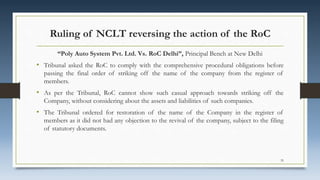
Ruling of NCLT reversing the action of the RoC
“Poly Auto System Pvt. Ltd. Vs. RoC Delhi”, Principal Bench at New Delhi
• Tribunal asked the RoC to comply with the comprehensive procedural obligations before
passing the final order of striking off the name of the company from the register of
members.
• As per the Tribunal, RoC cannot show such casual approach towards striking off the
Company, without considering about the assets and liabilities of such companies.
• The Tribunal ordered for restoration of the name of the Company in the register of
members as it did not had any objection to the revival of the company, subject to the filing
of statutory documents.
35
Purushottamdass v. ROC Maharashtra
1986 60 CompCas 154 Bom
In the instance case, the Bombay High Court made the following observations-
“The objects of section 560(6) of the Companies Act is to give a chance to the company, its members and
creditors to revive the company which has been struck off by the Registrar of Companies, within a period of 20
years, and to give them an opportunity of carrying on the business only after the company judge is satisfied that
such restoration is necessary in the interests of justice. The company judge may be satisfied that
either the company was carrying on its business or was in operation or otherwise, and it
is, in the circumstances of the case, equitable and just to restore the company. It, however,
does not mean that the rights and liabilities of the company are lost during the interim period, inasmuch as section
560(6) of the Companies Act provides that after an order of restoration is passed, it shall be deemed as if the
company was never struck of the register of companies. The section also provides the company judge with wide
powers to put certain conditions or directions at the time of ordering the restoration.”
Also cited in: Ascot Shoes Private Limited v. ROC [CO. PET 23/2016- Delhi High Court]
36
Meghdoot Services Ltd. v. ROC, West Bengal, 2016 TaxPub (CL)
0317: (2016) 128 CC 0728- High Court of Calcutta- 11th May, 2016
Issues for consideration :
• Where the company’s name was struck off from Register on the prayer of company itself or of its directors, whether the
application for restoration of name by the company or its director would be allowable?
• Whether petition for restoration of company’s name to Register of companies could be filed only if a company, or any member
or a creditor of company feels aggrieved by company having being struck off?
Observations of the High Court:
• It was not possible to accept that a Company whose name had been struck off on its own invitation, 6 or 7 years ago, should be
permitted to apply under the said provision for the striking off to be undone.
• In such a situation, only a creditor or a shareholder of the Company could have applied, provided of course the application was
made within 20 years from the date on which the Company’s name had been struck off.
Decision:
• Company having been struck off, on the prayer of the Company itself and/or its directors, there can be no question of the
Company being aggrieved by the striking off.
Similar Judgment: Dasaprakash (P.) Ltd. v. ROC [Madras High Court- C.P. No. 31/2012 decided on 03.08.2012] 37
Dormant companies
Another section which empowers RoC to remove the name of a company from the
register of members is Sec 455.
• RoC may remove the name of company from the register of members and put the
same in the register of dormant companies. [455 (4)]
• The dormant company shall then comply with the requirements and retain its
dormant status or make an application to become an active company. [455 (5)]
o the Registrar shall initiate the process of striking off the name of the company if the
company remains as a dormant company for a period of consecutive five years. – [R. 8 (1)
of Miscellaneous Rules, 2014]
• Thereafter, if the dormant company fails to comply with the requirements of the
section, then the RoC can finally remove the name of such company from the
register of dormant company as well. [455 (6)]
38
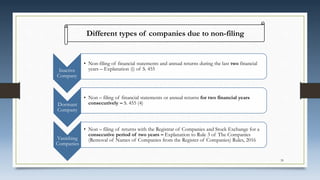
Different types of companies due to non-filing
Inactive
Company
• Non-filing of financial statements and annual returns during the last two financial
years – Explanation (i) of S. 455
Vanishing
Companies
• Non – filing of returns with the Registrar of Companies and Stock Exchange for a
consecutive period of two years – Explanation to Rule 3 of The Companies
(Removal of Names of Companies from the Register of Companies) Rules, 2016
Dormant
Company
• Non – filing of financial statements or annual returns for two financial years
consecutively – S. 455 (4)
39
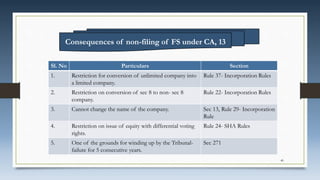
Consequences of non-filing of FS under CA, 13
Sl. No Particulars Section
1. Restriction for conversion of unlimited company into
a limited company.
Rule 37- Incorporation Rules
2. Restriction on conversion of sec 8 to non- sec 8
company.
Rule 22- Incorporation Rules
3. Cannot change the name of the company. Sec 13, Rule 29- Incorporation
Rule
4. Restriction on issue of equity with differential voting
rights.
Rule 24- SHA Rules
5. One of the grounds for winding up by the Tribunal-
failure for 5 consecutive years.
Sec 271
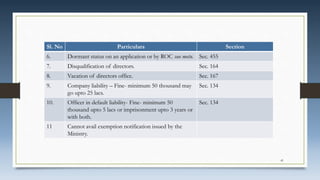
40
Sl. No Particulars Section
6. Dormant status on an application or by ROC suo motu. Sec. 455
7. Disqualification of directors. Sec. 164
8. Vacation of directors office. Sec. 167
9. Company liability – Fine- minimum 50 thousand may
go upto 25 lacs.
Sec. 134
10. Officer in default liability- Fine- minimum 50
thousand upto 5 lacs or imprisonment upto 3 years or
with both.
Sec. 134
11 Cannot avail exemption notification issued by the
Ministry.
41
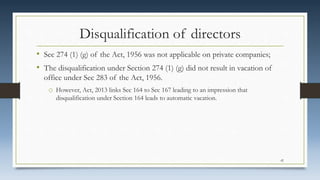
Disqualification of directors
• Sec 274 (1) (g) of the Act, 1956 was not applicable on private companies;
• The disqualification under Section 274 (1) (g) did not result in vacation of
office under Sec 283 of the Act, 1956.
o However, Act, 2013 links Sec 164 to Sec 167 leading to an impression that
disqualification under Section 164 leads to automatic vacation.
42
Whether sec. 164 (2) (a) prospective,
retrospective or retroactive ?
43
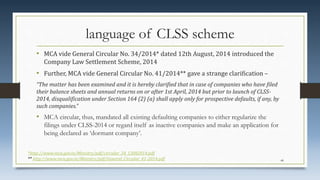
language of CLSS scheme
• MCA vide General Circular No. 34/2014* dated 12th August, 2014 introduced the
Company Law Settlement Scheme, 2014
• Further, MCA vide General Circular No. 41/2014** gave a strange clarification –
“The matter has been examined and it is hereby clarified that in case of companies who have filed
their balance sheets and annual returns on or after 1st April, 2014 but prior to launch of CLSS-
2014, disqualification under Section 164 (2) (a) shall apply only for prospective defaults, if any, by
such companies.”
• MCA circular, thus, mandated all existing defaulting companies to either regularize the
filings under CLSS-2014 or regard itself as inactive companies and make an application for
being declared as ‘dormant company’.
*http://www.mca.gov.in/Ministry/pdf/circular_34_13082014.pdf
** http://www.mca.gov.in/Ministry/pdf/General_Circular_41-2014.pdf 44
Ruling of NCLT
Vikram Ahuja Vs. Greenstone Investments Pvt. Ltd. and ors., before the
NCLT, Mumbai Bench, decided on November 11, 2016*
• The default in filing will be taken from where the non-filing has started;
• The statute providing posterior disqualification on past conduct does not
become a retrospective one because a part of a requisition for its action is
drawn from a time antecedent to its passing.
*http://nclt.gov.in/Publication/Mumbai_Bench/2016/397_398/Greenstone%20Investments%20Pvt.%20Lt
d.%2022.11.2016_.pdf 45
Settled principle of law
• In the Supreme Court Judgment in case of Maharaja Chintamani Saran Nath ... vs State
Of Bihar And Ors on 7 October, 1999* that the true principle is that Lex prospicit non
respicit (law looks forward not back)
o Retrospective legislation is contrary to the general principle -- A law that affects substantive rights
of parties can only be prospective
• The Supreme Court of India in Hitendra Vishnu Thakur and Others v. State of
Maharashtra and Others, [1994] 4 SCC 602 held that where a statute which affects
substantive rights is presumed to be prospective in operation unless made retrospective,
either expressly or by necessary intendment, whereas a statute which merely affects
procedure, unless such a construction is textually impossible, is presumed to be retrospective
in its application, should not be given an extended meaning and should be strictly confined
to its clearly defined limits .
• Article 20 of the Constitution of India - A penal law cannot be retrospective at all
https://indiankanoon.org/doc/1293868/ 46
47
Will disqualification u/s 164(2)(b) of the
Act also apply to directors newly appointed
in the company?
48
As per Act, 2013 -
The starting lines of the Sec 164(2)(b), read as follows: “No person who is or has been a
director of a company …..”
Therefore, even the newly director will be covered by the Section.
As per Companies (Amendment) Bill, 2017 –
The proposed Bill provides a time period of six months for an incoming director to
correct the filing defaults committed by the company.
How will the company function
when all the directors of a company
will need to vacate their offices?
49
50
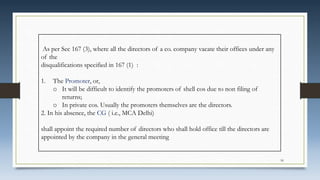
As per Sec 167 (3), where all the directors of a co. company vacate their offices under any
of the
disqualifications specified in 167 (1) :
1. The Promoter, or,
o It will be difficult to identify the promoters of shell cos due to non filing of
returns;
o In private cos. Usually the promoters themselves are the directors.
2. In his absence, the CG ( i.e., MCA Delhi)
shall appoint the required number of directors who shall hold office till the directors are
appointed by the company in the general meeting
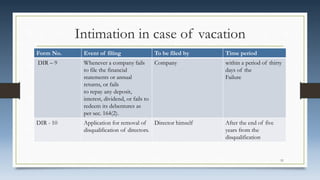
Intimation in case of vacation
Form No. Event of filing To be filed by Time period
DIR – 9 Whenever a company fails
to file the financial
statements or annual
returns, or fails
to repay any deposit,
interest, dividend, or fails to
redeem its debentures as
per sec. 164(2).
Company within a period of thirty
days of the
Failure
DIR - 10 Application for removal of
disqualification of directors.
Director himself After the end of five
years from the
disqualification
51
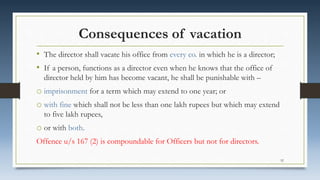
Consequences of vacation
• The director shall vacate his office from every co. in which he is a director;
• If a person, functions as a director even when he knows that the office of
director held by him has become vacant, he shall be punishable with –
o imprisonment for a term which may extend to one year; or
o with fine which shall not be less than one lakh rupees but which may extend
to five lakh rupees,
o or with both.
Offence u/s 167 (2) is compoundable for Officers but not for directors.
52

Striking off under ca 13 vinod kothari (1)

  • 1.
    Vinod Kothari Vinod Kothari& Company www.vinodkothari.com Kolkata 1006-1009 Krishna Building 224 AJC Bose Road Kolkata – 700017 Phone: 033- 2281 7715/ 1276/ 3742 E: corplaw@vinodkothari.com Mumbai 403-406, 175, Shreyas Chambers, D.N. Road, Fort, Mumbai – 400001 Phone: 022 – 22614021 / 30447498 E: bombay@vinodkothari.com Delhi A/11, Hauz Khas, New Delhi – 110016 Phone: 011- 41315340 / 65515340 E: delhi@vinodkothari.com Striking off under Companies Act, 2013 1
  • 2.
    Copyright • The presentationis a property of Vinod Kothari & Company. • No part of it can be copied, reproduced or distributed in any manner, without explicit prior permission. • In case of linking, please do give credit and full link 2
  • 3.
    About Us • VinodKothari & Co., o Based in Kolkata, Mumbai and Delhi • We are a team of consultants, advisors & qualified professionals having over 25 years of practice. Our Organization’s Credo: Focus on capabilities; opportunities follow 3
  • 4.
    Scope of thepresentation Since there are several partly-overlapping issues, let us be clear about the scope of the presentation. • The presentation deals with Companies Act provisions dealing with striking-off • Does not deal with- o Tax issues arising out of unauthenticated capital or sources of funding for companies or consequential impact on properties of companies; o Benami properties or the Benami property law 4
  • 5.
    • The massivestriking-off of companies is somehow connected with Operation Clean Money – a drive against black money. • The Companies Act deals with striking off of a defunct company. • If the company is defunct, it apparently has no substance into it.Hence, unlikely that something which is defunct can be used as a conduit for money laundering. A drive against black money 5
  • 6.
    Several expressions beingused in conjunction Even though these expressions may have no mutual intersection:  Defunct companies  Dormant companies  Shell companies  Benami companies  Vanishing companies 6
  • 7.
    An almanac ofevents 1. The Companies (Removal of Names of Companies from the Register of Companies) Rules, 2016 were notified on 26th Dec 2016 2. Government initiated the ‘Operation Clean Money’ – January 31, 2017; 3. RoCs started issuing Public Notice to the shell companies – April, 2017; 4. Public Notice was put on MCA site – different dates for different states; 5. Notice was put on MCA site for LLPs - August 31, 2017; 6. Government confirmed that names of over 2.09 lakh companies have been struck off from the Register of Companies - September 5, 2017; 7. MCA came out with its Press Release dealing with the punishment for siphoning off money from bank a/cs of such cos and disqualification of directors – September 6, 2017. 7
  • 8.
    The vengeance ofthe empire The government has expressed intent to take several actions- • Directors of struck off companies cannot operate bank accounts post striking off. • If there is a continued failure to file financial statements for 3 years, the directors will vacate their offices in terms of sec. 167 read with sec 164 (2). o Hence, they will get disqualified in all other cos as well; o Banks have been instructed to stop the operation of bank accounts by such directors • Profile of directors and their antecedents being investigated. • Role of auditors/company secretaries/cost accountants also being investigated. 8
  • 9.
    City wise datashowing total number of companies struck off during 2017 11955, 9% 1818, 1% 7399, 6% 8822, 7% 321, 0% 24338, 19%64000, 49% 11265, 9% Kolkata Ahmedabad Bangalore Chennai Delhi Hyderabad Mumbai Pune Note: The above pie chart has been drawn based on the data of selective cities only. 9
  • 10.
    Trend showing numberof companies struck off during October 2016- August 2017 2172 1115 1260 1361 1021 20 956 1450 103476 75244 31416 Oct-16 Nov-16 Dec-16 Jan-17 Feb-17 Mar-17 Apr-17 May-17 Jun-17 Jul-17 Aug-17 10
  • 11.
    • Sec 248- Striking off of defunct companies by the registrar o Compulsory strike-off: By the registrar – sec 248 (1) o Voluntary strike-off: By the company – sec. 248 (2) o Consequential and appellate provisions – sec 249 – 252 o The Companies (Removal of Names of Companies from the Register of Companies) Rules, 2016 • Sec 164 (2) (a) read with sec 167 (1) (a); 167 (2) - disqualification of directors. • Sec 271 (1) (f) – compulsory winding up • Sec 455 –dormant companies – read with Companies (Miscellaneous) Rules • 455 (4) – register of dormant companies • 455 (6) - striking off of names of dormant companies from register of dormant companies • Several other implications of non filing of financial statements Relevant provisions of Companies Act 11
  • 12.
    Meaning of defunctcompanies The term ‘Defunct Company’ is defined in the Guidelines issued by MCA for Fast Track Exit mode for defunct companies under section 560 of the Companies Act, 1956 , which states – “For Fast Track Exit mode (FTE), it is stated as under:- (a) Any company will be called as “defunct company” for the purpose of these guidelines, which has nil asset and liability and (i) has not commenced any business activity or operation since incorporation; or (ii) is not carrying over any business activity or operation for last one year before making application under FTE.” 12
  • 13.
    The three conditionsfor mandatory strike-off are:- • Company has failed to commence business within 1 year from incorporation o This condition actually pertains to requirement of earlier law requiring cos to file certificate of commencement of business; irrelevant now • Subscribers to memorandum have not paid their subscription amount within 6 months of incorporation – the same has been omitted by the Companies (Amendment) Act, 2015 • Company is not carrying business or operation for two immediately preceding financial years and has not applied for dormant status o Since the RoC action has been taken before October, 2017 (before the due date for annual filings for 2016-17), it pertains to the act of non-filing of financial statements, the relevant financial years are 2014-15, and 2015-16 Provisions of sec. 248 (1) 13
  • 14.
    Legal position asto inoperative companies • If a company becomes inoperative or dormant, it may apply to be categorised as a dormant company u/s 455 • There is only an annual filing in case of dormant companies • Form MSC -3, certified by a chartered accountant; rest of the formalities are not applicable • However, if a company, which is not an optionally dormant companies, becomes inoperative, the Registrar may use powers to strike off the name • The purpose of strike-off, whether voluntary or involuntary, is to clean up the register of companies which have become substantively extinct • If the company has assets/liabilities, it may go the process of winding up • Thus, there are 2 options for an inoperative company • Get categories as dormant company • Get treated or opt to be treated as defunct company • In case of defunct companies, do the implications on directors cease: • Form STK-1 clearly says to the contrary 14
  • 15.
    Meaning of theterm ‘not in operation’ • The power of the RoC to strike off the name of the company not carrying business or operation has been there in CA, 1956 • Similar provisions have existed in UK, 1948 • Also, in UK CA 2006, sections 1000-1002 • A company is in the course of being wound up and not carrying on any business, yet so long as it remains undissolved -- it will be considered to be in operation- Re, Outlay Assurance Society, (1887) 34 Ch D 479. 15
  • 16.
    Presumption of non-operativecompany Where a company since its incorporation in 1929 and for thirty years thereafter had— (a) never met in a shareholders’or directors’meeting, and (b) no returns or list of members were filed (c) no balance sheets prepared or bank accounts were maintained by the company, and (d) the properties of the company were dealt with, sold and transferred as if they were the personal property of the individual members, Registrar was justified in striking the company off the register of companies after giving sufficient opportunities to the interested parties to show cause to the contrary. Rai Saheb U.N. Mandal’s Estate Ltd., In re, (1960) 30 Com Cases 172 (Cal). 16
  • 17.
    Process of strikingoff 1/2 • Sending of notice of proposed action by the RoC –rule 3 (2) • To the company • To all directors as per addresses on record • In form STK-1 • Notice to be sent by registered post or speed post • Notice shall state the reasons for which the name of the company to be struck off • Opportunity to make representation within 30 days from the date of notice. • This is not a pre-striking off notice; this seems to be a notice to presume that the company is inoperative • Pre-strike-off notice u/s 248 (1), rule 7, form STK-5 • To be given to company and directors • Notice shall also be put on official gazette – sec 248 (4) : was this done?? • Publication of the notice in newspapers – English and vernacular –state-wise • To be put on the website of the MCA • Simultaneously, the RoC shall intimate the concerned regulatory and tax authorites – rule 7 (2) 17
  • 18.
    • There seemsa 30-day period for the second notice as well –rule 7 (2) • For getting objections, if any, of regulatory authorities • Notice of strike-off : On expiry of 30 days, RoC shall once again put a notice in Official Gazette – sec. 248 (5), rule 9, form STK-7 • Official gazette and the website of the MCA • however, no such notice seems to have been put on the Official Gazette till now. • In view of the language of STK-7, this seems to be notice for each company dissolved • Thereafter, the company stands dissolved Process of striking off 2/2 18
  • 19.
    RoC’s obligation [sec248 (6)] • Looking at the tone of the provision, the provision seems applicable only to voluntary strike-off by the company; however, language extends to compulsory strike-off as well. • RoC to satisfy himself that -- o Sufficient provision has been made for realization of amount due to the company; o Sufficient provision made for discharge of obligations or liabilities by the company; 19
  • 20.
    Importance of followingprocedural requirements • Courts have held in several cases that the procedural requirements of sec. 560 of CA 1956 /248 of CA 2013 are important; action of striking off has been reversed on that ground: • Basanti Cotton Mills, Calcutta High court, 2010, https://indiankanoon.org/doc/49377648/, subsequently, Gopal Navinbhai Dave and ors. Vs. Nirendranath Kar and anr., 2012 ruling • The power of the registrar under sec. 560 is a power; not a duty • Sukhbir Saran Bhatnagar And Ors. vs Registrar Of Companies https://indiankanoon.org/docfragment/1718097/ 20
  • 21.
    However, following companiescannot be struck off • Rule 3 provides the following companies cannot be struck off, either under compulsory or voluntary strike-off • listed companies; • companies that have been delisted due to non-compliance of listing regulations or listing agreement or any other statutory laws; • vanishing companies; • where inspection or investigation is ordered, being carried out, or prosecutions arising out of inspection or investigation pending • Inspection/investigation under 1956 Act • companies against which any prosecution for an offence is pending in any court; • companies whose application for compounding is pending before the competent authority • companies, which have accepted public deposits • companies having charges which are pending for satisfaction; • companies registered under section 25 of the Companies Act, 1956 or section 8 of the Act. 21
  • 22.
    Can non-filing offinancial statements be a ground for treating the company as inoperative • Sec 455 (4) provides, in case of non-filing of financial statements and annual return by companies, the RoC shall serve a notice to the company to enter the name of the company in the register of dormant companies • Primafacie, unless there are other strong reasons, it seems the first action required on account of non-filing of financial statements is dormancy, and not strike off • Sec. 248 nowhere talks about non-filing of financial statements • In UK practice, the presumption about company being inoperative is taken based on several facts: • Non-filing of documents • Non-delivery of documents at the registered office • Directors not being traceable [https://www.gov.uk/government/publications/company-strike-off- dissolution-and-restoration/strike-off-dissolution-and-restoration ] 22
  • 23.
    Directors’ liability incase of defunct companies • Calculating and Business Machines, 1983 54 Comp Cas 100 Patna, https://indiankanoon.org/doc/454964/ • company applied for strike off • RoC objected on the ground of “some liability” and served prosecution notices • Prosecution notices were struck down as there was no mens rea • Liability of directors continues despite strike off- International Asset Reconstruction Co vs RoC, https://indiankanoon.org/doc/163386364/ 23
  • 24.
    Effect of dissolutionu/s 248 • Sec 250 – it shall cease to operate as a company • Certificate of incorporation shall be deemed to have been canceled o Except for the purpose of realization of money due to the company o And for discharge of obligations of the company That is, the company may realize assets and pay off obligations, but will have to cease to be a going concern • Proviso to sec. 248 (6) says assets of the company may be still available for discharge of the obligations of the company • Certainly enough, the realization of assets and discharge of obligations can be done only by the-then signatories 24
  • 25.
    Fate of assets& liabilities • Where a small family company, although not formally liquidated, was treated by all the family members as being defunct and was struck off the register and dissolved, it was held that some ordinary shares of the company which were registered in names of two directors as nominees of the company did not become bona vacantia for being vested in the Crown and that cash value of the shares would be divided between the family members proportionally to their shareholding. Neville v. Wilson, (1996) 2 BCLC 310 (CA). • The dissolution of a legal entity as a company is akin to the death of a living person, Salton v. New Beeston Cycle Co., (1900) 1 Ch. 43 : 69 LJ Ch 20(24). On its dissolution the company ceases to exist. Coxon v. Gorst (1891) 2 Ch. 73 : 60 LJ Ch 502 (503); Travancore National and Quilon Bank Ltd. In Re, AIR 1939 Mad 318 (332) • However, in Jayashree Textile and Industries, https://indiankanoon.org/doc/1697483/, court distinguished between a defunct company and a dead person: • Defunct company may be revived for 20 years; there is no reincarnation of a dead person 25
  • 26.
    Restoration of Nameof Companies 26
  • 27.
    How can restorationof name be done? 1. Filing an Appeal: Any person aggrieved from the order of the ROC to strike-off the name of a company, can file an appeal within a period of 3 years from the date of order of ROC. 2. Application to Tribunal: If a company or any member or creditor or workman has been aggrieved by the company’s name struck off, it can apply to National Company Law Tribunal (NCLT) to restore the company’s name, within a period of 20 years from the date of publication of striking off notice in the Official Gazette. 27
  • 28.
    Provision of AppealVs Restoration Restoration • Time limit – 20 years • Application can be made by - the company, member, creditor or workman • The company is restored -- the company and all other persons are deemed to be in the same position as nearly as may be as if the name of the company had not been struck off from the register of companies. • The provision is silent on providing fresh Certificate of Incorporation. Appeal • Time limit – 3 years • Application can be made by (1) RoC itself; (2) Any person aggrieved by the order of RoC • The law is silent about restoring the rights of the company and the persons involved in the same position as it was before striking of. • Fresh Certificate of Incorporation is provided 28
  • 29.
    Section 560 ofthe Act, 1956 As per the erstwhile act: • where it appears from the latest available balance-sheet of a defunct company that it has adequate realisable assets -- steps are taken to take the company into compulsory liquidation. • But where the latest available balance-sheet shows that the company has no assets or has such assets as would not be sufficient to meet the costs of liquidation, steps are taken to strike their names off the register under section 560. 29
  • 30.
    Who may fileapplication? Aggrieved by the company having its name struck off- • Company; or • Any member; or • Creditor; or • workman Where to file application? NCLT When to file application? Before the expiry of 20 years from the publication in the Official Gazette of the notice under section 248(5). 30 Section 252 (3) of the Companies Act, 2013 corresponding to Section 560(6) of the Companies Act, 1956
  • 31.
    Annexures to theapplication 1. Copy of MOA and AOA of the Company 2. List of Directors of the Company 3. CTC of the order of ROC for strike off 4. Available signed Balance Sheets of the Company 5. CTC of Board Resolution passed by the company for making petition to NCLT to make appeal against the order of ROC 6. Affidavit verifying the petition 7. Copy of bank draft evidencing payment of fee of Rs. 2,500/- 8. Memorandum of appearance with copy of the Board Resolution or the vakalatnama, as the case may be 31
  • 32.
    Steps for Restorationof Name First Step- Preparation of Petition: Rule 87A (1) The petition shall be filed in Form No. NCLT-9. Second Step- Submission of Petition with ROC: Rule 87A(2) A copy of the application shall be served on ROC and on such other persons as NCLT may direct, not less than 14 days before the date fixed for hearing of the application. Third Step- Hearing by NCLT: Rule 87A(3) NCLT shall hear all the parties and take note of the objections received. Then, if it is satisfied of the following, it can order the restoration of name of the company: • At the time of its name being struck off, Company was carrying on business or was in operation; or • If otherwise it is just that the name of the company be restored. 32
  • 33.
    Fourth Step- Directionsby NCLT- Rule 87A(4) Where NCLT makes an order restoring the name of a company, the order shall direct that- (a) Appellant or applicant shall deliver a certified copy to ROC within 30 days from the date of the order; (b) On such delivery, ROC shall, in his official name and seal, publish the order in the Official Gazette; (c) Appellant or applicant do pay to ROC his costs of, and occasioned by, the appeal or application, unless NCLT directs otherwise; and (d) Company shall file pending financial statements and annual returns with ROC and comply with the requirements of the Companies Act, 2013 and rules made there under within such time as may be directed by NCLT. Fifth Step- Filing of Order with ROC • Company shall file the copy of order with ROC with in period of 30 days from the date of the order. Sixth Step- Publication of Order in Official Gazette ROC shall, in his official name and seal, publish the order in the Official Gazette. Final Step- Company shall file pending financial statements and annual returns with ROC and comply with the requirements of the Companies Act, 2013. 33
  • 34.
    Effect on Restorationof Name • After restoration, all the statutory returns of the company shall be filed along with the applicable additional fee. • NCLT may, by the order, give such other directions and make such provision as deemed just for placing the company and all other persons in the same position as nearly as may be as if the name of the company had not been struck off from ROC [Section 252(3)]. 34
  • 35.
    Ruling of NCLTreversing the action of the RoC “Poly Auto System Pvt. Ltd. Vs. RoC Delhi”, Principal Bench at New Delhi • Tribunal asked the RoC to comply with the comprehensive procedural obligations before passing the final order of striking off the name of the company from the register of members. • As per the Tribunal, RoC cannot show such casual approach towards striking off the Company, without considering about the assets and liabilities of such companies. • The Tribunal ordered for restoration of the name of the Company in the register of members as it did not had any objection to the revival of the company, subject to the filing of statutory documents. 35
  • 36.
    Purushottamdass v. ROCMaharashtra 1986 60 CompCas 154 Bom In the instance case, the Bombay High Court made the following observations- “The objects of section 560(6) of the Companies Act is to give a chance to the company, its members and creditors to revive the company which has been struck off by the Registrar of Companies, within a period of 20 years, and to give them an opportunity of carrying on the business only after the company judge is satisfied that such restoration is necessary in the interests of justice. The company judge may be satisfied that either the company was carrying on its business or was in operation or otherwise, and it is, in the circumstances of the case, equitable and just to restore the company. It, however, does not mean that the rights and liabilities of the company are lost during the interim period, inasmuch as section 560(6) of the Companies Act provides that after an order of restoration is passed, it shall be deemed as if the company was never struck of the register of companies. The section also provides the company judge with wide powers to put certain conditions or directions at the time of ordering the restoration.” Also cited in: Ascot Shoes Private Limited v. ROC [CO. PET 23/2016- Delhi High Court] 36
  • 37.
    Meghdoot Services Ltd.v. ROC, West Bengal, 2016 TaxPub (CL) 0317: (2016) 128 CC 0728- High Court of Calcutta- 11th May, 2016 Issues for consideration : • Where the company’s name was struck off from Register on the prayer of company itself or of its directors, whether the application for restoration of name by the company or its director would be allowable? • Whether petition for restoration of company’s name to Register of companies could be filed only if a company, or any member or a creditor of company feels aggrieved by company having being struck off? Observations of the High Court: • It was not possible to accept that a Company whose name had been struck off on its own invitation, 6 or 7 years ago, should be permitted to apply under the said provision for the striking off to be undone. • In such a situation, only a creditor or a shareholder of the Company could have applied, provided of course the application was made within 20 years from the date on which the Company’s name had been struck off. Decision: • Company having been struck off, on the prayer of the Company itself and/or its directors, there can be no question of the Company being aggrieved by the striking off. Similar Judgment: Dasaprakash (P.) Ltd. v. ROC [Madras High Court- C.P. No. 31/2012 decided on 03.08.2012] 37
  • 38.
    Dormant companies Another sectionwhich empowers RoC to remove the name of a company from the register of members is Sec 455. • RoC may remove the name of company from the register of members and put the same in the register of dormant companies. [455 (4)] • The dormant company shall then comply with the requirements and retain its dormant status or make an application to become an active company. [455 (5)] o the Registrar shall initiate the process of striking off the name of the company if the company remains as a dormant company for a period of consecutive five years. – [R. 8 (1) of Miscellaneous Rules, 2014] • Thereafter, if the dormant company fails to comply with the requirements of the section, then the RoC can finally remove the name of such company from the register of dormant company as well. [455 (6)] 38
  • 39.
    Different types ofcompanies due to non-filing Inactive Company • Non-filing of financial statements and annual returns during the last two financial years – Explanation (i) of S. 455 Vanishing Companies • Non – filing of returns with the Registrar of Companies and Stock Exchange for a consecutive period of two years – Explanation to Rule 3 of The Companies (Removal of Names of Companies from the Register of Companies) Rules, 2016 Dormant Company • Non – filing of financial statements or annual returns for two financial years consecutively – S. 455 (4) 39
  • 40.
    Consequences of non-filingof FS under CA, 13 Sl. No Particulars Section 1. Restriction for conversion of unlimited company into a limited company. Rule 37- Incorporation Rules 2. Restriction on conversion of sec 8 to non- sec 8 company. Rule 22- Incorporation Rules 3. Cannot change the name of the company. Sec 13, Rule 29- Incorporation Rule 4. Restriction on issue of equity with differential voting rights. Rule 24- SHA Rules 5. One of the grounds for winding up by the Tribunal- failure for 5 consecutive years. Sec 271 40
  • 41.
    Sl. No ParticularsSection 6. Dormant status on an application or by ROC suo motu. Sec. 455 7. Disqualification of directors. Sec. 164 8. Vacation of directors office. Sec. 167 9. Company liability – Fine- minimum 50 thousand may go upto 25 lacs. Sec. 134 10. Officer in default liability- Fine- minimum 50 thousand upto 5 lacs or imprisonment upto 3 years or with both. Sec. 134 11 Cannot avail exemption notification issued by the Ministry. 41
  • 42.
    Disqualification of directors •Sec 274 (1) (g) of the Act, 1956 was not applicable on private companies; • The disqualification under Section 274 (1) (g) did not result in vacation of office under Sec 283 of the Act, 1956. o However, Act, 2013 links Sec 164 to Sec 167 leading to an impression that disqualification under Section 164 leads to automatic vacation. 42
  • 43.
    Whether sec. 164(2) (a) prospective, retrospective or retroactive ? 43
  • 44.
    language of CLSSscheme • MCA vide General Circular No. 34/2014* dated 12th August, 2014 introduced the Company Law Settlement Scheme, 2014 • Further, MCA vide General Circular No. 41/2014** gave a strange clarification – “The matter has been examined and it is hereby clarified that in case of companies who have filed their balance sheets and annual returns on or after 1st April, 2014 but prior to launch of CLSS- 2014, disqualification under Section 164 (2) (a) shall apply only for prospective defaults, if any, by such companies.” • MCA circular, thus, mandated all existing defaulting companies to either regularize the filings under CLSS-2014 or regard itself as inactive companies and make an application for being declared as ‘dormant company’. *http://www.mca.gov.in/Ministry/pdf/circular_34_13082014.pdf ** http://www.mca.gov.in/Ministry/pdf/General_Circular_41-2014.pdf 44
  • 45.
    Ruling of NCLT VikramAhuja Vs. Greenstone Investments Pvt. Ltd. and ors., before the NCLT, Mumbai Bench, decided on November 11, 2016* • The default in filing will be taken from where the non-filing has started; • The statute providing posterior disqualification on past conduct does not become a retrospective one because a part of a requisition for its action is drawn from a time antecedent to its passing. *http://nclt.gov.in/Publication/Mumbai_Bench/2016/397_398/Greenstone%20Investments%20Pvt.%20Lt d.%2022.11.2016_.pdf 45
  • 46.
    Settled principle oflaw • In the Supreme Court Judgment in case of Maharaja Chintamani Saran Nath ... vs State Of Bihar And Ors on 7 October, 1999* that the true principle is that Lex prospicit non respicit (law looks forward not back) o Retrospective legislation is contrary to the general principle -- A law that affects substantive rights of parties can only be prospective • The Supreme Court of India in Hitendra Vishnu Thakur and Others v. State of Maharashtra and Others, [1994] 4 SCC 602 held that where a statute which affects substantive rights is presumed to be prospective in operation unless made retrospective, either expressly or by necessary intendment, whereas a statute which merely affects procedure, unless such a construction is textually impossible, is presumed to be retrospective in its application, should not be given an extended meaning and should be strictly confined to its clearly defined limits . • Article 20 of the Constitution of India - A penal law cannot be retrospective at all https://indiankanoon.org/doc/1293868/ 46
  • 47.
    47 Will disqualification u/s164(2)(b) of the Act also apply to directors newly appointed in the company?
  • 48.
    48 As per Act,2013 - The starting lines of the Sec 164(2)(b), read as follows: “No person who is or has been a director of a company …..” Therefore, even the newly director will be covered by the Section. As per Companies (Amendment) Bill, 2017 – The proposed Bill provides a time period of six months for an incoming director to correct the filing defaults committed by the company.
  • 49.
    How will thecompany function when all the directors of a company will need to vacate their offices? 49
  • 50.
    50 As per Sec167 (3), where all the directors of a co. company vacate their offices under any of the disqualifications specified in 167 (1) : 1. The Promoter, or, o It will be difficult to identify the promoters of shell cos due to non filing of returns; o In private cos. Usually the promoters themselves are the directors. 2. In his absence, the CG ( i.e., MCA Delhi) shall appoint the required number of directors who shall hold office till the directors are appointed by the company in the general meeting
  • 51.
    Intimation in caseof vacation Form No. Event of filing To be filed by Time period DIR – 9 Whenever a company fails to file the financial statements or annual returns, or fails to repay any deposit, interest, dividend, or fails to redeem its debentures as per sec. 164(2). Company within a period of thirty days of the Failure DIR - 10 Application for removal of disqualification of directors. Director himself After the end of five years from the disqualification 51
  • 52.
    Consequences of vacation •The director shall vacate his office from every co. in which he is a director; • If a person, functions as a director even when he knows that the office of director held by him has become vacant, he shall be punishable with – o imprisonment for a term which may extend to one year; or o with fine which shall not be less than one lakh rupees but which may extend to five lakh rupees, o or with both. Offence u/s 167 (2) is compoundable for Officers but not for directors. 52