StratusLab: Darn Simple Cloud
Charles (Cal) Loomis (CNRS/LAL & SixSq Sàrl)
FOSDEM’13: Cloud Devroom (3 February 2013)
StratusLab


What is it?
  Complete Infrastructure as a Service (IaaS) cloud distribution
  Open source with Apache 2 license
  Solid IaaS for direct use and for PaaS/SaaS developers


Focus: Darn Simple Cloud
  Simple to install, using commodity hardware
  Simple to use, from (most) any client machine
  Scales down as well as up!


                                                                    2
Bridging the Chasm…


Users
  How to use virtual machines to get my work done?
  How to structure, store, access, and protect data?
  Realize shared infrastructures with customized env. are possible

Application Developers
  How to use cloud techniques to improve my applications?
  … and my development workflows?
  Applications can be services with pluses and minuses…

Data Centers
  Reuse existing (commodity) hardware investments
  Take advantage of (and train) existing system administrators
  How to manage/use a (private, community, public) cloud?

Significant benefits from cloud even without large scale elasticity!
                                                                       3
Where did it start?

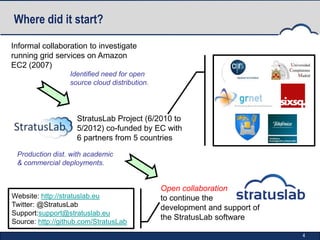
Informal collaboration to investigate
running grid services on Amazon
EC2 (2007)
                  Identified need for open
                  source cloud distribution.


                    StratusLab Project (6/2010 to
                    5/2012) co-funded by EC with
                    6 partners from 5 countries

 Production dist. with academic
 & commercial deployments.


                                               Open collaboration
Website: http://stratuslab.eu                  to continue the
Twitter: @StratusLab                           development and support of
Support:support@stratuslab.eu
                                               the StratusLab software
Source: http://github.com/StratusLab
                                                                            4
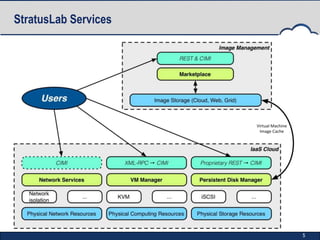
StratusLab Services


                      5
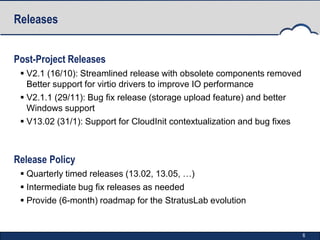
Releases


Post-Project Releases
  V2.1 (16/10): Streamlined release with obsolete components removed
   Better support for virtio drivers to improve IO performance
  V2.1.1 (29/11): Bug fix release (storage upload feature) and better
   Windows support
  V13.02 (31/1): Support for CloudInit contextualization and bug fixes


Release Policy
  Quarterly timed releases (13.02, 13.05, …)
  Intermediate bug fix releases as needed
  Provide (6-month) roadmap for the StratusLab evolution


                                                                          6
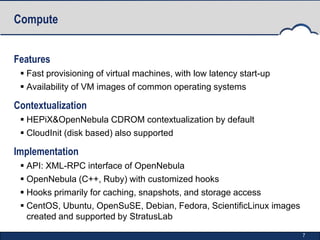
Compute


Features
  Fast provisioning of virtual machines, with low latency start-up
  Availability of VM images of common operating systems

Contextualization
  HEPiX&OpenNebula CDROM contextualization by default
  CloudInit (disk based) also supported

Implementation
  API: XML-RPC interface of OpenNebula
  OpenNebula (C++, Ruby) with customized hooks
  Hooks primarily for caching, snapshots, and storage access
  CentOS, Ubuntu, OpenSuSE, Debian, Fedora, ScientificLinux images
   created and supported by StratusLab

                                                                      7
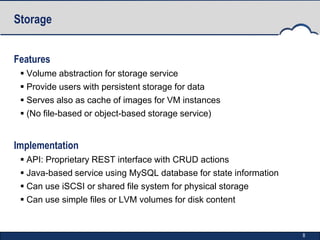
Storage


Features
  Volume abstraction for storage service
  Provide users with persistent storage for data
  Serves also as cache of images for VM instances
  (No file-based or object-based storage service)


Implementation
  API: Proprietary REST interface with CRUD actions
  Java-based service using MySQL database for state information
  Can use iSCSI or shared file system for physical storage
  Can use simple files or LVM volumes for disk content


                                                                   8
Network


Features
  Support3 specific use cases: public service (public),
   batch system (local), and BOINC-like worker (private)
  Dynamic configuration of network switches not needed
  Use standard services for (virtual) machine network configuration


Implementation
  No API: manual, static configuration of network
  Rec. configuration: VLAN for cloud services separate VLAN for VMs
  All classes of IP addresses are optional, can create other classes
  Uses DHCP for VM network configuration
  Users responsible for protecting their machines

                                                                        9
Marketplace & Image Handling


Priorities
  Mechanism for sharing and trusting images
  Possible to distribute fixed, read-only data sets as well
  Split the storage of image metadata and image contents
  Define roles for creator, user, administrator, and validator


Implementation
  Marketplace API: Proprietary REST API for create, read, search
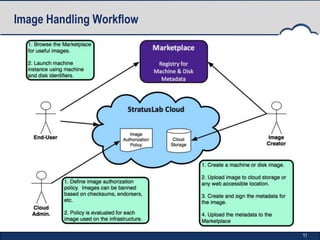
  Marketplace acts as image registry and handles only metadata
  Image contents can be located on any public (web) server
  ‘Private’ images can also be held in cloud storage


                                                                    10
Image Handling Workflow


                          11
Tools


Command Line Client
  Administrator: simplifies StratusLab installation
  Users: access StratusLab cloud from anywhere

Administration
  Quarantine for stopped virtual machines
  Monitoring of cloud activity and resources

Authentication and Authorization
  Supports username/password, certificates, cert. proxies
  Specification in local file and/or LDAP


                                                             12
Tools


Information from Developers
  Web site documentation and support mailing list
  Live tutorials (usually 2-3 per year)
  Workshops (next week of 11 March 2013 in Paris)


                                                     13
StratusLab Deployments


Reference Cloud Services
  (~)Open infrastructures for using StratusLab and providing feedback
  Operated on a first-come, first-served, best-effort basis
  In production 2+ years, with 250+ registered users
  Two sites: LAL (Orsay, France) and GRNET (Athens, Greece)

Other deployments…
  Academic: France, Ireland, UK, Vietnam, South Africa, …
  Commercial: Atos, Helix Nebula, …

Building on top…
  SlipStream: cloud based systems deployment and testing
  Go-based CLI …


                                                                         14
Priorities for Evolution


Interfaces
  Provide Libcloud (python) driver for StratusLab
  Adopt CIMI as the standard interface to services
  Provide complete browser interface for all services
  Provide EC2 adaptor to REST interface

Simplicity, Scalability, & Robustness
  Direct use of libvirt as VM manager
  Distributed database (Cassandra, Couchbase) as information ‘bus’

Better services for system administrators
  Improved overview and monitoring of infrastructure
  Fine-grained accounts for all resources
  Migration control
                                                                      15
Direct Use of Libvirt


libvirt
  libvirt model fits very well with StratusLab
  Already using libvirt indirectly behind OpenNebula
  Will significantly simplify the distribution, esp. wrt storage volumes


Plan
  Develop ‘placement service’ to replace OpenNebula scheduler
  Bind current VM management code to libvirt directly
  Modify services to take advantage of libvirt storage pools


                                                                            16
Distributed Database


Use distributed database as coordination backbone
  Already have experience with Cassandra, looking at Couchbase also
  Will make it easy to scale both front-ends and hypervisor nodes
  Provides easy mechanism for reporting resource utilization
  Similarly for coordination between services


Plan
  Evaluate the pros/cons of the DB solutions
  Implement prototype service (probably monitoring) as POC
  Move other services to DB, starting with VM management


                                                                       17
CIMI


CIMI (DMTF DSP0263 http://dmtf.org/standards/cloud)
  Resource-Oriented API with reasonable mappings to JSON and XML
  IaaS-focused specification that will likely become international std.
  Defined mapping to OVF schema
  Full coverage of StratusLab services

Plan
  Migrate services individually
  Keep CLI and Libcloud working throughout migration
  Changes should be transparent to users
  Developers using API will see backward-incompatible changes

Aside: A working StratusLabplugin for rOCCI is available.

                                                                           18
Conclusions


StratusLab Cloud Distribution
  Supported, stable, and production-quality IaaS cloud distribution
  Used for reference cloud service for 2+ years
  Other academic and commercial deployments
  Defined, ambitious roadmap for the its continued evolution

StratusLab Collaboration
  New collaborators welcome! Developers and documenters!
  Weekly phone conference between developers
  Biannual StratusLab workshops (next week of 11 March 2013)


Try it and provide feedback on software, services, support, …

                                                                       19
Questions and Discussion

   Website: http://stratuslab.eu/
       Twitter: @StratusLab
  Support: support@stratuslab.eu
Source: http://github.com/StratusLab


                                       20
http://stratuslab.eu/


            Copyright © 2013, Members of the StratusLab collaboration.


This work is licensed under the Creative Commons Attribution 3.0
Unported License (http://creativecommons.org/licenses/by/3.0/).

StratusLab at FOSDEM'13

  • 1.
    StratusLab: Darn SimpleCloud Charles (Cal) Loomis (CNRS/LAL & SixSq Sàrl) FOSDEM’13: Cloud Devroom (3 February 2013)
  • 2.
    StratusLab What is it?  Complete Infrastructure as a Service (IaaS) cloud distribution  Open source with Apache 2 license  Solid IaaS for direct use and for PaaS/SaaS developers Focus: Darn Simple Cloud  Simple to install, using commodity hardware  Simple to use, from (most) any client machine  Scales down as well as up! 2
  • 3.
    Bridging the Chasm… Users  How to use virtual machines to get my work done?  How to structure, store, access, and protect data?  Realize shared infrastructures with customized env. are possible Application Developers  How to use cloud techniques to improve my applications?  … and my development workflows?  Applications can be services with pluses and minuses… Data Centers  Reuse existing (commodity) hardware investments  Take advantage of (and train) existing system administrators  How to manage/use a (private, community, public) cloud? Significant benefits from cloud even without large scale elasticity! 3
  • 4.
    Where did itstart? Informal collaboration to investigate running grid services on Amazon EC2 (2007) Identified need for open source cloud distribution. StratusLab Project (6/2010 to 5/2012) co-funded by EC with 6 partners from 5 countries Production dist. with academic & commercial deployments. Open collaboration Website: http://stratuslab.eu to continue the Twitter: @StratusLab development and support of Support:support@stratuslab.eu the StratusLab software Source: http://github.com/StratusLab 4
  • 5.
  • 6.
    Releases Post-Project Releases V2.1 (16/10): Streamlined release with obsolete components removed Better support for virtio drivers to improve IO performance  V2.1.1 (29/11): Bug fix release (storage upload feature) and better Windows support  V13.02 (31/1): Support for CloudInit contextualization and bug fixes Release Policy  Quarterly timed releases (13.02, 13.05, …)  Intermediate bug fix releases as needed  Provide (6-month) roadmap for the StratusLab evolution 6
  • 7.
    Compute Features  Fastprovisioning of virtual machines, with low latency start-up  Availability of VM images of common operating systems Contextualization  HEPiX&OpenNebula CDROM contextualization by default  CloudInit (disk based) also supported Implementation  API: XML-RPC interface of OpenNebula  OpenNebula (C++, Ruby) with customized hooks  Hooks primarily for caching, snapshots, and storage access  CentOS, Ubuntu, OpenSuSE, Debian, Fedora, ScientificLinux images created and supported by StratusLab 7
  • 8.
    Storage Features  Volumeabstraction for storage service  Provide users with persistent storage for data  Serves also as cache of images for VM instances  (No file-based or object-based storage service) Implementation  API: Proprietary REST interface with CRUD actions  Java-based service using MySQL database for state information  Can use iSCSI or shared file system for physical storage  Can use simple files or LVM volumes for disk content 8
  • 9.
    Network Features  Support3specific use cases: public service (public), batch system (local), and BOINC-like worker (private)  Dynamic configuration of network switches not needed  Use standard services for (virtual) machine network configuration Implementation  No API: manual, static configuration of network  Rec. configuration: VLAN for cloud services separate VLAN for VMs  All classes of IP addresses are optional, can create other classes  Uses DHCP for VM network configuration  Users responsible for protecting their machines 9
  • 10.
    Marketplace & ImageHandling Priorities  Mechanism for sharing and trusting images  Possible to distribute fixed, read-only data sets as well  Split the storage of image metadata and image contents  Define roles for creator, user, administrator, and validator Implementation  Marketplace API: Proprietary REST API for create, read, search  Marketplace acts as image registry and handles only metadata  Image contents can be located on any public (web) server  ‘Private’ images can also be held in cloud storage 10
  • 11.
  • 12.
    Tools Command Line Client  Administrator: simplifies StratusLab installation  Users: access StratusLab cloud from anywhere Administration  Quarantine for stopped virtual machines  Monitoring of cloud activity and resources Authentication and Authorization  Supports username/password, certificates, cert. proxies  Specification in local file and/or LDAP 12
  • 13.
    Tools Information from Developers  Web site documentation and support mailing list  Live tutorials (usually 2-3 per year)  Workshops (next week of 11 March 2013 in Paris) 13
  • 14.
    StratusLab Deployments Reference CloudServices  (~)Open infrastructures for using StratusLab and providing feedback  Operated on a first-come, first-served, best-effort basis  In production 2+ years, with 250+ registered users  Two sites: LAL (Orsay, France) and GRNET (Athens, Greece) Other deployments…  Academic: France, Ireland, UK, Vietnam, South Africa, …  Commercial: Atos, Helix Nebula, … Building on top…  SlipStream: cloud based systems deployment and testing  Go-based CLI … 14
  • 15.
    Priorities for Evolution Interfaces  Provide Libcloud (python) driver for StratusLab  Adopt CIMI as the standard interface to services  Provide complete browser interface for all services  Provide EC2 adaptor to REST interface Simplicity, Scalability, & Robustness  Direct use of libvirt as VM manager  Distributed database (Cassandra, Couchbase) as information ‘bus’ Better services for system administrators  Improved overview and monitoring of infrastructure  Fine-grained accounts for all resources  Migration control 15
  • 16.
    Direct Use ofLibvirt libvirt  libvirt model fits very well with StratusLab  Already using libvirt indirectly behind OpenNebula  Will significantly simplify the distribution, esp. wrt storage volumes Plan  Develop ‘placement service’ to replace OpenNebula scheduler  Bind current VM management code to libvirt directly  Modify services to take advantage of libvirt storage pools 16
  • 17.
    Distributed Database Use distributeddatabase as coordination backbone  Already have experience with Cassandra, looking at Couchbase also  Will make it easy to scale both front-ends and hypervisor nodes  Provides easy mechanism for reporting resource utilization  Similarly for coordination between services Plan  Evaluate the pros/cons of the DB solutions  Implement prototype service (probably monitoring) as POC  Move other services to DB, starting with VM management 17
  • 18.
    CIMI CIMI (DMTF DSP0263http://dmtf.org/standards/cloud)  Resource-Oriented API with reasonable mappings to JSON and XML  IaaS-focused specification that will likely become international std.  Defined mapping to OVF schema  Full coverage of StratusLab services Plan  Migrate services individually  Keep CLI and Libcloud working throughout migration  Changes should be transparent to users  Developers using API will see backward-incompatible changes Aside: A working StratusLabplugin for rOCCI is available. 18
  • 19.
    Conclusions StratusLab Cloud Distribution  Supported, stable, and production-quality IaaS cloud distribution  Used for reference cloud service for 2+ years  Other academic and commercial deployments  Defined, ambitious roadmap for the its continued evolution StratusLab Collaboration  New collaborators welcome! Developers and documenters!  Weekly phone conference between developers  Biannual StratusLab workshops (next week of 11 March 2013) Try it and provide feedback on software, services, support, … 19
  • 20.
    Questions and Discussion Website: http://stratuslab.eu/ Twitter: @StratusLab Support: support@stratuslab.eu Source: http://github.com/StratusLab 20
  • 21.
    http://stratuslab.eu/ Copyright © 2013, Members of the StratusLab collaboration. This work is licensed under the Creative Commons Attribution 3.0 Unported License (http://creativecommons.org/licenses/by/3.0/).