



Definition (Martin Fowler)
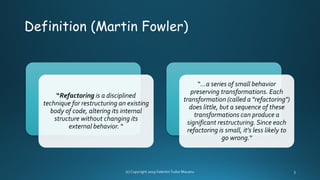
“Refactoring is a disciplined
technique for restructuring an existing
body of code, altering its internal
structure without changing its
external behavior. “
“…a series of small behavior
preserving transformations. Each
transformation (called a "refactoring")
does little, but a sequence of these
transformations can produce a
significant restructuring. Since each
refactoring is small, it's less likely to
go wrong.“
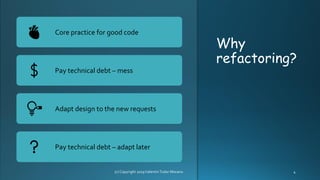
Why
refactoring?
Core practice for good code
Pay technical debt – mess
Adapt design to the new requests
Pay technical debt – adapt later
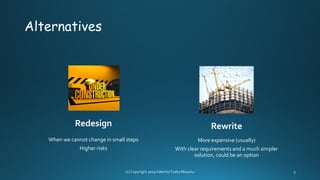
Alternatives
Redesign
When we cannot change in small steps
Higher risks
Rewrite
More expensive (usually)
With clear requirements and a much simpler
solution, could be an option
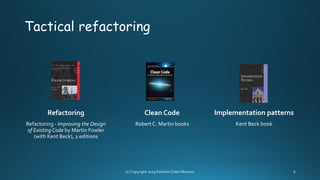
Tactical refactoring
Refactoring
Refactoring - Improving the Design
of Existing Code by Martin Fowler
(with Kent Beck), 2 editions
Clean Code
RobertC. Martin books
Implementation patterns
Kent Beck book
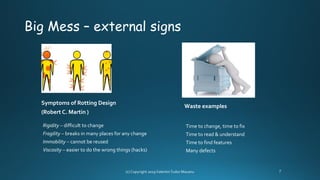
Big Mess – external signs
Symptoms of Rotting Design
(Robert C. Martin )
Rigidity – difficult to change
Fragility – breaks in many places for any change
Immobility – cannot be reused
Viscosity – easier to do the wrong things (hacks)
Waste examples
Time to change, time to fix
Time to read & understand
Time to find features
Many defects
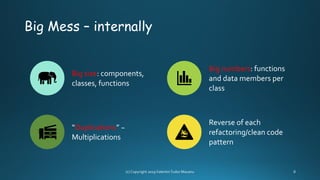
Big Mess – internally
Big size: components,
classes, functions
Big numbers: functions
and data members per
class
“Duplications” ~
Multiplications
Reverse of each
refactoring/clean code
pattern
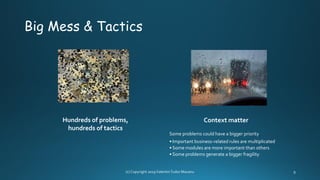
Big Mess & Tactics
Hundreds of problems,
hundreds of tactics
Context matter
Some problems could have a bigger priority
• Important business-related rules are multiplicated
• Some modules are more important than others
• Some problems generate a bigger fragility
?
?
?
?
?
?
?
?
?
?
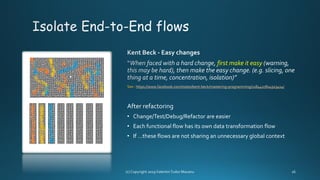
When faced with a hard change, first make it easy
first make it easy
See : https://www.facebook.com/notes/kent-beck/mastering-programming/1184427814923414/
After refactoring
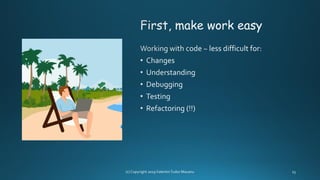
• Change/Test/Debug/Refactor are easier
• Each functional flow has its own data transformation flow
• If …these flows are not sharing an unnecessary global context
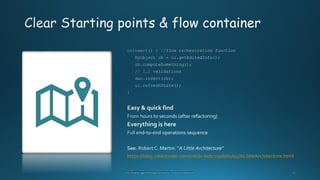
https://blog.cleancoder.com/uncle-bob/2016/01/04/ALittleArchitecture.html
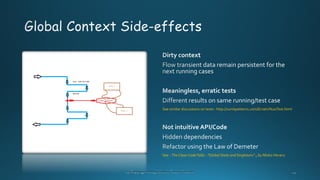
See similar discussions on tests : http://xunitpatterns.com/Erratic%20Test.html
See - The Clean CodeTalks - "Global State and Singletons" , by Misko Hevery
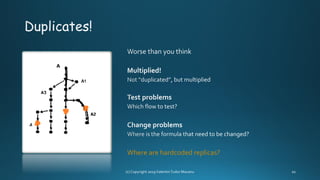
Where are hardcoded replicas?
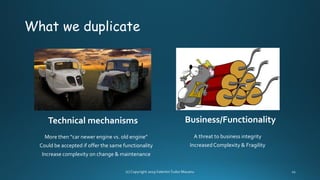
What we duplicate
Technical mechanisms
More then “car newer engine vs. old engine”
Could be accepted if offer the same functionality
Increase complexity on change & maintenance
Business/Functionality
A threat to business integrity
IncreasedComplexity & Fragility
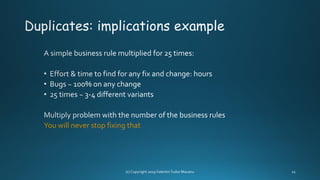
You will never stop fixing that
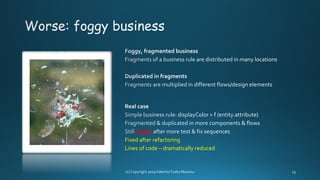
fragile
Fixed after refactoring
Lines of code – dramatically reduced
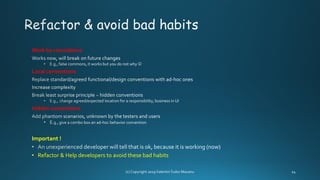
Work by coincidence
Local conventions
Hidden conventions
Important !
• Refactor & Help developers to avoid these bad habits
Bad habits
perpetual
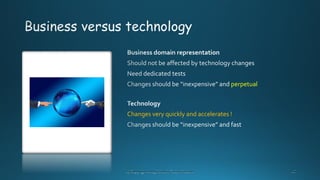
Changes very quickly and accelerates !
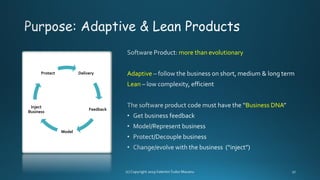
more than evolutionary
Adaptive
Lean
Business DNA
Delivery
Feedback
Model
Inject
Business
Protect
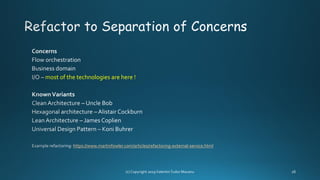
most of the technologies are here !
https://www.martinfowler.com/articles/refactoring-external-service.html
Example:
2 cells Clean Architecture
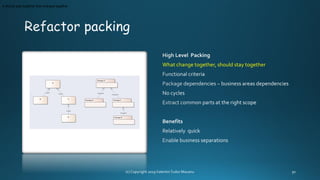
What change together, should stay together
It should stay together that changes together
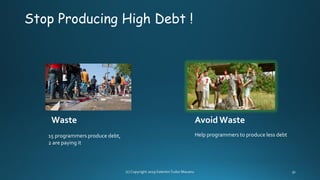
Stop Producing High Debt !
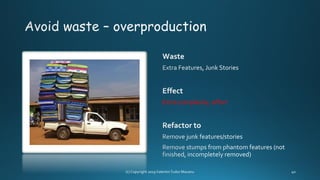
Waste
15 programmers produce debt,
2 are paying it
Avoid Waste
Help programmers to produce less debt
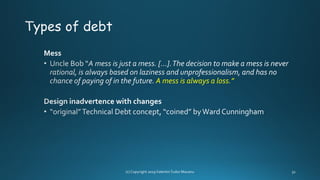
A mess is always a loss.”
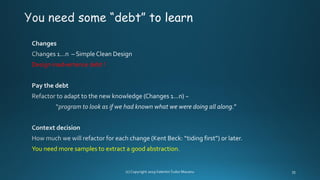
modifying the program to look as if we had
known what we were doing all along
Ward Cunningham
https://youtu.be/pqeJFYwnkjE?t=1
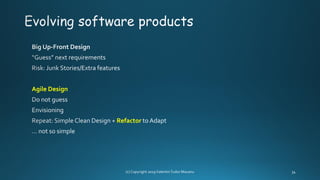
Agile Design
Refactor
Design inadvertence debt !
You need more samples to extract a good abstraction.
Refactoring & Avoiding Waste
Lean Software development
Inspired from
Toyota Production System
Reference:
Lean Software Development:
An AgileToolkit - Mary and
Tom Poppendieck
Solutions: XP-like practices,
refactoring included
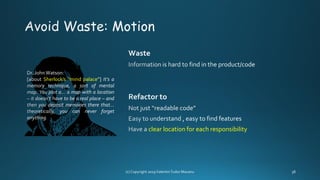
Motion
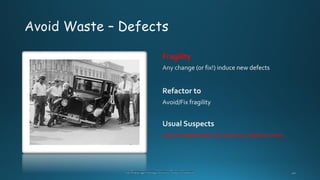
Defects
Overproduction
clear location for each responsibility
Sherlock’s “mind palace
Fragility
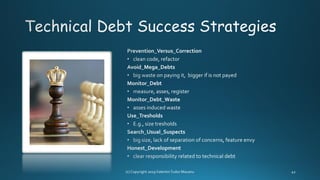
Lack of separation of concerns, feature envy
Extra complexity, effort
https://disciplinedagiledelivery.com/essence01/
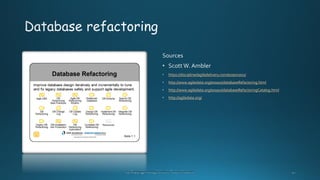
http://www.agiledata.org/essays/databaseRefactoring.html
http://www.agiledata.org/essays/databaseRefactoringCatalog.html
http://agiledata.org/
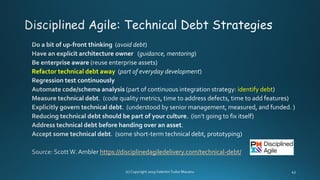
Refactor technical debt away
identify debt
https://disciplinedagiledelivery.com/technical-debt/
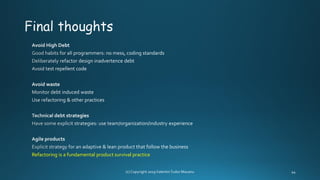
Refactoring is a fundamental product survival practice
Info
Questions ?
Strategic refactoring. Refactoring strategies

Strategic refactoring. Refactoring strategies