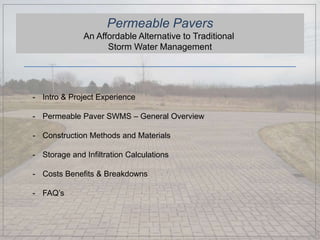
Permeable Pavers
An Affordable Alternative to Traditional
Storm Water Management
- Intro & Project Experience
- Permeable Paver SWMS – General Overview
- Construction Methods and Materials
- Storage and Infiltration Calculations
- Costs Benefits & Breakdowns
- FAQ’s
Eric K Weishaar
President
The Breckenridge Landscaping – New Berlin
- Over 20 yrs. Landscaping Experience
- Started Breckenridge Landscape – 2009
- Inc. 5000 Fastest Growing Companies in America – 2015, 2016, 2017 & 2018
- MMAC/COSBE Future 50 Company 2017 & 2018
- Installed over 700,000 sf of Permeable Paver Projects
- Installed largest Permeable Roadway in WI – Assembly Park, Delavan
- Recently completed the installation of the Grafton Lumberyard Project
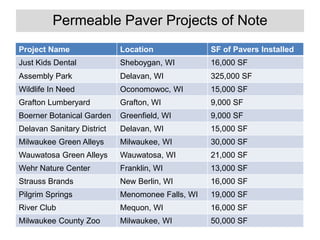
Permeable Paver Projects of Note
Project Name Location SF of Pavers Installed
Just Kids Dental Sheboygan, WI 16,000 SF
Assembly Park Delavan, WI 325,000 SF
Wildlife In Need Oconomowoc, WI 15,000 SF
Grafton Lumberyard Grafton, WI 9,000 SF
Boerner Botanical Garden Greenfield, WI 9,000 SF
Delavan Sanitary District Delavan, WI 15,000 SF
Milwaukee Green Alleys Milwaukee, WI 30,000 SF
Wauwatosa Green Alleys Wauwatosa, WI 21,000 SF
Wehr Nature Center Franklin, WI 13,000 SF
Strauss Brands New Berlin, WI 16,000 SF
Pilgrim Springs Menomonee Falls, WI 19,000 SF
River Club Mequon, WI 16,000 SF
Milwaukee County Zoo Milwaukee, WI 50,000 SF
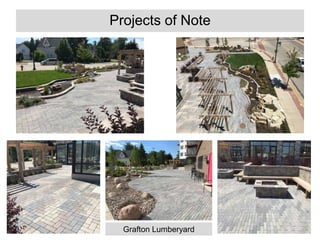
Projects of Note
Grafton Lumberyard
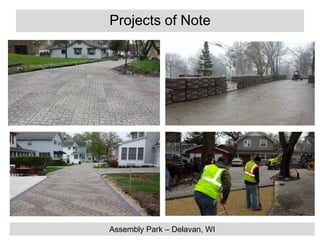
Projects of Note
Assembly Park – Delavan, WI
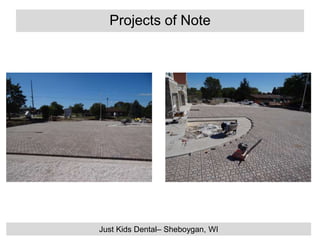
Projects of Note
Just Kids Dental– Sheboygan, WI
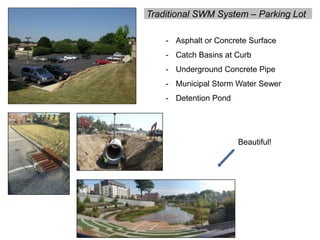
- Asphalt or Concrete Surface
- Catch Basins at Curb
- Underground Concrete Pipe
- Municipal Storm Water Sewer
- Detention Pond
Traditional SWM System – Parking Lot
Beautiful!
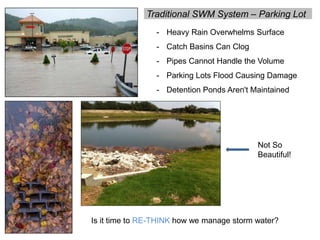
Traditional SWM System – Parking Lot
Not So
Beautiful!
- Heavy Rain Overwhelms Surface
- Catch Basins Can Clog
- Pipes Cannot Handle the Volume
- Parking Lots Flood Causing Damage
- Detention Ponds Aren't Maintained
Is it time to RE-THINK how we manage storm water?
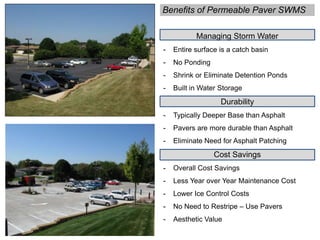
Benefits of Permeable Paver SWMS
Managing Storm Water
- Entire surface is a catch basin
- No Ponding
- Shrink or Eliminate Detention Ponds
- Built in Water Storage
Durability
- Typically Deeper Base than Asphalt
- Pavers are more durable than Asphalt
- Eliminate Need for Asphalt Patching
Cost Savings
- Overall Cost Savings
- Less Year over Year Maintenance Cost
- Lower Ice Control Costs
- No Need to Restripe – Use Pavers
- Aesthetic Value
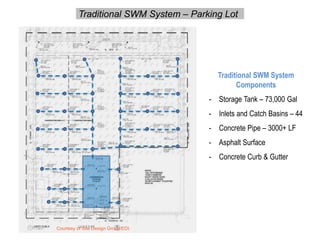
Traditional SWM System
Components
- Storage Tank – 73,000 Gal
- Inlets and Catch Basins – 44
- Concrete Pipe – 3000+ LF
- Asphalt Surface
- Concrete Curb & Gutter
Courtesy of Site Design Group/EDI
Traditional SWM System – Parking Lot
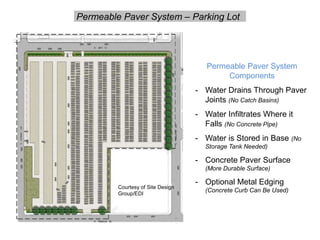
Permeable Paver System
Components
- Water Drains Through Paver
Joints (No Catch Basins)
- Water Infiltrates Where it
Falls (No Concrete Pipe)
- Water is Stored in Base (No
Storage Tank Needed)
- Concrete Paver Surface
(More Durable Surface)
- Optional Metal Edging
(Concrete Curb Can Be Used)
Courtesy of Site Design
Group/EDI
Permeable Paver System – Parking Lot
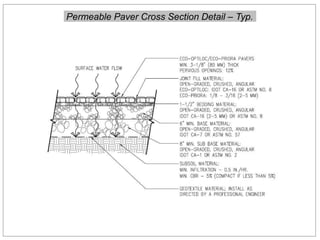
Permeable Paver Cross Section Detail – Typ.
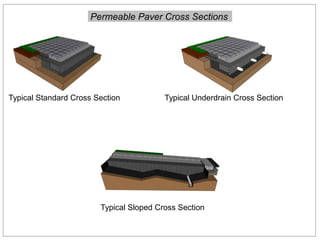
Permeable Paver Cross Sections
Typical Standard Cross Section Typical Underdrain Cross Section
Typical Sloped Cross Section
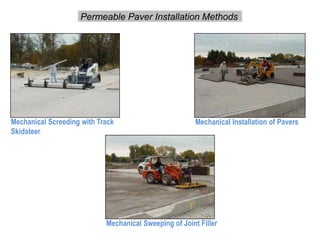
Mechanical Installation of PaversMechanical Screeding with Track
Skidsteer
Mechanical Sweeping of Joint Filler
Permeable Paver Installation Methods
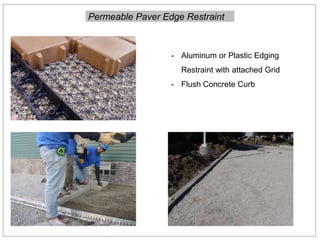
Permeable Paver Edge Restraint
- Aluminum or Plastic Edging
Restraint with attached Grid
- Flush Concrete Curb
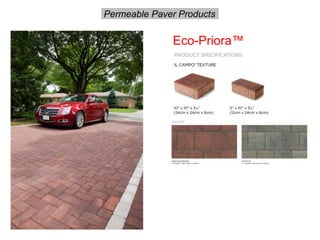
Eco-Priora™
Permeable Paver Products
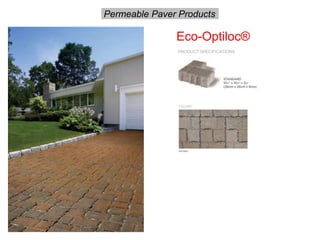
Eco-Optiloc®
Permeable Paver Products
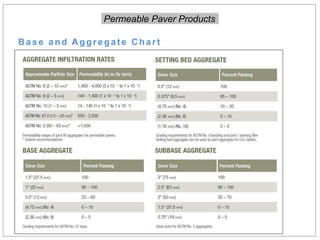
B ase and A ggregat e C hart
Permeable Paver Products
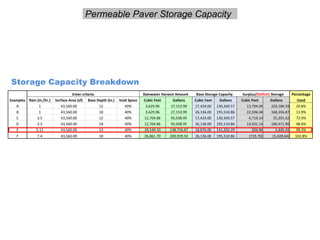
Storage Capacity Breakdown
Enter criteria Rainwater Harvest Amount Base Storage Capacity Surplus/(Deficit) Storage Percentage
Examples Rain (in./hr.) Surface Area (sf) Base Depth (in.) Void Space Cubic Feet Gallons Cubic Feet Gallons Cubic Feet Gallons Used
A 1 43,560.00 12 40% 3,629.96 27,153.99 17,424.00 130,340.57 13,794.04 103,186.59 20.8%
B 1 43,560.00 18 40% 3,629.96 27,153.99 26,136.00 195,510.86 22,506.04 168,356.87 13.9%
C 3.5 43,560.00 12 40% 12,704.86 95,038.95 17,424.00 130,340.57 4,719.14 35,301.62 72.9%
D 3.5 43,560.00 18 40% 12,704.86 95,038.95 26,136.00 195,510.86 13,431.14 100,471.90 48.6%
E 5.11 43,560.00 13 40% 18,549.10 138,756.87 18,876.00 141,202.29 326.90 2,445.41 98.3%
F 7.4 43,560.00 18 40% 26,861.70 200,939.50 26,136.00 195,510.86 (725.70) (5,428.64) 102.8%
Permeable Paver Storage Capacity
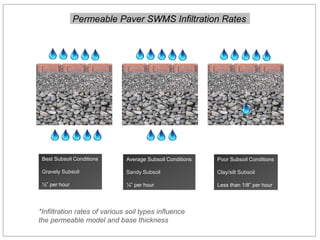
*Infiltration rates of various soil types influence
the permeable model and base thickness
Best Subsoil Conditions
Gravely Subsoil
½” per hour
Average Subsoil Conditions
Sandy Subsoil
¼” per hour
Poor Subsoil Conditions
Clay/silt Subsoil
Less than 1/8” per hour
Permeable Paver SWMS Infiltration Rates
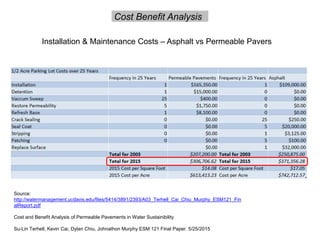
Source:
http://watermanagement.ucdavis.edu/files/5414/3891/2393/A03_Terhell_Cai_Chiu_Murphy_ESM121_Fin
alReport.pdf
Cost and Benefit Analysis of Permeable Pavements in Water Sustainibility
Su-Lin Terhell, Kevin Cai, Dylan Chiu, Johnathon Murphy ESM 121 Final Paper. 5/25/2015
Cost Benefit Analysis
Installation & Maintenance Costs – Asphalt vs Permeable Pavers
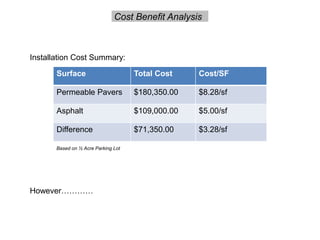
Cost Benefit Analysis
Installation Cost Summary:
Surface Total Cost Cost/SF
Permeable Pavers $180,350.00 $8.28/sf
Asphalt $109,000.00 $5.00/sf
Difference $71,350.00 $3.28/sf
However…………
Based on ½ Acre Parking Lot
Cost Benefit Analysis
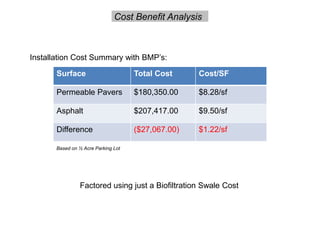
…….Once you factor in any or all of these costs, the equation changes.
Cost Benefit Analysis
Installation Cost Summary with BMP’s:
Surface Total Cost Cost/SF
Permeable Pavers $180,350.00 $8.28/sf
Asphalt $207,417.00 $9.50/sf
Difference ($27,067.00) $1.22/sf
Factored using just a Biofiltration Swale Cost
Based on ½ Acre Parking Lot
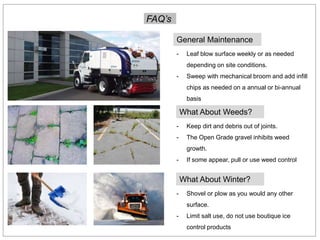
FAQ’s
General Maintenance
- Leaf blow surface weekly or as needed
depending on site conditions.
- Sweep with mechanical broom and add infill
chips as needed on a annual or bi-annual
basis
- Keep dirt and debris out of joints.
- The Open Grade gravel inhibits weed
growth.
- If some appear, pull or use weed control
What About Weeds?
- Shovel or plow as you would any other
surface.
- Limit salt use, do not use boutique ice
control products
What About Winter?

Stormwater Management Using Permeable Pavers

  • 1.
    Permeable Pavers An AffordableAlternative to Traditional Storm Water Management - Intro & Project Experience - Permeable Paver SWMS – General Overview - Construction Methods and Materials - Storage and Infiltration Calculations - Costs Benefits & Breakdowns - FAQ’s
  • 2.
    Eric K Weishaar President TheBreckenridge Landscaping – New Berlin - Over 20 yrs. Landscaping Experience - Started Breckenridge Landscape – 2009 - Inc. 5000 Fastest Growing Companies in America – 2015, 2016, 2017 & 2018 - MMAC/COSBE Future 50 Company 2017 & 2018 - Installed over 700,000 sf of Permeable Paver Projects - Installed largest Permeable Roadway in WI – Assembly Park, Delavan - Recently completed the installation of the Grafton Lumberyard Project
  • 3.
    Permeable Paver Projectsof Note Project Name Location SF of Pavers Installed Just Kids Dental Sheboygan, WI 16,000 SF Assembly Park Delavan, WI 325,000 SF Wildlife In Need Oconomowoc, WI 15,000 SF Grafton Lumberyard Grafton, WI 9,000 SF Boerner Botanical Garden Greenfield, WI 9,000 SF Delavan Sanitary District Delavan, WI 15,000 SF Milwaukee Green Alleys Milwaukee, WI 30,000 SF Wauwatosa Green Alleys Wauwatosa, WI 21,000 SF Wehr Nature Center Franklin, WI 13,000 SF Strauss Brands New Berlin, WI 16,000 SF Pilgrim Springs Menomonee Falls, WI 19,000 SF River Club Mequon, WI 16,000 SF Milwaukee County Zoo Milwaukee, WI 50,000 SF
  • 4.
  • 5.
    Projects of Note AssemblyPark – Delavan, WI
  • 6.
    Projects of Note JustKids Dental– Sheboygan, WI
  • 7.
    - Asphalt orConcrete Surface - Catch Basins at Curb - Underground Concrete Pipe - Municipal Storm Water Sewer - Detention Pond Traditional SWM System – Parking Lot Beautiful!
  • 8.
    Traditional SWM System– Parking Lot Not So Beautiful! - Heavy Rain Overwhelms Surface - Catch Basins Can Clog - Pipes Cannot Handle the Volume - Parking Lots Flood Causing Damage - Detention Ponds Aren't Maintained Is it time to RE-THINK how we manage storm water?
  • 9.
    Benefits of PermeablePaver SWMS Managing Storm Water - Entire surface is a catch basin - No Ponding - Shrink or Eliminate Detention Ponds - Built in Water Storage Durability - Typically Deeper Base than Asphalt - Pavers are more durable than Asphalt - Eliminate Need for Asphalt Patching Cost Savings - Overall Cost Savings - Less Year over Year Maintenance Cost - Lower Ice Control Costs - No Need to Restripe – Use Pavers - Aesthetic Value
  • 10.
    Traditional SWM System Components -Storage Tank – 73,000 Gal - Inlets and Catch Basins – 44 - Concrete Pipe – 3000+ LF - Asphalt Surface - Concrete Curb & Gutter Courtesy of Site Design Group/EDI Traditional SWM System – Parking Lot
  • 11.
    Permeable Paver System Components -Water Drains Through Paver Joints (No Catch Basins) - Water Infiltrates Where it Falls (No Concrete Pipe) - Water is Stored in Base (No Storage Tank Needed) - Concrete Paver Surface (More Durable Surface) - Optional Metal Edging (Concrete Curb Can Be Used) Courtesy of Site Design Group/EDI Permeable Paver System – Parking Lot
  • 12.
    Permeable Paver CrossSection Detail – Typ.
  • 13.
    Permeable Paver CrossSections Typical Standard Cross Section Typical Underdrain Cross Section Typical Sloped Cross Section
  • 14.
    Mechanical Installation ofPaversMechanical Screeding with Track Skidsteer Mechanical Sweeping of Joint Filler Permeable Paver Installation Methods
  • 15.
    Permeable Paver EdgeRestraint - Aluminum or Plastic Edging Restraint with attached Grid - Flush Concrete Curb
  • 16.
  • 17.
  • 18.
    B ase andA ggregat e C hart Permeable Paver Products
  • 19.
    Storage Capacity Breakdown Entercriteria Rainwater Harvest Amount Base Storage Capacity Surplus/(Deficit) Storage Percentage Examples Rain (in./hr.) Surface Area (sf) Base Depth (in.) Void Space Cubic Feet Gallons Cubic Feet Gallons Cubic Feet Gallons Used A 1 43,560.00 12 40% 3,629.96 27,153.99 17,424.00 130,340.57 13,794.04 103,186.59 20.8% B 1 43,560.00 18 40% 3,629.96 27,153.99 26,136.00 195,510.86 22,506.04 168,356.87 13.9% C 3.5 43,560.00 12 40% 12,704.86 95,038.95 17,424.00 130,340.57 4,719.14 35,301.62 72.9% D 3.5 43,560.00 18 40% 12,704.86 95,038.95 26,136.00 195,510.86 13,431.14 100,471.90 48.6% E 5.11 43,560.00 13 40% 18,549.10 138,756.87 18,876.00 141,202.29 326.90 2,445.41 98.3% F 7.4 43,560.00 18 40% 26,861.70 200,939.50 26,136.00 195,510.86 (725.70) (5,428.64) 102.8% Permeable Paver Storage Capacity
  • 20.
    *Infiltration rates ofvarious soil types influence the permeable model and base thickness Best Subsoil Conditions Gravely Subsoil ½” per hour Average Subsoil Conditions Sandy Subsoil ¼” per hour Poor Subsoil Conditions Clay/silt Subsoil Less than 1/8” per hour Permeable Paver SWMS Infiltration Rates
  • 21.
    Source: http://watermanagement.ucdavis.edu/files/5414/3891/2393/A03_Terhell_Cai_Chiu_Murphy_ESM121_Fin alReport.pdf Cost and BenefitAnalysis of Permeable Pavements in Water Sustainibility Su-Lin Terhell, Kevin Cai, Dylan Chiu, Johnathon Murphy ESM 121 Final Paper. 5/25/2015 Cost Benefit Analysis Installation & Maintenance Costs – Asphalt vs Permeable Pavers
  • 22.
    Cost Benefit Analysis InstallationCost Summary: Surface Total Cost Cost/SF Permeable Pavers $180,350.00 $8.28/sf Asphalt $109,000.00 $5.00/sf Difference $71,350.00 $3.28/sf However………… Based on ½ Acre Parking Lot
  • 23.
    Cost Benefit Analysis …….Onceyou factor in any or all of these costs, the equation changes.
  • 24.
    Cost Benefit Analysis InstallationCost Summary with BMP’s: Surface Total Cost Cost/SF Permeable Pavers $180,350.00 $8.28/sf Asphalt $207,417.00 $9.50/sf Difference ($27,067.00) $1.22/sf Factored using just a Biofiltration Swale Cost Based on ½ Acre Parking Lot
  • 25.
    FAQ’s General Maintenance - Leafblow surface weekly or as needed depending on site conditions. - Sweep with mechanical broom and add infill chips as needed on a annual or bi-annual basis - Keep dirt and debris out of joints. - The Open Grade gravel inhibits weed growth. - If some appear, pull or use weed control What About Weeds? - Shovel or plow as you would any other surface. - Limit salt use, do not use boutique ice control products What About Winter?

Editor's Notes

  • #2 Intro to Topic and discussion points
  • #3 Who am I? My background
  • #8 Collect & Direct
  • #9 Is it time to RE-THINK How we manage Stormwater?