Kurs21Nord workshop panel/team modelsThe participants for Kurs21Nord seminar in Oulu, 18th-22nd September, 2010.
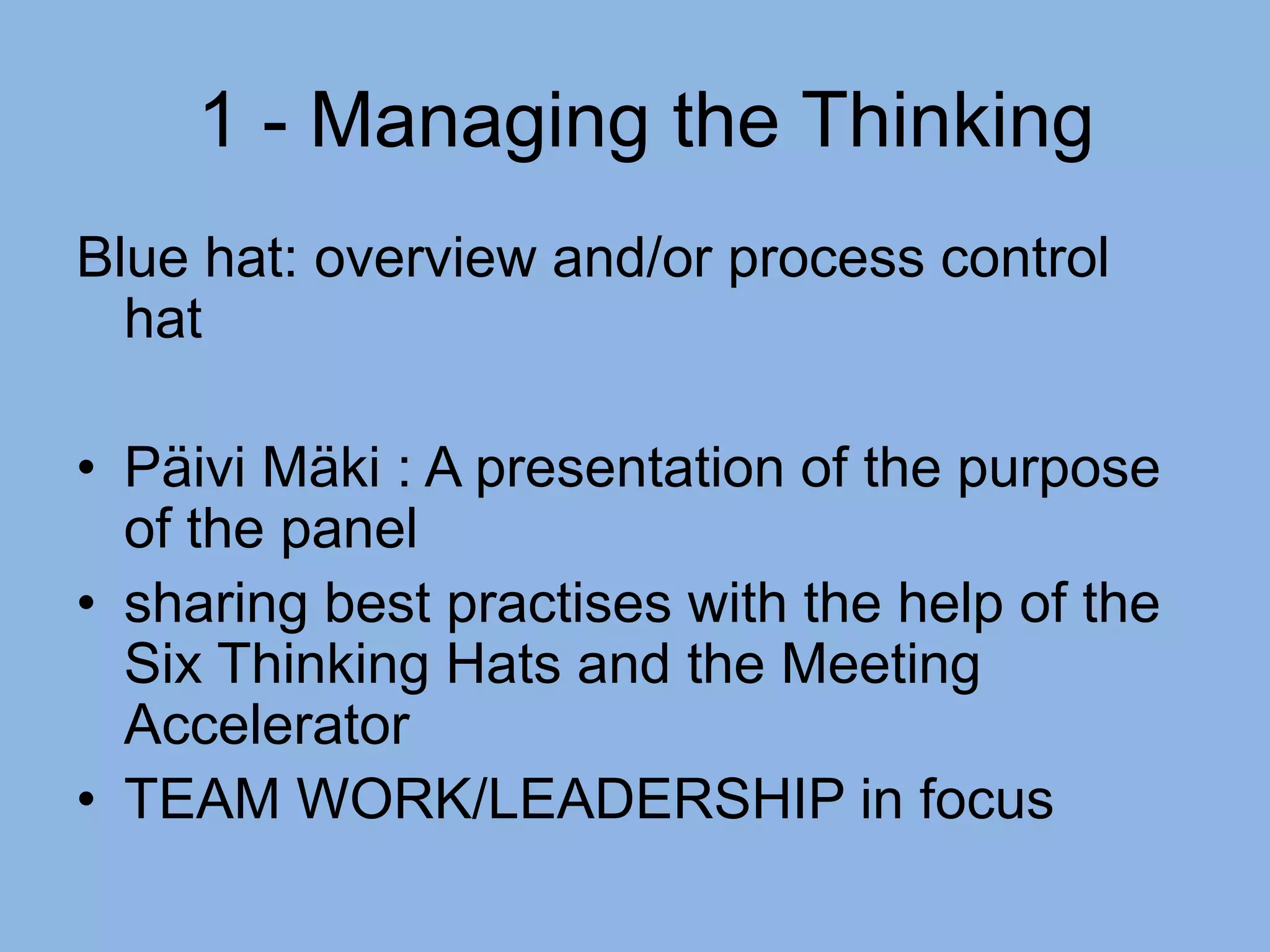
 1 - Managing the ThinkingBlue hat: overview and/or process controlhatPäivi Mäki : A presentation of the purpose of the panelsharing best practises with the help of the Six Thinking Hats and the Meeting AcceleratorTEAM WORK/LEADERSHIP in focus
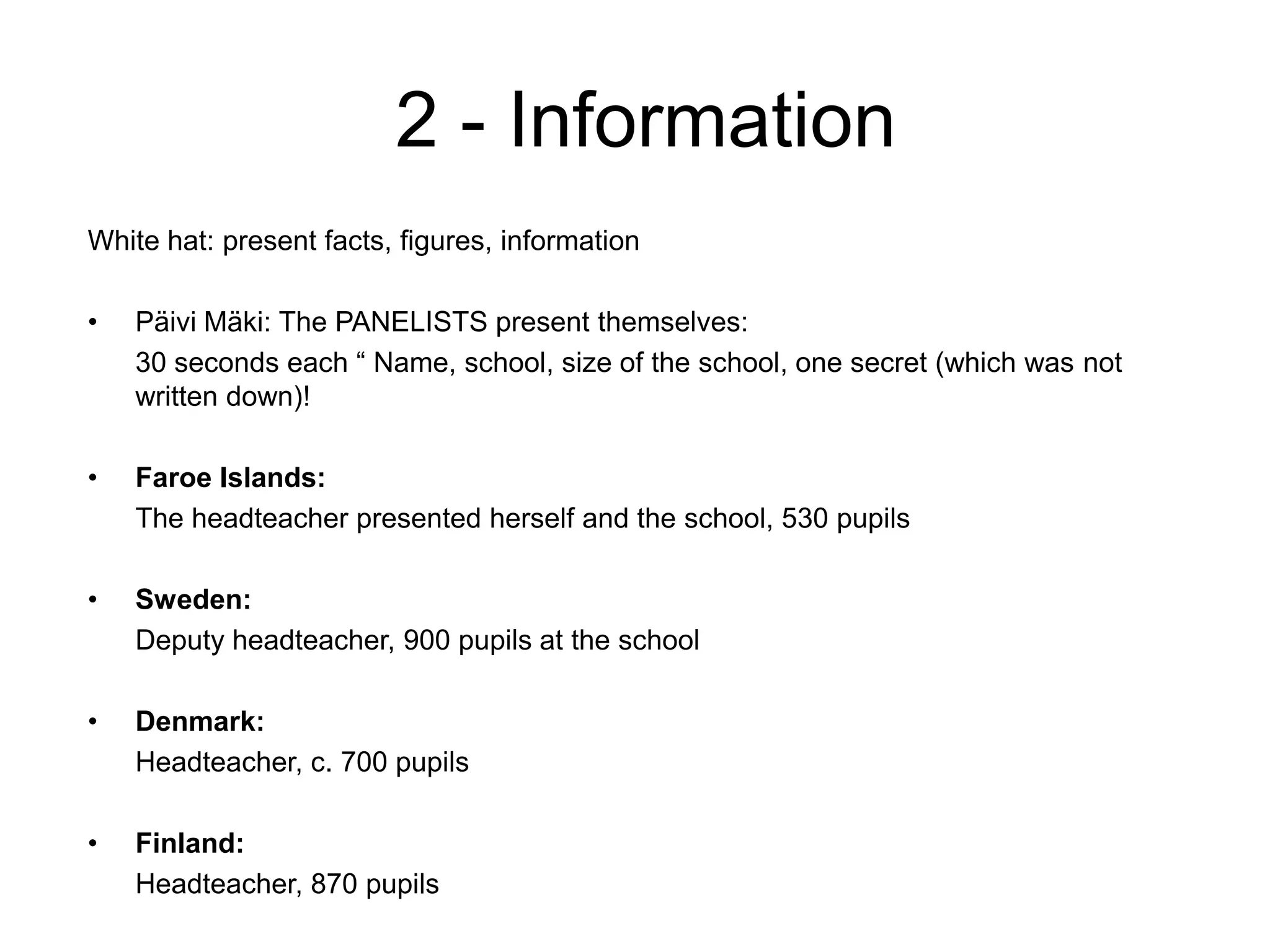
 2 - InformationWhite hat: present facts, figures, informationPäivi Mäki: The PANELISTS present themselves:	30 seconds each “ Name, school, size of the school, one secret (which was not written down)!Faroe Islands:	The headteacher presented herself and the school,530 pupilsSweden:	Deputy headteacher, 900 pupils at the schoolDenmark:Headteacher, c. 700 pupilsFinland:Headteacher, 870 pupils
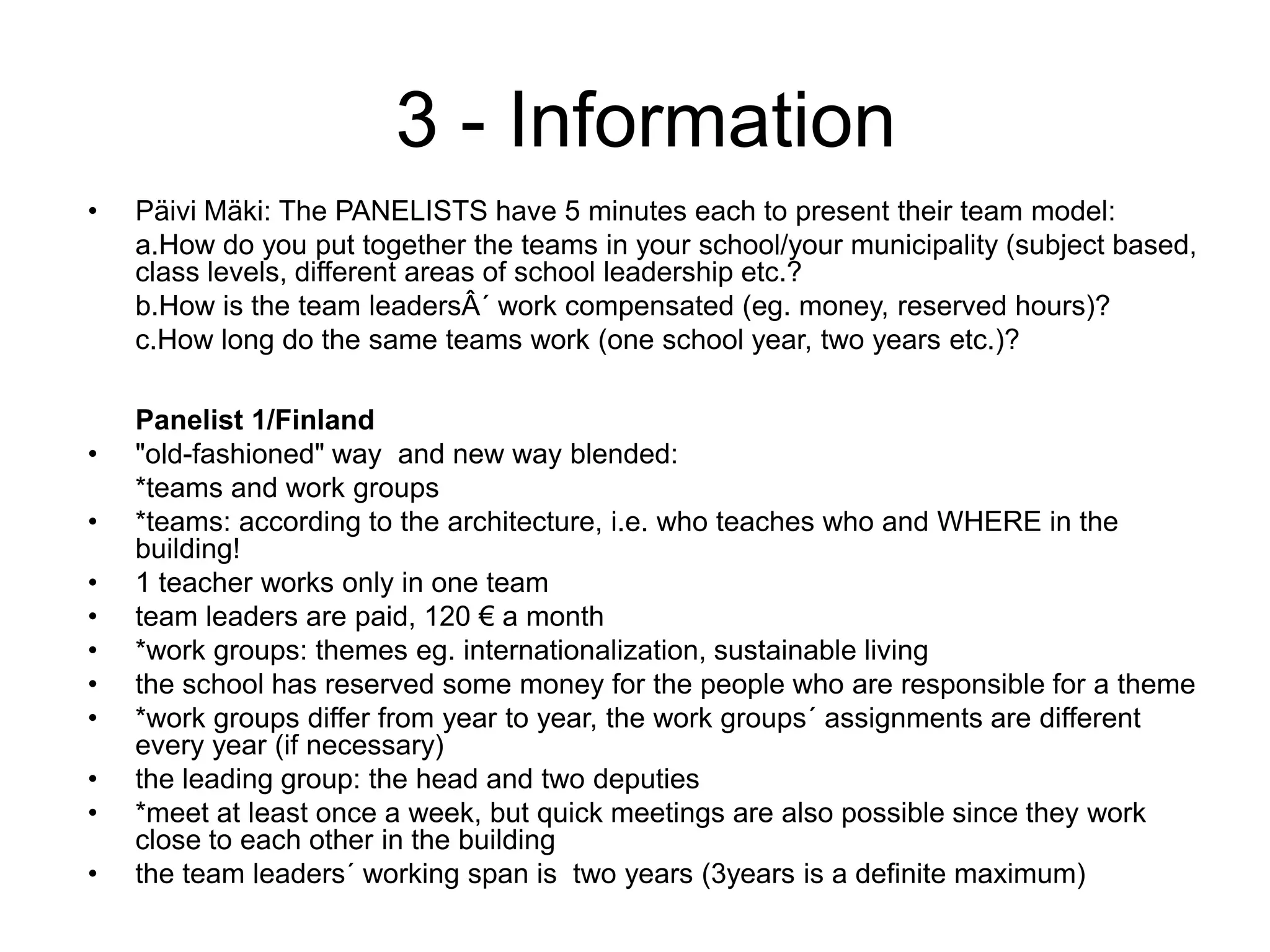
 3 - InformationPäivi Mäki: The PANELISTS have 5 minutes each to present their team model:a.How do you put together the teams in your school/your municipality (subject based, class levels, different areas of school leadership etc.?b.How is the team leaders´ work compensated (eg. money, reserved hours)?c.How long do the same teams work (one school year, two years etc.)?Panelist 1/Finland"old-fashioned" way  and new way blended:	*teams and work groups*teams: according to the architecture, i.e. who teaches who and WHERE in the building!1 teacher works only in one teamteam leaders are paid, 120 € a month*work groups: themes eg. internationalization, sustainable livingthe school has reserved some money for the people who are responsible for a theme*work groups differ from year to year, the work groups´ assignments are different every year (if necessary)the leading group: the head and two deputies*meet at least once a week, but quick meetings are also possible since they work close to each other in the buildingthe team leaders´ working span is  two years (3years is a definite maximum)
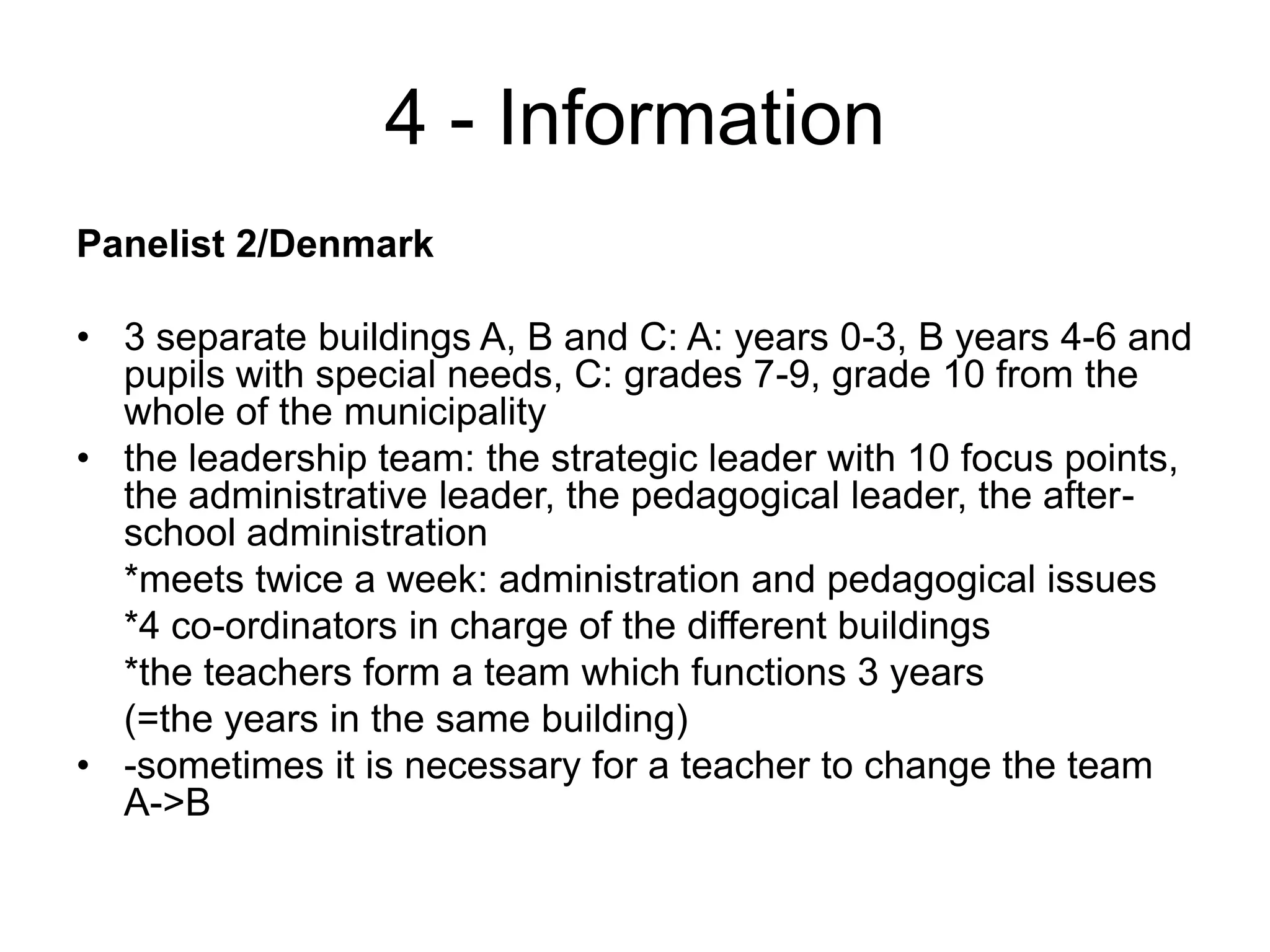
4 - InformationPanelist 2/Denmark3 separate buildings A, B and C: A: years 0-3, B years 4-6 and pupils with special needs, C: grades 7-9, grade 10 from the whole of the municipalitythe leadership team: the strategic leader with 10 focus points, the administrative leader, the pedagogical leader, the after-school administration	*meets twice a week: administration and pedagogical issues	*4 co-ordinators in charge of the different buildings	*the teachers form a team which functions 3 years	(=the years in the same building)-sometimes it is necessary for a teacher to change the team A->B
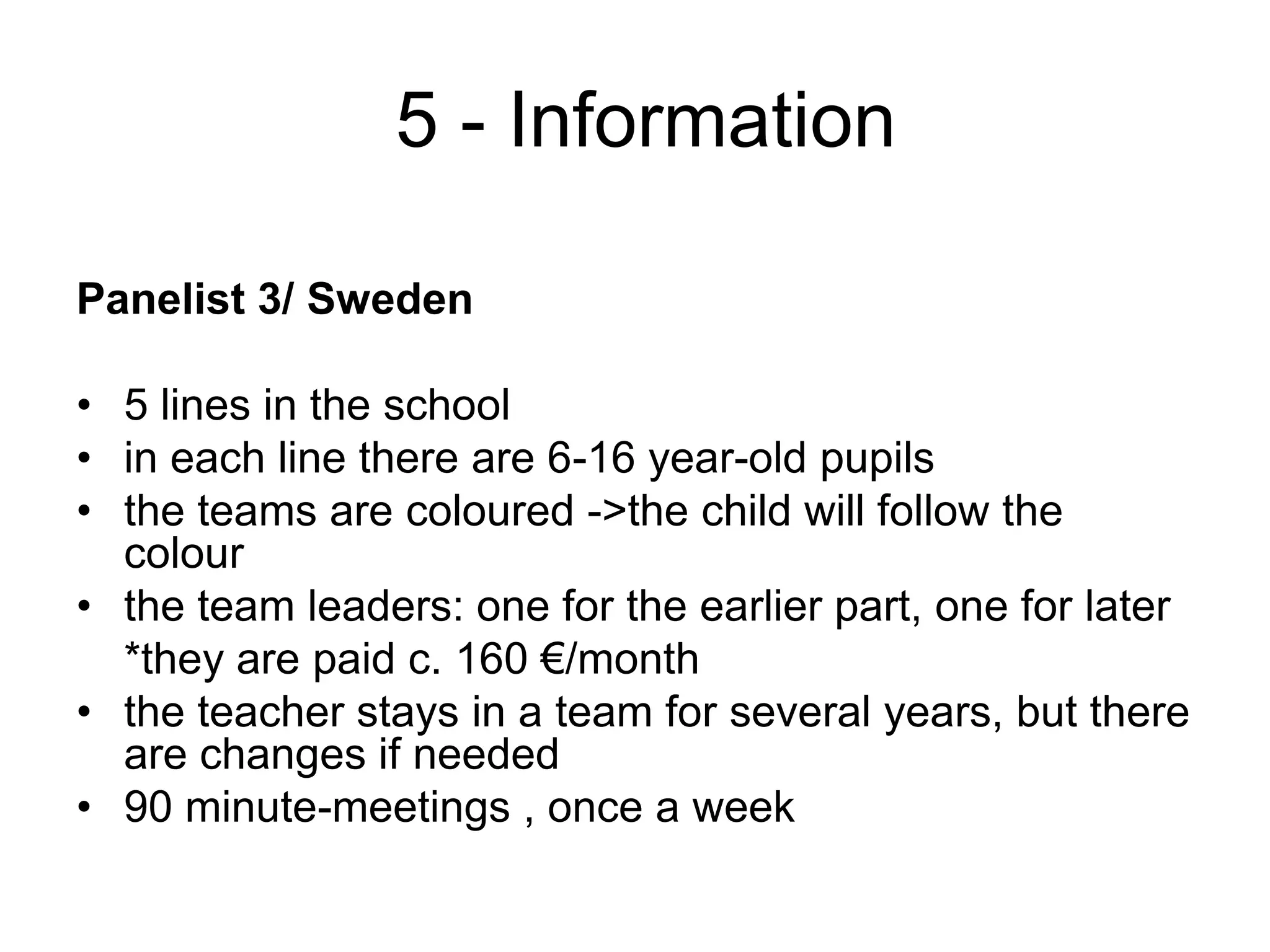
 5 - InformationPanelist 3/ Sweden5 lines in the schoolin each line there are 6-16 year-old pupilsthe teams are coloured ->the child will follow the colourthe team leaders: one for the earlier part, one for later	*they are paidc. 160 €/monththe teacher stays in a team for several years, but there are changes if needed90 minute-meetings , once a week
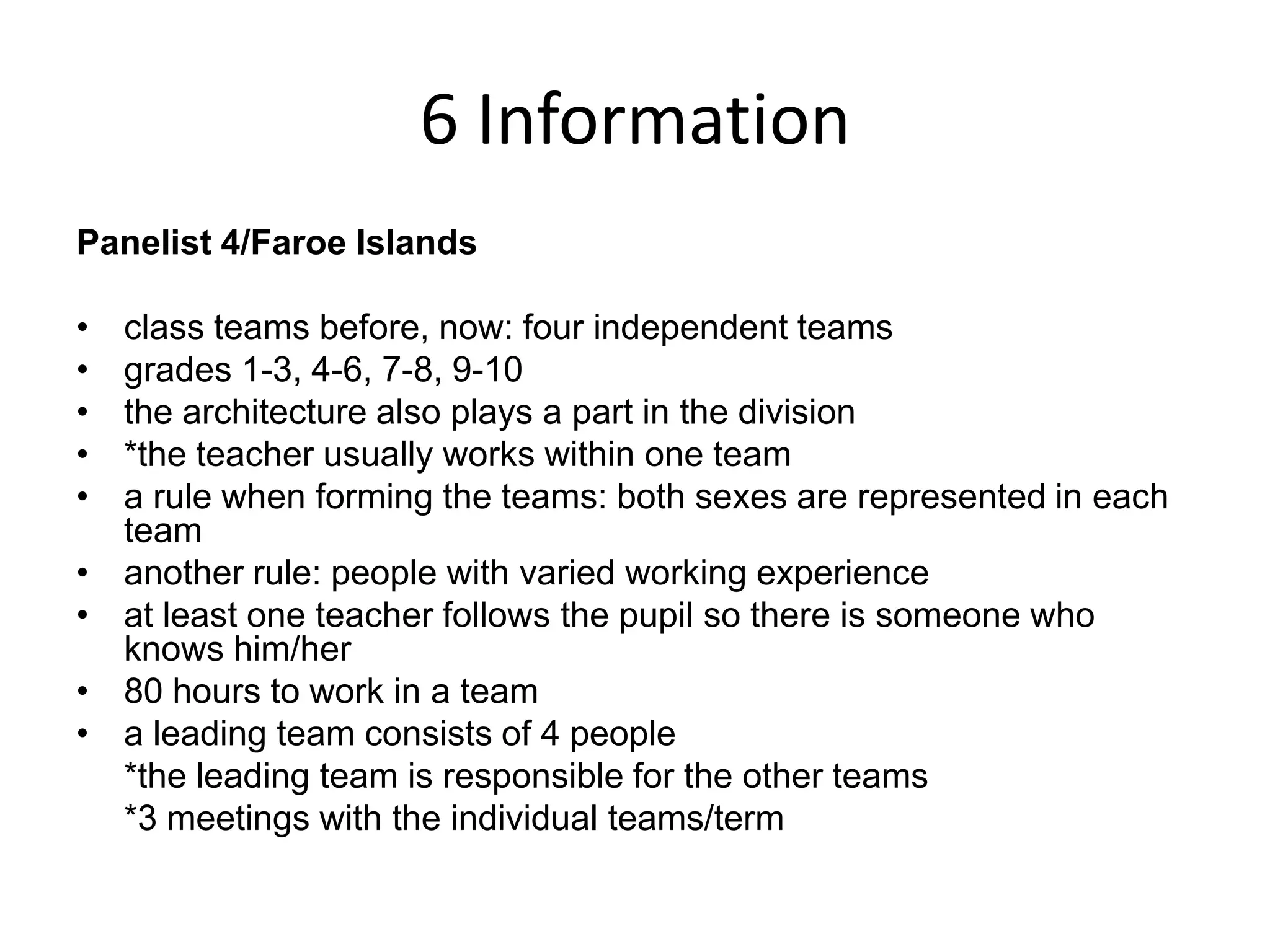
6 InformationPanelist 4/Faroe Islandsclass teams before, now: four independent teamsgrades 1-3, 4-6, 7-8, 9-10the architecture also plays a part in the division*the teacher usually works within one teama rule when forming the teams: both sexes are represented in each teamanother rule: people with varied working experienceat least one teacher follows the pupil so there is someone who knows him/her80 hours to work in a teama leading team consists of 4 people	*the leading team is responsible for the other teams	*3 meetings with the individual teams/term
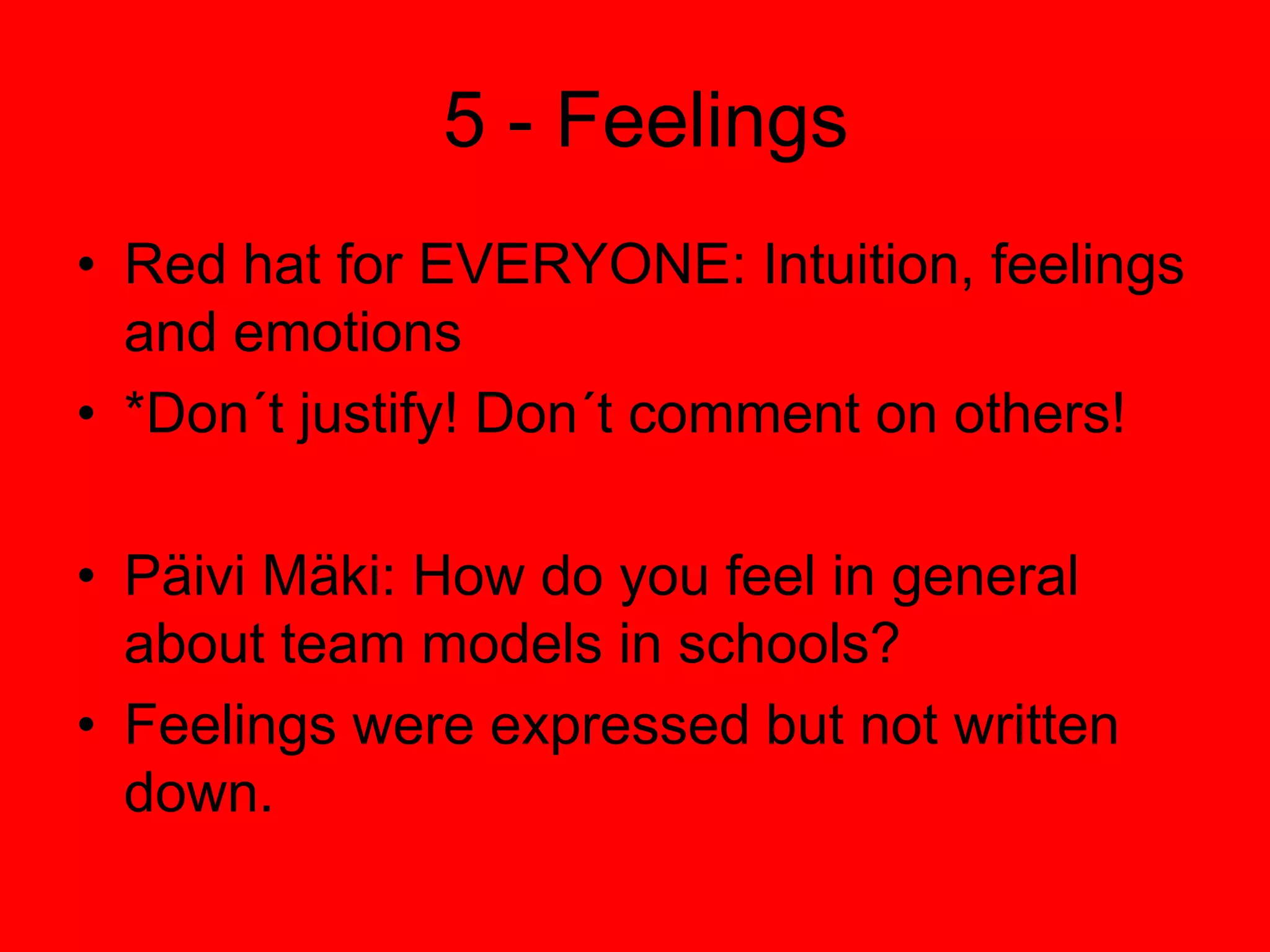
 5 - FeelingsRed hat for EVERYONE: Intuition, feelings and emotions *Don´t justify! Don´t comment on others!Päivi Mäki: How do you feel in general about team models in schools?Feelings were expressed but not written down.
 6 - BenefitsThe yellow hat is the logical positive. Find something of value!Päivi Mäki: Why the model/some part of the model works/work and what are the benefits? Justify! Only PARTICIPANTS are allowed to talk!The team organization is essential. The minimum is to have developing teams at least	The developing team has a crucial role in developing the school->the workload is shared, everything is written down for others to seeDifferent people have different strengths, use them!-> synergyno single person can be perfect, a team can:	it brings quality and more thinking, discussion to the schoolthe teams are organized in many different ways (in different countries, in different schools)
6 - Benefitsrotation is good for team workchildren are very different: adults can see better what the strengths in them  are if there are more than oneit´s important that you can base a team system on thinking at the age of the pupils because the school is for them! The pupil is in focus!the leadership teams: the load is on many shoulders, not just on one´sa poor leader is compensated by a good leadership team!the leadership teams: the headteacher is like "the adult" for the staff, he/she is needed in that sense, too
 7 - CautionBlack hat: judgment and caution. Why doesn´t something work or fit?Ahman on Sunday: "too much energy is wasted on defending your viewpoint"->the other way round today.Päivi Mäki: Only PANELISTS are allowed to talk (c. 3 minutes each):	Find challenges in the team model system in general (and your own system, too)	Denmark:the main challenge is communication between different levelsit´s necessary to share the same values->otherwise there will be three different systems in terms of values, for example	Sweden:communication is a problemthe grades are very separatesome teams don´t have a born leader which is a problemgenerally speaking, the biggest problems isthat we are focused on subjects, subject-teachingnot enough room for feelingssharing responsibilities means that no one takes care of  them (sometimes…)
 8 - CreativityGreen hat: alternatives, proposals, what is interesting, provocations and changes	Use the random picture/word provided by the meeting accelerator programme!!! It might lead to the best idea.Päivi Mäki: This is a green hat for PARTICIPANTS only: 	What is the greatest idea/observation you made during the presentations and discussions. Discuss in groups!(meanwhile the PANELISTS think about their models and the next green hat for them:	"Choose on thing that you could change in your model according to what you heard from the others during yellow and black hat".)
 9 - CreativityGreen hat: alternatives, proposals, what is interesting, provocations and changesPäivi Mäki: This is the green hat for PANELISTS only: tell about the one thing that you could change in your model according to what you heard from the others during yellow and black hat.The panelists told what they would change:Finland:the most important thing is to get more planning timethe head would like to show appreciation for team work*eg. giving time, money, in-service coursesDenmark:development discussion with all the teams	*emphasis on the interaction, not only on the actual work
9 - CreativitySweden:Why not let the born leaders be leaders->realization of dreams is easier!*reorganization of teams*the white hats gave inspiration!Faroeislands:focus on the leading team	*to meet at least twice a week for a short time
 10 - Managing the ThinkingBlue hat: overview and/or process control hatPäivi Mäki: The notes will be on Kurs21Nord Website for everyone to go through again. John puts the Power Point based on the notes  on the website on Thursday the 23rd.There will be a question on the ZEF - evaluation form on how you found using the Six Thinking Hats in this session. The instructions for ZEF are sent to the participants after the seminar.Kurs21Nord is going to go on working on team models! Let us know about it, please.

STH Stream Model

  • 1.
    Kurs21Nord workshop panel/teammodelsThe participants for Kurs21Nord seminar in Oulu, 18th-22nd September, 2010.
  • 2.
    1 -Managing the ThinkingBlue hat: overview and/or process controlhatPäivi Mäki : A presentation of the purpose of the panelsharing best practises with the help of the Six Thinking Hats and the Meeting AcceleratorTEAM WORK/LEADERSHIP in focus
  • 3.
    2 -InformationWhite hat: present facts, figures, informationPäivi Mäki: The PANELISTS present themselves: 30 seconds each “ Name, school, size of the school, one secret (which was not written down)!Faroe Islands: The headteacher presented herself and the school,530 pupilsSweden: Deputy headteacher, 900 pupils at the schoolDenmark:Headteacher, c. 700 pupilsFinland:Headteacher, 870 pupils
  • 4.
    3 -InformationPäivi Mäki: The PANELISTS have 5 minutes each to present their team model:a.How do you put together the teams in your school/your municipality (subject based, class levels, different areas of school leadership etc.?b.How is the team leaders´ work compensated (eg. money, reserved hours)?c.How long do the same teams work (one school year, two years etc.)?Panelist 1/Finland"old-fashioned" way and new way blended: *teams and work groups*teams: according to the architecture, i.e. who teaches who and WHERE in the building!1 teacher works only in one teamteam leaders are paid, 120 € a month*work groups: themes eg. internationalization, sustainable livingthe school has reserved some money for the people who are responsible for a theme*work groups differ from year to year, the work groups´ assignments are different every year (if necessary)the leading group: the head and two deputies*meet at least once a week, but quick meetings are also possible since they work close to each other in the buildingthe team leaders´ working span is two years (3years is a definite maximum)
  • 5.
    4 - InformationPanelist2/Denmark3 separate buildings A, B and C: A: years 0-3, B years 4-6 and pupils with special needs, C: grades 7-9, grade 10 from the whole of the municipalitythe leadership team: the strategic leader with 10 focus points, the administrative leader, the pedagogical leader, the after-school administration *meets twice a week: administration and pedagogical issues *4 co-ordinators in charge of the different buildings *the teachers form a team which functions 3 years (=the years in the same building)-sometimes it is necessary for a teacher to change the team A->B
  • 6.
    5 -InformationPanelist 3/ Sweden5 lines in the schoolin each line there are 6-16 year-old pupilsthe teams are coloured ->the child will follow the colourthe team leaders: one for the earlier part, one for later *they are paidc. 160 €/monththe teacher stays in a team for several years, but there are changes if needed90 minute-meetings , once a week
  • 7.
    6 InformationPanelist 4/FaroeIslandsclass teams before, now: four independent teamsgrades 1-3, 4-6, 7-8, 9-10the architecture also plays a part in the division*the teacher usually works within one teama rule when forming the teams: both sexes are represented in each teamanother rule: people with varied working experienceat least one teacher follows the pupil so there is someone who knows him/her80 hours to work in a teama leading team consists of 4 people *the leading team is responsible for the other teams *3 meetings with the individual teams/term
  • 8.
    5 -FeelingsRed hat for EVERYONE: Intuition, feelings and emotions *Don´t justify! Don´t comment on others!Päivi Mäki: How do you feel in general about team models in schools?Feelings were expressed but not written down.
  • 9.
    6 -BenefitsThe yellow hat is the logical positive. Find something of value!Päivi Mäki: Why the model/some part of the model works/work and what are the benefits? Justify! Only PARTICIPANTS are allowed to talk!The team organization is essential. The minimum is to have developing teams at least The developing team has a crucial role in developing the school->the workload is shared, everything is written down for others to seeDifferent people have different strengths, use them!-> synergyno single person can be perfect, a team can: it brings quality and more thinking, discussion to the schoolthe teams are organized in many different ways (in different countries, in different schools)
  • 10.
    6 - Benefitsrotationis good for team workchildren are very different: adults can see better what the strengths in them are if there are more than oneit´s important that you can base a team system on thinking at the age of the pupils because the school is for them! The pupil is in focus!the leadership teams: the load is on many shoulders, not just on one´sa poor leader is compensated by a good leadership team!the leadership teams: the headteacher is like "the adult" for the staff, he/she is needed in that sense, too
  • 11.
    7 -CautionBlack hat: judgment and caution. Why doesn´t something work or fit?Ahman on Sunday: "too much energy is wasted on defending your viewpoint"->the other way round today.Päivi Mäki: Only PANELISTS are allowed to talk (c. 3 minutes each): Find challenges in the team model system in general (and your own system, too) Denmark:the main challenge is communication between different levelsit´s necessary to share the same values->otherwise there will be three different systems in terms of values, for example Sweden:communication is a problemthe grades are very separatesome teams don´t have a born leader which is a problemgenerally speaking, the biggest problems isthat we are focused on subjects, subject-teachingnot enough room for feelingssharing responsibilities means that no one takes care of them (sometimes…)
  • 12.
    8 -CreativityGreen hat: alternatives, proposals, what is interesting, provocations and changes Use the random picture/word provided by the meeting accelerator programme!!! It might lead to the best idea.Päivi Mäki: This is a green hat for PARTICIPANTS only: What is the greatest idea/observation you made during the presentations and discussions. Discuss in groups!(meanwhile the PANELISTS think about their models and the next green hat for them: "Choose on thing that you could change in your model according to what you heard from the others during yellow and black hat".)
  • 13.
    9 -CreativityGreen hat: alternatives, proposals, what is interesting, provocations and changesPäivi Mäki: This is the green hat for PANELISTS only: tell about the one thing that you could change in your model according to what you heard from the others during yellow and black hat.The panelists told what they would change:Finland:the most important thing is to get more planning timethe head would like to show appreciation for team work*eg. giving time, money, in-service coursesDenmark:development discussion with all the teams *emphasis on the interaction, not only on the actual work
  • 14.
    9 - CreativitySweden:Whynot let the born leaders be leaders->realization of dreams is easier!*reorganization of teams*the white hats gave inspiration!Faroeislands:focus on the leading team *to meet at least twice a week for a short time
  • 15.
    10 -Managing the ThinkingBlue hat: overview and/or process control hatPäivi Mäki: The notes will be on Kurs21Nord Website for everyone to go through again. John puts the Power Point based on the notes on the website on Thursday the 23rd.There will be a question on the ZEF - evaluation form on how you found using the Six Thinking Hats in this session. The instructions for ZEF are sent to the participants after the seminar.Kurs21Nord is going to go on working on team models! Let us know about it, please.