M A S T E R O F E N G I N E E R I N G
D O C T O R A L D E G R E E
G R A D U A T E C E R T I F I C A T E S
STEVENS.EDU/EM
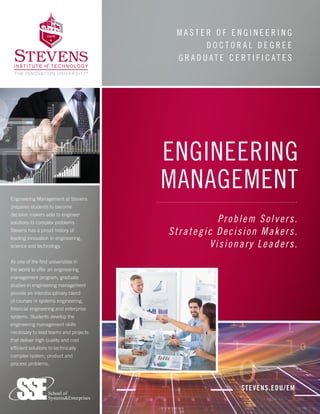
Engineering Management at Stevens
prepares students to become
decision makers able to engineer
solutions to complex problems.
Stevens has a proud history of
leading innovation in engineering,
science and technology.
As one of the first universities in
the world to offer an engineering
management program, graduate
studies in engineering management
provide an interdisciplinary blend
of courses in systems engineering,
financial engineering and enterprise
systems. Students develop the
engineering management skills
necessary to lead teams and projects
that deliver high quality and cost
efficient solutions to technically
complex system, product and
process problems.
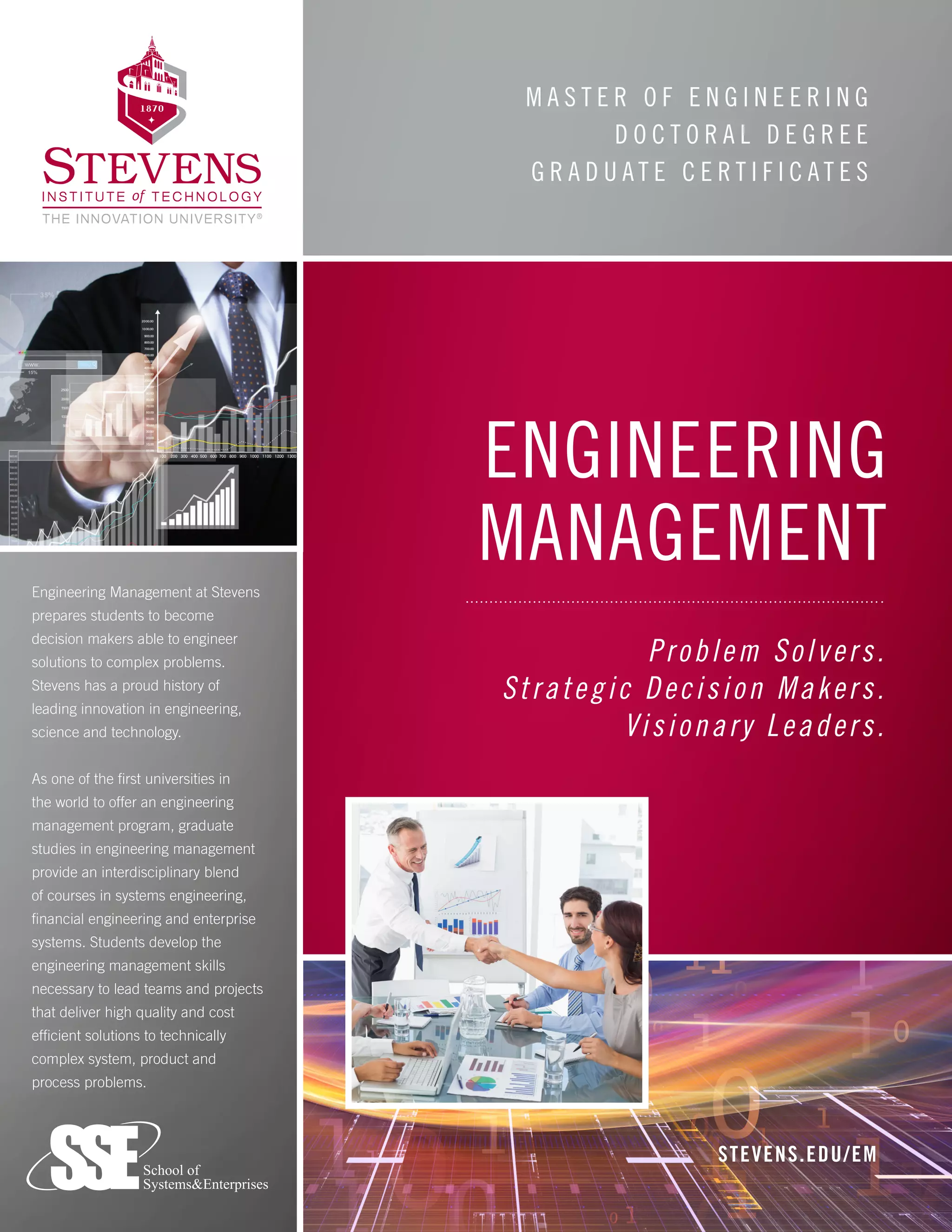
ENGINEERING
MANAGEMENT
Problem Solvers.
Strategic Decision Makers.
Visionary Leaders.
“The Engineering Management
program at Stevens is challenging,
but rewarding. It provides essential
tools for getting ahead in the world.
Along with technical knowledge, we
learn about the workings of day-to-day
business, strategic planning, and most
importantly, building relationships and
having confidence. We are taught to
see the big picture.”
Guoquan Xu
Student, Master’s in Engineering
Management
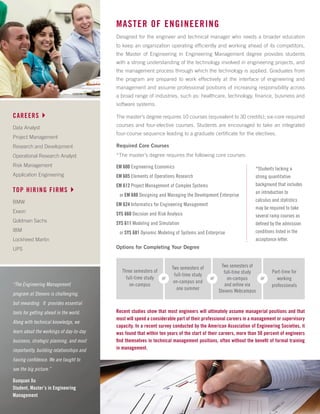
MASTER OF ENGINEERING
Designed for the engineer and technical manager who needs a broader education
to keep an organization operating efficiently and working ahead of its competitors,
the Master of Engineering in Engineering Management degree provides students
with a strong understanding of the technology involved in engineering projects, and
the management process through which the technology is applied. Graduates from
the program are prepared to work effectively at the interface of engineering and
management and assume professional positions of increasing responsibility across
a broad range of industries, such as: healthcare, technology, finance, business and
software systems.
The master’s degree requires 10 courses (equivalent to 30 credits); six-core required
courses and four-elective courses. Students are encouraged to take an integrated
four-course sequence leading to a graduate certificate for the electives.
CAREERS4
Data Analyst
Project Management
Research and Development
Operational Research Analyst
Risk Management
Application Engineering
TOP HIRING FIRMS4
BMW
Exxon
Goldman Sachs
IBM
Lockheed Martin
UPS
Required Core Courses
*The master’s degree requires the following core courses:
*Students lacking a
strong quantitative
background that includes
an introduction to
calculus and statistics
may be required to take
several ramp courses as
defined by the admission
conditions listed in the
acceptance letter.
EM 600 Engineering Economics
EM 605 Elements of Operations Research
EM 612 Project Management of Complex Systems
or EM 680 Designing and Managing the Development Enterprise
EM 624 Informatics for Engineering Management
SYS 660 Decision and Risk Analysis
SYS 611 Modeling and Simulation
or SYS 681 Dynamic Modeling of Systems and Enterprise
Recent studies show that most engineers will ultimately assume managerial positions and that
most will spend a considerable part of their professional careers in a management or supervisory
capacity. In a recent survey conducted by the American Association of Engineering Societies, it
was found that within ten years of the start of their careers, more than 50 percent of engineers
find themselves in technical management positions, often without the benefit of formal training
in management.
Options for Completing Your Degree
Three semesters of
full-time study
on-campus
Two semesters of
full-time study
on-campus and
one summer
Two semesters of
full-time study
on-campus
and online via
Stevens Webcampus
Part-time for
working
professionals
or or or
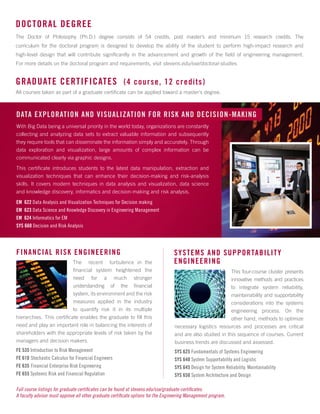
DOCTORAL DEGREE
The Doctor of Philosophy (Ph.D.) degree consists of 54 credits, post master’s and minimum 15 research credits. The
curriculum for the doctoral program is designed to develop the ability of the student to perform high-impact research and
high-level design that will contribute significantly in the advancement and growth of the field of engineering management.
For more details on the doctoral program and requirements, visit stevens.edu/sse/doctoral-studies.
With Big Data being a universal priority in the world today, organizations are constantly
collecting and analyzing data sets to extract valuable information and subsequently
they require tools that can disseminate the information simply and accurately. Through
data exploration and visualization, large amounts of complex information can be
communicated clearly via graphic designs.
This certificate introduces students to the latest data manipulation, extraction and
visualization techniques that can enhance their decision-making and risk-analysis
skills. It covers modern techniques in data analysis and visualization, data science
and knowledge discovery, informatics and decision-making and risk analysis.
EM 622 Data Analysis and Visualization Techniques for Decision making
EM 623 Data Science and Knowledge Discovery in Engineering Management
EM 624 Informatics for EM
SYS 660 Decision and Risk Analysis
The recent turbulence in the
financial system heightened the
need for a much stronger
understanding of the financial
system, its environment and the risk
measures applied in the industry
to quantify risk it in its multiple
hierarchies. This certificate enables the graduate to fill this
need and play an important role in balancing the interests of
shareholders with the appropriate levels of risk taken by the
managers and decision makers.
FE 535 Introduction to Risk Management
FE 610 Stochastic Calculus for Financial Engineers
FE 635 Financial Enterprise Risk Engineering
FE 655 Systemic Risk and Financial Regulation
This four-course cluster presents
innovative methods and practices
to integrate system reliability,
maintainability and supportability
considerations into the systems
engineering process. On the
other hand, methods to optimize
necessary logistics resources and processes are critical
and are also studied in this sequence of courses. Current
business trends are discussed and assessed.
SYS 625 Fundamentals of Systems Engineering
SYS 640 System Supportability and Logistic
SYS 645 Design for System Reliability, Maintainability
SYS 650 System Architecture and Design
FINANCIAL RISK ENGINEERING SYSTEMS AND SUPPORTABILITY
ENGINEERING
GRADUATE CERTIFICATES (4 course, 12 credits)
All courses taken as part of a graduate certificate can be applied toward a master’s degree.
Full course listings for graduate certificates can be found at stevens.edu/sse/graduate-certificates.
A faculty advisor must approve all other graduate certificate options for the Engineering Management program.
DATA EXPLORATION AND VISUALIZATION FOR RISK AND DECISION-MAKING
CONTACT
DR. JOSE EMMANUEL RAMIREZ-MARQUEZ
DIRECTOR, ENTERPRISE SCIENCE AND
ENGINEERING DIVISION
EMAIL: JMARQUEZ@STEVENS.EDU
STEVENS INSTITUTE OF TECHNOLOGY
CASTLE POINT ON HUDSON
HOBOKEN, NEW JERSEY 07030
PHONE: 800.496.4935
FAX: 201.216.8044
SSE.ASSIST@STEVENS.EDU
RELEVANT CURRICULUM
Stevens graduate courses are designed with a theory and implementation
perspective. Utilizing an Open Academic Model, the School of Systems and
Enterprises (SSE) leverages global partnerships with industry and government to
provide a highly relevant and engaged curriculum tailored to the real world and
the skill competency needs of practitioners.
UNIQUELY QUALIFIED FACULTY
Stevens Institute of Technology brings together institute-wide faculty who are
industry experts and practitioners, researchers and academics, with students
who are committed to learning in a dynamic, diverse and engaged community.
Stevens faculty possess a wealth of industry and government experience, and
expertise across diverse domains, including Aerospace, Healthcare, Security,
Telecommunications, Finance and Defense.
FLEXIBLE DELIVERY OPTIONS
Stevens Institute of Technology delivers its courses in convenient, flexible delivery
formats including:
• Traditional semester courses held one evening a week for 15 weeks,
on-campus at Stevens in Hoboken, NJ
• Online via our award-winning Stevens WebCampus

• On-site at industry and government sponsor locations worldwide
ADMISSION REQUIREMENTS
Applicants may apply online at stevens.edu/applications
• Completed application for admission
• $60 non-refundable fee
• An undergraduate degree in engineering or in computer science or in a related
discipline, with a “B” average or better from an accredited college or university
• Official transcripts from all institutions attended
• Two letters of recommendation
• GRE /GMAT scores (Part-time students do not require GRE/GMAT scores)
STEVENS.EDU/EM
CODE: 10/14

StevensEM_final

  • 1.
    M A ST E R O F E N G I N E E R I N G D O C T O R A L D E G R E E G R A D U A T E C E R T I F I C A T E S STEVENS.EDU/EM Engineering Management at Stevens prepares students to become decision makers able to engineer solutions to complex problems. Stevens has a proud history of leading innovation in engineering, science and technology. As one of the first universities in the world to offer an engineering management program, graduate studies in engineering management provide an interdisciplinary blend of courses in systems engineering, financial engineering and enterprise systems. Students develop the engineering management skills necessary to lead teams and projects that deliver high quality and cost efficient solutions to technically complex system, product and process problems. ENGINEERING MANAGEMENT Problem Solvers. Strategic Decision Makers. Visionary Leaders.
  • 2.
    “The Engineering Management programat Stevens is challenging, but rewarding. It provides essential tools for getting ahead in the world. Along with technical knowledge, we learn about the workings of day-to-day business, strategic planning, and most importantly, building relationships and having confidence. We are taught to see the big picture.” Guoquan Xu Student, Master’s in Engineering Management MASTER OF ENGINEERING Designed for the engineer and technical manager who needs a broader education to keep an organization operating efficiently and working ahead of its competitors, the Master of Engineering in Engineering Management degree provides students with a strong understanding of the technology involved in engineering projects, and the management process through which the technology is applied. Graduates from the program are prepared to work effectively at the interface of engineering and management and assume professional positions of increasing responsibility across a broad range of industries, such as: healthcare, technology, finance, business and software systems. The master’s degree requires 10 courses (equivalent to 30 credits); six-core required courses and four-elective courses. Students are encouraged to take an integrated four-course sequence leading to a graduate certificate for the electives. CAREERS4 Data Analyst Project Management Research and Development Operational Research Analyst Risk Management Application Engineering TOP HIRING FIRMS4 BMW Exxon Goldman Sachs IBM Lockheed Martin UPS Required Core Courses *The master’s degree requires the following core courses: *Students lacking a strong quantitative background that includes an introduction to calculus and statistics may be required to take several ramp courses as defined by the admission conditions listed in the acceptance letter. EM 600 Engineering Economics EM 605 Elements of Operations Research EM 612 Project Management of Complex Systems or EM 680 Designing and Managing the Development Enterprise EM 624 Informatics for Engineering Management SYS 660 Decision and Risk Analysis SYS 611 Modeling and Simulation or SYS 681 Dynamic Modeling of Systems and Enterprise Recent studies show that most engineers will ultimately assume managerial positions and that most will spend a considerable part of their professional careers in a management or supervisory capacity. In a recent survey conducted by the American Association of Engineering Societies, it was found that within ten years of the start of their careers, more than 50 percent of engineers find themselves in technical management positions, often without the benefit of formal training in management. Options for Completing Your Degree Three semesters of full-time study on-campus Two semesters of full-time study on-campus and one summer Two semesters of full-time study on-campus and online via Stevens Webcampus Part-time for working professionals or or or
  • 3.
    DOCTORAL DEGREE The Doctorof Philosophy (Ph.D.) degree consists of 54 credits, post master’s and minimum 15 research credits. The curriculum for the doctoral program is designed to develop the ability of the student to perform high-impact research and high-level design that will contribute significantly in the advancement and growth of the field of engineering management. For more details on the doctoral program and requirements, visit stevens.edu/sse/doctoral-studies. With Big Data being a universal priority in the world today, organizations are constantly collecting and analyzing data sets to extract valuable information and subsequently they require tools that can disseminate the information simply and accurately. Through data exploration and visualization, large amounts of complex information can be communicated clearly via graphic designs. This certificate introduces students to the latest data manipulation, extraction and visualization techniques that can enhance their decision-making and risk-analysis skills. It covers modern techniques in data analysis and visualization, data science and knowledge discovery, informatics and decision-making and risk analysis. EM 622 Data Analysis and Visualization Techniques for Decision making EM 623 Data Science and Knowledge Discovery in Engineering Management EM 624 Informatics for EM SYS 660 Decision and Risk Analysis The recent turbulence in the financial system heightened the need for a much stronger understanding of the financial system, its environment and the risk measures applied in the industry to quantify risk it in its multiple hierarchies. This certificate enables the graduate to fill this need and play an important role in balancing the interests of shareholders with the appropriate levels of risk taken by the managers and decision makers. FE 535 Introduction to Risk Management FE 610 Stochastic Calculus for Financial Engineers FE 635 Financial Enterprise Risk Engineering FE 655 Systemic Risk and Financial Regulation This four-course cluster presents innovative methods and practices to integrate system reliability, maintainability and supportability considerations into the systems engineering process. On the other hand, methods to optimize necessary logistics resources and processes are critical and are also studied in this sequence of courses. Current business trends are discussed and assessed. SYS 625 Fundamentals of Systems Engineering SYS 640 System Supportability and Logistic SYS 645 Design for System Reliability, Maintainability SYS 650 System Architecture and Design FINANCIAL RISK ENGINEERING SYSTEMS AND SUPPORTABILITY ENGINEERING GRADUATE CERTIFICATES (4 course, 12 credits) All courses taken as part of a graduate certificate can be applied toward a master’s degree. Full course listings for graduate certificates can be found at stevens.edu/sse/graduate-certificates. A faculty advisor must approve all other graduate certificate options for the Engineering Management program. DATA EXPLORATION AND VISUALIZATION FOR RISK AND DECISION-MAKING
  • 4.
    CONTACT DR. JOSE EMMANUELRAMIREZ-MARQUEZ DIRECTOR, ENTERPRISE SCIENCE AND ENGINEERING DIVISION EMAIL: JMARQUEZ@STEVENS.EDU STEVENS INSTITUTE OF TECHNOLOGY CASTLE POINT ON HUDSON HOBOKEN, NEW JERSEY 07030 PHONE: 800.496.4935 FAX: 201.216.8044 SSE.ASSIST@STEVENS.EDU RELEVANT CURRICULUM Stevens graduate courses are designed with a theory and implementation perspective. Utilizing an Open Academic Model, the School of Systems and Enterprises (SSE) leverages global partnerships with industry and government to provide a highly relevant and engaged curriculum tailored to the real world and the skill competency needs of practitioners. UNIQUELY QUALIFIED FACULTY Stevens Institute of Technology brings together institute-wide faculty who are industry experts and practitioners, researchers and academics, with students who are committed to learning in a dynamic, diverse and engaged community. Stevens faculty possess a wealth of industry and government experience, and expertise across diverse domains, including Aerospace, Healthcare, Security, Telecommunications, Finance and Defense. FLEXIBLE DELIVERY OPTIONS Stevens Institute of Technology delivers its courses in convenient, flexible delivery formats including: • Traditional semester courses held one evening a week for 15 weeks, on-campus at Stevens in Hoboken, NJ • Online via our award-winning Stevens WebCampus
 • On-site at industry and government sponsor locations worldwide ADMISSION REQUIREMENTS Applicants may apply online at stevens.edu/applications • Completed application for admission • $60 non-refundable fee • An undergraduate degree in engineering or in computer science or in a related discipline, with a “B” average or better from an accredited college or university • Official transcripts from all institutions attended • Two letters of recommendation • GRE /GMAT scores (Part-time students do not require GRE/GMAT scores) STEVENS.EDU/EM CODE: 10/14