STEAM Pyramid
Analysis
-The Importance of Art Context
POE
ASSIGNME
NT
2
What is Steam Pyramid
analysis?
• STEAM is an educational approach that combines the traditional
academic subjects of science.
• It is an educational movement that has been growing rapidly in the 21st
century.
• “STEAM” stands for Science, Technology, Engineering, the Arts, and
Mathematics.
• This movement aims to bring a new spirit of learning to children by
combining the traditional arts and sciences with high-performance
technologies, thereby making a new kind of modern person​.
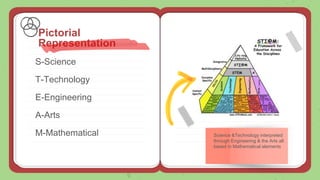
S-Science
T-Technology
E-Engineering
A-Arts
M-Mathematical
Pictorial
Representation
Science &Technology interpreted
through Engineering & the Arts all
based in Mathematical elements
WHAT IS
ART?
• The arts is a collective term, which is
used to describe a range of
different subject areas that are
broadly considered to be artistic or
otherwise creative in their nature.
When the STEAM concept was
originally created, the arts were
divided into a number of sub-
categories by Georgette Yakman,
and these can be briefly
summarized as follows:
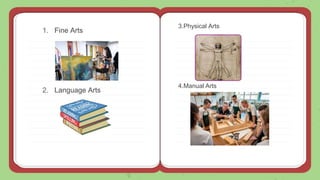
1. Fine Arts
2. Language Arts
3.Physical Arts
4.Manual Arts
5. Liberal Arts
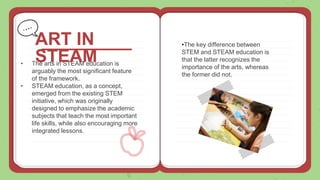
• The arts in STEAM education is
arguably the most significant feature
of the framework.
• STEAM education, as a concept,
emerged from the existing STEM
initiative, which was originally
designed to emphasize the academic
subjects that teach the most important
life skills, while also encouraging more
integrated lessons.
ART IN
STEAM​
•The key difference between
STEM and STEAM education is
that the latter recognizes the
importance of the arts, whereas
the former did not.
Continuation of
……
ART IN STEAM​
• The idea behind STEAM
education is to place a focus on
five key areas – science,
technology, engineering, the arts,
and mathematics – while
also encouraging the teaching of
those fields to be
more engaging and integrated.
• The idea grew out of a concept
known as STEM education, with
the key difference being the
inclusion of the ‘A’ for the arts.
• Through the foundations
of STEAM education, the potential
is there for students to go on to
anything they wish with their
careers.
• Whether it’s to become engineers
or computer designers. With the
design of STEAM education, they
are given the opportunity to do
anything they like.
Why is it
important?
• Science, technology, engineering,
art and maths are all things that
are extremely relevant to life now,
• Especially with the technological
revolution that is currently taking
place around the world.
• Since computers are now so
prevalent, it is very important that
students are taught these subjects
in order to be able to cope with
the future. Prepares students for the
future by increasing their
creativity, innovation and
development!
IMPORTANCE OF ART​
• It is worth taking the time to understand the importance of the arts
in providing students with a rounded education.
• The subjects contained within this field are able to teach people
the value of creativity, innovation, communication, and
contemplation.
• In addition, the arts can help to provide individuals with a greater
appreciation for culture.
• The skills developed through the arts are often in high demand
within the workforce, where creative solutions to problems may be
needed and where different perspectives can be useful.
• The language arts are also vital for communication and, in the
case of things like sign language, can help to provide people with
greater accessibility.
STEAM education highlights the arts as one of its five fields and
its inclusion is important.
After all, the arts can help learners to develop the kind of creativity,
ingenuity, communication, and performance skills that will assist them
throughout their education, but also with employment opportunities too.
As a field, the arts is extremely broad and diverse, covering
everything from painting and photography to dance, history, and
architecture.
This does, however, help teachers looking to integrate elements of the
arts into their lessons
• The ‘Art’ in STEAM represents visual arts, social studies, history, physical arts,
fine arts and music. Art is about using creativity and imagination to increase the
development of STEM’s essential skills, as well as enhance flexibility,
adaptability, productivity, responsibility and innovation - all required skills for a
successful career in any field of study
• Slotting the arts into a child’s STEM education have proven benefits such as
increased creativity, improved academic performance, increased motor skills,
higher decision making skills, better visual learning and an enhanced learning
experience:

STEAM PYRAMID ANALYSIS-.pptx

  • 1.
    STEAM Pyramid Analysis -The Importanceof Art Context POE ASSIGNME NT 2
  • 2.
    What is SteamPyramid analysis? • STEAM is an educational approach that combines the traditional academic subjects of science. • It is an educational movement that has been growing rapidly in the 21st century. • “STEAM” stands for Science, Technology, Engineering, the Arts, and Mathematics. • This movement aims to bring a new spirit of learning to children by combining the traditional arts and sciences with high-performance technologies, thereby making a new kind of modern person​.
  • 3.
  • 4.
    WHAT IS ART? • Thearts is a collective term, which is used to describe a range of different subject areas that are broadly considered to be artistic or otherwise creative in their nature. When the STEAM concept was originally created, the arts were divided into a number of sub- categories by Georgette Yakman, and these can be briefly summarized as follows:
  • 5.
    1. Fine Arts 2.Language Arts 3.Physical Arts 4.Manual Arts
  • 6.
  • 7.
    • The artsin STEAM education is arguably the most significant feature of the framework. • STEAM education, as a concept, emerged from the existing STEM initiative, which was originally designed to emphasize the academic subjects that teach the most important life skills, while also encouraging more integrated lessons. ART IN STEAM​ •The key difference between STEM and STEAM education is that the latter recognizes the importance of the arts, whereas the former did not.
  • 8.
    Continuation of …… ART INSTEAM​ • The idea behind STEAM education is to place a focus on five key areas – science, technology, engineering, the arts, and mathematics – while also encouraging the teaching of those fields to be more engaging and integrated. • The idea grew out of a concept known as STEM education, with the key difference being the inclusion of the ‘A’ for the arts.
  • 9.
    • Through thefoundations of STEAM education, the potential is there for students to go on to anything they wish with their careers. • Whether it’s to become engineers or computer designers. With the design of STEAM education, they are given the opportunity to do anything they like. Why is it important? • Science, technology, engineering, art and maths are all things that are extremely relevant to life now, • Especially with the technological revolution that is currently taking place around the world. • Since computers are now so prevalent, it is very important that students are taught these subjects in order to be able to cope with the future. Prepares students for the future by increasing their creativity, innovation and development!
  • 10.
    IMPORTANCE OF ART​ •It is worth taking the time to understand the importance of the arts in providing students with a rounded education. • The subjects contained within this field are able to teach people the value of creativity, innovation, communication, and contemplation. • In addition, the arts can help to provide individuals with a greater appreciation for culture. • The skills developed through the arts are often in high demand within the workforce, where creative solutions to problems may be needed and where different perspectives can be useful. • The language arts are also vital for communication and, in the case of things like sign language, can help to provide people with greater accessibility.
  • 11.
    STEAM education highlightsthe arts as one of its five fields and its inclusion is important. After all, the arts can help learners to develop the kind of creativity, ingenuity, communication, and performance skills that will assist them throughout their education, but also with employment opportunities too. As a field, the arts is extremely broad and diverse, covering everything from painting and photography to dance, history, and architecture. This does, however, help teachers looking to integrate elements of the arts into their lessons
  • 12.
    • The ‘Art’in STEAM represents visual arts, social studies, history, physical arts, fine arts and music. Art is about using creativity and imagination to increase the development of STEM’s essential skills, as well as enhance flexibility, adaptability, productivity, responsibility and innovation - all required skills for a successful career in any field of study • Slotting the arts into a child’s STEM education have proven benefits such as increased creativity, improved academic performance, increased motor skills, higher decision making skills, better visual learning and an enhanced learning experience: