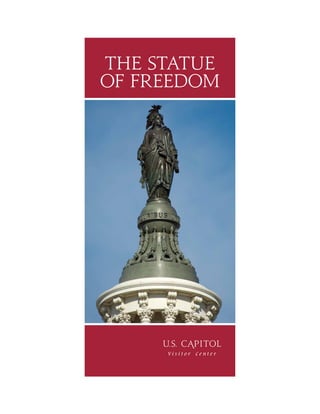
The STATUe
of FreedoM
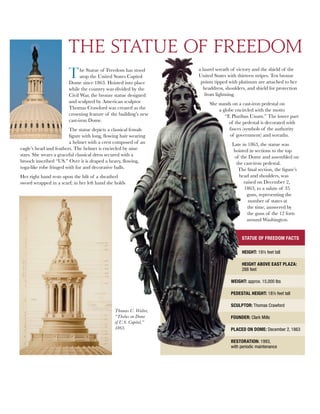
Height: 19½ feet tall
	 Height above EAST plaza:
	 288 feet
Weight: approx. 15,000 lbs
Pedestal Height: 18½ feet tall
Sculptor: Thomas Crawford
Founder: Clark Mills
Placed on dome: December 2, 1863
Restoration: 1993,
with periodic maintenance
STATUE OF FREEDOM FACTS
The STATUe of FreedoM
The Statue of Freedom has stood
atop the United States Capitol
Dome since 1863. Hoisted into place
while the country was divided by the
Civil War, the bronze statue designed
and sculpted by American sculptor
Thomas Crawford was created as the
crowning feature of the building’s new
cast-iron Dome.
The statue depicts a classical female
figure with long, flowing hair wearing
a helmet with a crest composed of an
eagle’s head and feathers. The helmet is encircled by nine
stars. She wears a graceful classical dress secured with a
brooch inscribed “US.” Over it is draped a heavy, flowing,
toga-like robe fringed with fur and decorative balls.
Her right hand rests upon the hilt of a sheathed
sword wrapped in a scarf; in her left hand she holds
a laurel wreath of victory and the shield of the
United States with thirteen stripes. Ten bronze
points tipped with platinum are attached to her
headdress, shoulders, and shield for protection
from lightning.
She stands on a cast-iron pedestal on
a globe encircled with the motto
“E Pluribus Unum.” The lower part
of the pedestal is decorated with
fasces (symbols of the authority
of government) and wreaths.
Late in 1863, the statue was
hoisted in sections to the top
of the Dome and assembled on
the cast-iron pedestal.
The final section, the figure’s
head and shoulders, was
raised on December 2,
1863, to a salute of 35
guns, representing the
number of states at
the time, answered by
the guns of the 12 forts
around Washington.
Thomas U. Walter,
“Tholus on Dome
of U.S. Capitol,”
1863.
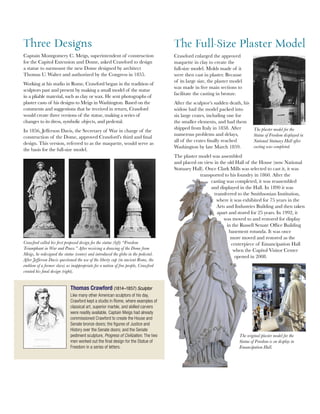
Crawford called his first proposed design for the statue (left) “Freedom
Triumphant in War and Peace.” After receiving a drawing of the Dome from
Meigs, he redesigned the statue (center) and introduced the globe in the pedestal.
After Jefferson Davis questioned the use of the liberty cap (in ancient Rome, the
emblem of a former slave) as inappropriate for a nation of free people, Crawford
created his final design (right).
Three Designs
Captain Montgomery C. Meigs, superintendent of construction
for the Capitol Extension and Dome, asked Crawford to design
a statue to surmount the new Dome designed by architect
Thomas U. Walter and authorized by the Congress in 1855.
Working at his studio in Rome, Crawford began in the tradition of
sculptors past and present by making a small model of the statue
in a pliable material, such as clay or wax. He sent photographs of
plaster casts of his designs to Meigs in Washington. Based on the
comments and suggestions that he received in return, Crawford
would create three versions of the statue, making a series of
changes to its dress, symbolic objects, and pedestal.
In 1856, Jefferson Davis, the Secretary of War in charge of the
construction of the Dome, approved Crawford’s third and final
design. This version, referred to as the maquette, would serve as
the basis for the full-size model.
Thomas Crawford (1814–1857) Sculptor
Like many other American sculptors of his day,
Crawford kept a studio in Rome, where examples of
classical art, superior marble, and skilled carvers
were readily available. Captain Meigs had already
commissioned Crawford to create the House and
Senate bronze doors; the figures of Justice and
History over the Senate doors; and the Senate
pediment sculpture, Progress of Civilization. The two
men worked out the final design for the Statue of
Freedom in a series of letters.
The Full-Size Plaster Model
Crawford enlarged the approved
maquette in clay to create the
full-size model. Molds made of it
were then cast in plaster. Because
of its large size, the plaster model
was made in five main sections to
facilitate the casting in bronze.
After the sculptor’s sudden death, his
widow had the model packed into
six large crates, including one for
the smaller elements, and had them
shipped from Italy in 1858. After
numerous problems and delays,
all of the crates finally reached
Washington by late March 1859.
The plaster model was assembled
and placed on view in the old Hall of the House (now National
Statuary Hall). Once Clark Mills was selected to cast it, it was
transported to his foundry in 1860. After the
casting was completed, it was reassembled
and displayed in the Hall. In 1890 it was
transferred to the Smithsonian Institution,
where it was exhibited for 75 years in the
Arts and Industries Building and then taken
apart and stored for 25 years. In 1992, it
was moved to and restored for display
in the Russell Senate Office Building
basement rotunda. It was once
more moved and restored as the
centerpiece of Emancipation Hall
when the Capitol Visitor Center
opened in 2008.
The plaster model for the
Statue of Freedom displayed in
National Statuary Hall after
casting was completed.
The original plaster model for the
Statue of Freedom is on display in
Emancipation Hall.
On May 9, 1993, after almost 130 years in place, the bronze
statue was removed from the Dome by helicopter for restoration
of the statue and its pedestal. The restored Statue of Freedom
was returned to its pedestal by helicopter on October 23, 1993,
amidst the congressional celebration of the bicentennial of the
U.S. Capitol.
Since then, its protective coating has been renewed every few
years to prevent corrosion, keeping it in good condition.
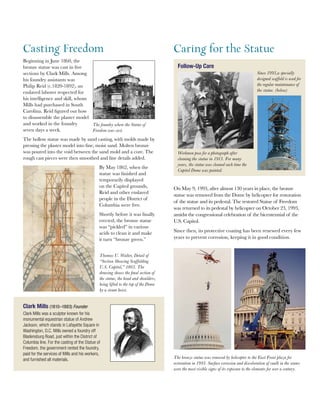
The bronze statue was removed by helicopter to the East Front plaza for
restoration in 1993. Surface corrosion and discoloration of caulk in the seams
were the most visible signs of its exposure to the elements for over a century.
Casting Freedom
Beginning in June 1860, the
bronze statue was cast in five
sections by Clark Mills. Among
his foundry assistants was
Philip Reid (c.1820-1892), an
enslaved laborer respected for
his intelligence and skill, whom
Mills had purchased in South
Carolina. Reid figured out how
to disassemble the plaster model
and worked in the foundry
seven days a week.
The hollow statue was made by sand casting, with molds made by
pressing the plaster model into fine, moist sand. Molten bronze
was poured into the void between the sand mold and a core. The
rough cast pieces were then smoothed and fine details added.
By May 1862, when the
statue was finished and
temporarily displayed
on the Capitol grounds,
Reid and other enslaved
people in the District of
Columbia were free.
Shortly before it was finally
erected, the bronze statue
was “pickled” in various
acids to clean it and make
it turn “bronze green.”
Thomas U. Walter, Detail of
“Section Showing Scaffolding
U.S. Capitol,” 1863. The
drawing shows the final section of
the statue, the head and shoulders,
being lifted to the top of the Dome
by a steam hoist.
Clark Mills (1810–1883) Founder
Clark Mills was a sculptor known for his
monumental equestrian statue of Andrew
Jackson, which stands in Lafayette Square in
Washington, D.C. Mills owned a foundry off
Bladensburg Road, just within the District of
Columbia line. For the casting of the Statue of
Freedom, the government rented the foundry,
paid for the services of Mills and his workers,
and furnished all materials.
The foundry where the Statue of
Freedom was cast.
Caring for the Statue
Workmen pose for a photograph after
cleaning the statue in 1913. For many
years, the statue was cleaned each time the
Capitol Dome was painted.
Since 1993,a specially
designed scaffold is used for
the regular maintenance of
the statue. (below)
Follow-Up Care
CVC#13-113
www.visitthecapitol.gov
Photographs and architechural drawings from the records
of the Architect of the Capitol.
LOCATION & HOURS
The Capitol Visitor Center, the public entrance to the U.S. Capitol,
is located below the East Plaza of the Capitol between Constitution
and Independence Avenues.
Hours: The Capitol Visitor Center is open to the public from
8:30 a.m. to 4:30 p.m., Monday through Saturday. It is closed on
Thanksgiving Day, Christmas Day, New Year’s Day, and
Inauguration Day.
Official Business: Visitors with official business appointments
may enter the Capitol Visitor Center as early as 7:15 a.m.
Accessibility: Listening devices with audio description of the
U.S. Capitol tour orientation film and Exhibition Hall are available
at the Information Desks. Visitors may request wheelchairs at the
North Coat Check located on the Upper Level or from Capitol
Visitor Center staff. All restrooms are accessible.
International Visitors: Visitors may request listening devices for
foreign-language versions of the U.S. Capitol tour orientation film
and the Exhibition Hall audio tour at the Information Desks.
Twitter @visitthecapitol
www.visitthecapitol.gov
Thank you for visiting the U.S. Capitol.
Your feedback is important to us. Share your experience at
www.visitthecapitol.gov/comments.
or text “Capitol” to 313131 Message and data rates may apply.

Statue freedomen

  • 1.
  • 2.
    Height: 19½ feettall Height above EAST plaza: 288 feet Weight: approx. 15,000 lbs Pedestal Height: 18½ feet tall Sculptor: Thomas Crawford Founder: Clark Mills Placed on dome: December 2, 1863 Restoration: 1993, with periodic maintenance STATUE OF FREEDOM FACTS The STATUe of FreedoM The Statue of Freedom has stood atop the United States Capitol Dome since 1863. Hoisted into place while the country was divided by the Civil War, the bronze statue designed and sculpted by American sculptor Thomas Crawford was created as the crowning feature of the building’s new cast-iron Dome. The statue depicts a classical female figure with long, flowing hair wearing a helmet with a crest composed of an eagle’s head and feathers. The helmet is encircled by nine stars. She wears a graceful classical dress secured with a brooch inscribed “US.” Over it is draped a heavy, flowing, toga-like robe fringed with fur and decorative balls. Her right hand rests upon the hilt of a sheathed sword wrapped in a scarf; in her left hand she holds a laurel wreath of victory and the shield of the United States with thirteen stripes. Ten bronze points tipped with platinum are attached to her headdress, shoulders, and shield for protection from lightning. She stands on a cast-iron pedestal on a globe encircled with the motto “E Pluribus Unum.” The lower part of the pedestal is decorated with fasces (symbols of the authority of government) and wreaths. Late in 1863, the statue was hoisted in sections to the top of the Dome and assembled on the cast-iron pedestal. The final section, the figure’s head and shoulders, was raised on December 2, 1863, to a salute of 35 guns, representing the number of states at the time, answered by the guns of the 12 forts around Washington. Thomas U. Walter, “Tholus on Dome of U.S. Capitol,” 1863.
  • 3.
    Crawford called hisfirst proposed design for the statue (left) “Freedom Triumphant in War and Peace.” After receiving a drawing of the Dome from Meigs, he redesigned the statue (center) and introduced the globe in the pedestal. After Jefferson Davis questioned the use of the liberty cap (in ancient Rome, the emblem of a former slave) as inappropriate for a nation of free people, Crawford created his final design (right). Three Designs Captain Montgomery C. Meigs, superintendent of construction for the Capitol Extension and Dome, asked Crawford to design a statue to surmount the new Dome designed by architect Thomas U. Walter and authorized by the Congress in 1855. Working at his studio in Rome, Crawford began in the tradition of sculptors past and present by making a small model of the statue in a pliable material, such as clay or wax. He sent photographs of plaster casts of his designs to Meigs in Washington. Based on the comments and suggestions that he received in return, Crawford would create three versions of the statue, making a series of changes to its dress, symbolic objects, and pedestal. In 1856, Jefferson Davis, the Secretary of War in charge of the construction of the Dome, approved Crawford’s third and final design. This version, referred to as the maquette, would serve as the basis for the full-size model. Thomas Crawford (1814–1857) Sculptor Like many other American sculptors of his day, Crawford kept a studio in Rome, where examples of classical art, superior marble, and skilled carvers were readily available. Captain Meigs had already commissioned Crawford to create the House and Senate bronze doors; the figures of Justice and History over the Senate doors; and the Senate pediment sculpture, Progress of Civilization. The two men worked out the final design for the Statue of Freedom in a series of letters. The Full-Size Plaster Model Crawford enlarged the approved maquette in clay to create the full-size model. Molds made of it were then cast in plaster. Because of its large size, the plaster model was made in five main sections to facilitate the casting in bronze. After the sculptor’s sudden death, his widow had the model packed into six large crates, including one for the smaller elements, and had them shipped from Italy in 1858. After numerous problems and delays, all of the crates finally reached Washington by late March 1859. The plaster model was assembled and placed on view in the old Hall of the House (now National Statuary Hall). Once Clark Mills was selected to cast it, it was transported to his foundry in 1860. After the casting was completed, it was reassembled and displayed in the Hall. In 1890 it was transferred to the Smithsonian Institution, where it was exhibited for 75 years in the Arts and Industries Building and then taken apart and stored for 25 years. In 1992, it was moved to and restored for display in the Russell Senate Office Building basement rotunda. It was once more moved and restored as the centerpiece of Emancipation Hall when the Capitol Visitor Center opened in 2008. The plaster model for the Statue of Freedom displayed in National Statuary Hall after casting was completed. The original plaster model for the Statue of Freedom is on display in Emancipation Hall.
  • 4.
    On May 9,1993, after almost 130 years in place, the bronze statue was removed from the Dome by helicopter for restoration of the statue and its pedestal. The restored Statue of Freedom was returned to its pedestal by helicopter on October 23, 1993, amidst the congressional celebration of the bicentennial of the U.S. Capitol. Since then, its protective coating has been renewed every few years to prevent corrosion, keeping it in good condition. The bronze statue was removed by helicopter to the East Front plaza for restoration in 1993. Surface corrosion and discoloration of caulk in the seams were the most visible signs of its exposure to the elements for over a century. Casting Freedom Beginning in June 1860, the bronze statue was cast in five sections by Clark Mills. Among his foundry assistants was Philip Reid (c.1820-1892), an enslaved laborer respected for his intelligence and skill, whom Mills had purchased in South Carolina. Reid figured out how to disassemble the plaster model and worked in the foundry seven days a week. The hollow statue was made by sand casting, with molds made by pressing the plaster model into fine, moist sand. Molten bronze was poured into the void between the sand mold and a core. The rough cast pieces were then smoothed and fine details added. By May 1862, when the statue was finished and temporarily displayed on the Capitol grounds, Reid and other enslaved people in the District of Columbia were free. Shortly before it was finally erected, the bronze statue was “pickled” in various acids to clean it and make it turn “bronze green.” Thomas U. Walter, Detail of “Section Showing Scaffolding U.S. Capitol,” 1863. The drawing shows the final section of the statue, the head and shoulders, being lifted to the top of the Dome by a steam hoist. Clark Mills (1810–1883) Founder Clark Mills was a sculptor known for his monumental equestrian statue of Andrew Jackson, which stands in Lafayette Square in Washington, D.C. Mills owned a foundry off Bladensburg Road, just within the District of Columbia line. For the casting of the Statue of Freedom, the government rented the foundry, paid for the services of Mills and his workers, and furnished all materials. The foundry where the Statue of Freedom was cast. Caring for the Statue Workmen pose for a photograph after cleaning the statue in 1913. For many years, the statue was cleaned each time the Capitol Dome was painted. Since 1993,a specially designed scaffold is used for the regular maintenance of the statue. (below) Follow-Up Care
  • 5.
    CVC#13-113 www.visitthecapitol.gov Photographs and architechuraldrawings from the records of the Architect of the Capitol. LOCATION & HOURS The Capitol Visitor Center, the public entrance to the U.S. Capitol, is located below the East Plaza of the Capitol between Constitution and Independence Avenues. Hours: The Capitol Visitor Center is open to the public from 8:30 a.m. to 4:30 p.m., Monday through Saturday. It is closed on Thanksgiving Day, Christmas Day, New Year’s Day, and Inauguration Day. Official Business: Visitors with official business appointments may enter the Capitol Visitor Center as early as 7:15 a.m. Accessibility: Listening devices with audio description of the U.S. Capitol tour orientation film and Exhibition Hall are available at the Information Desks. Visitors may request wheelchairs at the North Coat Check located on the Upper Level or from Capitol Visitor Center staff. All restrooms are accessible. International Visitors: Visitors may request listening devices for foreign-language versions of the U.S. Capitol tour orientation film and the Exhibition Hall audio tour at the Information Desks. Twitter @visitthecapitol www.visitthecapitol.gov Thank you for visiting the U.S. Capitol. Your feedback is important to us. Share your experience at www.visitthecapitol.gov/comments. or text “Capitol” to 313131 Message and data rates may apply.