







Static website generators
First websites were static.
As those websites grew, problems
      became more obvious.
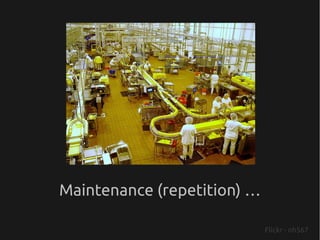
Maintenance (repetition) …

                             Flickr - nh567
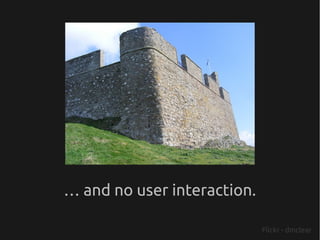
… and no user interaction.

                             Flickr - dmclear
The solution is soon found in
server-side programs. But they bring
     their own set of problems.
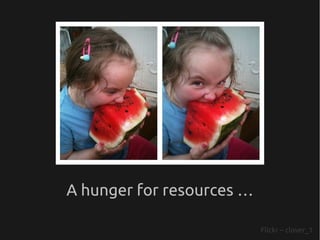
A hunger for resources …

                           Flickr – clover_1
… complexity …

                 Flickr – dominik99
… and security threats.

                          Flickr – llreadll
Is it worth it? Not always.
1. Simple websites
        (but not necessarily small)

Many private and business, product and service
websites are updated rarely, if ever. And when they
are, it is often by a tech-savvy person.
2. Online books

Unless it is a collaborative project, it will probably
change as often as the paper version on a bookshelf.
Check out http://progit.org/book/, it is very good.
3. Blogs

If you write a blog post, there is a 99.99% chance it
will not see any update. Ever. So why do you need to
recreate the post for every page request?
4. Presentations

Very soon most of the presentations will be written
(or at least presented) in HTML and JavaScript. And
you will need a tool for that.
Static website generator

It provides all the good things of static websites
(speed, stability and security) and eliminates most
of the problems.
How does it work?

                    Flickr – shinythings
Let us look at Hyde, one of the
          generators.
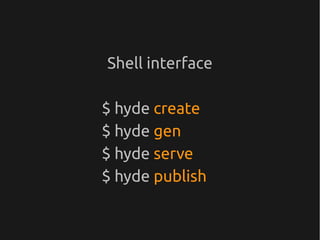
Shell interface

$ hyde create
$ hyde gen
$ hyde serve
$ hyde publish
After “$ hyde create”, the project
contains configuration, layout and
            content.
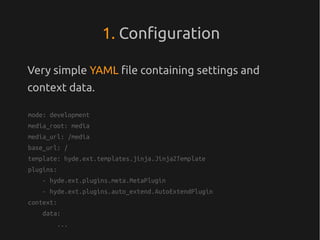
1. Configuration

Very simple YAML file containing settings and
context data.

mode: development
media_root: media
media_url: /media
base_url: /
template: hyde.ext.templates.jinja.Jinja2Template
plugins:
    - hyde.ext.plugins.meta.MetaPlugin
    - hyde.ext.plugins.auto_extend.AutoExtendPlugin
context:
    data:
        ...
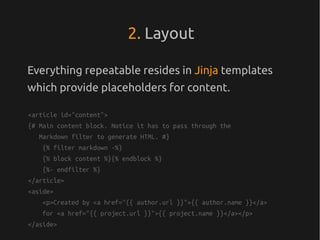
2. Layout

Everything repeatable resides in Jinja templates
which provide placeholders for content.

<article id="content">
{# Main content block. Notice it has to pass through the
   Markdown filter to generate HTML. #}
    {% filter markdown -%}
    {% block content %}{% endblock %}
    {%- endfilter %}
</article>
<aside>
    <p>Created by <a href="{{ author.url }}">{{ author.name }}</a>
    for <a href="{{ project.url }}">{{ project.name }}</a></p>
</aside>
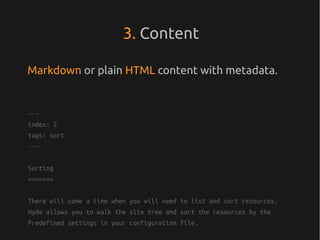
3. Content

Markdown or plain HTML content with metadata.


---
index: 2
tags: sort
---


Sorting
=======


There will come a time when you will need to list and sort resources.
Hyde allows you to walk the site tree and sort the resources by the
Predefined settings in your configuration file.
“$ hyde gen” takes all of that and
generates a complete static website
(HTML, CSS, images and JavaScript).
Use Hyde’s “serve” and “publish”
  commands to facilitate faster
 development and deployment.
And that’s it! All web servers can
  serve static content without
    any extra configuration.
Deploy anywhere.

                   Flickr – toasty
Show me some names!
Python: Hyde, Blogofile, Cactus

Ruby: Jekyll, nanoc, Bonsai

PHP: Phrozn

JavaScript: Petrify, DocPad
What about user interaction?
You can use JavaScript.

Many applications can run solely on the client. For
example, Chinese calendar or body mass index
calculators. Even some more complex ones, like a
typography lab (http://www.typetester.org/).
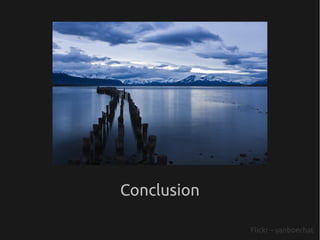
Conclusion

             Flickr – yanboechat
If you are a designer/developer …
… who is creating web content for
yourself or for somebody who will
  leave it to you to update it …
… and you care about simplicity and
            speed …
… give static websites a try.
Thank you :)

@merlinrebrovic

Static website generators

  • 1.
  • 2.
  • 3.
    As those websitesgrew, problems became more obvious.
  • 4.
  • 5.
    … and nouser interaction. Flickr - dmclear
  • 6.
    The solution issoon found in server-side programs. But they bring their own set of problems.
  • 7.
    A hunger forresources … Flickr – clover_1
  • 8.
    … complexity … Flickr – dominik99
  • 9.
    … and securitythreats. Flickr – llreadll
  • 10.
    Is it worthit? Not always.
  • 11.
    1. Simple websites (but not necessarily small) Many private and business, product and service websites are updated rarely, if ever. And when they are, it is often by a tech-savvy person.
  • 12.
    2. Online books Unlessit is a collaborative project, it will probably change as often as the paper version on a bookshelf. Check out http://progit.org/book/, it is very good.
  • 13.
    3. Blogs If youwrite a blog post, there is a 99.99% chance it will not see any update. Ever. So why do you need to recreate the post for every page request?
  • 14.
    4. Presentations Very soonmost of the presentations will be written (or at least presented) in HTML and JavaScript. And you will need a tool for that.
  • 15.
    Static website generator Itprovides all the good things of static websites (speed, stability and security) and eliminates most of the problems.
  • 16.
    How does itwork? Flickr – shinythings
  • 17.
    Let us lookat Hyde, one of the generators.
  • 18.
    Shell interface $ hydecreate $ hyde gen $ hyde serve $ hyde publish
  • 19.
    After “$ hydecreate”, the project contains configuration, layout and content.
  • 20.
    1. Configuration Very simpleYAML file containing settings and context data. mode: development media_root: media media_url: /media base_url: / template: hyde.ext.templates.jinja.Jinja2Template plugins: - hyde.ext.plugins.meta.MetaPlugin - hyde.ext.plugins.auto_extend.AutoExtendPlugin context: data: ...
  • 21.
    2. Layout Everything repeatableresides in Jinja templates which provide placeholders for content. <article id="content"> {# Main content block. Notice it has to pass through the Markdown filter to generate HTML. #} {% filter markdown -%} {% block content %}{% endblock %} {%- endfilter %} </article> <aside> <p>Created by <a href="{{ author.url }}">{{ author.name }}</a> for <a href="{{ project.url }}">{{ project.name }}</a></p> </aside>
  • 22.
    3. Content Markdown orplain HTML content with metadata. --- index: 2 tags: sort --- Sorting ======= There will come a time when you will need to list and sort resources. Hyde allows you to walk the site tree and sort the resources by the Predefined settings in your configuration file.
  • 23.
    “$ hyde gen”takes all of that and generates a complete static website (HTML, CSS, images and JavaScript).
  • 24.
    Use Hyde’s “serve”and “publish” commands to facilitate faster development and deployment.
  • 25.
    And that’s it!All web servers can serve static content without any extra configuration.
  • 26.
    Deploy anywhere. Flickr – toasty
  • 27.
  • 28.
    Python: Hyde, Blogofile,Cactus Ruby: Jekyll, nanoc, Bonsai PHP: Phrozn JavaScript: Petrify, DocPad
  • 29.
    What about userinteraction?
  • 30.
    You can useJavaScript. Many applications can run solely on the client. For example, Chinese calendar or body mass index calculators. Even some more complex ones, like a typography lab (http://www.typetester.org/).
  • 31.
    Conclusion Flickr – yanboechat
  • 32.
    If you area designer/developer …
  • 33.
    … who iscreating web content for yourself or for somebody who will leave it to you to update it …
  • 34.
    … and youcare about simplicity and speed …
  • 35.
    … give staticwebsites a try.
  • 36.