STATE PATTERN
Software Design and Architecture
Presented by
• Khadija Noor BSEF20A512
• Tania BSEF20A508
Agenda
■ What is State Pattern?
■ Relation to Finite State Machines
■ Structure
■ Pros and Cons
■ Applicability and Use cases
■ Pseudocode
■ Notable Usage
What is the State Design Pattern?
■ The State Design Pattern is a behavioral design pattern that allows an object
to change its behavior when its internal state changes. This pattern is
particularly useful when an object’s behavior depends on its state, and the
state can change during the object’s lifecycle.
■ The object will appear to change its class.
■ It is also known as Object for States.
Relation to the Finite State Machine
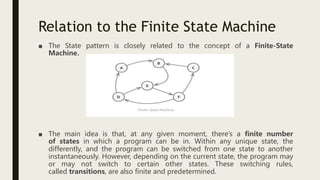
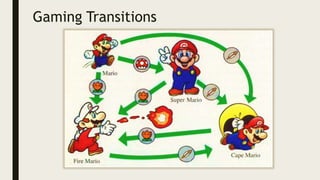
■ The State pattern is closely related to the concept of a Finite-State
Machine.
■ The main idea is that, at any given moment, there’s a finite number
of states in which a program can be in. Within any unique state, the
differently, and the program can be switched from one state to another
instantaneously. However, depending on the current state, the program may
or may not switch to certain other states. These switching rules,
called transitions, are also finite and predetermined.
Motivation
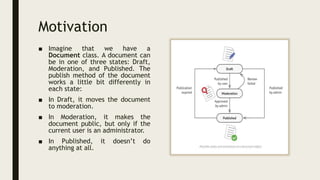
■ Imagine that we have a
Document class. A document can
be in one of three states: Draft,
Moderation, and Published. The
publish method of the document
works a little bit differently in
each state:
■ In Draft, it moves the document
to moderation.
■ In Moderation, it makes the
document public, but only if the
current user is an administrator.
■ In Published, it doesn’t do
anything at all.
State Machine based Solution
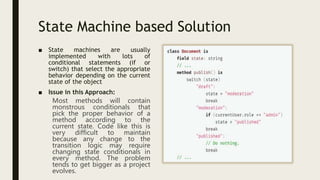
■ State machines are usually
implemented with lots of
conditional statements (if or
switch) that select the appropriate
behavior depending on the current
state of the object
■ Issue in this Approach:
Most methods will contain
monstrous conditionals that
pick the proper behavior of a
method according to the
current state. Code like this is
very difficult to maintain
because any change to the
transition logic may require
changing state conditionals in
every method. The problem
tends to get bigger as a project
evolves.
State Pattern Based Solution
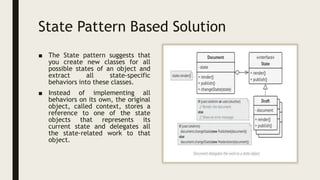
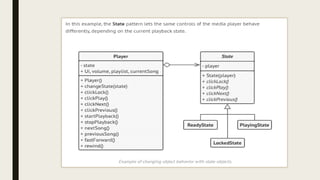
■ The State pattern suggests that
you create new classes for all
possible states of an object and
extract all state-specific
behaviors into these classes.
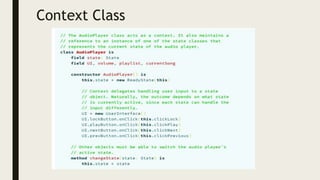
■ Instead of implementing all
behaviors on its own, the original
object, called context, stores a
reference to one of the state
objects that represents its
current state and delegates all
the state-related work to that
object.
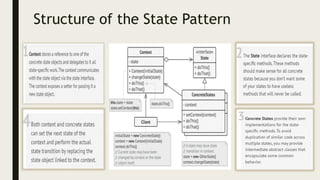
Structure of the State Pattern
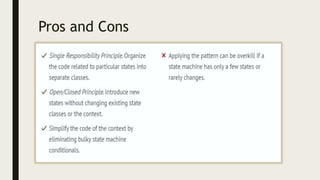
Pros and Cons
Applicability and its
Use Cases
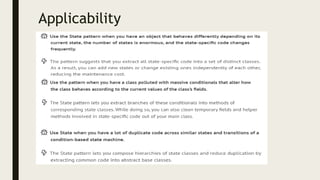
Applicability
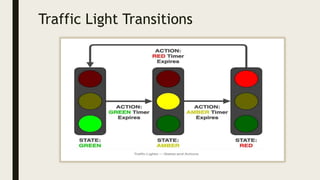
Traffic Light Transitions
Gaming Transitions
Pseudocode
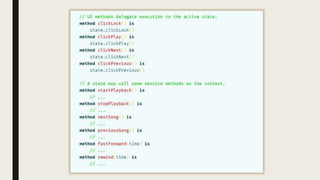
Context Class
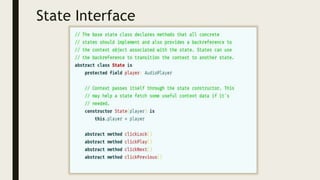
State Interface
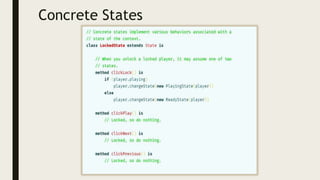
Concrete States
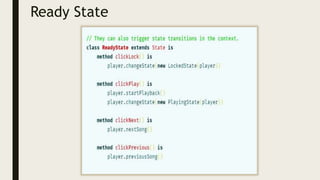
Ready State
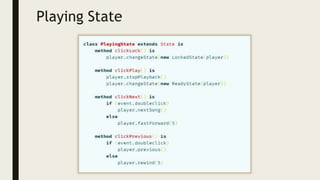
Playing State
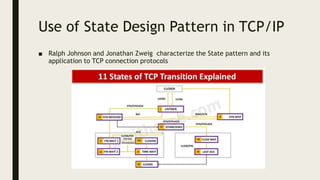
Use of State Design Pattern in TCP/IP
■ Ralph Johnson and Jonathan Zweig characterize the State pattern and its
application to TCP connection protocols
References
■ Design Patterns: Elements of Reusable Object-Oriented Software
■ Ralph E. Johnson and Jonathan Zweig. Delegation in C++. Journal of Object-Oriented
Programming, 4(11):22–35, November 1991.
■ https://refactoring.guru/design-patterns/state
■ https://www.geeksforgeeks.org/state-design-pattern/
■ https://www.ashishvishwakarma.com/GoF-Design-Patterns-by-Example/State-
Pattern/
■ https://medium.com/well-red/state-machines-for-everyone-part-1-introduction-
b7ac9aaf482e
■ https://networkinterview.com/11-states-of-tcp-transition-explained/

State Design Pattern in GOF Design Patterns

  • 1.
    STATE PATTERN Software Designand Architecture Presented by • Khadija Noor BSEF20A512 • Tania BSEF20A508
  • 2.
    Agenda ■ What isState Pattern? ■ Relation to Finite State Machines ■ Structure ■ Pros and Cons ■ Applicability and Use cases ■ Pseudocode ■ Notable Usage
  • 3.
    What is theState Design Pattern? ■ The State Design Pattern is a behavioral design pattern that allows an object to change its behavior when its internal state changes. This pattern is particularly useful when an object’s behavior depends on its state, and the state can change during the object’s lifecycle. ■ The object will appear to change its class. ■ It is also known as Object for States.
  • 4.
    Relation to theFinite State Machine ■ The State pattern is closely related to the concept of a Finite-State Machine. ■ The main idea is that, at any given moment, there’s a finite number of states in which a program can be in. Within any unique state, the differently, and the program can be switched from one state to another instantaneously. However, depending on the current state, the program may or may not switch to certain other states. These switching rules, called transitions, are also finite and predetermined.
  • 5.
    Motivation ■ Imagine thatwe have a Document class. A document can be in one of three states: Draft, Moderation, and Published. The publish method of the document works a little bit differently in each state: ■ In Draft, it moves the document to moderation. ■ In Moderation, it makes the document public, but only if the current user is an administrator. ■ In Published, it doesn’t do anything at all.
  • 6.
    State Machine basedSolution ■ State machines are usually implemented with lots of conditional statements (if or switch) that select the appropriate behavior depending on the current state of the object ■ Issue in this Approach: Most methods will contain monstrous conditionals that pick the proper behavior of a method according to the current state. Code like this is very difficult to maintain because any change to the transition logic may require changing state conditionals in every method. The problem tends to get bigger as a project evolves.
  • 7.
    State Pattern BasedSolution ■ The State pattern suggests that you create new classes for all possible states of an object and extract all state-specific behaviors into these classes. ■ Instead of implementing all behaviors on its own, the original object, called context, stores a reference to one of the state objects that represents its current state and delegates all the state-related work to that object.
  • 8.
    Structure of theState Pattern
  • 9.
  • 10.
  • 11.
  • 12.
  • 13.
  • 14.
  • 16.
  • 18.
  • 19.
  • 20.
  • 21.
  • 22.
    Use of StateDesign Pattern in TCP/IP ■ Ralph Johnson and Jonathan Zweig characterize the State pattern and its application to TCP connection protocols
  • 23.
    References ■ Design Patterns:Elements of Reusable Object-Oriented Software ■ Ralph E. Johnson and Jonathan Zweig. Delegation in C++. Journal of Object-Oriented Programming, 4(11):22–35, November 1991. ■ https://refactoring.guru/design-patterns/state ■ https://www.geeksforgeeks.org/state-design-pattern/ ■ https://www.ashishvishwakarma.com/GoF-Design-Patterns-by-Example/State- Pattern/ ■ https://medium.com/well-red/state-machines-for-everyone-part-1-introduction- b7ac9aaf482e ■ https://networkinterview.com/11-states-of-tcp-transition-explained/