
In partnership with
Standardizing Project Portfolio Reporting
Eliminating Errors, Improving Governance, and Ensuring Accuracy
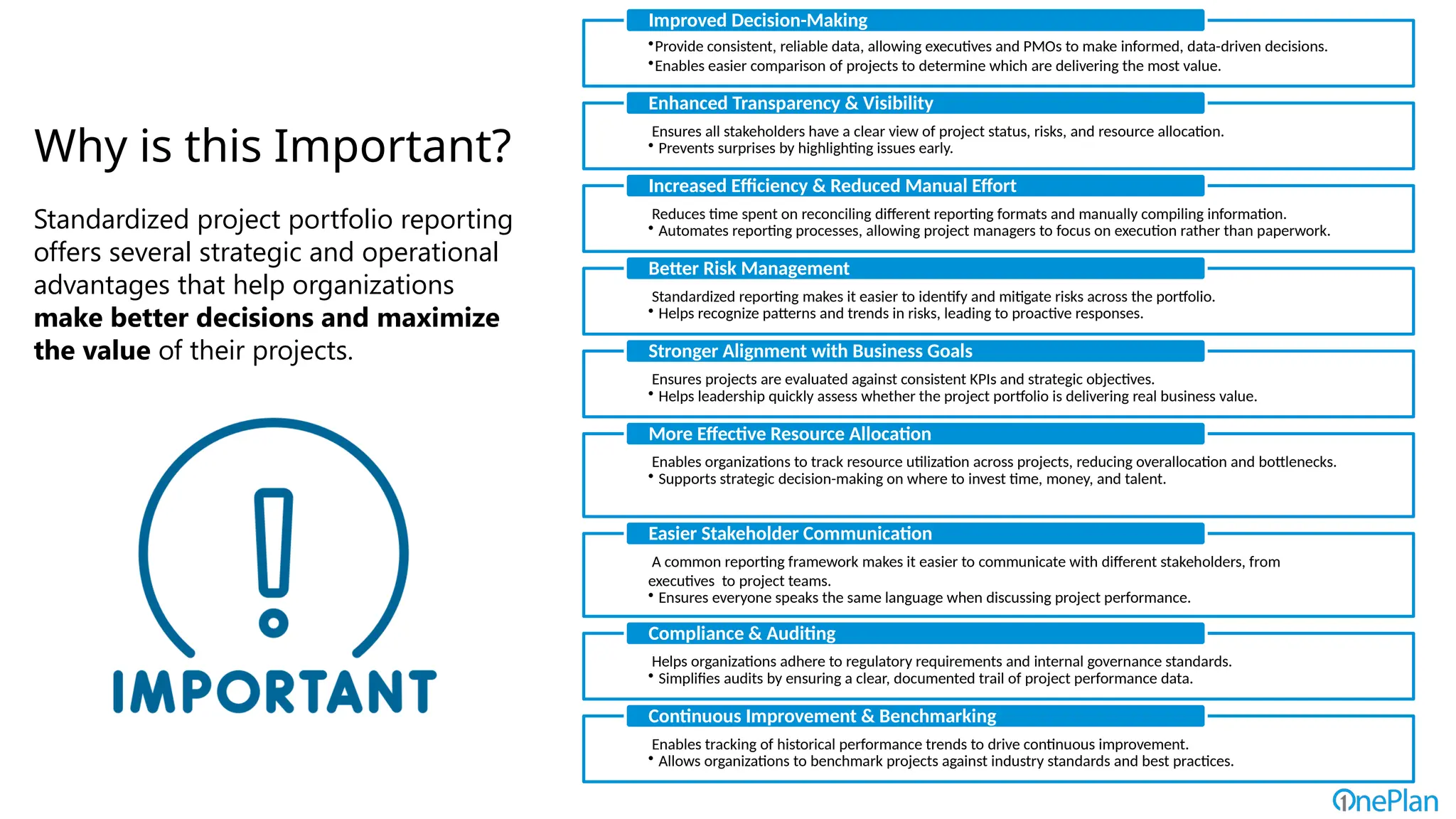
Why is this Important?
Standardized project portfolio reporting
offers several strategic and operational
advantages that help organizations
make better decisions and maximize
the value of their projects.
•Provide consistent, reliable data, allowing executives and PMOs to make informed, data-driven decisions.
•Enables easier comparison of projects to determine which are delivering the most value.
Improved Decision-Making
Ensures all stakeholders have a clear view of project status, risks, and resource allocation.
• Prevents surprises by highlighting issues early.
Enhanced Transparency & Visibility
Reduces time spent on reconciling different reporting formats and manually compiling information.
• Automates reporting processes, allowing project managers to focus on execution rather than paperwork.
Increased Efficiency & Reduced Manual Effort
Standardized reporting makes it easier to identify and mitigate risks across the portfolio.
• Helps recognize patterns and trends in risks, leading to proactive responses.
Better Risk Management
Ensures projects are evaluated against consistent KPIs and strategic objectives.
• Helps leadership quickly assess whether the project portfolio is delivering real business value.
Stronger Alignment with Business Goals
Enables organizations to track resource utilization across projects, reducing overallocation and bottlenecks.
• Supports strategic decision-making on where to invest time, money, and talent.
More Effective Resource Allocation
A common reporting framework makes it easier to communicate with different stakeholders, from
executives to project teams.
• Ensures everyone speaks the same language when discussing project performance.
Easier Stakeholder Communication
Helps organizations adhere to regulatory requirements and internal governance standards.
• Simplifies audits by ensuring a clear, documented trail of project performance data.
Compliance & Auditing
Enables tracking of historical performance trends to drive continuous improvement.
• Allows organizations to benchmark projects against industry standards and best practices.
Continuous Improvement & Benchmarking
• Different teams may use various tools (Excel, Jira, MS Project, etc.), leading to inconsistent
data collection and reporting formats.
Lack of Unified Data and Systems
• Teams and project managers may prefer their own reporting methods and resist adopting
standardized templates or processes.
Resistance to Change
• Different projects may track performance using unique KPIs, making it difficult to align
reporting across the portfolio.
Inconsistent Metrics and KPIs
• Incomplete, outdated, or inaccurate project data can hinder the effectiveness of
standardized reporting.
Data Quality Issues
• Executives, PMOs, and project teams may have different reporting needs, making it difficult
to create a single standardized format that satisfies everyone.
Stakeholder Misalignment
• Without clear accountability for maintaining reporting standards, inconsistencies can creep
in over time.
Lack of Governance and Ownership
• Reporting standards that work for a small set of projects may not be effective when scaled
across a large enterprise portfolio.
Scalability Challenges
• If an organization relies on multiple project management platforms, integrating data for a
unified report can be complex and costly.
Tool Integration Issues
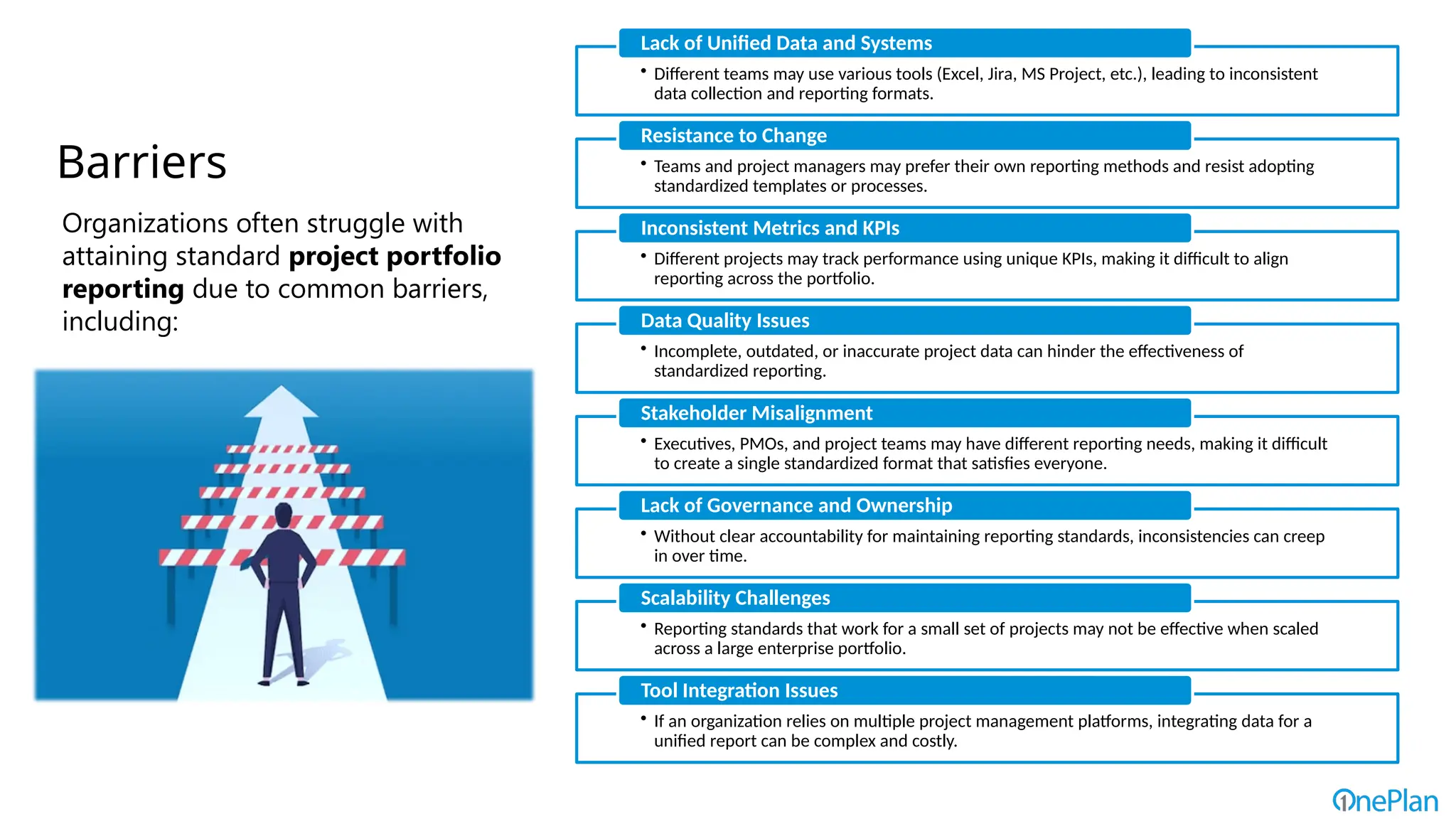
Barriers
Organizations often struggle with
attaining standard project portfolio
reporting due to common barriers,
including:
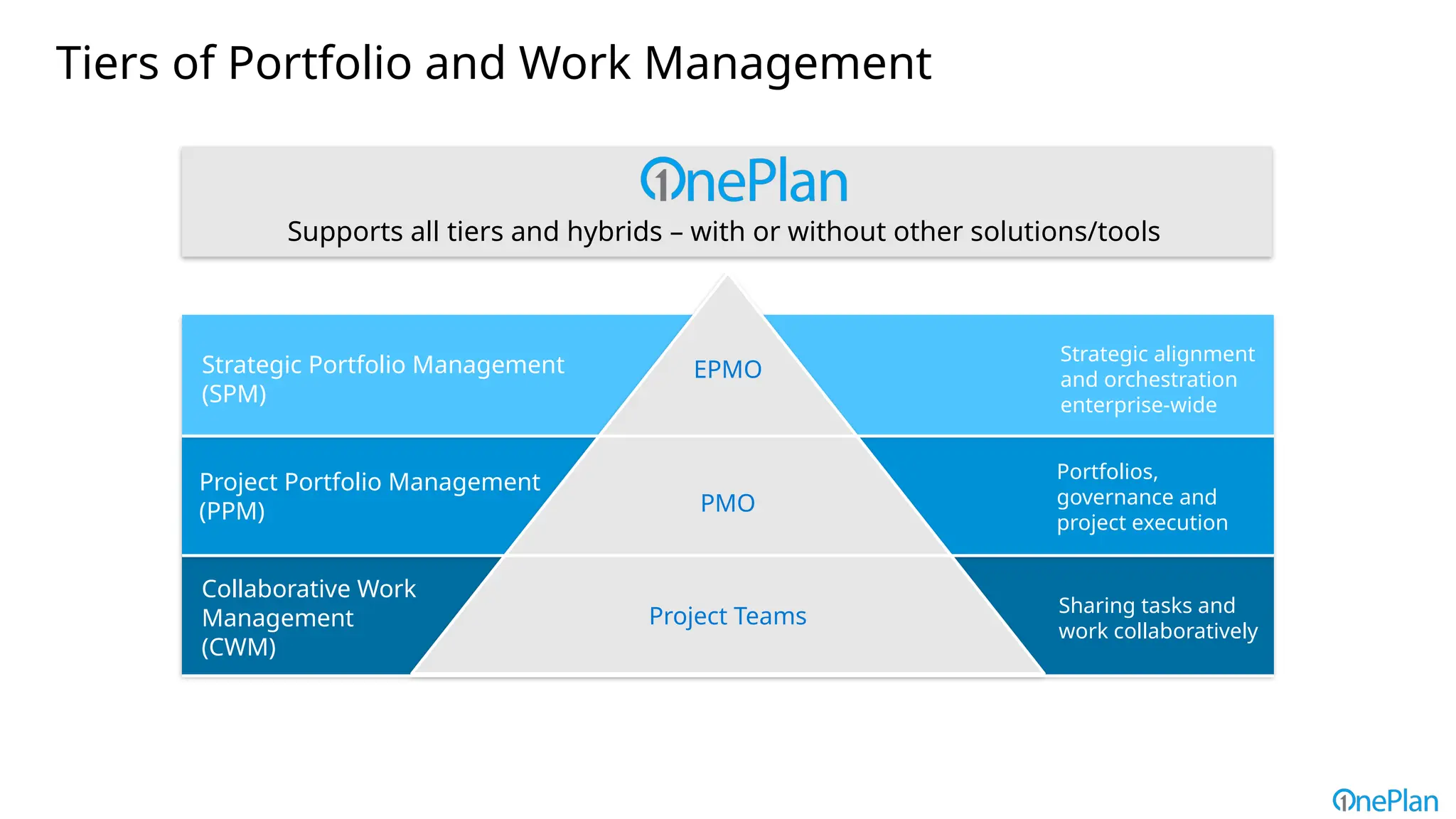
Tiers of Portfolio and Work Management
EPMO
PMO
Project Teams
Strategic Portfolio Management
(SPM)
Project Portfolio Management
(PPM)
Collaborative Work
Management
(CWM)
Sharing tasks and
work collaboratively
Portfolios,
governance and
project execution
Strategic alignment
and orchestration
enterprise-wide
Supports all tiers and hybrids – with or without other solutions/tools
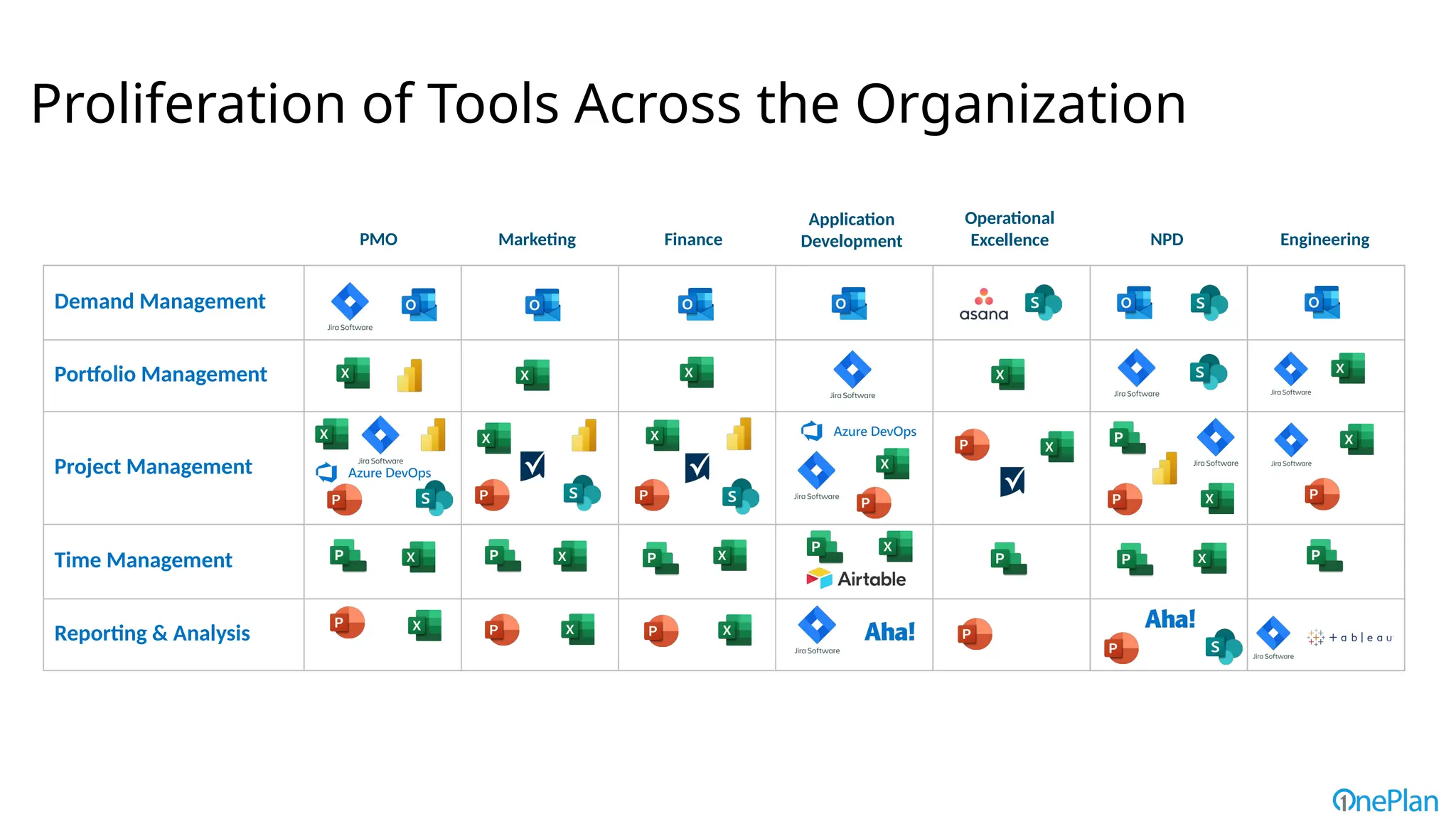
Proliferation of Tools Across the Organization
Demand Management
Portfolio Management
Project Management
Time Management
Reporting & Analysis
PMO Marketing Finance
Application
Development
Operational
Excellence NPD Engineering
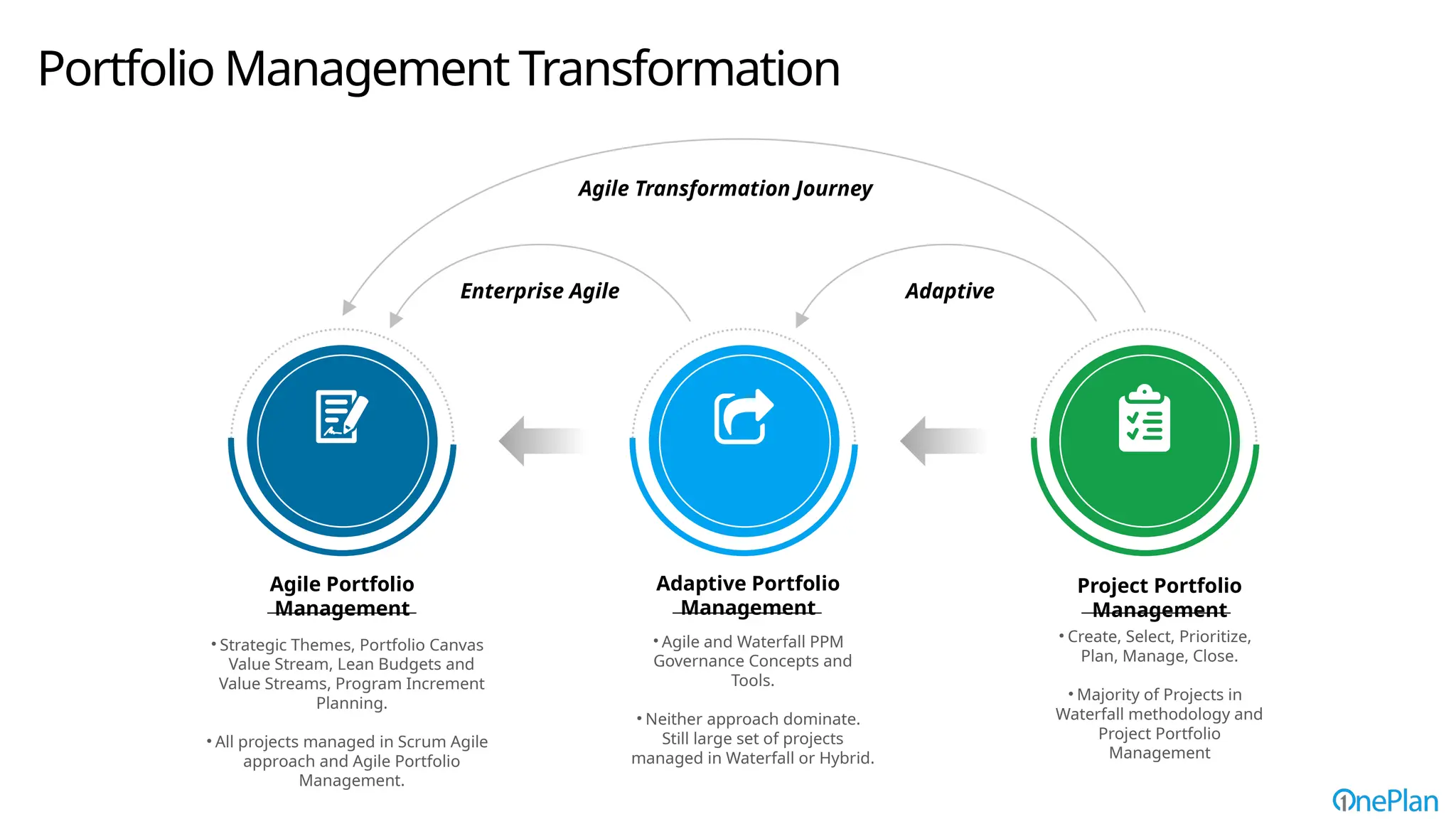
Agile Transformation Journey
Enterprise Agile Adaptive
Agile Portfolio
Management
Adaptive Portfolio
Management
Project Portfolio
Management
Portfolio Management Transformation
• Strategic Themes, Portfolio Canvas
Value Stream, Lean Budgets and
Value Streams, Program Increment
Planning.
• All projects managed in Scrum Agile
approach and Agile Portfolio
Management.
• Create, Select, Prioritize,
Plan, Manage, Close.
• Majority of Projects in
Waterfall methodology and
Project Portfolio
Management
• Agile and Waterfall PPM
Governance Concepts and
Tools.
• Neither approach dominate.
Still large set of projects
managed in Waterfall or Hybrid.
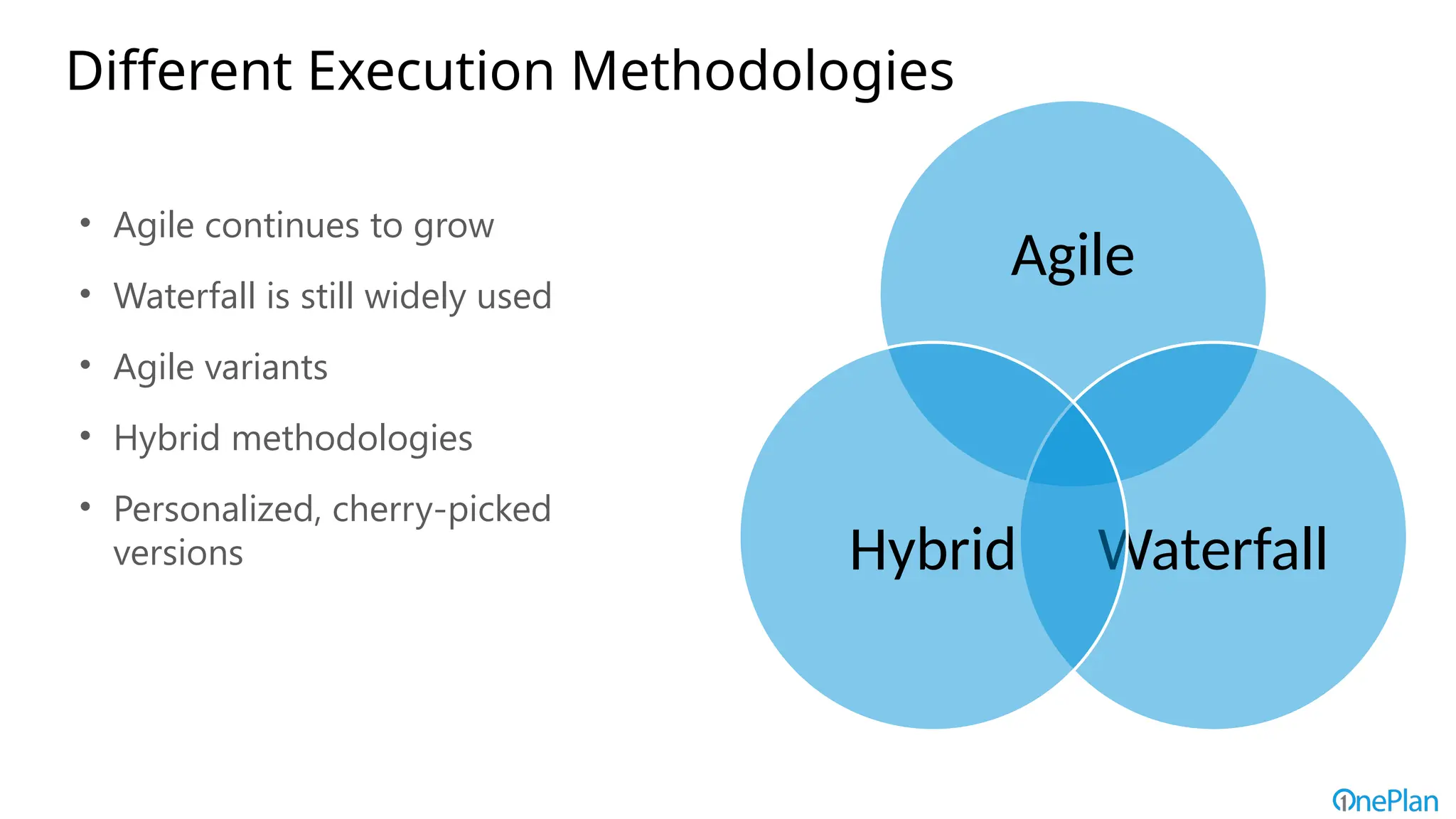
Different Execution Methodologies
Agile
Waterfall
Hybrid
• Agile continues to grow
• Waterfall is still widely used
• Agile variants
• Hybrid methodologies
• Personalized, cherry-picked
versions
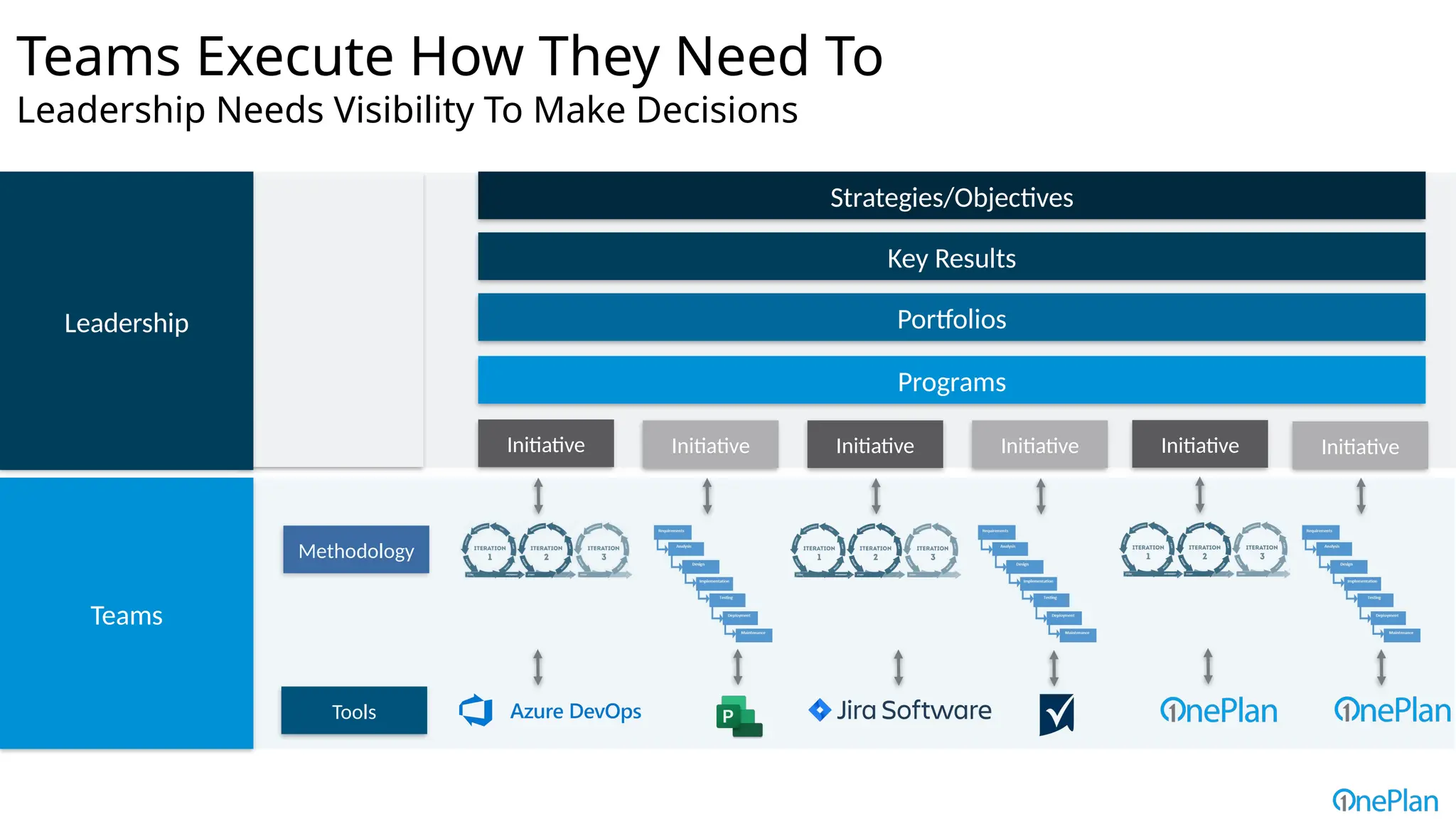
• Associate and align
• Aggregate and rollup
• Different methodologies
• Variety of tools
• Translate to common
metrics for leadership
Teams Execute How They Need To
Leadership Needs Visibility To Make Decisions
Strategies/Objectives
Key Results
Portfolios
Programs
Initiative Initiative Initiative Initiative Initiative Initiative
Methodology
Tools
Teams
Leadership
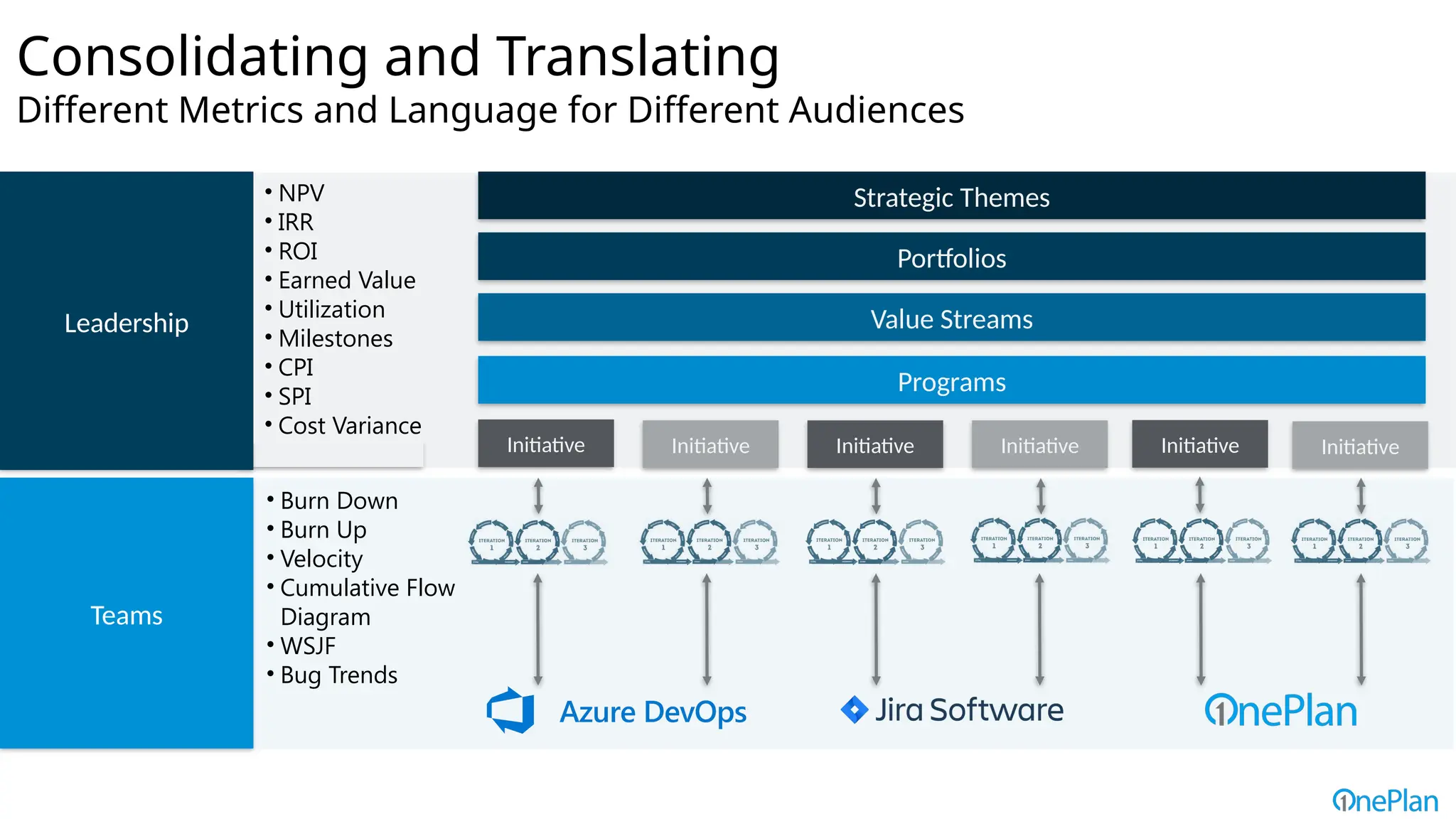
Strategic Themes
Portfolios
Value Streams
Programs
Initiative Initiative Initiative Initiative Initiative Initiative
Methodology
Tools
• Associate and align
• Aggregate and rollup
• Different methodologies
• Variety of tools
• Translate to common
metrics for leadership
Teams
Leadership
• NPV
• IRR
• ROI
• Earned Value
• Utilization
• Milestones
• CPI
• SPI
• Cost Variance
• Burn Down
• Burn Up
• Velocity
• Cumulative Flow
Diagram
• WSJF
• Bug Trends
Consolidating and Translating
Different Metrics and Language for Different Audiences
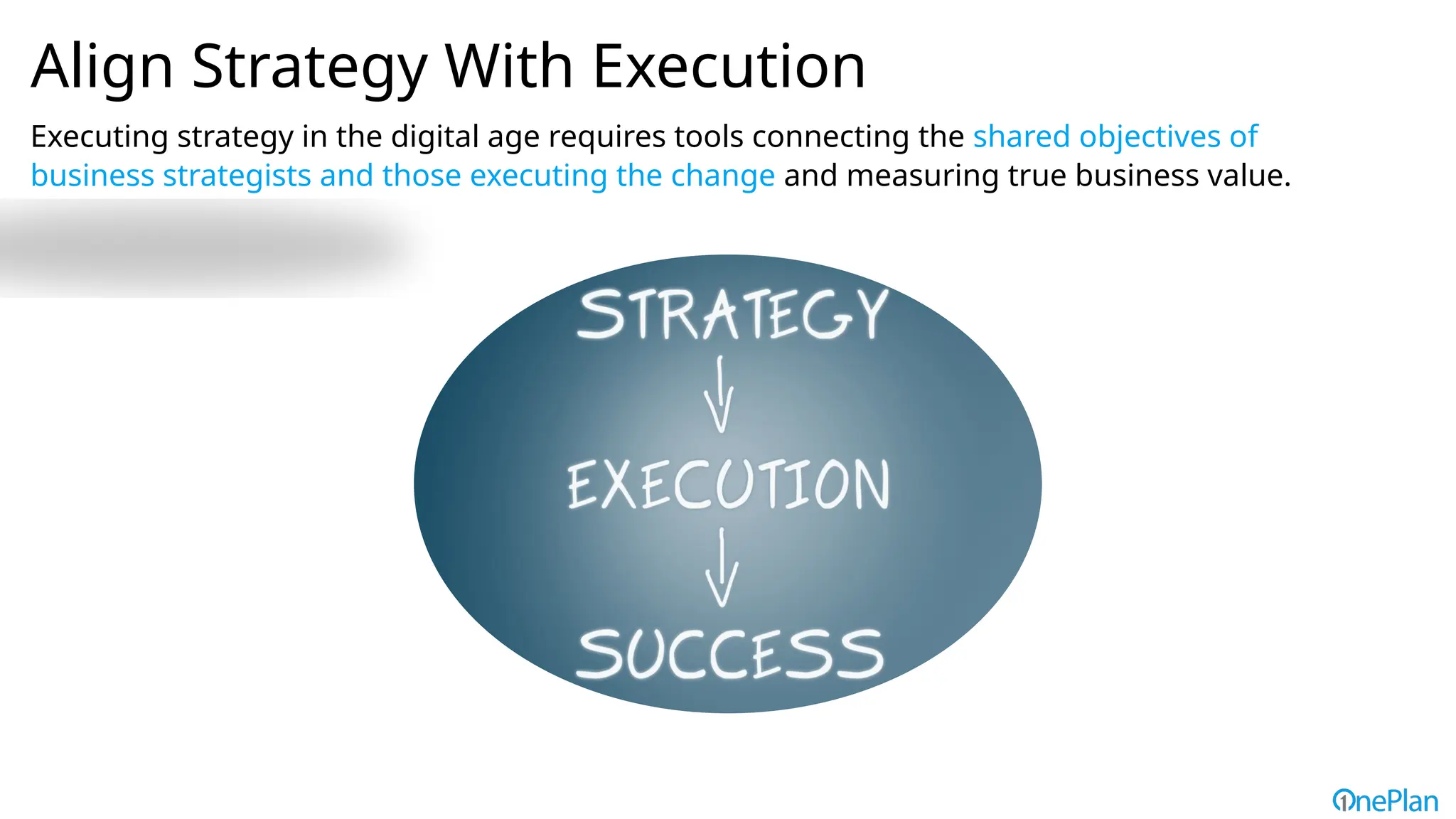
Align Strategy With Execution
Executing strategy in the digital age requires tools connecting the shared objectives of
business strategists and those executing the change and measuring true business value.
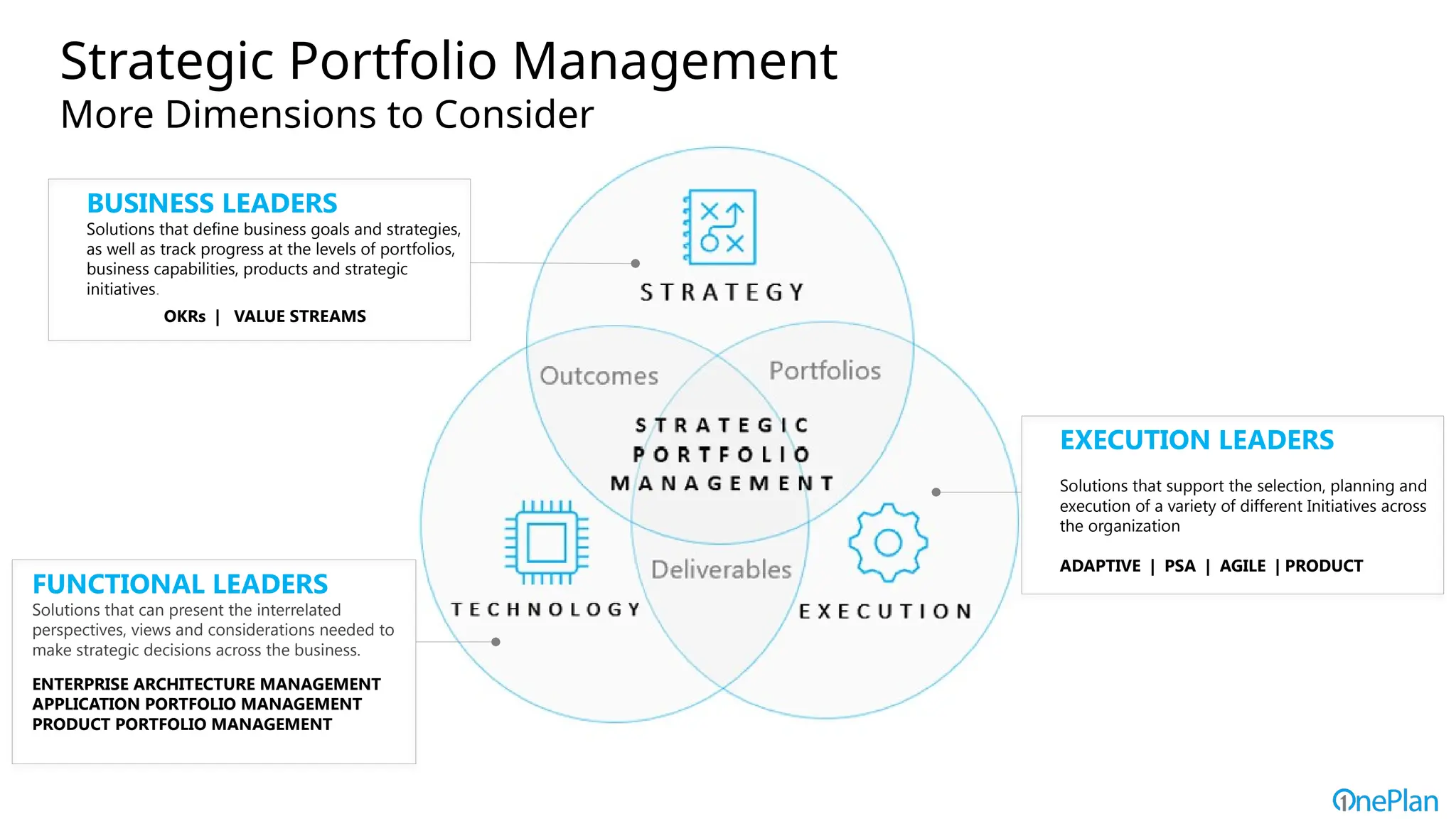
Strategic Portfolio Management
More Dimensions to Consider
BUSINESS LEADERS
Solutions that define business goals and strategies,
as well as track progress at the levels of portfolios,
business capabilities, products and strategic
initiatives.
OKRs | VALUE STREAMS
FUNCTIONAL LEADERS
Solutions that can present the interrelated
perspectives, views and considerations needed to
make strategic decisions across the business.
ENTERPRISE ARCHITECTURE MANAGEMENT
APPLICATION PORTFOLIO MANAGEMENT
PRODUCT PORTFOLIO MANAGEMENT
EXECUTION LEADERS
Solutions that support the selection, planning and
execution of a variety of different Initiatives across
the organization
ADAPTIVE | PSA | AGILE | PRODUCT
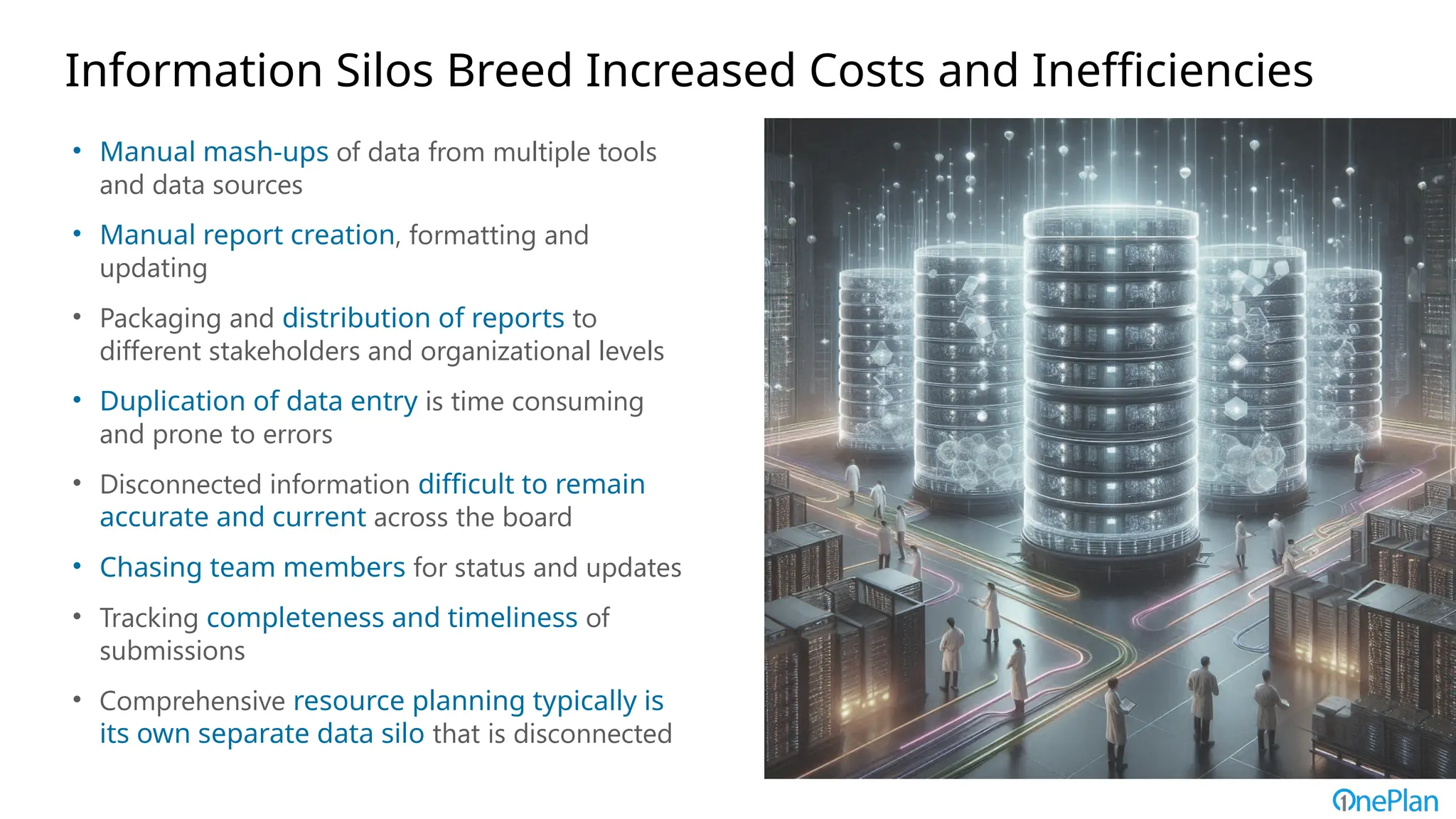
Information Silos Breed Increased Costs and Inefficiencies
• Manual mash-ups of data from multiple tools
and data sources
• Manual report creation, formatting and
updating
• Packaging and distribution of reports to
different stakeholders and organizational levels
• Duplication of data entry is time consuming
and prone to errors
• Disconnected information difficult to remain
accurate and current across the board
• Chasing team members for status and updates
• Tracking completeness and timeliness of
submissions
• Comprehensive resource planning typically is
its own separate data silo that is disconnected
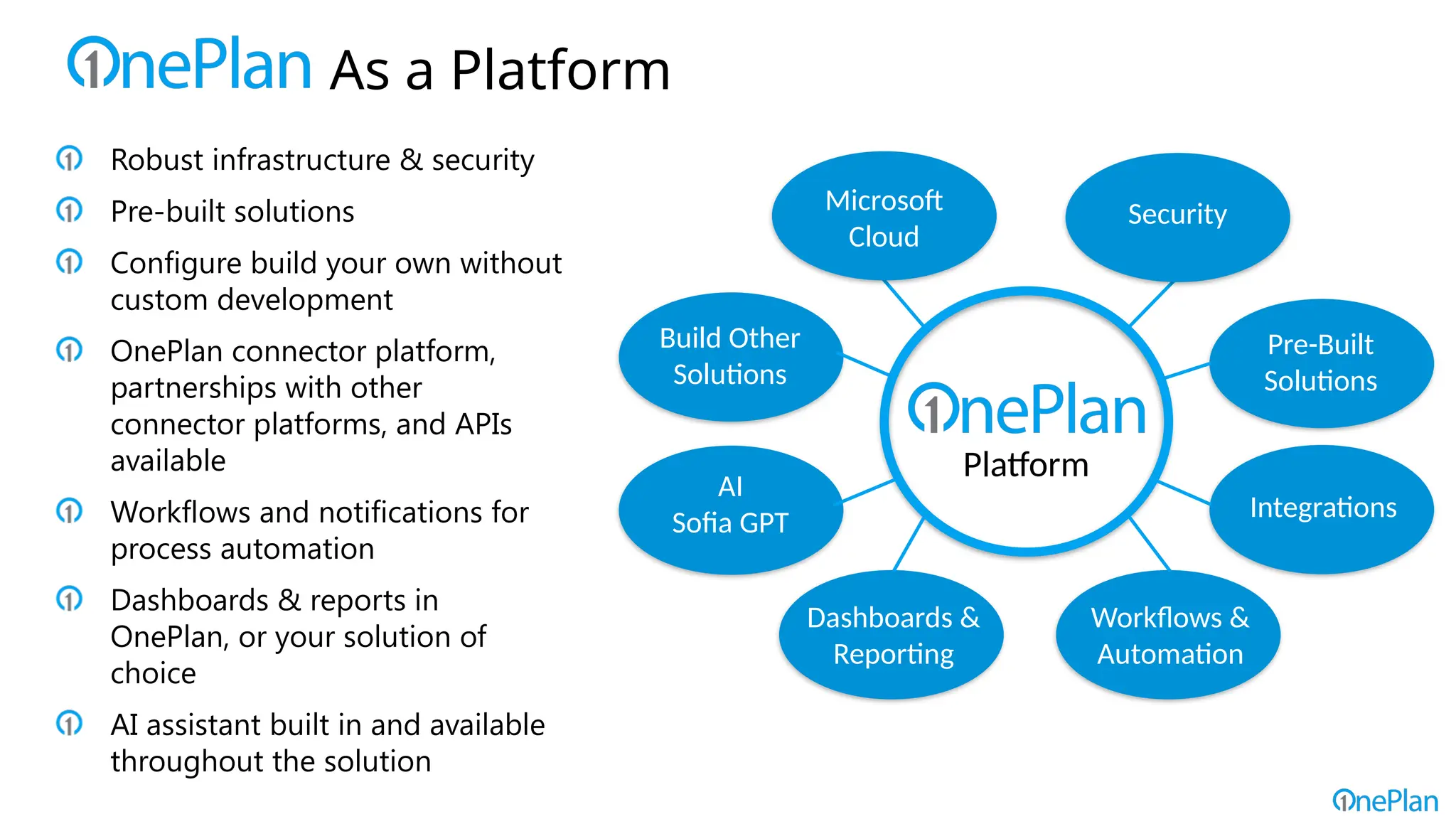
As a Platform
Robust infrastructure & security
Pre-built solutions
Configure build your own without
custom development
OnePlan connector platform,
partnerships with other
connector platforms, and APIs
available
Workflows and notifications for
process automation
Dashboards & reports in
OnePlan, or your solution of
choice
AI assistant built in and available
throughout the solution
Platform
Security
AI
Sofia GPT
Pre-Built
Solutions
Integrations
Workflows &
Automation
Dashboards &
Reporting
Build Other
Solutions
Microsoft
Cloud
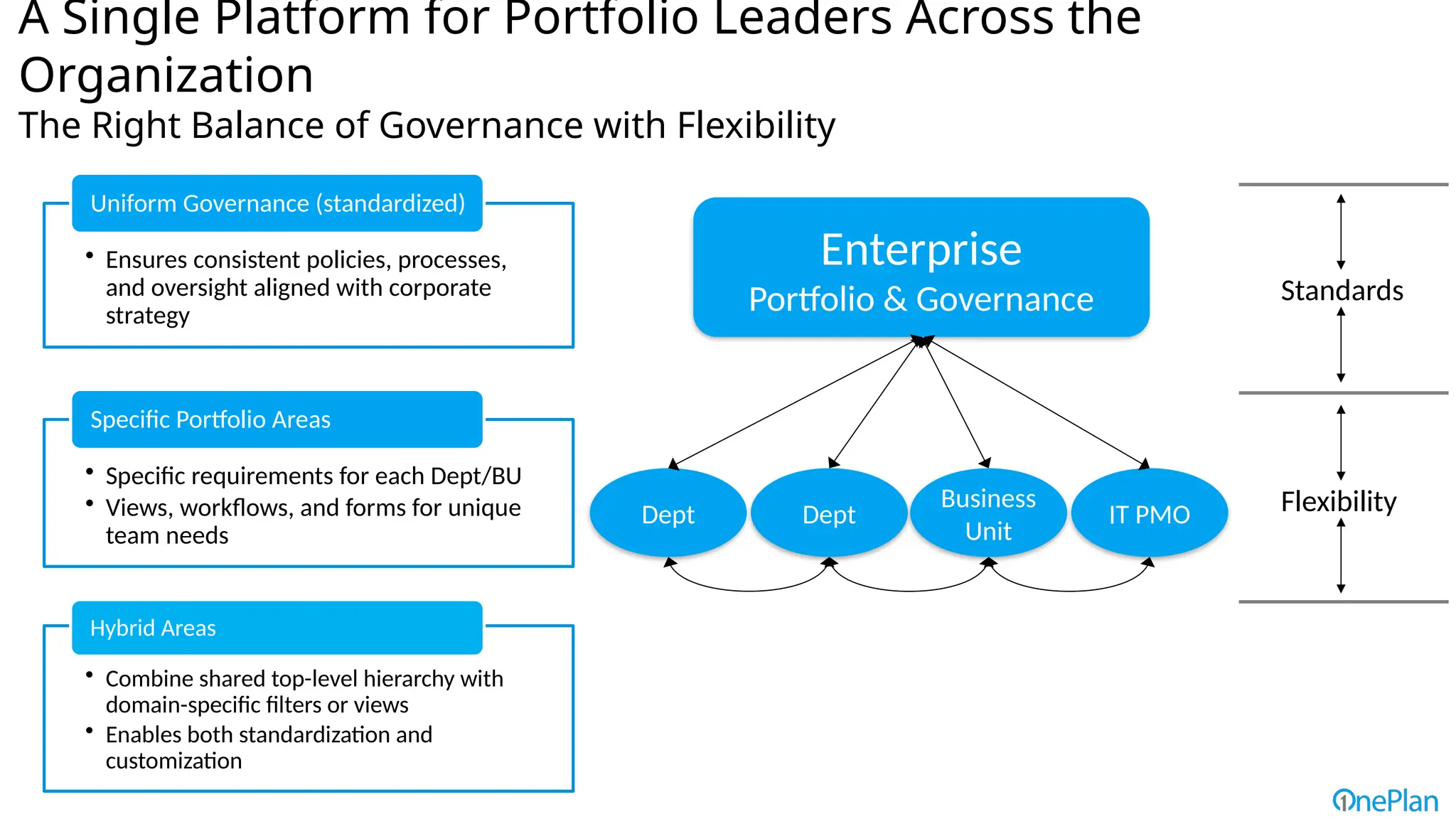
A Single Platform for Portfolio Leaders Across the
Organization
The Right Balance of Governance with Flexibility
Dept Dept
Business
Unit
IT PMO
Enterprise
Portfolio & Governance Standards
Flexibility
• Ensures consistent policies, processes,
and oversight aligned with corporate
strategy
Uniform Governance (standardized)
• Specific requirements for each Dept/BU
• Views, workflows, and forms for unique
team needs
Specific Portfolio Areas
• Combine shared top-level hierarchy with
domain-specific filters or views
• Enables both standardization and
customization
Hybrid Areas
Portfolio Managers
Resource Planning
Financial Planning
Work Plan
Visualizations
Dashboards
Status Reports
Plan Managers
Agile Plan
Ideation / Requests
Artificial Intelligence – Sofia GPT
Strategy
Timesheets
My Work
Stakeholders
Team Members
Executives
Portfolio Planning
Planning
Do the right work Do the work right
Resource Negotiation
Resource Managers
Enterprise Architecture
Execution Analysis
What-if Scenario Modeling
• Products
• Services
• Applications
Capacity Planning
Issues Risks Changes
• Business Value
• Benefits
Realization
OKRs
Software
Development
Ideation
Professional
Services
Financial
Management
Work
Management
Service
Management
Private Cloud Connector
OnePlan Integrations
Dynamics 365
Dynamics 365
Dynamics 365
Strategy
Enterprise
Architecture
Viva Goals
• Pre-built connectors
• Data / field mapping
• Business rules
• Workflows
• Scheduling
• Logging
• Extensible and
Flexible
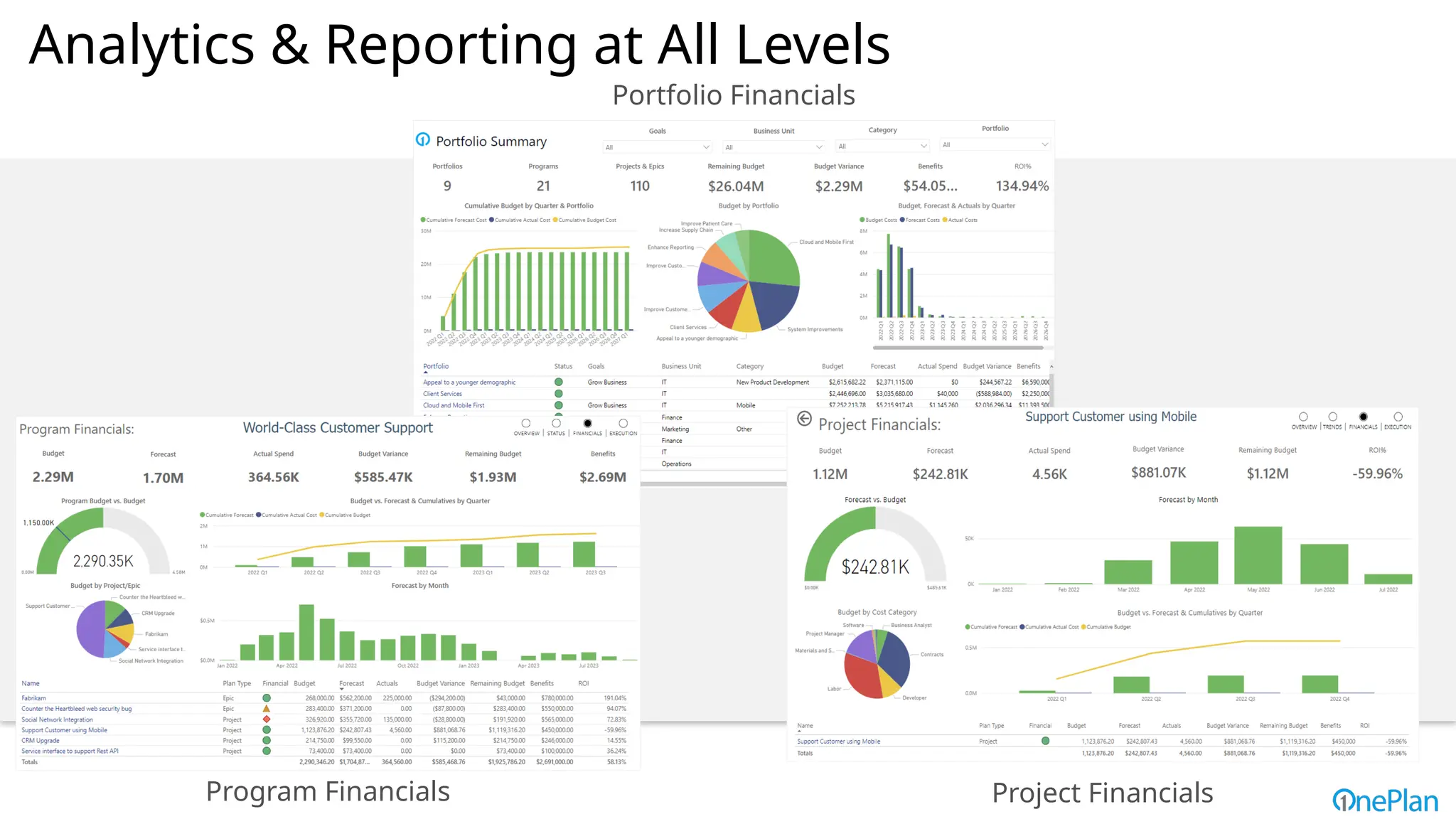
Program Financials Project Financials
Analytics & Reporting at All Levels
Portfolio Financials
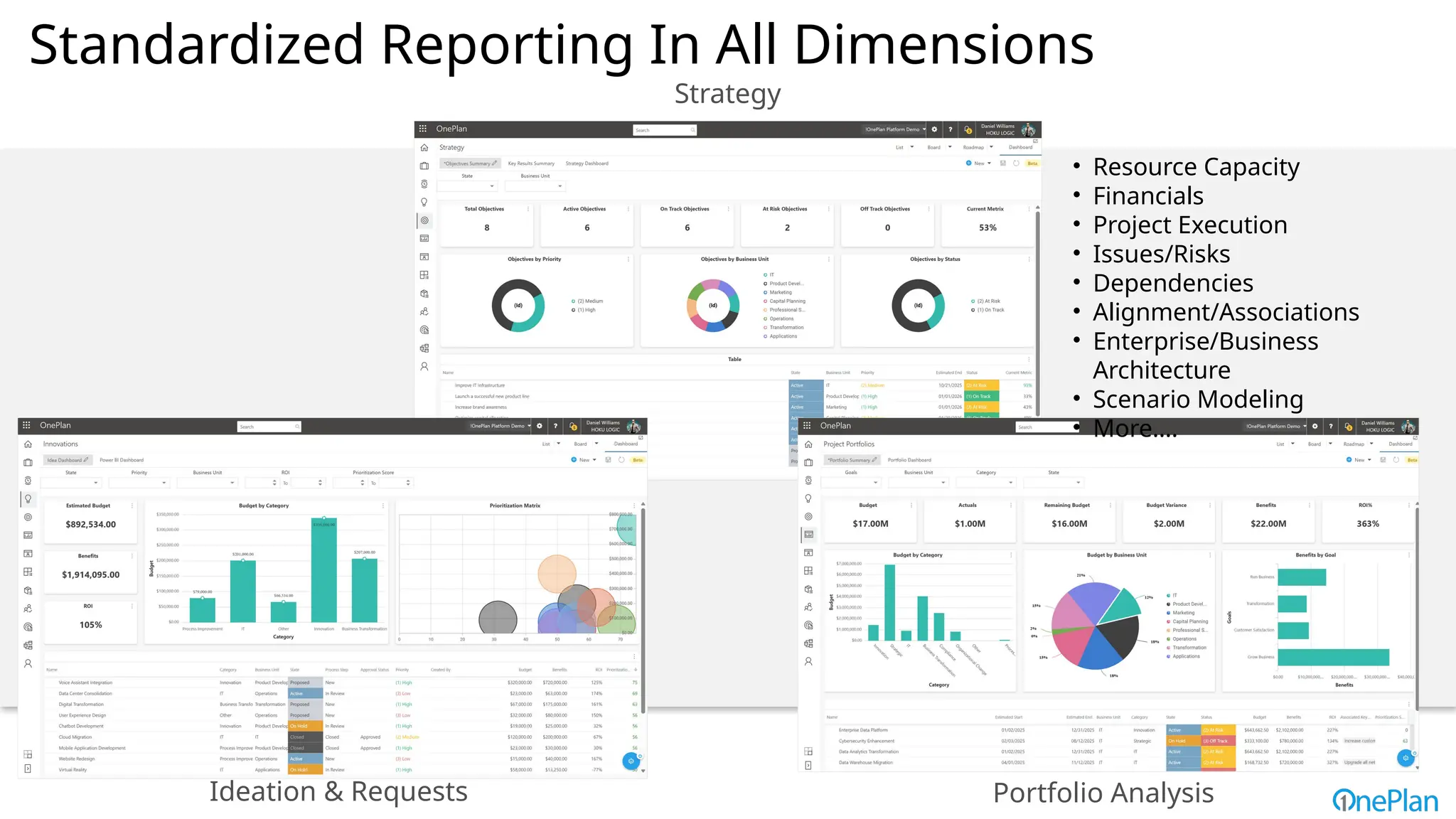
Ideation & Requests Portfolio Analysis
Standardized Reporting In All Dimensions
Strategy
• Resource Capacity
• Financials
• Project Execution
• Issues/Risks
• Dependencies
• Alignment/Associations
• Enterprise/Business
Architecture
• Scenario Modeling
• More….
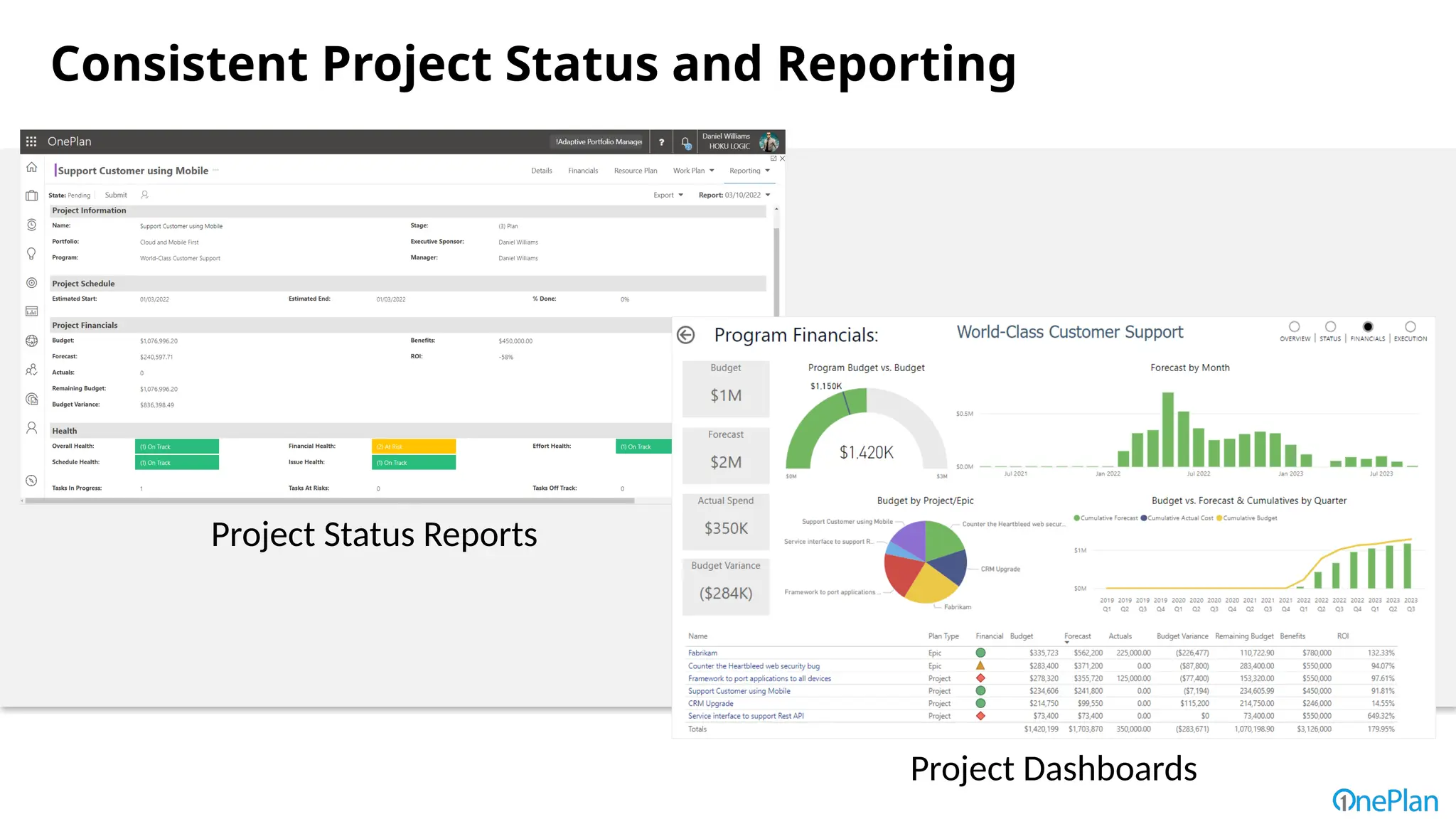
Consistent Project Status and Reporting
Project Status Reports
Project Dashboards
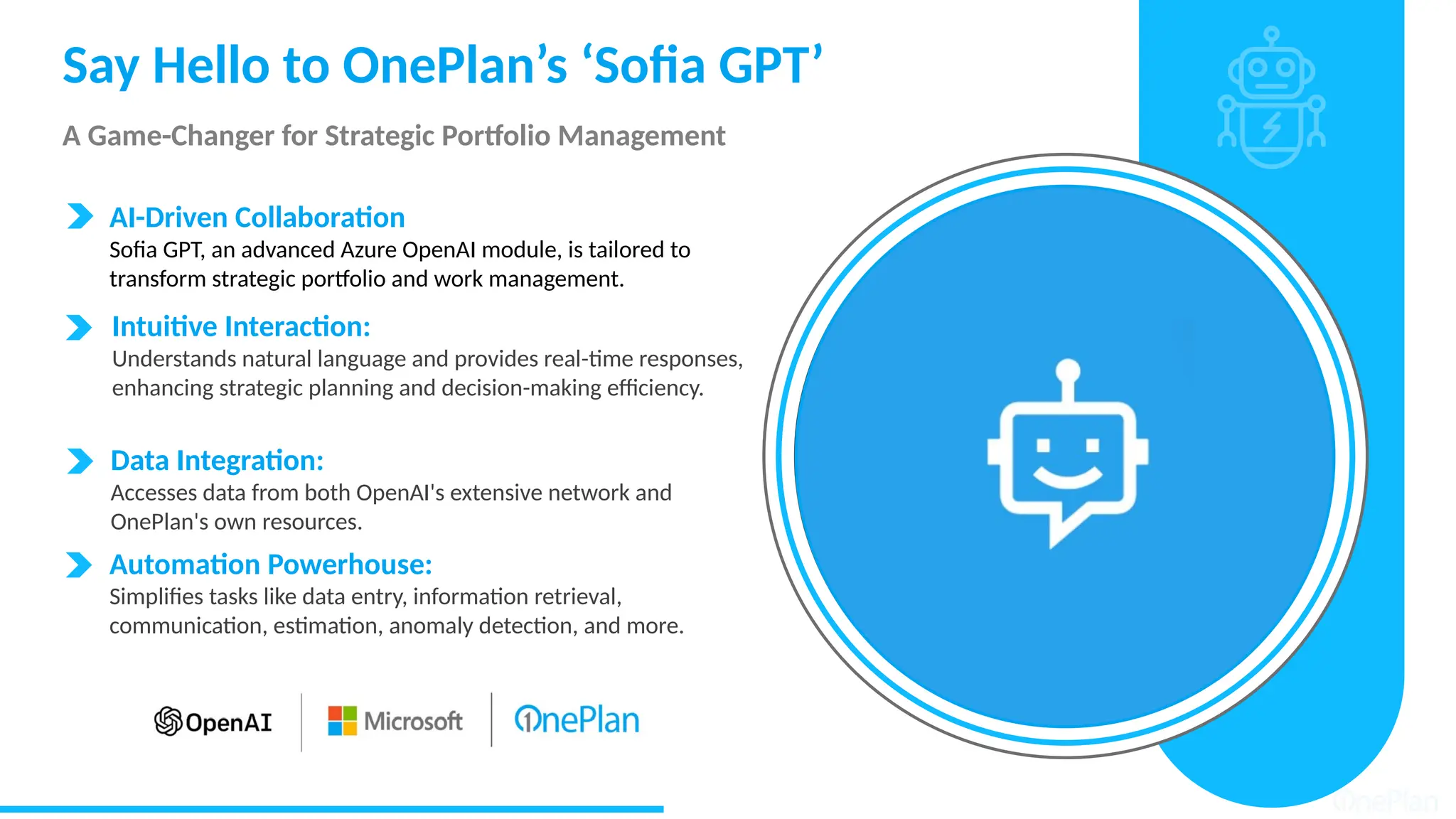
Say Hello to OnePlan’s ‘Sofia GPT’
A Game-Changer for Strategic Portfolio Management
Data Integration:
Accesses data from both OpenAI's extensive network and
OnePlan's own resources.
AI-Driven Collaboration
Sofia GPT, an advanced Azure OpenAI module, is tailored to
transform strategic portfolio and work management.
Intuitive Interaction:
Understands natural language and provides real-time responses,
enhancing strategic planning and decision-making efficiency.
Automation Powerhouse:
Simplifies tasks like data entry, information retrieval,
communication, estimation, anomaly detection, and more.
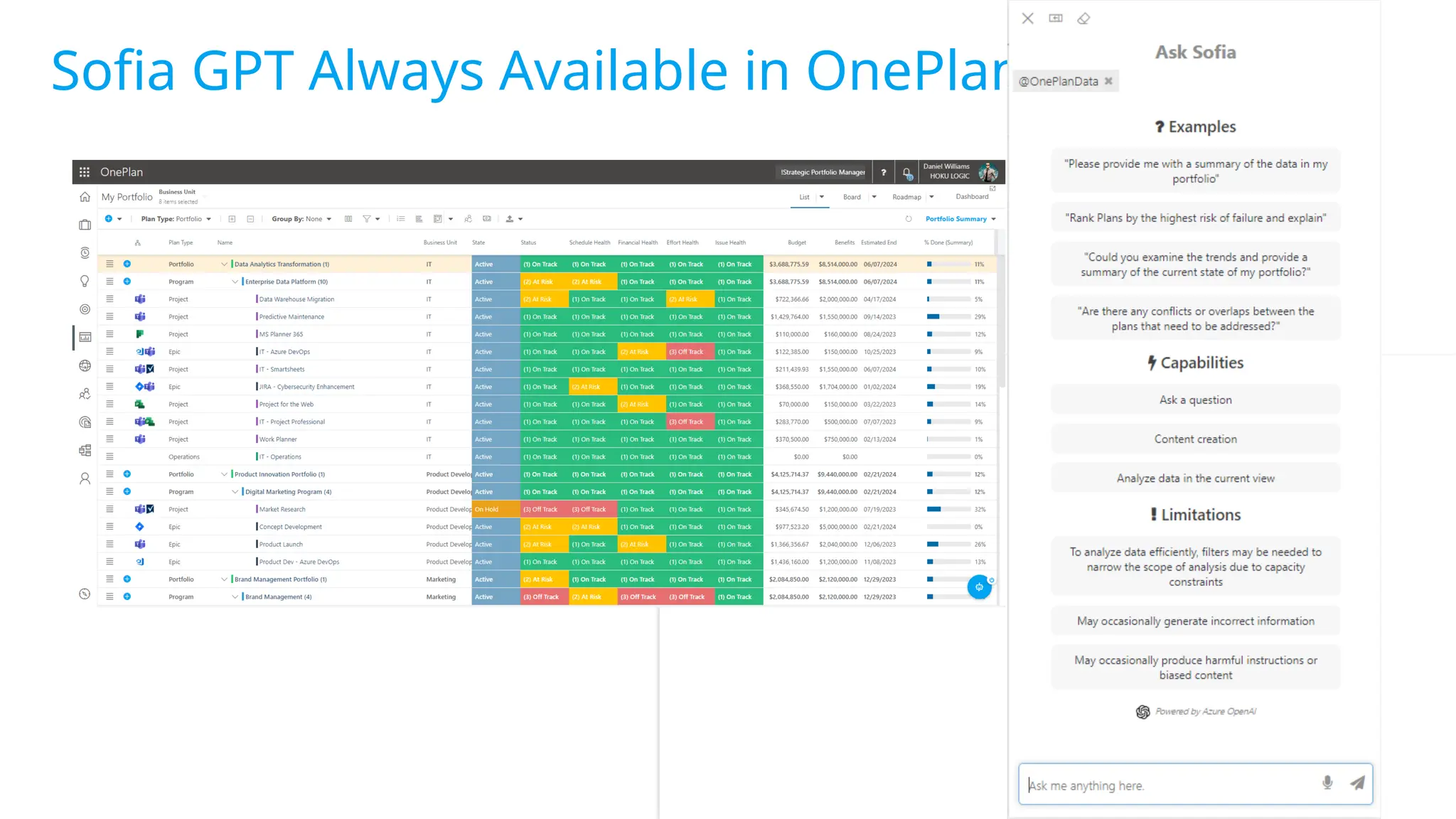
Sofia GPT Always Available in OnePlan
Demonstration
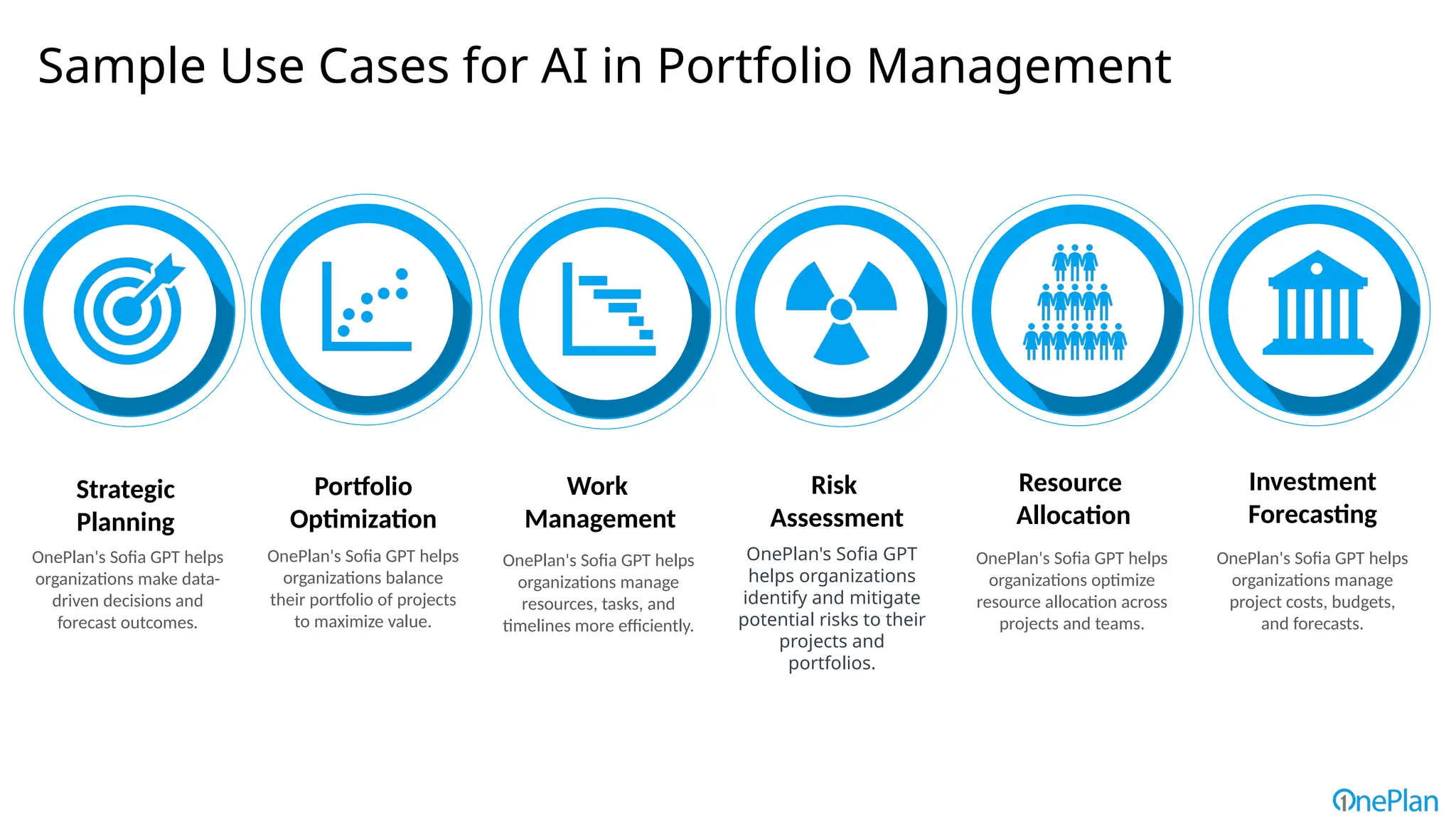
Sample Use Cases for AI in Portfolio Management
OnePlan's Sofia GPT helps
organizations make data-
driven decisions and
forecast outcomes.
Strategic
Planning
Work
Management
OnePlan's Sofia GPT helps
organizations balance
their portfolio of projects
to maximize value.
Resource
Allocation
OnePlan's Sofia GPT helps
organizations manage
resources, tasks, and
timelines more efficiently.
Investment
Forecasting
OnePlan's Sofia GPT
helps organizations
identify and mitigate
potential risks to their
projects and
portfolios.
Risk
Assessment
OnePlan's Sofia GPT helps
organizations optimize
resource allocation across
projects and teams.
Portfolio
Optimization
OnePlan's Sofia GPT helps
organizations manage
project costs, budgets,
and forecasts.
 Increased Productivity: Sofia GPT's AI-based strategic planning tools can help to increase
productivity by streamlining the OKR development process, reducing manual input, and
automating routine tasks.
 Improved Alignment: Sofia GPT can help to align organizational objectives with individual
and team OKRs. By analyzing business performance metrics and identifying areas for
improvement, Sofia GPT can inform the development of OKRs and ensure alignment with
overall organizational objectives.
 Data-Driven Decision Making: Sofia GPT can analyze OKRs and related data to identify
patterns, opportunities, and potential risks. It can use predictive analytics to forecast OKR
outcomes and identify potential roadblocks. This can help stakeholders make data-driven
decisions to achieve their strategic goals.
 Optimization: Sofia GPT can analyze OKRs and provide recommendations to optimize
outcomes. By recommending adjustments to OKRs, resource allocations, and other
factors, Sofia GPT can maximize OKR success and improve business outcomes.
AI-Driven Strategic Planning with OnePlan
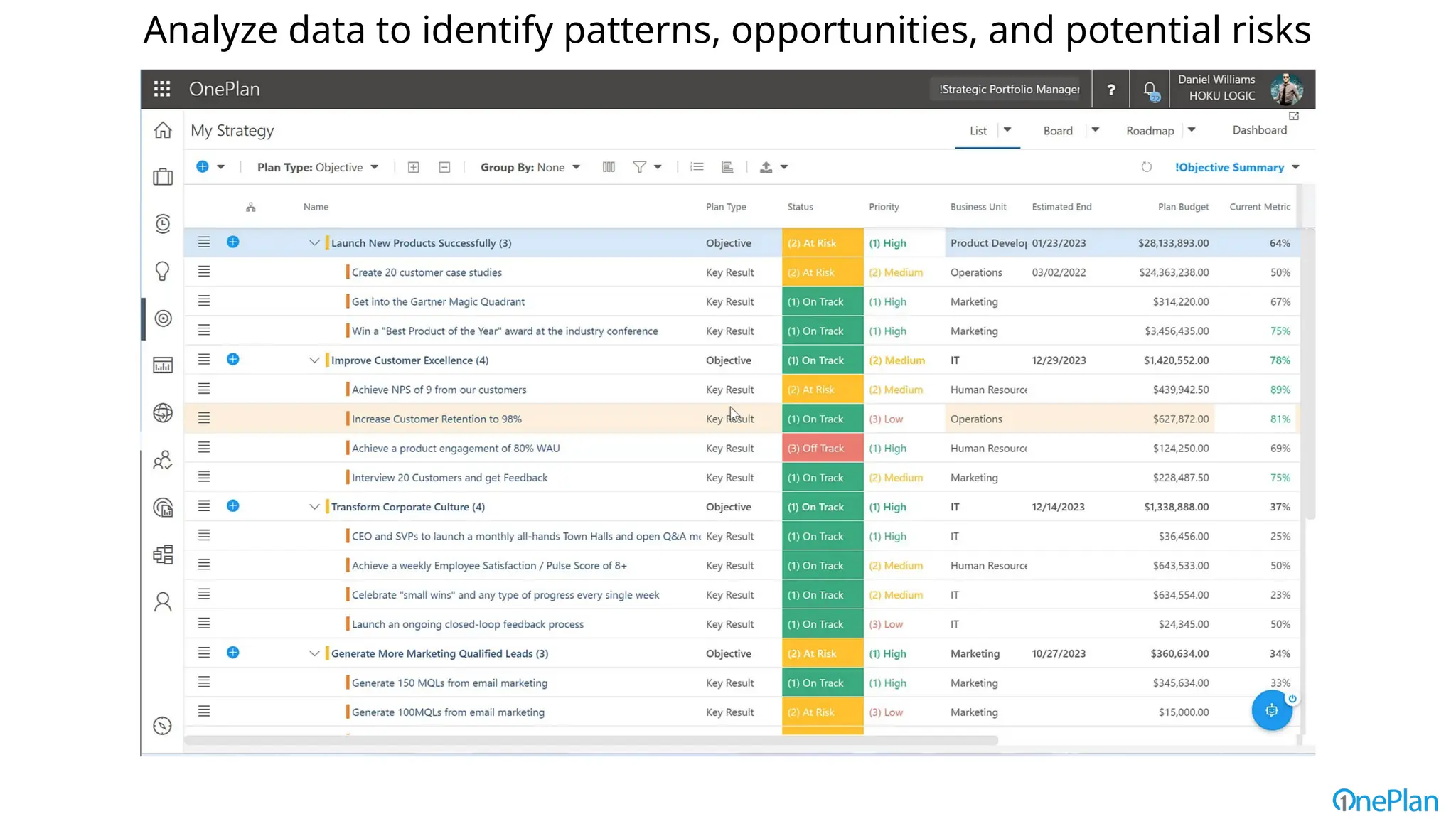
Analyze data to identify patterns, opportunities, and potential risks
AI-enabled Portfolio Optimization with OnePlan
 Data analysis: OnePlan's Sofia GPT can analyze data related to a company's project
portfolio, including project goals, resources, timelines, budgets, and risks. This analysis can
help identify patterns and trends that can inform decision-making around project selection
and prioritization.
 Prediction and forecasting: By analyzing OnePlan data, OnePlan's Sofia GPT can make
predictions and forecasts about the likely outcomes of different project scenarios. This can
help decision-makers anticipate potential problems or opportunities and make more
informed decisions about project prioritization.
 Risk assessment: OnePlan's Sofia GPT can help assess the risk associated with different
projects in a portfolio, including the likelihood of project delays, cost overruns, and other
potential issues. This information can help inform project prioritization and resource
allocation decisions.
 Portfolio Optimization: OnePlan's Sofia GPT can use optimization algorithms to identify the
best combination of projects to include in a portfolio based on various criteria, such as
business goals, resource availability, and risk tolerance.
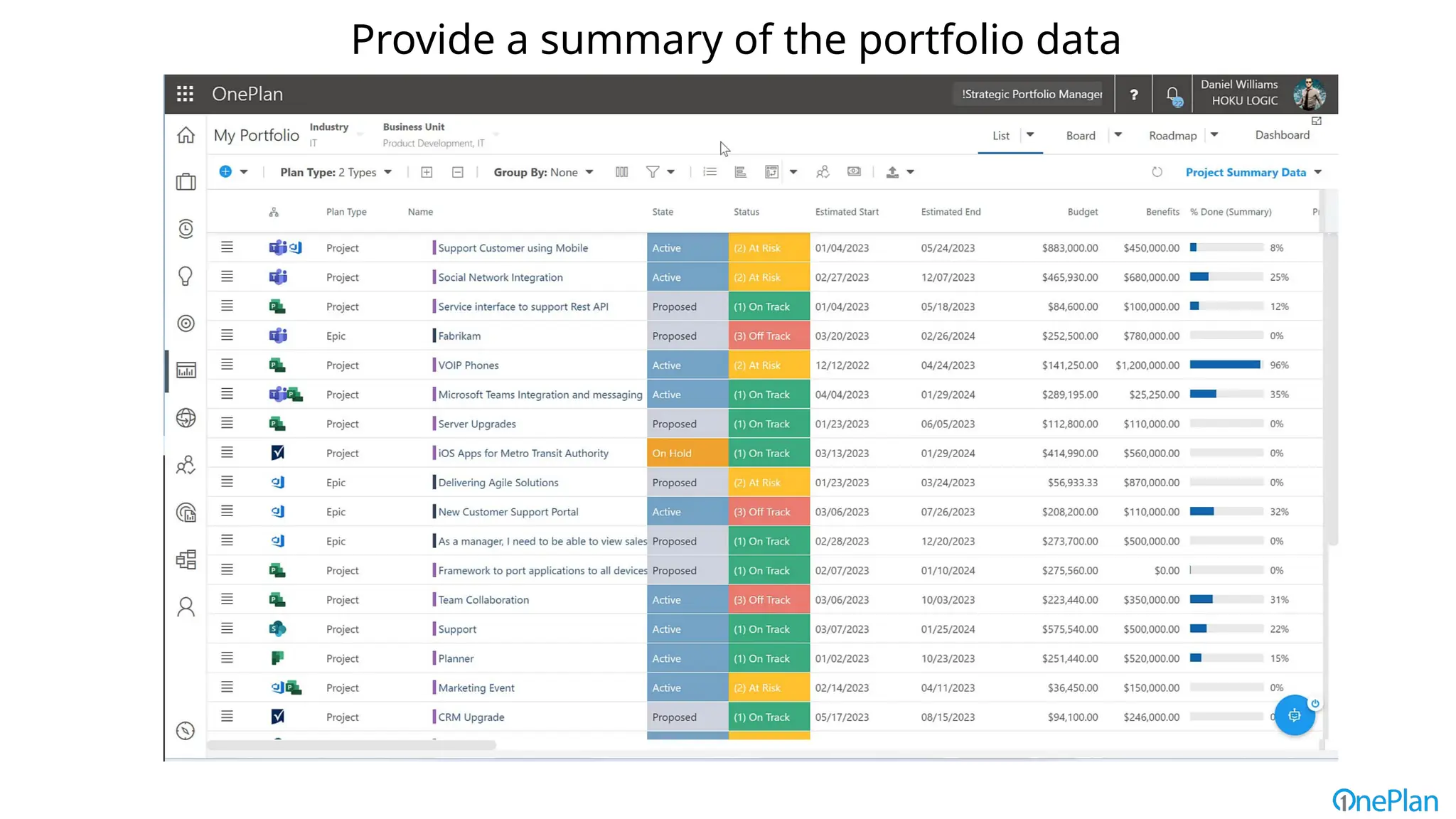
Provide a summary of the portfolio data
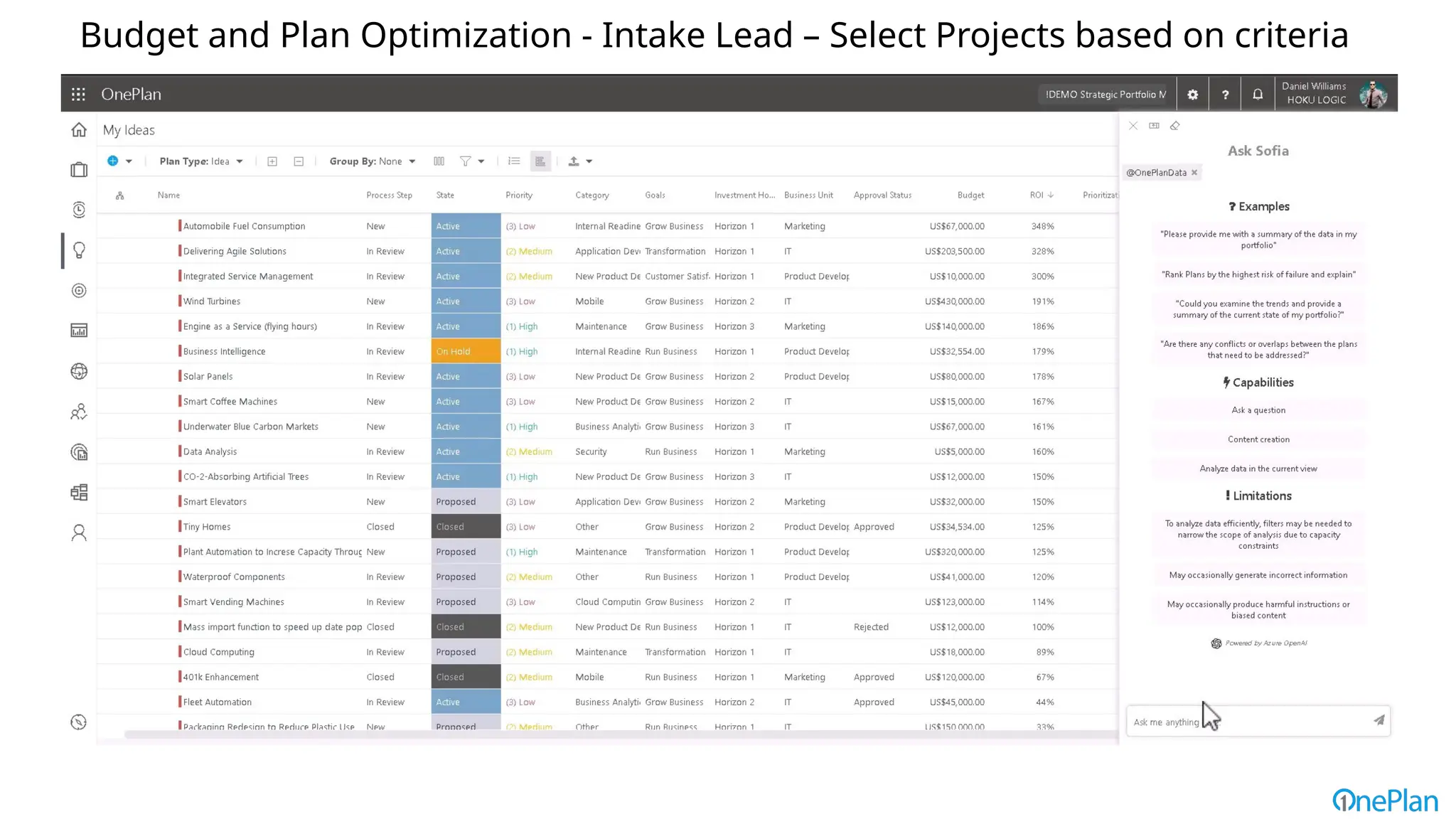
Budget and Plan Optimization - Intake Lead – Select Projects based on criteria
AI-enabled Risk Identification & Mitigation with OnePlan
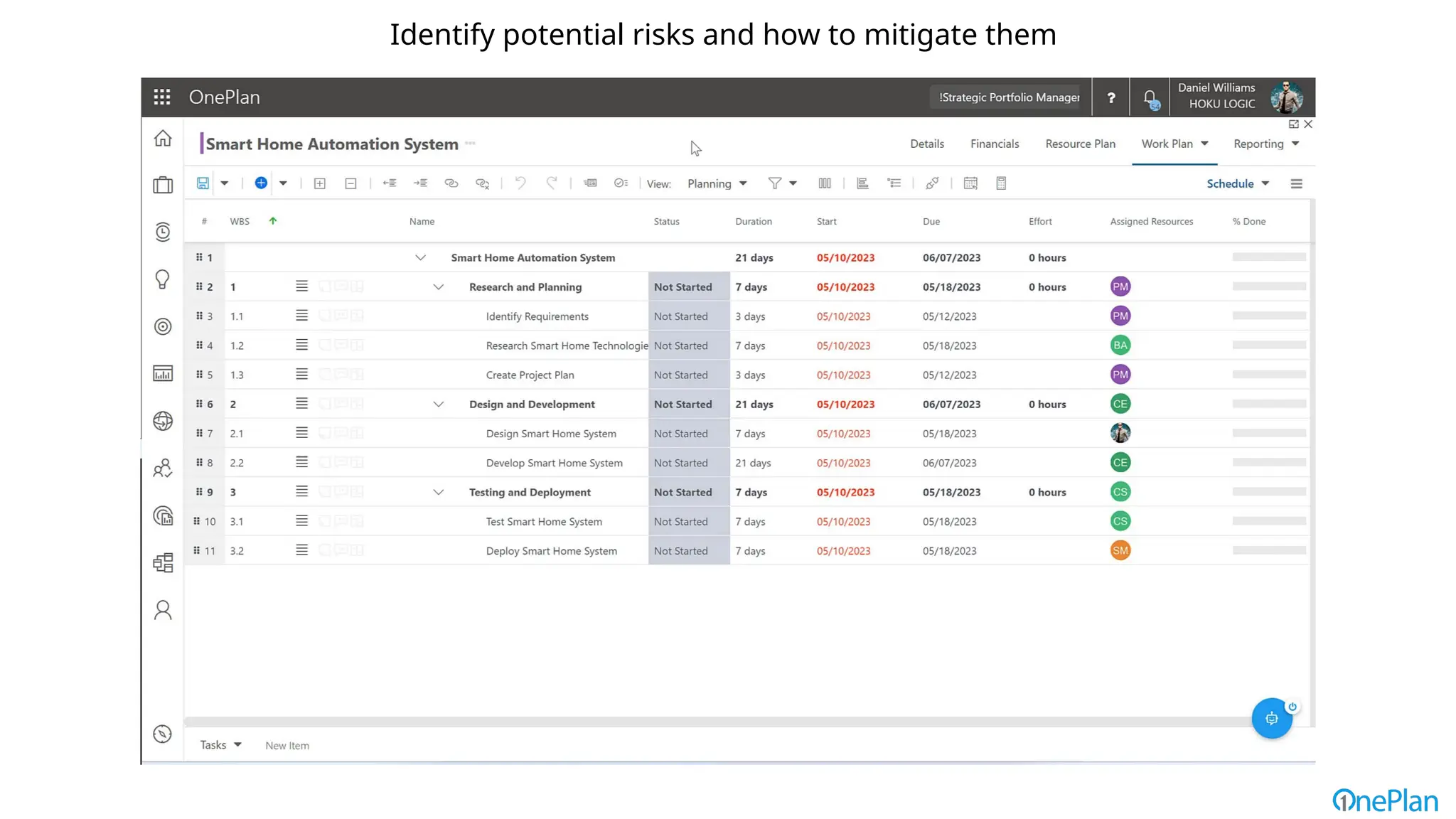
 Identifying and categorizing risks: Sofia GPT can analyze large volumes of data and
identify potential risks that may affect an organization. It can also categorize the risks
based on severity, likelihood of occurrence, and potential impact on the organization.
 Predicting future risks: Sofia GPT can analyze historical data and use machine learning
algorithms to predict future risks that may arise. This can help organizations take
preventive measures and prepare for potential risks.
 Recommending mitigation strategies: Based on the identified risks, Sofia GPT can
recommend mitigation strategies that can help organizations reduce the likelihood or
impact of the risks. These strategies can be customized based on the specific needs and
characteristics of the organization.
Identify potential risks and how to mitigate them
AI-enabled Resource Capacity Planning with OnePlan
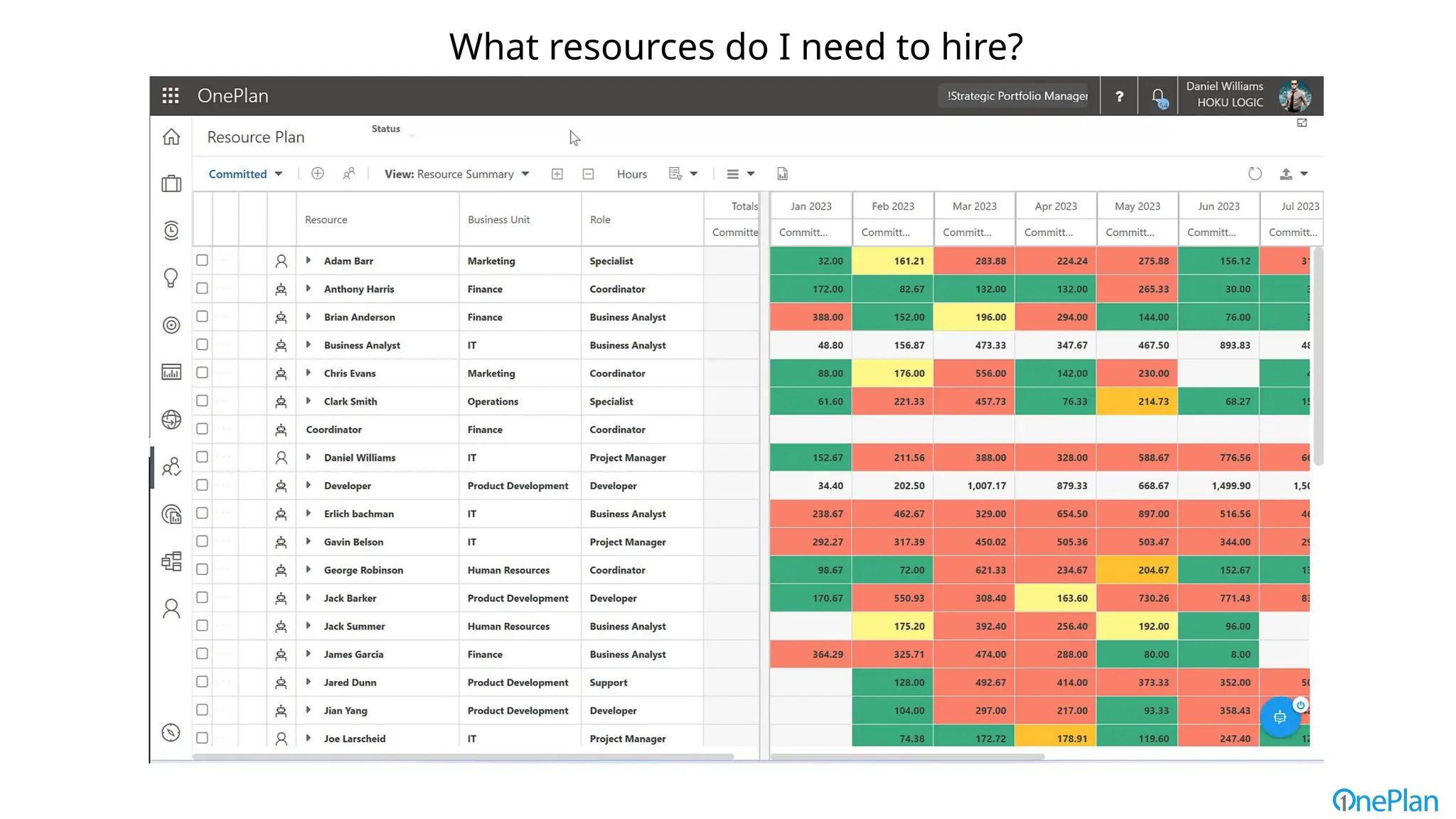
 Resource Allocation: Sofia GPT can help organizations optimize resource allocation by
analyzing the current resource usage patterns and predicting future demand. This can help
organizations to allocate resources more efficiently and avoid over/underutilization of
resources.
 Capacity Planning: Sofia GPT can help organizations to plan for future capacity requirements
by analyzing historical usage data and predicting future demand. This can help organizations
to make informed decisions about when to add or remove resources to meet changing
business needs.
 Resource Optimization: Sofia GPT can be used to optimize resource utilization by identifying
opportunities to reduce waste, improve efficiency, and increase productivity. This can help
organizations to reduce costs and improve their overall performance.
 Predictive Talent Acquisition: Sofia GPT can analyze OnePlan data to predict future hiring
needs based on trends and patterns. This can help businesses plan their talent acquisition
strategy and identify the right candidates for their organization
What resources do I need to hire?
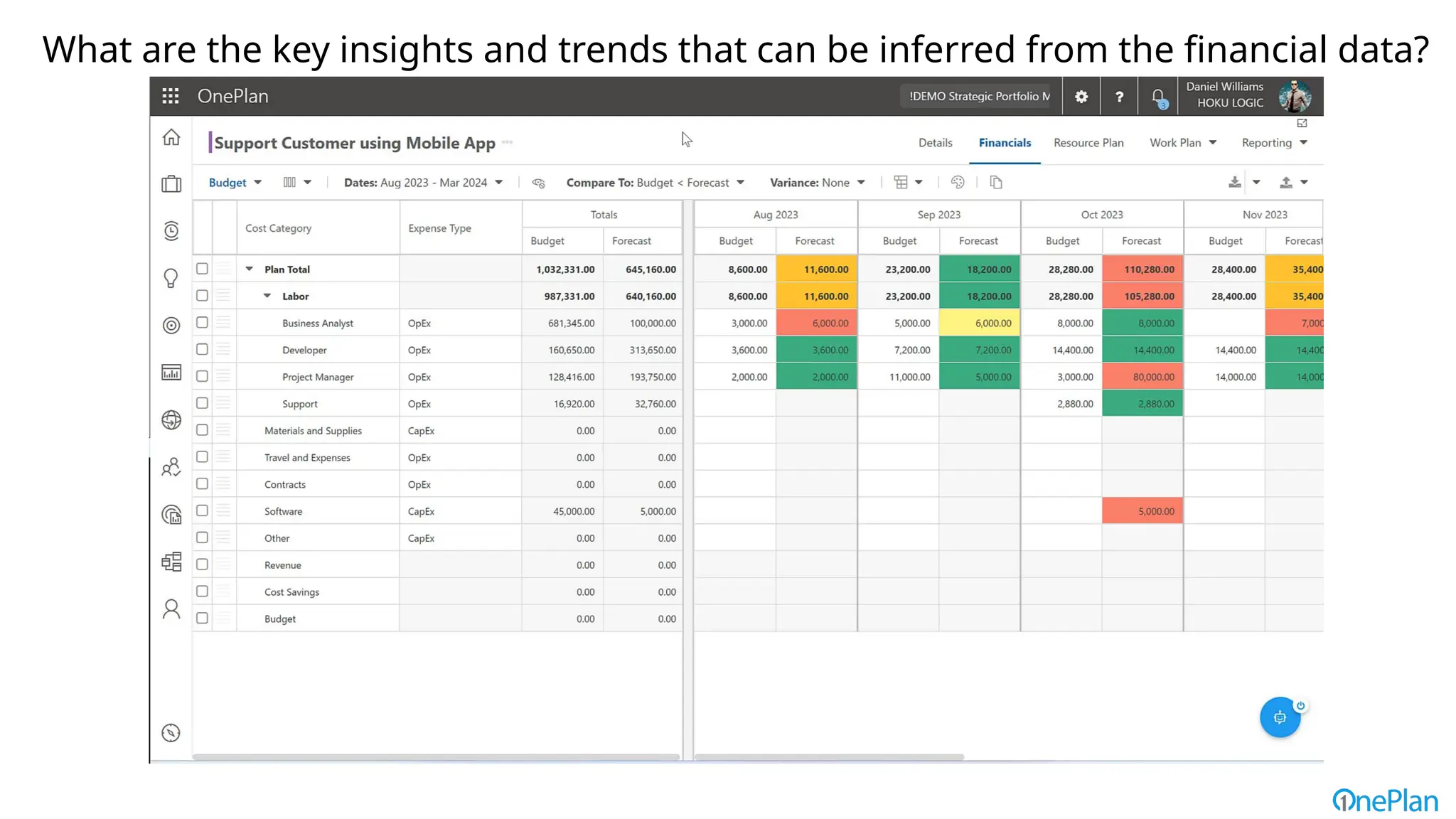
AI-powered Investment Forecasting and Predictive Analytics
 Predicting and forecasting costs: Sofia GPT can analyze OnePlan financial data, identify
patterns, and predict future costs. This can help businesses plan their budgets more
accurately and avoid unexpected expenses.
 Optimizing spending: Sofia GPT can analyze spending patterns and identify areas where
costs can be reduced or optimized. This can help businesses make more informed
decisions about where to allocate their resources.
 Providing real-time insights: Sofia GPT can provide real-time insights into financial data,
allowing businesses to make more informed decisions quickly. This can help businesses
respond to changes in the market or in their own financial situation more effectively.
What are the key insights and trends that can be inferred from the financial data?
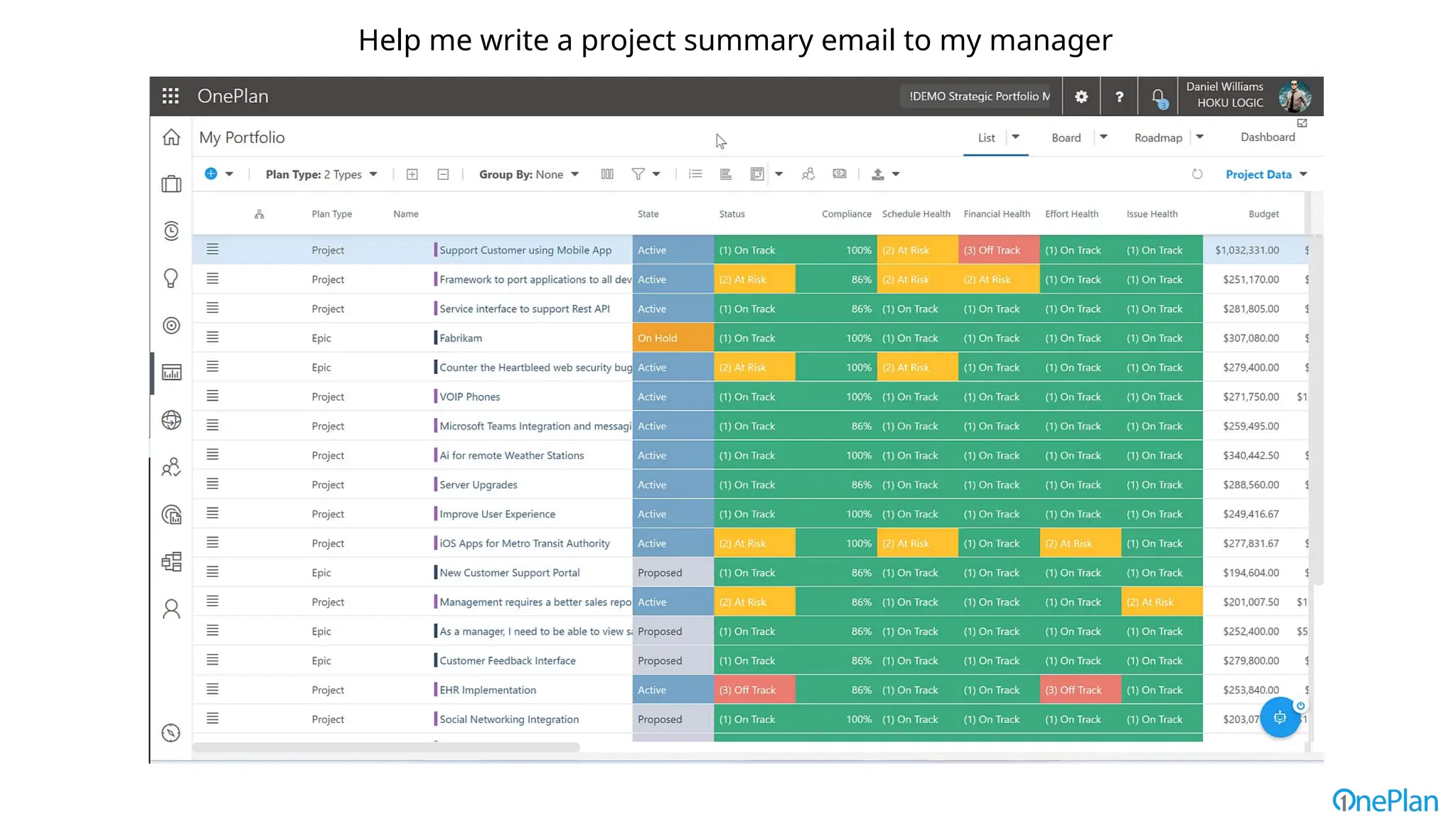
Help me write a project summary email to my manager
Summary and Next Steps
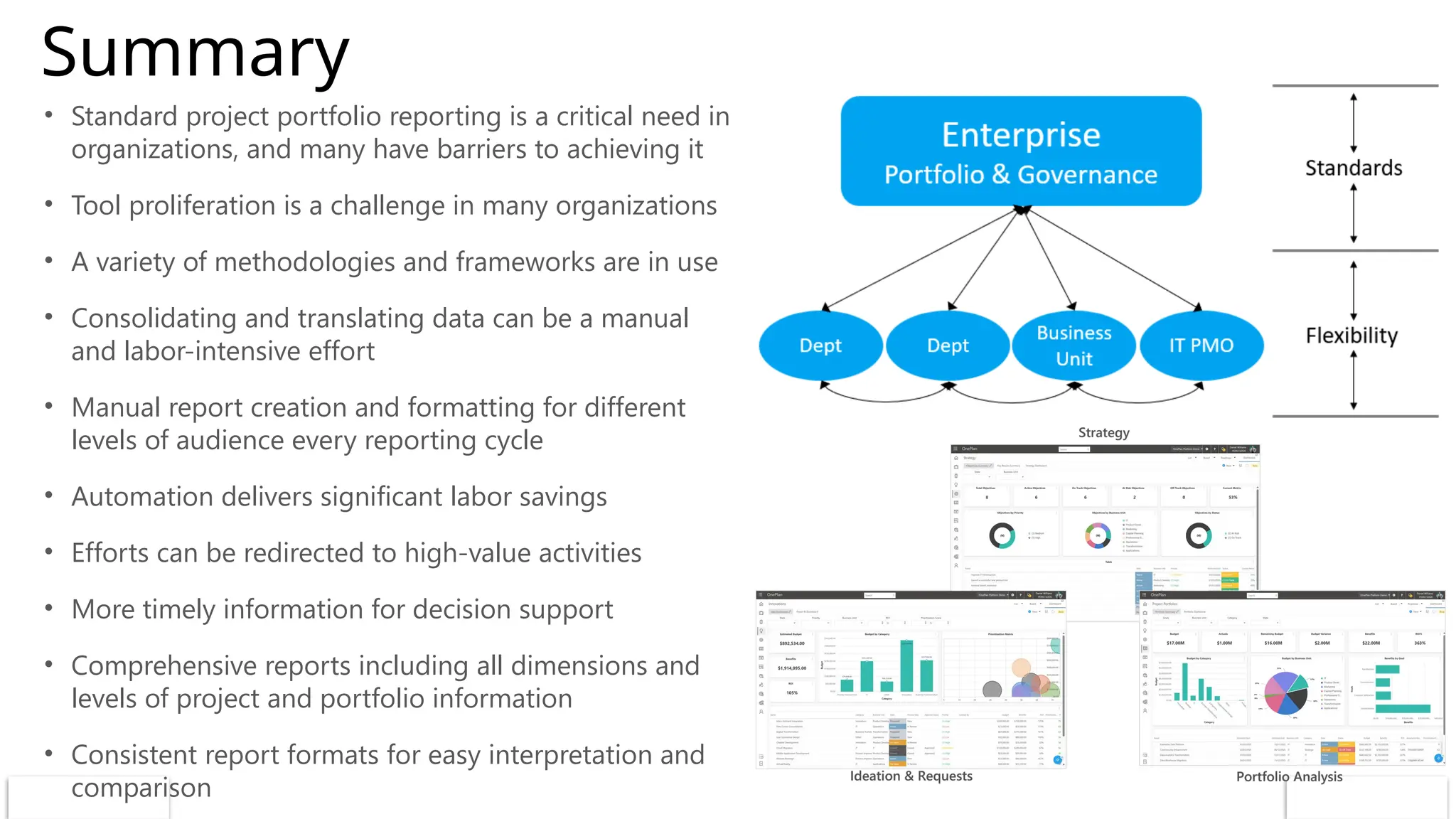
Summary
• Standard project portfolio reporting is a critical need in
organizations, and many have barriers to achieving it
• Tool proliferation is a challenge in many organizations
• A variety of methodologies and frameworks are in use
• Consolidating and translating data can be a manual
and labor-intensive effort
• Manual report creation and formatting for different
levels of audience every reporting cycle
• Automation delivers significant labor savings
• Efforts can be redirected to high-value activities
• More timely information for decision support
• Comprehensive reports including all dimensions and
levels of project and portfolio information
• Consistent report formats for easy interpretation and
comparison
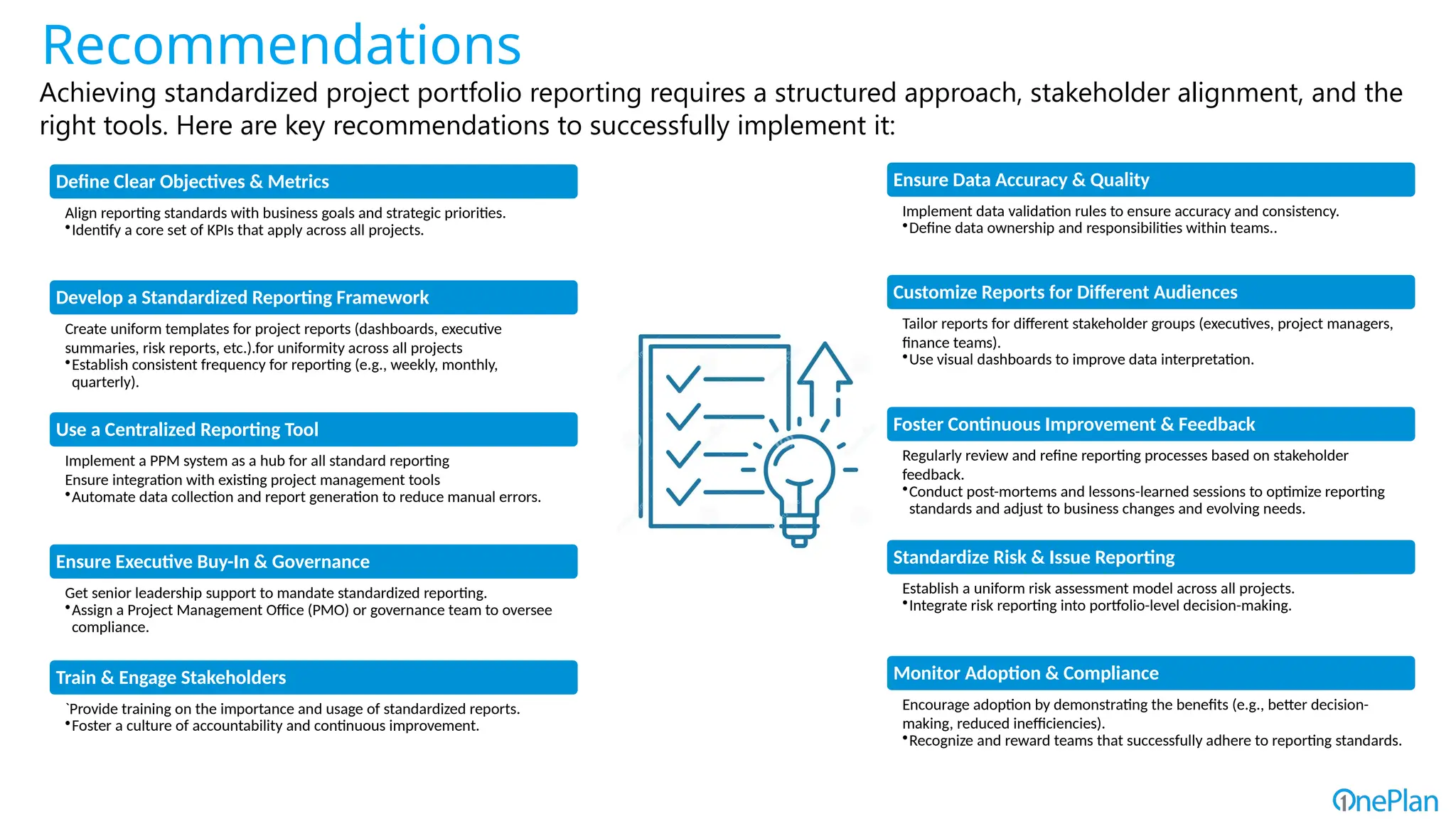
Define Clear Objectives & Metrics
Align reporting standards with business goals and strategic priorities.
•Identify a core set of KPIs that apply across all projects.
Develop a Standardized Reporting Framework
Create uniform templates for project reports (dashboards, executive
summaries, risk reports, etc.).for uniformity across all projects
•Establish consistent frequency for reporting (e.g., weekly, monthly,
quarterly).
Use a Centralized Reporting Tool
Implement a PPM system as a hub for all standard reporting
Ensure integration with existing project management tools
•Automate data collection and report generation to reduce manual errors.
Ensure Executive Buy-In & Governance
Get senior leadership support to mandate standardized reporting.
•Assign a Project Management Office (PMO) or governance team to oversee
compliance.
Train & Engage Stakeholders
`Provide training on the importance and usage of standardized reports.
•Foster a culture of accountability and continuous improvement.
Ensure Data Accuracy & Quality
Implement data validation rules to ensure accuracy and consistency.
•Define data ownership and responsibilities within teams..
Customize Reports for Different Audiences
Tailor reports for different stakeholder groups (executives, project managers,
finance teams).
•Use visual dashboards to improve data interpretation.
Foster Continuous Improvement & Feedback
Regularly review and refine reporting processes based on stakeholder
feedback.
•Conduct post-mortems and lessons-learned sessions to optimize reporting
standards and adjust to business changes and evolving needs.
Standardize Risk & Issue Reporting
Establish a uniform risk assessment model across all projects.
•Integrate risk reporting into portfolio-level decision-making.
Monitor Adoption & Compliance
Encourage adoption by demonstrating the benefits (e.g., better decision-
making, reduced inefficiencies).
•Recognize and reward teams that successfully adhere to reporting standards.
Recommendations
Achieving standardized project portfolio reporting requires a structured approach, stakeholder alignment, and the
right tools. Here are key recommendations to successfully implement it:
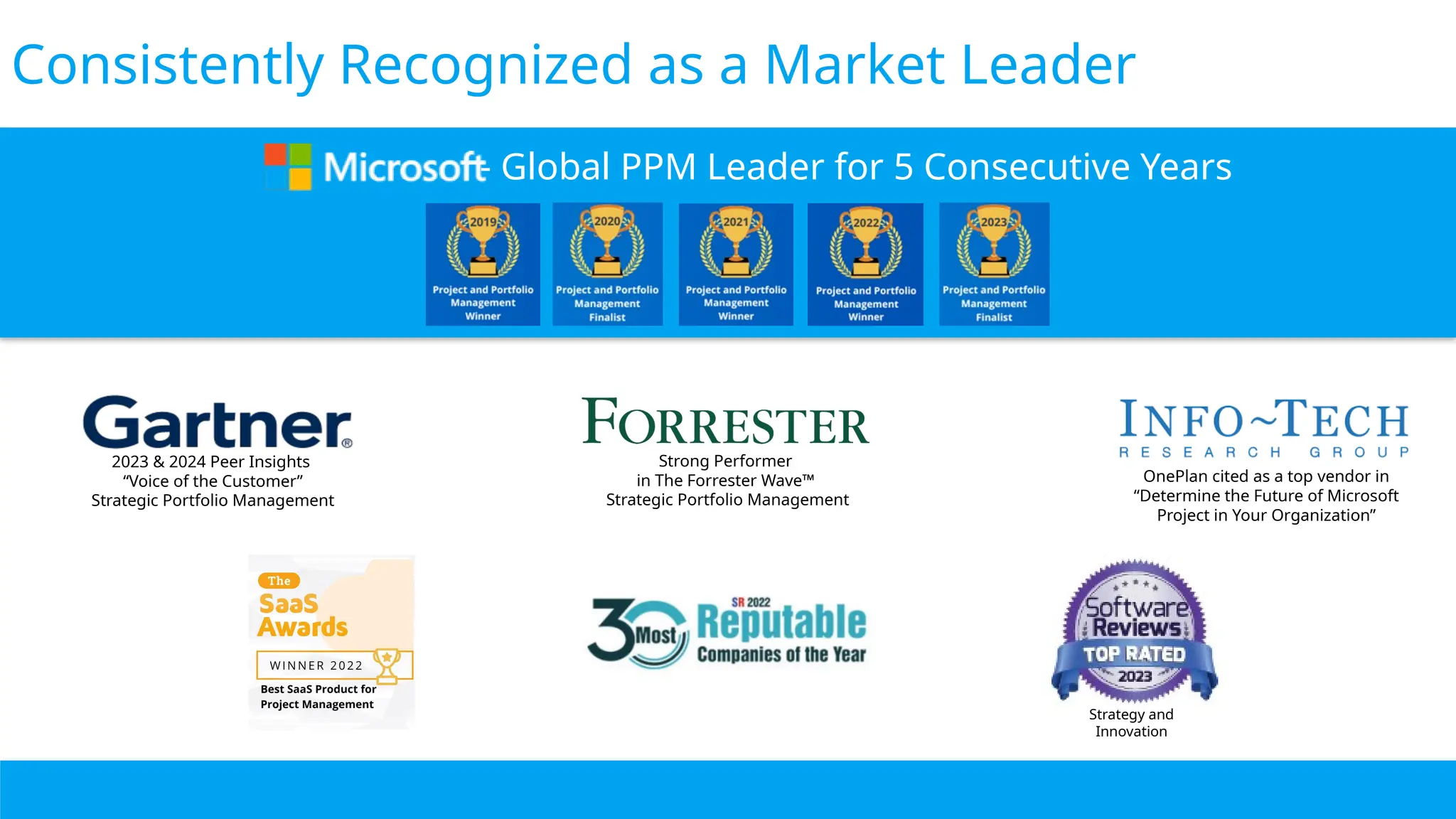
- Global PPM Leader for 5 Consecutive Years
Consistently Recognized as a Market Leader
OnePlan cited as a top vendor in
“Determine the Future of Microsoft
Project in Your Organization”
Strategy and
Innovation
2023 & 2024 Peer Insights
“Voice of the Customer”
Strategic Portfolio Management
Strong Performer
in The Forrester Wave™
Strategic Portfolio Management
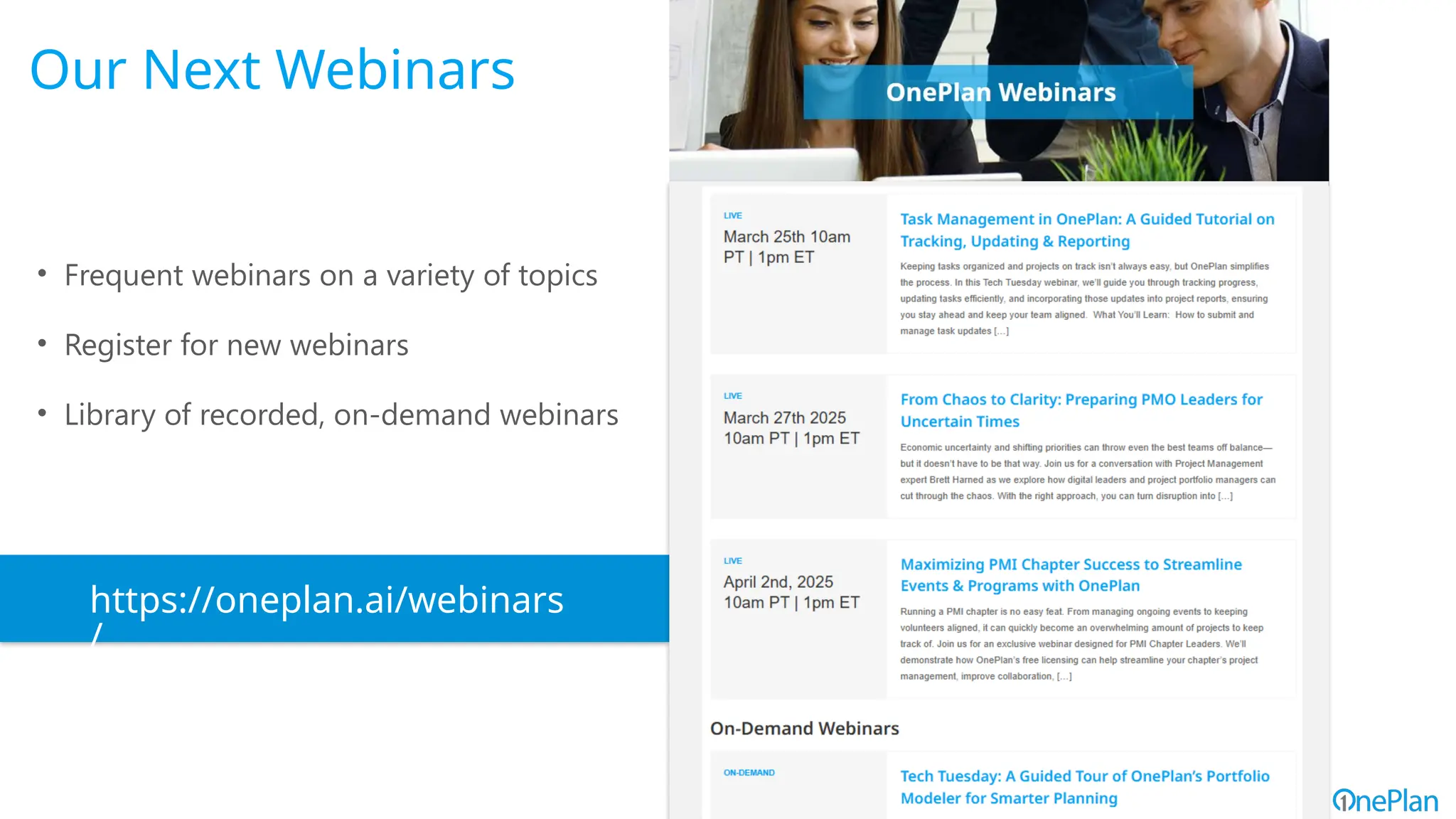
Our Next Webinars
https://oneplan.ai/webinars
/
• Frequent webinars on a variety of topics
• Register for new webinars
• Library of recorded, on-demand webinars
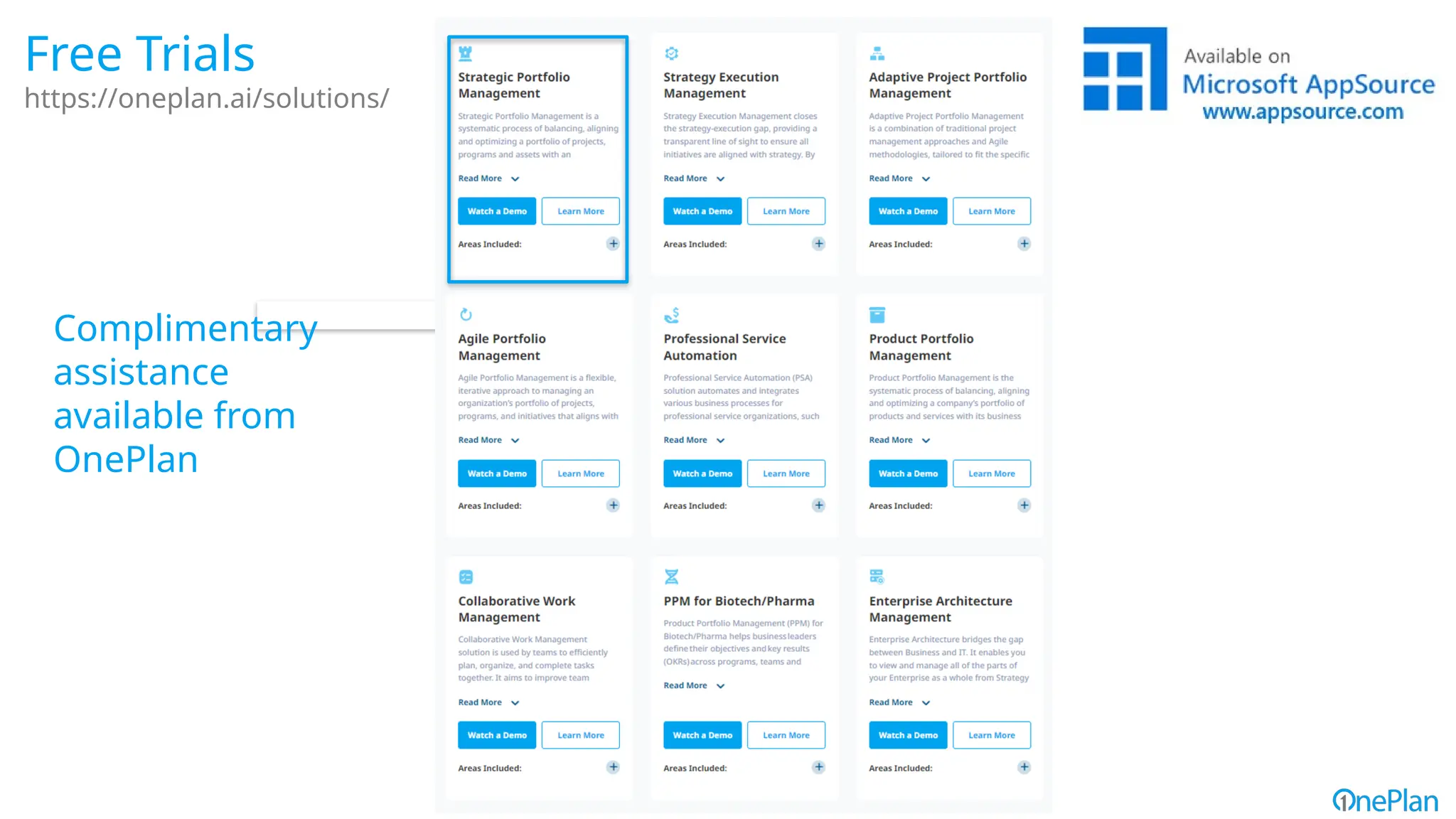
Free Trials
https://oneplan.ai/solutions/
Complimentary
assistance
available from
OnePlan
For more information:
contact@oneplan.ai
Free Offers and Next
Steps
• FREE - OnePlan Trial
• FREE – Roadmap Workshop
• FREE – Personalized 1:1
Demo
www.oneplan.a
i
Contact Us
contact@oneplan.ai
www.oneplan.ai
Jim Patterson
jpatterson@oneplan.ai
Thank You!!
The Power of One

Standardizing Project Portfolio Reporting - Eliminating Errors, Improving Governance, and Ensuring Accuracy

  • 1.
    In partnership with StandardizingProject Portfolio Reporting Eliminating Errors, Improving Governance, and Ensuring Accuracy
  • 2.
    Why is thisImportant? Standardized project portfolio reporting offers several strategic and operational advantages that help organizations make better decisions and maximize the value of their projects. •Provide consistent, reliable data, allowing executives and PMOs to make informed, data-driven decisions. •Enables easier comparison of projects to determine which are delivering the most value. Improved Decision-Making Ensures all stakeholders have a clear view of project status, risks, and resource allocation. • Prevents surprises by highlighting issues early. Enhanced Transparency & Visibility Reduces time spent on reconciling different reporting formats and manually compiling information. • Automates reporting processes, allowing project managers to focus on execution rather than paperwork. Increased Efficiency & Reduced Manual Effort Standardized reporting makes it easier to identify and mitigate risks across the portfolio. • Helps recognize patterns and trends in risks, leading to proactive responses. Better Risk Management Ensures projects are evaluated against consistent KPIs and strategic objectives. • Helps leadership quickly assess whether the project portfolio is delivering real business value. Stronger Alignment with Business Goals Enables organizations to track resource utilization across projects, reducing overallocation and bottlenecks. • Supports strategic decision-making on where to invest time, money, and talent. More Effective Resource Allocation A common reporting framework makes it easier to communicate with different stakeholders, from executives to project teams. • Ensures everyone speaks the same language when discussing project performance. Easier Stakeholder Communication Helps organizations adhere to regulatory requirements and internal governance standards. • Simplifies audits by ensuring a clear, documented trail of project performance data. Compliance & Auditing Enables tracking of historical performance trends to drive continuous improvement. • Allows organizations to benchmark projects against industry standards and best practices. Continuous Improvement & Benchmarking
  • 3.
    • Different teamsmay use various tools (Excel, Jira, MS Project, etc.), leading to inconsistent data collection and reporting formats. Lack of Unified Data and Systems • Teams and project managers may prefer their own reporting methods and resist adopting standardized templates or processes. Resistance to Change • Different projects may track performance using unique KPIs, making it difficult to align reporting across the portfolio. Inconsistent Metrics and KPIs • Incomplete, outdated, or inaccurate project data can hinder the effectiveness of standardized reporting. Data Quality Issues • Executives, PMOs, and project teams may have different reporting needs, making it difficult to create a single standardized format that satisfies everyone. Stakeholder Misalignment • Without clear accountability for maintaining reporting standards, inconsistencies can creep in over time. Lack of Governance and Ownership • Reporting standards that work for a small set of projects may not be effective when scaled across a large enterprise portfolio. Scalability Challenges • If an organization relies on multiple project management platforms, integrating data for a unified report can be complex and costly. Tool Integration Issues Barriers Organizations often struggle with attaining standard project portfolio reporting due to common barriers, including:
  • 4.
    Tiers of Portfolioand Work Management EPMO PMO Project Teams Strategic Portfolio Management (SPM) Project Portfolio Management (PPM) Collaborative Work Management (CWM) Sharing tasks and work collaboratively Portfolios, governance and project execution Strategic alignment and orchestration enterprise-wide Supports all tiers and hybrids – with or without other solutions/tools
  • 5.
    Proliferation of ToolsAcross the Organization Demand Management Portfolio Management Project Management Time Management Reporting & Analysis PMO Marketing Finance Application Development Operational Excellence NPD Engineering
  • 6.
    Agile Transformation Journey EnterpriseAgile Adaptive Agile Portfolio Management Adaptive Portfolio Management Project Portfolio Management Portfolio Management Transformation • Strategic Themes, Portfolio Canvas Value Stream, Lean Budgets and Value Streams, Program Increment Planning. • All projects managed in Scrum Agile approach and Agile Portfolio Management. • Create, Select, Prioritize, Plan, Manage, Close. • Majority of Projects in Waterfall methodology and Project Portfolio Management • Agile and Waterfall PPM Governance Concepts and Tools. • Neither approach dominate. Still large set of projects managed in Waterfall or Hybrid.
  • 7.
    Different Execution Methodologies Agile Waterfall Hybrid •Agile continues to grow • Waterfall is still widely used • Agile variants • Hybrid methodologies • Personalized, cherry-picked versions
  • 8.
    • Associate andalign • Aggregate and rollup • Different methodologies • Variety of tools • Translate to common metrics for leadership Teams Execute How They Need To Leadership Needs Visibility To Make Decisions Strategies/Objectives Key Results Portfolios Programs Initiative Initiative Initiative Initiative Initiative Initiative Methodology Tools Teams Leadership
  • 9.
    Strategic Themes Portfolios Value Streams Programs InitiativeInitiative Initiative Initiative Initiative Initiative Methodology Tools • Associate and align • Aggregate and rollup • Different methodologies • Variety of tools • Translate to common metrics for leadership Teams Leadership • NPV • IRR • ROI • Earned Value • Utilization • Milestones • CPI • SPI • Cost Variance • Burn Down • Burn Up • Velocity • Cumulative Flow Diagram • WSJF • Bug Trends Consolidating and Translating Different Metrics and Language for Different Audiences
  • 10.
    Align Strategy WithExecution Executing strategy in the digital age requires tools connecting the shared objectives of business strategists and those executing the change and measuring true business value.
  • 11.
    Strategic Portfolio Management MoreDimensions to Consider BUSINESS LEADERS Solutions that define business goals and strategies, as well as track progress at the levels of portfolios, business capabilities, products and strategic initiatives. OKRs | VALUE STREAMS FUNCTIONAL LEADERS Solutions that can present the interrelated perspectives, views and considerations needed to make strategic decisions across the business. ENTERPRISE ARCHITECTURE MANAGEMENT APPLICATION PORTFOLIO MANAGEMENT PRODUCT PORTFOLIO MANAGEMENT EXECUTION LEADERS Solutions that support the selection, planning and execution of a variety of different Initiatives across the organization ADAPTIVE | PSA | AGILE | PRODUCT
  • 12.
    Information Silos BreedIncreased Costs and Inefficiencies • Manual mash-ups of data from multiple tools and data sources • Manual report creation, formatting and updating • Packaging and distribution of reports to different stakeholders and organizational levels • Duplication of data entry is time consuming and prone to errors • Disconnected information difficult to remain accurate and current across the board • Chasing team members for status and updates • Tracking completeness and timeliness of submissions • Comprehensive resource planning typically is its own separate data silo that is disconnected
  • 13.
    As a Platform Robustinfrastructure & security Pre-built solutions Configure build your own without custom development OnePlan connector platform, partnerships with other connector platforms, and APIs available Workflows and notifications for process automation Dashboards & reports in OnePlan, or your solution of choice AI assistant built in and available throughout the solution Platform Security AI Sofia GPT Pre-Built Solutions Integrations Workflows & Automation Dashboards & Reporting Build Other Solutions Microsoft Cloud
  • 14.
    A Single Platformfor Portfolio Leaders Across the Organization The Right Balance of Governance with Flexibility Dept Dept Business Unit IT PMO Enterprise Portfolio & Governance Standards Flexibility • Ensures consistent policies, processes, and oversight aligned with corporate strategy Uniform Governance (standardized) • Specific requirements for each Dept/BU • Views, workflows, and forms for unique team needs Specific Portfolio Areas • Combine shared top-level hierarchy with domain-specific filters or views • Enables both standardization and customization Hybrid Areas
  • 15.
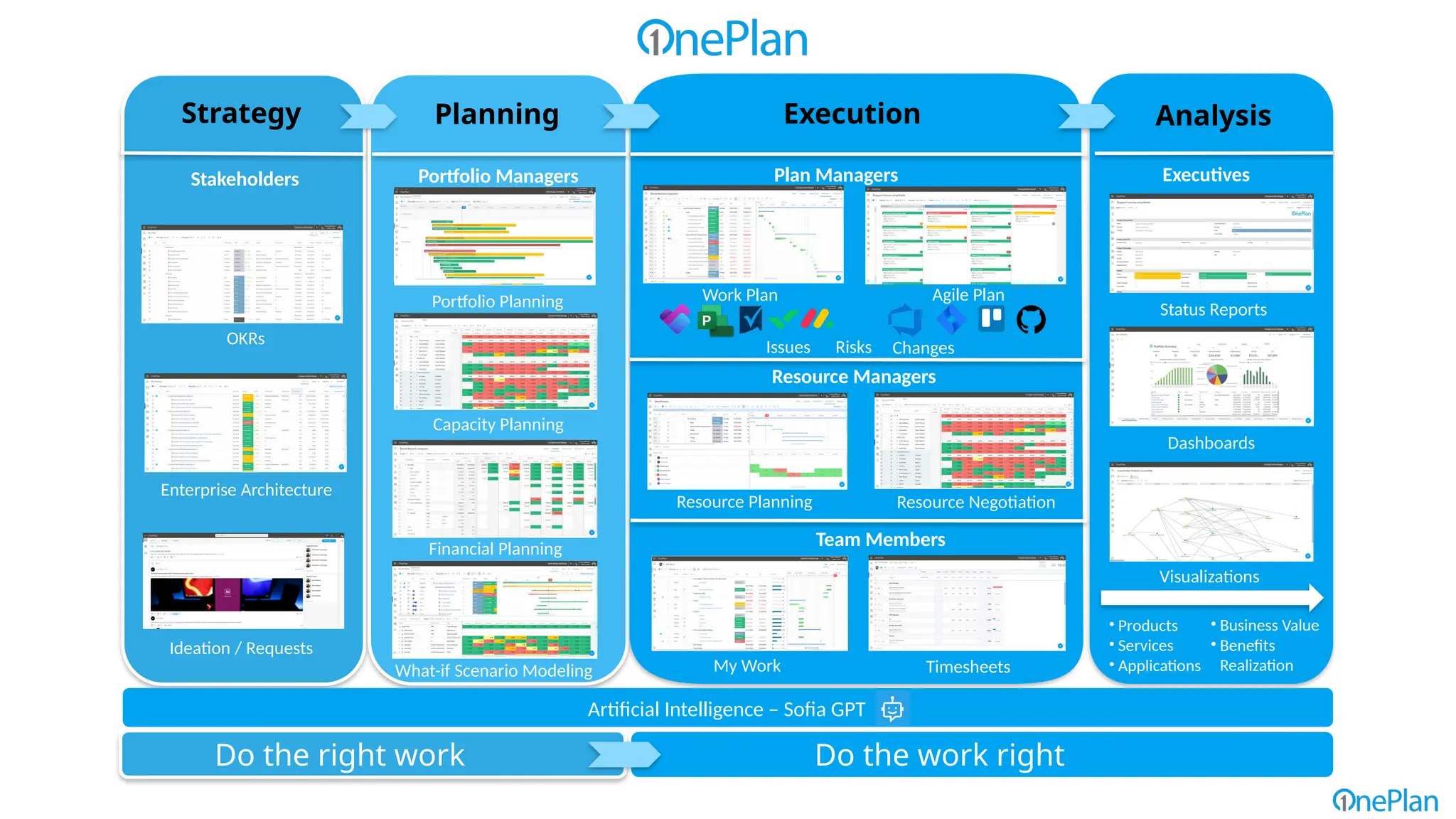
    Portfolio Managers Resource Planning FinancialPlanning Work Plan Visualizations Dashboards Status Reports Plan Managers Agile Plan Ideation / Requests Artificial Intelligence – Sofia GPT Strategy Timesheets My Work Stakeholders Team Members Executives Portfolio Planning Planning Do the right work Do the work right Resource Negotiation Resource Managers Enterprise Architecture Execution Analysis What-if Scenario Modeling • Products • Services • Applications Capacity Planning Issues Risks Changes • Business Value • Benefits Realization OKRs
  • 16.
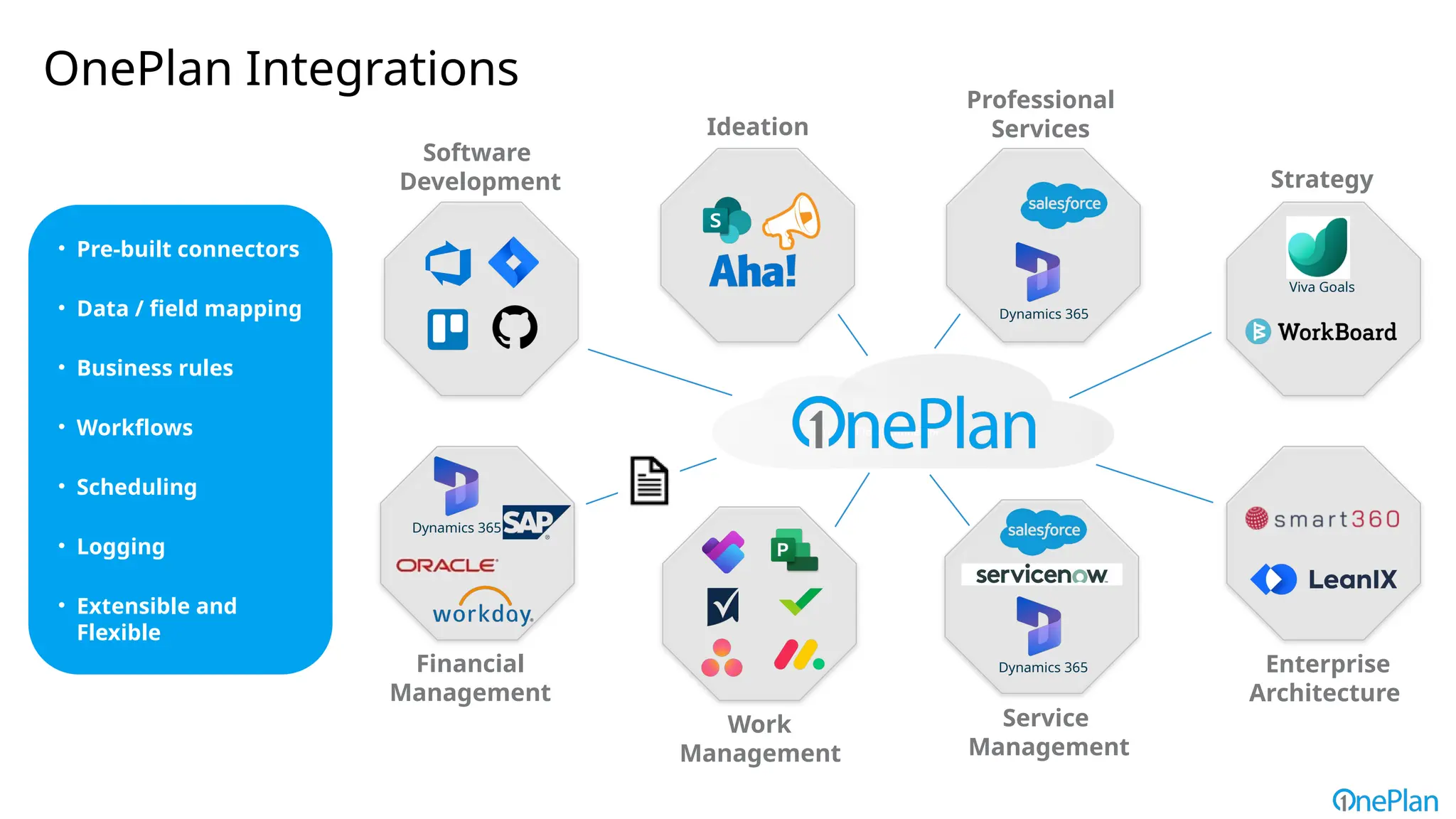
    Software Development Ideation Professional Services Financial Management Work Management Service Management Private Cloud Connector OnePlanIntegrations Dynamics 365 Dynamics 365 Dynamics 365 Strategy Enterprise Architecture Viva Goals • Pre-built connectors • Data / field mapping • Business rules • Workflows • Scheduling • Logging • Extensible and Flexible
  • 17.
    Program Financials ProjectFinancials Analytics & Reporting at All Levels Portfolio Financials
  • 18.
    Ideation & RequestsPortfolio Analysis Standardized Reporting In All Dimensions Strategy • Resource Capacity • Financials • Project Execution • Issues/Risks • Dependencies • Alignment/Associations • Enterprise/Business Architecture • Scenario Modeling • More….
  • 19.
    Consistent Project Statusand Reporting Project Status Reports Project Dashboards
  • 20.
    Say Hello toOnePlan’s ‘Sofia GPT’ A Game-Changer for Strategic Portfolio Management Data Integration: Accesses data from both OpenAI's extensive network and OnePlan's own resources. AI-Driven Collaboration Sofia GPT, an advanced Azure OpenAI module, is tailored to transform strategic portfolio and work management. Intuitive Interaction: Understands natural language and provides real-time responses, enhancing strategic planning and decision-making efficiency. Automation Powerhouse: Simplifies tasks like data entry, information retrieval, communication, estimation, anomaly detection, and more.
  • 21.
    Sofia GPT AlwaysAvailable in OnePlan
  • 22.
  • 23.
    Sample Use Casesfor AI in Portfolio Management OnePlan's Sofia GPT helps organizations make data- driven decisions and forecast outcomes. Strategic Planning Work Management OnePlan's Sofia GPT helps organizations balance their portfolio of projects to maximize value. Resource Allocation OnePlan's Sofia GPT helps organizations manage resources, tasks, and timelines more efficiently. Investment Forecasting OnePlan's Sofia GPT helps organizations identify and mitigate potential risks to their projects and portfolios. Risk Assessment OnePlan's Sofia GPT helps organizations optimize resource allocation across projects and teams. Portfolio Optimization OnePlan's Sofia GPT helps organizations manage project costs, budgets, and forecasts.
  • 24.
     Increased Productivity:Sofia GPT's AI-based strategic planning tools can help to increase productivity by streamlining the OKR development process, reducing manual input, and automating routine tasks.  Improved Alignment: Sofia GPT can help to align organizational objectives with individual and team OKRs. By analyzing business performance metrics and identifying areas for improvement, Sofia GPT can inform the development of OKRs and ensure alignment with overall organizational objectives.  Data-Driven Decision Making: Sofia GPT can analyze OKRs and related data to identify patterns, opportunities, and potential risks. It can use predictive analytics to forecast OKR outcomes and identify potential roadblocks. This can help stakeholders make data-driven decisions to achieve their strategic goals.  Optimization: Sofia GPT can analyze OKRs and provide recommendations to optimize outcomes. By recommending adjustments to OKRs, resource allocations, and other factors, Sofia GPT can maximize OKR success and improve business outcomes. AI-Driven Strategic Planning with OnePlan
  • 25.
    Analyze data toidentify patterns, opportunities, and potential risks
  • 26.
    AI-enabled Portfolio Optimizationwith OnePlan  Data analysis: OnePlan's Sofia GPT can analyze data related to a company's project portfolio, including project goals, resources, timelines, budgets, and risks. This analysis can help identify patterns and trends that can inform decision-making around project selection and prioritization.  Prediction and forecasting: By analyzing OnePlan data, OnePlan's Sofia GPT can make predictions and forecasts about the likely outcomes of different project scenarios. This can help decision-makers anticipate potential problems or opportunities and make more informed decisions about project prioritization.  Risk assessment: OnePlan's Sofia GPT can help assess the risk associated with different projects in a portfolio, including the likelihood of project delays, cost overruns, and other potential issues. This information can help inform project prioritization and resource allocation decisions.  Portfolio Optimization: OnePlan's Sofia GPT can use optimization algorithms to identify the best combination of projects to include in a portfolio based on various criteria, such as business goals, resource availability, and risk tolerance.
  • 27.
    Provide a summaryof the portfolio data
  • 28.
    Budget and PlanOptimization - Intake Lead – Select Projects based on criteria
  • 29.
    AI-enabled Risk Identification& Mitigation with OnePlan  Identifying and categorizing risks: Sofia GPT can analyze large volumes of data and identify potential risks that may affect an organization. It can also categorize the risks based on severity, likelihood of occurrence, and potential impact on the organization.  Predicting future risks: Sofia GPT can analyze historical data and use machine learning algorithms to predict future risks that may arise. This can help organizations take preventive measures and prepare for potential risks.  Recommending mitigation strategies: Based on the identified risks, Sofia GPT can recommend mitigation strategies that can help organizations reduce the likelihood or impact of the risks. These strategies can be customized based on the specific needs and characteristics of the organization.
  • 30.
    Identify potential risksand how to mitigate them
  • 31.
    AI-enabled Resource CapacityPlanning with OnePlan  Resource Allocation: Sofia GPT can help organizations optimize resource allocation by analyzing the current resource usage patterns and predicting future demand. This can help organizations to allocate resources more efficiently and avoid over/underutilization of resources.  Capacity Planning: Sofia GPT can help organizations to plan for future capacity requirements by analyzing historical usage data and predicting future demand. This can help organizations to make informed decisions about when to add or remove resources to meet changing business needs.  Resource Optimization: Sofia GPT can be used to optimize resource utilization by identifying opportunities to reduce waste, improve efficiency, and increase productivity. This can help organizations to reduce costs and improve their overall performance.  Predictive Talent Acquisition: Sofia GPT can analyze OnePlan data to predict future hiring needs based on trends and patterns. This can help businesses plan their talent acquisition strategy and identify the right candidates for their organization
  • 32.
    What resources doI need to hire?
  • 33.
    AI-powered Investment Forecastingand Predictive Analytics  Predicting and forecasting costs: Sofia GPT can analyze OnePlan financial data, identify patterns, and predict future costs. This can help businesses plan their budgets more accurately and avoid unexpected expenses.  Optimizing spending: Sofia GPT can analyze spending patterns and identify areas where costs can be reduced or optimized. This can help businesses make more informed decisions about where to allocate their resources.  Providing real-time insights: Sofia GPT can provide real-time insights into financial data, allowing businesses to make more informed decisions quickly. This can help businesses respond to changes in the market or in their own financial situation more effectively.
  • 34.
    What are thekey insights and trends that can be inferred from the financial data?
  • 35.
    Help me writea project summary email to my manager
  • 36.
  • 37.
    Summary • Standard projectportfolio reporting is a critical need in organizations, and many have barriers to achieving it • Tool proliferation is a challenge in many organizations • A variety of methodologies and frameworks are in use • Consolidating and translating data can be a manual and labor-intensive effort • Manual report creation and formatting for different levels of audience every reporting cycle • Automation delivers significant labor savings • Efforts can be redirected to high-value activities • More timely information for decision support • Comprehensive reports including all dimensions and levels of project and portfolio information • Consistent report formats for easy interpretation and comparison
  • 38.
    Define Clear Objectives& Metrics Align reporting standards with business goals and strategic priorities. •Identify a core set of KPIs that apply across all projects. Develop a Standardized Reporting Framework Create uniform templates for project reports (dashboards, executive summaries, risk reports, etc.).for uniformity across all projects •Establish consistent frequency for reporting (e.g., weekly, monthly, quarterly). Use a Centralized Reporting Tool Implement a PPM system as a hub for all standard reporting Ensure integration with existing project management tools •Automate data collection and report generation to reduce manual errors. Ensure Executive Buy-In & Governance Get senior leadership support to mandate standardized reporting. •Assign a Project Management Office (PMO) or governance team to oversee compliance. Train & Engage Stakeholders `Provide training on the importance and usage of standardized reports. •Foster a culture of accountability and continuous improvement. Ensure Data Accuracy & Quality Implement data validation rules to ensure accuracy and consistency. •Define data ownership and responsibilities within teams.. Customize Reports for Different Audiences Tailor reports for different stakeholder groups (executives, project managers, finance teams). •Use visual dashboards to improve data interpretation. Foster Continuous Improvement & Feedback Regularly review and refine reporting processes based on stakeholder feedback. •Conduct post-mortems and lessons-learned sessions to optimize reporting standards and adjust to business changes and evolving needs. Standardize Risk & Issue Reporting Establish a uniform risk assessment model across all projects. •Integrate risk reporting into portfolio-level decision-making. Monitor Adoption & Compliance Encourage adoption by demonstrating the benefits (e.g., better decision- making, reduced inefficiencies). •Recognize and reward teams that successfully adhere to reporting standards. Recommendations Achieving standardized project portfolio reporting requires a structured approach, stakeholder alignment, and the right tools. Here are key recommendations to successfully implement it:
  • 39.
    - Global PPMLeader for 5 Consecutive Years Consistently Recognized as a Market Leader OnePlan cited as a top vendor in “Determine the Future of Microsoft Project in Your Organization” Strategy and Innovation 2023 & 2024 Peer Insights “Voice of the Customer” Strategic Portfolio Management Strong Performer in The Forrester Wave™ Strategic Portfolio Management
  • 40.
    Our Next Webinars https://oneplan.ai/webinars / •Frequent webinars on a variety of topics • Register for new webinars • Library of recorded, on-demand webinars
  • 41.
  • 42.
    For more information: contact@oneplan.ai FreeOffers and Next Steps • FREE - OnePlan Trial • FREE – Roadmap Workshop • FREE – Personalized 1:1 Demo www.oneplan.a i
  • 43.

Editor's Notes

  • #5 So given this, we have seen numerous examples of customers who have a wide proliferation of tools across the organization. See the functions along the left … see the organizations across the top … look at the different tools being used and you’ll quickly see that there is no single standard, and this is difficult to achieve.
  • #15 SPM
  • #19 Leave this slide up for matt until he is don’t talking to it.. Then transfer Presentation Rights to him,.