STANDALONE SOLAR PV BASED AC MICROGRID FOR EV CHARGING
1.
STANDALONE SOLAR PVBASED AC
MICROGRID FOR EV CHARGING
PRESENTED BY,
DHINESH KUMAR.P –210921105006
MOHAN KUMAR.M –210921105017
PRASONRAJ.S – 210921105022
2.
ABSTRACT
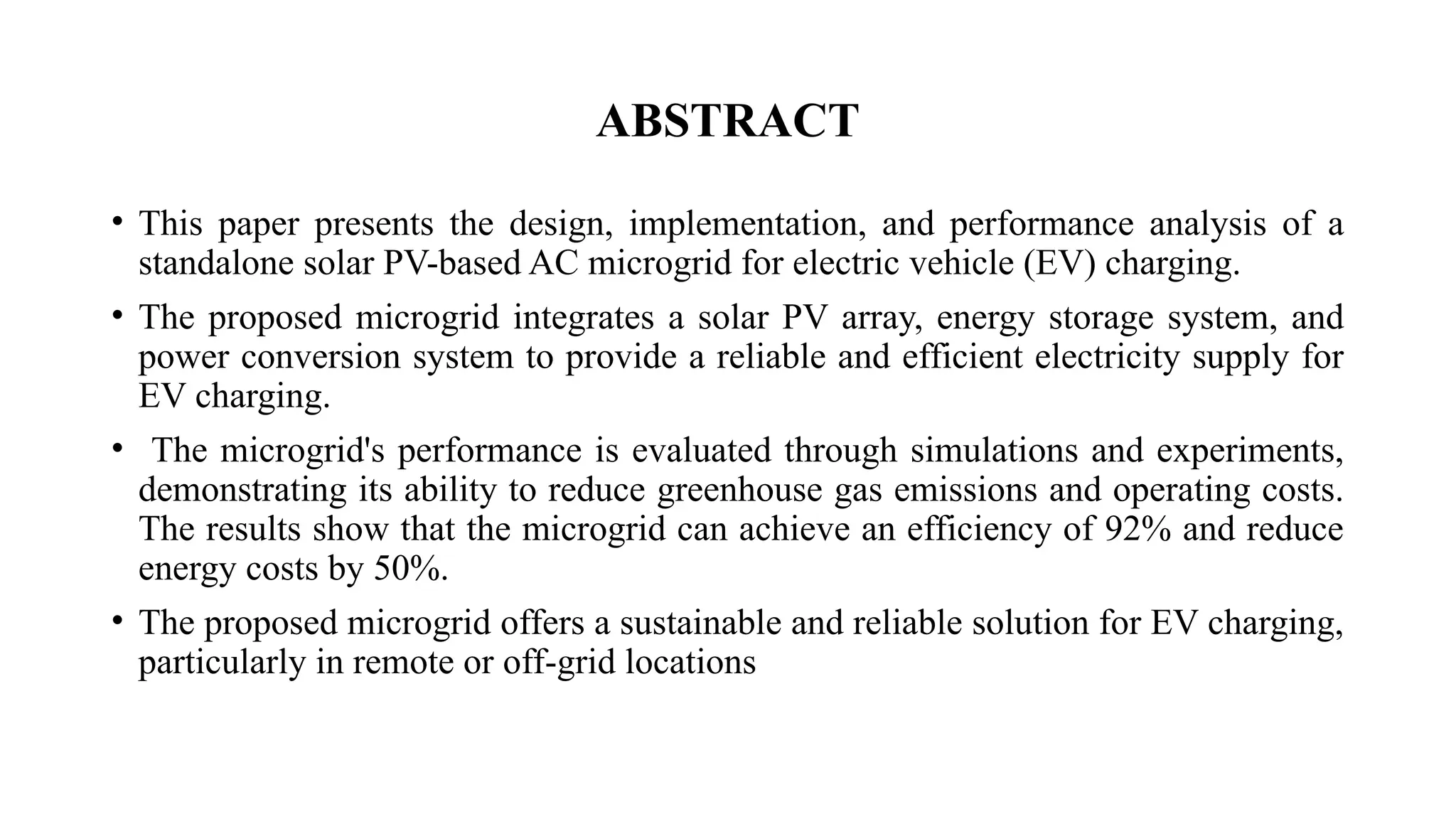
• This paperpresents the design, implementation, and performance analysis of a
standalone solar PV-based AC microgrid for electric vehicle (EV) charging.
• The proposed microgrid integrates a solar PV array, energy storage system, and
power conversion system to provide a reliable and efficient electricity supply for
EV charging.
• The microgrid's performance is evaluated through simulations and experiments,
demonstrating its ability to reduce greenhouse gas emissions and operating costs.
The results show that the microgrid can achieve an efficiency of 92% and reduce
energy costs by 50%.
• The proposed microgrid offers a sustainable and reliable solution for EV charging,
particularly in remote or off-grid locations
3.
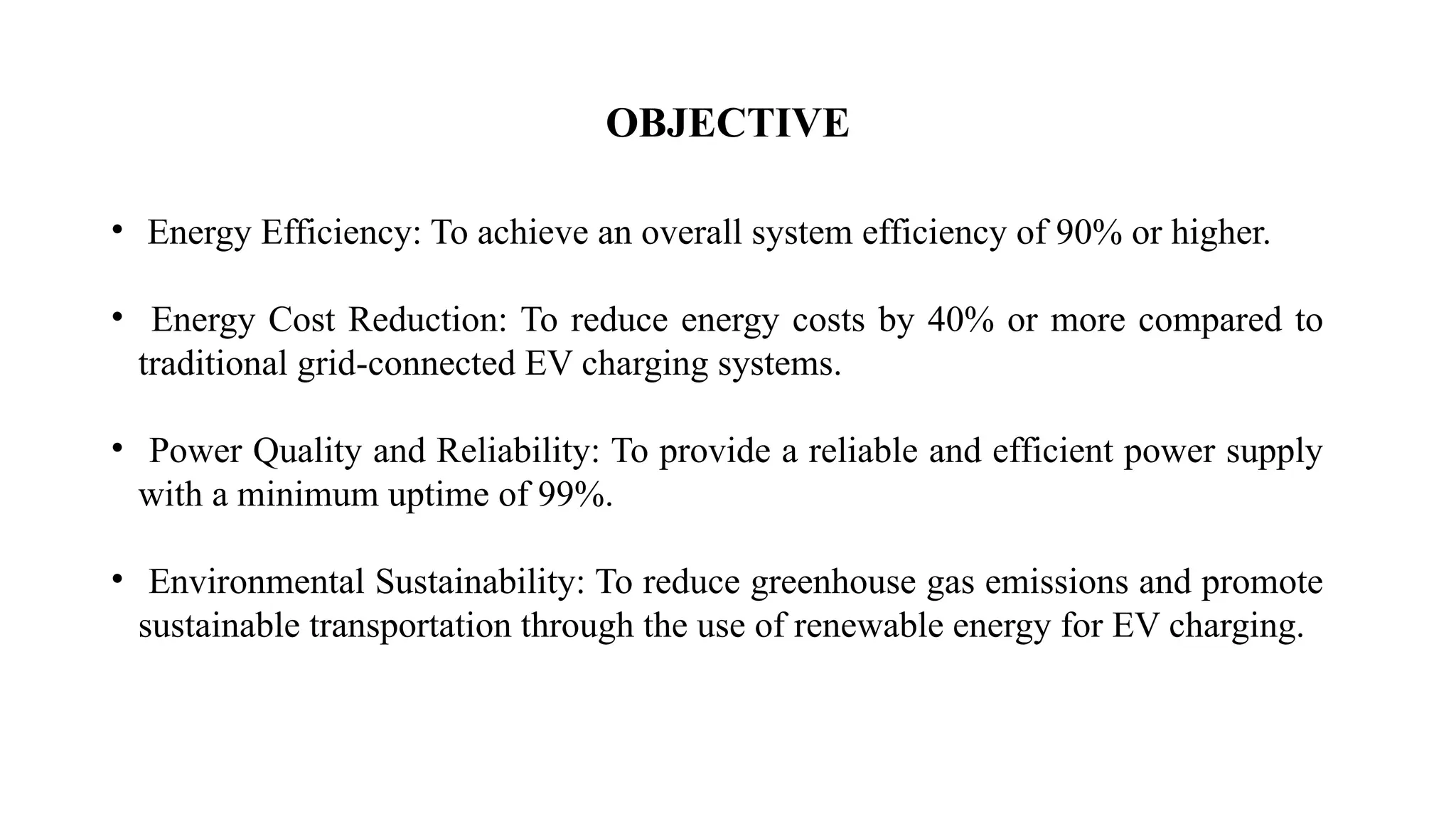
OBJECTIVE
• Energy Efficiency:To achieve an overall system efficiency of 90% or higher.
• Energy Cost Reduction: To reduce energy costs by 40% or more compared to
traditional grid-connected EV charging systems.
• Power Quality and Reliability: To provide a reliable and efficient power supply
with a minimum uptime of 99%.
• Environmental Sustainability: To reduce greenhouse gas emissions and promote
sustainable transportation through the use of renewable energy for EV charging.
4.
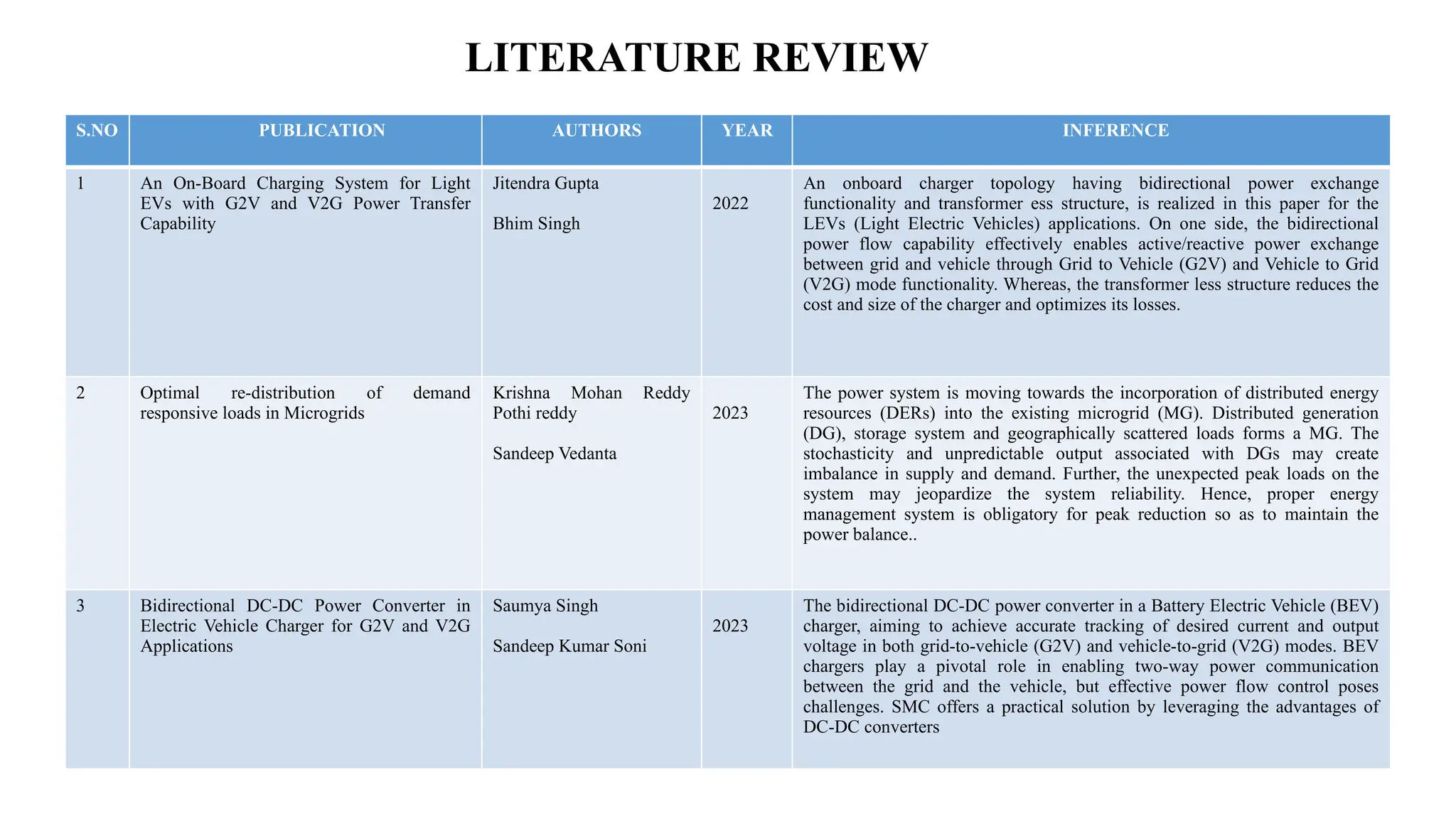
S.NO PUBLICATION AUTHORSYEAR INFERENCE
1 An On-Board Charging System for Light
EVs with G2V and V2G Power Transfer
Capability
Jitendra Gupta
Bhim Singh
2022
An onboard charger topology having bidirectional power exchange
functionality and transformer ess structure, is realized in this paper for the
LEVs (Light Electric Vehicles) applications. On one side, the bidirectional
power flow capability effectively enables active/reactive power exchange
between grid and vehicle through Grid to Vehicle (G2V) and Vehicle to Grid
(V2G) mode functionality. Whereas, the transformer less structure reduces the
cost and size of the charger and optimizes its losses.
2 Optimal re-distribution of demand
responsive loads in Microgrids
Krishna Mohan Reddy
Pothi reddy
Sandeep Vedanta
2023
The power system is moving towards the incorporation of distributed energy
resources (DERs) into the existing microgrid (MG). Distributed generation
(DG), storage system and geographically scattered loads forms a MG. The
stochasticity and unpredictable output associated with DGs may create
imbalance in supply and demand. Further, the unexpected peak loads on the
system may jeopardize the system reliability. Hence, proper energy
management system is obligatory for peak reduction so as to maintain the
power balance..
3 Bidirectional DC-DC Power Converter in
Electric Vehicle Charger for G2V and V2G
Applications
Saumya Singh
Sandeep Kumar Soni
2023
The bidirectional DC-DC power converter in a Battery Electric Vehicle (BEV)
charger, aiming to achieve accurate tracking of desired current and output
voltage in both grid-to-vehicle (G2V) and vehicle-to-grid (V2G) modes. BEV
chargers play a pivotal role in enabling two-way power communication
between the grid and the vehicle, but effective power flow control poses
challenges. SMC offers a practical solution by leveraging the advantages of
DC-DC converters
LITERATURE REVIEW
5.
CONVENTIONAL METHOD
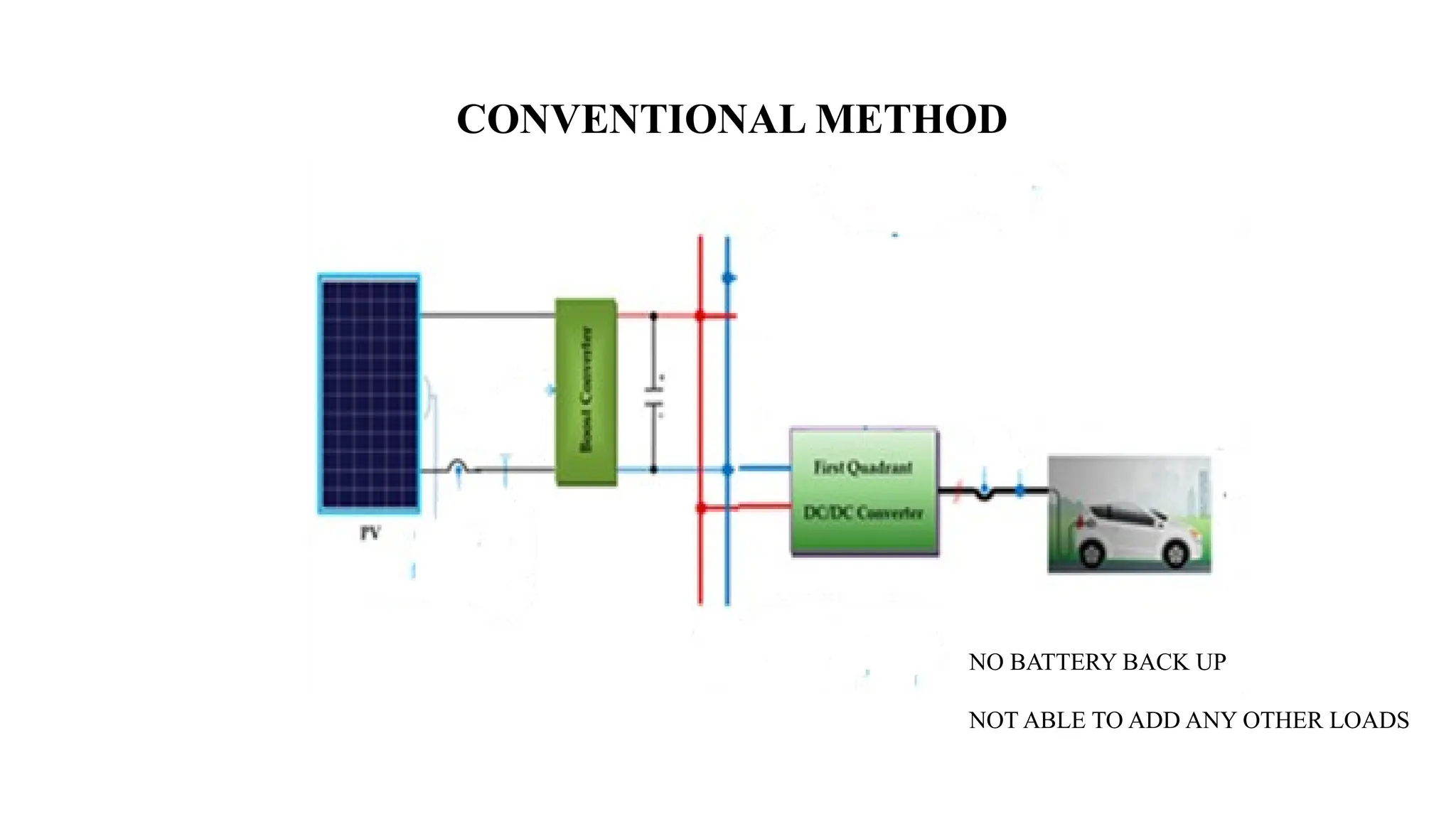
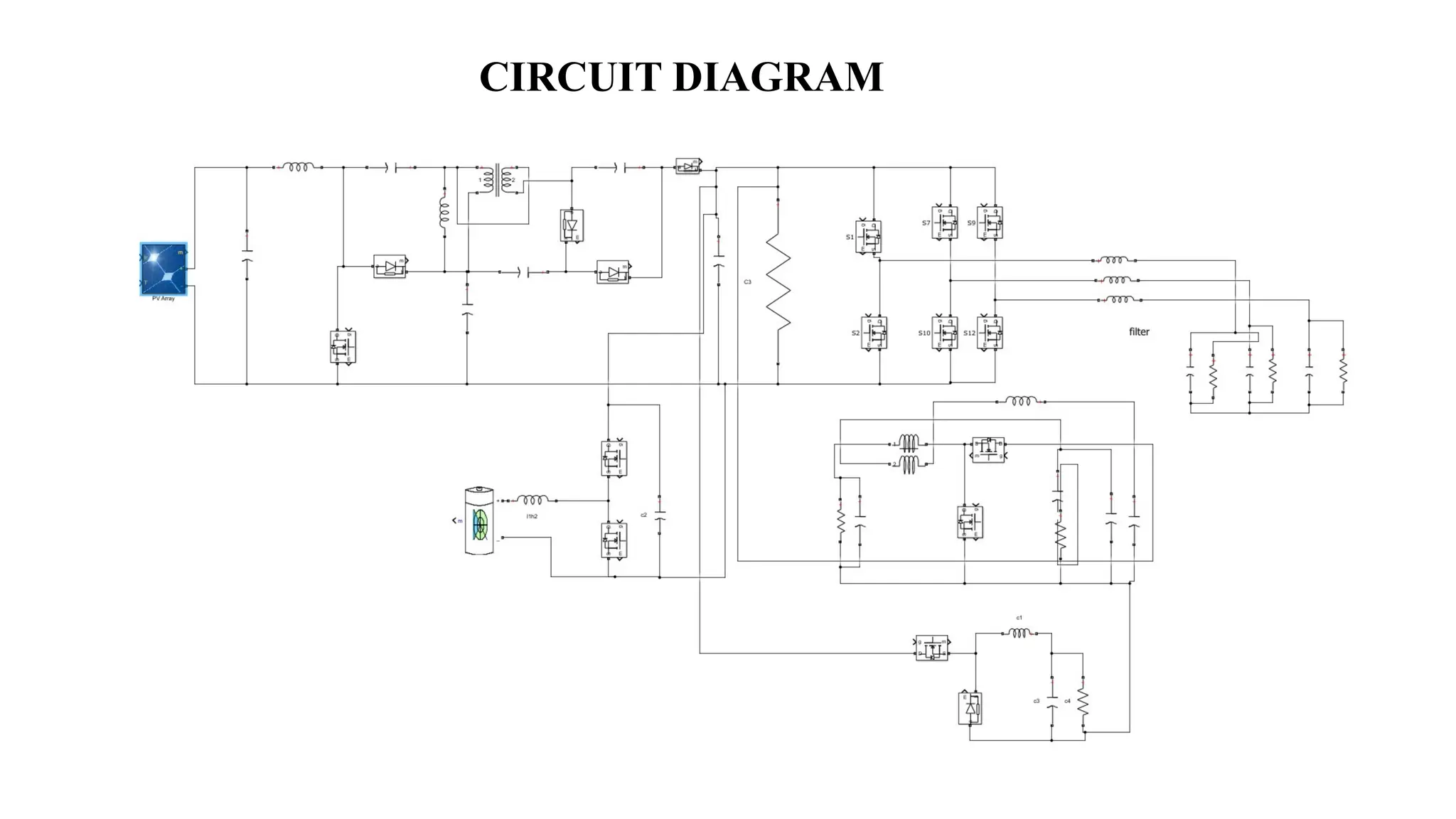
The architectureof the proposed EVCS system is shown in FIG. The EVCS system is an
off-grid type that is powered by solar energy. It is collected by a PV array that generates
electrical energy to the EVCS. The PV panel represents the main source of energy for the
charging station. However, the generated energy is not steady. It varies according to the
solar insolation level and other environmental issues. Hence, ESS batteries are usually
used to compensate for the problem of energy intermittence. The output terminals of the
PV are connected to a boost converter. Its function is to match the PV voltage level to
that of the DC bus and helps in utilizing the maximum power point tracking (MPPT)
condition of the PV panel. Two charging converters are connected to the DC bus namely
the EV charger and the energy storage converter. These converters are generally DC/DC
converters. However, the EV charger is one quadrant buck converter that is used to
charge the EV battery
PROPOSED METHOD
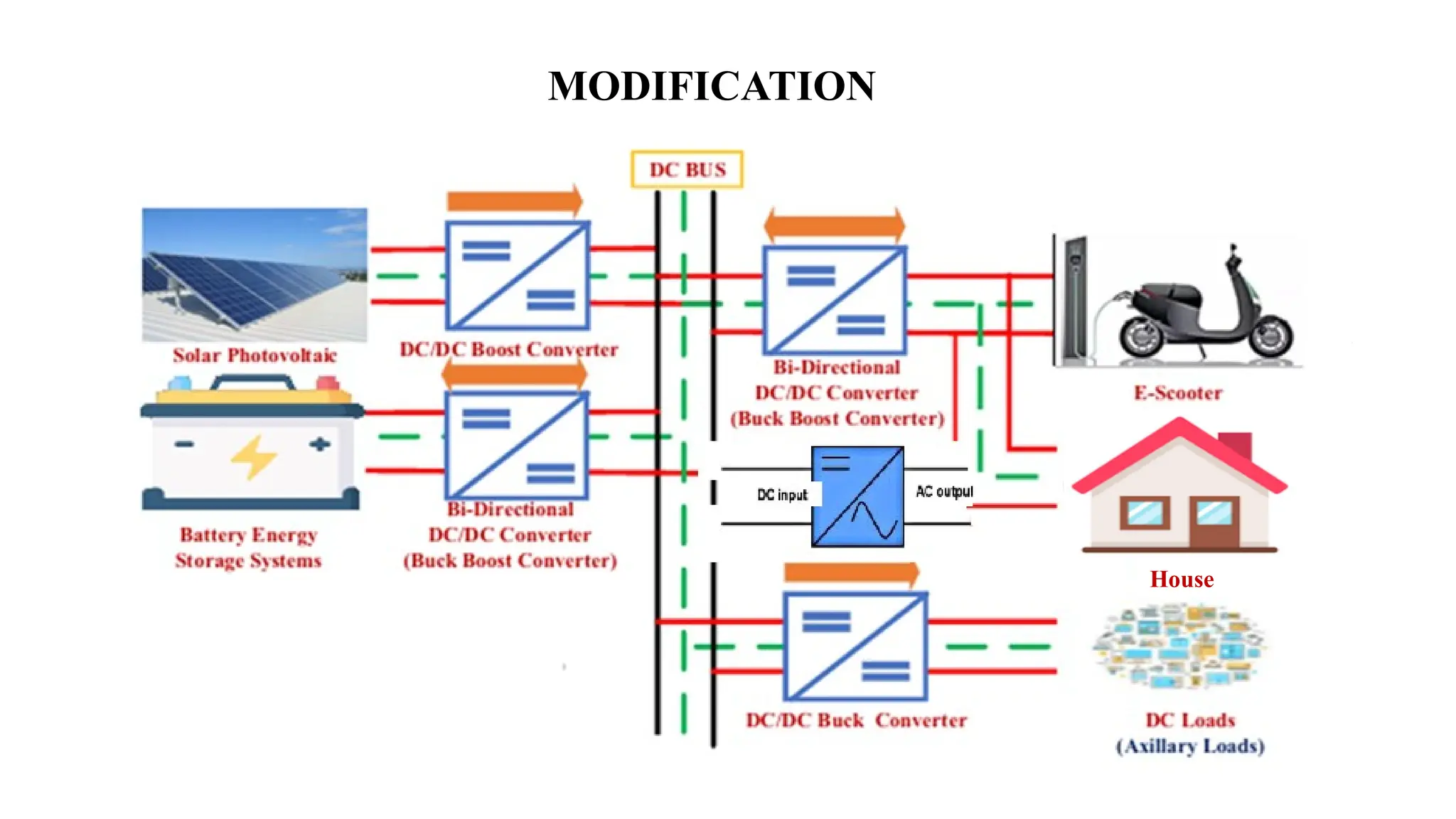
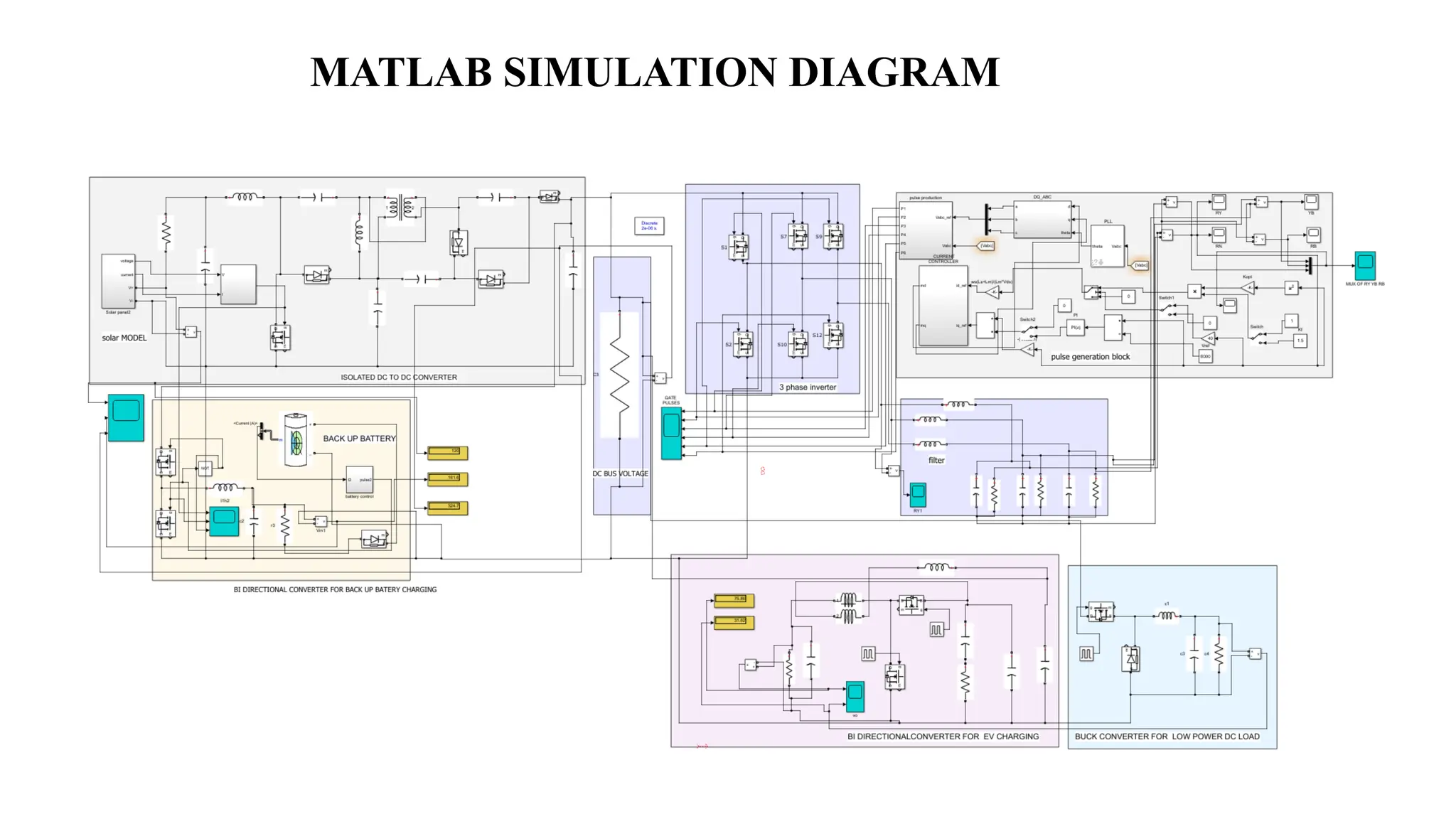
• Astandalone SPV and energy storage-based DC microgrid designed for EV charging, emphasizing
the significance of an EMS. The system includes a SPV array, a BESS, DC-DC converters, and
multiple loads that are all connected to a common DC bus for efficient functioning.
• A SPV is one of the most environmentally friendly and reliable beneficial way to meet load demand in
remote locations. Solar photovoltaic power.The BESS were used to store excess energy from RESs
like SPV systems under typical conditions of operation and to supply power to the load under
unexpected circumstances, such as power cuts caused by weather.
• When the utility's energy price is high during peak load, for example, the battery would be discharged
in this grid connected microgrid in order to supply the demand during regular operation.
• In addition, it uses energy from an EV battery to balance the BACK UP batteries when the vehicle is
parked.
• A bi-directional Inverter to convert DC power from the solar PV array and ESS to AC power for
domestic purpose like house.
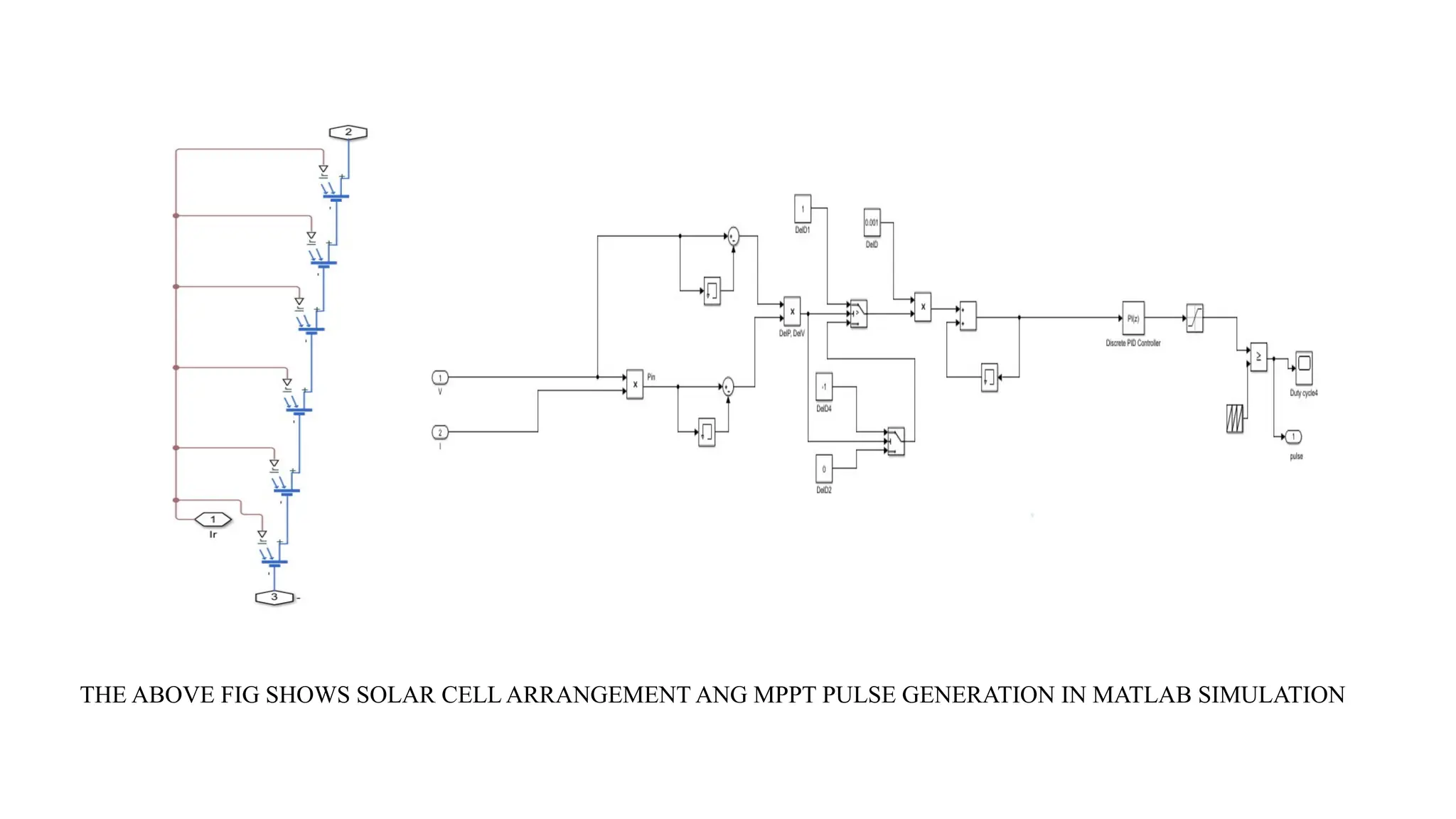
THE ABOVE FIGSHOWS SOLAR CELL ARRANGEMENT ANG MPPT PULSE GENERATION IN MATLAB SIMULATION
12.
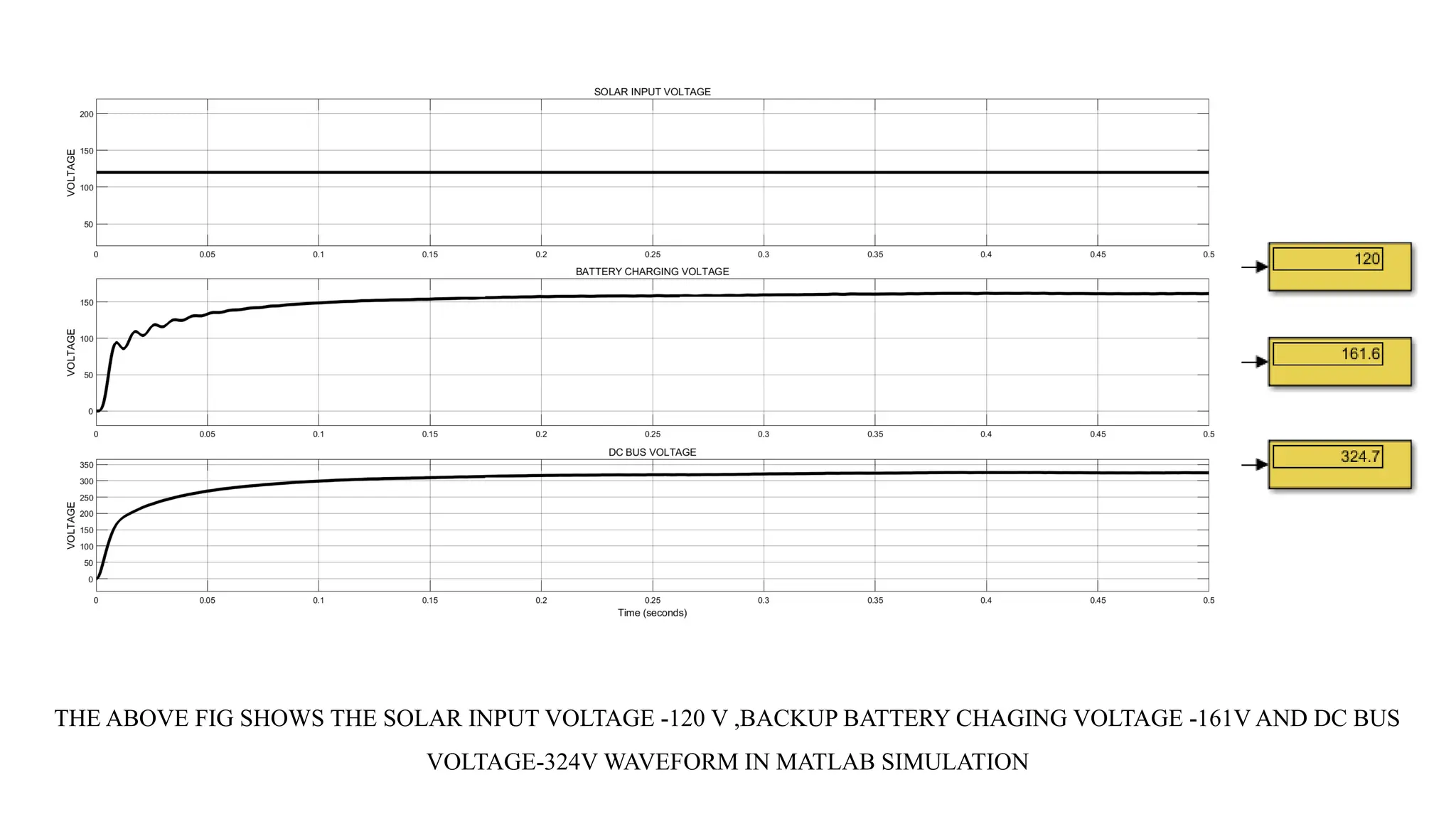
THE ABOVE FIGSHOWS THE SOLAR INPUT VOLTAGE -120 V ,BACKUP BATTERY CHAGING VOLTAGE -161V AND DC BUS
VOLTAGE-324V WAVEFORM IN MATLAB SIMULATION
13.
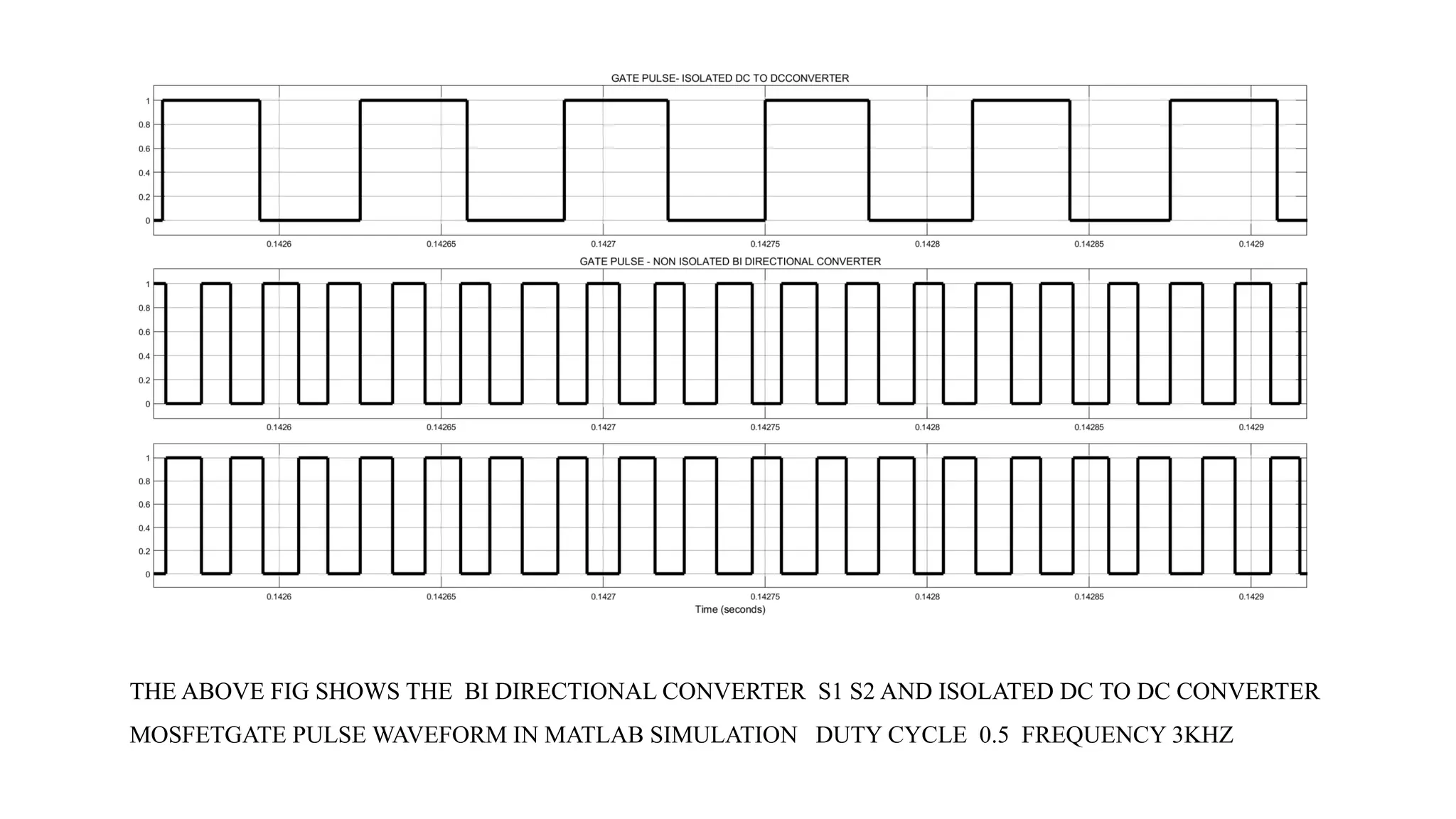
THE ABOVE FIGSHOWS THE BI DIRECTIONAL CONVERTER S1 S2 AND ISOLATED DC TO DC CONVERTER
MOSFETGATE PULSE WAVEFORM IN MATLAB SIMULATION DUTY CYCLE 0.5 FREQUENCY 3KHZ
14.
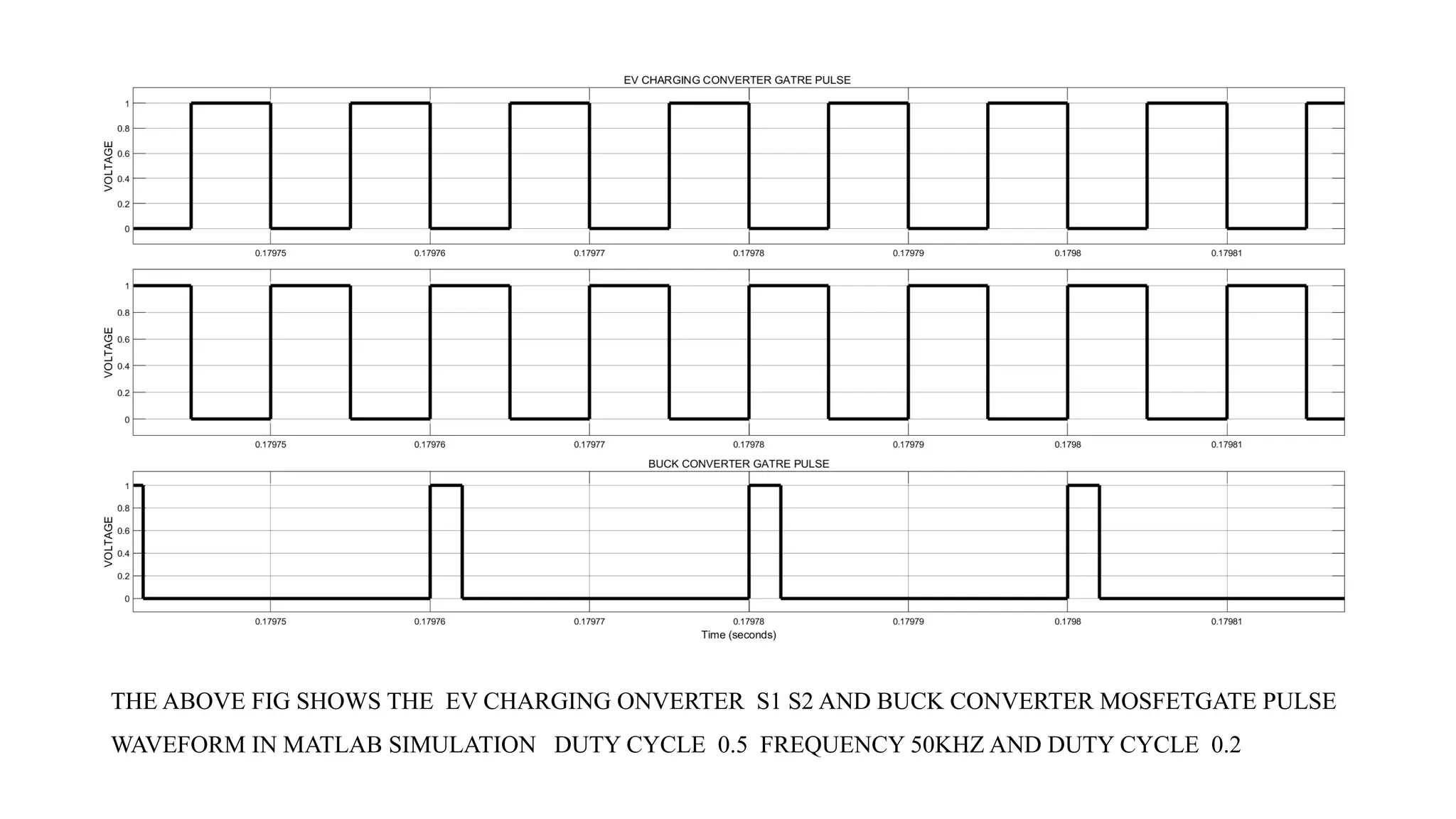
THE ABOVE FIGSHOWS THE EV CHARGING ONVERTER S1 S2 AND BUCK CONVERTER MOSFETGATE PULSE
WAVEFORM IN MATLAB SIMULATION DUTY CYCLE 0.5 FREQUENCY 50KHZ AND DUTY CYCLE 0.2
15.
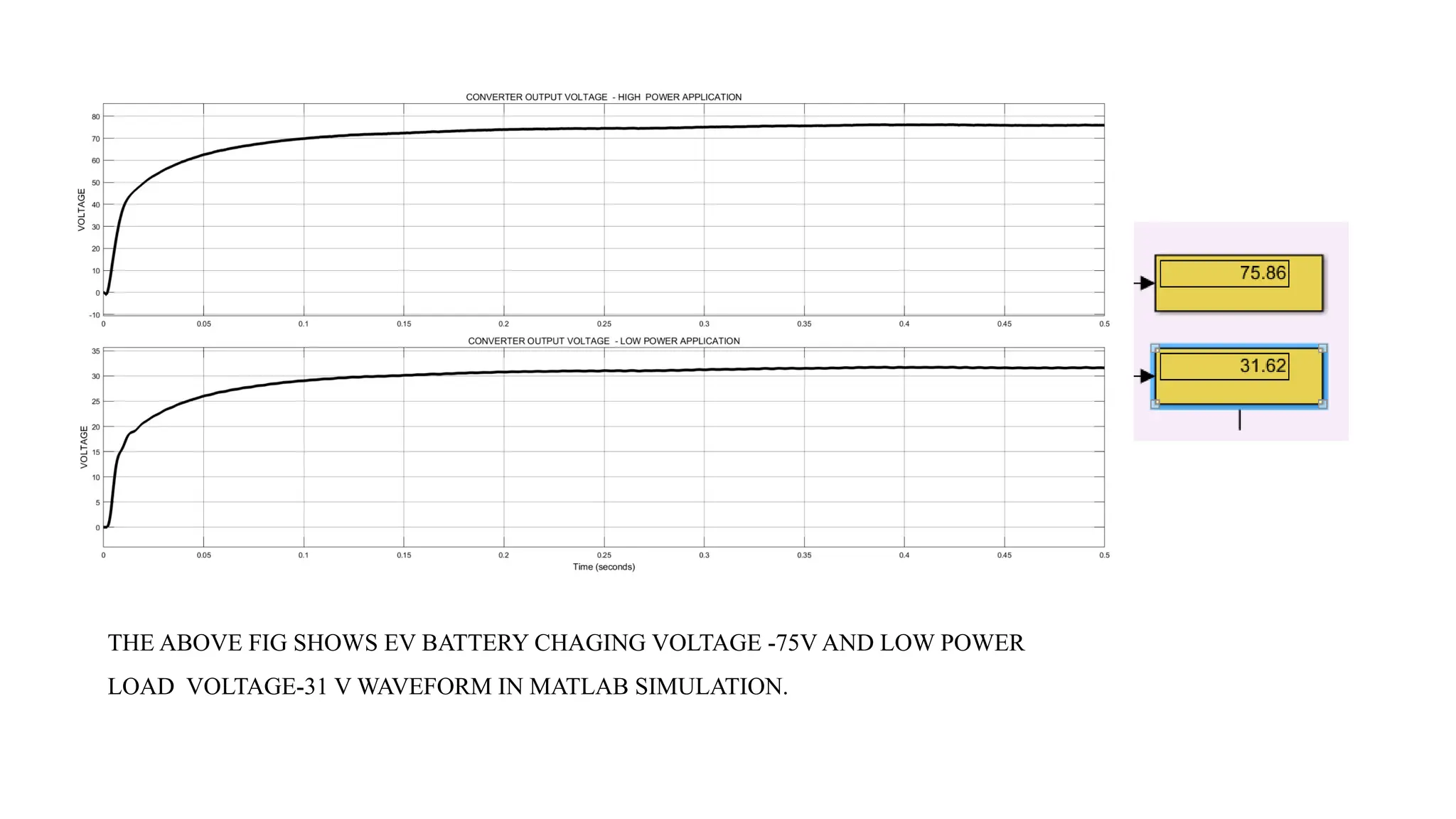
THE ABOVE FIGSHOWS EV BATTERY CHAGING VOLTAGE -75V AND LOW POWER
LOAD VOLTAGE-31 V WAVEFORM IN MATLAB SIMULATION.
16.
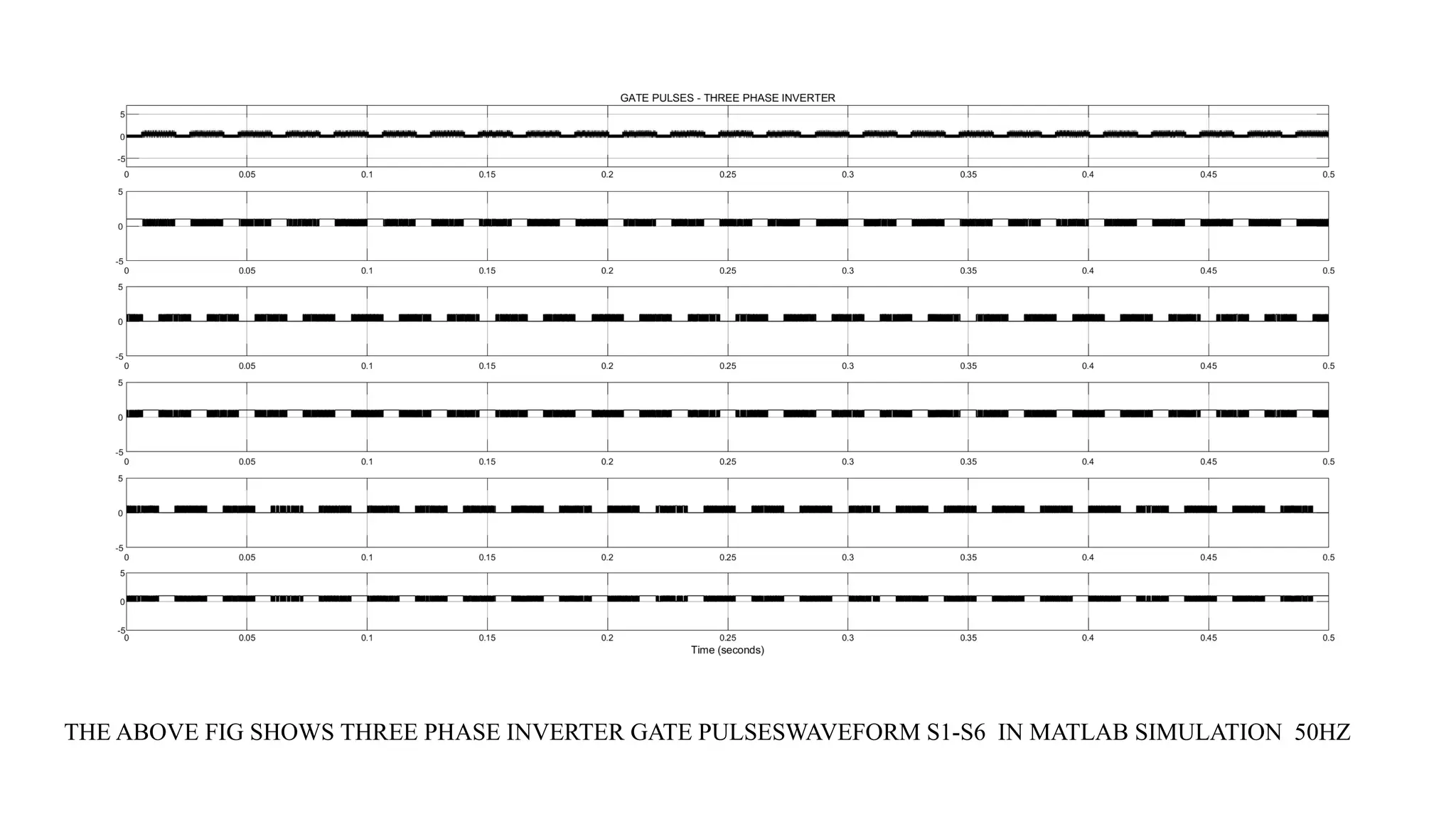
THE ABOVE FIGSHOWS THREE PHASE INVERTER GATE PULSESWAVEFORM S1-S6 IN MATLAB SIMULATION 50HZ
17.
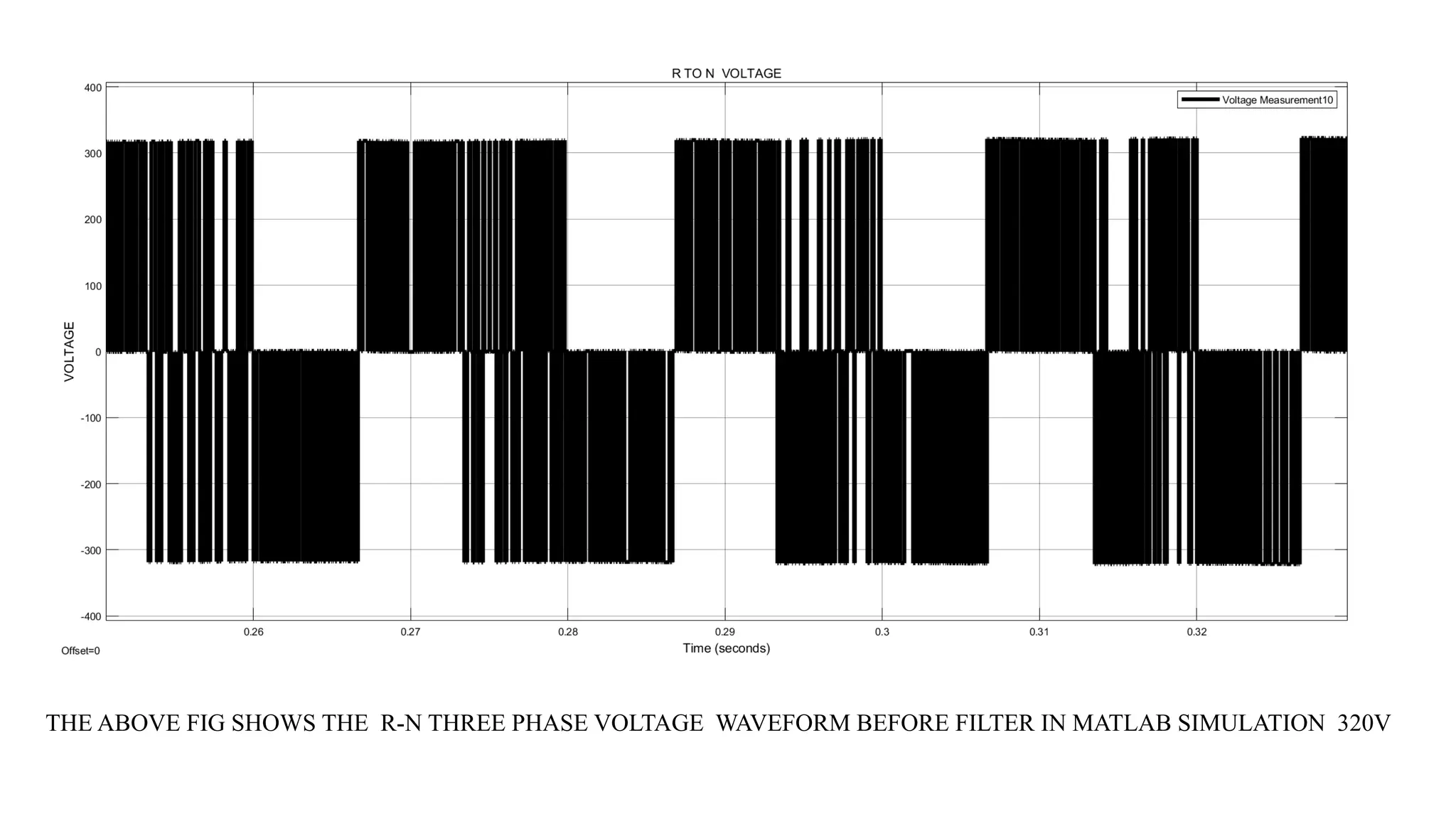
THE ABOVE FIGSHOWS THE R-N THREE PHASE VOLTAGE WAVEFORM BEFORE FILTER IN MATLAB SIMULATION 320V
18.
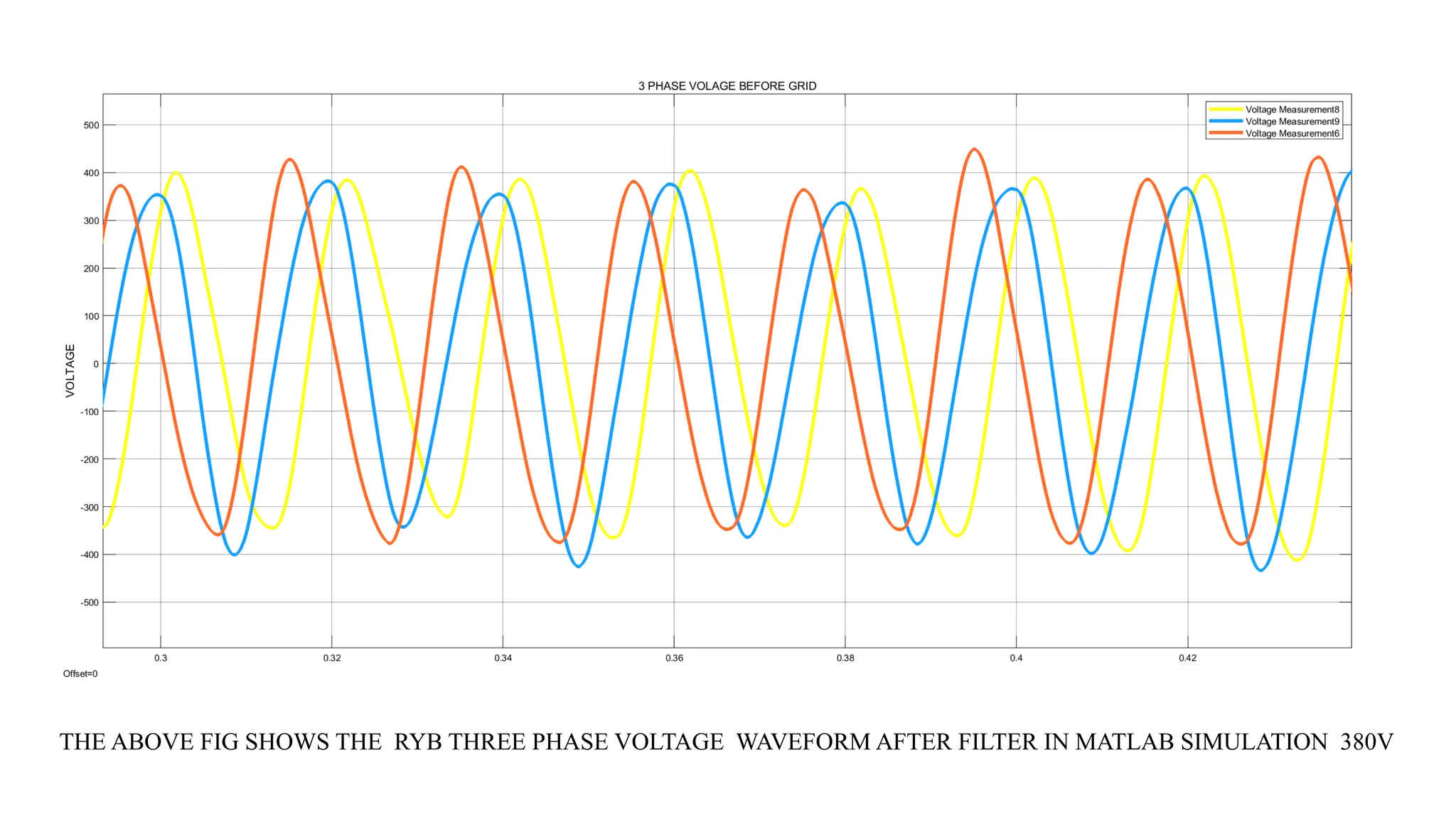
THE ABOVE FIGSHOWS THE RYB THREE PHASE VOLTAGE WAVEFORM AFTER FILTER IN MATLAB SIMULATION 380V
19.
CONCLUSION
The proposed hybridstandalone microgrid successfully combines an AC and DC
inverter circuits to allows synchronized EV charging and also a optimal load
control. By integrating solar energy and as a battery energy storage system (BESS),
the system provides dependable power distribution and backup charging. The
bidirectional DC-DC converter increases smooth energy sharing across EVs, the
grid, and storage, enhancing overall efficiency. Furthermore, the uniqued energy
management system (EMS) increases the load forecasting and also a decision-
making, assuring reliable operation. The confirmed MATLAB Simulink simulations
indicate the system’s efficacy in optimizing energy usage, aiding rural
electrification, and delivering a stable power supply.CONCLUS
![1ST_BATCH_PPT[1].pptxdvbfghqswdegtrhyeteswerty](https://cdn.slidesharecdn.com/ss_thumbnails/1stbatchppt1-250419142130-31e8e09e-thumbnail.jpg?width=640&height=640&fit=bounds)


