まとめ
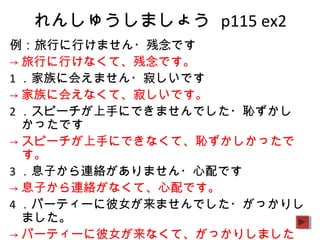
• One useof て form is to link sentences in the
order of event
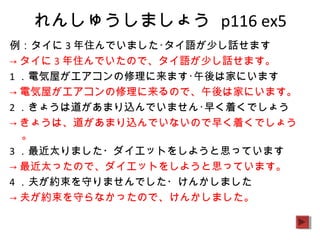
• Another use of て form is to express a cause
( 原因 ) and the sentence which follows
express a result ( 結果 )
• In this case, the result to express your
feelings.
• ニュースを聞いてびっくりしました。
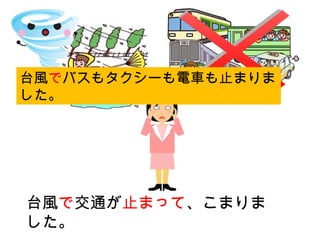
• 台風で交通が止まって困りました。
まとめ
• Potential verbsand verbs can express states.
• ニュースがショックで、ご飯が食べられ
ませんでした。
• 土曜日は都合が悪くて、行けません。
• 話が複雑で、よくわかりませんでした。
• て form can express situations in the past.
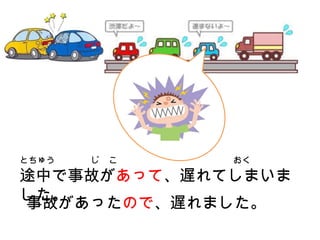
• 途中で事故があって、遅れてしまいまし
た。
まとめ
• て formnow sounds like you can say a reason of the
cause BUT there are exceptions.
• When expressing volitional meanings(will - 意志 ,
orders - 命令 , invitation - 招待 or request - お願
い ) in the 2nd
part of the sentence, it is more
appropriate to use から
あぶなくて、機械に触らないでください。 ( お
願い )
あぶないですから、機械に触らないでください
。
あした会議があって、きょう準備しなければな
りません。
あした会議がありますから、きょう準備しなけ
ればなりません。(意志)
• The last 2 sentences, remember the original usage of
12.
まとめ
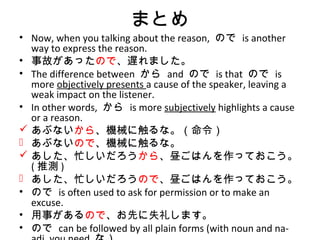
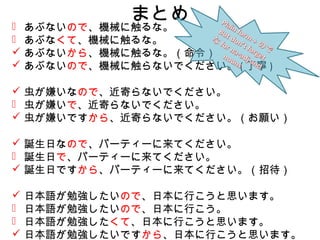
• Now, whenyou talking about the reason, ので is another
way to express the reason.
• 事故があったので、遅れました。
• The difference between から and ので is that ので is
more objectively presents a cause of the speaker, leaving a
weak impact on the listener.
• In other words, から is more subjectively highlights a cause
or a reason.
あぶないから、機械に触るな。(命令)
あぶないので、機械に触るな。
あした、忙しいだろうから、昼ごはんを作っておこう。
( 推測 )
あした、忙しいだろうので、昼ごはんを作っておこう。
• ので is often used to ask for permission or to make an
excuse.
• 用事があるので、お先に失礼します。
• ので can be followed by all plain forms (with noun and na-
まとめ
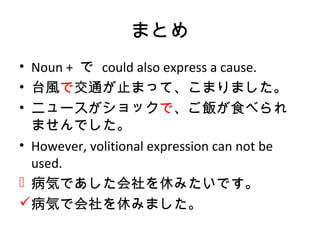
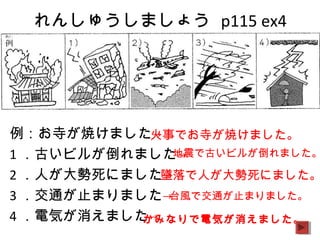
• Noun +で could also express a cause.
• 台風で交通が止まって、こまりました。
• ニュースがショックで、ご飯が食べられ
ませんでした。
• However, volitional expression can not be
used.
病気であした会社を休みたいです。
病気で会社を休みました。