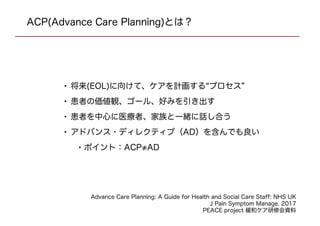
• 将来(EOL)に向けて、ケアを計画する“プロセス”
• 患者の価値観、ゴール、好みを引き出す
•患者を中心に医療者、家族と一緒に話し合う
• アドバンス・ディレクティブ(AD)を含んでも良い
•ポイント:ACP≠AD
ACP(Advance Care Planning)とは?
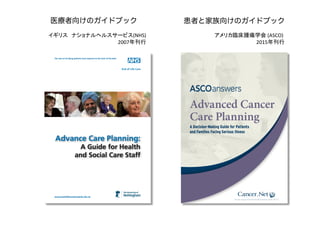
Advance Care Planning: A Guide for Health and Social Care Staff: NHS UK
J Pain Symptom Manage. 2017
PEACE project 緩和ケア研修会資料
EOLコミュニケーションの基本的な考え方
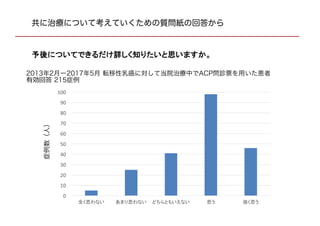
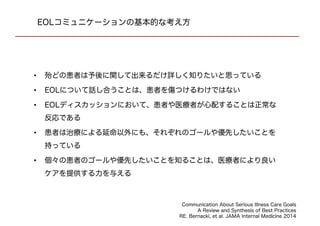
• 殆どの患者は予後に関して出来るだけ詳しく知りたいと思っている
• EOLについて話し合うことは、患者を傷つけるわけではない
•EOLディスカッションにおいて、患者や医療者が心配することは正常な反応で
ある
• 患者は治療による延命以外にも、それぞれのゴールや優先したいことを持って
いる
• 個々の患者のゴールや優先したいことを知ることは、医療者により良いケアを
提供する力を与える
Communication About Serious Illness Care Goals
A Review and Synthesis of Best Practices
RE. Bernacki, et al. JAMA Internal Medicine 2014
58.
EOLコミュニケーションにおけるコツ
Don’t Do
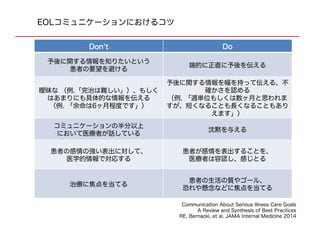
予後に関する情報を知りたいという
患者の要望を避ける
端的に正直に予後を伝える
曖昧な (例.「完治は難しい」)、もしくはあまり
にも具体的な情報を伝える
(例.「余命は6ヶ月程度です」)
予後に関する情報を幅を持って伝える、不確
かさを認める
(例. 「週単位もしくは数ヶ月と思われますが、
短くなることも長くなることもありえます」)
コミュニケーションの半分以上
において医療者が話している
沈黙を与える
患者の感情の強い表出に対して、
医学的情報で対応する
患者が感情を表出することを、
医療者は容認し、感じとる
治療に焦点を当てる
患者の生活の質やゴール、
恐れや懸念などに焦点を当てる
Communication About Serious Illness Care Goals
A Review and Synthesis of Best Practices
RE. Bernacki, et al. JAMA Internal Medicine 2014
#26 → トレーニングシステム (e.g. PEACE program)
→ 患者や家族は知りたいと思っている。どのように?
→ リマインダー、看護師のトレーニング
インセンティブ、期待余命 1、2年
Delineate explicit responsibilities for elements of conversation among clinicians Build care models that incentivize coordination of care between clinicians in a fragmented care delivery system Use policy to ensure follow-up and management of needs generated by conversations about patients’ wishesCreate
Build practice metrics on timing, quality, and quantity of conversations completed for selected patients Develop national consensus and promulgation of key metrics for timing, quality, and number of conversations for different patient populations
#27 → トレーニングシステム (e.g. PEACE program)
→ 患者や家族は知りたいと思っている。どのように?
→ リマインダー、看護師のトレーニング
インセンティブ、期待余命 1、2年
Delineate explicit responsibilities for elements of conversation among clinicians Build care models that incentivize coordination of care between clinicians in a fragmented care delivery system Use policy to ensure follow-up and management of needs generated by conversations about patients’ wishesCreate
Build practice metrics on timing, quality, and quantity of conversations completed for selected patients Develop national consensus and promulgation of key metrics for timing, quality, and number of conversations for different patient populations
#28 → トレーニングシステム (e.g. PEACE program)
→ 患者や家族は知りたいと思っている。どのように?
→ リマインダー、看護師のトレーニング
インセンティブ、期待余命 1、2年
Delineate explicit responsibilities for elements of conversation among clinicians Build care models that incentivize coordination of care between clinicians in a fragmented care delivery system Use policy to ensure follow-up and management of needs generated by conversations about patients’ wishesCreate
Build practice metrics on timing, quality, and quantity of conversations completed for selected patients Develop national consensus and promulgation of key metrics for timing, quality, and number of conversations for different patient populations
#29 → トレーニングシステム (e.g. PEACE program)
→ 患者や家族は知りたいと思っている。どのように?
→ リマインダー、看護師のトレーニング
インセンティブ、期待余命 1、2年
Delineate explicit responsibilities for elements of conversation among clinicians Build care models that incentivize coordination of care between clinicians in a fragmented care delivery system Use policy to ensure follow-up and management of needs generated by conversations about patients’ wishesCreate
Build practice metrics on timing, quality, and quantity of conversations completed for selected patients Develop national consensus and promulgation of key metrics for timing, quality, and number of conversations for different patient populations
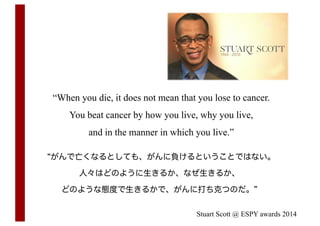
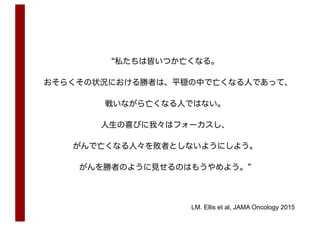
#67 “When you die, it does not mean that you lose to cancer. You beat cancer by how you live, why you live, and in the manner in which you live.” We will all die one day; perhaps the winner here is the person who does it under his or her own terms; the person who dies peacefully and not at war.
Let us focus on the life that people enjoyed before being told “you have cancer” and remember them as victors in life, not losers in death. Let us stop letting cancer appear to be the winner."
#68 “When you die, it does not mean that you lose to cancer. You beat cancer by how you live, why you live, and in the manner in which you live.” We will all die one day; perhaps the winner here is the person who does it under his or her own terms; the person who dies peacefully and not at war.
Let us focus on the life that people enjoyed before being told “you have cancer” and remember them as victors in life, not losers in death. Let us stop letting cancer appear to be the winner."



![[治療変更時]
今後どうなるの
かしら?
今後の治療において、
あなたが大切にしたい
ことや希望を
教えてください
[医師との話し合いの後]
できる限りの治療を受け
たいけど、、
あなたに最善の治療法を
一緒に考えていきたいので、
質問紙に答えて
頂けませんか?
ACP質問紙を渡すタイミング
治療方針の変更時や医師との話し合いの後
患者と医療者の認識のギャップを感じる時など
医師もしくは看護師から提案
質問紙のメリット
質問内容の標準化・網羅性
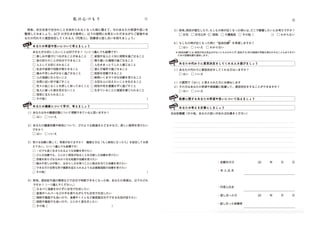
効率化](https://image.slidesharecdn.com/2017-170928124123/85/slide-33-320.jpg)