The first thoughtsand attempts I made to practice [the Monte Carlo Method]
were suggested by a question which occurred to me in 1946 as I was
convalescing from an illness and playing solitaires. The question was what are
the chances that a Canfield solitaire laid out with 52 cards will come out
successfully? After spending a lot of time trying to estimate them by pure
combinatorial calculations, I wondered whether a more practical method than
"abstract thinking" might not be to lay it out say one hundred times and simply
observe and count the number of successful plays. This was already possible to
envisage with the beginning of the new era of fast computers, and I immediately
thought of problems of neutron diffusion and other questions of mathematical
physics, and more generally how to change processes described by certain
differential equations into an equivalent form interpretable as a succession of
random operations. Later [in 1946], I described the idea to John von Neumann,
and we began to plan actual calculations.
–- Stanislaw Ulam
https://en.wikipedia.org/wiki/Monte_Carlo_method
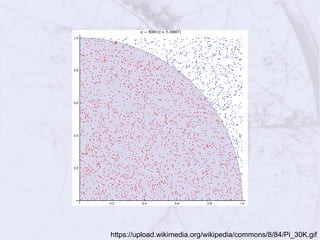
布豐投針法求 π
Mario Lazzariniin 1901
https://en.wikipedia.org/wiki/Buffon%27s_needle
拋了3408次針,得到π的近似值為355/113。
27.
布豐投針法求 π
對稱性
考慮針的中心點 x落在
的機率都相同,針的方向也是
與線條相交時的距離
所以相交的機率為
https://en.wikipedia.org/wiki/Buffon%27s_needle
a
l
b
t
http://blog.linux.org.tw/~jserv/archives/002004.html






![The first thoughts and attempts I made to practice [the Monte Carlo Method]
were suggested by a question which occurred to me in 1946 as I was
convalescing from an illness and playing solitaires. The question was what are
the chances that a Canfield solitaire laid out with 52 cards will come out
successfully? After spending a lot of time trying to estimate them by pure
combinatorial calculations, I wondered whether a more practical method than
"abstract thinking" might not be to lay it out say one hundred times and simply
observe and count the number of successful plays. This was already possible to
envisage with the beginning of the new era of fast computers, and I immediately
thought of problems of neutron diffusion and other questions of mathematical
physics, and more generally how to change processes described by certain
differential equations into an equivalent form interpretable as a succession of
random operations. Later [in 1946], I described the idea to John von Neumann,
and we began to plan actual calculations.
–- Stanislaw Ulam
https://en.wikipedia.org/wiki/Monte_Carlo_method](https://image.slidesharecdn.com/ychao20160820-160821054423/85/slide-15-320.jpg)


![import random
import numpy
import ROOT
m_total = 10**5
m_radius = 1
def in_circle(point):
x = point[0]
y = point[1]
return (x**2 + y**2) < m_radius**2
m_count = m_inside = 0
c1 = ROOT.TCanvas("pi", "#pi", 600, 600)
m_x = numpy.linspace(0, 1.,101)
m_y = (1.**2 - m_x**2)**0.5
c1.cd()
g = ROOT.TGraph(len(m_x), m_x, m_y)
g.SetTitle("#pi")
g.GetXaxis().SetTitle("x")
g.GetYaxis().SetTitle("y")
hist1 = ROOT.TH2F("hist1", "#pi outside", 100, 0, 1, 100, 0, 1)
hist2 = ROOT.TH2F("hist2", "#pi inside", 100, 0, 1, 100, 0, 1)
for i in range(m_total):
point = random.random()*m_radius, random.random()*m_radius
if in_circle(point):
hist2.Fill(point[0], point[1])
m_inside += 1
else:
hist1.Fill(point[0], point[1])
m_count += 1
pi = (m_inside * 1.0 / m_count) * 4
print(pi)
hist1.SetMarkerColor(4)
hist1.Draw("same")
hist2.SetMarkerColor(2)
hist2.Draw("same")
g.SetLineWidth(3)
g.Draw("same")
c1.SaveAs("pi.png")
$ python pyroot_pi.py
3.14108
git@github.com:yuanchao/MCnVC.git](https://image.slidesharecdn.com/ychao20160820-160821054423/85/slide-23-320.jpg)













![[ZigBee 嵌入式系統] ZigBee 應用實作 - 使用 TI Z-Stack Firmware](https://cdn.slidesharecdn.com/ss_thumbnails/zigbeeappimplementation-150613072040-lva1-app6891-thumbnail.jpg?width=640&height=640&fit=bounds)


