SQL (Structured Query Language) is a programming language which is used
to manage data stored in relational databases like MySQL, MS Access, SQL
Server, Oracle, Sybase, Informix, Postgres etc.
Our SQL tutorial helps you learn SQL (Structured Query Language) in simple
and easy steps so that you can start your database programming quickly. It
covers most of the important concepts related to SQL for a basic to
advanced understanding of SQL and to get a feel of how SQL works.
SQL is a database computer language designed for the retrieval and
management of data in a relational databases like MySQL, MS Access, SQL
Server, Oracle, Sybase, Informix, Postgres etc. SQL stands for Structured
Query Language. SQL was developed in the 1970s by IBM Computer
Scientists.
 SQL is widely popular because it offers the following advantages
−
 Allows users to access data in the relational database management
systems.
 Allows users to describe the data.
 Allows users to define the data in a database and manipulate that
data.
 Allows to embed within other languages using SQL modules,
libraries & pre-compilers.
 Allows users to create and drop databases and tables.
 Allows users to create view, stored procedure, functions in a
database.
 Allows users to set permissions on tables, procedures and views.

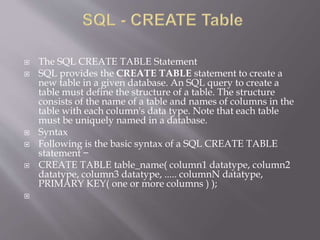
 The SQL CREATE TABLE Statement
 SQL provides the CREATE TABLE statement to create a
new table in a given database. An SQL query to create a
table must define the structure of a table. The structure
consists of the name of a table and names of columns in the
table with each column's data type. Note that each table
must be uniquely named in a database.
 Syntax
 Following is the basic syntax of a SQL CREATE TABLE
statement −
 CREATE TABLE table_name( column1 datatype, column2
datatype, column3 datatype, ..... columnN datatype,
PRIMARY KEY( one or more columns ) );


SQL.pptx

  • 1.
    SQL (Structured QueryLanguage) is a programming language which is used to manage data stored in relational databases like MySQL, MS Access, SQL Server, Oracle, Sybase, Informix, Postgres etc. Our SQL tutorial helps you learn SQL (Structured Query Language) in simple and easy steps so that you can start your database programming quickly. It covers most of the important concepts related to SQL for a basic to advanced understanding of SQL and to get a feel of how SQL works. SQL is a database computer language designed for the retrieval and management of data in a relational databases like MySQL, MS Access, SQL Server, Oracle, Sybase, Informix, Postgres etc. SQL stands for Structured Query Language. SQL was developed in the 1970s by IBM Computer Scientists.
  • 2.
     SQL iswidely popular because it offers the following advantages −  Allows users to access data in the relational database management systems.  Allows users to describe the data.  Allows users to define the data in a database and manipulate that data.  Allows to embed within other languages using SQL modules, libraries & pre-compilers.  Allows users to create and drop databases and tables.  Allows users to create view, stored procedure, functions in a database.  Allows users to set permissions on tables, procedures and views. 
  • 3.
     The SQLCREATE TABLE Statement  SQL provides the CREATE TABLE statement to create a new table in a given database. An SQL query to create a table must define the structure of a table. The structure consists of the name of a table and names of columns in the table with each column's data type. Note that each table must be uniquely named in a database.  Syntax  Following is the basic syntax of a SQL CREATE TABLE statement −  CREATE TABLE table_name( column1 datatype, column2 datatype, column3 datatype, ..... columnN datatype, PRIMARY KEY( one or more columns ) ); 