


About MySQL Introduction to SQL: SQL is a standard language for accessing and manipulating databases. What is SQL? * SQL stands for Structured Query Language * SQL lets you access and manipulate databases * SQL is an ANSI (American National Standards Institute) standard
What Can MySQL do? *  SQL can execute queries against a database * SQL can retrieve data from a database * SQL can insert records in a database * SQL can update records in a database * SQL can delete records from a database * SQL can create new databases * SQL can create new tables in a database * SQL can create stored procedures in a database * SQL can create views in a database * SQL can set permissions on tables, procedures, and views
SQL is a Standard - BUT.... Although SQL is an ANSI (American National Standards Institute) standard, there are many different versions of the SQL language. However, to be compliant with the ANSI standard, they all support at least the major commands (such as SELECT, UPDATE, DELETE, INSERT, WHERE) in a similar manner. Note: Most of the SQL database programs also have their own proprietary extensions in addition to the SQL standard!
Using SQL in Your Web Site To build a web site that shows some data from a database, you will need the following: * An RDBMS database program (i.e. MS Access, SQL Server, MySQL) * A server-side scripting language, like PHP or ASP * SQL * HTML / CSS
RDBMS RDBMS stands for Relational Database Management System. RDBMS is the basis for SQL, and for all modern database systems like MS SQL Server, IBM DB2, Oracle, MySQL, and Microsoft Access. The data in RDBMS is stored in database objects called tables. A table is a collections of related data entries and it consists of columns and rows.
SQL Syntax
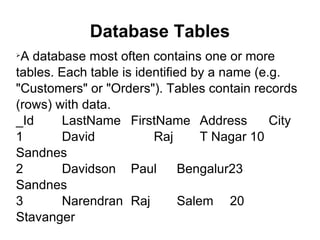
Database Tables A database most often contains one or more tables. Each table is identified by a name (e.g. "Customers" or "Orders"). Tables contain records (rows) with data. _Id  LastName  FirstName  Address  City 1  David   Raj  T Nagar 10  Sandnes 2  Davidson  Paul Bengalur23  Sandnes 3  Narendran  Raj  Salem   20  Stavanger
Keep in Mind That... SQL is not case sensitive
Semicolon after SQL Statements? Some database systems require a semicolon at the end of each SQL statement. Semicolon is the standard way to separate each SQL statement in database systems that allow more than one SQL statement to be executed in the same call to the server.
SQL Types SQL can be divided into two parts:  The Data Manipulation Language (DML) The Data Definition Language (DDL)
DML Statements The query and update commands form the DML part of SQL: * SELECT - extracts data from a database * UPDATE - updates data in a database * DELETE - deletes data from a database * INSERT INTO - inserts new data into a database
DDL Statements The DDL part of SQL permits database tables to be created or deleted. It also define indexes (keys), specify links between tables, and impose constraints between tables. The most important DDL statements in SQL are: * CREATE DATABASE - creates a new database * ALTER DATABASE - modifies a database * CREATE TABLE - creates a new table * ALTER TABLE - modifies a table * DROP TABLE - deletes a table * CREATE INDEX - creates an index (search key) * DROP INDEX - deletes an index


MySQL intro

  • 1.
    About MySQL Introductionto SQL: SQL is a standard language for accessing and manipulating databases. What is SQL? * SQL stands for Structured Query Language * SQL lets you access and manipulate databases * SQL is an ANSI (American National Standards Institute) standard
  • 2.
    What Can MySQLdo? * SQL can execute queries against a database * SQL can retrieve data from a database * SQL can insert records in a database * SQL can update records in a database * SQL can delete records from a database * SQL can create new databases * SQL can create new tables in a database * SQL can create stored procedures in a database * SQL can create views in a database * SQL can set permissions on tables, procedures, and views
  • 3.
    SQL is aStandard - BUT.... Although SQL is an ANSI (American National Standards Institute) standard, there are many different versions of the SQL language. However, to be compliant with the ANSI standard, they all support at least the major commands (such as SELECT, UPDATE, DELETE, INSERT, WHERE) in a similar manner. Note: Most of the SQL database programs also have their own proprietary extensions in addition to the SQL standard!
  • 4.
    Using SQL inYour Web Site To build a web site that shows some data from a database, you will need the following: * An RDBMS database program (i.e. MS Access, SQL Server, MySQL) * A server-side scripting language, like PHP or ASP * SQL * HTML / CSS
  • 5.
    RDBMS RDBMS standsfor Relational Database Management System. RDBMS is the basis for SQL, and for all modern database systems like MS SQL Server, IBM DB2, Oracle, MySQL, and Microsoft Access. The data in RDBMS is stored in database objects called tables. A table is a collections of related data entries and it consists of columns and rows.
  • 6.
  • 7.
    Database Tables Adatabase most often contains one or more tables. Each table is identified by a name (e.g. "Customers" or "Orders"). Tables contain records (rows) with data. _Id LastName FirstName Address City 1 David Raj T Nagar 10 Sandnes 2 Davidson Paul Bengalur23 Sandnes 3 Narendran Raj Salem 20 Stavanger
  • 8.
    Keep in MindThat... SQL is not case sensitive
  • 9.
    Semicolon after SQLStatements? Some database systems require a semicolon at the end of each SQL statement. Semicolon is the standard way to separate each SQL statement in database systems that allow more than one SQL statement to be executed in the same call to the server.
  • 10.
    SQL Types SQLcan be divided into two parts: The Data Manipulation Language (DML) The Data Definition Language (DDL)
  • 11.
    DML Statements Thequery and update commands form the DML part of SQL: * SELECT - extracts data from a database * UPDATE - updates data in a database * DELETE - deletes data from a database * INSERT INTO - inserts new data into a database
  • 12.
    DDL Statements TheDDL part of SQL permits database tables to be created or deleted. It also define indexes (keys), specify links between tables, and impose constraints between tables. The most important DDL statements in SQL are: * CREATE DATABASE - creates a new database * ALTER DATABASE - modifies a database * CREATE TABLE - creates a new table * ALTER TABLE - modifies a table * DROP TABLE - deletes a table * CREATE INDEX - creates an index (search key) * DROP INDEX - deletes an index
  • 13.
  • 14.
  • 15.