SQL: The Backbone of Modern
Data Management
Introduction
In the vast and ever-expanding digital universe, data acts as both the currency and the
lifeblood, driving decisions, innovations, and ultimately, the future of businesses across
the globe. At the heart of data manipulation, management, and analysis lies SQL
(Structured Query Language), a specialized programming language designed for managing
and manipulating relational databases. Since its inception in the 1970s, SQL has become
an indispensable tool in the data scientist's toolkit, embodying the convergence of
simplicity, power, and versatility.
The Genesis and Evolution of SQL
SQL's journey began as a project at IBM, where it was initially developed to manipulate
and retrieve data stored in IBM's early relational database management system. Its
introduction was a pivotal moment in the data management field, marking a departure
from the cumbersome and less intuitive data management methodologies of the past. As
it evolved, SQL adhered to standards set by the American National Standards Institute
(ANSI) and the International Organization for Standardization (ISO), ensuring consistency
and interoperability across different database systems.
Jeevi academy
8807798331
hello@jeeviacademy.com
www.jeeviacademy.com
Follow us at
Learn any technology with us.
#jeeviacademy
SQL in the Modern Data Ecosystem
Today, SQL is universally recognized for its critical role in data retrieval, analysis, and
manipulation. Its syntax allows for the execution of a variety of operations, such as
querying data, updating records, and managing access to database objects. What makes
SQL uniquely powerful is its ability to communicate with databases in a way that is both
approachable for beginners and deeply powerful for experienced users. This balance has
cemented SQL's position as a lingua franca of data manipulation across disparate
database systems.
One of SQL's core strengths lies in its simplicity and efficiency in handling complex data
queries. Whether it's aggregating large datasets, conducting transactional operations, or
querying relational databases, SQL provides the tools and functions necessary to extract
meaningful insights from data. Its relevance extends beyond traditional database
management to underpin the burgeoning fields of data science, big data analytics, and
business intelligence.
The Educational and Professional Landscape
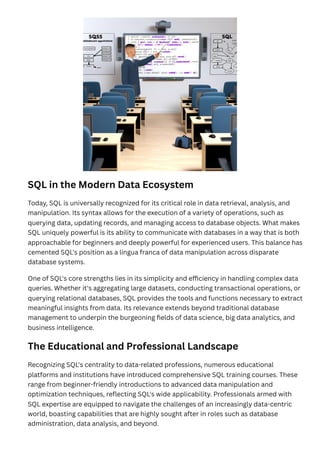
Recognizing SQL's centrality to data-related professions, numerous educational
platforms and institutions have introduced comprehensive SQL training courses. These
range from beginner-friendly introductions to advanced data manipulation and
optimization techniques, reflecting SQL's wide applicability. Professionals armed with
SQL expertise are equipped to navigate the challenges of an increasingly data-centric
world, boasting capabilities that are highly sought after in roles such as database
administration, data analysis, and beyond.
Furthermore, SQL training has become more accessible than ever, with online courses
offering certifications and skill-building exercises. Platforms like Coursera and Skillshare
provide courses developed by top universities and seasoned professionals, making it
easier for individuals to acquire and refine their SQL skills irrespective of their
educational background or professional experience.
The Future of SQL
As the digital landscape continues to evolve, so too does the role of SQL within it. With
the advent of NoSQL databases and new data management technologies, some
speculated that SQL's relevance might wane. However, the opposite has proven true; SQL
has adapted, integrating with new technologies and maintaining its position as a crucial
tool for data management and analysis. The future of SQL is one of adaptation and
integration, as it continues to serve as the foundation upon which new data technologies
are built and refined.
Conclusion
SQL's journey from a pioneering query language to the cornerstone of modern data
management underscores its enduring importance. Its continued evolution and
adaptability speak to a simple truth: in a world driven by data, SQL remains an essential
skill for anyone looking to unlock the full potential of that data. As we stand on the brink
of new discoveries and technologies, SQL will undoubtedly continue to play a pivotal role
in shaping the future of data science, analytics, and beyond.
For more details about sql course in chennai, sql training in chennai

sql course in Chennai, sql training in Chennai

  • 1.
    SQL: The Backboneof Modern Data Management Introduction In the vast and ever-expanding digital universe, data acts as both the currency and the lifeblood, driving decisions, innovations, and ultimately, the future of businesses across the globe. At the heart of data manipulation, management, and analysis lies SQL (Structured Query Language), a specialized programming language designed for managing and manipulating relational databases. Since its inception in the 1970s, SQL has become an indispensable tool in the data scientist's toolkit, embodying the convergence of simplicity, power, and versatility. The Genesis and Evolution of SQL SQL's journey began as a project at IBM, where it was initially developed to manipulate and retrieve data stored in IBM's early relational database management system. Its introduction was a pivotal moment in the data management field, marking a departure from the cumbersome and less intuitive data management methodologies of the past. As it evolved, SQL adhered to standards set by the American National Standards Institute (ANSI) and the International Organization for Standardization (ISO), ensuring consistency and interoperability across different database systems. Jeevi academy 8807798331 hello@jeeviacademy.com www.jeeviacademy.com Follow us at Learn any technology with us. #jeeviacademy
  • 2.
    SQL in theModern Data Ecosystem Today, SQL is universally recognized for its critical role in data retrieval, analysis, and manipulation. Its syntax allows for the execution of a variety of operations, such as querying data, updating records, and managing access to database objects. What makes SQL uniquely powerful is its ability to communicate with databases in a way that is both approachable for beginners and deeply powerful for experienced users. This balance has cemented SQL's position as a lingua franca of data manipulation across disparate database systems. One of SQL's core strengths lies in its simplicity and efficiency in handling complex data queries. Whether it's aggregating large datasets, conducting transactional operations, or querying relational databases, SQL provides the tools and functions necessary to extract meaningful insights from data. Its relevance extends beyond traditional database management to underpin the burgeoning fields of data science, big data analytics, and business intelligence. The Educational and Professional Landscape Recognizing SQL's centrality to data-related professions, numerous educational platforms and institutions have introduced comprehensive SQL training courses. These range from beginner-friendly introductions to advanced data manipulation and optimization techniques, reflecting SQL's wide applicability. Professionals armed with SQL expertise are equipped to navigate the challenges of an increasingly data-centric world, boasting capabilities that are highly sought after in roles such as database administration, data analysis, and beyond.
  • 3.
    Furthermore, SQL traininghas become more accessible than ever, with online courses offering certifications and skill-building exercises. Platforms like Coursera and Skillshare provide courses developed by top universities and seasoned professionals, making it easier for individuals to acquire and refine their SQL skills irrespective of their educational background or professional experience. The Future of SQL As the digital landscape continues to evolve, so too does the role of SQL within it. With the advent of NoSQL databases and new data management technologies, some speculated that SQL's relevance might wane. However, the opposite has proven true; SQL has adapted, integrating with new technologies and maintaining its position as a crucial tool for data management and analysis. The future of SQL is one of adaptation and integration, as it continues to serve as the foundation upon which new data technologies are built and refined. Conclusion SQL's journey from a pioneering query language to the cornerstone of modern data management underscores its enduring importance. Its continued evolution and adaptability speak to a simple truth: in a world driven by data, SQL remains an essential skill for anyone looking to unlock the full potential of that data. As we stand on the brink of new discoveries and technologies, SQL will undoubtedly continue to play a pivotal role in shaping the future of data science, analytics, and beyond. For more details about sql course in chennai, sql training in chennai