BikalpaThapa
COMMANDS IN SQL
www.slideshare.net/AlkThp
ALTER TABLE
ALTERTABLE lets you add columns to a table in a database.
ALTERTABLE table_name
ADD column_name datatype;
BikalpaThapa
COMMANDS IN SQL
www.slideshare.net/AlkThp
AND
AND is an operator that combines two conditions. Both conditions
must be true for the row to be included in the result set.
SELECT column_name (s)
FROM table_name
WHERE column_1 = value_1
AND column_2 = value_2;
BikalpaThapa
COMMANDS IN SQL
www.slideshare.net/AlkThp
AND
AND is an operator that combines two conditions. Both conditions
must be true for the row to be included in the result set.
SELECT column_name (s)
FROM table_name
WHERE column_1 = value_1
AND column_2 = value_2;
BikalpaThapa
COMMANDS IN SQL
www.slideshare.net/AlkThp
WITH
WITH clause lets you store the result of a query in a temporary
table using an alias. You can also define multiple temporary tables
using a comma and with one instance of the WITH keyboard.
WITH temporary_name AS (
SELECT*
FROM table_name)
SELECT*
FROM temporary_name
WHERE column_name operator value;
BikalpaThapa
COMMANDS IN SQL
www.slideshare.net/AlkThp
WHERE
WHERE is a clause that indicates you want to filter the result set to
include only rows where the following condition is true.
SELECT column_name (s)
FROM table_name
WHERE column_name operator value;
BikalpaThapa
COMMANDS IN SQL
www.slideshare.net/AlkThp
SELECT DISTINCT
SELECT DISTINCT specifies that the statement is going to be a
query that returns unique values in the specified column(s).
SELECT DISTINCT column_name
FROM table_name;
BikalpaThapa
COMMANDS IN SQL
www.slideshare.net/AlkThp
SUM
SUM() is a function that takes the name of a column as an
argument and returns the sum of all the values in that column.
SELECT SUM (column_name)
FROM table_name;
BikalpaThapa
COMMANDS IN SQL
www.slideshare.net/AlkThp
UPDATE
UPDATE statements allows you to edit rows in a table.
UPDATE table_name
SET some_column = some_value
WHERE some_column = some_value;
BikalpaThapa
COMMANDS IN SQL
www.slideshare.net/AlkThp
SELECT
SELECT statements are used to fetch data from a database. Every
query will begin with SELECT.
SELECT column_name
FROM table_name;
BikalpaThapa
COMMANDS IN SQL
www.slideshare.net/AlkThp
ROUND()
ROUND() is a function that takes a column name and an integer as
an argument. It rounds the values in the column to the number of
decimal places specified by the integer.
SELECT ROUND (column_name, integer)
FROM table_name;
BikalpaThapa
COMMANDS IN SQL
www.slideshare.net/AlkThp
OUTER JOIN
An outer join will combine rows from different tales even if the join
condition is not met. Every row in the left table is returned in the
result set, and if the join condition is not met, then NULL values are
used to fill in the columns from the right table.
SELECT column_name(s)
FROM table_1
LEFT JOIN table_2
ON table_1.column_name = table_2.column_name;
BikalpaThapa
COMMANDS IN SQL
www.slideshare.net/AlkThp
MIN()
MIN() is a function that takes the name of a column as an argument
and returns the smallest value in that column.
SELECT MIN (column_name)
FROM table_name;
BikalpaThapa
COMMANDS IN SQL
www.slideshare.net/AlkThp
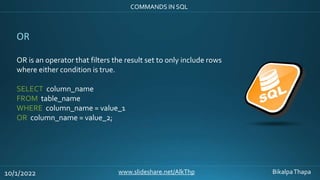
OR
OR is an operator that filters the result set to only include rows
where either condition is true.
SELECT column_name
FROM table_name
WHERE column_name = value_1
OR column_name = value_2;
BikalpaThapa
COMMANDS IN SQL
www.slideshare.net/AlkThp
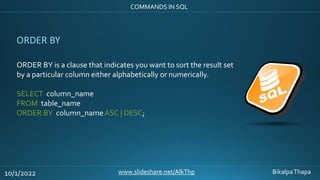
ORDER BY
ORDER BY is a clause that indicates you want to sort the result set
by a particular column either alphabetically or numerically.
SELECT column_name
FROM table_name
ORDER BY column_nameASC | DESC;
BikalpaThapa
COMMANDS IN SQL
www.slideshare.net/AlkThp
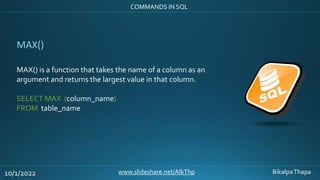
MAX()
MAX() is a function that takes the name of a column as an
argument and returns the largest value in that column.
SELECT MAX (column_name)
FROM table_name
BikalpaThapa
COMMANDS IN SQL
www.slideshare.net/AlkThp
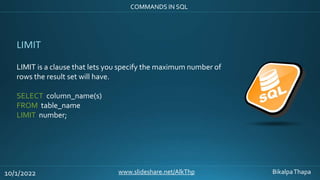
LIMIT
LIMIT is a clause that lets you specify the maximum number of
rows the result set will have.
SELECT column_name(s)
FROM table_name
LIMIT number;
BikalpaThapa
COMMANDS IN SQL
www.slideshare.net/AlkThp
LIKE
LIKE is a special operator used with the WHERE clause to search for
a specific pattern in a column.
SELECT column_name(s)
FROM table_name
WHERE column_name LIKE pattern;
BikalpaThapa
COMMANDS IN SQL
www.slideshare.net/AlkThp
INNER JOIN
An inner join will combine rows from different tables if the join
condition is true.
SELECT column_name(s)
FROM table_1
JOIN table_2
ON table_1.column_name = table_2.column_name;
BikalpaThapa
COMMANDS IN SQL
www.slideshare.net/AlkThp
INSERT
INSERT statements are used to add a new row to a table.
INSERT INTO table_name (column_1, column_2, column_3)
VALUES (value_1, ‘value_2’, value_3);
BikalpaThapa
COMMANDS IN SQL
www.slideshare.net/AlkThp
IS NULL / IS NOT NULL
IS NULL and IS NOT NULL are operators used with theWHERE
clause to test for empty values.
SELECT column_name(s)
FROM table_name
WHERE column_name IS NULL;
BikalpaThapa
COMMANDS IN SQL
www.slideshare.net/AlkThp
HAVING
HAVING was added to SQL because the WHERE keyword could not
be used with aggregate functions.
SELECT column_name, COUNT(*)
FROM table_name
GROUP BY column_name
HAVING COUNT(*) > value;
BikalpaThapa
COMMANDS IN SQL
www.slideshare.net/AlkThp
GROUP BY
GROUP BY is a clause in SQL that is only used with aggregate
functions. It is used in collaboration with the SELECT statement to
arrange identical data into groups.
SELECT column_name, COUNT(*)
FROM table_name
GROUP BY column_name;
BikalpaThapa
COMMANDS IN SQL
www.slideshare.net/AlkThp
DELETE
DELETE statements are used to remove rows from a table.
DELETE FROM table_name
WHERE some_column = some_value;

SQL COMMANDS WITH EXAMPLES.pptx