Andrew Sheaff presents about swimming sprint training to the audience at WAFSU.org, the World Aquatic Federation of Schools and Universities. See WAFSU.org. This is part of the lesson in the course on Bygone Seminars.
What We’ll Cover
1.The key principles for speed development
2. The skills of speed
3. Developing speed
4. Supporting speed
5. Planning
3.
Inexpensive Experience
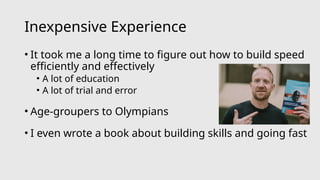
• Ittook me a long time to figure out how to build speed
efficiently and effectively
• A lot of education
• A lot of trial and error
• Age-groupers to Olympians
• I even wrote a book about building skills and going fast
What REALLY Matters
1.Skill = speed
2. To go fast, you have to go fast
3. The goal is to keep the goal the goal
6.
Faster Swimmers AreBetter Swimmers
• The KEY aspect of fast swimming is skill
• Swimmer must be able to execute great skills FAST
• All the training in the world will not compensate for poor skills
• The DETAILS matter
• Surface swimming
• Underwater swimming
• Starts
• Turns
• Breakouts
• Finishes
7.
Speed Must BePracticed
• To get better at swimming fast, swimmers have to
practice swimming fast
• The more QUALITY work they do, the more they will improve
• Set them up for success
8.
Stay Focused
• Developingskill and speed is difficult
1. Stay focused on skill development
2. Stay focused on speed development
3. Don’t let anything take away from #1 and #2
• There will appear to be easier answers
• They don’t exist
• It’s simple, not easy
EACH Component MustBe Addressed
• Targets
• Surface swimming
• Underwater swimming
• Starts
• Turns
• Breakouts
• Finishes
• EVERYTHING matters
• The faster swimmers want to go, the MORE important it is
11.
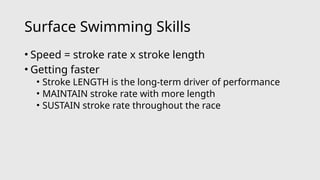
Surface Swimming Skills
•Speed = stroke rate x stroke length
• Getting faster
• Stroke LENGTH is the long-term driver of performance
• MAINTAIN stroke rate with more length
• SUSTAIN stroke rate throughout the race
12.
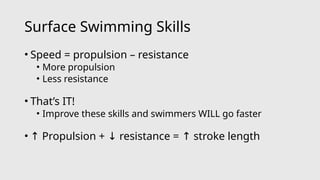
Surface Swimming Skills
•Speed = propulsion – resistance
• More propulsion
• Less resistance
• That’s IT!
• Improve these skills and swimmers WILL go faster
• ↑ Propulsion + resistance = stroke length
↓ ↑
13.
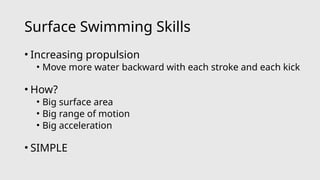
Surface Swimming Skills
•Increasing propulsion
• Move more water backward with each stroke and each kick
• How?
• Big surface area
• Big range of motion
• Big acceleration
• SIMPLE
14.
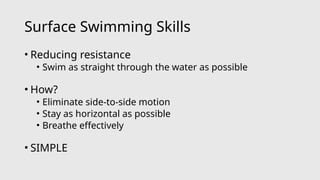
Surface Swimming Skills
•Reducing resistance
• Swim as straight through the water as possible
• How?
• Eliminate side-to-side motion
• Stay as horizontal as possible
• Breathe effectively
• SIMPLE
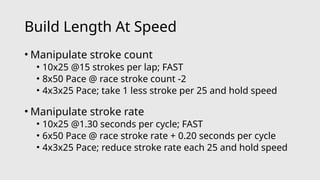
Build Length AtSpeed
• Manipulate stroke count
• 10x25 @15 strokes per lap; FAST
• 8x50 Pace @ race stroke count -2
• 4x3x25 Pace; take 1 less stroke per 25 and hold speed
• Manipulate stroke rate
• 10x25 @1.30 seconds per cycle; FAST
• 6x50 Pace @ race stroke rate + 0.20 seconds per cycle
• 4x3x25 Pace; reduce stroke rate each 25 and hold speed
17.
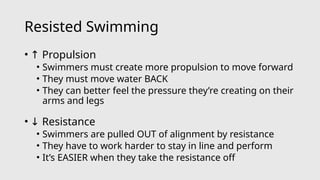
Resisted Swimming
• ↑Propulsion
• Swimmers must create more propulsion to move forward
• They must move water BACK
• They can better feel the pressure they’re creating on their
arms and legs
• ↓ Resistance
• Swimmers are pulled OUT of alignment by resistance
• They have to work harder to stay in line and perform
• It’s EASIER when they take the resistance off
18.
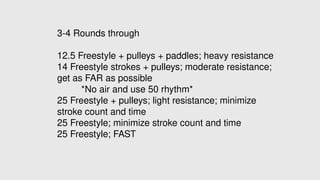
3-4 Rounds through
12.5Freestyle + pulleys + paddles; heavy resistance
14 Freestyle strokes + pulleys; moderate resistance;
get as FAR as possible
*No air and use 50 rhythm*
25 Freestyle + pulleys; light resistance; minimize
stroke count and time
25 Freestyle; minimize stroke count and time
25 Freestyle; FAST
19.
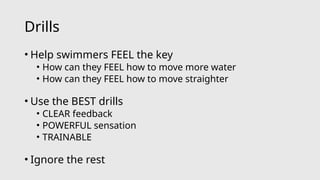
Drills
• Help swimmersFEEL the key
• How can they FEEL how to move more water
• How can they FEEL how to move straighter
• Use the BEST drills
• CLEAR feedback
• POWERFUL sensation
• TRAINABLE
• Ignore the rest
20.
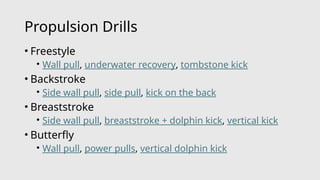
Propulsion Drills
• Freestyle
•Wall pull, underwater recovery, tombstone kick
• Backstroke
• Side wall pull, side pull, kick on the back
• Breaststroke
• Side wall pull, breaststroke + dolphin kick, vertical kick
• Butterfly
• Wall pull, power pulls, vertical dolphin kick
21.
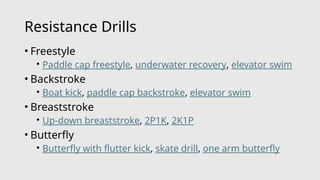
Resistance Drills
• Freestyle
•Paddle cap freestyle, underwater recovery, elevator swim
• Backstroke
• Boat kick, paddle cap backstroke, elevator swim
• Breaststroke
• Up-down breaststroke, 2P1K, 2K1P
• Butterfly
• Butterfly with flutter kick, skate drill, one arm butterfly
22.
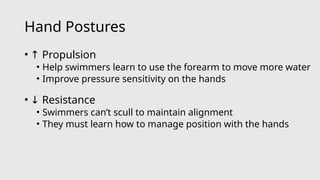
Hand Postures
• ↑Propulsion
• Help swimmers learn to use the forearm to move more water
• Improve pressure sensitivity on the hands
• ↓ Resistance
• Swimmers can’t scull to maintain alignment
• They must learn how to manage position with the hands
23.
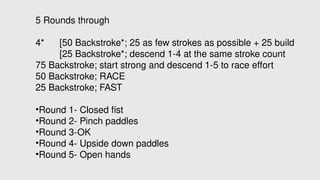
5 Rounds through
4*[50 Backstroke*; 25 as few strokes as possible + 25 build
[25 Backstroke*; descend 1-4 at the same stroke count
75 Backstroke; start strong and descend 1-5 to race effort
50 Backstroke; RACE
25 Backstroke; FAST
•Round 1- Closed fist
•Round 2- Pinch paddles
•Round 3-OK
•Round 4- Upside down paddles
•Round 5- Open hands
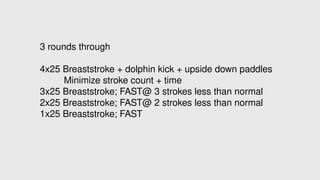
24.
3 rounds through
4x25Breaststroke + dolphin kick + upside down paddles
Minimize stroke count + time
3x25 Breaststroke; FAST@ 3 strokes less than normal
2x25 Breaststroke; FAST@ 2 strokes less than normal
1x25 Breaststroke; FAST
25.
Underwater Kicking Skills
•Stability
• Create undulation through controlled upper body movements
• Propulsion
• Hold water with the feet through a big range of motion
• Both directions
• Develop a fast and effective upkick
• Alignment
• Maintain great streamline
Drills
• Stability
• Wallkick, vertical kick holding an object,
underwater kick holding an object
• Propulsion
• Flipper kick, vertical kick moving back
• Both directions
• Vertical kick moving forward, kicking on the back
• Alignment
• Arms crossed behind the head, amplitude changes
28.
Resistance
• Parachute/cord/wall kick/bulldozer
•Swimmers have to hold water with the feet
• They can learn to feel pressure on the feet
• DragSox
• Forces a wavelike kick
• Requires swimmers to create more force
• Shoes can work well
• Clothing
• Swimmers can better feel their alignment moving through the water
• Better awareness = better alignment = more speed
29.
4 rounds through
6x[10 Seconds on/60 seconds off] vertical kicking +
DragSox; FAST
ODD Moving forward EVEN moving backward
4x15 Underwater DK on side + DragSox; FAST
2x8DK + 4 cycles swim*; FAST
Round 2 add fins
Round 4 NO Dragsox
*Swim can be any stroke; stick with one for the set
30.
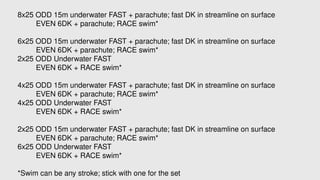
8x25 ODD 15munderwater FAST + parachute; fast DK in streamline on surface
EVEN 6DK + parachute; RACE swim*
6x25 ODD 15m underwater FAST + parachute; fast DK in streamline on surface
EVEN 6DK + parachute; RACE swim*
2x25 ODD Underwater FAST
EVEN 6DK + RACE swim*
4x25 ODD 15m underwater FAST + parachute; fast DK in streamline on surface
EVEN 6DK + parachute; RACE swim*
4x25 ODD Underwater FAST
EVEN 6DK + RACE swim*
2x25 ODD 15m underwater FAST + parachute; fast DK in streamline on surface
EVEN 6DK + parachute; RACE swim*
6x25 ODD Underwater FAST
EVEN 6DK + RACE swim*
*Swim can be any stroke; stick with one for the set
31.
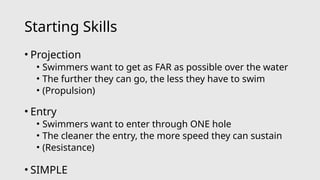
Starting Skills
• Projection
•Swimmers want to get as FAR as possible over the water
• The further they can go, the less they have to swim
• (Propulsion)
• Entry
• Swimmers want to enter through ONE hole
• The cleaner the entry, the more speed they can sustain
• (Resistance)
• SIMPLE
32.
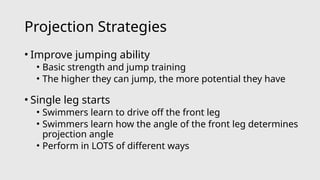
Projection Strategies
• Improvejumping ability
• Basic strength and jump training
• The higher they can jump, the more potential they have
• Single leg starts
• Swimmers learn to drive off the front leg
• Swimmers learn how the angle of the front leg determines
projection angle
• Perform in LOTS of different ways
33.
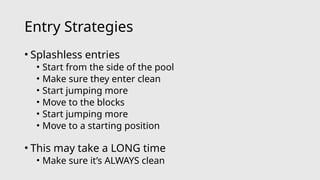
Entry Strategies
• Splashlessentries
• Start from the side of the pool
• Make sure they enter clean
• Start jumping more
• Move to the blocks
• Start jumping more
• Move to a starting position
• This may take a LONG time
• Make sure it’s ALWAYS clean
34.
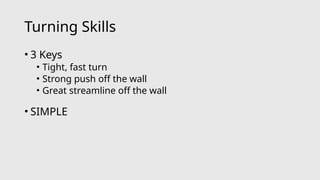
Turning Skills
• 3Keys
• Tight, fast turn
• Strong push off the wall
• Great streamline off the wall
• SIMPLE
35.
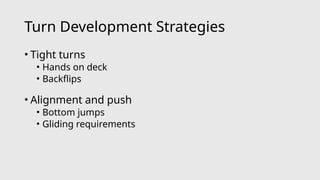
Turn Development Strategies
•Tight turns
• Hands on deck
• Backflips
• Alignment and push
• Bottom jumps
• Gliding requirements
36.
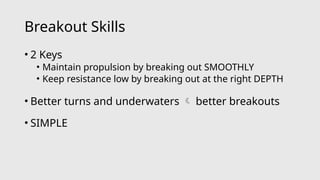
Breakout Skills
• 2Keys
• Maintain propulsion by breaking out SMOOTHLY
• Keep resistance low by breaking out at the right DEPTH
• Better turns and underwaters better breakouts
• SIMPLE
37.
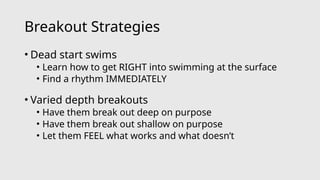
Breakout Strategies
• Deadstart swims
• Learn how to get RIGHT into swimming at the surface
• Find a rhythm IMMEDIATELY
• Varied depth breakouts
• Have them break out deep on purpose
• Have them break out shallow on purpose
• Let them FEEL what works and what doesn’t
38.
Finishing Skills
• 3Keys
• Maintain rhythm
• Stay in line
• Full stroke finish
• SIMPLE
39.
Finishing Strategies
• Midpool finishes
• Start at different points
• Building repetitions
• The more they get used to finishing fast, the more likely it is
that it will happen
• HABIT
Training Goals
• Outcomes
•Develop the ability to execute skills at speed
• Develop the ability to sustain skills at speed
• Strategy
• Get as much practice swimming fast as possible
• Ensure skills are developed at speed
• Perform some speed work when fatigued
42.
50 Speed
• Thegoal is to improve the ability to swim as fast as
possible with better and better skills
• Build top end speed
• Practice skills at maximal speed
• Develop the skills and abilities necessary race over 50-meters
• Practice swimming at REALLY, REALLY high intensities
43.
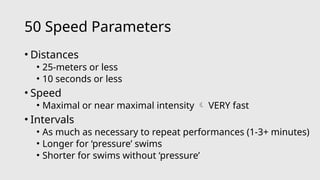
50 Speed Parameters
•Distances
• 25-meters or less
• 10 seconds or less
• Speed
• Maximal or near maximal intensity VERY fast
• Intervals
• As much as necessary to repeat performances (1-3+ minutes)
• Longer for ‘pressure’ swims
• Shorter for swims without ‘pressure’
44.
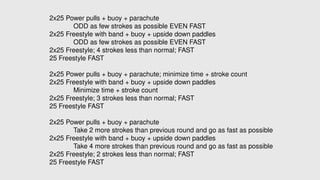
2x25 Power pulls+ buoy + parachute
ODD as few strokes as possible EVEN FAST
2x25 Freestyle with band + buoy + upside down paddles
ODD as few strokes as possible EVEN FAST
2x25 Freestyle; 4 strokes less than normal; FAST
25 Freestyle FAST
2x25 Power pulls + buoy + parachute; minimize time + stroke count
2x25 Freestyle with band + buoy + upside down paddles
Minimize time + stroke count
2x25 Freestyle; 3 strokes less than normal; FAST
25 Freestyle FAST
2x25 Power pulls + buoy + parachute
Take 2 more strokes than previous round and go as fast as possible
2x25 Freestyle with band + buoy + upside down paddles
Take 4 more strokes than previous round and go as fast as possible
2x25 Freestyle; 2 strokes less than normal; FAST
25 Freestyle FAST
45.
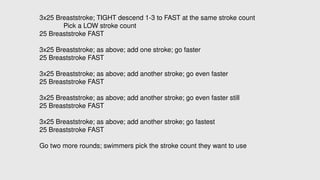
3x25 Breaststroke; TIGHTdescend 1-3 to FAST at the same stroke count
Pick a LOW stroke count
25 Breaststroke FAST
3x25 Breaststroke; as above; add one stroke; go faster
25 Breaststroke FAST
3x25 Breaststroke; as above; add another stroke; go even faster
25 Breaststroke FAST
3x25 Breaststroke; as above; add another stroke; go even faster still
25 Breaststroke FAST
3x25 Breaststroke; as above; add another stroke; go fastest
25 Breaststroke FAST
Go two more rounds; swimmers pick the stroke count they want to use
46.
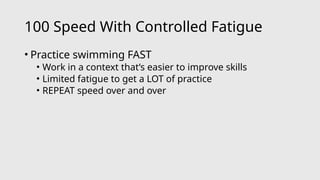
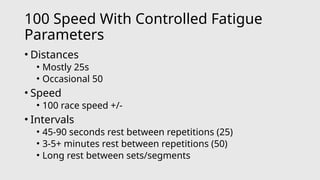
100 Speed WithControlled Fatigue
• Practice swimming FAST
• Work in a context that’s easier to improve skills
• Limited fatigue to get a LOT of practice
• REPEAT speed over and over
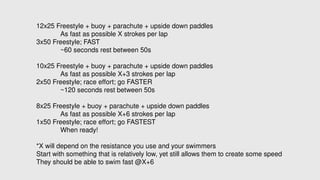
12x25 Freestyle +buoy + parachute + upside down paddles
As fast as possible X strokes per lap
3x50 Freestyle; FAST
~60 seconds rest between 50s
10x25 Freestyle + buoy + parachute + upside down paddles
As fast as possible X+3 strokes per lap
2x50 Freestyle; race effort; go FASTER
~120 seconds rest between 50s
8x25 Freestyle + buoy + parachute + upside down paddles
As fast as possible X+6 strokes per lap
1x50 Freestyle; race effort; go FASTEST
When ready!
*X will depend on the resistance you use and your swimmers
Start with something that is relatively low, yet still allows them to create some speed
They should be able to swim fast @Х+6
49.
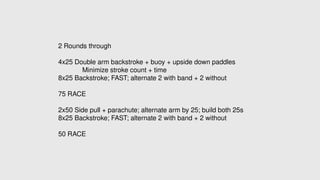
2 Rounds through
4x25Double arm backstroke + buoy + upside down paddles
Minimize stroke count + time
8x25 Backstroke; FAST; alternate 2 with band + 2 without
75 RACE
2x50 Side pull + parachute; alternate arm by 25; build both 25s
8x25 Backstroke; FAST; alternate 2 with band + 2 without
50 RACE
50.
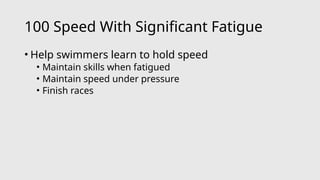
100 Speed WithSignificant Fatigue
• Help swimmers learn to hold speed
• Maintain skills when fatigued
• Maintain speed under pressure
• Finish races
51.
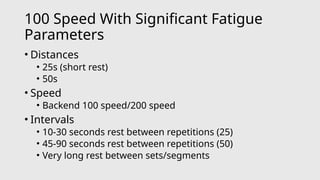
100 Speed WithSignificant Fatigue
Parameters
• Distances
• 25s (short rest)
• 50s
• Speed
• Backend 100 speed/200 speed
• Intervals
• 10-30 seconds rest between repetitions (25)
• 45-90 seconds rest between repetitions (50)
• Very long rest between sets/segments
52.
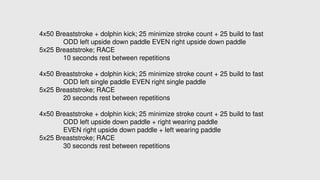
4x50 Breaststroke +dolphin kick; 25 minimize stroke count + 25 build to fast
ODD left upside down paddle EVEN right upside down paddle
5x25 Breaststroke; RACE
10 seconds rest between repetitions
4x50 Breaststroke + dolphin kick; 25 minimize stroke count + 25 build to fast
ODD left single paddle EVEN right single paddle
5x25 Breaststroke; RACE
20 seconds rest between repetitions
4x50 Breaststroke + dolphin kick; 25 minimize stroke count + 25 build to fast
ODD left upside down paddle + right wearing paddle
EVEN right upside down paddle + left wearing paddle
5x25 Breaststroke; RACE
30 seconds rest between repetitions
53.
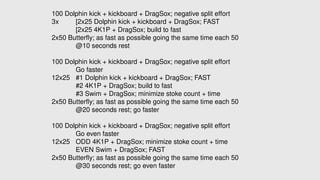
100 Dolphin kick+ kickboard + DragSox; negative split effort
3х [2x25 Dolphin kick + kickboard + DragSox; FAST
[2x25 4K1P + DragSox; build to fast
2x50 Butterfly; as fast as possible going the same time each 50
@10 seconds rest
100 Dolphin kick + kickboard + DragSox; negative split effort
Go faster
12x25 #1 Dolphin kick + kickboard + DragSox; FAST
#2 4K1P + DragSox; build to fast
#3 Swim + DragSox; minimize stoke count + time
2x50 Butterfly; as fast as possible going the same time each 50
@20 seconds rest; go faster
100 Dolphin kick + kickboard + DragSox; negative split effort
Go even faster
12x25 ODD 4K1P + DragSox; minimize stoke count + time
EVEN Swim + DragSox; FAST
2x50 Butterfly; as fast as possible going the same time each 50
@30 seconds rest; go even faster
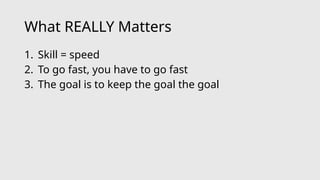
What REALLY Matters
1.Skill = speed
2. To go fast, you have to go fast
3. The goal is to keep the goal the goal
56.
Faster Swimmers AreBetter Swimmers
• The KEY aspect of fast swimming is skill
• Swimmer must be able to execute great skills FAST
• All the training in the world will not compensate for poor skills
• The DETAILS matter
• Surface swimming
• Underwater swimming
• Starts
• Turns
• Breakouts
• Finishes
57.
Speed Must BePracticed
• To get better at swimming fast, swimmers have to
practice swimming fast
• The more QUALITY work they do, the more they will improve
• Set them up for success
58.
Stay Focused
• Developingskill and speed is difficult
1. Stay focused on skill development
2. Stay focused on speed development
3. Don’t let anything take away from #1 and #2
• There will appear to be easier answers
• They don’t exist
• It’s simple, not easy




![4 rounds through
6x [10 Seconds on/60 seconds off] vertical kicking +
DragSox; FAST
ODD Moving forward EVEN moving backward
4x15 Underwater DK on side + DragSox; FAST
2x8DK + 4 cycles swim*; FAST
Round 2 add fins
Round 4 NO Dragsox
*Swim can be any stroke; stick with one for the set](https://image.slidesharecdn.com/6sprinttraining-250620145122-ca585e07/85/Sprint-Training-Slide-Deck-from-Andrew-Sheaff-29-320.jpg)





![536463413-SWIMMING-PPT-jmd [Auto-saved].pptx](https://cdn.slidesharecdn.com/ss_thumbnails/536463413-swimming-ppt-jmdauto-saved-251220120548-5230eea3-thumbnail.jpg?width=640&height=640&fit=bounds)


