September 2016
“IYCF support groups have
empowered these women to feed
their babies well and have given us
a sense of belonging, too.”
-Hajiya Abdullahi, OVC desk officer
Improved Infant Nutrition Gives Nigerian
Mothers a Sense of Community and Pride
By SPRING/Nigeria
The Power of Knowledge
Many caregivers of infants and young children in
the Toto Local Government Area (LGA) of
Nasarawa State, Nigeria, have had no reliable
source of information about infant and young child
nutrition. That was why most women exclusively
breastfed their babies for only three months even
though the World Health Organization
recommends breastfeeding for six months before
introducing complementary solid foods and water.
In May 2015, Hajiya Abdullahi, an orphan and
vulnerable children (OVC) desk officer at the
Ministry of Women Affairs and Social Development
in Toto LGA attended a training on infant and
young child nutrition practices led by the USAID-
funded Strengthening Partnerships, Results, and
Innovations in Nutrition Globally (SPRING) project.
After the training, she was determined to use the
knowledge she gained to improve the health of
infants and young children in her area by
improving the mother or caregiver’s feeding
practices.
From Student to Teacher
In July 2015, SPRING supported a three-day
training in Toto conducted by Action Aid Pact
(AAP), a local civil society organization working
with the USAID-funded SMILE program (a SPRING
partner). Participants included community
volunteers and primary health care workers. Hajiya
served as one of the trainers, helping form support
groups during the training, and attending their
meetings in the months after to monitor their
progress.
Photocredit:SPRING/Nigeria
Hajiya Abdullahi talks with infant and young child
feeding support group members in Toto, Nigeria.
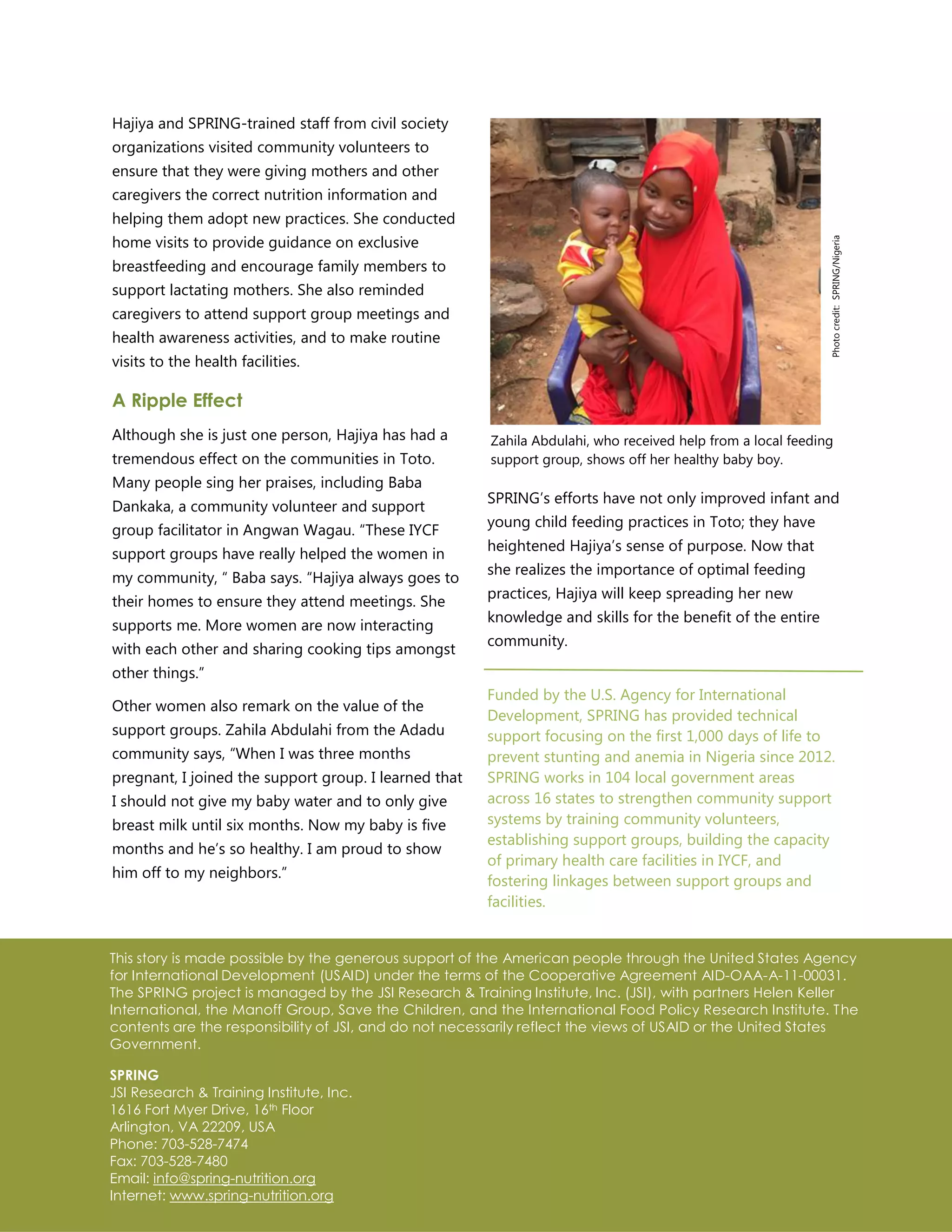
Zahila Abdulahi, who received help from a local feeding
support group, shows off her healthy baby boy.
This story is made possible by the generous support of the American people through the United States Agency
for International Development (USAID) under the terms of the Cooperative Agreement AID-OAA-A-11-00031.
The SPRING project is managed by the JSI Research & Training Institute, Inc. (JSI), with partners Helen Keller
International, the Manoff Group, Save the Children, and the International Food Policy Research Institute. The
contents are the responsibility of JSI, and do not necessarily reflect the views of USAID or the United States
Government.
SPRING
JSI Research & Training Institute, Inc.
1616 Fort Myer Drive, 16th Floor
Arlington, VA 22209, USA
Phone: 703-528-7474
Fax: 703-528-7480
Email: info@spring-nutrition.org
Internet: www.spring-nutrition.org
Hajiya and SPRING-trained staff from civil society
organizations visited community volunteers to
ensure that they were giving mothers and other
caregivers the correct nutrition information and
helping them adopt new practices. She conducted
home visits to provide guidance on exclusive
breastfeeding and encourage family members to
support lactating mothers. She also reminded
caregivers to attend support group meetings and
health awareness activities, and to make routine
visits to the health facilities.
A Ripple Effect
Although she is just one person, Hajiya has had a
tremendous effect on the communities in Toto.
Many people sing her praises, including Baba
Dankaka, a community volunteer and support
group facilitator in Angwan Wagau. “These IYCF
support groups have really helped the women in
my community, “ Baba says. “Hajiya always goes to
their homes to ensure they attend meetings. She
supports me. More women are now interacting
with each other and sharing cooking tips amongst
other things.”
Other women also remark on the value of the
support groups. Zahila Abdulahi from the Adadu
community says, “When I was three months
pregnant, I joined the support group. I learned that
I should not give my baby water and to only give
breast milk until six months. Now my baby is five
months and he’s so healthy. I am proud to show
him off to my neighbors.”
SPRING’s efforts have not only improved infant and
young child feeding practices in Toto; they have
heightened Hajiya’s sense of purpose. Now that
she realizes the importance of optimal feeding
practices, Hajiya will keep spreading her new
knowledge and skills for the benefit of the entire
community.
Funded by the U.S. Agency for International
Development, SPRING has provided technical
support focusing on the first 1,000 days of life to
prevent stunting and anemia in Nigeria since 2012.
SPRING works in 104 local government areas
across 16 states to strengthen community support
systems by training community volunteers,
establishing support groups, building the capacity
of primary health care facilities in IYCF, and
fostering linkages between support groups and
facilities.
Photocredit:SPRING/Nigeria

springnigeriass-communitypride_final

  • 1.
    September 2016 “IYCF supportgroups have empowered these women to feed their babies well and have given us a sense of belonging, too.” -Hajiya Abdullahi, OVC desk officer Improved Infant Nutrition Gives Nigerian Mothers a Sense of Community and Pride By SPRING/Nigeria The Power of Knowledge Many caregivers of infants and young children in the Toto Local Government Area (LGA) of Nasarawa State, Nigeria, have had no reliable source of information about infant and young child nutrition. That was why most women exclusively breastfed their babies for only three months even though the World Health Organization recommends breastfeeding for six months before introducing complementary solid foods and water. In May 2015, Hajiya Abdullahi, an orphan and vulnerable children (OVC) desk officer at the Ministry of Women Affairs and Social Development in Toto LGA attended a training on infant and young child nutrition practices led by the USAID- funded Strengthening Partnerships, Results, and Innovations in Nutrition Globally (SPRING) project. After the training, she was determined to use the knowledge she gained to improve the health of infants and young children in her area by improving the mother or caregiver’s feeding practices. From Student to Teacher In July 2015, SPRING supported a three-day training in Toto conducted by Action Aid Pact (AAP), a local civil society organization working with the USAID-funded SMILE program (a SPRING partner). Participants included community volunteers and primary health care workers. Hajiya served as one of the trainers, helping form support groups during the training, and attending their meetings in the months after to monitor their progress. Photocredit:SPRING/Nigeria Hajiya Abdullahi talks with infant and young child feeding support group members in Toto, Nigeria.
  • 2.
    Zahila Abdulahi, whoreceived help from a local feeding support group, shows off her healthy baby boy. This story is made possible by the generous support of the American people through the United States Agency for International Development (USAID) under the terms of the Cooperative Agreement AID-OAA-A-11-00031. The SPRING project is managed by the JSI Research & Training Institute, Inc. (JSI), with partners Helen Keller International, the Manoff Group, Save the Children, and the International Food Policy Research Institute. The contents are the responsibility of JSI, and do not necessarily reflect the views of USAID or the United States Government. SPRING JSI Research & Training Institute, Inc. 1616 Fort Myer Drive, 16th Floor Arlington, VA 22209, USA Phone: 703-528-7474 Fax: 703-528-7480 Email: info@spring-nutrition.org Internet: www.spring-nutrition.org Hajiya and SPRING-trained staff from civil society organizations visited community volunteers to ensure that they were giving mothers and other caregivers the correct nutrition information and helping them adopt new practices. She conducted home visits to provide guidance on exclusive breastfeeding and encourage family members to support lactating mothers. She also reminded caregivers to attend support group meetings and health awareness activities, and to make routine visits to the health facilities. A Ripple Effect Although she is just one person, Hajiya has had a tremendous effect on the communities in Toto. Many people sing her praises, including Baba Dankaka, a community volunteer and support group facilitator in Angwan Wagau. “These IYCF support groups have really helped the women in my community, “ Baba says. “Hajiya always goes to their homes to ensure they attend meetings. She supports me. More women are now interacting with each other and sharing cooking tips amongst other things.” Other women also remark on the value of the support groups. Zahila Abdulahi from the Adadu community says, “When I was three months pregnant, I joined the support group. I learned that I should not give my baby water and to only give breast milk until six months. Now my baby is five months and he’s so healthy. I am proud to show him off to my neighbors.” SPRING’s efforts have not only improved infant and young child feeding practices in Toto; they have heightened Hajiya’s sense of purpose. Now that she realizes the importance of optimal feeding practices, Hajiya will keep spreading her new knowledge and skills for the benefit of the entire community. Funded by the U.S. Agency for International Development, SPRING has provided technical support focusing on the first 1,000 days of life to prevent stunting and anemia in Nigeria since 2012. SPRING works in 104 local government areas across 16 states to strengthen community support systems by training community volunteers, establishing support groups, building the capacity of primary health care facilities in IYCF, and fostering linkages between support groups and facilities. Photocredit:SPRING/Nigeria