SPRING ESSENTIALS 1
Introduction to Spring and XML Configuration
(Spring Series 01)
Presenter: Heartin Jacob Kanikathottu
TOPICS
• History and Need for Spring
• Inversion of Control (IoC) and Dependency Injection (DI)
• Different Ways to Configure Spring 4 Applications
• Writing Spring Programs Using XML Configuration
• Constructor Injection and Setter Injection
• Autowiring
• Java Configuration and Annotations
HISTORY
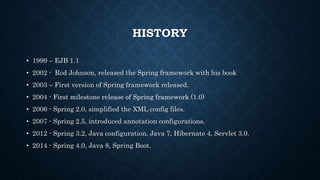
• 1999 – EJB 1.1
• 2002 - Rod Johnson, released the Spring framework with his book
• 2003 – First version of Spring framework released.
• 2004 - First milestone release of Spring framework (1.0)
• 2006 - Spring 2.0, simplified the XML config files.
• 2007 - Spring 2.5, introduced annotation configurations.
• 2012 - Spring 3.2, Java configuration, Java 7, Hibernate 4, Servlet 3.0.
• 2014 - Spring 4.0, Java 8, Spring Boot.
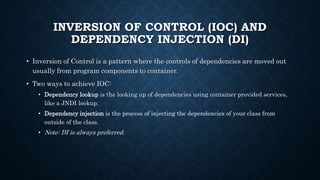
INVERSION OF CONTROL (IOC) AND
DEPENDENCY INJECTION (DI)
• Inversion of Control is a pattern where the controls of dependencies are moved out
usually from program components to container.
• Two ways to achieve IOC:
• Dependency lookup is the looking up of dependencies using container provided services,
like a JNDI lookup.
• Dependency injection is the process of injecting the dependencies of your class from
outside of the class.
• Note: DI is always preferred.
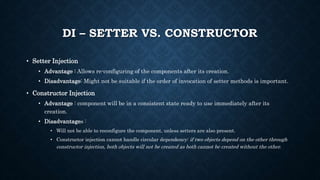
DI – SETTER VS. CONSTRUCTOR
• Setter Injection
• Advantage : Allows re-configuring of the components after its creation.
• Disadvantage: Might not be suitable if the order of invocation of setter methods is important.
• Constructor Injection
• Advantage : component will be in a consistent state ready to use immediately after its
creation.
• Disadvantages :
• Will not be able to reconfigure the component, unless setters are also present.
• Constructor injection cannot handle circular dependency: if two objects depend on the other through
constructor injection, both objects will not be created as both cannot be created without the other.
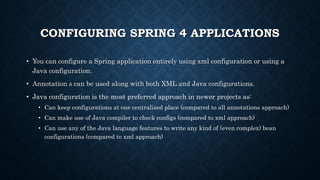
CONFIGURING SPRING 4 APPLICATIONS
• You can configure a Spring application entirely using xml configuration or using a
Java configuration.
• Annotation s can be used along with both XML and Java configurations.
• Java configuration is the most preferred approach in newer projects as:
• Can keep configurations at one centralized place (compared to all annotations approach)
• Can make use of Java compiler to check configs (compared to xml approach)
• Can use any of the Java language features to write any kind of (even complex) bean
configurations (compared to xml approach)
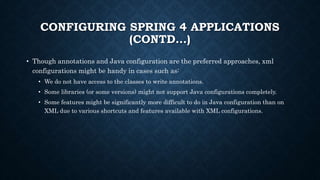
CONFIGURING SPRING 4 APPLICATIONS
(CONTD…)
• Though annotations and Java configuration are the preferred approaches, xml
configurations might be handy in cases such as:
• We do not have access to the classes to write annotations.
• Some libraries (or some versions) might not support Java configurations completely.
• Some features might be significantly more difficult to do in Java configuration than on
XML due to various shortcuts and features available with XML configurations.
GETTING STARTED
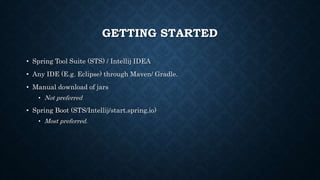
• Spring Tool Suite (STS) / Intellij IDEA
• Any IDE (E.g. Eclipse) through Maven/ Gradle.
• Manual download of jars
• Not preferred
• Spring Boot (STS/Intellij/start.spring.io)
• Most preferred.
FIRST SPRING PROGRAM USING
XML CONFIGURATION
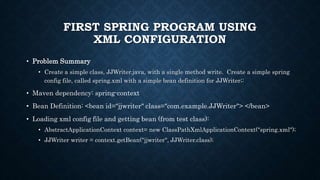
• Problem Summary
• Create a simple class, JJWriter.java, with a single method write. Create a simple spring
config file, called spring.xml with a simple bean definition for JJWriter;:
• Maven dependency: spring-context
• Bean Definition: <bean id="jjwriter" class="com.example.JJWriter"> </bean>
• Loading xml config file and getting bean (from test class):
• AbstractApplicationContext context= new ClassPathXmlApplicationContext("spring.xml");
• JJWriter writer = context.getBean("jjwriter", JJWriter.class);
FIRST SPRING PROGRAM USING
XML CONFIGURATION (CONTD…)
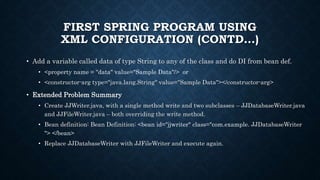
• Add a variable called data of type String to any of the class and do DI from bean def.
• <property name = "data" value="Sample Data"/> or
• <constructor-arg type="java.lang.String" value="Sample Data"></constructor-arg>
• Extended Problem Summary
• Create JJWriter.java, with a single method write and two subclasses – JJDatabaseWriter.java
and JJFileWriter.java – both overriding the write method.
• Bean definition: Bean Definition: <bean id="jjwriter" class="com.example. JJDatabaseWriter
"> </bean>
• Replace JJDatabaseWriter with JJFileWriter and execute again.
OBJECT INJECTION EXAMPLE
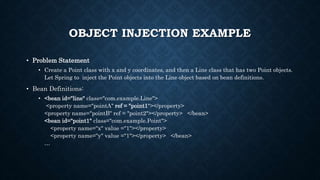
• Problem Statement
• Create a Point class with x and y coordinates, and then a Line class that has two Point objects.
Let Spring to inject the Point objects into the Line object based on bean definitions.
• Bean Definitions:
• <bean id="line" class="com.example.Line">
<property name="pointA" ref = "point1"></property>
<property name="pointB" ref = "point2"></property> </bean>
<bean id="point1" class="com.example.Point">
<property name="x" value ="1"></property>
<property name="y" value ="1"></property> </bean>
…
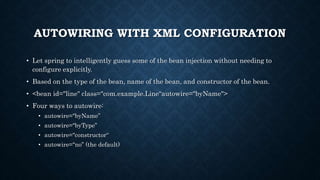
AUTOWIRING WITH XML CONFIGURATION
• Let spring to intelligently guess some of the bean injection without needing to
configure explicitly.
• Based on the type of the bean, name of the bean, and constructor of the bean.
• <bean id="line" class="com.example.Line“autowire="byName">
• Four ways to autowire:
• autowire="byName”
• autowire="byType”
• autowire="constructor“
• autowire="no” (the default)
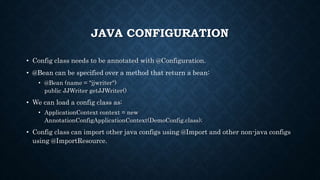
JAVA CONFIGURATION
• Config class needs to be annotated with @Configuration.
• @Bean can be specified over a method that return a bean:
• @Bean (name = "jjwriter")
public JJWriter getJJWriter()
• We can load a config class as:
• ApplicationContext context = new
AnnotationConfigApplicationContext(DemoConfig.class);
• Config class can import other java configs using @Import and other non-java configs
using @ImportResource.
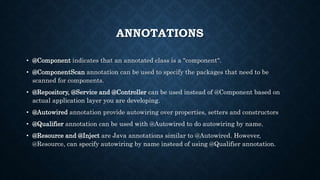
ANNOTATIONS
• @Component indicates that an annotated class is a "component".
• @ComponentScan annotation can be used to specify the packages that need to be
scanned for components.
• @Repository, @Service and @Controller can be used instead of @Component based on
actual application layer you are developing.
• @Autowired annotation provide autowiring over properties, setters and constructors
• @Qualifier annotation can be used with @Autowired to do autowiring by name.
• @Resource and @Inject are Java annotations similar to @Autowired. However,
@Resource, can specify autowiring by name instead of using @Qualifier annotation.
WHAT NEXT?
• Please complete doing examples for all concepts mentioned.
• We will go deep into Java Configurations, Annotations, Profiles, Junit Testing and
eventually start with Spring Boot.
RESOURCES & REFERENCES
• https://spring.io/docs
• http://javajee.com/spring-framework-4-essentials

Spring essentials 1 (Spring Series 01)

  • 1.
    SPRING ESSENTIALS 1 Introductionto Spring and XML Configuration (Spring Series 01) Presenter: Heartin Jacob Kanikathottu
  • 2.
    TOPICS • History andNeed for Spring • Inversion of Control (IoC) and Dependency Injection (DI) • Different Ways to Configure Spring 4 Applications • Writing Spring Programs Using XML Configuration • Constructor Injection and Setter Injection • Autowiring • Java Configuration and Annotations
  • 3.
    HISTORY • 1999 –EJB 1.1 • 2002 - Rod Johnson, released the Spring framework with his book • 2003 – First version of Spring framework released. • 2004 - First milestone release of Spring framework (1.0) • 2006 - Spring 2.0, simplified the XML config files. • 2007 - Spring 2.5, introduced annotation configurations. • 2012 - Spring 3.2, Java configuration, Java 7, Hibernate 4, Servlet 3.0. • 2014 - Spring 4.0, Java 8, Spring Boot.
  • 4.
    INVERSION OF CONTROL(IOC) AND DEPENDENCY INJECTION (DI) • Inversion of Control is a pattern where the controls of dependencies are moved out usually from program components to container. • Two ways to achieve IOC: • Dependency lookup is the looking up of dependencies using container provided services, like a JNDI lookup. • Dependency injection is the process of injecting the dependencies of your class from outside of the class. • Note: DI is always preferred.
  • 5.
    DI – SETTERVS. CONSTRUCTOR • Setter Injection • Advantage : Allows re-configuring of the components after its creation. • Disadvantage: Might not be suitable if the order of invocation of setter methods is important. • Constructor Injection • Advantage : component will be in a consistent state ready to use immediately after its creation. • Disadvantages : • Will not be able to reconfigure the component, unless setters are also present. • Constructor injection cannot handle circular dependency: if two objects depend on the other through constructor injection, both objects will not be created as both cannot be created without the other.
  • 6.
    CONFIGURING SPRING 4APPLICATIONS • You can configure a Spring application entirely using xml configuration or using a Java configuration. • Annotation s can be used along with both XML and Java configurations. • Java configuration is the most preferred approach in newer projects as: • Can keep configurations at one centralized place (compared to all annotations approach) • Can make use of Java compiler to check configs (compared to xml approach) • Can use any of the Java language features to write any kind of (even complex) bean configurations (compared to xml approach)
  • 7.
    CONFIGURING SPRING 4APPLICATIONS (CONTD…) • Though annotations and Java configuration are the preferred approaches, xml configurations might be handy in cases such as: • We do not have access to the classes to write annotations. • Some libraries (or some versions) might not support Java configurations completely. • Some features might be significantly more difficult to do in Java configuration than on XML due to various shortcuts and features available with XML configurations.
  • 8.
    GETTING STARTED • SpringTool Suite (STS) / Intellij IDEA • Any IDE (E.g. Eclipse) through Maven/ Gradle. • Manual download of jars • Not preferred • Spring Boot (STS/Intellij/start.spring.io) • Most preferred.
  • 9.
    FIRST SPRING PROGRAMUSING XML CONFIGURATION • Problem Summary • Create a simple class, JJWriter.java, with a single method write. Create a simple spring config file, called spring.xml with a simple bean definition for JJWriter;: • Maven dependency: spring-context • Bean Definition: <bean id="jjwriter" class="com.example.JJWriter"> </bean> • Loading xml config file and getting bean (from test class): • AbstractApplicationContext context= new ClassPathXmlApplicationContext("spring.xml"); • JJWriter writer = context.getBean("jjwriter", JJWriter.class);
  • 10.
    FIRST SPRING PROGRAMUSING XML CONFIGURATION (CONTD…) • Add a variable called data of type String to any of the class and do DI from bean def. • <property name = "data" value="Sample Data"/> or • <constructor-arg type="java.lang.String" value="Sample Data"></constructor-arg> • Extended Problem Summary • Create JJWriter.java, with a single method write and two subclasses – JJDatabaseWriter.java and JJFileWriter.java – both overriding the write method. • Bean definition: Bean Definition: <bean id="jjwriter" class="com.example. JJDatabaseWriter "> </bean> • Replace JJDatabaseWriter with JJFileWriter and execute again.
  • 11.
    OBJECT INJECTION EXAMPLE •Problem Statement • Create a Point class with x and y coordinates, and then a Line class that has two Point objects. Let Spring to inject the Point objects into the Line object based on bean definitions. • Bean Definitions: • <bean id="line" class="com.example.Line"> <property name="pointA" ref = "point1"></property> <property name="pointB" ref = "point2"></property> </bean> <bean id="point1" class="com.example.Point"> <property name="x" value ="1"></property> <property name="y" value ="1"></property> </bean> …
  • 12.
    AUTOWIRING WITH XMLCONFIGURATION • Let spring to intelligently guess some of the bean injection without needing to configure explicitly. • Based on the type of the bean, name of the bean, and constructor of the bean. • <bean id="line" class="com.example.Line“autowire="byName"> • Four ways to autowire: • autowire="byName” • autowire="byType” • autowire="constructor“ • autowire="no” (the default)
  • 13.
    JAVA CONFIGURATION • Configclass needs to be annotated with @Configuration. • @Bean can be specified over a method that return a bean: • @Bean (name = "jjwriter") public JJWriter getJJWriter() • We can load a config class as: • ApplicationContext context = new AnnotationConfigApplicationContext(DemoConfig.class); • Config class can import other java configs using @Import and other non-java configs using @ImportResource.
  • 14.
    ANNOTATIONS • @Component indicatesthat an annotated class is a "component". • @ComponentScan annotation can be used to specify the packages that need to be scanned for components. • @Repository, @Service and @Controller can be used instead of @Component based on actual application layer you are developing. • @Autowired annotation provide autowiring over properties, setters and constructors • @Qualifier annotation can be used with @Autowired to do autowiring by name. • @Resource and @Inject are Java annotations similar to @Autowired. However, @Resource, can specify autowiring by name instead of using @Qualifier annotation.
  • 15.
    WHAT NEXT? • Pleasecomplete doing examples for all concepts mentioned. • We will go deep into Java Configurations, Annotations, Profiles, Junit Testing and eventually start with Spring Boot.
  • 16.
    RESOURCES & REFERENCES •https://spring.io/docs • http://javajee.com/spring-framework-4-essentials

Editor's Notes

  • #4 2002 - Rod Johnson, released the framework with his book Expert One-on-One J2EE Design and Development