© Copyright 2018 Pivotal Software, Inc. All rights Reserved. Version 1.0
Lars Rosenquist
June 2018
Spring Boot & Spring Cloud
on k8s and PCF
Cover w/ Image
Topics
■ Introduction
■ Platforms
■ k8s (PKS) vs PCF
○ Spring Boot + Spring Cloud
■ What runtime to pick? Future?
■ Pivotal Cloud Foundry
■ Q&A
Introduction
So what’s this about?
Lars Rosenquist
● Platform Architect at Pivotal
○ Field organisation
○ Helping companies become great software companies
● Developing software professionally since 1998
○ Financial, governmental, commercial
○ Java, Spring, Cloud Foundry
● Twitter: @larsrosenquist
● Email: lrosenquist@pivotal.io
About me
Platforms
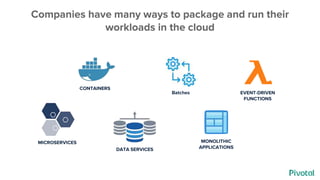
Which platform for which workloads
CONTAINERS
EVENT-DRIVEN
FUNCTIONS
DATA SERVICES
MICROSERVICES
Batches
MONOLITHIC
APPLICATIONS
Companies have many ways to package and run their
workloads in the cloud
Pick the right runtime for each workload
CONTAINERS
EVENT-DRIVEN
FUNCTIONS
DATA SERVICESMICROSERVICES
Batches
MONOLITHIC
APPLICATIONS
IaaS
Container
Orchestrator
(CaaS)
Application
Platform
(PaaS)
Serverless
Functions
(FaaS)
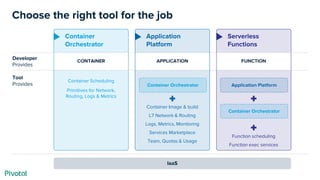
Container
Orchestrator
Container Scheduling
Primitives for Network,
Routing, Logs & Metrics
CONTAINER
Choose the right tool for the job
Developer
Provides
Tool
Provides
Application
Platform
APPLICATION
Container Orchestrator
Serverless
Functions
FUNCTION
Application Platform
IaaS
Container Image & build
L7 Network & Routing
Logs, Metrics, Monitoring
Services Marketplace
Team, Quotas & Usage
Function scheduling
Function exec services
Container Orchestrator
Container
Orchestrator
Container Scheduling
Primitives for Network,
Routing, Logs & Metrics
CONTAINER
Choose the right tool for the job
Developer
Provides
Tool
Provides
Application
Platform
APPLICATION
Container Orchestrator
Serverless
Functions
FUNCTION
IaaS
Container Image & build
L7 Network & Routing
Logs, Metrics, Monitoring
Services Marketplace
Team, Quotas & Usage
Application Platform
Container Orchestrator
Function scheduling
Function exec services
Lower complexity, higher efficiency
Higher flexibility, lower standardization
Hardware
IaaS
Container Orchestrator
Application Platform
Serverless
Functions
Strategic goal: Push as many workloads as technically
feasible to the top of the platform hierarchy
Higher flexibility and
less enforcement of
standards
Lower development
complexity and higher
operational efficiency
Application runtime <-> Container runtime
Which platform for which workloads
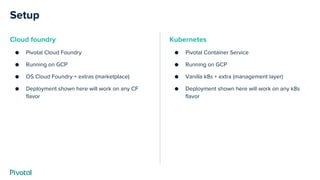
Setup
Cloud foundry
● Pivotal Cloud Foundry
● Running on GCP
● OS Cloud Foundry + extras (marketplace)
● Deployment shown here will work on any CF
flavor
Kubernetes
● Pivotal Container Service
● Running on GCP
● Vanilla k8s + extra (management layer)
● Deployment shown here will work on any k8s
flavor
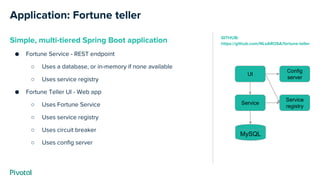
Application: Fortune teller
Simple, multi-tiered Spring Boot application
● Fortune Service - REST endpoint
○ Uses a database, or in-memory if none available
○ Uses service registry
● Fortune Teller UI - Web app
○ Uses Fortune Service
○ Uses service registry
○ Uses circuit breaker
○ Uses config server
GITHUB:
https://github.com/NLxAROSA/fortune-teller
UI
Service
Service
registry
MySQL
Config
server
Application: Fortune Teller
Stack
● Spring Boot
● Spring Cloud
○ Netflix
■ Circuit breaker (Hystrix)
■ Service Registry (Eureka)
○ Spring Cloud Config
○ Spring Cloud Services connectors for CF
● Spring Data JPA
Building and deploying an application
Cloud Foundry
● mvn clean package
● Create/edit manifest.yml
● cf push
Kubernetes
● mvn clean package
● Create/edit Dockerfile
● mvn dockerfile:push
● Create/edit deployment and service ymls
● kubectl create -f deployment.yml
● kubectl create -f service.yml
Viewing application logs
Cloud Foundry
● cf logs fortune-service --recent
● cf logs fortune-ui --recent
● Aggregated, streamed to firehose
● Basic options (for extended options use the
firehose and a logging solution like Splunk, ELK,
etc.)
Kubernetes
● kubectl get po
● kubectl logs <podname> -f
● Not aggregated
● More flexible options, like tailing, since,
timestamps, etc.
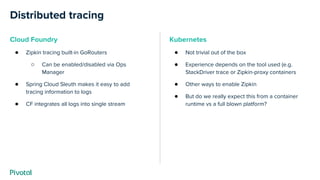
Distributed tracing
Cloud Foundry
● Zipkin tracing built-in GoRouters
○ Can be enabled/disabled via Ops
Manager
● Spring Cloud Sleuth makes it easy to add
tracing information to logs
● CF integrates all logs into single stream
Kubernetes
● Not trivial out of the box
● Experience depends on the tool used (e.g.
StackDriver trace or Zipkin-proxy containers
● Other ways to enable Zipkin
● But do we really expect this from a container
runtime vs a full blown platform?
Connecting to a database
Cloud Foundry
● Database available via marketplace
○ Implementation depends on vendor
○ User experience should be similar
● cf create-service p-mysql 100mb fortunes-db
● Bind to application either by:
○ cf bind-service fortune-service p-mysql
○ Add to manifest.yml
● No config to maintain for developer
● Allows cool stuff like credential rotation
Kubernetes
● Create yourself
○ Create your own pod/cluster
○ Use a Helm chart
● Use Open Service Broker API when available
● kubectl create -f database.yml
● No binding (just point to it via deployment.yml)
● Harder/more to maintain
● No automated capabilities in the platform (yet)
SSH into running application
Cloud Foundry
● cf ssh fortune-service -i 0
Kubernetes
● kubectl get po
● kubectl exec -it <podname> -- /bin/bash
Developer experience summary
Cloud Foundry
● Little overhead/less verbose
○ Specify app
○ Specify dependencies
● Platform handles for you
○ Routing
○ Port mappings
○ Load balancing
Kubernetes
● More overhead/verbose
○ Specify app/container
○ Specify dependencies
● You specify
○ Routing
○ Port mapping
○ Load balancing
● Big ball o’yaml
○ Reminds of Spring XML config era
● Not platform by itself, snowflake pitfall
Regardless of differences
Both experiences
● Both experiences are miles ahead of deploying straight to IAAS or bare metal
○ Standardized ways of configuration and deployment
○ Higher level of standardization = higher level of automation = faster time to
market
● Both assume infrastructure is managed
○ Explicitly in CF (BOSH)
○ Implicitly on k8s (depending on vendor)
○ Less time spent on ops = faster time to market
Cloud Foundry or Kubernetes?
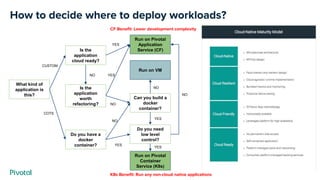
How to pick where to deploy what workload?
Run on Pivotal
Application
Service (CF)
Run on VM
Run on Pivotal
Container
Service (K8s)
What kind of
application is
this?
Is the
application
cloud ready?
Do you have a
docker
container?
Can you build a
docker
container?
CUSTOM
COTS
YES
NO
YES
NO
YES
NOIs the
application
worth
refactoring?
NO YES
NO
Do you need
low level
control?
YES
K8s Benefit: Run any non-cloud native applications
CF Benefit: Lower development complexity
How to decide where to deploy workloads?
So what about the future?
CAAS, PAAS, FAAS, ?
Some tweets to consider
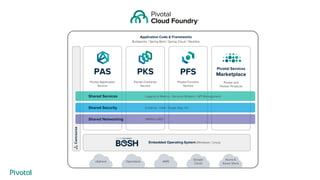
Pivotal Cloud Foundry
Short commercial break
vSphere Openstack AWS
Google
Cloud
Azure &
Azure Stack
Shared Services
Shared Security
Shared Networking
Logging & Metrics / Services Brokers / API Management
Credhub / UAA / Single Sign On
VMWare NSX
Embedded Operating System (Windows / Linux)
Application Code & Frameworks
Buildpacks / Spring Boot / Spring Cloud / Steeltoe
PAS
Pivotal Application
Service
PKS
Pivotal Container
Service
PFS
Pivotal Function
Service
Pivotal Services
Marketplace
Pivotal and
Partner Products
Concourse
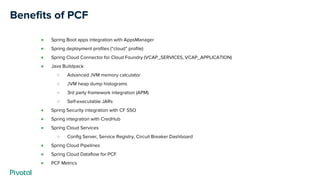
Benefits of PCF
● Spring Boot apps integration with AppsManager
● Spring deployment profiles (“cloud” profile)
● Spring Cloud Connector for Cloud Foundry (VCAP_SERVICES, VCAP_APPLICATION)
● Java Buildpack
○ Advanced JVM memory calculator
○ JVM heap dump histograms
○ 3rd party framework integration (APM)
○ Self-executable JARs
● Spring Security integration with CF SSO
● Spring integration with CredHub
● Spring Cloud Services
○ Config Server, Service Registry, Circuit Breaker Dashboard
● Spring Cloud Pipelines
● Spring Cloud Dataflow for PCF
● PCF Metrics
Q&A
Transforming How The World Builds Software
© Copyright 2018 Pivotal Software, Inc. All rights Reserved.

Spring Boot & Spring Cloud on k8s and PCF

  • 1.
    © Copyright 2018Pivotal Software, Inc. All rights Reserved. Version 1.0 Lars Rosenquist June 2018 Spring Boot & Spring Cloud on k8s and PCF
  • 2.
    Cover w/ Image Topics ■Introduction ■ Platforms ■ k8s (PKS) vs PCF ○ Spring Boot + Spring Cloud ■ What runtime to pick? Future? ■ Pivotal Cloud Foundry ■ Q&A
  • 3.
  • 4.
    Lars Rosenquist ● PlatformArchitect at Pivotal ○ Field organisation ○ Helping companies become great software companies ● Developing software professionally since 1998 ○ Financial, governmental, commercial ○ Java, Spring, Cloud Foundry ● Twitter: @larsrosenquist ● Email: lrosenquist@pivotal.io About me
  • 5.
  • 6.
  • 7.
    Pick the rightruntime for each workload CONTAINERS EVENT-DRIVEN FUNCTIONS DATA SERVICESMICROSERVICES Batches MONOLITHIC APPLICATIONS IaaS Container Orchestrator (CaaS) Application Platform (PaaS) Serverless Functions (FaaS)
  • 8.
    Container Orchestrator Container Scheduling Primitives forNetwork, Routing, Logs & Metrics CONTAINER Choose the right tool for the job Developer Provides Tool Provides Application Platform APPLICATION Container Orchestrator Serverless Functions FUNCTION Application Platform IaaS Container Image & build L7 Network & Routing Logs, Metrics, Monitoring Services Marketplace Team, Quotas & Usage Function scheduling Function exec services Container Orchestrator
  • 9.
    Container Orchestrator Container Scheduling Primitives forNetwork, Routing, Logs & Metrics CONTAINER Choose the right tool for the job Developer Provides Tool Provides Application Platform APPLICATION Container Orchestrator Serverless Functions FUNCTION IaaS Container Image & build L7 Network & Routing Logs, Metrics, Monitoring Services Marketplace Team, Quotas & Usage Application Platform Container Orchestrator Function scheduling Function exec services Lower complexity, higher efficiency Higher flexibility, lower standardization
  • 10.
    Hardware IaaS Container Orchestrator Application Platform Serverless Functions Strategicgoal: Push as many workloads as technically feasible to the top of the platform hierarchy Higher flexibility and less enforcement of standards Lower development complexity and higher operational efficiency
  • 11.
    Application runtime <->Container runtime Which platform for which workloads
  • 12.
    Setup Cloud foundry ● PivotalCloud Foundry ● Running on GCP ● OS Cloud Foundry + extras (marketplace) ● Deployment shown here will work on any CF flavor Kubernetes ● Pivotal Container Service ● Running on GCP ● Vanilla k8s + extra (management layer) ● Deployment shown here will work on any k8s flavor
  • 13.
    Application: Fortune teller Simple,multi-tiered Spring Boot application ● Fortune Service - REST endpoint ○ Uses a database, or in-memory if none available ○ Uses service registry ● Fortune Teller UI - Web app ○ Uses Fortune Service ○ Uses service registry ○ Uses circuit breaker ○ Uses config server GITHUB: https://github.com/NLxAROSA/fortune-teller UI Service Service registry MySQL Config server
  • 14.
    Application: Fortune Teller Stack ●Spring Boot ● Spring Cloud ○ Netflix ■ Circuit breaker (Hystrix) ■ Service Registry (Eureka) ○ Spring Cloud Config ○ Spring Cloud Services connectors for CF ● Spring Data JPA
  • 15.
    Building and deployingan application Cloud Foundry ● mvn clean package ● Create/edit manifest.yml ● cf push Kubernetes ● mvn clean package ● Create/edit Dockerfile ● mvn dockerfile:push ● Create/edit deployment and service ymls ● kubectl create -f deployment.yml ● kubectl create -f service.yml
  • 16.
    Viewing application logs CloudFoundry ● cf logs fortune-service --recent ● cf logs fortune-ui --recent ● Aggregated, streamed to firehose ● Basic options (for extended options use the firehose and a logging solution like Splunk, ELK, etc.) Kubernetes ● kubectl get po ● kubectl logs <podname> -f ● Not aggregated ● More flexible options, like tailing, since, timestamps, etc.
  • 17.
    Distributed tracing Cloud Foundry ●Zipkin tracing built-in GoRouters ○ Can be enabled/disabled via Ops Manager ● Spring Cloud Sleuth makes it easy to add tracing information to logs ● CF integrates all logs into single stream Kubernetes ● Not trivial out of the box ● Experience depends on the tool used (e.g. StackDriver trace or Zipkin-proxy containers ● Other ways to enable Zipkin ● But do we really expect this from a container runtime vs a full blown platform?
  • 18.
    Connecting to adatabase Cloud Foundry ● Database available via marketplace ○ Implementation depends on vendor ○ User experience should be similar ● cf create-service p-mysql 100mb fortunes-db ● Bind to application either by: ○ cf bind-service fortune-service p-mysql ○ Add to manifest.yml ● No config to maintain for developer ● Allows cool stuff like credential rotation Kubernetes ● Create yourself ○ Create your own pod/cluster ○ Use a Helm chart ● Use Open Service Broker API when available ● kubectl create -f database.yml ● No binding (just point to it via deployment.yml) ● Harder/more to maintain ● No automated capabilities in the platform (yet)
  • 19.
    SSH into runningapplication Cloud Foundry ● cf ssh fortune-service -i 0 Kubernetes ● kubectl get po ● kubectl exec -it <podname> -- /bin/bash
  • 20.
    Developer experience summary CloudFoundry ● Little overhead/less verbose ○ Specify app ○ Specify dependencies ● Platform handles for you ○ Routing ○ Port mappings ○ Load balancing Kubernetes ● More overhead/verbose ○ Specify app/container ○ Specify dependencies ● You specify ○ Routing ○ Port mapping ○ Load balancing ● Big ball o’yaml ○ Reminds of Spring XML config era ● Not platform by itself, snowflake pitfall
  • 21.
    Regardless of differences Bothexperiences ● Both experiences are miles ahead of deploying straight to IAAS or bare metal ○ Standardized ways of configuration and deployment ○ Higher level of standardization = higher level of automation = faster time to market ● Both assume infrastructure is managed ○ Explicitly in CF (BOSH) ○ Implicitly on k8s (depending on vendor) ○ Less time spent on ops = faster time to market
  • 22.
    Cloud Foundry orKubernetes? How to pick where to deploy what workload?
  • 23.
    Run on Pivotal Application Service(CF) Run on VM Run on Pivotal Container Service (K8s) What kind of application is this? Is the application cloud ready? Do you have a docker container? Can you build a docker container? CUSTOM COTS YES NO YES NO YES NOIs the application worth refactoring? NO YES NO Do you need low level control? YES K8s Benefit: Run any non-cloud native applications CF Benefit: Lower development complexity How to decide where to deploy workloads?
  • 24.
    So what aboutthe future? CAAS, PAAS, FAAS, ?
  • 25.
  • 26.
  • 27.
    vSphere Openstack AWS Google Cloud Azure& Azure Stack Shared Services Shared Security Shared Networking Logging & Metrics / Services Brokers / API Management Credhub / UAA / Single Sign On VMWare NSX Embedded Operating System (Windows / Linux) Application Code & Frameworks Buildpacks / Spring Boot / Spring Cloud / Steeltoe PAS Pivotal Application Service PKS Pivotal Container Service PFS Pivotal Function Service Pivotal Services Marketplace Pivotal and Partner Products Concourse
  • 28.
    Benefits of PCF ●Spring Boot apps integration with AppsManager ● Spring deployment profiles (“cloud” profile) ● Spring Cloud Connector for Cloud Foundry (VCAP_SERVICES, VCAP_APPLICATION) ● Java Buildpack ○ Advanced JVM memory calculator ○ JVM heap dump histograms ○ 3rd party framework integration (APM) ○ Self-executable JARs ● Spring Security integration with CF SSO ● Spring integration with CredHub ● Spring Cloud Services ○ Config Server, Service Registry, Circuit Breaker Dashboard ● Spring Cloud Pipelines ● Spring Cloud Dataflow for PCF ● PCF Metrics
  • 29.
  • 30.
    Transforming How TheWorld Builds Software © Copyright 2018 Pivotal Software, Inc. All rights Reserved.

Editor's Notes

  • #7  By making the first task on any software effort “delivery” - deploy the code somewhere, even if it doesn’t do anything. And then keep doing that every time you change anything…
  • #8  By making the first task on any software effort “delivery” - deploy the code somewhere, even if it doesn’t do anything. And then keep doing that every time you change anything…