Spring Boot: A Modern Framework for Java
Developers
Spring Boot simplifies Java development with a
convention-over-configuration approach. It
offers a streamlined way to build web
applications, RESTful APIs, and microservices.
Benefits of Spring Boot
1 Rapid Development
Spring Boot's auto-configuration
features streamline development
by reducing boilerplate code,
allowing developers to focus on
core business logic.
2 Simplified Dependencies
Spring Boot provides a starter
dependency system that includes
commonly used libraries,
simplifying project setup and
reducing dependency conflicts.
3 Embedded Servers
Spring Boot includes embedded
servers like Tomcat, Jetty, and
Undertow, simplifying
deployment and eliminating the
need for separate server
configuration.
4 Production-Ready
Applications
Spring Boot applications are
designed for production
environments with features like
health checks, metrics, and
actuator endpoints for
monitoring and management.
Key Features of Spring Boot
Auto-Configuration
Spring Boot automatically configures
common application settings based
on dependencies, minimizing manual
configuration and reducing setup
time.
Starter Dependencies
Spring Boot provides starter
dependencies that include commonly
used libraries for web development,
data access, security, and more,
simplifying project setup and
reducing dependency conflicts.
Actuator Endpoints
Spring Boot's Actuator provides
endpoints for monitoring application
health, metrics, and other runtime
information, providing valuable
insights for debugging and
performance optimization.
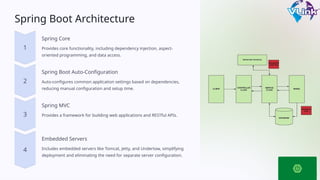
Spring Boot Architecture
Spring Core
Provides core functionality, including dependency injection, aspect-
oriented programming, and data access.
Spring Boot Auto-Configuration
Auto-configures common application settings based on dependencies,
reducing manual configuration and setup time.
Spring MVC
Provides a framework for building web applications and RESTful APIs.
Embedded Servers
Includes embedded servers like Tomcat, Jetty, and Undertow, simplifying
deployment and eliminating the need for separate server configuration.
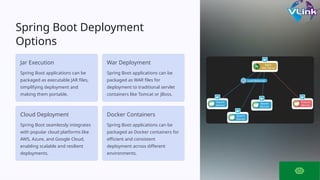
Spring Boot Deployment
Options
Jar Execution
Spring Boot applications can be
packaged as executable JAR files,
simplifying deployment and
making them portable.
War Deployment
Spring Boot applications can be
packaged as WAR files for
deployment to traditional servlet
containers like Tomcat or JBoss.
Cloud Deployment
Spring Boot seamlessly integrates
with popular cloud platforms like
AWS, Azure, and Google Cloud,
enabling scalable and resilient
deployments.
Docker Containers
Spring Boot applications can be
packaged as Docker containers for
efficient and consistent
deployment across different
environments.
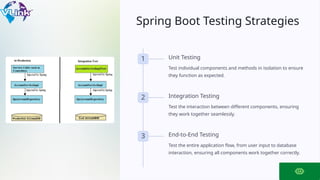
Spring Boot Testing Strategies
1 Unit Testing
Test individual components and methods in isolation to ensure
they function as expected.
2 Integration Testing
Test the interaction between different components, ensuring
they work together seamlessly.
3 End-to-End Testing
Test the entire application flow, from user input to database
interaction, ensuring all components work together correctly.
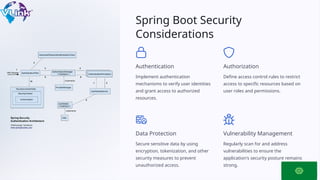
Spring Boot Security
Considerations
Authentication
Implement authentication
mechanisms to verify user identities
and grant access to authorized
resources.
Authorization
Define access control rules to restrict
access to specific resources based on
user roles and permissions.
Data Protection
Secure sensitive data by using
encryption, tokenization, and other
security measures to prevent
unauthorized access.
Vulnerability Management
Regularly scan for and address
vulnerabilities to ensure the
application's security posture remains
strong.
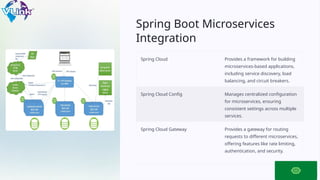
Spring Boot Microservices
Integration
Spring Cloud Provides a framework for building
microservices-based applications,
including service discovery, load
balancing, and circuit breakers.
Spring Cloud Config Manages centralized configuration
for microservices, ensuring
consistent settings across multiple
services.
Spring Cloud Gateway Provides a gateway for routing
requests to different microservices,
offering features like rate limiting,
authentication, and security.
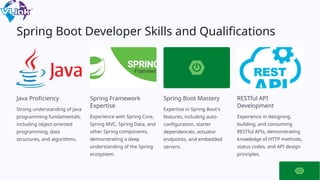
Spring Boot Developer Skills and Qualifications
Java Proficiency
Strong understanding of Java
programming fundamentals,
including object-oriented
programming, data
structures, and algorithms.
Spring Framework
Expertise
Experience with Spring Core,
Spring MVC, Spring Data, and
other Spring components,
demonstrating a deep
understanding of the Spring
ecosystem.
Spring Boot Mastery
Expertise in Spring Boot's
features, including auto-
configuration, starter
dependencies, actuator
endpoints, and embedded
servers.
RESTful API
Development
Experience in designing,
building, and consuming
RESTful APIs, demonstrating
knowledge of HTTP methods,
status codes, and API design
principles.
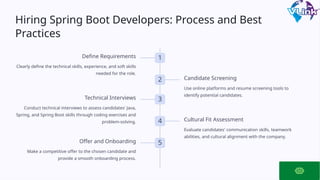
Hiring Spring Boot Developers: Process and Best
Practices
1
Define Requirements
Clearly define the technical skills, experience, and soft skills
needed for the role.
2 Candidate Screening
Use online platforms and resume screening tools to
identify potential candidates.
3
Technical Interviews
Conduct technical interviews to assess candidates' Java,
Spring, and Spring Boot skills through coding exercises and
problem-solving. 4 Cultural Fit Assessment
Evaluate candidates' communication skills, teamwork
abilities, and cultural alignment with the company.
5
Offer and Onboarding
Make a competitive offer to the chosen candidate and
provide a smooth onboarding process.
Reference :-
https://www.vlinkinfo.com/hire-developer
s/springboot-react-developers/
Get In Touch
•info.us@vlinkinfo.com
•+1 (860) 247-1400

Spring-Boot-A-Modern-Framework-for-Java-Developers.pptx

  • 1.
    Spring Boot: AModern Framework for Java Developers Spring Boot simplifies Java development with a convention-over-configuration approach. It offers a streamlined way to build web applications, RESTful APIs, and microservices.
  • 2.
    Benefits of SpringBoot 1 Rapid Development Spring Boot's auto-configuration features streamline development by reducing boilerplate code, allowing developers to focus on core business logic. 2 Simplified Dependencies Spring Boot provides a starter dependency system that includes commonly used libraries, simplifying project setup and reducing dependency conflicts. 3 Embedded Servers Spring Boot includes embedded servers like Tomcat, Jetty, and Undertow, simplifying deployment and eliminating the need for separate server configuration. 4 Production-Ready Applications Spring Boot applications are designed for production environments with features like health checks, metrics, and actuator endpoints for monitoring and management.
  • 3.
    Key Features ofSpring Boot Auto-Configuration Spring Boot automatically configures common application settings based on dependencies, minimizing manual configuration and reducing setup time. Starter Dependencies Spring Boot provides starter dependencies that include commonly used libraries for web development, data access, security, and more, simplifying project setup and reducing dependency conflicts. Actuator Endpoints Spring Boot's Actuator provides endpoints for monitoring application health, metrics, and other runtime information, providing valuable insights for debugging and performance optimization.
  • 4.
    Spring Boot Architecture SpringCore Provides core functionality, including dependency injection, aspect- oriented programming, and data access. Spring Boot Auto-Configuration Auto-configures common application settings based on dependencies, reducing manual configuration and setup time. Spring MVC Provides a framework for building web applications and RESTful APIs. Embedded Servers Includes embedded servers like Tomcat, Jetty, and Undertow, simplifying deployment and eliminating the need for separate server configuration.
  • 5.
    Spring Boot Deployment Options JarExecution Spring Boot applications can be packaged as executable JAR files, simplifying deployment and making them portable. War Deployment Spring Boot applications can be packaged as WAR files for deployment to traditional servlet containers like Tomcat or JBoss. Cloud Deployment Spring Boot seamlessly integrates with popular cloud platforms like AWS, Azure, and Google Cloud, enabling scalable and resilient deployments. Docker Containers Spring Boot applications can be packaged as Docker containers for efficient and consistent deployment across different environments.
  • 6.
    Spring Boot TestingStrategies 1 Unit Testing Test individual components and methods in isolation to ensure they function as expected. 2 Integration Testing Test the interaction between different components, ensuring they work together seamlessly. 3 End-to-End Testing Test the entire application flow, from user input to database interaction, ensuring all components work together correctly.
  • 7.
    Spring Boot Security Considerations Authentication Implementauthentication mechanisms to verify user identities and grant access to authorized resources. Authorization Define access control rules to restrict access to specific resources based on user roles and permissions. Data Protection Secure sensitive data by using encryption, tokenization, and other security measures to prevent unauthorized access. Vulnerability Management Regularly scan for and address vulnerabilities to ensure the application's security posture remains strong.
  • 8.
    Spring Boot Microservices Integration SpringCloud Provides a framework for building microservices-based applications, including service discovery, load balancing, and circuit breakers. Spring Cloud Config Manages centralized configuration for microservices, ensuring consistent settings across multiple services. Spring Cloud Gateway Provides a gateway for routing requests to different microservices, offering features like rate limiting, authentication, and security.
  • 9.
    Spring Boot DeveloperSkills and Qualifications Java Proficiency Strong understanding of Java programming fundamentals, including object-oriented programming, data structures, and algorithms. Spring Framework Expertise Experience with Spring Core, Spring MVC, Spring Data, and other Spring components, demonstrating a deep understanding of the Spring ecosystem. Spring Boot Mastery Expertise in Spring Boot's features, including auto- configuration, starter dependencies, actuator endpoints, and embedded servers. RESTful API Development Experience in designing, building, and consuming RESTful APIs, demonstrating knowledge of HTTP methods, status codes, and API design principles.
  • 10.
    Hiring Spring BootDevelopers: Process and Best Practices 1 Define Requirements Clearly define the technical skills, experience, and soft skills needed for the role. 2 Candidate Screening Use online platforms and resume screening tools to identify potential candidates. 3 Technical Interviews Conduct technical interviews to assess candidates' Java, Spring, and Spring Boot skills through coding exercises and problem-solving. 4 Cultural Fit Assessment Evaluate candidates' communication skills, teamwork abilities, and cultural alignment with the company. 5 Offer and Onboarding Make a competitive offer to the chosen candidate and provide a smooth onboarding process.
  • 11.