SPM Speaking TestOverview
• The Speaking test is taken by all Form 5 students and constitutes
25% of their overall candidate grade (the other papers, i.e.
Reading and Use of English, Listening and Writing also being
worth 25% each).
• The SPM Speaking test is paired format, i.e. 2 candidates take
the tests together.
• There are two examiners present during the test: the Interlocutor
and the Assessor who mark the test in situ.
• The Speaking test has three sections, all aimed at the A2-C1
CEFR range, with a variety of tasks to elicit different types of
spoken language.
• The duration of the test is approximately 13 minutes.
4.
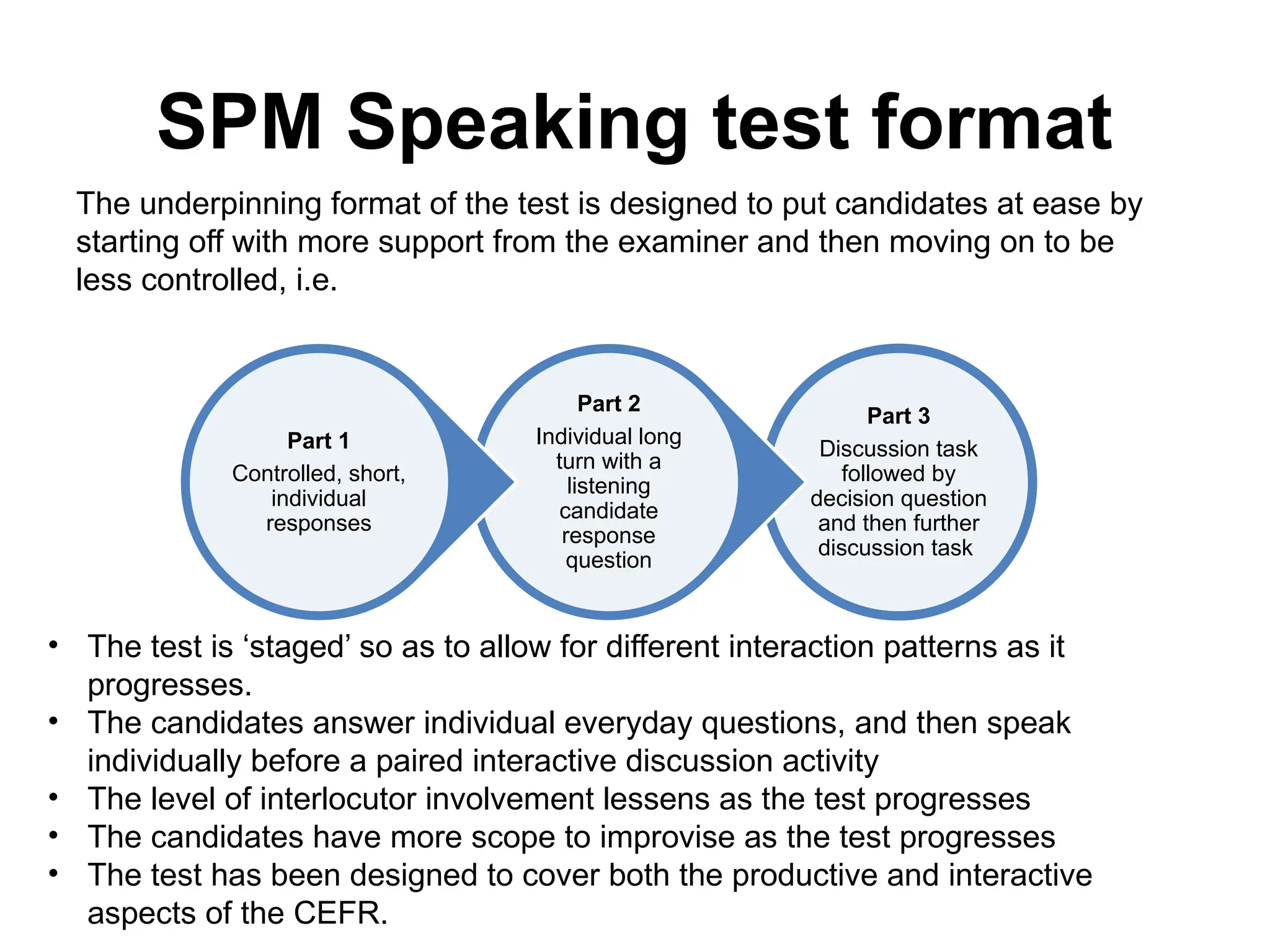
SPM Speaking testformat
Part 3
Discussion task
followed by
decision question
and then further
discussion task
Part 2
Individual long
turn with a
listening
candidate
response
question
Part 1
Controlled, short,
individual
responses
• The test is ‘staged’ so as to allow for different interaction patterns as it
progresses.
• The candidates answer individual everyday questions, and then speak
individually before a paired interactive discussion activity
• The level of interlocutor involvement lessens as the test progresses
• The candidates have more scope to improvise as the test progresses
• The test has been designed to cover both the productive and interactive
aspects of the CEFR.
The underpinning format of the test is designed to put candidates at ease by
starting off with more support from the examiner and then moving on to be
less controlled, i.e.
5.
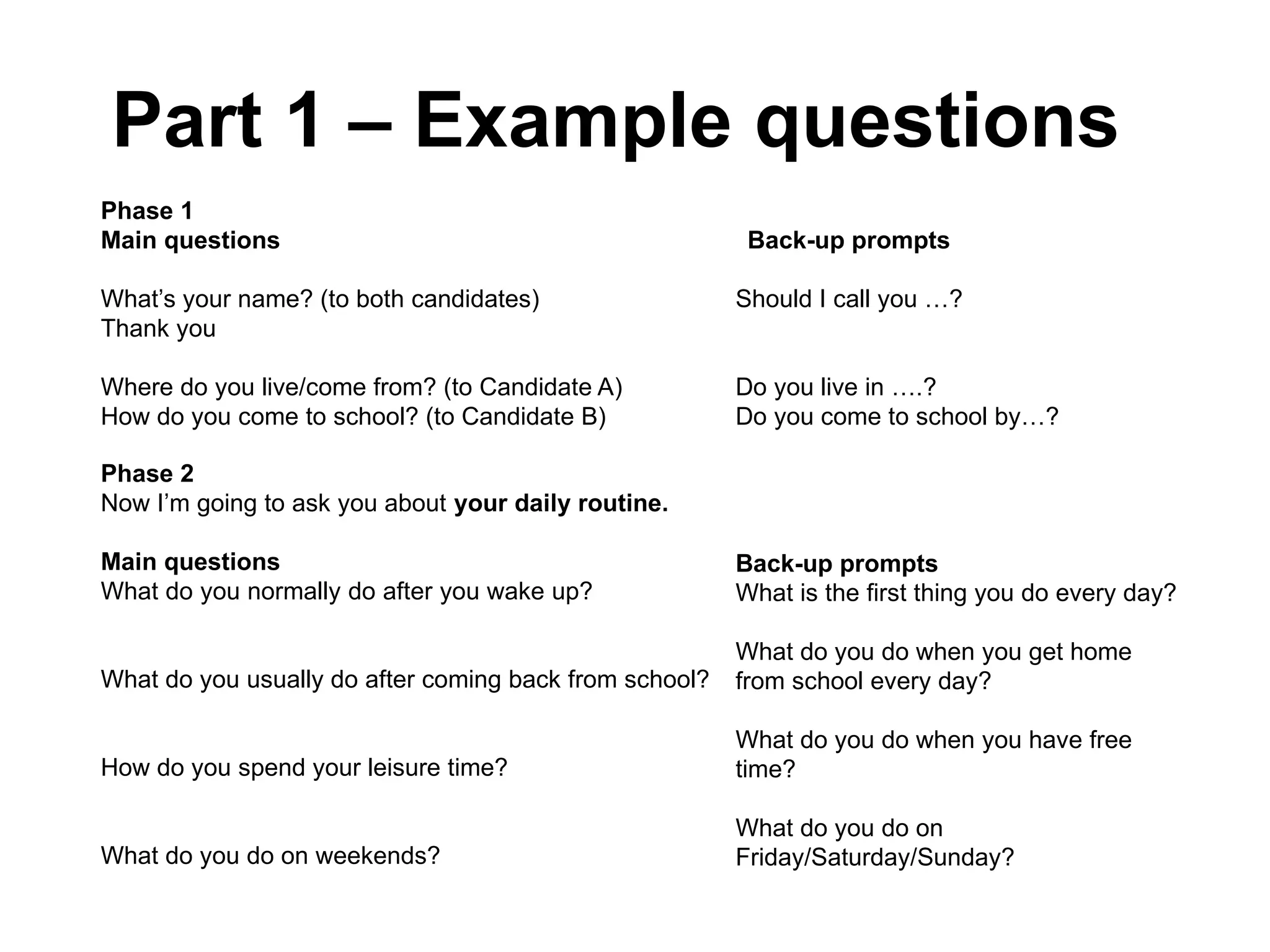
Part 1 –Example questions
Phase 1
Main questions Back-up prompts
What’s your name? (to both candidates)
Thank you
Where do you live/come from? (to Candidate A)
How do you come to school? (to Candidate B)
Should I call you …?
Do you live in ….?
Do you come to school by…?
Phase 2
Now I’m going to ask you about your daily routine.
Main questions
What do you normally do after you wake up?
What do you usually do after coming back from school?
How do you spend your leisure time?
What do you do on weekends?
Back-up prompts
What is the first thing you do every day?
What do you do when you get home
from school every day?
What do you do when you have free
time?
What do you do on
Friday/Saturday/Sunday?
6.
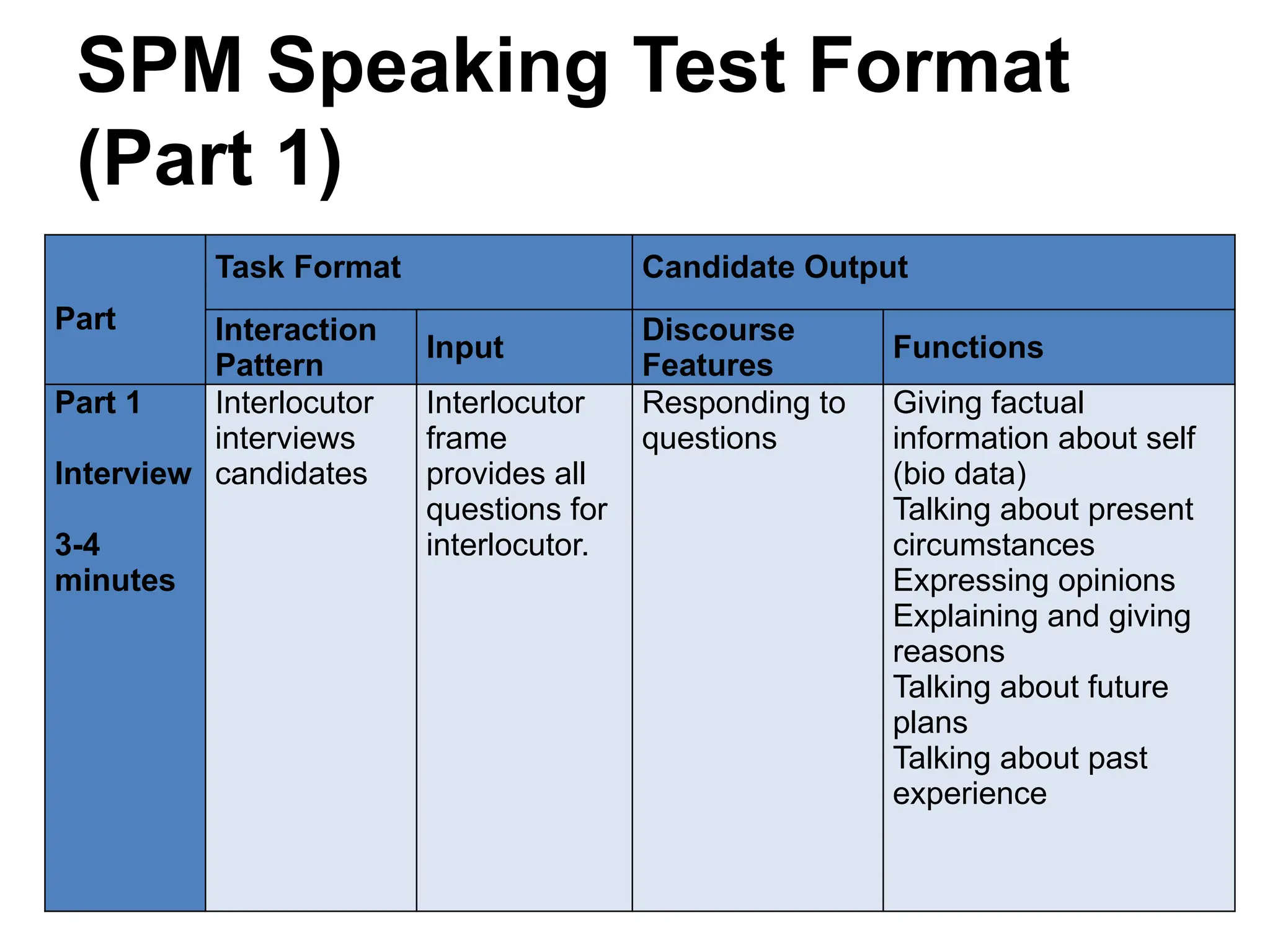
SPM Speaking TestFormat
(Part 1)
Part
Task Format Candidate Output
Interaction
Pattern
Input
Discourse
Features
Functions
Part 1
Interview
3-4
minutes
Interlocutor
interviews
candidates
Interlocutor
frame
provides all
questions for
interlocutor.
Responding to
questions
Giving factual
information about self
(bio data)
Talking about present
circumstances
Expressing opinions
Explaining and giving
reasons
Talking about future
plans
Talking about past
experience
Part
Task Format CandidateOutput
Interaction
Pattern
Input
Discourse
Features
Functions
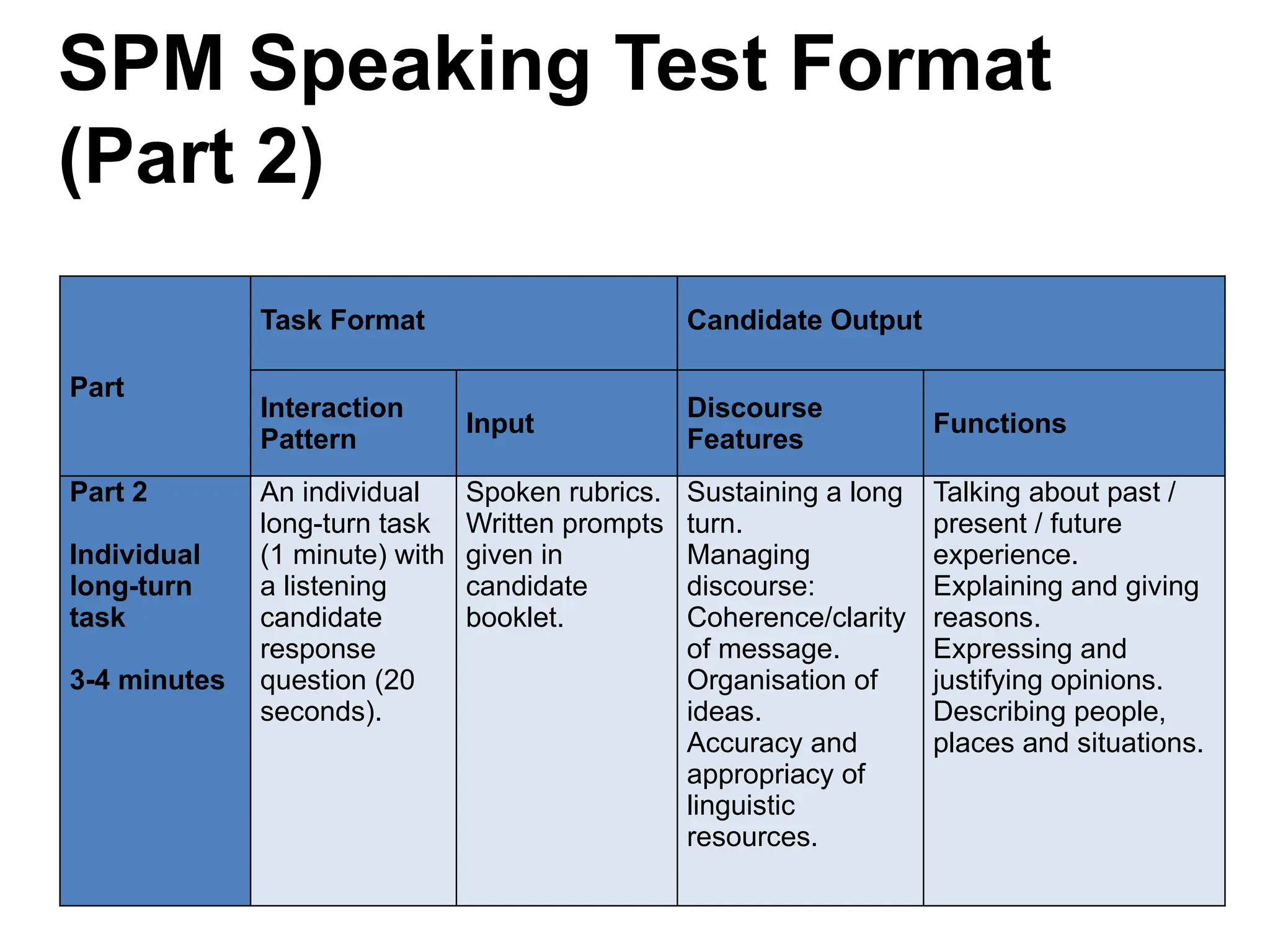
Part 2
Individual
long-turn
task
3-4 minutes
An individual
long-turn task
(1 minute) with
a listening
candidate
response
question (20
seconds).
Spoken rubrics.
Written prompts
given in
candidate
booklet.
Sustaining a long
turn.
Managing
discourse:
Coherence/clarity
of message.
Organisation of
ideas.
Accuracy and
appropriacy of
linguistic
resources.
Talking about past /
present / future
experience.
Explaining and giving
reasons.
Expressing and
justifying opinions.
Describing people,
places and situations.
SPM Speaking Test Format
(Part 2)
Part
Task Format CandidateOutput
Interaction
Pattern
Input Discourse Features Functions
Part 3
Discussion
task
4-5 minutes
Candidates
discuss a
task based
on a mind-
map. Then
they have a
decision
question to
discuss.
Candidates
are given a
topic with a
central focus
question and
surrounding
ideas to help
them.
Turn-taking and
responding
appropriately.
Negotiating.
Initiating.
Developing topics.
Explaining and giving
reasons.
Exchanging information
and opinions.
Expressing and
justifying opinions.
Negotiating agreement.
Making and responding
to suggestions.
Discussing
alternatives.
SPM Speaking Test Format
(Part 3)
14.
The level ofthe SPM Speaking test
• The Speaking test primarily targets the B1-B2 range of
language proficiency with the highest results reported at
C1
• The assessment scales used to rate candidates’
performance are derived from the guidance provided by
the CEFR
• The exam is criterion referenced (i.e. to the CEFR)
• In line with the positive ‘can do’ ethos of the CEFR, the
descriptors aim to describe communicative ability rather
than inability
Explain to the examiners the following key points before we
move on to focus on Speaking in more detail.
15.
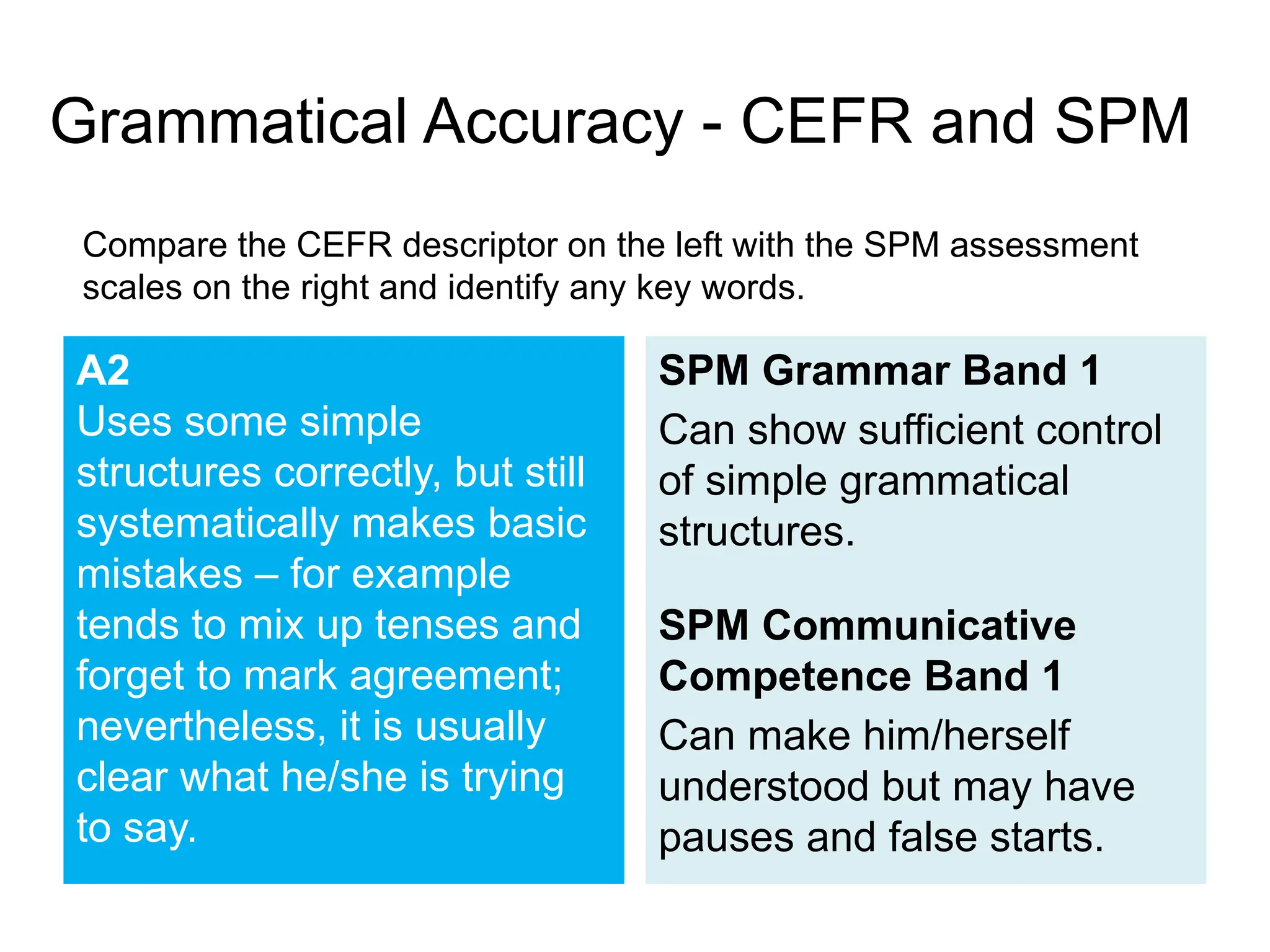
Grammatical Accuracy -CEFR and SPM
A2
Uses some simple
structures correctly, but still
systematically makes basic
mistakes – for example
tends to mix up tenses and
forget to mark agreement;
nevertheless, it is usually
clear what he/she is trying
to say.
SPM Grammar Band 1
Can show sufficient control
of simple grammatical
structures.
SPM Communicative
Competence Band 1
Can make him/herself
understood but may have
pauses and false starts.
Compare the CEFR descriptor on the left with the SPM assessment
scales on the right and identify any key words.
16.
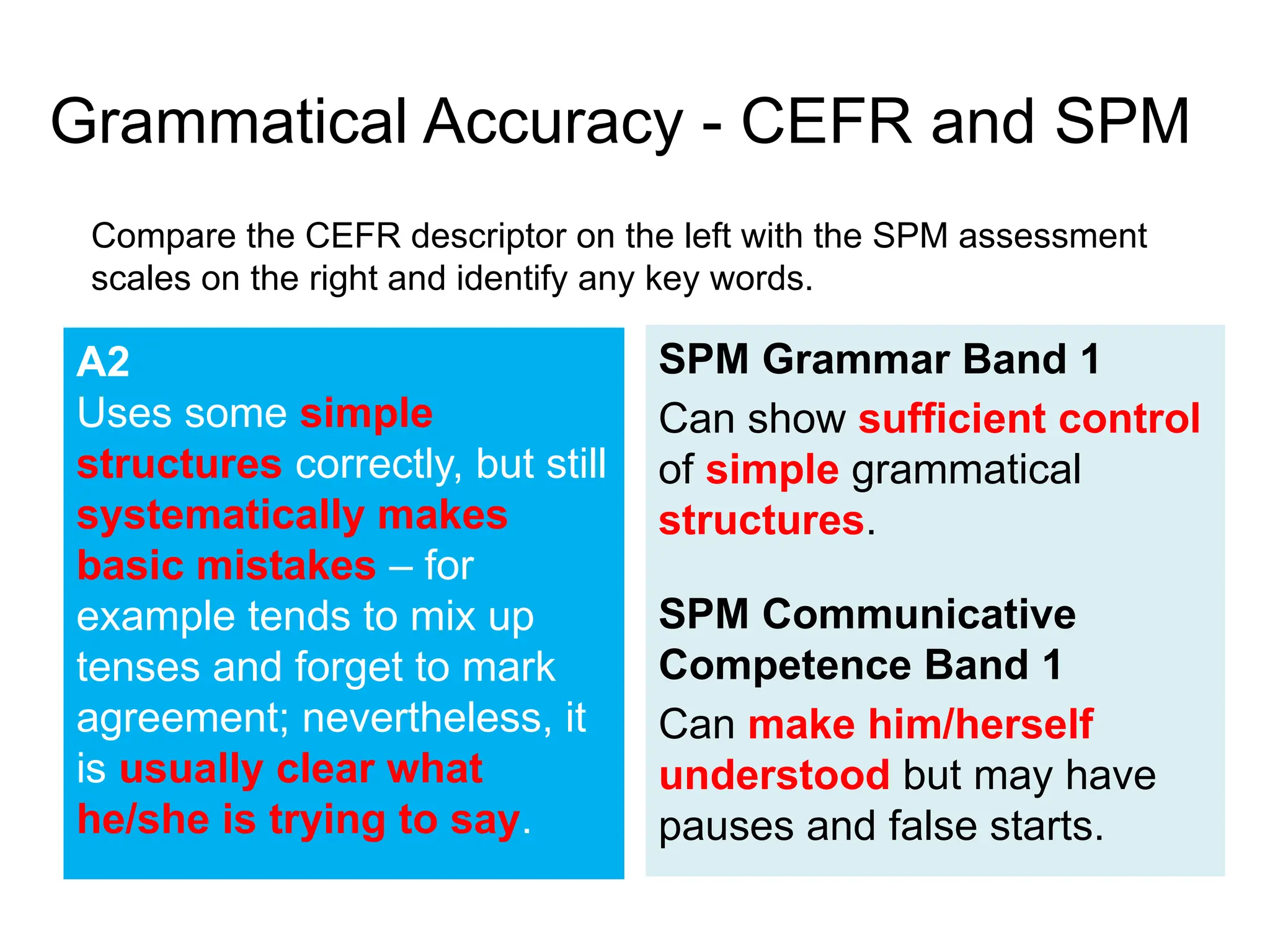
Grammatical Accuracy -CEFR and SPM
A2
Uses some simple
structures correctly, but still
systematically makes
basic mistakes – for
example tends to mix up
tenses and forget to mark
agreement; nevertheless, it
is usually clear what
he/she is trying to say.
SPM Grammar Band 1
Can show sufficient control
of simple grammatical
structures.
SPM Communicative
Competence Band 1
Can make him/herself
understood but may have
pauses and false starts.
Compare the CEFR descriptor on the left with the SPM assessment
scales on the right and identify any key words.
17.
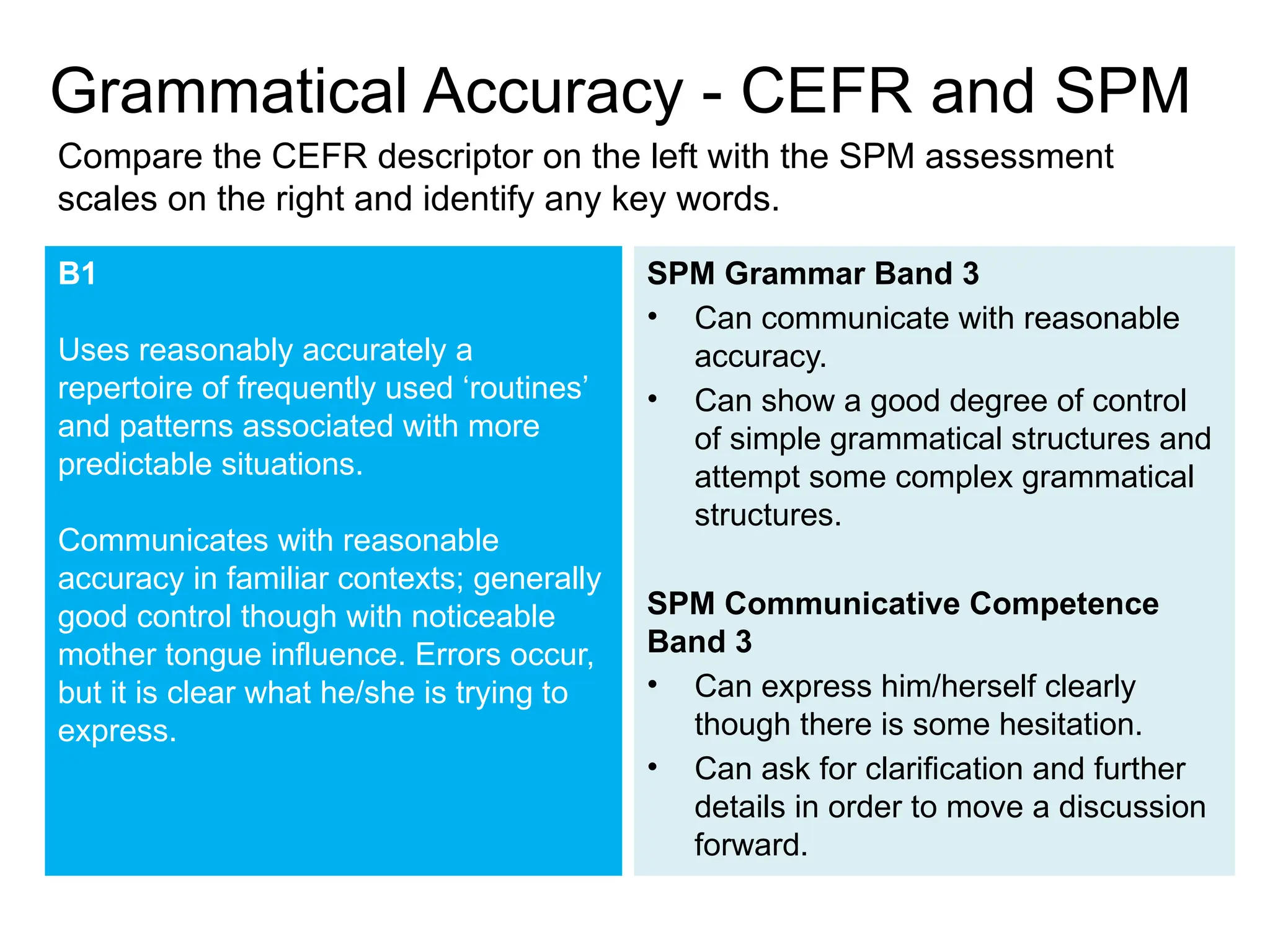
Grammatical Accuracy -CEFR and SPM
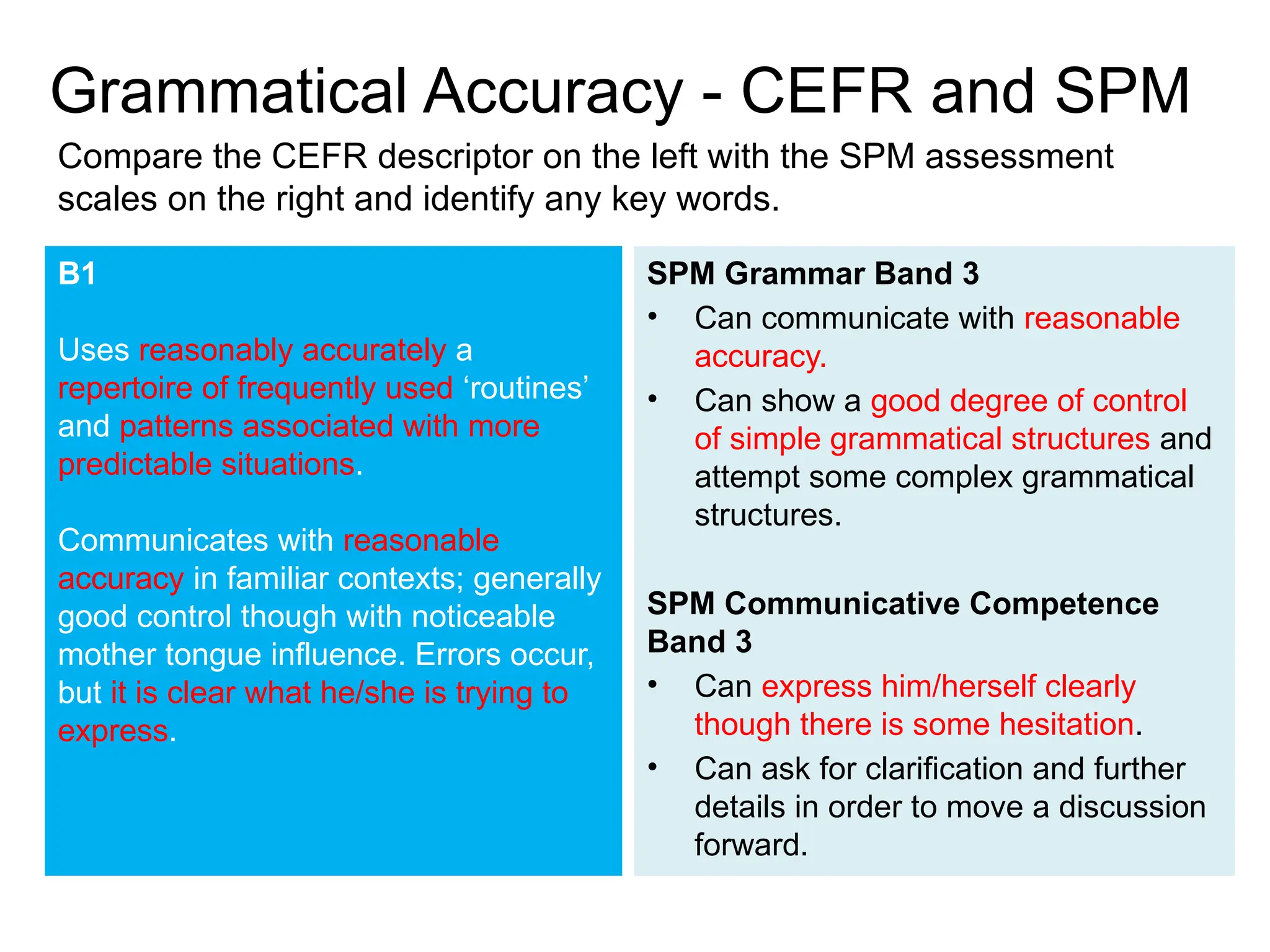
B1
Uses reasonably accurately a
repertoire of frequently used ‘routines’
and patterns associated with more
predictable situations.
Communicates with reasonable
accuracy in familiar contexts; generally
good control though with noticeable
mother tongue influence. Errors occur,
but it is clear what he/she is trying to
express.
SPM Grammar Band 3
• Can communicate with reasonable
accuracy.
• Can show a good degree of control
of simple grammatical structures and
attempt some complex grammatical
structures.
SPM Communicative Competence
Band 3
• Can express him/herself clearly
though there is some hesitation.
• Can ask for clarification and further
details in order to move a discussion
forward.
Compare the CEFR descriptor on the left with the SPM assessment
scales on the right and identify any key words.
18.
Grammatical Accuracy -CEFR and SPM
B1
Uses reasonably accurately a
repertoire of frequently used ‘routines’
and patterns associated with more
predictable situations.
Communicates with reasonable
accuracy in familiar contexts; generally
good control though with noticeable
mother tongue influence. Errors occur,
but it is clear what he/she is trying to
express.
SPM Grammar Band 3
• Can communicate with reasonable
accuracy.
• Can show a good degree of control
of simple grammatical structures and
attempt some complex grammatical
structures.
SPM Communicative Competence
Band 3
• Can express him/herself clearly
though there is some hesitation.
• Can ask for clarification and further
details in order to move a discussion
forward.
Compare the CEFR descriptor on the left with the SPM assessment
scales on the right and identify any key words.
19.
Grammatical Accuracy -CEFR and SPM
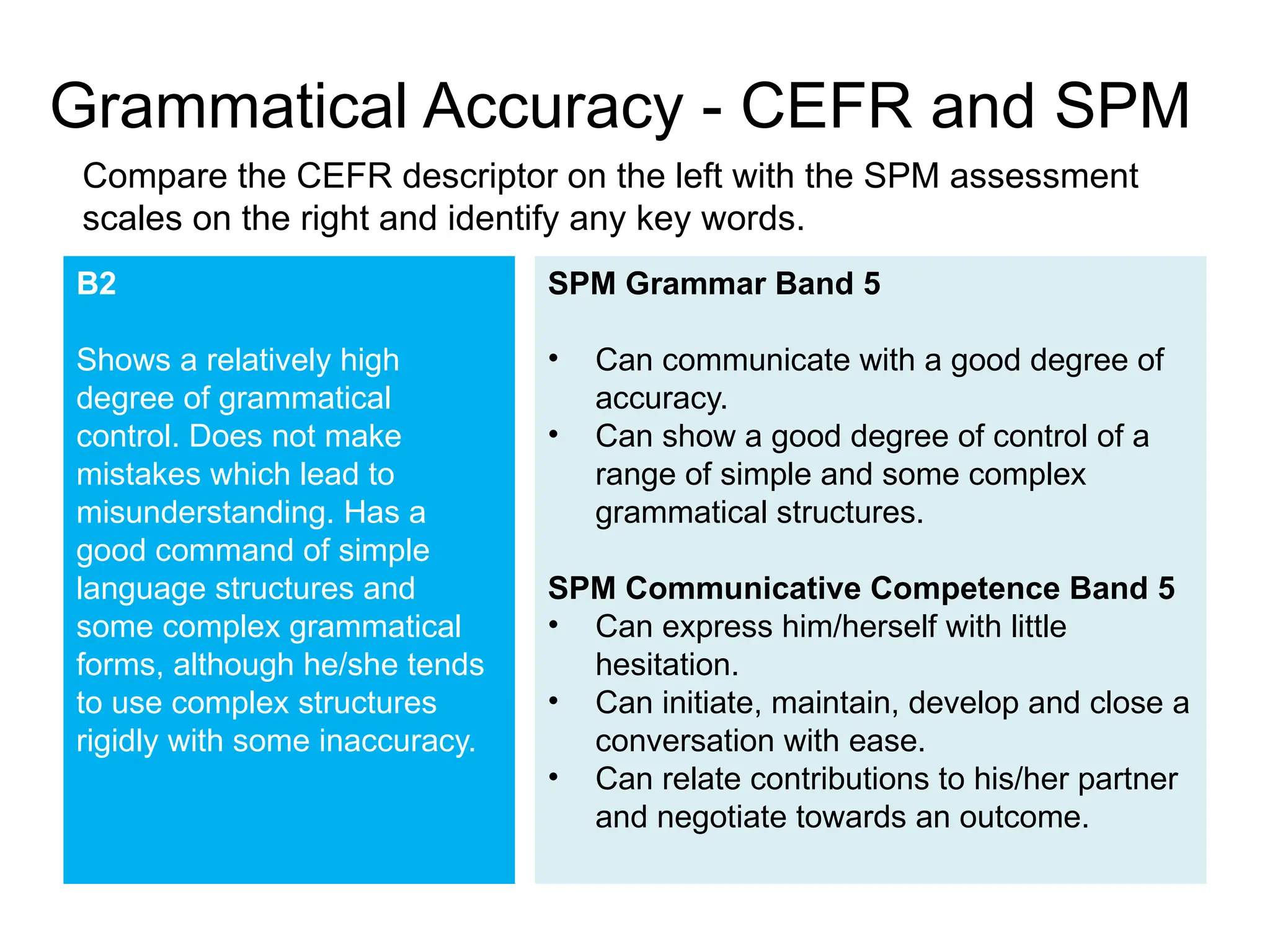
B2
Shows a relatively high
degree of grammatical
control. Does not make
mistakes which lead to
misunderstanding. Has a
good command of simple
language structures and
some complex grammatical
forms, although he/she tends
to use complex structures
rigidly with some inaccuracy.
SPM Grammar Band 5
• Can communicate with a good degree of
accuracy.
• Can show a good degree of control of a
range of simple and some complex
grammatical structures.
SPM Communicative Competence Band 5
• Can express him/herself with little
hesitation.
• Can initiate, maintain, develop and close a
conversation with ease.
• Can relate contributions to his/her partner
and negotiate towards an outcome.
Compare the CEFR descriptor on the left with the SPM assessment
scales on the right and identify any key words.
20.
Grammatical Accuracy -CEFR and SPM
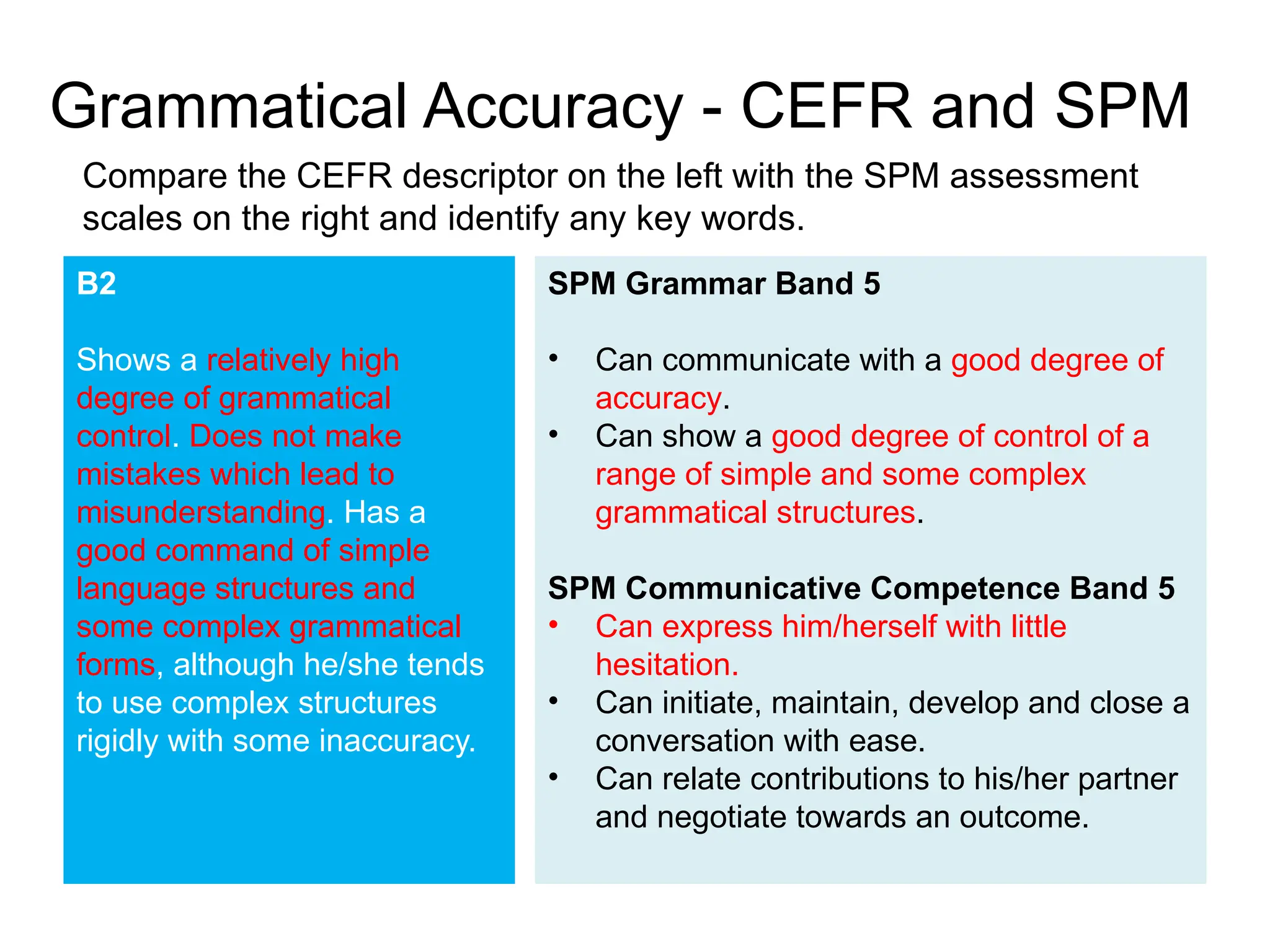
B2
Shows a relatively high
degree of grammatical
control. Does not make
mistakes which lead to
misunderstanding. Has a
good command of simple
language structures and
some complex grammatical
forms, although he/she tends
to use complex structures
rigidly with some inaccuracy.
SPM Grammar Band 5
• Can communicate with a good degree of
accuracy.
• Can show a good degree of control of a
range of simple and some complex
grammatical structures.
SPM Communicative Competence Band 5
• Can express him/herself with little
hesitation.
• Can initiate, maintain, develop and close a
conversation with ease.
• Can relate contributions to his/her partner
and negotiate towards an outcome.
Compare the CEFR descriptor on the left with the SPM assessment
scales on the right and identify any key words.
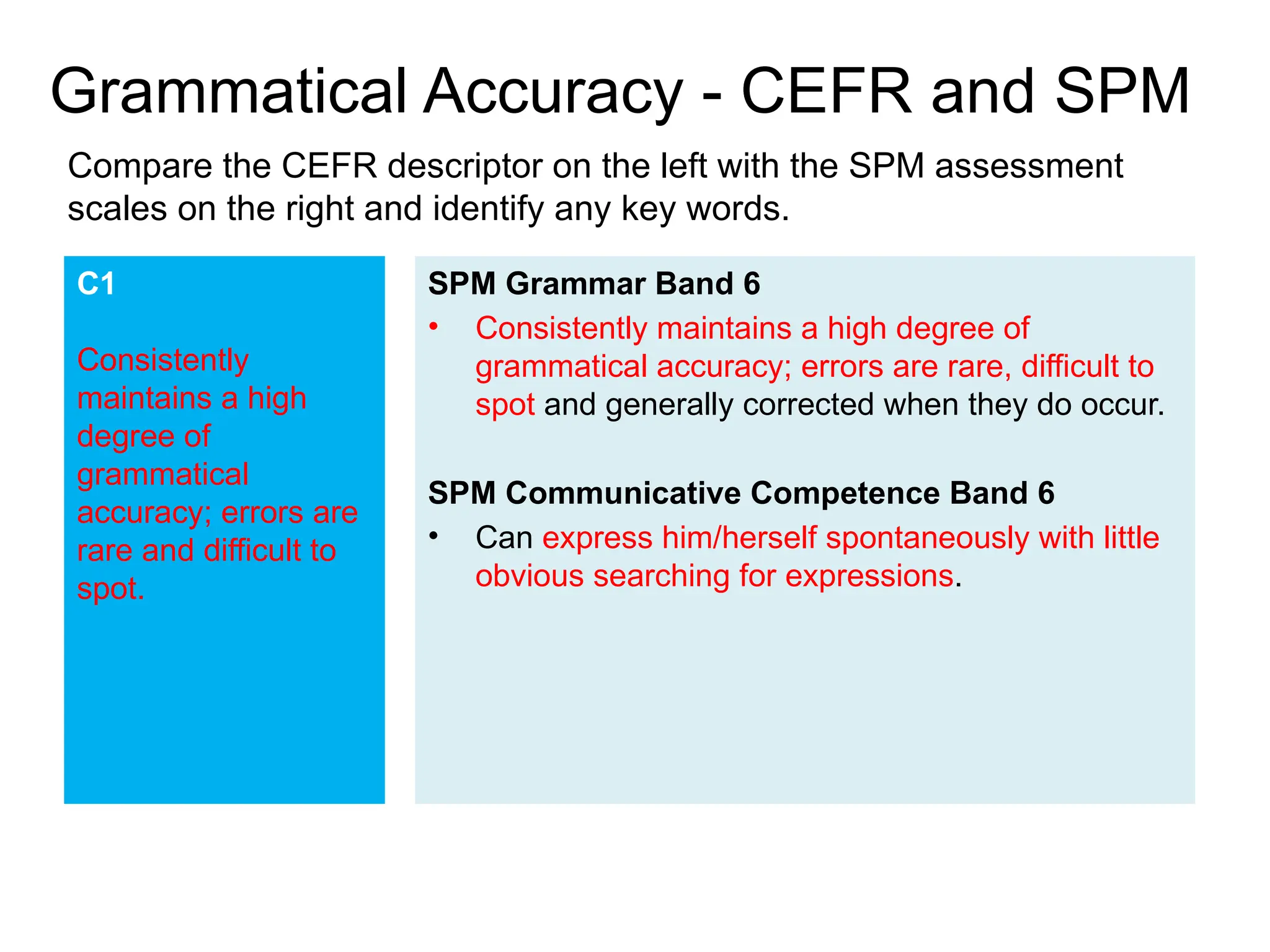
21.
Grammatical Accuracy -CEFR and SPM
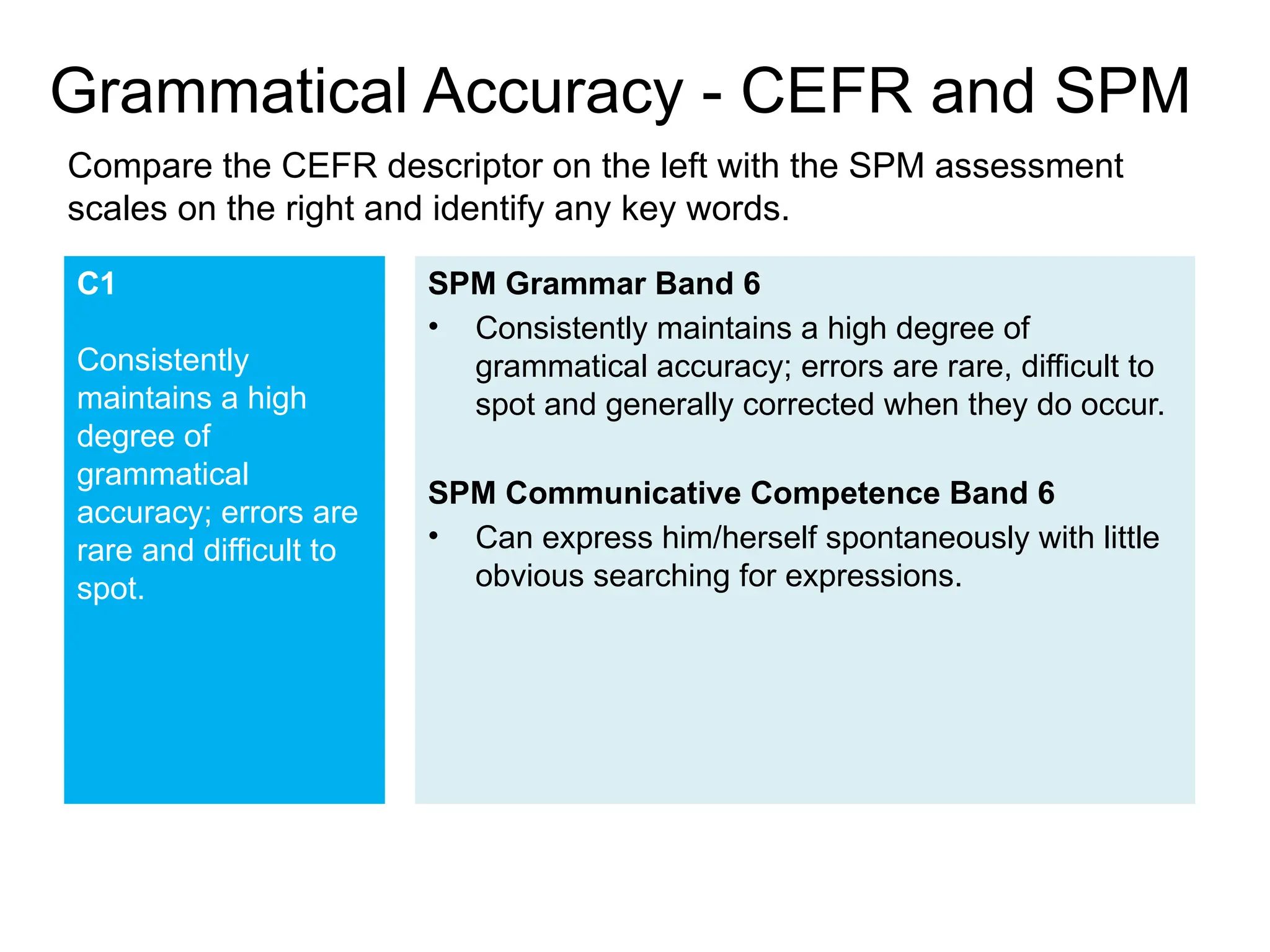
C1
Consistently
maintains a high
degree of
grammatical
accuracy; errors are
rare and difficult to
spot.
SPM Grammar Band 6
• Consistently maintains a high degree of
grammatical accuracy; errors are rare, difficult to
spot and generally corrected when they do occur.
SPM Communicative Competence Band 6
• Can express him/herself spontaneously with little
obvious searching for expressions.
Compare the CEFR descriptor on the left with the SPM assessment
scales on the right and identify any key words.
22.
Grammatical Accuracy -CEFR and SPM
C1
Consistently
maintains a high
degree of
grammatical
accuracy; errors are
rare and difficult to
spot.
SPM Grammar Band 6
• Consistently maintains a high degree of
grammatical accuracy; errors are rare, difficult to
spot and generally corrected when they do occur.
SPM Communicative Competence Band 6
• Can express him/herself spontaneously with little
obvious searching for expressions.
Compare the CEFR descriptor on the left with the SPM assessment
scales on the right and identify any key words.
23.
Speaking and theCEFR
Activity
Look at Handout S1 (SPM Speaking and the
CEFR) on the following slides.
For each pair of CEFR descriptors decide which
level of ability they are describing.
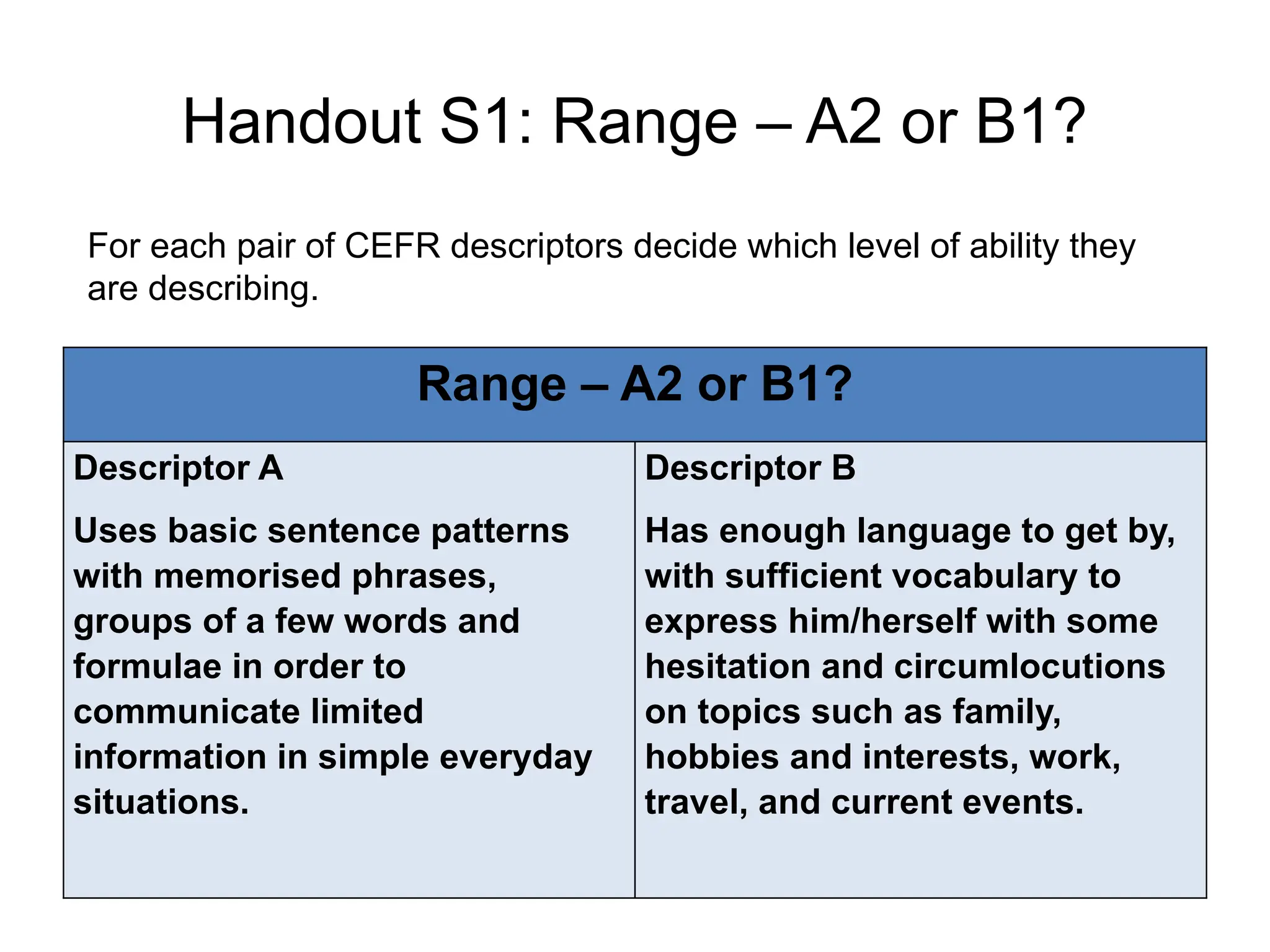
24.
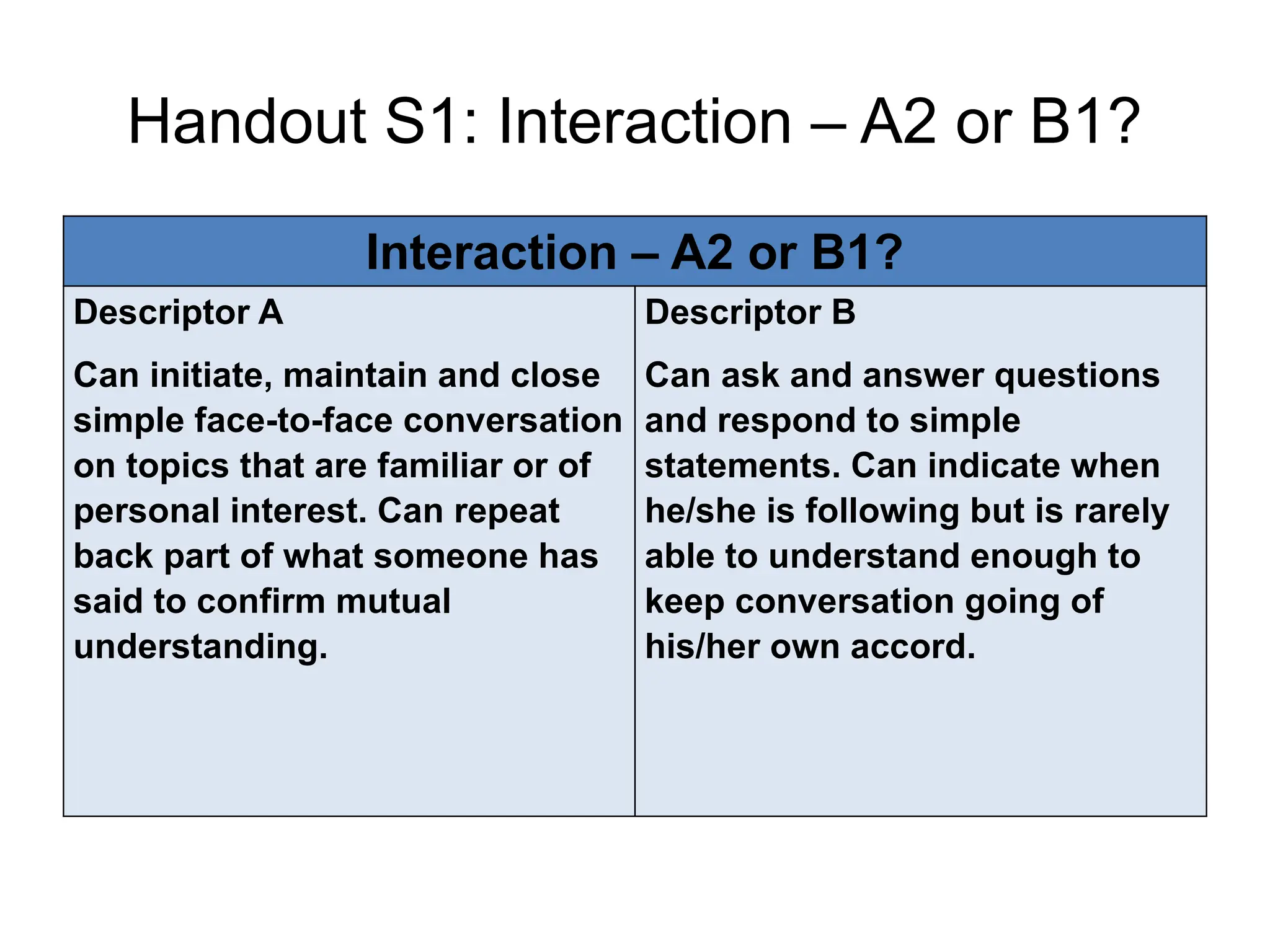
Handout S1: Range– A2 or B1?
Range – A2 or B1?
Descriptor A
Uses basic sentence patterns
with memorised phrases,
groups of a few words and
formulae in order to
communicate limited
information in simple everyday
situations.
Descriptor B
Has enough language to get by,
with sufficient vocabulary to
express him/herself with some
hesitation and circumlocutions
on topics such as family,
hobbies and interests, work,
travel, and current events.
For each pair of CEFR descriptors decide which level of ability they
are describing.
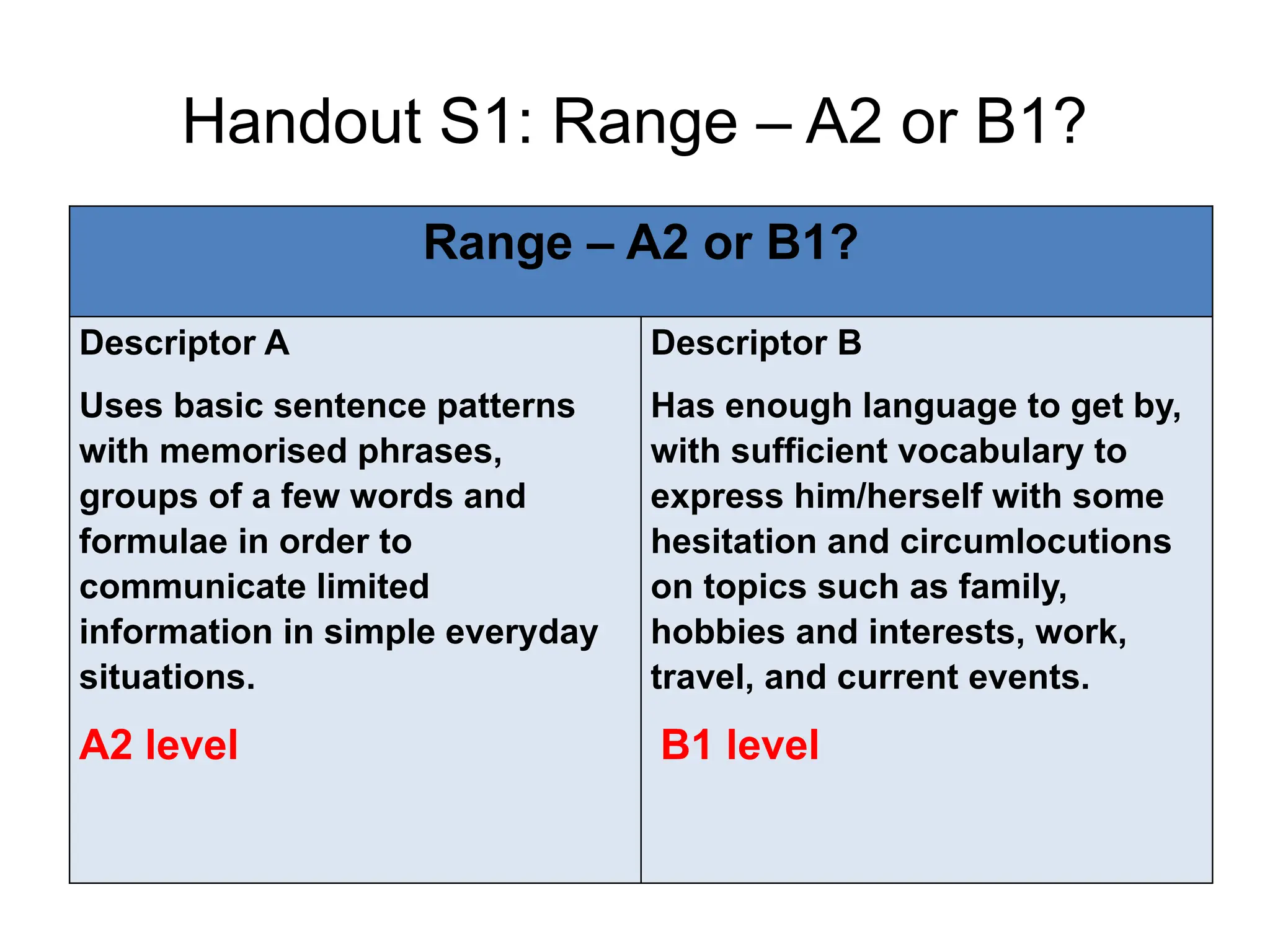
25.
Handout S1: Range– A2 or B1?
Range – A2 or B1?
Descriptor A
Uses basic sentence patterns
with memorised phrases,
groups of a few words and
formulae in order to
communicate limited
information in simple everyday
situations.
A2 level
Descriptor B
Has enough language to get by,
with sufficient vocabulary to
express him/herself with some
hesitation and circumlocutions
on topics such as family,
hobbies and interests, work,
travel, and current events.
B1 level
26.
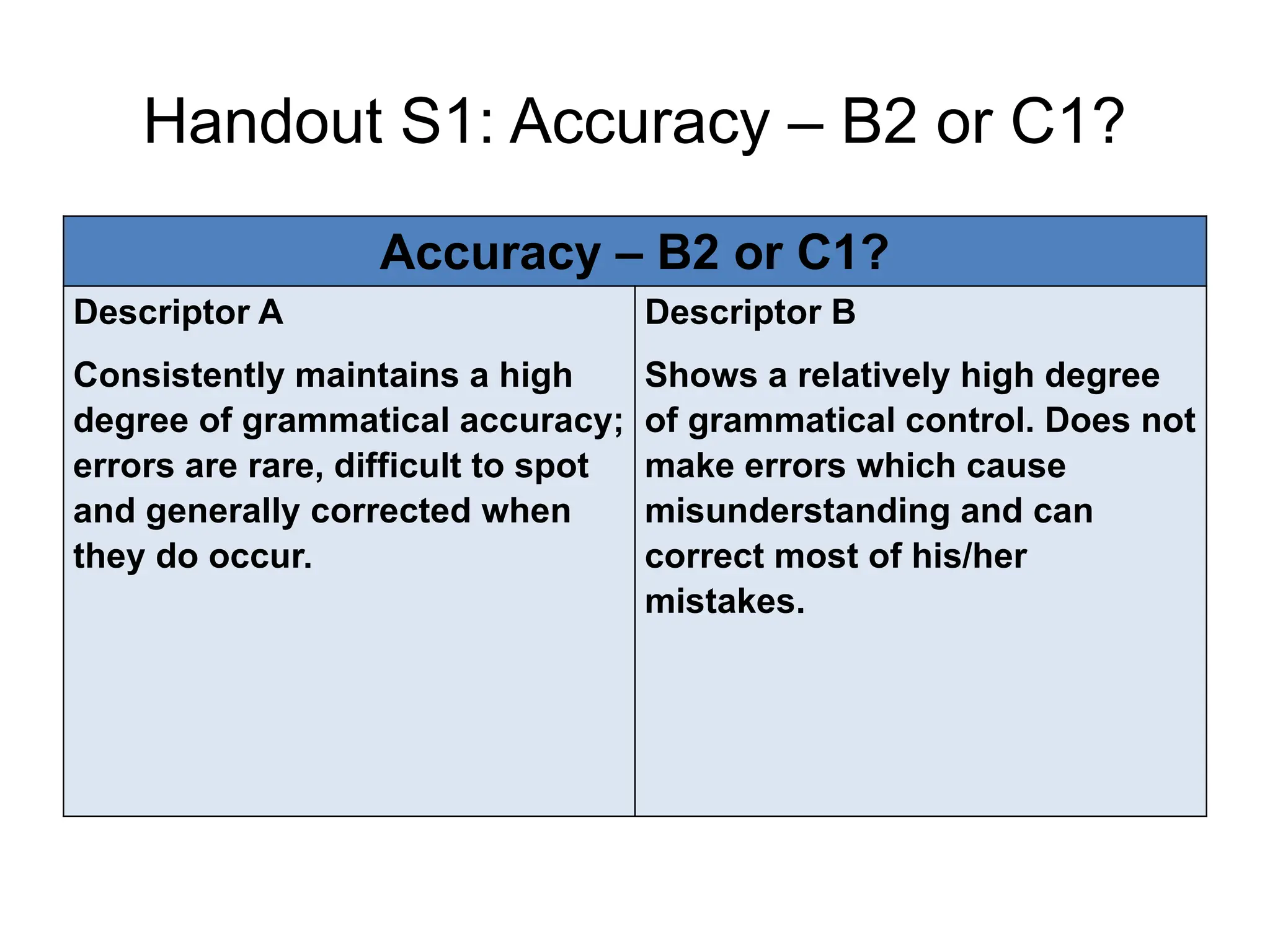
Handout S1: Accuracy– B2 or C1?
Accuracy – B2 or C1?
Descriptor A
Consistently maintains a high
degree of grammatical accuracy;
errors are rare, difficult to spot
and generally corrected when
they do occur.
Descriptor B
Shows a relatively high degree
of grammatical control. Does not
make errors which cause
misunderstanding and can
correct most of his/her
mistakes.
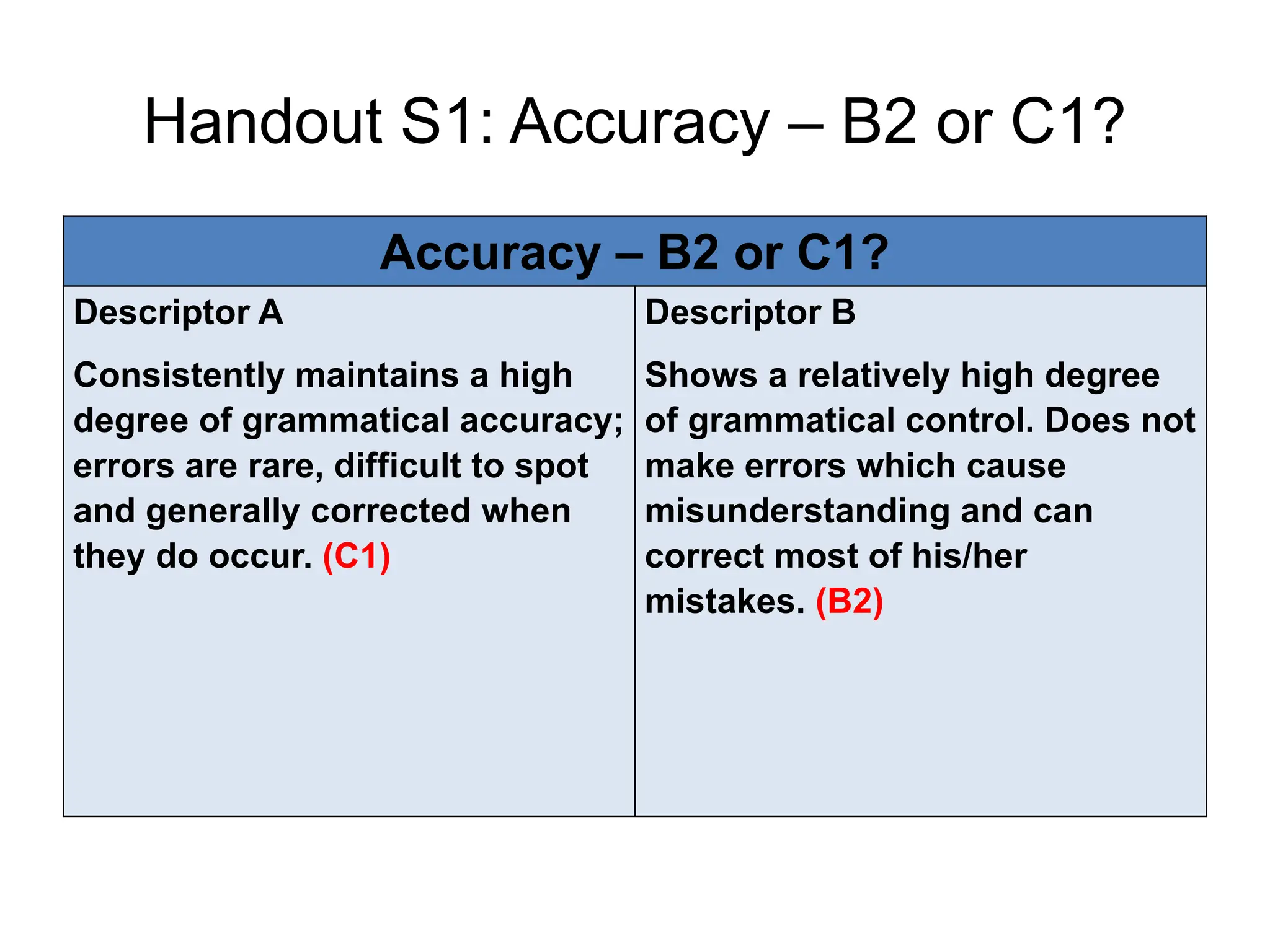
27.
Handout S1: Accuracy– B2 or C1?
Accuracy – B2 or C1?
Descriptor A
Consistently maintains a high
degree of grammatical accuracy;
errors are rare, difficult to spot
and generally corrected when
they do occur. (C1)
Descriptor B
Shows a relatively high degree
of grammatical control. Does not
make errors which cause
misunderstanding and can
correct most of his/her
mistakes. (B2)
28.
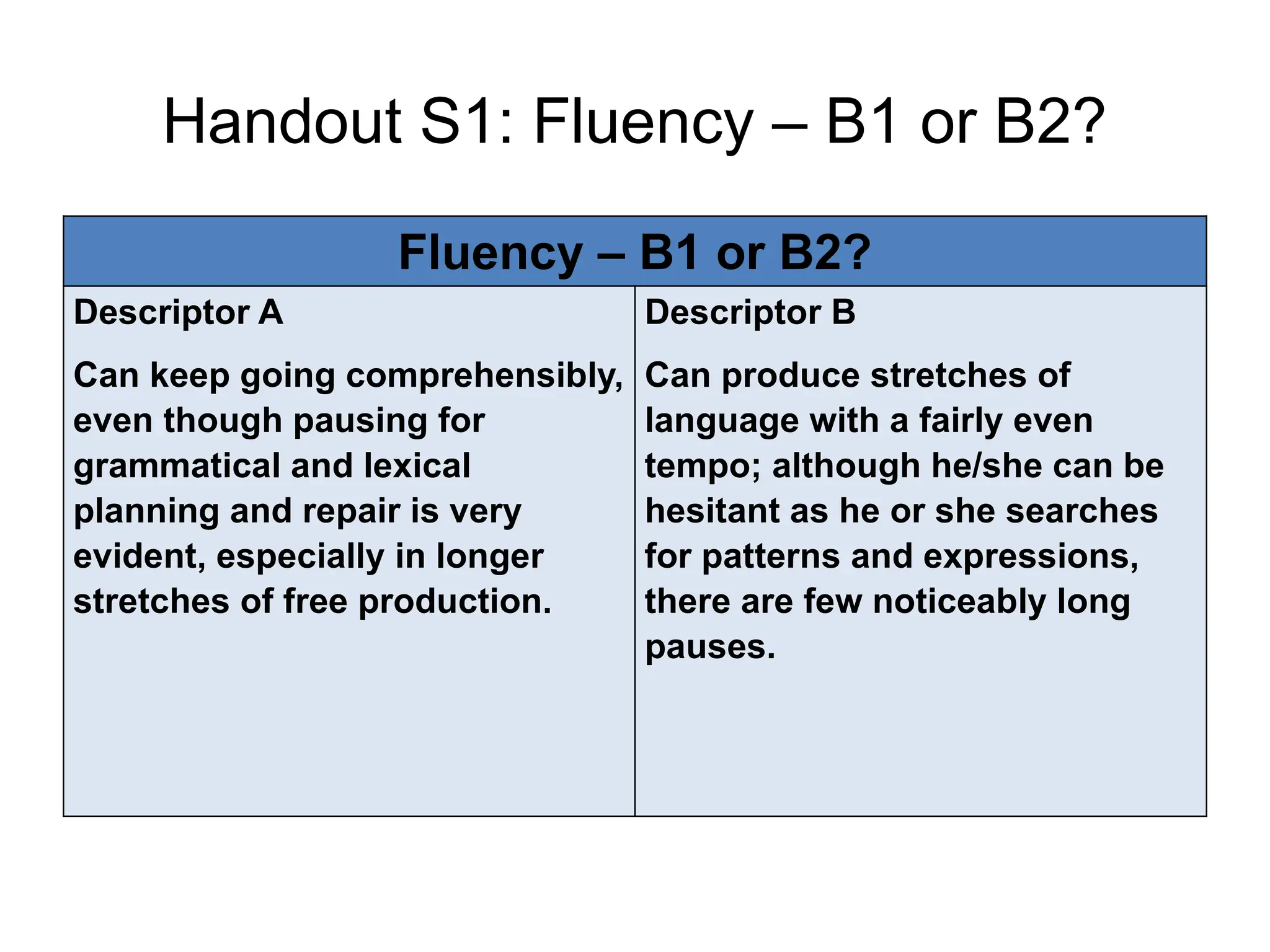
Handout S1: Fluency– B1 or B2?
Fluency – B1 or B2?
Descriptor A
Can keep going comprehensibly,
even though pausing for
grammatical and lexical
planning and repair is very
evident, especially in longer
stretches of free production.
Descriptor B
Can produce stretches of
language with a fairly even
tempo; although he/she can be
hesitant as he or she searches
for patterns and expressions,
there are few noticeably long
pauses.
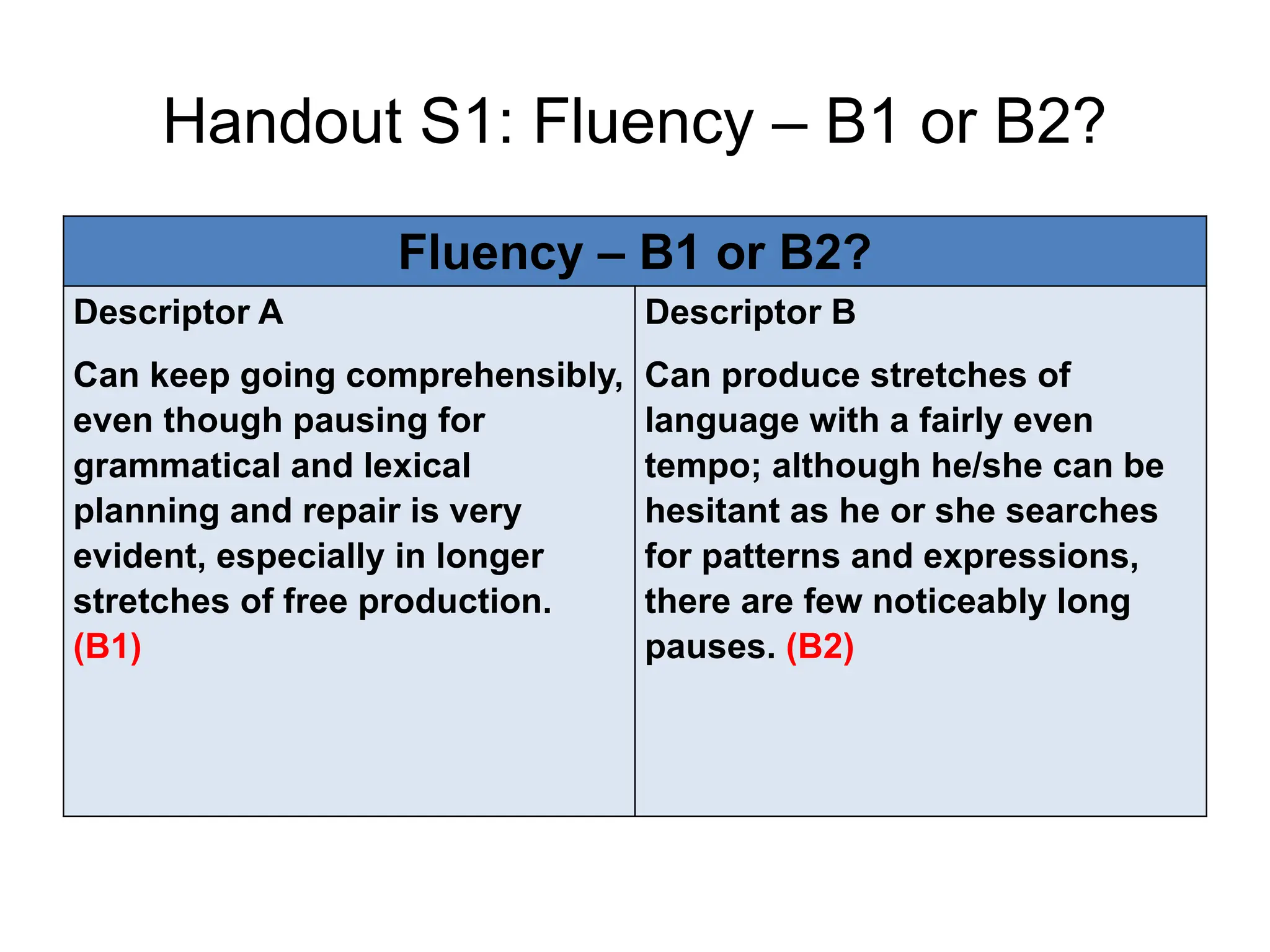
29.
Handout S1: Fluency– B1 or B2?
Fluency – B1 or B2?
Descriptor A
Can keep going comprehensibly,
even though pausing for
grammatical and lexical
planning and repair is very
evident, especially in longer
stretches of free production.
(B1)
Descriptor B
Can produce stretches of
language with a fairly even
tempo; although he/she can be
hesitant as he or she searches
for patterns and expressions,
there are few noticeably long
pauses. (B2)
30.
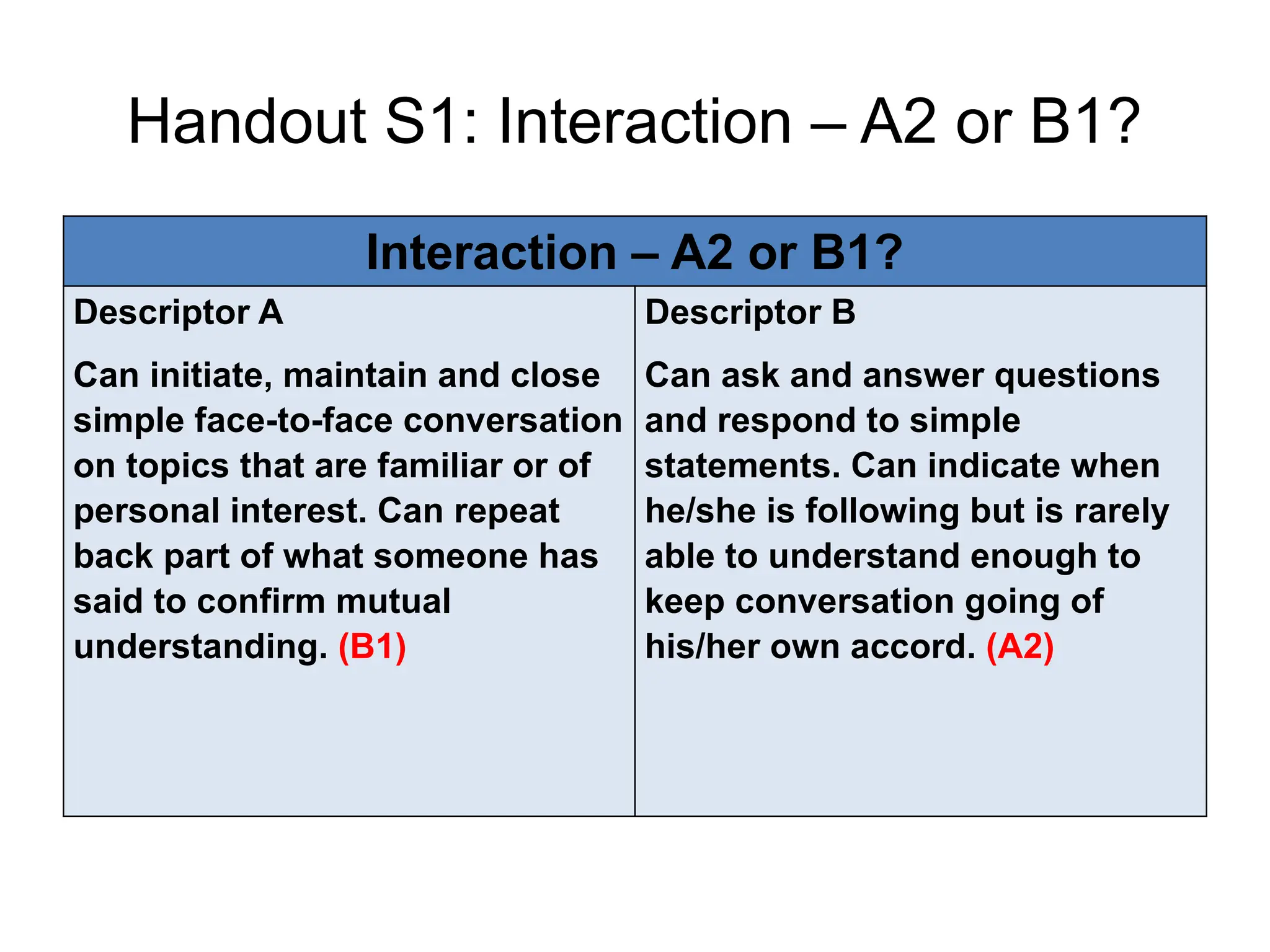
Handout S1: Interaction– A2 or B1?
Interaction – A2 or B1?
Descriptor A
Can initiate, maintain and close
simple face-to-face conversation
on topics that are familiar or of
personal interest. Can repeat
back part of what someone has
said to confirm mutual
understanding.
Descriptor B
Can ask and answer questions
and respond to simple
statements. Can indicate when
he/she is following but is rarely
able to understand enough to
keep conversation going of
his/her own accord.
31.
Handout S1: Interaction– A2 or B1?
Interaction – A2 or B1?
Descriptor A
Can initiate, maintain and close
simple face-to-face conversation
on topics that are familiar or of
personal interest. Can repeat
back part of what someone has
said to confirm mutual
understanding. (B1)
Descriptor B
Can ask and answer questions
and respond to simple
statements. Can indicate when
he/she is following but is rarely
able to understand enough to
keep conversation going of
his/her own accord. (A2)
32.
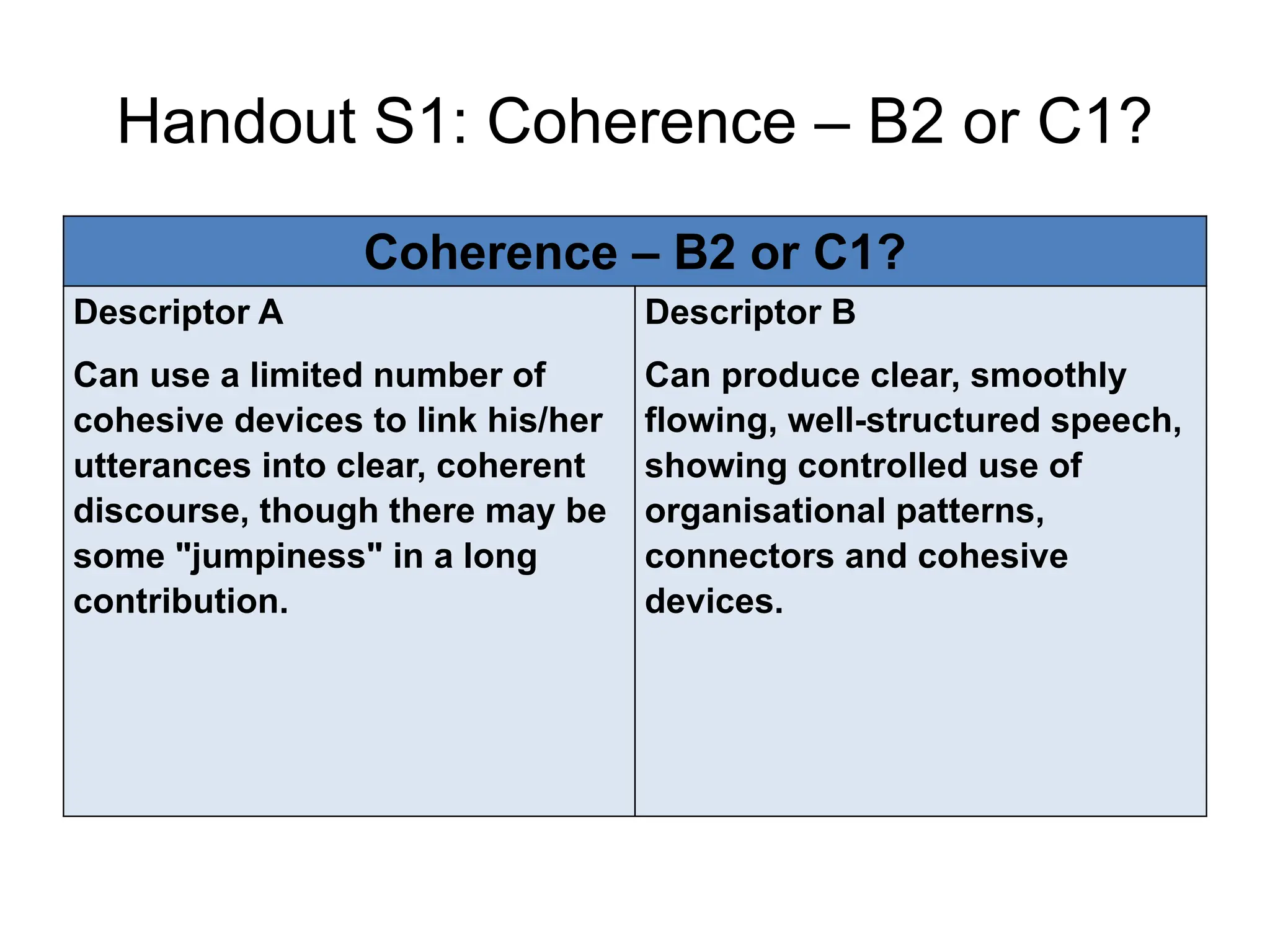
Handout S1: Coherence– B2 or C1?
Coherence – B2 or C1?
Descriptor A
Can use a limited number of
cohesive devices to link his/her
utterances into clear, coherent
discourse, though there may be
some "jumpiness" in a long
contribution.
Descriptor B
Can produce clear, smoothly
flowing, well-structured speech,
showing controlled use of
organisational patterns,
connectors and cohesive
devices.
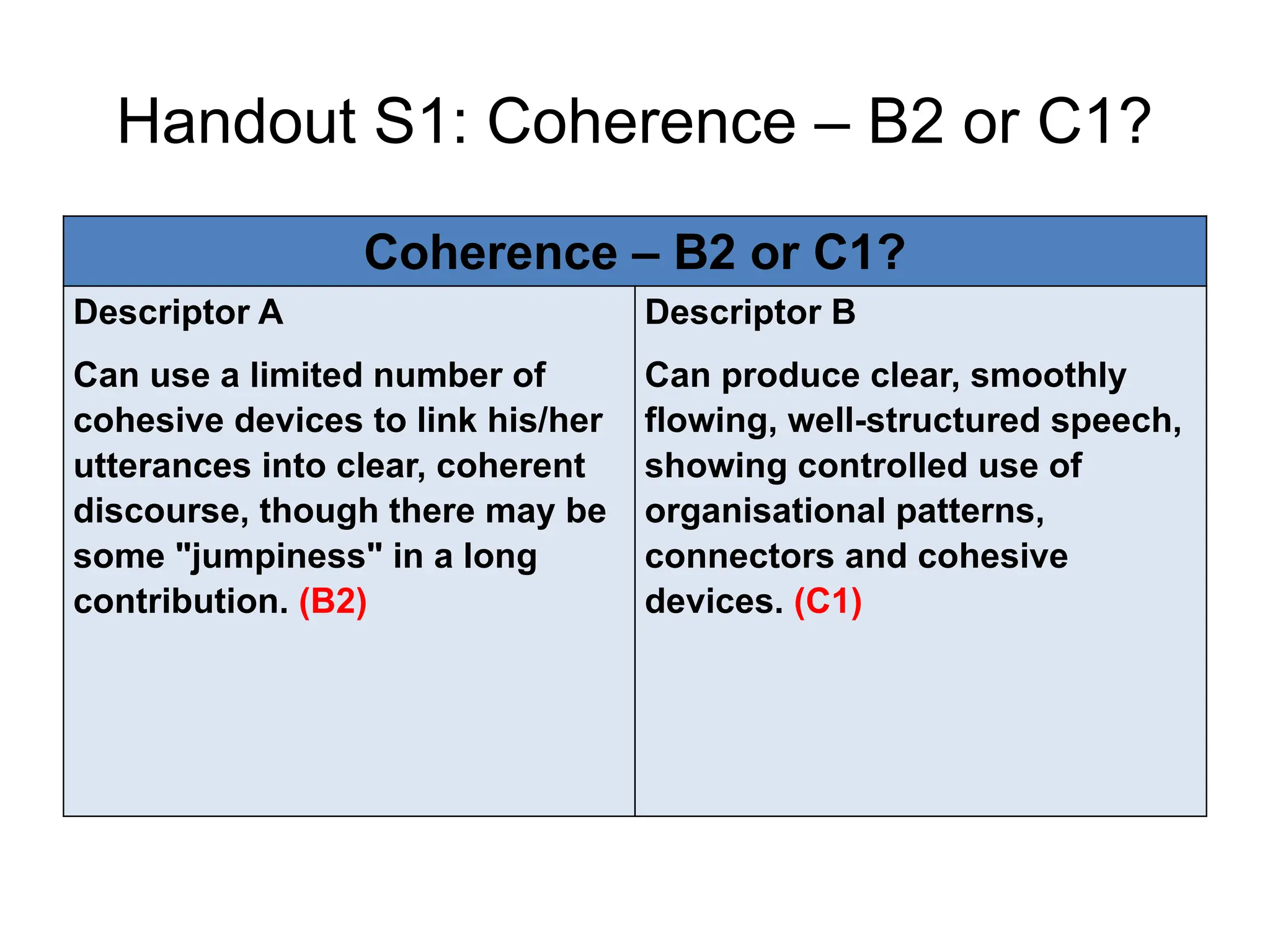
33.
Handout S1: Coherence– B2 or C1?
Coherence – B2 or C1?
Descriptor A
Can use a limited number of
cohesive devices to link his/her
utterances into clear, coherent
discourse, though there may be
some "jumpiness" in a long
contribution. (B2)
Descriptor B
Can produce clear, smoothly
flowing, well-structured speech,
showing controlled use of
organisational patterns,
connectors and cohesive
devices. (C1)
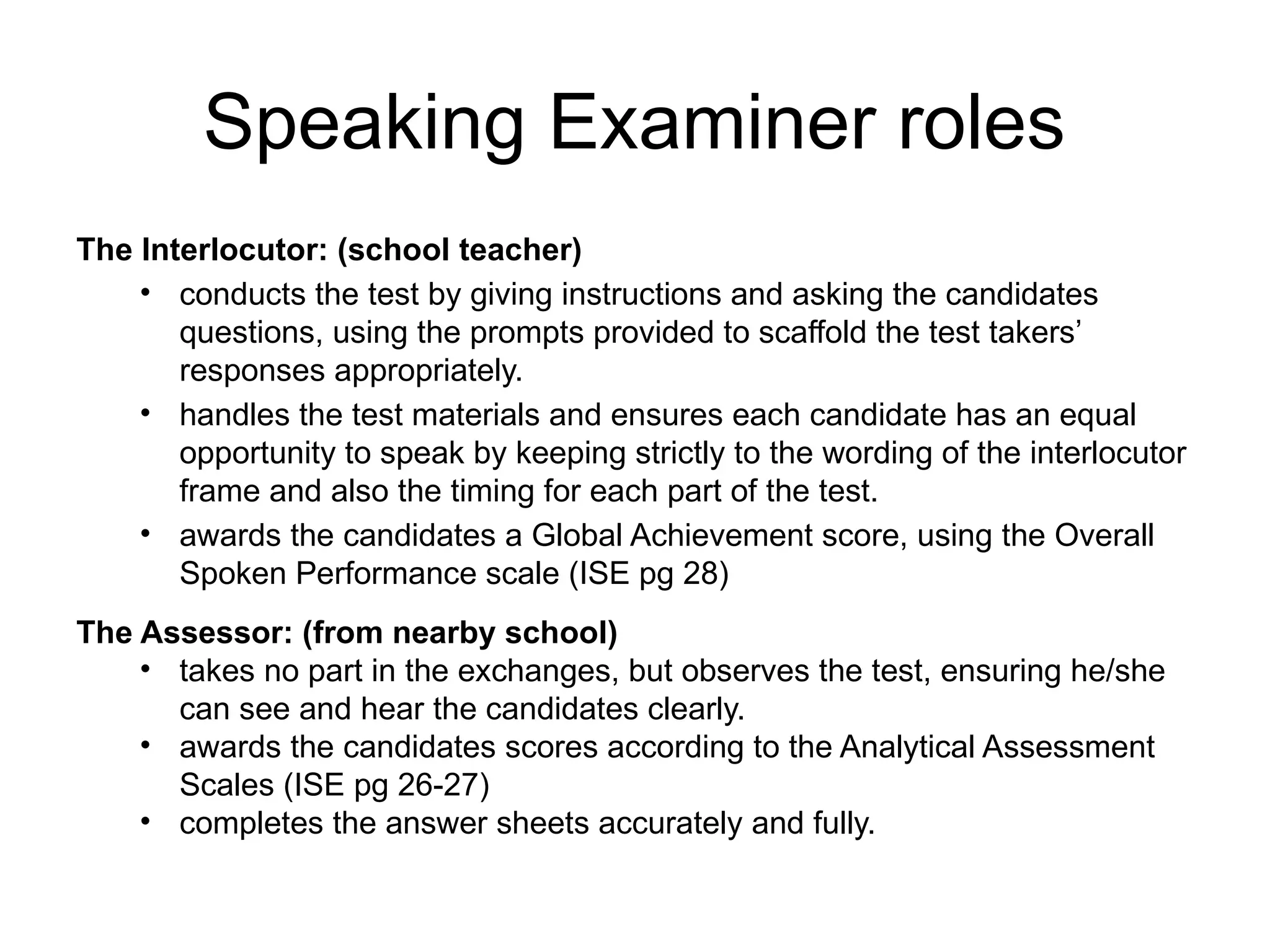
Speaking Examiner roles
TheInterlocutor: (school teacher)
• conducts the test by giving instructions and asking the candidates
questions, using the prompts provided to scaffold the test takers’
responses appropriately.
• handles the test materials and ensures each candidate has an equal
opportunity to speak by keeping strictly to the wording of the interlocutor
frame and also the timing for each part of the test.
• awards the candidates a Global Achievement score, using the Overall
Spoken Performance scale (ISE pg 28)
The Assessor: (from nearby school)
• takes no part in the exchanges, but observes the test, ensuring he/she
can see and hear the candidates clearly.
• awards the candidates scores according to the Analytical Assessment
Scales (ISE pg 26-27)
• completes the answer sheets accurately and fully.
37.
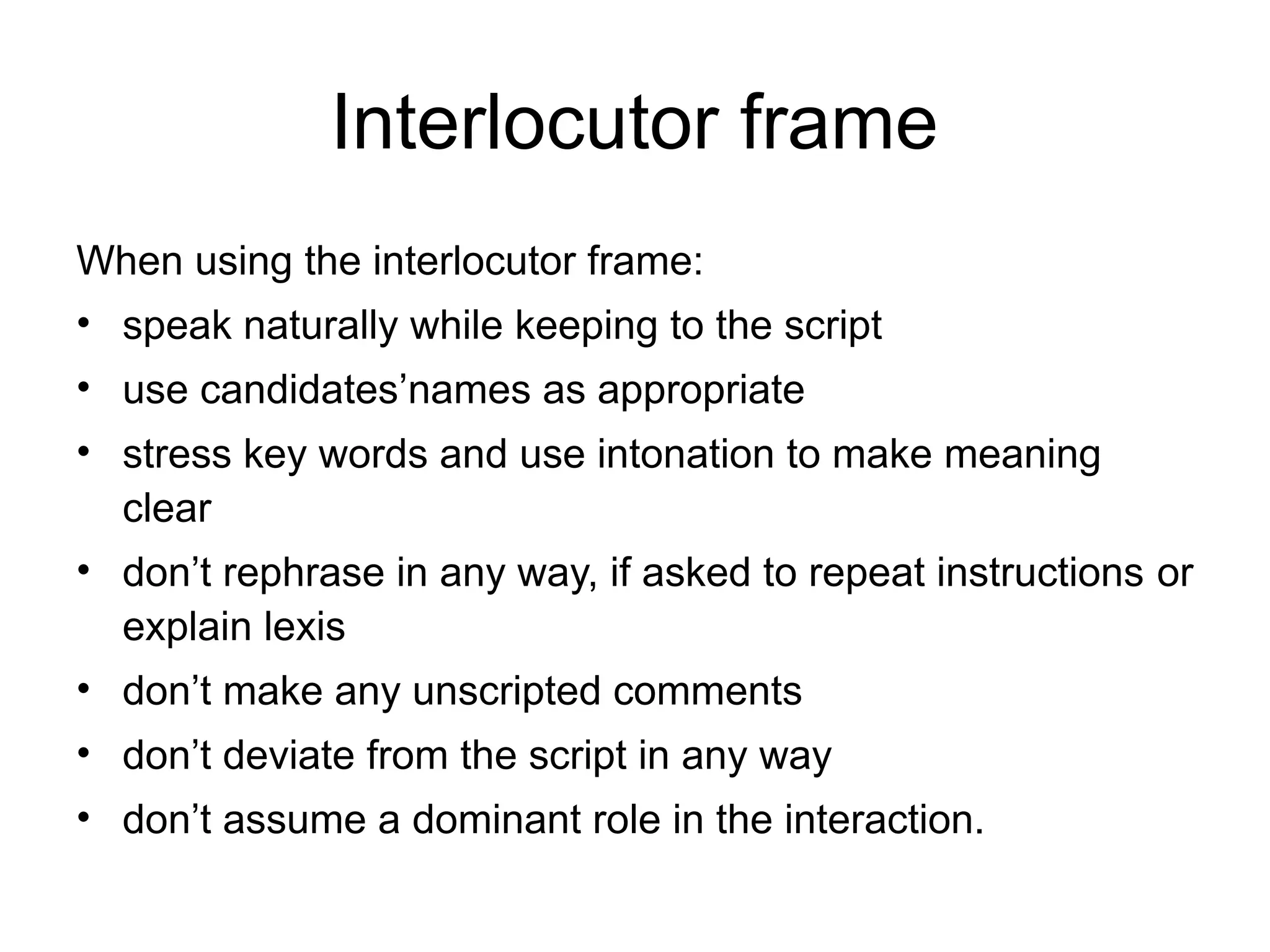
Interlocutor frame
When usingthe interlocutor frame:
• speak naturally while keeping to the script
• use candidates’names as appropriate
• stress key words and use intonation to make meaning
clear
• don’t rephrase in any way, if asked to repeat instructions or
explain lexis
• don’t make any unscripted comments
• don’t deviate from the script in any way
• don’t assume a dominant role in the interaction.
Speaking Test Procedure
Activity
Lookat Handout S2 (Speaking Test Procedure)
on the next slide.
Watch the sample Speaking test and put the steps
for carrying out the test in the correct order (1 – 9).
(For Trainers): Make a note of any questions you
have on this activity or anything you want more
information about for the Q and A session.
42.
A sample SPMSpeaking test
Focus on Procedure
Video 1: Helmi and Ain
43.
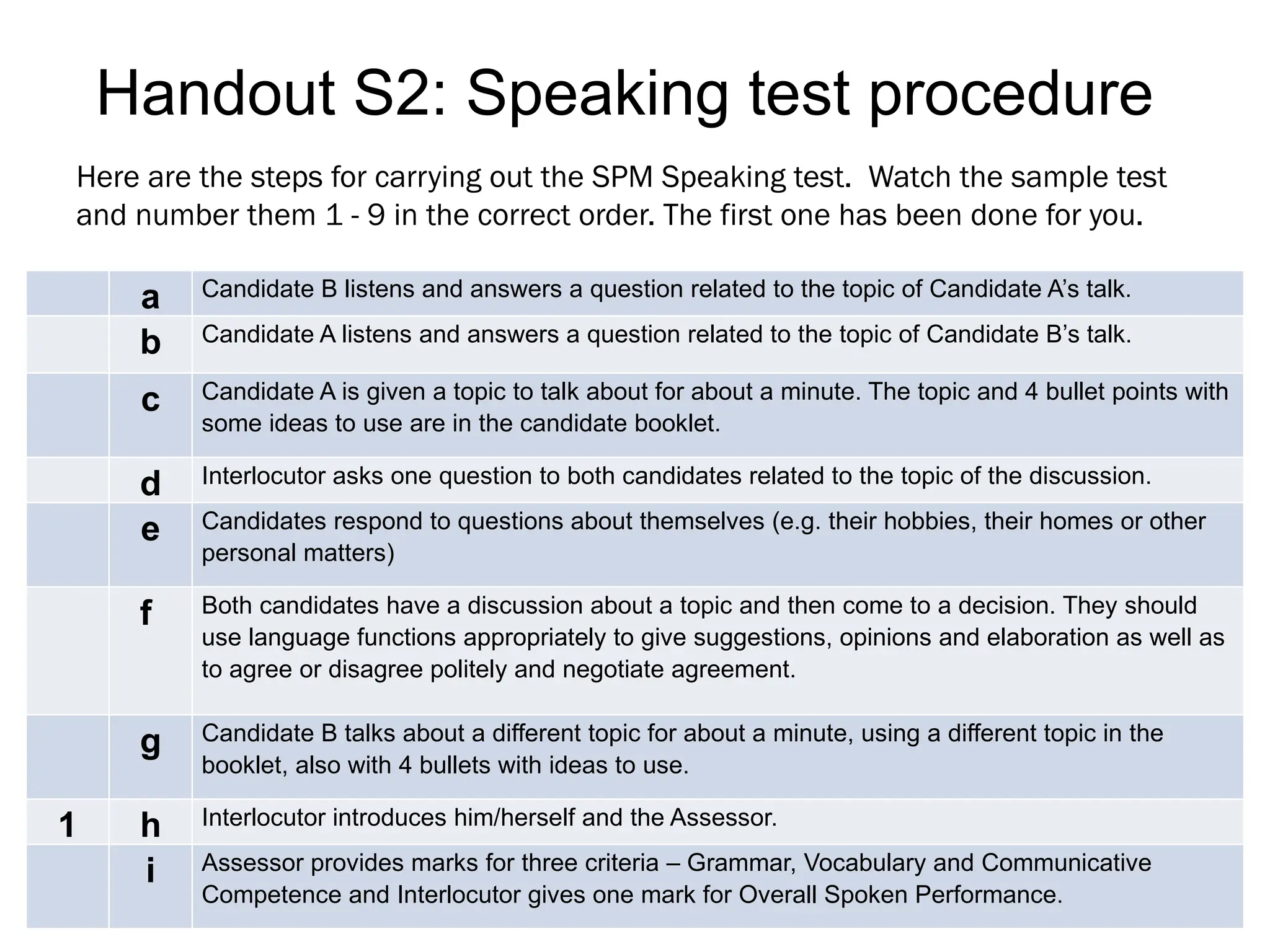
Handout S2: Speakingtest procedure
Here are the steps for carrying out the SPM Speaking test. Watch the sample test
and number them 1 - 9 in the correct order. The first one has been done for you.
a Candidate B listens and answers a question related to the topic of Candidate A’s talk.
b Candidate A listens and answers a question related to the topic of Candidate B’s talk.
c Candidate A is given a topic to talk about for about a minute. The topic and 4 bullet points with
some ideas to use are in the candidate booklet.
d Interlocutor asks one question to both candidates related to the topic of the discussion.
e Candidates respond to questions about themselves (e.g. their hobbies, their homes or other
personal matters)
f Both candidates have a discussion about a topic and then come to a decision. They should
use language functions appropriately to give suggestions, opinions and elaboration as well as
to agree or disagree politely and negotiate agreement.
g Candidate B talks about a different topic for about a minute, using a different topic in the
booklet, also with 4 bullets with ideas to use.
1 h Interlocutor introduces him/herself and the Assessor.
i Assessor provides marks for three criteria – Grammar, Vocabulary and Communicative
Competence and Interlocutor gives one mark for Overall Spoken Performance.
44.
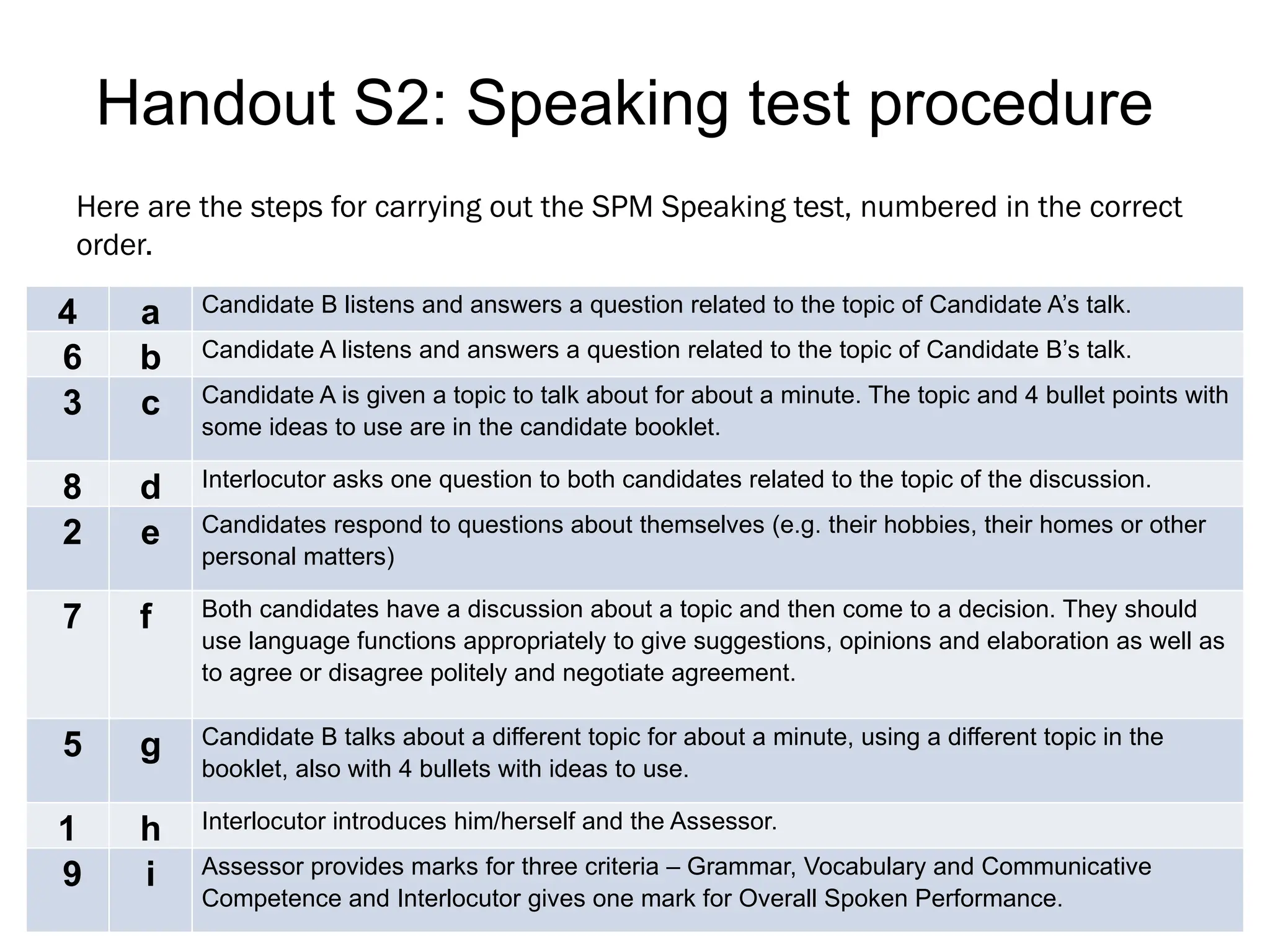
Handout S2: Speakingtest procedure
Here are the steps for carrying out the SPM Speaking test, numbered in the correct
order.
4 a Candidate B listens and answers a question related to the topic of Candidate A’s talk.
6 b Candidate A listens and answers a question related to the topic of Candidate B’s talk.
3 c Candidate A is given a topic to talk about for about a minute. The topic and 4 bullet points with
some ideas to use are in the candidate booklet.
8 d Interlocutor asks one question to both candidates related to the topic of the discussion.
2 e Candidates respond to questions about themselves (e.g. their hobbies, their homes or other
personal matters)
7 f Both candidates have a discussion about a topic and then come to a decision. They should
use language functions appropriately to give suggestions, opinions and elaboration as well as
to agree or disagree politely and negotiate agreement.
5 g Candidate B talks about a different topic for about a minute, using a different topic in the
booklet, also with 4 bullets with ideas to use.
1 h Interlocutor introduces him/herself and the Assessor.
9 i Assessor provides marks for three criteria – Grammar, Vocabulary and Communicative
Competence and Interlocutor gives one mark for Overall Spoken Performance.
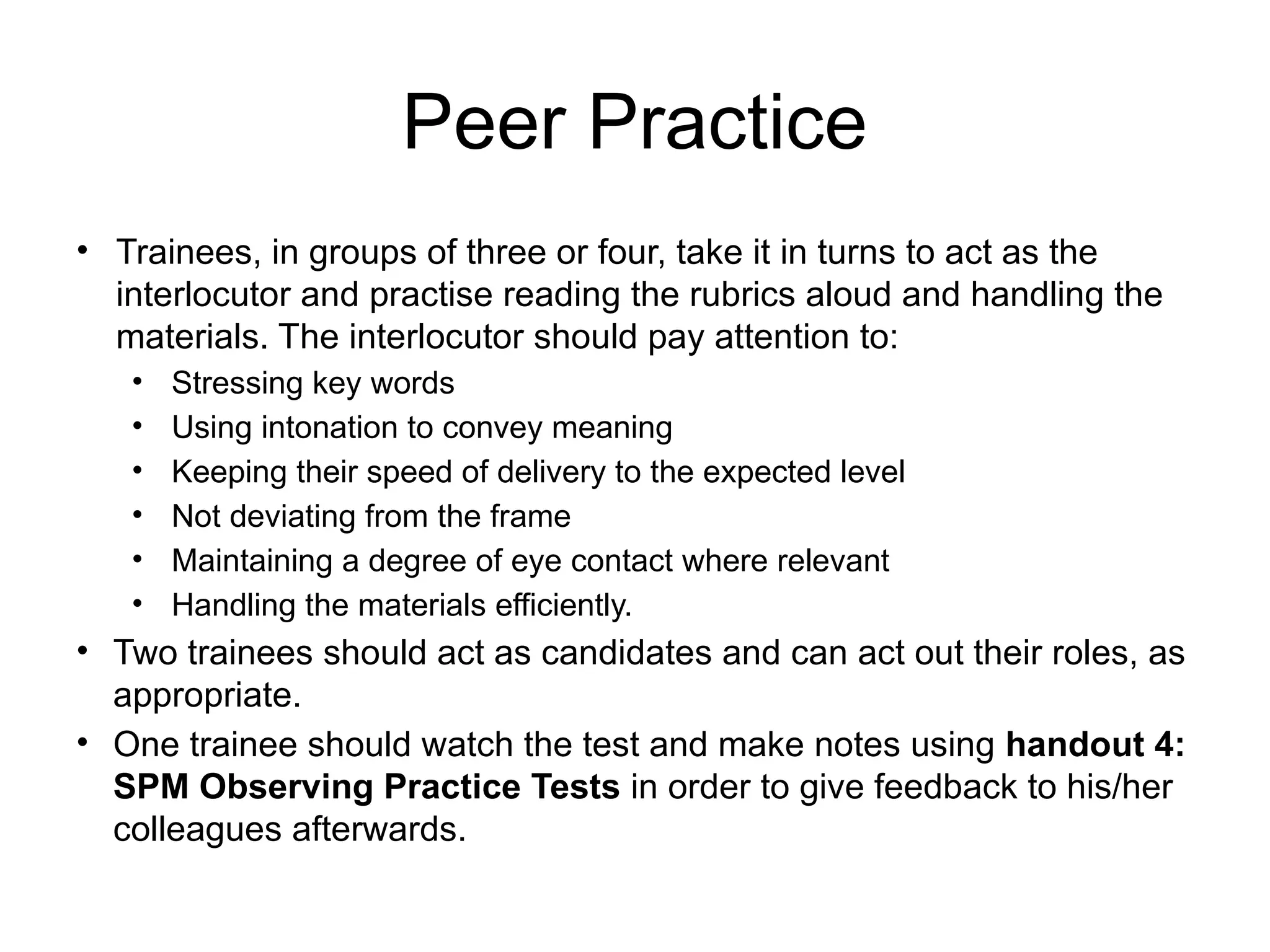
Peer Practice
• Trainees,in groups of three or four, take it in turns to act as the
interlocutor and practise reading the rubrics aloud and handling the
materials. The interlocutor should pay attention to:
• Stressing key words
• Using intonation to convey meaning
• Keeping their speed of delivery to the expected level
• Not deviating from the frame
• Maintaining a degree of eye contact where relevant
• Handling the materials efficiently.
• Two trainees should act as candidates and can act out their roles, as
appropriate.
• One trainee should watch the test and make notes using handout 4:
SPM Observing Practice Tests in order to give feedback to his/her
colleagues afterwards.
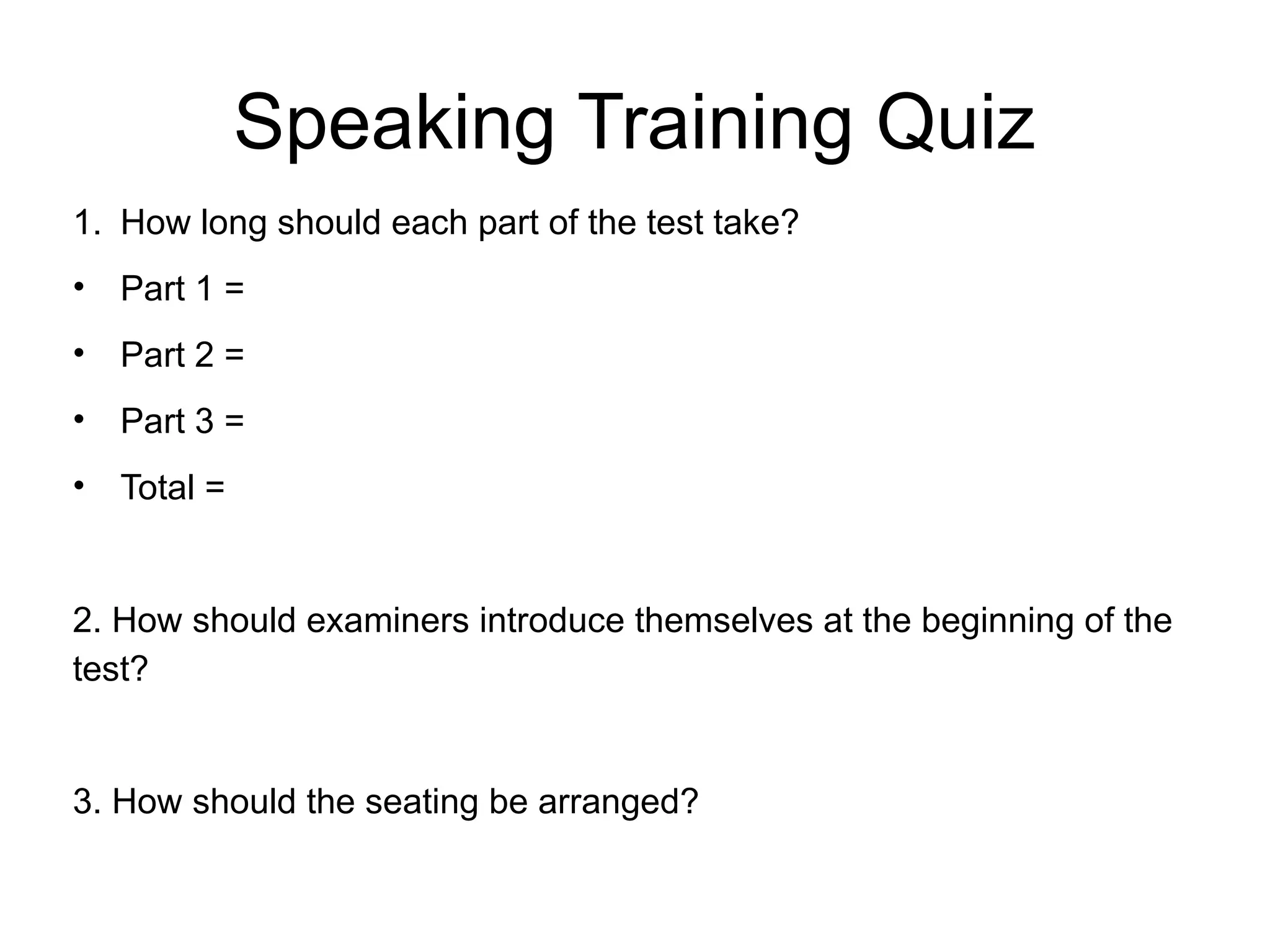
Speaking Training Quiz
1.How long should each part of the test take?
• Part 1 =
• Part 2 =
• Part 3 =
• Total =
2. How should examiners introduce themselves at the beginning of the
test?
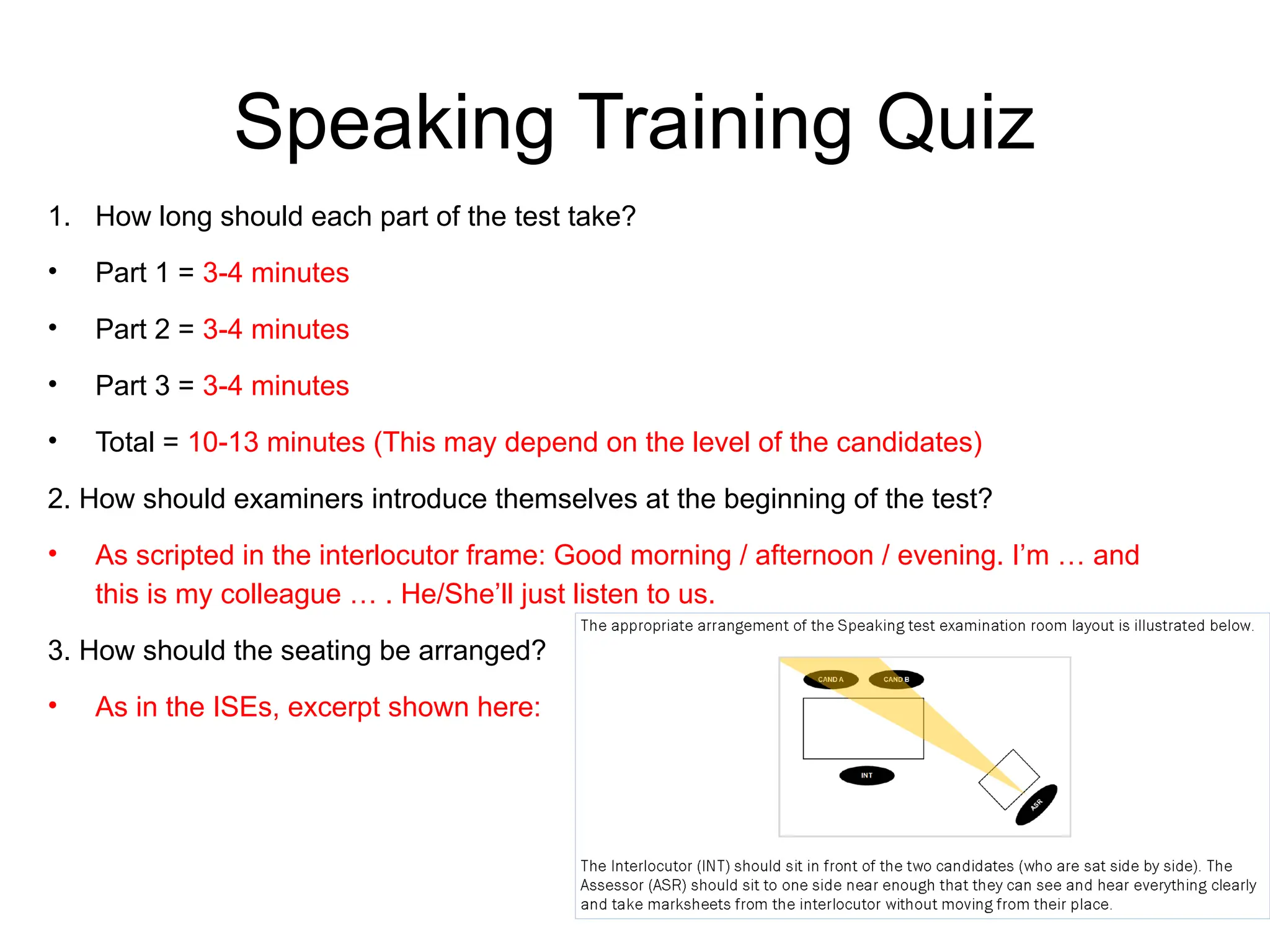
3. How should the seating be arranged?
49.
Speaking Training Quiz
1.How long should each part of the test take?
• Part 1 = 3-4 minutes
• Part 2 = 3-4 minutes
• Part 3 = 3-4 minutes
• Total = 10-13 minutes (This may depend on the level of the candidates)
2. How should examiners introduce themselves at the beginning of the test?
• As scripted in the interlocutor frame: Good morning / afternoon / evening. I’m … and
this is my colleague … . He/She’ll just listen to us.
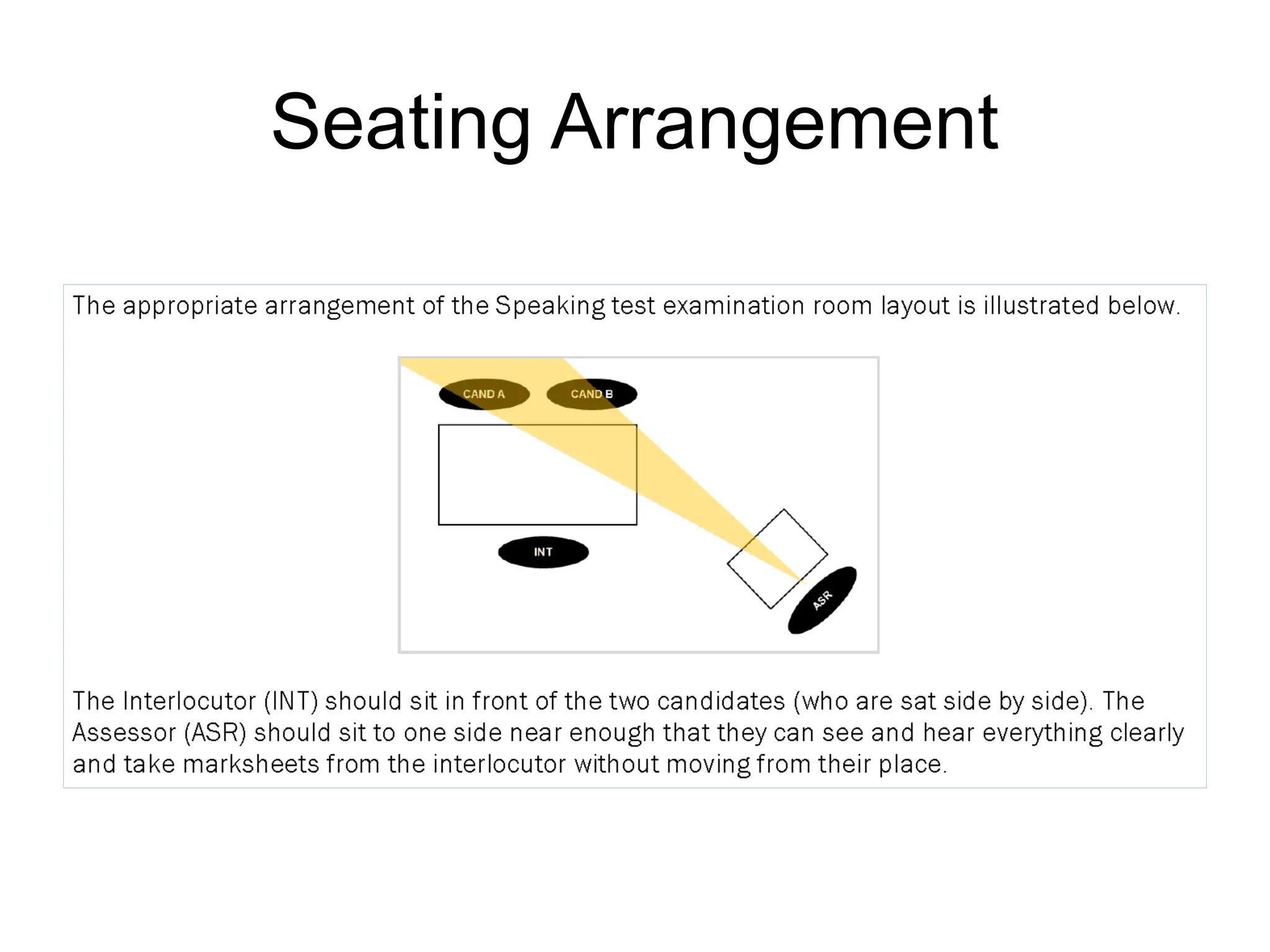
3. How should the seating be arranged?
• As in the ISEs, excerpt shown here:
50.
Speaking Training Quiz
4.Towhat extent should the interlocutor follow the frames provided
in the materials?
5. What are the analytical criteria used in assessing candidates?
•
•
•
6. Who leads/controls the interaction in Part 3 of the test?
51.
Speaking Training Quiz
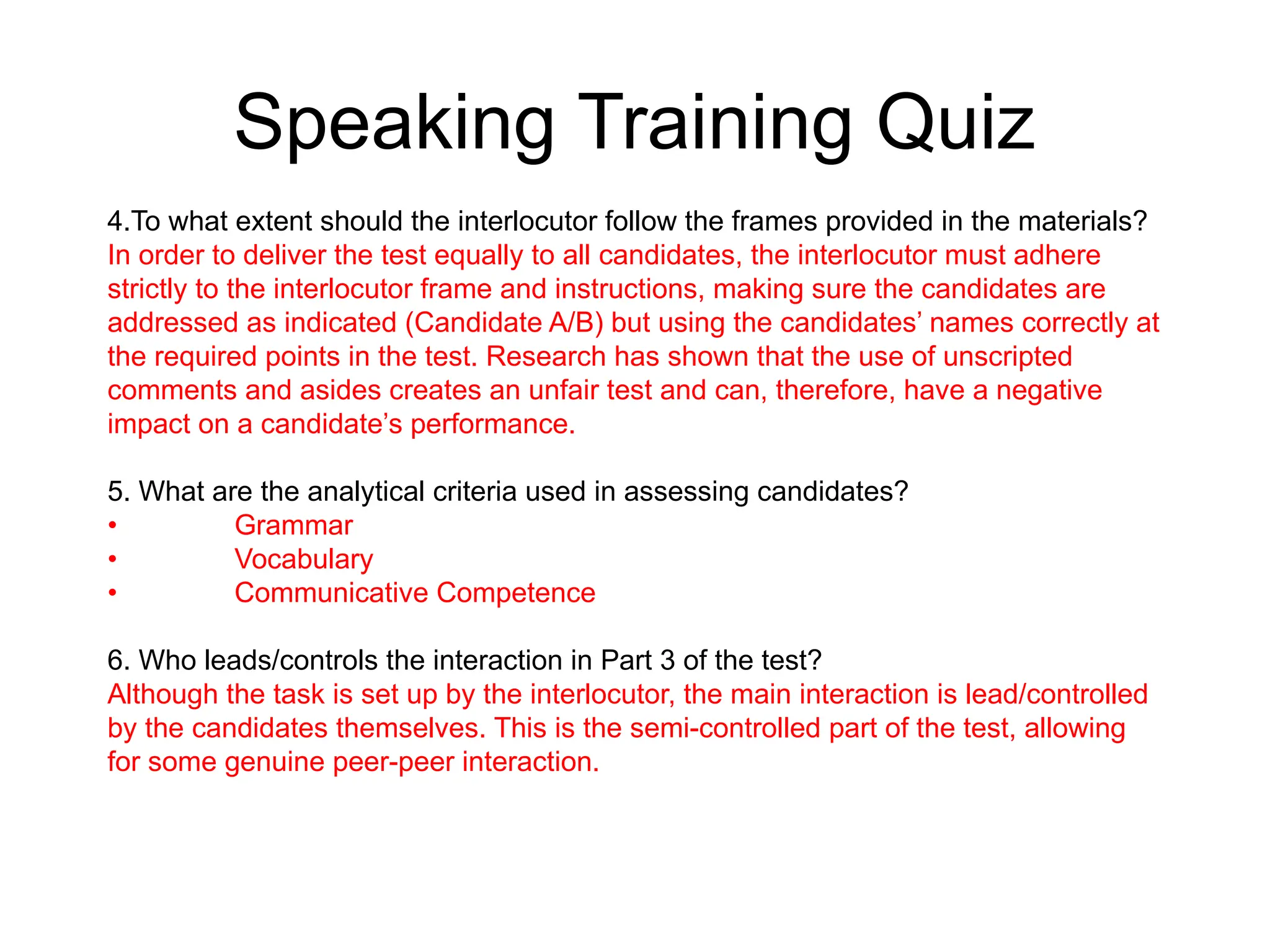
4.Towhat extent should the interlocutor follow the frames provided in the materials?
In order to deliver the test equally to all candidates, the interlocutor must adhere
strictly to the interlocutor frame and instructions, making sure the candidates are
addressed as indicated (Candidate A/B) but using the candidates’ names correctly at
the required points in the test. Research has shown that the use of unscripted
comments and asides creates an unfair test and can, therefore, have a negative
impact on a candidate’s performance.
5. What are the analytical criteria used in assessing candidates?
• Grammar
• Vocabulary
• Communicative Competence
6. Who leads/controls the interaction in Part 3 of the test?
Although the task is set up by the interlocutor, the main interaction is lead/controlled
by the candidates themselves. This is the semi-controlled part of the test, allowing
for some genuine peer-peer interaction.
52.
Speaking Training Quiz
7.What kind of timepiece should you use?
8. When do you start timing the test?
9. Why should you keep to timing for each section?
53.
Speaking Training Quiz
7.What kind of timepiece should you use?
SEs should use a reliable clock or watch which shows seconds, and
which doesn’t have a loud tick. Clocks/watches must not be set to emit
noises to signal the timings of the different parts of the test
8. When do you start timing the test?
The timing of the test begins when the interlocutor greets the
candidates, this should also be noted discretely.
9. Why should you keep to timing for each section?
It is important, for reasons of test reliability and fairness to candidates,
that all tests are of the same length and that the time spent on the
individual parts of the test does not vary from that indicated.
54.
Speaking Training Quiz
10.Can you repeat the same materials?
11. When should you change roles (interlocutor to assessor)?
12. What information does the interlocutor complete on the mark
sheet?
55.
Speaking Training Quiz
10.Can you repeat the same materials?
There will be a selection of tasks to choose and these will be in sets that should
not be separated. You should use the sets randomly and vary the sets in order to
provide test security.
11. When should you change roles (interlocutor to assessor)?
Roles are fixed.
The assessor is the teacher from a nearby school/centre appointed by the
Assessment and Examination Sector in the State Education Department (SPP,
JPN) while interlocutors are teachers who teach in the candidate’s school/centre.
The Principal or School Administrator is responsible in appointing the
interlocutor(s) and arranging the interlocutors’ schedules throughout the Speaking
exam period. The role of interlocutor will be assigned by the head teacher within
each school/centre.
12. What information does the interlocutor complete on the mark sheet?
The interlocutor uses the Overall Spoken Performance scale and refers to
it after the end of the test (as well as while the candidates are involved in
the collaborative tasks and possibly during the long turns) and they record
these marks on their mark sheet.
56.
Speaking Training Quiz
13.How can you react to candidates who need support in understanding
or speaking?
14. How can you interrupt a candidate or candidates discreetly when
necessary?
15. Why mustn’t you discuss marks with your co-examiner?
57.
Speaking Training Quiz
13.How can you react to candidates who need support in understanding or
speaking?
Redirection/support may take the form of:
•repetition of all or part of the rubric
•pointing to a task in the Candidate booklet
•use of a scripted back-up question/prompt.
You can use gesture and/or repetition and any back-up
questions, but you must never deviate from the frame.
14. How can you interrupt a candidate or candidates discreetly
when necessary?
Use the “hovering hand” and a firm “Thank you” to interrupt
discreetly and retrieve the task quickly.
15. Why mustn’t you discuss marks with your co-examiner?
Because the Analytical Scale and the Overall Spoken
Performance Scale refer to different areas on spoken language
and the two examiners have very different viewpoints of the
candidates’ performance.
58.
Speaking Training Quiz
16.Should you make notes to aid assessment?
17. Does it matter that the Part 1 questions don’t change?
18. How many questions should you ask in Phase 2 of Part 1?
59.
Speaking Training Quiz
16.Should you make notes to aid assessment?
No: making notes means there are parts of candidate performance
that you will miss.
17. Does it matter that the Part 1 questions don’t change?
No, because the main function is to put candidates at ease.
18. How many questions should you ask in Phase 2 of Part 1?
You should ask one or more questions from the list, depending on
the time available (Part 1 is between 3 and 4 minutes). Try to ask
different questions to each candidate if possible, using the back-up
prompts as needed, and encouraging them to extend their answers
if necessary with a hand gesture or nod.
60.
Speaking Training Quiz
19.Do you have to record every test you do?
20. If you have a question about a mark and you need advice,
what should you do?
61.
Speaking Training Quiz
19.Do you have to record every test you do?
No: ES or your senior hierarchy member will inform you if and
when a sample of your marking is required.
20. If you have a question about a mark and you need advice,
what should you do?
Always refer queries to the person directly above you in the
hierarchy. If need be, they will escalate it higher but it is
essential you do refer queries as a way to ensure standardised
practices in assessment.
62.
Procedure: round up
SPMSpeaking Examiners should:
• maintain the security and confidentiality of the Speaking test.
• be familiar with all relevant sections of the Instructions to Speaking
Examiners booklet.
• be familiar with the test procedure.
• be familiar with the test materials and use them as instructed.
• switch off mobile phones.
• minimise security risks by varying the test materials, using the full range
of tasks, and not always starting a session with materials which appear
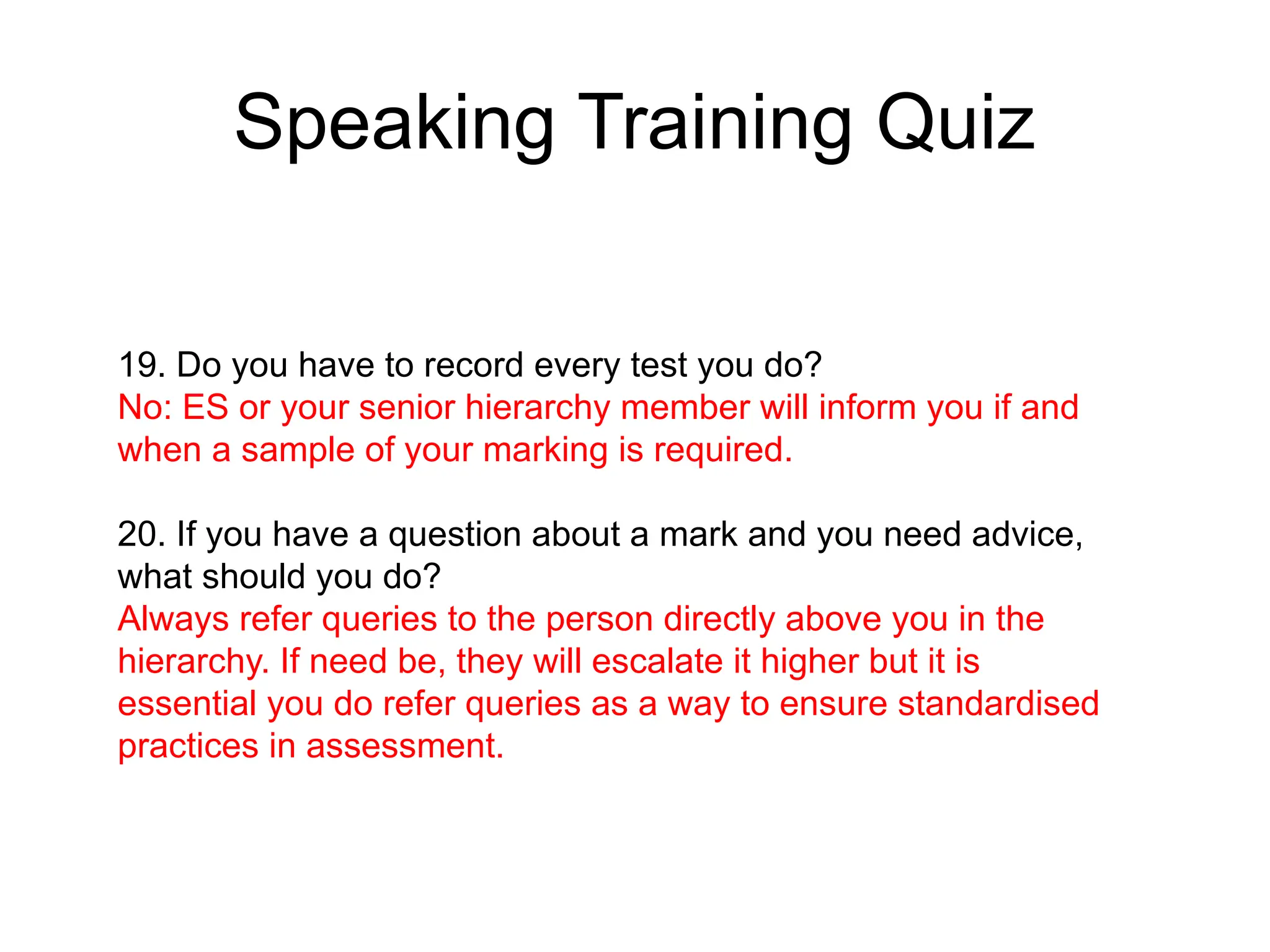
at the front of the pack.
• ensure that no test materials are taken out of their personal charge.
• maintain the confidentiality of the examination throughout the examining
period and thereafter.
• create a non-intimidating atmosphere so as to encourage candidates to
perform to the best of their ability.
• ensure that all candidates are treated fairly.
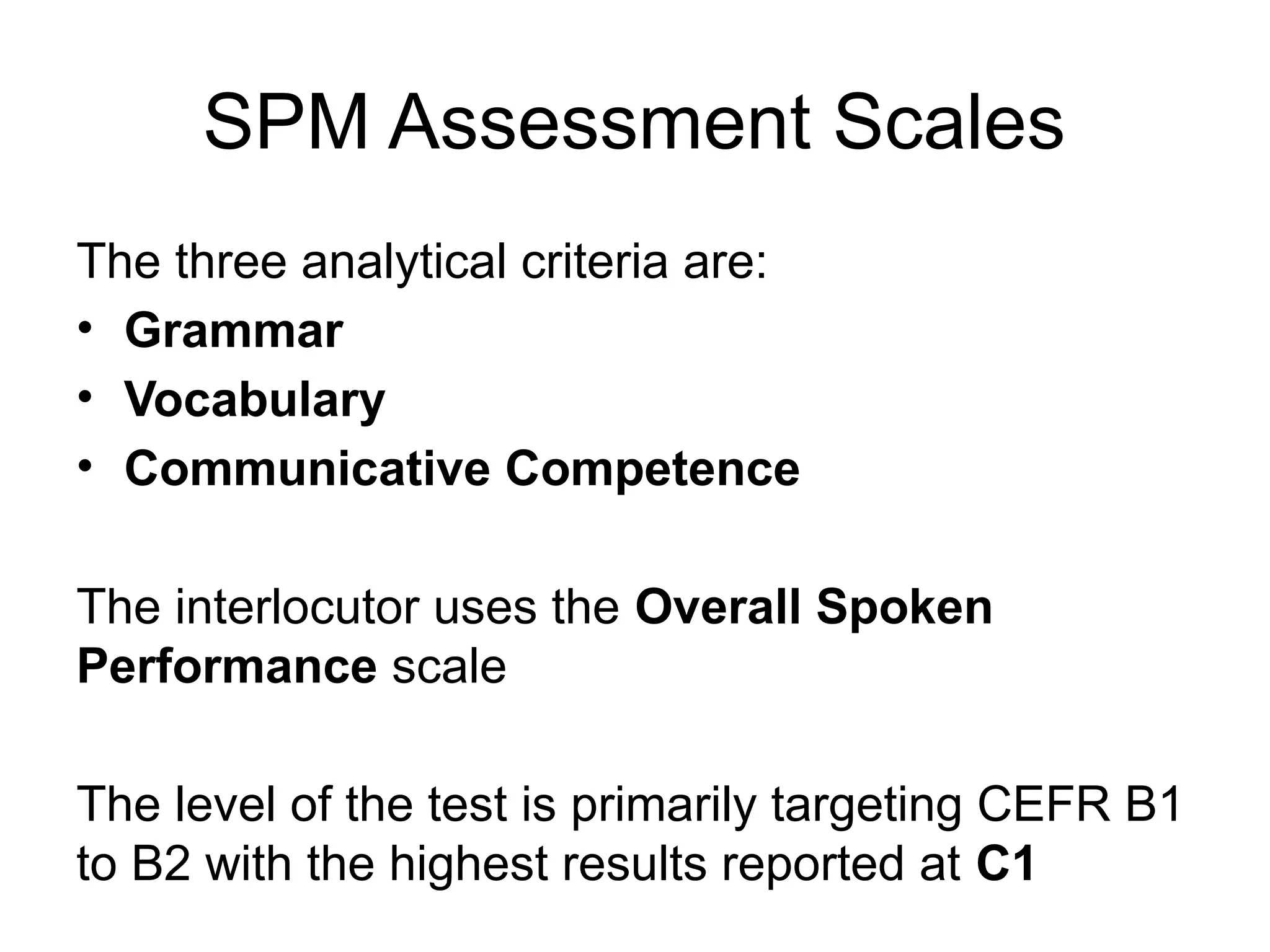
SPM Assessment Scales
Thethree analytical criteria are:
• Grammar
• Vocabulary
• Communicative Competence
The interlocutor uses the Overall Spoken
Performance scale
The level of the test is primarily targeting CEFR B1
to B2 with the highest results reported at C1
65.
Focus on theAnalytical and
Global Scales
Activity
Look at Handout S5 (SPM Speaking Scales
Sorting Activity) on the following slides.
For each descriptor, decide which is the Band 6
(C1 level), Band 5 (B2 level), Band 3 (B1 level)
and Band 1 (A2 level) descriptor.
66.
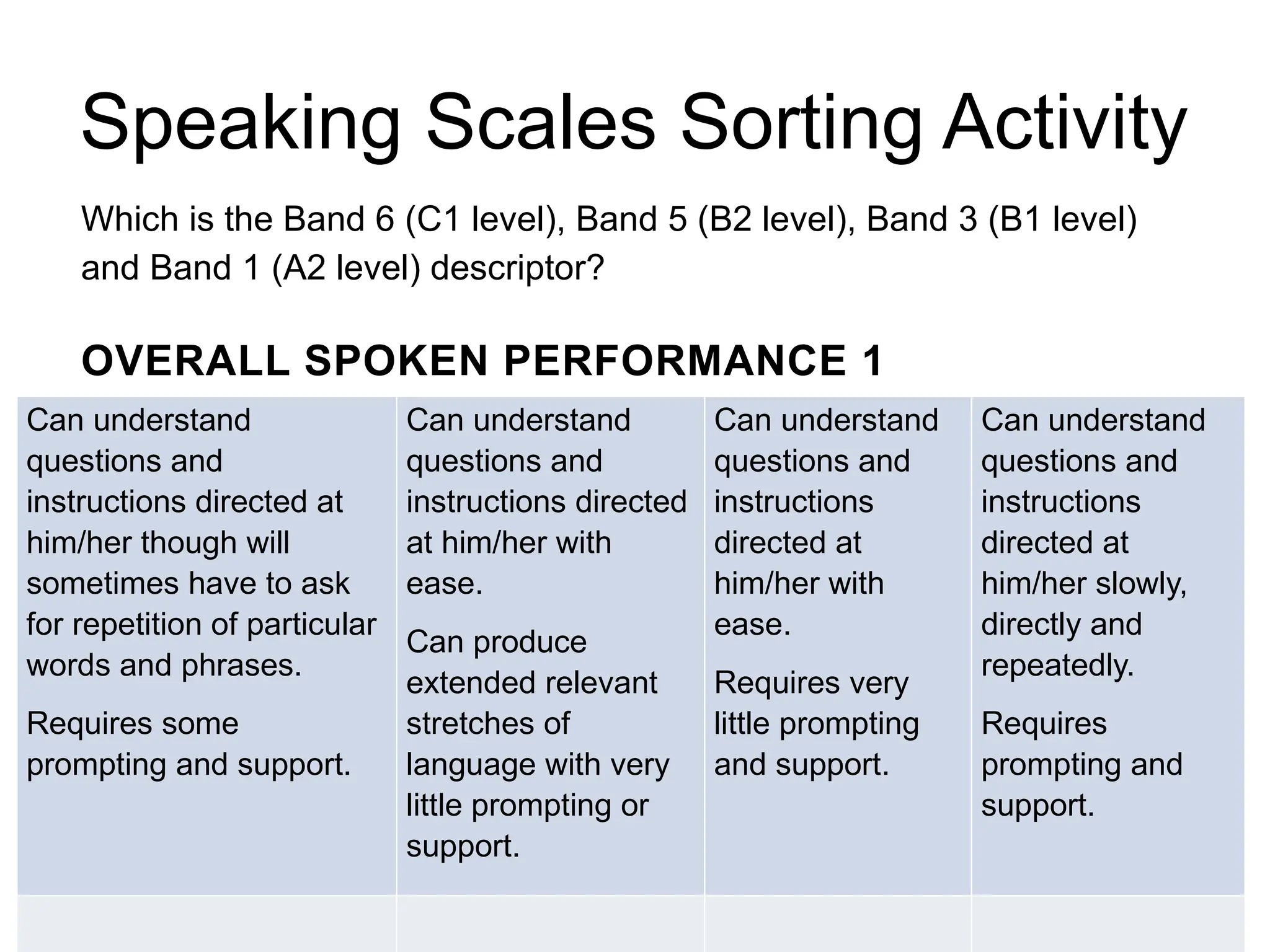
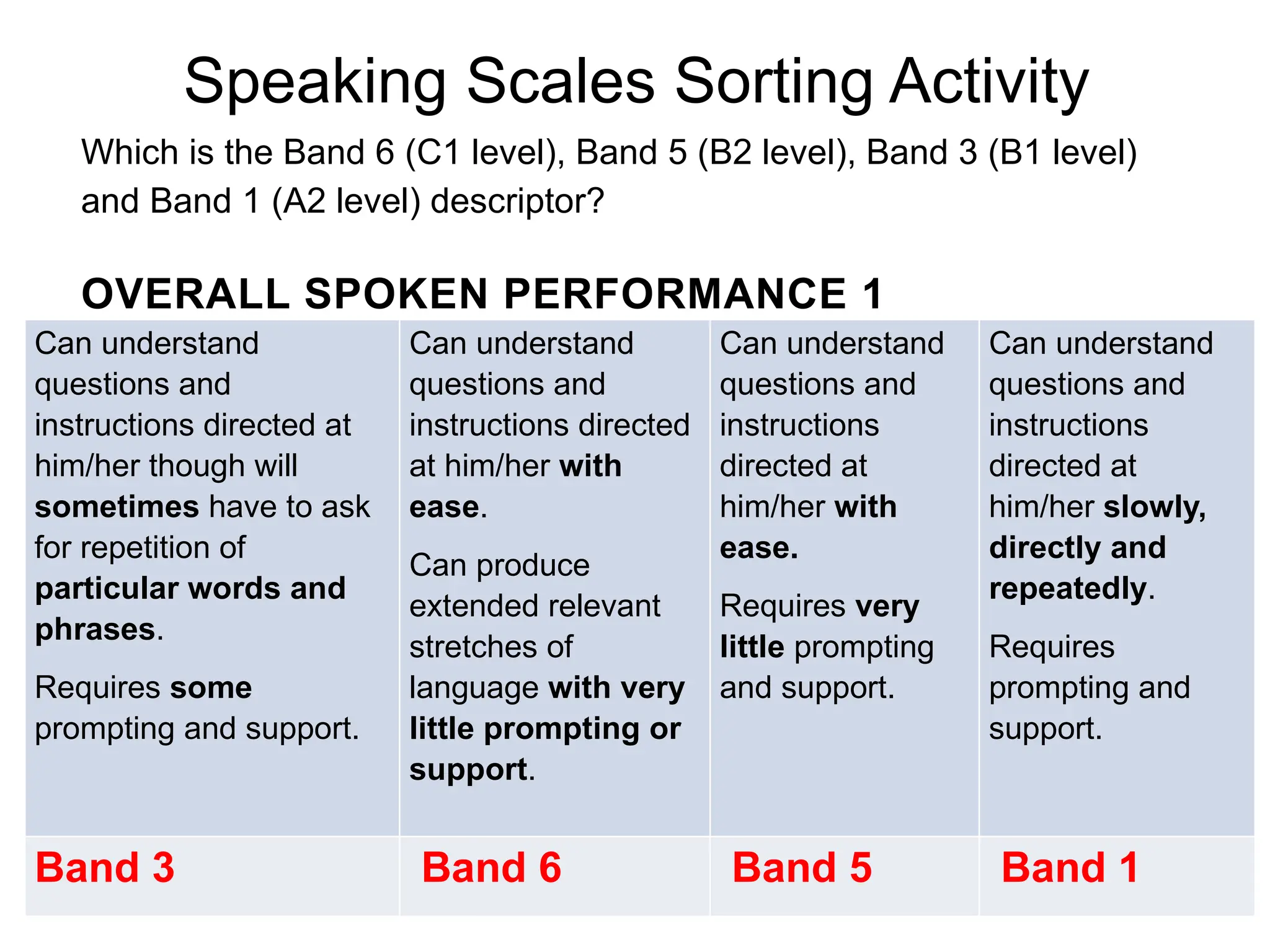
Speaking Scales SortingActivity
Which is the Band 6 (C1 level), Band 5 (B2 level), Band 3 (B1 level)
and Band 1 (A2 level) descriptor?
OVERALL SPOKEN PERFORMANCE 1
Can understand
questions and
instructions directed at
him/her though will
sometimes have to ask
for repetition of particular
words and phrases.
Requires some
prompting and support.
Can understand
questions and
instructions directed
at him/her with
ease.
Can produce
extended relevant
stretches of
language with very
little prompting or
support.
Can understand
questions and
instructions
directed at
him/her with
ease.
Requires very
little prompting
and support.
Can understand
questions and
instructions
directed at
him/her slowly,
directly and
repeatedly.
Requires
prompting and
support.
67.
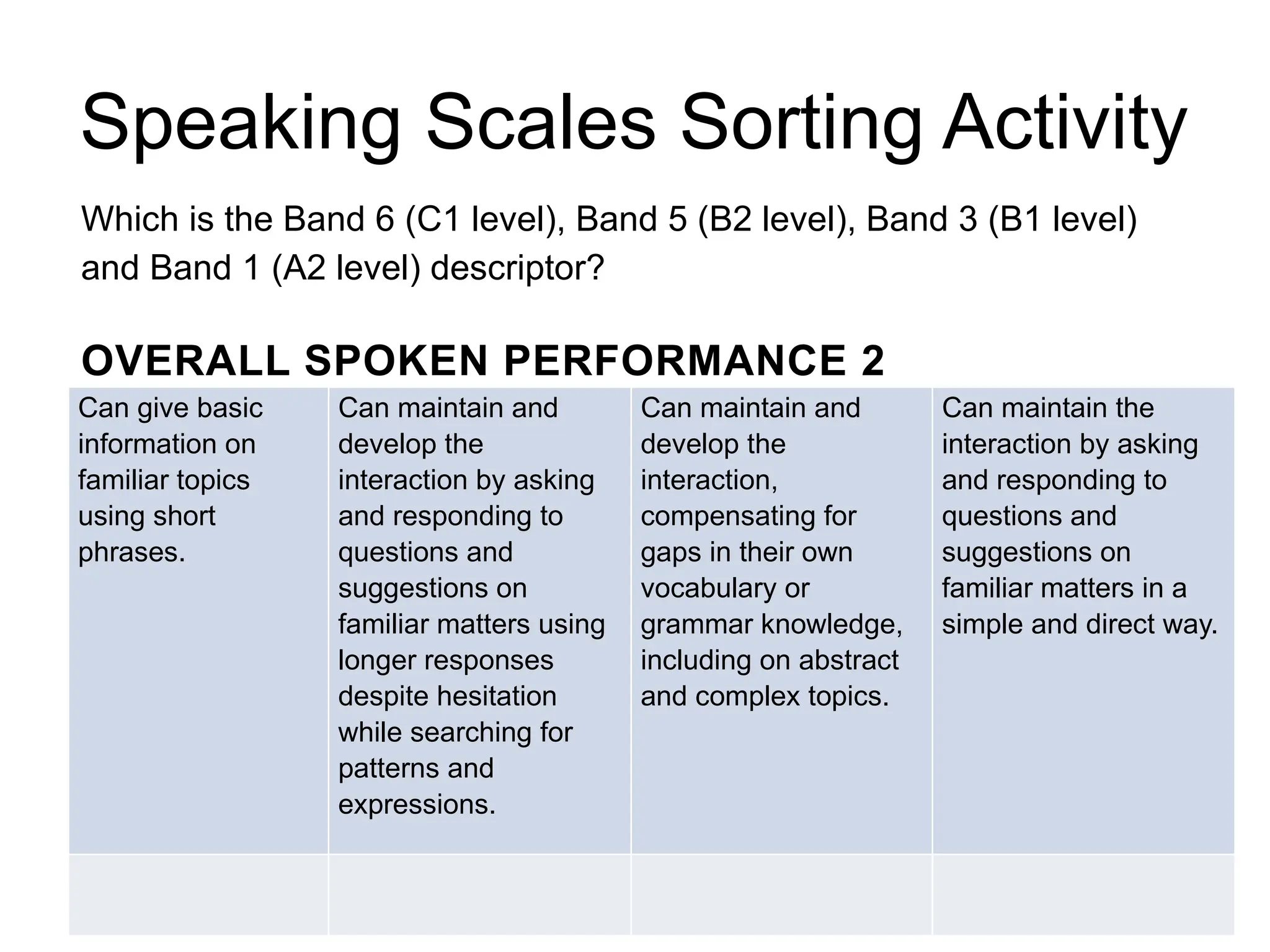
Speaking Scales SortingActivity
Which is the Band 6 (C1 level), Band 5 (B2 level), Band 3 (B1 level)
and Band 1 (A2 level) descriptor?
OVERALL SPOKEN PERFORMANCE 1
Can understand
questions and
instructions directed at
him/her though will
sometimes have to ask
for repetition of
particular words and
phrases.
Requires some
prompting and support.
Can understand
questions and
instructions directed
at him/her with
ease.
Can produce
extended relevant
stretches of
language with very
little prompting or
support.
Can understand
questions and
instructions
directed at
him/her with
ease.
Requires very
little prompting
and support.
Can understand
questions and
instructions
directed at
him/her slowly,
directly and
repeatedly.
Requires
prompting and
support.
Band 3 Band 6 Band 5 Band 1
68.
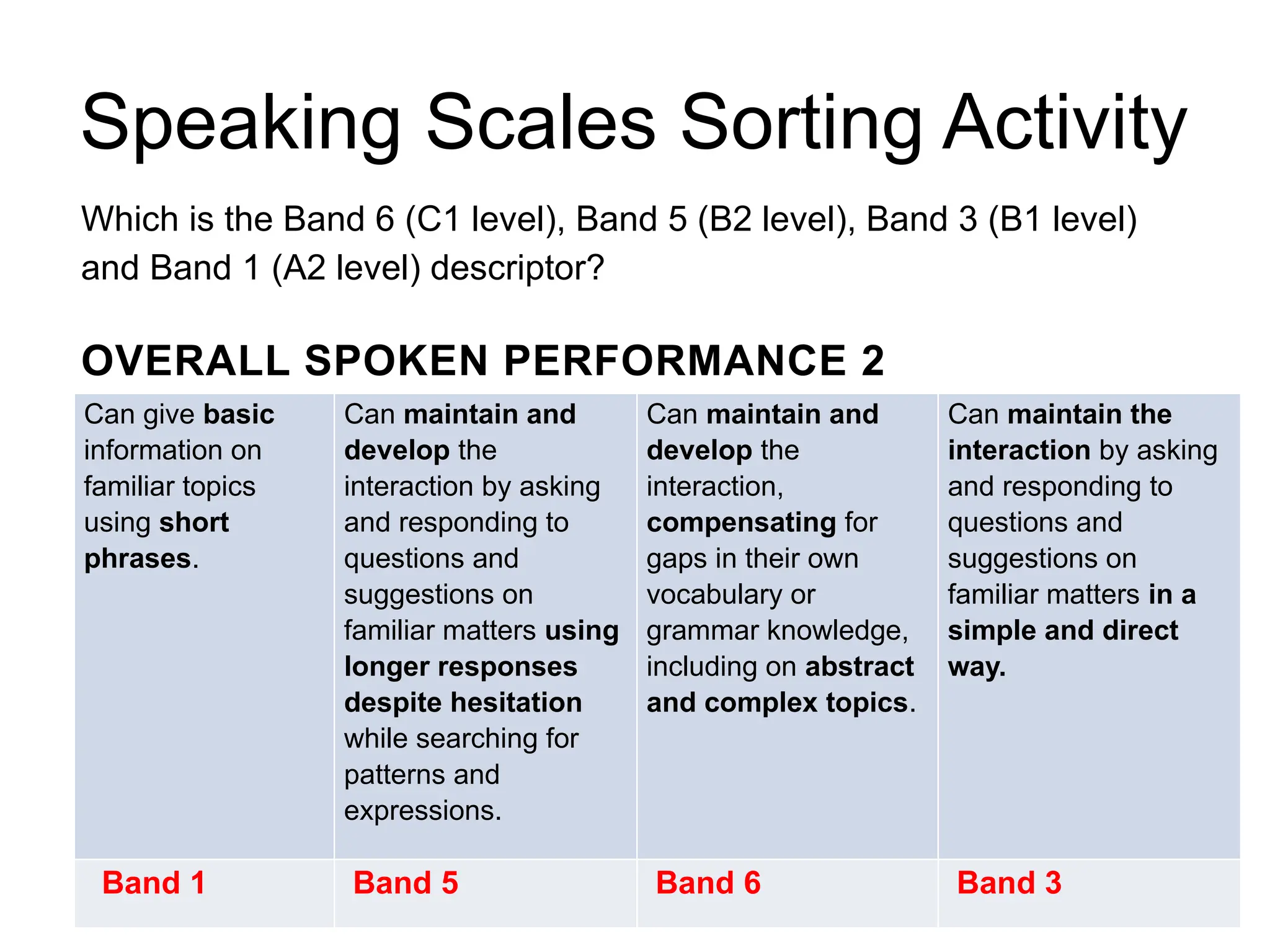
Speaking Scales SortingActivity
Which is the Band 6 (C1 level), Band 5 (B2 level), Band 3 (B1 level)
and Band 1 (A2 level) descriptor?
OVERALL SPOKEN PERFORMANCE 2
Can give basic
information on
familiar topics
using short
phrases.
Can maintain and
develop the
interaction by asking
and responding to
questions and
suggestions on
familiar matters using
longer responses
despite hesitation
while searching for
patterns and
expressions.
Can maintain and
develop the
interaction,
compensating for
gaps in their own
vocabulary or
grammar knowledge,
including on abstract
and complex topics.
Can maintain the
interaction by asking
and responding to
questions and
suggestions on
familiar matters in a
simple and direct way.
69.
Speaking Scales SortingActivity
Which is the Band 6 (C1 level), Band 5 (B2 level), Band 3 (B1 level)
and Band 1 (A2 level) descriptor?
OVERALL SPOKEN PERFORMANCE 2
Can give basic
information on
familiar topics
using short
phrases.
Can maintain and
develop the
interaction by asking
and responding to
questions and
suggestions on
familiar matters using
longer responses
despite hesitation
while searching for
patterns and
expressions.
Can maintain and
develop the
interaction,
compensating for
gaps in their own
vocabulary or
grammar knowledge,
including on abstract
and complex topics.
Can maintain the
interaction by asking
and responding to
questions and
suggestions on
familiar matters in a
simple and direct
way.
Band 1 Band 5 Band 6 Band 3
70.
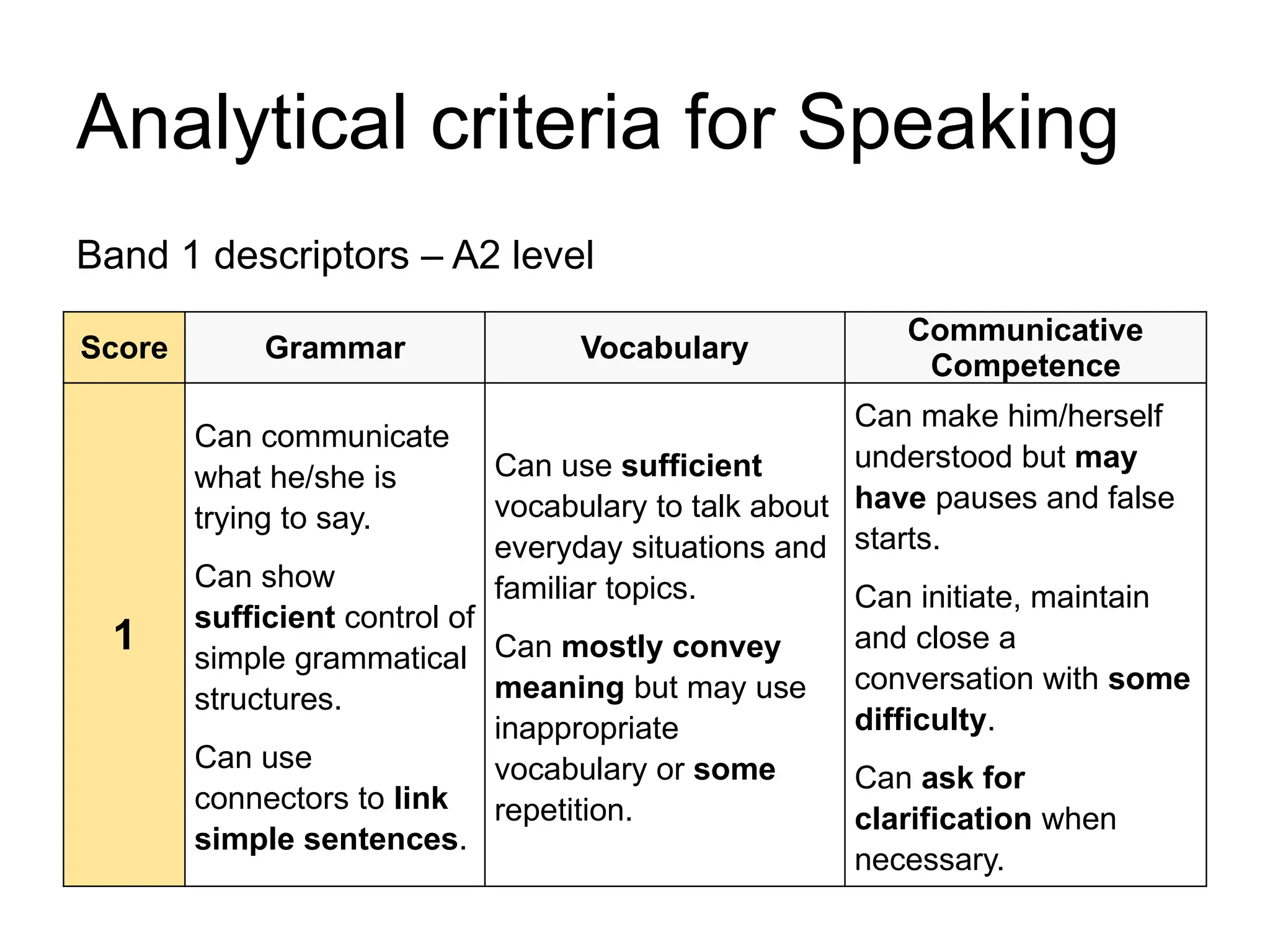
Analytical criteria forSpeaking
Band 1 descriptors – A2 level
Score Grammar Vocabulary
Communicative
Competence
1
Can communicate
what he/she is
trying to say.
Can show
sufficient control of
simple grammatical
structures.
Can use
connectors to link
simple sentences.
Can use sufficient
vocabulary to talk about
everyday situations and
familiar topics.
Can mostly convey
meaning but may use
inappropriate
vocabulary or some
repetition.
Can make him/herself
understood but may
have pauses and false
starts.
Can initiate, maintain
and close a
conversation with some
difficulty.
Can ask for
clarification when
necessary.
71.
Analytical criteria forSpeaking
Band 3 descriptors – B1 level
Score Grammar Vocabulary
Communicative
Competence
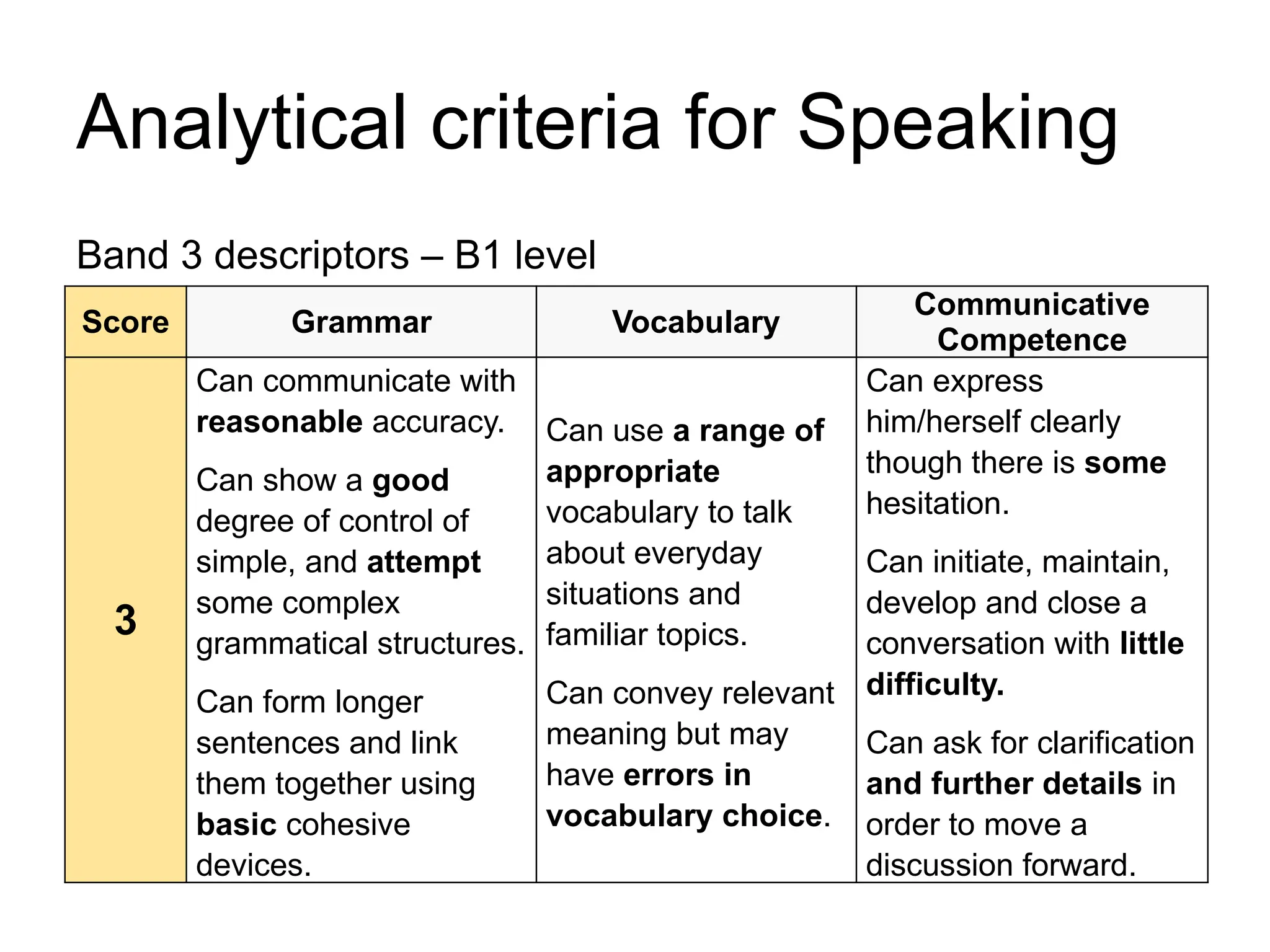
3
Can communicate with
reasonable accuracy.
Can show a good
degree of control of
simple, and attempt
some complex
grammatical structures.
Can form longer
sentences and link
them together using
basic cohesive
devices.
Can use a range of
appropriate
vocabulary to talk
about everyday
situations and
familiar topics.
Can convey relevant
meaning but may
have errors in
vocabulary choice.
Can express
him/herself clearly
though there is some
hesitation.
Can initiate, maintain,
develop and close a
conversation with little
difficulty.
Can ask for clarification
and further details in
order to move a
discussion forward.
72.
Analytical criteria forSpeaking
Band 5 descriptors – B2 level
Score Grammar Vocabulary
Communicative
Competence
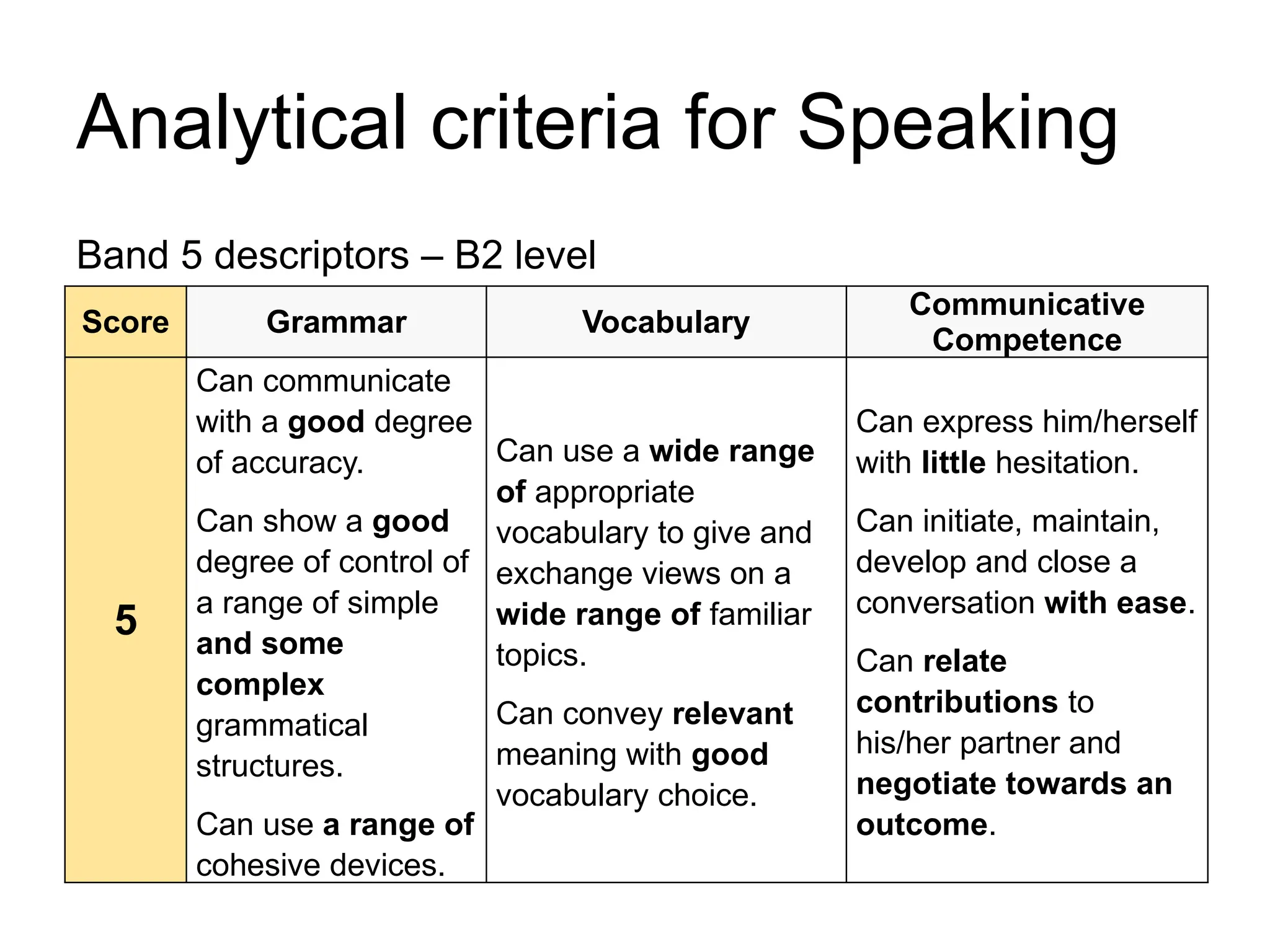
5
Can communicate
with a good degree
of accuracy.
Can show a good
degree of control of
a range of simple
and some
complex
grammatical
structures.
Can use a range of
cohesive devices.
Can use a wide range
of appropriate
vocabulary to give and
exchange views on a
wide range of familiar
topics.
Can convey relevant
meaning with good
vocabulary choice.
Can express him/herself
with little hesitation.
Can initiate, maintain,
develop and close a
conversation with ease.
Can relate
contributions to
his/her partner and
negotiate towards an
outcome.
73.
Analytical criteria forSpeaking
Band 6 descriptors – C1 level
Score Grammar Vocabulary
Communicative
Competence
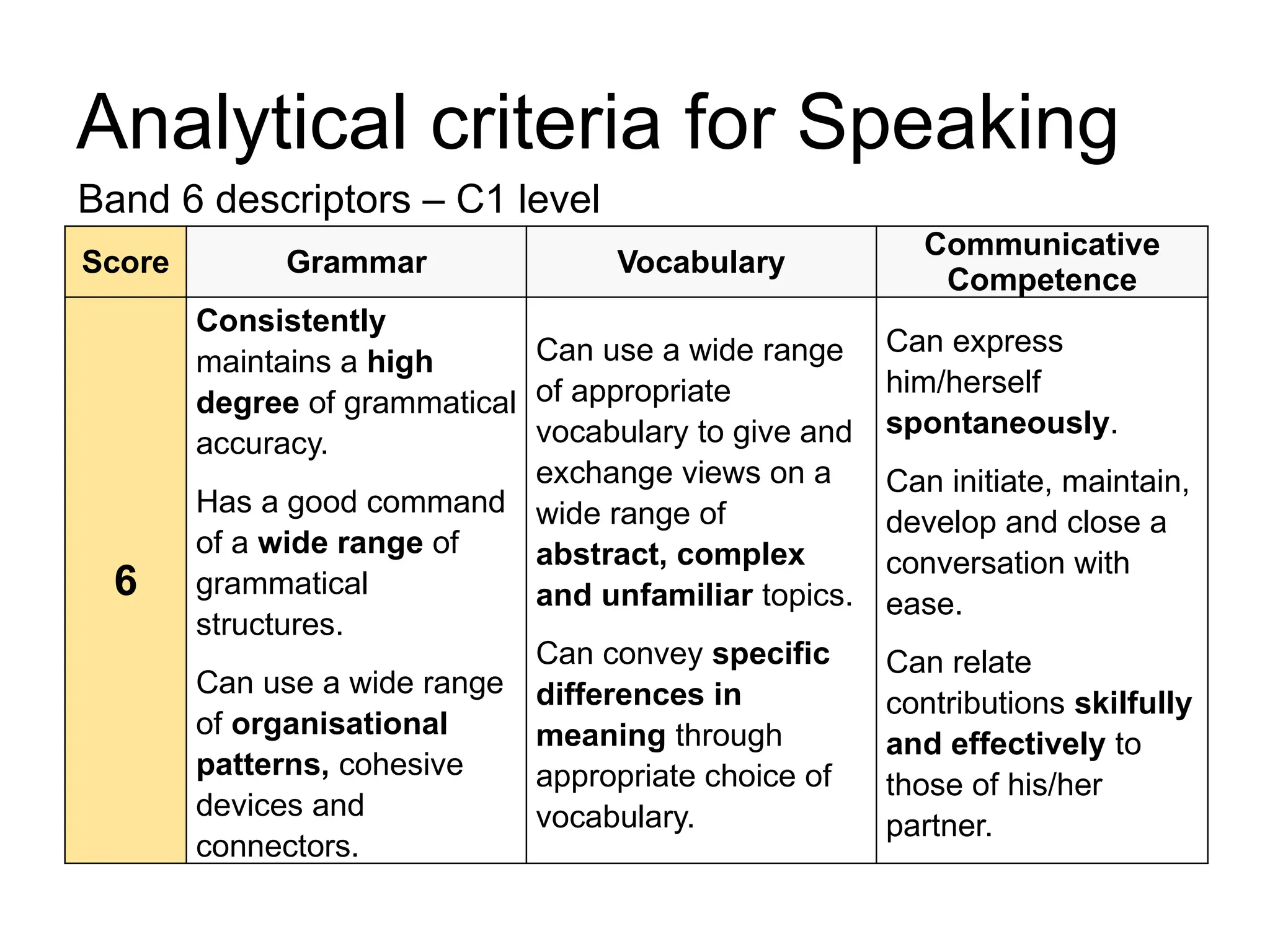
6
Consistently
maintains a high
degree of grammatical
accuracy.
Has a good command
of a wide range of
grammatical
structures.
Can use a wide range
of organisational
patterns, cohesive
devices and
connectors.
Can use a wide range
of appropriate
vocabulary to give and
exchange views on a
wide range of
abstract, complex
and unfamiliar topics.
Can convey specific
differences in
meaning through
appropriate choice of
vocabulary.
Can express
him/herself
spontaneously.
Can initiate, maintain,
develop and close a
conversation with
ease.
Can relate
contributions skilfully
and effectively to
those of his/her
partner.
74.
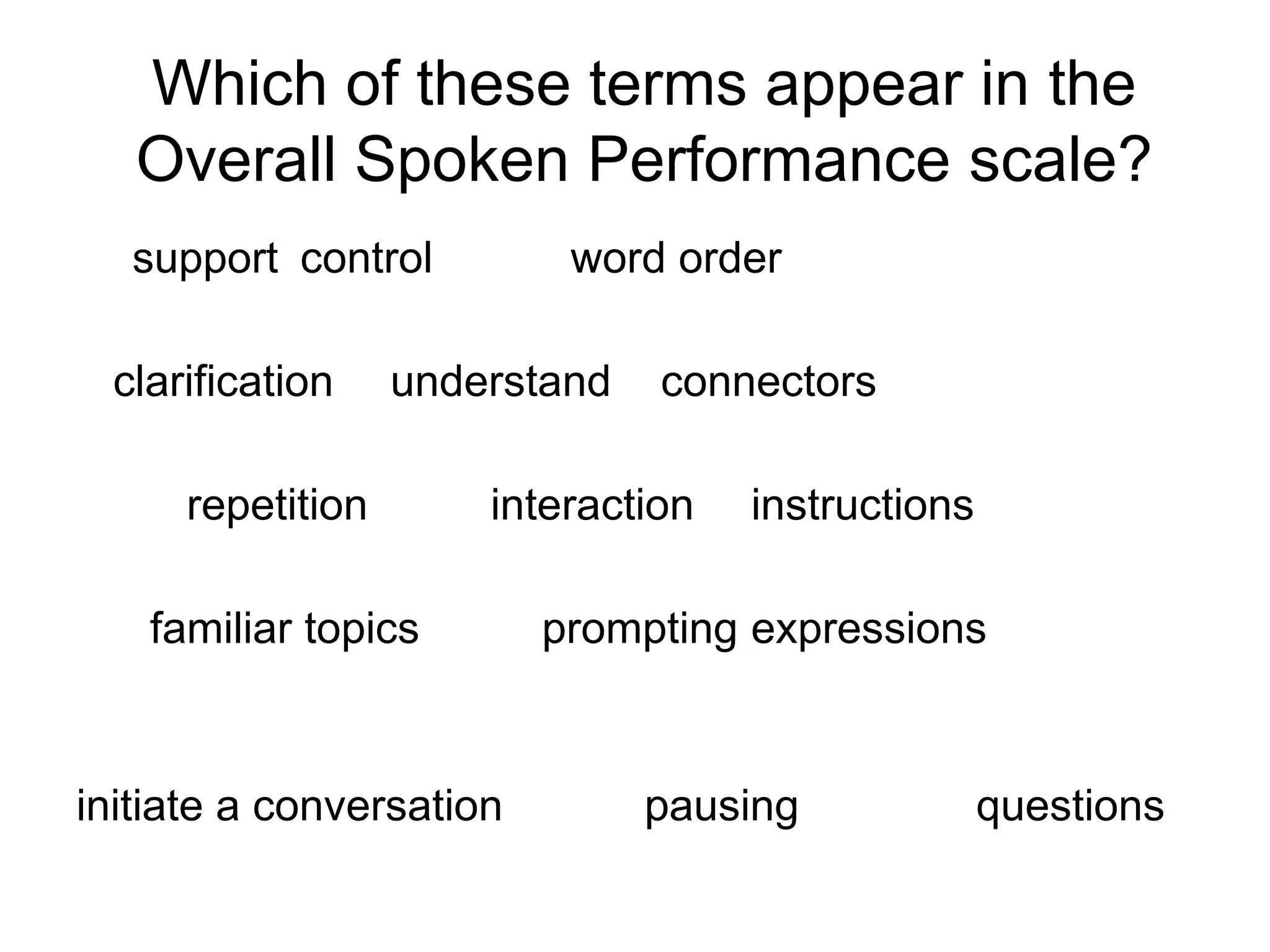
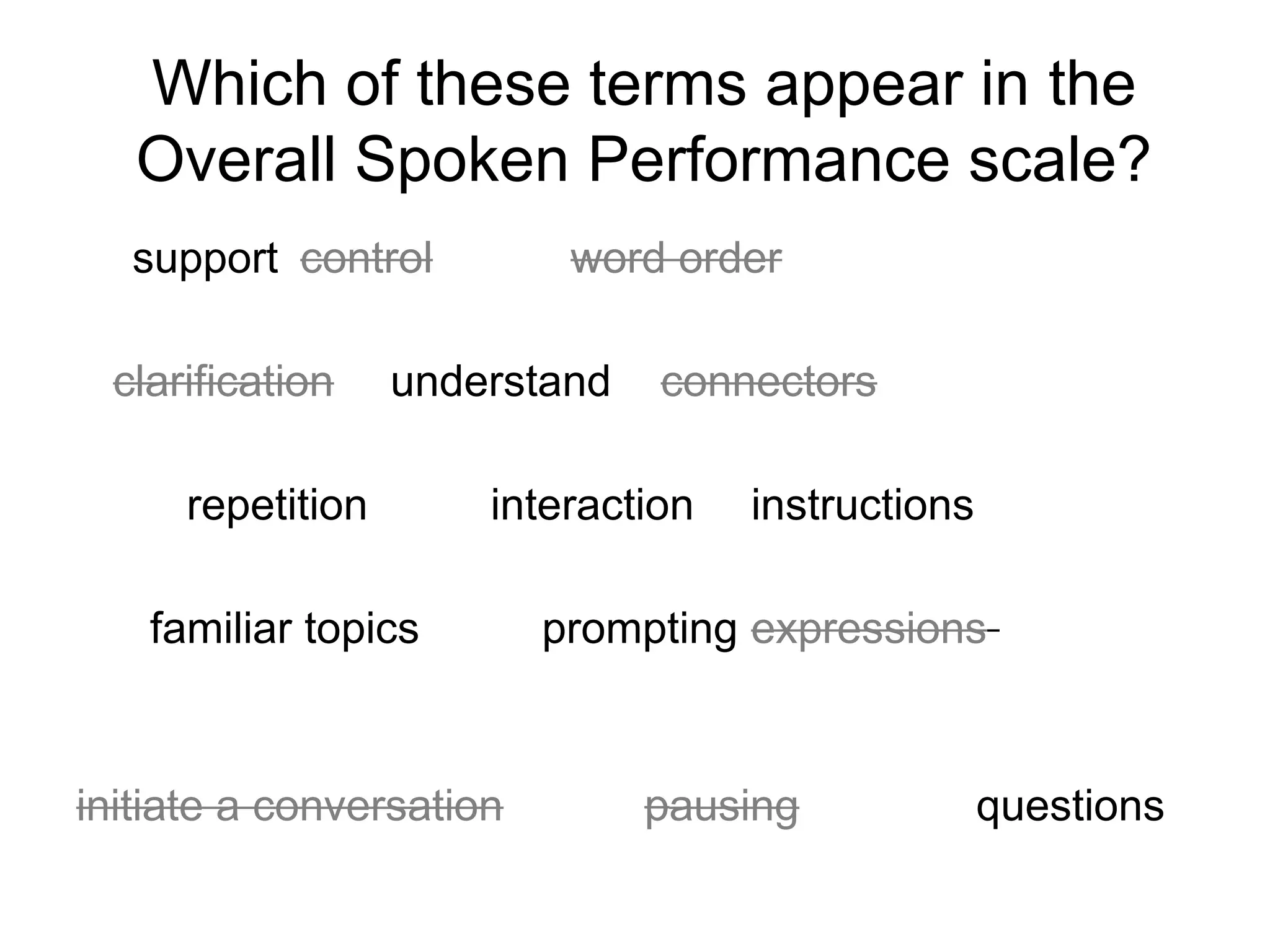
Which of theseterms appear in the
Overall Spoken Performance scale?
support control word order
clarification understand connectors
repetition interaction instructions
familiar topics prompting expressions
initiate a conversation pausing questions
75.
Which of theseterms appear in the
Overall Spoken Performance scale?
support control word order
clarification understand connectors
repetition interaction instructions
familiar topics prompting expressions
initiate a conversation pausing questions
76.
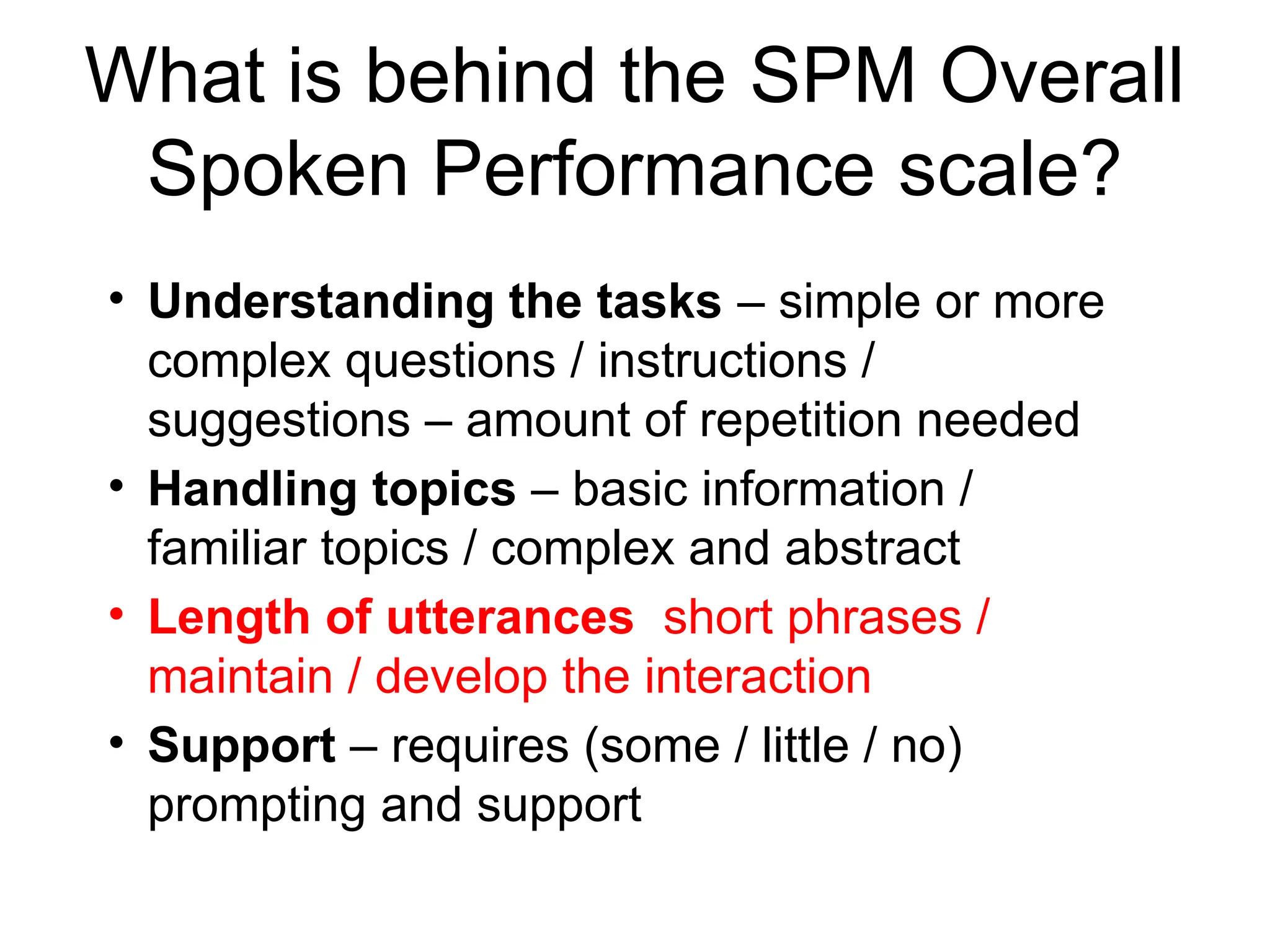
What is behindthe SPM Overall
Spoken Performance scale?
• Understanding the tasks – simple or more
complex questions / instructions /
suggestions – amount of repetition needed
• Handling topics – basic information /
familiar topics / complex and abstract
• Length of utterances short phrases /
maintain / develop the interaction
• Support – requires (some / little / no)
prompting and support
77.
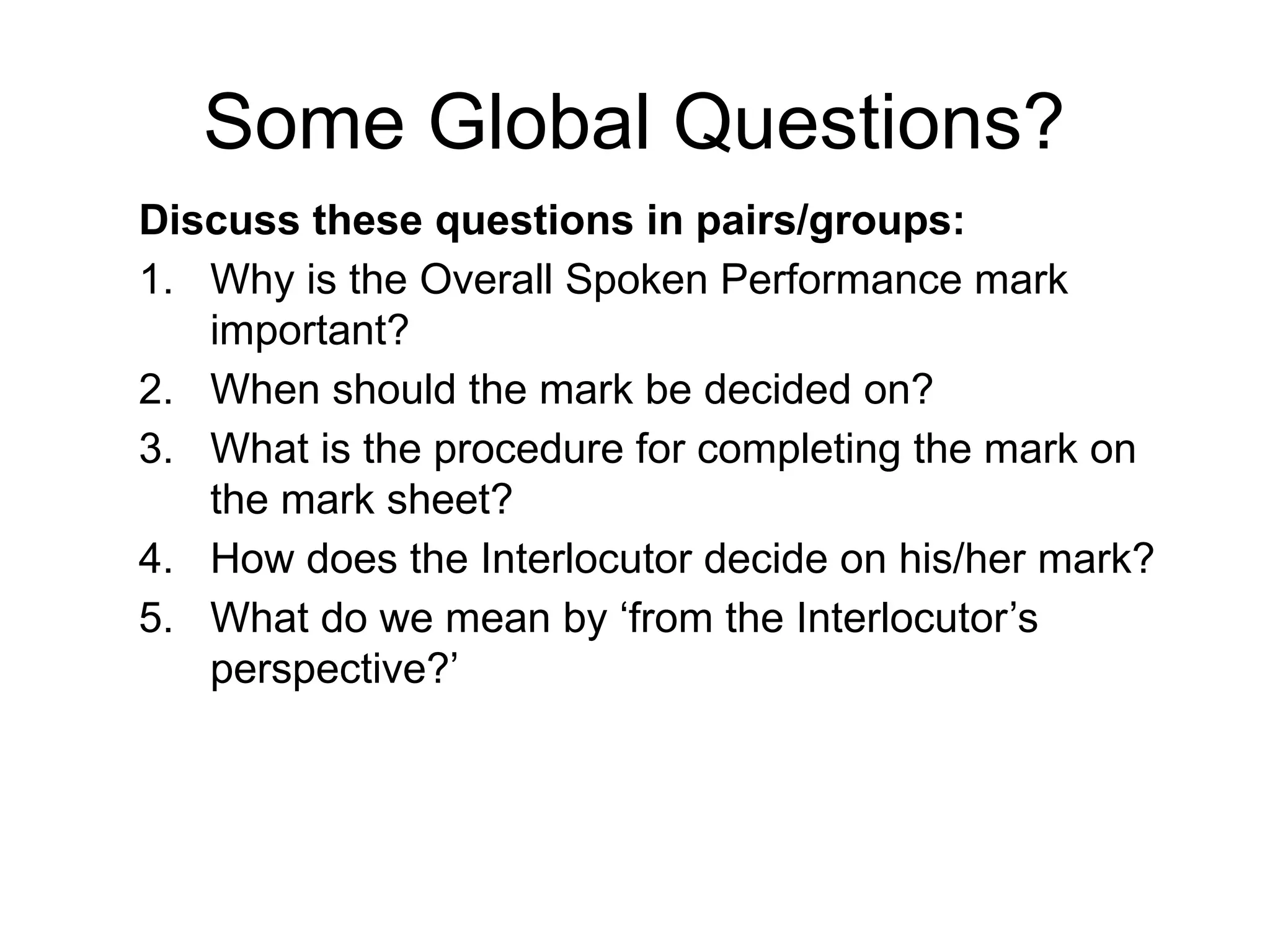
Some Global Questions?
Discussthese questions in pairs/groups:
1. Why is the Overall Spoken Performance mark
important?
2. When should the mark be decided on?
3. What is the procedure for completing the mark on
the mark sheet?
4. How does the Interlocutor decide on his/her mark?
5. What do we mean by ‘from the Interlocutor’s
perspective?’
78.
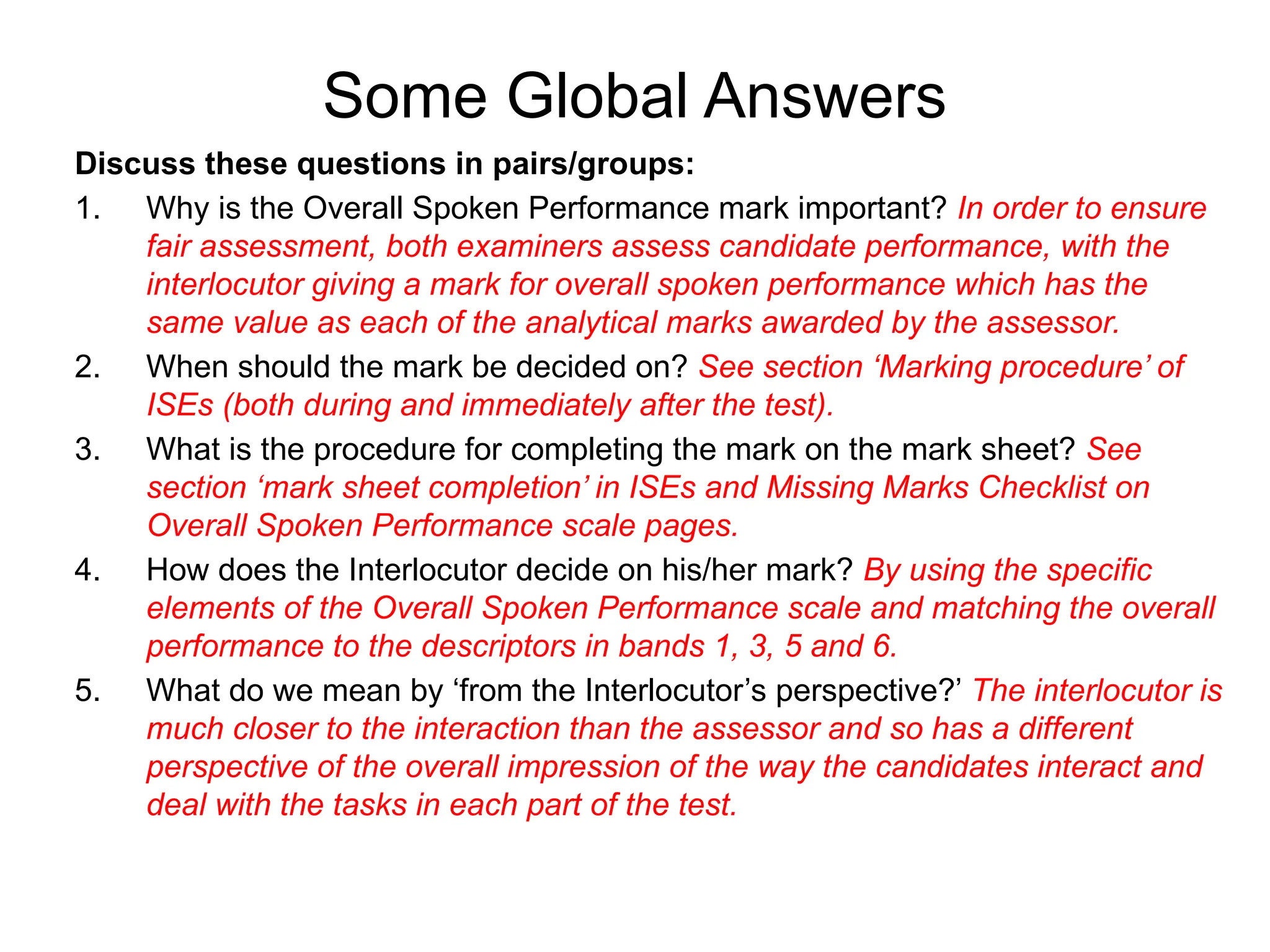
Some Global Answers
Discussthese questions in pairs/groups:
1. Why is the Overall Spoken Performance mark important? In order to ensure
fair assessment, both examiners assess candidate performance, with the
interlocutor giving a mark for overall spoken performance which has the
same value as each of the analytical marks awarded by the assessor.
2. When should the mark be decided on? See section ‘Marking procedure’ of
ISEs (both during and immediately after the test).
3. What is the procedure for completing the mark on the mark sheet? See
section ‘mark sheet completion’ in ISEs and Missing Marks Checklist on
Overall Spoken Performance scale pages.
4. How does the Interlocutor decide on his/her mark? By using the specific
elements of the Overall Spoken Performance scale and matching the overall
performance to the descriptors in bands 1, 3, 5 and 6.
5. What do we mean by ‘from the Interlocutor’s perspective?’ The interlocutor is
much closer to the interaction than the assessor and so has a different
perspective of the overall impression of the way the candidates interact and
deal with the tasks in each part of the test.
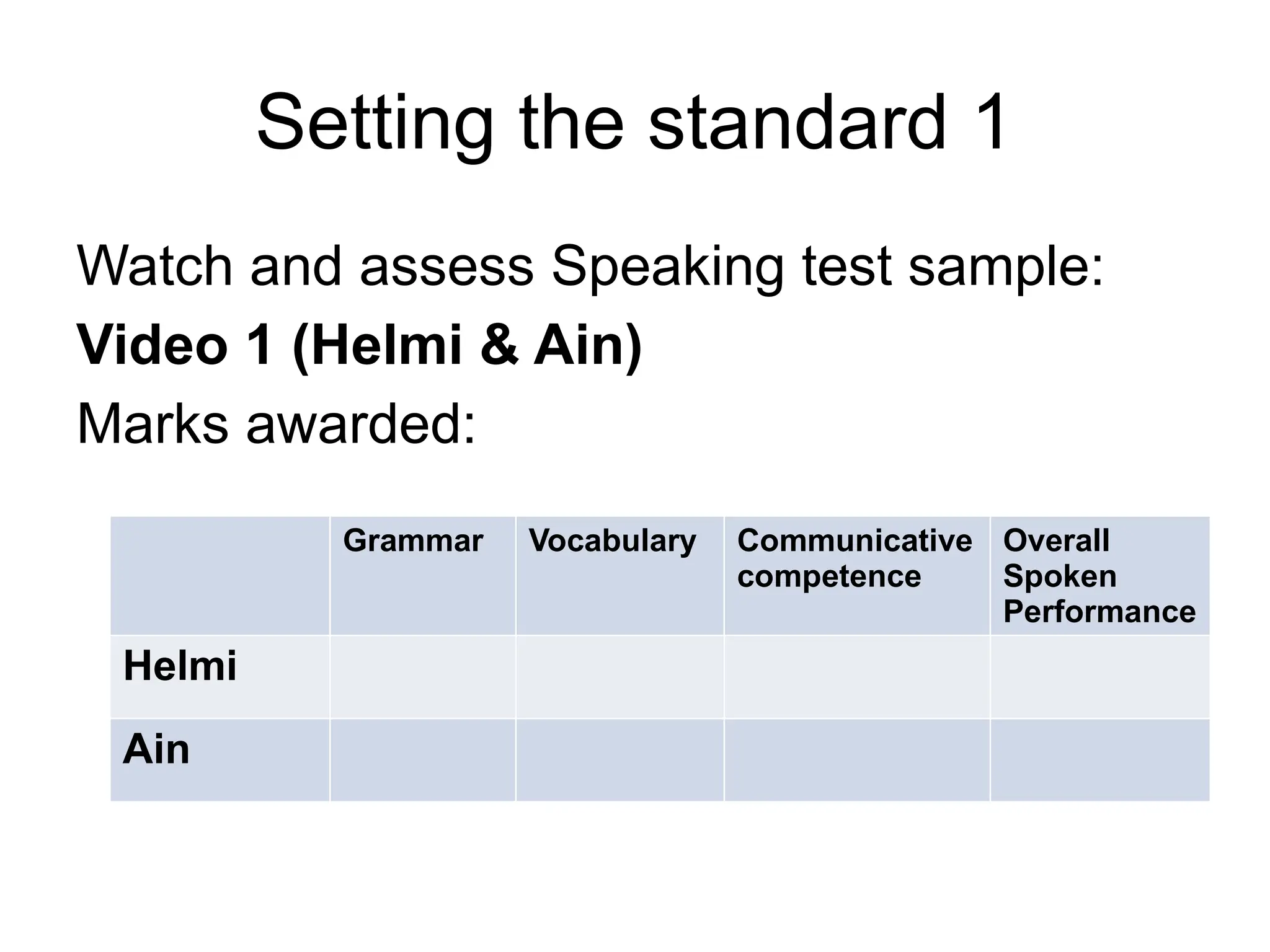
Setting the standard1
Watch and assess Speaking test sample:
Video 1 (Helmi & Ain)
Marks awarded:
Grammar Vocabulary Communicative
competence
Overall
Spoken
Performance
Helmi
Ain
81.
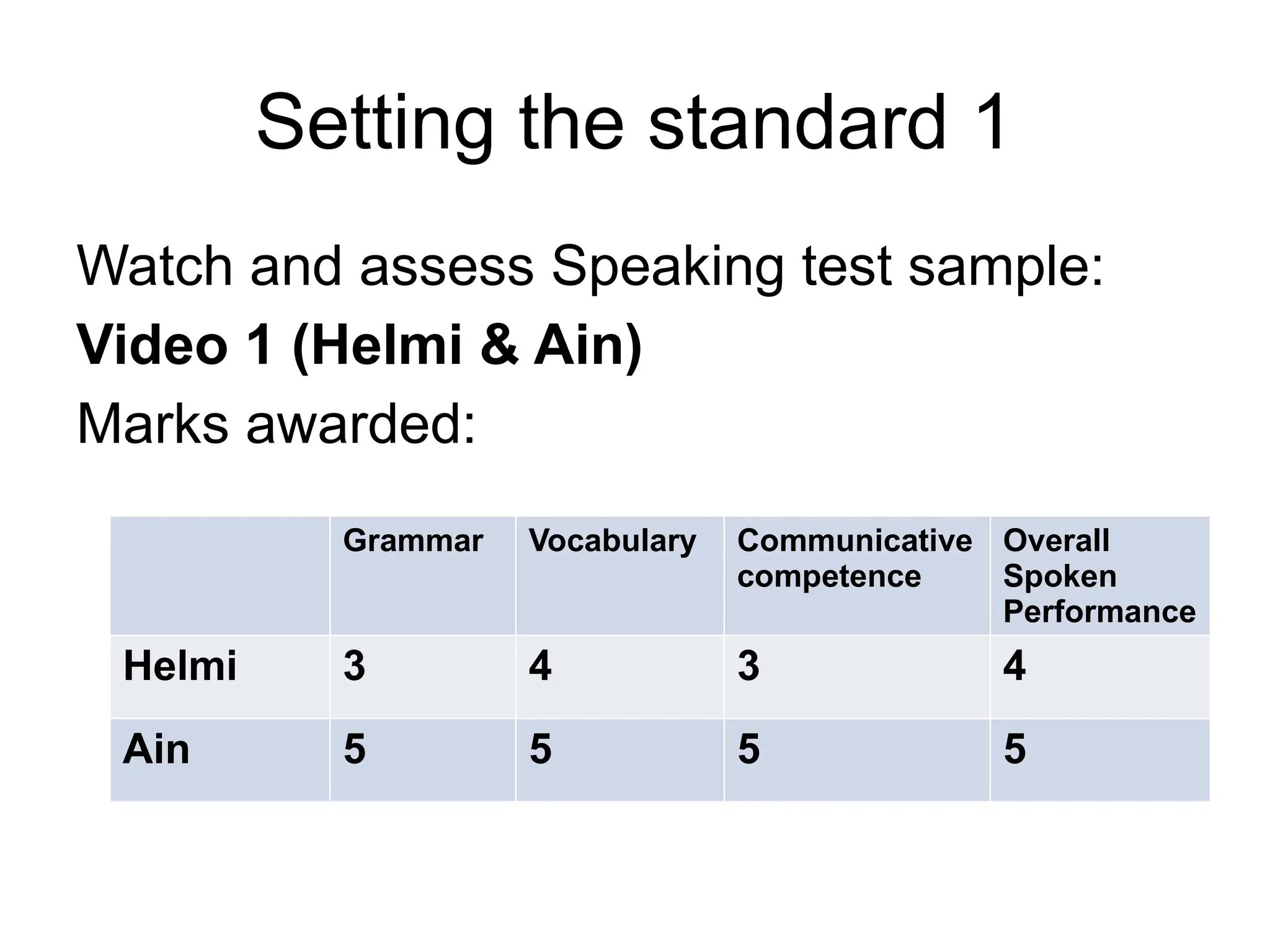
Setting the standard1
Watch and assess Speaking test sample:
Video 1 (Helmi & Ain)
Marks awarded:
Grammar Vocabulary Communicative
competence
Overall
Spoken
Performance
Helmi 3 4 3 4
Ain 5 5 5 5
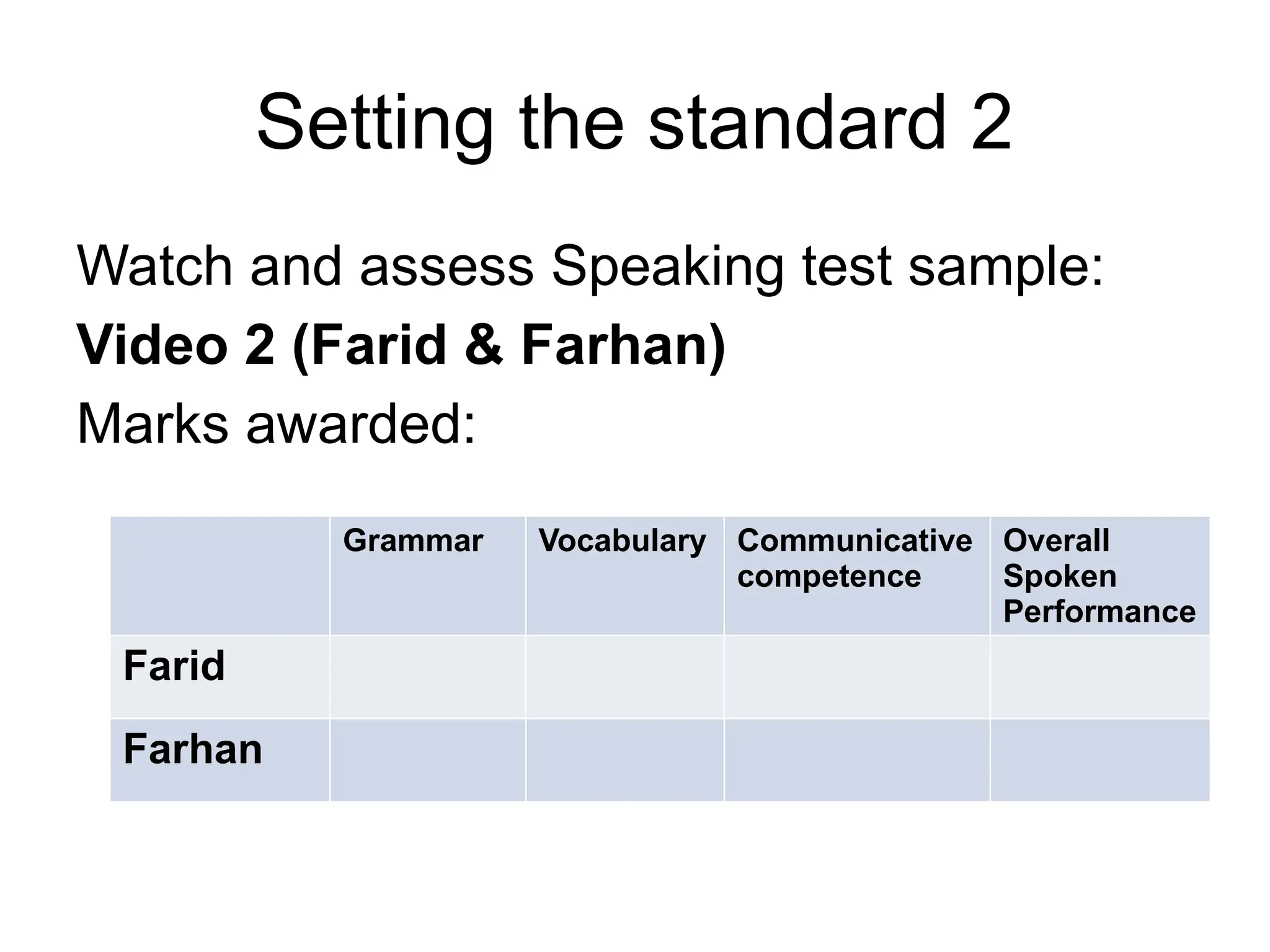
Setting the standard2
Watch and assess Speaking test sample:
Video 2 (Farid & Farhan)
Marks awarded:
Grammar Vocabulary Communicative
competence
Overall
Spoken
Performance
Farid
Farhan
84.
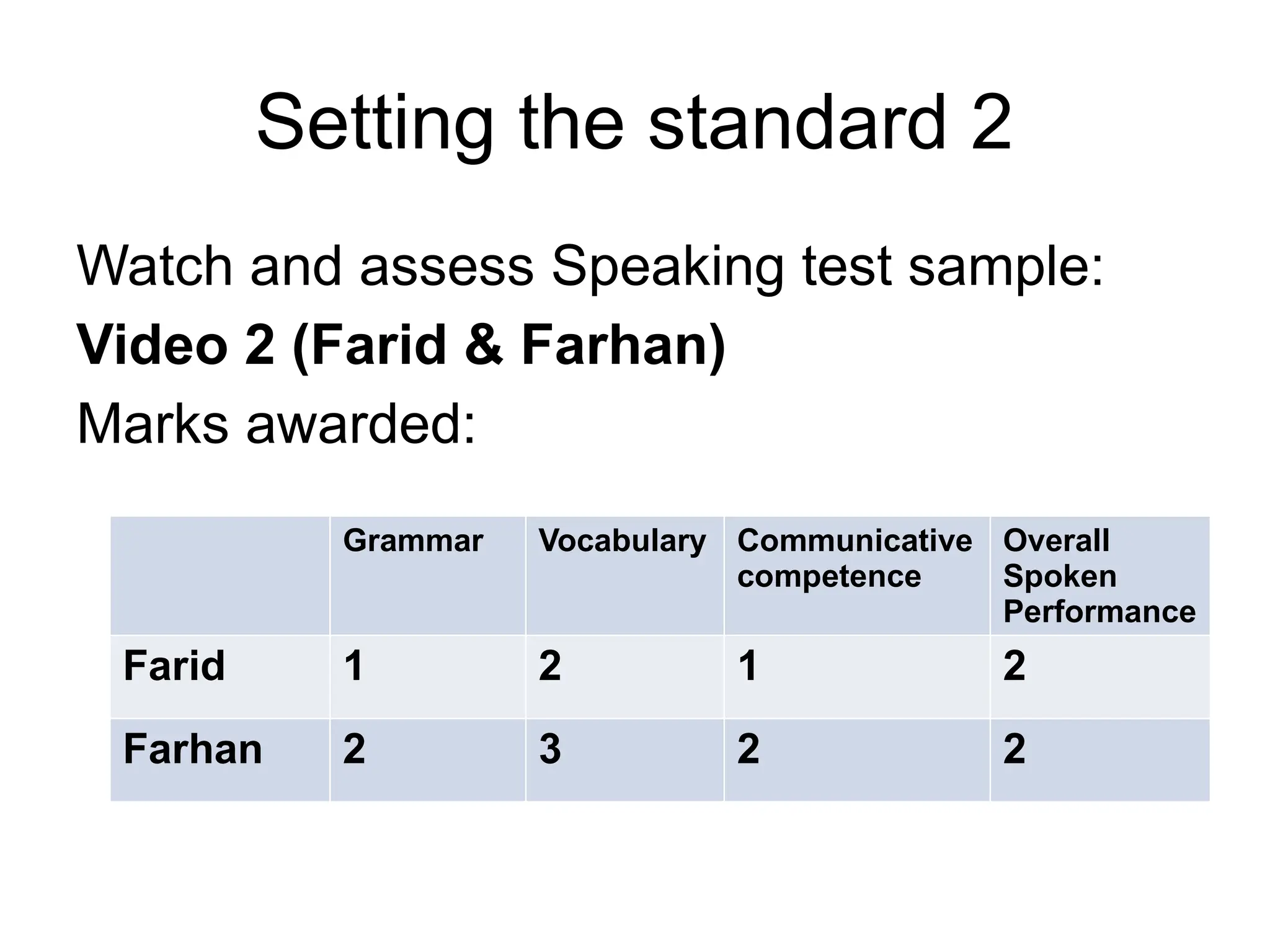
Setting the standard2
Watch and assess Speaking test sample:
Video 2 (Farid & Farhan)
Marks awarded:
Grammar Vocabulary Communicative
competence
Overall
Spoken
Performance
Farid 1 2 1 2
Farhan 2 3 2 2
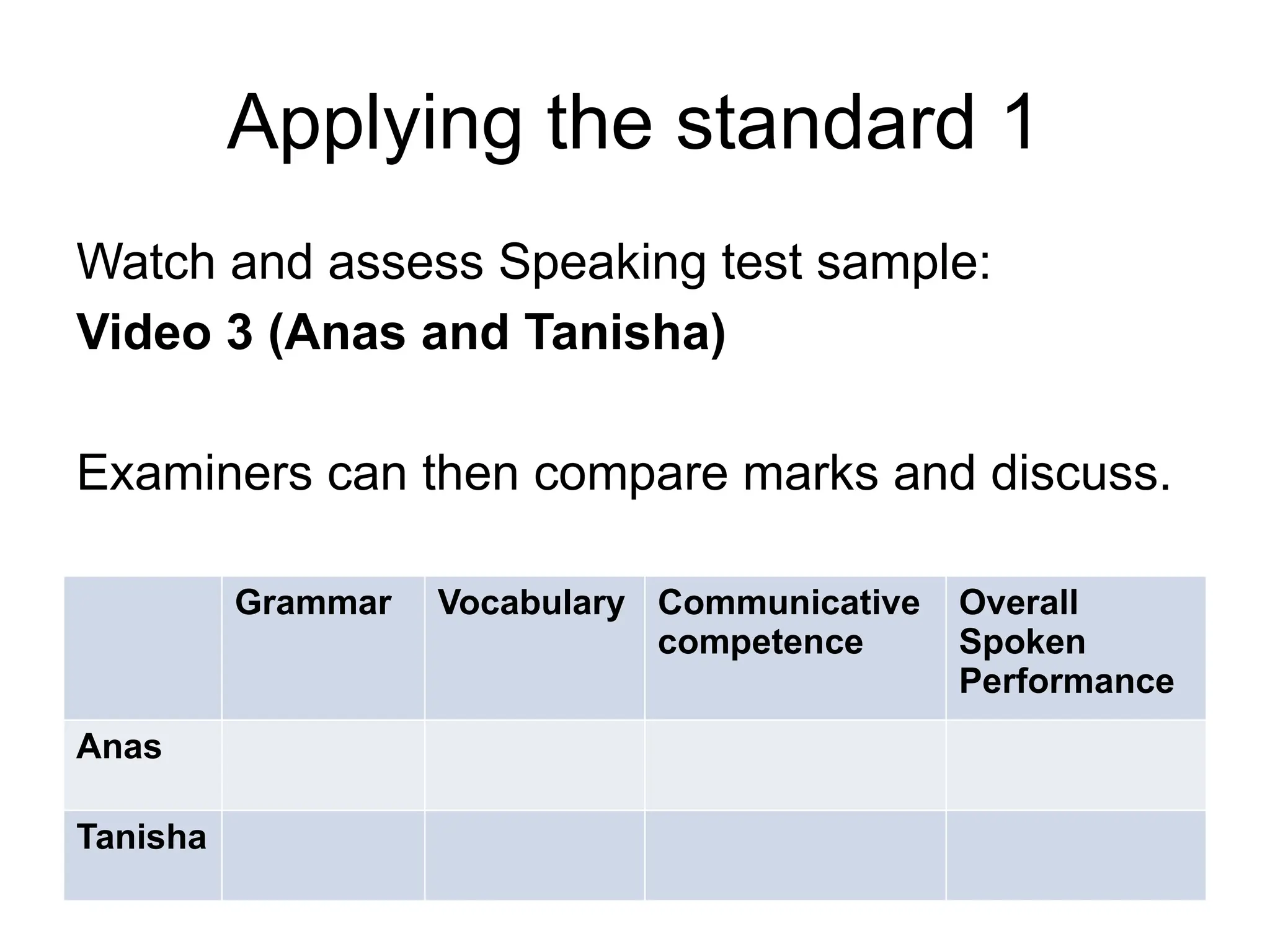
Applying the standard1
Watch and assess Speaking test sample:
Video 3 (Anas and Tanisha)
Examiners can then compare marks and discuss.
Grammar Vocabulary Communicative
competence
Overall
Spoken
Performance
Anas
Tanisha
87.
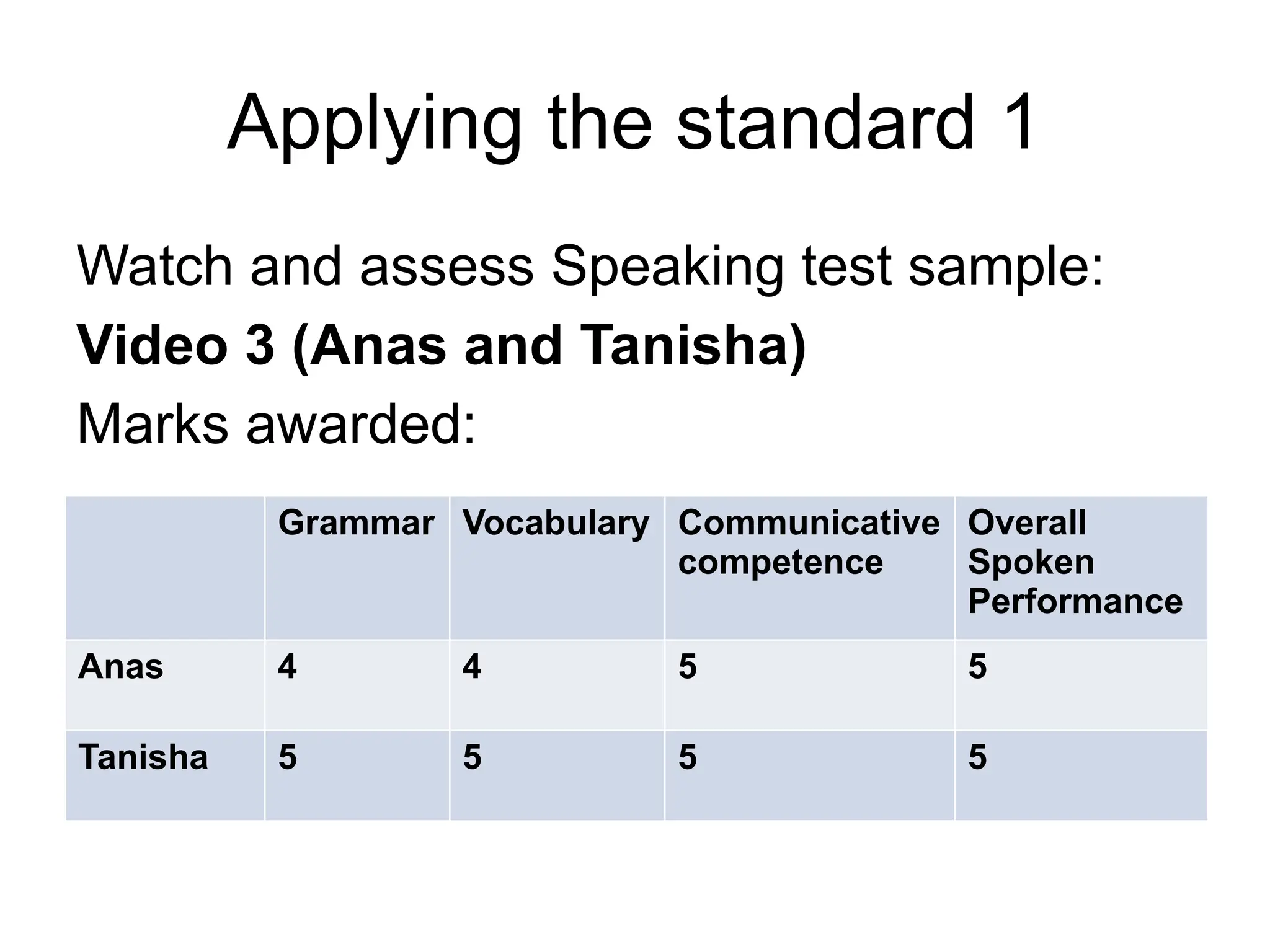
Applying the standard1
Watch and assess Speaking test sample:
Video 3 (Anas and Tanisha)
Marks awarded:
Grammar Vocabulary Communicative
competence
Overall
Spoken
Performance
Anas 4 4 5 5
Tanisha 5 5 5 5
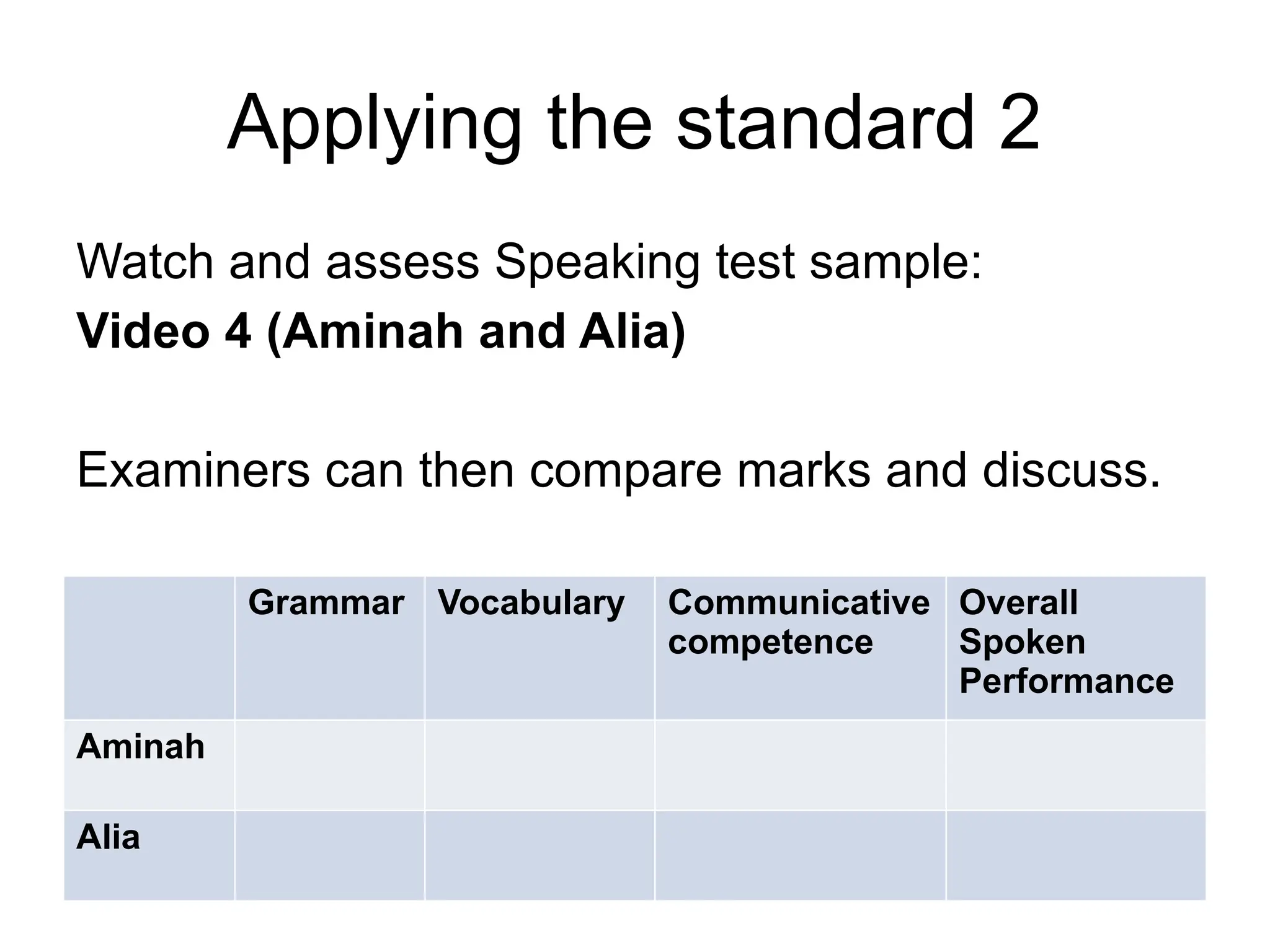
Applying the standard2
Watch and assess Speaking test sample:
Video 4 (Aminah and Alia)
Examiners can then compare marks and discuss.
Grammar Vocabulary Communicative
competence
Overall
Spoken
Performance
Aminah
Alia
90.
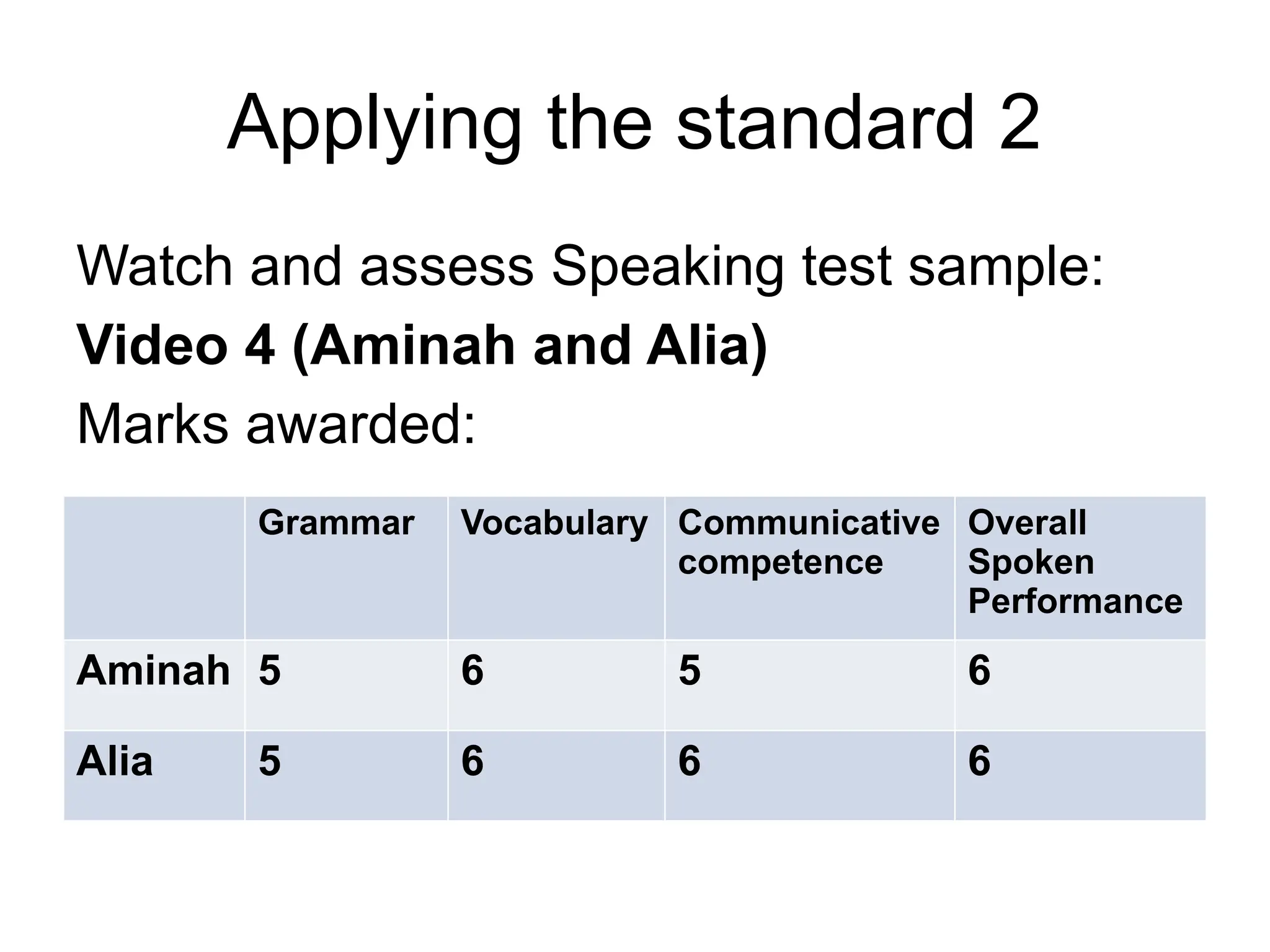
Applying the standard2
Watch and assess Speaking test sample:
Video 4 (Aminah and Alia)
Marks awarded:
Grammar Vocabulary Communicative
competence
Overall
Spoken
Performance
Aminah 5 6 5 6
Alia 5 6 6 6
#1 This section serves as both familiarisation for the trainers on the new Speaking test and also guides you as to what aspects to focus on for the examiner training.
#2 This section serves as both familiarisation for the trainers on the new Speaking test and also guides you as to what aspects to focus on for the examiner training.
#3 This slide provides examiners with essential background information on the test.
#4 This slide provides examiners with essential background information on the test format.
#5 Here is the Interlocutor frame for Part 1 of the test.
Tip for examiner training:
Show the example of Part 1 of the test and elicit from the trainees:
What is the interaction pattern? E.g. interlocutor to each candidate in turn
What kind of language is the candidate expected to produce? E.g. candidates are giving factual information about themselves and their everyday activities.
Then show the following slide with the test format for Part 1 and check further details with the trainees.
#6 This slide makes examiners aware of the format, interaction pattern and candidate output for Part 1 of the test.
Tip for examiner training:
Refer to the Instructions for Examiners booklet page 13 where there is more information about conducting Part 1.
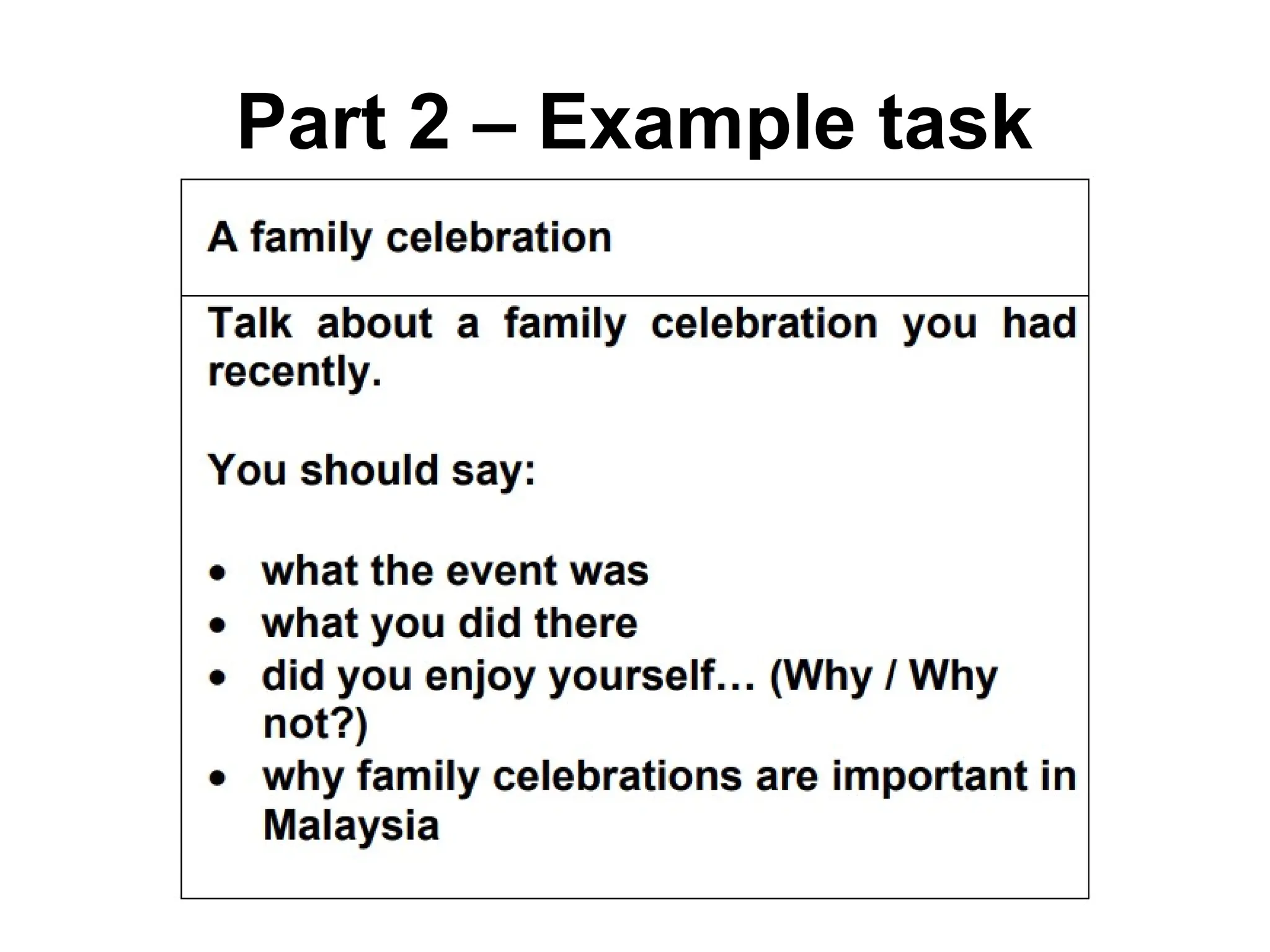
#7 Here is the Candidate prompt card for Candidate A for Part 2 of the test.
Tip for examiner training:
Show the example task for Part 2 of the test and elicit from the trainees:
What is the interaction pattern? E.g. interlocutor sets up task and then interaction is one candidate talking on their own
What kind of language is the candidate expected to produce? E.g. candidates are describing a past experience, giving details, explaining and giving opinion.
Invite one trainees to demonstrate the activity to the group (in one minute).
Then show the following slide with the interlocutor frame for Part 2.
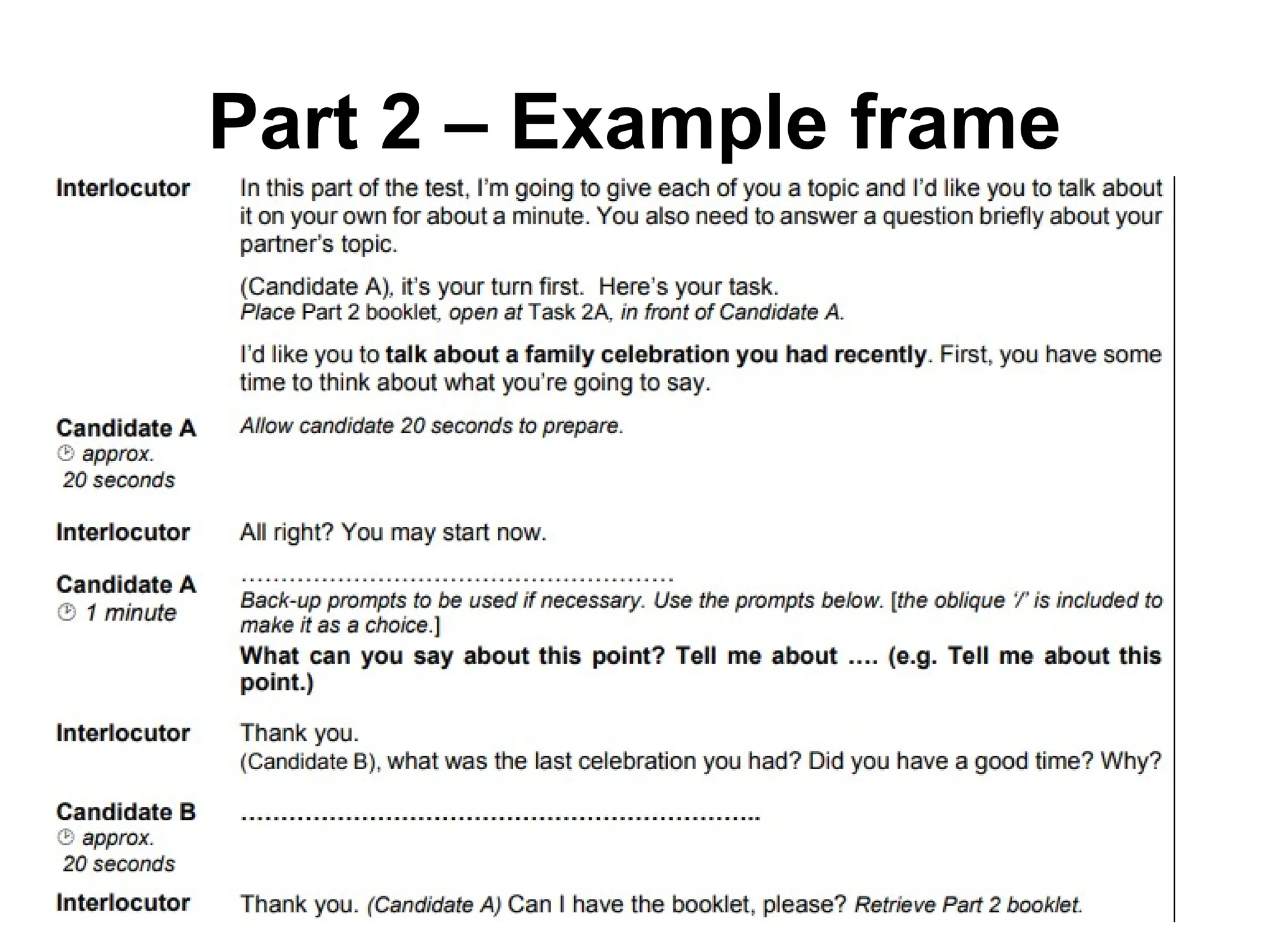
#8 Here is the Interlocutor frame for Part 2 of the test for the family celebration task you just looked at.
Tip for training:
Show the example frame for Part 2 and elicit from the trainees:
What is the difference between text in italics, text in bold and normal text? E.g. italics refers to candidate names and instructions to the interlocutor, text in bold refers to the speakers, the candidate materials and the back-up prompts, and normal text refers to what the interlocutor says.
How long do candidates have to prepare? E.g. 20 seconds.
Refer trainees to the Sample Test material for the second task, and draw attention to:
How the interlocutor handles the two sets of candidate materials
What the interlocutor should do if candidates don’t start the interaction, or they get stuck on a particular question prompt (see ISE booklet pages 14-15)
Then show the following slide with the test format for Part 2 and check any further details with the trainees.
#9 This slide makes examiners aware of the format, interaction pattern and candidate output for Part 2 of the test.
Tip for examiner training:
Refer to the Instructions for Examiners booklet pages 11 (overview) and also page 14 (detail) where there is more information about conducting Part 2.
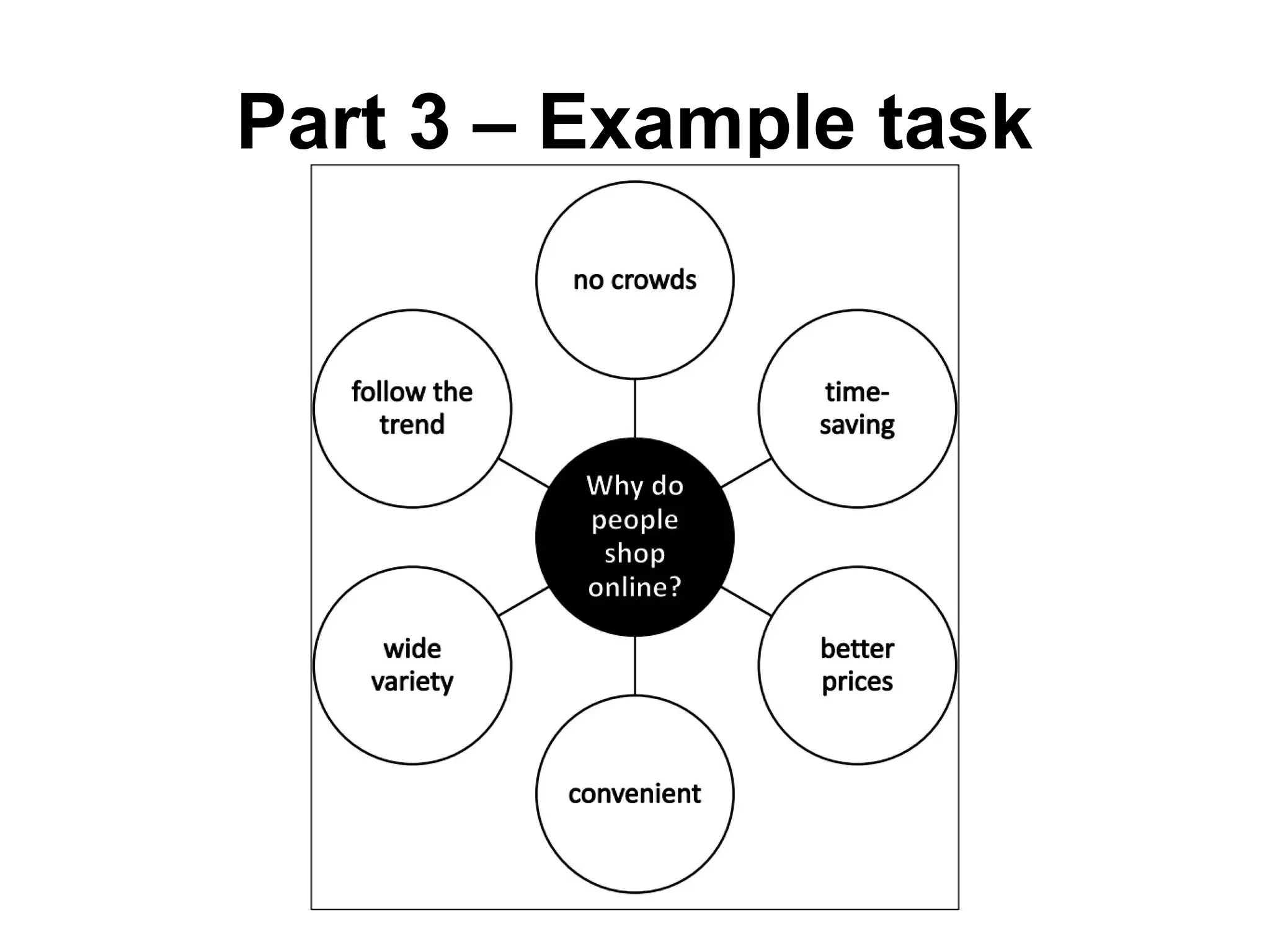
#10 Here is a Candidate prompt card for Part 3 of the test.
Tip for examiner training:
Show the example task of Part 3 of the test and elicit from the trainees:
What is the interaction pattern? E.g. candidates discuss the question in pairs, using the prompts given.
What kind of language are the candidates expected to produce? E.g. exchanging information and opinions, expressing and justifying opinions, discussing alternatives, negotiating agreement etc.
Invite trainees to demonstrate the activity, by asking them to discuss the question for 2 minutes in pairs.
Then show the following slide with the test format for Part 3 and check further details with the trainees.
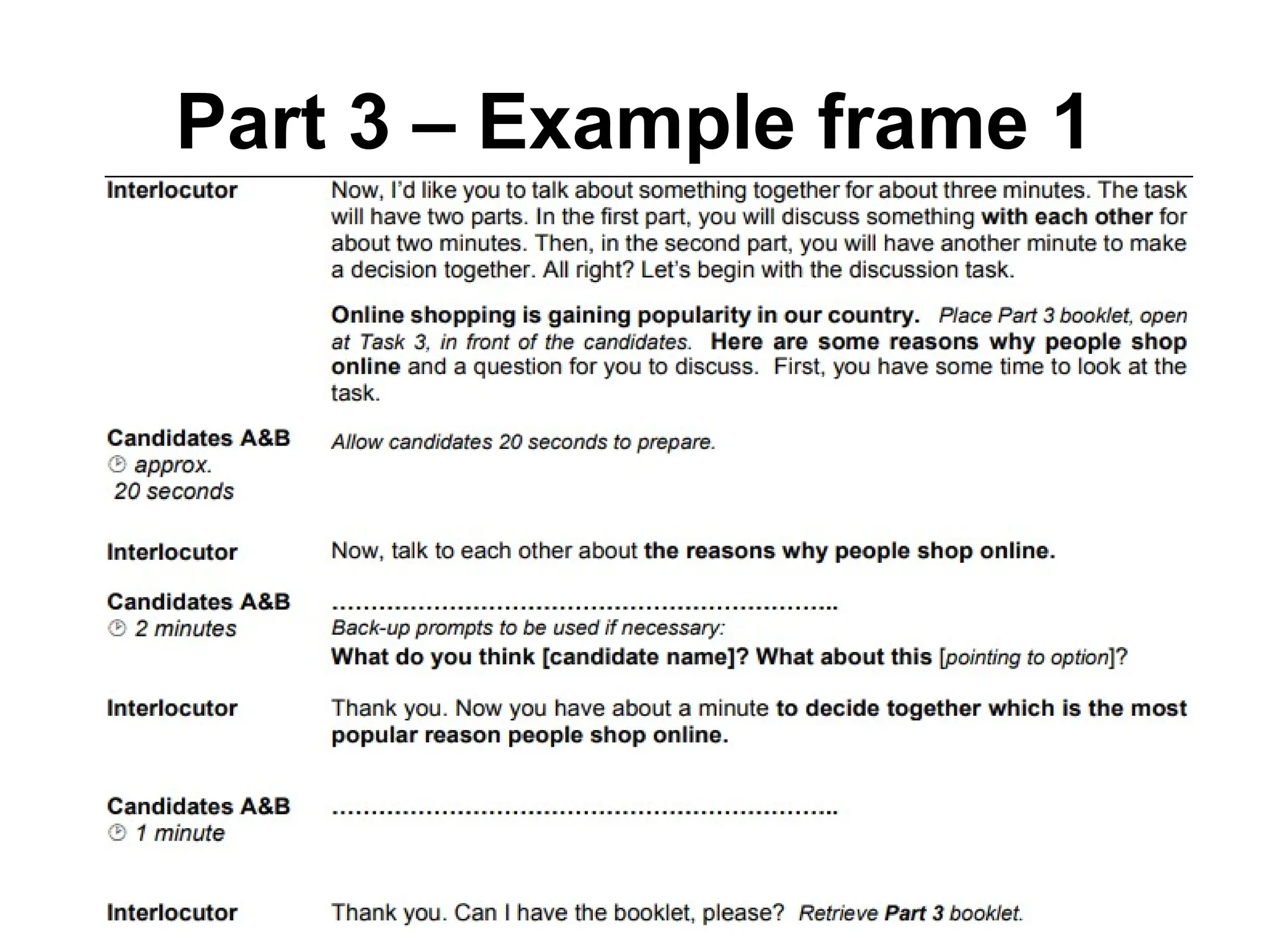
#11 Here is the Interlocutor frame for the first part of the Part 3 online shopping task. The final section is on the next slide.
Tip for examiner training:
Show the example frame for Part 3 task and elicit from the trainees:
How long do the candidates have to prepare? E.g. 20 seconds.
What should the interlocutor do if candidates don’t start the discussion? e.g. use back-up prompts provided, see ISE booklet page 17 for more information.
What do the candidates do after their 2 minute discussion? E.g. they have a decision-making task, where they discuss together for a further minute and come to a conclusion.
There is another section to this part of the test, which follows on from the discussion. What do you think this is? E.g. a more general question, designed to extend the discussion into a more challenging area. Show example on following slide.
Then show the following slide with the test format for Part 3 and check any further details with the trainees.
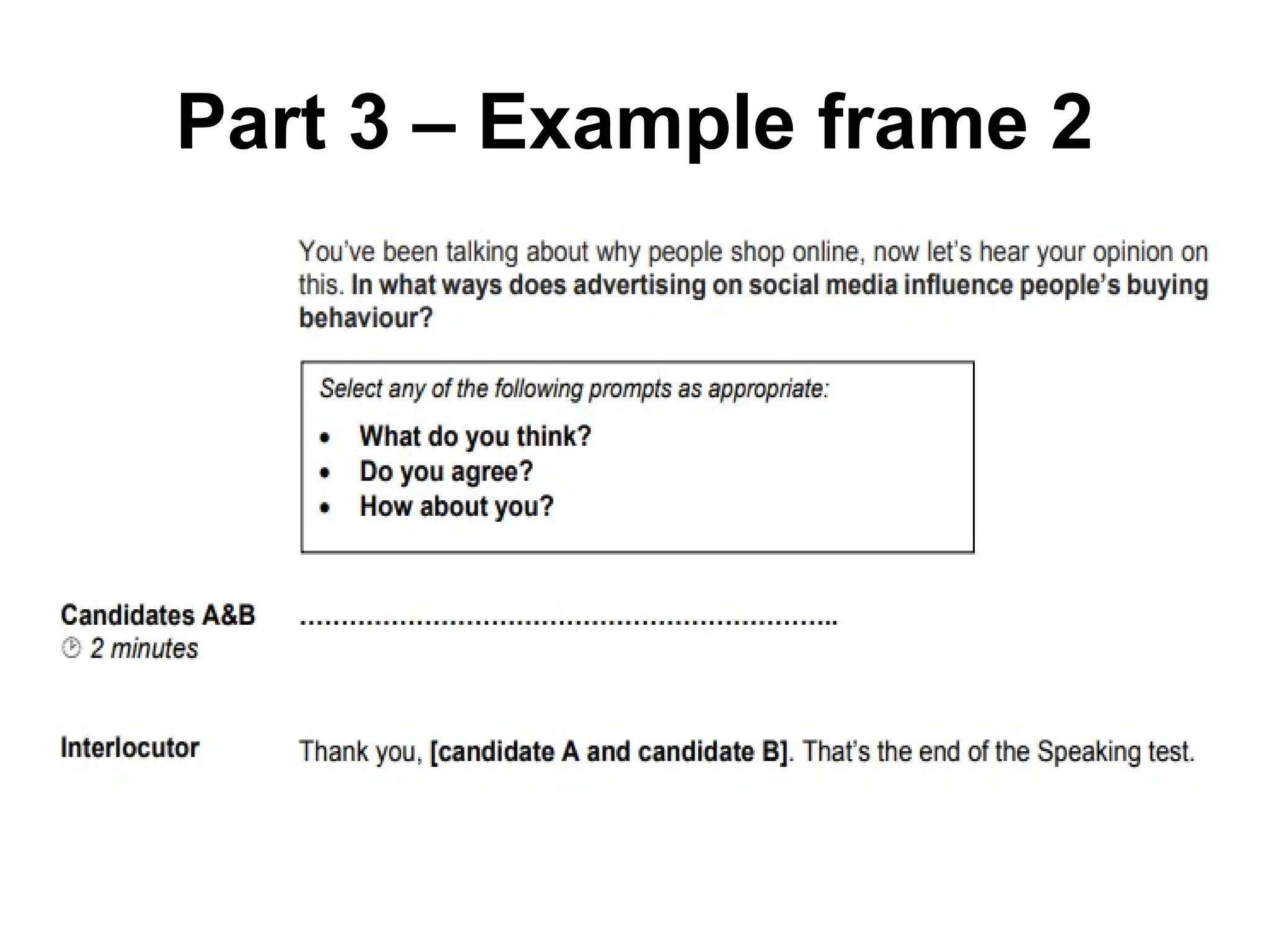
#12 Here is the Interlocutor frame for the final part of the Part 3 online shopping task.
Tip for examiner training:
Elicit from the trainees:
Why do you think this final question is needed? E.g. It allows candidates at the top end of the range (C1 level) to show their ability to discuss a complex, abstract topic, as this is what is required at the higher level. Lower level candidates may not be able to discuss the question for as long as 2 minutes, so the Interlocutor should be prepared to bring the test to a close earlier than this if necessary.
Then show the following slide with the test format for Part 3 and check any further details with the trainees.
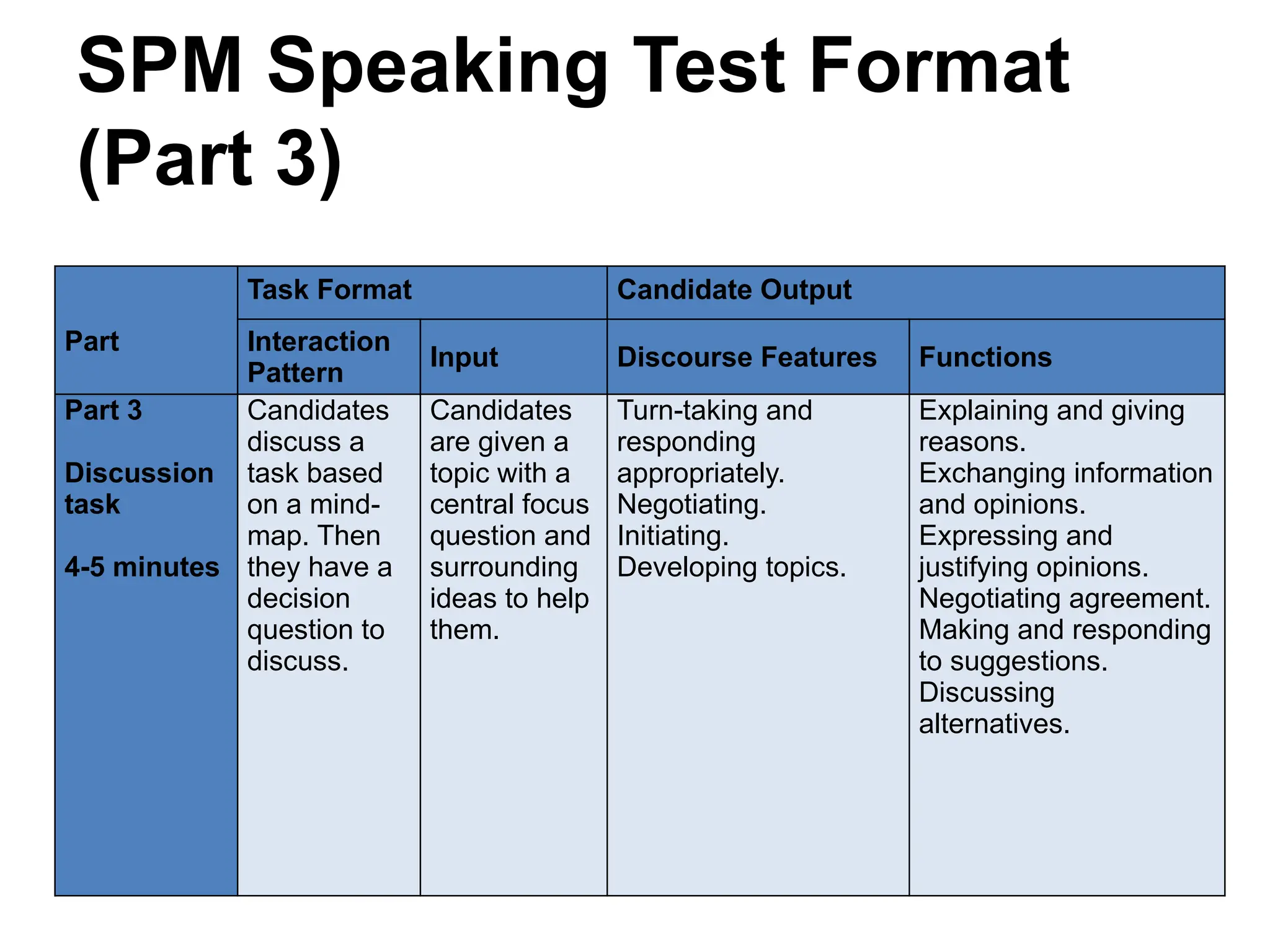
#13 This slide makes examiners aware of the format, interaction pattern and candidate output for Part 3 of the test.
Tip for examiner training:
Refer to the Instructions for Examiners booklet page 16 where there is more information about conducting Part 3.
#14 This slide focuses on the background to the level of the test.
Tip for examiner training:
When training, make sure you emphasise that:
The main focus of the test is on the B1-B1 range, but the tasks and assessment criteria are designed to accommodate a broader range (A2/A1 up to C1 for productive skills).
The scales used were developed with a heavy emphasis on the corresponding CEFR scales, but that these are ‘illustrative’ descriptors, and are designed to be adapted and interpreted for each specific test situation. This is why the SPM scales are not exactly the same as the CEFR ones.
The scales focus on what learners can do rather than what they can’t do, so the scales are worded positively. This doesn’t mean that you’re not taking errors into account, though, rather that candidates may not achieve the descriptor of the higher bands.
#15 Here is an example of how the language of the CEFR illustrative descriptors is similar to that of the SPM assessment scales.
Tip: With the trainees, you could show them this slide and ask them to discuss in pairs and identify the key similarities between the CEFR descriptor and the SPM scales. For example, simple structures are used and although there are errors usually what is said is clearly understood.
Then show the following slide to check their ideas.
#17 Here is an example of how the language of the CEFR illustrative descriptors is similar to that of the SPM assessment scales. This shows B1 CEFR level and Band 3 of SPM.
Tip: With the trainees, you could show them this slide and ask them to discuss in pairs and identify the key similarities between the CEFR descriptor and the SPM scales. Then show the following slide to check their ideas.
Note: the descriptors shown for SPM are partial (what is shown is of most relevance to the grammatical accuracy scale of the CEFR)
#19 Here is an example of how the language of the CEFR illustrative descriptors is similar to that of the SPM assessment scales. This shows B2 CEFR level and Band 5 of SPM.
Tip: With the trainees, you could show them this slide and ask them to discuss in pairs and identify the key similarities between the CEFR descriptor and the SPM scales. Then show the following slide to check their ideas.
Note: the descriptors shown for SPM are partial (what is shown is of most relevance to the grammatical accuracy scale of the CEFR)
#21 Here is an example of how the language of the CEFR illustrative descriptors is similar to that of the SPM assessment scales. This shows C1 CEFR level and Band 6 of SPM.
Tip: With the trainees, you could show them this slide and ask them to discuss in pairs and identify the key similarities between the CEFR descriptor and the SPM scales. Then show the following slide to check their ideas.
Note: the descriptors shown for SPM are partial (what is shown is of most relevance to the grammatical accuracy scale of the CEFR)
#22 When it comes to C1 level and Band 6 the wording is almost identical (and notably, the SPM criteria provide a broader definition than the CEFR because it is an operational scale).
#23 This activity highlights some of the key distinctions in the overall spoken production features of the CEFR from level A2 to C1.
N.B. For your face-to-face training session, this activity will be on a handout (SPM Speaking and the CEFR – Handout S1), which can be given to the trainees to discuss in pairs. Here each pair of descriptors is on a slide for you to read and consider, before moving on to the following slide for the answer.
#33 Answer to question 5 (last question on worksheet)
#34 This section serves as both familiarisation for the trainers on the new Speaking test and also guides you as to what aspects to focus on for the examiner training.
#36 The following slides summarise some of the key points about procedure, and they can be used in your session to focus SEs on these particular aspects.
This slide is a summary of the information found on page 12 of the Training Guidelines and page 7 of the Instructions to Speaking Examiners.
Tip for examiner training:
Remind Speaking Examiners of the following points:
two Speaking Examiners are always required for the test
Speaking Examiners make their assessments independently, using the appropriate scales. They must not adjust their marks in light of those given by their co-examiner. Each Speaking Examiner makes their assessment from a different perspective, using different criteria. Both sets of marks are used to calculate the candidate’s final Speaking test mark.
#37 This slide is a summary of the information found on page 12 of the Training Guidelines and page 7 of the Instructions to Speaking Examiners.
Tip for examiner training:
Remind Speaking Examiners of the following points:
research has shown that the use of unscripted comments and asides creates an unfair test and can, therefore, have a negative impact on a candidate’s performance.
adhering to the interlocutor frame ensures standardisation of the Speaking tests and therefore fairness and equality of opportunity for candidates.
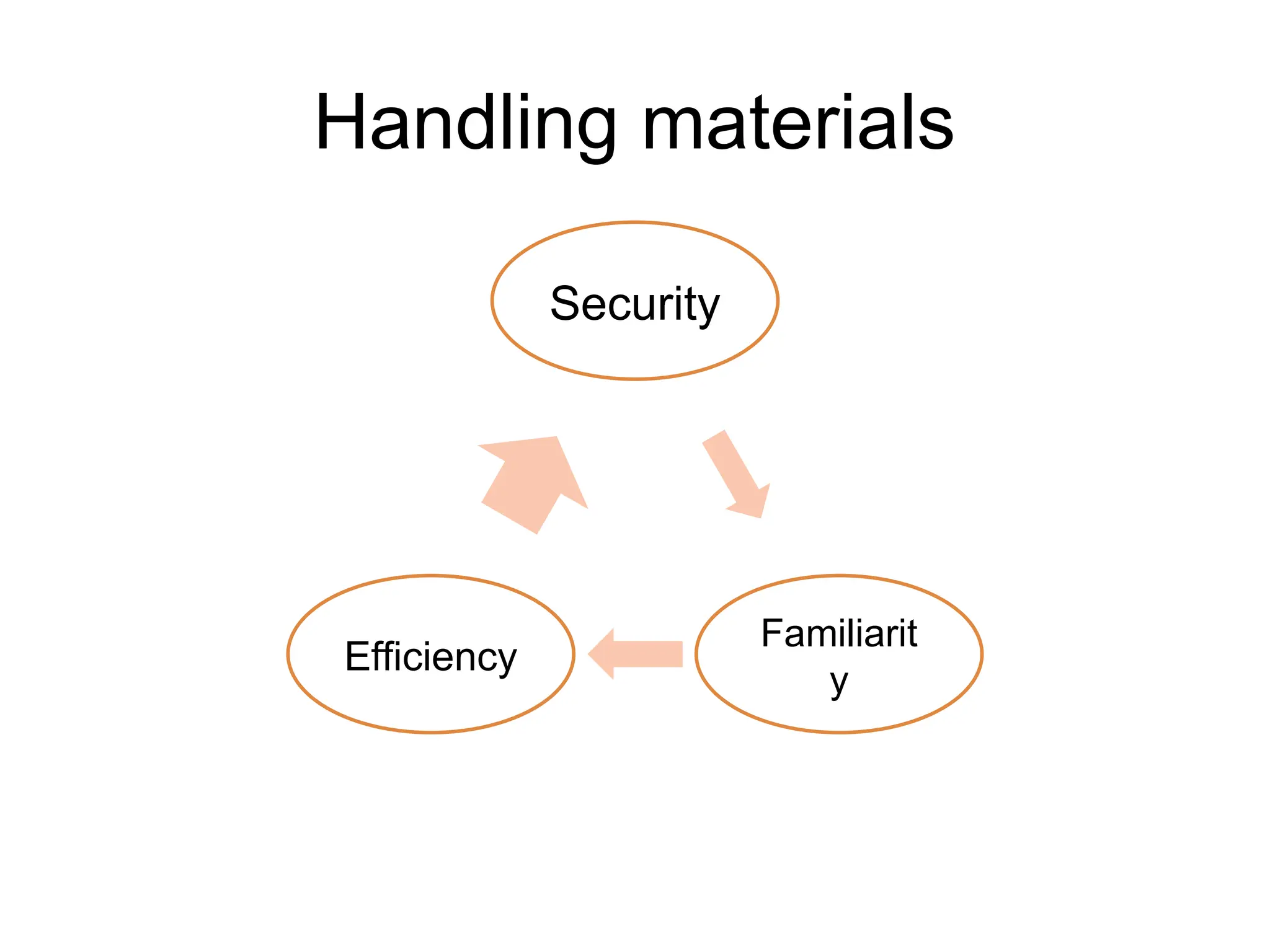
#38 This slide is a summary of the information found on page 13 of the Training Guidelines and page 12 (onwards, at relevant points) of the Instructions to Speaking Examiners.
Tip for examiner training:
Refer trainees to the sample speaking test materials at this point, if you haven’t already done so.
Elicit some reasons why these three elements are important when handling materials and then follow up with these points:
Security
Speaking Examiners must not leave materials unattended
Speaking Examiners must collect materials at the appropriate times
Speaking Examiners must not allow candidates to see assessment criteria or additional materials, such as other tasks or mark sheets.
Familiarity
Speaking Examiners must prepare thoroughly before examining
Speaking Examiners must familiarise themselves with the full range of test materials.
Efficiency
Speaking Examiners must ensure they are able to handle the materials in an organised and efficient way (see Instructions to Speaking Examiners page 5 – this is an aspect of performance which should be monitored).
#39 This section is a summary of the information found on page 13 of the Training Guidelines (Interlocutor involvement and intervention, Interlocutor body language, manner) and page 8 of the Instructions to Speaking Examiners. Consider what you think are the important points to raise with trainees when thinking about interlocutor behaviour.
Tip for examiner training:
In your session, invite the trainees to brainstorm in groups of 3 or 4 what they think are the most important elements of Interlocutor behaviour, then discuss ideas using the following slide.
#40 This slide is a summary of the information found on page 13 of the Training Guidelines (Interlocutor involvement and intervention, Interlocutor body language, manner) and page 8 of the Instructions to Speaking Examiners.
Tip for examiner training:
In your session, invite the trainees to brainstorm in groups of 3 or 4 what they think are the most important elements of Interlocutor behaviour.
Then remind Speaking Examiners of the following points:
Redirect candidates who are slow to respond or reluctant to take part by repeating the rubric, using back-up prompts where given in the frame, pointing to prompt material, using gestures etc.
Avoid using other forms of intervention as these can cause the candidate to become confused or lost concentration/confidence.
Use eye contact/gesture to show interest in what the candidate is saying, indicate that the candidate has said enough/should say more.
Withdraw eye contact in paired tasks to allow candidates to talk to each other.
Provide equal opportunities for both candidates to speak
Use candidates’ names throughout the test.
Use a friendly and encouraging manner as well as being professional. It is important that all Speaking Examiners appear equally firm, fair and friendly.
#41 As a means of checking basic understanding of test format and procedure, trainers may wish to give the examiners the handout: SPM Speaking Test Procedure Activity (Handout S2) to complete while watching the sample Speaking test.
#42 Watch the test and focus particularly on the procedure and what the Interlocutor is doing. If you have the sample materials, you might like to look at these at the same time as watching the test. This video will be used again later to focus on the candidate marks, but don’t worry about that at the moment – the focus here is procedure.
Tip for examiner training:
Show trainees the sample test. While watching, as well as completing the SPM Speaking Test Procedure Activity (Handout S2), ask trainees to watch the examiners and note down anything they notice about the Interlocutor or Assessor behaviour. Avoid discussion of marks/level of performance at this stage. You may wish to stop the video at the end of each Part to discuss anything relevant, referring to the Instructions to Speaking Examiners booklet pages 12-17, where procedure is discussed in detail.
After watching the test, check the answers to the activity on the handout (on the following slide for your reference) and elicit and discuss any questions and comments on procedure.
Points to mention:
Part 1: Timing should be 3-4 minutes (here it was shorter than that – 1:30). Emphasise the importance of asking 2 questions in Part 1 Phase 2 and also encouraging candidates to produce longer responses if possible so there is more language to assess in this part. Elicit ways to do this (e.g. smile and nod encouragingly, use a hand gesture to indicate they should keep talking for a bit longer, allow some thinking time, use the back-up prompts etc.). You may want to mention that the Interlocutor here omits the question in Phase 1, ‘How do you come to school?’, and stress the importance of keeping strictly to the Interlocutor frame, so all tests are standardized (there’s more focus on this later in this module).
Part 2: Ain only speaks for just over 30 seconds in her long turn, which is rather short. Refer trainees to the Instructions for Speaking Examiners booklet pages 14-15, where there is some advice on giving candidates the opportunity to extend e.g. use of gesture and eye contact, repetition of all or part of the rubric, use of the back-up prompts provided in the interlocutor frame, or by directing the candidate to the task material.
#44 Handout S2: Speaking Test Procedure Activity - answers
#46 Obviously, there is no opportunity for you to practise in the online session, but you should attempt to prepare for the face-to-face training by doing some practise with peers if you have the opportunity. Refer to the Training Guidelines page 14 and set up the Peer Practice session (approx. 20 mins) according to the information on this slide.
Tip for examiner training:
If you have space, trainees can spread out into different rooms to do their practice, before coming back for a plenary feedback session to compare experiences and observations.
Instructions for the activity (S4: SPM Observing Practice Tests) are on the following slides.
If you are able to source some volunteer candidates, this is the most effective way of practising as examiners. Note that volunteers must not be candidates who are going to be examined by these trainees in the near future.
Full instructions for organising the volunteer practice tests are in the Training Guidelines pages 14-15.
#48 Consider the questions before moving onto the answers on the next slide.
#50 Consider the questions before moving onto the answers on the next slide.
#52 Consider the questions before moving onto the answers on the next slide.
#54 Consider the questions before moving onto the answers on the next slide.
#56 Consider the questions before moving onto the answers on the next slide.
#58 Consider the questions before moving onto the answers on the next slide.
#59 Q18 – the interlocutor frame says ‘one or more’ but - as indicated in the ISE document – this is expected to be 1-2 questions in all but rare cases (e.g. where a candidate gives an unexpectedly short answer or they misunderstand a question and an examiner wants to use another question).
#60 Consider the questions before moving onto the answers on the next slide.
#62 This slide is a summary of the information found on page 16 of the Training Guidelines (and basic requirements of the role in the Instructions for Speaking Examiners – p.6).
Tip for examiner training:
At the end of the feedback plenary when trainees have shared their impressions of the practice tests, invite some reflection on what the trainees have learnt about Speaking Examiner responsibilities relating to the procedure of the SPM Speaking test. Then summarise the information with this slide.
#64 This slide is a summary of the information found on page 16 (onwards) of the Training Guidelines and pages 17-20 of the Instructions to Speaking Examiners.
Tip for examiner training:
Refer to the Instructions to Speaking Examiners booklet where Speaking Examiners can find the descriptions of the assessment criteria on pages 17-20, and remind trainees of the level.
Elicit from the trainees what the difference is between the analytical criteria scales and the overall spoken performance scale. (Analytical criteria are looking at the detail of the candidate’s performance according to grammar, vocabulary and communication, whereas the overall spoken performance scale is looking at the performance globally from the Interlocutor’s perspective). Explain that in the next section of the training, the trainees will have a more detailed look at the analytical criteria first and then the overall performance scale.
#65 This activity, on the handout: SPM Speaking Scales Sorting Activity (Handout S5) and the following slides, is intended to allow you to familiarize yourself with the Analytical and Global scales and the band descriptors for Bands 1, 3 and 5, and focus on the differences in each scale as you go up the band levels. Note that Bands 2 and 4 can be used when candidates show elements of both the Band above and below in approximately equal measure.
Tip for examiner training:
For your face-to-face training session, this activity will be on a handout, which can be given to the trainees to discuss in pairs, before feedback with the whole group.
#67 Note the words in bold here which focus on the main differences between the bands, and the fact that Overall Spoken Performance is assessing understanding of the tasks and questions, and how much repetition, prompting and support is required to complete the tasks.
#69 Note the words in bold here which focus on the main differences between the bands and the fact that Overall Spoken Performance is also assessing the type of information and interaction the candidates can manage.
#70 This slide gives a summary of the Band 1 descriptors for all three Analytical scales, and highlights the key words of each. There is more detailed information of key terms on pages 17-21 of the Instructions to Speaking Examiners booklets.
Tip for examiner training: Show the following four slides to summarise the differences between the bands of the Analytical scales. You should ensure that everyone understands the assessment criteria and the procedure for assessment. Details are provided in the relevant Instructions to Speaking Examiners booklet. You should take every opportunity to refer to the assessment criteria and scales when discussing the marks awarded in the standardisation tests.
You should stress that:
when assessing, Speaking Examiners need to refer to the assessment scales throughout the test
the interlocutor and the assessor assess independently and there is no discussion
the assessor should have finalised the analytical marks for each candidate by the time the candidates leave the test room
the assessor is responsible for checking with the interlocutor for their Overall Spoken Performance score.
Examiner trainees should also be instructed on how to complete the relevant mark sheet, and understand the importance of doing so fully and accurately. During the training session, they should be provided with copies of mark sheets, fictional IDs, candidate numbers, etc. and given practice in mark sheet completion while marking the tests.
#71 This slide gives a summary of the Band 3 descriptors for all three Analytical scales, and highlights the key words of each.
#72 This slide gives a summary of the Band 5 descriptors for all three Analytical scales, and highlights the key words of each.
#73 This slide gives a summary of the Band 6 descriptors for all three Analytical scales, and highlights the key words of each.
#74 This slide gives an activity to focus on the key words associated with the Analytical and Global scales and encourage further familiarity with the wording of the scales.
Tip for examiner training:
Trainees discuss this in groups to gain familiarity and raise awareness of the terms from the Global and Analytical scales. They shouldn’t look at the scales until after they have done the activity.
#75 This slide highlights the words that appear in the Overall Spoken Performance scale (Global).
Tip for examiner training:
In feedback, discuss where the deleted words belong:
control, word order, connectors = ‘Grammar’ scale,
expressions = ‘Vocabulary’ scale
clarification, initiate a conversation, pausing = ‘Communicative Competence’ scale
Ask trainees to identify what they think are the main areas behind the Global Achievement scale.
#76 This slide gives a summary of the rationale behind the Global scale.
#77 Optional activity for training.
Tip for examiner training:
Ask the Speaking Examiners to discuss the questions in pairs/small groups using the Instructions to Speaking Examiners if they need to. Conduct group feedback and show the next slide with some suggested answers.
#78 This slide gives the answers to the previous activity.
Tip for examiner training:
Remind Speaking Examiners of the independence of the assessor’s and interlocutor’s marks and that no discussion is allowed. The assessor records all the marks on the mark sheet, including the Interlocutor’s mark.
#80 This is the first video to set the standard of the SPM Speaking test and is the same test that we watched earlier for procedure.
Tip for examiner training:
Explain that the first video to set the standard is the same as the one we watched earlier for procedure. Explain that this test gives a benchmark for what is expected at between B1 and B2 level. Give the analytical marks for both candidates and ask trainees to have the Analytical Scales to hand while watching and make notes of features of performance that relate to these marks. When the test is finished, allow trainees to briefly discuss their observations in pairs and then invite comments to justify the marks. Encourage them to use mark scheme language and refer to the performance commentary as necessary. Elicit the marks trainees would award these candidates for Overall Performance (remembering that this is from the Interlocutor’s perspective) and why and check their ideas against the commentary. (Helmi: 4 and Ain: 5)
#81 This is the first video to set the standard of the SPM Speaking test and is the same test that we watched earlier for procedure.
Tip for examiner training:
Explain that the first video to set the standard is the same as the one we watched earlier for procedure. Explain that this test gives a benchmark for what is expected at between B1 and B2 level. Give the analytical marks for both candidates and ask trainees to have the Analytical Scales to hand while watching and make notes of features of performance that relate to these marks. When the test is finished, allow trainees to briefly discuss their observations in pairs and then invite comments to justify the marks. Encourage them to use mark scheme language and refer to the performance commentary as necessary. Elicit the marks trainees would award these candidates for Overall Performance (remembering that this is from the Interlocutor’s perspective) and why and check their ideas against the commentary. (Helmi: 4 and Ain: 5)
#83 This is the second video to set the standard of the SPM Speaking test and shows performances at around A2 and A2+ level.
Tip for examiner training:
Repeat with the second Setting the Standard video, if time permits. As before, ask candidates to watch and justify the marks with examples of what the candidates say. When the test is finished, allow trainees to briefly discuss their observations in pairs and then invite comments to justify the marks. Encourage them to use mark scheme language and refer to the performance commentary as necessary. Elicit the marks trainees would award these candidates for Overall Performance (remembering that this is from the Interlocutor’s perspective) and why and check their ideas against the commentary. (Farid: 2 and Farhan: 2)
N.B. Remind trainees of the importance of indicating (using a gesture) to the candidates that they should leave the booklet on the table, rather than holding it in Part 2, as this allows the Interlocutor to point to the booklet as necessary if candidates need support or prompting. It also allows the other candidate to see their partner’s task topic if necessary.
#84 This is the second video to set the standard of the SPM Speaking test and shows performances at around A2 and A2+ level.
Tip for examiner training:
Repeat with the second Setting the Standard video, if time permits. As before, ask candidates to watch and justify the marks with examples of what the candidates say. When the test is finished, allow trainees to briefly discuss their observations in pairs and then invite comments to justify the marks. Encourage them to use mark scheme language and refer to the performance commentary as necessary. Elicit the marks trainees would award these candidates for Overall Performance (remembering that this is from the Interlocutor’s perspective) and why and check their ideas against the commentary. (Farid: 2 and Farhan: 2)
N.B. Remind trainees of the importance of indicating (using a gesture) to the candidates that they should leave the booklet on the table, rather than holding it in Part 2, as this allows the Interlocutor to point to the booklet as necessary if candidates need support or prompting. It also allows the other candidate to see their partner’s task topic if necessary.
#86 This is the first video to practise applying the standard of the SPM Speaking test, so is your opportunity to assess using the analytical criteria. You can also think about the Overall Spoken Performance mark, but remember as assessor, you wouldn’t be asked to do this in a live test.
Tip for examiner training:
Trainees will be able to become more familiar with the criteria for assessment and gain confidence by practising applying the standard with 2 more samples. For these tests, you could divide the trainees into two groups and ask them to focus just on one candidate and mark each criteria for that candidate. This gives them more time to analyse the language in more detail. Alternatively, you could divide the trainees into three groups and give one criteria to each group (Grammar, Vocabulary or Communicative Competence). They can decide on marks for both candidates for the criterion they have been given. For both of these scenarios, when trainees have finished watching, allow plenty of discussion in pairs/groups before eliciting the marks/justifications. This is less threatening than working individually and often stimulates useful discussion. In whole group feedback, elicit some marks from each group or pair and write all of these suggestions on a flipchart or whiteboard, asking trainees to justify their mark with examples and using mark scheme language. Then circle the correct mark, reading further examples from the performance commentary as necessary. Finally, elicit some suggestions for the Overall Spoken Performance mark and read out the commentary for this.
N.B. For one or both of the Assessing the Standard tests, you can ask trainees to complete copies of the mark sheet (you will need 2 per trainee) in order to practise this.
#89 This is the second video to practise applying the standard of the SPM Speaking test, so is another opportunity to assess using the analytical criteria. You can also think about the Overall Spoken Performance mark, but remember as assessor, you wouldn’t be asked to do this in a live test.
Tip for examiner training:
Trainees will be able to become more familiar with the criteria for assessment and gain confidence by practising applying the standard with 2 more samples. For these tests, you could divide the trainees into two groups and ask them to focus just on one candidate and mark each criteria for that candidate. This gives them more time to analyse the language in more detail. Alternatively, you could divide the trainees into three groups and give one criteria to each group (Grammar, Vocabulary or Communicative Competence). They can decide on marks for both candidates for the criterion they have been given. For both of these scenarios, when trainees have finished watching, allow plenty of discussion in pairs/groups before eliciting the marks/justifications. This is less threatening than working individually and often stimulates useful discussion. In whole group feedback, elicit some marks from each group or pair and write all of these suggestions on a flipchart or whiteboard, asking trainees to justify their mark with examples and using mark scheme language. Then circle the correct mark, reading further examples from the performance commentary as necessary. Finally, elicit some suggestions for the Overall Spoken Performance mark and read out the commentary for this.
N.B. For one or both of the Assessing the Standard tests, you can ask trainees to complete copies of the mark sheet (you will need 2 per trainee) in order to practise this.
#90 Here are the marks.
N.B. Note that there a few examples in this test of interlocutor behaviour which you can discuss with the trainees.
In Part 2, it is not necessary to read all of the questions at the same time for the Candidate B follow-up question: (What was the last celebration you had? Did you have a good time? Why?) You should use the second question and the ‘Why?’ only if you need to, if Candidate B doesn’t talk for approx 30 seconds.
In Part 3, it is important as Interlocutor to read the whole of the rubrics to set up the discussion tasks, so that the candidates are completely familiar with the task and what they have to do. It’s also important for fairness to the candidates that the wording is identical for every test, as discussed earlier.