Improving MySQL-
based applications
performance with
Sphinx

Maciej Dobrzaoski
(Мачей Добжаньски)
Percona, Inc.
INTRODUCTION
Who am I?
  – Consultant at Percona, Inc.
  – What do I do?
     • Performance audits
     • Fix broken systems
     • Design architectures
  – Typically work from home
INTRODUCTION
What is Percona, Inc.?
   – Consulting company
   – Provides services for MySQL applications
   – Develops open-source software
      • Scalability patches for InnoDB
      • XtraDB storage engine for MySQL
      • Xtrabackup – free backup solution for InnoDB/XtraDB
WHAT IS MYSQL?
WHAT IS MYSQL?
MySQL is...
   – Open-source relational database management system
   – Popular enough to assume everyone here knows it
WHAT IS SPHINX?
WHAT IS SPHINX?
A standalone full-text search engine
   – Consists of two major applications
      • indexer
      • searchd
   – More efficient than MySQL FULLTEXT
      • On larger data sets
WHAT IS SPHINX?
A standalone full-text search engine
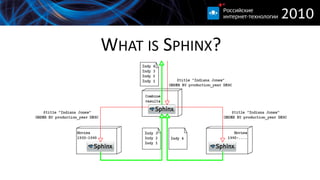
   – Can be easily scaled horizontally
      • Sphinx indexes can be distributed across many servers
      • Allows parallel searching
      • One instance becomes a dispatcher
          – Forwards queries to other instances
          – Combines results before sending them back to clients
WHAT IS SPHINX?
WHAT IS SPHINX?
Many additional features beyond just full-text search
   – Indexable attributes for non-FTS filtering
      • numerical, multi-value and now also text
      • Example: limit results to rows which have
        article_score>=2
   – Sorting results by an attribute or an expression
      • Example: @weight+(article_score)*0.1
WHAT IS SPHINX?
Many additional features beyond just full-text search
   – Grouping results by an attribute
      • Additional support for timestamp attributes
      • Returns also row count per group – may be approximate
   – Calculating expressions
      • Much faster than in MySQL as per recent benchmarks
WHAT IS SPHINX?
Anything else?
   – On-line re-indexing
   – Live index updates
   – Extensive API available for many programming languages
      •   PHP
      •   Python
      •   Java
      •   many more
WHAT IS SPHINX?
There’s even more!
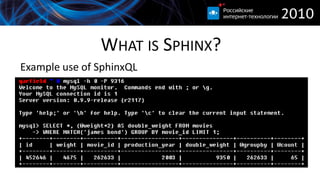
   – SphinxQL – MySQL server protocol compatible
      • Connect with any MySQL client
         – command line
         – API call, e.g. mysql_connect()
      • Run SQL-like queries
WHAT IS SPHINX?
Example use of SphinxQL
HOW DOES SPHINX WORK WITH MYSQL?
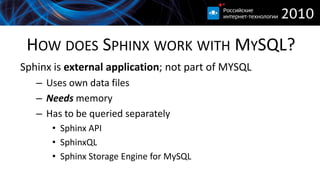
Sphinx is external application; not part of MYSQL
   – Uses own data files
   – Needs memory
   – Has to be queried separately
      • Sphinx API
      • SphinxQL
      • Sphinx Storage Engine for MySQL
HOW DOES SPHINX WORK WITH MYSQL?
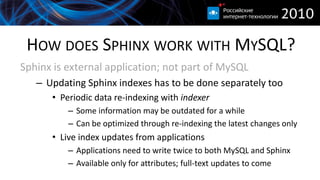
Sphinx is external application; not part of MySQL
   – Updating Sphinx indexes has to be done separately too
      • Periodic data re-indexing with indexer
          – Some information may be outdated for a while
          – Can be optimized through re-indexing the latest changes only
      • Live index updates from applications
          – Applications need to write twice to both MySQL and Sphinx
          – Available only for attributes; full-text updates to come
HOW DOES MYSQL WORK WITH SPHINX?
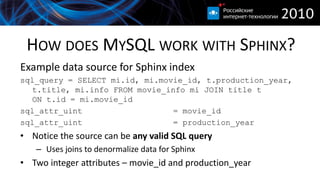
Example data source for Sphinx index
sql_query = SELECT mi.id, mi.movie_id, t.production_year,
   t.title, mi.info FROM movie_info mi JOIN title t
   ON t.id = mi.movie_id
sql_attr_uint                   = movie_id
sql_attr_uint                   = production_year
• Notice the source can be any valid SQL query
   – Uses joins to denormalize data for Sphinx
• Two integer attributes – movie_id and production_year
HOW DOES SPHINX WORK WITH MYSQL?
Sphinx is not a full database (yet?)
   – It’s primarily a search engine
   – It can return values stored as attributes, e.g:
     movie_id, production_year
   – …but not any full-text searchable columns
   – Results from Sphinx can be used to fetch full details from
     database
IMPORTANT FACTS TO KNOW ABOUT
           MYSQL
IMPORTANT FACTS TO KNOW ABOUT MYSQL
Uses B-TREE indexes to improve search performance
   – Works great for equality operator (=)
   – …and small range lookups: >, >=, <, <=, IN (list), LIKE
      • Range size relative to table size, not an absolute value
      • Large range often turns into plain scan
IMPORTANT FACTS TO KNOW ABOUT MYSQL
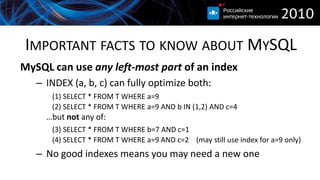
MySQL can use any left-most part of an index
   – INDEX (a, b, c) can fully optimize both:
      (1) SELECT * FROM T WHERE a=9
      (2) SELECT * FROM T WHERE a=9 AND b IN (1,2) AND c=4
     …but not any of:
      (3) SELECT * FROM T WHERE b=7 AND c=1
      (4) SELECT * FROM T WHERE a=9 AND c=2 (may still use index for a=9 only)
   – No good indexes means you may need a new one
IMPORTANT FACTS TO KNOW ABOUT MYSQL
Each index slows down writes to a table
   – Index is an organized structure, it has to be maintained
   – There can’t be too many or performance will suffer
MySQL can typically use only one index per query
   – There are rare exceptions – index merge optimizations
   – Merges are often not good enough – an observation
IMPORTANT FACTS TO KNOW ABOUT MYSQL
These work great in MySQL
   – Index optimized searching
      • A query which uses indexes efficiently is fast enough
      • B-TREE lookups are typically very efficient
      • FULLTEXT indexes can be the exception
   – Index optimized sorting and grouping
      • Rows are read in the proper order
IMPORTANT FACTS TO KNOW ABOUT MYSQL
These can cause problems in MySQL
   – Full table scans
      • No index is used
      • Query reads entire table row by row checking for matches
   – Large scans related to poor selectivity
      • An index is used, but it is not selective enough
      • MySQL has to read a lot of rows and reject many of them
IMPORTANT FACTS TO KNOW ABOUT MYSQL
These can cause problems in MySQL
   – Search on many combinations of columns in a single table
      • Each combination may require new index
      • Can’t have too many indexes in table at the same time
   – Handling multi-value properties in searches
      • Keywords, tags
      • Such queries often can’t be optimized very well
IMPORTANT FACTS TO KNOW ABOUT MYSQL
These can cause problems in MySQL
   – Sorting or grouping not done through indexes
      • Requires rewriting rows into temporary storage
      • At least one additional pass over results to complete
      • LIMIT does not work until all matches are found and
        sorted/grouped
IMPORTANT FACTS TO KNOW ABOUT MYSQL
Indexes and data may be cached in memory
   – key_buffer and filesystem cache for MyISAM tables
   – innodb_buffer_pool for InnoDB tables
   – No guarantees what is in RAM
      • MySQL has no option to lock certain data in buffers
IMPORTANT FACTS TO KNOW ABOUT MYSQL
Full-text support in MySQL
   – Available through FULLTEXT keys
   – Only supported by MyISAM engine
      • MyISAM uses table level locking
      • May become a showstopper for busy databases
   – Cannot be used together with any other index
      • Even index merge will not work
IMPORTANT FACTS TO KNOW ABOUT
            SPHINX
IMPORTANT FACTS TO KNOW ABOUT SPHINX
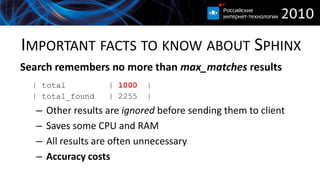
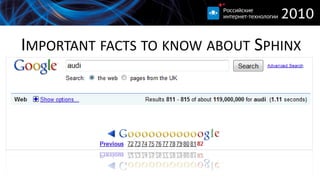
Search remembers no more than max_matches results
  | total           | 1000   |
  | total_found     | 2255   |
  –   Other results are ignored before sending them to client
  –   Saves some CPU and RAM
  –   All results are often unnecessary
  –   Accuracy costs
IMPORTANT FACTS TO KNOW ABOUT SPHINX
Grouping is done in fixed memory
   – Results may be approximate
      • When number of matches exceeds max_matches
   – Inaccuracy depends on max_matches setting
      • The larger the more accurate grouping results
      • Growing max_matches can reduce performance
   – Accuracy costs
IMPORTANT FACTS TO KNOW ABOUT SPHINX
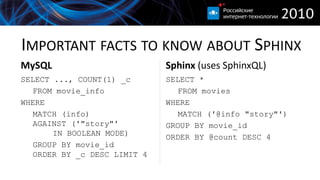
MySQL                         Sphinx (uses SphinxQL)
SELECT ..., COUNT(1) _c       SELECT *
   FROM movie_info               FROM movies
WHERE                         WHERE
   MATCH (info)                  MATCH ('@info "story"')
   AGAINST ('"story"'         GROUP BY movie_id
       IN BOOLEAN MODE)       ORDER BY @count DESC 4
   GROUP BY movie_id
   ORDER BY _c DESC LIMIT 4
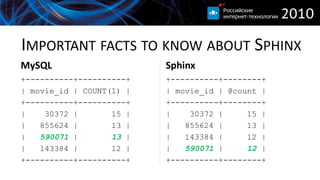
IMPORTANT FACTS TO KNOW ABOUT SPHINX
MySQL                     Sphinx
+----------+----------+   +----------+--------+
| movie_id | COUNT(1) |   | movie_id | @count |
+----------+----------+   +----------+--------+
|    30372 |       15 |   |    30372 |     15 |
|   855624 |       13 |   |   855624 |     13 |
|   590071 |       13 |   |   143384 |     12 |
|   143384 |       12 |   |   590071 |     12 |
+----------+----------+   +----------+--------+
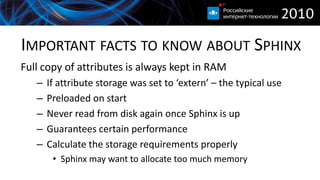
IMPORTANT FACTS TO KNOW ABOUT SPHINX
Full copy of attributes is always kept in RAM
   –   If attribute storage was set to ‘extern’ – the typical use
   –   Preloaded on start
   –   Never read from disk again once Sphinx is up
   –   Guarantees certain performance
   –   Calculate the storage requirements properly
        • Sphinx may want to allocate too much memory
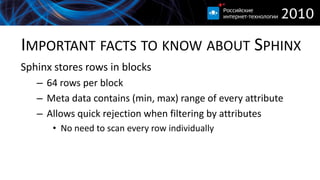
IMPORTANT FACTS TO KNOW ABOUT SPHINX
Sphinx stores rows in blocks
   – 64 rows per block
   – Meta data contains (min, max) range of every attribute
   – Allows quick rejection when filtering by attributes
      • No need to scan every row individually
MYSQL V SPHINX
 PERFORMANCE
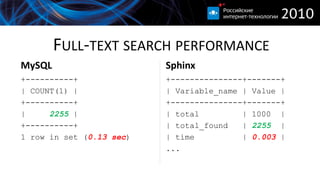
FULL-TEXT SEARCH PERFORMANCE

           USES FULL IMDB DATABASE
 IMPORTED INTO MYSQL AND INDEXED WITH SPHINX
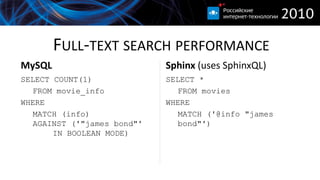
FULL-TEXT SEARCH PERFORMANCE
MySQL                        Sphinx (uses SphinxQL)
SELECT COUNT(1)              SELECT *
   FROM movie_info              FROM movies
WHERE                        WHERE
   MATCH (info)                 MATCH ('@info "james
   AGAINST ('"james bond"'      bond"')
       IN BOOLEAN MODE)
FULL-TEXT SEARCH PERFORMANCE
MySQL                     Sphinx
+----------+              +---------------+-------+
| COUNT(1) |              | Variable_name | Value |
+----------+              +---------------+-------+
|     2255 |              | total         | 1000 |
+----------+              | total_found   | 2255 |
1 row in set (0.13 sec)   | time          | 0.003 |
                          ...
SCAN PERFORMANCE

          USES FULL IMDB DATABASE
IMPORTED INTO MYSQL AND INDEXED WITH SPHINX
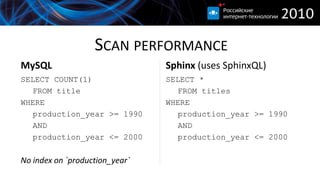
SCAN PERFORMANCE
MySQL                           Sphinx (uses SphinxQL)
SELECT COUNT(1)                 SELECT *
   FROM title                      FROM titles
WHERE                           WHERE
   production_year >= 1990         production_year >= 1990
   AND                             AND
   production_year <= 2000         production_year <= 2000

No index on `production_year`
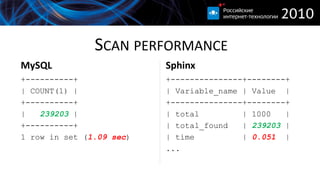
SCAN PERFORMANCE
MySQL                     Sphinx
+----------+              +---------------+--------+
| COUNT(1) |              | Variable_name | Value |
+----------+              +---------------+--------+
|   239203 |              | total         | 1000   |
+----------+              | total_found   | 239203 |
1 row in set (1.09 sec)   | time          | 0.051 |
                          ...
MORE COMPLEX CASE
      SEARCH BY KEYWORDS
          USES FULL IMDB DATABASE
IMPORTED INTO MYSQL AND INDEXED WITH SPHINX
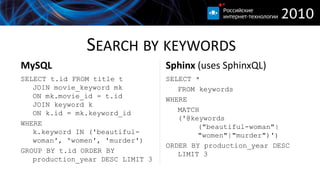
SEARCH BY KEYWORDS
MySQL                             Sphinx (uses SphinxQL)
SELECT t.id FROM title t          SELECT *
   JOIN movie_keyword mk             FROM keywords
   ON mk.movie_id = t.id          WHERE
   JOIN keyword k
   ON k.id = mk.keyword_id           MATCH
                                     ('@keywords
WHERE                                     ("beautiful-woman"|
   k.keyword IN ('beautiful-              "women"|"murder")')
   woman', 'women', 'murder')
                                  ORDER BY production_year DESC
GROUP BY t.id ORDER BY               LIMIT 3
   production_year DESC LIMIT 3
SEARCH BY KEYWORDS
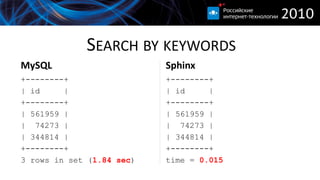
MySQL                      Sphinx
+--------+                 +--------+
| id     |                 | id     |
+--------+                 +--------+
| 561959 |                 | 561959 |
| 74273 |                  | 74273 |
| 344814 |                 | 344814 |
+--------+                 +--------+
3 rows in set (1.84 sec)   time = 0.015
SEARCH BY KEYWORDS
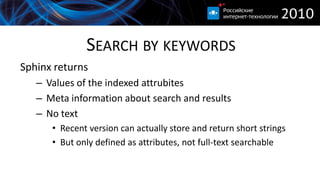
Sphinx returns
   – Values of the indexed attrubites
   – Meta information about search and results
   – No text
      • Recent version can actually store and return short strings
      • But only defined as attributes, not full-text searchable
SEARCH BY KEYWORDS
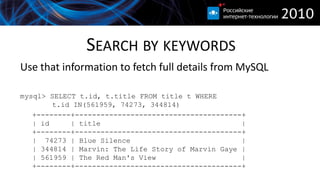
Use that information to fetch full details from MySQL

mysql> SELECT t.id, t.title FROM title t WHERE
        t.id IN(561959, 74273, 344814)
   +--------+---------------------------------------+
   | id     | title                                 |
   +--------+---------------------------------------+
   | 74273 | Blue Silence                           |
   | 344814 | Marvin: The Life Story of Marvin Gaye |
   | 561959 | The Red Man's View                    |
   +--------+---------------------------------------+
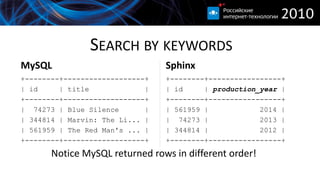
SEARCH BY KEYWORDS
MySQL                            Sphinx
+--------+-------------------+   +--------+-----------------+
| id     | title             |   | id     | production_year |
+--------+-------------------+   +--------+-----------------+
| 74273 | Blue Silence       |   | 561959 |            2014 |
| 344814 | Marvin: The Li... |   | 74273 |             2013 |
| 561959 | The Red Man's ... |   | 344814 |            2012 |
+--------+-------------------+   +--------+-----------------+
       Notice MySQL returned rows in different order!
SEARCH BY KEYWORDS
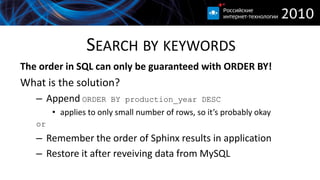
The order in SQL can only be guaranteed with ORDER BY!
What is the solution?
   – Append ORDER       BY production_year DESC
        • applies to only small number of rows, so it’s probably okay
   or
   – Remember the order of Sphinx results in application
   – Restore it after reveiving data from MySQL
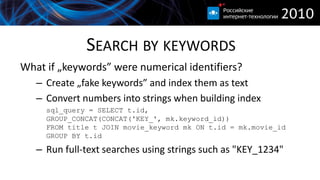
SEARCH BY KEYWORDS
What if „keywords” were numerical identifiers?
   – Create „fake keywords” and index them as text
   – Convert numbers into strings when building index
     sql_query = SELECT t.id,
     GROUP_CONCAT(CONCAT('KEY_', mk.keyword_id))
     FROM title t JOIN movie_keyword mk ON t.id = mk.movie_id
     GROUP BY t.id

   – Run full-text searches using strings such as "KEY_1234"
FLEXIBLE SEARCH
FLEXIBLE SEARCH
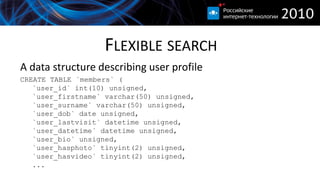
A data structure describing user profile
CREATE TABLE `members` (
   `user_id` int(10) unsigned,
   `user_firstname` varchar(50) unsigned,
   `user_surname` varchar(50) unsigned,
   `user_dob` date unsigned,
   `user_lastvisit` datetime unsigned,
   `user_datetime` datetime unsigned,
   `user_bio` unsigned,
   `user_hasphoto` tinyint(2) unsigned,
   `user_hasvideo` tinyint(2) unsigned,
   ...
FLEXIBLE SEARCH
Flexible search typically means
   – Search conditions may involve any number of columns in
     any combination
   – Sorting may be done on one of many columns as well

Often impossible to add all necessary indexes in MySQL
FLEXIBLE SEARCH
Many columns may have very low cardinality
   – Example: user_gender
   – MySQL would not even consider using index for such
     column

It may be very difficult to make it work fast in MySQL
   – When tables or traffic are large enough
FLEXIBLE SEARCH
How does Sphinx help?
   –   Scans are optimized
   –   Optimizations apply to all columns
   –   Possibility to use „fake keywords”
   –   Data can be split across several instances
        • Parallel search
        • No extra application logic necessary to combine results
SUMMARY
SUMMARY
Sphinx can be of great help to many MySQL-based apps
   – Developed to work better where MySQL performs poorly
      •   Text search
      •   Large scans
      •   Filtering on many combinations of columns
      •   Handling multi-value properties
SUMMARY
Sphinx can be of great help to any MySQL-based apps
   –   Comes with features that can actually replace database
   –   Easily scalable
   –   Actively developed
   –   You can sponsor development and have features you need
       done soon
        • No need to wait long until some functionality „appears”
Sphinx
http://www.sphinxsearch.com/

Percona Consulting
http://www.percona.com/
THANK YOU!

Sphinx new

  • 1.
    Improving MySQL- based applications performancewith Sphinx Maciej Dobrzaoski (Мачей Добжаньски) Percona, Inc.
  • 2.
    INTRODUCTION Who am I? – Consultant at Percona, Inc. – What do I do? • Performance audits • Fix broken systems • Design architectures – Typically work from home
  • 3.
    INTRODUCTION What is Percona,Inc.? – Consulting company – Provides services for MySQL applications – Develops open-source software • Scalability patches for InnoDB • XtraDB storage engine for MySQL • Xtrabackup – free backup solution for InnoDB/XtraDB
  • 4.
  • 5.
    WHAT IS MYSQL? MySQLis... – Open-source relational database management system – Popular enough to assume everyone here knows it
  • 6.
  • 7.
    WHAT IS SPHINX? Astandalone full-text search engine – Consists of two major applications • indexer • searchd – More efficient than MySQL FULLTEXT • On larger data sets
  • 8.
    WHAT IS SPHINX? Astandalone full-text search engine – Can be easily scaled horizontally • Sphinx indexes can be distributed across many servers • Allows parallel searching • One instance becomes a dispatcher – Forwards queries to other instances – Combines results before sending them back to clients
  • 9.
  • 10.
    WHAT IS SPHINX? Manyadditional features beyond just full-text search – Indexable attributes for non-FTS filtering • numerical, multi-value and now also text • Example: limit results to rows which have article_score>=2 – Sorting results by an attribute or an expression • Example: @weight+(article_score)*0.1
  • 11.
    WHAT IS SPHINX? Manyadditional features beyond just full-text search – Grouping results by an attribute • Additional support for timestamp attributes • Returns also row count per group – may be approximate – Calculating expressions • Much faster than in MySQL as per recent benchmarks
  • 12.
    WHAT IS SPHINX? Anythingelse? – On-line re-indexing – Live index updates – Extensive API available for many programming languages • PHP • Python • Java • many more
  • 13.
    WHAT IS SPHINX? There’seven more! – SphinxQL – MySQL server protocol compatible • Connect with any MySQL client – command line – API call, e.g. mysql_connect() • Run SQL-like queries
  • 14.
    WHAT IS SPHINX? Exampleuse of SphinxQL
  • 15.
    HOW DOES SPHINXWORK WITH MYSQL?
  • 16.
    HOW DOES SPHINXWORK WITH MYSQL? Sphinx is external application; not part of MYSQL – Uses own data files – Needs memory – Has to be queried separately • Sphinx API • SphinxQL • Sphinx Storage Engine for MySQL
  • 17.
    HOW DOES SPHINXWORK WITH MYSQL? Sphinx is external application; not part of MySQL – Updating Sphinx indexes has to be done separately too • Periodic data re-indexing with indexer – Some information may be outdated for a while – Can be optimized through re-indexing the latest changes only • Live index updates from applications – Applications need to write twice to both MySQL and Sphinx – Available only for attributes; full-text updates to come
  • 18.
    HOW DOES MYSQLWORK WITH SPHINX? Example data source for Sphinx index sql_query = SELECT mi.id, mi.movie_id, t.production_year, t.title, mi.info FROM movie_info mi JOIN title t ON t.id = mi.movie_id sql_attr_uint = movie_id sql_attr_uint = production_year • Notice the source can be any valid SQL query – Uses joins to denormalize data for Sphinx • Two integer attributes – movie_id and production_year
  • 19.
    HOW DOES SPHINXWORK WITH MYSQL? Sphinx is not a full database (yet?) – It’s primarily a search engine – It can return values stored as attributes, e.g: movie_id, production_year – …but not any full-text searchable columns – Results from Sphinx can be used to fetch full details from database
  • 20.
    IMPORTANT FACTS TOKNOW ABOUT MYSQL
  • 21.
    IMPORTANT FACTS TOKNOW ABOUT MYSQL Uses B-TREE indexes to improve search performance – Works great for equality operator (=) – …and small range lookups: >, >=, <, <=, IN (list), LIKE • Range size relative to table size, not an absolute value • Large range often turns into plain scan
  • 22.
    IMPORTANT FACTS TOKNOW ABOUT MYSQL MySQL can use any left-most part of an index – INDEX (a, b, c) can fully optimize both: (1) SELECT * FROM T WHERE a=9 (2) SELECT * FROM T WHERE a=9 AND b IN (1,2) AND c=4 …but not any of: (3) SELECT * FROM T WHERE b=7 AND c=1 (4) SELECT * FROM T WHERE a=9 AND c=2 (may still use index for a=9 only) – No good indexes means you may need a new one
  • 23.
    IMPORTANT FACTS TOKNOW ABOUT MYSQL Each index slows down writes to a table – Index is an organized structure, it has to be maintained – There can’t be too many or performance will suffer MySQL can typically use only one index per query – There are rare exceptions – index merge optimizations – Merges are often not good enough – an observation
  • 24.
    IMPORTANT FACTS TOKNOW ABOUT MYSQL These work great in MySQL – Index optimized searching • A query which uses indexes efficiently is fast enough • B-TREE lookups are typically very efficient • FULLTEXT indexes can be the exception – Index optimized sorting and grouping • Rows are read in the proper order
  • 25.
    IMPORTANT FACTS TOKNOW ABOUT MYSQL These can cause problems in MySQL – Full table scans • No index is used • Query reads entire table row by row checking for matches – Large scans related to poor selectivity • An index is used, but it is not selective enough • MySQL has to read a lot of rows and reject many of them
  • 26.
    IMPORTANT FACTS TOKNOW ABOUT MYSQL These can cause problems in MySQL – Search on many combinations of columns in a single table • Each combination may require new index • Can’t have too many indexes in table at the same time – Handling multi-value properties in searches • Keywords, tags • Such queries often can’t be optimized very well
  • 27.
    IMPORTANT FACTS TOKNOW ABOUT MYSQL These can cause problems in MySQL – Sorting or grouping not done through indexes • Requires rewriting rows into temporary storage • At least one additional pass over results to complete • LIMIT does not work until all matches are found and sorted/grouped
  • 28.
    IMPORTANT FACTS TOKNOW ABOUT MYSQL Indexes and data may be cached in memory – key_buffer and filesystem cache for MyISAM tables – innodb_buffer_pool for InnoDB tables – No guarantees what is in RAM • MySQL has no option to lock certain data in buffers
  • 29.
    IMPORTANT FACTS TOKNOW ABOUT MYSQL Full-text support in MySQL – Available through FULLTEXT keys – Only supported by MyISAM engine • MyISAM uses table level locking • May become a showstopper for busy databases – Cannot be used together with any other index • Even index merge will not work
  • 30.
    IMPORTANT FACTS TOKNOW ABOUT SPHINX
  • 31.
    IMPORTANT FACTS TOKNOW ABOUT SPHINX Search remembers no more than max_matches results | total | 1000 | | total_found | 2255 | – Other results are ignored before sending them to client – Saves some CPU and RAM – All results are often unnecessary – Accuracy costs
  • 32.
    IMPORTANT FACTS TOKNOW ABOUT SPHINX
  • 33.
    IMPORTANT FACTS TOKNOW ABOUT SPHINX Grouping is done in fixed memory – Results may be approximate • When number of matches exceeds max_matches – Inaccuracy depends on max_matches setting • The larger the more accurate grouping results • Growing max_matches can reduce performance – Accuracy costs
  • 34.
    IMPORTANT FACTS TOKNOW ABOUT SPHINX MySQL Sphinx (uses SphinxQL) SELECT ..., COUNT(1) _c SELECT * FROM movie_info FROM movies WHERE WHERE MATCH (info) MATCH ('@info "story"') AGAINST ('"story"' GROUP BY movie_id IN BOOLEAN MODE) ORDER BY @count DESC 4 GROUP BY movie_id ORDER BY _c DESC LIMIT 4
  • 35.
    IMPORTANT FACTS TOKNOW ABOUT SPHINX MySQL Sphinx +----------+----------+ +----------+--------+ | movie_id | COUNT(1) | | movie_id | @count | +----------+----------+ +----------+--------+ | 30372 | 15 | | 30372 | 15 | | 855624 | 13 | | 855624 | 13 | | 590071 | 13 | | 143384 | 12 | | 143384 | 12 | | 590071 | 12 | +----------+----------+ +----------+--------+
  • 36.
    IMPORTANT FACTS TOKNOW ABOUT SPHINX Full copy of attributes is always kept in RAM – If attribute storage was set to ‘extern’ – the typical use – Preloaded on start – Never read from disk again once Sphinx is up – Guarantees certain performance – Calculate the storage requirements properly • Sphinx may want to allocate too much memory
  • 37.
    IMPORTANT FACTS TOKNOW ABOUT SPHINX Sphinx stores rows in blocks – 64 rows per block – Meta data contains (min, max) range of every attribute – Allows quick rejection when filtering by attributes • No need to scan every row individually
  • 38.
    MYSQL V SPHINX PERFORMANCE
  • 39.
    FULL-TEXT SEARCH PERFORMANCE USES FULL IMDB DATABASE IMPORTED INTO MYSQL AND INDEXED WITH SPHINX
  • 40.
    FULL-TEXT SEARCH PERFORMANCE MySQL Sphinx (uses SphinxQL) SELECT COUNT(1) SELECT * FROM movie_info FROM movies WHERE WHERE MATCH (info) MATCH ('@info "james AGAINST ('"james bond"' bond"') IN BOOLEAN MODE)
  • 41.
    FULL-TEXT SEARCH PERFORMANCE MySQL Sphinx +----------+ +---------------+-------+ | COUNT(1) | | Variable_name | Value | +----------+ +---------------+-------+ | 2255 | | total | 1000 | +----------+ | total_found | 2255 | 1 row in set (0.13 sec) | time | 0.003 | ...
  • 42.
    SCAN PERFORMANCE USES FULL IMDB DATABASE IMPORTED INTO MYSQL AND INDEXED WITH SPHINX
  • 43.
    SCAN PERFORMANCE MySQL Sphinx (uses SphinxQL) SELECT COUNT(1) SELECT * FROM title FROM titles WHERE WHERE production_year >= 1990 production_year >= 1990 AND AND production_year <= 2000 production_year <= 2000 No index on `production_year`
  • 44.
    SCAN PERFORMANCE MySQL Sphinx +----------+ +---------------+--------+ | COUNT(1) | | Variable_name | Value | +----------+ +---------------+--------+ | 239203 | | total | 1000 | +----------+ | total_found | 239203 | 1 row in set (1.09 sec) | time | 0.051 | ...
  • 45.
    MORE COMPLEX CASE SEARCH BY KEYWORDS USES FULL IMDB DATABASE IMPORTED INTO MYSQL AND INDEXED WITH SPHINX
  • 46.
    SEARCH BY KEYWORDS MySQL Sphinx (uses SphinxQL) SELECT t.id FROM title t SELECT * JOIN movie_keyword mk FROM keywords ON mk.movie_id = t.id WHERE JOIN keyword k ON k.id = mk.keyword_id MATCH ('@keywords WHERE ("beautiful-woman"| k.keyword IN ('beautiful- "women"|"murder")') woman', 'women', 'murder') ORDER BY production_year DESC GROUP BY t.id ORDER BY LIMIT 3 production_year DESC LIMIT 3
  • 47.
    SEARCH BY KEYWORDS MySQL Sphinx +--------+ +--------+ | id | | id | +--------+ +--------+ | 561959 | | 561959 | | 74273 | | 74273 | | 344814 | | 344814 | +--------+ +--------+ 3 rows in set (1.84 sec) time = 0.015
  • 48.
    SEARCH BY KEYWORDS Sphinxreturns – Values of the indexed attrubites – Meta information about search and results – No text • Recent version can actually store and return short strings • But only defined as attributes, not full-text searchable
  • 49.
    SEARCH BY KEYWORDS Usethat information to fetch full details from MySQL mysql> SELECT t.id, t.title FROM title t WHERE t.id IN(561959, 74273, 344814) +--------+---------------------------------------+ | id | title | +--------+---------------------------------------+ | 74273 | Blue Silence | | 344814 | Marvin: The Life Story of Marvin Gaye | | 561959 | The Red Man's View | +--------+---------------------------------------+
  • 50.
    SEARCH BY KEYWORDS MySQL Sphinx +--------+-------------------+ +--------+-----------------+ | id | title | | id | production_year | +--------+-------------------+ +--------+-----------------+ | 74273 | Blue Silence | | 561959 | 2014 | | 344814 | Marvin: The Li... | | 74273 | 2013 | | 561959 | The Red Man's ... | | 344814 | 2012 | +--------+-------------------+ +--------+-----------------+ Notice MySQL returned rows in different order!
  • 51.
    SEARCH BY KEYWORDS Theorder in SQL can only be guaranteed with ORDER BY! What is the solution? – Append ORDER BY production_year DESC • applies to only small number of rows, so it’s probably okay or – Remember the order of Sphinx results in application – Restore it after reveiving data from MySQL
  • 52.
    SEARCH BY KEYWORDS Whatif „keywords” were numerical identifiers? – Create „fake keywords” and index them as text – Convert numbers into strings when building index sql_query = SELECT t.id, GROUP_CONCAT(CONCAT('KEY_', mk.keyword_id)) FROM title t JOIN movie_keyword mk ON t.id = mk.movie_id GROUP BY t.id – Run full-text searches using strings such as "KEY_1234"
  • 53.
  • 54.
    FLEXIBLE SEARCH A datastructure describing user profile CREATE TABLE `members` ( `user_id` int(10) unsigned, `user_firstname` varchar(50) unsigned, `user_surname` varchar(50) unsigned, `user_dob` date unsigned, `user_lastvisit` datetime unsigned, `user_datetime` datetime unsigned, `user_bio` unsigned, `user_hasphoto` tinyint(2) unsigned, `user_hasvideo` tinyint(2) unsigned, ...
  • 55.
    FLEXIBLE SEARCH Flexible searchtypically means – Search conditions may involve any number of columns in any combination – Sorting may be done on one of many columns as well Often impossible to add all necessary indexes in MySQL
  • 56.
    FLEXIBLE SEARCH Many columnsmay have very low cardinality – Example: user_gender – MySQL would not even consider using index for such column It may be very difficult to make it work fast in MySQL – When tables or traffic are large enough
  • 57.
    FLEXIBLE SEARCH How doesSphinx help? – Scans are optimized – Optimizations apply to all columns – Possibility to use „fake keywords” – Data can be split across several instances • Parallel search • No extra application logic necessary to combine results
  • 58.
  • 59.
    SUMMARY Sphinx can beof great help to many MySQL-based apps – Developed to work better where MySQL performs poorly • Text search • Large scans • Filtering on many combinations of columns • Handling multi-value properties
  • 60.
    SUMMARY Sphinx can beof great help to any MySQL-based apps – Comes with features that can actually replace database – Easily scalable – Actively developed – You can sponsor development and have features you need done soon • No need to wait long until some functionality „appears”
  • 61.
  • 62.