
Presenter: Andreas Georgakopoulos
SPEED-5G Workshop
Advanced Spectrum Management in 5G+ Networks
London, 7th March 2018
RRM Innovations
www.speed-5g.eu
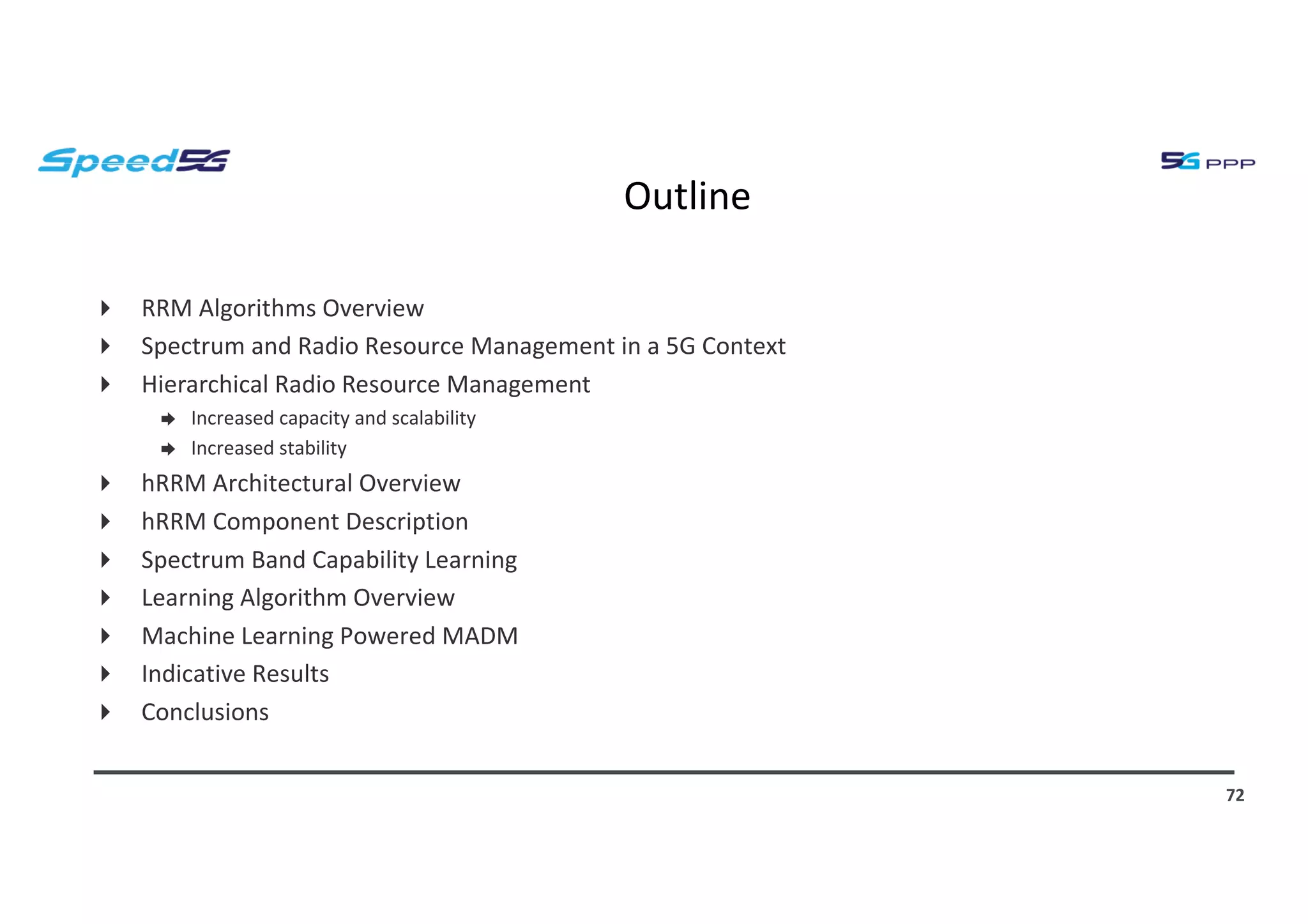
Outline
4 RRM Algorithms Overview
4 Spectrum and Radio Resource Management in a 5G Context
4 Hierarchical Radio Resource Management
➨ Increased capacity and scalability
➨ Increased stability
4 hRRM Architectural Overview
4 hRRM Component Description
4 Spectrum Band Capability Learning
4 Learning Algorithm Overview
4 Machine Learning Powered MADM
4 Indicative Results
4 Conclusions
72
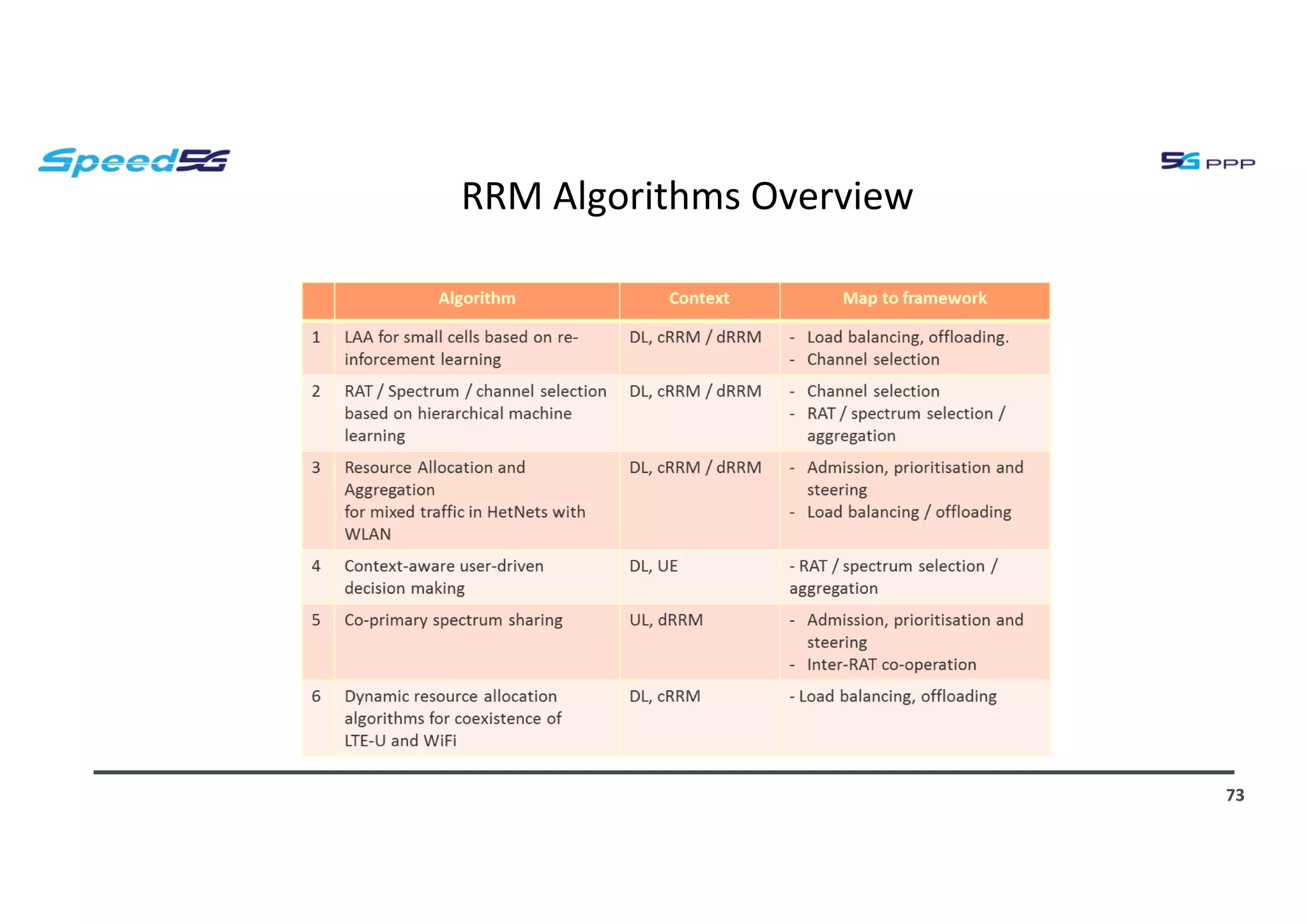
RRM Algorithms Overview
73
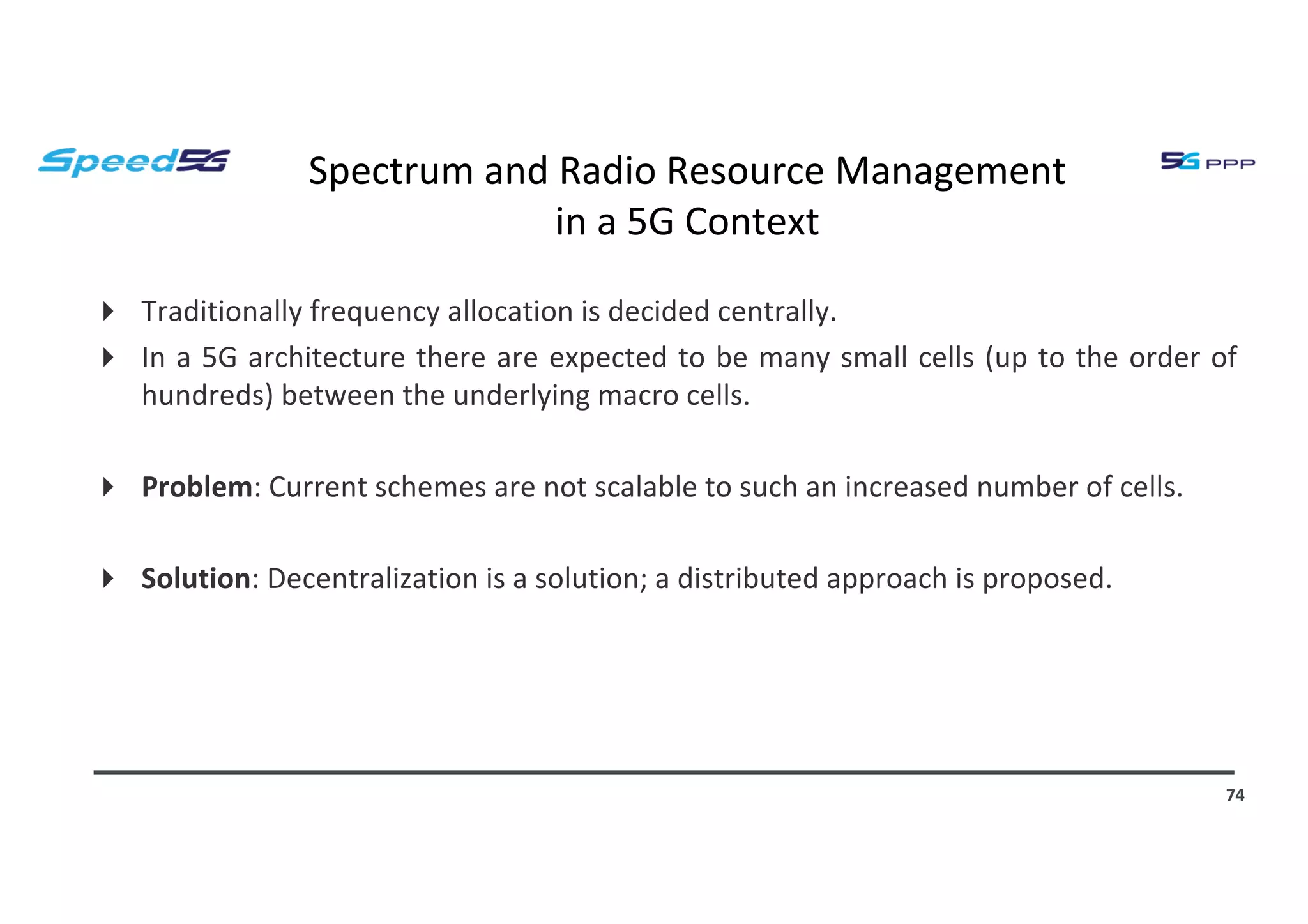
Spectrum and Radio Resource Management
in a 5G Context
4 Traditionally frequency allocation is decided centrally.
4 In a 5G architecture there are expected to be many small cells (up to the order of
hundreds) between the underlying macro cells.
4 Problem: Current schemes are not scalable to such an increased number of cells.
4 Solution: Decentralization is a solution; a distributed approach is proposed.
74
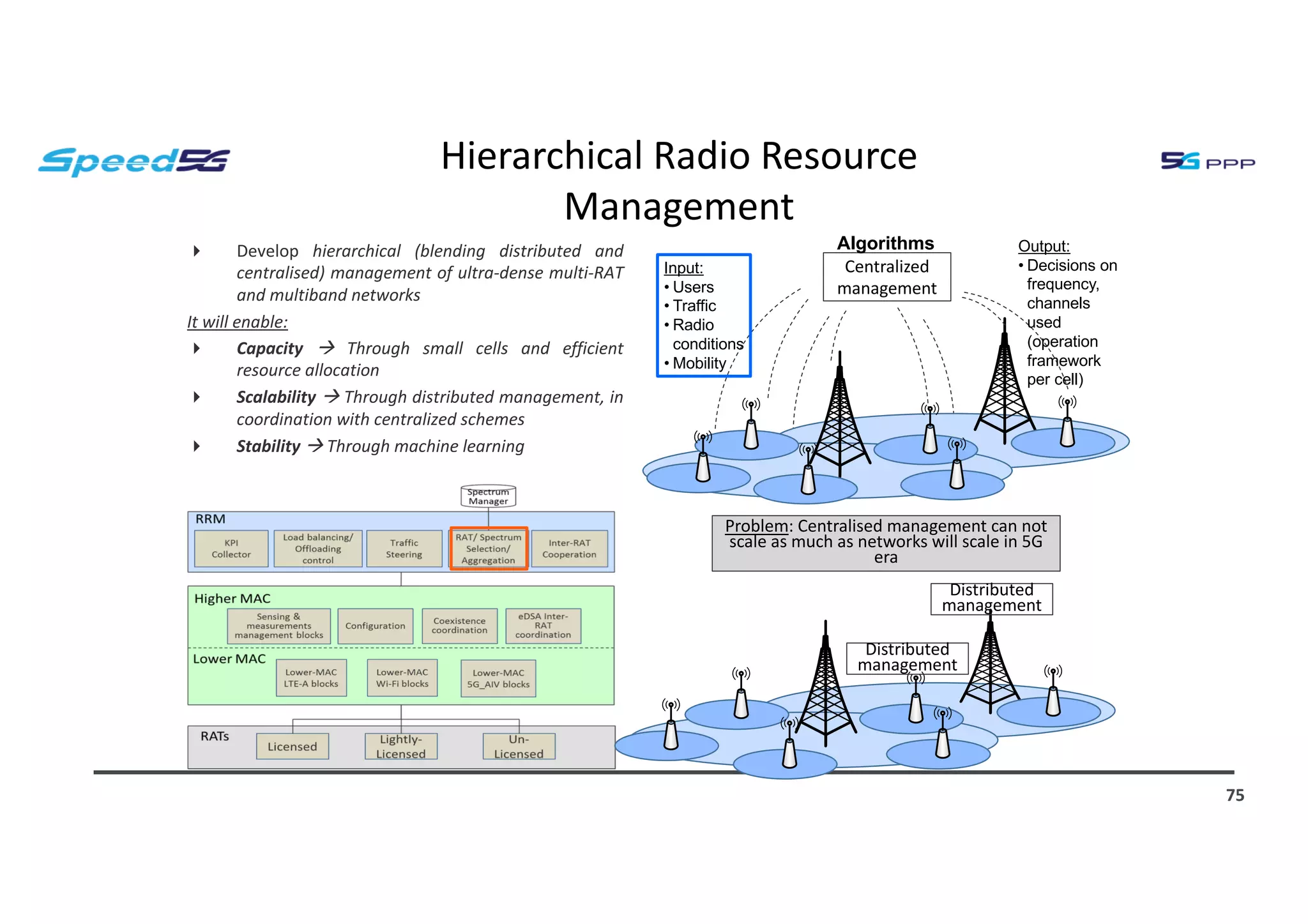
Hierarchical Radio Resource
Management
75
Centralized
management
Input:
• Users
• Traffic
• Radio
conditions
• Mobility
Output:
• Decisions on
frequency,
channels
used
(operation
framework
per cell)
Algorithms
Distributed
management
Distributed
management
4 Develop hierarchical (blending distributed and
centralised) management of ultra-dense multi-RAT
and multiband networks
It will enable:
4 Capacity à Through small cells and efficient
resource allocation
4 Scalability à Through distributed management, in
coordination with centralized schemes
4 Stability à Through machine learning
Problem: Centralised management can not
scale as much as networks will scale in 5G
era
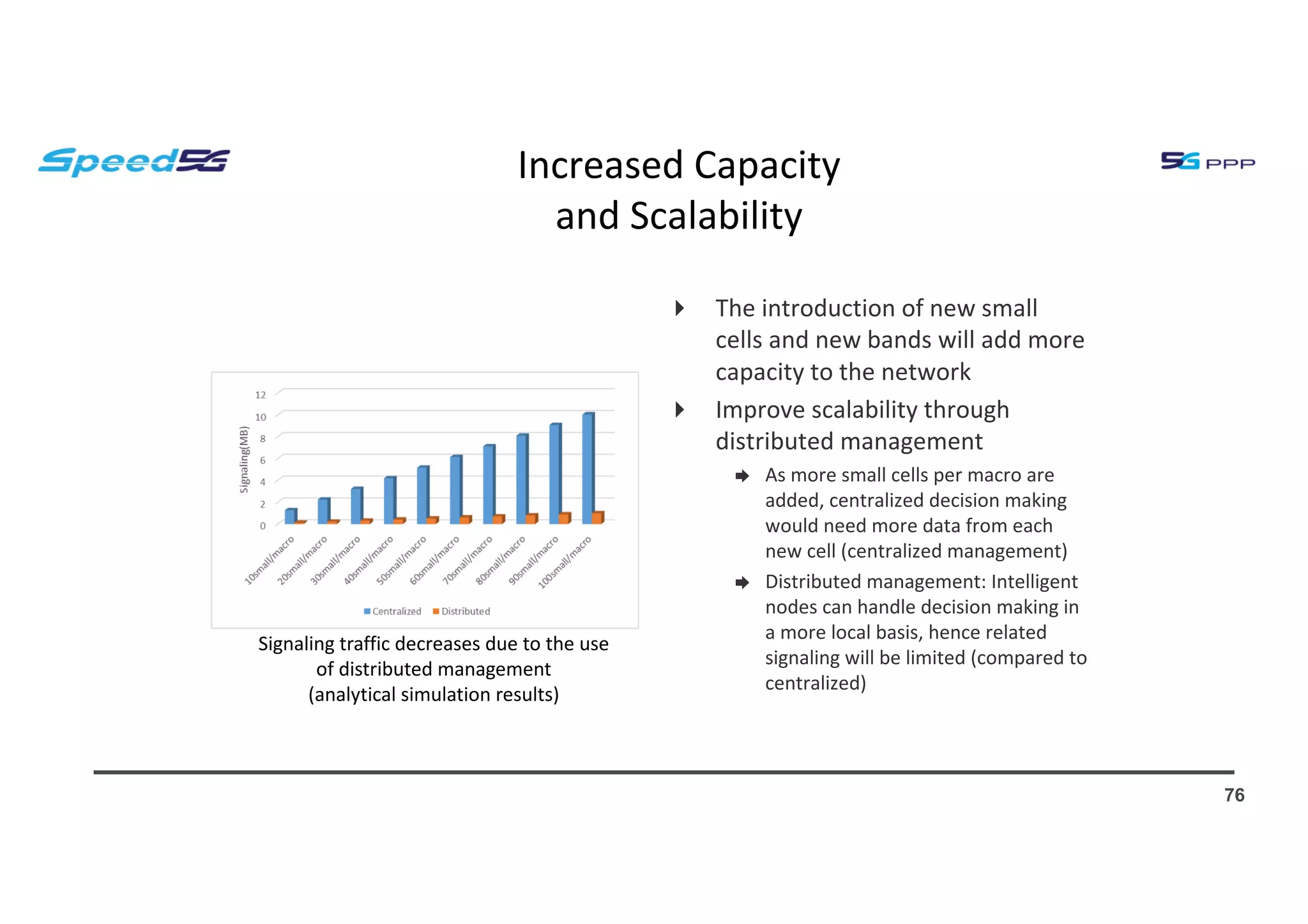
Increased Capacity
and Scalability
4 The introduction of new small
cells and new bands will add more
capacity to the network
4 Improve scalability through
distributed management
➨ As more small cells per macro are
added, centralized decision making
would need more data from each
new cell (centralized management)
➨ Distributed management: Intelligent
nodes can handle decision making in
a more local basis, hence related
signaling will be limited (compared to
centralized)
76
Signaling traffic decreases due to the use
of distributed management
(analytical simulation results)
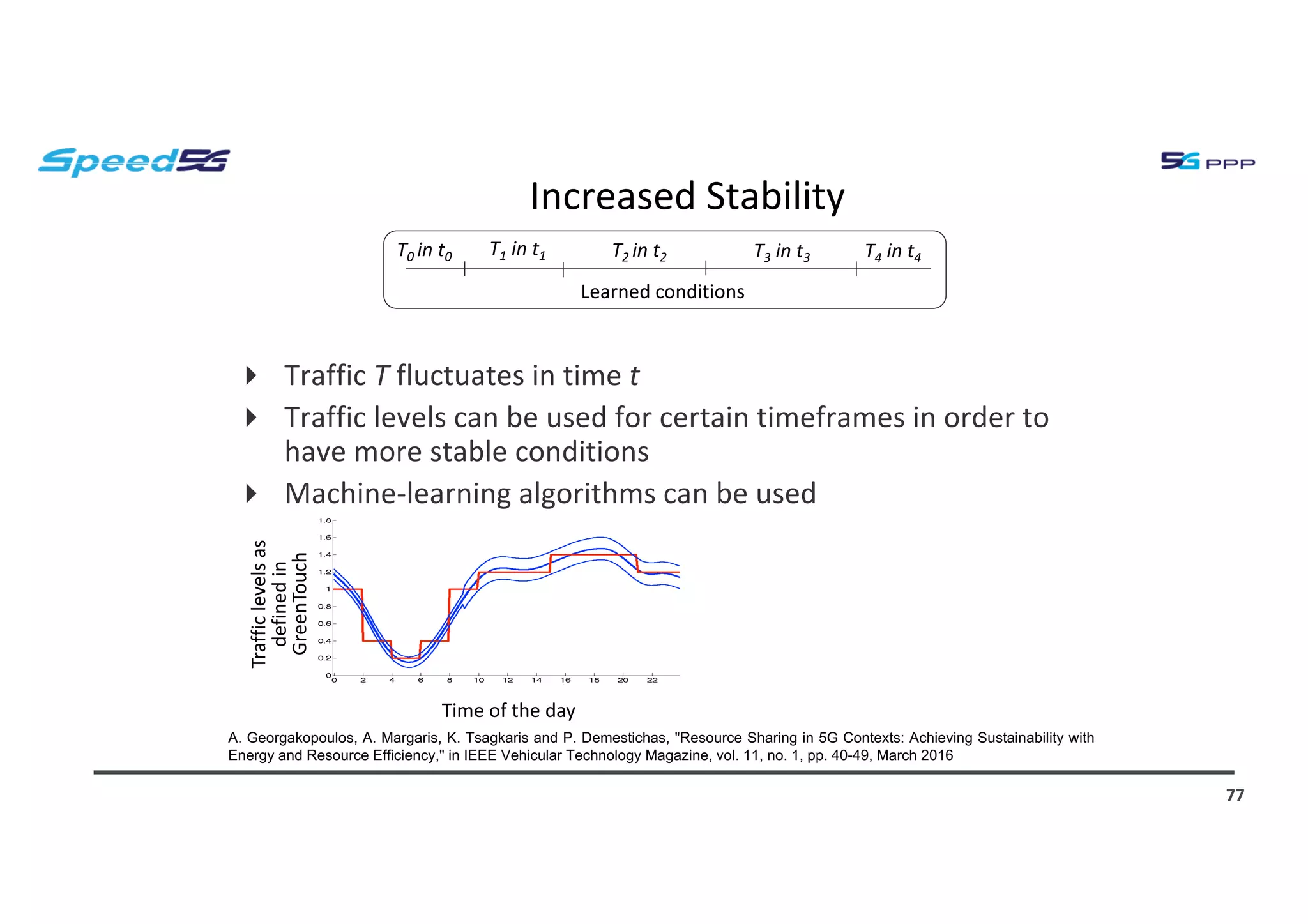
Increased Stability
4 Traffic T fluctuates in time t
4 Traffic levels can be used for certain timeframes in order to
have more stable conditions
4 Machine-learning algorithms can be used
77
Trafficlevelsas
definedin
GreenTouch
A. Georgakopoulos, A. Margaris, K. Tsagkaris and P. Demestichas, "Resource Sharing in 5G Contexts: Achieving Sustainability with
Energy and Resource Efficiency," in IEEE Vehicular Technology Magazine, vol. 11, no. 1, pp. 40-49, March 2016
Learned conditions
T0 in t0 T1 in t1 T2 in t2 T3 in t3 T4 in t4
Time of the day
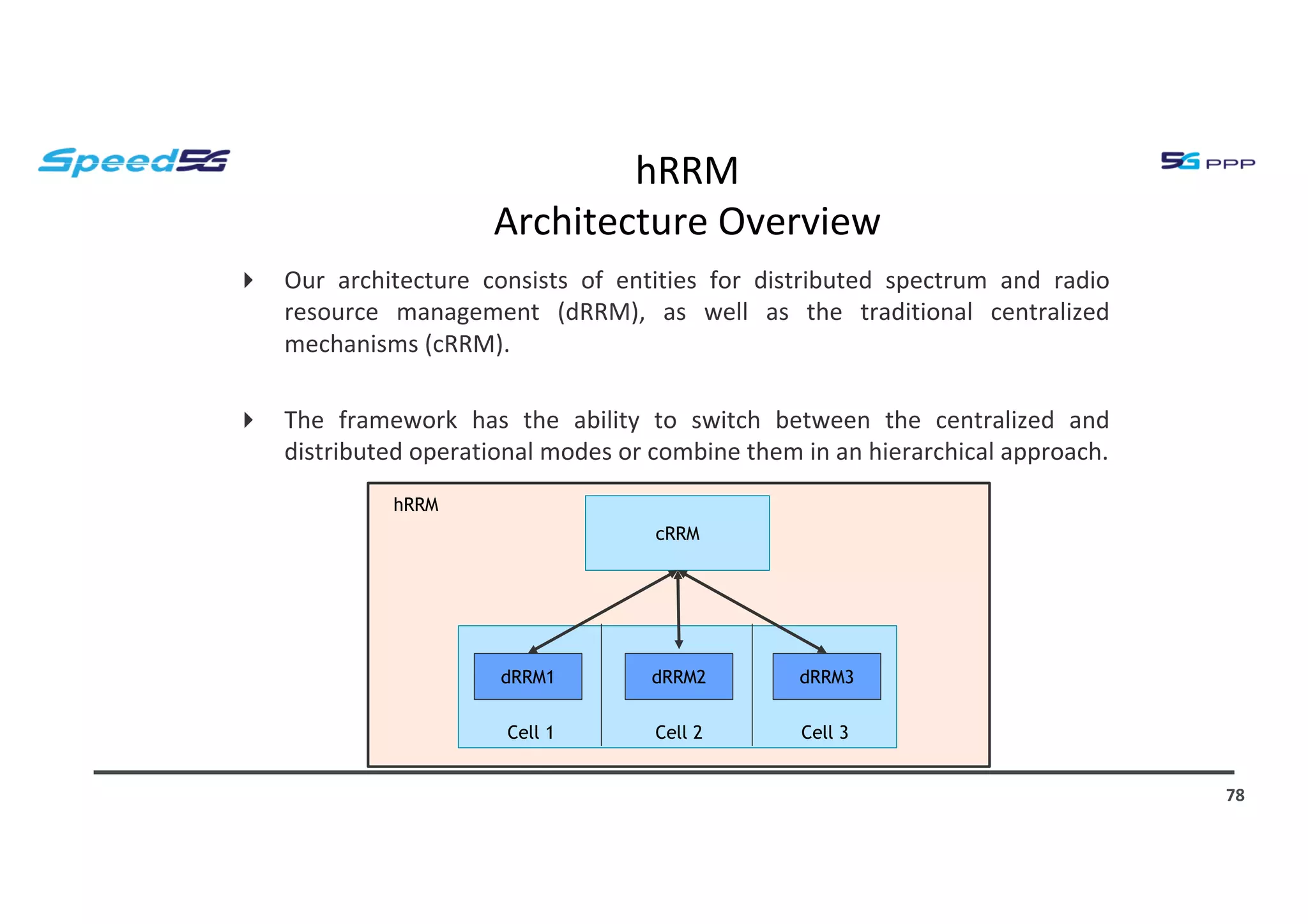
hRRM
Architecture Overview
4 Our architecture consists of entities for distributed spectrum and radio
resource management (dRRM), as well as the traditional centralized
mechanisms (cRRM).
4 The framework has the ability to switch between the centralized and
distributed operational modes or combine them in an hierarchical approach.
78
cRRM
dRRM1 dRRM3dRRM2
Cell 1 Cell 2 Cell 3
hRRM
hRRM
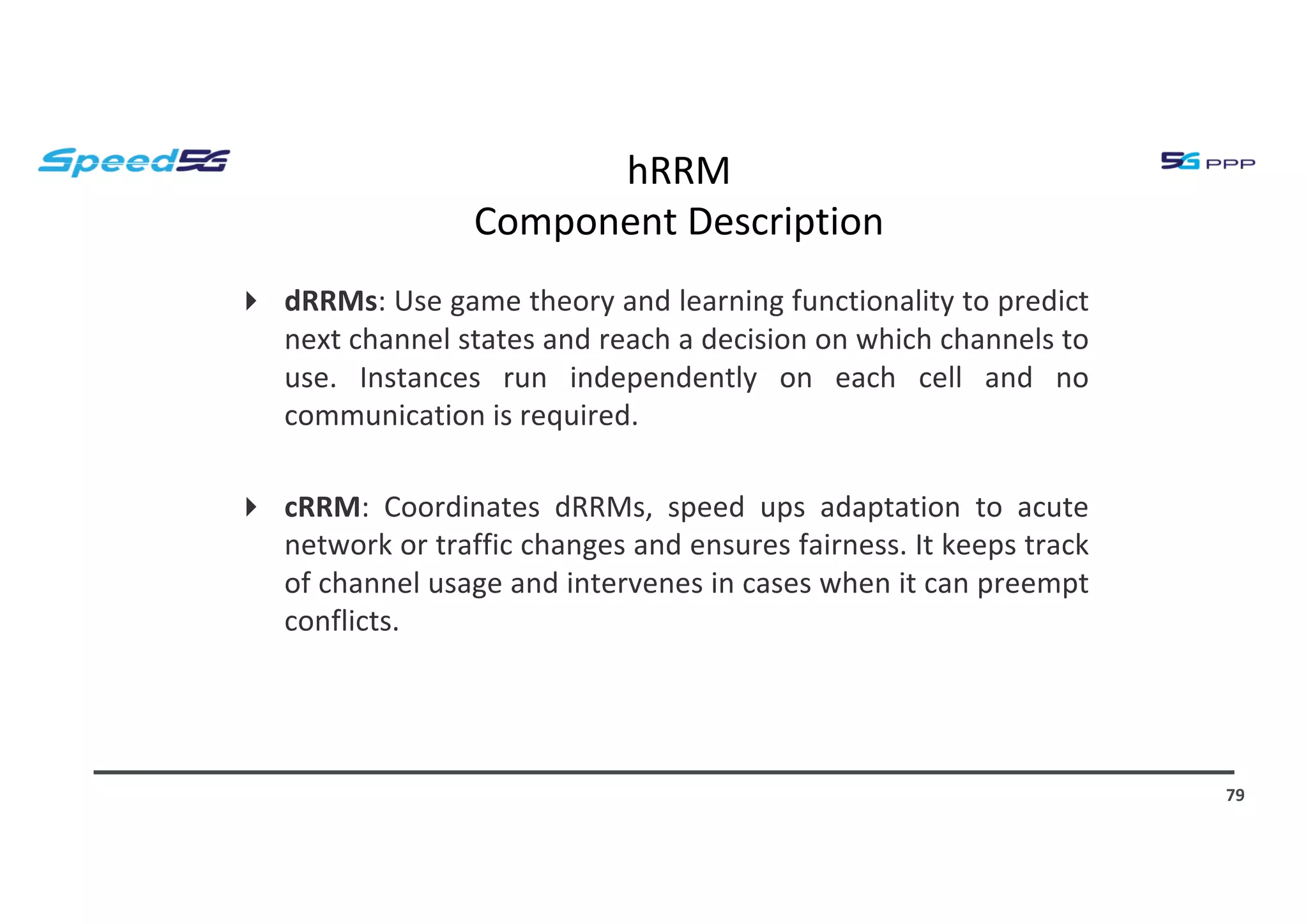
Component Description
4 dRRMs: Use game theory and learning functionality to predict
next channel states and reach a decision on which channels to
use. Instances run independently on each cell and no
communication is required.
4 cRRM: Coordinates dRRMs, speed ups adaptation to acute
network or traffic changes and ensures fairness. It keeps track
of channel usage and intervenes in cases when it can preempt
conflicts.
79
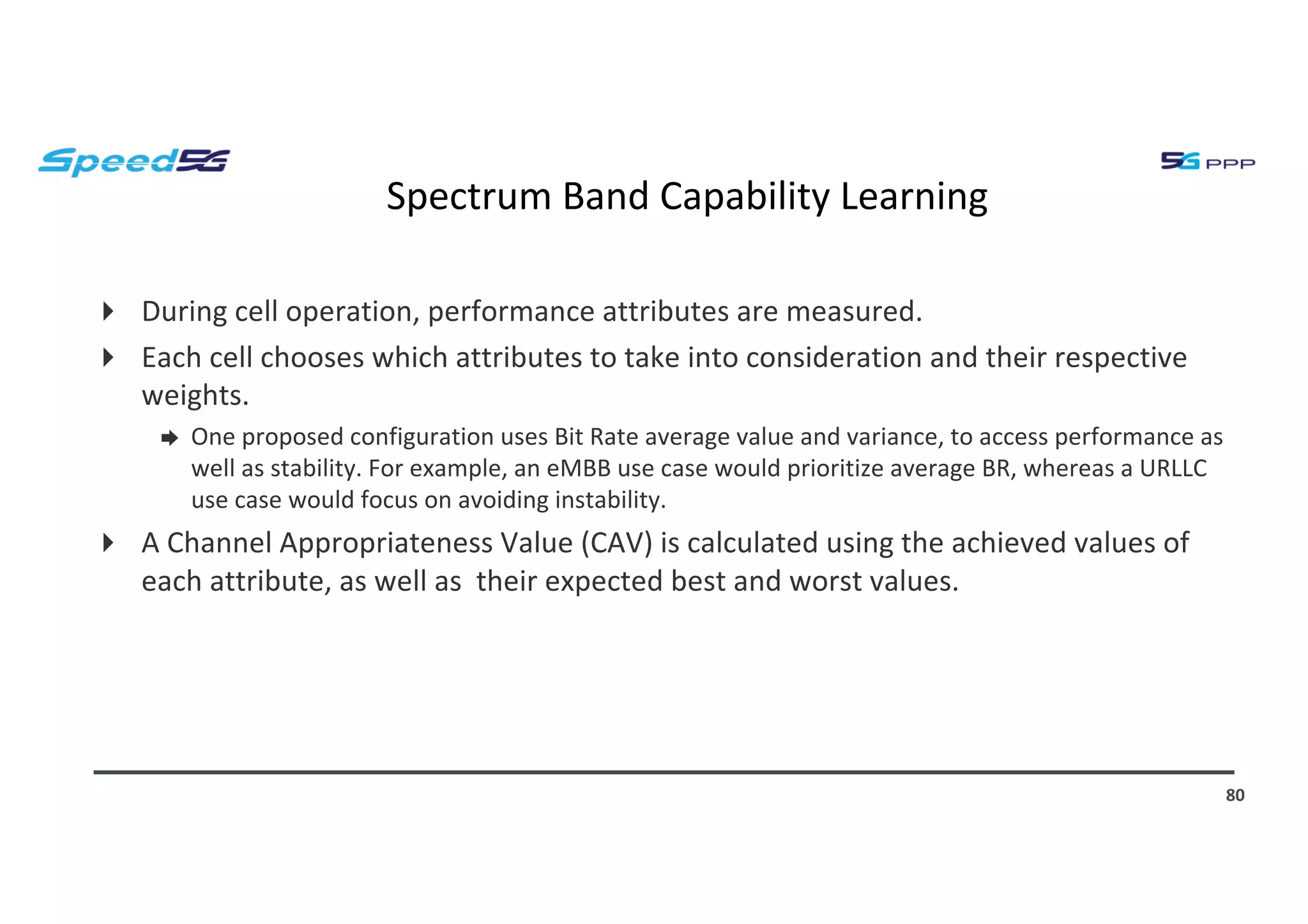
Spectrum Band Capability Learning
4 During cell operation, performance attributes are measured.
4 Each cell chooses which attributes to take into consideration and their respective
weights.
➨ One proposed configuration uses Bit Rate average value and variance, to access performance as
well as stability. For example, an eMBB use case would prioritize average BR, whereas a URLLC
use case would focus on avoiding instability.
4 A Channel Appropriateness Value (CAV) is calculated using the achieved values of
each attribute, as well as their expected best and worst values.
80
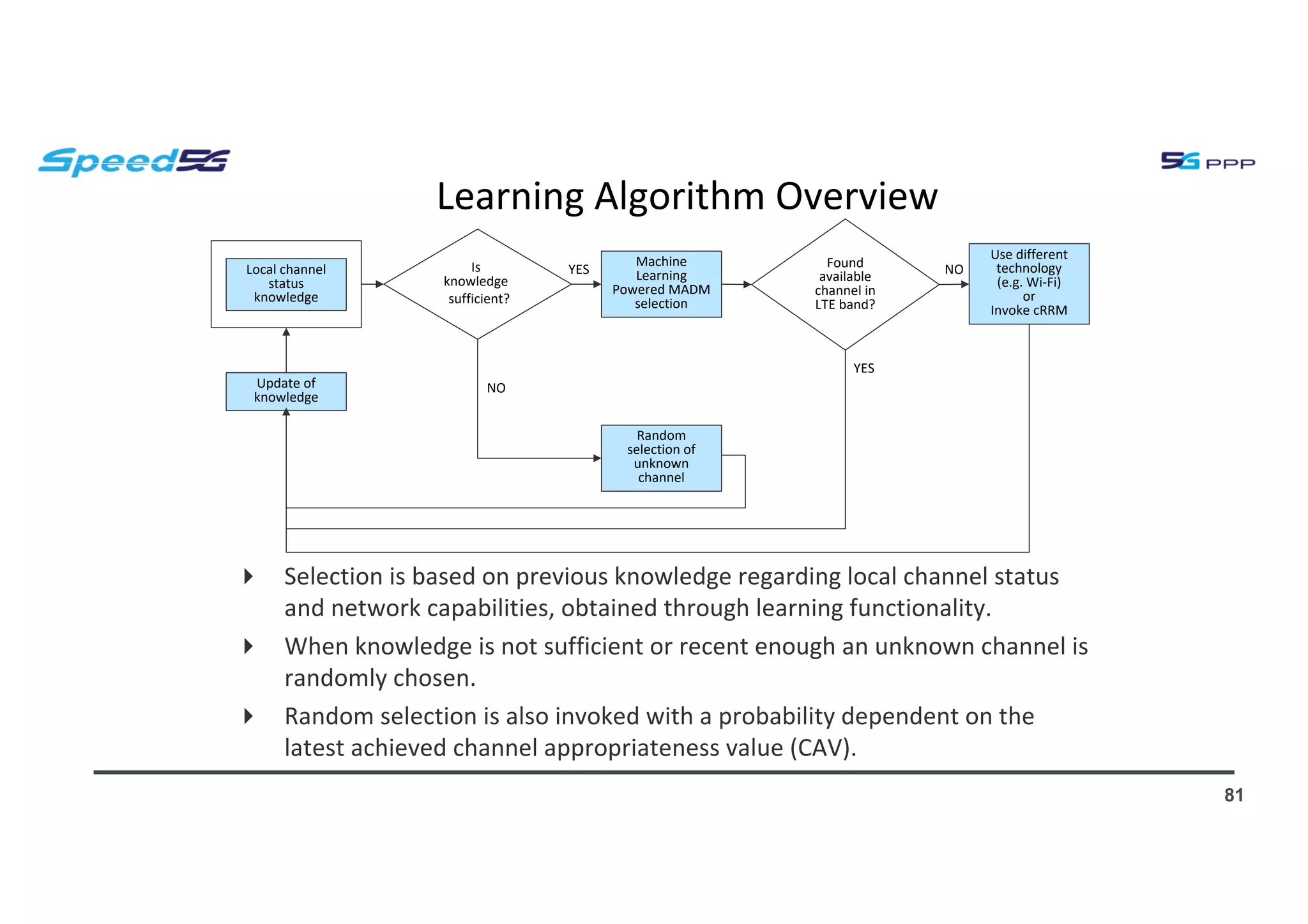
Learning Algorithm Overview
81
Is
knowledge
sufficient?
Local channel
status
knowledge
Random
selection of
unknown
channel
Machine
Learning
Powered MADM
selection
Found
available
channel in
LTE band?
Update of
knowledge
YES
YES
NO
NO
4 Selection is based on previous knowledge regarding local channel status
and network capabilities, obtained through learning functionality.
4 When knowledge is not sufficient or recent enough an unknown channel is
randomly chosen.
4 Random selection is also invoked with a probability dependent on the
latest achieved channel appropriateness value (CAV).
Use different
technology
(e.g. Wi-Fi)
or
Invoke cRRM
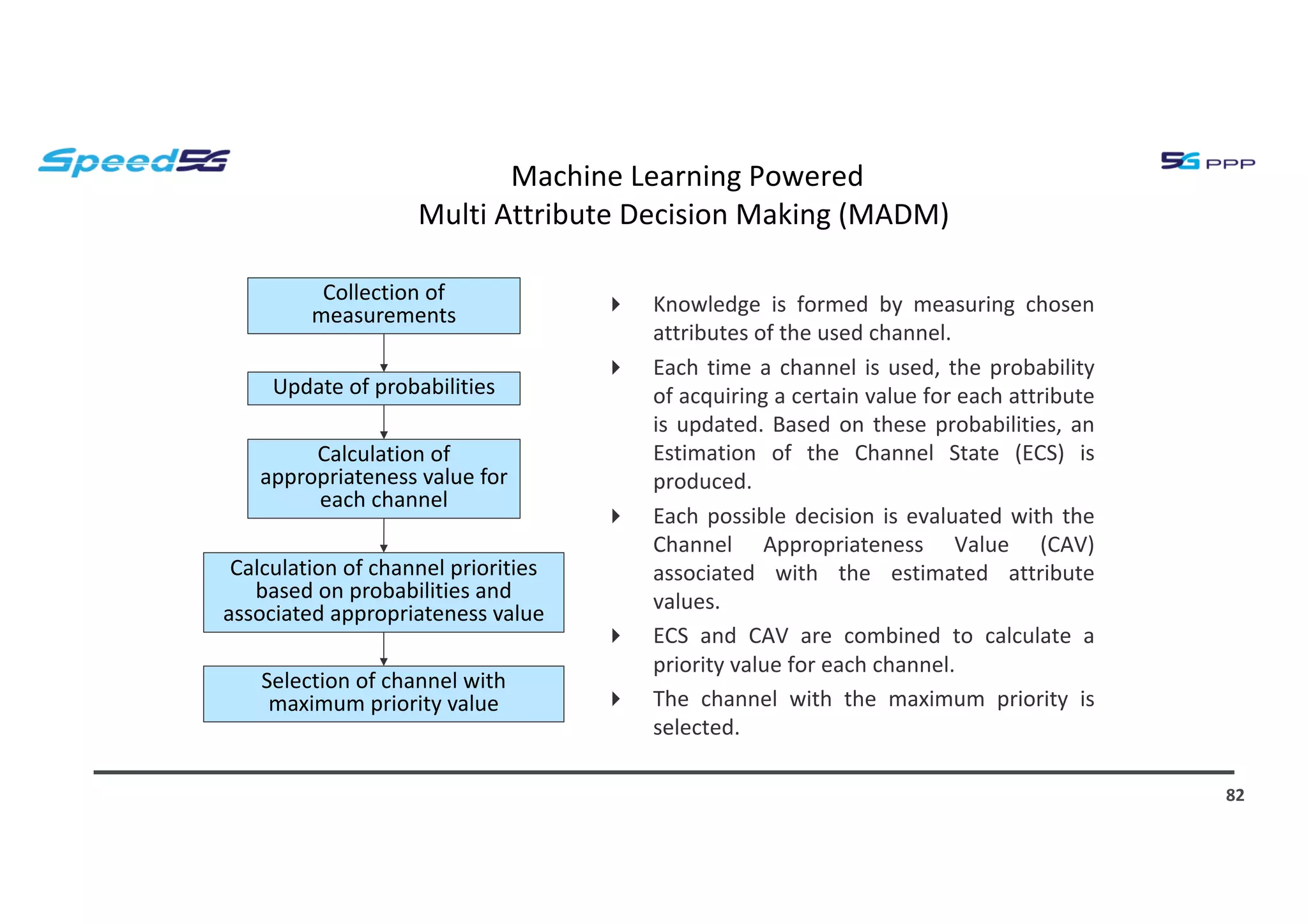
Machine Learning Powered
Multi Attribute Decision Making (MADM)
4 Knowledge is formed by measuring chosen
attributes of the used channel.
4 Each time a channel is used, the probability
of acquiring a certain value for each attribute
is updated. Based on these probabilities, an
Estimation of the Channel State (ECS) is
produced.
4 Each possible decision is evaluated with the
Channel Appropriateness Value (CAV)
associated with the estimated attribute
values.
4 ECS and CAV are combined to calculate a
priority value for each channel.
4 The channel with the maximum priority is
selected.
82
Collection of
measurements
Calculation of channel priorities
based on probabilities and
associated appropriateness value
Selection of channel with
maximum priority value
Update of probabilities
Calculation of
appropriateness value for
each channel
Indicative Results
4 The hRRM algorithm is being
tested in terms of convergence
capability, speed and adaptability
with varying parameters.
4 In the Fig. we can see the
progressive convergence of CAV to
1.0 after algorithm iterations,
assuming 30 cells simultaneously
initiated with zero knowledge.
83
Indicative Results
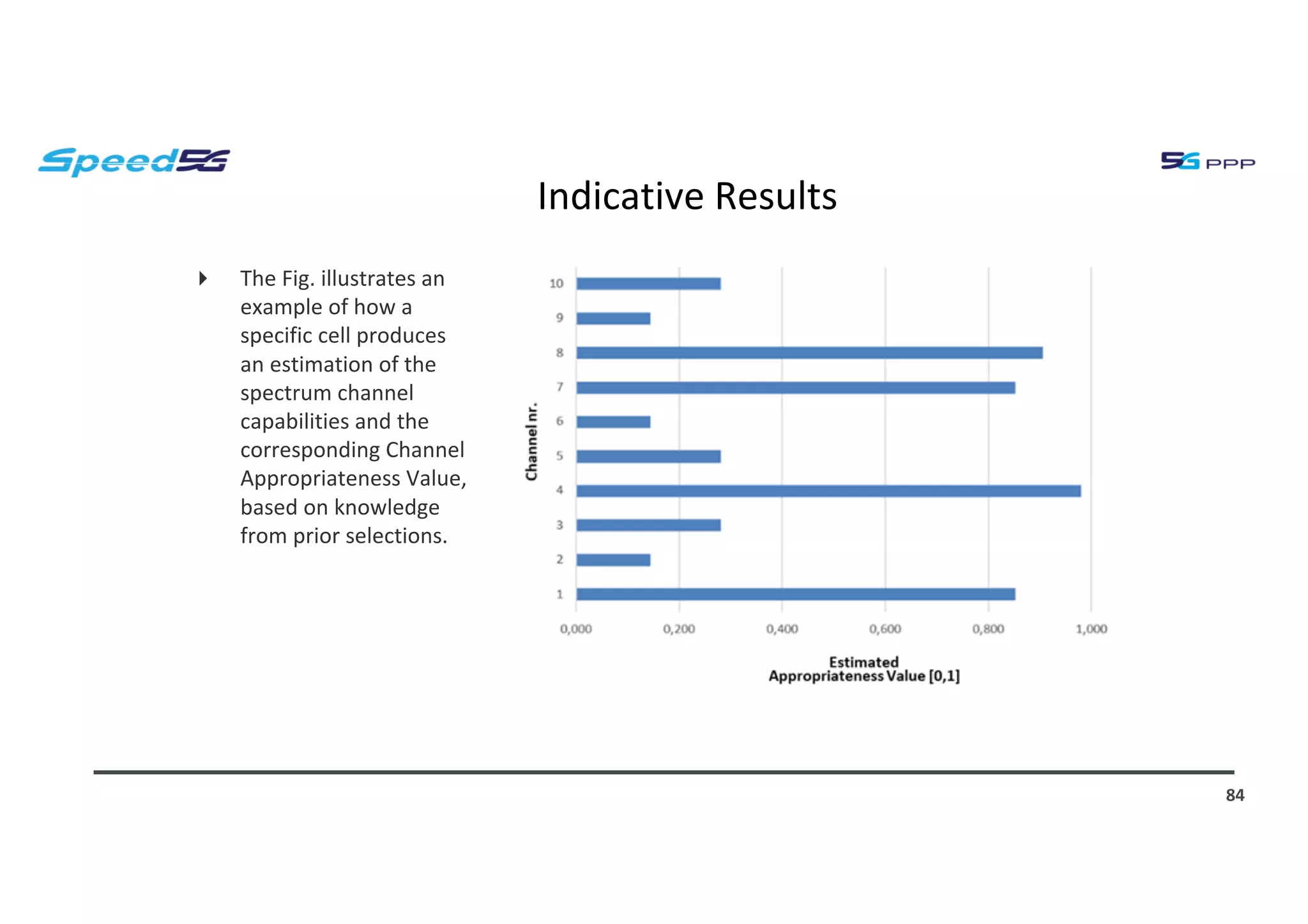
4 The Fig. illustrates an
example of how a
specific cell produces
an estimation of the
spectrum channel
capabilities and the
corresponding Channel
Appropriateness Value,
based on knowledge
from prior selections.
84
Conclusions
4 Capacity
➨ Introduction of new small cells and new bands
➨ Efficient spectrum and radio resource allocation
4 Scalability
➨ Intelligent nodes handling decision making in a local basis
➨ Distributed, learning-based selection
➨ Limited signaling
4 Stability
➨ Adaptation to network or traffic changes
➨ Inter-Cell fairness
85
Thank you for your attention!
86
Acknowledgment:
The research conducted by Speed-5G receives funding from the European Commission H2020 programme under
Grant Agreement N : 671705. The European Commission has no responsibility for the content of this
presentation.
Find us at www.speed-5g.eu

Speed5G Workshop London presentation of the Speed5G RRM framework

  • 1.
    Presenter: Andreas Georgakopoulos SPEED-5GWorkshop Advanced Spectrum Management in 5G+ Networks London, 7th March 2018 RRM Innovations www.speed-5g.eu
  • 2.
    Outline 4 RRM AlgorithmsOverview 4 Spectrum and Radio Resource Management in a 5G Context 4 Hierarchical Radio Resource Management ➨ Increased capacity and scalability ➨ Increased stability 4 hRRM Architectural Overview 4 hRRM Component Description 4 Spectrum Band Capability Learning 4 Learning Algorithm Overview 4 Machine Learning Powered MADM 4 Indicative Results 4 Conclusions 72
  • 3.
  • 4.
    Spectrum and RadioResource Management in a 5G Context 4 Traditionally frequency allocation is decided centrally. 4 In a 5G architecture there are expected to be many small cells (up to the order of hundreds) between the underlying macro cells. 4 Problem: Current schemes are not scalable to such an increased number of cells. 4 Solution: Decentralization is a solution; a distributed approach is proposed. 74
  • 5.
    Hierarchical Radio Resource Management 75 Centralized management Input: •Users • Traffic • Radio conditions • Mobility Output: • Decisions on frequency, channels used (operation framework per cell) Algorithms Distributed management Distributed management 4 Develop hierarchical (blending distributed and centralised) management of ultra-dense multi-RAT and multiband networks It will enable: 4 Capacity à Through small cells and efficient resource allocation 4 Scalability à Through distributed management, in coordination with centralized schemes 4 Stability à Through machine learning Problem: Centralised management can not scale as much as networks will scale in 5G era
  • 6.
    Increased Capacity and Scalability 4The introduction of new small cells and new bands will add more capacity to the network 4 Improve scalability through distributed management ➨ As more small cells per macro are added, centralized decision making would need more data from each new cell (centralized management) ➨ Distributed management: Intelligent nodes can handle decision making in a more local basis, hence related signaling will be limited (compared to centralized) 76 Signaling traffic decreases due to the use of distributed management (analytical simulation results)
  • 7.
    Increased Stability 4 TrafficT fluctuates in time t 4 Traffic levels can be used for certain timeframes in order to have more stable conditions 4 Machine-learning algorithms can be used 77 Trafficlevelsas definedin GreenTouch A. Georgakopoulos, A. Margaris, K. Tsagkaris and P. Demestichas, "Resource Sharing in 5G Contexts: Achieving Sustainability with Energy and Resource Efficiency," in IEEE Vehicular Technology Magazine, vol. 11, no. 1, pp. 40-49, March 2016 Learned conditions T0 in t0 T1 in t1 T2 in t2 T3 in t3 T4 in t4 Time of the day
  • 8.
    hRRM Architecture Overview 4 Ourarchitecture consists of entities for distributed spectrum and radio resource management (dRRM), as well as the traditional centralized mechanisms (cRRM). 4 The framework has the ability to switch between the centralized and distributed operational modes or combine them in an hierarchical approach. 78 cRRM dRRM1 dRRM3dRRM2 Cell 1 Cell 2 Cell 3 hRRM
  • 9.
    hRRM Component Description 4 dRRMs:Use game theory and learning functionality to predict next channel states and reach a decision on which channels to use. Instances run independently on each cell and no communication is required. 4 cRRM: Coordinates dRRMs, speed ups adaptation to acute network or traffic changes and ensures fairness. It keeps track of channel usage and intervenes in cases when it can preempt conflicts. 79
  • 10.
    Spectrum Band CapabilityLearning 4 During cell operation, performance attributes are measured. 4 Each cell chooses which attributes to take into consideration and their respective weights. ➨ One proposed configuration uses Bit Rate average value and variance, to access performance as well as stability. For example, an eMBB use case would prioritize average BR, whereas a URLLC use case would focus on avoiding instability. 4 A Channel Appropriateness Value (CAV) is calculated using the achieved values of each attribute, as well as their expected best and worst values. 80
  • 11.
    Learning Algorithm Overview 81 Is knowledge sufficient? Localchannel status knowledge Random selection of unknown channel Machine Learning Powered MADM selection Found available channel in LTE band? Update of knowledge YES YES NO NO 4 Selection is based on previous knowledge regarding local channel status and network capabilities, obtained through learning functionality. 4 When knowledge is not sufficient or recent enough an unknown channel is randomly chosen. 4 Random selection is also invoked with a probability dependent on the latest achieved channel appropriateness value (CAV). Use different technology (e.g. Wi-Fi) or Invoke cRRM
  • 12.
    Machine Learning Powered MultiAttribute Decision Making (MADM) 4 Knowledge is formed by measuring chosen attributes of the used channel. 4 Each time a channel is used, the probability of acquiring a certain value for each attribute is updated. Based on these probabilities, an Estimation of the Channel State (ECS) is produced. 4 Each possible decision is evaluated with the Channel Appropriateness Value (CAV) associated with the estimated attribute values. 4 ECS and CAV are combined to calculate a priority value for each channel. 4 The channel with the maximum priority is selected. 82 Collection of measurements Calculation of channel priorities based on probabilities and associated appropriateness value Selection of channel with maximum priority value Update of probabilities Calculation of appropriateness value for each channel
  • 13.
    Indicative Results 4 ThehRRM algorithm is being tested in terms of convergence capability, speed and adaptability with varying parameters. 4 In the Fig. we can see the progressive convergence of CAV to 1.0 after algorithm iterations, assuming 30 cells simultaneously initiated with zero knowledge. 83
  • 14.
    Indicative Results 4 TheFig. illustrates an example of how a specific cell produces an estimation of the spectrum channel capabilities and the corresponding Channel Appropriateness Value, based on knowledge from prior selections. 84
  • 15.
    Conclusions 4 Capacity ➨ Introductionof new small cells and new bands ➨ Efficient spectrum and radio resource allocation 4 Scalability ➨ Intelligent nodes handling decision making in a local basis ➨ Distributed, learning-based selection ➨ Limited signaling 4 Stability ➨ Adaptation to network or traffic changes ➨ Inter-Cell fairness 85
  • 16.
    Thank you foryour attention! 86 Acknowledgment: The research conducted by Speed-5G receives funding from the European Commission H2020 programme under Grant Agreement N : 671705. The European Commission has no responsibility for the content of this presentation. Find us at www.speed-5g.eu