Rhetorical Devices and Structure
 Communicating an idea to an audience
SPEAKER
 Informative
 Informative
 Demonstrative
 Informative
 Demonstrative
 Persuasive
 Informative
 Demonstrative
 Persuasive
 Entertaining
 Rhetoric—the art of effective persuasive
speaking
 Rhetoric—the art of effective persuasive
speaking
 Rhetorical Triangle
 Rhetoric—the art of effective persuasive
speaking
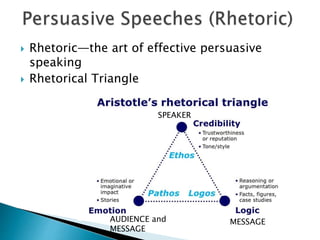
 Rhetorical Triangle
SPEAKER
MESSAGEAUDIENCE and
MESSAGE
 Parallelism
 Parallelism
 Repetition
 Parallelism
 Repetition
 Rhetorical Question
 Parallelism
 Repetition
 Rhetorical Question
 Analogy
 Parallelism
 Repetition
 Rhetorical Question
 Analogy
 Hyperbole
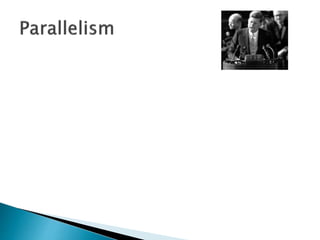
 Figure of balance identified by
successive words, phrases,
clauses with the same or very
similar grammatical structure.
 "Let every nation know, whether
it wishes us well or ill, that we
shall pay any price, bear any
burden, meet any
hardship, support any
friend, oppose any foe to assure
the survival and the success of
liberty.“
-- John F. Kennedy, Inaugural Address
 "Let every nation know, whether
it wishes us well or ill, that we
shall pay any price, bear any
burden, meet any
hardship, support any
friend, oppose any foe to assure
the survival and the success of
liberty.“
-- John F. Kennedy, Inaugural Address
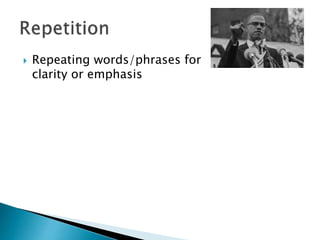
 Repeating words/phrases for
clarity or emphasis
 "I said you're afraid to bleed. [As]
long as the white man sent you
to Korea, you bled. He sent you
to Germany, you bled. He sent
you to the South Pacific to fight
the Japanese, you bled. You
bleed for white people. But when
it comes time to seeing your own
churches being bombed and
little black girls be[ing]
murdered, you haven't got no
blood."
-- Malcolm X, Message to the Grassroots
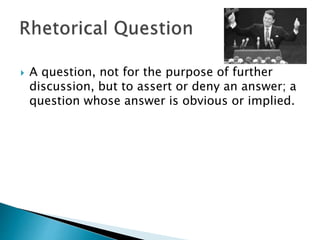
 A question, not for the purpose of further
discussion, but to assert or deny an answer; a
question whose answer is obvious or implied.
 A question, not for the purpose of further
discussion, but to assert or deny an answer; a
question whose answer is obvious or implied.
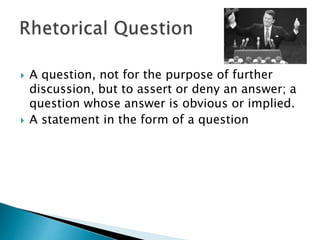
 A statement in the form of a question
 A question, not for the purpose of further
discussion, but to assert or deny an answer; a
question whose answer is obvious or implied.
 A statement in the form of a question
 A question posed which causes the audience
to agree with the speaker
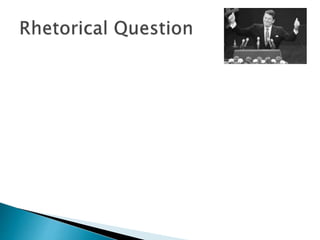
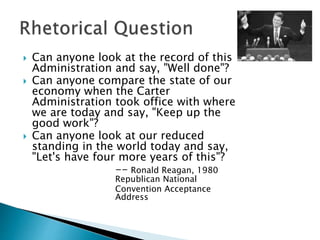
 Can anyone look at the record of this
Administration and say, "Well done"?
 Can anyone compare the state of our
economy when the Carter
Administration took office with where
we are today and say, "Keep up the
good work"?
 Can anyone look at our reduced
standing in the world today and say,
"Let's have four more years of this"?
-- Ronald Reagan, 1980
Republican National
Convention Acceptance
Address
 An extended metaphor or long
simile in which an explicit
comparison is made between two
things for the purpose of furthering
a line of reasoning or drawing an
inference
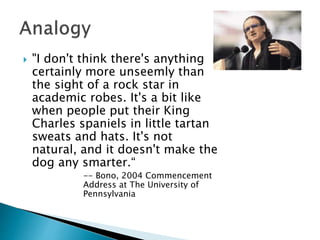
 "I don't think there's anything
certainly more unseemly than
the sight of a rock star in
academic robes. It's a bit like
when people put their King
Charles spaniels in little tartan
sweats and hats. It's not
natural, and it doesn't make the
dog any smarter.“
-- Bono, 2004 Commencement
Address at The University of
Pennsylvania
 deliberate exaggeration of
a person, thing, quality,
event to emphasize a point
external to the object of
exaggeration; intentional
exaggeration for rhetorical
effect.
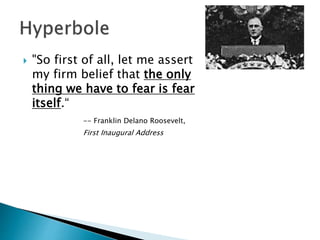
 "So first of all, let me assert
my firm belief that the only
thing we have to fear is fear
itself.“
-- Franklin Delano Roosevelt,
First Inaugural Address
 "I've tried to offer leadership to the
Democratic Party and the Nation. If, in my
high moments, I have done some
good, offered some service, shed some
light, healed some wounds, rekindled some
hope, or stirred someone from apathy and
indifference, or in any way along the way
helped somebody, then this campaign has
not been in vain."
 "My senior year, I received a telephone call
from a gentleman by the name of Mr. Gil
Brandt of the Dallas Cowboys. And he stated
that the Cowboys was interested in drafting
me, and I couldn't ignore it. I decided to
attend the Cowboys training camp. That year,
1967, the Dallas Cowboys had 137 rookies in
training camp. Gil Brandt was signing
everybody that could walk. Only five made
the team that year, and I was one of the five."
 "Withdrawal of U.S. troops will become like
salted peanuts to the American public; the
more U.S. troops come home, the more will
be demanded."
 "The minister who has been called by God,
ordained by God, appointed by God, and
anointed by God, is assumed guilty until
proven innocent."
 "Some have asked, 'How could you have the
United States Senate vote on Judge Thomas'
nomination and leave Senators in the dark
about Professor [Anita] Hill's charges?' And to
this I answer, 'How can you expect us to have
forced Professor Hill against her will into the
blinding light which you see here today."

Speeches and-rhetoric

  • 1.
  • 3.
     Communicating anidea to an audience SPEAKER
  • 4.
  • 5.
  • 6.
  • 7.
     Informative  Demonstrative Persuasive  Entertaining
  • 9.
     Rhetoric—the artof effective persuasive speaking
  • 10.
     Rhetoric—the artof effective persuasive speaking  Rhetorical Triangle
  • 11.
     Rhetoric—the artof effective persuasive speaking  Rhetorical Triangle SPEAKER MESSAGEAUDIENCE and MESSAGE
  • 12.
  • 13.
  • 14.
  • 15.
     Parallelism  Repetition Rhetorical Question  Analogy
  • 16.
     Parallelism  Repetition Rhetorical Question  Analogy  Hyperbole
  • 18.
     Figure ofbalance identified by successive words, phrases, clauses with the same or very similar grammatical structure.
  • 19.
     "Let everynation know, whether it wishes us well or ill, that we shall pay any price, bear any burden, meet any hardship, support any friend, oppose any foe to assure the survival and the success of liberty.“ -- John F. Kennedy, Inaugural Address
  • 20.
     "Let everynation know, whether it wishes us well or ill, that we shall pay any price, bear any burden, meet any hardship, support any friend, oppose any foe to assure the survival and the success of liberty.“ -- John F. Kennedy, Inaugural Address
  • 22.
     Repeating words/phrasesfor clarity or emphasis
  • 23.
     "I saidyou're afraid to bleed. [As] long as the white man sent you to Korea, you bled. He sent you to Germany, you bled. He sent you to the South Pacific to fight the Japanese, you bled. You bleed for white people. But when it comes time to seeing your own churches being bombed and little black girls be[ing] murdered, you haven't got no blood." -- Malcolm X, Message to the Grassroots
  • 25.
     A question,not for the purpose of further discussion, but to assert or deny an answer; a question whose answer is obvious or implied.
  • 26.
     A question,not for the purpose of further discussion, but to assert or deny an answer; a question whose answer is obvious or implied.  A statement in the form of a question
  • 27.
     A question,not for the purpose of further discussion, but to assert or deny an answer; a question whose answer is obvious or implied.  A statement in the form of a question  A question posed which causes the audience to agree with the speaker
  • 28.
     Can anyonelook at the record of this Administration and say, "Well done"?  Can anyone compare the state of our economy when the Carter Administration took office with where we are today and say, "Keep up the good work"?  Can anyone look at our reduced standing in the world today and say, "Let's have four more years of this"? -- Ronald Reagan, 1980 Republican National Convention Acceptance Address
  • 30.
     An extendedmetaphor or long simile in which an explicit comparison is made between two things for the purpose of furthering a line of reasoning or drawing an inference
  • 31.
     "I don'tthink there's anything certainly more unseemly than the sight of a rock star in academic robes. It's a bit like when people put their King Charles spaniels in little tartan sweats and hats. It's not natural, and it doesn't make the dog any smarter.“ -- Bono, 2004 Commencement Address at The University of Pennsylvania
  • 33.
     deliberate exaggerationof a person, thing, quality, event to emphasize a point external to the object of exaggeration; intentional exaggeration for rhetorical effect.
  • 34.
     "So firstof all, let me assert my firm belief that the only thing we have to fear is fear itself.“ -- Franklin Delano Roosevelt, First Inaugural Address
  • 35.
     "I've triedto offer leadership to the Democratic Party and the Nation. If, in my high moments, I have done some good, offered some service, shed some light, healed some wounds, rekindled some hope, or stirred someone from apathy and indifference, or in any way along the way helped somebody, then this campaign has not been in vain."
  • 36.
     "My senioryear, I received a telephone call from a gentleman by the name of Mr. Gil Brandt of the Dallas Cowboys. And he stated that the Cowboys was interested in drafting me, and I couldn't ignore it. I decided to attend the Cowboys training camp. That year, 1967, the Dallas Cowboys had 137 rookies in training camp. Gil Brandt was signing everybody that could walk. Only five made the team that year, and I was one of the five."
  • 37.
     "Withdrawal ofU.S. troops will become like salted peanuts to the American public; the more U.S. troops come home, the more will be demanded."
  • 38.
     "The ministerwho has been called by God, ordained by God, appointed by God, and anointed by God, is assumed guilty until proven innocent."
  • 39.
     "Some haveasked, 'How could you have the United States Senate vote on Judge Thomas' nomination and leave Senators in the dark about Professor [Anita] Hill's charges?' And to this I answer, 'How can you expect us to have forced Professor Hill against her will into the blinding light which you see here today."

Editor's Notes

  • #5 An informative speech simply conveys information to an audience
  • #6 A demonstrative speech occurs when the speaker demonstrates how to do something.
  • #7 A persuasive speech occurs when a speaker attempts to persuade the audience to believe as he/she does.
  • #8 The speaker gives a speech in order to entertain an audience.
  • #9 A persuasive speech contains and argument (an opinion supported by reasons).
  • #12 Every communication is essentially a trilateral relationship.  Each point of the triangle influences the others, and all are influenced by the context of the communication.  Each point of the triangle bears some responsibility for the success of the communication, The word ethical comes from the Greek, ethos. Ethos means credibility/believability. It relates to the speaker. Is the speaker trustworthy? Does the speaker have a good reputation? What is his/her tone or style of delivery? The word logical comes from the Greek, logos. It relates to the message of the speech. Does the speaker use sound reasoning to present his/her argument? Does the speaker support his/her argument with facts, figures, and logical information? The words sympathy and empathy come from the Greek, pathos. It relates to both the message and the audience. Does the message have an emotional impact? Does the message contain stories/info that evoke emotion? How does the audience feel during/after the speech? Are they changed?
  • #24 Malcolm X believed that during the Civil Rights Movement, African Americans should defend themselves with any means necessary. He scoffed at Dr. King’s peaceful approach to Civil Rights. Knowing his belief, why does he repeat “you bled” in this passage? Why does he emphasize this?
  • #29 Jimmy Carter was President before Ronald Reagan. During his administration the economy was terrible. Inflation went up to 18% and the unemployment rate rose. Gas prices skyrocketed as well. In addition, several Americans were taken hostage in Iran during his administration. (They were released the day he left the White House.) Based on this knowledge, what is the obvious answer to Reagan’s question? What will Reagan discuss in this speech?
  • #32 What two things are being compared in this analogy? What does this comparison mean?
  • #35 Why is this an exaggeration?
  • #36 On the next slides, number from 1 to 5 and write which type of rhetorical device is shown in the passage.