Introducin
g
As againstdyadic communication (i.e., one to one) and mass
communication (i.e., one to many), group communication implies a
many-to-many communication.
It is both a technique and an art and a comprehensive tool to judge
the worthiness of the student and his appropriateness for the job.
Group Discussion
Purpose
Share andexchange information and ideas.
To prepare you for the future and make you well informed.
If you need to disagree, then doing so in a graceful manner.
Attacking issues not people.
Carefully listen to other people's points and try to refine your own
by using other people's inputs on the subject.
Arrive at a decision on important issues.
Solve a problem concerning the organization as a whole.
Elicit feedback upon any work undertaken or research performed.
7.
Types of
GD
GDcan be Topic based or Case based.
Topic based group discussion can be of three types:
Factual topics
Controversial topics
Abstract topics
8.
Factual
Topics
Factual topicsare about practical things, which an ordinary
person is aware of in his day to day life
Typically they are socio- economic topics. These can be the
current topics.
Such topics gives a candidate a chance to prove that she is
aware of and sensitive to her environment.
9.
Controversi
al Topics
Theyare the ones that are argumentative in nature. They are
meant to generate controversy.
In GDs where such topics are given for discussion the noise
and temper is usually high.
The idea behind giving such topic is likely to see how much
maturity the candidate is displaying by keeping his temper in
check.
10.
Abstract
Topics
Abstract topicsare about intangible things.
These topics are used to check your lateral thinking and
creativity.
i.e: the number 10
Joy
Color red
11.
Case Based
GD
Anothervariation of GD is the use of case instead of a topic”
The case study tries to simulate a real life situation .
Information about the situation will be given to you and you
would be asked as a group to resolve the situation.
In case study there are no incorrect answers or perfect
solutions.
The objective is to get you think about the situation from
various angles.
12.
Preparatio
n for GD
GD reflects the inherent qualities of an individual .
Reading: This is the first and the most crucial step in preparation.
Mocks: Create an informal GD group and meet regularly to discuss
and exchange feedback.
13.
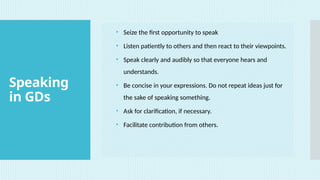
Speaking
in GDs
• Seizethe first opportunity to speak
• Listen patiently to others and then react to their viewpoints.
• Speak clearly and audibly so that everyone hears and
understands.
• Be concise in your expressions. Do not repeat ideas just for
the sake of speaking something.
• Ask for clarification, if necessary.
• Facilitate contribution from others.
14.
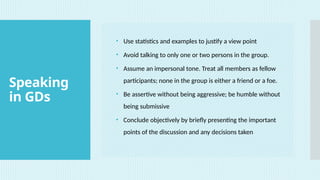
Speaking
in GDs
• Usestatistics and examples to justify a view point
• Avoid talking to only one or two persons in the group.
• Assume an impersonal tone. Treat all members as fellow
participants; none in the group is either a friend or a foe.
• Be assertive without being aggressive; be humble without
being submissive
• Conclude objectively by briefly presenting the important
points of the discussion and any decisions taken
15.
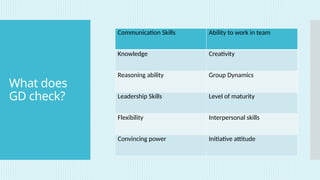
What does
GD check?
CommunicationSkills Ability to work in team
Knowledge Creativity
Reasoning ability Group Dynamics
Leadership Skills Level of maturity
Flexibility Interpersonal skills
Convincing power Initiative attitude
16.
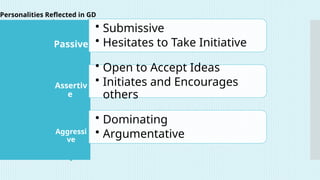
Passive
• Submissive
• Hesitatesto Take Initiative
Assertiv
e
• Open to Accept Ideas
• Initiates and Encourages
others
Aggressi
ve
• Dominating
• Argumentative
Personalities Reflected in GD
17.
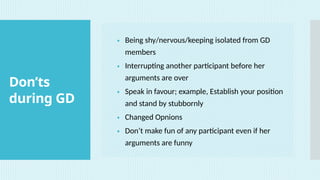
Don’ts
during GD
• Beingshy/nervous/keeping isolated from GD
members
• Interrupting another participant before her
arguments are over
• Speak in favour; example, Establish your position
and stand by stubbornly
• Changed Opnions
• Don’t make fun of any participant even if her
arguments are funny
18.
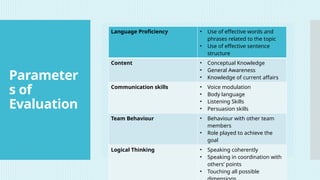
Parameter
s of
Evaluation
Language Proficiency• Use of effective words and
phrases related to the topic
• Use of effective sentence
structure
Content • Conceptual Knowledge
• General Awareness
• Knowledge of current affairs
Communication skills • Voice modulation
• Body language
• Listening Skills
• Persuasion skills
Team Behaviour • Behaviour with other team
members
• Role played to achieve the
goal
Logical Thinking • Speaking coherently
• Speaking in coordination with
others’ points
• Touching all possible
Few GD
Topics
E-books or printed books: what's your choice?
Government schools Vs private schools
Demonetization– success or publicity
Should politicians have retirement age?
Should capital punishment be legal? Yes or no




![Edge_Based_Segmentation[1].pptx________________](https://cdn.slidesharecdn.com/ss_thumbnails/edgebasedsegmentation1-251223085651-7850345c-thumbnail.jpg?width=640&height=640&fit=bounds)


