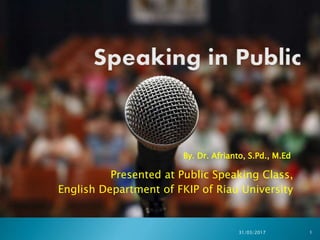
Presented at Public Speaking Class,
English Department of FKIP of Riau University
31/03/2017 1
By. Dr. Afrianto, S.Pd., M.Ed
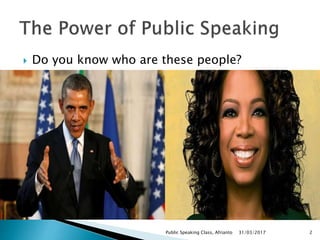
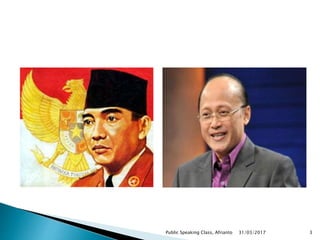
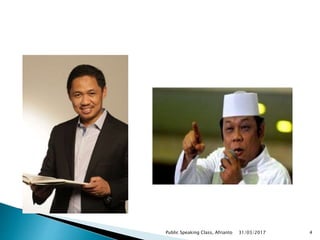
 Do you know who are these people?
31/03/2017Public Speaking Class, Afrianto 2
31/03/2017Public Speaking Class, Afrianto 3
31/03/2017Public Speaking Class, Afrianto 4
 Sucessfull people
 Public figure
 Excellent public speaking skills
31/03/2017Public Speaking Class, Afrianto 5
31/03/2017Public Speaking Class, Afrianto 6
 What are the good things in the speech?
31/03/2017Public Speaking Class, Afrianto 7
A way of making your ideas public, sharing
them with people and of influencing them.
31/03/2017Public Speaking Class, Afrianto 8
‘ I am not going to be a politician, a president,
or any kinds of public figuresw, do I still need
to have a public speaking skill?’
31/03/2017Public Speaking Class, Afrianto 9
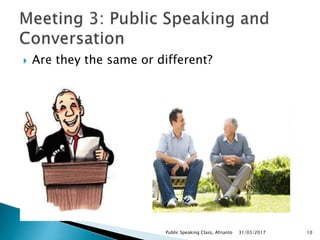
 Are they the same or different?
31/03/2017Public Speaking Class, Afrianto 10
SIMILARITIES BETWEEN PUBLIC SPEAKING
AND CONVERSATION
What happens if
your ideas are
out of
sequence? Will
your audience
understand your
ideas?
 Organize your
thoughts LOGICALLY
31/03/2017Public Speaking Class, Afrianto 11
Can you present
an idea the same
way to your five-
year-old niece as
you can to your
mother? Can you
present that idea
to an audience of
your peers in the
same way as you
did to your
mother?
 Tailor your message to
your AUDIENCE
31/03/2017Public Speaking Class, Afrianto 12
When you tell a story, do you
just give the facts in a dry
way? Or, do you embellish a
bit, adding a touch of drama
to get your point across and
keep them interested?
 Tell a story for MAXIMUM
IMPACT
31/03/2017Public Speaking Class, Afrianto 13
In conversation, when
the person with whom
you are communicating
gives you a look to
indicate she does not
understand your point,
what do you do? You
rephrase what you have
said to add clarity.
You must do the same
thing in public
speaking.
Watch for and adapt to
feedback.
 ADAPT to
listener
feedback
31/03/2017Public Speaking Class, Afrianto 14
DIFFERENCES BETWEEN PUBLIC
SPEAKING AND CONVERSATION
Consider this:
Public Speaking is generally pre-
arranged -- at a pre-arranged time and
place. Conversation can take place
anytime and any place.
 Public Speaking is
more HIGHLY
STRUCTURED
31/03/2017Public Speaking Class, Afrianto 15
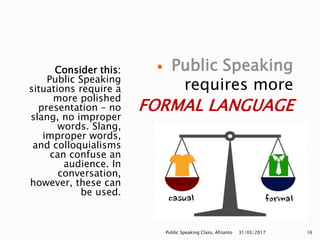
Consider this:
Public Speaking
situations require a
more polished
presentation – no
slang, no improper
words. Slang,
improper words,
and colloquialisms
can confuse an
audience. In
conversation,
however, these can
be used.
 Public Speaking
requires more
FORMAL LANGUAGE
31/03/2017Public Speaking Class, Afrianto 16
Consider this:
Can you hold conversation
while lounging at the pool?
Can you speak publicly
while lounging at the pool?
What about while jogging?
 Public Speaking
requires a
DIFFERENT
METHOD OF
DELIVERY
31/03/2017Public Speaking Class, Afrianto 17
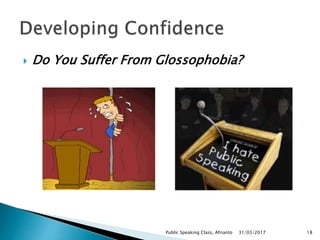
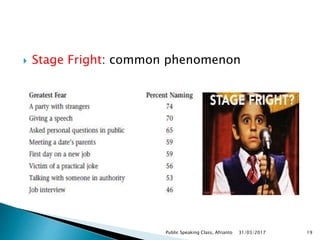
 Do You Suffer From Glossophobia?
31/03/2017Public Speaking Class, Afrianto 18
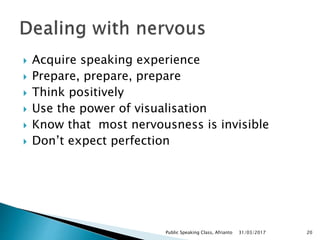
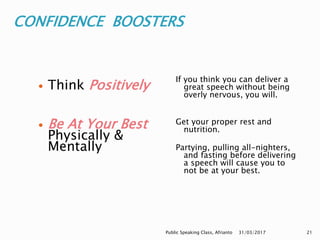
 Stage Fright: common phenomenon
31/03/2017Public Speaking Class, Afrianto 19
 Acquire speaking experience
 Prepare, prepare, prepare
 Think positively
 Use the power of visualisation
 Know that most nervousness is invisible
 Don’t expect perfection
31/03/2017Public Speaking Class, Afrianto 20
CONFIDENCE BOOSTERS
If you think you can deliver a
great speech without being
overly nervous, you will.
Get your proper rest and
nutrition.
Partying, pulling all-nighters,
and fasting before delivering
a speech will cause you to
not be at your best.
 Think Positively
 Be At Your Best
Physically &
Mentally
31/03/2017Public Speaking Class, Afrianto 21
CONFIDENCE BOOSTERS
Rather than on how
nervous you think
you are.
Deep Breathing
always helps to calm
and focus.
 Concentrate On
Communicating
With Your
Audience
 Take A Couple Of
Deep Breaths
31/03/2017Public Speaking Class, Afrianto 22
CONFIDENCE BOOSTERS
Preparing a great
introduction, and
taking it written
word-for-word to
the lectern will allow
you to focus on your
speech, rather than
on nerves.
We tend to be most
nervous when we
first come to the
lectern. This is when
we are most likely to
forget what we
wanted to say.
 Work Especially
Hard On Your
Introduction
31/03/2017Public Speaking Class, Afrianto 23
CONFIDENCE
BOOSTERS
Find a few friendly faces
in the audience and begin
your focused eye contact
with them. Remember
that audiences are made
up of individuals.
~ ~ ~ ~ ~
Using Visual Aids will help
boost your confidence by
placing your focus on
doing something
(displaying, explaining,
and removing the visual),
rather than focusing on
your nervousness.
 Make Eye Contact
With Members Of
Your Audience
 Use Visual Aids
31/03/2017Public Speaking Class, Afrianto 24
Other Tips
31/03/2017Public Speaking Class, Afrianto 25
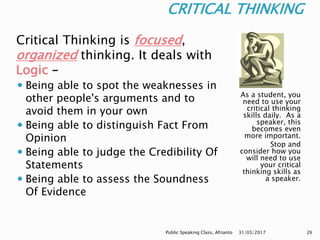
CRITICAL THINKING
As a student, you
need to use your
critical thinking
skills daily. As a
speaker, this
becomes even
more important.
Stop and
consider how you
will need to use
your critical
thinking skills as
a speaker.
Critical Thinking is focused,
organized thinking. It deals with
Logic –
 Being able to spot the weaknesses in
other people's arguments and to
avoid them in your own
 Being able to distinguish Fact From
Opinion
 Being able to judge the Credibility Of
Statements
 Being able to assess the Soundness
Of Evidence
31/03/2017Public Speaking Class, Afrianto 26
 We are now living in more diversed
society in terms of cultures, beliefs,
and political background.
 All nations and cultures are now part
of a vast "global village", due to air
travel, immigration, and electronic
communication.
31/03/2017Public Speaking Class, Afrianto 27
CULTURAL DIVERSITY AND THE
PUBLIC SPEAKER
Ethnocentrism
The belief
that one’s
own group
or culture is
superior to
all other
groups or
cultures.
 Diversity and multiculturalism
are such basic facts of life that
public speakers, to be
successful, need to take
account of cultural differences
between themselves and their
listeners.
 Because of this diversity and
multiculturalism, it is
especially important for public
speakers to avoid
ethnocentrism.
31/03/2017Public Speaking Class, Afrianto 28
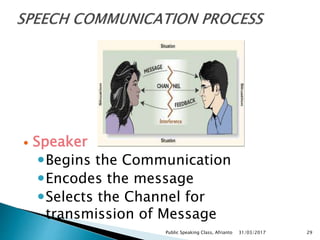
 Speaker
Begins the Communication
Encodes the message
Selects the Channel for
transmission of Message
31/03/2017Public Speaking Class, Afrianto 29
 Message
The communication
 Channel
Means by which the message is
communicated
31/03/2017Public Speaking Class, Afrianto 30
SPEECH
COMMUNICATION PROCESS
Frame of
Reference
The sum total of
a person’s life
experience.
This acts as a
filter for all
incoming
information to
protect the
individual from
information
overload.
 Listener
Person receiving the
message through a
Frame of Reference
31/03/2017Public Speaking Class, Afrianto 31
 Interference
Anything that impedes the
communication
Can be Internal or External
31/03/2017Public Speaking Class, Afrianto 32
 Feedback
Messages sent back to the
speaker by the listener
 Situation
Time & Place in which
communication occurs
31/03/2017Public Speaking Class, Afrianto 33

Speaking in public

  • 1.
    Presented at PublicSpeaking Class, English Department of FKIP of Riau University 31/03/2017 1 By. Dr. Afrianto, S.Pd., M.Ed
  • 2.
     Do youknow who are these people? 31/03/2017Public Speaking Class, Afrianto 2
  • 3.
  • 4.
  • 5.
     Sucessfull people Public figure  Excellent public speaking skills 31/03/2017Public Speaking Class, Afrianto 5
  • 6.
  • 7.
     What arethe good things in the speech? 31/03/2017Public Speaking Class, Afrianto 7
  • 8.
    A way ofmaking your ideas public, sharing them with people and of influencing them. 31/03/2017Public Speaking Class, Afrianto 8
  • 9.
    ‘ I amnot going to be a politician, a president, or any kinds of public figuresw, do I still need to have a public speaking skill?’ 31/03/2017Public Speaking Class, Afrianto 9
  • 10.
     Are theythe same or different? 31/03/2017Public Speaking Class, Afrianto 10
  • 11.
    SIMILARITIES BETWEEN PUBLICSPEAKING AND CONVERSATION What happens if your ideas are out of sequence? Will your audience understand your ideas?  Organize your thoughts LOGICALLY 31/03/2017Public Speaking Class, Afrianto 11
  • 12.
    Can you present anidea the same way to your five- year-old niece as you can to your mother? Can you present that idea to an audience of your peers in the same way as you did to your mother?  Tailor your message to your AUDIENCE 31/03/2017Public Speaking Class, Afrianto 12
  • 13.
    When you tella story, do you just give the facts in a dry way? Or, do you embellish a bit, adding a touch of drama to get your point across and keep them interested?  Tell a story for MAXIMUM IMPACT 31/03/2017Public Speaking Class, Afrianto 13
  • 14.
    In conversation, when theperson with whom you are communicating gives you a look to indicate she does not understand your point, what do you do? You rephrase what you have said to add clarity. You must do the same thing in public speaking. Watch for and adapt to feedback.  ADAPT to listener feedback 31/03/2017Public Speaking Class, Afrianto 14
  • 15.
    DIFFERENCES BETWEEN PUBLIC SPEAKINGAND CONVERSATION Consider this: Public Speaking is generally pre- arranged -- at a pre-arranged time and place. Conversation can take place anytime and any place.  Public Speaking is more HIGHLY STRUCTURED 31/03/2017Public Speaking Class, Afrianto 15
  • 16.
    Consider this: Public Speaking situationsrequire a more polished presentation – no slang, no improper words. Slang, improper words, and colloquialisms can confuse an audience. In conversation, however, these can be used.  Public Speaking requires more FORMAL LANGUAGE 31/03/2017Public Speaking Class, Afrianto 16
  • 17.
    Consider this: Can youhold conversation while lounging at the pool? Can you speak publicly while lounging at the pool? What about while jogging?  Public Speaking requires a DIFFERENT METHOD OF DELIVERY 31/03/2017Public Speaking Class, Afrianto 17
  • 18.
     Do YouSuffer From Glossophobia? 31/03/2017Public Speaking Class, Afrianto 18
  • 19.
     Stage Fright:common phenomenon 31/03/2017Public Speaking Class, Afrianto 19
  • 20.
     Acquire speakingexperience  Prepare, prepare, prepare  Think positively  Use the power of visualisation  Know that most nervousness is invisible  Don’t expect perfection 31/03/2017Public Speaking Class, Afrianto 20
  • 21.
    CONFIDENCE BOOSTERS If youthink you can deliver a great speech without being overly nervous, you will. Get your proper rest and nutrition. Partying, pulling all-nighters, and fasting before delivering a speech will cause you to not be at your best.  Think Positively  Be At Your Best Physically & Mentally 31/03/2017Public Speaking Class, Afrianto 21
  • 22.
    CONFIDENCE BOOSTERS Rather thanon how nervous you think you are. Deep Breathing always helps to calm and focus.  Concentrate On Communicating With Your Audience  Take A Couple Of Deep Breaths 31/03/2017Public Speaking Class, Afrianto 22
  • 23.
    CONFIDENCE BOOSTERS Preparing agreat introduction, and taking it written word-for-word to the lectern will allow you to focus on your speech, rather than on nerves. We tend to be most nervous when we first come to the lectern. This is when we are most likely to forget what we wanted to say.  Work Especially Hard On Your Introduction 31/03/2017Public Speaking Class, Afrianto 23
  • 24.
    CONFIDENCE BOOSTERS Find a fewfriendly faces in the audience and begin your focused eye contact with them. Remember that audiences are made up of individuals. ~ ~ ~ ~ ~ Using Visual Aids will help boost your confidence by placing your focus on doing something (displaying, explaining, and removing the visual), rather than focusing on your nervousness.  Make Eye Contact With Members Of Your Audience  Use Visual Aids 31/03/2017Public Speaking Class, Afrianto 24
  • 25.
  • 26.
    CRITICAL THINKING As astudent, you need to use your critical thinking skills daily. As a speaker, this becomes even more important. Stop and consider how you will need to use your critical thinking skills as a speaker. Critical Thinking is focused, organized thinking. It deals with Logic –  Being able to spot the weaknesses in other people's arguments and to avoid them in your own  Being able to distinguish Fact From Opinion  Being able to judge the Credibility Of Statements  Being able to assess the Soundness Of Evidence 31/03/2017Public Speaking Class, Afrianto 26
  • 27.
     We arenow living in more diversed society in terms of cultures, beliefs, and political background.  All nations and cultures are now part of a vast "global village", due to air travel, immigration, and electronic communication. 31/03/2017Public Speaking Class, Afrianto 27
  • 28.
    CULTURAL DIVERSITY ANDTHE PUBLIC SPEAKER Ethnocentrism The belief that one’s own group or culture is superior to all other groups or cultures.  Diversity and multiculturalism are such basic facts of life that public speakers, to be successful, need to take account of cultural differences between themselves and their listeners.  Because of this diversity and multiculturalism, it is especially important for public speakers to avoid ethnocentrism. 31/03/2017Public Speaking Class, Afrianto 28
  • 29.
     Speaker Begins theCommunication Encodes the message Selects the Channel for transmission of Message 31/03/2017Public Speaking Class, Afrianto 29
  • 30.
     Message The communication Channel Means by which the message is communicated 31/03/2017Public Speaking Class, Afrianto 30
  • 31.
    SPEECH COMMUNICATION PROCESS Frame of Reference Thesum total of a person’s life experience. This acts as a filter for all incoming information to protect the individual from information overload.  Listener Person receiving the message through a Frame of Reference 31/03/2017Public Speaking Class, Afrianto 31
  • 32.
     Interference Anything thatimpedes the communication Can be Internal or External 31/03/2017Public Speaking Class, Afrianto 32
  • 33.
     Feedback Messages sentback to the speaker by the listener  Situation Time & Place in which communication occurs 31/03/2017Public Speaking Class, Afrianto 33