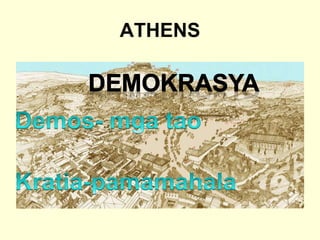
ATHENS
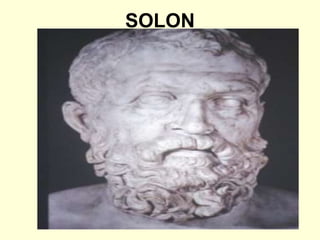
SOLON
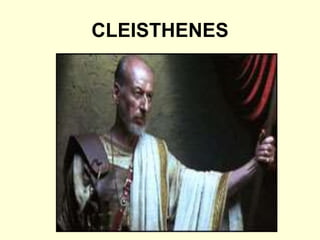
CLEISTHENES
SPARTA
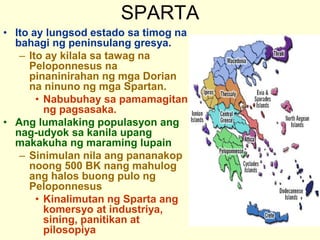
• Ito ay lungsod estado sa timog na
bahagi ng peninsulang gresya.
– Ito ay kilala sa tawag na
Peloponnesus na
pinaninirahan ng mga Dorian
na ninuno ng mga Spartan.
• Nabubuhay sa pamamagitan
ng pagsasaka.
• Ang lumalaking populasyon ang
nag-udyok sa kanila upang
makakuha ng maraming lupain
– Sinimulan nila ang pananakop
noong 500 BK nang mahulog
ang halos buong pulo ng
Peloponnesus
• Kinalimutan ng Sparta ang
komersyo at industriya,
sining, panitikan at
pilosopiya
PAGSASANAY NG SPARTAN
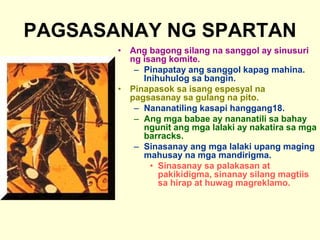
• Ang bagong silang na sanggol ay sinusuri
ng isang komite.
– Pinapatay ang sanggol kapag mahina.
Inihuhulog sa bangin.
• Pinapasok sa isang espesyal na
pagsasanay sa gulang na pito.
– Nananatiling kasapi hanggang18.
– Ang mga babae ay nananatili sa bahay
ngunit ang mga lalaki ay nakatira sa mga
barracks.
– Sinasanay ang mga lalaki upang maging
mahusay na mga mandirigma.
• Sinasanay sa palakasan at
pakikidigma, sinanay silang magtiis
sa hirap at huwag magreklamo.
pagsasanay
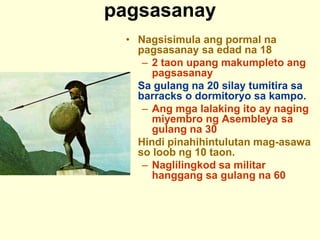
• Nagsisimula ang pormal na
pagsasanay sa edad na 18
– 2 taon upang makumpleto ang
pagsasanay
• Sa gulang na 20 silay tumitira sa
barracks o dormitoryo sa kampo.
– Ang mga lalaking ito ay naging
miyembro ng Asembleya sa
gulang na 30
• Hindi pinahihintulutan mag-asawa
so loob ng 10 taon.
– Naglilingkod sa militar
hanggang sa gulang na 60
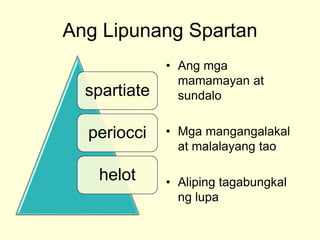
Ang Lipunang Spartan
spartiate
periocci
helot
• Ang mga
mamamayan at
sundalo
• Mga mangangalakal
at malalayang tao
• Aliping tagabungkal
ng lupa
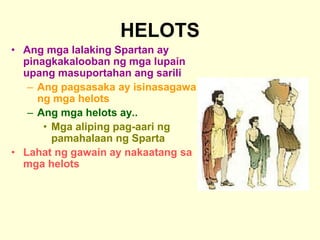
HELOTS
• Ang mga lalaking Spartan ay
pinagkakalooban ng mga lupain
upang masuportahan ang sarili
– Ang pagsasaka ay isinasagawa
ng mga helots
– Ang mga helots ay..
• Mga aliping pag-aari ng
pamahalaan ng Sparta
• Lahat ng gawain ay nakaatang sa
mga helots
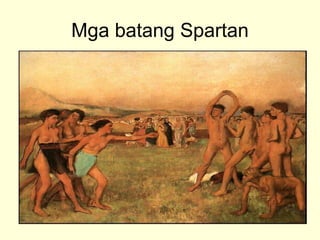
Mga batang Spartan
• Ginawang mga helots ang mga nasakop mula
sa Peloponnesus
– Hindi malaya ang mga helots
– Maaaring magkapamilya, ngunit hindi maaaring
iwanan ang mga lupang sakahan.
– Noong 6th Century B.C. higit na mas marami ang
populasyon ng helots kumpara sa mga mamamayang
Spartan. 10=1
• Lahat ng mga Spartans ay pantay-pantay
– Hinikayat ang simpleng pamumuhay ng mga Spartan
upang hindi magkaroon ng pagitan ang mayayaman
at mahihirap.
– Ipinagbawal ang mga alahas, magagarbong
kasuotan, luho at pagmamay-ari ng mga yaman.
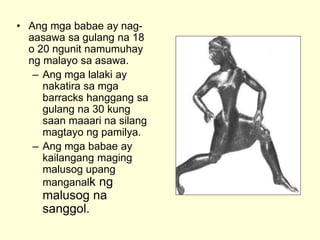
• Ang mga babae ay nag-
aasawa sa gulang na 18
o 20 ngunit namumuhay
ng malayo sa asawa.
– Ang mga lalaki ay
nakatira sa mga
barracks hanggang sa
gulang na 30 kung
saan maaari na silang
magtayo ng pamilya.
– Ang mga babae ay
kailangang maging
malusog upang
manganalk ng
malusog na
sanggol.
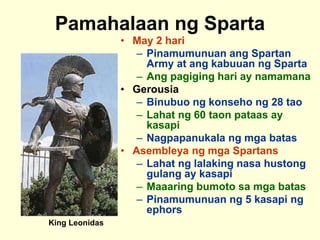
Pamahalaan ng Sparta
• May 2 hari
– Pinamumunuan ang Spartan
Army at ang kabuuan ng Sparta
– Ang pagiging hari ay namamana
• Gerousia
– Binubuo ng konseho ng 28 tao
– Lahat ng 60 taon pataas ay
kasapi
– Nagpapanukala ng mga batas
• Asembleya ng mga Spartans
– Lahat ng lalaking nasa hustong
gulang ay kasapi
– Maaaring bumoto sa mga batas
– Pinamumunuan ng 5 kasapi ng
ephors
King Leonidas
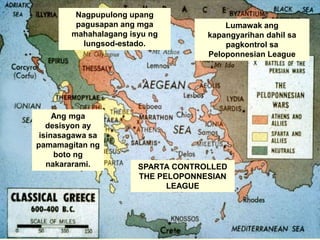
Lumawak ang
kapangyarihan dahil sa
pagkontrol sa
Peloponnesian League
Nagpupulong upang
pagusapan ang mga
mahahalagang isyu ng
lungsod-estado.
Ang mga
desisyon ay
isinasagawa sa
pamamagitan ng
boto ng
nakararami. SPARTA CONTROLLED
THE PELOPONNESIAN
LEAGUE
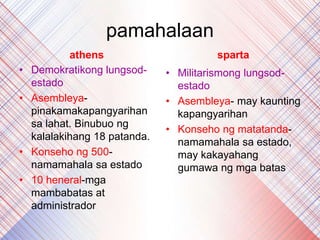
pamahalaan
athens
• Demokratikong lungsod-
estado
• Asembleya-
pinakamakapangyarihan
sa lahat. Binubuo ng
kalalakihang 18 patanda.
• Konseho ng 500-
namamahala sa estado
• 10 heneral-mga
mambabatas at
administrador
sparta
• Militarismong lungsod-
estado
• Asembleya- may kaunting
kapangyarihan
• Konseho ng matatanda-
namamahala sa estado,
may kakayahang
gumawa ng mga batas
Pamahalaan
athens
• Delian League liga o
samahan ng mga lungsod
estado
sparta
• Peloponnesian League
itinatag ng Sparta
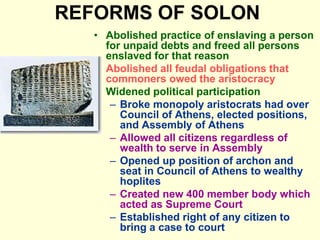
REFORMS OF SOLON
• Abolished practice of enslaving a person
for unpaid debts and freed all persons
enslaved for that reason
• Abolished all feudal obligations that
commoners owed the aristocracy
• Widened political participation
– Broke monopoly aristocrats had over
Council of Athens, elected positions,
and Assembly of Athens
– Allowed all citizens regardless of
wealth to serve in Assembly
– Opened up position of archon and
seat in Council of Athens to wealthy
hoplites
– Created new 400 member body which
acted as Supreme Court
– Established right of any citizen to
bring a case to court
REFORMS BACKFIRE A LITTLE
• Solon’s reforms went long way
towards opening up Athenian
society and government to a
greater number of people
– But they did not immediately
end the turmoil that plagued the
city
• Athens did prosper
– Rapid population growth,
geographic expansion, various
public works projects
– But Solon’s reforms increased
infighting by multiplying the
number of factions struggling
for control
• Even resulted in several
dictatorships (tyrannies)
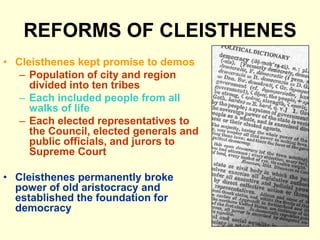
REFORMS OF CLEISTHENES
• Cleisthenes kept promise to demos
– Population of city and region
divided into ten tribes
– Each included people from all
walks of life
– Each elected representatives to
the Council, elected generals and
public officials, and jurors to
Supreme Court
• Cleisthenes permanently broke
power of old aristocracy and
established the foundation for
democracy
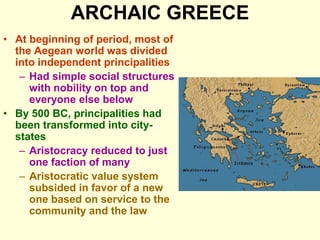
ARCHAIC GREECE
• At beginning of period, most of
the Aegean world was divided
into independent principalities
– Had simple social structures
with nobility on top and
everyone else below
• By 500 BC, principalities had
been transformed into city-
states
– Aristocracy reduced to just
one faction of many
– Aristocratic value system
subsided in favor of a new
one based on service to the
community and the law
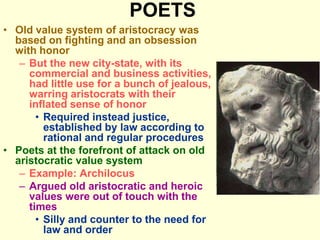
POETS
• Old value system of aristocracy was
based on fighting and an obsession
with honor
– But the new city-state, with its
commercial and business activities,
had little use for a bunch of jealous,
warring aristocrats with their
inflated sense of honor
• Required instead justice,
established by law according to
rational and regular procedures
• Poets at the forefront of attack on old
aristocratic value system
– Example: Archilocus
– Argued old aristocratic and heroic
values were out of touch with the
times
• Silly and counter to the need for
law and order
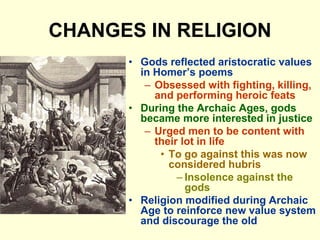
CHANGES IN RELIGION
• Gods reflected aristocratic values
in Homer’s poems
– Obsessed with fighting, killing,
and performing heroic feats
• During the Archaic Ages, gods
became more interested in justice
– Urged men to be content with
their lot in life
• To go against this was now
considered hubris
– Insolence against the
gods
• Religion modified during Archaic
Age to reinforce new value system
and discourage the old
SUMMARY
• Mutually-reinforcing cycle
– Growth of business and trade undermined the
aristocratic monopoly over society
• Decline of aristocracy was accompanied by a parallel
decline in their value system
– Helped by propaganda attacks by poets and a
gradual shift in religious emphasis
– Decline of aristocratic value system was paralleled by
the rise of a new value system based on law, order, and
stability
• Encouraged further business growth and prosperity
– Sped up the decline of the aristocracy
– Provided good environment for development of
literature and beginning of philosophic and
scientific speculation
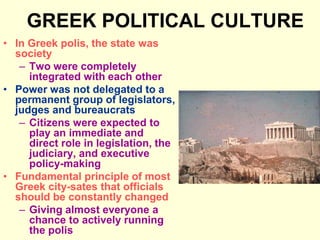
GREEK POLITICAL CULTURE
• In Greek polis, the state was
society
– Two were completely
integrated with each other
• Power was not delegated to a
permanent group of legislators,
judges and bureaucrats
– Citizens were expected to
play an immediate and
direct role in legislation, the
judiciary, and executive
policy-making
• Fundamental principle of most
Greek city-sates that officials
should be constantly changed
– Giving almost everyone a
chance to actively running
the polis
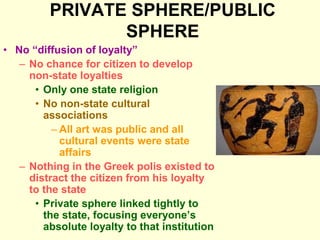
PRIVATE SPHERE/PUBLIC
SPHERE
• No “diffusion of loyalty”
– No chance for citizen to develop
non-state loyalties
• Only one state religion
• No non-state cultural
associations
– All art was public and all
cultural events were state
affairs
– Nothing in the Greek polis existed to
distract the citizen from his loyalty
to the state
• Private sphere linked tightly to
the state, focusing everyone’s
absolute loyalty to that institution
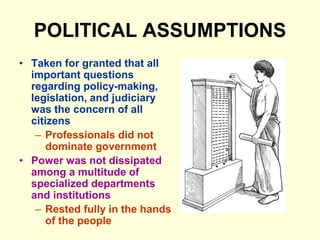
POLITICAL ASSUMPTIONS
• Taken for granted that all
important questions
regarding policy-making,
legislation, and judiciary
was the concern of all
citizens
– Professionals did not
dominate government
• Power was not dissipated
among a multitude of
specialized departments
and institutions
– Rested fully in the hands
of the people
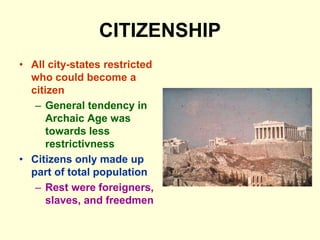
CITIZENSHIP
• All city-states restricted
who could become a
citizen
– General tendency in
Archaic Age was
towards less
restrictivness
• Citizens only made up
part of total population
– Rest were foreigners,
slaves, and freedmen
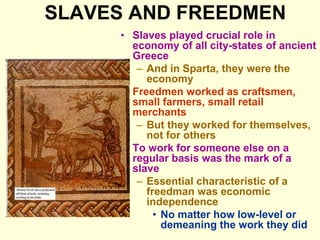
SLAVES AND FREEDMEN
• Slaves played crucial role in
economy of all city-states of ancient
Greece
– And in Sparta, they were the
economy
• Freedmen worked as craftsmen,
small farmers, small retail
merchants
– But they worked for themselves,
not for others
• To work for someone else on a
regular basis was the mark of a
slave
– Essential characteristic of a
freedman was economic
independence
• No matter how low-level or
demeaning the work they did
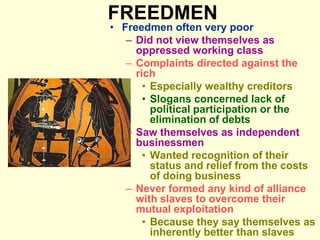
FREEDMEN
• Freedmen often very poor
– Did not view themselves as
oppressed working class
– Complaints directed against the
rich
• Especially wealthy creditors
• Slogans concerned lack of
political participation or the
elimination of debts
– Saw themselves as independent
businessmen
• Wanted recognition of their
status and relief from the costs
of doing business
– Never formed any kind of alliance
with slaves to overcome their
mutual exploitation
• Because they say themselves as
inherently better than slaves
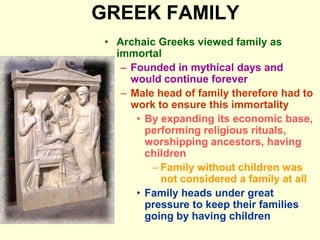
GREEK FAMILY
• Archaic Greeks viewed family as
immortal
– Founded in mythical days and
would continue forever
– Male head of family therefore had to
work to ensure this immortality
• By expanding its economic base,
performing religious rituals,
worshipping ancestors, having
children
– Family without children was
not considered a family at all
• Family heads under great
pressure to keep their families
going by having children
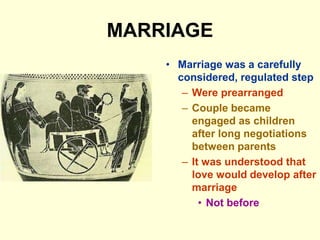
MARRIAGE
• Marriage was a carefully
considered, regulated step
– Were prearranged
– Couple became
engaged as children
after long negotiations
between parents
– It was understood that
love would develop after
marriage
• Not before
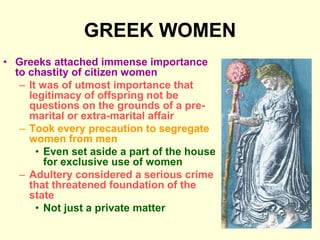
GREEK WOMEN
• Greeks attached immense importance
to chastity of citizen women
– It was of utmost importance that
legitimacy of offspring not be
questions on the grounds of a pre-
marital or extra-marital affair
– Took every precaution to segregate
women from men
• Even set aside a part of the house
for exclusive use of women
– Adultery considered a serious crime
that threatened foundation of the
state
• Not just a private matter
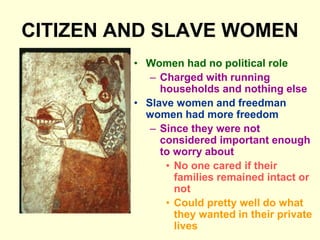
CITIZEN AND SLAVE WOMEN
• Women had no political role
– Charged with running
households and nothing else
• Slave women and freedman
women had more freedom
– Since they were not
considered important enough
to worry about
• No one cared if their
families remained intact or
not
• Could pretty well do what
they wanted in their private
lives
FINAL POINT
• Neither male nor female citizens enjoyed a high degree of
freedom (in the modern sense of the term)
– Greek ideas of freedom implied conformity to
community standards of behavior
• Community needs defined the roles of men and
women and restricted the freedom of both
• Male family heads had little choice over who and
when he should marry, whether to have children, etc.
– Law and custom demanded that he subordinate
his own needs and desires to those of his family
and the community at large
– In exchange, men and women enjoyed a strong
and stimulating community life
» A trade off between liberty and security, with
security receiving the most emphasis

Sparta 100825212506-phpapp02

  • 2.
  • 3.
  • 4.
  • 5.
    SPARTA • Ito aylungsod estado sa timog na bahagi ng peninsulang gresya. – Ito ay kilala sa tawag na Peloponnesus na pinaninirahan ng mga Dorian na ninuno ng mga Spartan. • Nabubuhay sa pamamagitan ng pagsasaka. • Ang lumalaking populasyon ang nag-udyok sa kanila upang makakuha ng maraming lupain – Sinimulan nila ang pananakop noong 500 BK nang mahulog ang halos buong pulo ng Peloponnesus • Kinalimutan ng Sparta ang komersyo at industriya, sining, panitikan at pilosopiya
  • 6.
    PAGSASANAY NG SPARTAN •Ang bagong silang na sanggol ay sinusuri ng isang komite. – Pinapatay ang sanggol kapag mahina. Inihuhulog sa bangin. • Pinapasok sa isang espesyal na pagsasanay sa gulang na pito. – Nananatiling kasapi hanggang18. – Ang mga babae ay nananatili sa bahay ngunit ang mga lalaki ay nakatira sa mga barracks. – Sinasanay ang mga lalaki upang maging mahusay na mga mandirigma. • Sinasanay sa palakasan at pakikidigma, sinanay silang magtiis sa hirap at huwag magreklamo.
  • 7.
    pagsasanay • Nagsisimula angpormal na pagsasanay sa edad na 18 – 2 taon upang makumpleto ang pagsasanay • Sa gulang na 20 silay tumitira sa barracks o dormitoryo sa kampo. – Ang mga lalaking ito ay naging miyembro ng Asembleya sa gulang na 30 • Hindi pinahihintulutan mag-asawa so loob ng 10 taon. – Naglilingkod sa militar hanggang sa gulang na 60
  • 8.
    Ang Lipunang Spartan spartiate periocci helot •Ang mga mamamayan at sundalo • Mga mangangalakal at malalayang tao • Aliping tagabungkal ng lupa
  • 9.
    HELOTS • Ang mgalalaking Spartan ay pinagkakalooban ng mga lupain upang masuportahan ang sarili – Ang pagsasaka ay isinasagawa ng mga helots – Ang mga helots ay.. • Mga aliping pag-aari ng pamahalaan ng Sparta • Lahat ng gawain ay nakaatang sa mga helots
  • 10.
  • 11.
    • Ginawang mgahelots ang mga nasakop mula sa Peloponnesus – Hindi malaya ang mga helots – Maaaring magkapamilya, ngunit hindi maaaring iwanan ang mga lupang sakahan. – Noong 6th Century B.C. higit na mas marami ang populasyon ng helots kumpara sa mga mamamayang Spartan. 10=1
  • 12.
    • Lahat ngmga Spartans ay pantay-pantay – Hinikayat ang simpleng pamumuhay ng mga Spartan upang hindi magkaroon ng pagitan ang mayayaman at mahihirap. – Ipinagbawal ang mga alahas, magagarbong kasuotan, luho at pagmamay-ari ng mga yaman.
  • 13.
    • Ang mgababae ay nag- aasawa sa gulang na 18 o 20 ngunit namumuhay ng malayo sa asawa. – Ang mga lalaki ay nakatira sa mga barracks hanggang sa gulang na 30 kung saan maaari na silang magtayo ng pamilya. – Ang mga babae ay kailangang maging malusog upang manganalk ng malusog na sanggol.
  • 14.
    Pamahalaan ng Sparta •May 2 hari – Pinamumunuan ang Spartan Army at ang kabuuan ng Sparta – Ang pagiging hari ay namamana • Gerousia – Binubuo ng konseho ng 28 tao – Lahat ng 60 taon pataas ay kasapi – Nagpapanukala ng mga batas • Asembleya ng mga Spartans – Lahat ng lalaking nasa hustong gulang ay kasapi – Maaaring bumoto sa mga batas – Pinamumunuan ng 5 kasapi ng ephors King Leonidas
  • 15.
    Lumawak ang kapangyarihan dahilsa pagkontrol sa Peloponnesian League Nagpupulong upang pagusapan ang mga mahahalagang isyu ng lungsod-estado. Ang mga desisyon ay isinasagawa sa pamamagitan ng boto ng nakararami. SPARTA CONTROLLED THE PELOPONNESIAN LEAGUE
  • 16.
    pamahalaan athens • Demokratikong lungsod- estado •Asembleya- pinakamakapangyarihan sa lahat. Binubuo ng kalalakihang 18 patanda. • Konseho ng 500- namamahala sa estado • 10 heneral-mga mambabatas at administrador sparta • Militarismong lungsod- estado • Asembleya- may kaunting kapangyarihan • Konseho ng matatanda- namamahala sa estado, may kakayahang gumawa ng mga batas
  • 17.
    Pamahalaan athens • Delian Leagueliga o samahan ng mga lungsod estado sparta • Peloponnesian League itinatag ng Sparta
  • 18.
    REFORMS OF SOLON •Abolished practice of enslaving a person for unpaid debts and freed all persons enslaved for that reason • Abolished all feudal obligations that commoners owed the aristocracy • Widened political participation – Broke monopoly aristocrats had over Council of Athens, elected positions, and Assembly of Athens – Allowed all citizens regardless of wealth to serve in Assembly – Opened up position of archon and seat in Council of Athens to wealthy hoplites – Created new 400 member body which acted as Supreme Court – Established right of any citizen to bring a case to court
  • 19.
    REFORMS BACKFIRE ALITTLE • Solon’s reforms went long way towards opening up Athenian society and government to a greater number of people – But they did not immediately end the turmoil that plagued the city • Athens did prosper – Rapid population growth, geographic expansion, various public works projects – But Solon’s reforms increased infighting by multiplying the number of factions struggling for control • Even resulted in several dictatorships (tyrannies)
  • 20.
    REFORMS OF CLEISTHENES •Cleisthenes kept promise to demos – Population of city and region divided into ten tribes – Each included people from all walks of life – Each elected representatives to the Council, elected generals and public officials, and jurors to Supreme Court • Cleisthenes permanently broke power of old aristocracy and established the foundation for democracy
  • 21.
    ARCHAIC GREECE • Atbeginning of period, most of the Aegean world was divided into independent principalities – Had simple social structures with nobility on top and everyone else below • By 500 BC, principalities had been transformed into city- states – Aristocracy reduced to just one faction of many – Aristocratic value system subsided in favor of a new one based on service to the community and the law
  • 22.
    POETS • Old valuesystem of aristocracy was based on fighting and an obsession with honor – But the new city-state, with its commercial and business activities, had little use for a bunch of jealous, warring aristocrats with their inflated sense of honor • Required instead justice, established by law according to rational and regular procedures • Poets at the forefront of attack on old aristocratic value system – Example: Archilocus – Argued old aristocratic and heroic values were out of touch with the times • Silly and counter to the need for law and order
  • 23.
    CHANGES IN RELIGION •Gods reflected aristocratic values in Homer’s poems – Obsessed with fighting, killing, and performing heroic feats • During the Archaic Ages, gods became more interested in justice – Urged men to be content with their lot in life • To go against this was now considered hubris – Insolence against the gods • Religion modified during Archaic Age to reinforce new value system and discourage the old
  • 24.
    SUMMARY • Mutually-reinforcing cycle –Growth of business and trade undermined the aristocratic monopoly over society • Decline of aristocracy was accompanied by a parallel decline in their value system – Helped by propaganda attacks by poets and a gradual shift in religious emphasis – Decline of aristocratic value system was paralleled by the rise of a new value system based on law, order, and stability • Encouraged further business growth and prosperity – Sped up the decline of the aristocracy – Provided good environment for development of literature and beginning of philosophic and scientific speculation
  • 25.
    GREEK POLITICAL CULTURE •In Greek polis, the state was society – Two were completely integrated with each other • Power was not delegated to a permanent group of legislators, judges and bureaucrats – Citizens were expected to play an immediate and direct role in legislation, the judiciary, and executive policy-making • Fundamental principle of most Greek city-sates that officials should be constantly changed – Giving almost everyone a chance to actively running the polis
  • 26.
    PRIVATE SPHERE/PUBLIC SPHERE • No“diffusion of loyalty” – No chance for citizen to develop non-state loyalties • Only one state religion • No non-state cultural associations – All art was public and all cultural events were state affairs – Nothing in the Greek polis existed to distract the citizen from his loyalty to the state • Private sphere linked tightly to the state, focusing everyone’s absolute loyalty to that institution
  • 27.
    POLITICAL ASSUMPTIONS • Takenfor granted that all important questions regarding policy-making, legislation, and judiciary was the concern of all citizens – Professionals did not dominate government • Power was not dissipated among a multitude of specialized departments and institutions – Rested fully in the hands of the people
  • 28.
    CITIZENSHIP • All city-statesrestricted who could become a citizen – General tendency in Archaic Age was towards less restrictivness • Citizens only made up part of total population – Rest were foreigners, slaves, and freedmen
  • 29.
    SLAVES AND FREEDMEN •Slaves played crucial role in economy of all city-states of ancient Greece – And in Sparta, they were the economy • Freedmen worked as craftsmen, small farmers, small retail merchants – But they worked for themselves, not for others • To work for someone else on a regular basis was the mark of a slave – Essential characteristic of a freedman was economic independence • No matter how low-level or demeaning the work they did
  • 30.
    FREEDMEN • Freedmen oftenvery poor – Did not view themselves as oppressed working class – Complaints directed against the rich • Especially wealthy creditors • Slogans concerned lack of political participation or the elimination of debts – Saw themselves as independent businessmen • Wanted recognition of their status and relief from the costs of doing business – Never formed any kind of alliance with slaves to overcome their mutual exploitation • Because they say themselves as inherently better than slaves
  • 31.
    GREEK FAMILY • ArchaicGreeks viewed family as immortal – Founded in mythical days and would continue forever – Male head of family therefore had to work to ensure this immortality • By expanding its economic base, performing religious rituals, worshipping ancestors, having children – Family without children was not considered a family at all • Family heads under great pressure to keep their families going by having children
  • 32.
    MARRIAGE • Marriage wasa carefully considered, regulated step – Were prearranged – Couple became engaged as children after long negotiations between parents – It was understood that love would develop after marriage • Not before
  • 33.
    GREEK WOMEN • Greeksattached immense importance to chastity of citizen women – It was of utmost importance that legitimacy of offspring not be questions on the grounds of a pre- marital or extra-marital affair – Took every precaution to segregate women from men • Even set aside a part of the house for exclusive use of women – Adultery considered a serious crime that threatened foundation of the state • Not just a private matter
  • 34.
    CITIZEN AND SLAVEWOMEN • Women had no political role – Charged with running households and nothing else • Slave women and freedman women had more freedom – Since they were not considered important enough to worry about • No one cared if their families remained intact or not • Could pretty well do what they wanted in their private lives
  • 35.
    FINAL POINT • Neithermale nor female citizens enjoyed a high degree of freedom (in the modern sense of the term) – Greek ideas of freedom implied conformity to community standards of behavior • Community needs defined the roles of men and women and restricted the freedom of both • Male family heads had little choice over who and when he should marry, whether to have children, etc. – Law and custom demanded that he subordinate his own needs and desires to those of his family and the community at large – In exchange, men and women enjoyed a strong and stimulating community life » A trade off between liberty and security, with security receiving the most emphasis