what technology has help us understand
 the solar system and what happens in
                 space?


   Space Questions


                                         By Kaylee Beard
Telescopes

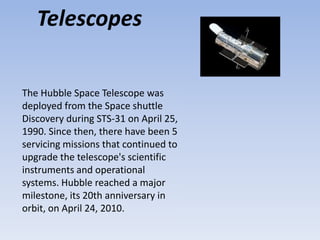
The Hubble Space Telescope was
deployed from the Space shuttle
Discovery during STS-31 on April 25,
1990. Since then, there have been 5
servicing missions that continued to
upgrade the telescope's scientific
instruments and operational
systems. Hubble reached a major
milestone, its 20th anniversary in
orbit, on April 24, 2010.
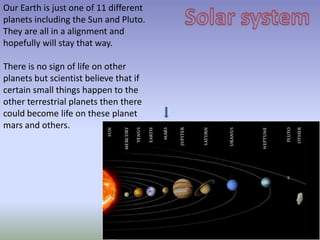
Our Earth is just one of 11 different
planets including the Sun and Pluto.
They are all in a alignment and
hopefully will stay that way.

There is no sign of life on other
planets but scientist believe that if
certain small things happen to the
other terrestrial planets then there
could become life on these planet
mars and others.
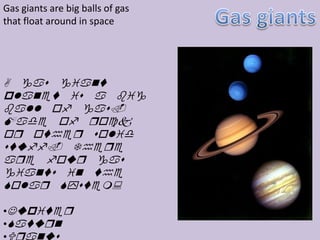
Gas giants are big balls of gas
that float around in space


A gas giant
planet is a big
ball of gas.
Made of qock
oq otheq solid
stuff. Theqe
aqe fouq gas
giants in the
Solaq System:

•Jupiteq
•Satuqn
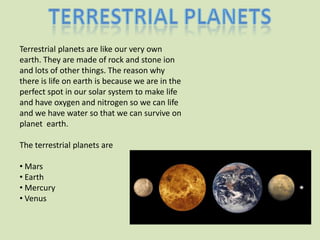
Terrestrial planets are like our very own
earth. They are made of rock and stone ion
and lots of other things. The reason why
there is life on earth is because we are in the
perfect spot in our solar system to make life
and have oxygen and nitrogen so we can life
and we have water so that we can survive on
planet earth.

The terrestrial planets are

• Mars
• Earth
• Mercury
• Venus
References
http://en.wikipedia.org/wiki/Terrestrial_planet


http://www.google.com.au/search?um=1&hl=en&safe=active&gbv=2&q=terrestrial%20planets
&ie=UTF-8&tbm=isch&source=og&sa=N&tab=wi

http://www.google.com.au/search?um=1&hl=en&safe=active&gbv=2&ie=ISO-8859-
1&tbm=isch&q=earth


http://www.nasa.gov/


http://www.nasa.gov/topics/shuttle_station/index.html


http://www.nasa.gov/topics/technology/index.html

Space questions