A not-for-profit
 health and tax policy
research organization
                         What’s coming and what it
                         means for medical practice


                         Grace-Marie Turner
                         November 16, 2012
                         Southern Medical Association
   /GalenInstitute
   www.galen.org
Americans’ views on the law
        • Americans say the health law will make things
          worse rather than better for
          taxpayers, businesses, doctors, and those who
          currently have health insurance.

        • Opposition to the law remains as high as it was
          when the law was enacted.

        • Three more states passed ballot initiatives to
          block the individual mandate – AL, WY, MT


Sources: ―Americans: Healthcare Law Helps Some, Hurts Others ,‖ Gallup, July 16, 2012, http://www.gallup.com/poll/155726/Americans-Healthcare-Law-
Helps-Hurts-Others.aspx?utm_source=add%2Bthis&utm_medium=addthis.com&utm_campaign=sharing#.UARkmBS6osE.twitter. The New York Times/CBS
News Poll, July 11-16, 2012, http://s3.documentcloud.org/documents/402362/jul12a-ocr.pdf. ―Kaiser Health Tracking Poll,‖ The Kaiser Family Foundation, July
2012, http://www.kff.org/kaiserpolls/upload/8339-C.pdf
Americans agreed on goals for health reform…

       • The U.S. needs health reform to:
                – make coverage more affordable
                – assure quality, and
                – expand access to insurance

       • Most people rate their own coverage as good or
         excellent

       • They wanted stability. Change was for others.

www.galen.org
A not-for-profit
 health and tax policy
research organization


   /GalenInstitute
   www.galen.org
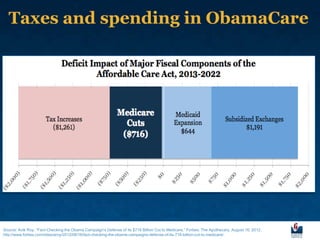
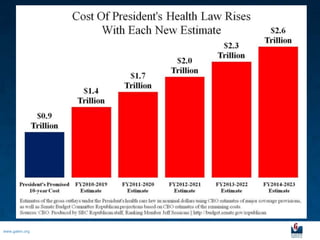
Taxes and spending in ObamaCare


Source: Avik Roy, ―Fact-Checking the Obama Campaign's Defense of its $716 Billion Cut to Medicare,‖ Forbes: The Apothecary, August 16, 2012,
http://www.forbes.com/sites/aroy/2012/08/16/fact-checking-the-obama-campaigns-defense-of-its-716-billion-cut-to-medicare/.
Generous Subsidies in Exchanges
  Examples:
  • A person earning $42,000 a year with a family of
    4 qualifies for $14,759 in new health insurance
    subsidies
  • A single person earning $20,600 qualifies for
    $5,156 in new health insurance subsidies

  But only if employer doesn’t offer coverage or if it’s
  not ―affordable‖ (costs >9.5% of income)

www.galen.org
www.galen.org
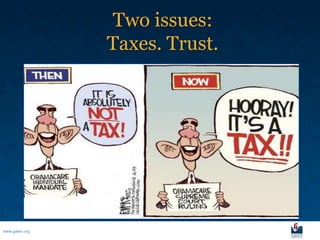
Two issues:
                Taxes. Trust.


www.galen.org
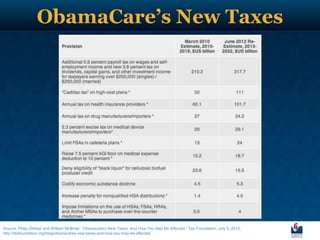
ObamaCare’s New Taxes


Source: Philip Dittmer and William McBride, ―Obamacare's New Taxes, And How You May Be Affected,‖ Tax Foundation, July 5, 2012,
http://taxfoundation.org/blog/obamacares-new-taxes-and-how-you-may-be-affected.
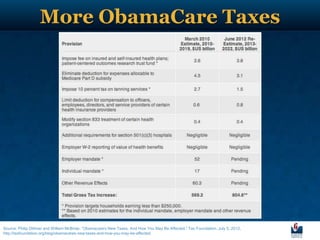
More ObamaCare Taxes


Source: Philip Dittmer and William McBride, ―Obamacare's New Taxes, And How You May Be Affected,‖ Tax Foundation, July 5, 2012,
http://taxfoundation.org/blog/obamacares-new-taxes-and-how-you-may-be-affected.
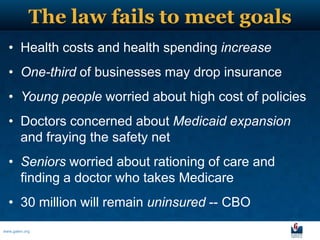
The law fails to meet goals
  • Health costs and health spending increase
  • One-third of businesses may drop insurance
  • Young people worried about high cost of policies
  • Doctors concerned about Medicaid expansion
    and fraying the safety net
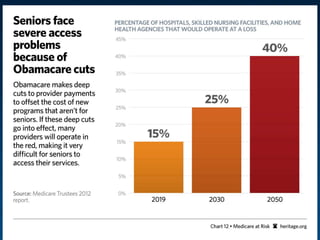
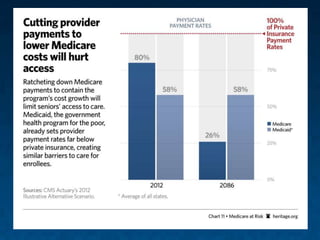
  • Seniors worried about rationing of care and
    finding a doctor who takes Medicare
  • 30 million will remain uninsured -- CBO
www.galen.org
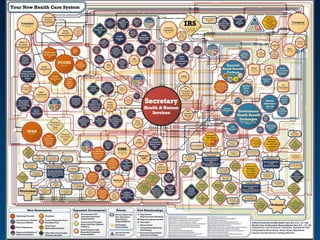
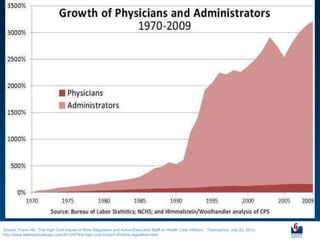
Some realities


www.galen.org
Source: Frank Hill, ―The High Cost Impact of More Regulation and Admin/Executive Staff on Health Care Inflation,‖ Telemachus, July 22, 2012,
http://www.telemachusleaps.com/2012/07/the-high-cost-impact-of-more-regulation.html.
The AMA and practicing physicians

      • The SGR Medicare payment fix was its
        key bargaining chip

      • The chance for a permanent fix is missed;
        the president got the AMA endorsement
        for an empty promise

      • Pleas for short-term fixes are likely to
        continue indefinitely

www.galen.org
The Doctors Co. Survey:
                – 60% say increased patient volume will
                  hurt the level of care they can provide

                – 43% said they are thinking about retiring
                  in the next five years

                – Nine out of ten said they would
                  discourage friends and family members
                  from pursuing a career in medicine


www.galen.org
                  http://www.thedoctors.com/TDC/PressRoom/PressContent/CON_ID_004671
Physician concerns

      • Questions about Accountable Care
        Organizations
      • Authority of HHS Secretary to set new
        rules for quality of care
      • Regulatory requirements impacting private
        medical practices
      • More burdensome record-keeping


www.galen.org
Specific changes to watch

     • IPAB — the Independent Payment Advisory
       Board
     • Patient-Centered Outcomes Research
       Institute and comparative effectiveness
       ―guidelines‖
     • Physician Quality Reporting Initiative
     • Value-based Payment Modifier

www.galen.org
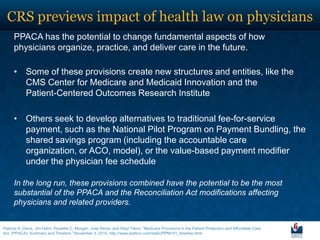
CRS previews impact of health law on physicians
      PPACA has the potential to change fundamental aspects of how
      physicians organize, practice, and deliver care in the future.

      • Some of these provisions create new structures and entities, like the
        CMS Center for Medicare and Medicaid Innovation and the
        Patient-Centered Outcomes Research Institute

      • Others seek to develop alternatives to traditional fee-for-service
        payment, such as the National Pilot Program on Payment Bundling, the
        shared savings program (including the accountable care
        organization, or ACO, model), or the value-based payment modifier
        under the physician fee schedule

      In the long run, these provisions combined have the potential to be the most
      substantial of the PPACA and the Reconciliation Act modifications affecting
      physicians and related providers.


Patricia A. Davis, Jim Hahn, Paulette C. Morgan, Julie Stone, and Sibyl Tilson, ―Medicare Provisions in the Patient Protection and Affordable Care
Act, (PPACA): Summary and Timeline,‖ November 3, 2010, http://www.politico.com/static/PPM191_timeline.html.
Health care in 2013
     • Legislation
       Searching for bi-partisan support for fixes;
       hearings to highlight problems and successes
     • Regulation
       13,000+ pages so far, and they’ve only begun!
     • Legal
       At least new 35 court challenges proceed
     …and the battle over the doc fix continues


www.galen.org
Americans agreed on goals for health reform…

       • The U.S. needs health reform to:
                – make coverage more affordable
                – assure quality, and
                – expand access to insurance
       • Targeted subsidies for the uninsured
       • Portable insurance, equal tax treatment
       • More functional high-risk pools
       • Cutting Medicaid’s red tape

www.galen.org
Even Europeans going the other way

                    • Consumerism
                    • Value of private enterprise
                      and competition
                    • Doctor-patient relationship
                    • Decentralized
                      decision-making


www.galen.org
A market-based solution
  “Defined contributions” for health coverage
         A system that puts doctors and patients in charge of
         medical decisions

  Restructuring financing for a 21st century health
  sector
  • Medicare
  • Medicaid
  • Private Insurance

www.galen.org
The future?
                  • The global move toward
                    consumerism is real, driven by
                    greater patient demand for more
                    control over decisions.

                  • Physicians will find new and
                    creative ways to deliver patient
                    care outside the ACA’s centralized
                    control.

                  Search for your opportunities!


www.galen.org
Why ObamaCare Is Wrong for America
          How does the health care law
          drive up costs?

          Is your doctor really in charge of
          your health care decisions?

          Are your Constitutional rights
          threatened?


          Discover the law’s impact on
          your life in a new book from
          four nationally recognized
          health policy experts

          Published by Broadside Books,
          an imprint of HarperCollins          www.WrongForAmericaBook.com


www.galen.org
Grace-Marie Turner
   A not-for-profit
 health and tax policy
                         Galen Institute
research organization
                         703-299-8900
                         gracemarie@galen.org

                         twitter.com/GalenInstitute
                         facebook.com/GalenInstitute


                         Subscribe to our free email alerts at
   /GalenInstitute
   www.galen.org         www.galen.org/subscribe

Southern Medical Association

  • 1.
    A not-for-profit healthand tax policy research organization What’s coming and what it means for medical practice Grace-Marie Turner November 16, 2012 Southern Medical Association /GalenInstitute www.galen.org
  • 3.
    Americans’ views onthe law • Americans say the health law will make things worse rather than better for taxpayers, businesses, doctors, and those who currently have health insurance. • Opposition to the law remains as high as it was when the law was enacted. • Three more states passed ballot initiatives to block the individual mandate – AL, WY, MT Sources: ―Americans: Healthcare Law Helps Some, Hurts Others ,‖ Gallup, July 16, 2012, http://www.gallup.com/poll/155726/Americans-Healthcare-Law- Helps-Hurts-Others.aspx?utm_source=add%2Bthis&utm_medium=addthis.com&utm_campaign=sharing#.UARkmBS6osE.twitter. The New York Times/CBS News Poll, July 11-16, 2012, http://s3.documentcloud.org/documents/402362/jul12a-ocr.pdf. ―Kaiser Health Tracking Poll,‖ The Kaiser Family Foundation, July 2012, http://www.kff.org/kaiserpolls/upload/8339-C.pdf
  • 4.
    Americans agreed ongoals for health reform… • The U.S. needs health reform to: – make coverage more affordable – assure quality, and – expand access to insurance • Most people rate their own coverage as good or excellent • They wanted stability. Change was for others. www.galen.org
  • 6.
    A not-for-profit healthand tax policy research organization /GalenInstitute www.galen.org
  • 7.
    Taxes and spendingin ObamaCare Source: Avik Roy, ―Fact-Checking the Obama Campaign's Defense of its $716 Billion Cut to Medicare,‖ Forbes: The Apothecary, August 16, 2012, http://www.forbes.com/sites/aroy/2012/08/16/fact-checking-the-obama-campaigns-defense-of-its-716-billion-cut-to-medicare/.
  • 8.
    Generous Subsidies inExchanges Examples: • A person earning $42,000 a year with a family of 4 qualifies for $14,759 in new health insurance subsidies • A single person earning $20,600 qualifies for $5,156 in new health insurance subsidies But only if employer doesn’t offer coverage or if it’s not ―affordable‖ (costs >9.5% of income) www.galen.org
  • 9.
  • 10.
    Two issues: Taxes. Trust. www.galen.org
  • 11.
    ObamaCare’s New Taxes Source:Philip Dittmer and William McBride, ―Obamacare's New Taxes, And How You May Be Affected,‖ Tax Foundation, July 5, 2012, http://taxfoundation.org/blog/obamacares-new-taxes-and-how-you-may-be-affected.
  • 12.
    More ObamaCare Taxes Source:Philip Dittmer and William McBride, ―Obamacare's New Taxes, And How You May Be Affected,‖ Tax Foundation, July 5, 2012, http://taxfoundation.org/blog/obamacares-new-taxes-and-how-you-may-be-affected.
  • 13.
    The law failsto meet goals • Health costs and health spending increase • One-third of businesses may drop insurance • Young people worried about high cost of policies • Doctors concerned about Medicaid expansion and fraying the safety net • Seniors worried about rationing of care and finding a doctor who takes Medicare • 30 million will remain uninsured -- CBO www.galen.org
  • 14.
  • 17.
    Source: Frank Hill,―The High Cost Impact of More Regulation and Admin/Executive Staff on Health Care Inflation,‖ Telemachus, July 22, 2012, http://www.telemachusleaps.com/2012/07/the-high-cost-impact-of-more-regulation.html.
  • 18.
    The AMA andpracticing physicians • The SGR Medicare payment fix was its key bargaining chip • The chance for a permanent fix is missed; the president got the AMA endorsement for an empty promise • Pleas for short-term fixes are likely to continue indefinitely www.galen.org
  • 19.
    The Doctors Co.Survey: – 60% say increased patient volume will hurt the level of care they can provide – 43% said they are thinking about retiring in the next five years – Nine out of ten said they would discourage friends and family members from pursuing a career in medicine www.galen.org http://www.thedoctors.com/TDC/PressRoom/PressContent/CON_ID_004671
  • 20.
    Physician concerns • Questions about Accountable Care Organizations • Authority of HHS Secretary to set new rules for quality of care • Regulatory requirements impacting private medical practices • More burdensome record-keeping www.galen.org
  • 21.
    Specific changes towatch • IPAB — the Independent Payment Advisory Board • Patient-Centered Outcomes Research Institute and comparative effectiveness ―guidelines‖ • Physician Quality Reporting Initiative • Value-based Payment Modifier www.galen.org
  • 22.
    CRS previews impactof health law on physicians PPACA has the potential to change fundamental aspects of how physicians organize, practice, and deliver care in the future. • Some of these provisions create new structures and entities, like the CMS Center for Medicare and Medicaid Innovation and the Patient-Centered Outcomes Research Institute • Others seek to develop alternatives to traditional fee-for-service payment, such as the National Pilot Program on Payment Bundling, the shared savings program (including the accountable care organization, or ACO, model), or the value-based payment modifier under the physician fee schedule In the long run, these provisions combined have the potential to be the most substantial of the PPACA and the Reconciliation Act modifications affecting physicians and related providers. Patricia A. Davis, Jim Hahn, Paulette C. Morgan, Julie Stone, and Sibyl Tilson, ―Medicare Provisions in the Patient Protection and Affordable Care Act, (PPACA): Summary and Timeline,‖ November 3, 2010, http://www.politico.com/static/PPM191_timeline.html.
  • 23.
    Health care in2013 • Legislation Searching for bi-partisan support for fixes; hearings to highlight problems and successes • Regulation 13,000+ pages so far, and they’ve only begun! • Legal At least new 35 court challenges proceed …and the battle over the doc fix continues www.galen.org
  • 25.
    Americans agreed ongoals for health reform… • The U.S. needs health reform to: – make coverage more affordable – assure quality, and – expand access to insurance • Targeted subsidies for the uninsured • Portable insurance, equal tax treatment • More functional high-risk pools • Cutting Medicaid’s red tape www.galen.org
  • 26.
    Even Europeans goingthe other way • Consumerism • Value of private enterprise and competition • Doctor-patient relationship • Decentralized decision-making www.galen.org
  • 27.
    A market-based solution “Defined contributions” for health coverage A system that puts doctors and patients in charge of medical decisions Restructuring financing for a 21st century health sector • Medicare • Medicaid • Private Insurance www.galen.org
  • 28.
    The future? • The global move toward consumerism is real, driven by greater patient demand for more control over decisions. • Physicians will find new and creative ways to deliver patient care outside the ACA’s centralized control. Search for your opportunities! www.galen.org
  • 29.
    Why ObamaCare IsWrong for America How does the health care law drive up costs? Is your doctor really in charge of your health care decisions? Are your Constitutional rights threatened? Discover the law’s impact on your life in a new book from four nationally recognized health policy experts Published by Broadside Books, an imprint of HarperCollins www.WrongForAmericaBook.com www.galen.org
  • 30.
    Grace-Marie Turner A not-for-profit health and tax policy Galen Institute research organization 703-299-8900 gracemarie@galen.org twitter.com/GalenInstitute facebook.com/GalenInstitute Subscribe to our free email alerts at /GalenInstitute www.galen.org www.galen.org/subscribe