Sources of Jammu and
Kashmir
Dr Amita Gupta
Assistant Professor
Central University of Jammu
Sources of Kashmir History
• Literary evidences Sanskrit sources
• Nilamata Purana
• Kuttanimata kavya
• Darpadalan Charucharya,
• Kavikanthabharana,
• Suvrattatilakam,
• Samayamatrka,
• Dashavataracaritam
• Vikramankadevacaritam
• Kathasaritsagara
• Rajatarangini
• Vishnudharmothar Purana
Nilamata
Purana
Kuttanimata
kavya
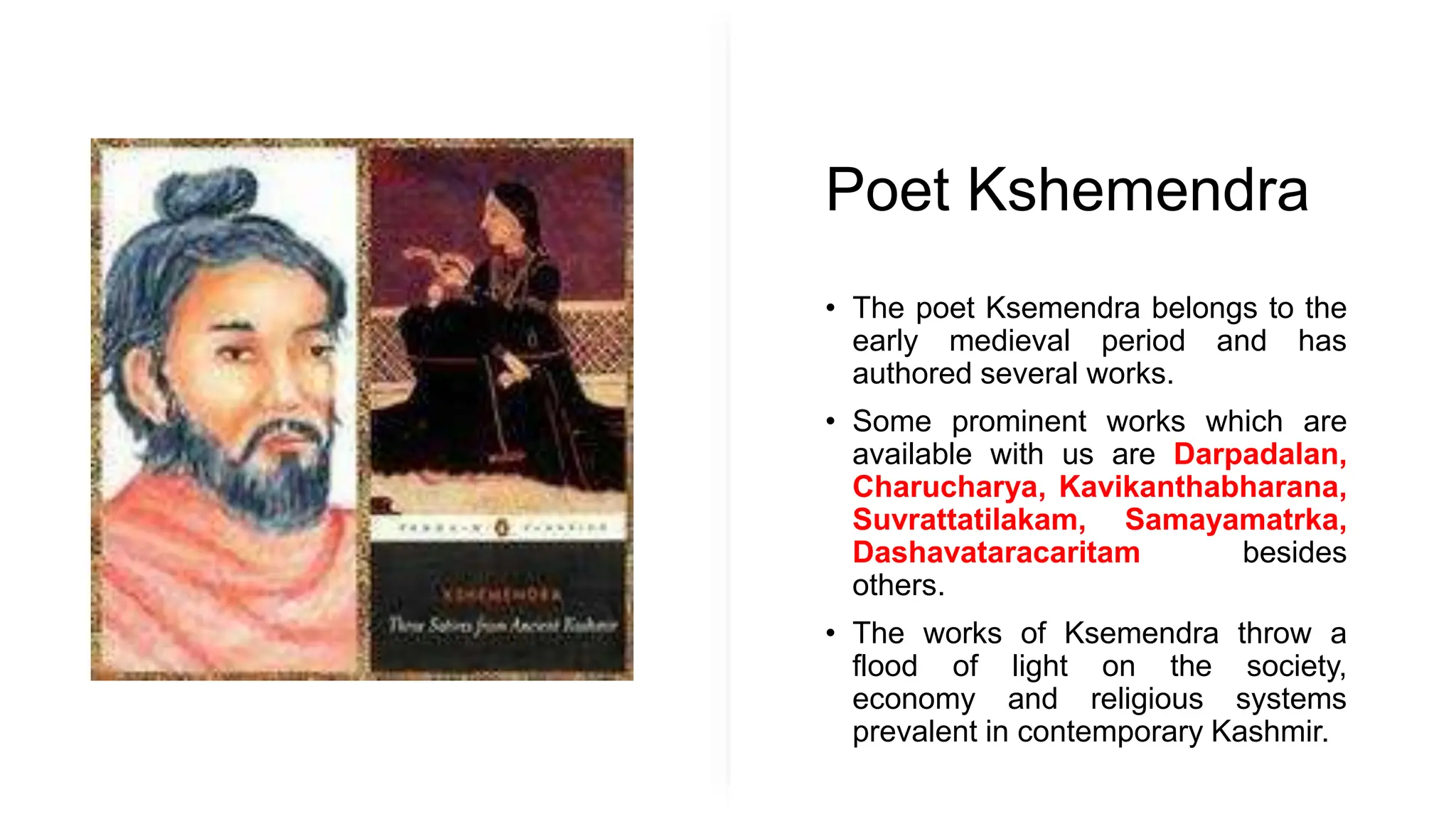
Poet Kshemendra
• The poet Ksemendra belongs to the
early medieval period and has
authored several works.
• Some prominent works which are
available with us are Darpadalan,
Charucharya, Kavikanthabharana,
Suvrattatilakam, Samayamatrka,
Dashavataracaritam besides
others.
• The works of Ksemendra throw a
flood of light on the society,
economy and religious systems
prevalent in contemporary Kashmir.
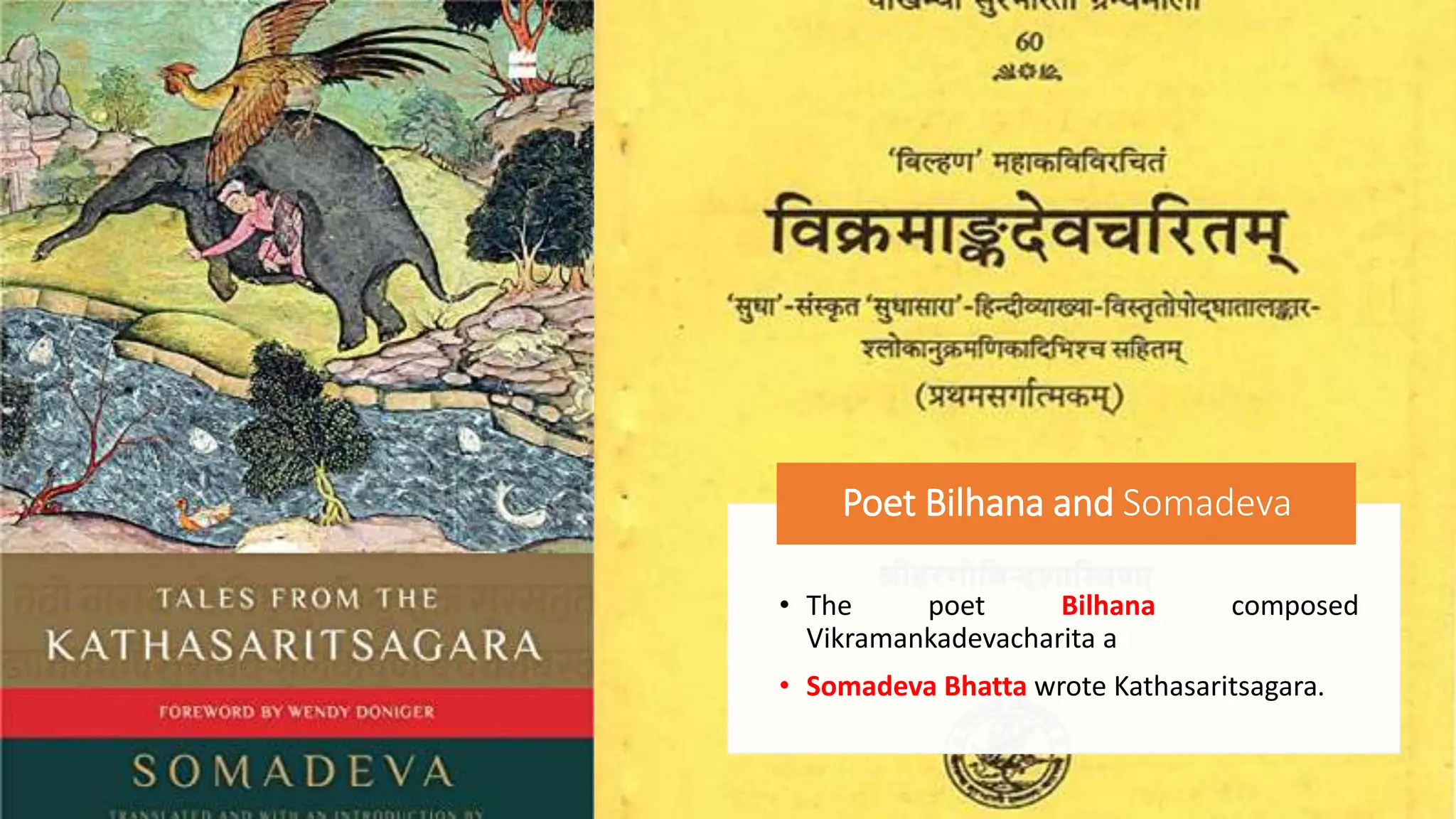
Poet Bilhana and Somadeva
• The poet Bilhana composed
Vikramankadevacharita a
• Somadeva Bhatta wrote Kathasaritsagara.
Rajatarangini
• Besides these works, the magnum opus pertaining to
the history of ancient and early medieval Kashmir is the
Rajatarangini written by Pandit Kalhana. It was
composed in 1148-49 AD by him.
• The Rajatarangini contains eight cantos or eight books
and it records the history of various dynasties which
ruled Kashmir from early days down to the time of the
author.
• Although the first three books are not all that reliable,
the account from the fourth book onwards is considered
fairly accurate and authentic. Thus we have accurate
historical record of the history of Kashmir from the
seventh century onwards.
Persian sources
• Tarikh-i-Kashmir
• Baharistan-i-Shahi
• Mukhtsar-tarikh-i-Kashmir
• Tarikh-i-Rashidi
• Muntakhab-ut-Tawarikh
• Akbarnama
• Tuzuk-i-Jahangiri
Other
importan
t works
Khulasatul
Manaqib
Hilyatul Arifin
Foreign
accounts
Si-yu-ki
Kitab-ul-Hind
Archaeological evidences
• The earliest monumental remains of the historical period have been reported from
Harwan and are dated 3rd to 6th centuries AD. At Uskur, they are dated 2nd to 5th
centuries AD. Harwan is a prominent site where buildings and terracotta tiles have been
excavated. These tiles reveal certain sasanian and central Asian characteristics with a
background of Gandhara art of the 4th or 5th centuries AD.
• The archeological remains of temples constructed during the reign period of Lalitaditya
have been reported. Of these, the majestic ruins of the Sun temple at Martanda clearly
represent the glory and splendour of this period. Several sculptural remains have also
been reported.
• The remains at Avantipura are a fine example of the architectural achievements of the
reign of Avantivarman.
• The stupendous work done by archaeologists like Alexander Cunningham, George Buhler
and Aurel Stein went a long way in unearthing the rich legacy of archaeological remains
existing in Kashmir.
Harwan
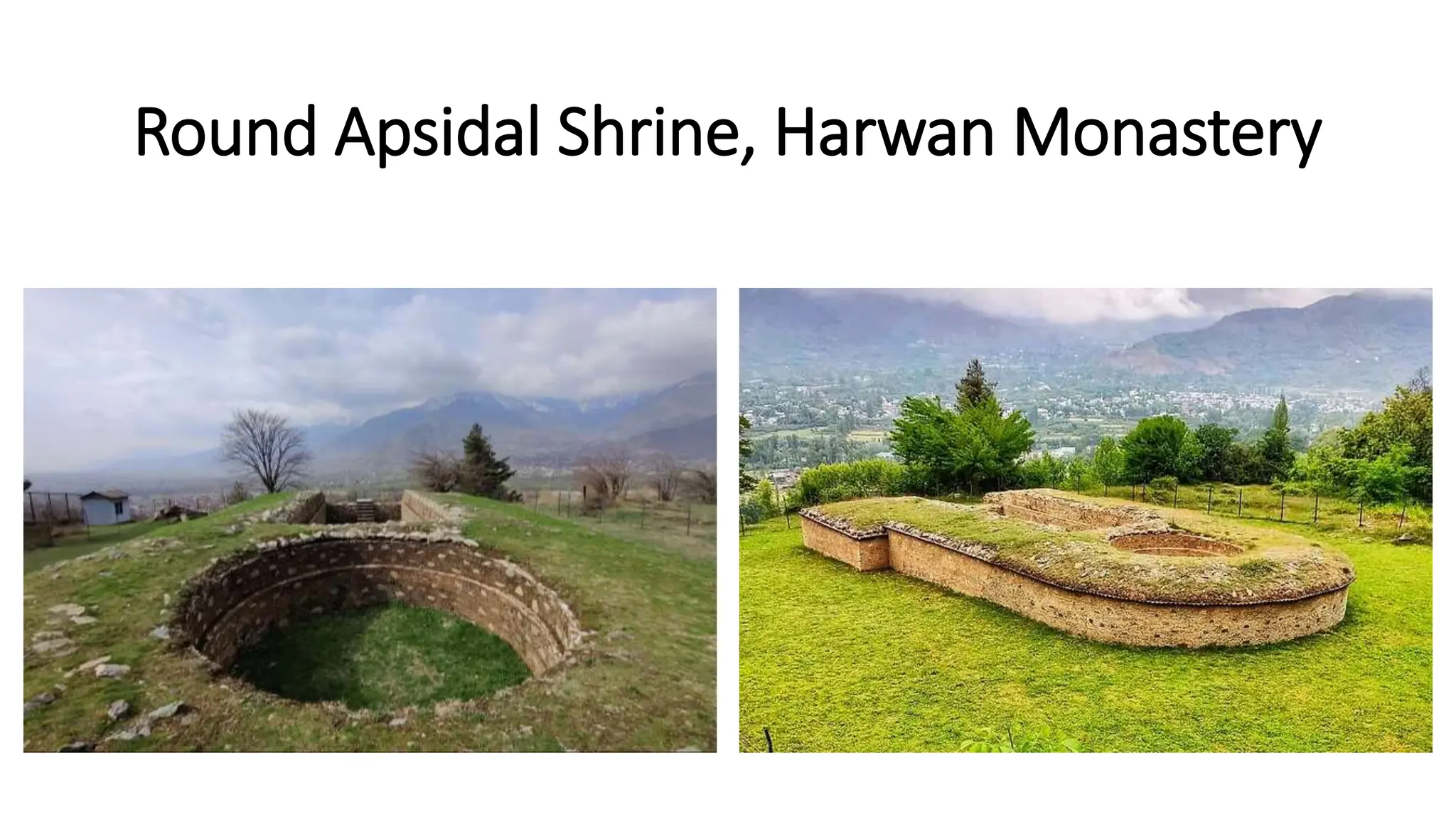
Round Apsidal Shrine, Harwan Monastery
Terracotta tiles
Terracotta tiles
Martanda temple
Martanda temple
Martanda temple
Martanda temple
Martanda temple
AI picture
Numismatic evidences
• The rise of the Karkota dynasty in Kashmir brought forth a regular series of Kashmir coins. These
coins were known by different names, for example, Dinnaras, Swarna Rupaka, Tanka and Kedara.
• Several gold, silver, white metal and copper coins of the kings and queens of Kashmir have been
found from different parts of the valley, north western India and also from Monghyr in Bihar and
Banda in Uttar Pradesh.
• The coins of the Karkotas are of bold but rude worksmanship. They depict the standing king and
seated goddess. It is believed by several historians that the Sri Pratapa coins should be attributed
to King Lalitaditya Muktapida. These coins have been found at Faizabad, Banda, Varanasi,
Monghyr and Nalanda. Since King Durlabhaka had never won over these regions while Lalitaditya
had conquered most of them, they have been attributed to King Lalitaditya. Gold coins bearing the
legend Sri Yasovarma have been attributed to King Samkaravarman of the Utpala dynasty.
• Harshadeva also got minted several coins while his gold and silver coins are few, his copper coins
are abundant.
Early References
• The first historical mention of the land may have been covered by the name
‘Madra-desh’ which had its headquarters at Sakala or Shalkot i.e., the modem
Sialkot which is only 26 miles to the South of Jammu city.
• Raja Shal, the maternal uncle of the Pandus made in roads on Jammu several
times and ultimately conquered it.
• For many generations this territory remained subject to Shal’s successors when at
last 454 years after Kaliyug a certain Raja, named Joti Parkash recovered and
occupied Jammu and afterwards his descendents ruled there unabated.
• It might have happened somewhere in the hoary past of which a legendary
history of Jammu is recorded in the Vanshavali.
• But coming to the historical period, the mention of the state under the name
Durgar occurs on two Chamba copper-plate title deeds dated between 1056 - 66
A. D (first issued by soma-vamam and the second by Soma and Asatta, rulers of
(chamba).
Dogri folk songs and ballads
• An analysis of the Dogri folk-songs published so far presents a great variety of compositions which
falls into two great classes (i) Ballads and (ii) Lyrics
• A great variety of Lyrics, such as Jhanjhotian, bishanpate, dhotru, Pakhan, Nausatra, behne,
Swashi and Gugrian are no more than rhymed over-flow of emotions.
• The Ballad literature of Baran and Karkan and the devotional type is expected to yield some
knowledge of historical facts. But this folk literature fails to give much help to the historians of the
Dogras. They convey only a few dejoined stray facts of social history.
• However, some anecdotes of local history have been preserved in these ballads clad in
superstation and fancy.
• The historic Barans of Mian Diddo, Mehta Basti Ram, Wazir Ratnu, General Zorawar Singh,
General Baj Singh are of considerable historical value.
• Whole of this Balled literature may help a historian in reconstructing a fragmentary picture of the
cultural life of the Dogras.
Archaeological Remains
• Archaeological remains are spread over whole of Jammu region. Recently some archeological
excavation have been conducted in this region and very surprising remains have been found in
Jammu region. Whatever little excavations and survey work has been recently been done in the
district of Jammu, Kathua and Udhampur, it has brought to light stone tools belonging to the early
man.
• These tools are similar to those found in the valley of Sohan river in western Punjab near
Rawalpindi. At Lakhanpur some sites of Pleistocene Age extending from 3 Lakh years to about thirty
thousand years from today were found. These included rough stone tools like ace, hammer,
chopper. In
• Samba area some sites at Nandi, Mananu, Paith and Diyalachak have been discovered which
yielded Paleolithic i.e., early stone age tools like Bi-facial hand ace, uni-facial choppers, scrapers,
discoids and flakes- Southern slopes of the Udhampur district particularly on the banks of Gambher
Khad near the village Kishanpur Nagrota, yielded a few early stone age tools of the kind.
• Those exploitation reveals that the habitation of early stone Age man were scattered all over the
Jammu region lying between the Chenab and Ravi.

Sources of Jammu and Kashmir of Kash.pptx

  • 1.
    Sources of Jammuand Kashmir Dr Amita Gupta Assistant Professor Central University of Jammu
  • 2.
    Sources of KashmirHistory • Literary evidences Sanskrit sources • Nilamata Purana • Kuttanimata kavya • Darpadalan Charucharya, • Kavikanthabharana, • Suvrattatilakam, • Samayamatrka, • Dashavataracaritam • Vikramankadevacaritam • Kathasaritsagara • Rajatarangini • Vishnudharmothar Purana
  • 3.
  • 4.
  • 5.
    Poet Kshemendra • Thepoet Ksemendra belongs to the early medieval period and has authored several works. • Some prominent works which are available with us are Darpadalan, Charucharya, Kavikanthabharana, Suvrattatilakam, Samayamatrka, Dashavataracaritam besides others. • The works of Ksemendra throw a flood of light on the society, economy and religious systems prevalent in contemporary Kashmir.
  • 6.
    Poet Bilhana andSomadeva • The poet Bilhana composed Vikramankadevacharita a • Somadeva Bhatta wrote Kathasaritsagara.
  • 7.
    Rajatarangini • Besides theseworks, the magnum opus pertaining to the history of ancient and early medieval Kashmir is the Rajatarangini written by Pandit Kalhana. It was composed in 1148-49 AD by him. • The Rajatarangini contains eight cantos or eight books and it records the history of various dynasties which ruled Kashmir from early days down to the time of the author. • Although the first three books are not all that reliable, the account from the fourth book onwards is considered fairly accurate and authentic. Thus we have accurate historical record of the history of Kashmir from the seventh century onwards.
  • 8.
    Persian sources • Tarikh-i-Kashmir •Baharistan-i-Shahi • Mukhtsar-tarikh-i-Kashmir • Tarikh-i-Rashidi • Muntakhab-ut-Tawarikh • Akbarnama • Tuzuk-i-Jahangiri
  • 9.
  • 10.
  • 11.
    Archaeological evidences • Theearliest monumental remains of the historical period have been reported from Harwan and are dated 3rd to 6th centuries AD. At Uskur, they are dated 2nd to 5th centuries AD. Harwan is a prominent site where buildings and terracotta tiles have been excavated. These tiles reveal certain sasanian and central Asian characteristics with a background of Gandhara art of the 4th or 5th centuries AD. • The archeological remains of temples constructed during the reign period of Lalitaditya have been reported. Of these, the majestic ruins of the Sun temple at Martanda clearly represent the glory and splendour of this period. Several sculptural remains have also been reported. • The remains at Avantipura are a fine example of the architectural achievements of the reign of Avantivarman. • The stupendous work done by archaeologists like Alexander Cunningham, George Buhler and Aurel Stein went a long way in unearthing the rich legacy of archaeological remains existing in Kashmir.
  • 12.
  • 13.
    Round Apsidal Shrine,Harwan Monastery
  • 14.
  • 15.
  • 16.
  • 17.
  • 18.
  • 19.
  • 20.
  • 21.
  • 22.
    Numismatic evidences • Therise of the Karkota dynasty in Kashmir brought forth a regular series of Kashmir coins. These coins were known by different names, for example, Dinnaras, Swarna Rupaka, Tanka and Kedara. • Several gold, silver, white metal and copper coins of the kings and queens of Kashmir have been found from different parts of the valley, north western India and also from Monghyr in Bihar and Banda in Uttar Pradesh. • The coins of the Karkotas are of bold but rude worksmanship. They depict the standing king and seated goddess. It is believed by several historians that the Sri Pratapa coins should be attributed to King Lalitaditya Muktapida. These coins have been found at Faizabad, Banda, Varanasi, Monghyr and Nalanda. Since King Durlabhaka had never won over these regions while Lalitaditya had conquered most of them, they have been attributed to King Lalitaditya. Gold coins bearing the legend Sri Yasovarma have been attributed to King Samkaravarman of the Utpala dynasty. • Harshadeva also got minted several coins while his gold and silver coins are few, his copper coins are abundant.
  • 23.
    Early References • Thefirst historical mention of the land may have been covered by the name ‘Madra-desh’ which had its headquarters at Sakala or Shalkot i.e., the modem Sialkot which is only 26 miles to the South of Jammu city. • Raja Shal, the maternal uncle of the Pandus made in roads on Jammu several times and ultimately conquered it. • For many generations this territory remained subject to Shal’s successors when at last 454 years after Kaliyug a certain Raja, named Joti Parkash recovered and occupied Jammu and afterwards his descendents ruled there unabated. • It might have happened somewhere in the hoary past of which a legendary history of Jammu is recorded in the Vanshavali. • But coming to the historical period, the mention of the state under the name Durgar occurs on two Chamba copper-plate title deeds dated between 1056 - 66 A. D (first issued by soma-vamam and the second by Soma and Asatta, rulers of (chamba).
  • 24.
    Dogri folk songsand ballads • An analysis of the Dogri folk-songs published so far presents a great variety of compositions which falls into two great classes (i) Ballads and (ii) Lyrics • A great variety of Lyrics, such as Jhanjhotian, bishanpate, dhotru, Pakhan, Nausatra, behne, Swashi and Gugrian are no more than rhymed over-flow of emotions. • The Ballad literature of Baran and Karkan and the devotional type is expected to yield some knowledge of historical facts. But this folk literature fails to give much help to the historians of the Dogras. They convey only a few dejoined stray facts of social history. • However, some anecdotes of local history have been preserved in these ballads clad in superstation and fancy. • The historic Barans of Mian Diddo, Mehta Basti Ram, Wazir Ratnu, General Zorawar Singh, General Baj Singh are of considerable historical value. • Whole of this Balled literature may help a historian in reconstructing a fragmentary picture of the cultural life of the Dogras.
  • 25.
    Archaeological Remains • Archaeologicalremains are spread over whole of Jammu region. Recently some archeological excavation have been conducted in this region and very surprising remains have been found in Jammu region. Whatever little excavations and survey work has been recently been done in the district of Jammu, Kathua and Udhampur, it has brought to light stone tools belonging to the early man. • These tools are similar to those found in the valley of Sohan river in western Punjab near Rawalpindi. At Lakhanpur some sites of Pleistocene Age extending from 3 Lakh years to about thirty thousand years from today were found. These included rough stone tools like ace, hammer, chopper. In • Samba area some sites at Nandi, Mananu, Paith and Diyalachak have been discovered which yielded Paleolithic i.e., early stone age tools like Bi-facial hand ace, uni-facial choppers, scrapers, discoids and flakes- Southern slopes of the Udhampur district particularly on the banks of Gambher Khad near the village Kishanpur Nagrota, yielded a few early stone age tools of the kind. • Those exploitation reveals that the habitation of early stone Age man were scattered all over the Jammu region lying between the Chenab and Ravi.