Sort() Function in
Python Unlocking
the Power of
Sorting Lists
AM – MAY 2023
Outline
 Basic Usage
 Sorting by Key
 Sorting Complex Object
 In-Place vs Non-In-Place Sorting
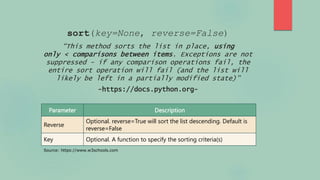
sort(key=None, reverse=False)
“This method sorts the list in place, using
only < comparisons between items. Exceptions are not
suppressed - if any comparison operations fail, the
entire sort operation will fail (and the list will
likely be left in a partially modified state)”
-https://docs.python.org-
Parameter Description
Reverse
Optional. reverse=True will sort the list descending. Default is
reverse=False
Key Optional. A function to specify the sorting criteria(s)
Source: https://www.w3schools.com
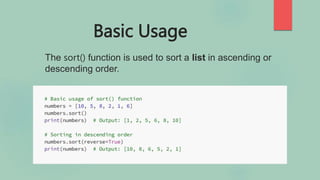
Basic Usage
The sort() function is used to sort a list in ascending or
descending order.
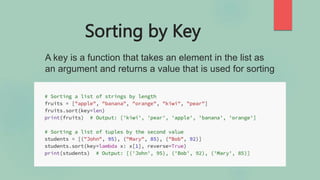
Sorting by Key
A key is a function that takes an element in the list as
an argument and returns a value that is used for sorting
Sorting Complex Object
The sort() function can also be used to sort complex
objects, such as dictionaries and tuples, by specifying a
key function
# Sorting a list of dictionaries by a specific key
people = [{"name": "Alice", "age": 25}, {"name": "Bob", "age": 18}, {"name": "Charlie", "age": 32}]
people.sort(key=lambda x: x["age"])
print(people) # Output: [{'name': 'Bob', 'age': 18}, {'name': 'Alice', 'age': 25}, {'name': 'Charlie',
'age': 32}]
# Sorting a list of tuples by a specific value
inventory = [("apple", 10), ("banana", 5), ("orange", 7)]
inventory.sort(key=lambda x: x[1], reverse=True)
print(inventory) # Output: [('apple', 10), ('orange', 7), ('banana', 5)]
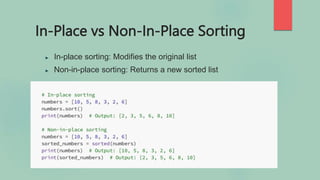
In-Place vs Non-In-Place Sorting
► In-place sorting: Modifies the original list
► Non-in-place sorting: Returns a new sorted list
Sort() Function in
Python Unlocking
the Power of
Sorting Lists
AM – MAY 2023

Sort() Function in Python.pptx

  • 1.
    Sort() Function in PythonUnlocking the Power of Sorting Lists AM – MAY 2023
  • 2.
    Outline  Basic Usage Sorting by Key  Sorting Complex Object  In-Place vs Non-In-Place Sorting
  • 3.
    sort(key=None, reverse=False) “This methodsorts the list in place, using only < comparisons between items. Exceptions are not suppressed - if any comparison operations fail, the entire sort operation will fail (and the list will likely be left in a partially modified state)” -https://docs.python.org- Parameter Description Reverse Optional. reverse=True will sort the list descending. Default is reverse=False Key Optional. A function to specify the sorting criteria(s) Source: https://www.w3schools.com
  • 4.
    Basic Usage The sort()function is used to sort a list in ascending or descending order.
  • 5.
    Sorting by Key Akey is a function that takes an element in the list as an argument and returns a value that is used for sorting
  • 6.
    Sorting Complex Object Thesort() function can also be used to sort complex objects, such as dictionaries and tuples, by specifying a key function # Sorting a list of dictionaries by a specific key people = [{"name": "Alice", "age": 25}, {"name": "Bob", "age": 18}, {"name": "Charlie", "age": 32}] people.sort(key=lambda x: x["age"]) print(people) # Output: [{'name': 'Bob', 'age': 18}, {'name': 'Alice', 'age': 25}, {'name': 'Charlie', 'age': 32}] # Sorting a list of tuples by a specific value inventory = [("apple", 10), ("banana", 5), ("orange", 7)] inventory.sort(key=lambda x: x[1], reverse=True) print(inventory) # Output: [('apple', 10), ('orange', 7), ('banana', 5)]
  • 7.
    In-Place vs Non-In-PlaceSorting ► In-place sorting: Modifies the original list ► Non-in-place sorting: Returns a new sorted list
  • 8.
    Sort() Function in PythonUnlocking the Power of Sorting Lists AM – MAY 2023