SEPARATION OF
POWER
PRESENTED BY: PRIYANKA GODARA
COURSE: LL.M. (CONSTITUTIONAL LAW SPECIALISATION)
ENROLMENT NO: A50801820019
INTRODUCTION
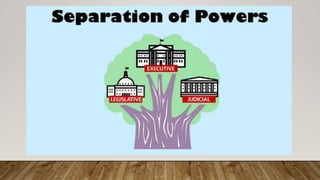
• Separation of powers refers to a system of government in which the
powers are divided among multiple branches of the government.
• In most of the democratic countries, it is accepted that the three
branches are the legislature, the executive and the judiciary.
• These organs work and perform their functions independently, the
executive cannot exercise legislative and judicial powers, the
legislature cannot exercise executive and judicial powers and the
judiciary cannot exercise legislative and executive powers.
THE HISTORICAL EVOLUTION
• Aristotle, in his book ‘Politics’, discussed the concept of separation of powers
stating that every constitution should have a heterogeneous form of government
consisting of mainly three branches: the deliberative, public officials and the
judiciary.
• According to Wade and Phillips, the principle of separation of powers meant three
things: One person should not be made part of more than one branch of the
government. Two there should not be any interference and control of any organ of
the government by the other. Three, no organ of the government should exercise
the functions and powers of the other organ.
OBJECTIVES OF SEPARATION OF
POWERS
• Firstly, it aims to eliminate arbitrariness, totalitarianism and tyranny
and promote an accountable and democratic form of government.
• Secondly, it prevents the misuse of powers within the different
organs of the government. The Indian Constitution provides certain
limits and boundaries for each domain of the government and they
are supposed to perform their function within such limits. In India,
the Constitution is the ultimate sovereign and if anything goes
beyond the provisions of the constitution, it will automatically be
considered as null, void and unconstitutional.
OBJECTIVES OF SEPARATION OF POWER
(CONTD.)
• Thirdly, it keeps a check on all the branches of the government by making
them accountable for themselves.
• Fourthly, separation of powers maintains a balance among the three organs
of government by dividing the powers among them so that powers do not
concentrate on any one branch leading to arbitrariness.
• Fifthly, this principle allows all the branches to specialize themselves in their
respective field with an intention to enhance and improve the efficiency of the
government.
ELEMENTS OF SEPARATION OF POWERS
• Legislative: The legislative organ of the government is also known as the rule-
making body. The primary function of the legislature is to make laws for good
governance of a state. It has the authority of amending the existing rules and
regulations as well. Generally, the parliament holds the power of making rules
and laws.
• Executive: This branch of government is responsible for governing the state. The
executives mainly implement and enforce the laws made by the legislature. The
President and the Bureaucrats form the Executive branch of government.
ELEMENTS OF SEPARATION OF POWERS
(CONTD.)
• Judiciary: Judiciary plays a very crucial role in any state. It interprets
and applies the laws made by the legislature and safeguards the
rights of the individuals. It also resolves the disputes within the state
or internationally.
INDIAN CONSTITUTION AND SEPARATION
OF POWER
Like the United Kingdom, India also practices the parliamentary form
of government in which executive and legislature are linked to each
other. So, the doctrine of separation of powers is not implemented in
its strict sense. However, the composition of our constitution creates
no doubt that the Indian Constitution is bound by the separation of
powers. There are various provisions under the Indian Constitution
that clearly demonstrate the existence of the doctrine of separation of
powers. This principle is followed both at the centre and the state
level.
PROVISIONS THAT SUBSTANTIATE
SEPARATION OF POWER
• Article 53(1) and Article 154 of the Indian Constitution clearly say that the
Executive powers of the Union and the States are vest in the President and
Governor respectively and shall only be exercised directly by him or through his
subordinate officers.
• Article 122 and Article 212 of the Indian Constitution state that the courts cannot
inquire in the proceedings of Parliament and the State Legislature. This ensures
that there will be no interference of the judiciary in the legislature.
• Article 105 and Article 194 of the Indian Constitution specify that the MPs and
MLAs cannot be called by the court for whatever they speak in the session.
PROVISIONS THAT SUBSTANTIATE
SEPARATION OF POWER (CONTD.)
• Article 50 of the Indian Constitution encourages the separation of judiciary from the
executive in the states.
• Article 245 of the Indian Constitution gives authority to Parliament and State
Legislature for making laws for the whole country and the states respectively.
• Article 121 and Article 211 of the Indian Constitution state that the judicial conduct of
any judge of the Supreme Court or High Court shall not be discussed in Parliament or
State Legislature.
• Article 361 of the Indian Constitution specifies that the President and the Governor
are not accountable to any court for exercising their powers and performance of
duties in his office.
JUDICIAL APPROACH TOWARDS SEPARATION
OF POWER IN INDIA
• The very first judgment with relation to the separation of powers was given by
Mukherjee J. in the case of Ram Jawaya Kapur v. State of Punjab. He concluded
that- “ The Constitution of India has not acknowledged the doctrine of separation
of power emphatically but the functions and powers of all the organs have been
adequately distinguished. Thus it would not be wrong to say that Indian
constitution does not behold assumptions rather it works in a flexible manner
considering the needs of the country. So, the executive can exercise the law-
making power only when delegated by the legislature and it is also empowered to
exercise judicial powers within the limits. But on an all, no organ should exercise
its power beyond the provision of the constitution.”
JUDICIAL APPROACH TOWARDS SEPARATION
OF POWER IN INDIA (CONTD.)
• In the case of Indira Nehru Gandhi v. Raj Narain, Ray C. J. said:-
“ A rigid sense of separation of powers which has been given under the
American and Australian constitution does not apply to India.”
Beg J. further added that:- “ The separation of power is a part of the basic
structure of the constitution. So, the schemes of the constitution cannot be
changed even after restoring Article 368 of the Indian Constitution.
JUDICIAL APPROACH TOWARDS SEPARATION
OF POWER IN INDIA (CONTD.)
• In Golak Nath v. State of Punjab, it was observed by Subba Rao C.J. that:-
“ The three organs of the government have to exercise their functions keeping in
mind certain encroachments assigned by the constitution. The constitution
demarcates the jurisdiction of the three organs minutely and expects them to be
exercised within their respective powers without overstepping their limits. All the
organs must function within the spheres allotted to them by the constitution. No
authority which is created by the constitution is supreme. The constitution of India is
sovereign and all the authorities must function under the supreme law of the land
i.e. the Constitution.”
CRITICISMS TO SEPARATION OF POWER
• It is extraordinarily difficult to distinguish the powers of the legislature, executive
and judiciary precisely. A smooth and stable government can exist only if there is
cooperation among the three organs. Any attempt made to separate these organs
into watertight compartments may lead to failure and inefficiency in the
government.
• If this concept is adopted in its totality, then it will become impossible to take
certain actions. Consequently, neither the legislature can delegate the law making
power to the executive which may have expertise in the subject matter, nor the
courts can make laws related to the functioning of courts and proceedings.
CRITICISMS TO SEPARATION OF POWER
(CONTD.)
• In the present scenario, a state works for the welfare and prosperity of the people.
It has to resolve the complex issues of society. In such circumstances, the
principle of separation of power seems to be impossible. The imposition of this
doctrine in its rigid conception will not lead to the effectuation of the objectives of
the modern state. Thus, separation of power is theoretically improbable and
practically impossible.
• Montesquieu, by propounding this theory aimed to protect and safeguard the
freedom and liberty of the individuals which is impossible by the strict
enforcement of separation of powers.
CONCLUSION
The doctrine of separation of powers must be interpreted in a relative form. In the
era of liberalisation, privatisation and globalisation, separation of power has to be
expounded in a wider perspective. It should not be curb to the principle of restraint
or strict classification only but a group power exercised in the spirit of cooperation,
coordination and in the interest of the welfare of the state. Though this doctrine is
unfeasible in its rigid perception nevertheless its effectiveness lies in the
prominence on those checks and balances which are necessary in order to avert
maladroit government and to prevent abuse of powers by the different organs of the
government.

SOP presentation

  • 1.
    SEPARATION OF POWER PRESENTED BY:PRIYANKA GODARA COURSE: LL.M. (CONSTITUTIONAL LAW SPECIALISATION) ENROLMENT NO: A50801820019
  • 2.
    INTRODUCTION • Separation ofpowers refers to a system of government in which the powers are divided among multiple branches of the government. • In most of the democratic countries, it is accepted that the three branches are the legislature, the executive and the judiciary. • These organs work and perform their functions independently, the executive cannot exercise legislative and judicial powers, the legislature cannot exercise executive and judicial powers and the judiciary cannot exercise legislative and executive powers.
  • 4.
    THE HISTORICAL EVOLUTION •Aristotle, in his book ‘Politics’, discussed the concept of separation of powers stating that every constitution should have a heterogeneous form of government consisting of mainly three branches: the deliberative, public officials and the judiciary. • According to Wade and Phillips, the principle of separation of powers meant three things: One person should not be made part of more than one branch of the government. Two there should not be any interference and control of any organ of the government by the other. Three, no organ of the government should exercise the functions and powers of the other organ.
  • 5.
    OBJECTIVES OF SEPARATIONOF POWERS • Firstly, it aims to eliminate arbitrariness, totalitarianism and tyranny and promote an accountable and democratic form of government. • Secondly, it prevents the misuse of powers within the different organs of the government. The Indian Constitution provides certain limits and boundaries for each domain of the government and they are supposed to perform their function within such limits. In India, the Constitution is the ultimate sovereign and if anything goes beyond the provisions of the constitution, it will automatically be considered as null, void and unconstitutional.
  • 6.
    OBJECTIVES OF SEPARATIONOF POWER (CONTD.) • Thirdly, it keeps a check on all the branches of the government by making them accountable for themselves. • Fourthly, separation of powers maintains a balance among the three organs of government by dividing the powers among them so that powers do not concentrate on any one branch leading to arbitrariness. • Fifthly, this principle allows all the branches to specialize themselves in their respective field with an intention to enhance and improve the efficiency of the government.
  • 7.
    ELEMENTS OF SEPARATIONOF POWERS • Legislative: The legislative organ of the government is also known as the rule- making body. The primary function of the legislature is to make laws for good governance of a state. It has the authority of amending the existing rules and regulations as well. Generally, the parliament holds the power of making rules and laws. • Executive: This branch of government is responsible for governing the state. The executives mainly implement and enforce the laws made by the legislature. The President and the Bureaucrats form the Executive branch of government.
  • 8.
    ELEMENTS OF SEPARATIONOF POWERS (CONTD.) • Judiciary: Judiciary plays a very crucial role in any state. It interprets and applies the laws made by the legislature and safeguards the rights of the individuals. It also resolves the disputes within the state or internationally.
  • 9.
    INDIAN CONSTITUTION ANDSEPARATION OF POWER Like the United Kingdom, India also practices the parliamentary form of government in which executive and legislature are linked to each other. So, the doctrine of separation of powers is not implemented in its strict sense. However, the composition of our constitution creates no doubt that the Indian Constitution is bound by the separation of powers. There are various provisions under the Indian Constitution that clearly demonstrate the existence of the doctrine of separation of powers. This principle is followed both at the centre and the state level.
  • 10.
    PROVISIONS THAT SUBSTANTIATE SEPARATIONOF POWER • Article 53(1) and Article 154 of the Indian Constitution clearly say that the Executive powers of the Union and the States are vest in the President and Governor respectively and shall only be exercised directly by him or through his subordinate officers. • Article 122 and Article 212 of the Indian Constitution state that the courts cannot inquire in the proceedings of Parliament and the State Legislature. This ensures that there will be no interference of the judiciary in the legislature. • Article 105 and Article 194 of the Indian Constitution specify that the MPs and MLAs cannot be called by the court for whatever they speak in the session.
  • 11.
    PROVISIONS THAT SUBSTANTIATE SEPARATIONOF POWER (CONTD.) • Article 50 of the Indian Constitution encourages the separation of judiciary from the executive in the states. • Article 245 of the Indian Constitution gives authority to Parliament and State Legislature for making laws for the whole country and the states respectively. • Article 121 and Article 211 of the Indian Constitution state that the judicial conduct of any judge of the Supreme Court or High Court shall not be discussed in Parliament or State Legislature. • Article 361 of the Indian Constitution specifies that the President and the Governor are not accountable to any court for exercising their powers and performance of duties in his office.
  • 12.
    JUDICIAL APPROACH TOWARDSSEPARATION OF POWER IN INDIA • The very first judgment with relation to the separation of powers was given by Mukherjee J. in the case of Ram Jawaya Kapur v. State of Punjab. He concluded that- “ The Constitution of India has not acknowledged the doctrine of separation of power emphatically but the functions and powers of all the organs have been adequately distinguished. Thus it would not be wrong to say that Indian constitution does not behold assumptions rather it works in a flexible manner considering the needs of the country. So, the executive can exercise the law- making power only when delegated by the legislature and it is also empowered to exercise judicial powers within the limits. But on an all, no organ should exercise its power beyond the provision of the constitution.”
  • 13.
    JUDICIAL APPROACH TOWARDSSEPARATION OF POWER IN INDIA (CONTD.) • In the case of Indira Nehru Gandhi v. Raj Narain, Ray C. J. said:- “ A rigid sense of separation of powers which has been given under the American and Australian constitution does not apply to India.” Beg J. further added that:- “ The separation of power is a part of the basic structure of the constitution. So, the schemes of the constitution cannot be changed even after restoring Article 368 of the Indian Constitution.
  • 14.
    JUDICIAL APPROACH TOWARDSSEPARATION OF POWER IN INDIA (CONTD.) • In Golak Nath v. State of Punjab, it was observed by Subba Rao C.J. that:- “ The three organs of the government have to exercise their functions keeping in mind certain encroachments assigned by the constitution. The constitution demarcates the jurisdiction of the three organs minutely and expects them to be exercised within their respective powers without overstepping their limits. All the organs must function within the spheres allotted to them by the constitution. No authority which is created by the constitution is supreme. The constitution of India is sovereign and all the authorities must function under the supreme law of the land i.e. the Constitution.”
  • 15.
    CRITICISMS TO SEPARATIONOF POWER • It is extraordinarily difficult to distinguish the powers of the legislature, executive and judiciary precisely. A smooth and stable government can exist only if there is cooperation among the three organs. Any attempt made to separate these organs into watertight compartments may lead to failure and inefficiency in the government. • If this concept is adopted in its totality, then it will become impossible to take certain actions. Consequently, neither the legislature can delegate the law making power to the executive which may have expertise in the subject matter, nor the courts can make laws related to the functioning of courts and proceedings.
  • 16.
    CRITICISMS TO SEPARATIONOF POWER (CONTD.) • In the present scenario, a state works for the welfare and prosperity of the people. It has to resolve the complex issues of society. In such circumstances, the principle of separation of power seems to be impossible. The imposition of this doctrine in its rigid conception will not lead to the effectuation of the objectives of the modern state. Thus, separation of power is theoretically improbable and practically impossible. • Montesquieu, by propounding this theory aimed to protect and safeguard the freedom and liberty of the individuals which is impossible by the strict enforcement of separation of powers.
  • 17.
    CONCLUSION The doctrine ofseparation of powers must be interpreted in a relative form. In the era of liberalisation, privatisation and globalisation, separation of power has to be expounded in a wider perspective. It should not be curb to the principle of restraint or strict classification only but a group power exercised in the spirit of cooperation, coordination and in the interest of the welfare of the state. Though this doctrine is unfeasible in its rigid perception nevertheless its effectiveness lies in the prominence on those checks and balances which are necessary in order to avert maladroit government and to prevent abuse of powers by the different organs of the government.