Sonification Design From Data to Intelligible
Soundfields David Worrall download
https://textbookfull.com/product/sonification-design-from-data-
to-intelligible-soundfields-david-worrall/
Download full version ebook from https://textbookfull.com
We believe these products will be a great fit for you. Click
the link to download now, or visit textbookfull.com
to discover even more!
R Visualizations: Derive Meaning from Data 1st Edition
David Gerbing
https://textbookfull.com/product/r-visualizations-derive-meaning-
from-data-1st-edition-david-gerbing/
Policing 4th Edition John L. Worrall
https://textbookfull.com/product/policing-4th-edition-john-l-
worrall/
Pro Ember Data: Getting Ember Data to Work with Your
API David Tang
https://textbookfull.com/product/pro-ember-data-getting-ember-
data-to-work-with-your-api-david-tang/
Idea Searching for Design How to Research and Develop
Design Concepts David Bramston
https://textbookfull.com/product/idea-searching-for-design-how-
to-research-and-develop-design-concepts-david-bramston/
Nanobiosensors From Design to Applications Aiguo Wu
https://textbookfull.com/product/nanobiosensors-from-design-to-
applications-aiguo-wu/
Making Sense of Sensors: End-to-End Algorithms and
Infrastructure Design from Wearable-Devices to Data
Center 1st Edition Omesh Tickoo
https://textbookfull.com/product/making-sense-of-sensors-end-to-
end-algorithms-and-infrastructure-design-from-wearable-devices-
to-data-center-1st-edition-omesh-tickoo/
Pro Ember Data Getting Ember Data to Work with Your API
1st Edition David Tang
https://textbookfull.com/product/pro-ember-data-getting-ember-
data-to-work-with-your-api-1st-edition-david-tang/
Network Security Through Data Analysis From Data to
Action 2nd Edition Michael Collins
https://textbookfull.com/product/network-security-through-data-
analysis-from-data-to-action-2nd-edition-michael-collins/
Battle of Berlin 1943–44: Bomber Harris' Gamble to End
the War 1st Edition Richard Worrall
https://textbookfull.com/product/battle-of-berlin-1943-44-bomber-
harris-gamble-to-end-the-war-1st-edition-richard-worrall/
Human–Computer Interaction Series
Sonification
Design
DavidWorrall
From Data to Intelligible Soundfields
Human–Computer Interaction Series
Editors-in-Chief
Desney Tan
Microsoft Research, Redmond, WA, USA
Jean Vanderdonckt
Louvain School of Management, Université catholique de Louvain,
Louvain-La-Neuve, Belgium
The Human-Computer Interaction Series, launched in 2004, publishes books that
advance the science and technology of developing systems which are effective and
satisfying for people in a wide variety of contexts. Titles focus on theoretical
perspectives (such as formal approaches drawn from a variety of behavioural
sciences), practical approaches (such as techniques for effectively integrating user
needs in system development), and social issues (such as the determinants of utility,
usability and acceptability).
HCI is a multidisciplinary field and focuses on the human aspects in the
development of computer technology. As technology becomes increasingly more
pervasive the need to take a human-centred approach in the design and
development of computer-based systems becomes ever more important.
Titles published within the Human–Computer Interaction Series are included in
Thomson Reuters’ Book Citation Index, The DBLP Computer Science
Bibliography and The HCI Bibliography.
More information about this series at http://www.springer.com/series/6033
David Worrall
Sonification Design
From Data to Intelligible Soundfields
123
David Worrall
Department of Audio Arts and Acoustics
Columbia College Chicago
Chicago, IL, USA
ISSN 1571-5035 ISSN 2524-4477 (electronic)
Human–Computer Interaction Series
ISBN 978-3-030-01496-4 ISBN 978-3-030-01497-1 (eBook)
https://doi.org/10.1007/978-3-030-01497-1
© Springer Nature Switzerland AG 2019
This work is subject to copyright. All rights are reserved by the Publisher, whether the whole or part
of the material is concerned, specifically the rights of translation, reprinting, reuse of illustrations,
recitation, broadcasting, reproduction on microfilms or in any other physical way, and transmission
or information storage and retrieval, electronic adaptation, computer software, or by similar or dissimilar
methodology now known or hereafter developed.
The use of general descriptive names, registered names, trademarks, service marks, etc. in this
publication does not imply, even in the absence of a specific statement, that such names are exempt from
the relevant protective laws and regulations and therefore free for general use.
The publisher, the authors and the editors are safe to assume that the advice and information in this
book are believed to be true and accurate at the date of publication. Neither the publisher nor the
authors or the editors give a warranty, expressed or implied, with respect to the material contained
herein or for any errors or omissions that may have been made. The publisher remains neutral with regard
to jurisdictional claims in published maps and institutional affiliations.
This Springer imprint is published by the registered company Springer Nature Switzerland AG
The registered company address is: Gewerbestrasse 11, 6330 Cham, Switzerland
For Bek
My Angkor, Wat
Preface and Acknowledgements
This book is about the contemporary design practice known as data sonification,
which assists us to experience information by listening, much as we understand
relationships between spatial features by viewing a graph of them. Data sonification
begins with the observation that sounds can convey meanings in a multiplicity of
circumstances: Exploring the structure of deep space, detecting a stock-market
bubble, assisting injured patients to recover more quickly with less pain, monitoring
the flow of traffic to help detect potential congestion, improving sporting perfor-
mance, tracking storms, earthquakes and other changes in the environment … and
the list could go on: hundreds of applications that rely on studies in acoustics and
psychoacoustics, philosophy of perception, cognitive psychology, computer sci-
ence, creative auditory design and music composition.
Data sonification grew out of an interest by composers in generating musical
forms with the assistance of computers: algorithmic compositions based on both
traditional musical languages, and the exploration of mathematical models of nat-
ural and abstract worlds. With ears searching for new means of expressing the
contemporary world, they explored such fields as fractal geometry, neural networks,
iterated function and reaction–diffusion systems, and flocking and herding. As
computer processing speeds and storage capacity increased, and digital networks
evolved, it became possible to use large datasets from real and real-time systems,
not just abstract idealized models, and this led us into the currently emerging era of
Big Data.
One of the motivations for this book was to understand some of the perceptual
and conceptual correlates of intelligible data sonification so as to encapsulate the
knowledge-bases that underpin them in software design. For example, the psy-
choacoustic, gestural and psycho-physiological substrates such as cognitive-load
sensitivity and emotional valence, with low-level latent functions that can be
compiled into higher level interactive modelling tools. Design is an inherently
‘messy’ and iterative activity that, while a process, may never be entirely proce-
dural. So, the purpose here is not to trivialize the skills of an experienced designer,
but to hierarchize the masking of many of the functional decisions made in
designing, including such processes as equal-loudness contouring and modal
vii
convex pitch and time transforms. It is hoped that in doing so, novice designers
might consider more adventurous possibilities and experienced designers will be
enabled to implement complex procedures more flexibly: to test multiple different
approaches to sonifying a dataset.
Part I: Theory
Chapter 1: The idea that sound can reliably convey information predates the modern
era. The term data sonification has evolved along with its applications and use-
fulness in various disciplines. It can be broadly described as the creation and study
of the aural representation of information, or the use of sound to convey
non-linguistic information. As a field of contemporary enquiry and design practice,
it is young, interdisciplinary and evolving; existing in parallel to the field of data
visualization, which is concerned with the creation and study of the visual repre-
sentation of information. Sonification and visualization techniques have many
applications in ‘humanizing’ information, particularly when applied to large and
complex sets of data. Drawing on ancient practices such as auditing, and the use of
information messaging in music, this chapter provides an historical understanding
of how sound and its representational deployment in communicating information
has changed. In doing so, it aims to encourage critical awareness of some of the
socio-cultural as well as technical assumptions often adopted in sonifying data,
especially those that have been developed in the context of Western music of the
past half-century or so. Whilst acknowledging the Eurocentricity of the enquiry,
there is no suggestion that the ideas discussed do not have wider applicability.
Chapter 2: Encompassing ideas and techniques from music composition, per-
ceptual psychology, computer science, acoustics, biology and philosophy, data
sonification is a multi- even trans-disciplinary practice. This Chapter summarizes
different ways sonification has been defined, the types and classifications of data
that it attempts to represent with sound, and how these representations perform
under the pressure of various real-world utilizations.
Chapter 3: One task of data sonification is to provide a means by which listeners
can obtain new ideas about the nature of the source of derived data. In so doing they
can increase their knowledge and comprehension of that source and thus improve
the efficiency, accuracy and/or quality of their knowledge acquisition and any
decision-making based on it. The purpose of this chapter is to develop an historical
understanding of what information is as a concept, how information can be rep-
resented in various forms as something that can be communicated with non-verbal
sonic structures between its source and its (human) receiver and thus retained as
knowledge. Whilst a complete philosophical and psychological overview of these
issues is outside the scope of the chapter, it is important, in the context of devel-
oping computational design strategies that enable such communication, to gain an
understanding of some of the basic concepts involved. A quasi-historical episte-
mology of human perception and the types of information these epistemologies
viii Preface and Acknowledgements
engender is followed by a discussion of the phenomenal nature of sounds and sonic
structures their ability to convey information of various sorts.
Chapter 4: The previous chapter traced a path towards an understanding of the
inadequacy of epistemological approaches to knowledge formation that do not
account for the deeply embodied nature of perception, to succeed in solving any but
highly constrained problems. The slower-than-expected rise in the effectiveness of
artificial intelligence provided the impetus for a more critical examination of the
ontological dimensions of perception and human knowledge, which necessitated
the recognition of another form of truth which is not derived empirically but from
meaningful action. This chapter enunciates this Pragmatist approach as it can be
applied to sonification design: a generative activity in which bespoke design skills
are supported by scientific research in biology, perception, cognitive science—in
the field of conceptual metaphor theory in particular, and aesthetics. It proceeds to
outline pertinent features of a broad design methodology based on the under-
standings developed that could yield to computational support.
Chapter 5: The need for better software tools for data sonification was high-
lighted in the 1997 Sonification Report, the first comprehensive status review of the
field which included some general proposals for adapting sound synthesis software
to the needs of sonification research. It outlined the reasons the demands on soft-
ware by sonification research are greater than those afforded by music composition
and sound synthesis software alone. As its Sample Research Proposal acknowl-
edged, the development of a comprehensive sonification shell is not easy and the
depth and breadth of knowledge, and skills required to effect such a project are
easily underestimated. Although many of the tools developed to date have various
degrees of flexibility and power for the integration of sound synthesis and data
processing, a complete heterogeneous Data Sonification Design Framework
(DSDF) for research and auditory display has not yet emerged. This chapter out-
lines the requirements for such a comprehensive framework, and proposes an
integration of various existing independent components such as those for data
acquisition, storage and analysis, together with a means to include new work on
cognitive and perceptual mappings, and user interface and control, by encapsulating
them, or control of them, as Python libraries, as well as a wrappers for new
initiatives, which together, form the basis of SoniPy, a comprehensive toolkit for
computational sonification designing.
Part II: Praxis
Chapter 6: Having established the design criteria for a comprehensive heteroge-
neous data sonification software framework in the previous chapter, this chapter
introduces two pillars of such a framework, the Python and Csound programming
languages, as integrated through a Python–Csound Application Programming
Interface. The result is a mature, stable, flexible and comprehensive combination of
Preface and Acknowledgements ix
tools suitable for real and non-realtime sonification, some of the features of which
are illustrated in the examples of subsequent chapters.
Chapter 7: Despite intensive study, a comprehensive understanding of the
structure of capital market trading data remains elusive. The one known application
of audification to market price data reported in 1990 that it was difficult to interpret
the results, probably because the market does not resonate according to acoustic
laws. This chapter illustrates some techniques for transforming data so it does
resonate; so audification may be used as a means of identifying autocorrelation in
trading–and similar–datasets. Some experiments to test the veracity of this process
are described in detail, along with the computer code used to produce them. Also
reported are some experiments in which the data is sonified using a homomorphic
modulation technique. The results obtained indicate that the technique may have a
wider application to other similarly structured time-series datasets.
Chapter 8: The previous chapter explored the use of audification of a numerical
series, each member representing the daily closing value of an entire stock market,
to observe the cross-correlation (trending) within the market itself. This chapter
employs parameter-mapping sonification to study the perceptual flow of all trades
in individual stock groupings over a trading day by applying various filters and
selection methodologies to a detailed ‘tick’ dataset. It outlines the use of a size/mass
metaphorical model of market activity and the simultaneous use of two opposing
conceptual paradigms without apparent conceptual contradiction or cognitive dis-
sonance to demonstrate, given conducive conditions, the power of intention over
perception and sensation, in auditory information seeking.
Chapter 9: The design of a real-time monitor for an organization’s digital net-
work can produce several significant design challenges, both from the technical and
human operational perspectives. One challenge is how to capture network data with
minimal impact on the network itself. Also, from an operational perspective, sounds
need to perform en suite over long periods of time while producing only minimal
listener fatigue. This chapter describes two related network data sonification pro-
jects which resulted in a set of audiovisual “concert” compositions (Corpo Real), an
immersive installation, and a perceptual monitoring tool (Netson). This tool uses
both sonification and visualization to present monitoring humans with features of
data flow that allow them to experience selectable operational network character-
istics. In doing so, it can be used to assist in the peripheral monitoring of a network
for improved operational performance.
Code and audio examples for this book are available at https://github.com/david-
worrall/springer/.
Acknowledgements
Gregory Kramer had a particular vision and commitment to establishing auditory
display as a legitimate discipline. His organizing of the first conference in 1992,
followed by the editing and publication of the extended proceedings, Auditory
x Preface and Acknowledgements
display: Sonification, Audification, and Auditory Interfaces, produced a go-to ref-
erence for researchers in the field until the publication, in 2011, of The Sonification
Handbook, with major contributions by many members of the community under the
inciteful editorship of Thomas Hermann, Andy Hunt and John Neuhoff.
Over the past 10 years or so, various strands of the work in this book have
appeared in papers for the International Conference for Auditory Display and I am
grateful to many of the members of that diverse community for their annual col-
legiality, vigorous debate and general bonhomie. In 2009, my first attempt at a
succinct overview of the field (Chap. 2) was published in The Oxford Handbook of
Computer Music and Digital Sound Culture, edited by Roger Dean. Roger was
brave enough, with Mitchell Whitelaw, to supervise my Ph.D. which eventually
also formed the foundation for parts of Chaps. 3, 5, 7 and 8, for the latter of which,
the Capital Markets Cooperative Research Centre in Sydney funded the experi-
ments and provided the data. The securities trading data techniques discussed in
Chap. 7 were first published in the Springer’s 2010 Lecture Notes in Computer
Science volume on Auditory Display. The research and development for the net-
work sonifications reported in Chap. 9 was undertaken, in addition to other work
with Norberto Degara, during 2013–16, whilst a Professorial Research Fellow, at
Fraunhofer IIS, in Erlangen, Germany, at Frederik Nagel’s International Audio
Laboratories, under the leadership of the Institute Director, Albert Heuberger.
I am often struck by how even a small sense of the influences on a writer can
provide meaningful insights into their work. In that spirit, I mention some.
However, lest it resulted in too autobiographical an appearance, I omit details of
years of music-making and restless inquisitiveness in the arts of mathematics and
animal anatomy. I spent the mid-1980s as a member of the Composition
Department in the Faculty of Music, and in the Computer Science Department at
The University Melbourne, followed by 15 years of research and teaching at the
School of Music and the Australian Centre for the Arts and Technology (ACAT) at
the Australian National University in Canberra, and, more recently, in the Audio
Arts and Acoustic Department at Columbia College Chicago. In order not to draw
the wrath of any individual inadvertently missed from what would be a long list,
most of the names accompany mine on conference papers, in journal articles and
concert programs, so I defer to another time to name them all individually. I have
been fortunate to work with a few people who have dedicated their talents to
working behind the scenes in technical and assistive capacities, and without whom
everything would have ground to a halt: Les Craythorn in Melbourne, Niven Stines
and Julie Fraser in Canberra, and David Knuth and Maria Ratulowska in Chicago.
This work is grounded in an intellectual and artistic experimental tradition, from
which I have been blessed with more than my fair share of excellent mentors. Out
of respect for those traditions and in honor of them, I also invoke the spirits of those
who have passed, thus: Richard Meale (and through him), Winifred Burston,
Ferruccio Busoni, Frans Liszt, Carl Maria von Weber, Carl Philipp Emmanuel Bach
and his father Johan Sebastian, John Bull, Carlos Gesualdo … That thread has been
crisscrossed in my own life by various others, including Tristram Cary, Iannis
Xenakis, Olivier Messiaen and Jean-Claude Risset. Richard was a mentor, friend
Preface and Acknowledgements xi
and as fierce critic as he was an experimentalist: in music, chess and cooking.
Although we fought bitterly as he was overcome by the affliction of postmodernism
in his latter years, he wrote some of the best music of his generation. He is deeply
missed.
Thanks go to the editorial staff at Springer for their encouragement and
long-suffering: tolerance way beyond reasonable expectations. I was not to know, at
the time of discussing publishing with them in 2015, that this book would be
written in ten residences on three continents. That it has appeared at all is a minor
miracle, performed by my beautiful, gracious, strong and unbelievably perceptive
wife, Rebekah, who, with Isaac and Catheryn have been my constant companions
and family support throughout. As we have lived out our semi-nomadic existence,
their day-long ‘visits’ to the local library, wherever we were, so “Dad could work
on the book” has not been easy for them, and we’re looking forward to a summer of
bikes and music-making.
Oak Park, Illinois David Worrall
March 2019
I like to listen. I have learned a great deal from listening carefully. Most people never listen.
(Ernest Hemmingway, my Oak Park neighbor before I moved in.)
xii Preface and Acknowledgements
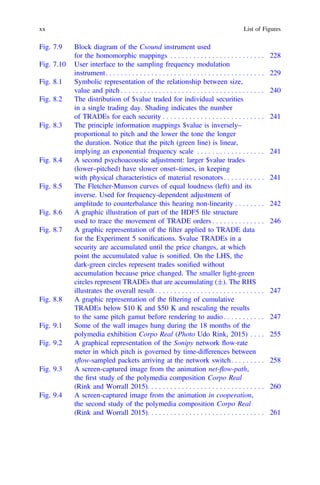
Contents
Part I Theory
1 Data Sonification: A Prehistory . . . . . . . . . . . . . . . . . . . . . . . . . . . . 3
1.1 An Ancient and Modern Practice . . . . . . . . . . . . . . . . . . . . . . . . 3
1.2 Ancient Egyptian Use of Sound to Convey Information . . . . . . . 5
1.3 The Ancient Greek Understanding of Music . . . . . . . . . . . . . . . . 6
1.3.1 Numerical Rationality . . . . . . . . . . . . . . . . . . . . . . . . . . 6
1.3.2 Empirical Experience . . . . . . . . . . . . . . . . . . . . . . . . . . 7
1.3.3 Expressive Power . . . . . . . . . . . . . . . . . . . . . . . . . . . . . 8
1.4 The Ear as the Central Organ of the Church. . . . . . . . . . . . . . . . 8
1.5 Music as Language and Rhetoric . . . . . . . . . . . . . . . . . . . . . . . . 10
1.6 The Rise of Abstract Instrumental Music . . . . . . . . . . . . . . . . . . 11
1.7 “Organizing the Delirium” . . . . . . . . . . . . . . . . . . . . . . . . . . . . 12
1.8 From Program Music to Programmed Music . . . . . . . . . . . . . . . 14
1.9 Algorithmic Composition and Data Sonification . . . . . . . . . . . . . 15
1.10 Purposeful Listening: Music and Sonification . . . . . . . . . . . . . . . 16
1.11 Musical Notation as Representation . . . . . . . . . . . . . . . . . . . . . . 18
References . . . . . . . . . . . . . . . . . . . . . . . . . . . . . . . . . . . . . . . . . . . . . 19
2 Sonification: An Overview . . . . . . . . . . . . . . . . . . . . . . . . . . . . . . . . 23
2.1 Classifying Sonifications . . . . . . . . . . . . . . . . . . . . . . . . . . . . . . 25
2.2 Data-Type Representations . . . . . . . . . . . . . . . . . . . . . . . . . . . . 27
2.2.1 Discrete Data Representations . . . . . . . . . . . . . . . . . . . . 27
2.2.2 Continuous Data Representations . . . . . . . . . . . . . . . . . 36
2.3 Interactive Data Representations . . . . . . . . . . . . . . . . . . . . . . . . 41
2.3.1 Sound Graphs . . . . . . . . . . . . . . . . . . . . . . . . . . . . . . . 41
2.3.2 Physical Models and Model-Based Sonifications . . . . . . 41
2.4 Sonification Research . . . . . . . . . . . . . . . . . . . . . . . . . . . . . . . . 44
2.4.1 Music Psychology . . . . . . . . . . . . . . . . . . . . . . . . . . . . 44
2.4.2 Computational Tools . . . . . . . . . . . . . . . . . . . . . . . . . . 45
xiii
2.5 Design . . . . . . . . . . . . . . . . . . . . . . . . . . . . . . . . . . . . . . . . . . . 47
2.6 Summary . . . . . . . . . . . . . . . . . . . . . . . . . . . . . . . . . . . . . . . . . 50
References . . . . . . . . . . . . . . . . . . . . . . . . . . . . . . . . . . . . . . . . . . . . . 50
3 Knowledge and Information . . . . . . . . . . . . . . . . . . . . . . . . . . . . . . . 55
3.1 Introduction . . . . . . . . . . . . . . . . . . . . . . . . . . . . . . . . . . . . . . . 55
3.2 Knowledge . . . . . . . . . . . . . . . . . . . . . . . . . . . . . . . . . . . . . . . . 56
3.2.1 Types of Knowledge . . . . . . . . . . . . . . . . . . . . . . . . . . 57
3.2.2 Methods of Acquiring Knowledge. . . . . . . . . . . . . . . . . 59
3.3 Information . . . . . . . . . . . . . . . . . . . . . . . . . . . . . . . . . . . . . . . 61
3.3.1 Information as Quantity of Improbabilities . . . . . . . . . . . 62
3.3.2 Information: General, Scientific and Pragmatic . . . . . . . . 63
3.3.3 Forms of Perceptual Information . . . . . . . . . . . . . . . . . . 64
3.3.4 Platonic Ideals . . . . . . . . . . . . . . . . . . . . . . . . . . . . . . . 64
3.3.5 Materialist Ideals . . . . . . . . . . . . . . . . . . . . . . . . . . . . . 66
3.3.6 Transcendental Ideals and Phenomena . . . . . . . . . . . . . . 68
3.3.7 Brentano’s Mental Phenomena and Intentional
Inexistence. . . . . . . . . . . . . . . . . . . . . . . . . . . . . . . . . . 72
3.3.8 Husserl’s Transcendental Phenomenology . . . . . . . . . . . 74
3.3.9 Gestalt Psychology and Group Theory . . . . . . . . . . . . . 77
3.3.10 Pragmatic Perception and the Meaning of Truth . . . . . . . 79
3.3.11 The Immediate Perception of Objects Through
Sensation . . . . . . . . . . . . . . . . . . . . . . . . . . . . . . . . . . . 80
3.3.12 The Sense-Datum Theory of Immediate Perception . . . . 81
3.3.13 Representationalism (Indirect Realism) . . . . . . . . . . . . . 83
3.3.14 Phenomenalism . . . . . . . . . . . . . . . . . . . . . . . . . . . . . . 83
3.3.15 Direct Realism and Ecological Psychology . . . . . . . . . . 84
3.3.16 Information as Relations Through Signs . . . . . . . . . . . . 85
3.3.17 Information in Networks and Connections . . . . . . . . . . . 87
3.4 An Attempt at Integration . . . . . . . . . . . . . . . . . . . . . . . . . . . . . 88
3.5 Perception and the Neural Correlates of Consciousness . . . . . . . . 89
3.5.1 Mirror Neurons . . . . . . . . . . . . . . . . . . . . . . . . . . . . . . 90
3.5.2 Critical Discussion . . . . . . . . . . . . . . . . . . . . . . . . . . . . 91
3.6 The Perceiving Body . . . . . . . . . . . . . . . . . . . . . . . . . . . . . . . . 92
3.7 Summary . . . . . . . . . . . . . . . . . . . . . . . . . . . . . . . . . . . . . . . . . 94
Appendix 3A General Methods of Acquiring Knowledge . . . . . . . . . . . 97
Appendix 3B Inference Methods of Acquiring Knowledge . . . . . . . . . . 98
References . . . . . . . . . . . . . . . . . . . . . . . . . . . . . . . . . . . . . . . . . . . . . 100
4 Intelligible Sonifications . . . . . . . . . . . . . . . . . . . . . . . . . . . . . . . . . . 105
4.1 Two Forms of Truth: Material and Functional . . . . . . . . . . . . . . 106
4.1.1 Material: Rational and Empirical Truth . . . . . . . . . . . . . 106
4.1.2 Functional: Truth as a Value Proposition . . . . . . . . . . . . 107
4.1.3 Truth and Sensory Perception . . . . . . . . . . . . . . . . . . . . 109
xiv Contents
4.2 Cognition: Physical and Psychophysical . . . . . . . . . . . . . . . . . . . 110
4.2.1 The Neurophysiology of Perception and Memory. . . . . . 111
4.2.2 The Temporal Domain: Short- and Long-Term
Memory. . . . . . . . . . . . . . . . . . . . . . . . . . . . . . . . . . . . 117
4.2.3 Implicit Aural Cognition: Gesture . . . . . . . . . . . . . . . . . 118
4.2.4 Modes of Listening . . . . . . . . . . . . . . . . . . . . . . . . . . . 120
4.2.5 Attention and Perceptual Gestalt Principles . . . . . . . . . . 121
4.3 Analogies, Conceptual Metaphors and Blending . . . . . . . . . . . . . 124
4.3.1 Imagination and Making Sense of the Unknown . . . . . . 124
4.3.2 Analogies and Metaphors . . . . . . . . . . . . . . . . . . . . . . . 125
4.3.3 Literary Metaphors as Classical Rhetorical Devices . . . . 126
4.3.4 Metaphors and Propositional Thinking. . . . . . . . . . . . . . 127
4.3.5 Conceptual Metaphors as Frameworks for Thinking . . . . 128
4.3.6 Mental Spaces and Conceptual Blending . . . . . . . . . . . . 129
4.3.7 Metaphors for Sonification: INFORMATION IS
SOUND . . . . . . . . . . . . . . . . . . . . . . . . . . . . . . . . . . . 130
4.4 Towards a Design Methodology . . . . . . . . . . . . . . . . . . . . . . . . 131
4.4.1 The Auditory Environment of a Sonification . . . . . . . . . 132
4.4.2 Data . . . . . . . . . . . . . . . . . . . . . . . . . . . . . . . . . . . . . . 137
4.5 Sonification Designing: The First Steps . . . . . . . . . . . . . . . . . . . 140
4.5.1 Tuning Your Listening: Ear-Cleaning
and Ear-Tuning . . . . . . . . . . . . . . . . . . . . . . . . . . . . . . 140
4.5.2 Data: Cleaning and Statistical Analysis . . . . . . . . . . . . . 141
4.5.3 Scoping: Defining the Purpose . . . . . . . . . . . . . . . . . . . 141
4.5.4 Design Criteria: Representation–Figurative
or Conceptual? . . . . . . . . . . . . . . . . . . . . . . . . . . . . . . . 142
4.6 Aesthetic Considerations . . . . . . . . . . . . . . . . . . . . . . . . . . . . . . 143
4.7 Summary and Conclusions . . . . . . . . . . . . . . . . . . . . . . . . . . . . 145
References . . . . . . . . . . . . . . . . . . . . . . . . . . . . . . . . . . . . . . . . . . . . . 146
5 Towards a Data Sonification Design Framework . . . . . . . . . . . . . . . 151
5.1 Introduction . . . . . . . . . . . . . . . . . . . . . . . . . . . . . . . . . . . . . . . 151
5.2 The First Bottleneck: Data . . . . . . . . . . . . . . . . . . . . . . . . . . . . 153
5.3 A Comprehensive DSDF: Concepts and Requirements . . . . . . . . 155
5.3.1 Features of the Python Language . . . . . . . . . . . . . . . . . 155
5.3.2 Integration Through Wrapping . . . . . . . . . . . . . . . . . . . 159
5.4 The SoniPy Data Sonification Design Framework (DSDF) . . . . . 159
5.5 Inter-module Communication: The Three Networks . . . . . . . . . . 161
5.6 The Modules . . . . . . . . . . . . . . . . . . . . . . . . . . . . . . . . . . . . . . 161
5.6.1 Data Processing Modules . . . . . . . . . . . . . . . . . . . . . . . 162
5.6.2 Scale, Storage, Access, and Persistence . . . . . . . . . . . . . 163
5.6.3 Conceptual Modelling and Data Mapping . . . . . . . . . . . 165
5.6.4 Psychoacoustic Modelling. . . . . . . . . . . . . . . . . . . . . . . 166
Contents xv
5.6.5 Acoustic Modelling . . . . . . . . . . . . . . . . . . . . . . . . . . . 166
5.6.6 User Interface, Monitoring, Feedback
and Evaluation . . . . . . . . . . . . . . . . . . . . . . . . . . . . . . . 167
5.7 Computational Designing: A New Frontier . . . . . . . . . . . . . . . . . 170
5.7.1 Computation Versus Computerization . . . . . . . . . . . . . . 171
5.7.2 Some Advantages of Using a Computational
Approach . . . . . . . . . . . . . . . . . . . . . . . . . . . . . . . . . . . 172
5.8 Summary . . . . . . . . . . . . . . . . . . . . . . . . . . . . . . . . . . . . . . . . . 174
References . . . . . . . . . . . . . . . . . . . . . . . . . . . . . . . . . . . . . . . . . . . . . 176
Part II Praxis
6 The Sonipy Framework: Getting Started . . . . . . . . . . . . . . . . . . . . . 181
6.1 Two Pillars of the SoniPy DSDF: Python and Csound . . . . . . . . 181
6.2 A Brief Introduction to Python . . . . . . . . . . . . . . . . . . . . . . . . . 182
6.2.1 The Python Interpreter . . . . . . . . . . . . . . . . . . . . . . . . . 183
6.2.2 Values, Variables, Types and Expressions . . . . . . . . . . . 184
6.2.3 Built-In Types . . . . . . . . . . . . . . . . . . . . . . . . . . . . . . . 185
6.2.4 Arithmetic Operators . . . . . . . . . . . . . . . . . . . . . . . . . . 185
6.2.5 Boolean Comparison Operators . . . . . . . . . . . . . . . . . . . 185
6.2.6 Variable Names . . . . . . . . . . . . . . . . . . . . . . . . . . . . . . 186
6.2.7 Variable Assignments . . . . . . . . . . . . . . . . . . . . . . . . . . 186
6.2.8 Ordered Sets: Sequences . . . . . . . . . . . . . . . . . . . . . . . . 186
6.2.9 Dictionaries . . . . . . . . . . . . . . . . . . . . . . . . . . . . . . . . . 188
6.2.10 Functions . . . . . . . . . . . . . . . . . . . . . . . . . . . . . . . . . . . 189
6.2.11 The Scope of Variables . . . . . . . . . . . . . . . . . . . . . . . . 189
6.2.12 Flow of Execution: Looping, Iteration, and Flow
Control . . . . . . . . . . . . . . . . . . . . . . . . . . . . . . . . . . . . 190
6.2.13 Namespaces, Modules and Libraries . . . . . . . . . . . . . . . 193
6.2.14 Object Orientation: Classes Variables and Methods . . . . 194
6.3 A Brief Introduction to Csound . . . . . . . . . . . . . . . . . . . . . . . . . 196
6.3.1 A Basic Overview of the Csound Language. . . . . . . . . . 198
6.4 The Python-Csound API (ctcsound.py) . . . . . . . . . . . . . . . . 201
6.4.1 The Csound Class Csound() . . . . . . . . . . . . . . . . . . . . . 201
6.4.2 The Csound Class
CsoundPerformanceThread() . . . . . . . . . . . . . . . 202
6.4.3 Real-Time Event Generation . . . . . . . . . . . . . . . . . . . . . 203
6.5 Summary . . . . . . . . . . . . . . . . . . . . . . . . . . . . . . . . . . . . . . . . . 205
Appendix: The Main Python-Csound API Methods . . . . . . . . . . . . . . . 205
Python-Csound API Error Codes . . . . . . . . . . . . . . . . . . . . . . . . 206
Python-Csound API Csound() Methods . . . . . . . . . . . . . . . . . . . 206
Python-Csound API CsoundPerformanceThread() Methods . . . . . 210
References . . . . . . . . . . . . . . . . . . . . . . . . . . . . . . . . . . . . . . . . . . . . . 211
xvi Contents
7 Audification Experiments: Market Data Correlation . . . . . . . . . . . . 213
7.1 Introduction . . . . . . . . . . . . . . . . . . . . . . . . . . . . . . . . . . . . . . . 213
7.2 The Data . . . . . . . . . . . . . . . . . . . . . . . . . . . . . . . . . . . . . . . . . 215
7.2.1 Context . . . . . . . . . . . . . . . . . . . . . . . . . . . . . . . . . . . . 215
7.2.2 Quantitative Analysis . . . . . . . . . . . . . . . . . . . . . . . . . . 216
7.3 Review of Previous Work . . . . . . . . . . . . . . . . . . . . . . . . . . . . . 217
7.3.1 Survey of the Sonification of Financial Data . . . . . . . . . 217
7.3.2 Sonification of Stochastic Functions . . . . . . . . . . . . . . . 220
7.4 Experiments: Audification of Security Index Returns . . . . . . . . . 220
7.4.1 The Dataset . . . . . . . . . . . . . . . . . . . . . . . . . . . . . . . . . 221
7.4.2 Experiment 1: Can Market Correlation Be Heard? . . . . . 224
7.4.3 Experiment 2: Correlation and Decorrelated
Compared . . . . . . . . . . . . . . . . . . . . . . . . . . . . . . . . . . 226
7.5 Experiment 3: Homomorphic Modulation Sonification . . . . . . . . 227
7.5.1 Observations on Experiment 3 . . . . . . . . . . . . . . . . . . . 231
7.6 Conclusions . . . . . . . . . . . . . . . . . . . . . . . . . . . . . . . . . . . . . . . 232
References . . . . . . . . . . . . . . . . . . . . . . . . . . . . . . . . . . . . . . . . . . . . . 233
8 Parameter-Mapping Sonification of Tick-Data . . . . . . . . . . . . . . . . . 237
8.1 Introduction . . . . . . . . . . . . . . . . . . . . . . . . . . . . . . . . . . . . . . . 237
8.2 The Dataset . . . . . . . . . . . . . . . . . . . . . . . . . . . . . . . . . . . . . . . 238
8.3 Experiment 4: $value at Time . . . . . . . . . . . . . . . . . . . . . . . . . . 239
8.3.1 Size Matters . . . . . . . . . . . . . . . . . . . . . . . . . . . . . . . . . 239
8.3.2 Data Subset and Sound Rendering . . . . . . . . . . . . . . . . 242
8.3.3 Observations on Experiment 4 . . . . . . . . . . . . . . . . . . . 244
8.4 Experiment 5: Sonification of Market Volatility . . . . . . . . . . . . . 244
8.5 Experiment 6: Sonification of Price Accumulations . . . . . . . . . . . 246
8.5.1 Observations on Experiment 6 . . . . . . . . . . . . . . . . . . . 247
8.6 Experiment 7: Using Conflicting Conceptual Mappings. . . . . . . . 248
8.6.1 Observations on Experiment 7 . . . . . . . . . . . . . . . . . . . 248
8.7 Summary . . . . . . . . . . . . . . . . . . . . . . . . . . . . . . . . . . . . . . . . . 249
Appendix Market Trading Order Types . . . . . . . . . . . . . . . . . . . . . . . . 250
References . . . . . . . . . . . . . . . . . . . . . . . . . . . . . . . . . . . . . . . . . . . . . 252
9 Polymedia Design for Network Metadata Monitoring . . . . . . . . . . . . 253
9.1 Introduction . . . . . . . . . . . . . . . . . . . . . . . . . . . . . . . . . . . . . . . 253
9.1.1 Big Data . . . . . . . . . . . . . . . . . . . . . . . . . . . . . . . . . . . 254
9.1.2 Data Transfer Protocols: TCP and UDP. . . . . . . . . . . . . 256
9.1.3 The Sonipy Network Flow Meter . . . . . . . . . . . . . . . . . 257
9.2 The Corpo Real Art and Technology Project . . . . . . . . . . . . . . . 258
9.2.1 Short Description: net–path–flow. . . . . . . . . . . . . . . . . . 259
9.2.2 Short Description: in–cooperation . . . . . . . . . . . . . . . . . 260
9.2.3 Short Description: 3am chill . . . . . . . . . . . . . . . . . . . . . 261
Contents xvii
9.3 The Netson Network Monitor . . . . . . . . . . . . . . . . . . . . . . . . . . 262
9.3.1 Review of Related Work . . . . . . . . . . . . . . . . . . . . . . . 262
9.4 Technical Overview of the Netson System . . . . . . . . . . . . . . . . . 264
9.4.1 Data Handling . . . . . . . . . . . . . . . . . . . . . . . . . . . . . . . 265
9.4.2 Data Security . . . . . . . . . . . . . . . . . . . . . . . . . . . . . . . . 265
9.4.3 Data Storage Repository . . . . . . . . . . . . . . . . . . . . . . . . 266
9.4.4 Data Filtering. . . . . . . . . . . . . . . . . . . . . . . . . . . . . . . . 266
9.4.5 Data Stream Selection . . . . . . . . . . . . . . . . . . . . . . . . . 267
9.4.6 Metaphorical Information Mapping . . . . . . . . . . . . . . . . 267
9.4.7 Sound Rendering and Playback . . . . . . . . . . . . . . . . . . . 269
9.4.8 Image Rendering . . . . . . . . . . . . . . . . . . . . . . . . . . . . . 270
9.4.9 Internet Streaming and Extensions. . . . . . . . . . . . . . . . . 270
References . . . . . . . . . . . . . . . . . . . . . . . . . . . . . . . . . . . . . . . . . . . . . 271
Index . . . . . . . . . . . . . . . . . . . . . . . . . . . . . . . . . . . . . . . . . . . . . . . . . . . . . . 275
xviii Contents
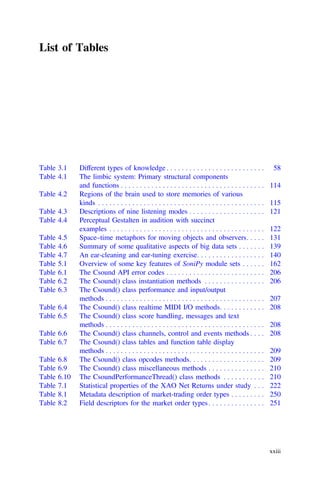
List of Figures
Fig. 2.1 The different amplitude profiles of a the sample the samples
b being realized with amplitude modulation, and c individually
enveloped events. . . . . . . . . . . . . . . . . . . . . . . . . . . . . . . . . . . . . 40
Fig. 4.1 Illustrations of some major components of the human brain’s
motor, sensory and limbic systems involved in learning and
memory. Illustrations, some retouched, from Gray’s Anatomy
of the human body (1918). . . . . . . . . . . . . . . . . . . . . . . . . . . . . . 113
Fig. 5.1 Conceptual flow diagram of SoniPy’s five module sets
and two networks . . . . . . . . . . . . . . . . . . . . . . . . . . . . . . . . . . . . 160
Fig. 5.2 A simplified map of the configuration of SoniPy’s Data
Processing modules. . . . . . . . . . . . . . . . . . . . . . . . . . . . . . . . . . . 163
Fig. 7.1 Only one of these two graphs is of a real market. Which
one is it?. . . . . . . . . . . . . . . . . . . . . . . . . . . . . . . . . . . . . . . . . . . 214
Fig. 7.2 A plot of 22 years of daily closing values of the ASX’s XAO,
highlighting the market action on “Black Tuesday”
(20 October 1987) . . . . . . . . . . . . . . . . . . . . . . . . . . . . . . . . . . . 222
Fig. 7.3 A plot of Net Returns of the XAO dataset . . . . . . . . . . . . . . . . . 223
Fig. 7.4 A histogram of Net Returns of the XAO dataset . . . . . . . . . . . . 223
Fig. 7.5 A plot of Net Returns, highlighting the clipping of the largest
negative return . . . . . . . . . . . . . . . . . . . . . . . . . . . . . . . . . . . . . . 224
Fig. 7.6 A histogram of the Net Returns, illustrating both the skewness
and kurtosis of the dataset. The most extreme positive and
negative returns define the gamut of the abscissa . . . . . . . . . . . . 224
Fig. 7.7 A comparison of the correlated and decorrelated Returns . . . . . . 225
Fig. 7.8 The different amplitude profiles of a the sample the samples
b being realized with amplitude modulation, and c individually
enveloped events. . . . . . . . . . . . . . . . . . . . . . . . . . . . . . . . . . . . . 228
xix
Fig. 7.9 Block diagram of the Csound instrument used
for the homomorphic mappings . . . . . . . . . . . . . . . . . . . . . . . . . 228
Fig. 7.10 User interface to the sampling frequency modulation
instrument. . . . . . . . . . . . . . . . . . . . . . . . . . . . . . . . . . . . . . . . . . 229
Fig. 8.1 Symbolic representation of the relationship between size,
value and pitch . . . . . . . . . . . . . . . . . . . . . . . . . . . . . . . . . . . . . . 240
Fig. 8.2 The distribution of $value traded for individual securities
in a single trading day. Shading indicates the number
of TRADEs for each security . . . . . . . . . . . . . . . . . . . . . . . . . . . 241
Fig. 8.3 The principle information mappings $value is inversely–
proportional to pitch and the lower the tone the longer
the duration. Notice that the pitch (green line) is linear,
implying an exponential frequency scale . . . . . . . . . . . . . . . . . . 241
Fig. 8.4 A second psychoacoustic adjustment: larger $value trades
(lower–pitched) have slower onset–times, in keeping
with physical characteristics of material resonators. . . . . . . . . . . 241
Fig. 8.5 The Fletcher-Munson curves of equal loudness (left) and its
inverse. Used for frequency-dependent adjustment of
amplitude to counterbalance this hearing non-linearity . . . . . . . . 242
Fig. 8.6 A graphic illustration of part of the HDF5 file structure
used to trace the movement of TRADE orders . . . . . . . . . . . . . . 246
Fig. 8.7 A graphic representation of the filter applied to TRADE data
for the Experiment 5 sonifications. $value TRADEs in a
security are accumulated until the price changes, at which
point the accumulated value is sonified. On the LHS, the
dark-green circles represent trades sonified without
accumulation because price changed. The smaller light-green
circles represent TRADEs that are accumulating (±). The RHS
illustrates the overall result . . . . . . . . . . . . . . . . . . . . . . . . . . . . . 247
Fig. 8.8 A graphic representation of the filtering of cumulative
TRADEs below $10 K and $50 K and rescaling the results
to the same pitch gamut before rendering to audio . . . . . . . . . . . 247
Fig. 9.1 Some of the wall images hung during the 18 months of the
polymedia exhibition Corpo Real (Photo Udo Rink, 2015) . . . . 255
Fig. 9.2 A graphical representation of the Sonipy network flow-rate
meter in which pitch is governed by time-differences between
sflow-sampled packets arriving at the network switch. . . . . . . . . 258
Fig. 9.3 A screen-captured image from the animation net-flow-path,
the first study of the polymedia composition Corpo Real
(Rink and Worrall 2015). . . . . . . . . . . . . . . . . . . . . . . . . . . . . . . 260
Fig. 9.4 A screen-captured image from the animation in cooperation,
the second study of the polymedia composition Corpo Real
(Rink and Worrall 2015). . . . . . . . . . . . . . . . . . . . . . . . . . . . . . . 261
xx List of Figures
Fig. 9.5 A screen-captured image from the animation 3am chill,
the third study of the polymedia composition Corpo Real
(Rink and Worrall 2015). . . . . . . . . . . . . . . . . . . . . . . . . . . . . . . 261
Fig. 9.6 Netson operational schematic . . . . . . . . . . . . . . . . . . . . . . . . . . . 265
Fig. 9.7 Illustration of the primary mode of the graphical display . . . . . . 271
List of Figures xxi
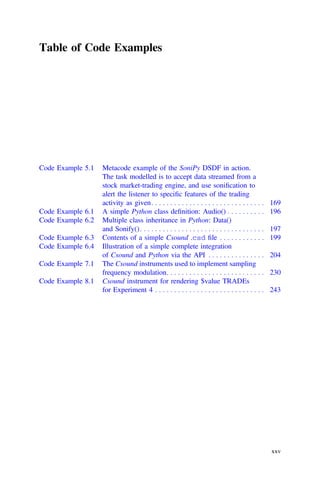
List of Tables
Table 3.1 Different types of knowledge . . . . . . . . . . . . . . . . . . . . . . . . . . 58
Table 4.1 The limbic system: Primary structural components
and functions . . . . . . . . . . . . . . . . . . . . . . . . . . . . . . . . . . . . . . 114
Table 4.2 Regions of the brain used to store memories of various
kinds . . . . . . . . . . . . . . . . . . . . . . . . . . . . . . . . . . . . . . . . . . . . 115
Table 4.3 Descriptions of nine listening modes . . . . . . . . . . . . . . . . . . . . 121
Table 4.4 Perceptual Gestalten in audition with succinct
examples . . . . . . . . . . . . . . . . . . . . . . . . . . . . . . . . . . . . . . . . . 122
Table 4.5 Space–time metaphors for moving objects and observers. . . . . 131
Table 4.6 Summary of some qualitative aspects of big data sets . . . . . . . 139
Table 4.7 An ear-cleaning and ear-tuning exercise. . . . . . . . . . . . . . . . . . 140
Table 5.1 Overview of some key features of SoniPy module sets . . . . . . 162
Table 6.1 The Csound API error codes . . . . . . . . . . . . . . . . . . . . . . . . . . 206
Table 6.2 The Csound() class instantiation methods . . . . . . . . . . . . . . . . 206
Table 6.3 The Csound() class performance and input/output
methods . . . . . . . . . . . . . . . . . . . . . . . . . . . . . . . . . . . . . . . . . . 207
Table 6.4 The Csound() class realtime MIDI I/O methods. . . . . . . . . . . . 208
Table 6.5 The Csound() class score handling, messages and text
methods . . . . . . . . . . . . . . . . . . . . . . . . . . . . . . . . . . . . . . . . . . 208
Table 6.6 The Csound() class channels, control and events methods . . . . 208
Table 6.7 The Csound() class tables and function table display
methods . . . . . . . . . . . . . . . . . . . . . . . . . . . . . . . . . . . . . . . . . . 209
Table 6.8 The Csound() class opcodes methods. . . . . . . . . . . . . . . . . . . . 209
Table 6.9 The Csound() class miscellaneous methods . . . . . . . . . . . . . . . 210
Table 6.10 The CsoundPerformanceThread() class methods . . . . . . . . . . . 210
Table 7.1 Statistical properties of the XAO Net Returns under study . . . 222
Table 8.1 Metadata description of market-trading order types . . . . . . . . . 250
Table 8.2 Field descriptors for the market order types. . . . . . . . . . . . . . . 251
xxiii
Table of Code Examples
Code Example 5.1 Metacode example of the SoniPy DSDF in action.
The task modelled is to accept data streamed from a
stock market-trading engine, and use sonification to
alert the listener to specific features of the trading
activity as given. . . . . . . . . . . . . . . . . . . . . . . . . . . . . . 169
Code Example 6.1 A simple Python class definition: Audio() . . . . . . . . . . 196
Code Example 6.2 Multiple class inheritance in Python: Data()
and Sonify(). . . . . . . . . . . . . . . . . . . . . . . . . . . . . . . . . 197
Code Example 6.3 Contents of a simple Csound .csd file . . . . . . . . . . . . 199
Code Example 6.4 Illustration of a simple complete integration
of Csound and Python via the API . . . . . . . . . . . . . . . 204
Code Example 7.1 The Csound instruments used to implement sampling
frequency modulation. . . . . . . . . . . . . . . . . . . . . . . . . . 230
Code Example 8.1 Csound instrument for rendering $value TRADEs
for Experiment 4 . . . . . . . . . . . . . . . . . . . . . . . . . . . . . 243
xxv
Table of Audio Examples
Audio Example 7.1 An auditory comparison of four noise
distributions . . . . . . . . . . . . . . . . . . . . . . . . . . . . . . . . 226
Audio Example 7.2 Three sequences each of three audio chunks. C & E
are decorrelated versions of the Net Returns (D) . . . . 227
Audio Example 7.3 Homomorphic modulation sonifications of four
datasets. . . . . . . . . . . . . . . . . . . . . . . . . . . . . . . . . . . . 231
Audio Example 7.4 Full dataset versions of snippets in Audio
Example 7.3 . . . . . . . . . . . . . . . . . . . . . . . . . . . . . . . . 231
Audio Example 8.1 Audio examples of the $value sum of the total
market, moment–to–moment . . . . . . . . . . . . . . . . . . . 243
Audio Example 8.2 Using simultaneous $value TRADEs to contribute
to the composition of an evolving spectrum. . . . . . . . 245
Audio Example 8.3 Three examples of cumulative TRADE data,
with $value filters. . . . . . . . . . . . . . . . . . . . . . . . . . . . 247
Audio Example 8.4 Four examples of cumulative TRADE data with a
shift in pitch to indicate whether the <price> of the
following trade increased or decreased and to what
extent. A higher pitch indicates that the price rose.
Audio rendering occurs when cumulative $value >=
$50 K. Time compression 1:60 (1 sec = 1min) . . . . . 248
Audio Example 9.1 An example of the attentional listening. A nighttime
pond chorus (Tomakin 2013) . . . . . . . . . . . . . . . . . . . 268
Audio Example 9.2 Examples of some of the mapping strategies
employed in the Netson network monitor. . . . . . . . . . 268
xxvii
Part I
Theory
Chapter 1
Data Sonification: A Prehistory
Yasyāmataṁ tasya mataṁ; mataṁ yasya na veda saḥ
[“One who (thinks he) knows not, knows; one who (thinks he)
knows, knows not.” (Muktananda 1972)].
Abstract The idea that sound can reliably convey information predates the modern
era. The term data sonification has evolved along with its applications and use-
fulness in various disciplines. It can be broadly described as the creation and study
of the aural representation of information, or the use of sound to convey
non-linguistic information. As a field of contemporary enquiry and design practice,
it is young, interdisciplinary and evolving; existing in parallel to the field of data
visualization, which is concerned with the creation and study of the visual repre-
sentation of information. Sonification and visualization techniques have many
applications in “humanizing” information, particularly when applied to large and
complex sets of data. Drawing on ancient practices such as auditing, and the use of
information messaging in music, this chapter provides an historical understanding
of how sound and its representational deployment in communicating information
has changed. In doing so, it aims to encourage critical awareness of some of the
socio-cultural as well as technical assumptions often adopted in sonifying data,
especially those that have been developed in the context of Western music of the
last half-century or so. Whilst acknowledging the Eurocentricity of the enquiry,
there is no suggestion that the ideas discussed do not have wider applicability.
1.1 An Ancient and Modern Practice
We are at a time in the evolution of humans and their tools when the power of
digital information processing and algorithmic decision-making is demonstrating an
ability to radically change our lives: From genetic finger-printing, gene-splicing and
pharmacology, to driverless vehicles, patterns in our consumption and how we
amuse ourselves. Even now, so early in this new Dataist era, organizations with
networked computational intelligence, already have access to more data about
© Springer Nature Switzerland AG 2019
D. Worrall, Sonification Design, Human–Computer
Interaction Series, https://doi.org/10.1007/978-3-030-01497-1_1
3
ourselves than we ourselves have access to, and are beginning to demonstrate a
power to make better decisions for us than we make for ourselves. What, then, one
might reasonably ask, is the use of exploring such ancient, intensely
human-centered approaches to information-gathering and decision-making as lis-
tening? How old-fashioned; how quaint! This is an increasingly pertinent question
and has been latently fundamental to why this book was written. The answers are
not necessarily obvious as they lie at the heart of the difference between a con-
ception of life merely in terms of information flow and data storage as might be
imagined by the cognitivists (Worrall 2010), and one in which mind, body and
(now technologically enhanced) consciousness play a fundamental role in active
perception, knowledge acquisition, meaning-creation and decision-making.
In a contemporary media-saturated environment, sound plays a wider variety of
different social and communicative roles today than it ever did in the past. Although
computer-generated data sonification is a relatively recent formalized practice,1
cultural antecedents can be identified in all periods of history. This chapter provides
a focused description of how the deployment of sound and sonic structures to
communicate information has changed over time. It the spirit of the adage “know
from whence you came”, doing so will assist us to critically examine some of the
socio-cultural assumptions we have adopted in our own age.2
In the process of uncovering the accuracy or truth3
of our assumptions about
perception, it is not uncommon for commentators to be seduced into a type of sense
war, in which hearing and listening are pitted against vision and seeing. Such
casting can take many forms. What is to be gained by Marshal McLuhan’s myopia,
for example?
The ear is hypersensitive. The eye is cool and detached. The ear turns man over to universal
panic while the eye, extended by literacy and mechanical time, leaves some gaps and some
islands free from the unremitting acoustic pressure and reverberation (McLuhan 1968, 168).
Thankfully, the discussion has moved on, at least in some circles.4
Each have their
place and so to be encumbered with such a burden is not useful, particularly when a
culturally-driven focus on one sense assumes a decline of another. While this book
1
The first international conference was held in 1992 (Kramer 1994a).
2
As Jonathan Sterne indicates, while there is a vast array of literature on the history and philosophy
of sound, it is without some kind of overarching, shared sensibility about what constitutes the
history of sound, sound culture, or sound studies (Sterne 2003). It is not the purpose of this chapter
to remedy that!
3
Truth, as in the Heideggerian meaning of the term alétheia: a non-propositional unconcealment.
This concept of ‘truth’ takes on the dynamic structure of uncovering that is disclosive rather than
propositional or judgmental.
4
A comprehensive survey of increasingly nuanced arguments is outside the confines of this work.
In its notes and bibliography, The Audible Past Stern (2003) lists a significant amount of literature
in English on the topic since the Enlightenment. Over a longer historical timeframe, Veit
Erlmann’s, Reason and Resonance traces historical changes in the understanding of the rela-
tionship between developing conceptions of sound and hearing physiology (2010).
4 1 Data Sonification: A Prehistory
is about the transmission of intelligibility through sonic structures, it does not
contend that sound should replace vision in enquiry, any more than the assertion
that music expression is best when unencumbered by the “strictures” of musical
notation. This is not to deny that there are sensory differences; they all assist us
differently, else it is unlikely evolution would have sustained their individual
continuance. In fact, it can be instructive to identify them. For example, it is
hearing, not vision, that affords omnidirectional coherent perceptual experiences.
For all moving creatures, including our ancestors, both ancient and modern, in sit-
uations where sight is obscured, spatial auditory clarity plays a vital survival role in
determining both from where the predator is approaching or to where the prey has
escaped. On the other hand, we can suppose that, to a creature sleeping in a cave,
being alerted early by the amplifying echoic resonance of the space that something
of a certain mass was entering, was more important than details of its exact position.
These evolutionary adaptations are sometimes very deep in our biology, such as the
presence of defensive startle reflexes which are very resistant to habituation, and the
fascinating orienting reflex (eliciting a “what is it?” reaction) (DeGangi 2017, 309–
60; Sokolov et al. 2002) which have cultural resonances such as, for example, when
the biological preferencing of the ears to lead the eyes5
forms the basis of as a scene
transition technique to enhance narrative continuity in film.
While sensory differences do exist, it is instructive to consider that the domi-
nation of one sense over another—especially when considering hearing and vision
—is not a biological phenomenon, but a cultural one. As will be seen in the
upcoming discussion of the role of sound in the Church’s dominion over Europe,
when the control of the whole community was through the sense of hearing, such
control was more easily broken away from by individual ‘voices’ using another
sense (vision) and, supported by development in visual technologies, which in-turn,
through notation, supported the development of individual musical voices that were
able to create complex sonic ‘inputs’ to the resonant cathedrals while maintaining
‘signal’ coherence which supported understanding.
1.2 Ancient Egyptian Use of Sound to Convey Information
There are many reasons why, in certain circumstances, sound might be the preferred
representation and communication medium for information, including the known
superiority of the hearing sense to discriminate particular kinds of structures. For
example, it is easy for most of us to personally verify that a purely visual
side-by-side comparison of two sets of written records requires high levels of
concentration and that doing so is very prone to error, especially over extended
periods of time. One the other hand, listening to vocalizations of such
5
Resulting, presumably, from the superiority of the omni-directionality of hearing in
visually-obscured environments.
1.1 An Ancient and Modern Practice 5
representations is much easier. The presence of such auditing6
can be inferred from
records of Mesopotamian civilizations going as far back as 3500 BCE. To ensure
that the Pharaoh was not being cheated, auditors compared the “soundness” of
meticulous independently-scribed accounts of commodities such as grains moving
in and out, or remaining, in warehouses (Boyd 1905). When granary masters,
otherwise strictly isolated from each other, assembled before the Pharaoh and
alternated in their intoning of such records, differences in their accounting records
could be easily identified aurally. A faster and more secure method that eliminates
any “copy-cat” syndrome in such alternation, is to have the scribes read the records
simultaneously—a type of modulation differencing technique. Although we have
no hard evidence that these techniques were practiced, such a suggestion does not
seem unreasonable, and would represent possibly the earliest form of data
sonification.
1.3 The Ancient Greek Understanding of Music
While sound has also played an important role in both theoretical and empirical
inquiry for millennia, the ancient Greeks wrote extensively on the subject, notably
in reference to music, the most complex and abstractly considered form of
non-linguistic aural communication made by humans. It can be divided into three
modes of enquiry that are of direct concern to sonification: numerical rationality,
empirical experience and expressive power.
1.3.1 Numerical Rationality
At least as far back as Pythagoras (born * 569 BCE), arithmetic was considered to
be number in itself, geometry to be number in space, and harmony to be number in
time. The concept of The Harmony of the Spheres, in which the Sun, Moon and
planets emit their own unique “sounds” based on their orbital revolution,7
played a
unifying role in the development of the arts and sciences, and incorporated the
metaphysical principle that mathematical relationships express qualities or “tones”
6
Literally, the hearing of accounts from the Latin auditus.
7
Known generally as the “music of the spheres”. As Gaius Plinius Secundus observed, “…
occasionally Pythagoras draws on the theory of music, and designates the distance between the
Earth and the Moon as a whole tone, that between the Moon and Mercury as a semitone, …” the
seven tones thus producing the so-called diapason, i.e. a universal harmony (Pliny [77AD] 1938).
Ptolemy and Plato also wrote about this practice.
6 1 Data Sonification: A Prehistory
Other documents randomly have
different content
d’Alembert were pressed too hard, he might, instead of apologizing,
prove that the things which he had said were true.
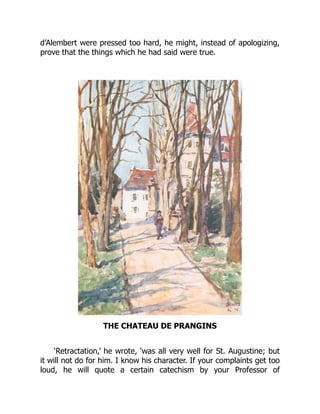
THE CHATEAU DE PRANGINS
‘Retractation,’ he wrote, ‘was all very well for St. Augustine; but
it will not do for him. I know his character. If your complaints get too
loud, he will quote a certain catechism by your Professor of
Theology, wherein it is said that revelation is “a thing of some utility,”
and wherein there is no single word about the holy, adorable, and
invisible Trinity. When he establishes that he has not disclosed a
secret, but has only publicly taken cognizance of an opinion publicly
expressed, you will be slightly embarrassed.’
CHAPTER XXII
VOLTAIRE AND THE THEATRE
Another bone of contention was found in Voltaire’s passionate
devotion to the theatre. His tastes were shared by the ‘advanced’ set
at Geneva; but the divines, in spite of their broad views on matters
of dogmatic theology, still held narrow views on the subject of the
drama. Dramatic performances, whether public or private, were not
allowed upon Genevan soil; while performances given close to the
frontier, on the territory of Savoy or France, caused the ministers
many searchings of heart.
There had been such performances shortly before Voltaire’s
arrival—in 1751—at Carouge and Chatelaine, and the Consistory had
passed a resolution on the subject. It had decided to exhort the
members of the Council to keep their wives away from the
entertainments, and to exhort the professors to warn the students—
and more particularly the candidates for Holy Orders—not to attend
them. Afterwards, hearing that the daughters of some of the pastors
had visited the theatre in defiance of their admonitions, they had
passed a further resolution to the effect that this state of things gave
ground for reflection—qu’il y a lieu d’y réfléchir.
Such was the public opinion which Voltaire braved; and his first
attempt to brave it was not very successful. Soon after his arrival he
arranged a salle de spectacle inside the city walls, and organized a
performance of ‘L’Orphelin de la Chine.’ The Consistory growled out a
hostile resolution, and he dropped the enterprise, but proceeded to
educate opinion from a safe distance; that is to say, he set up his
theatre at Lausanne, and wrote insinuating letters about its
management to his friends among the Genevan pastors. We have
Gibbon’s testimony to the fact that this theatre ‘refined in a visible
degree the manners of Lausanne’; and we have a letter in which
Voltaire gives the pastor, Vernés, sound reasons for coming to
witness the performances.
‘In your quality of minister of the Gospel,’ he writes, ‘you might
very well be present at the rendering of a piece taken from the
Gospel itself, and hear the word of God from the mouth of the
Marquise de Gentil, Madame d’Aubonne, and Madame
d’Hermenches, who are as worthy women as the three Magdalens,
and more respectable.’ And he adds: ‘At the first representation we
had all the ministers of the Holy Gospel in the Town, and all the
candidates for Holy Orders.’
It was a pretty good beginning; but there was still to be trouble
and controversy before the educational process was completed. In
this field, as in the field of theology, d’Alembert, with his
encyclopædia article, stirred Camerina. He said that it was a pity
that comedy should be neglected in such a centre of civilization, but
added that the thing that the Genevans dreaded was not the
demoralizing influence of plays, but the dissolute behaviour of
players. And he suggested that this difficulty be got over by means
of stringent regulations as to the conduct of comedians. By this
means, he said, Geneva might have both good morals and good
theatres, and derive as much advantage from the one as from the
other.
For the moment it looked as though this ingeniously ironical
proposal would escape attention, the theologians being too excited
about their impugned orthodoxy to notice anything else. Rousseau,
however, saw it, and decided to reply to it, and in due course
launched his ‘Lettre sur les Spectacles.’ Being himself a dramatic
author of some note, he was not an ideal champion of the cause
which he represented; but in the stir caused by his intervention no
one seems to have thought of that. His rhetoric made just as lively
an impression as though his actions had always been in keeping with
it. The Genevans took sides; and Voltaire—as though for the express
purpose of giving them something tangible to fight about—
established a theatre close to their gates, outside the jurisdiction of
their magistrates, at Tournay.
The battle raged furiously. To this period of Voltaire’s sojourn
belong most of his bitter sarcastic sayings about Geneva; his
reference to ‘the little church of Calvin, which makes virtue consist in
usury and asceticism,’ and his famous epigram containing the lines:
‘On haït le bal, on haït la comédie;
Pour tout plaisir Genève psalmodie
Du bon David des antiques concerts,
Croyant que Dieu se plaît aux mauvais vers.’
Abuse of Jean Jacques also abounds in his letters at this period.
Jean Jacques is a ‘blackguard’; Jean Jacques is in league with two
rascally Calvinist priests, and ‘has the insolence’ to say this, that, and
the other thing; Jean Jacques is ‘valet to Diogenes,’ who ‘has played
in vain the part of an addle-pated idiot’; if Jean Jacques comes to
Ferney, he shall be stuffed into a barrel, and presumably rolled
downhill—which proves, even if it proves nothing else, that, when
philosophers fall out, they are apt to wrangle in much the same
language as less intellectual people.
Yet, on the whole, Voltaire was steadily winning the victory. The
Council, it is true, forbade the citizens to attend his theatre; but little
attention was paid to the prohibition, and among those who
disregarded it were included many of the Councillors themselves.
‘Being unable,’ as Petit-Senn wittily put it, ‘to remove the danger,
they bravely set out to share it’; and the philosopher chuckled:
‘I am civilizing the Allobroges as well as I can. Before I came
here the Genevans had nothing to amuse them but bad sermons. I
am corrupting all the youth of the pedantic city. I make play-actors
of the sons of Syndics. The clergy are furious; but I crush them.’
After a while, moreover, his evangelistic efforts received support
from an unexpected quarter. In 1766 there were certain political
disturbances in the city, and ambassadors were sent from Berne,
Zurich, and Paris, to assist in composing them. Voltaire suggested to
the French ambassador, M. de Beauteville, that he should request
admission to the city for a company of comedians to amuse himself
and his suite. Life at Geneva being duller than he liked, M. de
Beauteville adopted the suggestion. The comedians were
introduced; a theatre was arranged for them; and Voltaire could
chuckle again. The divines thundered. ‘Children,’ they declared, ‘will
be badly brought up; domestic discords will trouble families more
and more; young men and young women will occupy themselves
with nothing but comedy and vainglorious display; the love of
pleasure, vanity, and pride will be their favourite emotions; indecent
familiarities and libertine behaviour will take the place of modesty
and chastity.’
But this warning was uttered in vain. Voltaire had triumphed;
and though he was now an old man, nearing his eightieth birthday,
he enjoyed his triumph to the full. A picture of the patriarch at the
play is graphically drawn by a letter-writer of the period:
‘Not the least interesting feature of the spectacle was Voltaire
himself, leaning his back against the wings in full view of the
audience, applauding like a man possessed; now beating the floor
with his walking-stick, now interjecting exclamations such as
“Couldn’t be better!” “By God, how good!” and now directing the
flow of sentiment by lifting his handkerchief to his eyes. So little
could he control his enthusiasm that, at the moment when Ninias
quits the scene to brave Assue, he ran after Lekain without
considering how he was breaking down the illusion, took him by the
hand, and kissed him at the back of the stage. It would be difficult
to imagine a more ridiculous burlesque; for Voltaire looked like an
old man out of a farce, dressed in a bygone fashion, with his
stockings rolled up over his knees, and only able to keep himself on
his trembling legs with the help of his stick.’
CHAPTER XXIII
VISITORS TO FERNEY
While Voltaire was vexing the citizens of Geneva, he was also
enjoying the veneration of all educated Europe, and even of
educated America. He corresponded regularly with at least four
reigning sovereigns, to say nothing of men of letters, Cardinals, and
Marshals of France; and he kept open house for travellers of mark
from every country in the world. Those of the travellers who wrote
books never failed to devote a chapter to an account of a visit to
Ferney; and from the mass of such descriptions we may select for
quotation that written, in the stately style of the period, by Dr. John
Moore, author of ‘Zeluco,’ then making the grand tour as tutor to the
Duke of Hamilton.
‘The most piercing eyes I ever beheld,’ the doctor writes, ‘are
those of Voltaire, now in his eightieth year. His whole countenance is
expressive of genius, observation, and extreme sensibility. In the
morning he has a look of anxiety and discontent; but this gradually
wears off, and after dinner he seems cheerful; yet an air of irony
never entirely forsakes his face, but may always be observed lurking
in his features whether he frowns or smiles.... Composition is his
principal amusement. No author who writes for daily bread, no
young poet ardent for distinction, is more assiduous with his pen, or
more anxious for fresh fame, than the wealthy and applauded
Seigneur of Ferney. He lives in a very hospitable manner, and takes
care always to have a good cook. He generally has two or three
visitors from Paris, who stay with him a month or six weeks at a
time. When they go, their places are soon supplied, so that there is
a constant rotation of society at Ferney. These, with Voltaire’s own
family and his visitors from Geneva, compose a company of twelve
or fourteen people, who dine daily at his table, whether he appears
or not.... All who bring recommendations from his friends may
depend upon being received, if he be not really indisposed. He often
presents himself to the strangers who assemble every afternoon in
his antechamber, although they bring no particular recommendation.’
A VAUDOISE: SUMMER
It might have been added that, when an interesting stranger
who carried no introduction was passing through the town, Voltaire
sometimes sent for him; but this experiment was not always a
success, and failed most ludicrously in the case of Claude Gay, the
Philadelphian Quaker, author of some theological works now
forgotten, but then of note. The meeting was only arranged with
difficulty on the philosopher’s undertaking to put a bridle on his
tongue, and say nothing flippant about holy things. He tried to keep
his promise, but the temptation was too strong for him. After a while
he entangled his guest in a controversy concerning the proceedings
of the patriarchs and the evidences of Christianity, and lost his
temper on finding that his sarcasms failed to make their usual
impression. The member of the Society of Friends, however, was not
disconcerted. He rose from his place at the dinner-table, and replied:
‘Friend Voltaire! perhaps thou mayest come to understand these
matters rightly; in the meantime, finding I can do thee no good, I
leave thee, and so fare thee well.’
And so saying, he walked out and walked back to Geneva, while
Voltaire retired in dudgeon to his room, and the company sat
expecting something terrible to happen.
CHAPTER XXIV
COPPETT
A word, in conclusion, about Coppet!
Necker bought the property from his old banking partner,
Thelusson, for 500,000 livres in French money, and retired to live
there when the French Revolution drove him out of politics. His
daughter, Madame de Staël, inherited it from him, and made it
famous.
Not that she loved Switzerland; it would be more true to say that
she detested Switzerland. Swiss scenery meant nothing to her. When
she was taken for an excursion to the glaciers, she asked what the
crime was that she had to expiate by such a punishment; and she
could look out on the blue waters of Lake Leman, and sigh for ‘the
gutter of the Rue du Bac.’ Even to this day, the Swiss have hardly
forgiven her for that, or for speaking of the Canton of Vaud as the
country in which she had been ‘so intensely bored for such a number
of years.’
What she wanted was to live in Paris, to be a leader—or, rather,
to be the leader—of Parisian society, to sit in a salon, the admired of
all admirers, and to pull the wires of politics to the advantage of her
friends. For a while she succeeded in doing this. It was she who
persuaded Barras to give Talleyrand his political start in life. But
whereas Barras was willing to act on her advice, Napoleon was by no
means equally amenable to her influence. Almost from the first he
regarded her as a mischief-maker; and when a spy brought him an
intercepted letter in which Madame de Staël expressed her hope that
none of the old aristocracy of France would condescend to accept
appointments in the household of ‘the bourgeois of Corsica,’ he
became her personal enemy, and, refusing her permission to live
either in the capital or near it, practically compelled her to take
refuge in her country seat. Her pleasaunce in that way became her
gilded cage.
Perhaps she was not quite so unhappy there as she sometimes
represented. If she could not go to Paris, many distinguished and
brilliant Parisians came to Coppet, and met there many brilliant and
distinguished Germans, Genevans, Italians, and Danes. The Parisian
salon, reconstituted, flourished on Swiss soil. There visited there, at
one time or another, Madame Récamier and Madame Krüdner;
Benjamin Constant, who was so long Madame de Staël’s lover;
Bonstetten, the Voltairean philosopher; Frederika Brun, the Danish
artist; Sismondi, the historian; Werner, the German poet; Karl Ritter,
the German geographer; Baron de Voght; Monti, the Italian poet;
Madame Vigée Le Brun; Cuvier; and Oelenschlaeger. From almost
every one of them we have some pen-and-ink sketch of the life
there.
This, for instance, is the scene as it appeared to Madame Le
Brun, who came to paint the hostess’s portrait:
‘I paint her in antique costume. She is not beautiful, but the
animation of her visage takes the place of beauty. To aid the
expression I wished to give her, I entreated her to recite tragic
verses while I painted. She declaimed passages from Corneille and
Racine.... I find many persons established at Coppet: the beautiful
Madame Récamier, the Comte de Sabran, a young English woman,
Benjamin Constant, etc. Its society is continually renewed. They
come to visit the illustrious exile who is pursued by the rancour of
the Emperor. Her two sons are now with her, under the instruction of
the German scholar Schlegel; her daughter is very beautiful, and has
a passionate love of study; she leaves her company free all the
morning, but they unite in the evening. It is only after dinner that
they can converse with her. She then walks in her salon, holding in
her hand a little green branch; and her words have an ardour quite
peculiar to her: it is impossible to interrupt her. At these times she
produces on one the effect of an improvisatrice.’
And here is a still more graphic description, taken from a letter
written to Madame Récamier by Baron de Voght:
‘It is to you that I owe my most amiable reception at Coppet. It
is no doubt to the favourable expectations aroused by your
friendship that I owe my intimate acquaintance with this remarkable
woman. I might have met her without your assistance—some casual
acquaintance would no doubt have introduced me—but I should
never have penetrated to the intimacy of this sublime and beautiful
soul, and should never have known how much better she is than her
reputation. She is an angel sent from heaven to reveal the divine
goodness upon earth. To make her irresistible, a pure ray of celestial
light embellishes her spirit and makes her amiable from every point
of view.
‘At once profound and light, whether she is discovering a
mysterious secret of the soul or grasping the lightest shadow of a
sentiment, her genius shines without dazzling, and when the orb of
light has disappeared, it leaves a pleasant twilight to follow it.... No
doubt a few faults, a few weaknesses, occasionally veil this celestial
apparition; even the initiated must sometimes be troubled by these
eclipses, which the Genevan astronomers in vain endeavour to
predict.
‘My travels so far have been limited to journeys to Lausanne and
Coppet, where I often stay three or four days. The life there suits
me perfectly; the company is even more to my taste. I like
Constant’s wit, Schlegel’s learning, Sabran’s amiability, Sismondi’s
talent and character, the simple truthful disposition and just
intellectual perceptions of Auguste,
B
the wit and sweetness of
Albertine
C
—I was forgetting Bonstetten, an excellent fellow, full of
knowledge of all sorts, ready in wit, adaptable in character—in every
way inspiring one’s respect and confidence.
B
Madame de Staël’s son, who afterwards edited the works
of Madame de Staël and Madame Necker.
C
Madame de Staël’s daughter, afterwards Duchesse de
Broglie.
‘Your sublime friend looks and gives life to everything. She
imparts intelligence to those around her. In every corner of the
house some one is engaged in composing a great work.... Corinne is
writing her delightful letters about Germany, which will no doubt
prove to be the best thing she has ever done.
‘The “Shunamitish Widow,” an Oriental melodrama which she
has just finished, will be played in October; it is charming. Coppet
will be flooded with tears. Constant and Auguste are both composing
tragedies; Sabran is writing a comic opera, and Sismondi a history;
Schlegel is translating something; Bonstetten is busy with
philosophy, and I am busy with my letter to Juliette.’
THE TRICOTEUSE: WINTER
Then, a month later:
‘Since my last letter, Madame de Staël has read us several
chapters of her work. Everywhere it bears the marks of her talent. I
wish I could persuade her to cut out everything in it connected with
politics, and all the metaphors which interfere with its clarity,
simplicity and accuracy. What she needs to demonstrate is not her
republicanism, but her wisdom.... Mlle. Jenner played in one of
Werner’s tragedies which was given, last Friday, before an audience
of twenty. She, Werner, and Schlegel played perfectly....
‘The arrival in Switzerland of M. Cuvier has been a happy
distraction for Madame de Staël; they spent two days together at
Geneva, and were well pleased with each other. On her return to
Coppet she found Middleton there, and in receiving his confidences
forgot her troubles. Yesterday she resumed her work.
‘The poet whose mystical and sombre genius has caused us such
profound emotions starts, in a few days’ time, for Italy.
‘I accompanied Corinne to Massot’s. To alleviate the tedium of
the sitting, a Mlle. Romilly played pleasantly on the harp, and the
studio was a veritable temple of the Muses....
‘Bonstetten gave us two readings of a Memoir on the Northern
Alps. It began very well, but afterwards it bored us.... Madame de
Staël resumed her reading, and there was no longer any question of
being bored. It is marvellous how much she must have read and
thought over to be able to find the opportunity of saying so many
good things. One may differ from her, but one cannot help delighting
in her talent....
‘And now here we are at Geneva, trying to reproduce Coppet at
the Hôtel des Balances. I am delightfully situated with a wide view
over the Valley of Savoy, between the Alps and the Jura.... Yesterday
evening the illusion of Coppet was complete. I had been with
Madame de Staël to call on Madame Rilliet, who is so charming at
her own fireside. On my return I played chess with Sismondi.
Madame de Staël, Mlle. Randall, and Mlle. Jenner sat on the sofa
chatting with Bonstetten and young Barante. We were as we had
always been—as we were in the days that I shall never cease
regretting.’
Other descriptions exist in great abundance, but these suffice to
serve our purpose. They show us the Coppet salon as it was—
pleasant, brilliant, unconventional; something like Holland House,
but more Bohemian; something like Harley Street, but more select;
something like Gad’s Hill—which it resembled in the fact that the
members of the house-parties were expected to spend their
mornings at their desks—but on a higher social plane; a centre at
once of high thinking and frivolous behaviour; of hard work and
desperate love-making, which sometimes paved the way to trouble.
If only one had space to go into the details of that love-making!
But that is a subject which would need a much larger book than this
to do it justice.
INDEX
Academy of Calvin, 3
Amadeus IX., Duke, 15
Amaulx, Pierre, 30
Amiel, 90, 105
Annecy, 91
Arlaud, 73
Arve, The, 20
Aubert, Syndic, 30
Balmat, Jacques, 80
Bauhin, Sieur, plague-doctor, 47
Beauteville, M. de, 115
Bérenger, 71, 73
Berlonière, M., 53
Berthelier, Philibert, 10
Bèze, M. de, 34, 36, 38, 40, 41, 43, 44, 46, 48, 51, 52, 57,
58, 59, 61, 62, 94
Blanvalet, Henri, 102
Bonaventura, Cornelius, 41
Bonivard, François de, 11, 24
Bonivard’s Chronicle, 14
Bonnet, Charles, 73, 75, 86, 87, 89
Bonstetten, 125, 129, 130
Bourrit, 72, 74, 80, 83
Brun, Frederika, 125
Calendrini, 61
Calvin, 3, 23, 24, 30, 31, 34, 43, 97, 109
Casaubon, Isaac, 34
Caveau Genevois, 97
Chaponnière, J. F., 98
Charles Emanuel, Duke, 52, 53, 56
Charles IV., Emperor, 33
Cherbuliez, 105
Chevalier, M., 36
Chillon, 11
Constant, Benjamin, 125, 127
Coppet, 106, 123, 124, 126, 127, 129, 130
Cordier, Mathurin, 37
Corraterie, 1, 2, 54
Couvent de la Rive, 14
de Sainte-Claire, 15
Cuisine Papale, 44
Curchod, Mademoiselle Suzanne, 72
Cuvier, 125, 129
D’Albigni, 53, 54, 55, 56
D’Alembert, 108, 109, 113
D’Aubigné, Agrippa, 90
Merle, 96
Dentan, 73
Didier, Charles, 102
Diodati, Jean, 61
D’Ivernois, 71
École de la Rive, 33, 34
Égaliseurs, 67
Eidgenossen, The, 9
Englués, 67
Escalade, The, 52, 61
Estienne, Robert, 35
Etrembières, 55
Fabri, Bishop Adhémar de, 9
Farel, 13, 14, 18, 23, 24, 97
Ferney, 107, 115, 119, 120
Galloix, Imbert, 102
Gay, Claude, 121
Geneston, Matthew, 46
Genevan Revolutions, 78
Gesner, 84
Gibbon, 72, 112
Gide, Etienne, 99, 102
Goulart, Simon, 55, 61
Haldane, Mr., 95, 96
Henri IV., 52
Hotman, Francis, 41
Hubers, The Two, 72
Hugues, Besançon, 10
Jacobinical Clubs, 67
Jallabert, 73
Javelle, Emile, 105
Jeanne de Jussie, 15, 17
Jeûne Genevois, 48
Knox, John, 25
Krüdner, Madame de, 125
La Faye, Antoine, 58
Lamartine, 99
Laws and Statutes of Geneva, The, 25
Le Brun, Madame Vigée, 125
Lefort, François, 72
Le Sage, 72
Libertines, 23
Liberty, The Friends of, 30, 97
Lolme, De, 71, 72
Luc, Jean André de, 73, 83
Lucs, The De, 72
Maimbourg, 43
Malan, Cæsar, 96
Malingre, Pastor, 13
Mallet, 75
Massacre of St. Bartholomew, 45
Melvill, Andrew, 39, 41
Monnet, Raoul, 30
Monnier, Dr. Philippe, 105
Marc, 89, 99, 105
Monod, Adolphe, 96
Montet, Albert de, 105
Monti, 125
Moore, Dr. John, 119
Necker, 123
Neff, Félix, 96
Odier, 73
Oelenschlaeger, 125
Pecolat, Jean, 10
Petit-Senn, 100, 102
Picot, 73
Pictet, 73
Portus, 41
Prangins, 107
Récamier, Madame, 125, 126
Register of the Consistory, The, 29
Revocation of the Edict of Nantes, The, 61, 62
Revolution at Geneva, 86
Age of, 71
Revolutions, 65, 66
Réveil, The, 94, 95
Rilliet, Madame, 130
Ritter, Karl, 125
Eugène, 105
Romantic School, The, 99
Rousseau, 3, 82, 89, 91, 113
Jean-Jaques, 91, 114
Salève, 1
Saulnier, Antoine, 33
Saussure, De, 72, 75, 77, 78, 80, 81, 82, 83, 84, 86, 87
Scheuchzer, 84
Schlegel, 127, 129
Scrymgeour, Henry, 41
Senebier, 72
Servetus, 31
Sismondi, 125, 127
Social Evil, The, 7
Staël, Madame de, 89, 106, 123, 124, 125, 128, 129, 130
Albertine de, 127
Auguste de, 127
St. Bartholomew’s Day, 47
St. Ours, 73
Tanners, 67
Theocracy, The, 25
Toepfer, 105
Trembley, 61, 73, 79
Tronchin, Dr., 61, 73, 74, 107, 109
Turretini, 61, 108
University, 33, 34, 35, 36, 39
Vernés, 112
Verre, André, 103
Viret, 18
Voght, Baron de, 125, 126
Voltaire, 75, 106, 107, 109, 111, 112, 114, 115, 116, 117,
119, 120, 121
Werner, 125, 129
THE END
BILLING AND SONS, LTD., PRINTERS, GUILDFORD
Transcriber’s Notes
Punctuation, hyphenation, and spelling were made
consistent when a predominant preference was found in
this book; otherwise they were not changed. The spelling
of non-English words was not checked.
Simple typographical errors were corrected.
Ambiguous hyphens at the ends of lines were
retained.
Index not checked for proper alphabetization or
correct page references.
Welcome to our website – the ideal destination for book lovers and
knowledge seekers. With a mission to inspire endlessly, we offer a
vast collection of books, ranging from classic literary works to
specialized publications, self-development books, and children's
literature. Each book is a new journey of discovery, expanding
knowledge and enriching the soul of the reade
Our website is not just a platform for buying books, but a bridge
connecting readers to the timeless values of culture and wisdom. With
an elegant, user-friendly interface and an intelligent search system,
we are committed to providing a quick and convenient shopping
experience. Additionally, our special promotions and home delivery
services ensure that you save time and fully enjoy the joy of reading.
Let us accompany you on the journey of exploring knowledge and
personal growth!
textbookfull.com


Sonification Design From Data to Intelligible Soundfields David Worrall

  • 1.
    Sonification Design FromData to Intelligible Soundfields David Worrall download https://textbookfull.com/product/sonification-design-from-data- to-intelligible-soundfields-david-worrall/ Download full version ebook from https://textbookfull.com
  • 2.
    We believe theseproducts will be a great fit for you. Click the link to download now, or visit textbookfull.com to discover even more! R Visualizations: Derive Meaning from Data 1st Edition David Gerbing https://textbookfull.com/product/r-visualizations-derive-meaning- from-data-1st-edition-david-gerbing/ Policing 4th Edition John L. Worrall https://textbookfull.com/product/policing-4th-edition-john-l- worrall/ Pro Ember Data: Getting Ember Data to Work with Your API David Tang https://textbookfull.com/product/pro-ember-data-getting-ember- data-to-work-with-your-api-david-tang/ Idea Searching for Design How to Research and Develop Design Concepts David Bramston https://textbookfull.com/product/idea-searching-for-design-how- to-research-and-develop-design-concepts-david-bramston/
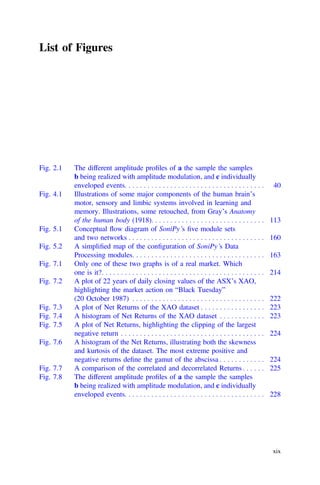
  • 3.
    Nanobiosensors From Designto Applications Aiguo Wu https://textbookfull.com/product/nanobiosensors-from-design-to- applications-aiguo-wu/ Making Sense of Sensors: End-to-End Algorithms and Infrastructure Design from Wearable-Devices to Data Center 1st Edition Omesh Tickoo https://textbookfull.com/product/making-sense-of-sensors-end-to- end-algorithms-and-infrastructure-design-from-wearable-devices- to-data-center-1st-edition-omesh-tickoo/ Pro Ember Data Getting Ember Data to Work with Your API 1st Edition David Tang https://textbookfull.com/product/pro-ember-data-getting-ember- data-to-work-with-your-api-1st-edition-david-tang/ Network Security Through Data Analysis From Data to Action 2nd Edition Michael Collins https://textbookfull.com/product/network-security-through-data- analysis-from-data-to-action-2nd-edition-michael-collins/ Battle of Berlin 1943–44: Bomber Harris' Gamble to End the War 1st Edition Richard Worrall https://textbookfull.com/product/battle-of-berlin-1943-44-bomber- harris-gamble-to-end-the-war-1st-edition-richard-worrall/
  • 4.
  • 5.
    Human–Computer Interaction Series Editors-in-Chief DesneyTan Microsoft Research, Redmond, WA, USA Jean Vanderdonckt Louvain School of Management, Université catholique de Louvain, Louvain-La-Neuve, Belgium
  • 6.
    The Human-Computer InteractionSeries, launched in 2004, publishes books that advance the science and technology of developing systems which are effective and satisfying for people in a wide variety of contexts. Titles focus on theoretical perspectives (such as formal approaches drawn from a variety of behavioural sciences), practical approaches (such as techniques for effectively integrating user needs in system development), and social issues (such as the determinants of utility, usability and acceptability). HCI is a multidisciplinary field and focuses on the human aspects in the development of computer technology. As technology becomes increasingly more pervasive the need to take a human-centred approach in the design and development of computer-based systems becomes ever more important. Titles published within the Human–Computer Interaction Series are included in Thomson Reuters’ Book Citation Index, The DBLP Computer Science Bibliography and The HCI Bibliography. More information about this series at http://www.springer.com/series/6033
  • 7.
    David Worrall Sonification Design FromData to Intelligible Soundfields 123
  • 8.
    David Worrall Department ofAudio Arts and Acoustics Columbia College Chicago Chicago, IL, USA ISSN 1571-5035 ISSN 2524-4477 (electronic) Human–Computer Interaction Series ISBN 978-3-030-01496-4 ISBN 978-3-030-01497-1 (eBook) https://doi.org/10.1007/978-3-030-01497-1 © Springer Nature Switzerland AG 2019 This work is subject to copyright. All rights are reserved by the Publisher, whether the whole or part of the material is concerned, specifically the rights of translation, reprinting, reuse of illustrations, recitation, broadcasting, reproduction on microfilms or in any other physical way, and transmission or information storage and retrieval, electronic adaptation, computer software, or by similar or dissimilar methodology now known or hereafter developed. The use of general descriptive names, registered names, trademarks, service marks, etc. in this publication does not imply, even in the absence of a specific statement, that such names are exempt from the relevant protective laws and regulations and therefore free for general use. The publisher, the authors and the editors are safe to assume that the advice and information in this book are believed to be true and accurate at the date of publication. Neither the publisher nor the authors or the editors give a warranty, expressed or implied, with respect to the material contained herein or for any errors or omissions that may have been made. The publisher remains neutral with regard to jurisdictional claims in published maps and institutional affiliations. This Springer imprint is published by the registered company Springer Nature Switzerland AG The registered company address is: Gewerbestrasse 11, 6330 Cham, Switzerland
  • 9.
  • 10.
    Preface and Acknowledgements Thisbook is about the contemporary design practice known as data sonification, which assists us to experience information by listening, much as we understand relationships between spatial features by viewing a graph of them. Data sonification begins with the observation that sounds can convey meanings in a multiplicity of circumstances: Exploring the structure of deep space, detecting a stock-market bubble, assisting injured patients to recover more quickly with less pain, monitoring the flow of traffic to help detect potential congestion, improving sporting perfor- mance, tracking storms, earthquakes and other changes in the environment … and the list could go on: hundreds of applications that rely on studies in acoustics and psychoacoustics, philosophy of perception, cognitive psychology, computer sci- ence, creative auditory design and music composition. Data sonification grew out of an interest by composers in generating musical forms with the assistance of computers: algorithmic compositions based on both traditional musical languages, and the exploration of mathematical models of nat- ural and abstract worlds. With ears searching for new means of expressing the contemporary world, they explored such fields as fractal geometry, neural networks, iterated function and reaction–diffusion systems, and flocking and herding. As computer processing speeds and storage capacity increased, and digital networks evolved, it became possible to use large datasets from real and real-time systems, not just abstract idealized models, and this led us into the currently emerging era of Big Data. One of the motivations for this book was to understand some of the perceptual and conceptual correlates of intelligible data sonification so as to encapsulate the knowledge-bases that underpin them in software design. For example, the psy- choacoustic, gestural and psycho-physiological substrates such as cognitive-load sensitivity and emotional valence, with low-level latent functions that can be compiled into higher level interactive modelling tools. Design is an inherently ‘messy’ and iterative activity that, while a process, may never be entirely proce- dural. So, the purpose here is not to trivialize the skills of an experienced designer, but to hierarchize the masking of many of the functional decisions made in designing, including such processes as equal-loudness contouring and modal vii
  • 11.
    convex pitch andtime transforms. It is hoped that in doing so, novice designers might consider more adventurous possibilities and experienced designers will be enabled to implement complex procedures more flexibly: to test multiple different approaches to sonifying a dataset. Part I: Theory Chapter 1: The idea that sound can reliably convey information predates the modern era. The term data sonification has evolved along with its applications and use- fulness in various disciplines. It can be broadly described as the creation and study of the aural representation of information, or the use of sound to convey non-linguistic information. As a field of contemporary enquiry and design practice, it is young, interdisciplinary and evolving; existing in parallel to the field of data visualization, which is concerned with the creation and study of the visual repre- sentation of information. Sonification and visualization techniques have many applications in ‘humanizing’ information, particularly when applied to large and complex sets of data. Drawing on ancient practices such as auditing, and the use of information messaging in music, this chapter provides an historical understanding of how sound and its representational deployment in communicating information has changed. In doing so, it aims to encourage critical awareness of some of the socio-cultural as well as technical assumptions often adopted in sonifying data, especially those that have been developed in the context of Western music of the past half-century or so. Whilst acknowledging the Eurocentricity of the enquiry, there is no suggestion that the ideas discussed do not have wider applicability. Chapter 2: Encompassing ideas and techniques from music composition, per- ceptual psychology, computer science, acoustics, biology and philosophy, data sonification is a multi- even trans-disciplinary practice. This Chapter summarizes different ways sonification has been defined, the types and classifications of data that it attempts to represent with sound, and how these representations perform under the pressure of various real-world utilizations. Chapter 3: One task of data sonification is to provide a means by which listeners can obtain new ideas about the nature of the source of derived data. In so doing they can increase their knowledge and comprehension of that source and thus improve the efficiency, accuracy and/or quality of their knowledge acquisition and any decision-making based on it. The purpose of this chapter is to develop an historical understanding of what information is as a concept, how information can be rep- resented in various forms as something that can be communicated with non-verbal sonic structures between its source and its (human) receiver and thus retained as knowledge. Whilst a complete philosophical and psychological overview of these issues is outside the scope of the chapter, it is important, in the context of devel- oping computational design strategies that enable such communication, to gain an understanding of some of the basic concepts involved. A quasi-historical episte- mology of human perception and the types of information these epistemologies viii Preface and Acknowledgements
  • 12.
    engender is followedby a discussion of the phenomenal nature of sounds and sonic structures their ability to convey information of various sorts. Chapter 4: The previous chapter traced a path towards an understanding of the inadequacy of epistemological approaches to knowledge formation that do not account for the deeply embodied nature of perception, to succeed in solving any but highly constrained problems. The slower-than-expected rise in the effectiveness of artificial intelligence provided the impetus for a more critical examination of the ontological dimensions of perception and human knowledge, which necessitated the recognition of another form of truth which is not derived empirically but from meaningful action. This chapter enunciates this Pragmatist approach as it can be applied to sonification design: a generative activity in which bespoke design skills are supported by scientific research in biology, perception, cognitive science—in the field of conceptual metaphor theory in particular, and aesthetics. It proceeds to outline pertinent features of a broad design methodology based on the under- standings developed that could yield to computational support. Chapter 5: The need for better software tools for data sonification was high- lighted in the 1997 Sonification Report, the first comprehensive status review of the field which included some general proposals for adapting sound synthesis software to the needs of sonification research. It outlined the reasons the demands on soft- ware by sonification research are greater than those afforded by music composition and sound synthesis software alone. As its Sample Research Proposal acknowl- edged, the development of a comprehensive sonification shell is not easy and the depth and breadth of knowledge, and skills required to effect such a project are easily underestimated. Although many of the tools developed to date have various degrees of flexibility and power for the integration of sound synthesis and data processing, a complete heterogeneous Data Sonification Design Framework (DSDF) for research and auditory display has not yet emerged. This chapter out- lines the requirements for such a comprehensive framework, and proposes an integration of various existing independent components such as those for data acquisition, storage and analysis, together with a means to include new work on cognitive and perceptual mappings, and user interface and control, by encapsulating them, or control of them, as Python libraries, as well as a wrappers for new initiatives, which together, form the basis of SoniPy, a comprehensive toolkit for computational sonification designing. Part II: Praxis Chapter 6: Having established the design criteria for a comprehensive heteroge- neous data sonification software framework in the previous chapter, this chapter introduces two pillars of such a framework, the Python and Csound programming languages, as integrated through a Python–Csound Application Programming Interface. The result is a mature, stable, flexible and comprehensive combination of Preface and Acknowledgements ix
  • 13.
    tools suitable forreal and non-realtime sonification, some of the features of which are illustrated in the examples of subsequent chapters. Chapter 7: Despite intensive study, a comprehensive understanding of the structure of capital market trading data remains elusive. The one known application of audification to market price data reported in 1990 that it was difficult to interpret the results, probably because the market does not resonate according to acoustic laws. This chapter illustrates some techniques for transforming data so it does resonate; so audification may be used as a means of identifying autocorrelation in trading–and similar–datasets. Some experiments to test the veracity of this process are described in detail, along with the computer code used to produce them. Also reported are some experiments in which the data is sonified using a homomorphic modulation technique. The results obtained indicate that the technique may have a wider application to other similarly structured time-series datasets. Chapter 8: The previous chapter explored the use of audification of a numerical series, each member representing the daily closing value of an entire stock market, to observe the cross-correlation (trending) within the market itself. This chapter employs parameter-mapping sonification to study the perceptual flow of all trades in individual stock groupings over a trading day by applying various filters and selection methodologies to a detailed ‘tick’ dataset. It outlines the use of a size/mass metaphorical model of market activity and the simultaneous use of two opposing conceptual paradigms without apparent conceptual contradiction or cognitive dis- sonance to demonstrate, given conducive conditions, the power of intention over perception and sensation, in auditory information seeking. Chapter 9: The design of a real-time monitor for an organization’s digital net- work can produce several significant design challenges, both from the technical and human operational perspectives. One challenge is how to capture network data with minimal impact on the network itself. Also, from an operational perspective, sounds need to perform en suite over long periods of time while producing only minimal listener fatigue. This chapter describes two related network data sonification pro- jects which resulted in a set of audiovisual “concert” compositions (Corpo Real), an immersive installation, and a perceptual monitoring tool (Netson). This tool uses both sonification and visualization to present monitoring humans with features of data flow that allow them to experience selectable operational network character- istics. In doing so, it can be used to assist in the peripheral monitoring of a network for improved operational performance. Code and audio examples for this book are available at https://github.com/david- worrall/springer/. Acknowledgements Gregory Kramer had a particular vision and commitment to establishing auditory display as a legitimate discipline. His organizing of the first conference in 1992, followed by the editing and publication of the extended proceedings, Auditory x Preface and Acknowledgements
  • 14.
    display: Sonification, Audification,and Auditory Interfaces, produced a go-to ref- erence for researchers in the field until the publication, in 2011, of The Sonification Handbook, with major contributions by many members of the community under the inciteful editorship of Thomas Hermann, Andy Hunt and John Neuhoff. Over the past 10 years or so, various strands of the work in this book have appeared in papers for the International Conference for Auditory Display and I am grateful to many of the members of that diverse community for their annual col- legiality, vigorous debate and general bonhomie. In 2009, my first attempt at a succinct overview of the field (Chap. 2) was published in The Oxford Handbook of Computer Music and Digital Sound Culture, edited by Roger Dean. Roger was brave enough, with Mitchell Whitelaw, to supervise my Ph.D. which eventually also formed the foundation for parts of Chaps. 3, 5, 7 and 8, for the latter of which, the Capital Markets Cooperative Research Centre in Sydney funded the experi- ments and provided the data. The securities trading data techniques discussed in Chap. 7 were first published in the Springer’s 2010 Lecture Notes in Computer Science volume on Auditory Display. The research and development for the net- work sonifications reported in Chap. 9 was undertaken, in addition to other work with Norberto Degara, during 2013–16, whilst a Professorial Research Fellow, at Fraunhofer IIS, in Erlangen, Germany, at Frederik Nagel’s International Audio Laboratories, under the leadership of the Institute Director, Albert Heuberger. I am often struck by how even a small sense of the influences on a writer can provide meaningful insights into their work. In that spirit, I mention some. However, lest it resulted in too autobiographical an appearance, I omit details of years of music-making and restless inquisitiveness in the arts of mathematics and animal anatomy. I spent the mid-1980s as a member of the Composition Department in the Faculty of Music, and in the Computer Science Department at The University Melbourne, followed by 15 years of research and teaching at the School of Music and the Australian Centre for the Arts and Technology (ACAT) at the Australian National University in Canberra, and, more recently, in the Audio Arts and Acoustic Department at Columbia College Chicago. In order not to draw the wrath of any individual inadvertently missed from what would be a long list, most of the names accompany mine on conference papers, in journal articles and concert programs, so I defer to another time to name them all individually. I have been fortunate to work with a few people who have dedicated their talents to working behind the scenes in technical and assistive capacities, and without whom everything would have ground to a halt: Les Craythorn in Melbourne, Niven Stines and Julie Fraser in Canberra, and David Knuth and Maria Ratulowska in Chicago. This work is grounded in an intellectual and artistic experimental tradition, from which I have been blessed with more than my fair share of excellent mentors. Out of respect for those traditions and in honor of them, I also invoke the spirits of those who have passed, thus: Richard Meale (and through him), Winifred Burston, Ferruccio Busoni, Frans Liszt, Carl Maria von Weber, Carl Philipp Emmanuel Bach and his father Johan Sebastian, John Bull, Carlos Gesualdo … That thread has been crisscrossed in my own life by various others, including Tristram Cary, Iannis Xenakis, Olivier Messiaen and Jean-Claude Risset. Richard was a mentor, friend Preface and Acknowledgements xi
  • 15.
    and as fiercecritic as he was an experimentalist: in music, chess and cooking. Although we fought bitterly as he was overcome by the affliction of postmodernism in his latter years, he wrote some of the best music of his generation. He is deeply missed. Thanks go to the editorial staff at Springer for their encouragement and long-suffering: tolerance way beyond reasonable expectations. I was not to know, at the time of discussing publishing with them in 2015, that this book would be written in ten residences on three continents. That it has appeared at all is a minor miracle, performed by my beautiful, gracious, strong and unbelievably perceptive wife, Rebekah, who, with Isaac and Catheryn have been my constant companions and family support throughout. As we have lived out our semi-nomadic existence, their day-long ‘visits’ to the local library, wherever we were, so “Dad could work on the book” has not been easy for them, and we’re looking forward to a summer of bikes and music-making. Oak Park, Illinois David Worrall March 2019 I like to listen. I have learned a great deal from listening carefully. Most people never listen. (Ernest Hemmingway, my Oak Park neighbor before I moved in.) xii Preface and Acknowledgements
  • 16.
    Contents Part I Theory 1Data Sonification: A Prehistory . . . . . . . . . . . . . . . . . . . . . . . . . . . . 3 1.1 An Ancient and Modern Practice . . . . . . . . . . . . . . . . . . . . . . . . 3 1.2 Ancient Egyptian Use of Sound to Convey Information . . . . . . . 5 1.3 The Ancient Greek Understanding of Music . . . . . . . . . . . . . . . . 6 1.3.1 Numerical Rationality . . . . . . . . . . . . . . . . . . . . . . . . . . 6 1.3.2 Empirical Experience . . . . . . . . . . . . . . . . . . . . . . . . . . 7 1.3.3 Expressive Power . . . . . . . . . . . . . . . . . . . . . . . . . . . . . 8 1.4 The Ear as the Central Organ of the Church. . . . . . . . . . . . . . . . 8 1.5 Music as Language and Rhetoric . . . . . . . . . . . . . . . . . . . . . . . . 10 1.6 The Rise of Abstract Instrumental Music . . . . . . . . . . . . . . . . . . 11 1.7 “Organizing the Delirium” . . . . . . . . . . . . . . . . . . . . . . . . . . . . 12 1.8 From Program Music to Programmed Music . . . . . . . . . . . . . . . 14 1.9 Algorithmic Composition and Data Sonification . . . . . . . . . . . . . 15 1.10 Purposeful Listening: Music and Sonification . . . . . . . . . . . . . . . 16 1.11 Musical Notation as Representation . . . . . . . . . . . . . . . . . . . . . . 18 References . . . . . . . . . . . . . . . . . . . . . . . . . . . . . . . . . . . . . . . . . . . . . 19 2 Sonification: An Overview . . . . . . . . . . . . . . . . . . . . . . . . . . . . . . . . 23 2.1 Classifying Sonifications . . . . . . . . . . . . . . . . . . . . . . . . . . . . . . 25 2.2 Data-Type Representations . . . . . . . . . . . . . . . . . . . . . . . . . . . . 27 2.2.1 Discrete Data Representations . . . . . . . . . . . . . . . . . . . . 27 2.2.2 Continuous Data Representations . . . . . . . . . . . . . . . . . 36 2.3 Interactive Data Representations . . . . . . . . . . . . . . . . . . . . . . . . 41 2.3.1 Sound Graphs . . . . . . . . . . . . . . . . . . . . . . . . . . . . . . . 41 2.3.2 Physical Models and Model-Based Sonifications . . . . . . 41 2.4 Sonification Research . . . . . . . . . . . . . . . . . . . . . . . . . . . . . . . . 44 2.4.1 Music Psychology . . . . . . . . . . . . . . . . . . . . . . . . . . . . 44 2.4.2 Computational Tools . . . . . . . . . . . . . . . . . . . . . . . . . . 45 xiii
  • 17.
    2.5 Design .. . . . . . . . . . . . . . . . . . . . . . . . . . . . . . . . . . . . . . . . . . 47 2.6 Summary . . . . . . . . . . . . . . . . . . . . . . . . . . . . . . . . . . . . . . . . . 50 References . . . . . . . . . . . . . . . . . . . . . . . . . . . . . . . . . . . . . . . . . . . . . 50 3 Knowledge and Information . . . . . . . . . . . . . . . . . . . . . . . . . . . . . . . 55 3.1 Introduction . . . . . . . . . . . . . . . . . . . . . . . . . . . . . . . . . . . . . . . 55 3.2 Knowledge . . . . . . . . . . . . . . . . . . . . . . . . . . . . . . . . . . . . . . . . 56 3.2.1 Types of Knowledge . . . . . . . . . . . . . . . . . . . . . . . . . . 57 3.2.2 Methods of Acquiring Knowledge. . . . . . . . . . . . . . . . . 59 3.3 Information . . . . . . . . . . . . . . . . . . . . . . . . . . . . . . . . . . . . . . . 61 3.3.1 Information as Quantity of Improbabilities . . . . . . . . . . . 62 3.3.2 Information: General, Scientific and Pragmatic . . . . . . . . 63 3.3.3 Forms of Perceptual Information . . . . . . . . . . . . . . . . . . 64 3.3.4 Platonic Ideals . . . . . . . . . . . . . . . . . . . . . . . . . . . . . . . 64 3.3.5 Materialist Ideals . . . . . . . . . . . . . . . . . . . . . . . . . . . . . 66 3.3.6 Transcendental Ideals and Phenomena . . . . . . . . . . . . . . 68 3.3.7 Brentano’s Mental Phenomena and Intentional Inexistence. . . . . . . . . . . . . . . . . . . . . . . . . . . . . . . . . . 72 3.3.8 Husserl’s Transcendental Phenomenology . . . . . . . . . . . 74 3.3.9 Gestalt Psychology and Group Theory . . . . . . . . . . . . . 77 3.3.10 Pragmatic Perception and the Meaning of Truth . . . . . . . 79 3.3.11 The Immediate Perception of Objects Through Sensation . . . . . . . . . . . . . . . . . . . . . . . . . . . . . . . . . . . 80 3.3.12 The Sense-Datum Theory of Immediate Perception . . . . 81 3.3.13 Representationalism (Indirect Realism) . . . . . . . . . . . . . 83 3.3.14 Phenomenalism . . . . . . . . . . . . . . . . . . . . . . . . . . . . . . 83 3.3.15 Direct Realism and Ecological Psychology . . . . . . . . . . 84 3.3.16 Information as Relations Through Signs . . . . . . . . . . . . 85 3.3.17 Information in Networks and Connections . . . . . . . . . . . 87 3.4 An Attempt at Integration . . . . . . . . . . . . . . . . . . . . . . . . . . . . . 88 3.5 Perception and the Neural Correlates of Consciousness . . . . . . . . 89 3.5.1 Mirror Neurons . . . . . . . . . . . . . . . . . . . . . . . . . . . . . . 90 3.5.2 Critical Discussion . . . . . . . . . . . . . . . . . . . . . . . . . . . . 91 3.6 The Perceiving Body . . . . . . . . . . . . . . . . . . . . . . . . . . . . . . . . 92 3.7 Summary . . . . . . . . . . . . . . . . . . . . . . . . . . . . . . . . . . . . . . . . . 94 Appendix 3A General Methods of Acquiring Knowledge . . . . . . . . . . . 97 Appendix 3B Inference Methods of Acquiring Knowledge . . . . . . . . . . 98 References . . . . . . . . . . . . . . . . . . . . . . . . . . . . . . . . . . . . . . . . . . . . . 100 4 Intelligible Sonifications . . . . . . . . . . . . . . . . . . . . . . . . . . . . . . . . . . 105 4.1 Two Forms of Truth: Material and Functional . . . . . . . . . . . . . . 106 4.1.1 Material: Rational and Empirical Truth . . . . . . . . . . . . . 106 4.1.2 Functional: Truth as a Value Proposition . . . . . . . . . . . . 107 4.1.3 Truth and Sensory Perception . . . . . . . . . . . . . . . . . . . . 109 xiv Contents
  • 18.
    4.2 Cognition: Physicaland Psychophysical . . . . . . . . . . . . . . . . . . . 110 4.2.1 The Neurophysiology of Perception and Memory. . . . . . 111 4.2.2 The Temporal Domain: Short- and Long-Term Memory. . . . . . . . . . . . . . . . . . . . . . . . . . . . . . . . . . . . 117 4.2.3 Implicit Aural Cognition: Gesture . . . . . . . . . . . . . . . . . 118 4.2.4 Modes of Listening . . . . . . . . . . . . . . . . . . . . . . . . . . . 120 4.2.5 Attention and Perceptual Gestalt Principles . . . . . . . . . . 121 4.3 Analogies, Conceptual Metaphors and Blending . . . . . . . . . . . . . 124 4.3.1 Imagination and Making Sense of the Unknown . . . . . . 124 4.3.2 Analogies and Metaphors . . . . . . . . . . . . . . . . . . . . . . . 125 4.3.3 Literary Metaphors as Classical Rhetorical Devices . . . . 126 4.3.4 Metaphors and Propositional Thinking. . . . . . . . . . . . . . 127 4.3.5 Conceptual Metaphors as Frameworks for Thinking . . . . 128 4.3.6 Mental Spaces and Conceptual Blending . . . . . . . . . . . . 129 4.3.7 Metaphors for Sonification: INFORMATION IS SOUND . . . . . . . . . . . . . . . . . . . . . . . . . . . . . . . . . . . 130 4.4 Towards a Design Methodology . . . . . . . . . . . . . . . . . . . . . . . . 131 4.4.1 The Auditory Environment of a Sonification . . . . . . . . . 132 4.4.2 Data . . . . . . . . . . . . . . . . . . . . . . . . . . . . . . . . . . . . . . 137 4.5 Sonification Designing: The First Steps . . . . . . . . . . . . . . . . . . . 140 4.5.1 Tuning Your Listening: Ear-Cleaning and Ear-Tuning . . . . . . . . . . . . . . . . . . . . . . . . . . . . . . 140 4.5.2 Data: Cleaning and Statistical Analysis . . . . . . . . . . . . . 141 4.5.3 Scoping: Defining the Purpose . . . . . . . . . . . . . . . . . . . 141 4.5.4 Design Criteria: Representation–Figurative or Conceptual? . . . . . . . . . . . . . . . . . . . . . . . . . . . . . . . 142 4.6 Aesthetic Considerations . . . . . . . . . . . . . . . . . . . . . . . . . . . . . . 143 4.7 Summary and Conclusions . . . . . . . . . . . . . . . . . . . . . . . . . . . . 145 References . . . . . . . . . . . . . . . . . . . . . . . . . . . . . . . . . . . . . . . . . . . . . 146 5 Towards a Data Sonification Design Framework . . . . . . . . . . . . . . . 151 5.1 Introduction . . . . . . . . . . . . . . . . . . . . . . . . . . . . . . . . . . . . . . . 151 5.2 The First Bottleneck: Data . . . . . . . . . . . . . . . . . . . . . . . . . . . . 153 5.3 A Comprehensive DSDF: Concepts and Requirements . . . . . . . . 155 5.3.1 Features of the Python Language . . . . . . . . . . . . . . . . . 155 5.3.2 Integration Through Wrapping . . . . . . . . . . . . . . . . . . . 159 5.4 The SoniPy Data Sonification Design Framework (DSDF) . . . . . 159 5.5 Inter-module Communication: The Three Networks . . . . . . . . . . 161 5.6 The Modules . . . . . . . . . . . . . . . . . . . . . . . . . . . . . . . . . . . . . . 161 5.6.1 Data Processing Modules . . . . . . . . . . . . . . . . . . . . . . . 162 5.6.2 Scale, Storage, Access, and Persistence . . . . . . . . . . . . . 163 5.6.3 Conceptual Modelling and Data Mapping . . . . . . . . . . . 165 5.6.4 Psychoacoustic Modelling. . . . . . . . . . . . . . . . . . . . . . . 166 Contents xv
  • 19.
    5.6.5 Acoustic Modelling. . . . . . . . . . . . . . . . . . . . . . . . . . . 166 5.6.6 User Interface, Monitoring, Feedback and Evaluation . . . . . . . . . . . . . . . . . . . . . . . . . . . . . . . 167 5.7 Computational Designing: A New Frontier . . . . . . . . . . . . . . . . . 170 5.7.1 Computation Versus Computerization . . . . . . . . . . . . . . 171 5.7.2 Some Advantages of Using a Computational Approach . . . . . . . . . . . . . . . . . . . . . . . . . . . . . . . . . . . 172 5.8 Summary . . . . . . . . . . . . . . . . . . . . . . . . . . . . . . . . . . . . . . . . . 174 References . . . . . . . . . . . . . . . . . . . . . . . . . . . . . . . . . . . . . . . . . . . . . 176 Part II Praxis 6 The Sonipy Framework: Getting Started . . . . . . . . . . . . . . . . . . . . . 181 6.1 Two Pillars of the SoniPy DSDF: Python and Csound . . . . . . . . 181 6.2 A Brief Introduction to Python . . . . . . . . . . . . . . . . . . . . . . . . . 182 6.2.1 The Python Interpreter . . . . . . . . . . . . . . . . . . . . . . . . . 183 6.2.2 Values, Variables, Types and Expressions . . . . . . . . . . . 184 6.2.3 Built-In Types . . . . . . . . . . . . . . . . . . . . . . . . . . . . . . . 185 6.2.4 Arithmetic Operators . . . . . . . . . . . . . . . . . . . . . . . . . . 185 6.2.5 Boolean Comparison Operators . . . . . . . . . . . . . . . . . . . 185 6.2.6 Variable Names . . . . . . . . . . . . . . . . . . . . . . . . . . . . . . 186 6.2.7 Variable Assignments . . . . . . . . . . . . . . . . . . . . . . . . . . 186 6.2.8 Ordered Sets: Sequences . . . . . . . . . . . . . . . . . . . . . . . . 186 6.2.9 Dictionaries . . . . . . . . . . . . . . . . . . . . . . . . . . . . . . . . . 188 6.2.10 Functions . . . . . . . . . . . . . . . . . . . . . . . . . . . . . . . . . . . 189 6.2.11 The Scope of Variables . . . . . . . . . . . . . . . . . . . . . . . . 189 6.2.12 Flow of Execution: Looping, Iteration, and Flow Control . . . . . . . . . . . . . . . . . . . . . . . . . . . . . . . . . . . . 190 6.2.13 Namespaces, Modules and Libraries . . . . . . . . . . . . . . . 193 6.2.14 Object Orientation: Classes Variables and Methods . . . . 194 6.3 A Brief Introduction to Csound . . . . . . . . . . . . . . . . . . . . . . . . . 196 6.3.1 A Basic Overview of the Csound Language. . . . . . . . . . 198 6.4 The Python-Csound API (ctcsound.py) . . . . . . . . . . . . . . . . 201 6.4.1 The Csound Class Csound() . . . . . . . . . . . . . . . . . . . . . 201 6.4.2 The Csound Class CsoundPerformanceThread() . . . . . . . . . . . . . . . 202 6.4.3 Real-Time Event Generation . . . . . . . . . . . . . . . . . . . . . 203 6.5 Summary . . . . . . . . . . . . . . . . . . . . . . . . . . . . . . . . . . . . . . . . . 205 Appendix: The Main Python-Csound API Methods . . . . . . . . . . . . . . . 205 Python-Csound API Error Codes . . . . . . . . . . . . . . . . . . . . . . . . 206 Python-Csound API Csound() Methods . . . . . . . . . . . . . . . . . . . 206 Python-Csound API CsoundPerformanceThread() Methods . . . . . 210 References . . . . . . . . . . . . . . . . . . . . . . . . . . . . . . . . . . . . . . . . . . . . . 211 xvi Contents
  • 20.
    7 Audification Experiments:Market Data Correlation . . . . . . . . . . . . 213 7.1 Introduction . . . . . . . . . . . . . . . . . . . . . . . . . . . . . . . . . . . . . . . 213 7.2 The Data . . . . . . . . . . . . . . . . . . . . . . . . . . . . . . . . . . . . . . . . . 215 7.2.1 Context . . . . . . . . . . . . . . . . . . . . . . . . . . . . . . . . . . . . 215 7.2.2 Quantitative Analysis . . . . . . . . . . . . . . . . . . . . . . . . . . 216 7.3 Review of Previous Work . . . . . . . . . . . . . . . . . . . . . . . . . . . . . 217 7.3.1 Survey of the Sonification of Financial Data . . . . . . . . . 217 7.3.2 Sonification of Stochastic Functions . . . . . . . . . . . . . . . 220 7.4 Experiments: Audification of Security Index Returns . . . . . . . . . 220 7.4.1 The Dataset . . . . . . . . . . . . . . . . . . . . . . . . . . . . . . . . . 221 7.4.2 Experiment 1: Can Market Correlation Be Heard? . . . . . 224 7.4.3 Experiment 2: Correlation and Decorrelated Compared . . . . . . . . . . . . . . . . . . . . . . . . . . . . . . . . . . 226 7.5 Experiment 3: Homomorphic Modulation Sonification . . . . . . . . 227 7.5.1 Observations on Experiment 3 . . . . . . . . . . . . . . . . . . . 231 7.6 Conclusions . . . . . . . . . . . . . . . . . . . . . . . . . . . . . . . . . . . . . . . 232 References . . . . . . . . . . . . . . . . . . . . . . . . . . . . . . . . . . . . . . . . . . . . . 233 8 Parameter-Mapping Sonification of Tick-Data . . . . . . . . . . . . . . . . . 237 8.1 Introduction . . . . . . . . . . . . . . . . . . . . . . . . . . . . . . . . . . . . . . . 237 8.2 The Dataset . . . . . . . . . . . . . . . . . . . . . . . . . . . . . . . . . . . . . . . 238 8.3 Experiment 4: $value at Time . . . . . . . . . . . . . . . . . . . . . . . . . . 239 8.3.1 Size Matters . . . . . . . . . . . . . . . . . . . . . . . . . . . . . . . . . 239 8.3.2 Data Subset and Sound Rendering . . . . . . . . . . . . . . . . 242 8.3.3 Observations on Experiment 4 . . . . . . . . . . . . . . . . . . . 244 8.4 Experiment 5: Sonification of Market Volatility . . . . . . . . . . . . . 244 8.5 Experiment 6: Sonification of Price Accumulations . . . . . . . . . . . 246 8.5.1 Observations on Experiment 6 . . . . . . . . . . . . . . . . . . . 247 8.6 Experiment 7: Using Conflicting Conceptual Mappings. . . . . . . . 248 8.6.1 Observations on Experiment 7 . . . . . . . . . . . . . . . . . . . 248 8.7 Summary . . . . . . . . . . . . . . . . . . . . . . . . . . . . . . . . . . . . . . . . . 249 Appendix Market Trading Order Types . . . . . . . . . . . . . . . . . . . . . . . . 250 References . . . . . . . . . . . . . . . . . . . . . . . . . . . . . . . . . . . . . . . . . . . . . 252 9 Polymedia Design for Network Metadata Monitoring . . . . . . . . . . . . 253 9.1 Introduction . . . . . . . . . . . . . . . . . . . . . . . . . . . . . . . . . . . . . . . 253 9.1.1 Big Data . . . . . . . . . . . . . . . . . . . . . . . . . . . . . . . . . . . 254 9.1.2 Data Transfer Protocols: TCP and UDP. . . . . . . . . . . . . 256 9.1.3 The Sonipy Network Flow Meter . . . . . . . . . . . . . . . . . 257 9.2 The Corpo Real Art and Technology Project . . . . . . . . . . . . . . . 258 9.2.1 Short Description: net–path–flow. . . . . . . . . . . . . . . . . . 259 9.2.2 Short Description: in–cooperation . . . . . . . . . . . . . . . . . 260 9.2.3 Short Description: 3am chill . . . . . . . . . . . . . . . . . . . . . 261 Contents xvii
  • 21.
    9.3 The NetsonNetwork Monitor . . . . . . . . . . . . . . . . . . . . . . . . . . 262 9.3.1 Review of Related Work . . . . . . . . . . . . . . . . . . . . . . . 262 9.4 Technical Overview of the Netson System . . . . . . . . . . . . . . . . . 264 9.4.1 Data Handling . . . . . . . . . . . . . . . . . . . . . . . . . . . . . . . 265 9.4.2 Data Security . . . . . . . . . . . . . . . . . . . . . . . . . . . . . . . . 265 9.4.3 Data Storage Repository . . . . . . . . . . . . . . . . . . . . . . . . 266 9.4.4 Data Filtering. . . . . . . . . . . . . . . . . . . . . . . . . . . . . . . . 266 9.4.5 Data Stream Selection . . . . . . . . . . . . . . . . . . . . . . . . . 267 9.4.6 Metaphorical Information Mapping . . . . . . . . . . . . . . . . 267 9.4.7 Sound Rendering and Playback . . . . . . . . . . . . . . . . . . . 269 9.4.8 Image Rendering . . . . . . . . . . . . . . . . . . . . . . . . . . . . . 270 9.4.9 Internet Streaming and Extensions. . . . . . . . . . . . . . . . . 270 References . . . . . . . . . . . . . . . . . . . . . . . . . . . . . . . . . . . . . . . . . . . . . 271 Index . . . . . . . . . . . . . . . . . . . . . . . . . . . . . . . . . . . . . . . . . . . . . . . . . . . . . . 275 xviii Contents
  • 22.
    List of Figures Fig.2.1 The different amplitude profiles of a the sample the samples b being realized with amplitude modulation, and c individually enveloped events. . . . . . . . . . . . . . . . . . . . . . . . . . . . . . . . . . . . . 40 Fig. 4.1 Illustrations of some major components of the human brain’s motor, sensory and limbic systems involved in learning and memory. Illustrations, some retouched, from Gray’s Anatomy of the human body (1918). . . . . . . . . . . . . . . . . . . . . . . . . . . . . . 113 Fig. 5.1 Conceptual flow diagram of SoniPy’s five module sets and two networks . . . . . . . . . . . . . . . . . . . . . . . . . . . . . . . . . . . . 160 Fig. 5.2 A simplified map of the configuration of SoniPy’s Data Processing modules. . . . . . . . . . . . . . . . . . . . . . . . . . . . . . . . . . . 163 Fig. 7.1 Only one of these two graphs is of a real market. Which one is it?. . . . . . . . . . . . . . . . . . . . . . . . . . . . . . . . . . . . . . . . . . . 214 Fig. 7.2 A plot of 22 years of daily closing values of the ASX’s XAO, highlighting the market action on “Black Tuesday” (20 October 1987) . . . . . . . . . . . . . . . . . . . . . . . . . . . . . . . . . . . 222 Fig. 7.3 A plot of Net Returns of the XAO dataset . . . . . . . . . . . . . . . . . 223 Fig. 7.4 A histogram of Net Returns of the XAO dataset . . . . . . . . . . . . 223 Fig. 7.5 A plot of Net Returns, highlighting the clipping of the largest negative return . . . . . . . . . . . . . . . . . . . . . . . . . . . . . . . . . . . . . . 224 Fig. 7.6 A histogram of the Net Returns, illustrating both the skewness and kurtosis of the dataset. The most extreme positive and negative returns define the gamut of the abscissa . . . . . . . . . . . . 224 Fig. 7.7 A comparison of the correlated and decorrelated Returns . . . . . . 225 Fig. 7.8 The different amplitude profiles of a the sample the samples b being realized with amplitude modulation, and c individually enveloped events. . . . . . . . . . . . . . . . . . . . . . . . . . . . . . . . . . . . . 228 xix
  • 23.
    Fig. 7.9 Blockdiagram of the Csound instrument used for the homomorphic mappings . . . . . . . . . . . . . . . . . . . . . . . . . 228 Fig. 7.10 User interface to the sampling frequency modulation instrument. . . . . . . . . . . . . . . . . . . . . . . . . . . . . . . . . . . . . . . . . . 229 Fig. 8.1 Symbolic representation of the relationship between size, value and pitch . . . . . . . . . . . . . . . . . . . . . . . . . . . . . . . . . . . . . . 240 Fig. 8.2 The distribution of $value traded for individual securities in a single trading day. Shading indicates the number of TRADEs for each security . . . . . . . . . . . . . . . . . . . . . . . . . . . 241 Fig. 8.3 The principle information mappings $value is inversely– proportional to pitch and the lower the tone the longer the duration. Notice that the pitch (green line) is linear, implying an exponential frequency scale . . . . . . . . . . . . . . . . . . 241 Fig. 8.4 A second psychoacoustic adjustment: larger $value trades (lower–pitched) have slower onset–times, in keeping with physical characteristics of material resonators. . . . . . . . . . . 241 Fig. 8.5 The Fletcher-Munson curves of equal loudness (left) and its inverse. Used for frequency-dependent adjustment of amplitude to counterbalance this hearing non-linearity . . . . . . . . 242 Fig. 8.6 A graphic illustration of part of the HDF5 file structure used to trace the movement of TRADE orders . . . . . . . . . . . . . . 246 Fig. 8.7 A graphic representation of the filter applied to TRADE data for the Experiment 5 sonifications. $value TRADEs in a security are accumulated until the price changes, at which point the accumulated value is sonified. On the LHS, the dark-green circles represent trades sonified without accumulation because price changed. The smaller light-green circles represent TRADEs that are accumulating (±). The RHS illustrates the overall result . . . . . . . . . . . . . . . . . . . . . . . . . . . . . 247 Fig. 8.8 A graphic representation of the filtering of cumulative TRADEs below $10 K and $50 K and rescaling the results to the same pitch gamut before rendering to audio . . . . . . . . . . . 247 Fig. 9.1 Some of the wall images hung during the 18 months of the polymedia exhibition Corpo Real (Photo Udo Rink, 2015) . . . . 255 Fig. 9.2 A graphical representation of the Sonipy network flow-rate meter in which pitch is governed by time-differences between sflow-sampled packets arriving at the network switch. . . . . . . . . 258 Fig. 9.3 A screen-captured image from the animation net-flow-path, the first study of the polymedia composition Corpo Real (Rink and Worrall 2015). . . . . . . . . . . . . . . . . . . . . . . . . . . . . . . 260 Fig. 9.4 A screen-captured image from the animation in cooperation, the second study of the polymedia composition Corpo Real (Rink and Worrall 2015). . . . . . . . . . . . . . . . . . . . . . . . . . . . . . . 261 xx List of Figures
  • 24.
    Fig. 9.5 Ascreen-captured image from the animation 3am chill, the third study of the polymedia composition Corpo Real (Rink and Worrall 2015). . . . . . . . . . . . . . . . . . . . . . . . . . . . . . . 261 Fig. 9.6 Netson operational schematic . . . . . . . . . . . . . . . . . . . . . . . . . . . 265 Fig. 9.7 Illustration of the primary mode of the graphical display . . . . . . 271 List of Figures xxi
  • 25.
    List of Tables Table3.1 Different types of knowledge . . . . . . . . . . . . . . . . . . . . . . . . . . 58 Table 4.1 The limbic system: Primary structural components and functions . . . . . . . . . . . . . . . . . . . . . . . . . . . . . . . . . . . . . . 114 Table 4.2 Regions of the brain used to store memories of various kinds . . . . . . . . . . . . . . . . . . . . . . . . . . . . . . . . . . . . . . . . . . . . 115 Table 4.3 Descriptions of nine listening modes . . . . . . . . . . . . . . . . . . . . 121 Table 4.4 Perceptual Gestalten in audition with succinct examples . . . . . . . . . . . . . . . . . . . . . . . . . . . . . . . . . . . . . . . . . 122 Table 4.5 Space–time metaphors for moving objects and observers. . . . . 131 Table 4.6 Summary of some qualitative aspects of big data sets . . . . . . . 139 Table 4.7 An ear-cleaning and ear-tuning exercise. . . . . . . . . . . . . . . . . . 140 Table 5.1 Overview of some key features of SoniPy module sets . . . . . . 162 Table 6.1 The Csound API error codes . . . . . . . . . . . . . . . . . . . . . . . . . . 206 Table 6.2 The Csound() class instantiation methods . . . . . . . . . . . . . . . . 206 Table 6.3 The Csound() class performance and input/output methods . . . . . . . . . . . . . . . . . . . . . . . . . . . . . . . . . . . . . . . . . . 207 Table 6.4 The Csound() class realtime MIDI I/O methods. . . . . . . . . . . . 208 Table 6.5 The Csound() class score handling, messages and text methods . . . . . . . . . . . . . . . . . . . . . . . . . . . . . . . . . . . . . . . . . . 208 Table 6.6 The Csound() class channels, control and events methods . . . . 208 Table 6.7 The Csound() class tables and function table display methods . . . . . . . . . . . . . . . . . . . . . . . . . . . . . . . . . . . . . . . . . . 209 Table 6.8 The Csound() class opcodes methods. . . . . . . . . . . . . . . . . . . . 209 Table 6.9 The Csound() class miscellaneous methods . . . . . . . . . . . . . . . 210 Table 6.10 The CsoundPerformanceThread() class methods . . . . . . . . . . . 210 Table 7.1 Statistical properties of the XAO Net Returns under study . . . 222 Table 8.1 Metadata description of market-trading order types . . . . . . . . . 250 Table 8.2 Field descriptors for the market order types. . . . . . . . . . . . . . . 251 xxiii
  • 26.
    Table of CodeExamples Code Example 5.1 Metacode example of the SoniPy DSDF in action. The task modelled is to accept data streamed from a stock market-trading engine, and use sonification to alert the listener to specific features of the trading activity as given. . . . . . . . . . . . . . . . . . . . . . . . . . . . . . 169 Code Example 6.1 A simple Python class definition: Audio() . . . . . . . . . . 196 Code Example 6.2 Multiple class inheritance in Python: Data() and Sonify(). . . . . . . . . . . . . . . . . . . . . . . . . . . . . . . . . 197 Code Example 6.3 Contents of a simple Csound .csd file . . . . . . . . . . . . 199 Code Example 6.4 Illustration of a simple complete integration of Csound and Python via the API . . . . . . . . . . . . . . . 204 Code Example 7.1 The Csound instruments used to implement sampling frequency modulation. . . . . . . . . . . . . . . . . . . . . . . . . . 230 Code Example 8.1 Csound instrument for rendering $value TRADEs for Experiment 4 . . . . . . . . . . . . . . . . . . . . . . . . . . . . . 243 xxv
  • 27.
    Table of AudioExamples Audio Example 7.1 An auditory comparison of four noise distributions . . . . . . . . . . . . . . . . . . . . . . . . . . . . . . . . 226 Audio Example 7.2 Three sequences each of three audio chunks. C & E are decorrelated versions of the Net Returns (D) . . . . 227 Audio Example 7.3 Homomorphic modulation sonifications of four datasets. . . . . . . . . . . . . . . . . . . . . . . . . . . . . . . . . . . . 231 Audio Example 7.4 Full dataset versions of snippets in Audio Example 7.3 . . . . . . . . . . . . . . . . . . . . . . . . . . . . . . . . 231 Audio Example 8.1 Audio examples of the $value sum of the total market, moment–to–moment . . . . . . . . . . . . . . . . . . . 243 Audio Example 8.2 Using simultaneous $value TRADEs to contribute to the composition of an evolving spectrum. . . . . . . . 245 Audio Example 8.3 Three examples of cumulative TRADE data, with $value filters. . . . . . . . . . . . . . . . . . . . . . . . . . . . 247 Audio Example 8.4 Four examples of cumulative TRADE data with a shift in pitch to indicate whether the <price> of the following trade increased or decreased and to what extent. A higher pitch indicates that the price rose. Audio rendering occurs when cumulative $value >= $50 K. Time compression 1:60 (1 sec = 1min) . . . . . 248 Audio Example 9.1 An example of the attentional listening. A nighttime pond chorus (Tomakin 2013) . . . . . . . . . . . . . . . . . . . 268 Audio Example 9.2 Examples of some of the mapping strategies employed in the Netson network monitor. . . . . . . . . . 268 xxvii
  • 28.
  • 29.
    Chapter 1 Data Sonification:A Prehistory Yasyāmataṁ tasya mataṁ; mataṁ yasya na veda saḥ [“One who (thinks he) knows not, knows; one who (thinks he) knows, knows not.” (Muktananda 1972)]. Abstract The idea that sound can reliably convey information predates the modern era. The term data sonification has evolved along with its applications and use- fulness in various disciplines. It can be broadly described as the creation and study of the aural representation of information, or the use of sound to convey non-linguistic information. As a field of contemporary enquiry and design practice, it is young, interdisciplinary and evolving; existing in parallel to the field of data visualization, which is concerned with the creation and study of the visual repre- sentation of information. Sonification and visualization techniques have many applications in “humanizing” information, particularly when applied to large and complex sets of data. Drawing on ancient practices such as auditing, and the use of information messaging in music, this chapter provides an historical understanding of how sound and its representational deployment in communicating information has changed. In doing so, it aims to encourage critical awareness of some of the socio-cultural as well as technical assumptions often adopted in sonifying data, especially those that have been developed in the context of Western music of the last half-century or so. Whilst acknowledging the Eurocentricity of the enquiry, there is no suggestion that the ideas discussed do not have wider applicability. 1.1 An Ancient and Modern Practice We are at a time in the evolution of humans and their tools when the power of digital information processing and algorithmic decision-making is demonstrating an ability to radically change our lives: From genetic finger-printing, gene-splicing and pharmacology, to driverless vehicles, patterns in our consumption and how we amuse ourselves. Even now, so early in this new Dataist era, organizations with networked computational intelligence, already have access to more data about © Springer Nature Switzerland AG 2019 D. Worrall, Sonification Design, Human–Computer Interaction Series, https://doi.org/10.1007/978-3-030-01497-1_1 3
  • 30.
    ourselves than weourselves have access to, and are beginning to demonstrate a power to make better decisions for us than we make for ourselves. What, then, one might reasonably ask, is the use of exploring such ancient, intensely human-centered approaches to information-gathering and decision-making as lis- tening? How old-fashioned; how quaint! This is an increasingly pertinent question and has been latently fundamental to why this book was written. The answers are not necessarily obvious as they lie at the heart of the difference between a con- ception of life merely in terms of information flow and data storage as might be imagined by the cognitivists (Worrall 2010), and one in which mind, body and (now technologically enhanced) consciousness play a fundamental role in active perception, knowledge acquisition, meaning-creation and decision-making. In a contemporary media-saturated environment, sound plays a wider variety of different social and communicative roles today than it ever did in the past. Although computer-generated data sonification is a relatively recent formalized practice,1 cultural antecedents can be identified in all periods of history. This chapter provides a focused description of how the deployment of sound and sonic structures to communicate information has changed over time. It the spirit of the adage “know from whence you came”, doing so will assist us to critically examine some of the socio-cultural assumptions we have adopted in our own age.2 In the process of uncovering the accuracy or truth3 of our assumptions about perception, it is not uncommon for commentators to be seduced into a type of sense war, in which hearing and listening are pitted against vision and seeing. Such casting can take many forms. What is to be gained by Marshal McLuhan’s myopia, for example? The ear is hypersensitive. The eye is cool and detached. The ear turns man over to universal panic while the eye, extended by literacy and mechanical time, leaves some gaps and some islands free from the unremitting acoustic pressure and reverberation (McLuhan 1968, 168). Thankfully, the discussion has moved on, at least in some circles.4 Each have their place and so to be encumbered with such a burden is not useful, particularly when a culturally-driven focus on one sense assumes a decline of another. While this book 1 The first international conference was held in 1992 (Kramer 1994a). 2 As Jonathan Sterne indicates, while there is a vast array of literature on the history and philosophy of sound, it is without some kind of overarching, shared sensibility about what constitutes the history of sound, sound culture, or sound studies (Sterne 2003). It is not the purpose of this chapter to remedy that! 3 Truth, as in the Heideggerian meaning of the term alétheia: a non-propositional unconcealment. This concept of ‘truth’ takes on the dynamic structure of uncovering that is disclosive rather than propositional or judgmental. 4 A comprehensive survey of increasingly nuanced arguments is outside the confines of this work. In its notes and bibliography, The Audible Past Stern (2003) lists a significant amount of literature in English on the topic since the Enlightenment. Over a longer historical timeframe, Veit Erlmann’s, Reason and Resonance traces historical changes in the understanding of the rela- tionship between developing conceptions of sound and hearing physiology (2010). 4 1 Data Sonification: A Prehistory
  • 31.
    is about thetransmission of intelligibility through sonic structures, it does not contend that sound should replace vision in enquiry, any more than the assertion that music expression is best when unencumbered by the “strictures” of musical notation. This is not to deny that there are sensory differences; they all assist us differently, else it is unlikely evolution would have sustained their individual continuance. In fact, it can be instructive to identify them. For example, it is hearing, not vision, that affords omnidirectional coherent perceptual experiences. For all moving creatures, including our ancestors, both ancient and modern, in sit- uations where sight is obscured, spatial auditory clarity plays a vital survival role in determining both from where the predator is approaching or to where the prey has escaped. On the other hand, we can suppose that, to a creature sleeping in a cave, being alerted early by the amplifying echoic resonance of the space that something of a certain mass was entering, was more important than details of its exact position. These evolutionary adaptations are sometimes very deep in our biology, such as the presence of defensive startle reflexes which are very resistant to habituation, and the fascinating orienting reflex (eliciting a “what is it?” reaction) (DeGangi 2017, 309– 60; Sokolov et al. 2002) which have cultural resonances such as, for example, when the biological preferencing of the ears to lead the eyes5 forms the basis of as a scene transition technique to enhance narrative continuity in film. While sensory differences do exist, it is instructive to consider that the domi- nation of one sense over another—especially when considering hearing and vision —is not a biological phenomenon, but a cultural one. As will be seen in the upcoming discussion of the role of sound in the Church’s dominion over Europe, when the control of the whole community was through the sense of hearing, such control was more easily broken away from by individual ‘voices’ using another sense (vision) and, supported by development in visual technologies, which in-turn, through notation, supported the development of individual musical voices that were able to create complex sonic ‘inputs’ to the resonant cathedrals while maintaining ‘signal’ coherence which supported understanding. 1.2 Ancient Egyptian Use of Sound to Convey Information There are many reasons why, in certain circumstances, sound might be the preferred representation and communication medium for information, including the known superiority of the hearing sense to discriminate particular kinds of structures. For example, it is easy for most of us to personally verify that a purely visual side-by-side comparison of two sets of written records requires high levels of concentration and that doing so is very prone to error, especially over extended periods of time. One the other hand, listening to vocalizations of such 5 Resulting, presumably, from the superiority of the omni-directionality of hearing in visually-obscured environments. 1.1 An Ancient and Modern Practice 5
  • 32.
    representations is mucheasier. The presence of such auditing6 can be inferred from records of Mesopotamian civilizations going as far back as 3500 BCE. To ensure that the Pharaoh was not being cheated, auditors compared the “soundness” of meticulous independently-scribed accounts of commodities such as grains moving in and out, or remaining, in warehouses (Boyd 1905). When granary masters, otherwise strictly isolated from each other, assembled before the Pharaoh and alternated in their intoning of such records, differences in their accounting records could be easily identified aurally. A faster and more secure method that eliminates any “copy-cat” syndrome in such alternation, is to have the scribes read the records simultaneously—a type of modulation differencing technique. Although we have no hard evidence that these techniques were practiced, such a suggestion does not seem unreasonable, and would represent possibly the earliest form of data sonification. 1.3 The Ancient Greek Understanding of Music While sound has also played an important role in both theoretical and empirical inquiry for millennia, the ancient Greeks wrote extensively on the subject, notably in reference to music, the most complex and abstractly considered form of non-linguistic aural communication made by humans. It can be divided into three modes of enquiry that are of direct concern to sonification: numerical rationality, empirical experience and expressive power. 1.3.1 Numerical Rationality At least as far back as Pythagoras (born * 569 BCE), arithmetic was considered to be number in itself, geometry to be number in space, and harmony to be number in time. The concept of The Harmony of the Spheres, in which the Sun, Moon and planets emit their own unique “sounds” based on their orbital revolution,7 played a unifying role in the development of the arts and sciences, and incorporated the metaphysical principle that mathematical relationships express qualities or “tones” 6 Literally, the hearing of accounts from the Latin auditus. 7 Known generally as the “music of the spheres”. As Gaius Plinius Secundus observed, “… occasionally Pythagoras draws on the theory of music, and designates the distance between the Earth and the Moon as a whole tone, that between the Moon and Mercury as a semitone, …” the seven tones thus producing the so-called diapason, i.e. a universal harmony (Pliny [77AD] 1938). Ptolemy and Plato also wrote about this practice. 6 1 Data Sonification: A Prehistory
  • 33.
    Other documents randomlyhave different content
  • 34.
    d’Alembert were pressedtoo hard, he might, instead of apologizing, prove that the things which he had said were true. THE CHATEAU DE PRANGINS ‘Retractation,’ he wrote, ‘was all very well for St. Augustine; but it will not do for him. I know his character. If your complaints get too loud, he will quote a certain catechism by your Professor of
  • 35.
    Theology, wherein itis said that revelation is “a thing of some utility,” and wherein there is no single word about the holy, adorable, and invisible Trinity. When he establishes that he has not disclosed a secret, but has only publicly taken cognizance of an opinion publicly expressed, you will be slightly embarrassed.’
  • 36.
    CHAPTER XXII VOLTAIRE ANDTHE THEATRE Another bone of contention was found in Voltaire’s passionate devotion to the theatre. His tastes were shared by the ‘advanced’ set at Geneva; but the divines, in spite of their broad views on matters of dogmatic theology, still held narrow views on the subject of the drama. Dramatic performances, whether public or private, were not allowed upon Genevan soil; while performances given close to the frontier, on the territory of Savoy or France, caused the ministers many searchings of heart. There had been such performances shortly before Voltaire’s arrival—in 1751—at Carouge and Chatelaine, and the Consistory had passed a resolution on the subject. It had decided to exhort the members of the Council to keep their wives away from the entertainments, and to exhort the professors to warn the students— and more particularly the candidates for Holy Orders—not to attend them. Afterwards, hearing that the daughters of some of the pastors had visited the theatre in defiance of their admonitions, they had passed a further resolution to the effect that this state of things gave ground for reflection—qu’il y a lieu d’y réfléchir. Such was the public opinion which Voltaire braved; and his first attempt to brave it was not very successful. Soon after his arrival he arranged a salle de spectacle inside the city walls, and organized a performance of ‘L’Orphelin de la Chine.’ The Consistory growled out a hostile resolution, and he dropped the enterprise, but proceeded to educate opinion from a safe distance; that is to say, he set up his
  • 37.
    theatre at Lausanne,and wrote insinuating letters about its management to his friends among the Genevan pastors. We have Gibbon’s testimony to the fact that this theatre ‘refined in a visible degree the manners of Lausanne’; and we have a letter in which Voltaire gives the pastor, Vernés, sound reasons for coming to witness the performances. ‘In your quality of minister of the Gospel,’ he writes, ‘you might very well be present at the rendering of a piece taken from the Gospel itself, and hear the word of God from the mouth of the Marquise de Gentil, Madame d’Aubonne, and Madame d’Hermenches, who are as worthy women as the three Magdalens, and more respectable.’ And he adds: ‘At the first representation we had all the ministers of the Holy Gospel in the Town, and all the candidates for Holy Orders.’ It was a pretty good beginning; but there was still to be trouble and controversy before the educational process was completed. In this field, as in the field of theology, d’Alembert, with his encyclopædia article, stirred Camerina. He said that it was a pity that comedy should be neglected in such a centre of civilization, but added that the thing that the Genevans dreaded was not the demoralizing influence of plays, but the dissolute behaviour of players. And he suggested that this difficulty be got over by means of stringent regulations as to the conduct of comedians. By this means, he said, Geneva might have both good morals and good theatres, and derive as much advantage from the one as from the other. For the moment it looked as though this ingeniously ironical proposal would escape attention, the theologians being too excited about their impugned orthodoxy to notice anything else. Rousseau, however, saw it, and decided to reply to it, and in due course launched his ‘Lettre sur les Spectacles.’ Being himself a dramatic author of some note, he was not an ideal champion of the cause which he represented; but in the stir caused by his intervention no one seems to have thought of that. His rhetoric made just as lively
  • 38.
    an impression asthough his actions had always been in keeping with it. The Genevans took sides; and Voltaire—as though for the express purpose of giving them something tangible to fight about— established a theatre close to their gates, outside the jurisdiction of their magistrates, at Tournay. The battle raged furiously. To this period of Voltaire’s sojourn belong most of his bitter sarcastic sayings about Geneva; his reference to ‘the little church of Calvin, which makes virtue consist in usury and asceticism,’ and his famous epigram containing the lines: ‘On haït le bal, on haït la comédie; Pour tout plaisir Genève psalmodie Du bon David des antiques concerts, Croyant que Dieu se plaît aux mauvais vers.’ Abuse of Jean Jacques also abounds in his letters at this period. Jean Jacques is a ‘blackguard’; Jean Jacques is in league with two rascally Calvinist priests, and ‘has the insolence’ to say this, that, and the other thing; Jean Jacques is ‘valet to Diogenes,’ who ‘has played in vain the part of an addle-pated idiot’; if Jean Jacques comes to Ferney, he shall be stuffed into a barrel, and presumably rolled downhill—which proves, even if it proves nothing else, that, when philosophers fall out, they are apt to wrangle in much the same language as less intellectual people. Yet, on the whole, Voltaire was steadily winning the victory. The Council, it is true, forbade the citizens to attend his theatre; but little attention was paid to the prohibition, and among those who disregarded it were included many of the Councillors themselves. ‘Being unable,’ as Petit-Senn wittily put it, ‘to remove the danger, they bravely set out to share it’; and the philosopher chuckled: ‘I am civilizing the Allobroges as well as I can. Before I came here the Genevans had nothing to amuse them but bad sermons. I am corrupting all the youth of the pedantic city. I make play-actors of the sons of Syndics. The clergy are furious; but I crush them.’
  • 39.
    After a while,moreover, his evangelistic efforts received support from an unexpected quarter. In 1766 there were certain political disturbances in the city, and ambassadors were sent from Berne, Zurich, and Paris, to assist in composing them. Voltaire suggested to the French ambassador, M. de Beauteville, that he should request admission to the city for a company of comedians to amuse himself and his suite. Life at Geneva being duller than he liked, M. de Beauteville adopted the suggestion. The comedians were introduced; a theatre was arranged for them; and Voltaire could chuckle again. The divines thundered. ‘Children,’ they declared, ‘will be badly brought up; domestic discords will trouble families more and more; young men and young women will occupy themselves with nothing but comedy and vainglorious display; the love of pleasure, vanity, and pride will be their favourite emotions; indecent familiarities and libertine behaviour will take the place of modesty and chastity.’ But this warning was uttered in vain. Voltaire had triumphed; and though he was now an old man, nearing his eightieth birthday, he enjoyed his triumph to the full. A picture of the patriarch at the play is graphically drawn by a letter-writer of the period: ‘Not the least interesting feature of the spectacle was Voltaire himself, leaning his back against the wings in full view of the audience, applauding like a man possessed; now beating the floor with his walking-stick, now interjecting exclamations such as “Couldn’t be better!” “By God, how good!” and now directing the flow of sentiment by lifting his handkerchief to his eyes. So little could he control his enthusiasm that, at the moment when Ninias quits the scene to brave Assue, he ran after Lekain without considering how he was breaking down the illusion, took him by the hand, and kissed him at the back of the stage. It would be difficult to imagine a more ridiculous burlesque; for Voltaire looked like an old man out of a farce, dressed in a bygone fashion, with his stockings rolled up over his knees, and only able to keep himself on his trembling legs with the help of his stick.’
  • 41.
    CHAPTER XXIII VISITORS TOFERNEY While Voltaire was vexing the citizens of Geneva, he was also enjoying the veneration of all educated Europe, and even of educated America. He corresponded regularly with at least four reigning sovereigns, to say nothing of men of letters, Cardinals, and Marshals of France; and he kept open house for travellers of mark from every country in the world. Those of the travellers who wrote books never failed to devote a chapter to an account of a visit to Ferney; and from the mass of such descriptions we may select for quotation that written, in the stately style of the period, by Dr. John Moore, author of ‘Zeluco,’ then making the grand tour as tutor to the Duke of Hamilton. ‘The most piercing eyes I ever beheld,’ the doctor writes, ‘are those of Voltaire, now in his eightieth year. His whole countenance is expressive of genius, observation, and extreme sensibility. In the morning he has a look of anxiety and discontent; but this gradually wears off, and after dinner he seems cheerful; yet an air of irony never entirely forsakes his face, but may always be observed lurking in his features whether he frowns or smiles.... Composition is his principal amusement. No author who writes for daily bread, no young poet ardent for distinction, is more assiduous with his pen, or more anxious for fresh fame, than the wealthy and applauded Seigneur of Ferney. He lives in a very hospitable manner, and takes care always to have a good cook. He generally has two or three visitors from Paris, who stay with him a month or six weeks at a
  • 42.
    time. When theygo, their places are soon supplied, so that there is a constant rotation of society at Ferney. These, with Voltaire’s own family and his visitors from Geneva, compose a company of twelve or fourteen people, who dine daily at his table, whether he appears or not.... All who bring recommendations from his friends may depend upon being received, if he be not really indisposed. He often presents himself to the strangers who assemble every afternoon in his antechamber, although they bring no particular recommendation.’
  • 43.
    A VAUDOISE: SUMMER Itmight have been added that, when an interesting stranger who carried no introduction was passing through the town, Voltaire sometimes sent for him; but this experiment was not always a success, and failed most ludicrously in the case of Claude Gay, the Philadelphian Quaker, author of some theological works now forgotten, but then of note. The meeting was only arranged with
  • 44.
    difficulty on thephilosopher’s undertaking to put a bridle on his tongue, and say nothing flippant about holy things. He tried to keep his promise, but the temptation was too strong for him. After a while he entangled his guest in a controversy concerning the proceedings of the patriarchs and the evidences of Christianity, and lost his temper on finding that his sarcasms failed to make their usual impression. The member of the Society of Friends, however, was not disconcerted. He rose from his place at the dinner-table, and replied: ‘Friend Voltaire! perhaps thou mayest come to understand these matters rightly; in the meantime, finding I can do thee no good, I leave thee, and so fare thee well.’ And so saying, he walked out and walked back to Geneva, while Voltaire retired in dudgeon to his room, and the company sat expecting something terrible to happen.
  • 45.
    CHAPTER XXIV COPPETT A word,in conclusion, about Coppet! Necker bought the property from his old banking partner, Thelusson, for 500,000 livres in French money, and retired to live there when the French Revolution drove him out of politics. His daughter, Madame de Staël, inherited it from him, and made it famous. Not that she loved Switzerland; it would be more true to say that she detested Switzerland. Swiss scenery meant nothing to her. When she was taken for an excursion to the glaciers, she asked what the crime was that she had to expiate by such a punishment; and she could look out on the blue waters of Lake Leman, and sigh for ‘the gutter of the Rue du Bac.’ Even to this day, the Swiss have hardly forgiven her for that, or for speaking of the Canton of Vaud as the country in which she had been ‘so intensely bored for such a number of years.’ What she wanted was to live in Paris, to be a leader—or, rather, to be the leader—of Parisian society, to sit in a salon, the admired of all admirers, and to pull the wires of politics to the advantage of her friends. For a while she succeeded in doing this. It was she who persuaded Barras to give Talleyrand his political start in life. But whereas Barras was willing to act on her advice, Napoleon was by no means equally amenable to her influence. Almost from the first he regarded her as a mischief-maker; and when a spy brought him an
  • 46.
    intercepted letter inwhich Madame de Staël expressed her hope that none of the old aristocracy of France would condescend to accept appointments in the household of ‘the bourgeois of Corsica,’ he became her personal enemy, and, refusing her permission to live either in the capital or near it, practically compelled her to take refuge in her country seat. Her pleasaunce in that way became her gilded cage. Perhaps she was not quite so unhappy there as she sometimes represented. If she could not go to Paris, many distinguished and brilliant Parisians came to Coppet, and met there many brilliant and distinguished Germans, Genevans, Italians, and Danes. The Parisian salon, reconstituted, flourished on Swiss soil. There visited there, at one time or another, Madame Récamier and Madame Krüdner; Benjamin Constant, who was so long Madame de Staël’s lover; Bonstetten, the Voltairean philosopher; Frederika Brun, the Danish artist; Sismondi, the historian; Werner, the German poet; Karl Ritter, the German geographer; Baron de Voght; Monti, the Italian poet; Madame Vigée Le Brun; Cuvier; and Oelenschlaeger. From almost every one of them we have some pen-and-ink sketch of the life there. This, for instance, is the scene as it appeared to Madame Le Brun, who came to paint the hostess’s portrait: ‘I paint her in antique costume. She is not beautiful, but the animation of her visage takes the place of beauty. To aid the expression I wished to give her, I entreated her to recite tragic verses while I painted. She declaimed passages from Corneille and Racine.... I find many persons established at Coppet: the beautiful Madame Récamier, the Comte de Sabran, a young English woman, Benjamin Constant, etc. Its society is continually renewed. They come to visit the illustrious exile who is pursued by the rancour of the Emperor. Her two sons are now with her, under the instruction of the German scholar Schlegel; her daughter is very beautiful, and has a passionate love of study; she leaves her company free all the morning, but they unite in the evening. It is only after dinner that
  • 47.
    they can conversewith her. She then walks in her salon, holding in her hand a little green branch; and her words have an ardour quite peculiar to her: it is impossible to interrupt her. At these times she produces on one the effect of an improvisatrice.’ And here is a still more graphic description, taken from a letter written to Madame Récamier by Baron de Voght: ‘It is to you that I owe my most amiable reception at Coppet. It is no doubt to the favourable expectations aroused by your friendship that I owe my intimate acquaintance with this remarkable woman. I might have met her without your assistance—some casual acquaintance would no doubt have introduced me—but I should never have penetrated to the intimacy of this sublime and beautiful soul, and should never have known how much better she is than her reputation. She is an angel sent from heaven to reveal the divine goodness upon earth. To make her irresistible, a pure ray of celestial light embellishes her spirit and makes her amiable from every point of view. ‘At once profound and light, whether she is discovering a mysterious secret of the soul or grasping the lightest shadow of a sentiment, her genius shines without dazzling, and when the orb of light has disappeared, it leaves a pleasant twilight to follow it.... No doubt a few faults, a few weaknesses, occasionally veil this celestial apparition; even the initiated must sometimes be troubled by these eclipses, which the Genevan astronomers in vain endeavour to predict. ‘My travels so far have been limited to journeys to Lausanne and Coppet, where I often stay three or four days. The life there suits me perfectly; the company is even more to my taste. I like Constant’s wit, Schlegel’s learning, Sabran’s amiability, Sismondi’s talent and character, the simple truthful disposition and just intellectual perceptions of Auguste, B the wit and sweetness of Albertine C —I was forgetting Bonstetten, an excellent fellow, full of
  • 48.
    knowledge of allsorts, ready in wit, adaptable in character—in every way inspiring one’s respect and confidence. B Madame de Staël’s son, who afterwards edited the works of Madame de Staël and Madame Necker. C Madame de Staël’s daughter, afterwards Duchesse de Broglie. ‘Your sublime friend looks and gives life to everything. She imparts intelligence to those around her. In every corner of the house some one is engaged in composing a great work.... Corinne is writing her delightful letters about Germany, which will no doubt prove to be the best thing she has ever done. ‘The “Shunamitish Widow,” an Oriental melodrama which she has just finished, will be played in October; it is charming. Coppet will be flooded with tears. Constant and Auguste are both composing tragedies; Sabran is writing a comic opera, and Sismondi a history; Schlegel is translating something; Bonstetten is busy with philosophy, and I am busy with my letter to Juliette.’
  • 49.
    THE TRICOTEUSE: WINTER Then,a month later: ‘Since my last letter, Madame de Staël has read us several chapters of her work. Everywhere it bears the marks of her talent. I wish I could persuade her to cut out everything in it connected with politics, and all the metaphors which interfere with its clarity, simplicity and accuracy. What she needs to demonstrate is not her
  • 50.
    republicanism, but herwisdom.... Mlle. Jenner played in one of Werner’s tragedies which was given, last Friday, before an audience of twenty. She, Werner, and Schlegel played perfectly.... ‘The arrival in Switzerland of M. Cuvier has been a happy distraction for Madame de Staël; they spent two days together at Geneva, and were well pleased with each other. On her return to Coppet she found Middleton there, and in receiving his confidences forgot her troubles. Yesterday she resumed her work. ‘The poet whose mystical and sombre genius has caused us such profound emotions starts, in a few days’ time, for Italy. ‘I accompanied Corinne to Massot’s. To alleviate the tedium of the sitting, a Mlle. Romilly played pleasantly on the harp, and the studio was a veritable temple of the Muses.... ‘Bonstetten gave us two readings of a Memoir on the Northern Alps. It began very well, but afterwards it bored us.... Madame de Staël resumed her reading, and there was no longer any question of being bored. It is marvellous how much she must have read and thought over to be able to find the opportunity of saying so many good things. One may differ from her, but one cannot help delighting in her talent.... ‘And now here we are at Geneva, trying to reproduce Coppet at the Hôtel des Balances. I am delightfully situated with a wide view over the Valley of Savoy, between the Alps and the Jura.... Yesterday evening the illusion of Coppet was complete. I had been with Madame de Staël to call on Madame Rilliet, who is so charming at her own fireside. On my return I played chess with Sismondi. Madame de Staël, Mlle. Randall, and Mlle. Jenner sat on the sofa chatting with Bonstetten and young Barante. We were as we had always been—as we were in the days that I shall never cease regretting.’ Other descriptions exist in great abundance, but these suffice to serve our purpose. They show us the Coppet salon as it was— pleasant, brilliant, unconventional; something like Holland House,
  • 51.
    but more Bohemian;something like Harley Street, but more select; something like Gad’s Hill—which it resembled in the fact that the members of the house-parties were expected to spend their mornings at their desks—but on a higher social plane; a centre at once of high thinking and frivolous behaviour; of hard work and desperate love-making, which sometimes paved the way to trouble. If only one had space to go into the details of that love-making! But that is a subject which would need a much larger book than this to do it justice.
  • 52.
    INDEX Academy of Calvin,3 Amadeus IX., Duke, 15 Amaulx, Pierre, 30 Amiel, 90, 105 Annecy, 91 Arlaud, 73 Arve, The, 20 Aubert, Syndic, 30 Balmat, Jacques, 80 Bauhin, Sieur, plague-doctor, 47 Beauteville, M. de, 115 Bérenger, 71, 73 Berlonière, M., 53 Berthelier, Philibert, 10 Bèze, M. de, 34, 36, 38, 40, 41, 43, 44, 46, 48, 51, 52, 57, 58, 59, 61, 62, 94 Blanvalet, Henri, 102 Bonaventura, Cornelius, 41 Bonivard, François de, 11, 24 Bonivard’s Chronicle, 14 Bonnet, Charles, 73, 75, 86, 87, 89 Bonstetten, 125, 129, 130 Bourrit, 72, 74, 80, 83 Brun, Frederika, 125
  • 53.
    Calendrini, 61 Calvin, 3,23, 24, 30, 31, 34, 43, 97, 109 Casaubon, Isaac, 34 Caveau Genevois, 97 Chaponnière, J. F., 98 Charles Emanuel, Duke, 52, 53, 56 Charles IV., Emperor, 33 Cherbuliez, 105 Chevalier, M., 36 Chillon, 11 Constant, Benjamin, 125, 127 Coppet, 106, 123, 124, 126, 127, 129, 130 Cordier, Mathurin, 37 Corraterie, 1, 2, 54 Couvent de la Rive, 14 de Sainte-Claire, 15 Cuisine Papale, 44 Curchod, Mademoiselle Suzanne, 72 Cuvier, 125, 129 D’Albigni, 53, 54, 55, 56 D’Alembert, 108, 109, 113 D’Aubigné, Agrippa, 90 Merle, 96 Dentan, 73 Didier, Charles, 102 Diodati, Jean, 61 D’Ivernois, 71 École de la Rive, 33, 34 Égaliseurs, 67
  • 54.
    Eidgenossen, The, 9 Englués,67 Escalade, The, 52, 61 Estienne, Robert, 35 Etrembières, 55 Fabri, Bishop Adhémar de, 9 Farel, 13, 14, 18, 23, 24, 97 Ferney, 107, 115, 119, 120 Galloix, Imbert, 102 Gay, Claude, 121 Geneston, Matthew, 46 Genevan Revolutions, 78 Gesner, 84 Gibbon, 72, 112 Gide, Etienne, 99, 102 Goulart, Simon, 55, 61 Haldane, Mr., 95, 96 Henri IV., 52 Hotman, Francis, 41 Hubers, The Two, 72 Hugues, Besançon, 10 Jacobinical Clubs, 67 Jallabert, 73 Javelle, Emile, 105 Jeanne de Jussie, 15, 17 Jeûne Genevois, 48 Knox, John, 25 Krüdner, Madame de, 125
  • 55.
    La Faye, Antoine,58 Lamartine, 99 Laws and Statutes of Geneva, The, 25 Le Brun, Madame Vigée, 125 Lefort, François, 72 Le Sage, 72 Libertines, 23 Liberty, The Friends of, 30, 97 Lolme, De, 71, 72 Luc, Jean André de, 73, 83 Lucs, The De, 72 Maimbourg, 43 Malan, Cæsar, 96 Malingre, Pastor, 13 Mallet, 75 Massacre of St. Bartholomew, 45 Melvill, Andrew, 39, 41 Monnet, Raoul, 30 Monnier, Dr. Philippe, 105 Marc, 89, 99, 105 Monod, Adolphe, 96 Montet, Albert de, 105 Monti, 125 Moore, Dr. John, 119 Necker, 123 Neff, Félix, 96 Odier, 73 Oelenschlaeger, 125
  • 56.
    Pecolat, Jean, 10 Petit-Senn,100, 102 Picot, 73 Pictet, 73 Portus, 41 Prangins, 107 Récamier, Madame, 125, 126 Register of the Consistory, The, 29 Revocation of the Edict of Nantes, The, 61, 62 Revolution at Geneva, 86 Age of, 71 Revolutions, 65, 66 Réveil, The, 94, 95 Rilliet, Madame, 130 Ritter, Karl, 125 Eugène, 105 Romantic School, The, 99 Rousseau, 3, 82, 89, 91, 113 Jean-Jaques, 91, 114 Salève, 1 Saulnier, Antoine, 33 Saussure, De, 72, 75, 77, 78, 80, 81, 82, 83, 84, 86, 87 Scheuchzer, 84 Schlegel, 127, 129 Scrymgeour, Henry, 41 Senebier, 72 Servetus, 31 Sismondi, 125, 127 Social Evil, The, 7
  • 57.
    Staël, Madame de,89, 106, 123, 124, 125, 128, 129, 130 Albertine de, 127 Auguste de, 127 St. Bartholomew’s Day, 47 St. Ours, 73 Tanners, 67 Theocracy, The, 25 Toepfer, 105 Trembley, 61, 73, 79 Tronchin, Dr., 61, 73, 74, 107, 109 Turretini, 61, 108 University, 33, 34, 35, 36, 39 Vernés, 112 Verre, André, 103 Viret, 18 Voght, Baron de, 125, 126 Voltaire, 75, 106, 107, 109, 111, 112, 114, 115, 116, 117, 119, 120, 121 Werner, 125, 129 THE END BILLING AND SONS, LTD., PRINTERS, GUILDFORD
  • 58.
    Transcriber’s Notes Punctuation, hyphenation,and spelling were made consistent when a predominant preference was found in this book; otherwise they were not changed. The spelling of non-English words was not checked. Simple typographical errors were corrected. Ambiguous hyphens at the ends of lines were retained. Index not checked for proper alphabetization or correct page references.
  • 59.
    Welcome to ourwebsite – the ideal destination for book lovers and knowledge seekers. With a mission to inspire endlessly, we offer a vast collection of books, ranging from classic literary works to specialized publications, self-development books, and children's literature. Each book is a new journey of discovery, expanding knowledge and enriching the soul of the reade Our website is not just a platform for buying books, but a bridge connecting readers to the timeless values of culture and wisdom. With an elegant, user-friendly interface and an intelligent search system, we are committed to providing a quick and convenient shopping experience. Additionally, our special promotions and home delivery services ensure that you save time and fully enjoy the joy of reading. Let us accompany you on the journey of exploring knowledge and personal growth! textbookfull.com